Uncommon Descent Serving The Intelligent Design Community

Logic & First Principles, 21: Insightful intelligence vs. computationalism

Categories
Animal minds
Artificial Intelligence
Computing
Design inference
Logic and Reason
Mind
Share
Facebook
Twitter/X
LinkedIn
Flipboard
Print
Email

One of the challenges of our day is the commonplace reduction of intelligent, insightful action to computation on a substrate. That’s not just Sci Fi, it is a challenge in the academy and on the street — especially as AI grabs more and more headlines.

A good stimulus for thought is John Searle as he further discusses his famous Chinese Room example:

The Failures of Computationalism
John R. Searle
Department of Philosophy
University of California
Berkeley CA

The Power in the Chinese Room.

Harnad and I agree that the Chinese Room Argument deals a knockout blow to Strong AI, but beyond that point we do not agree on much at all. So let’s begin by pondering the implications of the Chinese Room.

The Chinese Room shows that a system, me for example, could pass the Turing Test for understanding Chinese, for example, and could implement any program you like and still not understand a word of Chinese. Now, why? What does the genuine Chinese speaker have that I in the Chinese Room do not have?

The answer is obvious. I, in the Chinese room, am manipulating a bunch of formal symbols; but the Chinese speaker has more than symbols, he knows what they mean. That is, in addition to the syntax of Chinese, the genuine Chinese speaker has a semantics in the form of meaning, understanding, and mental contents generally.

But, once again, why?

Why can’t I in the Chinese room also have a semantics? Because all I have is a program and a bunch of symbols, and programs are defined syntactically in terms of the manipulation of the symbols.

The Chinese room shows what we should have known all along: syntax by itself is not sufficient for semantics. (Does anyone actually deny this point, I mean straight out? Is anyone actually willing to say, straight out, that they think that syntax, in the sense of formal symbols, is really the same as semantic content, in the sense of meanings, thought contents, understanding, etc.?)

Why did the old time computationalists make such an obvious mistake? Part of the answer is that they were confusing epistemology with ontology, they were confusing “How do we know?” with “What it is that we know when we know?”

This mistake is enshrined in the Turing Test(TT). Indeed this mistake has dogged the history of cognitive science, but it is important to get clear that the essential foundational question for cognitive science is the ontological one: “In what does cognition consist?” and not the epistemological other minds problem: “How do you know of another system that it has cognition?”

What is the Chinese Room about? Searle, again:

Imagine that a person—me, for example—knows no Chinese and is locked in a room with boxes full of Chinese symbols and an instruction book written in English for manipulating the symbols. Unknown to me, the boxes are called “the database” and the instruction book is called “the program.” I am called “the computer.”

People outside the room pass in bunches of Chinese symbols that, unknown to me, are questions. I look up in the instruction book what I am supposed to do and I give back answers in Chinese symbols.

Suppose I get so good at shuffling the symbols and passing out the answers that my answers are indistinguishable from a native Chinese speaker’s. I give every indication of understanding the language despite the fact that I actually don’t understand a word of Chinese.

And if I do not, neither does any digital computer, because no computer, qua computer, has anything I do not have. It has stocks of symbols, rules for manipulating symbols, a system that allows it to rapidly transition from zeros to ones, and the ability to process inputs and outputs. That is it. There is nothing else. [Cf. Jay Richards here.]

What is “strong AI”? Techopedia:

Strong artificial intelligence (strong AI) is an artificial intelligence construct that has mental capabilities and functions that mimic the human brain. In the philosophy of strong AI, there is no essential difference between the piece of software, which is the AI, exactly emulating the actions of the human brain, and actions of a human being, including its power of understanding and even its consciousness.

Strong artificial intelligence is also known as full AI.

In short, Reppert has a serious point:

. . . let us suppose that brain state A [–> notice, state of a wetware, electrochemically operated computational substrate], which is token identical to the thought that all men are mortal, and brain state B, which is token identical to the thought that Socrates is a man, together cause the belief [–> concious, perceptual state or disposition] that Socrates is mortal. It isn’t enough for rational inference that these events be those beliefs, it is also necessary that the causal transaction be in virtue of the content of those thoughts . . . [But] if naturalism is true, then the propositional content is irrelevant to the causal transaction that produces the conclusion, and [so] we do not have a case of rational inference. In rational inference, as Lewis puts it, one thought causes another thought not by being, but by being seen to be, the ground for it. But causal transactions in the brain occur in virtue of the brain’s being in a particular type of state that is relevant to physical causal transactions.

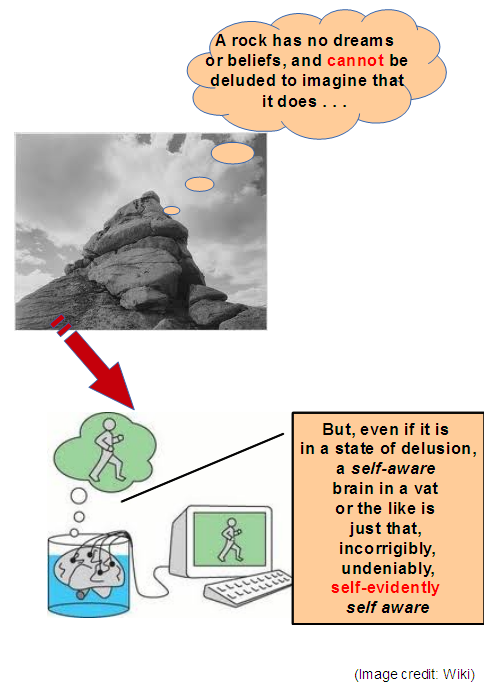
This brings up the challenge that computation [on refined rocks] is not rational, insightful, self-aware, semantically based, understanding-driven contemplation:
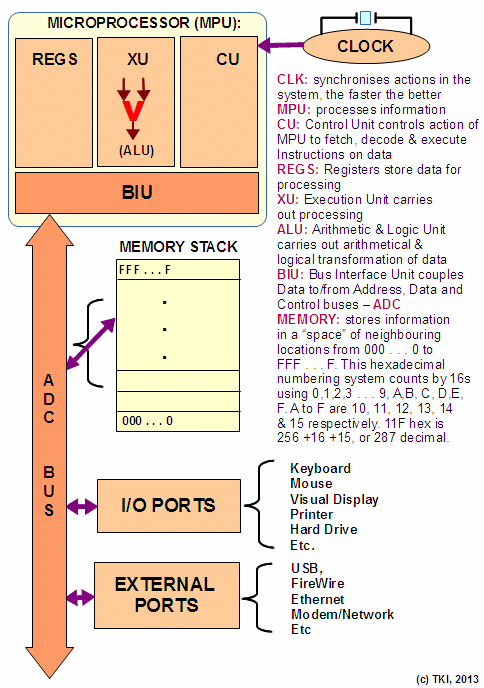
While this is directly about digital computers — oops, let’s see how they work —
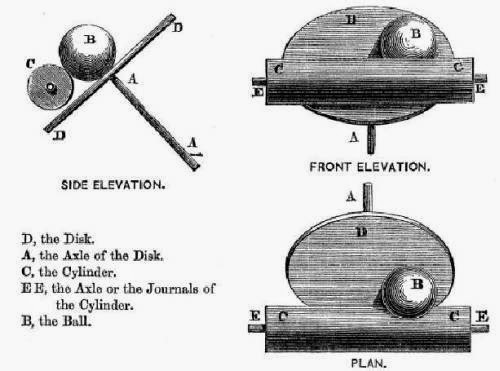
. . . but it also extends to analogue computers (which use smoothly varying signals):
. . . or a neural network:
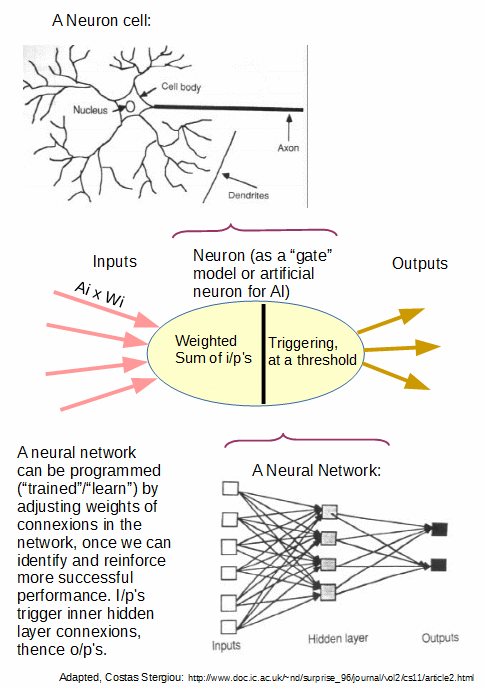
A neural network is essentially a weighted sum interconnected gate array, it is not an exception to the GIGO principle

A similar approach uses memristors, creating an analogue weighted sum vector-matrix operation:
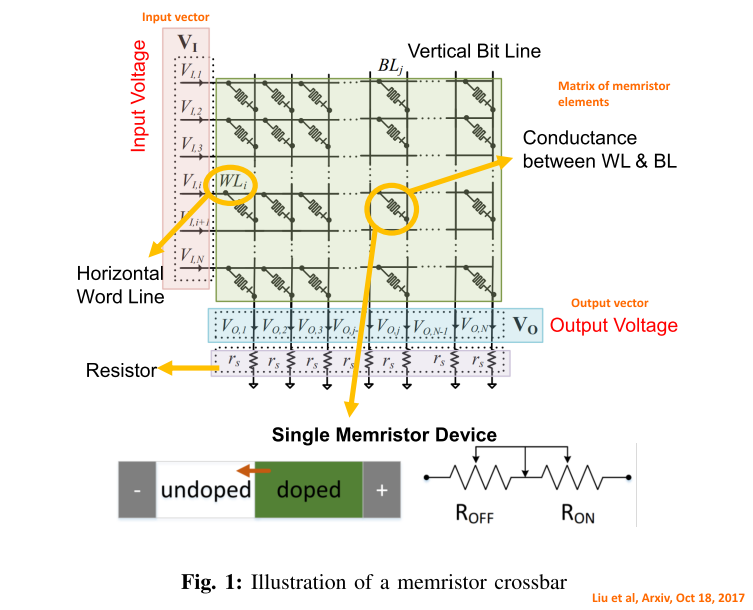
As we can see, these entities are about manipulating signals through physical interactions, not essentially different from Leibniz’s grinding mill wheels in Monadology 17:

It must be confessed, however, that perception, and that which depends upon it, are inexplicable by mechanical causes, that is to say, by figures and motions. Supposing that there were a machine whose structure produced thought, sensation, and perception, we could conceive of it as increased in size with the same proportions until one was able to enter into its interior, as he would into a mill. Now, on going into it he would find only pieces working upon one another, but never would he find anything to explain perception [[i.e. abstract conception]. It is accordingly in the simple substance, and not in the compound nor in a machine that the perception is to be sought . . .

In short, computationalism falls short.

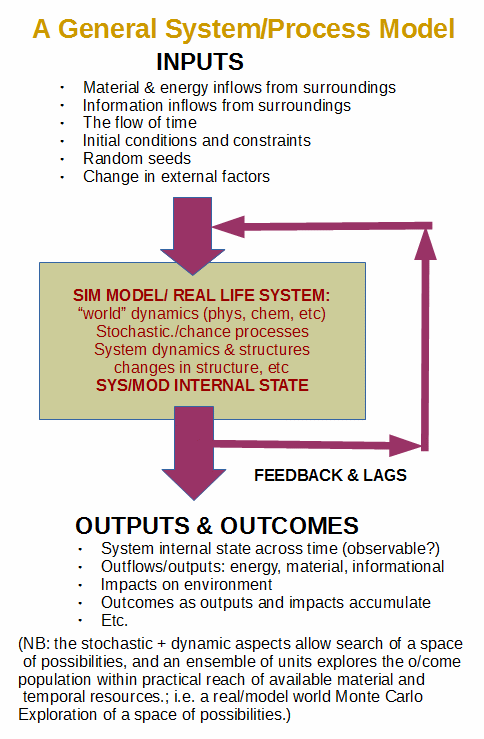
I add [Fri May 31], that is, computational substrates are forms of general dynamic-stochastic systems and are subject to their limitations:
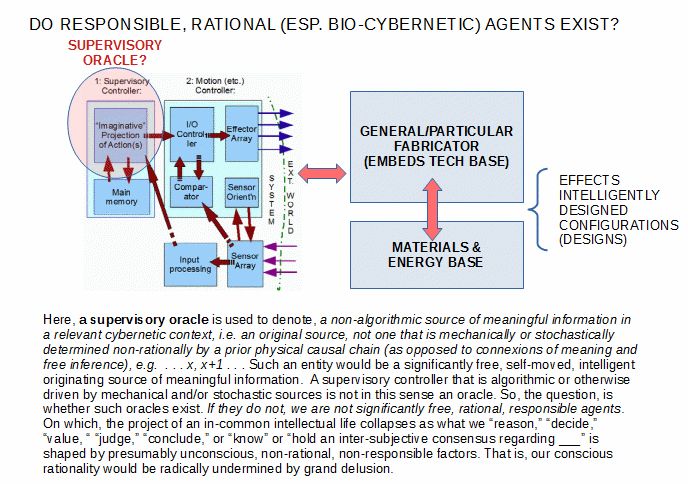
The alternative is, a supervisory oracle-controlled, significantly free, intelligent and designing bio-cybernetic agent:
As context (HT Wiki) I add [June 10] a diagram of a Model Identification Adaptive Controller . . . which, yes, identifies a model for the plant and updates it as it goes:
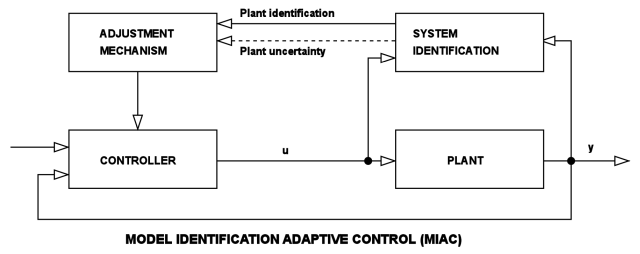
MIAC action, notice supervisory control and observation of “visible” outputs fed back to in-loop control and to system ID, where the model creates and updates a model of the plant being controlled. Parallels to the Smith model are obvious.

As I summarised recently:

What we actually observe is:

A: [material computational substrates] –X –> [rational inference]
B: [material computational substrates] —-> [mechanically and/or stochastically governed computation]
C: [intelligent agents] —-> [rational, freely chosen, morally governed inference]
D: [embodied intelligent agents] —-> [rational, freely chosen, morally governed inference]

The set of observations A through D imply that intelligent agency transcends computation, as their characteristics and capabilities are not reducible to:

– components and their device physics,
– organisation as circuits and networks [e.g. gates, flip-flops, registers, operational amplifiers (especially integrators), ball-disk integrators, neuron-gates and networks, etc],
– organisation/ architecture forming computational circuits, systems and cybernetic entities,
– input signals,
– stored information,
– processing/algorithm execution,
– outputs

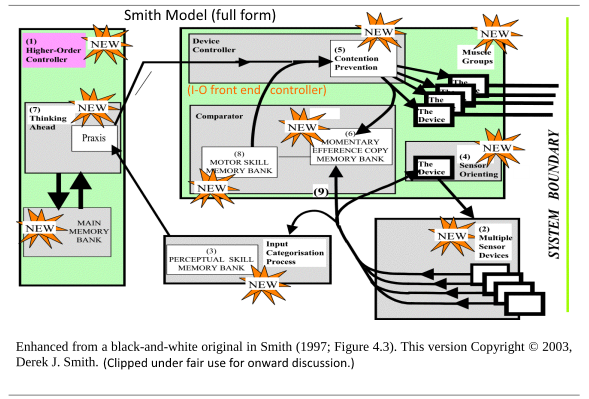
It may be useful to add here, a simplified Smith model with an in the loop computational controller and an out of the loop oracle that is supervisory, so that there may be room for pondering the bio-cybernetic system i/l/o the interface of the computational entity and the oracular entity:
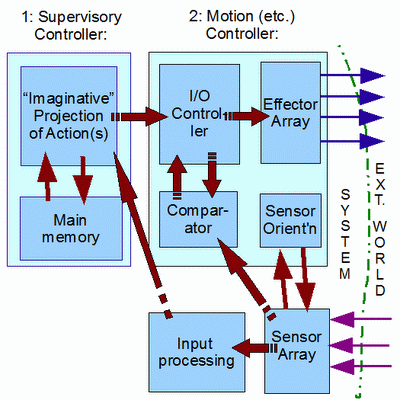
The Derek Smith two-tier controller cybernetic model

In more details, per Eng Derek Smith:
So too, we have to face the implication of the necessary freedom for rationality. That is, that our minds are governed by known, inescapable duties to truth, right reason, prudence (so, warrant), fairness, justice etc. Rationality is morally governed, it inherently exists on both sides of the IS-OUGHT gap.

That means — on pain of reducing rationality to nihilistic chaos and absurdity — that the gap must be bridged. Post Hume, it is known that that can only be done in the root of reality. Arguably, that points to an inherently good necessary being with capability to found a cosmos. If you doubt, provide a serious alternative under comparative difficulties: ____________

So, as we consider debates on intelligent design, we need to reflect on what intelligence is, especially in an era where computationalism is a dominant school of thought. Yes, we may come to various views, but the above are serious factors we need to take such into account. END

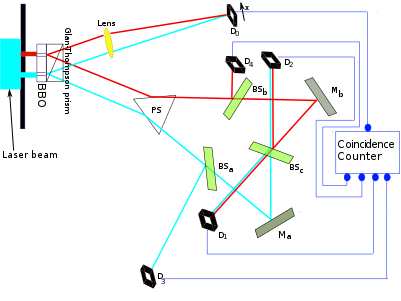
PS: As a secondary exchange developed on quantum issues, I take the step of posting a screen-shot from a relevant Wikipedia clip on the 1999 Delayed choice experiment by Kim et al:
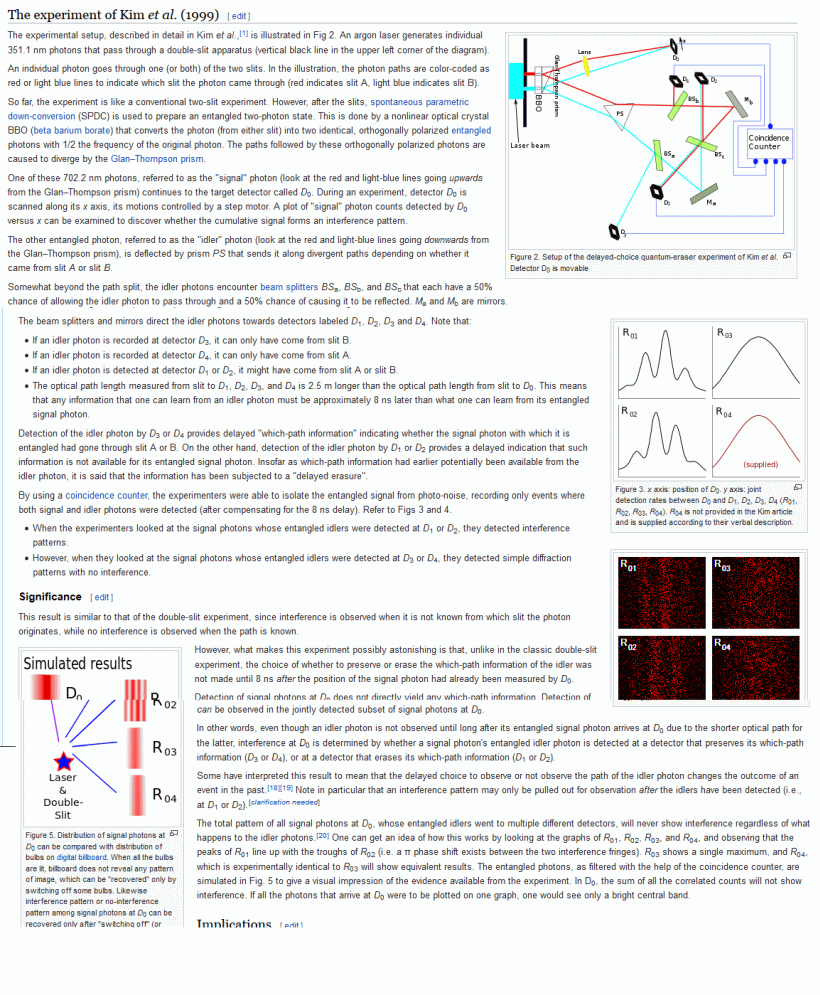
Wiki clip on Kim et al

The layout in a larger scale:

Gaasbeek adds:
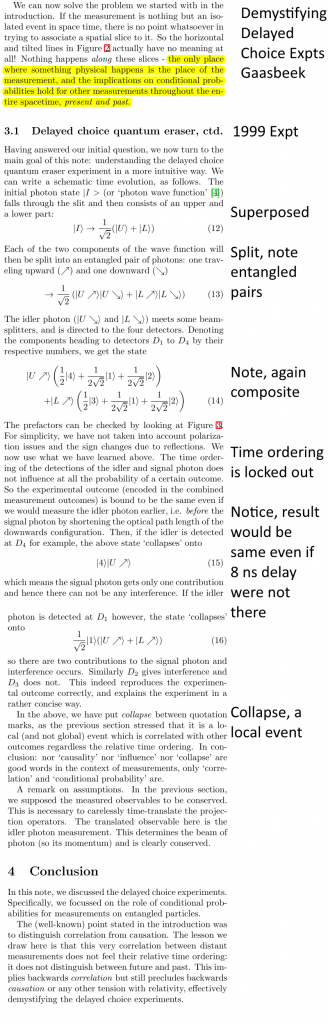
Weird, but that’s what we see. Notice, especially, Gaasbeek’s observation on his analysis, that “the experimental outcome (encoded in the combined measurement outcomes) is bound to be the same even if we would measure the idler photon earlier, i.e. before the signal photon by shortening the optical path length of the downwards configuration.” This is the point made in a recent SEP discussion on retrocausality.

PPS: Let me also add, on radio halos:
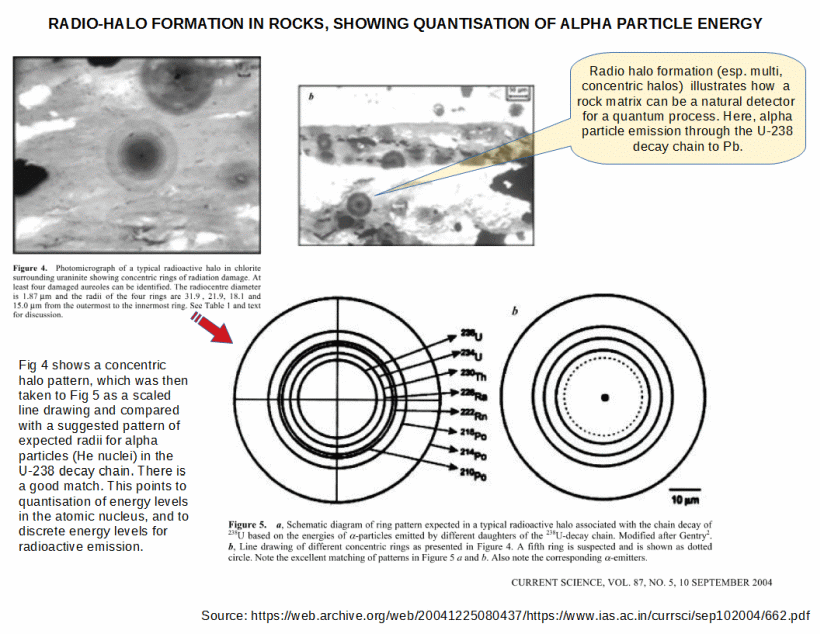
and, Fraunhoffer spectra:
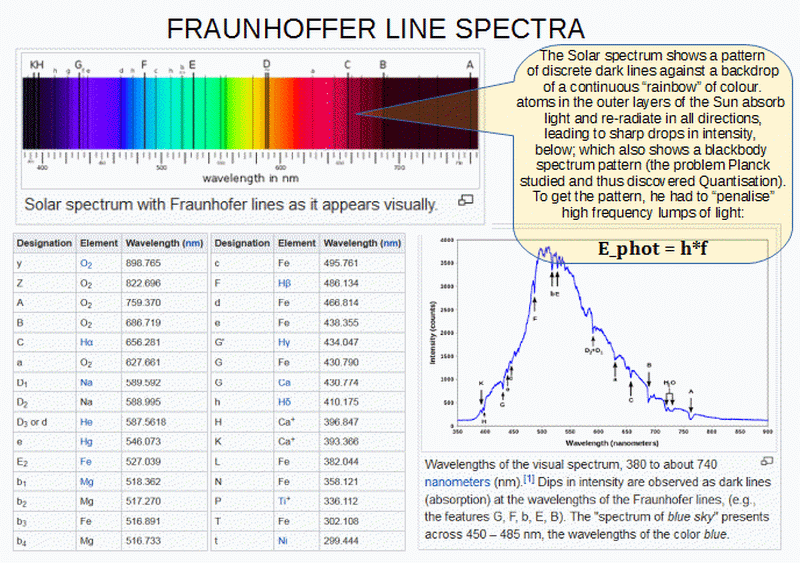
These document natural detection of quantised phenomena.


Comments
Observer-dependent locality of quantum events Philippe Allard Guérin and ?aslav Brukner - 25 October 2018 Excerpt: In general relativity, the causal structure between events is dynamical, but it is definite and observer-independent; events are point-like and the membership of an event A in the future or past light-cone of an event B is an observer-independent statement. When events are defined with respect to quantum systems however, nothing guarantees that the causal relationship between A and B is definite. We propose to associate a causal reference frame corresponding to each event, which can be interpreted as an observer-dependent time according to which an observer describes the evolution of quantum systems. In the causal reference frame of one event, this particular event is always localised, but other events can be 'smeared out' in the future and in the past. We do not impose a predefined causal order between the events, but only require that descriptions from different reference frames obey a global consistency condition. We show that our new formalism is equivalent to the pure process matrix formalism (Araújo et al 2017 Quantum 1 10). The latter is known to predict certain multipartite correlations, which are incompatible with the assumption of a causal ordering of the events—these correlations violate causal inequalities. We show how the causal reference frame description can be used to gain insight into the question of realisability of such strongly non-causal processes in laboratory experiments. https://iopscience.iop.org/article/10.1088/1367-2630/aae742/meta
bornagain77
June 6, 2019
June
06
Jun
6
06
2019
06:59 PM
6
06
59
PM
PDT
Hazel
Hazel June 6, 2019 at 3:02 pm My very speculative hypothesis is that matter and mind arise from a common, unknowable, underlying source, and that both manifest themselves through QM effects. (Word count: 25)
Then you must be wrong. Correct opinions require between 10,000 and 30,000 words. Everybody knows that.Brother Brian
June 6, 2019
June
06
Jun
6
06
2019
04:12 PM
4
04
12
PM
PDT
wjm: have you read the Carlos Castaneda books about the Mexican shaman Don Juan?hazel
June 6, 2019
June
06
Jun
6
06
2019
03:11 PM
3
03
11
PM
PDT
Axel @155, That might be a reasonable perspective if matter actually existed. The rational implication of modern physics is that matter does not exist; it is an observational, experiential phenomena caused by a consciousness observing and interpreting information.William J Murray
June 6, 2019
June
06
Jun
6
06
2019
02:54 PM
2
02
54
PM
PDT
My very speculative hypothesis is that matter and mind arise from a common, unknowable, underlying source, and that both manifest themselves through QM effects. (Word count: 25)hazel
June 6, 2019
June
06
Jun
6
06
2019
02:02 PM
2
02
02
PM
PDT
Is it any wonder that QM should be discovered to be more and more mysterious ? Is it not the interface of matter with spirit/mind ? Anyone else see it that way?Axel
June 6, 2019
June
06
Jun
6
06
2019
01:22 PM
1
01
22
PM
PDT
KF
BB, it is clear that you have not actually looked at what is happening, by lumping two very different individuals together with quite diverse patterns (esp. over the past few days).
You are absolutely correct. You were only responsible for about 10,000 of the 30,000 words. Therefore, it would take you at least ten days to produce a novel’s worth of words.Brother Brian
June 6, 2019
June
06
Jun
6
06
2019
12:18 PM
12
12
18
PM
PDT
BB, it is clear that you have not actually looked at what is happening, by lumping two very different individuals together with quite diverse patterns (esp. over the past few days). I have made some preliminary notes and comments, being particularly busy RW with several convergent issues. In my remarks I have put up some placeholder info that 1: via correspondence principle the insights on energy etc that go back hundreds of years are still relevant. This primarily responds to WJM in 94: "Just as there is no such thing as matter, there are no such things as forces and energies . . ." Energy moved to the heart of physics across C19, and it is still there. So coming in from kinematics and seeing where it came in, how it connects to force, work, momentum, etc, how first glimpses of conservation of energy and momentum arise, and hints of the importance of these, are a key first step. And of course these are key abstract quantities that are in effect the equivalent of money in running a business. Inertia is also key. 2: in response to various claims about observers and detectors, I took time to point to how experiments are done so that detectors are observers enough for quantum state resolution purposes. Likewise, Fraunhoffer lines and rock materials hosting radio-halos in natural rocks provide natural detectors. These are concrete facts. 3: I have used a brand new article at SEP to highlight just how contoversial and unsettled retrocausation and the like are. Yes, there are advocates, but this is not settled stuff. And given the highly abstruse nature of core issues with the hairiness of involved mathematical exposition, this is not a context for a general argument. This, by contrast with the core point about search challenge, needle in haystack blind search and functionally specific, complex organisation and/or associated information; especially in an information age. Cosmological fine tuning has in it fairly technical stuff but it has been sufficiently developed and summarised to be communicable to reasonably informed people. And astronomy remains the science with a significant amateur practitioner community, which tends to make for good, widely available lay level exposition. 4: Where possible, I have refocussed attention on the fundamental point from the OP, that we are dealing with a biocybernetic loop and the challenge that computation cannot credibly account for rational, responsible freedom, pointing to the need for a supervisory oracle. 5: Onward, when there is a window of time, I intend to pick up enough to address reduction of reality to mind and at least some of the quantum claims and clips. Meanwhile, there are a few markers. KFkairosfocus
June 6, 2019
June
06
Jun
6
06
2019
11:56 AM
11
11
56
AM
PDT
KF and BA77 have posted 29,355 words in the last two days. Given that a typical novel is about 100,000 words, they will have written the equivalent of a novel in six days if they keep up this pace. Even Stephen King isn’t that prolific.Brother Brian
June 6, 2019
June
06
Jun
6
06
2019
11:28 AM
11
11
28
AM
PDT
Or is it all just mental self gratification?Brother Brian
June 6, 2019
June
06
Jun
6
06
2019
10:37 AM
10
10
37
AM
PDT
You mean, does the wave function of a post ever collapse if no one does anything other than quickly scroll past without looking? (ba's position), or is the interaction with the pixels on my screen sufficient to bring the post into existence (kf's) position, and is the whole thing just part of the universal mind (wjm's position), or does it really exist as part of an objective reality (Stephen B's position) See, I have been paying attention! :-)hazel
June 6, 2019
June
06
Jun
6
06
2019
10:33 AM
10
10
33
AM
PDT
Hazel, did you make an attempt to read it all? And, a more important question, appropriate to what is being discussed, if nobody really reads (observes) it, does it even exist?Brother Brian
June 6, 2019
June
06
Jun
6
06
2019
10:05 AM
10
10
05
AM
PDT
Especially when so much of it is quotes or rhetorical phrases that have been posted before.hazel
June 6, 2019
June
06
Jun
6
06
2019
08:57 AM
8
08
57
AM
PDT
KF
BB, if you can’t be bothered to actually read and follow a discussion, ...
Are you serious? I simply refer you to comments 103, 108, 109, 110, 111, 117, 118, 119, 124, 125, 127, 128, 129, 130, 133, 136, 137, 139, 141, 142, 143, 144, 145 and 146. These posts are hundreds of words each, constituting thousands and thousands of words (maybe hundreds of thousands). All over a two day period. Do you honestly think anyone is reading all of this, let alone comprehending it?Brother Brian
June 6, 2019
June
06
Jun
6
06
2019
08:00 AM
8
08
00
AM
PDT
As Stuart Hameroff states in the following video 'it's possible that this quantum information can exist outside the body. Perhaps indefinitely as a soul'.
“Let’s say the heart stops beating. The blood stops flowing. The microtubules lose their quantum state. But the quantum information, which is in the microtubules, isn’t destroyed. It can’t be destroyed. It just distributes and dissipates to the universe at large. If a patient is resuscitated, revived, this quantum information can go back into the microtubules and the patient says, “I had a near death experience. I saw a white light. I saw a tunnel. I saw my dead relatives.,,” Now if they’re not revived and the patient dies, then it's possible that this quantum information can exist outside the body. Perhaps indefinitely as a soul.” - Stuart Hameroff - Quantum Entangled Consciousness - Life After Death - video (5:00 minute mark) https://youtu.be/jjpEc98o_Oo?t=300
To put the drastic implications for us even more clearly, we, with either our acceptance or rejection God and what He has done for us through Jesus Christ on the cross, are choosing between eternal life with God or eternal death separated from God: Verse:
Deuteronomy 30:19-20 This day I call the heavens and the earth as witnesses against you that I have set before you life and death, blessings and curses. Now choose life, so that you and your children may live and that you may love the Lord your God, listen to his voice, and hold fast to him. For the Lord is your life, and he will give you many years in the land he swore to give to your fathers, Abraham, Isaac and Jacob. Mark 8:37 Is anything worth more than your soul?
Because of such dire consequences for our eternal souls, I plead with any atheists who may be reading this to seriously reconsider their refusal to accept God, and to now choose God, even eternal life with God, instead of choosing eternal death separated from God. Not to sound cliche, but that decision is, by far, the single most important 'free will' decision that you will ever make in your entire life. Words fail me for trying to underscore just how important this decision is for you.
Turin Shroud Hologram Reveals The Words “The Lamb” – video https://www.youtube.com/watch?v=4Tmka1l8GAQ 2 Peter 3:9 The Lord is not slack concerning His promise, as some men count slackness, but is longsuffering toward us, not willing that any should perish, but that all should come to repentance.
bornagain77
June 6, 2019
June
06
Jun
6
06
2019
07:12 AM
7
07
12
AM
PDT
Thus, the Agent Causality of God and also now the agent causality of man himself, is empirically established by numerous lines of empirical evidence to, IMHO, overwhelming degree, and to deny the central important of Consciousness and/or immaterial mind in quantum theory, (as you presently seem to be doing in your disagreement with WJM, kf), is to refuse to follow the evidence where it leads. As to the mental attribute of free will in particular, I've already shown in post 130 that "Anton Zeilinger and company have recently, as of 2018, pushed the ‘free will loophole’ back to 7.8 billion years ago, thereby firmly establishing the ‘common sense’ fact that the free will choices of the experimenter in the quantum experiments are truly free and are not determined by any possible causal influences from the past for at least the last 7.8 billion years". Thus since the mental attribute of free will is now also an empirically established fact in quantum mechanics, I will go on to the implications. Allowing free will and/or Agent causality into the laws of physics at their most fundamental level has some fairly profound implications for us personally. First, allowing the Agent causality of God ‘back’ into physics, as the Christian founders of modern science originally envisioned,,,, (Isaac Newton, Michael Faraday, James Clerk Maxwell, and Max Planck, to name a few of the Christian founders),,, and as quantum mechanics itself now empirically demands (with the closing of the free will loophole by Anton Zeilinger and company), rightly allowing the Agent causality of God ‘back’ into physics provides us with a very plausible resolution for the much sought after ‘theory of everything’ in that Christ’s resurrection from the dead provides an empirically backed reconciliation, via the Shroud of Turin, between quantum mechanics and general relativity into the much sought after ‘Theory of Everything”. Here are a few posts where I lay out and defend some of the evidence for that claim:
Overturning of the Copernican Principle by both General Relativity and Quantum Mechanics https://uncommondescent.com/intelligent-design/bill-nye-should-check-wikipedia/#comment-671672 (April 2019) Overturning the Copernican principle Thus in conclusion, the new interactive graph by Dr. Dembski provides a powerful independent line of evidence, along with several other powerful lines of evidence, that overturns the Copernican principle and restores humanity back to centrality in the universe, and even, when putting all those lines of evidence together, brings modern science back, full circle, to Christianity from whence it originated in the first place. https://uncommondescent.com/intelligent-design/bill-dembski-and-colleagues-create-an-updated-magnifying-the-universe-tool/#comment-675730 I will reiterate my case for Christ’s resurrection from the dead providing the correct solution for the much sought after “Theory of Everything”. https://uncommondescent.com/intelligent-design/bill-nye-should-check-wikipedia/#comment-671692 (February 19, 2019) To support Isabel Piczek’s claim that the Shroud of Turin does indeed reveal a true ‘event horizon’, the following study states that ‘The bottom part of the cloth (containing the dorsal image) would have born all the weight of the man’s supine body, yet the dorsal image is not encoded with a greater amount of intensity than the frontal image.’,,, Moreover, besides gravity being dealt with, the shroud also gives us evidence that Quantum Mechanics was dealt with. In the following paper, it was found that it was not possible to describe the image formation on the Shroud in classical terms but they found it necessary to describe the formation of the image on the Shroud in discrete quantum terms. https://uncommondescent.com/intelligent-design/experiment-quantum-particles-can-violate-the-mathematical-pigeonhole-principle/#comment-673178 https://uncommondescent.com/intelligent-design/experiment-quantum-particles-can-violate-the-mathematical-pigeonhole-principle/#comment-673179 Supplemental notes defending the authenticity of the Shroud of Turin: https://uncommondescent.com/intelligent-design/viruses-devolve/#comment-674732
To give us a small glimpse of the power that was involved in Christ resurrection from the dead, the following recent article found that, ”it would take 34 Thousand Billion Watts of VUV radiations to make the image on the shroud. This output of electromagnetic energy remains beyond human technology.”
Astonishing discovery at Christ’s tomb supports Turin Shroud – NOV 26TH 2016 Excerpt: The first attempts made to reproduce the face on the Shroud by radiation, used a CO2 laser which produced an image on a linen fabric that is similar at a macroscopic level. However, microscopic analysis showed a coloring that is too deep and many charred linen threads, features that are incompatible with the Shroud image. Instead, the results of ENEA “show that a short and intense burst of VUV directional radiation can color a linen cloth so as to reproduce many of the peculiar characteristics of the body image on the Shroud of Turin, including shades of color, the surface color of the fibrils of the outer linen fabric, and the absence of fluorescence”. ‘However, Enea scientists warn, “it should be noted that the total power of VUV radiations required to instantly color the surface of linen that corresponds to a human of average height, body surface area equal to = 2000 MW/cm2 17000 cm2 = 34 thousand billion watts makes it impractical today to reproduce the entire Shroud image using a single laser excimer, since this power cannot be produced by any VUV light source built to date (the most powerful available on the market come to several billion watts )”. Comment The ENEA study of the Holy Shroud of Turin concluded that it would take 34 Thousand Billion Watts of VUV radiations to make the image on the shroud. This output of electromagnetic energy remains beyond human technology. http://westvirginianews.blogspot.com/2011/12/new-study-claims-shroud-of-turin-is.html
Besides the empirical verification of ‘free will’ and/or Agent causality within quantum theory bringing that rather startling solution to the much sought after ‘theory of everything’, there is, to put it mildly, also another fairly drastic implication for individual people being “brought into the laws of nature at the most fundamental level” as well. Although free will is often thought of as allowing someone to choose between a veritable infinity of options, in a theistic view of reality that veritable infinity of options all boils down to just two options. Eternal life with God, or Eternal life without God. C.S. Lewis stated the situation for people as such: “There are only two kinds of people in the end: those who say to God, “Thy will be done,” and those to whom God says, in the end, “Thy will be done.” All that are in Hell, choose it. Without that self-choice there could be no Hell.”
“There are only two kinds of people in the end: those who say to God, “Thy will be done,” and those to whom God says, in the end, “Thy will be done.” All that are in Hell, choose it. Without that self-choice there could be no Hell.” – C.S. Lewis, The Great Divorce
To support of C.S. Lewis’s contention that “Without that self-choice there could be no Hell”, all I have to do is to point to the many people of today who are fanatically ‘pro-choice’ as far as abortion in concerned, demanding the unrestricted right to choose death for their unborn babies no matter what stage of development their babies may be at. Unbelievably, infanticide itself, unthinkable in our society just a few short years ago, is now being demanded as a right by many on the ‘pro-choice’ side.
Proverbs 8:36 But those who fail to find me harm themselves; all who hate me love death."
On top of that, in order to support the physical reality of heaven and hell, I can appeal directly to two of our most powerful and precisely tested theories ever in the history of science. Special Relativity and General Relativity respectfully. As the following video shows, with General Relativity we find an ‘infinitely destructive’ eternity associated with it. And with Special Relativity we find an extremely orderly eternity associated with it:
Quantum Mechanics, Special Relativity, General Relativity and Christianity – video https://www.youtube.com/watch?v=h4QDy1Soolo
I can also appeal to advances in quantum biology to support the physical reality of our immaterial soul:
Darwinian Materialism vs. Quantum Biology - video https://youtu.be/LHdD2Am1g5Y
bornagain77
June 6, 2019
June
06
Jun
6
06
2019
07:12 AM
7
07
12
AM
PDT
And yet, to repeat the last sentence from the quantum information paper, “we wouldn’t say entropy is a property of a system, but a property of an observer who describes a system.”
The Quantum Thermodynamics Revolution – May 2017 Excerpt: “Now in (quantum) information theory, we wouldn’t say entropy is a property of a system, but a property of an observer who describes a system.”,,, https://www.quantamagazine.org/quantum-thermodynamics-revolution/
That statement is just fascinating! Why in blue blazes should the finely tuned entropic actions of the universe, entropic actions which happen to explain time itself, even care if I am consciously observing them unless ‘the experience of ‘the now’ really is more foundational to reality than the finely tuned 1 in 10^10^123 entropy of the universe is? To state the obvious, this finding of entropy being “a property of an observer who describes a system.” is very friendly to a Mind First, and/or to a Theistic view of reality. For instance Romans chapter 8: verses 20 and 21 itself states, “For the creation was subjected to frustration, not by its own choice, but by the will of the one who subjected it, in hope that the creation itself will be liberated from its bondage to decay and brought into the glorious freedom of the children of God.”
Romans 8:20-21 For the creation was subjected to frustration, not by its own choice, but by the will of the one who subjected it, in hope that the creation itself will be liberated from its bondage to decay and brought into the glorious freedom of the children of God.
Besides the Quantum Zeno effect, Quantum information theory and the experimental realization of Maxwell’s demon thought experiment all confirming that the mental attribute of ‘the experience of the now’ is very much a part of present day quantum physics, Quantum Mechanics also now shows that Stanley Jaki’s contention that “There is no physical parallel to the mind’s ability to extend from its position in the momentary present to its past moments, or in its ability to imagine its future” is confirmed by recent experimental breakthroughs in quantum mechanics. As to the ability of the mind to extend from its experience of the now to past moments in time, in recent experiments in quantum mechanics, it is now found that “quantum mechanics can even mimic an influence of future actions on past events”
Quantum physics mimics spooky action into the past – April 23, 2012 Excerpt: According to the famous words of Albert Einstein, the effects of quantum entanglement appear as “spooky action at a distance”. The recent experiment has gone one remarkable step further. “Within a naïve classical world view, quantum mechanics can even mimic an influence of future actions on past events”, says Anton Zeilinger. http://phys.org/news/2012-04-quantum-physics-mimics-spooky-action.html Qubits that never interact could exhibit past-future entanglement – July 30, 2012 Excerpt: Typically, for two particles to become entangled, they must first physically interact. Then when the particles are physically separated and still share the same quantum state, they are considered to be entangled. But in a new study, physicists have investigated a new twist on entanglement in which two qubits become entangled with each other even though they never physically interact.,, http://phys.org/news/2012-07-qubits-interact-past-future-entanglement.html Quantum Weirdness Now a Matter of Time – 2016 Bizarre quantum bonds connect distinct moments in time, suggesting that quantum links — not space-time — constitute the fundamental structure of the universe. Excerpt: Not only can two events be correlated, linking the earlier one to the later one, but two events can become correlated such that it becomes impossible to say which is earlier and which is later.,,, “If you have space-time, you have a well-defined causal order,” said Caslav Brukner, a physicist at the University of Vienna who studies quantum information. But “if you don’t have a well-defined causal order,” he said — as is the case in experiments he has proposed — then “you don’t have space-time.”,,, Quantum correlations come first, space-time later. Exactly how does space-time emerge out of the quantum world? Bruner said he is still unsure. https://www.quantamagazine.org/20160119-time-entanglement/
And as the following 2017 article states, “a decision made in the present can influence something in the past.”
Physicists provide support for retrocausal quantum theory, in which the future influences the past July 5, 2017 by Lisa Zyga Excerpt: retrocausality means that, when an experimenter chooses the measurement setting with which to measure a particle, that decision can influence the properties of that particle (or another particle) in the past, even before the experimenter made their choice. In other words, a decision made in the present can influence something in the past. https://phys.org/news/2017-07-physicists-retrocausal-quantum-theory-future.html
And to drive the point further home, in the following 2018 article Professor Crull provocatively states “entanglement can occur across two quantum systems that never coexisted,,, it implies that the measurements carried out by your eye upon starlight falling through your telescope this winter somehow dictated the polarity of photons more than 9 billion years old.”
You thought quantum mechanics was weird: check out entangled time – Feb. 2018 Excerpt: Just when you thought quantum mechanics couldn’t get any weirder, a team of physicists at the Hebrew University of Jerusalem reported in 2013 that they had successfully entangled photons that never coexisted. Previous experiments involving a technique called ‘entanglement swapping’ had already showed quantum correlations across time, by delaying the measurement of one of the coexisting entangled particles; but Eli Megidish and his collaborators were the first to show entanglement between photons whose lifespans did not overlap at all.,,, Up to today, most experiments have tested entanglement over spatial gaps. The assumption is that the ‘nonlocal’ part of quantum nonlocality refers to the entanglement of properties across space. But what if entanglement also occurs across time? Is there such a thing as temporal nonlocality?,,, The data revealed the existence of quantum correlations between ‘temporally nonlocal’ photons 1 and 4. That is, entanglement can occur across two quantum systems that never coexisted. What on Earth can this mean? Prima facie, it seems as troubling as saying that the polarity of starlight in the far-distant past – say, greater than twice Earth’s lifetime – nevertheless influenced the polarity of starlight falling through your amateur telescope this winter. Even more bizarrely: maybe it implies that the measurements carried out by your eye upon starlight falling through your telescope this winter somehow dictated the polarity of photons more than 9 billion years old. https://aeon.co/ideas/you-thought-quantum-mechanics-was-weird-check-out-entangled-time
In further confirmation of Stanley Jaki’s contention that, “There is no physical parallel to the mind’s ability to extend from its position in the momentary present to its past moments, or in its ability to imagine its future.”, in further confirmation of that contention, not only does “quantum mechanics show us that “a decision made in the present can influence something in the past.”, but quantum mechanics also shows us that our present conscious choices ultimately determine what type of future will be presented to us in our measurements of quantum systems. As leading experimentalist Anton Zeilinger states in the following video, “what we perceive as reality now depends on our earlier decision what to measure. Which is a very, very, deep message about the nature of reality and our part in the whole universe. We are not just passive observers.”
“The Kochen-Speckter Theorem talks about properties of one system only. So we know that we cannot assume – to put it precisely, we know that it is wrong to assume that the features of a system, which we observe in a measurement exist prior to measurement. Not always. I mean in a certain cases. So in a sense, what we perceive as reality now depends on our earlier decision what to measure. Which is a very, very, deep message about the nature of reality and our part in the whole universe. We are not just passive observers.” Anton Zeilinger – Quantum Physics Debunks Materialism – video (7:17 minute mark) https://www.youtube.com/watch?feature=player_detailpage&v=4C5pq7W5yRM#t=437
As well, with contextuality we find that, “In the quantum world, the property that you discover through measurement is not the property that the system actually had prior to the measurement process. What you observe necessarily depends on how you carried out the observation”
Contextuality is ‘magic ingredient’ for quantum computing – June 11, 2012 Excerpt: Contextuality was first recognized as a feature of quantum theory almost 50 years ago. The theory showed that it was impossible to explain measurements on quantum systems in the same way as classical systems. In the classical world, measurements simply reveal properties that the system had, such as colour, prior to the measurement. In the quantum world, the property that you discover through measurement is not the property that the system actually had prior to the measurement process. What you observe necessarily depends on how you carried out the observation. Imagine turning over a playing card. It will be either a red suit or a black suit – a two-outcome measurement. Now imagine nine playing cards laid out in a grid with three rows and three columns. Quantum mechanics predicts something that seems contradictory – there must be an even number of red cards in every row and an odd number of red cards in every column. Try to draw a grid that obeys these rules and you will find it impossible. It’s because quantum measurements cannot be interpreted as merely revealing a pre-existing property in the same way that flipping a card reveals a red or black suit. Measurement outcomes depend on all the other measurements that are performed – the full context of the experiment. Contextuality means that quantum measurements can not be thought of as simply revealing some pre-existing properties of the system under study. That’s part of the weirdness of quantum mechanics. http://phys.org/news/2014-06-weird-magic-ingredient-quantum.html
Thus, Stanley Jaki’s contention that “There is no physical parallel to the mind’s ability to extend from its position in the momentary present to its past moments, or in its ability to imagine its future.”, is now experimentally established to be true by the fact that “a decision made in the present can influence something in the past.” and is also established by the fact that, “We are not just passive observers,,, what we perceive as reality now depends on our earlier decision what to measure”. Thus, these recent experiments in quantum mechanics, contrary to what Einstein himself thought was possible for experimental physics, have now shown, in overwhelming fashion, that ‘the experience of the now’ is very much a part of experimental physics. In fact, due to advances in quantum mechanics, it would now be much more appropriate to rephrase Einstein’s answer to the philosopher Rudolph Carnap in this way:
“It is impossible for “the experience of ‘the now’” to ever be divorced from physical measurement, it will always be a part of physics.”
On top of all that, this very recent 2019 experimental confirmation of the “Wigner’s Friend” thought experiment established that “measurement results,, must be understood relative to the observer who performed the measurement”.
More Than One Reality Exists (in Quantum Physics) By Mindy Weisberger – March 20, 2019 Excerpt: “measurement results,, must be understood relative to the observer who performed the measurement”. https://www.livescience.com/65029-dueling-reality-photons.html
bornagain77
June 6, 2019
June
06
Jun
6
06
2019
07:10 AM
7
07
10
AM
PDT
Moreover, in the following 2010 experimental realization of Maxwell’s demon thought experiment, it was demonstrated that knowledge of a particle's location and/or position turns information into energy.
Maxwell's demon demonstration turns information into energy - November 2010 Excerpt: Scientists in Japan are the first to have succeeded in converting information into free energy in an experiment that verifies the "Maxwell demon" thought experiment devised in 1867.,,, In Maxwell’s thought experiment the demon creates a temperature difference simply from information about the gas molecule temperatures and without transferring any energy directly to them.,,, Until now, demonstrating the conversion of information to energy has been elusive, but University of Tokyo physicist Masaki Sano and colleagues have succeeded in demonstrating it in a nano-scale experiment. In a paper published in Nature Physics they describe how they coaxed a Brownian particle to travel upwards on a "spiral-staircase-like" potential energy created by an electric field solely on the basis of information on its location. As the particle traveled up the staircase it gained energy from moving to an area of higher potential, and the team was able to measure precisely how much energy had been converted from information. http://www.physorg.com/news/2010-11-maxwell-demon-energy.html
And as the following 2010 article stated about the preceding experiment, "This is a beautiful experimental demonstration that information has a thermodynamic content,"
Demonic device converts information to energy - 2010 Excerpt: "This is a beautiful experimental demonstration that information has a thermodynamic content," says Christopher Jarzynski, a statistical chemist at the University of Maryland in College Park. In 1997, Jarzynski formulated an equation to define the amount of energy that could theoretically be converted from a unit of information2; the work by Sano and his team has now confirmed this equation. "This tells us something new about how the laws of thermodynamics work on the microscopic scale," says Jarzynski. http://www.scientificamerican.com/article.cfm?id=demonic-device-converts-inform
And as the following 2017 article states: James Clerk Maxwell (said), “The idea of dissipation of energy depends on the extent of our knowledge.”,,, quantum information theory,,, describes the spread of information through quantum systems.,,, Fifteen years ago, “we thought of entropy as a property of a thermodynamic system,” he said. “Now in (quantum) information theory, we wouldn’t say entropy is a property of a system, but a property of an observer who describes a system.”,,,
The Quantum Thermodynamics Revolution – May 2017 Excerpt: the 19th-century physicist James Clerk Maxwell put it, “The idea of dissipation of energy depends on the extent of our knowledge.” In recent years, a revolutionary understanding of thermodynamics has emerged that explains this subjectivity using quantum information theory — “a toddler among physical theories,” as del Rio and co-authors put it, that describes the spread of information through quantum systems. Just as thermodynamics initially grew out of trying to improve steam engines, today’s thermodynamicists are mulling over the workings of quantum machines. Shrinking technology — a single-ion engine and three-atom fridge were both experimentally realized for the first time within the past year — is forcing them to extend thermodynamics to the quantum realm, where notions like temperature and work lose their usual meanings, and the classical laws don’t necessarily apply. They’ve found new, quantum versions of the laws that scale up to the originals. Rewriting the theory from the bottom up has led experts to recast its basic concepts in terms of its subjective nature, and to unravel the deep and often surprising relationship between energy and information — the abstract 1s and 0s by which physical states are distinguished and knowledge is measured.,,, Renato Renner, a professor at ETH Zurich in Switzerland, described this as a radical shift in perspective. Fifteen years ago, “we thought of entropy as a property of a thermodynamic system,” he said. “Now in (quantum) information theory, we wouldn’t say entropy is a property of a system, but a property of an observer who describes a system.”,,, https://www.quantamagazine.org/quantum-thermodynamics-revolution/
Again to repeat that last sentence, “we wouldn’t say entropy is a property of a system, but a property of an observer who describes a system.”
The Quantum Thermodynamics Revolution – May 2017 Excerpt: “Now in (quantum) information theory, we wouldn’t say entropy is a property of a system, but a property of an observer who describes a system.”,,, https://www.quantamagazine.org/quantum-thermodynamics-revolution/
Think about that statement for a second. These developments in quantum information theory go to the heart of the ID vs. Evolution debate and directly falsify Darwinian claims that immaterial information is merely ’emergent’ from some material basis. That is to say, immaterial information is now empirically shown to be its own distinct physical entity that, although it can interact with matter and energy, is completely separate from matter and energy. Moreover, this distinct physical entity of immaterial information is, via experimental realization of the Maxwell’s demon thought experiment, shown to be a product of the immaterial mind. Specifically, to reiterate for importance, “Now in (quantum) information theory, we wouldn’t say entropy is a property of a system, but a property of an observer who describes a system.”. If that does not send chills down your 'scientific' spine then you are not paying attention. The reason why I am very impressed with the preceding experiments demonstrating that the mental attribute of ‘the experience of the now’ is very much a part of entropy, is that the second law of thermodynamics, entropy, is very foundational to any definition of time that we may have. As the following article states, “Entropy explains time; it explains every possible action in the universe;,,”,, “Even gravity,,,, can be expressed as a consequence of the law of entropy.,,,”
Shining Light on Dark Energy – October 21, 2012 Excerpt: It (Entropy) explains time; it explains every possible action in the universe;,, Even gravity, Vedral argued, can be expressed as a consequence of the law of entropy.,,, The principles of thermodynamics are at their roots all to do with information theory. Information theory is simply an embodiment of how we interact with the universe —,,, http://crev.info/2012/10/shining-light-on-dark-energy/
On top of the fact that “(Entropy) explains time; it explains every possible action in the universe”, Entropy is also, by a wide margin, the most finely tuned of the initial conditions of the Big Bang. Finely tuned to an almost incomprehensible degree of precision, 1 part in 10 to the 10 to the 123rd power. As Roger Penrose himself stated that, “This now tells us how precise the Creator’s aim must have been: namely to an accuracy of one part in 10^10^123.”
“This now tells us how precise the Creator’s aim must have been: namely to an accuracy of one part in 10^10^123.” Roger Penrose - How special was the big bang? – (from the Emperor’s New Mind, Penrose, pp 339-345 – 1989) “The time-asymmetry is fundamentally connected to with the Second Law of Thermodynamics: indeed, the extraordinarily special nature (to a greater precision than about 1 in 10^10^123, in terms of phase-space volume) can be identified as the “source” of the Second Law (Entropy).” Roger Penrose - The Physics of the Small and Large: What is the Bridge Between Them? http://irafs.org/irafs_1/cd_irafs02/texts/penrose.pdf
In the following video, Dr, Bruce Gordon touches upon just how enormous that number truly is. Dr. Gordon states, “you would need a hundred million, trillion, trillion, trillion, universes our size, with a zero on every proton and neutron in all of those universes just to write out this number. That is how fine tuned the initial entropy of our universe is.”
“An explosion you think of as kind of a messy event. And this is the point about entropy. The explosion in which our universe began was not a messy event. And if you talk about how messy it could have been, this is what the Penrose calculation is all about essentially. It looks at the observed statistical entropy in our universe. The entropy per baryon. And he calculates that out and he arrives at a certain figure. And then he calculates using the Bekenstein-Hawking formula for Black-Hole entropy what the,,, (what sort of entropy could have been associated with,,, the singularity that would have constituted the beginning of the universe). So you've got the numerator, the observed entropy, and the denominator, how big it (the entropy) could have been. And that fraction turns out to be,, 1 over 10 to the 10 to the 123rd power. Let me just emphasize how big that denominator is so you can gain a real appreciation for how small that probability is. So there are 10^80th baryons in the universe. Protons and neutrons. No suppose we put a zero on every one of those. OK, how many zeros is that? That is 10^80th zeros. This number has 10^123rd zeros. OK, so you would need a hundred million, trillion, trillion, trillion, universes our size, with zero on every proton and neutron in all of those universes just to write out this number. That is how fine tuned the initial entropy of our universe is. And if there were a pre-Big Bang state and you had some bounces, then that fine tuning (for entropy) gets even finer as you go backwards if you can even imagine such a thing. ” Dr Bruce Gordon - Contemporary Physics and God Part 2 - video – 1:50 minute mark - video https://youtu.be/ff_sNyGNSko?t=110
In fact, entropy is also the primary reason why our own material, temporal, bodies grow old and eventually die in this universe,,,
Entropy Explains Aging, Genetic Determinism Explains Longevity, and Undefined Terminology Explains Misunderstanding Both - 2007 Excerpt: There is a huge body of knowledge supporting the belief that age changes are characterized by increasing entropy, which results in the random loss of molecular fidelity, and accumulates to slowly overwhelm maintenance systems [1–4].,,, http://www.plosgenetics.org/article/info%3Adoi/10.1371/journal.pgen.0030220 Dr. John Sanford Lecture at NIH (National Institute of Health): Genetic Entropy - Can Genome Degradation be Stopped? https://www.youtube.com/watch?v=2Mfn2upw-O8
bornagain77
June 6, 2019
June
06
Jun
6
06
2019
07:09 AM
7
07
09
AM
PDT
Besides such experiments as the preceding from quantum mechanics demonstrating that ‘the experience of the now’ is very much a part of present day quantum physics, there is also what is known as the ‘Quantum Zeno Effect’ in quantum mechanics which also clearly demonstrates that ‘the experience of the now’ is very much a part of present day quantum physics. An old entry in wikipedia described the Quantum Zeno effect as such, “an unstable particle, if observed continuously, will never decay.”
Perspectives on the quantum Zeno paradox - 2018 The quantum Zeno effect is,, an unstable particle, if observed continuously, will never decay. https://iopscience.iop.org/article/10.1088/1742-6596/196/1/012018/pdf
Likewise, the present day entry on wikipedia about the Quantum Zeno effect also provocatively states that "a system can't change while you are watching it"
Quantum Zeno effect Excerpt: Sometimes this effect is interpreted as "a system can't change while you are watching it" https://en.wikipedia.org/wiki/Quantum_Zeno_effect
And here is a fairly recent experiment which verified the ‘Quantum Zeno Effect’:
'Zeno effect' verified—atoms won't move while you watch - October 23, 2015 Excerpt: Graduate students,, created and cooled a gas of about a billion Rubidium atoms inside a vacuum chamber and suspended the mass between laser beams.,,, In that state the atoms arrange in an orderly lattice just as they would in a crystalline solid.,But at such low temperatures, the atoms can "tunnel" from place to place in the lattice.,,, The researchers demonstrated that they were able to suppress quantum tunneling merely by observing the atoms.,,, The researchers observed the atoms under a microscope by illuminating them with a separate imaging laser. A light microscope can't see individual atoms, but the imaging laser causes them to fluoresce, and the microscope captured the flashes of light. When the imaging laser was off, or turned on only dimly, the atoms tunneled freely. But as the imaging beam was made brighter and measurements made more frequently, the tunneling reduced dramatically.,,, The experiments were made possible by the group's invention of a novel imaging technique that made it possible to observe ultracold atoms while leaving them in the same quantum state.,,, The popular press has drawn a parallel of this work with the "weeping angels" depicted in the Dr. Who television series – alien creatures who look like statues and can't move as long as you're looking at them. There may be some sense to that. In the quantum world, the folk wisdom really is true: "A watched pot never boils." http://phys.org/news/2015-10-zeno-effect-verifiedatoms-wont.html
Atheistic materialists have tried to get around the Quantum Zeno effect by postulating that interactions with the environment are sufficient to explain the Quantum Zeno effect.
Perspectives on the quantum Zeno paradox - 2018 Excerpt: The references to observations and to wavefunction collapse tend to raise unnecessary questions related to the interpretation of quantum mechanics. Actually, all that is required is that some interaction with an external system disturb the unitary evolution of the quantum system in a way that is effectively like a projection operator. https://iopscience.iop.org/article/10.1088/1742-6596/196/1/012018/pdf
Yet, the following interaction-free measurement of the Quantum Zeno effect demonstrated that the presence of the Quantum Zeno effect can be detected without interacting with a single atom.
Interaction-free measurements by quantum Zeno stabilization of ultracold atoms – 14 April 2015 Excerpt: In our experiments, we employ an ultracold gas in an unstable spin configuration, which can undergo a rapid decay. The object—realized by a laser beam—prevents this decay because of the indirect quantum Zeno effect and thus, its presence can be detected without interacting with a single atom. http://www.nature.com/ncomms/2015/150414/ncomms7811/full/ncomms7811.html?WT.ec_id=NCOMMS-20150415
In short, the quantum zeno effect, regardless of how atheistic materialists may feel about it, is experimentally shown to be a real effect that is not reducible to any materialistic explanation. And thus the original wikipedia statement of, “an unstable particle, if observed continuously, will never decay”, stands as being a true statement.
Perspectives on the quantum Zeno paradox - 2018 The quantum Zeno effect is,, an unstable particle, if observed continuously, will never decay. https://iopscience.iop.org/article/10.1088/1742-6596/196/1/012018/pdf
Moreover, on top of the quantum zeno effect, the mental attribute of ‘the experience of the now’ is also now verified by recent experiments in quantum mechanics that have shown that “entropy is always dependent on the observer.” As the following article states, the deletion of data, under certain conditions, can create a cooling effect instead of generating heat. The cooling effect appears when the strange quantum phenomenon of entanglement is invoked.,,, In the new paper, the researchers,,, show that when the bits to be deleted are quantum-mechanically entangled with the state of an observer, then the observer could even withdraw heat from the system while deleting the bits. Entanglement links the observer's state to that of the computer in such a way that they know more about the memory than is possible in classical physics.,,, In measuring entropy, one should bear in mind that an object does not have a certain amount of entropy per se, instead an object's entropy is always dependent on the observer. Applied to the example of deleting data, this means that if two individuals delete data in a memory and one has more knowledge of this data, she perceives the memory to have lower entropy and can then delete the memory using less energy.,,,
Quantum knowledge cools computers: New understanding of entropy - June 1, 2011 Excerpt: Recent research by a team of physicists,,, describe,,, how the deletion of data, under certain conditions, can create a cooling effect instead of generating heat. The cooling effect appears when the strange quantum phenomenon of entanglement is invoked.,,, The new study revisits Landauer's principle for cases when the values of the bits to be deleted may be known. When the memory content is known, it should be possible to delete the bits in such a manner that it is theoretically possible to re-create them. It has previously been shown that such reversible deletion would generate no heat. In the new paper, the researchers go a step further. They show that when the bits to be deleted are quantum-mechanically entangled with the state of an observer, then the observer could even withdraw heat from the system while deleting the bits. Entanglement links the observer's state to that of the computer in such a way that they know more about the memory than is possible in classical physics.,,, In measuring entropy, one should bear in mind that an object does not have a certain amount of entropy per se, instead an object's entropy is always dependent on the observer. Applied to the example of deleting data, this means that if two individuals delete data in a memory and one has more knowledge of this data, she perceives the memory to have lower entropy and can then delete the memory using less energy.,,, No heat, even a cooling effect; In the case of perfect classical knowledge of a computer memory (zero entropy), deletion of the data requires in theory no energy at all. The researchers prove that "more than complete knowledge" from quantum entanglement with the memory (negative entropy) leads to deletion of the data being accompanied by removal of heat from the computer and its release as usable energy. This is the physical meaning of negative entropy. Renner emphasizes, however, "This doesn't mean that we can develop a perpetual motion machine." The data can only be deleted once, so there is no possibility to continue to generate energy. The process also destroys the entanglement, and it would take an input of energy to reset the system to its starting state. The equations are consistent with what's known as the second law of thermodynamics: the idea that the entropy of the universe can never decrease. Vedral says "We're working on the edge of the second law. If you go any further, you will break it." http://www.sciencedaily.com/releases/2011/06/110601134300.htm
The implications of the preceding experiment are of direct importance to the whole ID vs. Darwinism debate. As the following top expert in the field explained, "Landauer said that information is physical because it takes energy to erase it. We are saying that the reason it (information) is physical has a broader context than that.",
Scientists show how to erase information without using energy - January 2011 Excerpt: Until now, scientists have thought that the process of erasing information requires energy. But a new study shows that, theoretically, information can be erased without using any energy at all. Instead, the cost of erasure can be paid in terms of another conserved quantity, such as spin angular momentum.,,, "Landauer said that information is physical because it takes energy to erase it. We are saying that the reason it (information) is physical has a broader context than that.", Vaccaro explained. http://www.physorg.com/news/2011-01-scientists-erase-energy.html
bornagain77
June 6, 2019
June
06
Jun
6
06
2019
07:08 AM
7
07
08
AM
PDT
kf, I simply find it extremely strange that you, of all people, would be arguing, with your critique of retrocausality, etc.., against the Agent Causality of God. But anyways, to dive a bit deeper into why it is more than reasonable to conclude that the Agent causality of God is required to explain the actions we observe, including retrocausality, in quantum theory. Dr. Michael Egnor, who is a neurosurgeon as well as professor of neurosurgery at the State University of New York, Stony Brook, states six properties of immaterial mind that are irreconcilable to the view that the mind is just the material brain. Those six properties are, “Intentionality,,, Qualia,,, Persistence of Self-Identity,,, Restricted Access,,, Incorrigibility,,, Free Will,,,”
The Mind and Materialist Superstition – Michael Egnor – 2008 Six “conditions of mind” that are irreconcilable with materialism: – Excerpt: Intentionality,,, Qualia,,, Persistence of Self-Identity,,, Restricted Access,,, Incorrigibility,,, Free Will,,, http://www.evolutionnews.org/2008/11/the_mind_and_materialist_super013961.html
For the purpose of demonstrating that certain properties of our immaterial minds and/or consciousness are irreconcilable with reductive materialism and are yet that some of those same properties are consistent with what we are seeing in our present experiments with quantum mechanics, I will focus on two primary, even defining, attributes of immaterial mind that were listed by Dr. Egnor in his article. Those two defining attributes are Persistence of Self-Identity through time (which may also be termed ‘the experience of ‘the Now”), and free will, respectfully. Specifically, the mental attributes of the ‘Persistence of Self-Identity through time’ (which may also be termed ‘the experience of ‘the Now”), and ‘free will’, although being irreconcilable with reductive materialism, nonetheless, make their presence known to us in recent experimental evidence from quantum mechanics. As to defining the specific mental attribute of the ‘Persistence of Self-Identity through time’ (and/or ‘the experience of ‘the Now”) in particular, it is first important to note that we each have a unique perspective of being outside of time. In fact we each seemingly watch from some mysterious outside perspective of time as time seemingly passes us by. Simply put, we seem to be standing on an island of ‘now’ as the river of time continually flows past us. In the following video, Dr. Suarez states that the irresolvable dilemma for reductive materialists as such, “it is impossible for us to be 'persons' experiencing 'now' if we are nothing but particles flowing in space time. Moreover, for us to refer to ourselves as 'persons', we cannot refer to space-time as the ultimate substratum upon which everything exists, but must refer to a Person who is not bound by space time. (In other words) We must refer to God!”
Nothing: God's new Name - Antoine Suarez – video Paraphrased quote: (“it is impossible for us to be 'persons' experiencing 'now' if we are nothing but particles flowing in space time. Moreover, for us to refer to ourselves as 'persons', we cannot refer to space-time as the ultimate substratum upon which everything exists, but must refer to a Person who is not bound by space time. i.e. We must refer to God!”) https://www.youtube.com/watch?v=SOr9QqyaLlA
In further defining the mental attribute of ‘the experience of the now’, in the following article Stanley Jaki states that “There can be no active mind without its sensing its existence in the moment called now.,,, ,,,There is no physical parallel to the mind’s ability to extend from its position in the momentary present to its past moments, or in its ability to imagine its future. The mind remains identical with itself while it lives through its momentary nows.”
The Mind and Its Now – Stanley L. Jaki, May 2008 Excerpts: There can be no active mind without its sensing its existence in the moment called now.,,, Three quarters of a century ago Charles Sherrington, the greatest modern student of the brain, spoke memorably on the mind’s baffling independence of the brain. The mind lives in a self-continued now or rather in the now continued in the self. This life involves the entire brain, some parts of which overlap, others do not. ,,,There is no physical parallel to the mind’s ability to extend from its position in the momentary present to its past moments, or in its ability to imagine its future. The mind remains identical with itself while it lives through its momentary nows. ,,, the now is immensely richer an experience than any marvelous set of numbers, even if science could give an account of the set of numbers, in terms of energy levels. The now is not a number. It is rather a word, the most decisive of all words. It is through experiencing that word that the mind comes alive and registers all existence around and well beyond. ,,, All our moments, all our nows, flow into a personal continuum, of which the supreme form is the NOW which is uncreated, because it simply IS. http://metanexus.net/essay/mind-and-its-now
And ‘the experience of ‘the now” also happens to be exactly where Albert Einstein got into trouble with leading philosophers of his day and also happens to be exactly where Einstein eventually got into trouble with quantum mechanics itself. Around 1935, Einstein was asked by Rudolf Carnap (who was a philosopher):
“Can physics demonstrate the existence of ‘the now’ in order to make the notion of ‘now’ into a scientifically valid term?” Rudolf Carnap - Philosopher
Einstein’s answer was categorical, he said:
“The experience of ‘the now’ cannot be turned into an object of physical measurement, it can never be a part of physics.” Einstein
Quote was taken from the last few minutes of this following video.
Stanley L. Jaki: “The Mind and Its Now” https://vimeo.com/10588094
And here is an article that goes into bit more detail of that specific encounter between Einstein and Rudolf Carnap:
The Mind and Its Now – May 22, 2008 – By Stanley L. Jaki Excerpt: ,,, Rudolf Carnap, and the only one among them who was bothered with the mind’s experience of its now. His concern for this is noteworthy because he went about it in the wrong way. He thought that physics was the only sound way to know and to know anything. It was therefore only logical on his part that he should approach, we are around 1935, Albert Einstein, the greatest physicist of the day, with the question whether it was possible to turn the experience of the now into a scientific knowledge. Such knowledge must of course be verified with measurement. We do not have the exact record of Carnap’s conversation with Einstein whom he went to visit in Princeton, at eighteen hours by train at that time from Chicago. But from Einstein’s reply which Carnap jotted down later, it is safe to assume that Carnap reasoned with him as outlined above. Einstein’s answer was categorical: The experience of the now cannot be turned into an object of physical measurement. It can never be part of physics. http://metanexus.net/essay/mind-and-its-now
Prior to that encounter with Carnap, Einstein also had another disagreement with another famous philosopher, Henri Bergson, over what the proper definition of time should be (Bergson was also very well versed in the specific mental attribute of ‘the experience of the now’). In fact, that disagreement with Henri Bergson over what the proper definition of time should actually be was one of the primary reasons that Einstein failed to ever receive a Nobel prize for his work on relativity:
Einstein, Bergson, and the Experiment that Failed: Intellectual Cooperation at the League of Nations! – Jimena Canales page 1177 Excerpt: Bergson temporarily had the last word during their meeting at Société française de philosophie. His intervention negatively affected Einstein’s Nobel Prize, which was given “for his services to theoretical physics, and especially for his discovery of the law of the photoelectric effect” and not for relativity. The reasons behind this decision, as stated in the prize’s presentation speech, were related to Bergson’s intervention: “Most discussion [of Einstein’s work] centers on his Theory of Relativity. This pertains to epistemology and has therefore been the subject of lively debate in philosophical circles. It will be no secret that the famous philosopher Bergson in Paris has challenged this theory, while other philosophers have acclaimed it wholeheartedly.”51 For a moment, their debate dragged matters of time out of the solid terrain of “matters of fact” and into the shaky ground of “matters of concern.”52 https://dash.harvard.edu/bitstream/handle/1/3210598/canales-Einstein,%20Bergson%20and%20the%20Experiment%20that%20Failed%282%29.pdf?sequence=2
The specific statement that Einstein made to Carnap on the train, “The experience of ‘the now’ cannot be turned into an object of physical measurement, it can never be a part of physics.”, was a very interesting statement for Einstein to make to the philosopher since “The experience of ‘the now’ has, from many recent experiments in quantum mechanics, established itself as very much being a defining part of our physical measurements in quantum mechanics. For instance, the following delayed choice experiment with atoms demonstrated that, “It proves that measurement is everything. At the quantum level, reality does not exist if you are not looking at it,”
Reality doesn’t exist until we measure it, (Delayed Choice) quantum experiment confirms – Mind = blown. – FIONA MACDONALD – 1 JUN 2015 Excerpt: “It proves that measurement is everything. At the quantum level, reality does not exist if you are not looking at it,” lead researcher and physicist Andrew Truscott said in a press release. http://www.sciencealert.com/reality-doesn-t-exist-until-we-measure-it-quantum-experiment-confirms
Likewise, the following violation of Leggett's inequality stressed the quantum-mechanical assertion that reality does not exist when we're not observing it.
Quantum physics says goodbye to reality - Apr 20, 2007 Excerpt: They found that, just as in the realizations of Bell's thought experiment, Leggett's inequality is violated – thus stressing the quantum-mechanical assertion that reality does not exist when we're not observing it. "Our study shows that 'just' giving up the concept of locality would not be enough to obtain a more complete description of quantum mechanics," Aspelmeyer told Physics Web. "You would also have to give up certain intuitive features of realism." http://physicsworld.com/cws/article/news/27640
The Mind First and/or Theistic implications of quantum experiments such as the preceding are fairly obvious. As Professor Scott Aaronson of MIT once quipped, “Look, we all have fun ridiculing the creationists,,, But if we accept the usual picture of quantum mechanics, then in a certain sense the situation is far worse: the world (as you experience it) might as well not have existed 10^-43 seconds ago!”
“Look, we all have fun ridiculing the creationists who think the world sprang into existence on October 23, 4004 BC at 9AM (presumably Babylonian time), with the fossils already in the ground, light from distant stars heading toward us, etc. But if we accept the usual picture of quantum mechanics, then in a certain sense the situation is far worse: the world (as you experience it) might as well not have existed 10^-43 seconds ago!” – Scott Aaronson – MIT associate Professor quantum computation – Lecture 11: Decoherence and Hidden Variables
bornagain77
June 6, 2019
June
06
Jun
6
06
2019
07:07 AM
7
07
07
AM
PDT
BA77, did you notice my emphasis on the correspondence principle and how it subtly influences the development of modern physical theories addressing the small, fast and ultra-large? That is the connexion I am highlighting, and obviously the modern theories open up a deeper, wider understanding of the relevant concepts, including on matter. At no point have I suggested that the classic picture by itself is enough to account for the phenomena explored over the past 100+ years. If it were, there would be no modern physics. KFkairosfocus
June 6, 2019
June
06
Jun
6
06
2019
05:48 AM
5
05
48
AM
PDT
F/N2: Fine tuning issues -- not quite the same as cosmological or the sort of config space paths concerns Walker and Davies put on the table:
7.2 Retrocausality Requires Fine Tuning Causal modeling (Spirtes, Glymour, & Scheines 2000; Pearl 2009) is a practice that has arisen from the field of machine learning that consists in the development of algorithms that can automate the discovery of causes from correlations in large data sets. The causal discovery algorithms permit an inference from given statistical dependences and independences between distinct measurable elements of some system to a causal model for that system. As part of the algorithms, a series of constraints must be placed on the resulting models that capture general features that we take to be characteristic of causality. Two of the more significant assumptions are (i) the causal Markov condition, which ensures that every statistical dependence in the data results in a causal dependence in the model—essentially a formalization of Reichenbach’s common cause principle—and (ii) faithfulness, which ensures that every statistical independence implies a causal independence, or no causal independence is the result of a fine-tuning of the model. It has long been recognized (Butterfield 1992; Hausman 1999; Hausman & Woodward 1999) that quantum correlations force one to give up at least one of the assumptions usually made in the causal modeling framework. Wood and Spekkens (2015) argue that any causal model purporting to causally explain the observed quantum correlations must be fine-tuned (i.e., must violate the faithfulness assumption). More precisely, according to them, since the observed statistical independences in an entangled bipartite quantum system imply no signaling between the parties, when it is then assumed that every statistical independence implies a causal independence (which is what faithfulness dictates), it must be inferred that there can be no (direct or mediated) causal link between the parties. Since there is an observed statistical dependence between the outcomes of measurements on the bipartite system, we can no longer account for this dependence with a causal link unless this link is fine tuned to ensure that the no-signaling independences still hold. There is thus a fundamental tension between the observed quantum correlations and the no-signaling requirement, the faithfulness assumption and the possibility of a causal explanation. Formally, Wood and Spekkens argue that the following three assumptions form an inconsistent set: (i) the predictions of quantum theory concerning the observed statistical dependences and independences are correct; (ii) the observed statistical dependences and independences can be given a causal explanation; (iii) the faithfulness assumption holds. Wood and Spekkens conclude that, since the faithfulness assumption is an indispensable element of causal discovery, the second assumption must yield. The contrapositive of this is that any purported causal explanation of the observed correlations in an entangled bipartite quantum system falls afoul of the tension between the no-signaling constraint and no fine tuning and, thus, must violate the assumption of faithfulness. Such causal explanations, so the argument goes, including retrocausal explanations, should therefore be ruled out as viable explanations. As a brief aside, this fine-tuning worry for retrocausality in the quantum context arises in a more straightforward way. There is no good evidence to suggest that signaling towards the past is possible; that is, there is no retrocausality at the operational level. (Pegg 2006, 2008 argues that this can be explained formally as a result of the completeness condition on the measurement operators, introducing an asymmetry in normalization conditions for preparation and measurement.) Yet, despite there being no signaling towards the past, retrocausal accounts assume causal influences towards past. That these causal influences do not show up as statistical dependences exploitable for signaling purposes raises exactly the same fine-tuning worry as Wood and Spekkens raise. An obvious response to the challenge set by Wood and Spekkens is to simply reject the assumption of faithfulness. But this should not be taken lightly; the intuition behind the faithfulness assumption is basic and compelling. When no statistical correlation exists between the occurrences of a pair of events, there is no reason for supposing there to be a causal connection between them. Conversely, if we were to allow the possibility of a causal connection between statistically uncorrelated events, we would have a particularly hard task determining which of these uncorrelated sets could be harboring a conspiratorial causal connection that hides the correlation. The faithfulness assumption is thus a principle of parsimony—the simplest explanation for a pair of statistically uncorrelated events is that they are causally independent—much the same way that Spekkens’ (2005) definition of contextuality is, too (see §3.2); indeed, Cavalcanti (2018) argues that contextuality can be construed as a form of fine-tuning. There are, however, well-known examples of systems that potentially show a misapplication of the faithfulness assumption. One such example, originating in Hesslow (1976), involves a contraceptive pill that can cause thrombosis while simultaneously lowering the chance of pregnancy, which can also cause thrombosis. As Cartwright (2001: 246) points out, given the right weight for these process, it is conceivable that the net effect of the pills on the frequency of thrombosis be zero. This is a case of “cancel ling paths”, where the effect of two or more causal routes between a pair of variables cancels to achieve statistical independence. In a case such as this, since we can have independent knowledge of the separate causal mechanisms involved here, there are grounds for arguing that there really is a causal connection between the variables despite their statistical independence. Thus, it is certainly possible to imagine a scenario in which the faithfulness assumption could lead us astray. However, in defense of the general principle, an example such as this clearly contains what Wood and Spekkens refer to as fine tuning; the specific weights for these processes would need to match precisely to erase the statistical dependence, and such a balance would generally be thought as unstable (any change in background conditions, etc. would reveal the causal connection in the form of a statistical dependence). Näger (2016) raises the possibility that unfaithfulness can occur without conspiratorial fine tuning if the unfaithfulness arises in a stable way. In the quantum context, Näger suggests that the fine-tuning mechanism is what he calls “internal cancel ling paths”. This mechanism is analogous to the usual cancel ling paths scenario, but the path-cancel ling mechanism does not manifest at the level of variables, but at the level of values. On this view, such fine tuning would occur as a result of the particular causal and/or nomological process that governs the system, and it is in this sense that the cancel ling paths mechanism is internal, and it is the fact that the mechanism is internal that renders the associated fine tuning stable to external disturbances. Thus if the laws of nature are such that disturbances always alter the different paths in a balanced way, then it is physically impossible to unbalance the paths. (Näger 2016: 26) The possibility raised by Näger would circumvent the problem that violations of faithfulness ultimately undermine our ability to make suitable inferences of causal independence based on statistical independence by allowing only a specific kind of unfaithfulness—a principled or law-based unfaithfulness that is “internal” and is thus stable to background conditions—which is much less conspiratorial, as the fine-tuning is a function of the specific process involved. Evans (2018) argues that a basic retrocausal model of the sort envisaged by Costa de Beauregard (see §1) employs just such an internal cancel ling paths explanation to account for the unfaithful (no signaling) causal channels. See also Almada et al. (2016) for an argument that fine tuning in the quantum context is robust and arises as a result of symmetry considerations.
In short, we need to be aware that all sorts of complex debates are at work here. KFkairosfocus
June 6, 2019
June
06
Jun
6
06
2019
05:42 AM
5
05
42
AM
PDT
KF, I suggest that referring to cases or experiments that are not set up to examine how the characteristics, history and trajectories of phenomena change depending upon the behavior of the consciousnesses involved, including fail-safes against equipment variances that might be affecting the outcome (as you say, independent of the involvement of consciousness), are not examples of evidence to the contrary. Also, reiterating the line about the breakdown of reason is not an argument that explains, logically, why a misapprehension about the nature of physical experience leads to such. As far as I can tell, you have not made that argument - you've only asserted it as true. Let me set the nature of what you are arguing against explicitly: Instead of an actual, external physical world, what appears to be such is a specific kind of experience in universal mind, which we all, as individual consciousnesses operating within universal mind and having a localized, individualized aspect of mind, have immediate access to. We can call that quality of universal mind "consensual, consistent physicality". One might make an analogy to a shared, highly consistent, highly detailed dream with behavioral rules (in terms of mathematics, geometry, logic, etc.) sewn in because such conceptual principles are necessarily imposed on all subset experiences of universal mind. We can measure, test and experiment, and compare results of activities and research into this shared physicality the same way we can as if there was an external, physical world, but the conceptual component that is at the root of both the behavior of phenomena and our capacity to successfully examine it is no longer a mystery and no longer has an interface problem. The quantum physics qualities we witness are no longer a mystery. Certain proved psi capacities are no longer a problem. Spooky action at a distance is no longer a problem. The infinite information capacity of our local minds (directly accessing infinite information potential) is no longer a mystery. Dualism itself is no longer a real concern. The fine-tuning problem is no longer a "problem" - it would be a necessity in such a situation. Continuation of consciousness after death and other such phenomena are to be expected. Also, I don't see how any of this even contradicts with any of your Christian beliefs, so it baffles me why you insist such a set-up necessarily leads to self-delusion but refuse to make your case why you think that. Just because we are mistaken about the nature of our shared, consistent physical experience doesn't add any extra potential for self-delusion as far as I can tell, as long as what we are experiencing is still governed by the conceptual principles that provide warrant and protection against such error when properly utilized.William J Murray
June 6, 2019
June
06
Jun
6
06
2019
04:25 AM
4
04
25
AM
PDT
kf you state,
Thus, we should not speak as though the classic concepts of energy, work, momentum, force, inertia/mass, etc are discarded or meaningless, that only creates a fog of bewilderment.
Yet in post 101 it was specifically stated,
kf seemed to be a bit reluctant to accept WJM’s observation that ”I’m referring to the terminological and conceptual breakdown that happens when you reify the model of effects as the cause of the behavior.” when kf stated this in response to WJM, “WJM, energy is a central concept in physics, tied to work,”. Yet WJM did not claim that energy was not a ‘central concept in physics’. If I understand WJM correctly, WJM merely claims that energy (and force) have been reified (especially by materialists) as a cause that is sufficient unto itself and this leads to a breakdown in physics as to properly ascertaining what the ‘real cause’ of physical behavior actually is. Moreover, energy, like gravity, is not a cause that is sufficient unto itself. As Anton Zeilinger, a leading experimentalist in quantum mechanics, states in the following video, “The path taken by the photon is not an element of reality. We are not allowed to talk about the photon passing through this or this slit. Neither are we allowed to say the photon passes through both slits. All this kind of language is not applicable.” https://uncommondescent.com/animal-minds/logic-first-principles-21-insightful-intelligence-vs-computationalism/#comment-678118
and then in post 103 it was concluded that
Thus in conclusion, if we demand that our causal explanations in science have causal sufficiency, instead of just mathematical consistency (as kf seemed willing to settle for in his response to WJM), then we are driven to the conclusion that God must be the ‘uncaused cause’ of energy. i.e. God is the explanation that brings causal sufficiency, i.e. closure, to our scientific explanations. https://uncommondescent.com/animal-minds/logic-first-principles-21-insightful-intelligence-vs-computationalism/#comment-678120
Thus no one is arguing that "the classic concepts of energy, work, momentum, force, inertia/mass, etc are discarded or meaningless,". Much less is WJM creating a "fog of bewilderment." The main point is that the classic concepts of energy, work, momentum, force, inertia/mass, and especially detectors are NOT causally sufficient within themselves to explain quantum wave collapse. WJM is arguing for causal sufficiency in his scientific explanation, not just for mathematical consistency as you seem to be doing. kf you then go on to state,,,
Going beyond, with a lot of complex work, we arrive at Quantum Field theory,,,, I should add, that the concept of a field is at core, spatially distributed quantities, e.g. a magnet exerts measurable influence around it, and so does a massive object.
It seems that you are basing much of your rebuttal to WJM on quantum field theory. Yet as was pointed out already in post 127, Quantum Field theory left the entire enigma of quantum measurement on the cutting room floor
Besides kf’s clip from wikipedia completely ignoring the central role that conscious observers play in the experiment, here is another peculiar statement from kf’s wikipedia citation in post 108,
In fact, a theorem proved by Phillippe Eberhard shows that if the accepted equations of relativistic quantum field theory are correct, it should never be possible to experimentally violate causality using quantum effects.[23] (See reference[24] for a treatment emphasizing the role of conditional probabilities.)
The reason I consider that statement to be peculiar is because one of the unintended consequences of “brushing infinity under the rug (Feynman)” in the unifying of Special Relativity with Quantum Mechanics was that quantum measurement itself was left on the cutting room floor As the following article states, “Although quantum field theory is fully compatible with the special theory of relativity, a relativistic treatment of quantum measurement has yet to be formulated.,,, Bell never completed his planned quantum mechanics textbook because he could not devise a suitably relativistic theory of measurement.”
Not So Real – Sheldon Lee Glashow – Oct. 2018 Review of: “What Is Real? The Unfinished Quest for the Meaning of Quantum Physics” by Adam Becker Excerpt: Heisenberg, Schrödinger, and their contemporaries knew well that the theory they devised could not be made compatible with Einstein’s special theory of relativity. First order in time, but second order in space, Schrödinger’s equation is nonrelativistic. Although quantum field theory is fully compatible with the special theory of relativity, a relativistic treatment of quantum measurement has yet to be formulated.,,, Bell never completed his planned quantum mechanics textbook because he could not devise a suitably relativistic theory of measurement. https://inference-review.com/article/not-so-real
Thus for wikipedia to state that “if the accepted equations of relativistic quantum field theory are correct, it should never be possible to experimentally violate causality using quantum effects” is a complete non-sequitur since quantum measurement itself was left on the cutting room floor and isn’t even a part of quantum field theory. For crying out loud, quantum measurement is precisely where conscious observation makes its ‘spooky’ presence fully known and yet, to reiterate, quantum measurement is not even a part of quantum field theory. .
The Measurement Problem in quantum mechanics – (Inspiring Philosophy) – 2014 video https://www.youtube.com/watch?v=qB7d5V71vUE
etc.. etc.. Thus kf, with quantum field theory you are simply not even in the right conceptual theoretical ballpark to address WJM's concern that ”I’m referring to the terminological and conceptual breakdown that happens when you reify the model of effects as the cause of the behavior.” . In fact kf, with your appeal to quantum field theory, you are actually underscoring WJMs main point. Since the primacy of Agent causality itself was discarded from quantum mechanics and other entities end up being 'reified' in place of Agent Causality. Moreover, when we address the 'measurement problem' head on, (that is when we address the mysteries of quantum mechanics head on without 'brushing them under the rug' as the measurement problem is brushed under the rug in quantum field theory), then the central importance of the Agent Causality of God, and of our own agent causality, in regards to bringing causal sufficiency to our scientific explanations in Quantum theory, is brought front and center. kf, The point I find weirdest of all, is that you, a long time ID advocate and devoted Christian, ironically seem to be giving God Himself short rift when you stop short of demanding casual sufficiency in your scientific explanations, and seemingly want to award detectors themselves 'full civil rights' as conscious observers, instead of acknowledging the primacy of the Agent causality God, and even of our own agent causality, in quantum theory..bornagain77
June 6, 2019
June
06
Jun
6
06
2019
04:19 AM
4
04
19
AM
PDT
F/N: A clip from SEP on retrocausality and the "bilking" argument:
https://plato.stanford.edu/entries/qm-retrocausality/#ObjeAgaiRetrQuanMech Retrocausality in Quantum Mechanics First published Mon Jun 3, 2019 Quantum theory provides a framework for modern theoretical physics that enjoys enormous predictive and explanatory success. Yet, in view of the so-called “measurement problem”, there is no consensus on how physical reality can possibly be such that this framework has this success. The theory is thus an extremely well-functioning algorithm to predict and explain the results of observations, but [there is] no consensus on which kind of objective reality might plausibly underlie these observations. Amongst the many attempts to provide an “interpretation” of quantum theory to account for this predictive and explanatory success, one class of interpretations hypothesizes backward-in-time causal influences—retrocausality—as the basis for constructing a convincing foundational account of quantum theory. This entry presents an overview of retrocausal approaches to the interpretation of quantum theory, the main motivations for adopting this approach, a selection of concrete suggested retrocausal models, and a review of the objections brought forward against such approaches . . . . 2.1 Causality There is a tradition that stretches back at least as far as Russell (1913) that denies that there is any place for causal notions in the fundamental sciences, including physics: the notion serves no purpose, and simply does not appear, in the fundamental sciences. The argument goes that, since at least the nineteenth century, the laws that govern physical behavior in fundamental sciences such as physics are almost always differential equations. Such equations are notable for specifying, given some initial conditions, exact properties of systems for all time. And thus if everything is specified for all time, there is no place left for causality. Thus Russell advocates that “causality” should be eliminated from the philosophers lexicon, because it is certainly not a part of the scientific lexicon. [--> I suggest, thermodynamics brings back cause, grounding a temporal-causal view of physical reality tied to entropy and thermodynamic equilibrium.] In contrast to Russell’s position, Cartwright (1979: 420) claims that we do have a need and use for a causal vocabulary in science: “causal laws cannot be done away with, for they are needed to ground the distinction between effective strategies and ineffective ones”. One of the main contemporary accounts of causation, the interventionist account of causation (Woodward 2003; see also the entry on causation and manipulability), is an embodiment of Cartwright’s dictum. In a nutshell, the interventionist account claims that A is a cause of B if and only if manipulating A is an effective means of (indirectly) manipulating B. [--> try, neighbouring worlds W and W' with state of A the material difference and state of B as an observable result, e.g. oxidiser, heat, fuel, combustion chain reaction and fire] Causality in the present entry, unless specified otherwise, should be understood along broadly interventionist lines. According to accounts of quantum theory that hypothesize retrocausality, manipulating the setting of a measurement apparatus can be an effective means of manipulating aspects of the past . . . . 2.2 Locality According to Bell’s theorem (Bell 1964; Clauser et al. 1969; see also the entry on Bell’s theorem) and its descendants (e.g., Greenberger, Horne, & Zeilinger 1989; see also Goldstein et al. 2011; Brunner et al. 2014 for an overview), any theory that reproduces all the correlations of measurement outcomes predicted by quantum theory must violate a principle that Bell calls local causality (Bell 1976, 1990; see also Norsen 2011; Wiseman & Cavalcanti 2017). In a locally causal theory, probabilities of spatiotemporally localized events occurring in some region 1 are independent of what occurs in a region 2 that is spacelike separated from region 1, given a complete specification of what occurs in a spacetime region 3 in region 1’s backward light cone that completely shields off region 1 from the backward light cone of region 2. (See, for instance, Figs. 4 and 6 in Bell 1990 or Fig. 2 in Goldstein et al. 2011.) In a relativistic setting, then, the notion of locality involves prohibiting conditional dependences between spacelike separated events, provided that the region upon which these spacelike separated events are conditioned constitutes their common causal (Minkowski) past. This characterization of locality implicitly assumes causal asymmetry. Thus locality is the idea that there are no causal relations between spacelike separated events. There is another sense of “local” that is sometimes used that will be worth avoiding for the purposes of clarity. This is the idea that causal influences are constrained along timelike trajectories. Thus, given Costa de Beauregard’s suggestion of “zigzag” causal influences, it is perfectly possible for a retrocausal model of quantum phenomena to be nonlocal in the sense that causal relations exist between spacelike separated events, but “local” in the sense that these causal influences are mediated by timelike trajectories. To avoid ambiguity, it will be useful to refer to this latter sense as “action-by-contact” (set apart from action-at-a-distance) . . . . 7.1 General Arguments Against Retrocausality There is a tradition in philosophy for regarding the very idea of retrocausality as incoherent. The most prominent worry, forcefully made by Black (1956), is the so-called “bilking argument” (see the entry on time travel). Imagine a pair of events, a cause, C, and an effect, E, which we believe to be retrocausally connected (E occurs earlier in time than C). It seems possible to devise an experiment which could confirm whether our belief in the retrocausal connection is correct or not. Namely, once we had observed that E had occurred, we could then set about ensuring that C does not occur, thereby breaking any retrocausal connection that could have existed between them. If we were successful in doing this, then the effect would have been “bilked” of its cause. The bilking argument drives one towards the claim that any belief an agent might hold in the positive retrocausal correlation between event C and event E is simply false. However, Dummett (1964) disputes that giving up this belief is the only solution to the bilking argument. Rather, according to Dummett, what the bilking argument actually shows is that a set of three conditions concerning the two events, and the agent’s relationship to them, is incoherent: i There exists a positive correlation between an event C and an event E. ii Event C is within the power of an agent to perform. iii The agent has epistemic access to the occurrence of event E independently of any intention to bring it about. It is interesting to note that these conditions do not specify in which order events C and E occur. On simple reflection, there is a perfectly natural reason why it is not possible to bilk future effects of their causes, since condition (iii) fails to hold for future events: we simply have no access to which future events occur independently of the role we play as causal agents to bring the events about. When we lack that epistemic access to past events, the same route out of the bilking argument becomes available. Dummett’s defense against the bilking argument is especially relevant to quantum mechanics. In fact, once a suitable specification is made of how condition (iii) can be violated, we find that there exists a strong parallel between the conditions which need to hold to justify a belief in bringing about the past and the structure of quantum mechanics. Price (1996: 174) points out that bilking is impossible in the following circumstances: rather than suppose that a violation of condition (iii) entails that the relevant agent has no epistemic access to the relevant past events independently of any intention to bring them about, suppose that the means by which knowledge of these past events is gathered breaks the claimed correlation between the agent’s action and those past events. Such a condition can be stated as follows: iv The agent can gain epistemic access to the occurrence of event E independently of any intention to bring it about and without altering event E from what it would have been had no epistemic access been gained. The significance of this weakened violation of condition (iii) is that it is just the sort of condition one would expect to hold if the system in question were a quantum system. The very nature of quantum mechanics ensures that any claimed positive correlation between the future measurement settings and the hidden variables characterizing a quantum system cannot possibly be bilked of their causes because condition (iv) is perennially violated. Moreover, so long as we subscribe to the epistemic interpretation of the wavefunction, we lack epistemic access to the “hidden” variables of the system and we lack this access in principle as a result of the structure of quantum theory. Another prominent challenge against the very idea of retrocausality is that it inevitably would give rise to vicious causal loops (Mellor 1998). (See Faye 1994 for a response and the entry on backward causation for a more detailed review of the objections raised against the idea of retrocausality.) . . . . 7.3 Contextuality for Exotic Causal Structures Recall (§3.2) that Spekkens’ (2005) claim that no noncontextual ontological model can reproduce the observed statistics of quantum theory based on his principle of parsimony (that there can be no ontological difference without operational difference) was sidestepped by retrocausal approaches due to the explicit assumption of the ontological models framework that the ontic state is independent of the measurement procedure (i.e., that there is no retrocausality). It was noted there the possibility that Spekkens’ principle of parsimony might be recast to apply more generally to retrocausal models. Shrapnel and Costa (2018) achieve just this in a no-go theorem that applies to any exotic causal structure used to sidestep the ontological models framework, including retrocausal accounts, rendering such models contextual after all. Shrapnel and Costa’s result is based on a generalization of the ontological models framework which replaces the operational preparation, transformation, and measurement procedures with the temporally and causally neutral notions of local controllables and environmental processes that mediate correlations between different local systems, and generate the joint statistics for a set of events. “These include any global properties, initial states, connecting mechanisms, causal influence, or global dynamics” (2018: 5). Furthermore, they replace the ontic state ? with the ontic “process” ? : our ontic process captures the physical properties of the world that remain invariant under our local operations. That is, although we allow local properties to change under specific operations, we wish our ontic process to capture those aspects of reality that are independent of this probing. (2018: 8) As a result, the notion of ? -mediation (encountered in §4.1) is replaced by the notion of ?-mediation, in which the ontic process ? completely specifies the properties of the environment that mediate correlations between regions, and screens off outcomes produced by local controllables from the rest of the environment. Shrapnel and Costa (2018: 9) define the notion of “instrument noncontextuality” as a law of parsimony (along the lines of Spekkens’ own definition of noncontextuality): “Operationally indistinguishable pairs of outcomes and local controllables should remain indistinguishable at the ontological level”. They then show that no instrument noncontextual model can reproduce the quantum statistical predictions. Crucially, what is contextual is not just the traditional notion of “state”, but any supposedly objective feature of the theory, such as a dynamical law or boundary condition. (2018: 2) Since preparations, transformations, and measurements have been replaced by local controllables, there is no extra assumption in Shrapnel and Costa’s framework that ? is correlated with some controllables but independent of others. Thus the usual route out of the ontological models framework, and so the no-go theorems of §3, open to retrocausal approaches—that the framework assumes no retrocausality—is closed off in the Shrapnel-Costa theorem, rendering retrocausal approaches contextual along with the rest of the models captured by the ontological models framework. This presents a significant worry for retrocausal approaches to quantum theory. If the main motivation for pursing the hypothesis of retrocausality is to recapture in some sense a classical ontology for quantum theory (see §3.4), then the Shrapnel-Costa theorem has made this task either impossible, or beholden to the possibility of some further story explaining how the contextual features of the model arise from some noncontextual footing. On this latter point, it is difficult to see how this story might be told without significantly reducing the ideological economy of the conceptual framework of retrocausality, again jeopardizing a potential virtue of retrocausality. As mentioned above (§7.2), contextuality can be construed as a form of fine tuning (Cavalcanti 2018), especially when the demand for noncontextuality is understood as a requirement of parsimony, as above. The worries raised in this section and the last underline the fact that the challenge to account for various types of fine tuning is the most serious principled obstacle that retrocausal accounts continue to face.
In short, yes, there are advocates of retrocausality and there are QM interpretations in that direction but there is not a simple consensus. Again FFthot. KFkairosfocus
June 6, 2019
June
06
Jun
6
06
2019
04:09 AM
4
04
09
AM
PDT
BA77, I suggest you ponder the case of radio-halos in rocks as illustrative of naturally occurring detectors of quantum, radioactive processes, credibly antecedent to human observer action . . . we come along and slice open the rock, seeing the halos and inferring their source, here, likely a U-238 decay chain towards lead leaving rings corresponding to the quantised energy released (in effect, high energy particles affect rock compounds until energy is exhausted the ring marking the quantisation of their MeV level energy coming from RA decay reactions in the nucleus); this is similar to how, 8 minutes after emission by the sun, we can capture the spectrum of absorption lines showing quantum processes that we did not set up or twiddle the knobs on, etc, with similar Fraunhoffer lines in stellar spectra extending the detection to things that are many light years away, easily exceeding creation of instruments capable of detecting. In this case, continuous spectrum light interacts with fairly scattered atoms which absorb lines corresponding to quantum jumps and re-radiate in all directions, reducing the intensity on the direct line to us, appearing as dark lines corresponding to known emission lines. Thus we have a detection process involving a radiation flux and remote spectrometers that pick up at classical macro-level a process that is micro and quantum. Yes, speaking of detectors and measuring instruments as observers is odd terminology but it is long since there as common enough practice. The case in view shows that a rock matrix can be enough of an observer to be relevant. KFkairosfocus
June 6, 2019
June
06
Jun
6
06
2019
03:24 AM
3
03
24
AM
PDT
BB, if you can't be bothered to actually read and follow a discussion, snide dismissive commentary serves only to show that you are failing the test of good faith participation in a fairly significant albeit somewhat tangential discussion. I suggest, you would be well advised to reconsider the significance of moral government of our intellectual life in light of the inescapability of manifest duties to truth, right reason, prudence (including warrant), fairness and justice etc. Your triple fail here in a dismissive attempt speaks volumes. KFkairosfocus
June 6, 2019
June
06
Jun
6
06
2019
03:13 AM
3
03
13
AM
PDT
SB, you will notice, when such issues came up, I started from a very simple point, to establish the relevance of energy, force, momentum and work, concepts that had been challenged when they appeared in the context of the Casimir effect, one of those paradigmatic test cases that brings out the substantial import of a domain of study. By putting up basic kinematics of uniformly accelerated motion, introducing mass as a metric of resistance to acceleration and noting that bodies interact in pairs, exerting equally sized, oppositely directed forces, we can see that energy, work, force and momentum form a cluster at the core of physics. Indeed, energy and momentum conservation are already apparent and these extend across classical physics. I then noted that these results are strongly observationally confirmed and lead to the correspondence principle: results that obtain for more modern theories adapted to the very small and/or fast moving must reduce to this core in the classical limit of large scales and slow moving objects. This leads to these concepts and their extensions and reinterpretations being keys to more advanced topics. In particular, work and energy as well as momentum tend to be cross-cutting themes. Further to this, matter as commonly experienced becomes recognised as a quantised, atomic and molecular system, with fields of influence playing a key part. The atom is mostly empty space and constituent particles are not like classic tiny cricket balls, instead we deal with a duality of waves and particles, which manifest different results depending on circumstances, in the case of extended two-slit interference experiments, we may get particle or wave effects in contexts that raise questions about time-reversed causation. Resolving such issues leads to key insights or at least appreciation that at micro scale the world is a very strange place. Of course, in experiments, detectors are commonly used to make observations, and exploit quantum interactions. That such are not just matters of experiments we set up or our active observation can be seen in the case of rocks that exhibit radio-halos as RA decay leads to a ring -- strictly, a sphere -- of altered, discoloured material. The rock matrix with a RA particle embedded is a natural detector and the chain of decays as nuclides migrate down to lead can lead to concentric rings. In the case in the linked article, U-238 is the suspected source. Of course, "observer" is here used in an odd sense, but that is common in science and engineering, my favourite being the question of observability of a system's state. Going beyond, with a lot of complex work, we arrive at Quantum Field theory, which extends to many interacting particles . . . wavicles is a whimsical term . . . and to domains of investigation that deal with fast moving particles such as we often encounter in particle physics. The math is hairy, but this is now state of the art. However, as we trace back to that historic observationally warranted core, the correspondence principle will obtain, concepts of momentum and energy etc are extended and deepened but they are locked to a compatibility with the empirically well supported classical results. Thus, we should not speak as though the classic concepts of energy, work, momentum, force, inertia/mass, etc are discarded or meaningless, that only creates a fog of bewilderment. I should add, that the concept of a field is at core, spatially distributed quantities, e.g. a magnet exerts measurable influence around it, and so does a massive object. KF PS: Let us look at that humble classical case:
from kinematics of uniformly accelerated motion, v^2 = u^2 + 2ax Introduce m as metric of inertia, resistance to acceleration: m(v^2 – u^2) = 2 max Taking out F = ma and taking the 2 across: 1/2 * m(v^2 – u^2) = F*x Change in kinetic energy of a uniformly accelerated mass m is the work done to displace it through x by applied force F, and is reflected in the change of velocity. This also hints of what is absolute 0 for velocity, i.e. we look forward to one of the relativity issues. This is a first glimpse of energy, work and energy conservation. Bring in, that bodies interact in pairs, exerting equal sized, oppositely directed forces: Fx_1 = – Fx_2 This points to flow of energy to perform work, thus conservation. In parallel, the same kinematics gives: v = u + at (we can see these from a graph of such motion with time) m (v – u) = mat m(v – u) = F*t, uniform acceleration Change of momentum is impulse (F here being average, this is how in a fast collision, with very fast change in momentum, peak force is very high). Going to differentials, mdv = Fdt Or, F = d/dt [mv] F = m dP/dt. Force is the rate of change of momentum. Likewise for bodies 1 and 2, Force F on 1 has opposite force -F on 2, so that Ft [on 1] = -Ft [on 2], momentum conservation. Consilience.
Onward developments, however complicated and abstruse, must in the classical limit correspond to these well-confirmed findings for large slow moving objects. The concepts drawn out therefore have a subtle, pervasive influence.kairosfocus
June 6, 2019
June
06
Jun
6
06
2019
03:04 AM
3
03
04
AM
PDT
Since matter is said not to exist (as it has been understood in the past), we must find a way to explain what that can mean. To say that matter exists, but not in the traditional way of understanding matter is a long way from saying that it does not exist at all. Yet these two ideas are being conflated It has been proposed here that Plato's theory of forms can serve that purpose of explaining this riddle, but as far as I can tell, only an Aristotelian explanation can make sense of it. Without going into much detail, the idea is this: From a quantum perspective, matter exists potentially and after a certain point, it exists in actuality. I don't think any other solution can be made to work. One we take this approach, we can address all my other questions about design detection.StephenB
June 5, 2019
June
06
Jun
5
05
2019
09:05 PM
9
09
05
PM
PDT
I haven’t followed this discussion on reality and the observer, and I have no intention of reading thousands of obtuse words written by BA77 and KF. But I assume that it is the same nonsense about reality not existing until it is observed. How do you explain historic temperature estimates based on stable isotope ratios? Do the stable isotope ratios not exist until they are observed? Or do the historic temperatures not exist until the isotope ratios are observed? What about the discovery of fossils? Do the fossils not exist until we observe them? Do the animals that lived millions of years ago not exist until we observe the fossils?Brother Brian
June 5, 2019
June
06
Jun
5
05
2019
08:52 PM
8
08
52
PM
PDT
1 4 5 6 7 8 11

Leave a Reply