Uncommon Descent Serving The Intelligent Design Community
Category

Cosmology

Cosmology: And now, the minimalist … the unparticle!

Last May, the Tevatron particle accelerator in Batavia, Illinois showed a 1 per cent preference for B mesons, 40 times the predicted standard model amount. (Kate McAlpine, “Weird ‘unparticle’ boosted by Tevatron signal” (New Scientist, 19 May 2011) Proposed explanation here. Two separate groups now suggest an explanation for this larger asymmetry lies in the unparticle, a hypothetical entity conjured up in 2007 by theorist Howard Georgi of Harvard University. Georgi suggested that a property known as scale invariance – seen in fractal-like patterns that remain unchanged even when you zoom in and out to different scales, like the branching of redwood trees and the jagged edges of coastlines – could apply to individual particles too. The charge and spin of Read More ›

What’s SETI doing these days?

SETI instituteAccording to David Shiga (New Scientist 18 May 2011), they’ve been repurposed after the recent shutdown* when state funds dried up: “Alien-hunters focus in on habitable planets”:

Astronomers from the University of California, Berkeley, the SETI Institute of California, and the US National Radio Astronomy Observatory are listening for alien signals from dozens of planets in the so-called “habitable zone” of their stars, the first time a targeted search of this kind has been undertaken.

“We’ve honed the list to the really exciting exoplanets,” says team member Dan Werthimer of UC Berkeley

Essentially, they are looking for planets in habitable zones. Read More ›

Can we peek behind the Big Bang? CERN director: I doubt it.

Dark matter theorist Rolf-Dieter Heuer, CERN director since 2009, told The European, , that “We Are Crossing the Boundary Between Knowledge and Belief” (17.05.2011), but just what that means is unclear, as is who the “we” are in this case:

The European: Can something as vast and as complex as the universe ever be reduced to the scope of human mental capacities, or are there natural limits to what we can know?Heuer: That is a difficult question. Every time we discover something, we open the door to new knowledge but find new sets of questions that are more complex and dig deeper into the subject. So there is no real limit, the process of discovery never stops. Maybe the time to answer these questions, i.e. to open these new doors, will increase, but eventually we will be able to open them.

[ … ]

The European: Do you think it is conceivable that we will eventually learn something about before the Big Bang?

Heuer: I doubt it.

The European: How do you make sense of that paradox? Read More ›

“The end is far” bumps “the end is near”

You need to believe this, whatever it is

For one thing, “The end is far” is “scienceTM,” not “religionTM.”

Here, The Atlantic‘s Graeme Wood reports on “What will happen to us?: Forecasters tackle the extremely deep future” (Boston Globe, May 1, 2011), featuring recent Templeton winner Martin Rees and others on deep and distant futures, the theory being that it is now possible to be much more certain of the distant future than in the past:

The community of thinkers on distant-future questions stretches across disciplinary bounds, with the primary uniting trait a willingness to think about the future as a topic for objective study, rather than a space for idle speculation or science fictional reverie. They include theoretical cosmologists like Sean Carroll of the California Institute of Technology, who recently wrote a book about time, and nonacademic technology mavens like Ray Kurzweil, the precocious inventor and theorist. What binds this group together is that they are not, says Bostrom, “just trying to tell an interesting story.” Instead, they aim for precision. In its fundamentals, Carroll points out, the universe is a “relatively simple system,” compared, say, to a chaotic system like a human body — and thus “predicting the future is actually a feasible task,” even “for ridiculously long time periods.”

Past is past now …  Read More ›

Coffee!!: Why cosmologists should avoid being armchair philosophers

Trek chair, as if you didn't know

Look, it’s the armchair, okay? It’s got to go. There are real philosophers out there, besides which great scientists have taken the philosophy of science very seriously.

Undeterred by that history, Stephen Hawking recently dismissed philosophy in The Grand Design (with Leonard Mlodinow). In his view, philosophy did not contribute to knowledge compared with science. His view garnered a good deal of disapproval. The Economist sniffed,

There are actually rather a lot of questions that are more subtle than the authors think. It soon becomes evident that Professor Hawking and Mr Mlodinow regard a philosophical problem as something you knock off over a quick cup of tea after you have run out of Sudoku puzzles. Read More ›

“Twentieth century dematerialism”?

Information and the Nature of Reality: From Physics to Metaphysics

A late 2010 cosmology book features cosmologist Paul Davies as editor. Davies is known for a number of reflections on extraterrestrials.

Information and the Nature of Reality: From Physics to Metaphysics

“This is the anthology we have been waiting for … seminal papers deal with matter through the history of Greek thought, seventeenth-century materialism and twentieth-century dematerialism, the need for a new scientific world view in the light of the quantum nature of the universe, and the storage and transmission of information in biological systems with the new knowledge of their genomes and development … Philosophers, theologians and scientists all have their say, wrestling with the theme of God as the ultimate informational and structuring principle in the universe.”

Professor Sir Brian Heap, St Edmund’s College, President, European Academies Science Advisory Board, German Academy of Sciences Read More ›

NASA’s future in largely private hands?: Will the organization’s pronouncements on life in the universe change?

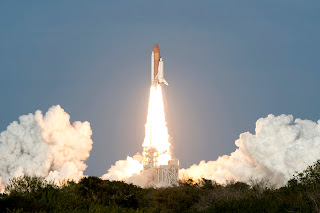
Space Shuttle Discovery lifts off Feb. 24, 2011, from Kennedy Space Center, Fla., on its STS-133 mission. (U.S. Air Force photo/Jonathan Gibson)

At MSNBC’s Cosmic Log, Alan Boyle tells us “How tycoons will fuel space flight” (April 22, 2011):

With the shuttle program winding down, the future of American spaceflight may well depend on how starry-eyed tycoons spend their money — and some of NASA’s money as well. Read More ›

Space, time, and quantum teleportation of light

From Rebecca Boyle at PopSci.com, we learn, “Researchers Succeed in Quantum Teleportation of Light Waves: Like Schrödinger’s cat, teleported light is both dead and alive” (04.15.2011) In this experiment, researchers in Australia and Japan were able to transfer quantum information from one place to another without having to physically move it. It was destroyed in one place and instantly resurrected in another, “alive” again and unchanged. This is a major advance, as previous teleportation experiments were either very slow or caused some information to be lost.The team employed a mind-boggling set of quantum manipulation techniques to achieve this, including squeezing, photon subtraction, entanglement and homodyne detection. The photo above depicts their device, nicknamed the Teleporter, in the lab of Akira Read More ›

Last call for real coffee!! “God particle” supposedly found

From Fox News LiveScience, we learn: World’s Largest Atom Smasher May Have Detected ‘God Particle’ (April 22, 2011): A rumor is floating around the physics community that the world’s largest atom smasher may have detected a long-sought subatomic particle called the Higgs boson, also known as the “God particle.” The controversial rumor is based on what appears to be a leaked internal note from physicists at the Large Hadron Collider (LHC), a 17-mile-long particle accelerator near Geneva, Switzerland. It’s not entirely clear at this point if the memo is authentic, or what the data it refers to might mean — but the note already has researchers talking. And announced on Good Friday, no less … It’s more seasonal, maybe, than Read More ›

One-dimensional early universe theory is testable, prof says

In “Primordial Weirdness: Did the Early Universe Have One Dimension? Scientists Outline Test for Theory”, at ScienceDaily (Apr. 20, 2011), we re asked to consider whether the universe started out with only one dimension: That’s the mind-boggling concept at the heart of a theory that University at Buffalo physicist Dejan Stojkovic and colleagues proposed in 2010.They suggested that the early universe — which exploded from a single point and was very, very small at first — was one-dimensional (like a straight line) before expanding to include two dimensions (like a plane) and then three (like the world in which we live today). The theory, if valid, would address important problems in particle physics. Now, in a new paper in Physical Read More ›

Dark matter still elusive?

In “Dark matter no-show at sensitive underground lab” (New Scientist, 14 April 2011), Celeste Biever reports that the WIMPs (yes, yes,) wimped out: It’s just like a wimp to be a no-show when summoned for interrogation. That seems to be the result of an experiment to detect the weakly interacting massive particles, or WIMPs, thought to make up elusive dark matter that is thought to make up much of the mass of the universe. After 100 days of monitoring, a tub of cryogenically chilled liquid xenon deep in an Italian mountain has shown no trace of the particles it is designed to catch. The result doesn’t rule out the existence of WIMPs, but it does seem these particles are slipperier Read More ›

Galaxy started forming stars only 200 million years after the Big Bang?

From the “earlier than thought” files, galaxies
From ScienceDaily (Apr. 12, 2011):

Using the amplifying power of a cosmic gravitational lens, astronomers have discovered a distant galaxy whose stars were born unexpectedly early in cosmic history. This result sheds new light on the formation of the first galaxies, as well as on the early evolution of the Universe.Johan Richard, the lead author of a new study says: Read More ›

Uncommon Descent Saturday contest: What would be acceptable evidence for other universes?

(Contest is now judged. Results are here.) First, here’s Nobel Prize winner Steven Weinberg: … There is also a less creditable reason for hostility to the idea of a multiverse, based on the fact that we will never be able to observe any subuniverses except our own. Livio and Rees, and Tegmark have given thorough discussions of various other ingredients of accepted theories that we will never be able to observe, without our being led to reject these theories. The test of a physical theory is not that everything in it should be observable and every prediction it makes should be testable, but rather that enough is observable and enough predictions are testable to give us confidence that the theory Read More ›

Cosmology: One of cosmic inflation theory’s creators now questions own theory

A theory that attempts to account for the fine tuning of the universe for life may be “deeply flawed,” we learn in Paul J. Steinhardt’s “The Inflation Debate.” Steinhardt is one of the theory’s creators, nevertheless asks, “Abstract: Is the theory at the heart of modern cosmology deeply flawed?

Cosmic inflation is so widely accepted that it is often taken as established fact. The idea is that the geometry and uniformity of the cosmos were established during an intense early growth spurt.

But some of the theory’s creators, including the author, are having second thoughts. As the original theory has developed, cracks have appeared in its logical foundations.

Highly improbable conditions are required to start inflation. Worse, inflation goes on eternally, producing infinitely many outcomes, so the theory makes no firm observational predictions.

Scientists debate among (and within) themselves whether these troubles are teething pains or signs of a deeper rot. Various proposals are circulating for ways to fix inflation or replace it.
– Scientific American (April 2011), 304, 36-43 | doi:10.1038/scientificamerican0411-36 (Paywall)

Rob Sheldon notes,

Inflation adds a whole bunch of really unlikely metaphysical assumptions — Read More ›

Proponent of multiverses and “our universe as possible simulation” wins this year’s Templeton Prize

Martin Rees Proponent of the multiverse and the universe as simulation wins this year’s Templeton Prize
The Prize has been awarded to Martin Rees. As Daniel Cressey tells it in Nature (6 April 2011),

Controversial ‘spirituality’ award goes to a scientist for fourth year in a row.

Martin Rees, an astrophysicist at the University of Cambridge, UK, and former head of the Royal Society in London, today received the 2011 prize, worth £1 million (US$1.62 million), which rewards “a living person who has made an exceptional contribution to affirming life’s spiritual dimension”.

The prize and the foundation have both attracted attacks from high-profile atheist scientists, who accuse them of attempting to insert religion needlessly into science. Rees says that he has no problem with accepting the prize, and he refuses to be drawn on the controversy, saying, “I have no comment on the views other people have.”


He also says he has no religious beliefs but sometimes attends Church of England services.

In 2004 Rees speculated controversially that we are living in a giant computer simulation: Read More ›