Uncommon Descent Serving The Intelligent Design Community

The TSZ and Jerad Thread, III — 900+ and almost 800 comments in, needing a new thread . . .

Categories
Culture
Design inference
Education
Evolution
ID Foundations
science education
specified complexity
worldview
Share
Facebook
Twitter/X
LinkedIn
Flipboard
Print
Email

Okay, the thread of discussion needs to pick up from here on.

To motivate discussion, let me clip here comment no 795 in the continuation thread, which I have marked up:

_________

>> 795Jerad October 23, 2012 at 1:18 am

KF (783):

At this point, with all due respect, you look like someone making stuff up to fit your predetermined conclusion.

I know you think so.

[a –> Jerad, I will pause to mark up. I would further with all due respect suggest that I have some warrant for my remark, especially given how glaringly you mishandled the design inference framework in your remark I responded to earlier.]

{Let me add a diagram of the per aspect explanatory filter, using the more elaborated form this time}
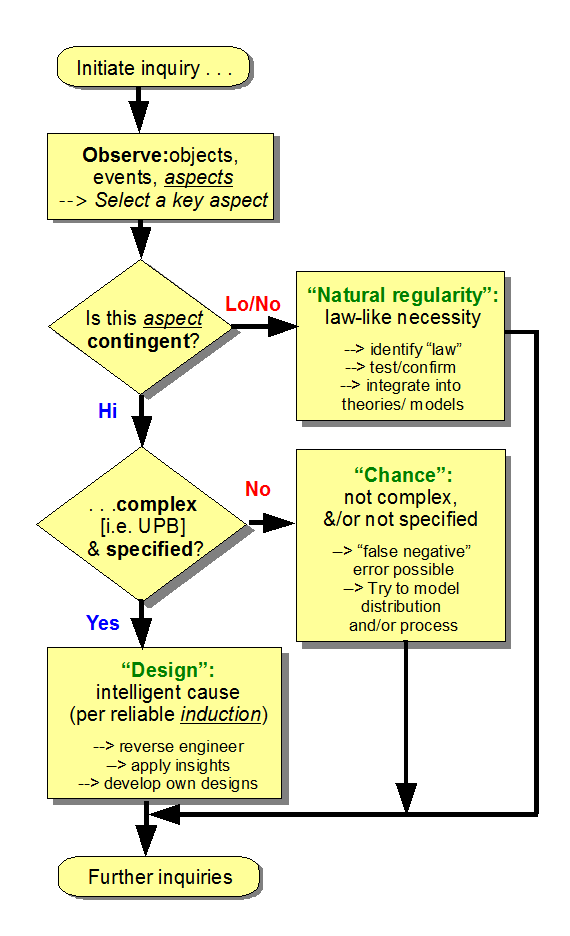
The ID Inference Explanatory Filter. Note in particular the sequence of decision nodes


You have for sure seen the per apsect design filter and know that the first default explanaiton is that something is caused by law of necessity, for good reason; that is the bulk of the cosmos. You know similarly that highly contingent outcomes have two empirically warrantged causal sources: chance and choice.

You kinow full well that he reason chance is teh default is to give the plain benefit of the doubnt to chance, even at the expense of false negatives.

I suppose. Again, I don’t think of it like that. I take each case and consider it’s context before I think the most likely explanation to be.

[b –> You have already had adequate summary on how scientific investigations evaluate items we cannot directly observe based on traces and causal patterns and signs we can directly establish as reliable, and comparison. This is the exact procedure used in design inference, a pattern that famously traces to Newton’s uniformity principle of reasoning in science.]

I think SETI signals are a good example of really having no idea what’s being looked at.

[c –> There are no, zip, zilch, nada, SETI signals of consequence. And certainly no coded messages. But it is beyond dispute that if such a signal were received, it would be taken very seriously indeed. In the case of dFSCI, we are examining patterns relevant to coded signals. And, we have a highly relevant case in point in the living cell, which points to the origin of life. Which of course is an area that has been highlighted as pivotal on the whole issue of origins, but which is one where you have determined not to tread any more than you have to.]

I suppose, in that case, they do go through something like you’re steps . . . first thing: seeing if the new signals is similar to known and explained stuff.

[d –> If you take off materialist blinkers for the moment and look at what the design filter does, you will see that it is saying, what is it that we are doing in an empirically based, scientific explanation, and how does this relate to the empirical fact that design exists and affects the world leaving evident traces? We see that the first thing that is looked for is natural regularities, tracing to laws of mechanical necessity. Second — and my home discipline pioneered in this in C19 — we look at stochastically distributed patterns of behaviour that credibly trace to chance processes. Then it asks, what happens if we look for distinguishing characteristics of the other cause of high contingency, design? And in so doing, we see that there are indeed empirically reliable signs of design, which have considerable relevance to how we look at among other things, origins. But more broadly, it grounds the intuition that there are markers of design as opposed to chance.]

And you know the stringency of the criterion of specificity (especially functional) JOINED TO complexity beyond 500 or 1,000 bits worth, as a pivot to show cases where the only reasonable, empirically warranted explanation is design.

I still think you’re calling design too early.

[e –> Give a false positive, or show warrant for the dismissal. Remember, just on the solar system scope, we are talking about a result that identifies that by using the entire resources of the solar system for its typically estimated lifespan to date, we could only sample something like 1 straw to a cubical haystack 1,000 light years across. If you think that he sampling theory result that a small but significant random sample will typically capture the bulk of a distribution is unsound, kindly show us why, and how that affects sampling theory in light of the issue of fluctuations. Failing that, I have every epistemic right to suggest that what we are seeing instead is your a priori commitment to not infer design peeking through.]

And, to be honest, the only things I’ve seen the design community call design on is DNA and, in a very different way, the cosmos.

[f –> Not so. What happens is that design is most contentious on these, but in fact the design inference is used all the time in all sorts of fields, often on an intuitive or semi intuitive basis. As just one example, consider how fires are explained as arson vs accident. Similarly, how a particular effect in our bodies is explained as a signature of drug intervention vs chance behaviour or natural mechanism. And of course there is the whole world of hypothesis testing by examining whether we are in the bulk or the far skirt and whether it is reasonable to expect such on the particularities of the situation.]

The real problem, with all respect, as already highlighted is obviously that this filter will point out cell based life as designed. Which — even though you do not have an empirically well warranted causal explanation for otherwise, you do not wish to accept.

I don’t think you’ve made the case yet.

[f –> On the evidence it is plain that there is a controlling a priori commitment at work, so the case will never be perceived as made, as there will always be a selectively hyperskeptical objection that demands an increment of warrant that is calculated or by unreflective assertion, unreasonable to demand, by comparison with essentially similar situations. Notice, how ever so many swallow a timeline model of the past without batting an eye, but strain at a design inference that is much more empirically reliable on the causal patterns and signs that we have. That’s a case of straining at a gnat while swallowing a camel.]

I don’t think the design inference has been rigorously established as an objective measure.

[g –> Dismissive assertion, in a context where “rigorous’ is often a signature of selective hyperskepticism at work, cf, the above. The inference on algorithmic digital code that has been the subject of Nobel Prize awards should be plain enough.]

I think you’ve decided that only intelligence can create stuff like DNA.

[h –> Rubbish, and I do not appreciate your putting words in my mouth or thoughts in my head that do not belong there, to justify a turnabout assertion. You know or full well should know, that — as is true for any significant science — a single well documented case of FSCO/I reliably coming about by blind chance and/or mechanical necessity would suffice to break the empirical reliability of the inference that eh only observed — billions of cases — cause of FSCO/I is design. That you are objecting on projecting question-begging (that is exactly what your assertion means) instead of putting forth clear counter-examples, is strong evidence in itself that the observation is quite correct. That observation is backed by the needle in the haystack analysis that shows why beyond a certain level of complexity joined to the sort of specificity that makes relevant cases come from narrow zones T in large config spaces W, it is utterly unlikely to observe cases E from T based on blind chance and mechanical necessity.]

I haven’t seen any objective way to determine that except to say: it’s over so many bits long so it’s designed.

[i –> Strawman caricature. You know better, a lot better. You full well know that we are looking at complexity AND specificity that confines us to narrow zones T in wide spaces of possibilities W such that the atomic resources of our solar system or the observed cosmos will be swamped by the amount of haystack to be searched. Where you have been given the reasoning on sampling theory as to why we would only expect blind samples comparable to 1 straw to a hay bale 1,000 light years across (as thick as our galaxy) will reliably only pick up the bulk, even if the haystack were superposed on our galaxy near earth. Indeed, just above you had opportunity to see a concrete example of a text string in English and how easily it passes the specificity-complexity criterion.]

And I just don’t think that’s good enough.

[j –> Knocking over a strawman. Kindly, deal with the real issue that has been put to you over and over, in more than adequate details.]

But that inference is based on what we do know, the reliable cause of FSCO/I and the related needle in the haystack analysis. (As was just shown for a concrete case.)

But you don’t know that there was an intelligence around when one needed to be around which means you’re assuming a cause.

[k –> Really! You have repeatedly been advised that we are addressing inference on empirically reliable sign per patterns we investigate in the present. Surely, that we see that reliably, where there is a sign, we have confirmed the presence of the associated cause, is an empirical base of fact that shows something that is at least a good candidate for being a uniform pattern. We back it up with an analysis that shows on well accepted and uncontroversial statistical principles, why this is so. Then we look at cases where we see traces from the past that are comparable to the signs we just confirmed to be reliable indices. Such signs, to any reasonable person not ideologically committed to a contrary position, will count as evidence of similar causes acting in the past. But more tellingly, we can point to other cases such as the reconstructed timeline of the earth’s past where on much weaker correlations between effects and putative causes, those who object to the design inference make highly confident conclusions about the past and in so doing, even go so far as to present them as though they were indisputable facts. The inconsistency is glaringly obvious, save to the true believers in the evo mat scheme.]

And you’re not addressing all the evidence which points to universal common descent with modification.

[l –> I have started form the evidence at the root of the tree of life and find that there is no credible reason to infer that chemistry and physics in some still warm pond or the like will assemble at once or incre4mentally, a gated, encapsulated, metabolising entity using a von Neumann, code based self replicator, based on highly endothermic and information rich macromolecules. So, I see there is no root to the alleged tree of life, on Darwinist premises. I look at the dFSCI in the living cell, a trace form the past, note that it is a case of FSCO/I and on the pattern of causal investigations and inductions already outlined I see I have excellent reason to conclude that the living cell is a work of skilled ART, not blind chance and mechanical necessity. thereafter, ay evidence of common descent or the like is to be viewed in that pivotal light. And I find that common design rather than descent is superior, given the systematic pattern of — too often papered over — islands of molecular function (try protein fold domains) ranging up to suddenness, stasis and the scope of fresh FSCO/I involved in novel body plans and reflected in the 1/4 million plus fossil species, plus mosaic animals etc that point to libraries of reusable parts, and more, give me high confidence that I am seeing a pattern of common design rather than common descent. This is reinforced when I see that ideological a prioris are heavily involved in forcing the Darwinist blind watchmaker thesis model of the past.]

We’re going around in circles here.

[m –> On the contrary, what is coming out loud and clear is the ideological a priori that drives circularity in the evolutionary materialist reconstruction of the deep past of origins. KF]>>

___________

GP at 796, and following,  is also a good pick-up point:

__________

>>796

  1. Joe:

    If a string for which we have correctly assesses dFSCI is proved to have historically emerged without any design intervention, that would be a false positive. dFSCI has been correctly assessed, but it does not correspond empirically to a design origin.

    It is important to remind that no such example is empirically known. That’s why we say that dFSCI has 100% specificity as an indicator of design.

    If a few examples of that kind were found, the specificity of the tool would be lower. We could still keep some use for it, but I admit that its relevance for a design inference in such a fundamental issue like the interpretation of biological information woudl be heavily compromised.

  2. If you received an electromagnetic burst from space that occurred at precisely equal intervals and kept to sidereal time would that be a candidate for SCI?

  3. Are homing beacons SCI?

  4. Jerad:

    As you should know, the first default is look for mechanical necessity. The neutron star model of pulsars suffices to explain what we see.

    Homing beacons come in networks — I here look at DECCA, LORAN and the like up to today’s GPS, and are highly complex nodes. They are parts of communication networks with highly complex and functionally specific communication systems. Where encoders, modulators, transmitters, receivers, demodulators and decoders have to be precisely and exactly matched.

    Just take an antenna tower if you don’t want to look at anything more complex.

    KF>>

__________

I am fairly sure that this discussion, now in excess of 1,500 comments, lets us all see what is really going on in the debate over the design inference. END

Comments
Petrushka: I think gpuccio (and all ID advocates) conflate agent and process. This confaltion becomes clear when we discuss whether humans creat a string via design or via a necessity process. I think this whole line of argument is rubbish. Not at all. If you look at my definition of design, you will see that I define three different things explicitly: Design process: the process by which conscious intelligent representations are outputted to a mterial object, shaping it pusposefully. Designer: the conscious intelligent being who outputs his conscious representations through the design process. Designed object: the material object that is shaped by the design process. There is no conflating at all. The issue to be decided is not whether sky fairies exist or whether mysterious agents meddle in the history of life, but whether evolutionary processes are sufficient. Let's say "non designed evolutionary processes", just to be precise. This is the same issue at the heart of OOL. Not whether we can determine the one true origin story, but whether regular pocesses are sufficient. Let's say non designed processes. The issue in any scientific theory is not true history, but sufficiency of regular processes. I don't agree. As you can read in my previous posts, true history, when observable, directly or indirectly, is a fact, and facts can always falsify any scientific theory, however "sufficient". Which is why Id advocates shy away from any attempt to model evolution and evolutionary processes. Simply not true. I shy away from wrong models that are passed as though they were true models. My own argument has been for some time that evolution is the only known process for creating and modifying biologically relevant information. There is simply no competing conjecture except poof. This is true even if we conceed the possibility of a designer. You are conflating, as you often do, "evolution" with "non designed evolution". Let's be clear. The true problem is between non designed processes and designed processes. Whatever your verbal tricks, that is the issue. You use the word "evolution" ambiguously. What do you mean? If you just mean a process that has some gradual aspects, then it is perfectly trivial to affirm that biological information was generated by "evolution". That is simply obvious: there is some graduality in the emergence of biological information. But if you use the word "evolution" to mean emergence through non designed processes, such as RV + NS (I know no other candidate!), then the type of graduality that is requested is completely different: it must be a graduality that passes through selectable intermediates, each of which must be in the range of RV. That is not true of the graduality that we can observe in designed processes. Process is always relevant. Obviously. The only known designers of abstract information do not poof things into existence. They build incrementally, modifying existing inventions by increment change or by horizontal transfer. Here you are wrong. While it is true that design processes often use some graduality and reuse of existing designed things, it is certainly not true that a dfesigner needs to proceed thorugh the same kind of "incremental change" that is required for RV + NS. Indeed, to believe such a thing is complete folly. In a sense, a designer always "poofs" something into existence: that "something" is the specific form he is representing in his consciousness. Obviously, he has to implement the output of that form to the material object. A complex form can be represented and/or implemented gradually, through simpler forms. But that process is completely different from the RV + NS algorithm, thaty goes on without any conscious representation, any undersatnding of meaning, any purpose. A solution often is represented in the designer's consciousness because of his understanding of laws, or of context, or just by intuition. Nothing like that happens in a non conscious context. Once a solution is represented, it can often be implemented easily. Other times, the implementation will be difficult and gradual, but it is always guided by the conscious representation of the designer. A designer can also use RV as a tool, and intelligently select outputs of RV. But again, the process is completely different here: it is always guided by the designer's understanding and by his purpose. It is really strange that you seem not to understand these very fundamental concepts.gpuccio
November 24, 2012
November
11
Nov
24
24
2012
04:44 AM
4
04
44
AM
PDT
Toronto:
Please clarify what you are explaining if not the origin of the string. A string that is the result of a necessity mechanism has an origin, and if that string meets complexity and functionality requirements, that string has “dFSCI”.
Let's clarify that again. An explanation is a theory about cause and effects relationahip, a set of logical or mathemathical connections, that tries to explain observed facts. An explantion can be good or bad (according to its explanatory power. An explanation can be accepted or refused. An explanation can be supported or falsified by new facts. But an explanation is never a fact (an observable). This is basic epistemology. The origin of a string, as said many times, is an observable fact. It can be known or not known. But it is not an explanation. We can offere an explanation for a string that implies a certain type of origin, for instance a design origin. If, at any moment, the true origin is directly or indirectly observed, that simple fact can be compatible with our explanation, or not. So, if the observed origin is from a conscious intelligent being, it is a design origin, and if our explanation implied a design origin, the observed origin is in support of our ecplanation. Still, our explanation could still be false in its logialc structure, although its conclusions may be in accord with the observed origin. On the other hand, if the observed origin is from a non design context, then that simple fact falsifies our explanation. That is in perfect accord with the general principle that scientific theories can be falsified, but never be proved true. Is that clear?gpuccio
November 24, 2012
November
11
Nov
24
24
2012
04:13 AM
4
04
13
AM
PDT
Toronto:
Please clarify what you are explaining if not the origin of the string. A string that is the result of a necessity mechanism has an origin, and if that string meets complexity and functionality requirements, that string has “dFSCI”.
Let's clarify that again. An explanation is a theory about cause and effects relationahip, a set of logical or mathemathical connections, that tries to explain observed facts. An explantion can be good or bad (according to its explanatory power. An explanation can be accepted or refused. An explanation can be supported or falsified by new facts. But an explanation is never a fact (an observable). This is basic epistemology. The origin of a string, as said many times, is an observable fact. It can be known or not known. But it is not an explanation. We can offere an explanation for a string that implies a certain type of origin, for instance a design origin. If, at any moment, the true origin is directly or indirectly observed, that simple fact can be compatible with our explanation, or not. So, if the observed origin is from a conscious intelligent being, it is a design origin, and if our explanation implied a design origin, the observed origin is in support of our ecplanation. Still, our explanation could still be false in its logialc structure, although its conclusions may be in accord with the observed origin. On the other hand, if the observed origin is from a non design context, then that simple facts falsifies our explanation. That is in perfect accord with the genearal principle that scientific theories can be falsified, but never be proved true. Is that clear?gpuccio
November 24, 2012
November
11
Nov
24
24
2012
04:13 AM
4
04
13
AM
PDT
F/N: JF needs to recognise that GA's START inside islands of function, and so at best explain some form of microevolutionary adaptation to niches, they do not explain origin of body plans starting with the first. That is, the fitness function has a generally uphill pointing slope of course with room for various local peaks etc. But the problem is that the vast majority of reasonable config spaces for multi component systems depending on well matched and organised parts to work, will be flat zero, non functional. There is no slope info to get one pointed right with a blind process. We don't even have the sort of neutral drift possibility in an already working entity to play with until we hit an island. And, given the complexity involved for FSCO/I, drifting is equivalent to blind random walks in the full config space. Which gets you nowhere. KFkairosfocus
November 24, 2012
November
11
Nov
24
24
2012
12:50 AM
12
12
50
AM
PDT
Mung (and, attn, Toronto): Thanks for drawing my attention to the notion that one can build a flip flop string then use it to generate a self replicating bit string, then claim the OOL problem is settled. I have a few remarks: 1 --> "Assume a can opener." (There is an old joke about the physicist, the engineer and the economist on a desert island who have food in cans but no can opener. The economist's "solution," assume the can opener.) 2 --> Flip flops are complex circuits themselves, and must be supported by rather restrictive power supplies. That requires information locked into the functionally specific organisation based on the wiring diagram and all the way back to the components and the precise arrangement of their parts for them to work, whether valve or solid state. A rough back of the envelope assessment of just the design specification for circuits and boards, not components and how we get to these puts you well beyond 500 - 1,000 bits to get such going. (Remember, 1,000 bits is 143 7-bit ascii characters.) 3 --> Toronto knows this or should know this, so he is simply putting up misleading talking points. Sadly, as usual. 4 --> When it comes to the living cell, the origin of which is to be explained, it is not just self replication per se that needs explaining. It is what Paley referred to in his self replicating watch example as additionality -- the watch told time AND replicated itself as a thought exercise. (I find it highly interesting that we seldom if ever see objections to Paley that address his argument in Ch 2, which is where he extends his watch in a field to the self-replicating case. A glance at the linked will show that in the IOSE, I essentially begin the serious discussion of the OO cell based life challenge with this point, so to try to dismiss on self replication alone, is a strawman tactic. About par for the evo mat rhetors' course.) 5 --> Notice, it is the observed living cell that needs explanation, int eh context of that additionality. That means that origin of codes, algorithms, self replicating automata that step by step assemble key components, etc need explanation. 6 --> Even if we were to run across a molecule that by some chemical magic ran a self replicating process, we have to explain the observed encapsulated, aqueous medium, metabolic automaton that uses codes and algorithms in the process. 7 --> Which would include bridging from your suggested self replicating molecular set to the actual observed architecture, step by incremental step by processes advantageous every step of the way. And, within the available time and atomic resources on the usual models. 8 --> In addition, you are looking at a vNSR and so face an irreducibly complex entity -- which challenges any proposed bridging process by the need to simultaneously come up with a cluster of well matched components that can plausibly assemble themselves into the relevant whole. As I noted in the OOL unit at IOSE:
the observed cell -- which is what we need to explain the origin of -- joins together (i) a metabolising entity that draws in energy and materials from its surroundings and processes them, ejecting wastes, to (ii) a symbol-based coded system that allows it to replicate itself. That is, we are looking at a molecular scale von Neumann self-replicating, metabolising automaton . . . . Now, following von Neumann generally (and as previously noted), such a machine uses . . . (i) an underlying storable code to record the required information to create not only (a) the primary functional machine [[here, for a "clanking replicator" as illustrated, a Turing-type “universal computer”; in a cell this would be the metabolic entity that transforms environmental materials into required components etc.] but also (b) the self-replicating facility; and, that (c) can express step by step finite procedures for using the facility; (ii) a coded blueprint/tape record of such specifications and (explicit or implicit) instructions, together with (iii) a tape reader [[called “the constructor” by von Neumann] that reads and interprets the coded specifications and associated instructions; thus controlling: (iv) position-arm implementing machines with “tool tips” controlled by the tape reader and used to carry out the action-steps for the specified replication (including replication of the constructor itself); backed up by (v) either: (1) a pre-existing reservoir of required parts and energy sources, or (2) associated “metabolic” machines carrying out activities that as a part of their function, can provide required specific materials/parts and forms of energy for the replication facility, by using the generic resources in the surrounding environment. Also, parts (ii), (iii) and (iv) are each necessary for and together are jointly sufficient to implement a self-replicating machine with an integral von Neumann universal constructor. That is, we see here an irreducibly complex set of core components that must all be present in a properly organised fashion for a successful self-replicating machine to exist. [[Take just one core part out, and self-replicating functionality ceases: the self-replicating machine is irreducibly complex (IC).] This irreducible complexity is compounded by the requirement (i) for codes, requiring organised symbols and rules to specify both steps to take and formats for storing information, and (v) for appropriate material resources and energy sources. Immediately, we are looking at islands of organised function for both the machinery and the information in the wider sea of possible (but mostly non-functional) configurations. In short, outside such functionally specific -- thus, isolated -- information-rich hot (or, "target") zones, want of correct components and/or of proper organisation and/or co-ordination will block function from emerging or being sustained across time from generation to generation. So, once the set of possible configurations is large enough and the islands of function are credibly sufficiently specific/isolated, it is unreasonable to expect such function to arise from chance, or from chance circumstances driving blind natural forces under the known laws of nature.
9 --> Remember, this is in an origins context, so either you explain this from the warm little pond, or else you come up with an autocatalytic reaction set that uses components that plausibly form under realistic prebiotic contexts -- i.e. you better have good explanations on issues of chirality, equilibria and kinetics, concentrations, cross reactions, interfering reactions, and degradation processes -- AND that bridges to code based vNSR replication integrated with metabolism, in a suitable environment. Either here on earth in a 200 mn year window or else getting to earth from a reasonable site as well, backed up by observations. 10 --> I can freely say that no serious chance and necessity only model in the peer-reviewed literature even comes close to such. Indeed the exchange between Orgel and Shapiro a few years back shows that we have mutually fratricidal models on genes and metabolism first, with RNA world scenarios caught up in the same pattern. 11 --> In fact, the mere challenge that the observed living cell starts out at over 100 k bits of stored info for a PARASITIC form, indicates that the 300 - 500+ k base zone or 1/2 - 1 mbit of info is a probable minimum for a viable vNSR cell. The entire cosmos we observe acting across its lifespan could not be expected to come up with as much as 1,000 bits worth of functionally specific complex info for needle in haystack reasons. And every bit beyond 1 kbit DOUBLES the search space challenge. 12 --> We do however have a well known, empirically reliable source for required FSCO/I: design. Indeed, we have every epistemic right to observe that such FSCO/I is a reliable sign of design as most credible causal explanation. Those who object need to identify a counter example instead of sitting around and playing at strawman and silly definitional debate talking point games. 13 --> I hardly need to add that once we see that design is sitting at the table as of right, we then have a serious candidate indeed to explain the onward bridges to the 10 - 100 mn+ bits of info required, dozens of times over, to explain complex body plans up to our own. In short, the ideological imposition of evolutionary materialism by the back door of an alleged methodological constraint, is patently explanatorily bankrupt. Time to move on, but as a rule -- as Planck observed, truly revolutionary paradigm shifts advance one funeral at a time. KFkairosfocus
November 24, 2012
November
11
Nov
24
24
2012
12:37 AM
12
12
37
AM
PDT
And flip-flop circuits are designed by agencies.
They are designed to do something logical using a physical mechanism. So first they need to evolve logic using only physics and chemistry.Mung
November 23, 2012
November
11
Nov
23
23
2012
04:53 PM
4
04
53
PM
PDT
Joe Felsenstein:
I also wrote my first GA program (but did not publish that one) in about 1962, 13 years before John Holland. I did my Ph.D. degree under the guy who was the first one to make a computer model of evolution at a single gene. I am one of the few people who got to meet Nils Aall Barricelli, who in 1954 was the very first person to use a computer to model evolution.
The point, Joe, is whether your GA in any way resembled these models of evolution. gpuccio says it's possible to model evolution. He says GA's don't do so. So let's compare a GA with a model. That was all I was asking. Joe Felsenstein:
I distribute a one-locus teaching program that simulates genetic drift, mutation, migration, and natural selection.
ok, we'll have to check it out. Maybe incorporate it into a GA. You realize don't you that GA's are goal driven. They have a purpose. Evolution isn't like that. So it's a mystery how you resolve that minor inconsistency. But I'd like to find out.Mung
November 23, 2012
November
11
Nov
23
23
2012
04:49 PM
4
04
49
PM
PDT
Toronto:
a self-replicator below the UPB means kairosfocus can no longer claim OOL is not possible without a designer.
So? If it's not over the UPB it's not dFSCI. Toronto:
a self-replicator below the UPB means kairosfocus can no longer claim OOL is not possible without a designer.
If you can program a string that can copy itself you've solved the OOL problem? Do you know where to go to collect your prize?Mung
November 23, 2012
November
11
Nov
23
23
2012
03:53 PM
3
03
53
PM
PDT
We recognize the necessity of flip-flopping when you're a Darwinist.Mung
November 23, 2012
November
11
Nov
23
23
2012
03:01 PM
3
03
01
PM
PDT
toronto:
The flip-flop in this analogy is used as a pattern generator which is the necessity mechanism that will build the content of a data string that we will evaluate as “dFSCI”.
And flip-flop circuits are designed by agencies.Joe
November 23, 2012
November
11
Nov
23
23
2012
01:27 PM
1
01
27
PM
PDT
keiths:
The “no known necessity mechanism” clause just amounts to “don’t infer design if a perfectly good non-design explanation is known.”
Well, YEAH. That is how it goes in archaeology, forensics and SETI, too.
Gpuccio’s error is in assuming that if a non-design explanation isn’t currently known (to his satisfaction), then none exists and it is safe to infer design.
Thanks for proving that you do NOT understand science, keiths. Ya see science goes on the knowledge we currently have and that is why with ALL scientific inferences the knowledge of tomorrow can either confirm or refute today's science. However we cannot wait for what tomorrow may or may not uncover. We have to work with what we currently have. And what we currently have demonstrates that only agency involvement can bring about dFSCI. Not that you will grasp any of that...Joe
November 23, 2012
November
11
Nov
23
23
2012
01:25 PM
1
01
25
PM
PDT
Joe Felsenstein:
Natural selection can be viewed either narrowly or broadly. Narrowly conceived, it is simply one class of violations of the assumptions of the Hardy-Weinberg Laws, namely the cases in which viability or fertility depends on genotype. Broadly conceived, it is the primary force which causes evolution to be adaptive, the creative and progressive element in the evolutionary process.
Are we going to find this creative force in the equations or will they just express changes in gene frequencies for genes that already exist?Mung
November 23, 2012
November
11
Nov
23
23
2012
01:02 PM
1
01
02
PM
PDT
Joe Felsenstein:
A comprehensive theory of evolution, one which does not yet exist, would integrate ecological processes (which determine the range of environments and the fitnesses of phenotypes), developmental processes (which determine the effect of genotype on phenotype), and population genetics (which tells us the changes in genetic composition of a population when the fitnesses of the genotypes are known). Lacking the other elements of this future theory, we concentrate here on the population genetics.
Mung
November 23, 2012
November
11
Nov
23
23
2012
12:58 PM
12
12
58
PM
PDT
petrushka:
There’s really no point in having a discussion with GP until you clear up his contentions regarding consciousness.
Well there’s really no point in having a discussion with any evo until they actually produce both a testable hypothesis along with supporting evidence for their position AND they stop with their continued cowardly equivocation.Joe
November 23, 2012
November
11
Nov
23
23
2012
12:37 PM
12
12
37
PM
PDT
Toronto:
As a test, if I could come up with a “software string” below the UPB that could self-replicate, would this qualify as an invalidation of “dFSCI”?
Didn't E. Liddle already attempt this and fail? But no, there's nothing that prevents designers from designing strings what fall below the UPB. Think Twitter. It's pretty remarkable that after all this time you still do not understand even the UPB. You need to generate a function that is above the UPB.Mung
November 23, 2012
November
11
Nov
23
23
2012
12:29 PM
12
12
29
PM
PDT
OMTWO:
Humans are built to predict the future.
How do you suppose they manage that, given all that randomness? Your position is incoherent.Mung
November 23, 2012
November
11
Nov
23
23
2012
12:15 PM
12
12
15
PM
PDT
OMTWO:
Of course the absurdity is that the “designer” created the universe yet can’t do anything more in it then that which is hidden behind “randomness”.
Just like a good 'skeptic' you don't let the facts stand in your way. One might wonder how science is even possible in the face of all that randomness. Tell us, if there was a designer, what would the probabilities look like? 60/40? 80/20? What level of randomness would reveal the designer?Mung
November 23, 2012
November
11
Nov
23
23
2012
12:11 PM
12
12
11
PM
PDT
petrushka:
I can’t get interested i the debate about design until the process of design is illuminated. Poof is not a process. Let’s see someone in the design community discuss a plausible process.
You're funny. You are completely in the dark as to the process but that's doesn't seem to stop you from engaging in the process. It follows that your internet posts just 'poof' into existence, and that 'poof' is a process.Mung
November 23, 2012
November
11
Nov
23
23
2012
12:02 PM
12
12
02
PM
PDT
keiths:
If you can’t give me lots of information about the intermediates, I’m allowed to assume that there are none. Zero.
You have no strong evidence that this is in fact what gpuccio believes. You fail at being a skeptic. We here at UD are the 'true skeptics.' We wait until we have strong evidence that someone is a troll or a liar, and then we ban them. You're banned from UD, right keiths?Mung
November 23, 2012
November
11
Nov
23
23
2012
09:22 AM
9
09
22
AM
PDT
And Toronto floats another brick.Mung
November 23, 2012
November
11
Nov
23
23
2012
09:16 AM
9
09
16
AM
PDT
gpuccio:
Why do you think that we use two different words? (probabilistic and deterministic).
Because one excludes the other. Because information requires freedom of choice between options and determinism is the opposite of that.Mung
November 23, 2012
November
11
Nov
23
23
2012
09:10 AM
9
09
10
AM
PDT
Mark Frank:
I am not a biologist and am not qualified to discuss the evidence for modern evolutionary theory although I am impressed by what I read.
Can we assume you don't believe any of it yet? Still withholding intellectual assent until strong evidence presents itself?Mung
November 23, 2012
November
11
Nov
23
23
2012
09:07 AM
9
09
07
AM
PDT
Mark Frank:
If you only want to discuss the evidence for “darwinism” I am not your man.
Is it really too much to ask of a skeptic that they give the evidence and reasoning for their beliefs? Mark Frank:
All it [skepticism] amounts to is the demand for strong evidence before believing anything.
Anything except darwinism.Mung
November 23, 2012
November
11
Nov
23
23
2012
09:03 AM
9
09
03
AM
PDT
keiths:
The mere existence of a known “necessity mechanism” that can produce the string is enough to disqualify the string from exhibiting dFSCI, even if that particular instance of the string happens to be designed.
No, that is false. The mere existence of a known "necessity mechanism" that can produce dFSCI means that dFSCI is not an indicator of design. So you guys are either stupid or obtuse (most likely both).Joe
November 23, 2012
November
11
Nov
23
23
2012
07:17 AM
7
07
17
AM
PDT
toronto:
Is this why “necessity mechanisms” are ruled out?
As I have told you several times already, necessity mechanisms have been ruled out because all observations and experiences demonstrate they are not up to the task. Obvioulsy you are just too dense to have that get through to you.Joe
November 23, 2012
November
11
Nov
23
23
2012
07:13 AM
7
07
13
AM
PDT
Toronto: Pardon, but 5 marks off. While the control mechanism for a D latch is indeed based on mechanical necessity, its response to input states is such that it stores two possible data states, and is therefore a contingent logic element. (One of the classic three: RS, D and JK.) Set up 504 in a chain with separate data feeds. It would be possible to store random info in them, by various means, but it is also possible to store intelligently designed data. Indeed, let's put coherent ASCII text in English. If you were to see 504 D latches with the ascii text for the start for this post in them, you would not need to ask, you would conclude with practical certainty that the info was intelligently fed in. This is because the number of configs that correspond to such a specification, will be vastly outweighed by the number that would be nonsense, and in addition, the resources of the solar system -- our practical universe -- would be such that we could not reasonably expect to find such on chance. All of which has been pointed out over and over and over in sufficient cases that it is patent that it is not adequacy of showing why dFSCI is a reliable sign of intelligence that is the problem, but rejection because the consequences in another relevant case are so immense and adverse to a favoured materialistic view of origins. Please, think again. KFkairosfocus
November 23, 2012
November
11
Nov
23
23
2012
07:01 AM
7
07
01
AM
PDT
Mark: You move from irony to sarcasm! Only occaionally. I definitely prefer irony! But I don’t see how it relates to my comment. I was declaring my prior beliefs and I emphasised that they were not something you could deduce from evidence. You respond by mocking my use of evidence in unrelated questions – very strange. The point should be as follows: You say: "YOUR PRIOR BELIEF IS THAT THERE IS A DESIGNER WITH THE APPROPRIATE MOTIVES AND ABILITIES. MINE IS THAT NOTHING IS PROVEN ABOUT THERE BEING A DESIGNER OR NOT." But that is not really consistent with your previous discourses. You previous argument, if I remember well, is that the existence of "a designer with the appropriate motives and abilities" is so unlikely that you refute the design inference. Now, that is not exactly compatible with affirming that your belief is "that nothing is proven about there being a designer or not". If you consider the existence of a conscious designer of life so unlikely, you are not "agnostic" at all about the issue. Strangely, my position was more "agnostic". I can happily agree that "nothing is proven". That's exactly why the design inference is valid, and cannot be refuted on the Bayesian basis that a designer is commpletely unlikely. If nothing is proven, a conscious designer of life can exist. The design inference points to that designer, and is a valid argument for its existence. My a priori conviction that non conscious designers exist is not necessary to my design inference, but certainly is no reason to refute it. Your a priori conviction that a conscious designer of life is extremely unlikely, instead, is absolutely necessary for your Bayesian refutation of the design inference. That's why I insist that our positions are not symmetrical, and that yours is more based on personal faith. Anyhow, having told you my prior beliefs, I am interested to know whether you admit that the ID argument is not valid unless you have a prior belief that there is a designer with the appropriate powers and motivation i.e. ID is not evidence for such a belief. As I have tried to explain, my point is that the ID argument points to a designer with the appropriate powers and motivation, and does not require a prior belief in that designer. It certainly requires that we are available to accept that such a designer can exist. On the contrary, your refusal of the ID argument critically depends on an explicit a priori conviction that the existence of such a designer is extremely unlikely, as shown by your Bayesian argument.gpuccio
November 23, 2012
November
11
Nov
23
23
2012
06:39 AM
6
06
39
AM
PDT
Mark (cont): It seems to me that the other conditions – complexity and non-compressibility – just rule out special cases of deterministic explanation (where selecting a string at “random” from all possible strings is one kind of deterministic explanation). I don't agree. It is a reasonable probabilistic explanation, if the probabilities of the event are acceptable. But it is not a deterministic explanation. Why do you think that we use two different words? (probabilistic and deterministic). That still leaves some uncertainty over the phrase:“no known deterministic explanation”. And if you conflate different terms, the uncertainty can only grow. The majority of people in our society at this time cannot conceive of even the outlines of a deterministic explanation. (B) Yes, if we mean "deterministic" with "deterministic". The probabilistic explanation is ruled out by an evaluation of the probability of the event, not by what the "majority of people in our society at this time" can or cannot conceive. So, A would be: “In the case of digital strings with a function, if the information linked to the function is compllex enough to exclude empirically a porbabilistic explanation, and if there is no known deterministic explanation why the string should happen to have a configuration that performs that function, then you can infer design”. (A) Why must you people always change my definitions, and then criticize your version of my definitions as though it were mine? And B becomes: "The functional information in the string is too complex to be explained by a probabilistic explanation, and the majority of people in our society at this time cannot conceive of even the outlines of a deterministic explanation." (B) And I “prove” (whatever that means) (A) mainly by pointing out that there are: lots of strings for which the functional information is too complex to justify a probabilistic explanation, and there is no known deterministic explanation, and which are known to be designed – sonnets and such like there are no instances of strings for which the functional complexity is too high to justify a probabilistic explanation, and there is no known deterministic explanation, which are known to have a non designed origin (not "explanation") (this is definitely non circular) For obvious reasons neither of these prove much! Not in your version, obviously. There is a digital string with no known deterministic explanation and the explanation is not known then later the explanation becomes known (C) I still can't see the great difference between this case (which is possible) and all the cases (which are very common) where the origin is known, but not to the person who assesses dFSCI. And again, there is a difference between knowing "a credible explanation" and "the origin". You make a lot of confusion between the two things. We can know the origin of something, and still we may not be able to explain how it came into existence. For instance, we can observe the origin of something in our lab, repeatedly, and still not know the explanation of what happens. And we can have a good explanation fro something, and yet the origin could be different, and our explanation, although good, could simply not be true. Now, the point is: if we correctly (and blindly) assess dFSCI for a string, and we can prove (before, at the same time, or after) that the origin is not designed, that falsifies dFSCI as a design indicator. In the same way, if we correctly (and blindly) assess dFSCI for a string, and we can prove (before, at the same time, or after) that some necessity explanation can really explain that string (not that its origin is non designed!), that falsifies dFSCI as a design indicator just the same. But the two situations are different. Given your reluctance to pursue hypothetical examples the alternative was the game we played. We try to construct examples of strings where you can’t conceive of a deterministic explanation but we know of one. It is not exactly the same as (C) but is close. This proves to be hard because you can raise the bar of “cannot conceive of deterministic explanation” very high. Perhaps the best example was the London temperatures. I described how to generate a digital string that could be used to tell you whether London temperatures were higher or lower than average. You dismissed this because the string could have been copied from the pattern of temperatures in some undefined way. Basically we have to think of a way that digital strings can be determined that you could not possibly conceive of in even the vaguest way – quite a challenge. Challenges need not be only for me. Maybe that is quite a challenge simnply because it is impossible... Again, try to find a mechanism that writes sonnets... There are other problems – even if the test cases flowed and they always resulted in a designed explanation I would stick to my guns that you cannot rationally transfer a correlation like this in one domain (man-made digital strings) to another (molecular digital strings) without understanding why the correlation happens. Well, this is more interesting. In a sense, we don't know how design can do waht nothing else can do. But we have some clues.Design acts by transferring conscious representations to a material object. Only design can do that, because that is the definition itself of design. So, the mystery of design is intrinically connected to the mystery of consciousness. And of its main properties: meaning, purpose, choice. Desing is essentially that; understanding meaning (something that no "natural process" can do); representing and desiring some result (something that no "natural process" can do); and choosing the right actions to implement that result (something that no "natural process" can do). As Abel says, design is realized by choosing a specific state for those "configurable switches" whose state can be set indifferently by natural mechanisms. That is the crucial difference between random strings and designed strings: both share similar formal properties (high complexity, no law-like regularity); from the point of view of Shannon "information" we could never distinguish the two categories. The only difference is: the "apparently random" arrangement in the designed string serves a purpose, usually easy to be recognized (language conveys meaning, software does useful things, proteins do useful things). Who recognizes that purpose? Only conscious beings. So, the circle is closed. Design starts in consciousness and ends in consciousness. It is the mark of consciousness on matter. So, we can have some understanding of why dFSCI can be found only in designed strings: it is a peculair output of conscious processes. That's why I always asay that a design inference does not necessarily imply "human designers", but it certainly implies "conscious designers". PS No a priori principles or worldviews were used in the construction of this argument! I like this disclaimer. I hope you are being ironic here! :)gpuccio
November 23, 2012
November
11
Nov
23
23
2012
06:21 AM
6
06
21
AM
PDT
Mark: I disagree and that is what I have tried to explain. I know. That is partly true. There is a rational process for inferring design and you might rationally come to different conclusions depending on your a priori beliefs about reality. However, these rational processes are not ID theory as usually expounded and do not include the argument from dFSCI. I am trying to explain why that is so I disagree. But maybe I am just obtuse. Also, we should not hide the requirement for those prior beliefs in order to make that rational deduction. They are prior beliefs, not something that you can deduce from the evidence. Your prior belief is that there is a designer with the appropriate motives and abilities. Mine is that nothing is proven about there being a designer or not. But, obviously, you lot do not rely on your prior beliefs, but only on evidence! You rely on evodence when you believe that consciousness is explained by some material arrangement. You rely on evidence when you believe that OOL happened in a pool, or an ocean vent. You rely on evidence when you believe that protein domains emerged in spite of all probabilistic evaluations, through selectable intermediates of which there is no evidence. How is that called? Evidence based imagination? Well of course I don’t accept they are valid scientific theories so I can’t try to falsify them at the scientific level. Your choice. I don’t think I have ever argued dFSCI is not politically correct! That was just irony! I know, I know, many do not understand my irony :) I believe there are deep methodological problems with your argument from dFSCI independent of evolutionary theory. As someone with a philosophy of science/statistics background I am vaguely qualified to discuss that. Well, we have certainly tried... I am not a biologist and am not qualified to discuss the evidence for modern evolutionary theory although I am impressed by what I read. Maybe if you were a biologist you would be less impressed. As a medical doctor, and more simply as a thinking person, I am not. (Well, I am impressed, but in a different way... but that could be irony, let's avoid it). If you only want to discuss the evidence for “darwinism” I am not your man. Well, some "my man" is sorely requested. (The evidence for darwinism is sorely requested too... ah, no, not irony again!). If you are at all interested in perceived methodological problems with dFSCI then I am interested to do my best to explain them. If I must be really sincere, I cannot see any methodological problem with dFSCI. Not before your arguments, not after. But again, maybe I am just obtuse. I know I have tried it many times but there are always new ways of putting the problems. I know, possible necessity mechanisms and possible arguments can always happen in the distant future... (irony?)gpuccio
November 23, 2012
November
11
Nov
23
23
2012
05:40 AM
5
05
40
AM
PDT
Toronto: I fully leave the responsibility of convincing you to Keiths. I have lost any hope.gpuccio
November 23, 2012
November
11
Nov
23
23
2012
05:25 AM
5
05
25
AM
PDT
1 13 14 15 16 17 37

Leave a Reply