Uncommon Descent Serving The Intelligent Design Community

The TSZ and Jerad Thread, III — 900+ and almost 800 comments in, needing a new thread . . .

Categories
Culture
Design inference
Education
Evolution
ID Foundations
science education
specified complexity
worldview
Share
Facebook
Twitter/X
LinkedIn
Flipboard
Print
Email

Okay, the thread of discussion needs to pick up from here on.

To motivate discussion, let me clip here comment no 795 in the continuation thread, which I have marked up:

_________

>> 795Jerad October 23, 2012 at 1:18 am

KF (783):

At this point, with all due respect, you look like someone making stuff up to fit your predetermined conclusion.

I know you think so.

[a –> Jerad, I will pause to mark up. I would further with all due respect suggest that I have some warrant for my remark, especially given how glaringly you mishandled the design inference framework in your remark I responded to earlier.]

{Let me add a diagram of the per aspect explanatory filter, using the more elaborated form this time}
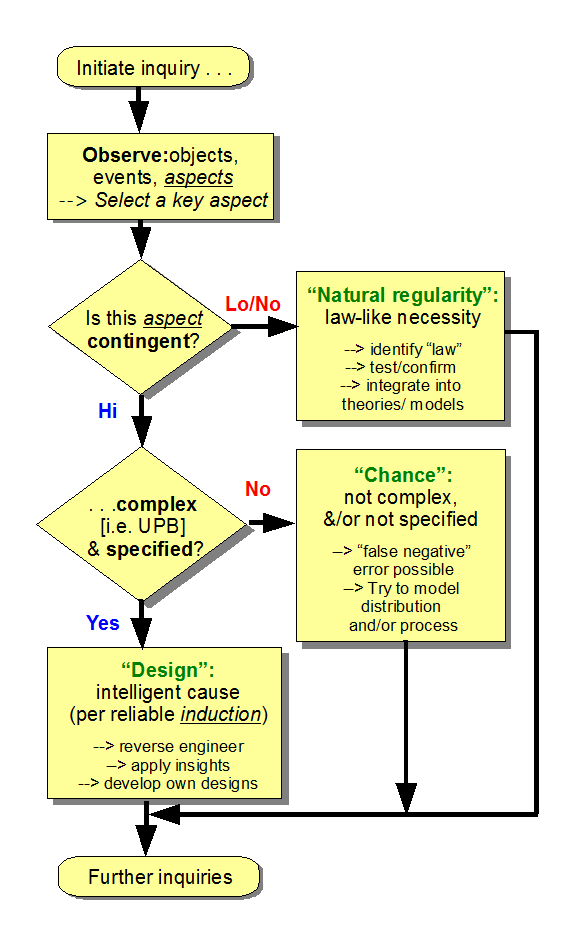
The ID Inference Explanatory Filter. Note in particular the sequence of decision nodes


You have for sure seen the per apsect design filter and know that the first default explanaiton is that something is caused by law of necessity, for good reason; that is the bulk of the cosmos. You know similarly that highly contingent outcomes have two empirically warrantged causal sources: chance and choice.

You kinow full well that he reason chance is teh default is to give the plain benefit of the doubnt to chance, even at the expense of false negatives.

I suppose. Again, I don’t think of it like that. I take each case and consider it’s context before I think the most likely explanation to be.

[b –> You have already had adequate summary on how scientific investigations evaluate items we cannot directly observe based on traces and causal patterns and signs we can directly establish as reliable, and comparison. This is the exact procedure used in design inference, a pattern that famously traces to Newton’s uniformity principle of reasoning in science.]

I think SETI signals are a good example of really having no idea what’s being looked at.

[c –> There are no, zip, zilch, nada, SETI signals of consequence. And certainly no coded messages. But it is beyond dispute that if such a signal were received, it would be taken very seriously indeed. In the case of dFSCI, we are examining patterns relevant to coded signals. And, we have a highly relevant case in point in the living cell, which points to the origin of life. Which of course is an area that has been highlighted as pivotal on the whole issue of origins, but which is one where you have determined not to tread any more than you have to.]

I suppose, in that case, they do go through something like you’re steps . . . first thing: seeing if the new signals is similar to known and explained stuff.

[d –> If you take off materialist blinkers for the moment and look at what the design filter does, you will see that it is saying, what is it that we are doing in an empirically based, scientific explanation, and how does this relate to the empirical fact that design exists and affects the world leaving evident traces? We see that the first thing that is looked for is natural regularities, tracing to laws of mechanical necessity. Second — and my home discipline pioneered in this in C19 — we look at stochastically distributed patterns of behaviour that credibly trace to chance processes. Then it asks, what happens if we look for distinguishing characteristics of the other cause of high contingency, design? And in so doing, we see that there are indeed empirically reliable signs of design, which have considerable relevance to how we look at among other things, origins. But more broadly, it grounds the intuition that there are markers of design as opposed to chance.]

And you know the stringency of the criterion of specificity (especially functional) JOINED TO complexity beyond 500 or 1,000 bits worth, as a pivot to show cases where the only reasonable, empirically warranted explanation is design.

I still think you’re calling design too early.

[e –> Give a false positive, or show warrant for the dismissal. Remember, just on the solar system scope, we are talking about a result that identifies that by using the entire resources of the solar system for its typically estimated lifespan to date, we could only sample something like 1 straw to a cubical haystack 1,000 light years across. If you think that he sampling theory result that a small but significant random sample will typically capture the bulk of a distribution is unsound, kindly show us why, and how that affects sampling theory in light of the issue of fluctuations. Failing that, I have every epistemic right to suggest that what we are seeing instead is your a priori commitment to not infer design peeking through.]

And, to be honest, the only things I’ve seen the design community call design on is DNA and, in a very different way, the cosmos.

[f –> Not so. What happens is that design is most contentious on these, but in fact the design inference is used all the time in all sorts of fields, often on an intuitive or semi intuitive basis. As just one example, consider how fires are explained as arson vs accident. Similarly, how a particular effect in our bodies is explained as a signature of drug intervention vs chance behaviour or natural mechanism. And of course there is the whole world of hypothesis testing by examining whether we are in the bulk or the far skirt and whether it is reasonable to expect such on the particularities of the situation.]

The real problem, with all respect, as already highlighted is obviously that this filter will point out cell based life as designed. Which — even though you do not have an empirically well warranted causal explanation for otherwise, you do not wish to accept.

I don’t think you’ve made the case yet.

[f –> On the evidence it is plain that there is a controlling a priori commitment at work, so the case will never be perceived as made, as there will always be a selectively hyperskeptical objection that demands an increment of warrant that is calculated or by unreflective assertion, unreasonable to demand, by comparison with essentially similar situations. Notice, how ever so many swallow a timeline model of the past without batting an eye, but strain at a design inference that is much more empirically reliable on the causal patterns and signs that we have. That’s a case of straining at a gnat while swallowing a camel.]

I don’t think the design inference has been rigorously established as an objective measure.

[g –> Dismissive assertion, in a context where “rigorous’ is often a signature of selective hyperskepticism at work, cf, the above. The inference on algorithmic digital code that has been the subject of Nobel Prize awards should be plain enough.]

I think you’ve decided that only intelligence can create stuff like DNA.

[h –> Rubbish, and I do not appreciate your putting words in my mouth or thoughts in my head that do not belong there, to justify a turnabout assertion. You know or full well should know, that — as is true for any significant science — a single well documented case of FSCO/I reliably coming about by blind chance and/or mechanical necessity would suffice to break the empirical reliability of the inference that eh only observed — billions of cases — cause of FSCO/I is design. That you are objecting on projecting question-begging (that is exactly what your assertion means) instead of putting forth clear counter-examples, is strong evidence in itself that the observation is quite correct. That observation is backed by the needle in the haystack analysis that shows why beyond a certain level of complexity joined to the sort of specificity that makes relevant cases come from narrow zones T in large config spaces W, it is utterly unlikely to observe cases E from T based on blind chance and mechanical necessity.]

I haven’t seen any objective way to determine that except to say: it’s over so many bits long so it’s designed.

[i –> Strawman caricature. You know better, a lot better. You full well know that we are looking at complexity AND specificity that confines us to narrow zones T in wide spaces of possibilities W such that the atomic resources of our solar system or the observed cosmos will be swamped by the amount of haystack to be searched. Where you have been given the reasoning on sampling theory as to why we would only expect blind samples comparable to 1 straw to a hay bale 1,000 light years across (as thick as our galaxy) will reliably only pick up the bulk, even if the haystack were superposed on our galaxy near earth. Indeed, just above you had opportunity to see a concrete example of a text string in English and how easily it passes the specificity-complexity criterion.]

And I just don’t think that’s good enough.

[j –> Knocking over a strawman. Kindly, deal with the real issue that has been put to you over and over, in more than adequate details.]

But that inference is based on what we do know, the reliable cause of FSCO/I and the related needle in the haystack analysis. (As was just shown for a concrete case.)

But you don’t know that there was an intelligence around when one needed to be around which means you’re assuming a cause.

[k –> Really! You have repeatedly been advised that we are addressing inference on empirically reliable sign per patterns we investigate in the present. Surely, that we see that reliably, where there is a sign, we have confirmed the presence of the associated cause, is an empirical base of fact that shows something that is at least a good candidate for being a uniform pattern. We back it up with an analysis that shows on well accepted and uncontroversial statistical principles, why this is so. Then we look at cases where we see traces from the past that are comparable to the signs we just confirmed to be reliable indices. Such signs, to any reasonable person not ideologically committed to a contrary position, will count as evidence of similar causes acting in the past. But more tellingly, we can point to other cases such as the reconstructed timeline of the earth’s past where on much weaker correlations between effects and putative causes, those who object to the design inference make highly confident conclusions about the past and in so doing, even go so far as to present them as though they were indisputable facts. The inconsistency is glaringly obvious, save to the true believers in the evo mat scheme.]

And you’re not addressing all the evidence which points to universal common descent with modification.

[l –> I have started form the evidence at the root of the tree of life and find that there is no credible reason to infer that chemistry and physics in some still warm pond or the like will assemble at once or incre4mentally, a gated, encapsulated, metabolising entity using a von Neumann, code based self replicator, based on highly endothermic and information rich macromolecules. So, I see there is no root to the alleged tree of life, on Darwinist premises. I look at the dFSCI in the living cell, a trace form the past, note that it is a case of FSCO/I and on the pattern of causal investigations and inductions already outlined I see I have excellent reason to conclude that the living cell is a work of skilled ART, not blind chance and mechanical necessity. thereafter, ay evidence of common descent or the like is to be viewed in that pivotal light. And I find that common design rather than descent is superior, given the systematic pattern of — too often papered over — islands of molecular function (try protein fold domains) ranging up to suddenness, stasis and the scope of fresh FSCO/I involved in novel body plans and reflected in the 1/4 million plus fossil species, plus mosaic animals etc that point to libraries of reusable parts, and more, give me high confidence that I am seeing a pattern of common design rather than common descent. This is reinforced when I see that ideological a prioris are heavily involved in forcing the Darwinist blind watchmaker thesis model of the past.]

We’re going around in circles here.

[m –> On the contrary, what is coming out loud and clear is the ideological a priori that drives circularity in the evolutionary materialist reconstruction of the deep past of origins. KF]>>

___________

GP at 796, and following,  is also a good pick-up point:

__________

>>796

  1. Joe:

    If a string for which we have correctly assesses dFSCI is proved to have historically emerged without any design intervention, that would be a false positive. dFSCI has been correctly assessed, but it does not correspond empirically to a design origin.

    It is important to remind that no such example is empirically known. That’s why we say that dFSCI has 100% specificity as an indicator of design.

    If a few examples of that kind were found, the specificity of the tool would be lower. We could still keep some use for it, but I admit that its relevance for a design inference in such a fundamental issue like the interpretation of biological information woudl be heavily compromised.

  2. If you received an electromagnetic burst from space that occurred at precisely equal intervals and kept to sidereal time would that be a candidate for SCI?

  3. Are homing beacons SCI?

  4. Jerad:

    As you should know, the first default is look for mechanical necessity. The neutron star model of pulsars suffices to explain what we see.

    Homing beacons come in networks — I here look at DECCA, LORAN and the like up to today’s GPS, and are highly complex nodes. They are parts of communication networks with highly complex and functionally specific communication systems. Where encoders, modulators, transmitters, receivers, demodulators and decoders have to be precisely and exactly matched.

    Just take an antenna tower if you don’t want to look at anything more complex.

    KF>>

__________

I am fairly sure that this discussion, now in excess of 1,500 comments, lets us all see what is really going on in the debate over the design inference. END

Comments
keiths:
Unguided evolution predicts the objective nested hierarchy.
Linnean taxonomy doesn't have anything to do with unguided evolution. And according to Theobald Linnean taxonomy is the nested hierarchy. Linnean taxonomy was based on a common design.
No, because HGT is explained by known unintelligent mechanisms.
Cuz keiths sez so! All science so far. keiths, unguided evolution can't even account for genes, nevermind their transfer. BTW keiths, HGT is not limited to prokaryotes. Nothing like ignoring facts and evidence. So if we ignore the facts and the evidence, then unguided evolution could be possible.Joe
December 3, 2012
December
12
Dec
3
03
2012
08:19 PM
8
08
19
PM
PDT
PS: Since the issue always comes up, the interested onlooker may wish to see how I separate the empirically grounded inference and the worldviews and commitments debate here. On the morrow I intend to take up the issue of self referential incoherence and evolutionary materialism, even as I continue to monitor what looks rather unfortunately like an attack on our local courthouses.kairosfocus
December 3, 2012
December
12
Dec
3
03
2012
03:03 PM
3
03
03
PM
PDT
F/N: Onlookers, it is simple. The provision of a 6,000 or so word essay that actually empirically grounds OOL by blind chance and necessity, and/or body-plan level macro evolution by the same, would devastate design theory. All of this hemming and hawing, pretence that the job has been done -- where, when, by whom? [remember 6,000 words is a reasonable limit for a good feature article length summary] -- and projection of loaded accusations are meant to distract from one simple, solid fact. Over the past two months, with over 4,000 comments across four or five long threads, plus more elsewhere, the objectors to design theory simply have not made their case. So, it can be taken to the bank that the actual situation is quite simple. Namely, FSCO/I in various forms, is an empirically well tested and inductively reliable sign of design. Such FSCO/I is ubiquitous in the world of life, and -- absent a priori materialist blinkers on doing science -- we have every reason to see the best empirically warranted explanation of OOL as design (this comes first as there was no reproductive cell based lifr form till we have this in hand), and with design in the door from the root of the tree of life, there is no good reason not to see major branches from protein domains to body plans as showing signs of design. That cuts clean across the ideology of a priori evolutionary materialism, and that is why we see so much intensity in objections that boil down to very little of the key required substance. And that is before we get to the persistent problem of Darwinist advocates speaking with disregard to truth and duties of care to fairness, hoping that they will profit from such assertions being perceived as true and well warranted. (By now they know what I just defined. and I will just quote my former neighbour: who de cap fit, let im wear it . . . ) KFkairosfocus
December 3, 2012
December
12
Dec
3
03
2012
02:49 PM
2
02
49
PM
PDT
keiths:
He seems to understand that it is perfectly fine for the programmer to model variation:
No, that would be an implementation of variation, not a model of it. Sheesh. You can't even put together a coherent argument.Mung
December 3, 2012
December
12
Dec
3
03
2012
01:41 PM
1
01
41
PM
PDT
keiths:
Third, the Blu-ray example is easily translated into a biological context. The Designer takes a complex structure that he implemented elsewhere (analogous to the Blu-ray drive) and “transplants” it into 25 distinct lineages (analogous to the 25 separate computer models). It’s design, it conforms to your unjustified assumption, and yet it still ruins the objective nested hierarchy.
Yet another 'test' of evolutionary theory that isn't. If a designer did that, you would claim that the lineages were not distinct because they all shared this feature in common. Say the designer created a genetic code and put it into a bunch of distinct lineages. Then you all would assert this proves they are all related by common ancestry. You wouldn't take it as evidence for design at all. And what your describing is pretty much what happens with HGT isn't it? But you don't attribute that to design, do you. And that invalidates your nested hierarchy, so you ignore it, as Joe has pointed out repeatedly. Are you saying convergence is proof of design? No, you wouldn't say that. Your theory is immune from disconfirmation. ID, otoh, can be refuted. All you have to do is get busy and do it.Mung
December 3, 2012
December
12
Dec
3
03
2012
01:37 PM
1
01
37
PM
PDT
Keiths: What he’s suggesting is not a model of NS, it’s an “implementation of NS” — his words. He’s rejecting the idea of modeling selection and saying instead that we must actually implement selection by creating computer viruses which compete for computational resources, which he oddly labels “natural resources”. Hey, it was just a proposal. Why are you so upset? I said that it was not a "model". I also discussed the case of a "model" (see my post #800). The obvious irony (obvious to us, anyway) is that in trying to model NS, he ends up implementing selection, rather than modeling it. I can't see the irony. I said myself that it was not a model, but an implementation. So, why do you say that "in trying to model NS" I "end up implementing selection, rather than modeling it"? A lie, again? And it’s a form of selection that isn’t derived from actual natural fitness landscapes. Instead, it’s based on the success of artificial replicators in an artificial environment with an artificial source of variation. OK, I said that myself. But, if NS can act as a logical principle, it could well act in a computer environment. IOWs, if complex functions can be obtained by replicators who have to share resources, why shouldn't that be true in a computer environment?
He seems to understand that it is perfectly fine for the programmer to model variation: c) we introduce in the replicators some random variation mechanism, which can be modulated appropriately to test different rates and modalities of random variation. Yet for some reason he doesn’t understand that if it’s okay to design a model of random variation, then it’s okay to design a model of natural selection.
No, for the reasons I have many times explained. We can observe RV in nature. We also have some ideas about how often it happens in different contexts, and of the ways it happens. So, it is rather easy to model it. Instead, we observe NS only in microevolutionary contexts. So, that can easily be modeled. But the assumption that NS can generate new complex functions through intermediate selectable steps is, as said many times, only an abstract assumptions. We have no real example of that. We should invent the frequency of how often it happens. We should just invent that it happens, we should assume that complex functions are deconstructable into functional steps with increasing function, and invent how many of those steps may exist. As everybody can easily see, the two scenarios are completely different. Anyway, once you cut through all of his confusion, the bottom line is this: Random variation plus selection can produce functional complexity, as gpuccio himself admits. Random variation plu intelligent selection can do it. That's the only thing I have ever admitted. Random variation plus NS can't do it. Be careful, when you quote me as admitting something. Whether it does so in a particular case depends on the specific fitness landscape involved. No. That is simply not true. And you have never demonstrated it. In IS, the generation of functional complexity, when it happens, depends on intelligent choices of the designer, who introduces all the necessary information in the system in direct or indirect ways. Natural environments are not designers, are not conscious, and are not intelligent. Gpuccio is therefore betting the farm on the hope that actual biological fitness landscapes will consist of separated “islands of function” which NS cannot navigate. Yes. The evidence for the objective nested hierarchy demonstrates that this is a huge mistake. Studies by Szostak, Lenski, Thornton, etc., are additional nails in the coffin. Now I am really scared!gpuccio
December 3, 2012
December
12
Dec
3
03
2012
01:31 PM
1
01
31
PM
PDT
keiths:
First of all, you haven’t given any independent justification for your assumption. A designer (and especially a Designer) doesn’t have to work through common descent, and he doesn’t have to reuse what already exists.
So let's label the assumptions and see who is making them: keiths_assumption_01: A designer (and especially a Designer) doesn’t have to work through common descent. keiths_assumption_02: he doesn’t have to reuse what already exists. Assumption Score: gpuccio: 0 keiths: 2Mung
December 3, 2012
December
12
Dec
3
03
2012
01:22 PM
1
01
22
PM
PDT
I see keiths is busy re-writing history as soon as it happens.
Being called a liar by the likes of Mung or Joe is harmless. No one takes them seriously on either side of the debate.
We've known for a long time now that truth is irrelevant to you. Are the actual demonstrations of your lies that we post likewise harmless, or do the facts not matter? And if it's true that my calling you liar is harmless, why the incessant moaning about it?Mung
December 3, 2012
December
12
Dec
3
03
2012
01:17 PM
1
01
17
PM
PDT
Keiths: First of all, you haven’t given any independent justification for your assumption. A designer (and especially a Designer) doesn’t have to work through common descent, and he doesn’t have to reuse what already exists. Your only reason for assuming that he does these things is that you are trying to force-fit your theory to the existing evidence. It’s the same error made by an advocate for the Rain Fairy hypothesis who assumes that the Rain Fairy always acts in ways that match the weather we are actually observing. You seem to know things about the designer that I don't know. "A designer (and especially a Designer) doesn’t have to work through common descent, " Why? This is really a bold assumption. The designer can input information through a consciousness matter interface, but why do you think that he can do anything he likes (or, rather, anything you like)? That assumption has no foundation. Working through common descent just measn that the huge informational leap that is implied by OOL had to be done only once. Working in any other way would mean to redo that task each time. It is rather obvious that it is easier to work though common descent. Even unguided evolution could redo the initial miracle many times (if it really were able to do it). But that would not lead to your nested hierarchies. Second, your assumption doesn’t even work. The example I gave, in which a computer designer takes a Blu-ray drive (which already exists) and adds it to 25 different computer models (which already exist), thus intelligently modifying them, conforms to your assumption. Yet I have already shown that it spoils the objective nested hierarchy. No, it conforms to your idea of my assumption. My simple assumption is that an informational input is done once, and then reutilized by common descent or, when appropriate, by HGT. IOWs, the information input is the most difficult task, and it is administered only when necessary. Third, the Blu-ray example is easily translated into a biological context. The Designer takes a complex structure that he implemented elsewhere (analogous to the Blu-ray drive) and “transplants” it into 25 distinct lineages (analogous to the 25 separate computer models). It’s design, it conforms to your unjustified assumption, and yet it still ruins the objective nested hierarchy. There is no reason why a designer should act that way. Human designers have different environments, purposes and contexts. Your human blue ray designer will behave in the most advantageous way for his context. My only assumption is that the biological designer, too, acts in the most advantageous way for his context. You seem to know what that context is or can be, and derive a false logic from your arbitrary assumptions. You have a serious problem. The theory of evolution makes the audacious prediction of an objective nested hierarchy, out of trillions of alternative possibilities. The prediction is confirmed. Under a design hypothesis, you have no reason to expect an objective nested hierarchy. I simply don't agree with your audacious logic. Is that a serious problem for me? I am not aware of that. If you “follow the evidence where it leads”, as IDers like to say, you find that it leads directly away from design and straight to modern evolutionary theory. Let's just say that I will follow the evidence wherever it leads, but I will do that my way, not your way.gpuccio
December 3, 2012
December
12
Dec
3
03
2012
01:15 PM
1
01
15
PM
PDT
Toronto:
gpuccio, you have to start posting comments on this side if you want a reply. It’s not fair to readers to have to follow two blogs for one conversation.
So, are you still reading my posts here? Is your “dFSCI” important enough to be defended in a cold objective non-biased environment? Frankly, you are not important enough. You asked for it, now you have it!
gpuccio
December 3, 2012
December
12
Dec
3
03
2012
01:02 PM
1
01
02
PM
PDT
Joe Felsenstein:
When ID types come up with arguments that are, or seem to be, quantitative, analyses of these arguments need to appear here (or at other relevant forums such as Panda’s Thumb). I’m going to keep doing that. Of course I am not assuming that the hard-core ID posters and commenters will be convinced. They never acknowledge that any of their arguments are wrong. But there are numerous spectators out there reading these threads, and they need to hear how theoretical and quantitative arguments work, and I can supply that. There are also other TSZ and PT commenters who don’t know how to evaluate these putatively-quantitative ID arguments. These commenters seem to find it useful to have a careful explanation of the theory. We need an accessible place for these quantitative and theoretical arguments to occur. TSZ and PT are such places.
How strange! I could write the same exact words, just changing some names, I believe.gpuccio
December 3, 2012
December
12
Dec
3
03
2012
01:00 PM
1
01
00
PM
PDT
Keiths: Personally, I think that interacting with the UDers does more good than harm. Again, we agree. 1. Anyone stumbling onto our odd interblog conversation quickly figures out the reason for it: censorship and banning on the UD side. We welcome open discussion at TSZ. They don’t at UD. That immediately discredits UD in the eyes of any objective observer. OK. You are the good guys! :) 2. IDers like to complain that their ideas aren’t given a fair hearing. TSZ puts the lie to that assertion. We go to great lengths to understand their claims, even when they don’t want us to (hi, Upright!). Look at how many threads we’ve dedicated to gpuccio’s argument, how much time we’ve spent parsing his very unclear declarations, and how much feedback we’ve given him. OK. You are the heroes. And, obviously, I am overwhelmed by your generosity towards this insignificant guy! 3. There are quite a few people who find pro-ID arguments persuasive in isolation. It’s good for such people to see that we can easily rebut those arguments and show that the evidence favors evolution over ID. OK. You are the winners. 4. Being called a liar by the likes of Mung or Joe is harmless. No one takes them seriously on either side of the debate. Now, that's really flattering. Is being called a liar by me a privilege? Or is it harmful? (That would be even better, but I dare not hope so much). 5. Interacting with the IDers reveals a lot about how they think, and why they make the mistakes they do. I think it’s fascinating and entertaining. It also suggests ways of better explaining evolution to those who don’t understand it. OK. You are the detached observers of silly people like us, and the wise teachers! 6. It gives us practice in expressing our positions clearly and logically to a hostile audience. That’s a useful skill to hone, even if the audience in this case tends to be impervious to reasoned argument. OK. Even the gods can improve their skills. What can I say? Nobody could sum up what has really happened here better than that. (For those who will read only this post of mine: maybe I have done it again, I have abandoned old good irony for explicit sarcasm :) )gpuccio
December 3, 2012
December
12
Dec
3
03
2012
12:57 PM
12
12
57
PM
PDT
And what’s up with Mike Elzinga?
He probably thinks that the negative of a log function is physical.Mung
December 3, 2012
December
12
Dec
3
03
2012
12:47 PM
12
12
47
PM
PDT
Joe Felsenstein: OK, I sense the frustration and anger, but … really close TSZ down? I vote no. For what it's worth, I vote no too! :) (I hope someone there is still reading me here).gpuccio
December 3, 2012
December
12
Dec
3
03
2012
12:46 PM
12
12
46
PM
PDT
Toronto:
Given that, I will only address comments made by ID/creationists on this blog. I also won’t read anything on UD anymore either, since the added traffic/visits will only be to their benefit, not mine since I am “banned” from participating.
Oh, my! Does that mean that I will no more be able to face your terrible challenge? I know, you cannot answer, you don't read here any more! Life is really unjust...gpuccio
December 3, 2012
December
12
Dec
3
03
2012
12:44 PM
12
12
44
PM
PDT
I bet keiths thinks the Dawkins Weasel program: a.) Is a GA b.) uses natural selectionMung
December 3, 2012
December
12
Dec
3
03
2012
12:43 PM
12
12
43
PM
PDT
And what's up with Mikey Elzinga? He talks as if he has been abused his entire life. Earth to Mikey-> EVIDENCE, as in only positive evidence for your position can do any damage to ID and its arguments. and I take it that it upsets you to no end that your position doesn't have any.Joe
December 3, 2012
December
12
Dec
3
03
2012
12:39 PM
12
12
39
PM
PDT
Keiths: At one point, he did retract his claim that fitness functions are verboten: As usual, you are the most careful among my readers (maybe with Petrushka). It's perfectly true, my earlier statement was not correct, so I have retracted it and formulated a different statement. I stick to the second version, obviously.
But he’s still saying things like the following, which makes me wonder if he isn’t regressing to his earlier position: Intelligent selection is any kind of selection where a conscious intelligent being decides what to select, and what the effects of selection will be. In the case of a GA or a computational evolutionary model, the programmer makes those decisions. So according to gpuccio’s criterion, any such GA or model necessarily involves intelligent selection, not natural selection. It looks like he’s still confused.
No. A GA can be accepted, if it models well a real situation that can be observed. Obviously, the GA is designed in all cases, but we can restrict our analysis to what the GA does, not to its existence. It's the same with our previous "challenge", where I have allowed just from the beginning that anyone could use a Random String Generator, provided that its working was really random. We must distinguish between two situations: a) A GA that correctly models a real situation, generates true RV, and, if it introduces some role for NS, tries to stick to realistic parameters for it (which, as I have alredy said, is at present impossible for obvious reasons). In that case, the GA is correct. The GA is designed, but it is not introducing any information beyond what is necessary to correspond to some real system and model it as well as possible. b) A GA that, instead, introduces in the algorithm parameters, procedures, and choices that in no way correspond to what it is apparently modeling. That is not a valid model at all.gpuccio
December 3, 2012
December
12
Dec
3
03
2012
12:28 PM
12
12
28
PM
PDT
Keiths: I’ve gone over this with him before, and I thought he was starting to get it, but other things he’s said since then seem to indicate otherwise. I believe I get it very well. I get it so well that I have proposed two different scenarios: a) If you want to model NS, you have to give parameters for how often it really happens, and how much it can lead to complex functions. Those parameters can be fully invented, or derived from observation. If you fully invent them you can say anything you like, but what you say is useless. If you derive from observations, your only parameters can be to attribute no role to NS for the generation of complex functions, because we have no real observed model where that happens. I have also proposed, again to Joe F., post #888, a computer implementation of NS, just to observe what it can do. That is not a model, but a computer experiment, similar to what Lenski is doing in the biological field. The only thing I cannot accept is that you model "NS" by some IS algorithm, with arbitrary parameters, chosen ad hoc for your purposes, that do not correspond to any real example, and then affirm that you are modeling NS and derive conclusions about it from your meaningless game.gpuccio
December 3, 2012
December
12
Dec
3
03
2012
12:18 PM
12
12
18
PM
PDT
Alan Fox:
Why would anyone re-invent the wheel? If you dismiss Theobold – if you are not interested in the popular works of Coyne, Carroll or Shubin and all the other vast literature written for professionals, students and the general public, what is an essay by some random people who still happen to read the UD blog going to be worth? Not much!
Maybe you can get one of them to come here and defend their pop-fiction. But I'm guessing they won't. Do any of them have anything to say about the evolution of protein superfamilies and the missing functional protein intermediates? If you guys had a well-reasoned, evidence-based argument you would post it. The fact is that you're all 'believers' in the magical powers of evolution, but can't say why. So instead, you attack ID.Mung
December 3, 2012
December
12
Dec
3
03
2012
11:14 AM
11
11
14
AM
PDT
gpuccio:
a) It must be functional b) It must be more functional than what already exists, so that it can be fixed (expanded) in the population. c) It must be in some way more related to the final sequence and structure more than what already exists (IOWs, it must really be an “intermediate”).
Otherwise you may as well just appeal to raw chance. This seems to be lost on Alan and Allen. And if you do calculate the probabilities in terms of raw chance they will scream an holler that you left out the impact of natural selection and it's supposed capability to make the staggeringly improbable somehow more probable. It's a nice shell game, if you can get away with it.Mung
December 3, 2012
December
12
Dec
3
03
2012
10:50 AM
10
10
50
AM
PDT
keiths:
Yet for some reason he doesn’t understand that if it’s okay to design a model of random variation, then it’s okay to design a model of natural selection.
With natural selection whatever is good enough survives to reproduce. And with sexual reproduction there's no telling how many offspring will inherit the beneficial mutation. So how, exactly, do you model that?Joe
December 3, 2012
December
12
Dec
3
03
2012
09:25 AM
9
09
25
AM
PDT
keiths:
I have given you an explicit example that shows why the design hypothesis doesn’t predict an objective nested hierarchy.
And I have given you an explicit examples that shows why the unguided evolution doesn’t predict an objective nested hierarchy. But you just ignore them because you are willfully ignorant and should be ignored.
If you “follow the evidence where it leads”, as IDers like to say, you find that it leads directly away from design and straight to modern evolutionary theory.
And as soon as there is supporting evidence for the MET we will give it all the consideration it deserves. Until then there isn’t anything to lead us to unguided evolution, not even a testable hypothesis. keiths would definitely eat it in a cold objective non-biased environment.Joe
December 3, 2012
December
12
Dec
3
03
2012
08:53 AM
8
08
53
AM
PDT
Joe Felsenstein:
When ID types come up with arguments that are, or seem to be, quantitative, analyses of these arguments need to appear here (or at other relevant forums such as Panda’s Thumb). I’m going to keep doing that.
Unfortunately your arguments against ID would also eat it in a cold objective non-biased environment. As would your "arguments" for the power of natural selection.Joe
December 3, 2012
December
12
Dec
3
03
2012
08:52 AM
8
08
52
AM
PDT
keiths:
I have given you an explicit example that shows why the design hypothesis doesn’t predict an objective nested hierarchy. And I have given you an explicit examples that shows why the unguided evolution doesn’t predict an objective nested hierarchy. But you just ignore them because you are willfully ignorant and should be ignored.
If you “follow the evidence where it leads”, as IDers like to say, you find that it leads directly away from design and straight to modern evolutionary theory.
And as soon as there is supporting evidence for the MET we will give it all the consideration it deserves. Until then there isn't anything to lead us to unguided evolution, not even a testable hypothesis. keiths would definitely eat it in a cold objective non-biased environment.
Joe
December 3, 2012
December
12
Dec
3
03
2012
08:50 AM
8
08
50
AM
PDT
toronto:
Is your “dFSCI” important enough to be defended in a cold objective non-biased environment?
TSZ isn't such a place, that's for sure. And neither toronto (any TSZ ilk) couldn't defend his position in a cold objective non-biased environment. But they sure can bluff, equivocate, lie and obfuscate. Your parents must be very proud.Joe
December 3, 2012
December
12
Dec
3
03
2012
08:46 AM
8
08
46
AM
PDT
Alan Fox redux:
If you dismiss Theobold – if you are not interested in the popular works of Coyne, Carroll or Shubin and all the other vast literature written for professionals, students and the general public, what is an essay by some random people who still happen to read the UD blog going to be worth?
Not one of those guys knows how evolution happened. Not one knows how many mutations it takes to make any of the changes required. Not one addresses UNGUIDED evolution. That said, Theobald gets it totally wrong wrt nested hierarchies- and I and others have explained why. Shubin found Tiktaalik but he has no idea how many mutations it takes to go from fish to Tiktaalik. Not only that thanks to tiktaalik the fossil record shows fish-> tetrapods-> fish-a-pods, yet fish-a-pods are supposed to have come before tetrapods. Carroll deals more with developmental biology, yet he has the same issue- has no udea how many mutations, what mutations nor how to use his skill with development to influence it in such a way to test his claims. As for Coyne, same issue. And they all have another issue- they think that their opponents argue for the fixity of species when even YECs accept change/ variation/ descent with modification, ie evolution. Where's the science? Where are the experiments that demonstrate that natural selection can actually construct something, ie that it is a designer mimic? And if the literature is really that vast then why can't Alan cut and paste so everyone can see that he is bluffing? :razz: Come on Alan, one testable hypothesis for ungiuded evolution- one that would convince people it can do what you say.Joe
December 3, 2012
December
12
Dec
3
03
2012
08:41 AM
8
08
41
AM
PDT
Alan Fox:
The case of gene duplication speaks against your point a).
Please tell us how it was determined that gene duplication is a blind and undirected chemical process- be specific.Joe
December 3, 2012
December
12
Dec
3
03
2012
07:05 AM
7
07
05
AM
PDT
Alan Fox:
And Joe promptly confirms my point!
So your point was that you are a bluffing equivocator?Joe
December 3, 2012
December
12
Dec
3
03
2012
07:04 AM
7
07
04
AM
PDT
Keiths: I see. You have time to post 2,000+ words a day, on average, but you can’t spare a few minutes to work through a simple exercise in phylogenetic inference. Not if I cannot see any relationship with biological reality. That’s a pity, especially considering that the entire issue right now is your misunderstanding of the prerequisites for successful phylogenetic inferences. Show the concept in a biological concept. Regarding the rest of your "argument", please read again what I wrote: "The only “assumption” necessary to explain that kind of nesting in the design explanation is that the designer needs to act through common descent, and to reuse what already exists with intelligent modifications. It seems not such an extreme assumption, and it fits the facts." Given that assumption, it is obvious that the only reasonable answer is #1. Exactly like in the non design scenario. You have stated that "other assumptions" are necessary so that the nested hierarchy is the same in the the two cases. I say that is not true. You have not shown which "other" assumption would be necessary. So do it, or just admit you are wrong.gpuccio
December 3, 2012
December
12
Dec
3
03
2012
06:55 AM
6
06
55
AM
PDT
1 5 6 7 8 9 37

Leave a Reply