Uncommon Descent Serving The Intelligent Design Community

Evolution driven by laws? Not random mutations?

Categories
Evolutionary biology
Intelligent Design
News
Share
Facebook
Twitter/X
LinkedIn
Flipboard
Print
Email

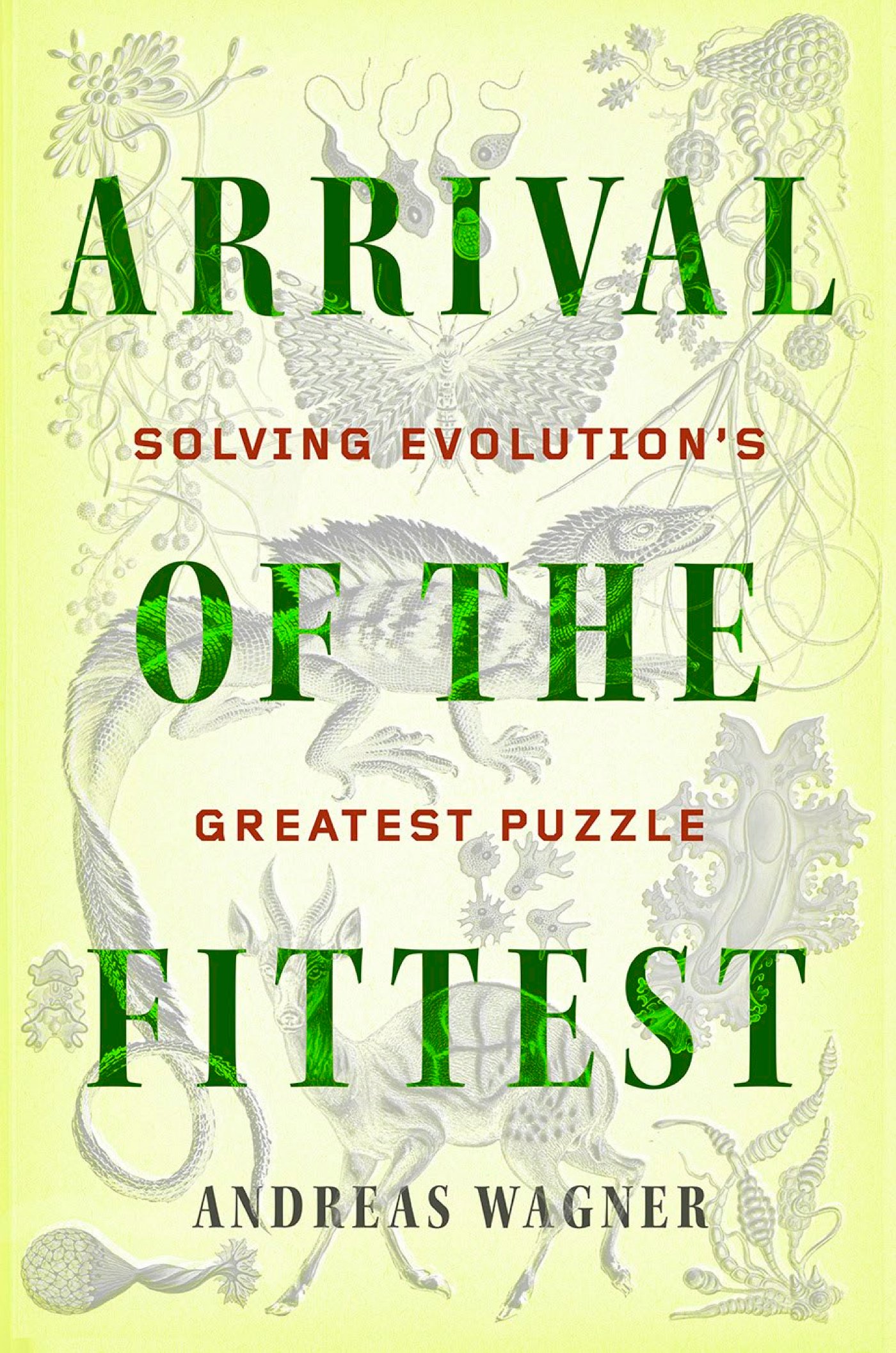
So claims a recent book, Arrival of the Fittest, by Andreas Wagner, professor of evolutionary biology at U Zurich in Switzerland (also associated with the Santa Fe Institute). He lectures worldwide and is a fellow of the American Association for the Advancement of Sciences.

From the book announcement:

Can random mutations over a mere 3.8 billion years solely be responsible for wings, eyeballs, knees, camouflage, lactose digestion, photosynthesis, and the rest of nature’s creative marvels? And if the answer is no, what is the mechanism that explains evolution’s speed and efficiency?

In Arrival of the Fittest, renowned evolutionary biologist Andreas Wagner draws on over fifteen years of research to present the missing piece in Darwin’s theory. Using experimental and computational technologies that were heretofore unimagined, he has found that adaptations are not just driven by chance, but by a set of laws that allow nature to discover new molecules and mechanisms in a fraction of the time that random variation would take.

From a review (which is careful to note that it is not a religious argument):

The question “how does nature innovate?” often elicits a succinct but unsatisfying response – random mutations. Andreas Wagner first illustrates why random mutations alone cannot be the cause of innovations – the search space for innovations, be it at the level of genes, protein, or metabolic reactions is too large that makes the probability of stumbling upon all the innovations needed to make a little fly (let alone humans) too low to have occurred within the time span the universe has been around.

He then shows some of the fundamental hidden principles that can actually make innovations possible for natural selection to then select and preserve those innovations.

Like interacting parallel worlds, this would be momentous news if it is true. But someone is going to have to read the book and assess the strength of the laws advanced.

One thing for sure, if an establishment figure can safely write this kind of thing, Darwin’s theory is coming under more serious fire than ever. But we knew, of course, when Nature published an article on the growing dissent within the ranks about Darwinism.

In origin of life research, there has long been a law vs. chance controversy. For example, Does nature just “naturally” produce life? vs. Maybe if we throw enough models at the origin of life… some of them will stick?

Note: You may have to apprise your old schoolmarm that Darwin’s theory* is “natural selection acting on random mutations,” not “evolution” in general. It is the only theory that claims sheer randomness can lead to creativity, in conflict with information theory. See also: Being as Communion.

*(or neo-Darwinism, or whatever you call what the Darwin-in-the-schools lobby is promoting or Evolution Sunday is celebrating).*

Follow UD News at Twitter!

Comments
keith s: The boolean part is very simple: If the numerical result is higher than an appropriate threshold for the system and time span, and I am not aware of any regularity or of any explicit algorithm in the system which can explain the sequence, I infer design. It is simple. I can do it. The only way it can be a fiasco is if it gives false positives. That would simply mean that it is a wrong procedure, not that it is circular. Empirical procedures, very simply, either work or do not work. So, again, falsify it. Offer a false positive. Is it possible that I have a simple practical procedure to detect design which, in your opinion, is circular, fiasco, whatever you like, and you can't falsify it empirically? Strange indeed.gpuccio
November 8, 2014
November
11
Nov
8
08
2014
11:54 PM
11
11
54
PM
PST
gpuccio,
There is a point where reasonable people must accept that they have different ideas. You don’t seem to believe that, and go on crying: “I am right. I win.”
I've made an argument showing that dFSCI has no scientific value. If you can't refute my argument, that's fine. We can leave it there. There is a cost, however. If you can't defend your own idea, no one else has a reason to take it seriously.keith s
November 8, 2014
November
11
Nov
8
08
2014
11:54 PM
11
11
54
PM
PST
gpuccio,
Wan’t the problem that dFSCI was circular? Please, decide.
The numerical part isn't circular, but it's useless. It's the boolean part that has significance, but your argument is circular. I've explained this already:
gpuccio, We’ve been over this many times, but the problem with your dFSCI calculations is that the number they produce is useless. The dFSCI number reflects the probability that a given sequence was produced purely randomly, without selection. No evolutionary biologists thinks the flagellum (or any other complex structure) arose through a purely random process; everyone thinks selection was involved. By neglecting selection, your dFSCI number is answering a question that no one is asking. It’s useless. There is a second aspect of dFSCI that is a boolean (true/false) variable, but it depends on knowing beforehand whether or not the structure in question could have evolved. You can’t use dFSCI to show that something couldn’t have evolved, because you already need to know that it couldn’t have evolved before you attribute dFSCI to it. It’s hopelessly circular. What a mess. The numerical part of dFSCI is useless because it neglects selection, and the boolean part is also useless because the argument that employs it is circular. dFSCI is a fiasco.
keith s
November 8, 2014
November
11
Nov
8
08
2014
11:47 PM
11
11
47
PM
PST
DNA_Jock: Thank you for your thoughts at #570. By the way, I apologize if I have been slightly "harsh", but that's what my bad character still considers "strong intellectual confrontation". I appreciate your intelligent answer even more for that. :) What can I say? You are a very reasonable person with, IMHO, a few very wrong ideas. No problem in that, and I would be happy if you could see me in a similar way (maybe without the "very", just not to feed my narcissism! :) ). And I don't want to sidetrack more than you would like. So, you feel free to stop the discussion wherever you want. You say: "But I see zero evidence to suggest that the mechanism for affinity maturation has a conscious source." OK, the evidence would obviously be of the ID type (complex functional information), but I never try to compute it for so complex systems. Let's say that I see zero evidence to suggest that the mechanism for affinity maturation evolved by RV + NS. Let's say that it is a pretty mysterious thing. "ABSOLUTELY not. If he were a hyper-intelligent shade of blue, I might have some thinking to do, but if he is the result of replication with variation, I have no trouble ascribing consciousness. It’s quite adaptive." You will maybe admit that there is some pre-commitment to a specific worldview here. No problem in that. I respect pre-commitments. I have mine too. But they are different. And I would definitely love a "hyper-intelligent shade of blue". OK, green would do, too! "I agree. Perhaps because I have a dog." I have three cats. How could we ever expect to understand each other! :) "I’m not the one making false inductions here, and neither are you. I was just pointing out the ridiculousness of the “universal experience” induction to infer a disembodied intelligence. The irony is that I only visited UD in order to point out to Kairosfocus his shoddy math. Sigh. I got involved in two side-tracks, one very interesting, the other, errr, not so much." This is a blog. You are free to choose your sidetracks (maybe you don't know it, but the only other point which I have debated here for a long time beyond ID proper is libertarian free will, in which I passionately believe). :) I must say that I have great respect for Dionisio and for his contributions here. His points about the complexity of regulatory procedures are absolutely valid, and he has offered a lot of very interesting references to recent literature about that in the "third way" thread. I have been deeply engrossed, in the last months, in what is known about epigenetic control of differentiation, and it is refreshing to study a biological argument which screams design and where RV + NS is rarely invoked explicitly, maybe because of some residual modesty. The only reason why I have not yet completed my "announced" post about the procedures is that the subject is so complex and fascinating that I am still studying and reflecting.gpuccio
November 8, 2014
November
11
Nov
8
08
2014
11:41 PM
11
11
41
PM
PST
keith s: "Your “test” is nothing more than this: 1. Look at a comment longer than 600 characters. 2. If you recognize it as meaningful English, conclude that it must be designed. 3. Perform a pointless and irrelevant dFSCI calculation. 4. Conclude that the comment was designed. Why not omit step 3, since it is useless? " Because it is not useless. You could easily enough attain, in a random character generator, the phrase: "I am". Which has perfect sense in English. So, see my post #400: "A Shakespeare sonnet. Alan’s comments about that are out of order. I don’t infer design because I know of Shakespeare, or because I am fascinated by the poetry (although I am). I infer design simply because this is a piece of language with perfect meaning in english (OK, ancient english). Now, a Shakespeare sonnet is about 600 characters long. That corresponds to a search space of about 3000 bits. Now, I cannot really compute the target space for language, but I am assuming here that the number of 600 characters sequences which make good sense in english is lower than 2^2500, and therefore the functional complexity of a Shakespeare sonnet is higher than 500 bits, Dembski’s UPB. As I am aware of no simple algorithm which can generate english sonnets from single characters, I infer design. I am certain that this is not a false positive." As you can see, there are reasons for my empirical threshold in this specific case, and those reasons derive from my concept of dFSCI. Which is neither pointless nor irrelevant. So much so, that you have not falsified it by offering a false positive to my simple procedure. As you can see, as soon as you try something different from repetition of statement of your victory, I answer. I respect arguments, even if wrong. Otherwise, see my post #536.gpuccio
November 8, 2014
November
11
Nov
8
08
2014
11:20 PM
11
11
20
PM
PST
keith s:
This is why the numerical value of dFSCI is irrelevant. Evolution isn’t searching for that specific target, and even if it were, it doesn’t work by random mutation without selection. By omitting selection, you’ve made the dFSCI value useless.
Wan't the problem that dFSCI was circular? Please, decide. For the "any possible function" objection, please see my post #400 here. I have discussed in detail the reasons why NS is not an explanation of protein's dFSCI, on many different threads. If you are backpedaling to this kind of argument, we can discuss it again. But I warn you: it is a biological argument, so you have to forget your silly sidetracks of "the designer can do it in so many other ways", or "dFSCI is circular", which have nothing to do with that. A good start would be: concede for the sake of discussion that there is no need to assume anything about the designer except that he is a conscious, intelligent, purposeful being, and that dFSCI is not circular and empirically works, and that the only way of falsifying the design inference for proteins is to demonstrate that the algorithm RV + NS can explain the functional complexity in them. Then explain briefly why you think that RV + NS can do the trick, and I will give you the reasons why they can't. OK? Otherwise, I quote myself (post #536): "There is a point where reasonable people must accept that they have different ideas. You don’t seem to believe that, and go on crying: “I am right. I win.” That’s fine. Go on."gpuccio
November 8, 2014
November
11
Nov
8
08
2014
11:14 PM
11
11
14
PM
PST
gpuccio, after describing his English-language comment "test" of dFSCI:
This is a challenge. My procedure works. It works not because is is a logical theorem. Not because I have hidden some keithian circularity in it (why should a circular procedure work, at all?). It works because we can empirically verify that it works.
You can't be serious. Can you? Your "test" is nothing more than this: 1. Look at a comment longer than 600 characters. 2. If you recognize it as meaningful English, conclude that it must be designed. 3. Perform a pointless and irrelevant dFSCI calculation. 4. Conclude that the comment was designed. Why not omit step 3, since it is useless? dFSCI adds absolutely nothing that wasn't there already. You had already determined that the comment was designed, so your entire argument is circular: 1. If a 600-character comment looks designed, attribute dFSCI to it. 2. If it has dFSCI, conclude that it was designed. It's amazing to me that you won't let yourself see this, gpuccio.keith s
November 8, 2014
November
11
Nov
8
08
2014
09:47 PM
9
09
47
PM
PST
gpuccio, to Learned Hand:
I will explain what is “simple, beautiful and consistent” about CSI. It is the concept that there is an objective complexity which can be linked to a specification, and that high values of that complexity are a mark of a design origin.
gpuccio, That is true for Dembski's CSI, but not your dFSCI. And as I pointed out above, Dembski's CSI requires knowing the value of P(T|H), which he cannot calculate. And even if he could calculate it, his argument would be circular. Your "solution" makes the numerical value calculable, at the expense of rendering it irrelevant. That's a pretty steep price to pay.
There are indeed different approaches to a formal definition of CSI and of how to compute it,
Different and incommensurable.
a) I define a specification as any explicit rule which generates a binary partition in a search space, so that we can identify a target space from the rest of objects in the search space.
Which is already a problem, because evolution does not seek out predefined targets. It takes what it stumbles upon, regardless of the "specification", as long as fitness isn't compromised.
b) I define a special subset of SI: FSI. IOWs, of all possible types of specification I choose those where the partition is generated by the definition of a function. c) I define a subset of FSI: those objects exhibiting digital information. d) I define dFSI the -log2 of the ratio of the target space / the search space.
This is why the numerical value of dFSCI is irrelevant. Evolution isn't searching for that specific target, and even if it were, it doesn't work by random mutation without selection. By omitting selection, you've made the dFSCI value useless.
e) I categorize the value of dFSI according to an appropriate threshold (for the system and object I am evaluating, see later). If the dFSI is higher than the threshold, I say that the object exhibits dFSCI (see later for the evaluation of necessity algorithms) To infer design for an object, the procedure is as follows: a) I observe an object, which has its origin in a system and in a certain time span. b) I observe that the configuration of the object can be read as a digital sequence. c) If I can imagine that the object with its sequence can be used to implement a function, I define that function explicitly, and give a method to objectively evaluate its presence or absence in any sequence of the same type. d) I can define any function I like for the object, including different functions for the same object. Maybe I can’t find any function for the object. e) Once I have defined a function which is implemented by the object, I define the search space (usually all the possible sequences of the same length). f) I compute, or approximate, as much as possible, the target space, and therefore the target space/search space ratio, and take -log2 of that. This is the dFSI of the sequence for that function. h) I consider if the sequence has any detectable form of regularity, and if any known explicit algorithm available in the system can explain the sequence. The important point here is: there is no need to exclude that some algorithm can logically exist that will be one day found, and so on. All that has no relevance. My procedure is an empiric procedure. If an algorithmic explanation is available, that’s fine. If no one is available, I go on with my procedure.
Which immediately makes the judgment subjective and dependent on your state of knowledge at the time. So much for objectivity.
i) I consider the system, the time span, and therefore the probabilistic resources of the system (the total number of states that the system can reach by RV in the time span). So I define a threshold of complexity that makes the emergence by RV in the system and in the time span of a sequence of the target space an extremely unlikely event. For the whole universe, Dembski’s UPB of 500 bits is a fine threshold. For biological proteins on our planet, I have proposed 150 bits (after a gross calculation).
Again, this is useless because nobody thinks that complicated structures or sequences come into being by pure random variation. It's a numerical straw man.
l) If the functional complexity of the sequence I observe is higher than the threshold (IOWs, if the sequence exhibits dFSCI), and if I am aware of no explicit algorithm available in the system which can explain the sequence, then I infer a design origin for the object. IOWs, I infer that the specific configuration which implements that function originated form a conscious representation and a conscious intentional output of information form a designer to the object.
In other words, you assume design if gpuccio is not aware of an explicit algorithm capable of producing the sequence. This is the worst kind of Designer of the Gaps reasoning. It boils down to this: "If gpuccio isn't aware of a non-design explanation, it must be designed!"keith s
November 8, 2014
November
11
Nov
8
08
2014
09:21 PM
9
09
21
PM
PST
570 DNA_Jock Is that the best you can do to comment on gpuccio's insightful post #569?Dionisio
November 8, 2014
November
11
Nov
8
08
2014
08:09 PM
8
08
09
PM
PST
#568 DNA_Jock
I was checking to see if there were any unanswered questions that you were willing to claim I ought to answer.
That's fine, the onlookers and lurkers can see which questions you didn't answer.Dionisio
November 8, 2014
November
11
Nov
8
08
2014
07:28 PM
7
07
28
PM
PST
#568 DNA_Jock
I think I’m done.
Well, what else can you do when you lack sound arguments to keep the discussion? :)Dionisio
November 8, 2014
November
11
Nov
8
08
2014
07:19 PM
7
07
19
PM
PST
567 DNA_Jock Is that the best you can do to answer questions?Dionisio
November 8, 2014
November
11
Nov
8
08
2014
07:14 PM
7
07
14
PM
PST
DNA_Jock:
(Off-topic: I believe I owe you an apology: from various things that Mung had said about you at TSZ, I had erroneously assumed that you had discussed PDZ on UD. My bad.)
Everything you read at TSZ is true. No need for an apology.Mung
November 8, 2014
November
11
Nov
8
08
2014
05:15 PM
5
05
15
PM
PST
gpuccio, Thought-provoking stuff.
Are you so sure that such a programming has no conscious source?
No, I am not sure. But I see zero evidence to suggest that the mechanism for affinity maturation has a conscious source. You seem to assume that I hold anthropocentric views that I do not, in fact, hold, viz:
if you met an alien who talks, designs, manifests cognition and feelings so that you can understand them, and communicates with you, would you doubt his conscious experiences only because he is not human?
ABSOLUTELY not. If he were a hyper-intelligent shade of blue, I might have some thinking to do, but if he is the result of replication with variation, I have no trouble ascribing consciousness. It's quite adaptive.
That understanding, feeling and love are not mere accidents of one species.
I agree. Perhaps because I have a dog.
So, attempts at trivializing that important concept with false inductions which have nothing to do with its substance have an unpleasant connotation of intellectual arrogance and reductionist dogma in them. With all respect.
I'm not the one making false inductions here, and neither are you. I was just pointing out the ridiculousness of the "universal experience" induction to infer a disembodied intelligence. The irony is that I only visited UD in order to point out to Kairosfocus his shoddy math. Sigh. I got involved in two side-tracks, one very interesting, the other, errr, not so much.DNA_Jock
November 8, 2014
November
11
Nov
8
08
2014
05:02 PM
5
05
02
PM
PST
DNA_Jock: Please, excuse my intrusion, but the inference to design by analogy in the presence of specific aspects in observed outcomes is not so trivial as you seem to make it. There is a reason why human consciousness can design things. It is an empirically observed fact, but there are other empirical observations which can explain how it happens. For example, I would argue that our ability to represent meaning, and our special capacity to have purposes, are the real source of our ability to design complex things. Meaning is the foundation of all human understanding, and meaning is a conscious experience. You cannot define it objectively, out of consciousness. The same is true for desire and purpose: they are feelings. You cannot define them in matter. Material systems do not understand meanings, and have no purposes. That's why they cannot generate new original dFSCI. You point to material algorithms which process information, like in the immune system, but these are not different from a computer software. Algorithms can compute, and they can generate meaningful outputs, but they don't understand what they do. The immune system is programmed to act that way, and it acts that way. Are you so sure that such a programming has no conscious source? The problem is, your equating conscious cognition with the human condition is rather keithian, and I must say that it is a small disappointment for me. Consciousness, meaning, cognition and purpose, and their product, design, are all realities of which we have ample experience in ourselves. Humans experience all those things. But equating all those things with being part of a specific species is rather narrow-minded. Again, I ask, as I have asked keith (if I remember well): if you met an alien who talks, designs, manifests cognition and feelings so that you can understand them, and communicates with you, would you doubt his conscious experiences only because he is not human? Humans have always understood that consciousness is more than human consciousness. That understanding, feeling and love are not mere accidents of one species. When we infer design, we infer a designer who is conscious, has understanding of meaning, and has purposes. We need not imagine him as human or anything else, because we know that those experiences, those qualities, are all that is necessary to design complex things. So, attempts at trivializing that important concept with false inductions which have nothing to do with its substance have an unpleasant connotation of intellectual arrogance and reductionist dogma in them. With all respect.gpuccio
November 8, 2014
November
11
Nov
8
08
2014
04:24 PM
4
04
24
PM
PST
Oh, honey, I know I don't have to answer any of your questions. I was checking to see if there were any unanswered questions that you were willing to claim I ought to answer. I think I'm done.DNA_Jock
November 8, 2014
November
11
Nov
8
08
2014
04:08 PM
4
04
08
PM
PST
Sorry. I was too busy laughing to pick up on the import of your final sentence in #561 there. I have included it as statement #4. It doesn’t change your fallacy, I’m afraid. Your argument now becomes 1. Humans are the only known creators of CFPOPI-processing systems (this is still true, however much you try to parse it) 2. We observe CFPOPI-processing systems in the camel immune system 3. Therefore humans are the creators of the camel immune system. 4. But we know humans are NOT the creators of the camel immune system. 5. Therefore we have made a mistake in our logic. Previously, your argument was Intelligence is the only known source of I-PS, therefore whenever there is I-PS, its origin must be intelligence. You backed away from this argument when I pointed out the corollary: Biology is the only known source of intelligence, therefore whenever there is intelligence, its origin must be biology. The argument that you want to make is as follows: 1. Humans, by virtue of their intelligence, are the only known creators of CFPOPI-processing systems 2. We observe CFPOPI-processing systems in the camel immune system 3. Therefore an intelligence is the creator of the camel immune system. 4. But we know humans are NOT the creators of the camel immune system. 5. Therefore a non-human intelligence is the creator of the camel immune system. But the same “universal observation” inductive reasoning leads us to conclude that all intelligences are made of food.DNA_Jock
November 8, 2014
November
11
Nov
8
08
2014
04:05 PM
4
04
05
PM
PST
#546 DNA_Jock
I answered many, but not all, of your questions. Some appeared to be entirely rhetorical. If there are particular questions that you think I ought to answer, but have not, please restate them.
Remember that you don't have to answer any of my questions. Still the onlookers and lurkers will see what I write and arrive at their own conclusions. :)Dionisio
November 8, 2014
November
11
Nov
8
08
2014
03:21 PM
3
03
21
PM
PST
#564 DNA_Jock Was that the best you could do to respond my question? You rewrote my original text in post #561 and completely changed its meaning. Is that a fair practice in your book? Did you do that by mistake, because you misread and misunderstood the text? Did you do that purposely, intentionally? Why? Do you do that frequently? Is that your way to engaging in serious discussions? :(Dionisio
November 8, 2014
November
11
Nov
8
08
2014
03:14 PM
3
03
14
PM
PST
Dionisio, Truly awesome!
Apparently you did not understand what I meant by “there’s only one known source of information-processing systems: intelligence”. This is about what is known to produce systems that process complex functional purpose-oriented prescriptive information. So far, we know that humans can create such systems.
Well, geez, why didn't you say so? [grin] Depending on your definition of complex (there are nearly as many definitions as there are IDists) then bacteriophage lambda process "complex functional purpose-oriented information". But to humor you, I will imagine that "prescriptive" has some particular meaning such that your statement "So far, we know [only] humans can create such systems". So your argument now has the form: 1. Humans are the only known creators of CFPOPI-processing systems 2. We observe CFPOPI-processing systems in the camel immune system 3. Therefore humans are the creators of the camel immune system. When in #551 I said "You might want to think that one through", I meant that you might want to think that one through. I then said : The problem is with the inductive nature of your “only one known source” argument. It's kinda cute that you omitted the "only" when you went from I-PS to CFPOPI-PS and switched from "intelligence" as the source to "humans". In other news, you might want to look at Fig 1 of Vernimmen.DNA_Jock
November 8, 2014
November
11
Nov
8
08
2014
02:36 PM
2
02
36
PM
PST
Learned Hand: I will explain what is “simple, beautiful and consistent” about CSI. It is the concept that there is an objective complexity which can be linked to a specification, and that high values of that complexity are a mark of a design origin. This is true, simple and beautiful. It is the only objective example of something which can only derive from a conscious intentional cognitive process. There are indeed different approaches to a formal definition of CSI and of how to compute it, and of how to interpret the simple fact that it is a mark of design. I have tried to detail my personal approach, mainly by answering the many objections of my kind interlocutors. And yes, there are slight differences between my approach and, for example, Dembski's, especially after the F. My approach is essentially a completely pragmatic formulation of the EF. In brief. a) I define a specification as any explicit rule which generates a binary partition in a search space, so that we can identify a target space from the rest of objects in the search space. b) I define a special subset of SI: FSI. IOWs, of all possible types of specification I choose those where the partition is generated by the definition of a function. c) I define a subset of FSI: those objects exhibiting digital information. d) I define dFSI the -log2 of the ratio of the target space / the search space. e) I categorize the value of dFSI according to an appropriate threshold (for the system and object I am evaluating, see later). If the dFSI is higher than the threshold, I say that the object exhibits dFSCI (see later for the evaluation of necessity algorithms) To infer design for an object, the procedure is as follows: a) I observe an object, which has its origin in a system and in a certain time span. b) I observe that the configuration of the object can be read as a digital sequence. c) If I can imagine that the object with its sequence can be used to implement a function, I define that function explicitly, and give a method to objectively evaluate its presence or absence in any sequence of the same type. d) I can define any function I like for the object, including different functions for the same object. Maybe I can't find any function for the object. e) Once I have defined a function which is implemented by the object, I define the search space (usually all the possible sequences of the same length). f) I compute, or approximate, as much as possible, the target space, and therefore the target space/search space ratio, and take -log2 of that. This is the dFSI of the sequence for that function. h) I consider if the sequence has any detectable form of regularity, and if any known explicit algorithm available in the system can explain the sequence. The important point here is: there is no need to exclude that some algorithm can logically exist that will be one day found, and so on. All that has no relevance. My procedure is an empiric procedure. If an algorithmic explanation is available, that's fine. If no one is available, I go on with my procedure. i) I consider the system, the time span, and therefore the probabilistic resources of the system (the total number of states that the system can reach by RV in the time span). So I define a threshold of complexity that makes the emergence by RV in the system and in the time span of a sequence of the target space an extremely unlikely event. For the whole universe, Dembski's UPB of 500 bits is a fine threshold. For biological proteins on our planet, I have proposed 150 bits (after a gross calculation). l) If the functional complexity of the sequence I observe is higher than the threshold (IOWs, if the sequence exhibits dFSCI), and if I am aware of no explicit algorithm available in the system which can explain the sequence, then I infer a design origin for the object. IOWs, I infer that the specific configuration which implements that function originated form a conscious representation and a conscious intentional output of information form a designer to the object. m) Why? This is the important point. This is not a logical deduction. The procedure is empirical. It can be applied as it has been described. The simple fact is that, if applied to any object whose origin is independently known (IOWs, we can know if it was designed or not, so we use it to test the procedure and see if the inference will be correct) it has 100% specificity and low sensitivity. IOWs, there are no false positives. IOWs, there is no object in the universe (of which we can know the origin independently) for which we would infer design by this procedure and be wrong. Now, I will do a quick test. There are 560 posts in this thread. While I know independently that they are designed things, for a lot of reasons, I state here that any post here longer than 600 characters, and with good meaning in English, is designed. And I challenge you to offer any list of characters longer than 600, as many as you like, where you can mix two types of sequences: some are true posts in good English, with a clear meaning, taken from any blog you like. Others will be random lists of characters, generated by a true random character generator software. Well, hear me! I will recognize all the true designed posts, and I will never make a falsely positive design inference for any of the other lists. Now, you can try any trick. You can add posts in languages that I don't know. You can add encryption of true posts that I will not recognize. Whatever you like. I will not recognize their meaning, and I will not infer design. They will be false negatives. You know, my procedure has low sensitivity. However, I will infer design for all the posts which have good meaning in English, and I will be right. And I will never infer design for a sequence which is the result of a random character generator. What about algorithms? Well, you can use any algorithm you like, but without adding any information about what has good meaning in English. IOWs, you cannot use the Weasel algorithm, where the outcome is already in the system. You cannot use an English dictionary, least of all a syntax correction software. Again, that would be recycling functional information, not generating it. But you can use an algorithm which generates sequences according to the Fibonacci series, if you like. Or an algorithm which takes a random character and generates lists with 600 same characters. Whatever you like. Because I am not using order as a form of specification. I am using meaning. And meaning cannot be generated by necessity algorithms. So, if I see a sequence of 600 A, I will not infer design for it. But for a Shakespeare sonnet I will. This is a challenge. My procedure works. It works not because is is a logical theorem. Not because I have hidden some keithian circularity in it (why should a circular procedure work, at all?). It works because we can empirically verify that it works. IOWs there could be sequences which are not designed, ad which are not obvious results of an algorithm, and which have high functional information. There could be. It is not logically impossible. But none of those sequences is known. They simply don't exist. In the known universe, of all the objects of which we know the origin, only designed object will be inferred as designed by the application of my procedure. Again, falsify this statement if you can. Offer one false positive. One. Except for... Except, obviously, for biological objects. They are the only known objects in the universe which exhibit dFSCI, tons of it, and of which we don't know the origin. But that is exactly the point. We don't know their origin. But they exhibit dFSCI. In tons. So, I infer design for them (or at least, for those which certainly exhibit dFSCI). Is any algorithm known explicitly which could explain the functional information, say, in ATP synthase? No. There is nothing like that. There is the RV + NS. But it cannot explain that. Not explicitly. Only dogma supports that kind of explanation. The simple fact is: both complex language and complex function never derive from simple necessity algorithms. You cannot write a Shakespeare sonnet by a simple mathematical formula. You cannot find the sequence of ATP synthase by a simple algorithm. Maybe we could do it by a very complex algorithmic search, which includes all our knowledge of biochemistry, present and future, and supreme computational resources. We are still very distant from that achievement. And the procedure would be infinitely more complex than the outcome, and it would require constant conscious cognition (design). Well, I have not been so brief, after all. Now, if there are parts of my reasoning which are not clear enough, just ask. I am here. Or, if you just want to falsify my empirical procedure, offer a false positive. I am here. More likely, you can simply join keith in the group of the denialists. But at least, you will know more now of what you are denying. :)gpuccio
November 8, 2014
November
11
Nov
8
08
2014
02:27 PM
2
02
27
PM
PST
#558 DNA_Jock #561 addendum RE: "systems that process complex functional purpose-oriented prescriptive information" you may read gpuccio's comments quoted in post #559 above. :)Dionisio
November 8, 2014
November
11
Nov
8
08
2014
01:42 PM
1
01
42
PM
PST
#558 DNA_Jock
Sure- if you say “there’s only one known source of information-processing systems: intelligence” this is fine so long as you include beavers, bees, termites, smile molds, yeast, and bacteriophage lambda, which are all sources of information-processing systems. Prions, not so much; they cause havoc in one particular type of information-processing system, one on which many people place an undue emphasis…
Apparently you did not understand what I meant by “there’s only one known source of information-processing systems: intelligence”. This is about what is known to produce systems that process complex functional purpose-oriented prescriptive information. So far, we know that humans can create such systems. Do we know anything else that can produce such systems? However, the discoveries in biology are pointing to that kind of systems. Our empirical evidence tells us that only intelligent agents have created that kind of systems, although we know humans did not create the biological systems we encounter in nature. What can you say about this?Dionisio
November 8, 2014
November
11
Nov
8
08
2014
01:31 PM
1
01
31
PM
PST
DNA_Jock: OK, it's been fun.gpuccio
November 8, 2014
November
11
Nov
8
08
2014
01:29 PM
1
01
29
PM
PST
#551 DNA_Jock
D: Has anyone proposed a comprehensive step-by-step description of how those biological orchestrations could have appeared? If you know of any, can you point to it? I would gladly read it.
Autodidactism can lead one astray; I would recommend taking a degree or two in biology.
Is that the best you can do to respond my question? Do you want to give it another try? Let me give you a hint. Here's something very interesting that gpuccio wrote in another thread today:
Indeed, what we see in research about cell differentiation and epigenomics is a growing mass of detailed knowledge (and believe me, it is really huge and daily growing) which seems to explain almost nothing. What is really difficult to catch is how all that complexity is controlled. Please note, at this level there is almost no discussion about how the complexity arose: we have really non idea of how it is implemented, and therefore any discussion about its origin is almost impossible. Now, there must be information which controls the flux. It is a fact that cellular differentiation happens, that it happens with very good order and in different ways in different species, different tissues, and so on. That cannot happen without a source of information. And yet, the only information that we understand clearly is then protein sequence information. Even the regulation of protein transcription at the level of promoters and enhancers by the transcription factor network is of astounding complexity.
Please, look at this paper: Uncovering Enhancer Functions Using the ?-Globin Locus. http://www.ncbi.nlm.nih.gov/pmc/articles/PMC4199490/pdf/pgen.1004668.pdft In particular Fig. 2. And this is only to regulate the synthesis of alpha globin in red cells, a very straightforward differentiation task.
So, I see that, say, 15 TFs are implied in regulating the synthesis of one protein, I want to know why, and what controls the 15 TFs, and what information guides that control. My general idea is that, unless we find some completely new model, information that guides a complex process, like differentiation, in a reliable, repetitive way must be written, in some way, somewhere. That’s what I want to know: where that information is written, how it is written, how does it work, and, last but not least, how did it originate? https://uncommondescent.com/evolution/a-third-way-of-evolution/#comment-526476
Dionisio
November 8, 2014
November
11
Nov
8
08
2014
01:11 PM
1
01
11
PM
PST
dionisio, Sure- if you say "there’s only one known source of information-processing systems: intelligence" this is fine so long as you include beavers, bees, termites, smile molds, yeast, and bacteriophage lambda, which are all sources of information-processing systems. Prions, not so much; they cause havoc in one particular type of information-processing system, one on which many people place an undue emphasis...DNA_Jock
November 8, 2014
November
11
Nov
8
08
2014
12:47 PM
12
12
47
PM
PST
#551 DNA_Jock
Have you read “Signature in the Cell”?
No, I haven't. Have you?
What did you think of his treatment of the TDPS bootstrap problem?
Since I haven't read that material, I don't have any opinion on what it says. Why did you ask?Dionisio
November 8, 2014
November
11
Nov
8
08
2014
12:38 PM
12
12
38
PM
PST
#551 DNA_Jock
When you say “As far as I recall, there’s only one known source of information-processing systems: intelligence.”, I am inclined to agree with you, but only so long as we maintain a rather broad view of “intelligence”, that includes virtually all extant organisms, and viruses too. We can exclude prions.
I don't understand what you mean by that. Can you explain it more? Thank you. :)Dionisio
November 8, 2014
November
11
Nov
8
08
2014
12:21 PM
12
12
21
PM
PST
Crikey, that's even worse. You have moved from the "the experiment was designed" complaint to the "it isn't the experiment I would have done" complaint. I understand that you think otherwise, but you have not provided any basis for your argument that Lizzie's model, or Keefe's experiments, were not fit-for-purpose. Well, it's been fun.DNA_Jock
November 8, 2014
November
11
Nov
8
08
2014
12:07 PM
12
12
07
PM
PST
DNA_Jock; No. He could have selected anything, then he could have taken that "anything", described that "anything" and we would know that that "anything" can be found in a random library. And he could have taken that "anything", as it was in the original library, and tested it in any biological experiment to show that it is naturally selectable. So, it is not the “the experiment was designed” complaint. It is the "the experiment is a bad experiment, which means nothing" complaint. Unless the purpose was to show that protein engineering, in its bottom up form, works. But we already knew that. Therefore, no, I am sorry, but I can't see that this is deranged. Can't you see, instead, how deranged it is to propose an implementation of engineering as though it were a model of NS? I supposed that the only quality requested of a model is that it should model the thing it is supposed to model. "Model" means to have a similar form, similar properties, so that we can draw conclusions about the modeled thing from the model itself. All those things are violated in both our examples, and yet you and others still defend them as though they were true models. This is deranged.gpuccio
November 8, 2014
November
11
Nov
8
08
2014
11:37 AM
11
11
37
AM
PST
1 … 3 4 5 6 7 … 24