Uncommon Descent Serving The Intelligent Design Community
meniscus

FOOTNOTE: On Einstein, Dembski, the Chi Metric and observation by the judging semiotic agent

Categories
Intelligent Design
Share
Facebook
Twitter/X
LinkedIn
Flipboard
Print
Email

(Follows up from here.)

Over at MF’s blog, there has been a continued stream of  objections to the recent log reduction of the chi metric in the recent CSI Newsflash thread.

Here is commentator Toronto:

__________

>> ID is qualifying a part of the equation’s terms with subjective observation.

If I do the same to Einstein’s, I might say;

E = MC^2, IF M contains more than 500 electrons,

BUT

E **MIGHT NOT** be equal to MC^2 IF M contains less than 500 electrons

The equation is no longer purely mathematical but subject to other observations and qualifications that are not mathematical at all.

Dembski claims a mathematical evaluation of information is sufficient for his CSI, but in practice, every attempt at CSI I have seen, requires a unique subjective evaluation of the information in the artifact under study.

The determination of CSI becomes a very small amount of math, coupled with an exhausting study and knowledge of the object itself.>>

_____________

A few thoughts in response:

a –> First, let us remind ourselves of the log reduction itself, starting with Dembski’s 2005 chi expression:

χ = – log2[10^120 ·ϕS(T)·P(T|H)]  . . . eqn n1

How about this (we are now embarking on an exercise in “open notebook” science):

1 –> 10^120 ~ 2^398

2 –> Following Hartley, we can define Information on a probability metric:

I = – log(p) . . .  eqn n2

3 –> So, we can re-present the Chi-metric:

Chi = – log2(2^398 * D2 * p)  . . .  eqn n3

Chi = Ip – (398 + K2) . . .  eqn n4

4 –> That is, the Dembski CSI Chi-metric is a measure of Information for samples from a target zone T on the presumption of a chance-dominated process, beyond a threshold of at least 398 bits, covering 10^120 possibilities.

5 –> Where also, K2 is a further increment to the threshold that naturally peaks at about 100 further bits . . . . As in (using Chi_500 for VJT’s CSI_lite):

Chi_500 = Ip – 500,  bits beyond the [solar system resources] threshold  . . . eqn n5

Chi_1000 = Ip – 1000, bits beyond the observable cosmos, 125 byte/ 143 ASCII character threshold . . . eqn n6

Chi_1024 = Ip – 1024, bits beyond a 2^10, 128 byte/147 ASCII character version of the threshold in n6, with a config space of 1.80*10^308 possibilities, not 1.07*10^301 . . . eqn n6a . . . .

Using Durston’s Fits from his Table 1, in the Dembski style metric of bits beyond the threshold, and simply setting the threshold at 500 bits:

RecA: 242 AA, 832 fits, Chi: 332 bits beyond

SecY: 342 AA, 688 fits, Chi: 188 bits beyond

Corona S2: 445 AA, 1285 fits, Chi: 785 bits beyond  . . . results n7

The two metrics are clearly consistent . . . .one may use the Durston metric as a good measure of the target zone’s actual encoded information content, which Table 1 also conveniently reduces to bits per symbol so we can see how the redundancy affects the information used across the domains of life to achieve a given protein’s function; not just the raw capacity in storage unit bits [= no.  of  AA’s * 4.32 bits/AA on 20 possibilities, as the chain is not particularly constrained.]

b –> In short, we are here reducing the explanatory filter to a formula. Once we have specific, observed functional information of Ip bits,  and we compare it to a threshold of a sufficiently large configuration space, we may infer that the instance of FSCI (or more broadly CSI)  is sufficiently isolated that the accessible search resources make it maximally unlikely that its best explanation is unintelligent cause by blind chance plus mechanical necessity. Instead, the best, and empirically massively supported causal explanation is design:


Fig 1: The ID Explanatory Filter

c –> This is especially clear when we use the 1,000 bit threshold, but in fact the “practical” universe we have is our solar system. And so, since the number of Planck time quantum states of our solar system since the usual date of the big bang is not more than 10^102, something that is in a config space of 10^150 [500 bits worth of possibilities] is 48 orders of magnitude beyond that threshold.

d –> So, something from a config space of 10^150 or more (500+ functionally specific bits) is on infinite monkey analysis grounds, comfortably beyond available search resources. 1,000 bits puts it beyond the resources of the observable cosmos:
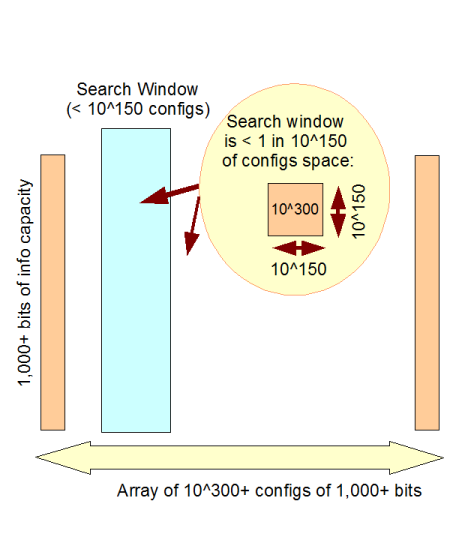
Fig 2: The Observed Cosmos search window

e –> What the reduced Chi metric is telling us is that if say we had 140 functional bits [20 ASCII characters] , we would be 360 bits short of the threshold, and in principle a random walk based search could find something like that. For, while the reduced chi metric is giving us a value, it tells us we are falling short and by how much:

Chi_500(140 bits) = 140 – 500 = – 360 specific bits, within the threshold

f –> So, the Chi_500 metric tells us instances of this could happen by chance and trial and error testing.   Indeed, that is exactly what has happened with random text generation experiments:

One computer program run by Dan Oliver of Scottsdale, Arizona, according to an article in The New Yorker, came up with a result on August 4, 2004: After the group had worked for 42,162,500,000 billion billion monkey-years, one of the “monkeys” typed, “VALENTINE. Cease toIdor:eFLP0FRjWK78aXzVOwm)-‘;8.t” The first 19 letters of this sequence can be found in “The Two Gentlemen of Verona”. Other teams have reproduced 18 characters from “Timon of Athens”, 17 from “Troilus and Cressida”, and 16 from “Richard II”.[20]

A website entitled The Monkey Shakespeare Simulator, launched on July 1, 2003, contained a Java applet that simulates a large population of monkeys typing randomly, with the stated intention of seeing how long it takes the virtual monkeys to produce a complete Shakespearean play from beginning to end. For example, it produced this partial line from Henry IV, Part 2, reporting that it took “2,737,850 million billion billion billion monkey-years” to reach 24 matching characters:

RUMOUR. Open your ears; 9r"5j5&?OWTY Z0d

g –> But, 500 bits or 72 ASCII characters, and beyond this 1,000 bits or 143 ASCII characters, are a very different proposition, relative to the search resources of the solar system or the observed cosmos.

h –> That is why, consistently, we observe CSI beyond that threshold [e.g. Toronto’s comment] being produced by intelligence, and ONLY as produced by intelligence.

i –> So, on inference to best empirically warranted explanation, and on infinite monkeys analytical grounds, we have excellent reason to have high confidence that the threshold metric is credible.

j –> As a bonus, we have exposed the strawman suggestion that the Chi metric only applies beyond the threshold. Nope, it applies within the threshold and correctly indicates that something of such an order could come about by chance and necessity within the solar system’s search resources.

k –> is a threshold metric inherently suspicious? Not at all. In control system studies, for instance, we learn that once you reduce your expression to a transfer function of form

G = [(s – z1)(s- z2) . . . ]/[(s – p1)(s-p2)(s – p3) . . . ]

. . . then, if poles appear in the RH side of the complex s-plane, you have an unstable system.

l –> A threshold, and one that, when poles approach close to the threshold from the LH half-plane, will show up in a tendency that can be detected in the frequency response as peakiness.

m –> Is the simplicity of the math in question, in the end [after you have done the hard work of specifying information, and identifying thresholds], suspicious? No, again. For instance, let us compare:

v = i* R

q = v* C

n = sin i/ sin r

F = m*a

F2 = – F1

s = k log W

E = m0*c^2

v = H0D

Ik = – log2 (pk)

E = h*νφ

n –> Each of these is elegantly simple, but awesomely powerful; indeed, the last — precisely, a threshold relationship — was a key component of Einstein’s Nobel Prize (Relativity was just plain too controversial). And, once we put them to work in practical, empirical situations, each of them ” . . .  is no longer purely mathematical but subject to other observations and qualifications that are not mathematical at all.”

(The objection is clearly selectively hyperskeptical. Since when was an expression about an empirical quantity or situation “purely mathematical”? Let’s try another expression:

Y = C + I + G + [X – M].

How are its components measured and/or estimated, and with how much application of judgement calls, including those tracing to GAAP? [Cf discussion here.] Is this expression therefore meaningless and of no utility? What about M*VT = PT*T?)

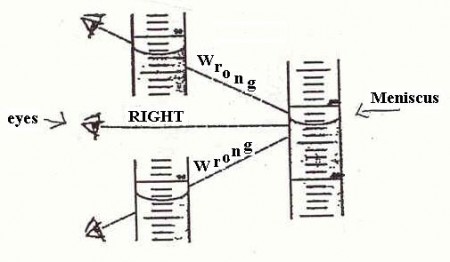
o –> So, what about that horror, the involvement of the semiotic, judging agent as observer, who may even intervene and– shudder — judge? Of course, the observer is a major part of quantum mechanics, to the point where some are tempted to make it into a philosophical position. But the problem starts long before that, e.g. look at the problem of reading a meniscus! (Try, for Hg in glass, and for water in glass — the answers are different and can affect your results.)
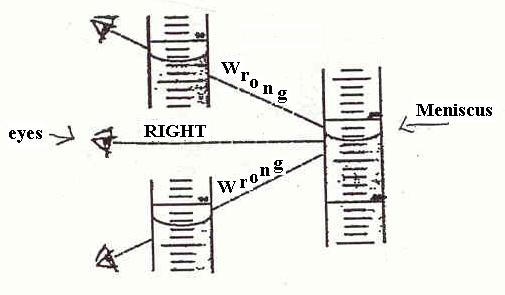
Fig 3: Reading a meniscus to obtain volume of a liquid is both subjective and objective (Fair use clipping.)

p –> So, there is nothing in principle or in practice wrong with looking at information, and doing exercises — e.g. see the effect of deliberately injected noise of different levels, or of random variations — to test for specificity. Axe does just this, here, showing the islands of function effect dramatically. Clipping:

. . . if we take perfection to be the standard (i.e., no typos are tolerated) then P has a value of one in 10^60. If we lower the standard by allowing, say, four mutations per string, then mutants like these are considered acceptable:

no biologycaa ioformation by natutal means
no biologicaljinfommation by natcrll means
no biolojjcal information by natiral myans

and if we further lower the standard to accept five mutations, we allow strings like these to pass:

no ziolrgicgl informationpby natural muans
no biilogicab infjrmation by naturalnmaans
no biologilah informazion by n turalimeans

The readability deteriorates quickly, and while we might disagree by one or two mutations as to where we think the line should be drawn, we can all see that it needs to be drawn well below twelve mutations. If we draw the line at four mutations, we find P to have a value of about one in 10^50, whereas if we draw it at five mutations, the P value increases about a thousand-fold, becoming one in 10^47.

q –> Let us note how — when confronted with the same sort of skepticism regarding the link between information [a “subjective” quantity] and entropy [an “objective” one tabulated in steam tables etc] — Jaynes replied:

“. . . The entropy of a thermodynamic system is a measure of the degree of ignorance of a person whose sole knowledge about its microstate consists of the values of the macroscopic quantities . . . which define its thermodynamic state. This is a perfectly ‘objective’ quantity . . . it is a function of [those variables] and does not depend on anybody’s personality. There is no reason why it cannot be measured in the laboratory.”

r –> In short, subjectivity of the investigating observer is not a barrier to the objectivity of the conclusions reached, providing they are warranted on empirical and analytical grounds. As has been provided for the Chi metric, in reduced form.  END

Comments
Still no sign of MathGrrl.Mung
May 15, 2011
May
05
May
15
15
2011
04:27 PM
4
04
27
PM
PDT
F/N: I have again had to respond correctively for the record at MF's blog, not least to attempted "outing" behaviour.kairosfocus
May 14, 2011
May
05
May
14
14
2011
05:57 AM
5
05
57
AM
PDT
PS: Kinchin seems to be a Russian Mathematician who wrote on the topics 60 years ago, originally in Russian. So, his work falls under the unfortunate cold war era split in science.kairosfocus
May 14, 2011
May
05
May
14
14
2011
02:17 AM
2
02
17
AM
PDT
Mung: MG, unfortunately, has been only showing up every so often to toss back in her repeated objections, regardless of corrections that have been worked through over and over. For weeks now. Over at MF's blog, she seems to have found an echo chamber. Somehow, it has not dawned on her that the CSI-FSCO/I concepts are plainly meaningful as descriptions of observed reality, and that the mathematical models and metrics developed in recent years are also reasonable relative to what such set out to be. Nor, that they are in fact effective, as we can again see above. All that is necessary is that the result of such cuts across the expectations of evolutionary materialism. Sad. When it comes to the intersection of information and the four Aristotelian causes, the classic view is a good point to begin. In a handy summary that we can start from:
1] Material cause: “that from which, [as a constituent] present in it, a thing comes to be … e.g., the bronze and silver, and their genera, are causes of the statue and the bowl.” [NB: S. Marc Cohen warns that the underlying word, aiton is being used ambiguously, accor to Ari's warning. So, he seeks to more accurately define sense. Here: x is what y is [made] out of. E.g. The table is made of wood.] 2] Formal cause: “the form, i.e., the pattern … the form is the account of the essence … and the parts of the account.” [sense: x is what it is to be y. E.g. Having four legs and a flat top makes this (count as) a table.] 3] Efficient cause: “the source of the primary principle of change or stability,” e.g., the man who gives advice, the father (of the child). “The producer is a cause of the product, and the initiator of the change is a cause of what is changed.” [sense: x is what produces y. E.g. A carpenter makes a table.] 4] Final cause: “something’s end (telos)—i.e., what it is for—is its cause, as health is [the cause] of walking.” [sense: x is what y is for. E.g. Having a surface suitable for eating or writing makes this (work as) a table. ]
Cohen then sets the matter in the context of our own issues in our day:
Matter and form are two of the four causes, or explanatory factors. They are used to analyze the world statically - they tell us how it is at a given moment. But they do not tell us how it came to be that way. For that we need to look at things dynamically - we need to look at causes that explain why matter has come to be formed in the way that it has. Change consists in matter taking on (or losing) form. Efficient and final causes are used to explain why change occurs . . . . This seems like a plausible doctrine about artifacts : they can be explained both statically (what they are, and what they’re made of) and dynamically (how they came to be, and what they are for) . . . . But what about natural objects? Aristotle (notoriously) held that the four causes could be found in nature, as well. That is, that there is a final cause of a tree, just as there is a final cause of a table. Here he is commonly thought to have made a huge mistake. How can there be final causes in nature, when final causes are purposes, what a thing is for? In the case of an artifact, the final cause is the end or goal that the artisan had in mind in making the thing. But what is the final cause of a dog, or a horse, or an oak tree? . . . . The final cause of a natural object - a plant or an animal - is not a purpose, plan, or “intention.” Rather, it is whatever lies at the end of the regular series of developmental changes that typical specimens of a given species undergo. The final cause need not be a purpose that someone has in mind. I.e., where F is a biological kind: the telos of an F is what embryonic, immature, or developing Fs are all tending to grow into. The telos of a developing tiger is to be a tiger. Aristotle opposes final causes in nature to chance or randomness. So the fact that there is regularity in nature - as Aristotle says, things in nature happen “always or for the most part” - suggests to him that biological individuals run true to form. So this end, which developing individuals regularly achieve, is what they are “aiming at.” Thus, for a natural object, the final cause is typically identified with the formal cause. The final cause of a developing plant or animal is the form it will ultimately achieve, the form into which it grows and develops. References: Physics 198a25, 199a31, De Anima 415b10, Generation of Animals 715a4ff. This helps to explain why “form, mover, and telos often coincide,” as Aristotle says (198a25). I.e., why one and the same thing can serve as three of the causes - formal, efficient, and final . . . . So the final cause of a natural substance is its form. But what is the form of such a substance like? Is form merely shape, as the word suggests? No. For natural objects - living things - form is more complex. It has to do with function. We can approach this point by beginning with the case of bodily organs. For example, the final cause of an eye is its function, namely, sight. That is what an eye is for. And this function, according to Aristotle, is part of the formal cause of the thing, as well. Its function tells us what it is. What it is to be an eye is to be an organ of sight. To say what a bodily organ is is to say what it does - what function it performs. And the function will be one which serves the purpose of preserving the organism or enabling it to survive and flourish in its environment.
The trick in all this is of course the subtle impact of Darwinian evolutionary materialism as a controlling perspective in our day. That is what leads us to ever so often miss the fact that the form that an embryonic organism of type X takes, is empirically known to be based on development regulating programs and "circuits" encoded in its DNA and the process of response to its stage in life and surroundings. The form that that process targets is in-built as in effect a guiding program. As information and linked effecting nanomachinery. In short, a tiger takes that form because of a program built into its zygote, and because of associated effecting machinery. Thus, formal cause is tied to information, and to an in-built information processing system. One that highly specific, and is well beyond the complexity threshold where the empirically warranted best explanation is design. That is, we are back at the point of Paley's stumbled upon self-replicating, AND time-keeping watch, as he discussed in Ch II of his Nat Theol -- which hardly ever comes up in the usual dismissive critiques. Let's hear him, in his own voice, beyond the convenient strawman we so often see set up and knocked over: ______________ >> Suppose, in the next place, that the person who found the watch should after some time discover that, in addition to all the properties which he had hitherto observed in it, it possessed the unexpected property of producing in the course of its movement another watch like itself -- the thing is conceivable; that it contained within it a mechanism, a system of parts -- a mold, for instance, or a complex adjustment of lathes, baffles, and other tools -- evidently and separately calculated for this purpose . . . . The first effect would be to increase his admiration of the contrivance, and his conviction of the consummate skill of the contriver. Whether he regarded the object of the contrivance, the distinct apparatus, the intricate, yet in many parts intelligible mechanism by which it was carried on, he would perceive in this new observation nothing but an additional reason for doing what he had already done -- for referring the construction of the watch to design and to supreme art . . . . He would reflect, that though the watch before him were, in some sense, the maker of the watch, which, was fabricated in the course of its movements, yet it was in a very different sense from that in which a carpenter, for instance, is the maker of a chair -- the author of its contrivance, the cause of the relation of its parts to their use. [[Emphases added. (Note: It is easy to rhetorically dismiss this argument because of the context: a work of natural theology. But, since (i) valid science can be -- and has been -- done by theologians; since (ii) the greatest of all modern scientific books (Newton's Principia) contains the General Scholium which is an essay in just such natural theology; and since (iii) an argument 's weight depends on its merits, we should not yield to such “label and dismiss” tactics. It is also worth noting Newton's remarks that “thus much concerning God; to discourse of whom from the appearances of things, does certainly belong to Natural Philosophy [[i.e. what we now call “science”].” )] >> _______________ Paley, of course was a generation before the computer was conceived by Babbage, and nearly 150 years before the first truly successful ones were built. But the point still stands. Our tendency to refuse to see that functional organisation on a Wicken wiring diagram -- especially in the context of things that serve a function AND replicate themselves -- is telling us that natural entities too can be artifacts, is challenged by this. All the more reason why there is that stubborn refusal to think outside of the materialistic box is an ideological captivity, not a sound framework for science. GEM of TKI PS: No I have never heard of this author. There are many authors, and there is much playing around with the basic ideas, e.g. I gather there are 3 - 4 dozen variants on the entropy concept and related models and metrics, alone. Before we wander off into the tangled bushes and vines of current speculative research, it would be wise to ground on the established, well tested frame of thought that is used in building engines, and in building telephone networks and the Internet.kairosfocus
May 14, 2011
May
05
May
14
14
2011
01:27 AM
1
01
27
AM
PDT
Well, that's a lot to chew on. But I'll save it to disk and work my way through. I haven't spent much time on the IOSE site, so I'll have to take a closer look. Still waiting for MathGrrl to show back up and demonstrate true sincerity. (Like that's ever going to happen.) In addition to the interests I stated above, I'd also like to explore the relationship between information and A-T formal causes. This is I think an interesting philosophical question, because of what the implications might be for information in the universe apart from biological organisms. I think I have one chapter to go in Information and the Nature of Reality, then it's on to Information and Living Systems. kairosfocus, Have you heard of A.I. Khinchin? One of my recent book acquisitions is his Mathematical Foundations of Information Theory. I think it contains two of his papers, the first of which is titled "The Entropy Concept in Probability Theory."Mung
May 13, 2011
May
05
May
13
13
2011
05:26 PM
5
05
26
PM
PDT
6: What is information? The UD glossary, clipping and re-organising Wiki, defines: "“ . . that which would be communicated by a message if it were sent from a sender to a receiver capable of understanding the message . . . . In terms of data, it can be defined as a collection of facts [i.e. as represented or sensed in some format] from which conclusions may be drawn [and on which decisions and actions may be taken]." 7: How can information be measured? By reducing it to symbols [if it is not already in that form] and observing the statistics, so that we see the argument in Taub and Schilling -- and BTW, are you repeating for emphasis or is the T & S summary unclear:
Let us consider a communication system in which the allowable messages are m1, m2, . . ., with probabilities of occurrence p1, p2 [generally, detected through statistical studies of messages, e/g E is about 1/8 of typical English text], . . . . Of course p1 + p2 + . . . = 1. Let the transmitter select message mk of probability pk; let us further assume that the receiver has correctly identified the message [My nb: i.e. the a posteriori probability in my online discussion is 1]. Then we shall say, by way of definition of the term information, that the system has communicated an amount of information Ik given by Ik = (def) log2 1/pk (13.2-1) [i.e. Ik = - log2 pk, in bits]
8: What is the relationship between information and Intelligent Design theory? Right from the beginning in the 70's, we see Orgel and Wicken observing, in the context of OOL and OO body plans: ___________ Orgel, 1973: >> . . . In brief, living organisms are distinguished by their specified complexity. Crystals are usually taken as the prototypes of simple well-specified structures, because they consist of a very large number of identical molecules packed together in a uniform way. Lumps of granite or random mixtures of polymers are examples of structures that are complex but not specified. The crystals fail to qualify as living because they lack complexity; the mixtures of polymers fail to qualify because they lack specificity. [[The Origins of Life (John Wiley, 1973), p. 189.] >> Wicken, 1979: >> ‘Organized’ systems are to be carefully distinguished from ‘ordered’ systems. Neither kind of system is ‘random,’ but whereas ordered systems are generated according to simple algorithms [[i.e. “simple” force laws acting on objects starting from arbitrary and common- place initial conditions] and therefore lack complexity, organized systems must be assembled element by element according to an [[originally . . . ] external ‘wiring diagram’ with a high information content . . . Organization, then, is functional complexity and carries information. It is non-random by design or by selection, rather than by the a priori necessity of crystallographic ‘order.’ [[“The Generation of Complexity in Evolution: A Thermodynamic and Information-Theoretical Discussion,” Journal of Theoretical Biology, 77 (April 1979): p. 353, of pp. 349-65. >> ____________ Design theory in effect draws from this challenge the conclusion that the central question is the causal origin of Wicken wiring diagram [which starts with s-t-r-i-n-g-s] functionally specific complex organisation/info, or more broadly of specified complexity similar to what is manifested in life forms. Empirically and analytically, the best explanation is intelligent design, as the FSCI in this post demonstrates. 9: What is entropy? A measure of microscopic freedom of state, which constrains how much work can be harvested from a hot body, and which is equivalently a measure of what we do not know about the specific arrangement of particles, momentum and energy at micro level if what we know is the lab level aggregate variables such as P, V, T, mass etc. Cf my B/N APP 1, from the beginning. Notice what happens with the marbles and pistons model once energy is pushed into it. 10: How can entropy be measured? Macroscopically, from the view of work and heat flows, ds >/= d'Q/T, increment in entropy is at least equal to the increment in heat flow divided by the absolute temp of the relevant body. From this, and considering the exchange of heat between a hot and a cold body within an isolated system, the second law drops out as a direct consequence. It is also implied that when a body has energy pushed into it, it tends to INCREASE its entropy, though of course if there is a coupling mechanism, some of the injected energy can be turned into work. Work being orderly or organised motion imposed by forces. At micro level, this is linked to the number of ways energy and mass etc may be specifically distributed conssitent with a given set of macro-level conditions: s = k log w 11: Why does entropy change in only one direction? This is loose terminology. In an exchange, entropy can increase or decrease for components, but at macro level overall entropy of an isolated system will rise as already discussed. At micro level, the issue is that spontaneous change will move to the more probable cluster of microstates associated with a given macro-level state. As already discussed. 12: What is the relationship between entropy and information? Cf Jaynes as already cited, and previous posts in this thread and elsewhere. 13: What is disorder? I this context, a more simple term for the sort of most likely, i.e equilibrium state at micro level. It turns out that the spontaneously most likely states are the ones where things at this level are most obviously "random," and that he states that are functional in interesting ways are strongly constrained and isolated in the space of possible configs. they come from MG's un-favourite: ISLANDS OF FUNCTION. 14: How can disorder be measured? By moving tot the more formal and defined term, entropy. 15: What is the relationship between disorder and entropy? Disorder is in effect a loose term for a high entropy condition, familiar form what happens when say a tornado passes through town. the fucntional configs of the structures is spontaneously rare but it is set up by design through doing organised work. Along comes a spontaneous force of nature and it moves towards equilibrium. A very expensive mess occurs. And, if the tornado passes through Seattle, it is utterly unlikely to assemble a flyable 747 by chance form the parts in the local junkyards. Sir Fred Hoyle was dead right on that. of course our busy little evo mat rhetors have tried to turn this into a "fallacy." One they love to brush aside. But in fact Sir Fred was a Nobel-equivalent prize winning astrophysicist, who knew his thermodynamics. So, one should take pause before dismissing what he has to say. In truth, the same tornado would be utterly unlikely to assemble an instrument on the 747's dashboard by chance, and for the same reason. Just as, if it were to hit the printer's shop in town, it would be utterly unlikely to print the manual for the 747, by splashing ink across paper. But, for the same reason, it would be utterly unlikely to print just one page from the manual either by the same means. Sir Fred used an extreme case to make his point, but they strawmannised his point instead of facing the core issue: once you go past about 143 ASCII characters worth of info, the resources of the observed cosmos are utterly inadequate to explain FSCO/I. And, 1,000 bits or 125 bytes worth of info, are utterly trivial if you are going to be doing something practical like write a control program. The only known, routinely observed and adequate cause of such FSCO/I is intelligence. So, on inference to best, empirically grounded and analytically grounded explanation, FSCO/I is a reliable sign of intelligence. We must not allow ourselves to be distracted by red herrings and strawman caricatures. _______________ Okay, I hope this is helpful. But now it is your turn, to interact with the above, and take it forward step by step, to see if you make sense of it and can use it in thinking and acting. As for the IOSE, it is a draft for m for a community level course, DV in good time the course manual will be published, as a print form to the online info. GEM of TKIkairosfocus
May 13, 2011
May
05
May
13
13
2011
02:22 AM
2
02
22
AM
PDT
Mung: I will clip and answer from further comments. But, I am beginning to realise that part of what is happening is that there is an implicit context and perspectives issue that creates gaps. Brillouin and Jaynes are physicists, and there is a lot of implicit background on how statistical thermodynamics analyses work. For instance, we are looking at a body, from the lab level macroscopic scale, where there are clusters of aggregate variables that specify the state of an object at that level. Consistent with that, are a great many microscopic moment to moment arrangements of micro-scopic elements [masses -- particles] and the ways energy [and recall, a moving mass carries energy by virtue of that, kinetic energy], momentum [a measure of motion, the rate of change of which is force, and which -- per Newton's 3rd law on how bodies interact with equal, oppositely directed forces] is a conserved quantity, etc are arranged. Knowledge of the lab level observables is in the context of ignorance of the micro-particles, save for certain distributions identifiable under certain conditions. In living systems, however, we move down a level, as the functionality -- a macro-observable [a mere optical microscope here does not peer down to the level of what is happening with 10^20+ atoms, from moment to moment] -- constrains sharply the state of molecules consistent with that function. And, we are looking in the first instance of wanting to get to that state from the start-point of organic monomers in some warm little pond with clay beds and electrification or the equivalent. (Remember, the main molecules of life are polymers.) It might help to look at my micro-jets thought exercise here. Then, to move up to the complex multicellular body plan organisms, we need to move from general purpose cells to co-ordinated networks forming integrated tissues, organs, systems and organisms, beginning with unfolding from the zygote after fertilisation. That requires not only protein coding but regulatory networks and trigger factors governing expression and development. Credibly this last is 10 - 100 mn + bases, dozens of times over within our solar system, in a context where 1,000 bases is beyond the reasonable search capacity of the observed cosmos. With that backdrop (and I suspect more is needed that I am not spotting yet) in mind: 1: Do you mean the higher the entropy in some absolute sense, or the higher the entropy with respect to something else, for example the number of possible macrostates [microstates compatible with a macrostate]. At this stat thermodynamic level, entropy is basically tracing to the absolute value identified by Boltzmann (and Gibbs . . . the other pioneer): s = k log w The entropy metric is a measure of the number of ways of micro-level arrangement consistent with a macro-level state, log transformed. 2: Does that question even make sense? Yes, and I have emphasised the micro-macro state description distinction. As does Jaynes, as does Brillouin, and so on. It is int hat context of micro-level freedom to vary that we are ignorant or uncertain of the specific microstate at given moments, and are constrained to speak in terms of functions of distributions of states, e.g. the Partition Function, Z. (Z is the holy grail of stat thermodynamics analysis of a given system. Once you have it, you can tie micro to macro much more specifically.) Hence, Jaynes' remark cited in the OP, point q:
“. . . The entropy of a thermodynamic system is a measure of the degree of ignorance of a person whose sole knowledge about its microstate consists of the values of the macroscopic quantities . . . which define its [lab level] thermodynamic state. This is a perfectly ‘objective’ quantity . . . it is a function of [those variables] and does not depend on anybody’s personality. There is no reason why it cannot be measured in the laboratory.”
3: I’m trying to think of a simple way to work out examples. Coins, dice, whatever. Start with the example in a book you cannot get [long out of access, it is from the USSR], as I cite in my B/N, app I point 4. Let's first try to make a sort of diagram from letters, using p for white to make an even diagram, as we cannot access Courier: ================ || p p p p p p p p p p || ---------------------------------- || b b b b b b b b b b || ================= That is, we here have 10 W (shown as p) on top of 10 B:
as we consider a simple model of diffusion, let us think of ten white and ten black balls in two rows in a container. There is of course but one way in which there are ten whites in the top row; the balls of any one colour being for our purposes identical. But on shuffling, there are 63,504 ways to arrange five each of black and white balls in the two rows, and 6-4 distributions may occur in two ways, each with 44,100 alternatives. So, if we for the moment see the set of balls as circulating among the various different possible arrangements at random, and spending about the same time in each possible state on average, the time the system spends in any given state will be proportionate to the relative number of ways that state may be achieved. [hence, thermodynamic probability and the unobservability of clusters of possible states that are sufficiently rare relative to states of overwhelming statistical weight] Immediately, we see that the system will gravitate towards the cluster of more evenly distributed states. [this is the equilibrium macrostate] In short, we have just seen that there is a natural trend of change at random, towards the more thermodynamically probable macrostates, i.e the ones with higher statistical weights. So "[b]y comparing the [thermodynamic] probabilities of two states of a thermodynamic system, we can establish at once the direction of the process that is [spontaneously] feasible in the given system. It will correspond to a transition from a less probable to a more probable state." [p. 284.] This is in effect the statistical form of the 2nd law of thermodynamics. [if a sysrem is free to change its microstate, energy and mass distributions will tend to the states with greater weight, i.e to more chaos; in the living cell, there are active, programmed algorithmic constraints that can keep this at bay, for a time sufficient to live, grow, eat and reproduce, but in the end we know what wins out . . . ]
Nash has a nice short book on statistical thermodynamics, that begins with coins and heads/tails. The binomial distribution on 50/50 odds, once we move from one or two coins to say 1,000 coins, moves to a sharply peaked distribution, clustered on the same more or less even heads and tails we expect from the layman's "law of averages." the statistical weight of the near-equal H/T microstates so dominate that if a system is free to come out as it wills, it will overwhelmingly likely be there. You have to constrain contingency to keep it away from that, in practice. For clusters of dice, the best thing would be sot see the sum of the values, With 1 die, we have a flat random distribution., For two, it peaks at 7. As more and more dice are brought in, the sum of the values runs to a sharp peak, and we can expect that average to dominate as the numbers of dice increase. It is possible to use strings of dice to make an information system, and encode information. On the assumption of such a code, to see a specific message, say algorithmic instructions and associated data structures, would be maximally unlikely on chance. The same holds for a Hard Disk. The magnetic particles in the disk naturally would have a random scatter, but we impose an organised, Wicken wiring diagram pattern. To see such emerge by random chance on the gamut of our observed cosmos, would be a statistical miracle. DNA and the support machinery in the cell are the equivalent of that programmed hard disk. What best explains it, given the patterns we just saw: blind chance and mechanical necessity, or a designer. Put in those terms, the answer is blatantly obvious, save to the already committed. And, we must never underestimate our willingness to cling to an absurdity if that is the dominant view in power institutions. The reason it is so hard to see the obvious is that we are blinded by that power and its programming. Let us cry: stop the madness!!!!! 4: I sense he is a teacher And curriculum developer. My problem is that the process of being brought up to speed in the relevant areas is such that it makes it hard to spot the gaps that those meeting the info for the first time are likely to have. Hence the draft status of the IOSE. The briefing note, well that is backup for those who will challenge, incrementally built up over years. That is why it has naked mathematics in it, even at 101 level. We must recognise that one of the lessons of the exchanges over the past weeks is that even a High School level log reduction is hard for many to follow. And, if we look back, let us ask why didn't Dr Dembski simply do the reduction in 2005? The answer is that it probably was not his focus. And we have all been looking at and being hung up about where the derivation comes from ever since. This is one of those odd cases where moving forward simplifies and brings out the issues more clearly. He did hint at it by speaking of how the 10^150 limit could be seen as a static limit, but since everyone was looking back, we all did not spot the effect of moving FORWARD. 5: The more people we have spouting off about information, and entropy, and disorder, and the second law of thermodynamics without knowing what they are talking about the more likely it is that ID will come into disrepute. Judging by what happened with ev, the same holds on the other side, save for he balance of power to dominate what people hear. We are treading into deep shark infested waters here. And, as one who had to go through the painful rigours of addressing the subjects as a student and surviving, I testify that it is very hard to come back and see how to help at 101 level. One's conceptual structures change, and what now looks obvious, was not at the first. So, there will be things assumed as a background context that will not be obvious to those encountering the materials first time up. Things said that are loaded with meaning, will not seem to be important, and may be read from the wrong context, leading to confusion. Worse, there is a definite confusion of terminology, where related and overlapping terms, considered from various viewpoints are being tossed around. You will see that int he IOSE, I duck away from delving on information theory. Now that I have been forced by the line the rhetorical objections -- some of which IMHO are calculated to sow confusion -- are taking, you will see that I have now put the issue right in the beginning in the intro-summary, citing, apologising for the need to go slow and go over points several times, and explaining. That is going to make the price of admission stiffer, but given MG et al's tactics, that is what is now needed. Do I succeed, at least in part? What more is needed? [ . . . ]kairosfocus
May 13, 2011
May
05
May
13
13
2011
02:21 AM
2
02
21
AM
PDT
Dr Rec: I have updated Comment 5 to respond to further aspects of your comment at 3. GEM of TKIkairosfocus
May 13, 2011
May
05
May
13
13
2011
12:33 AM
12
12
33
AM
PDT
As far as I know, other available literature on information theory is either too simple or too difficult to help the diligent but inexpert reader beyond the easiest parts of this book. I might note also that some of the literature is confused and some of it is just plain wrong. By this sort of talk I may have raised wonder in the reader's mind as to whether or not information theory is really worth so much trouble, either on his part, for that matter, or on mine. I can only say that to the degree that the whole world of science and technology around us is important, information theory is important., for it is an important part of that world. To the degree to which an intelligent reader wants to know something both about that world and about information theory, it is worth his while to try to get a clear picture. Such a picture must show information theory neither as something utterly alien and unintelligible nor as something that can be epitomized in a few easy words and appreciated without effort. : John R. Pierce : An Introduction to Information Theory: Symbols, Signals and Noise : Second, Revised Edition
MedsRex, thanks for your support. I can only hope that this will turn out to be fruitful for both of us. I am going to keep on with kairosfocus until he'll have no more of me, lol. But I sense he is a teacher, and as such will do his utmost to bear with me as long as he senses my interest is real and that the effort is there. There's no reward quite like seeing someone else "get it" as a result of your guidance. Information is now front and center in the debate over Intelligent Design, both from the work done by Dembski and also the fairly recent publication of Signature in the Cell. Yet it appears to me to also be the least understood and often misapplied aspect. The more people we have spouting off about information, and entropy, and disorder, and the second law of thermodynamics without knowing what they are talking about the more likely it is that ID will come into disrepute. We need to understand the argument and know how to make it and our voice should be as one. This just isn't an area of science where uncertainty (another pun!) will work in our favor. My goals are to understand the following: What is information? How can information be measured? What is the relationship between information and Intelligent Design theory? What is entropy? How can entropy be measured? Why does entropy change in only one direction? What is the relationship between entropy and information? What is disorder? How can disorder be measured? What is the relationship between disorder and entropy? Hopefully, from these, I can piece together a coherent picture and argument.Mung
May 12, 2011
May
05
May
12
12
2011
07:39 PM
7
07
39
PM
PDT
Mung, Excellent. Its punbelievable! And I am series that Kairos should find a publisher for the contents of his site...assignment kit and all.MedsRex
May 12, 2011
May
05
May
12
12
2011
06:38 PM
6
06
38
PM
PDT
How's this for a title: Mathematics for the Functionally Illiterate Think folks would get the pun? Sorry, kf, don't mean to hijack your thread, but my expectation that we'll see MathGrrl posting in it is pretty low. If she does I'll quickly get back on topic. Here's another title: Learn About Entropy with Minimal EffortMung
May 12, 2011
May
05
May
12
12
2011
06:28 PM
6
06
28
PM
PDT
mung @44. I would gladly trade graphic design for the cover of that "for dummies"...all I would ask is a copy of said book! :)MedsRex
May 12, 2011
May
05
May
12
12
2011
05:54 PM
5
05
54
PM
PDT
Your clips are a bit confusing, as they mix what I have said, what Brillouin said (notice his term “negentropy”), and what others are saying too, IIRC.
Right, sorry about that. Do those authors not present a consistent message, or have they added to the confusion, lol?
The bigger the number of ways mass and energy can be arranged compatible with a given macrostate, the higher its entropy.
Do you mean the higher the entropy in some absolute sense, or the higher the entropy with respect to something else, for example the number of possible macrostates. Does that question even make sense? I'm trying to think of a simple way to work out examples. Coins, dice, whatever. Trust me, I'm working hard on this subject. Just got in a box of books today! Four books on Information Theory, one book on entropy and the second law of thermodynamics, and one book on "The Emergence of a Scientific Culture." ok, that last one is a bit out of place :) I really do want to understand, even to the point that I can explain to others, and I seriously appreciate your time and patience. Maybe we could work out a "for dummies" version of the info on your site, lol!Mung
May 12, 2011
May
05
May
12
12
2011
05:12 PM
5
05
12
PM
PDT
PS: Your clips are a bit confusing, as they mix what I have said, what Brillouin said (notice his term "negentropy"), and what others are saying too, IIRC. It is even relevant that you snipped out the point where I cited Boltzmann's expression for entropy s = k log w, w being the statistical weight of a given macrostate. The bigger the number of ways mass and energy can be arranged compatible with a given macrostate, the higher its entropy. So, for instance if a hot sub-body passes a quantum of heat to a cold one, both being in an isolated system, the loss of ways in the hotter body is overcompensated by the gain in ways by the colder one, and so the net entropy of the isolated system rises. And as noted, all this is going on without our having a practically useful access to the specific states, so we work with the aggregates.kairosfocus
May 12, 2011
May
05
May
12
12
2011
02:22 PM
2
02
22
PM
PDT
Mung: A bit tangential, and a bit repeating of what was addressed on the weekend, but I will again respond on your points. This stuff does take time to soak in: _____________ >> 1] Does Shannon Information = Information? ANS: No. Shannon Info is a particular metric, average info per symbol, per the equation: H = - [SUM on i] pi log pi The most common base metric for info is: Ik = - log pk Other metrics can be composed for particular tasks, and of course the Dembski and Durston et al work does that. There is no one size fits all purposes metric. 2] Is Shannon Information = Shannon Entropy? These are used almost synonymously, though in fact we should recall the point that on being informed our uncertainty/ ignorance is reduced, and we are surprised to the extent that the info is the improbable. The H metric averages this out on a per symbol basis, suitable for use in say the carrying capacity of a telephone cable of a given bandwidth and noise profile. You want an overall view, not something that is specific to what happens with a particular message or symbol string. To begin with H has the same mathematical form as one of the expressions for Entropy in stat thermodynamics, and so the name was carried over. Subsequently, it has been shown that the two are closely related, much as Jaynes summed up (and as is cited above in the OP). This was still controversial until recently, but that is apparently now settling down. Wiki has a useful summary, which I cited in my always linked:
At an everyday practical level the links between information entropy and thermodynamic entropy are not close. Physicists and chemists are apt to be more interested in changes in entropy as a system spontaneously evolves away from its initial conditions, in accordance with the second law of thermodynamics, rather than an unchanging probability distribution. And, as the numerical smallness of Boltzmann's constant kB indicates, the changes in S / kB for even minute amounts of substances in chemical and physical processes represent amounts of entropy which are so large as to be right off the scale compared to anything seen in data compression or signal processing. But, at a multidisciplinary level, connections can be made between thermodynamic and informational entropy, although it took many years in the development of the theories of statistical mechanics and information theory to make the relationship fully apparent. In fact, in the view of Jaynes (1957), thermodynamics should be seen as an application of Shannon's information theory: the thermodynamic entropy is interpreted as being an estimate of the amount of further Shannon information needed to define the detailed microscopic state of the system, that remains uncommunicated by a description solely in terms of the macroscopic variables of classical thermodynamics [like pressure, temp etc]. For example, adding heat to a system increases its thermodynamic entropy because it increases the number of possible microscopic states that it could be in, thus making any complete state description longer. (See article: maximum entropy thermodynamics.[Also,another article remarks: >>in the words of G. N. Lewis writing about chemical entropy in 1930, "Gain in entropy always means loss of information, and nothing more" . . . in the discrete case using base two logarithms, the reduced Gibbs entropy is equal to the minimum number of yes/no questions that need to be answered in order to fully specify the microstate, given that we know the macrostate. >>]) Maxwell's demon can (hypothetically) reduce the thermodynamic entropy of a system by using information about the states of individual molecules; but, as Landauer (from 1961) and co-workers have shown, to function the demon himself must increase thermodynamic entropy in the process, by at least the amount of Shannon information he proposes to first acquire and store; and so the total entropy does not decrease (which resolves the paradox).
3] Is Shannon Entropy a measure of Missing Information? In the context of statistical thermodynamics, yes. As cited. That is how the mathematical identity of form was understood, as the clip shows. In the context of comms systems it is probably best to see the entropy metric as what we don't know about the source's state until it "speaks." Then, we have been informed and our uncertainty about its state has been reduced. But instead of getting tangled up in debates over entropy, uncertainty and information, it is best to first see H as a weighted average of the info per symbol transmitted [which is literally what the equation is saying], and as being focussed on the transmission rates of channels. If you go back to the previous thread [I forget the name just now], you will see where I clipped from I think it was section 6 of Shannon's paper where he uses the terms in ways that promote the near-synonym usage. In practice, once you sort out the weighted average, that is your safest guide to making sense. And bear in mind the more basic definition of info; which is what Schneider failed to do -- he sought to "correct" Dembski for using that more basic definition, by saying no it is not info it is surprisal; but in fact the two terms are synonymous. There is a lot of overlapping of terms, and we just have to get used to it, seeking to understand how any one person is speaking in any one context. (Sort of like how the term "theory" is used by scientists, never mind the general public.) 4] Does Information = Missing Information? In the context of the thermodynamics of bodies, that is so, the thermodynamic entropy can be seen as the missing info on microstates that locks us out of getting more than the Carnot limit of work. We have to work on the average/ aggregate macro-level behaviour and properties as manifested in pressure, volume, temp etc, not the specific behaviour of the individual molecules. When the macro-state of a body is given, there are a great many possible microstates [specific distributions of masses, energy, momentum etc -- remember we are easily dealing with 10^20 - 10^26 particles here, on human technology scales . . . if gas molecules at reasonable temps they will be flying around at about 100 m/s] compatible with it. (Think about what a computer to access and process that much info that fast would look like.) The lack of info on specific state is a measure of the ignorance of the particular state, and it restricts how much work you can get out of a body. If you DID know more, you could get more work [like how we harvest work very efficiently from a rotating water-wheel], but like the analysis of Maxwell's Demon shows, the effort expended to get the information undoes what you would have hoped for. Ah so de cookie crumble. >> _____________ GEM of TKIkairosfocus
May 12, 2011
May
05
May
12
12
2011
02:12 PM
2
02
12
PM
PDT
hi kf, I have some questions about material posted on your web page. On Thermodynamics, Information and Design (Section 3)
The point is, that there are as a rule a great many ways for energy and matter to be arranged at micro level relative to a given observable macro-state. That is, there is a "loss of information" issue here on going from specific microstate to a macro-level description, with which many microstates may be equally compatible.
Information is a function of the ratio of the number of possible answers before and after, and we choose a logarithmic law in order to insure additivity of the information contained in independent situations...
We prove that information must be considered as a negative term in the entropy of a system; in short, information is negentropy.
Entropy measures the lack of information; it gives us the total amount of missing information on the ultramicroscopic structure of the system.
This point of view is defined as the negentropy principle of information...It is then possible to compare the loss of negentropy (increase of entropy) with the amount of information obtained. The efficiency of an experiment can be defined as the ratio of information obtained to the associated increase in entropy.
A remarkably simple and clear analysis by Shannon [1948] has provided us with a quantitative measure of the uncertainty, or missing pertinent information, inherent in a set of probabilities [NB: i.e. a probability should be seen as, in part, an index of ignorance] . . . .
The entropy of a thermodynamic system is a measure of the degree of ignorance of a person whose sole knowledge about its microstate consists of the values of the macroscopic quantities...
Does Shannon Information = Information? Is Shannon Information = Shannon Entropy? Is Shannon Entropy a measure of Missing Information? Does Information = Missing Information? This is the point I was attempting to make the other day, perhaps poorly. Perhaps we can revisit it now. Thank you. p.s.
The essential point is to show that any observation or experiment made on a physical system automatically results in an increase of the entropy of the laboratory.
This was the AHAH! moment I had the other night, BEFORE even reading this on your site. How to tie information to entropy.Mung
May 12, 2011
May
05
May
12
12
2011
01:13 PM
1
01
13
PM
PDT
Mung: Repeat {"the end"} n times, is a specification. And, it is the Orgel criterion, not the Dembski. [A crystal is made up from: (i) set up unit cell, (ii) repeat in 3-D array, n times.] By contrast, something like a slab of granite -- just pulled a piece of polished black granite sitting next to me [I use it as a hone] to look at -- is a mish-mash of different sized, different orientation crystals of various minerals, forming a random pattern, and an organic tar is a random, highly complex blend of various polymeric molecules. (Cigarette smoke is not the only way to get a tar.) A random and complex "pattern" [like snow on a TV screen] -- there is no correlation between digits and there is no organising principle that specifies values of digits other than the roll of the die came up that way or the equivalent [recall the 100 - side die used in D & D] -- meets no specification other than itself, and what is significant is that any other pattern that turned up would have sufficed. Radical, stochastically controlled contingency. Of course, having generated a given pattern, we can use it to specify say a code reference -- some codes use sky noise to make a one time message pad -- or the combination for a bank vault. The otherwise meaningless phrase of symbols now has become an island of function. A singleton island too: hit, or miss. (And of course truly random numbers are so hard to remember that people tend to cheat, which is one of the tricks for breaking into systems: look for personally relevant significant information.) By contrast the string of alphanumerical digits in this post, while contingent, is highly specific and meaningful. It is of course also highly complex. And, it is yet another test case where FSCI of known provenance is designed. One of the millions of test cases that will be created this week. GEM of TKIkairosfocus
May 12, 2011
May
05
May
12
12
2011
08:42 AM
8
08
42
AM
PDT
She needs to take a long hard look at what she has done and set it straight.
Let's never forget her opening post:
As someone with a strong interest in computational biology, evolutionary algorithms, and genetic programming, this strikes me as the most readily testable claim made by ID proponents. For some time I’ve been trying to learn enough about CSI to be able to measure it objectively and to determine whether or not known evolutionary mechanisms are capable of generating it.
Anything we post elsewhere about this topic ought to include that quote and a statement of how empty that claim turned out to be.Mung
May 12, 2011
May
05
May
12
12
2011
07:51 AM
7
07
51
AM
PDT
[Class 1:] An ordered (periodic) and therefore specified arrangement: [Class 2:] A complex (aperiodic) unspecified arrangement:
I'm not sure I agree with this, or that it meets the Dembski criteria for specificity. For example, just because something exhibits a repeating pattern, does that mean it's specified? And just because we cannot detect a pattern (other than a pattern of randomness) does that means something is not specified? Doesn't the latter actually require the highest degree of specificity? But intuitively, I understand the point the authors are trying to make. My questtion is more along the lines of, if they could re-write this segment today, would they?Mung
May 12, 2011
May
05
May
12
12
2011
07:41 AM
7
07
41
AM
PDT
Mung: You have raised a serious issue. The truth is, that over the run of about two months, MG has yet to provide a single substantial contribution, where talking point objections ado not count. When I have gone to the other site, I find that the same talking points and many others that have long been cogently answered are being circulated as though there is not a duty to be truthful and fair in reasoning. I have decided that I will address the issue here, and only notify for the record there; for those who may wander in and wonder if there is another side to the story. Unfortunately, we will be hearing the mantra as to how CSI is meaningless and not "rigorous" for years to come. And, MG's failure to address serious matters seriously, to provide even the smallest response to the request of Dr Torley, to explain evident blunders such as confusing a log reduction with a probability calculation, making some nasty snide suggestions, and her stunt of trying to brush aside the very foundational issues that led to the CSI concept have made her behaviour sink ever further in my estimation. She needs to take a long hard look at what she has done and set it straight. GEM of TKIkairosfocus
May 12, 2011
May
05
May
12
12
2011
07:31 AM
7
07
31
AM
PDT
My belief is that MathGrrl felt she was losing the argument here and therefore ran away to some place where she hoped to get some help. She was allowed to guest post here, she owes us the courtesty of remaining here to carry on her argument (if she has one). She ought NOT be allowed to just drop in every so often and assert that her challenge hasn't been met, and oh, by the way, if anyone wants to try they can come to her chosen sanctuary and try to make their case there. That's cowardice.Mung
May 12, 2011
May
05
May
12
12
2011
07:20 AM
7
07
20
AM
PDT
22 --> Ever since Hartley's suggestion [1928 IIRC], a log measure of information has been on the table, and such a log measure is the basis for the common unit, the bit, the base for logs there being 2. Specifically, we may again cite Taub and Schilling as a good short summary that gives the basic commonly used definition of information that Dembski (and Durston et al) built on:
Let us consider a communication system in which the allowable messages are m1, m2, . . ., with probabilities of occurrence p1, p2 [generally, detected through statistical studies of messages, e/g E is about 1/8 of typical English text], . . . . Of course p1 + p2 + . . . = 1. Let the transmitter select message mk of probability pk; let us further assume that the receiver has correctly identified the message [My nb: i.e. the a posteriori probability in my online discussion is 1]. Then we shall say, by way of definition of the term information, that the system has communicated an amount of information Ik given by Ik = (def) log2 1/pk (13.2-1) [i.e. Ik = - log2 pk, in bits]
23 --> Average information per symbol (aka Shannon info, aka entropy, aka uncertainty, up to rough synonym status as commonly used in discussions) may be deduced by taking the weighted average: H = - [SUM on i] pi log pi 24 --> this is of course related to thermodynamic entropy as Jaynes pointed out and as recent work has supported. Citing Jaynes through Robertson, as in the OP:
“. . . The entropy of a thermodynamic system is a measure of the degree of ignorance [a near-synonym for uncertainty int eh sense above] of a person whose sole knowledge about its microstate consists of the values of the macroscopic quantities . . . which define its thermodynamic state. This is a perfectly ‘objective’ quantity . . . it is a function of [those variables] and does not depend on anybody’s personality. There is no reason why it cannot be measured in the laboratory.” [NB, as Fig 3 in the OP shows, subjectivity is not the logical denial of objectivity, once the latter is understood to mean that truth that we credibly discover and warrant about the world]
25 --> In this context, we can then see -- if we are willing -- that search challenge is a legitimate way to identify and measure more precisely what "complexity" and "specificity" as joint criteria is a valid approach to modelling and quantification of what CSI is about. 26 --> Namely, when we measure info in bits, we see that for a string of bits b1, b2, b3 . . . each additional bit DOUBLES the number of possible configurations. One bit takes two values, 1/0. Two bits take four values: 00/01/10/11, and so on. 27 --> Such can be mapped to a configuration space [and we can measure distances in that space following Hamming as bit differences, number of 1-bit flipping steps to transform one config into another]. 28 --> Such is plainly informational as the bits can be seen as the number of yes/no decisions to arrive at a specified config. The bit pattern is then descriptive of the configuration of interest, in a particular context of discussion. [And it should be evident that I am making a logical-mathematical argument in words on glorified common sense intuitively logical steps, much as I used to insist that my students be able to say in words what their derivations were doing, step by step.] 29 --> Now, some configurations work in a given context and others do not. Plug in the wrong Air Flow Sensor, and the engine will not start, never mind that the part numbers are supposed to be equivalent or the same, and the connectors and form factor are the same. In short, function is an observable, comparable criterion, and it may have a discrete threshold, and/or vary beyond that in steps or along a continuum. It may also have a saturation level, a peak or plateau value. And so on. 30 --> In fact, that was one of the puzzles Einstein solved in addressing the photo electric effect. Below a certain frequency, no matter how intense the light, no emission. Above it, no matter how weak, emissions, and then as intensity rises, rate of emissions rises. That is where the threshold -- the work function -- entered the expression: E = h*f - w. [Using substitutes for the Greek letters in the OP.] 31 --> All of these feed into the reduced Chi metric, which I here present in the form where S is a dummy variable denoting specificity, S = 1/0, and is based on observation of the "island of function" effect in the config space: Chi_500 = Ip*S - 500, bits beyond the solar system threshold 32 --> To pass the threshold, Chi_500 must be positive, must be specific, and must have at least 500 bits worth of complexity. 33 --> That is, observed cases of a phenomenon, E1, E2, E3, etc must come form an island of function (or a comparable definable and observable restriction), T, such that not just any function would do, i.e. T must be quite small relative to the space of possible configs. 34 --> Since the number of Planck-time atomic states of the atoms of our solar system since the time of its credible origin, will not exceed 10^102, WE HAVE 48 ORDERS OF MAGNITUDE WORTH OF CONFIGS TO PLAY WITH. 35 --> As long as T is sufficiently small that a random walk sample or search of 1 in 10^48 [a sample that in this context is beyond the actual feasible resources of our solar system] is maximally unlikely to find it, it is unreasonable to suggest that the best explanation for cases E is chance and natural selection on spontaneous trial and error. This is what the infinite monkeys type needle in the haystack analysis supports. 36 --> If we want to scale up the scope of search, Chi_1000 covers the resources of our observed cosmos. The only observed cosmos we have. (Multiverse suggestions, as addressed in 14 above for Koonin, move beyond science to speculative philosophy and simply move the issues up one level, ending back up at the same conclusion.) 37 --> Now, there is one empirically well supported and analytically credible explanation of instances of FSCI/CSI beyond the threshold: design. That is, across billions of examples [cf the Internet, libraries and the world of technology around us] in every case where we directly know the cause, the source of such specified complexity is design. 38 --> That is, on analytical grounds and on empirical observation, it is warranted to infer that cases of CSI beyond the threshold are best explained on design. 39 --> The significance of this analysis is therefore telling when we compare MG's impatient dismissal in 15 above:
discussions of islands of functionality, the computational power of the universe, presumed failures of modern evolutionary theory, Durston’s calculations, etc. are not relevant to answering these questions. The issue is whether or not CSI is a useful metric.
40 --> MG knows, or full well should know -- having been repeatedly informed, step by step -- that it is precisely these considerations that make CSI a useful metric. So, to brush them aside so brusquely as "not relevant" is to close her mind to the material facts and steps in reasoning. 41 --> the problem then is not lack of "rigour" or want of adequate definition, models and metrics etc, but that MG is refusing to follow the steps that present why the Chi metric and related metrics and models are legitimate and useful. this is the fallacy of the closed mind, and is grossly irresponsible and disrespectful; especially when one of her assertions that she has needed to explain -- for weeks now -- is her unwarranted projections of dishonesty on the part of design thinkers. 42 --> By way of utter contrast, let us scoop from the original post the way that the Chi metric easily incorporates the Durston et al values of FSC in Fits, and yields the following results:
RecA: 242 AA, 832 fits, Chi: 332 bits beyond SecY: 342 AA, 688 fits, Chi: 188 bits beyond Corona S2: 445 AA, 1285 fits, Chi: 785 bits beyond . . . results n7
43 --> In short, the Chi metric, as applied to protein families, renders the verdict that the best explanation for the information in these proteins is design, and beyond that, that the aggregate information in such proteins is best explained by design. That is, cell based life is -- on the Chi metric -- best explained as an artifact of design. _______________ It is clear that the Chi metric, the CSI and FSCI concepts are empirically anchored, are based on well known bodies of scientific work and are developed through reasonable extensions to that work. They are coherent, they are based on simple but not simplistic premises, and they are accurate to the relevant facts. The resulting metric is plainly eminently empirically testable, and on the face of it is successful on literally billions of tests, with millions more being added weekly on the Internet. The "there is no mathematically rigorous definition" objection is selectively hyperskeptical and -- as is cited from 15 above -- plainly rests on a closed minded refusal to consider the facts, history of ideas, and the chain of reasoning and mathematical modelling that leads to the Chi metric in its most useful form. The reason for that ideological refusal, is not hard to identify: a priori commitment of evolutionary materialism and/or its stalking horse, so-called methodological naturalism. To such, Philip Johnson has issued an apt reply ever since 1997:
For scientific materialists the materialism comes first; the science comes thereafter. [[Emphasis original] We might more accurately term them "materialists employing science." And if materialism is true, then some materialistic theory of evolution has to be true simply as a matter of logical deduction, regardless of the evidence. That theory will necessarily be at least roughly like neo-Darwinism, in that it will have to involve some combination of random changes and law-like processes capable of producing complicated organisms that (in Dawkins’ words) "give the appearance of having been designed for a purpose." . . . . The debate about creation and evolution is not deadlocked . . . Biblical literalism is not the issue. The issue is whether materialism and rationality are the same thing. Darwinism is based on an a priori commitment to materialism, not on a philosophically neutral assessment of the evidence. Separate the philosophy from the science, and the proud tower collapses. [[Emphasis added.] [[The Unraveling of Scientific Materialism, First Things, 77 (Nov. 1997), pp. 22 – 25.]
GEM of TKIkairosfocus
May 12, 2011
May
05
May
12
12
2011
01:40 AM
1
01
40
AM
PDT
F/N: Some remarks on measurement [to be posted here and linked at MF's blog by way of being for the corrective record], and on modelling, metrics and rigour, by way of a summary of the reasonableness of the steps taken to arrive at the sort of metric expressed as: Chi_500 = Ip - 500, in bits beyond a threshold The rhetorical pivot of MG's objection is that the Dembski-type metric and associated models of CSI lack "Rigour." It is therefore helpful to put some issues in context: 1 --> Fundamentally, the concept of CSI is a description of an observed reality, as we may see from Orgel's original description of organised as opposed to ordered as opposed to random systems, in 1973:
‘Organized’ systems are to be carefully distinguished from ‘ordered’ systems. Neither kind of system is ‘random,’ but whereas ordered systems are generated according to simple algorithms [[i.e. “simple” force laws acting on objects starting from arbitrary and common- place initial conditions] and therefore lack complexity, organized systems must be assembled element by element according to an [[originally . . . ] external ‘wiring diagram’ with a high information content . . . Organization, then, is functional complexity and carries information. It is non-random by design or by selection, rather than by the a priori necessity of crystallographic ‘order.’ [[“The Generation of Complexity in Evolution: A Thermodynamic and Information-Theoretical Discussion,” Journal of Theoretical Biology, 77 (April 1979): p. 353, of pp. 349-65.
2 --> So, the key issue is how (a) complex functional organisation may be distinguished from (b) order, and (c) randomness. Then, if possible, a mathematical model amenable to making measurements, is to be constructed and empirically validated. 3 --> An example of distinct string data structures provided by Thaxton et al in TMLO in 1984, Ch 8, provides a convenient point of departure in this task [one used in my always linked App 3 -- i.e. it has been two clicks away all along, in an appendix titled: "On the source, coherence and significance of the concept, Complex, Specified Information (CSI)" . . . ], when they distinguish:
1. [Class 1:] An ordered (periodic) and therefore specified arrangement: THE END THE END THE END THE END Example: Nylon, or a crystal . . . . 2. [Class 2:] A complex (aperiodic) unspecified arrangement: AGDCBFE GBCAFED ACEDFBG Example: Random polymers (polypeptides). 3. [Class 3:] A complex (aperiodic) specified arrangement: THIS SEQUENCE OF LETTERS CONTAINS A MESSAGE! Example: DNA, protein.
3 --> Since any describable object can be reduced to a structured pattern of strings [i.e to a nodes, arcs and interfaces structure], an analysis in terms of strings is without loss of generality. 4 --> Now, TBO give key contrastive examples of diverse types of strings, noting how periodic ordered patterns are distinct from at-random aperiodic ones, and these are again distinct from aperiodic, organised ones that bear functionally specific information. 5 --> They give polymer examples, similar to the examples Orgel provided; and went on to a thermodynamic analysis (which Bradley later converted to informational terms, as I have discussed in my always linked, app 1; of course, from Brillouin and Jaynes on, we have had good reason to understand that there is a link from entropy to information). 6 --> So, it is reasonable to see that order, randomness and [functional] organisation may be distinguished and to ask onward whether that distinction may be reducible to measurement values on a metric. 7 --> Already, Trevors and Abel provide a 3-dimensional model of the distinction in Fig 4 of their 2005 paper on three types of sequence complexity, OSC -- order, RSC -- randomness, FSC -- funcitonal organisation (discussed and shown here in App 3 my always linked). 8 --> That paper invites quantification of the diagram in Fig 4, and in 2007 Durston, Chiu, Abel and Trevors provided such a metric, giving 35 values for protein families, based on Shannon's H metric as applied to null, ground and functional states of amino acid sequences. In so doing, they remark (as was excerpted previously and above):
The measured FSC for the whole protein is . . . calculated as the summation of that for all aligned sites. The number of Fits quantifies the degree of algorithmic challenge, in terms of probability [info and probability are closely related], in achieving needed metabolic function. For example, if we find that the Ribosomal S12 protein family has a Fit value of 379, we can use the equations presented thus far to predict that there are about 10^49 different 121-residue sequences that could fall into the Ribsomal S12 family of proteins, resulting in an evolutionary search target of approximately 10^-106 percent of 121-residue sequence space. In general, the higher the Fit value, the more functional information is required to encode the particular function in order to find it in sequence space. A high Fit value for individual sites within a protein indicates sites that require a high degree of functional information.
9 --> But, we are getting a bit ahead of ourselves. What is a model, what are measurements, and what are metrics that allow us to apply mathematical models to making measurements? 10 --> Wiki gives a useful summary:
A mathematical model is a description of a system using mathematical language. The process of developing a mathematical model is termed mathematical modelling . . . A mathematical model usually describes a system by a set of variables and a set of equations that establish relationships between the variables. The values of the variables can be practically anything; real or integer numbers, boolean values or strings, for example. The variables represent some properties of the system, for example, measured system outputs often in the form of signals, timing data, counters, and event occurrence (yes/no). The actual model is the set of functions that describe the relations between the different variables.
11 --> Reasonable criteria for such a model are -- from worldview evaluation points of comparison on comparative difficulties -- that it should be (a) reliably empirically accurate for a relevant region of interest, that it should be (b) coherent [not self-contradictory], and that it should be (c) elegantly simple, neither simplistic nor an ad hoc patchwork. 12 --> Models that meet criteria a, b and c, can be trusted, will not confuse us, and are not prone to break down. 13 --> Accuracy also suggests that giving measurable and observable values is a desirable feature of such a model. 14 --> Wiki, likewise, defines measurement usefully, so I will cite it as a point of reference, expanding on the classic "the act or result of comparing an amount of a quantity with an agreed standard amount for the quantity, its unit":
Measurement is the process or the result of determining the magnitude of a quantity, such as length or mass, relative to a unit of measurement, such as a meter or a kilogram . . . . With the exception of a few seemingly fundamental quantum constants, units of measurement are essentially arbitrary; in other words, people make them up and then agree to use them. Nothing inherent in nature dictates that an inch has to be a certain length, or that a mile is a better measure of distance than a kilometre. Over the course of human history, however, first for convenience and then for necessity, standards of measurement evolved so that communities would have certain common benchmarks.
15 --> In this context, we can see that a metric is a mathematical framework for a particular measurement. In effect a metric identifies relevant observable variables and allows us to standardise relevant values, typically by fitting them into a model framework of variables and relationships on scales. The key variables need to be empirically connected so the relevant states can be observable (in the control system sense) and compared to standard values to yield measured values. Relevant classes of scales typically fit into the RION framework: ratio, interval, ordinal, nominal.
(RION categorisation is debated of course but is widely used and in my experience very helpful. I would take a digital state variable as ordinal and/or nominal, as there are gaps between values that are not defined and there may not be a meaningful "distance" between values. This extends to the Rasch polytomous model, whereby entities can be assigned to points on a stepwise scale, and where statistical methods can be applied to the possibility of being in one of a neighbourhood of points. Going beyond this, the configuration space state concept is based on the assignment of objects to states in an n-dimensional space, often illustrated by the idea of a vast ocean with islands sitting on zones of interest in it. This is a cut down version of phase space modelling [cf also state space in control system engineering], and it is linked to much thought on so-called fitness functions, where fitness values are assigned to points in a config space, and where having well-behaved trends is a key constraint for hill-climbing optimising algorithms. A pivotal issue and contention in design theory is that biologically relevant config spaces are credibly based on islands of function in a vast sea of non-function, posing the central search challenge to models of origin of life and/or origin of body plans. (Cf here on the related fossil record of sudden appearance, stasis, disappearance.) This also extends to the origin of a fine tuned cosmos in the space of possible cosmological parameters and laws. In each case, operating points are isolated/rare in the spaces, and credibly sit in clusters we could term islands of function. The key analytical point of ID is that such isolated islands of function are maximally hard to find by chance plus necessity, on the infinite monkeys type analysis, but are routinely produced by intelligently directed configuration, i.e. design.)
16 --> Can such a process be "rigorous"? Especially "mathematically rigorous"? Again, let us excerpt Wiki as a testimony against known interest:
An attempted short definition of intellectual rigour might be that no suspicion of double standard be allowed: uniform principles should be applied. This is a test of consistency . . . . Mathematical rigour is often cited as a kind of gold standard for mathematical proof. It has a history traced back to Greek mathematics, in the work of Euclid. This refers to the axiomatic method . . . . Most mathematical arguments are presented as prototypes of formally rigorous proofs. The reason often cited for this is that completely rigorous proofs, which tend to be longer and more unwieldy, may obscure what is being demonstrated. Steps which are obvious to a human mind may have fairly long formal derivations from the axioms. Under this argument, there is a trade-off between rigour and comprehension. Some argue that the use of formal languages to institute complete mathematical rigour might make theories which are commonly disputed or misinterpreted completely unambiguous by revealing flaws in reasoning.
17 --> We immediately see the key problems. For, plainly, if mathematics itself is subject to a tradeoff between being comprehensible and being "rigorous," with the issue of informed intuition allowing for reasonable steps in inference, then such must apply to explanatory and/or quantitative modelling. Otherwise, we are simply playing at selective hyperskeptical games; which is demonstrably inherently self-contradictory on matters of fact. If you trust intuitive insights and inferences sufficiently to cross the road and make other momentous decisions, then there is no reason to blanket dismiss such in scientific work. 18 --> We may properly insist on framing discussions and models on reasonable and accepted principles of mathematical reasoning and that fresh departures should reason from what is the body of accepted positions, whether to build on or to demolish and rebuild, but that is a commonplace. Nor are such approaches conspicuously missing in the context of this discussion. 19 --> In effect, if a model is empirically reliable and sufficiently accurate for relevant decisions to be made, is coherent and is based on reasonable assumptions, terms, and relationships [in turn tied back into the common pool of relevant thought], it should be acceptable to reasonable persons. 20 --> Immediately, the "not sufficiently mathematically rigorous" objection that we have seen so much for the past two months collapses. 21 --> Conceptually, CSI and FSCI relate to known, observed contrasts that have been discussed in the literature for decades. Specified complexity manifested in complex functional organisation is a fact of life, and one commonly associated with the world of technology. It is also recognisable in the living cell, especially the fact of digitally coded functional information. [ . . . ]kairosfocus
May 12, 2011
May
05
May
12
12
2011
01:39 AM
1
01
39
AM
PDT
She's managed to grind the axe to a dull point and now seeks to use it as a bludgeon.Mung
May 11, 2011
May
05
May
11
11
2011
03:13 PM
3
03
13
PM
PDT
UB: Sadly, MG is coming across more and more as one with an ideological axe to grind, not a serious participant in discussion towards mutual understanding, if not agreement. GEM of TKIkairosfocus
May 11, 2011
May
05
May
11
11
2011
01:00 PM
1
01
00
PM
PDT
es58: Euler's identity is indeed probably the most beautiful of equations, but alas, it is a purely mathematical equation. I have responded to Toronto's attempted dismissal by putting up some of the most striking simple but powerful empirically oriented equations. Equations with significant history behind them. And, in the case of the two macroeconomic equations,equations where a lot of subjectivity and judgement are involved in their application. (I remember my Father once going to a bus station to judge from the cross border traffic, a term in the import figure, to feed balance of payments estimates.) Gkairosfocus
May 11, 2011
May
05
May
11
11
2011
12:57 PM
12
12
57
PM
PDT
KF: sorry if I missed this, but if you were looking for elegant equations, isn't there euler's identity: e^(i*Pi) + 1 = 0es58
May 11, 2011
May
05
May
11
11
2011
12:07 PM
12
12
07
PM
PDT
KF, I have used far stronger language than you in relation to Mathgrrl. Her strategy was obvious from the start, but no less obvious than her tactics - to repeat her demands until our noses bleed, all to the slavish applause of those to whom evidence doesn't matter. StephenB summed her up very well, and to his credit refused to play along.Upright BiPed
May 11, 2011
May
05
May
11
11
2011
10:10 AM
10
10
10
AM
PDT
NOTE: Above, I have at length been forced by the evidence to use some strong language that I wish I did not have to use. Language that I do not lightly use. I think I need to explain myself, first by slightly modifying Finney's classic definition of a lie: "any species of willful deception, intended or successful." Given that:
a] there is a duty of care to the truth and to fairness, then b] to insistently propagate false, misleading and potentially damaging claims that c]one KNOWS or SHOULD KNOW are false or misleadingly half-truthful, is d] to be willfully deceptive.
I speak this, not to brand MG, but instead to call her back from the brink. MG, please, please -- PLEASE! [this is a shout, with clapped hands, not just an emphasis . . . ] -- do your duty of care to the truth and fairness. GEM of TKIkairosfocus
May 11, 2011
May
05
May
11
11
2011
08:43 AM
8
08
43
AM
PDT
By the way, as noted by Toronto on Mark Frank’s blog, a number of the participants there are not allowed to post comments here at UD. In the spirit of open discussion, I hope you will respond there.
You can't carry your own water here? Like having more monkeys typing on keyboards is somehow going to help you make your case? Why would we want to listen to people that have apparently been banned from UD? Have they all of a sudden changed their ways because they aren't posting here? If people there have relevant comments and can't post here you can copy and paste what they say. I, for one, am still waiting on you to make a meaningful case. Why not start there?Mung
May 11, 2011
May
05
May
11
11
2011
07:58 AM
7
07
58
AM
PDT
1 7 8 9 10