Uncommon Descent Serving The Intelligent Design Community

Putting the mind back on the table for discussion

Categories
Artificial Intelligence
Computing
ID Foundations
mind and brain
Share
Facebook
Twitter/X
LinkedIn
Flipboard
Print
Email

Design theory infers to design on inductive inference on tested reliable empirical signs. While many are disinclined to accept such inferences on matters linked to origins, that says more about lab coat clad materialist ideological a prioris and their cultural influences than it does about the actual balance of evidence on the merits.

But also, design implies designer.

One who exhibits creative, purposeful, imaginative, skilled intelligence adequate to configure a functionally specific, complex organised information-rich entity. Ranging from the text of this contribution (well beyond the 500 – 1,000 bits of FSCO/I that are easily shown to be beyond the plausible reach of blind chance and mechanical necessity on the gamut of solar system or observed cosmos), to complex body plans, to the DNA code — code! — involved, to first cell-based life to the complex fine tuned cosmos that facilitates the possibility of such life.

But, it seems, genuinely independent, conscious, purposeful, creative designing mind is also under materialist interdict.

Never mind the still telling force of famed Evolutionist J B S Haldane’s apt turn of the 1930’s observation:

“It seems to me immensely unlikely that mind is a mere by-product of matter. For if my mental processes are determined wholly by the motions of atoms in my brain I have no reason to suppose that my beliefs are true.They may be sound chemically, but that does not make them sound logically. And hence I have no reason for supposing my brain to be composed of atoms. In order to escape from this necessity of sawing away the branch on which I am sitting, so to speak, I am compelled to believe that mind is not wholly conditioned by matter.” [“When I am dead,” in Possible Worlds: And Other Essays [1927], Chatto and Windus: London, 1932, reprint, p.209. (Highlight and emphases added.)]

So, I think it is time to put the mind back on the table.

Starting with the principle that rocks have no dreams:
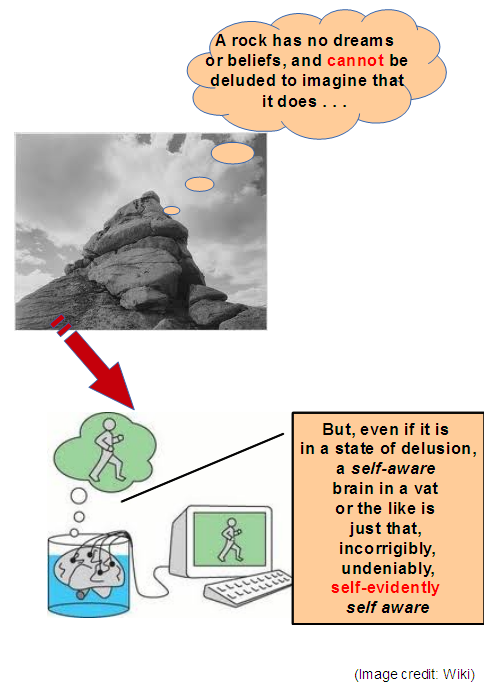
self_aware_or_not

Which, means that conscious mind is categorically distinct from blind mechanism based on cogs acting blindly on other cogs, or the substantial equivalent.

And continuing with the issue that blind mechanical processing is inherently limited by that blindness . . . a rock has no dreams, including “dust” reconfigured as neural network “gate” arrays:
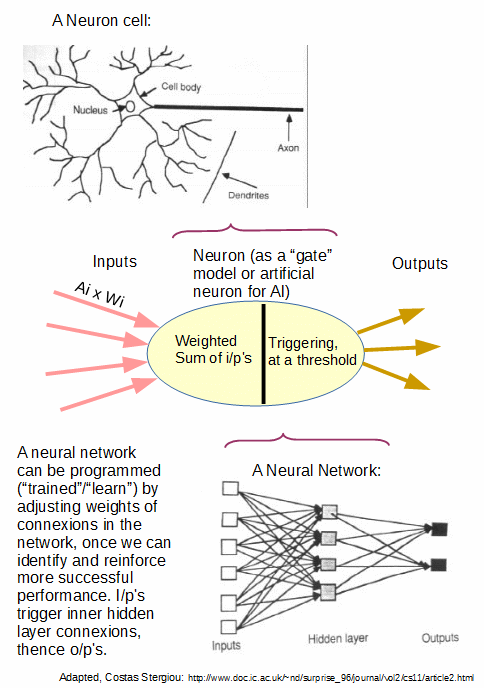
A neural network is essentially a weighted sum interconnected gate array, it is not an exception to the GIGO principle


I do so here, as there is a video involved that I doubt can be embedded at UD.

So. now, let us ponder the GIGO principle. As wiki aptly summarises (inadvertently testifying against known ideological inclination):

Garbage in, garbage out (GIGO) in the field of computer science or information and communications technology refers to the fact that computers, since they operate by logical processes, will unquestioningly process unintended, even nonsensical, input data (“garbage in”) and produce undesired, often nonsensical, output (“garbage out”).

Yes, blind mechanisms do not ask un-programmed questions and if out of whack or inadequately debugged, will just as blindly spew out garbage. They are utterly unreasoning, glorified calculation devices.

So, I say: GIGO-limited computation is not contemplation.

Again, I say: contemplative, creative designing mind does not credibly emerge from blind chance and mechanical necessity.

Yet again, I say: contemplative mind is categorically different from blindly computing matter, as a rock has no dreams.

So, now, what do you say, why? END

Comments
PS: Put a rock in your backyard through the Glasgow Coma Scale test and see where that gets you.kairosfocus
June 14, 2014
June
06
Jun
14
14
2014
04:17 PM
4
04
17
PM
PST
R-Bill, this is taking on the air of if I deny there was a response, that skepticism prevails. I'll be short. Rocks, raw, can neither compute -- execute algorithms on signals -- nor contemplate. Refined rock, organised by design, can compute. But computation itself is a blind mechanical, GIGO limited process. It exhibits no understanding or self awareness and the notion of such emerging from complex loops and data bases is little more than abracadabra. At the same time, we experience such consciousness, which points to a different order of existence . . . hence the hesitation in an era dominated by materialism. Ironically, as Haldane and many others have pointed out, that materialism is self-referentially incoherent and so should not unduly detain us. KFkairosfocus
June 14, 2014
June
06
Jun
14
14
2014
04:12 PM
4
04
12
PM
PST
KF:
I have answered, more than answered.
I don’t think you have. You’ve offered reasons why you believe that the human capacity for dreaming and contemplation (etc.) can’t be accounted for in physical and/or computational terms. I haven’t asked you about that. What I have asked you is how you justify your belief that rocks don’t dream. I know how I justify it, but you don’t have access to that justification.
As a cue, raw rocks can neither compute nor contemplate.
Wihch parses to:
Raw rocks can't compute...
Right. We know this because they don't have the right physical structure and organization for computation. But I don't see how this is relevant to your position vis rocks and dreams, as you state that the computational states of creatures that do (namely, human beings) fail to account for their subjective states (dreams, contemplation, etc). Therefore It can't be the absence of computational states justifies your belief that rocks don't dream, as it is your argument that even were they endowed with computational states comparable to those of human beings they would still be devoid of dreams.
Raw rocks can't contemplate...
Which just restates your original assertion: rocks don't dream - the very assertion I am asking you to justify. I know why I believe that: Upon inspecting rocks we find that they lack the right physical structure and organization necessary for contemplation. An exemplar of the right structure is the physical and organizational structure of human beings and their brains. Rocks have nothing resembling that organization. But that can't be your reasoning: you state that humans, like rocks, lack the right physical structure and organization for contemplation. Even the computational characteristics of the human brain are insufficient. Therefore, it can't be your reasoning that the physical and/or computational insufficiency of rocks justifies your belief that they are devoid of dreams. Then what does? As you have offered no other rationale, you have no basis for claiming your first principle: "rocks have no dreams." I do.
A rock has no dreams or beliefs and cannot be fooled to think it does — obvious, for many good reasons.
What are they?Reciprocating Bill
June 14, 2014
June
06
Jun
14
14
2014
03:41 PM
3
03
41
PM
PST
PPS: Money clip:
we do not come to have a concept of subjective experience because we have noticed that we have subjective experience. Rather the ability to notice that we have subjective experience is already to have the concept of it. This means that because we have inherited a folk-Cartesian concept that includes a doctrine of direct access, we will experience ourselves as confronting first person subjectivity as a brute fact, an explanandum, and thus the hard problem seems to be unavoidable. This is why a large majority of people think that something other than structure and function needs explaining: Because introspection tells them so. However, the Sellarsian view can account for this experience without asserting that we must know on the basis of introspection that we are conscious. Sellarsians claim that the existence of internal states is something we posit to explain certain facts about our life in the world. (for example, the fact that sometimes we hallucinate and have red-apple experiences when there are no red apples present., or that red apples look orange in yellow light.) Consequently, introspection does not directly reveal to us that we have mental states, rather introspection is only possible because we accept a theory that posits the existence of mental states that can be introspected. Those who have genuinely appropriated such a theory spontaneously make a distinction between inner events and outer events, and it thus seems to them that the inner events are directly given, and that the outer events are only inferred from those inner events. Professional epistemologists eventually refined this assumption into various sense datum theories. These eventually became so full of conceptual tangles that eventually Sellars had to come along and posit a new theory, which said that none of our experience is directly given, not even our experience of our own inner states.
Really, now! Why do we have a "folk theory"? Could it just possibly be that we are indeed self-aware, and pejoratively tagging it with a half-ludicrous strawman label -- one step away from folk-tale -- will not make it go away? (Except of course among those intimidated by name-calling.) Let us relabel: people have a common-sense understanding that we are normally self aware and aware of a real external world. We even have a Glasgow Coma Scale to have an index of that. And, while we can be in deluded or dream states, that has not undermined that we are indeed contemplatively aware of the inner and the outer life.kairosfocus
June 14, 2014
June
06
Jun
14
14
2014
12:37 PM
12
12
37
PM
PST
PS: This paper gives an idea of why the problem is hard and how it is so often skirted around by failing to up-front first and foremost face the fact that self-aware consciousness is experiential fact no 1 bfor each of us. Indeed, the fact through which we access the world of facts. (I suggest the onlooker scroll up to the OP and look at the chart with a rock and a brain in a vat. A rock has no dreams or beliefs and cannot be fooled to think it does -- obvious, for many good reasons. But for us, we may be deluded as to what we are, but we cannot be deluded that we are self-aware, conscious, contemplative. Such is self-evident. The trick of objection to such is to either try to push the other on the rhetorical defensive or to try to dodge facing the absurdity or brazenly denying that absurdities are absurd, the better to cling to them.)kairosfocus
June 14, 2014
June
06
Jun
14
14
2014
12:27 PM
12
12
27
PM
PST
R-Bill: I have answered, more than answered. Take another look, please, without a priori materialist blinkers. As a cue, raw rocks can neither compute nor contemplate. Processed rocks or dust [stardust] which are correctly organised . . . invariably, by a designer . . . can compute, with onward links given. But computing, GIGO limited as it is, is an inherently blind mechanical process, as Leibnitz long ago highlighted and as I developed for Thomson integrators, digital processors in Silicon, and neural networks -- also pointing out that appeals to emergence are appeals to poof magic. Rocks, raw or processed, do not account for contemplation; cf Searle's Chinese Room for the difference, and beyond, Nagel on what it is like to be a bat, or what it is to be appeared to redly and beautifully, Chalmers' the hard problem of consciousness, etc. Those are well known. Since we do know that we do contemplate, we must look elsewhere for its roots and capacity. The Smith model and the idea of an oracle machine begin to point us apropriately, towards bridging an explanatory gap unbridgeable by rocks. KFkairosfocus
June 14, 2014
June
06
Jun
14
14
2014
10:38 AM
10
10
38
AM
PST
KF: Although you open with "Starting with the principle that rocks have no dreams," you either won't or can't respond to my question: "On what basis do you claim that rocks don’t dream, and that with the certainty of 'principle?'"
If the latter, I need not take anything you say as any more serious than the sound the wind makes when it passes through the coconut trees outside my window.
I know you'd love to ignore my question on the basis of Haldane's reasoning. But it only matters what you take to be the case for me, not what I take to be the case, when it comes to your decision to dismiss my question on that basis. Unfortunately, you'd then be in the position of dismissing your own beliefs as well, because you can't reasonably doubt that, whatever I am, we are creatures of the same sort. You don't want that result. So you are stuck with me as "a conscious, enconscienced, contemplating minded human being" because that is what you believe about me. So, on what basis do you claim that rocks don’t dream, and that with the certainty of "principle?"Reciprocating Bill
June 14, 2014
June
06
Jun
14
14
2014
07:48 AM
7
07
48
AM
PST
R-Bill: Do kindly tell me, are you a conscious, enconscienced, contemplating minded human being, or are you the subject of this rebuke from J b S Haldane:
“It seems to me immensely unlikely that mind is a mere by-product of matter. For if my mental processes are determined wholly by the motions of atoms in my brain I have no reason to suppose that my beliefs are true.They may be sound chemically, but that does not make them sound logically. And hence I have no reason for supposing my ]brain to be composed of atoms. In order to escape from this necessity of sawing away the branch on which I am sitting, so to speak, I am compelled to believe that mind is not wholly conditioned by matter.” ["When I am dead," in Possible Worlds: And Other Essays [1927], Chatto and Windus: London, 1932, reprint, p.209.
If the latter, I need not take anything you say as any more serious than the sound the wind makes when it passes through the coconut trees outside my window. If the former, then that simply is not grounded in the material -- on pain of self referential incoherence, and you need to attend carefully to the Searle thought exercise already cited. KFkairosfocus
June 14, 2014
June
06
Jun
14
14
2014
07:13 AM
7
07
13
AM
PST
Should read, "What I am stating is that..."Reciprocating Bill
June 14, 2014
June
06
Jun
14
14
2014
04:48 AM
4
04
48
AM
PST
KF:
On what evidence do you wish to suggest that raw rocks compute, much less contemplate? Why should we entertain such as a serious alternative?
I don’t suggest that rocks compute, much less dream (contemplate, etc.; your language, which seems to be confusing Mung). Why would you think I do? I said above that I absolutely agree with you that rocks don't dream. What I am stating that while I can base my belief that rocks don’t dream upon knowledge of their physical structure (which precludes, among other things, computation), you can’t. That’s because you deny that the physical structure of human beings (e.g. of their brains) account for the fact that human beings dream (contemplate, etc.). If human physical organization doesn't account for human dreaming, then the absence of similar/analogous organization in rocks can’t be a basis for the claim that rocks don’t dream. So, I know the basis for my belief that rocks don’t dream. On what basis do you claim that rocks don’t dream, and that with the certainty of "principle?" I’m asking because it is a core claim of your OP.Reciprocating Bill
June 14, 2014
June
06
Jun
14
14
2014
04:23 AM
4
04
23
AM
PST
F/N 2: Searle on the crucial difference between computation and contemplation, via the Chinese Room thought exercise: _____________ >> Imagine that a person—me, for example—knows no Chinese and is locked in a room with boxes full of Chinese symbols and an instruction book written in English for manipulating the symbols. Unknown to me, the boxes are called “the database” and the instruction book is called “the program.” I am called “the computer.” People outside the room pass in bunches of Chinese symbols that, unknown to me, are questions. I look up in the instruction book what I am supposed to do and I give back answers in Chinese symbols. Suppose I get so good at shuffling the symbols and passing out the answers that my answers are indistinguishable from a native Chinese speaker’s. I give every indication of understanding the language despite the fact that I actually don’t understand a word of Chinese. And if I do not, neither does any digital computer, because no computer, qua computer, has anything I do not have. It has stocks of symbols, rules for manipulating symbols, a system that allows it to rapidly transition from zeros to ones, and the ability to process inputs and outputs. That is it. There is nothing else. >> _____________ Note, SOMEONE very intelligent had to set up that algorithm and its physical instantiation. Someone who understood Chinese very well indeed. Thus, we see the self-moved, insightful contemplative mind lurking behind the facade of computation. We can reliably say that complex computation is a sign of design. And then observe the contrast between blind GIGO-limited computing and insightful, creative responsiveness. KFkairosfocus
June 14, 2014
June
06
Jun
14
14
2014
03:52 AM
3
03
52
AM
PST
F/N: Leibnitz, in Monadology 17:
[P]erception, and that which depends upon it, are inexplicable by mechanical causes, that is to say, by figures and motions. Supposing that there were a machine whose structure produced thought, sensation, and perception, we could conceive of it as increased in size with the same proportions until one was able to enter into its interior, as he would into a mill. Now, on going into it he would find only pieces working upon one another, but never would he find anything to explain perception.
Compare that to the Thomson integrator, etc. KFkairosfocus
June 14, 2014
June
06
Jun
14
14
2014
02:47 AM
2
02
47
AM
PST
R_Bill: Let me clip and comment point by point: >> If the computational states exhibited by brains don’t account for human dreams (contemplation, etc.) then you’ve no basis for claiming rocks are devoid of dreams>> 1 --> Not at all. There is no good evidence that raw rocks compute, which is long before we get to the issue of contemplation. 2 --> So you are here again conflating computing with contemplation, and failing to see the difference. >> – at least not on the basis of computational states that are present in brains and absent in rocks.>> 3 --> Who ever said that contemplation is to be accounted on the basis of computational states or substrates in brains but not rocks? That is, that the one emerges from the other and is founded on it? 4 --> Instead, what was pointed out is that rocks are the material basis of computational substrates, but being raw or refined rocks or "dust" [stardust, literally] does not explain the FSCO/I exhibited in successful computational entities, that overcomes the GIGO challenge. 5 --> Indeed, that FSCO/I is on our experience and analysis of config space island of function search challenges, invariably and morally certainly, the product of intelligent, insightful design. 6 --> As, can be seen from even the text of posts here, where analysis on strings is WLOG as 3-D functional systems can be coded as strings, cf AutoCAD etc. >>Given that neither physical nor computational states account for contemplation, on what basis do you claim that rocks don’t dream? >> 7 --> On what evidence do you wish to suggest that raw rocks compute, much less contemplate? Why should we entertain such as a serious alternative? 8 --> Going beyond, we do have direct experience of computing substrates in action, indeed in the linked from the OP I addressed Thomson ball-disk integrators [much more intuitive than the op amp based integrators I worked with waaay back when analogue computers were still in serious use], digital switch based processors [in an onward linked] and neural networks. 9 --> In each case what we have is blind mechanical signal processing based on intelligently designed organisation that has to surmount the GIGO challenge and the FSCO/I search challenge that easily swamps the computational potential of our solar system or the observed cosmos beyond 500 - 1,000 bits. 10 --> So, we have evidence in hand that is empirically and analytically grounded, that a different order of operation is at work in such designs. In effect, from our experience as designers, we have an oracular machine that easily transcends GIGO and computational limits of our observed cosmos. 11 --> That is, we have here evidence of intelligent, insightful mind, and we directly know that our minds contemplate, they do not merely blindly compute. 12 --> If raw rocks showed signs of designing, insightful, creative intelligence, we would respect that. Just as we respect the limited designing intelligence manifested in beavers etc. 13 --> But, patently, beyond reasonable doubt, we don't. 14 --> And it is that difference that makes the use of rocks as raw materials a no problem act, but the abuse of people who exhibit "eternity in their hearts" is a matter of a different order entirely. 15 --> which brings up a further matter. We do not put walls on trial for the crime of falling on victims, we put the designers and builders. Another very strong sign of a different order of being, a morally governed creature. KFkairosfocus
June 14, 2014
June
06
Jun
14
14
2014
02:30 AM
2
02
30
AM
PST
BD:
Dembski likes to characterize the ability to create complex specified information (CSI) as making a choice of one particular configuration from the space of all possible ones. However, introspectively, this is not what happens. When I write a paragraph or solve a problem or create a piece of music, I don’t find myself running through a near infinite list of possibilities and then choosing the one I prefer. Rather, the words or a solution or a melody simply show up in my awareness. This is the mysterious process of creativity.
I'd say, Dembski is comparing to what a blind, chance and mechanical necessity based process would do. I like J Bartlett's remark about an oracle machine that feeds insightful influences into the cybernetic subsystem. That enriches my onward discussion of the Smith model two-tier controller with a shared memory space, here in the main discussion linked from the OP above. KF PS: I think a powerful direct illustration of mind distinct from body is not so much near death as post death experience. Here, I very much have in mind the case of the resurrection of Jesus of Nazareth with 500+ unstoppable eyewitnesses. (It is easy to show, per Babbage's point in the 9th Bridgewater thesis on how rapidly the likelihood of a large number of witnesses agreeing in a common error falls . . . exponentially, that 6 - 10 or so witnesses to even the most unusual phenomenon, suffices to overcome a Hume type objection. [Just think, 6 independent witnesses to a common event being in agreement in error, where each would be in error say 1 in 1,000 times . . . we are talking about recognising a friend and colleague here, and about knowing which of several events came 1st, 2nd, etc.])kairosfocus
June 14, 2014
June
06
Jun
14
14
2014
01:50 AM
1
01
50
AM
PST
RB: Memory, by itself is not what explains insightful contemplative reasoning. It is not just that we store and recirculate memories -- so do flip flops and so do computer processors -- but the kind that we store . . . meaningful, based on contemplative insight. We do not merely see X, we see X as type Z, or case Q, etc. We perceive, conceive and understand relationships, concepts and the like and through that understanding, we reason. This is not simply reducible to clusters of weights and connexions in neural networks and propagating electrochemical pulses, though we obviously use such. And, labelling such as not objective or not scientific simply amounts to tossing away a vast pool of common experience tied to empirical fact no 1 of our life as intelligent, consciously aware creatures. KFkairosfocus
June 14, 2014
June
06
Jun
14
14
2014
01:43 AM
1
01
43
AM
PST
RB: You are quite right that computers are not logical, instead they are blindly mechanical. They process signals blindly based on a configuration. This holds also for neural networks, hence my contrasting programming with the term "learning" that is being applied in a way that suggests contemplation. A genuinely logical reasoning process understands, perceives, and draws consequences of premises based on insight. Which, we all routinely experience. Materialists are guilty of unwarranted reductionism and discarding of patently important features of our common experience with reasoned thought. KFkairosfocus
June 14, 2014
June
06
Jun
14
14
2014
01:33 AM
1
01
33
AM
PST
I would add that computers are not logical. ALL that they are is accurate with memorized programs. They don't mean to be logical and are not. They have no concept of what they are talking about. So no logic is involved. Logic even for humans is based on memorized agreement about facts etc. i would also say we move our bodies entirely by our memories. We do just have a thought/intent but it /soul is attached to our great memory machine and simply its the memory that does the moving. the memory has wrongly been missed as the great thing in humans connection between our soul and the world. thats why they imagine computers are intelligent or will be because they misunderstand we ourselves greatly use our memories and this hides we aree just thinking souls.Robert Byers
June 13, 2014
June
06
Jun
13
13
2014
11:32 PM
11
11
32
PM
PST
WJM, re. #2:
Also, we can produce a virtually infinite amount of functionally specified complex information simply upon intent. This appears to me to be the very definition of supernatural capacity; how does physics account for the human capacity to infinitely arrange matter into apparently unlimited amounts of FSCI? How can a brain, which contains only a certain, finite amount of matter, produce such volumes of FSCI as if is connected to some unlimited information-generating machine?
Excellent point. Dembski likes to characterize the ability to create complex specified information (CSI) as making a choice of one particular configuration from the space of all possible ones. However, introspectively, this is not what happens. When I write a paragraph or solve a problem or create a piece of music, I don't find myself running through a near infinite list of possibilities and then choosing the one I prefer. Rather, the words or a solution or a melody simply show up in my awareness. This is the mysterious process of creativity. A consequence of this capacity that mind has---creativity---is that mind appears to be the only phenomenon in our experience that is capable of violating the Second Law of Thermodynamics, which our minds do repeatedly and routinely. This is additional evidence (additional to near death experiences, out of body travel, remembrance of past lives, etc.) that mind is not a physical phenomenon. The physical universe obeys the Second Law. Our minds do not.Bruce David
June 13, 2014
June
06
Jun
13
13
2014
11:28 PM
11
11
28
PM
PST
Reciprocating Bill:
If the computational states exhibited by brains don’t account for human dreams (contemplation, etc.) then you’ve no basis for claiming rocks are devoid of dreams – at least not on the basis of computational states that are present in brains and absent in rocks.
How is it that you equate contemplation with dreams?
If the computational states exhibited by brains don’t account for human dreams...
Only humans have brains? Really? Did you mean to ask:
If the computational states exhibited by human brains don’t account for human dreams (contemplation, etc.) then you’ve no basis for claiming rocks are devoid of dreams
Given that neither physical nor computational states account for contemplation, on what basis do you claim that rocks don’t dream?
Do you seriously expect us to believe that rocks dream? Do androids dream of electric sheep?Mung
June 13, 2014
June
06
Jun
13
13
2014
09:41 PM
9
09
41
PM
PST
An unrefined un-organised rock will have a problem computing, ...An organised, refined set of rocks or “dust” — stardust really . . . literally — sush as in the integrator or a microprocessor or a biological neural net can compute, once the designer has solved the GIGO problem. But that still has not bridged to contemplation
If the computational states exhibited by brains don’t account for human dreams (contemplation, etc.) then you’ve no basis for claiming rocks are devoid of dreams – at least not on the basis of computational states that are present in brains and absent in rocks. Given that neither physical nor computational states account for contemplation, on what basis do you claim that rocks don’t dream?Reciprocating Bill
June 13, 2014
June
06
Jun
13
13
2014
08:24 PM
8
08
24
PM
PST
If we removed Running Bill's brain from his body would it go on dreaming without him? Enquiring minds want to know!Mung
June 13, 2014
June
06
Jun
13
13
2014
07:43 PM
7
07
43
PM
PST
AYP, no doubt you are familiar with the term knee knocker! This one Knee-knockers Not the other one ;) knee knocker (Urban Dictionary)Mung
June 13, 2014
June
06
Jun
13
13
2014
07:38 PM
7
07
38
PM
PST
Mung, didn't think of that. Passage-ways on a ship are rather like lanes. KFkairosfocus
June 13, 2014
June
06
Jun
13
13
2014
07:32 PM
7
07
32
PM
PST
PS: Were you using such still in your stint in the US Navy? Computing gunsights?kairosfocus
June 13, 2014
June
06
Jun
13
13
2014
07:30 PM
7
07
30
PM
PST
kf, on board ship they are not called lanes!Mung
June 13, 2014
June
06
Jun
13
13
2014
07:29 PM
7
07
29
PM
PST
Mung: That Thomson mechanical integrator is irreducibly complex in so many ways it is ridiculous. The balls, disks and shaft plus support apparatus are each quite complex, specific and requiring an extremely precise mutual match and organisation. For instance, dimensional tolerances, balances of friction and lube [no slip, no wear, precise interaction) and more. A near perfect sphere of right material and size is already a tall order. I suspect brain integrators . . . we do make 3-d tracking path projections to catch a ball, etc . . . will run on neural networks. KFkairosfocus
June 13, 2014
June
06
Jun
13
13
2014
07:29 PM
7
07
29
PM
PST
AYP: must have been quite a trip down memory lane. KFkairosfocus
June 13, 2014
June
06
Jun
13
13
2014
07:22 PM
7
07
22
PM
PST
RB: You still miss the point, conflating GIGO-limited computation with contemplation. An unrefined un-organised rock will have a problem computing, it has not got a net of elements and algorithms and codes or signals to compute. An organised, refined set of rocks or "dust" -- stardust really . . . literally -- sush as in the integrator or a microprocessor or a biological neural net can compute, once the designer has solved the GIGO problem. But that still has not bridged to contemplation, say on the beauty of a red rose in which case we are aware of being appeared to redly and beautifully [where certain aesthetic judgements are as stable and reliable as any others] which is of a different order. Further, to assume or demand that such contemplation only can and must rest on a computational substrate begs huge questions. Questions that say arise in connexion with a fine tuned cosmos and the issue of mind at the root of being. Where also, our awareness of a world, our observation and measuring, our creative inferences on underlying dymnamics etc etc all require that contemplative ability. And if you ponder Haldane's point you will see that rational mind and even correctly computing substrates do not credibly spontaneously arise from blind chance and/or mechanical necessity. As, things of only modest complexity utterly dwarf the config space sampling power of the solar system or observed cosmos. 500 - 1,000 bits. Time for a fresh think. KFkairosfocus
June 13, 2014
June
06
Jun
13
13
2014
07:20 PM
7
07
20
PM
PST
KF: I forgot to mention. A month ago or so I took my son and grandson to Battleship Cove in Southern MASS. That's a cluster of museum ships including the USS Massachusetts(BB-59), USS Joseph P. Kennedy (DD-850) a "tin can", the USS Lionfish, a WWII diesel sub; and the Hiddensee, an East German/Soviet guided missile corvette. They also have a really excellent PT boat exhibit, with a couple of restored boats. On BB-59 we walked through the fire control spaces for the big 16 inchers, and on DD-850 we saw fire control "Plot" where the Mk1A resides and I worked a good many missions. It's restored beautifully and it was good to see it after these many years (1969. On BB59 you can actually get up into a gun mount and the 16" ammo handling rooms below - quite an awesome sight.ayearningforpublius
June 13, 2014
June
06
Jun
13
13
2014
05:17 PM
5
05
17
PM
PST
Given that, on what basis do you claim that rocks don’t dream?
On what basis do you claim that if you had your brain removed you'd stop dreaming?Mung
June 13, 2014
June
06
Jun
13
13
2014
05:11 PM
5
05
11
PM
PST
1 2 3 4 5

Leave a Reply