Uncommon Descent Serving The Intelligent Design Community

Should we recognise that “laws of nature” extend to laws of our human nature? (Which, would then frame civil law.)

Categories
Academic Freedom
Control vs Anarchy
Defending our Civilization
Laws
Lessons of History
Logic and Reason
Share
Facebook
Twitter/X
LinkedIn
Flipboard
Print
Email

Laws of Nature are a key part of the foundation of modern science. This reflects not only natural, law-like regularities such as the Law of Gravitation that promotes the Earth to the heavens (from being the sump of the cosmos) but also the perspective of many founders that they were thinking God’s creative, ordering providential and world-sustaining thoughts after him. The focal topic asks us whether our civil law is effectively an accident of power balances, or else, could it be accountable to a built in law that pivots on first duties coeval with our humanity.

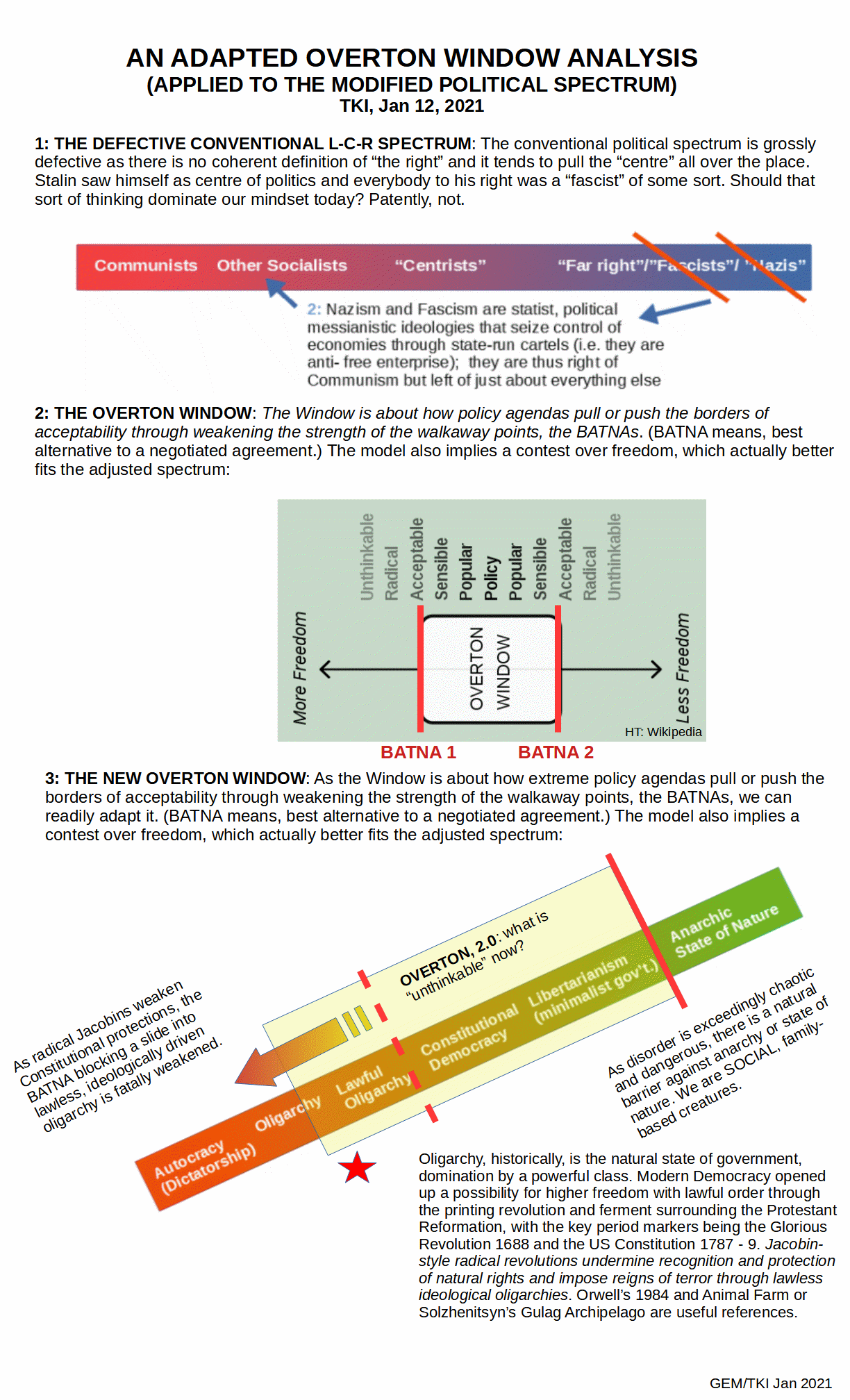
The issue becomes pivotal, once we ponder the premise that the typical, “natural” tendency of government is to open or veiled lawless oligarchy:
So, let us hear Cicero in his On The Republic, Bk 3 [c. 55 – 54 BC]:

{22.} [33] L . . . True law is right reason in agreement with nature , it is of universal application, unchanging and everlasting; it summons to duty by its commands, and averts from wrongdoing by its prohibitions. And it does not lay its commands or prohibitions upon good men in vain, though neither have any effect on the wicked. It is a sin to try to alter this law, nor is it allowable to attempt to repeal any part of it, and it is impossible to abolish it entirely. We cannot be freed from its obligations by senate or people, and we need not look outside ourselves for an expounder or interpreter of it. And there will not be different laws at Rome and at Athens, or different laws now and in the future, but one eternal and unchangeable law will be valid for all nations and all times, and there will be one master and ruler, that is, God, over us all, for he is the author of this law, its promulgator, and its enforcing judge. Whoever is disobedient is fleeing from himself and denying his human nature, and by reason of this very fact he will suffer the worst penalties, even if he escapes what is commonly considered punishment. . . . – Marcus Tullius Cicero, On the Republic, Bk 3

This, of course, is further reflected in his De Legibus, which lays out a framework:

With respect to the true principle of justice, many learned men have maintained that it springs from Law. I hardly know if their opinion be not correct, at least, according to their own definition; for “Law (say they) is the highest reason, implanted in nature, which prescribes those things which ought to be done, and forbids the contrary.” This, they think, is apparent from the converse of the proposition; because this same reason, when it [37]is confirmed and established in men’s minds, is the law of all their actions.

They therefore conceive that the voice of conscience is a law, that moral prudence is a law, whose operation is to urge us to good actions, and restrain us from evil ones.

We see in the Angelic Doctor, a broadening of the framework, elaborating four domains of law:

Thus, following Aquinas, we can see that arguably there is an intelligible core of law coeval with our responsible, rational, significantly free nature. This built-in law turns on inescapable, thus self-evident truths of justice and moral government, which rightly govern what courts may rule or parliaments legislate, per the premise of justice moderated by requisites of feasible order in a world that must reckon with the hardness of men’s hearts. Where, we are thus duty bound, morally governed creatures.

Hence, we come to the sense of duty attested to by sound conscience [“conscience is a law”], that breathes fire into what would otherwise be inert statements in dusty tomes. We may term these, by extension, the Ciceronian First Duties of Reason:

FIRST DUTIES OF RESPONSIBLE REASON

We can readily identify at least seven inescapable first duties of reason. “Inescapable,” as they are so antecedent to reasoning that even the objector implicitly appeals to them; i.e. they are self-evident. Namely, duties,

1 – to truth, 

2 – to right reason

3 – to prudence, 

4 – to sound conscience, 

5 – to neighbour; so also, 

6 – to fairness and

7 – justice 

x – etc.

[I add, Mar 12, for clarity:] {Of course, there is a linked but not equivalent pattern: bounded, error-prone rationality often tied to ill will and stubbornness or even closed mindedness; that’s why the study of right reason has a sub-study on fallacies and errors. That we seek to evade duties or may make errors does not overthrow the first duties of reason, which instead help us to detect and correct errors, as well as to expose our follies.}

Such built-in . . . thus, universal . . . law is not invented by parliaments, kings or courts, nor can these principles and duties be abolished by such; they are recognised, often implicitly as an indelible part of our evident nature. Hence, natural law,” coeval with our humanity, famously phrased in terms of “self-evident . . . rights . . . endowed by our Creator” in the US Declaration of Independence, 1776. (Cf. Cicero in De Legibus, c. 50 BC.) Indeed, it is on this framework that we can set out to soundly understand and duly balance rights, freedoms and duties; which is justice, the pivot of law.

The legitimate main task of government, then, is to uphold and defend the civil peace of justice through sound community order reflecting the built in, intelligible law of our nature. Where, as my right implies your duty a true right is a binding moral claim to be respected in life, liberty, honestly acquired property, innocent reputation etc. To so justly claim a right, one must therefore demonstrably be in the right.

Where, prudence can also be seen via Aristotle’s summary:  “. . . [who aptly] defined prudence as recta ratio agibilium, ‘right reason applied to practice.’ The emphasis on ‘right’ is important . . .  Prudence requires us to distinguish between what is right and what is wrong . . . If we mistake the evil for the good, we are not exercising prudence—in fact, we are showing our lack of it.”

Of course, we just saw a 400+ comment thread that saw objectors insistently, studiously evading the force of inescapability, where their objections consistently show that they cannot evade appealing to the same first duties that they would dismiss or suggest were so obscure and abstract that they cannot serve as a practical guide. The history of the modern civil rights movement once the print revolution, the civilisational ferment surrounding the reformation and the rise of newspapers, bills, coffee houses etc had unleashed democratising forces speaks to the contrary. The absurdity of appealing to what one seeks to overthrow simply underscores its self evidence. But free, morally governed creatures are just that, free. Even, free to cling to manifest absurdities.

This approach, of course, sharply contrasts with the idea that law is in effect whatever those who control the legal presses issue under that heading; based on power balances and so in effect might and/or manipulation. Aquinas’ corrective should suffice to show that not all that is issued under colour of law is lawful, or even simply prudent towards preserving order in a world of the hardness of men’s hearts.

Yes, obviously, if we are governed by built-in law, that raises the question that there is a cosmic law-giver, qualified to do so not by mere sheer power but also by being inherently good and utterly wise. Such a root of reality also answers the Hume Guillotine and the Euthyphro dilemma: an inherently good and utterly wise, necessary and maximally great being root of reality would bridge IS and OUGHT in the source of all reality and would issue good and wise, intelligible built-in law.

What of Mathematics? The answer is, of course, that a core of Math is inherent in the framework of any possible world. So, this would extend that core of Math tied to sets, structures and quantities expressed in N,Z,Q,R,C,R* etc to any actual world. That answers Wigner’s puzzlement on the universal power of Math and it points to, who has power to create an actual world in which we have fine tuning towards C-Chemistry, aqueous medium, cell based life? Likewise, it is suggestive on the source of the language and algorithms found in D/RNA etc.

Lest we forget, here is Crick, to his son, March 19, 1953:
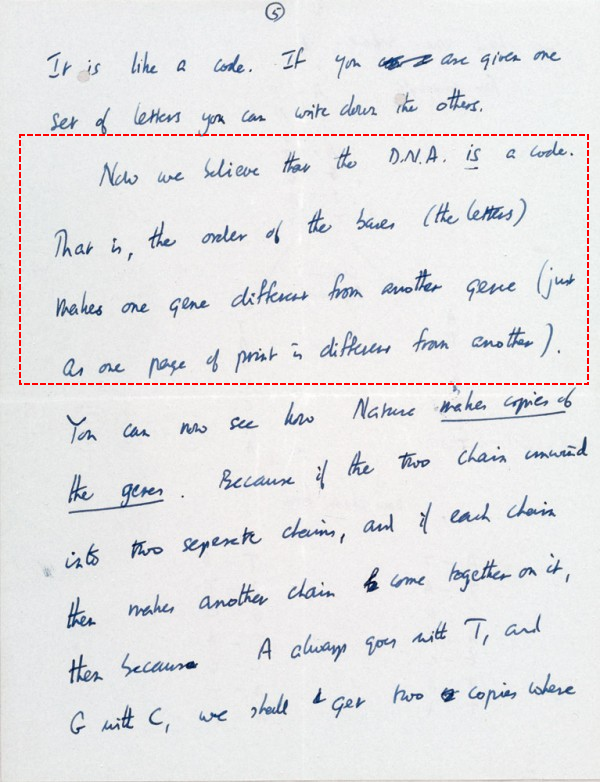
So, we have come full circle, to law as expressing ordering principles of the dynamic-stochastic physical world and those of the world of intelligent, rational, morally governed creatures. Surprise — NOT — the design thesis is central to both. END

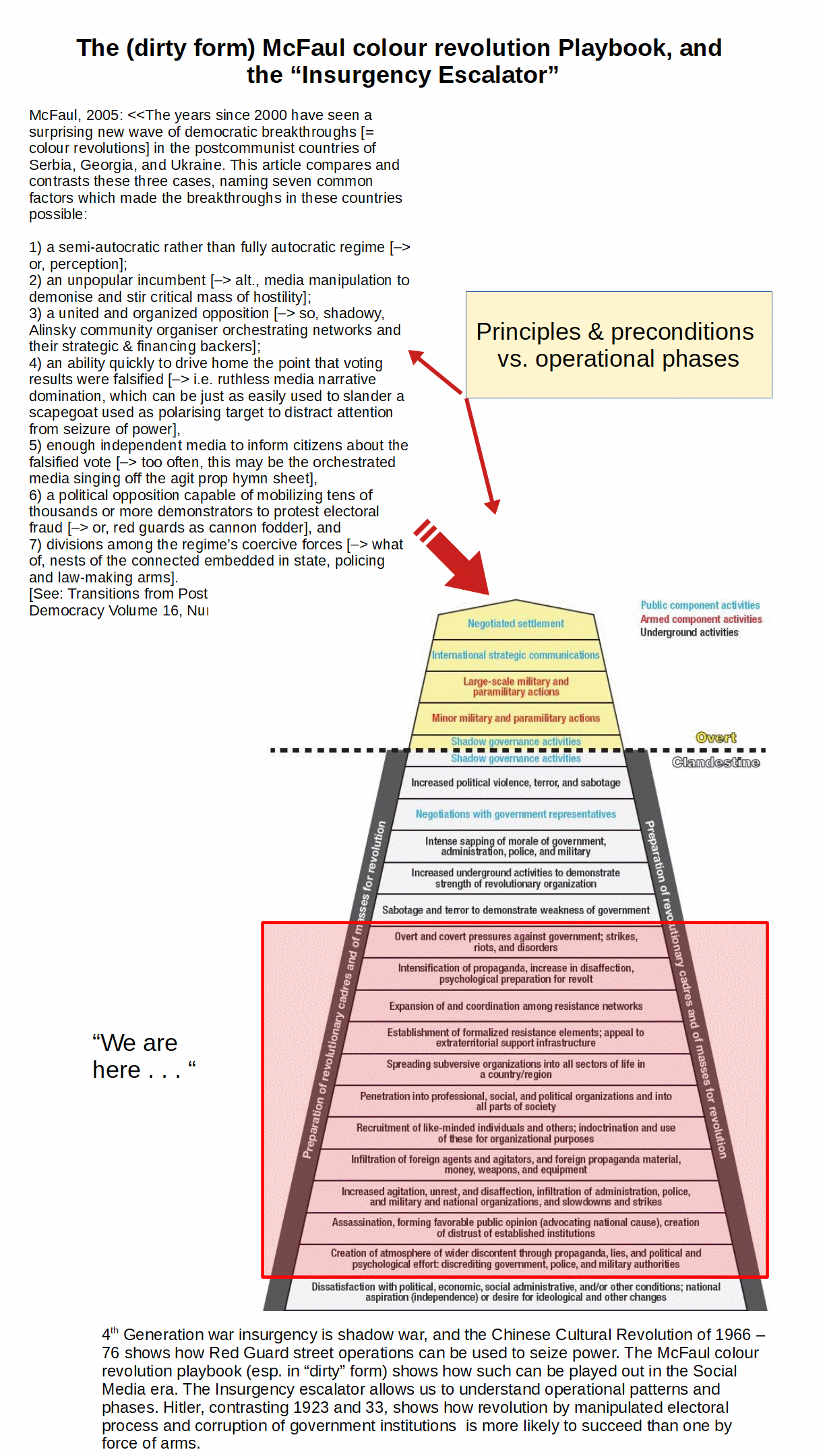
PS: As a reminder, the McFaul dirty form colour revolution framework and SOCOM insurgency escalator
U/D Feb 14: Outlines on first principles of right reason:
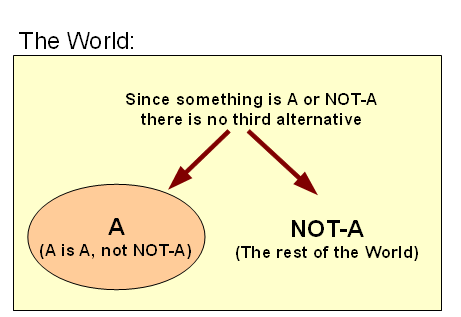
Here, we see that a distinct A — I usually use a bright red ball on a table:

and contrast a red near-ball in the sky, Betelgeuse as it went through a surprise darkening (something we observed separately and independently, it was not a figment of imagination):

. . . is distinct from the rest of the world. A is itself i/l/o its characteristics of being, and it is distinct from whatever else is not A, hence we see that in w there is no x that is A and ~A and any y that is in W will either be A or not A but not both or neither. These three are core to logic: P/LOI, LNC, LEM.

We may extend to governing principles that we have duties toward — never mind whoever may disregard such (and thereby cause chaos):
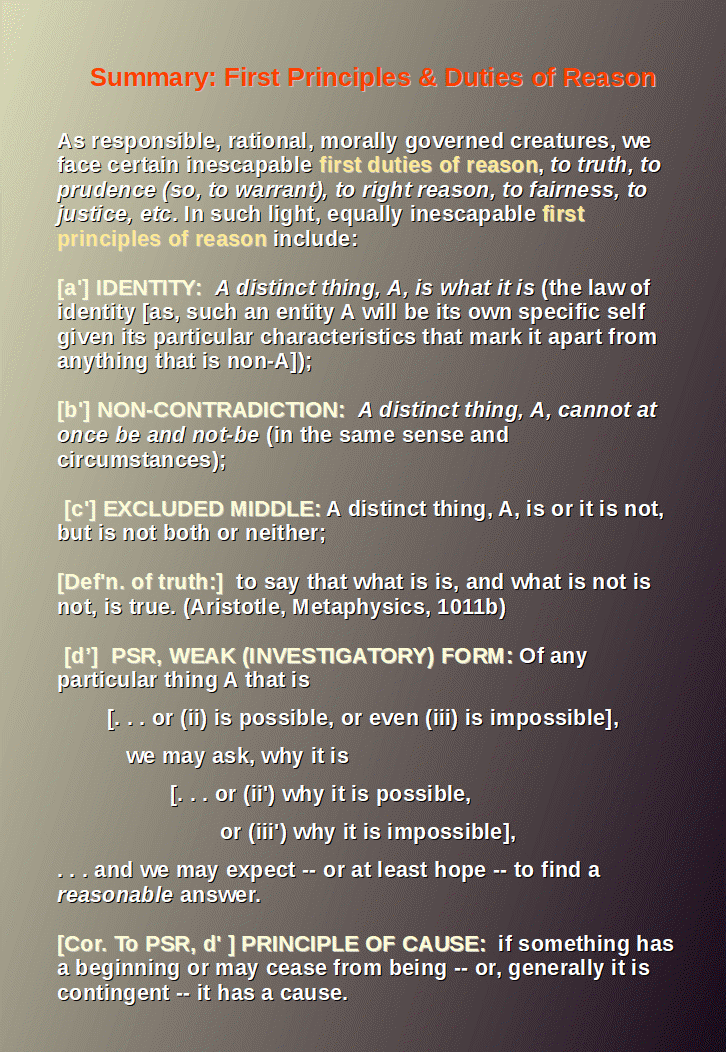
U/D March 13: The challenge of building a worldview i/l/o the infinite regress issue:
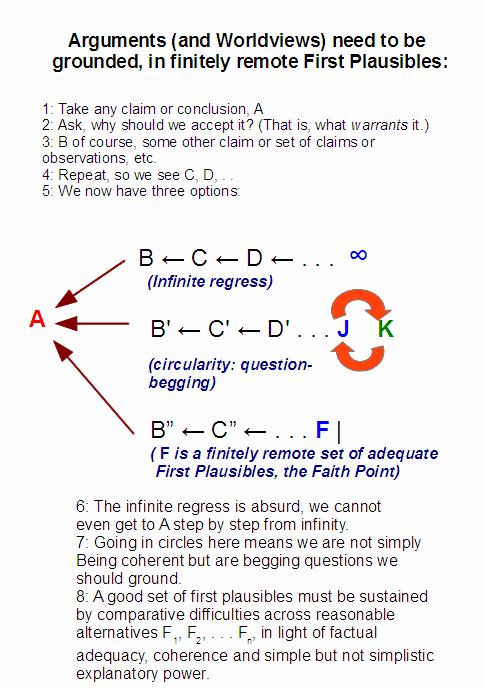
A summary of why we end up with foundations for our worldviews, whether or not we would phrase the matter that way}

Framing a ship:

. . . compare a wooden model aircraft:

. . . or a full scale, metal framework jet:
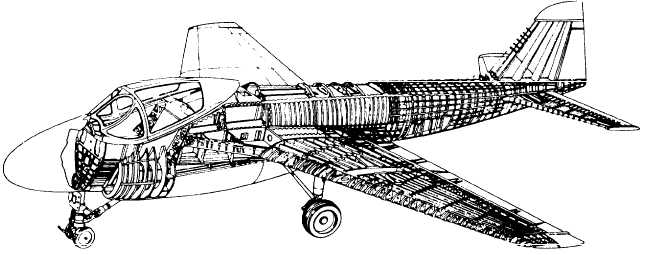
In short, there is always a foundational framework for any serious structure.

Comments
Equality existed as a concept for a nation for a brief time in Ancient Athens. It lasted less than three centuries in a small part of the world. The next example of equality as a concept for a nation happened in the United States over 2,000 years later. This concept did not exist anywhere else in the world to any extent or for any amount of time ever. So the United States did not get it exactly right at first. They had no model only the rhetoric of people such as Aristotle, Cicero, Sidney and Locke and a few others. In the course on Freedom the author said the United States was the first nation in the history of mankind established on a basis of principles, not of ethnicity, geography, accident of history—but principles. The foundation of those principles is the idea of natural law. The new nation justified its very independence by an appeal to the laws of nature and of nature’s God. But yet the US is attacked because it was not perfect then nor is it perfect today. No one else has ever got it even remotely right either. There will always be resentment and people who will argue the lack of perfection as a reason for dissolution. They offer no model to emulate, only chaos.jerry
March 6, 2021
March
03
Mar
6
06
2021
02:17 PM
2
02
17
PM
PDT
seversky:
What is actually self-evident is that human beings are not all created equal.
That all depends on what you mean by "equal". Everyone is born equal in the eyes of the Creator. Equal in stature
Moreover, the Old Testament testifies to the fact that their Creator ignored their “unalienable Rights” whenever it suited His purpose.
Nice cowardly strawman. It should make you wonder what those humans did that was so messed up. So there isn't any lie in the DoI. Just seversky's incompetence.ET
March 6, 2021
March
03
Mar
6
06
2021
12:55 PM
12
12
55
PM
PDT
It's a tad ironic is that those who argue for the importance of honesty in public discourse seem not to notice that the second paragraph of the Declaration begins with an outright lie.
We hold these truths to be self-evident, that all men are created equal, that they are endowed by their Creator with certain unalienable Rights, that among these are Life, Liberty and the pursuit of Happiness.
What is actually self-evident is that human beings are not all created equal. They vary widely in height, strength, talents, intelligence and so on. Moreover, the Old Testament testifies to the fact that their Creator ignored their "unalienable Rights" whenever it suited His purpose. Now, the men who drafted the Declaration were not stupid or ignorant, they were amongst the best-educated, most intelligent, wisest men of their time. They knew their Bible and they knew people. My guess is they knew full well that they could not craft a ringing declaration of rights and freedoms by telling the messy truth about human beings so they chose the aspirational. They chose to tell a lie. Were they immoral to do so? Does it undermine the ideals that the Declaration held up?Seversky
March 6, 2021
March
03
Mar
6
06
2021
10:23 AM
10
10
23
AM
PDT
KF, I just purchased another of the Great Courses titled the History of Freedom. One of its later lectures is on the Natural Law and the Declaration of Independence. The description for this lecture is
Born in democratic Athens, refined by Cicero, affirmed by St. Paul, and incorporated into first Roman and then the English common law, natural law would prove crucial to the American founding.
https://www.thegreatcourses.com/courses/history-of-freedom The term "natural law" appears about a hundred times in this course. If I find anything especially interesting, I will post it.jerry
March 6, 2021
March
03
Mar
6
06
2021
09:18 AM
9
09
18
AM
PDT
William J Murray Quantum physics has demonstrated...
Looks like Quantum physics doesn't {“collapse” into apparent specific energetic or physical states} in contrast with what all MRT components do .You have to modify your theory to exclude Quantum physics as the only one thing that doesn't collapse into apparent states, on the contrary , was very real and provided your 'evidences' for MRT. MRT is dead before birth.Lieutenant Commander Data
March 6, 2021
March
03
Mar
6
06
2021
07:15 AM
7
07
15
AM
PDT
WJM:
Quantum physics has demonstrated that what we as conscious observers are interacting with is not fundamentally matter or energy, or even anything physical, but rather fields of information that are “collapsed” into apparent specific energetic or physical states or characteristics at the time of observation or measurement.
Actually, the equations of QM do not imply that. The Copenhagen interpretation does, but that's not QM, per se. Other interpretations exist. Many Worlds, Super-Determinism, among others. There may good reasons to accept one over the other interpretations, but those are philosophical interpretations that require additions assumptions that are not actually a part of the QM equations.
MRT is actually a comprehensive Theory of Everything.
Pretty bold statement. How do you explain the nonsense that results when physicists try to join QM and General Relativity? The generally accepted answer is that one and/or the other theories is wrong in some fundamental way. How does MRT solve the problem?Concealed Citizen
March 6, 2021
March
03
Mar
6
06
2021
06:24 AM
6
06
24
AM
PDT
MRT is actually a comprehensive Theory of Everything.William J Murray
March 6, 2021
March
03
Mar
6
06
2021
04:12 AM
4
04
12
AM
PDT
LCD @812 asks:
Could you share with us what is the logic relation between your theory and quantum physics?
I don't know how the logical relation could be more direct or obvious. Quantum physics has demonstrated that what we as conscious observers are interacting with is not fundamentally matter or energy, or even anything physical, but rather fields of information that are "collapsed" into apparent specific energetic or physical states or characteristics at the time of observation or measurement. MRT predicts there is no such thing as "matter" or even "energy," that reality is comprised of consciousness interacting with information and processing that information into patterns which we label as physical, or matter and energy. MRT also predicts that even "the past" is ultimately nothing more than patterns of information entirely dependent on and related to observation in the "now." In other words, observation in the "now" can affect actualities in what we call the past. This has been demonstrated via quantum experimentation. MRT predicts that two different observers can experience the particular state of phenomena, such as the polarity of a photon, in contradiction to each other. This has also been demonstrated by quantum physics experimentation. There is no good "external (of mind) world" theory that accounts for these observations. It is all easily accounted for, and easily predicted, by MRT. Here's another prediction by MRT: other universes, or what you might call other dimensions or alternate realities not only exist; they can be experienced. MRT also explains and predicts a lot of so-called "paranormal" phenomena, such as remote viewing, mediumship, telepathy, what we call the "afterlife," NDEs, OOBEs, etc.William J Murray
March 6, 2021
March
03
Mar
6
06
2021
04:10 AM
4
04
10
AM
PDT
F/N: This summary on Phil, by Yandell, is also worth the clipping:
Philosophy’s task is the construction and assessment of worldviews. A worldview contains an account of the basic kinds of things there are and how they are related. These are the concern of metaphysics. It also contains an account of what knowledge is, what reasonable belief is, and how one identifies knowledge and reasonable belief. These are the concern of epistemology. It also gives an account of value, especially moral value. This is the concern of ethics. 1 There is no need for philosophy to construct such accounts from scratch. The common sense and cultural beliefs one encounters from one’s youth contain theses and themes that, sometimes explicitly and sometimes implicitly, make commitments regarding what there is, what is known, and what is good. 2 Philosophers of course are free to offer their own accounts of these matters. It is an essential feature of philosophy that views offered on philosophical issues are also assessed. There is no such thing as philosophy without argument. Assertion without assessment is not philosophy.
Hence, comparative difficulties. KFkairosfocus
March 6, 2021
March
03
Mar
6
06
2021
12:24 AM
12
12
24
AM
PDT
F/N: In discussing experience of God, Yandell speaks to the issue of veridicality of experience and the principle of credulity as opposed to pathological suspicion of error and hyperskepticism. Notice, inferences to best explanation i/l/o comparative difficulties:
One could argue: people seem to have experience of God; the best explanation of this fact is that God causes those experiences; hence there is reason to think that God exists. Similarly, one could argue: there seems to be a computer in front of me; the best explanation of things so appearing is that there is a computer in front of me; so there is reason to think a computer is there. But I seem simply to see the computer; my belief that it is there is a matter of at least seeming to see it and having no reason to think that things are not as they seem. I neither see something else from which I infer to my computer nor offer claims about best explanations. [--> presumably, not explicitly, save on request] Similarly, many have claimed to experience God, not to have some experience of something from which they can then properly infer that God exists. We will consider religious experience, viewed as evidence for God’s existence by virtue of its being a matter of “seeing God” rather than simply as a matter of its being the source of a premise in a proof of God’s existence.
Further food for thought, to be revisited later DV. KFkairosfocus
March 6, 2021
March
03
Mar
6
06
2021
12:11 AM
12
12
11
AM
PDT
F/N: I find some interesting remarks in introductory notes to Yandell's Routledge series Intro to Phil of Religion:
There are academic circles in which talk of truth, let alone religious perspectives being true, is about as popular as a teetotal sermon at a local pub. For this to be the line to take, it must be true (in the sense of “true” that was supposedly dismissed) that talk of truth is somehow so problematic as to require its abandonment. This line thus appears to be incoherent; it appears so because it is. 2 The devotees of a religious tradition typically take what their sacred texts say to be true. Nor is it beyond their ability to think what this “being true” might amount to. Monotheists will take God exists to be true – they will suppose that an omnicompetent being exists on whom the world depends. Some religious nonmonotheists will think this claim false, and will think that such claims as Persons are indestructible or Persons are nothing more than momentary states are true. As Aristotle once said, a proposition is true if things are as it says they are, and not otherwise. Aristotle, and most devotees of most traditions, have no difficulty in understanding what this means. It is possible to educate oneself out of all possibility of learning anything. Aristotle and ordinary religious people have not suffered this injury.
This response to the fashionable assumptions and concepts of a radically secularist, too often hyperskeptical day, need to be pondered as food for thought. DV, later. KFkairosfocus
March 5, 2021
March
03
Mar
5
05
2021
11:58 PM
11
11
58
PM
PDT
Jerry, Cicero, very consciously, was a Stoic. A Roman one, of course. Not, merely, indebted to them. His conservatism was to defend the then failing Roman Republican small-c constitution. He would eventually lose his head over it. He saw Caesar as a dangerous threatened tyrant and actually approved his assassination as a desperate last measure to preserve the Republic. Along the way he was a brilliant Rhetor [roughly, lawyer-politician]and Juris Consult, essayist and statesman. His writings have been influential down to our times. My thoughts along the lines in the OP were triggered by his remarks on law and thus government. I believe Paul of Tarsus [also in effect a Rhetor, but specifically Jewish] clearly knew the line of thought involved and recognised its relevance in reflecting a built-in, conscience attested intelligible law that morally governs our life of responsible reason and sense of guilty moral struggle; I add, conscience-shock is a defibrillation of a benumbed conscience in an era of massive warping of conscience . . . shocking the conscience[s] of the community is still a term of art in Anglophone jurisprudence. This is most explicit in Chs 2 and 13 of his Epistle to the Romans, reflecting Paul's ability to find subtle points of cultural contact. Later, men like Augustine and Aquinas would draw out elaborations in a line of influence that extends to Blackstone. KF PS: I annotate Cicero:
, On the Republic, Bk 3: {22.} [33] L . . . True law is right reason in agreement with [--> our morally governed] nature , it is of universal application, unchanging and everlasting; it summons to duty by its commands, and averts from wrongdoing by its prohibitions. And it does not lay its commands or prohibitions upon good men in vain, though neither have any effect on the wicked. It is a sin to try to alter this law, nor is it allowable to attempt to repeal any part of it [--> as universally binding core of law], and it is impossible to abolish it entirely. We cannot be freed from its obligations by senate or people [--> as binding, universal, coeval with our humanity], and we need not look outside ourselves for an expounder or interpreter of it. [--> sound conscience- guided reason will point out the core] And there will not be different laws at Rome and at Athens, or different laws now and in the future, but one eternal and unchangeable law will be valid for all nations and all times, and there will be one master and ruler, that is, God, over us all, for he is the author of this law, its promulgator, and its enforcing judge. Whoever is disobedient is fleeing from himself and denying his human nature, and by reason of this very fact he will suffer the worst penalties, even if he escapes what is commonly considered punishment. . . . – Marcus Tullius Cicero, c. 55 - 54 BC
kairosfocus
March 5, 2021
March
03
Mar
5
05
2021
11:40 PM
11
11
40
PM
PDT
On topic,masterly. Jordan Peterson on Rules for Life, Psychedelics, The Bible, and Much MoreLieutenant Commander Data
March 5, 2021
March
03
Mar
5
05
2021
06:00 PM
6
06
00
PM
PDT
I am posting the transcription of the lecture on Cicero on another OP because it is extremely long. Anyone wanting to read it can do so there. https://uncommondescent.com/intelligent-design/michael-ruse-update-morality-is-just-an-aid-to-survival-and-reproduction/#comment-725521 It is on a very appropriate OP titled "Morality is just an aid to survival and reproduction." Something that fits in here on Natural Law. I have to say after listening to this lecture and transcribing it, Cicero was quite an amazing thinker and I can understand why Kf has such respect for him. He is one of the great thinkers of all time. But he owes an immense debt to the Stoics.jerry
March 5, 2021
March
03
Mar
5
05
2021
03:51 PM
3
03
51
PM
PDT
William J Murray However, since my arguments and counter-arguments are about logic and evidence (to the degree “evidence” can be presented in a forum like this,) whether or not I’m “telling the truth” about my personal experience is irrelevant.
Could you share with us what is the logic relation between your theory and quantum physics?Lieutenant Commander Data
March 5, 2021
March
03
Mar
5
05
2021
10:16 AM
10
10
16
AM
PDT
Jerry asks:
Is this not truthful? How is anyone to know when you are uttering anything is truthful? By you own admission, they cannot.
Nobody can know when anyone else is telling the truth unless they have personal, direct knowledge about what that person says in any particular case.
So should I take you at your word or is this not truthful either. You have disqualified yourself as someone to pay attention to.
As I said, everything I say in this forum is, to the best of my ability and knowledge, truthful. Of course, I could be lying about that ... but then, anyone here could be lying about their supposed sense of moral obligation to truth as well, including you and KF. Whether or not you pay attention to me is up to you. However, since my arguments and counter-arguments are about logic and evidence (to the degree "evidence" can be presented in a forum like this,) whether or not I'm "telling the truth" about my personal experience is irrelevant.William J Murray
March 5, 2021
March
03
Mar
5
05
2021
07:22 AM
7
07
22
AM
PDT
I always tell the truth, as far as I know and experience it, in this forum because it serves my interests.
Since you said
does the fact that I do not directly experience a moral duty to truthfulness or right reason disprove KF’s premise of a directly experienced, objective moral reality?
Is this also not truthful? Who can know? How is anyone to know when you are uttering anything that is truthful? By you own admission, they cannot.
My first, last and only duty is to my own enjoyment.
So should I take you at your word or is this not truthful either. You have disqualified yourself as someone to pay attention to.jerry
March 5, 2021
March
03
Mar
5
05
2021
07:11 AM
7
07
11
AM
PDT
Jerry, I said I do not always tell the truth. I assume that's true of everyone. I always tell the truth, as far as I know and experience it, in this forum because it serves my interests.William J Murray
March 5, 2021
March
03
Mar
5
05
2021
07:03 AM
7
07
03
AM
PDT
Is this a joke?
The commenter has announced he does things only for his own enjoyment and does not tell the truth.jerry
March 5, 2021
March
03
Mar
5
05
2021
06:56 AM
6
06
56
AM
PDT
From Chapter 8 on the course on Natural Law. This may help those trying to understand Kf's position since it is mainly about Cicero.
Lecture Eight The Stoic Idea of Natural Law Scope: In his Republic, the Roman statesman Cicero provides the first thoroughgoing theory of natural law as “right reason in accord with nature,” but his knowledge of the subject is much indebted to Greek Stoicism. Although complete materialists, Stoics, such as Zeno and Chrysippus, held for a universal moral order that governed human beings and all other parts of the universe by “right reason, which fills all things and is the same as Zeus, lord and ruler of the universe.” A deep conservative in matters of Roman politics, Cicero tended to use appeals to natural law as a justification for existing laws and not as a basis for overturning positive laws, let alone as a basis for radical change. In distinguishing between moral and immoral warfare, he articulates a notion of just war and originates the term ius gentium (“law of nations”), a term that will play a large role in the subsequent history of natural law as the rational standard to which all legal systems are subject. He also maintains as a part of natural law the doctrine of the fundamental equality among all human beings. Outline I. Greek stoicism (begun by Zeno about 300 B.C.) championed the notion of self-reliance and “right reason in accord with nature.” A. The Stoics believed that both the material universe and all human culture were under the governance of what Zeno called “right reason, which pervades all things and is identical with Zeus, the lord and ruler of everything that exists.” B. The idea of “right reason” is important in the concept of natural law. It suggests that reason can operate rightly or wrongly. Reason operates rightly when it is discerning the truth and when it is figuring out how matters that are open to choice are to be selected in such a way as to achieve a kind of harmony. C. According to Chrysippus (232–206 B.C.), “For all beings which are social by nature, the natural law directs what must be done and forbids what must not be done.” D. Against the view that law and politics were based solely on individual or national self-interest, Panaetius (185–110 B.C.) argued for the reality of natural justice. He claimed that all human beings possess the basic capacity to participate in divine reason and that a fundamental equality and universal kinship exists among all human beings. E. The Stoics connected “right reason” to God. For them, God was perfect and impersonal, not willful or subjective. This concept had two results: 1. It allowed ethics to be seen in terms of law, rather than purely in terms of virtue. 2. Individual morality came to be seen as in the service of political morality. F. After the Roman conquest of Greece in 146 B.C., Stoicism was brought to Rome and found such adherents as Scipio Africanus the Younger. Scipio and members of his circle would appear as characters in Cicero’s dialogues. II. Cicero (106–43 B.C.) summarized the philosophical and political theories of the Stoics and transmitted to the medieval world the notion of natural law as right reason in accord with nature. A. De re publica (On the Commonwealth, 54–51 B.C.) links law and reason: 1. Book III, chapter 22, states: “There is a true law, right reason in accord with nature; it is of universal application, unchanging and everlasting…. It is wrong to abrogate this law and it cannot be annulled…. There is one law, eternal and unchangeable, binding at all times upon all peoples; and there will be, as it were, one common master and ruler of men, God, who is the author of this law, its interpreter and sponsor.” 2. This passage enunciates what will be the main themes for natural law for the rest of its history. 3. The “reason” mentioned here is not just the power to form concepts or to take part in logical argumentation, but right reason, a specifically moral power by which human beings can differentiate good and evil and can discern what is in harmony with human nature and what violates human nature. 4. The passage also implies that if we override the natural law, there will be a natural law sanction?a punishment. 5. Although Cicero does not articulate the content of natural law very fully, he does make clear that, at the very least, there are duties to observe justice, to respect the lives and property of others, and to contribute to society. 6. Ancient thinkers such as Cicero do not talk in terms of natural rights but in terms of natural duties. The concept of natural duties will become important for the articulation of natural rights in the modern era. B. Book III, chapter 23, of De re publica articulates a careful distinction between just and unjust warfare. 1. In answer to the charge that states are simply the result of force and conquest, Cicero argues that Roman wars were waged to repel invaders or to restore justice. 2. He insists that for war to be justified, it must be formally declared and that war may not begin until an explicit demand for the redress of the wrong done has been made and rejected. C. De Officiis (On Moral Duties, 44 B.C.) stresses the duties we have to one another because human beings are social by nature. We may not operate simply out of self-interest. 1. This is powerfully illustrated in the passage from Book III, chapter 5: “To take away wrongfully from another and for one man to advance his own interest by the disadvantage of another man is more contrary to nature than death, than poverty, than pain, than any other evil….” 2. In direct contrast with earlier Stoics, Cicero also praises public service and political participation in this treatise. 3. Bk. III, chs. 5 & 17: It is in Cicero’s writings that the idea of ius gentium (the law of nations) appears for the first time. While there is some dispute in modern scholarship about the precise reference of this term, Cicero uses it to describe the common element in the legal systems of diverse cultures that consists of the natural law requirement of respect for justice. D. De Legibus (On Laws, 43 B.C.) makes an argument for the moral equality of all human beings on the basis of their common nature; yet paradoxically, Cicero still defends the institution of slavery (at Book III, chapter 25). E. In Book I, chapter 10, of De Legibus, Cicero expands on his concept of a common human nature. He states: “No single being is so like another … as all of us are to one another … Reason, which alone raises us above the level of the beasts, is certainly common to us all and, though varying in what it learns, at least in the capacity to learn, it is invariable.” 1. This idea is fundamental to natural law theory. 2. Yet right after he makes this comment, Cicero proceeds to defend slavery! Suggested Reading: Heinrich A. Rommen, The Natural Law: A Study in Legal and Social History and Philosophy, translated by Thomas R. Hanley (Indianapolis: The Liberty Fund [1936, 1948], 1998), esp. “The Nature of Law” in chapter 1: “The Legacy of Greece and Rome.” Paul E. Sigmund, Natural Law in Political Thought (Cambridge: Winthrop Publ., 1971), chapter 2: “Natural Law in Roman Thought.” Questions to Consider: 1. “Right reason” is easier to discuss in the abstract than to identify in concrete situations. What do you think are the necessary characteristics of a person with “right reason”? What are some of the factors for identifying someone’s reason as merely self-interested or insufficiently impartial? 2. The usual conditions for determining a war to be just are three: (1) formal declaration of war by proper authority, (2) a just cause, (3) right intention in using the necessary force. What do you think of this set of criteria? How would you analyze the justice of recent wars?
Sorry for the long post but it is organized (not by me but by the author.). This is one of 24 lectures on Natural Law which has a long history as we see going back to Ancient Greece and probably before that.jerry
March 5, 2021
March
03
Mar
5
05
2021
06:44 AM
6
06
44
AM
PDT
William J Murray Do you consider the results of 100+ years of quantum physics experimentation “hard” evidence?
Is this a joke?Lieutenant Commander Data
March 5, 2021
March
03
Mar
5
05
2021
06:32 AM
6
06
32
AM
PDT
KF @803:
WJM, that’s a strawman caricature and you know it. Conscience shocking is analogous to defibrillation, as an event that can in at least some cases restore sound functioning. Pointing to defibrillation of conscience is not appeal to “intuition” or “emotion” etc, but to a pivotal shocking event that can restore a functional state, if we are lucky. And BTW, yet again, you are unable not to appeal to the binding nature of first duties in argument, which is my actual substantial argument: the inescapable in reasoning is part of the fabric of reasoning and should be taken as self-evident. KF
Another failed attempt to salvage your argument, this time with an appeal to analogy. Just stop it, KF. If you want salvage your case,, answer the following: Can you provide the aspect of conscience that is existentially necessary and inescapable or not? If you cannot, then by your own definitions, which I have agreed to arguendo, we do not have a moral first duty to our conscience.William J Murray
March 5, 2021
March
03
Mar
5
05
2021
06:17 AM
6
06
17
AM
PDT
LCD @802:
I’m sure you can provide some hard evidences(besides words) if you came to believe that.
Do you consider the results of 100+ years of quantum physics experimentation "hard" evidence? What do you mean "besides words?" All I can provide here is words. If I point you to papers describing the results of research and experiments, does the fact they are comprised of words disqualify them?. Perhaps you would like a video or the evidence provided in a sequence of pictures?William J Murray
March 5, 2021
March
03
Mar
5
05
2021
06:10 AM
6
06
10
AM
PDT
WJM, that's a strawman caricature and you know it. Conscience shocking is analogous to defibrillation, as an event that can in at least some cases restore sound functioning. Pointing to defibrillation of conscience is not appeal to "intuition" or "emotion" etc, but to a pivotal shocking event that can restore a functional state, if we are lucky. A sort of paradigm shift. And BTW, yet again, you are unable not to appeal to the binding nature of first duties in argument, which is my actual substantial argument: the inescapable in reasoning is part of the fabric of reasoning and should be taken as self-evident. KFkairosfocus
March 5, 2021
March
03
Mar
5
05
2021
06:06 AM
6
06
06
AM
PDT
William J Murray Why is that? Or, perhaps I don’t understand what you mean by “machine.” Do you mean that in the physical, material-world sense?
Some sort of mechanism that keep 'mind' running, organised,and do the job of 'selfs' inside 'mind' must exist 'Mind' fill a three-dimensional space , or is beyond space and time ? Use energy ,have a beginning, was created ,created itself ,is infinite or what? I'm sure you can provide some hard evidences(besides words) if you came to believe that.Lieutenant Commander Data
March 5, 2021
March
03
Mar
5
05
2021
05:40 AM
5
05
40
AM
PDT
Sandy said:
You need a machine for algorithmic processing.
Why is that? Or, perhaps I don't understand what you mean by "machine." Do you mean that in the physical, material-world sense?William J Murray
March 5, 2021
March
03
Mar
5
05
2021
02:57 AM
2
02
57
AM
PDT
KF, You quoted:
The man who is ready to prove that metaphysical knowledge is wholly impossible . . . himself has, perhaps unknowingly, entered the arena . . . To say the reality is such that our knowledge cannot reach it, is a claim to know reality ; to urge that our knowledge is of a kind which must fail to transcend appearance, itself implies that transcendence.
You then immediately comment in reference to make a point extending from that quote:
That is, we cannot not claim to know regarding the external world that presents itself to us.
You're conflating the full category of metaphysical claims indicating knowledge about reality with the sub-category of metaphysical claims that include an extra-mental world. You go on:
So, any system that denies such knowledge is fatally self-referential.
Nope, because under MRT, there is a distinction between self and mind. Please note that I never say "your mind" or "my mind." Everything exists in mind. There is no world external of mind. There are countless "selfs" in mind. Thus, nothing about MRT is "fatally self-referential." You might have understood this if you asked a question instead of assuming you know all you need to know about MRT - or if you had been paying attention to what I actually say.William J Murray
March 5, 2021
March
03
Mar
5
05
2021
02:52 AM
2
02
52
AM
PDT
William J Murray algorithmic processing of a certain category of information
You need a machine for algorithmic processing ,how appeared that super smart computer by chance or was created , who repairs it ,who chosen the operating system, who debugg the software , there is update of software? Did you think that you might be just a virus in that machine? Have antivirus that machine ? Do you think the update of antivirus is made too rare, too often or you don't know? ;)Sandy
March 5, 2021
March
03
Mar
5
05
2021
02:31 AM
2
02
31
AM
PDT
KF @794, I'm not saying your worldview is wrong - it may very well be correct. However, I gave you your chance to support your view logically by your own terms and definitions; you failed to do so as soon as you resorted to appealing to intuition, emotion and consequences. Reiterating your argument for your worldview, and reiterating what your worldview considers (even given what little you know about MRT) to be "errors" under MRT, isn't even a challenge. You're just saying the same thing over and over again. I've already addressed your concerns and demonstrated them to be irrational worries based on erroneously evaluating MRT under the rules of your own worldview, not out of actual logic. But, we have seen that where your logic fails, you are perfectly willing to move to appeals to intuition, emotion, and consequences - or, as evidenced above, stories that are convenient to your worldview. When you're serious about challenging MRT, let me know by asking a pertinent question that might lead - logically - to some actual logical inconsistency or fundamental issue. You know, instead of just assuming you already know everything about it.William J Murray
March 5, 2021
March
03
Mar
5
05
2021
01:20 AM
1
01
20
AM
PDT
Sandy @795:
Ask your mom if world existed before you were born.
Of course it did. If only you knew enough about my worldview to make relevant comments or ask meaningful questions - but, you do not.William J Murray
March 5, 2021
March
03
Mar
5
05
2021
01:05 AM
1
01
05
AM
PDT
1 12 13 14 15 16 41

Leave a Reply