Uncommon Descent Serving The Intelligent Design Community

Should we recognise that “laws of nature” extend to laws of our human nature? (Which, would then frame civil law.)

Categories
Academic Freedom
Control vs Anarchy
Defending our Civilization
Laws
Lessons of History
Logic and Reason
Share
Facebook
Twitter/X
LinkedIn
Flipboard
Print
Email

Laws of Nature are a key part of the foundation of modern science. This reflects not only natural, law-like regularities such as the Law of Gravitation that promotes the Earth to the heavens (from being the sump of the cosmos) but also the perspective of many founders that they were thinking God’s creative, ordering providential and world-sustaining thoughts after him. The focal topic asks us whether our civil law is effectively an accident of power balances, or else, could it be accountable to a built in law that pivots on first duties coeval with our humanity.

The issue becomes pivotal, once we ponder the premise that the typical, “natural” tendency of government is to open or veiled lawless oligarchy:
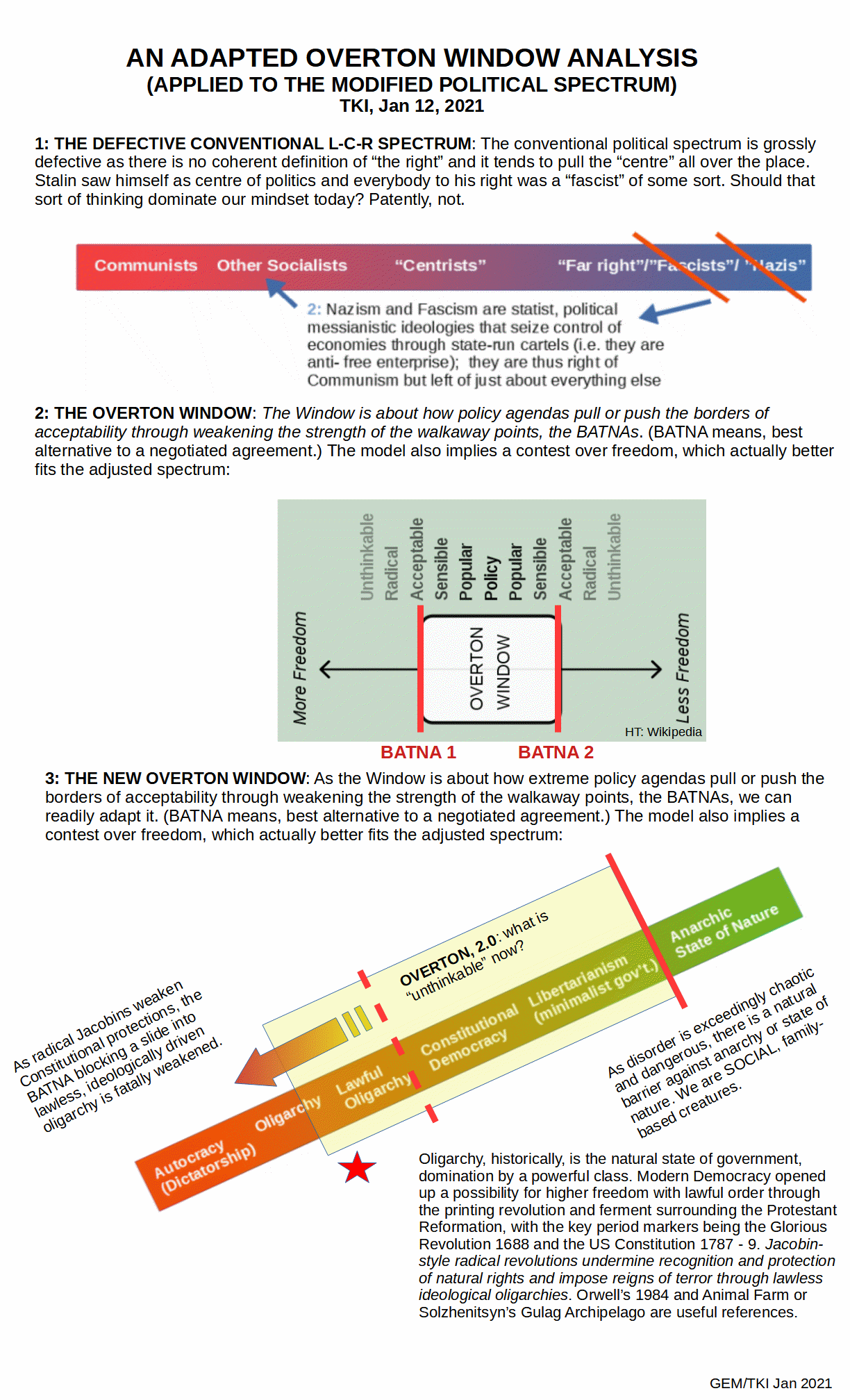
So, let us hear Cicero in his On The Republic, Bk 3 [c. 55 – 54 BC]:

{22.} [33] L . . . True law is right reason in agreement with nature , it is of universal application, unchanging and everlasting; it summons to duty by its commands, and averts from wrongdoing by its prohibitions. And it does not lay its commands or prohibitions upon good men in vain, though neither have any effect on the wicked. It is a sin to try to alter this law, nor is it allowable to attempt to repeal any part of it, and it is impossible to abolish it entirely. We cannot be freed from its obligations by senate or people, and we need not look outside ourselves for an expounder or interpreter of it. And there will not be different laws at Rome and at Athens, or different laws now and in the future, but one eternal and unchangeable law will be valid for all nations and all times, and there will be one master and ruler, that is, God, over us all, for he is the author of this law, its promulgator, and its enforcing judge. Whoever is disobedient is fleeing from himself and denying his human nature, and by reason of this very fact he will suffer the worst penalties, even if he escapes what is commonly considered punishment. . . . – Marcus Tullius Cicero, On the Republic, Bk 3

This, of course, is further reflected in his De Legibus, which lays out a framework:

With respect to the true principle of justice, many learned men have maintained that it springs from Law. I hardly know if their opinion be not correct, at least, according to their own definition; for “Law (say they) is the highest reason, implanted in nature, which prescribes those things which ought to be done, and forbids the contrary.” This, they think, is apparent from the converse of the proposition; because this same reason, when it [37]is confirmed and established in men’s minds, is the law of all their actions.

They therefore conceive that the voice of conscience is a law, that moral prudence is a law, whose operation is to urge us to good actions, and restrain us from evil ones.

We see in the Angelic Doctor, a broadening of the framework, elaborating four domains of law:

Thus, following Aquinas, we can see that arguably there is an intelligible core of law coeval with our responsible, rational, significantly free nature. This built-in law turns on inescapable, thus self-evident truths of justice and moral government, which rightly govern what courts may rule or parliaments legislate, per the premise of justice moderated by requisites of feasible order in a world that must reckon with the hardness of men’s hearts. Where, we are thus duty bound, morally governed creatures.

Hence, we come to the sense of duty attested to by sound conscience [“conscience is a law”], that breathes fire into what would otherwise be inert statements in dusty tomes. We may term these, by extension, the Ciceronian First Duties of Reason:

FIRST DUTIES OF RESPONSIBLE REASON

We can readily identify at least seven inescapable first duties of reason. “Inescapable,” as they are so antecedent to reasoning that even the objector implicitly appeals to them; i.e. they are self-evident. Namely, duties,

1 – to truth, 

2 – to right reason

3 – to prudence, 

4 – to sound conscience, 

5 – to neighbour; so also, 

6 – to fairness and

7 – justice 

x – etc.

[I add, Mar 12, for clarity:] {Of course, there is a linked but not equivalent pattern: bounded, error-prone rationality often tied to ill will and stubbornness or even closed mindedness; that’s why the study of right reason has a sub-study on fallacies and errors. That we seek to evade duties or may make errors does not overthrow the first duties of reason, which instead help us to detect and correct errors, as well as to expose our follies.}

Such built-in . . . thus, universal . . . law is not invented by parliaments, kings or courts, nor can these principles and duties be abolished by such; they are recognised, often implicitly as an indelible part of our evident nature. Hence, natural law,” coeval with our humanity, famously phrased in terms of “self-evident . . . rights . . . endowed by our Creator” in the US Declaration of Independence, 1776. (Cf. Cicero in De Legibus, c. 50 BC.) Indeed, it is on this framework that we can set out to soundly understand and duly balance rights, freedoms and duties; which is justice, the pivot of law.

The legitimate main task of government, then, is to uphold and defend the civil peace of justice through sound community order reflecting the built in, intelligible law of our nature. Where, as my right implies your duty a true right is a binding moral claim to be respected in life, liberty, honestly acquired property, innocent reputation etc. To so justly claim a right, one must therefore demonstrably be in the right.

Where, prudence can also be seen via Aristotle’s summary:  “. . . [who aptly] defined prudence as recta ratio agibilium, ‘right reason applied to practice.’ The emphasis on ‘right’ is important . . .  Prudence requires us to distinguish between what is right and what is wrong . . . If we mistake the evil for the good, we are not exercising prudence—in fact, we are showing our lack of it.”

Of course, we just saw a 400+ comment thread that saw objectors insistently, studiously evading the force of inescapability, where their objections consistently show that they cannot evade appealing to the same first duties that they would dismiss or suggest were so obscure and abstract that they cannot serve as a practical guide. The history of the modern civil rights movement once the print revolution, the civilisational ferment surrounding the reformation and the rise of newspapers, bills, coffee houses etc had unleashed democratising forces speaks to the contrary. The absurdity of appealing to what one seeks to overthrow simply underscores its self evidence. But free, morally governed creatures are just that, free. Even, free to cling to manifest absurdities.

This approach, of course, sharply contrasts with the idea that law is in effect whatever those who control the legal presses issue under that heading; based on power balances and so in effect might and/or manipulation. Aquinas’ corrective should suffice to show that not all that is issued under colour of law is lawful, or even simply prudent towards preserving order in a world of the hardness of men’s hearts.

Yes, obviously, if we are governed by built-in law, that raises the question that there is a cosmic law-giver, qualified to do so not by mere sheer power but also by being inherently good and utterly wise. Such a root of reality also answers the Hume Guillotine and the Euthyphro dilemma: an inherently good and utterly wise, necessary and maximally great being root of reality would bridge IS and OUGHT in the source of all reality and would issue good and wise, intelligible built-in law.

What of Mathematics? The answer is, of course, that a core of Math is inherent in the framework of any possible world. So, this would extend that core of Math tied to sets, structures and quantities expressed in N,Z,Q,R,C,R* etc to any actual world. That answers Wigner’s puzzlement on the universal power of Math and it points to, who has power to create an actual world in which we have fine tuning towards C-Chemistry, aqueous medium, cell based life? Likewise, it is suggestive on the source of the language and algorithms found in D/RNA etc.

Lest we forget, here is Crick, to his son, March 19, 1953:
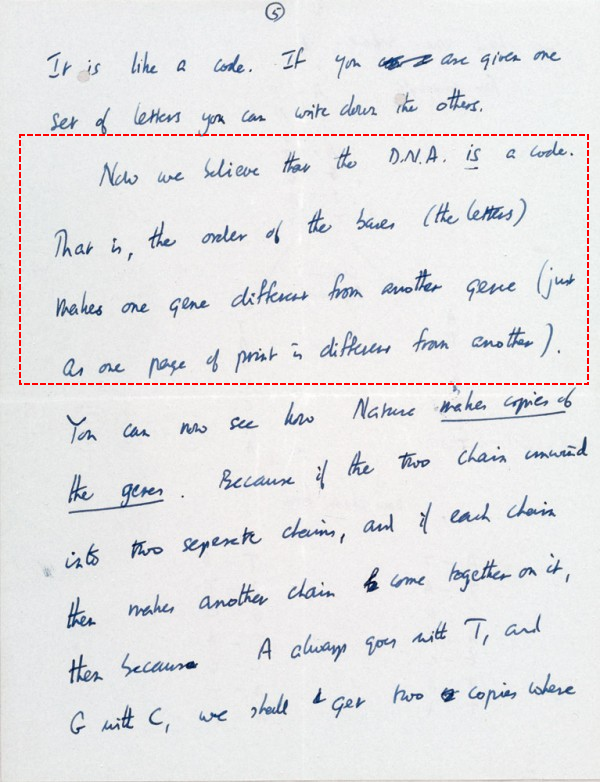
So, we have come full circle, to law as expressing ordering principles of the dynamic-stochastic physical world and those of the world of intelligent, rational, morally governed creatures. Surprise — NOT — the design thesis is central to both. END

PS: As a reminder, the McFaul dirty form colour revolution framework and SOCOM insurgency escalator
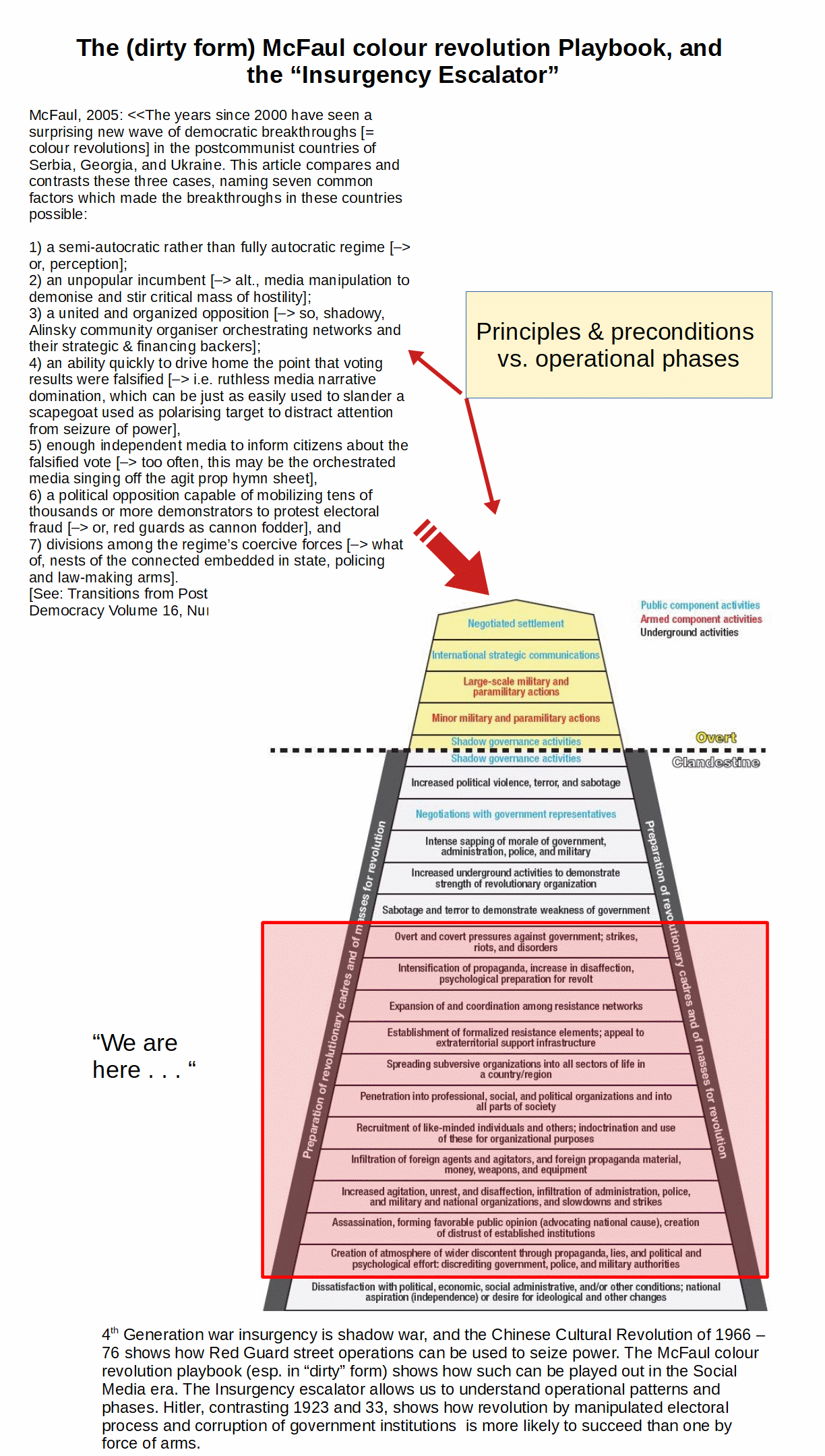
U/D Feb 14: Outlines on first principles of right reason:
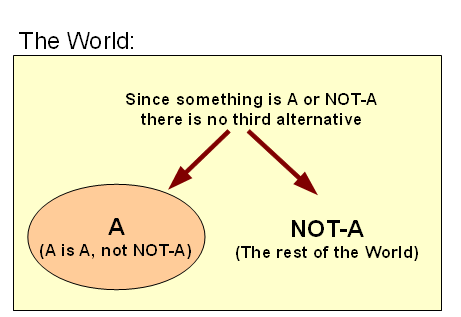
Here, we see that a distinct A — I usually use a bright red ball on a table:

and contrast a red near-ball in the sky, Betelgeuse as it went through a surprise darkening (something we observed separately and independently, it was not a figment of imagination):
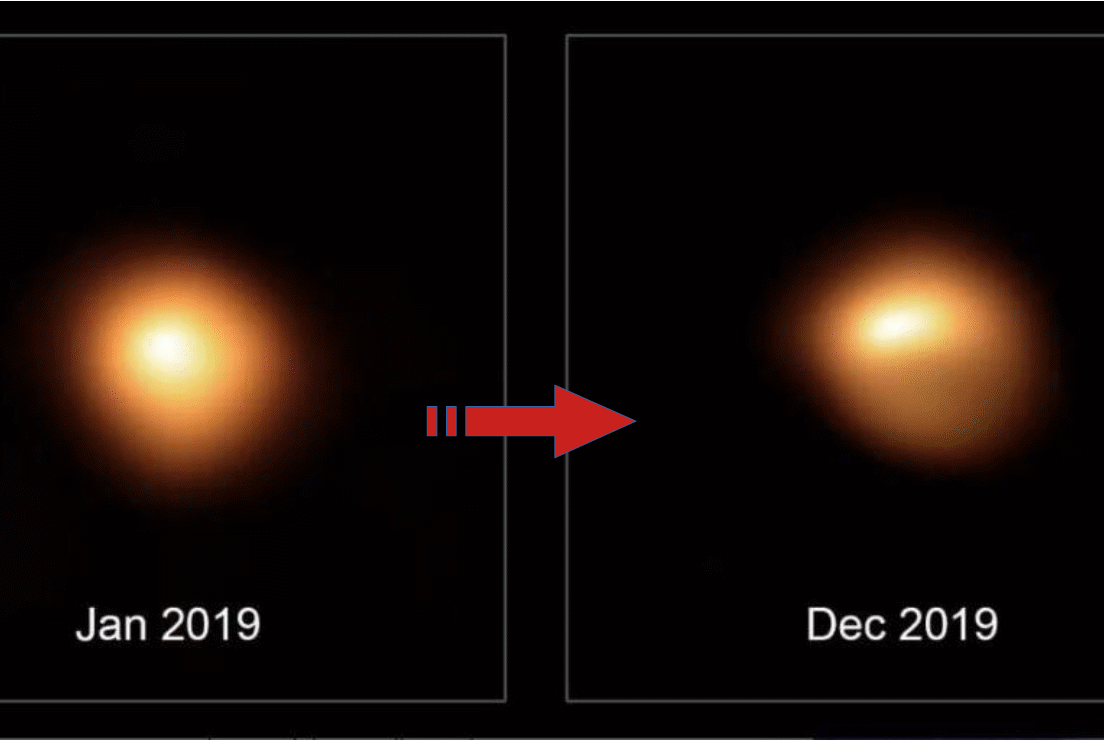
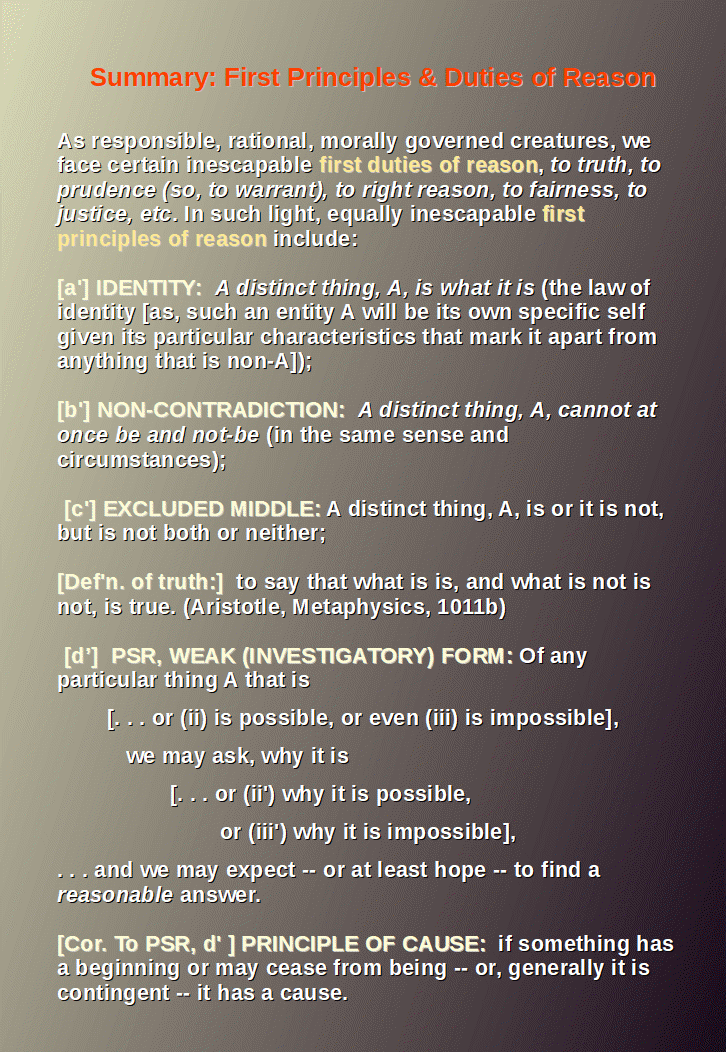
. . . is distinct from the rest of the world. A is itself i/l/o its characteristics of being, and it is distinct from whatever else is not A, hence we see that in w there is no x that is A and ~A and any y that is in W will either be A or not A but not both or neither. These three are core to logic: P/LOI, LNC, LEM.

We may extend to governing principles that we have duties toward — never mind whoever may disregard such (and thereby cause chaos):
U/D March 13: The challenge of building a worldview i/l/o the infinite regress issue:
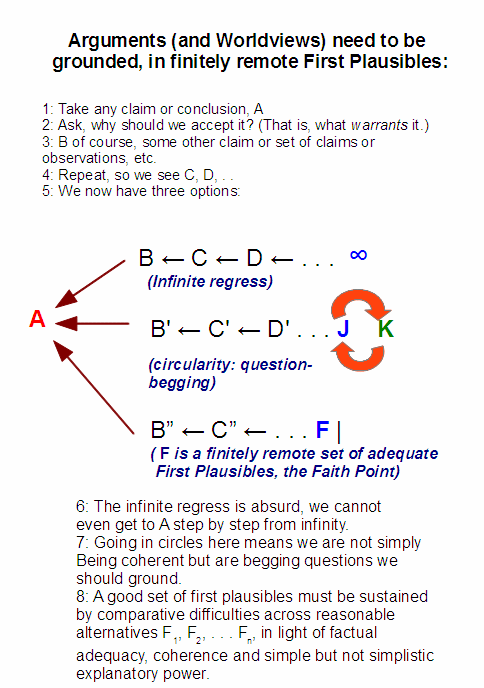
A summary of why we end up with foundations for our worldviews, whether or not we would phrase the matter that way}

Framing a ship:

. . . compare a wooden model aircraft:

. . . or a full scale, metal framework jet:
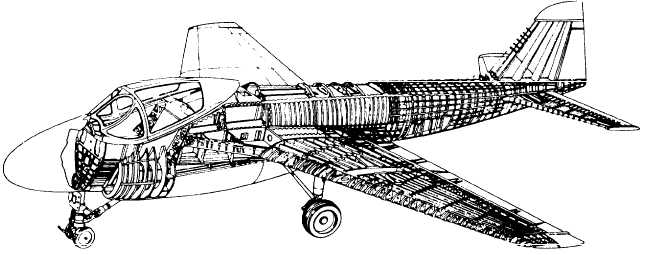
In short, there is always a foundational framework for any serious structure.

Comments
WJM, the principle is simple, we are responsible, rational, significantly free creatures, therefore we are free to choose but responsible to choose aright. That duty translates into the reasonable expectation that others of like nature will recognise and respect said first duties. That someone may choose to flout duties and act deceptively, oppressively or murderously does not change the expectations and duties. KFkairosfocus
February 16, 2021
February
02
Feb
16
16
2021
10:31 AM
10
10
31
AM
PDT
Jerry, the concept that a king is a god is precisely the opposite of being of one blood, apart from being idolatry, itself a severe sin of putting the creature -- another morally struggling human being -- in the place of God.. That someone is ordained or called by God does not make that person a superhuman or dehumanise others. These two issues are simply irrelevant to the principle that a responsible, rational, significantly free creature is responsible to choose and act aright in accord with intelligible principles coeval with that status; i.e. is morally governed in accord with that nature. KFkairosfocus
February 16, 2021
February
02
Feb
16
16
2021
10:26 AM
10
10
26
AM
PDT
KF, Existential necessities, even life, do not equal or confer upon us any right to them, including life. That's a purely ideological position, not a logically necessary one.William J Murray
February 16, 2021
February
02
Feb
16
16
2021
09:23 AM
9
09
23
AM
PDT
Here is PETA’s view about social justice.
“Words can create a more inclusive world, or perpetuate oppression. Calling someone an animal as an insult reinforces the myth that humans are superior to other animals & justified in violating them. Stand up for justice by rejecting supremacist language.”
https://www.foxnews.com/lifestyle/peta-mocked-on-social-media-for-claiming-insults-like-pig-and-chicken-hurt-animals But they went further. They argue that calling someone rat, pig sloth, chicken is now morally unacceptable… And, in 2018 they are argued that calling a cat or dog a pet is derogatory. PETA “Wants You to Stop Saying the Word ‘Pet’” because it’s ‘Offensive to Animals’ https://rare.us/rare-news/peta-pet-derogatory/ What? So calling my cat, “my pet,” is offensive to my cat? Of course, anyone who has ever “owned” a cat knows that it’s really the other way around: they own us, therefore, we’re really their pets. Therefore, I’m the one that should be offended. Peta is also being hypocritical. Look at their name. What do the first three letters of their name spell? (hint: P-E-T) If you think that logic is idiotic, it’s no more idiotic than theirs. This illustrates the off-the-rails logic of left wing "woke" SJW thinking in general. They have invented a new right. The right “to not be offended.” Does that right apply equally and universally to everyone? Do I have the right as a straight white male to not be offended? For example, it’s offensive to me when I get accused of white privilege, white supremacy, homophobia, transphobia and sexism simply because I’m a straight white male or because I don’t agree with the woke left’s social justice agenda. When rights are not equal and universal they are not rights. This also illustrates the irrationality of moral subjectivism, emotivism and moral relativism. How am I morally obligated to your subjective belief or opinion that something is a morally binding right because you believe it is?john_a_designer
February 16, 2021
February
02
Feb
16
16
2021
08:54 AM
8
08
54
AM
PDT
KF, I don't believe I mentioned anything about the "spontaneous origin" of the human body or human nature. I don't even know what you might mean? Poof - here's a human?Viola Lee
February 16, 2021
February
02
Feb
16
16
2021
08:37 AM
8
08
37
AM
PDT
all people are of one blood so the notion on the innately superior superman is discredited.
Not true. Since the city states of Mesopotamia and then Egypt, the king was often considered a god and then as someone specially ordained by God. This lasted into the 1800's and 1900's (a major faction in Spanish Civil War wanted to reestablish the king.) One often referred to the divine right of kings even at these late dates. Similar understanding of innate superiority or endowment were present in all the world. Something completely different happened only in England and a little bit in Holland and then the British colonies and then began to spread to the rest of the world as its success was so evident especially in the new United States.jerry
February 16, 2021
February
02
Feb
16
16
2021
08:21 AM
8
08
21
AM
PDT
VL, there is no good argument on the spontaneous origin of the human body, much less human nature. The simple reality of functionally specific, complex organisation and associated information is already decisive. KFkairosfocus
February 16, 2021
February
02
Feb
16
16
2021
08:18 AM
8
08
18
AM
PDT
WJM, life is the first right, without which there are no other rights, so tyranny is a big deal indeed, as is mass slaughter of the innocent. That is a very important reason to stand for lawfulness and recognise built-in moral government including the duty to justice. KFkairosfocus
February 16, 2021
February
02
Feb
16
16
2021
08:15 AM
8
08
15
AM
PDT
Jerry, it was elitism that led Plato to endorse oligarchy as opposed to Athens' collapsed democratic experiment. Up until 1650 - 1789, modern constitutional democracy was infeasible as the literacy, easy access to published information and theological frame were not there. The fundamental answer to such elitism is deeper, all people are of one blood so the notion on the innately superior superman is discredited. There may be people who have particular wisdom and access to position, but that has more to do with circumstances than some innate superiority that dehumanises lesser mortals. KFkairosfocus
February 16, 2021
February
02
Feb
16
16
2021
08:12 AM
8
08
12
AM
PDT
Natural law, especially Plato, led to the "The Great Chain of Being." This led to oppression of the masses as it was considered natural that some are destined to be superior and others inferior. This idea was only overturned in 17th century England as conflicts between Protestant sects led to more power for Parliament and less for the king. This led to more freedom to the common man as freedom of religion became widespread. This led to more innovation from these people as they could keep the results from their efforts. This led to even more freedom in the British colonies. This led to the Industrial revolution and the modern world and increases in the material goods for all on the planet, better medicine for everyone and more education for everyone. Not complete but almost until the reaction to C19 has devastated the poorer parts of the planet. Aside: it was not an absolute change in England as it was in the United States. Throughout Victorian England there was a definite class system which still lasts to some extent. Just witness "Upstairs Downstairs" and "Downton Abbey." We now have sort of a class system in the US as there are "deplorables" and "Trump voters" who our elites believe should be kept down. The interesting thing is that this group of elites depend on votes from lower educated individuals for their power base as they pit one lower economic group against the other. Deirdre McCloskey used to ask her students in an elite university where did your ancestors come from and nearly everyone said some sort of lower class occupation 3-4 generations back. Never happened In all the history of mankind till recent. My great grandfathers were a cooper, carriage driver, city clerk and a janitor.jerry
February 16, 2021
February
02
Feb
16
16
2021
07:52 AM
7
07
52
AM
PDT
KF said:
WJM, our civilisation and megadeaths are at stake.
So what? Why should that matter to me?
Duties that have been understood as on the table and binding, for 2 – 3000+ years. Duties, that are manifestly inescapable, they pervade for example the objections and arguments in this thread. Inescapable, so, inescapably true [on pain of absurd grand delusion], so too self-evident.
You have yet to demonstrate an inescapable duty to employ "right reason." You've only improperly relied on the agreed-upon debate contract of this particular forum as an example to make that case. You have yet to acknowledge the difference between fundamental logic that is required for sentient existence and communication and any "duty" for "right reason" beyond that (and what is fundamentally necessary for communication to occur at all,) much less made a case that we implicitly adhere to such duties in every situation and in every conversation. An argument that we inherently rely or expect others to be "truthful" and so this implies expectation of duty to truth still blurs the distinction between application of fundamental logic (identity, excluded middle and non-contradiction) that is necessary for any communication at all, and the duty to "right reason" which extends well beyond those necessary fundamentals. Again, I do not expect that others are telling me any "truth." I expect that that everyone is telling me what they hold as being in their self-interest to say to me. As far as I can tell, expecting anyone to exhibit a "duty to truth" or employ "right reason" is a gross mismanagement of personal expectations and is completely at odds with easily observable human behavior. You might counter that our daily life depends on the expectation that most others around us are telling us, at least directionally, the truth. That we can only live within the expectation of generally moral behavior from others as if we all share a common, general, implicit duty to moral behavior. Yes, our interactions with other people, and society in general, depend entirely on the assumption of some basic degree of shared truthfulness and morality. Criminals and sociopaths also depend on this for the success of most, if not all, of their criminal activities. Reliance upon these behavioral commonalities, even if it is an inescapable reliance, does not equal a moral duty to them or a duty to whatever you might think is their proper use. Your repeated warning of "absurdity" and "delusion" is a non-sequitur; do I have a "duty" to avoid absurdity and delusion, even if that were the inevitable consequence of abandoning those supposed duties? If what I say, think and do is absurd and delusional, so what?William J Murray
February 16, 2021
February
02
Feb
16
16
2021
07:26 AM
7
07
26
AM
PDT
But various questions remain: are these part of a common core of features of human nature that arise from within, so to speak, or are they transcendent and are accessed from outside us? That's question 1. Question 2 is how specific are they? They may include some version of "love thy neighbor as thyself", but do they tell us specifically that things like gambling, drinking alcohol, divorce, etc. are wrong are not? Question 3: how do we know either the general or specific components of natural law? If two people disagree, what are the means by which the disagreement is settled. These are the practical questions that remain after one accepts the existence of natural law in a broad form, not tied to any specific world view or religious belief.Viola Lee
February 16, 2021
February
02
Feb
16
16
2021
06:40 AM
6
06
40
AM
PDT
We derive the idea of natural rights from natural law (or more precisely natural moral law.) Notice that the natural law view of morality is not specific to any world view or religious belief. Paul a Christian Jew (1st century A.D.) arrives at virtually the same concept of “natural law,” as the gentile Roman statesman Cicero (1st century B.C.) Cicero in turn derived a lot of his ideas from studying Plato (4th/ 5th centuries B.C.) See my comments @ #374. https://uncommondescent.com/laws/should-we-recognise-that-laws-of-nature-extend-to-laws-of-our-human-nature-which-would-then-frame-civil-law/#comment-724199john_a_designer
February 16, 2021
February
02
Feb
16
16
2021
06:27 AM
6
06
27
AM
PDT
WJM, our civilisation and megadeaths are at stake. As, has happened before several times across the past century. We are going through ruthless erosion of the BATNA-wall of lawfulness, which opens up a slide into lawless oligarchy. That wall is part of the key cultural buttressing of sound, sustainable constitutional democracy. Which, precisely, grew out of the soil of built in natural law pivoting on the same first duties. Duties that have been understood as on the table and binding, for 2 - 3000+ years. Duties, that are manifestly inescapable, they pervade for example the objections and arguments in this thread. Inescapable, so, inescapably true [on pain of absurd grand delusion], so too self-evident. KFkairosfocus
February 16, 2021
February
02
Feb
16
16
2021
06:05 AM
6
06
05
AM
PDT
JVL:
I guess for most people who use ‘the problem of evil’ as an argument against the existence of a loving and attentive deity is why would such a caring entity allow innocent humans to suffer from such events.
It is how we are judged- our reactions and responses to such events. Only ignorant people, willfully so, use the argument from evil to argue against a strawman.ET
February 16, 2021
February
02
Feb
16
16
2021
05:59 AM
5
05
59
AM
PDT
F/N: Enc Brit on Solipsism: https://www.britannica.com/topic/solipsism
Solipsism WRITTEN BY The Editors of Encyclopaedia Britannica Encyclopaedia Britannica's editors oversee subject areas in which they have extensive knowledge, whether from years of experience gained by working on that content or via study for an advanced degree.... See Article History Solipsism, in philosophy, an extreme form of subjective idealism that denies that the human mind has any valid ground for believing in the existence of anything but itself. The British idealist F.H. Bradley, in Appearance and Reality (1893), characterized the solipsistic view as follows:
I cannot transcend experience, and experience must be my experience. From this it follows that nothing beyond my self exists; for what is experience is its [the self’s] states.
Presented as a solution of the problem of explaining human knowledge of the external world, it is generally regarded as a reductio ad absurdum. The only scholar who seems to have been a coherent radical solipsist is Claude Brunet, a 17th-century French physician.
If there is a suggestion of shared mental reality (or a multiverse of individual mind-verses), of course that too runs into similar trouble. Once any significant part of our mental consciousness is delusional that radically undermines the credibility of rationality. Let's note Bostom: https://bigthink.com/mind-brain/are-we-living-in-a-simulation?rebelltitem=1#rebelltitem1
In [a 2003] paper, Bostrom argues that future people will likely have super-powerful computers on which they could run simulations of their "forebears". These simulations would be so good that the simulated people would think they are conscious [--> reduction of mind to computation]. In that case, it's likely that we are among such "simulated minds" rather than "the original biological ones." In fact, if we don't believe we are simulations, concludes Bostrom, then "we are not entitled to believe that we will have descendants who will run lots of such simulations of their forebears." If you accept one premise (that you'll have powerful super-computing descendants), you have to accept the other (you are simulation).
This is another take on the same basic issue, that as computers will become powerful enough -- remote parts require less detailed simulation -- so many will be done that they dominate and most likely if you think you are in a pre grand sim society that's because you are part of such a sim. As such, you are part of a grand delusion. The answer to all such is that first, we should reckon with the possibility of warranted metaphysical access , ie metaphysical knowledge, here, we consult the opening remarks in Bradley's Appearance and Reality:
We may agree, perhaps, to understand by metaphysics an attempt to know reality as against mere appearance, or the study of first principles or ultimate truths, or again the effort to comprehend the universe, not simply piecemeal or by fragments, but somehow as a whole [--> i.e. the focus of Metaphysics is critical studies of worldviews] . . . . The man who is ready to prove that metaphysical knowledge is wholly impossible . . . himself has, perhaps unknowingly, entered the arena . . . To say the reality is such that our knowledge cannot reach it, is a claim to know reality ; to urge that our knowledge is of a kind which must fail to transcend appearance, itself implies that transcendence. [--> this is the "ugly gulch" of the Kantians] For, if we had no idea of a beyond, we should assuredly not know how to talk about failure or success. And the test, by which we distinguish them, must obviously be some acquaintance with the nature of the goal. Nay, the would-be sceptic, who presses on us the contradictions of our thoughts, himself asserts dogmatically. For these contradictions might be ultimate and absolute truth, if the nature of the reality were not known to be otherwise . . . [such] objections . . . are themselves, however unwillingly, metaphysical views, and . . . a little acquaintance with the subject commonly serves to dispel [them]. [Appearance and Reality, 2nd Edn, 1897 (1916 printing), pp. 1 - 2; INTRODUCTION. At Web Archive.]
The self-referential incoherence is clear. How can we know that we have no knowledge of an external world, which we naively think we perceive and act into causally, also being acted on. The answer is, not coherently, consistent with a mind that is credible. Hence, reductio. KFkairosfocus
February 16, 2021
February
02
Feb
16
16
2021
05:57 AM
5
05
57
AM
PDT
KF said:
WJM, it is indeed advisable that we act in accord with first duties of reason, and our individual and collective survival may well be at stake, but the reality is, we have significant freedom and often fail or refuse to do duty within our grasp.
Neither you or I believe our "survival" is at stake, because we both believe "survival" extends beyond physical death here. Until you can demonstrate I have a duty to it (and pointing at what I do and how I discuss here in the forum doesn't count for reasons I've given,) I have no reason to think that I do.
As one contemplates, say, the down-spiral into the Second World War, that becomes ever so painfully obvious. And, the less well appreciated facts of that war show that it could have spiralled up into something far worse, had it gone on much longer. KF
Ultimately, I don't care if society collapses or governments nuke us all to death. That's not my problem.
PS: When I get some time, I will make some further remarks on why the common sense view that our consciousness that we live in an external objective world independent of our consciousness is veridical, is the best reasonable worldview stance. That is a secondary issue, I am afraid.
A "common sense" approach is not going to cut it. Until you show me how my logic fails, and we both know you cannot do that, I will consider my position in this debate substantively uncontested. If you consider our existential nature "a secondary issue," the only response I can give is that you're just not being serious. Understanding our existential nature precedes everything else because if you get that wrong, nothing you say about "first duties" or "moral obligation" can have a proper foundation. You can "start at the middle" with other people because they share and don't question certain unspoken assumptions. I understand that's your comfort zone. In the past, I have enjoyed doing that as well back when I made arguments against subjective morality because I knew people did not have the capacity to question (or even see) the very assumptions that made their position logically untenable. It's not my duty to try to contribute to some sustainable society or try to prevent it from becoming more obviously brutish and oppressive because I do not share your fundamental concept of what existence is or how reality works. Until you address that substantively, you're just playing in the shallow end of the pool.William J Murray
February 16, 2021
February
02
Feb
16
16
2021
05:04 AM
5
05
04
AM
PDT
evil has no independent existence, yes. It parasites on and perverts or frustrates the good
Answered https://uncommondescent.com/intelligent-design/the-argument-from-evil-is-absurd/#comment-724230jerry
February 16, 2021
February
02
Feb
16
16
2021
05:03 AM
5
05
03
AM
PDT
Jerry, evil has no independent existence, yes. It parasites on and perverts or frustrates the good. KFkairosfocus
February 16, 2021
February
02
Feb
16
16
2021
04:35 AM
4
04
35
AM
PDT
I repeat from above. And I will not answer anything else on this thread about this because it is a diversion/distraction here.
This is not the place to discuss this. It has been discussed several other times on this site, once extensively in the last year with Barry. https://uncommondescent.com/intelligent-design/the-argument-from-evil-is-absurd/#comment-697809 I have been arguing this for years. No one has contradicted anything I said. Once you understand that evil essentially doesn’t exist, the whole Theodicy argument against God crumbles.
Another here. https://uncommondescent.com/intelligent-design/vividblue-the-problem-of-evil-is-more-of-a-problem-for-an-atheist-than-a-theist/ No one can define the term “evil” that leads to a coherent discussion. I maintain evil does not describe anything in this world (only one exception.) No one has shown me wrong in over a thousand comments. I came to this observation through discussions of Leibniz’s “Best of All Possible World” thesis and the Theodicy issue. Use the word if you wish. People find it almost impossible to refrain from doing so. Sort of like not putting your hand to your face to scratch an itch. It’s compulsive. It will just have no coherent meaning when you do because the word has no definition that is meaningful for anything in our world/universe. The one God chose to create. The one that is the best of all possible worlds.jerry
February 16, 2021
February
02
Feb
16
16
2021
04:21 AM
4
04
21
AM
PDT
WJM, it is indeed advisable that we act in accord with first duties of reason, and our individual and collective survival may well be at stake, but the reality is, we have significant freedom and often fail or refuse to do duty within our grasp. As one contemplates, say, the down-spiral into the Second World War, that becomes ever so painfully obvious. And, the less well appreciated facts of that war show that it could have spiralled up into something far worse, had it gone on much longer. KF PS: When I get some time, I will make some further remarks on why the common sense view that our consciousness that we live in an external objective world independent of our consciousness is veridical, is the best reasonable worldview stance. That is a secondary issue, I am afraid.kairosfocus
February 16, 2021
February
02
Feb
16
16
2021
03:10 AM
3
03
10
AM
PDT
KF said
First duties are inherently of moral character. We may flout them, but that does not mean they have vanished. Your very arguments pivot on such, inescapably. Which is my point, they are inescapable, so true and indeed self evident.
We do not have a moral obligation to use logic to structure our sentences or thoughts so that they are coherent; that is an existential necessity for sentient life. When you point to how I talk here as "evidence of implicit duty," you are taking advantage of the fact that in this particular forum we have agreed to operate under the game rules of right reason and good faith based on expectation of honesty. As I have explained, in other situations I use other techniques and styles. because I understand that people are, for the most part, irrational and do not make choices out of "right reason." Unless you can point out how I implicitly appeal to right reason in any and all situations besides this particular one that you are taking advantage of, you have not shown any moral duty to "right reason" whatsoever.William J Murray
February 16, 2021
February
02
Feb
16
16
2021
02:52 AM
2
02
52
AM
PDT
KF@ 363, I'll assume, for the sake of charitable discussion, that you just don't understand what I'm saying. BTW, what happened to BA77? I would think he would be in on this conversation.William J Murray
February 16, 2021
February
02
Feb
16
16
2021
02:42 AM
2
02
42
AM
PDT
Jerry: Once you understand that evil essentially doesn’t exist, the whole Theodicy argument against God crumbles. I don't think of natural occurrences (earthquakes, floods, hurricanes, plagues, CMEs, etc) as being 'evil', just examples of a pitiless and uncaring universe unfolding. I guess for most people who use 'the problem of evil' as an argument against the existence of a loving and attentive deity is why would such a caring entity allow innocent humans to suffer from such events. I would tend NOT to use such reasoning because it doesn't rule out an uncaring, absent or nasty creator.JVL
February 16, 2021
February
02
Feb
16
16
2021
02:41 AM
2
02
41
AM
PDT
CC:
[WJM:] That’s something I found hilarious after the capitol “insurrection.” People on both sides kept saying, “violence is never an acceptable means of gaining political change.” Yeah. Try telling the founding forefathers of this country that. Violence, or threat of violence, is usually the only path to actual political change. [CC:] A lot of these same people historically have had no problem bombing the hell out of foreign territories in the service of some “good” or other.
Another problematique. I think we need to distinguish violence, force, bloodshed, murder, excusable homicide etc, all in a circumstance of lesser of evils given the hardness of our hearts. I have often objected that in a world where there are enemies of justice who are perfectly willing to impose might or manipulation [often, might in deception and intimidation], we must distinguish legitimate force, inadequate force to be effective, undue excess and violence. Violence, here, being taken as excessive and/or illegitimate use of force, regardless of validity of ends in view. Due (and sadly, there will always be some excess) force enforces the civil peace of justice. this is the pivot of responsible policing and courts, with defence forces to back such up. So, in this context, force can be part of a sound solution as there are the ruthless who will not yield to the force of logic but will be deterred or curbed by the logic of force. In that context, it is reasonable to see that the alternative to the sword of justice is injustice and chaos. Where, despite discipline and sound command structures, there will always be cases of excess that can be turned into agit prop narratives and props for lawfare. As the past several months in the US demonstrated and continue to demonstrate. In context, the issue of bombing emerges. This is rooted in primarily WW2, when mass bombing became possible, but the electronics to control were severely limited. In turn, the underlying context was WW1, and the unsatisfactory settlement that led to Nazi Germany. Note, you didn't raise gas warfare? The gases of WW1 were still there, and new ones too, but they saw no use on the battlefield. Why? Because, having launched such in round 1 Germany saw sustained retaliation and realised it had better hold back. As it was, had Germany invaded the UK, the British were going to use Gas, starting on the beaches. Of course gas was used for the more spectacular part of the holocaust, the death camps . . . against disarmed, overawed, defenceless civilians. Itself a message. Compounding, WW2 was a nuke threshold war, a closely guarded secret on both sides. So, high command was in a secret race to get nukes and to win before the other side got nukes. Nukes + V2's = city-busting by men already notoriously ruthless. So, war against industrial potential, despite the notorious excesses, was found least of evils open to the allies, including by area bombardment of cities. And, at horrific cost and casualty rates for aircrew, who had to be of relatively high IQ. So, what feasible alternative was there? ________ (The blank is hard to fill.) By the time we get to Japan c 1944, we already had their rape of Nanking in the balances etc, and yes a similar nuke race. Area bombardment of cities was immediately resorted to, and nukes were used in the context of the alternative credible death toll. And, it nearly was not enough. Since then, we have seen bombing and sobering civilian tolls, including even from smart bombs. Can we condemn bombing across the board? If so, what is the feasible alternative, from 1942 to today? ______ Oh, that we were more responsive to first duties, but we have to reckon with the ruthless. KFkairosfocus
February 16, 2021
February
02
Feb
16
16
2021
01:53 AM
1
01
53
AM
PDT
LC, This is quite helpfully sobering:
As is evident from the comments here, it often takes years of advanced school to overcome the realization of first duties of reason that even babies grasp intuitively. As Thomas Jefferson said, “State a moral case to a plowman and a professor. The former will decide it as well, and often better than the lat[t]er, because he has not been led astray by artificial rules.” He was one of America’s founding fathers but since he owned slaves anything he said or wrote has since been cancelled. We recognize natural law not because it upsets a certain class of people but because it protects the commons from men who think avarice, power over society and control of what others can say and do are worthwhile life-goals. When you look at our recent history of the 20th you’ll find several men who, after seizing control of their nations, promptly [collectively] went about removing somewhere between 60 and 100 million people from this planet. In all cases these men had no regard for any first duties of reason, as truth in their society was whatever they said truth was, and attempting to claim otherwise resulted in you being removed from the planet. The same with right reason, prudence, sound conscience and the others. Far from being an obscure and abstract list these duties are plain and very descriptive of what we should see recognized by our government. As these are not created by any government, but exist prior to it’s inception, neither can these be modified or abolished by any government. Some will not agree with this.
Let us trust that there will be some reconsideration and clearing of tangled thoughts. KFkairosfocus
February 16, 2021
February
02
Feb
16
16
2021
01:17 AM
1
01
17
AM
PDT
CC, your reaction seems to be one of expecting a short simple answer to what is manifestly a complex of issues, problems, disagreements and deadlocks. Such golden bb rhetorical shots don't exist. Once a tangled disagreement has set in, it is going to take significant effort to sort out the equivalent of a bad backlash in a reel full of expensive braided fishing line. Something, one hopes to avert but once it is there trying for a one stroke cutting away is not going to work well. So, we are facing the need to address a measure of comparative difficulties and a range of cases that allows us to tease apart then clear the tangles. Not easy, not pleasant, but too often, necessary. KFkairosfocus
February 16, 2021
February
02
Feb
16
16
2021
01:13 AM
1
01
13
AM
PDT
Consciousness is primary. All else is reason working about. Don't you know? I love being a conscious thing in the "material" world.Concealed Citizen
February 16, 2021
February
02
Feb
16
16
2021
12:59 AM
12
12
59
AM
PDT
KF: what? Maybe it's time to retire.Concealed Citizen
February 16, 2021
February
02
Feb
16
16
2021
12:58 AM
12
12
58
AM
PDT
F/N: While I am still busy locally, it is clear that the above thread reflects the broad breakdown of thought connected to morality, soundness, prudence and truth in our civilisation, coming out especially in a secondary struggle over goodness and evil, with innate laws and duties coeval with our humanity implicated and the question of self evidence and adequacy of definition involved. Meanwhile, in all of this, it is quite evident that arguments inescapably appeal to the first duties of reason as outlined from the OP on. How can such a problematique be disentangled? First, let us clarify that the problem of definition is a form of the Agrippa trilemma, that infinite regress is absurd, question-begging circularity equally fails and we are left to finitely remote start-points that may in part be self-evident but cannot be wholly built up from such. In short, we are back to worldviews roots and comparative difficulties; worse, in a context where many are impatient of or even dismiss the sort of careful examination of live options on factual adequacy, coherence and explanatory balance and power that are involved. That must be duly noted. Self-evidence is a key concept, exemplified at one level by || + ||| --> ||||| and another by error exists, with Epictetus' discussion on inescapability of logic as a third. The sum of this is, for those with sufficient experience and linked maturity to understand a relevant matter, the self evident will be seen as true once understood, as in fact necessarily true and such on pain of immediate, patent absurdity on attempted denial or dismissal. I have given examples as the case study allows personal exploration and development. However, while some things are rightly seen as self-evident for the proverbial intelligent twelve year old, who has attained the threshold of reason, as Aquinas pointed out long since, some things have a stiffer price tag of maturity and experience to enter into. That is crucial, when we set out to disentangle claims of meaninglessness regarding good, evil, duty, first duties, built in law coeval with our humanity etc. First, it is patent that across ages, many reasonable and responsible people find significant, important and even pivotal meaning in such concepts. If, therefore, one is tempted to dismiss such as meaningless, one would be well advised to take a pause. That perception may simply reflect lack of understanding and/or struggle with difficulties rather than that thinkers like Aristotle or Jesus of Nazareth or Paul of Tarsus or Augustine of Hippo or Aquinas or Locke or say a Plantinga today, were hopelessly incompetent and confused about meaningless noise. Where, as "comparative difficulties" implies, essentially any significant worldviews position bristles with difficulties and so we are forced to exert prudent judgement (or, we may fail at duty of prudence . . . and yes, that's a first duty rearing its head and roaring). What is goodness, what is evil by contrast? We speak of a good hammer, a good song, a good argument, a good morning, good weather, a good man, ultimately, as French and Haitian people like to put it, The Good God. By contrast, to a good one, a bad hammer fails to adequately or effectively fulfill its purpose and function as a tool. A good/bad argument will be or fail to be cogent, logically responsible, promoting of truth or at least of recognising our limits on a matter. A good man exemplifies virtues and particularly, sound character and habitual helping of others. The good God is a necessary, maximally great being who is source and sustainer of worlds who is utterly pure, utterly wise, utterly powerful, utterly loving, and will act in all things to bring about due ends, tolerating evils [to be further explained] because creaturely freedom [the good/bad man exerting choice] opens up virtues such as love and its corollaries. Goodness is thus broad-ranging, can in part be intelligible from common usage and experience, but poses significant challenges at worldviews level. Evil, in this context is not a true dual, but the twisting, frustration or perversion of the good out of its due end. Aquinas noted that ultimate evil is an impossibility as such would not have even the good of existence. Even the Devil must have some goodness in him, starting with gifts of existence, intelligence, musical talent, ability to persuade etc, he is evil because he has in him the seeds of greatness reflecting God, but has by choice turned aside into selfish abuse of the good he has. A bad hammer (as opposed to a merely crude one) is one that is inadequate to its purpose relative to what it could have been, often by being cheaply made by manufacturers cutting corners, sometimes by error of process, e.g. failed heat treatment and tempering. From such cases, we see an emerging picture. Goodness may be a commonplace experience and may be intelligible in part from such, but has the most profound worldviews connexions and is therefore embroiled in controversies. We must therefore be willing to take a measured judgement informed by comparative difficulties etc. This leads us to recognise that creaturely goodness reflects degree to which valuable, beneficial potential towards an embedded purpose, function or nature is fulfilled and that evil reflects not mere creaturely limitations but chaotic, ultimately destructive, wrenching out of fulfillment of said potential, purpose or nature. At level of the creator, where one is willing to acknowledge such, goodness reflects maximal greatness as core character, manifesting to fullest possible degree, positive and valuable characteristics. In that context, creaturely duty arises in the context of responsible, rational freedom. That which hath not freedom to choose, only reflects the dynamic-stochastic forces, structures, programs etc at work within. It is that which may choose and act on said choice, that can have a duty. Which implies obligation to move towards potential, nature, value, built-in purpose. Those who deny or doubt such will therefore struggle with duty, though many duties are naturally, compellingly evident and are testified to from within by sound conscience. Which is a familiar voice bubbling up from our spirit within, calling us to do the right, the virtuous, the best or at least the better, etc. Again, we may deny or dismiss, but to our detriment. In this context, the right is the path of due diligence to duty, freely, responsibly, rationally understood and chosen. So, we are full circle, back to first, inescapable, self-evident duties. Again, we argue and motivate or persuade. But, the mere cold words of a case do not move us, they may sit in a book on a dusty shelf, or may be lurking on some blog out there, may pop up in a search engine, may be on some banned YouTube channel, now on BitChute or the like. We may hear something on the radio, but that has no force in itself. It is duty, first duties, that breathe fire into such things, motivating us to do diligence to seek and fulfill the good in reasoning and choosing. We are communicative, rational, responsible but limited and error-prone significantly free and socially embedded creatures, who often disagree. So, we see the first cluster emerge, finding these as pervasive in our arguments, thinking, disagreements: duty to truth, right (so responsible) reason on first principles of logic, prudence to seek, learn to find, discern and habitually decide towards the best alternative in circumstances. Even if we act otherwise, we clearly expect the other to do such, though we may exploit ignorance, naivety, fears, anger etc to mislead. Were such first duties to collapse, society would fail amidst anarchic chaos. in the midst of this, the voice of sound conscience arises, calling to duty. We may disregard, warp, blunt, drown out or even suppress conscience, but on the whole it remains. It seems possible to be or become so depraved that conscience is silenced. For me, two incidents leap out: "ah one little frighten-stab he give him, an he ups an dead." Like unto it, "him just cut a gal throat, ah nuh nutten." Both of these were heard at close hand -- 10 - 20 ft range -- as I walked the streets of my homeland's sadly crime riddled capital city and came in a matter of fact conversational tone from the mouths of seemingly sane youngsters I was walking along behind. The prevalence of such sociopathy is a grim warning on the fires we are playing with as a civilisation. Duty to neighbour is manifest, and is reflected in the classic golden rule, also in Kant's categorical imperative and linked thought. Fairness (so also, basic respect for the other) and justice -- due balance of rights, freedoms and responsibilities, etc are corollaries. That brings up the concept of duty reflecting a built-in moral government through intelligible laws and principles coeval with our humanity. The focus is the last triad: duty to neighbour who is a fellow creature of like order as we are: responsible, rational, significantly free, with the same dignity we recognise within when others violate it. So, by a positive mirror, we see the respect that leads to fairness as duty and the due balance that is justice: mutual duties, freedoms, responsibilities. Again, even the objector inescapably appeals to such, and with due pondering and deliberation on circumstances, we can apply to civil codes, community traditions, mores etc. This is how the great democratising reforms since the 1600's came about, and for instance led to abolition of the slave trade and delegitimising slavery under colour of law. Of course, it is argued that globally, there are still dozens of millions of the enslaved and there is a trafficking in human beings [often for forced labour and for sexual exploitation], but that is a criminal fringe. The point is made, and we can now re-examine with a different eye, Cicero:
, On the Republic, Bk 3: {22.} [33] L . . . True law is right reason in agreement with [--> our morally governed] nature , it is of universal application, unchanging and everlasting; it summons to duty by its commands, and averts from wrongdoing by its prohibitions. And it does not lay its commands or prohibitions upon good men in vain, though neither have any effect on the wicked. It is a sin to try to alter this law, nor is it allowable to attempt to repeal any part of it [--> as universally binding core of law], and it is impossible to abolish it entirely. We cannot be freed from its obligations by senate or people [--> as binding, universal, coeval with our humanity], and we need not look outside ourselves for an expounder or interpreter of it. [--> sound conscience- guided reason will point out the core] And there will not be different laws at Rome and at Athens, or different laws now and in the future, but one eternal and unchangeable law will be valid for all nations and all times, and there will be one master and ruler, that is, God, over us all, for he is the author of this law, its promulgator, and its enforcing judge. Whoever is disobedient is fleeing from himself and denying his human nature, and by reason of this very fact he will suffer the worst penalties, even if he escapes what is commonly considered punishment. . . . – Marcus Tullius Cicero, c. 55 - 54 BC
And, here is my summary:
We can readily identify at least seven inescapable first duties of reason. "Inescapable," as they are so antecedent to reasoning that even the objector implicitly appeals to them; i.e. they are self-evident. Namely, duties, to truth, to right reason, to prudence, to sound conscience, to neighbour; so also, to fairness and justice etc. Such built-in . . . thus, universal . . . law is not invented by parliaments, kings or courts, nor can these principles and duties be abolished by such; they are recognised, often implicitly as an indelible part of our evident nature. Hence, "natural law," coeval with our humanity, famously phrased in terms of "self-evident . . . rights . . . endowed by our Creator" in the US Declaration of Independence, 1776. (Cf. Cicero in De Legibus, c. 50 BC.) Indeed, it is on this framework that we can set out to soundly understand and duly balance rights, freedoms and duties; which is justice, the pivot of law. The legitimate main task of government, then, is to uphold and defend the civil peace of justice through sound community order reflecting the built in, intelligible law of our nature. Where, as my right implies your duty a true right is a binding moral claim to be respected in life, liberty, honestly aquired property, innocent reputation etc. To so justly claim a right, one must therefore demonstrably be in the right. Likewise, Aristotle long since anticipated Pilate's cynical "what is truth?": truth says of what is, that it is; and of what is not, that it is not. [Metaphysics, 1011b, C4 BC.] Simple in concept, but hard to establish on the ground; hence -- in key part -- the duties to right reason, prudence, fairness etc. Thus, too, we may compose sound civil law informed by that built-in law of our responsibly, rationally free morally governed nature; from such, we may identify what is unsound or false thus to be reformed or replaced even though enacted under the colour and solemn ceremonies of law. The first duties, also, are a framework for understanding and articulating the corpus of built-in law of our morally governed nature, antecedent to civil laws and manifest our roots in the Supreme Law-giver, the inherently good, utterly wise and just creator-God, the necessary (so, eternal), maximally great being at the root of reality.
KFkairosfocus
February 16, 2021
February
02
Feb
16
16
2021
12:28 AM
12
12
28
AM
PDT
1 26 27 28 29 30 41

Leave a Reply