Uncommon Descent Serving The Intelligent Design Community

Atheism’s problem of warrant (–> being, Logic and First Principles, No. 23)

Categories
Atheism
Defending our Civilization
Logic and Reason
Naturalism
Philosophy
Selective Hyperskepticism
Share
Facebook
Twitter/X
LinkedIn
Flipboard
Print
Email

Atheism seems to be on the table these days here at UD and a few points need clarification.

First up, what is Atheism?

The usual dictionaries are consistent:

atheism
n. Disbelief in or denial of the existence of God or gods.
[French athéisme, from athée, atheist, from Greek atheos, godless : a-, without; see a-1 + theos, god; see dh?s- in Indo-European roots.]

American Heritage® Dictionary of the English Language, Fifth Edition. Copyright © 2016 by Houghton Mifflin Harcourt Publishing Company. Published by Houghton Mifflin Harcourt Publishing Company. All rights reserved.

atheism
n (Philosophy) rejection of belief in God or gods
[C16: from French athéisme, from Greek atheos godless, from a-1 + theos god]
Collins English Dictionary – Complete and Unabridged, 12th Edition 2014 © HarperCollins Publishers 1991, 1994, 1998, 2000, 2003, 2006, 2007, 2009, 2011, 2014

a•the•ism
n. the doctrine or belief that there is no God.
[1580–90]
Random House Kernerman Webster’s College Dictionary, © 2010 K Dictionaries Ltd. Copyright 2005, 1997, 1991 by Random House, Inc. All rights reserved.

atheism
the absolute denial of the existence of God or any other gods.
-Ologies & -Isms. Copyright 2008 The Gale Group, Inc. All rights reserved.

However, from at least the 1880’s, there has been a claim by some advocates of the same, that what is meant is someone without faith in God.

(This tends to serve the rhetorical purpose of claiming that nothing is asserted and it can be taken as default, demanding that theists provide “compelling” warrant for faith in God. Where, often, this then leads to selectively hyperskeptical dismissals, sometimes to the degree of claiming that “there is no evidence” that supports the existence of God. [Of course, the no evidence gambit should usually be taken as implying ” there is no evidence [that I am willing to acknowledge].” Through that loophole, as fair comment, a lot of clearly question-beggingly closed minded hyperskepticism can be driven.)

There are many varieties of atheists, including idealistic ones that reject the reality of matter. However at this juncture in our civilisation, the relevant form is evolutionary materialistic, often associated with the scientism that holds that big-S Science effectively monopolises credible knowledge. (Never mind that such a view is an epistemological [thus philosophical and self-refuting] view. Evolutionary materialism is also self-refuting by way of undermining the credibility of mind.)

A key take-home point is that atheism is not an isolated view or belief, it is part of a wider worldview, where every worldview needs to be responsible before the bar of comparative difficulties: factual adequacy, coherence, balanced explanatory power. Likewise, given the tendency of modern atheism to dress up in a lab coat, we must also reckon with fellow travellers who do not explicitly avow atheism but clearly enable it.

So, already, we can see that atheism is best understood as disbelief — NB, Dicts: “refusal or reluctance to believe”/ “the inability or refusal to believe or to accept something as true” — in the existence of God, claimed or implied to be a well warranted view; not merely having doubts about God’s existence or thinking one does not know enough to hold a strong opinion. It inevitably exists as a part of a broader philosophical scheme, a worldview, and will imply therefore a cultural agenda.

(I add: Note by contrast, AmHD on agnosticism: “The belief that the existence or nonexistence of a deity or deities cannot be known with certainty. “ Where, of course, certainty comes in various degrees, starting with moral certainty, and where knowledge, as commonly used often speaks to credibly warranted beliefs taken as true but not typically held as utterly certain beyond any possibility of error or incompleteness. We not only know that 2 + 3 = 5, but we claim knowledge of less than utterly certain facts and theories. For instance, in the mid 2000’s, the previous understanding and “fact” that Pluto was the 9th Planet of our solar system was revised through redefining Pluto as a dwarf planet.)

It will be further helpful (given objections that suggest inapt, distorted caricature) to excerpt from the Stanford Encyclopedia of Philosophy, as appears at comment 11:

“Atheism” is typically defined in terms of “theism”. Theism, in turn, is best understood as a proposition—something that is either true or false. It is often defined as “the belief that God exists”, but here “belief” means “something believed”. It refers to the propositional content of belief, not to the attitude or psychological state of believing. This is why it makes sense to say that theism is true or false and to argue for or against theism. If, however, “atheism” is defined in terms of theism and theism is the proposition that God exists and not the psychological condition of believing that there is a God, then it follows that atheism is not the absence of the psychological condition of believing that God exists (more on this below). The “a-” in “atheism” must be understood as negation instead of absence, as “not” instead of “without”. Therefore, in philosophy at least, atheism should be construed as the proposition that God does not exist (or, more broadly, the proposition that there are no gods).

This definition has the added virtue of making atheism a direct answer to one of the most important metaphysical questions in philosophy of religion, namely, “Is there a God?” There are only two possible direct answers to this question: “yes”, which is theism, and “no”, which is atheism. Answers like “I don’t know”, “no one knows”, “I don’t care”, “an affirmative answer has never been established”, or “the question is meaningless” are not direct answers to this question.

While identifying atheism with the metaphysical claim that there is no God (or that there are no gods) is particularly useful for doing philosophy, it is important to recognize that the term “atheism” is polysemous—i.e., it has more than one related meaning—even within philosophy. For example, many writers at least implicitly identify atheism with a positive metaphysical theory like naturalism or even materialism. Given this sense of the word, the meaning of “atheism” is not straightforwardly derived from the meaning of “theism”. . . . .

[A] few philosophers and quite a few non-philosophers claim that “atheism” shouldn’t be defined as a proposition at all, even if theism is a proposition. Instead, “atheism” should be defined as a psychological state: the state of not believing in the existence of God (or gods). This view was famously proposed by the philosopher Antony Flew and arguably played a role in his (1972) defense of an alleged presumption of “atheism”. The editors of the Oxford Handbook of Atheism (Bullivant & Ruse 2013) also favor this definition and one of them, Stephen Bullivant (2013), defends it on grounds of scholarly utility. His argument is that this definition can best serve as an umbrella term for a wide variety of positions that have been identified with atheism. Scholars can then use adjectives like “strong” and “weak” to develop a taxonomy that differentiates various specific atheisms. Unfortunately, this argument overlooks the fact that, if atheism is defined as a psychological state, then no proposition can count as a form of atheism because a proposition is not a psychological state. This undermines his argument in defense of Flew’s definition; for it implies that what he calls “strong atheism”—the proposition (or belief in the sense of “something believed”) that there is no God—is not really a variety of atheism at all. In short, his proposed “umbrella” term leaves strong atheism out in the rain. [–> which makes little sense]

Although Flew’s definition of “atheism” [thus] fails as an umbrella term, it is certainly a legitimate definition in the sense that it reports how a significant number of people use the term. Again, there is more than one “correct” definition of “atheism”. The issue for philosophy is which definition is the most useful for scholarly or, more narrowly, philosophical purposes.

We can go further.

For, we all have intellectual duties of care in general and as regards worldviews and linked cultural agendas. There are particular, inescapable associated duties to truth, right reason, prudence (including warrant), sound conscience, fairness, justice, etc. To see why such are inescapable, consider the consequences of a widespread rejection of such duties: ruinous chaos that would undermine rationality itself. Reason is morally governed.

Also, given that post Godel, not even sufficiently complex mathematical systems are subject to proof beyond doubt, that one cannot provide absolute demonstration is not at all the same as that one does not have adequate warrant to hold responsible certainty about key points of knowledge. In this context, the issue is reasonable, responsible faith in a credible worldview. Where, the claim one has “absence of belief in” God is often patently evasive. Why such a strange lack?

Could it be that one knows enough to realise that trying to disprove the reality of God is an almost impossible task, once there is no demonstrable incoherence in the theistic concept of God? (Where, we note, that the old attempt to use the problem of evil to lead to such a contradiction has failed; a failure that is particularly evident, post-Plantinga.)

Now, such is significant, especially given point 7 from the recently cited six-country study on atheists:

7. Also perhaps challenging common suppositions: with
only a few exceptions, atheists and agnostics endorse
the realities of objective moral values, human dignity and
attendant rights, and the ‘deep value’ of nature, at similar
rates to the general populations in their countries. (3.1)

A key to this, is the already mentioned point that our mental lives are inescapably under moral government, through undeniably known duties to “truth, right reason, prudence (including warrant), sound conscience, fairness, justice, etc.” The attempt to deny such rapidly undercuts rational discussion and the credibility of thought and communication, much as is implicit in what would happen were lying to be the norm. So, one who rejects the objectivity of such duties discredits himself.

However, it is also possible to hold an inconsistency; accepting objective morality but placing it in a framework that undermines it.

A start-point is to see that our rationality is morally governed through said duties. This means, our life of reason operates on both sides of the IS-OUGHT gap, requiring that it be bridged. That can only be done in the root of reality, on pain of ungrounded ought. And no, indoctrination, socialisation and even conscience do not ground ought. We need that the root of reality is inherently and essentially good and wise, a serious bill to fill.

You may dispute this (so, as a phil exercise, provide an alternative _____ and justify it _____ ), but it is easy to show that after many centuries of debates there is just one serious candidate: the inherently good, utterly wise creator God, a necessary and maximally great being. One, worthy of loyalty and of the reasonable, responsible service of doing the good that accords with our evident nature. This is the heart of ethical theism.

There is another angle. How much of reality do we know, how much of what is knowable do we actually hold, and how much of that is certain beyond future correction? The ratio is obviously trending infinitesimal; even dismissing Boltzmann brain scenarios, Matrix worlds and Plato’s cave worlds etc.

So, what if what is required to know God is, is beyond what one happens to know, or what one is willing to acknowledge?

In short, the positive affirmation that there is no God is arguably an act of intellectual irresponsibility, given our inability to show that being God is incoherent and our effectively infinitesimal grasp of what is knowable.

Let me add a table, as a reminder on logic of being:
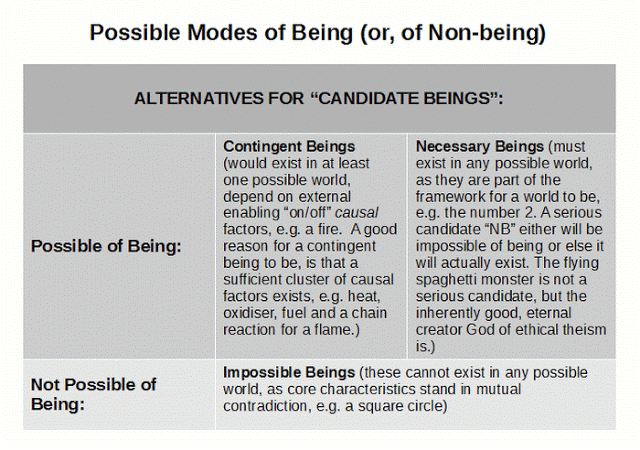
Indeed, as it is easy to see that reality has a necessary being root (something of independent existence that therefore has neither beginning nor end), given that traversal of the transfinite in finite temporal-causal steps is a supertask and given that were there ever utter non-being, as such has no causal powers that would forever obtain, if a world now is, something thus always was. Thus, too, the question is: what that necessary being is, and that is further shaped by our being under moral government starting with our rationality.

Where also, a serious candidate to be a necessary being either is, or is impossible of being as a square circle is impossible of being. Where, a necessary being is a world-framework entity: a component of what is necessary for there to be any world. God as historically understood through theism is clearly such a serious candidate (if you doubt, kindly justify: ____ ), and so the one who poses as knowing that God is not implies having warrant to hold God impossible of being. Where, given the centrality of root of reality, ducking the question is clearly irresponsible.

In short, asserting or implying atheism requires a serious — and unmet — burden of warrant. END

Comments
SA, I think we have very different perspectives on this, but I'll try and engage with one of your points. While the principles underlying reason and logic (the 3 classical laws of thought, I take it), may not be provable, surely they must be falsifiable, right? If so, they are testable. And if they always pass those tests, then I can be somewhat confident that they are correct, even without exercising any faith.daveS
July 12, 2019
July
07
Jul
12
12
2019
10:05 AM
10
10
05
AM
PDT
BB, any worldview has a burden of appropriate warrant per comparative difficulties across factual adequacy, coherence and balanced explanatory power. I know, I know, there is a common rhetorical talking point that those who advoicate atheism (esp. in the so-called "weak" form) aren't asserting anything and so hold default. Simply wrong and an evasion of worldview responsibilities. Just for starters, consider whether you hold that mind comes from brain as computational substrate and why (i/l/o the issue of computation vs rational inference). Then similarly, on OOl and OO body plans, then origin of the world. Pretty soon, it will be clear that your worldview is evolutionary materialistic scientismn, which is known to be both amoral and self referentially incoherent. Dressing up in a lab coat does not evade this challenge of thinking through across major worldview options. The unmet warrant challenge of atheism still stands. KFkairosfocus
July 12, 2019
July
07
Jul
12
12
2019
09:34 AM
9
09
34
AM
PDT
DaveS
In these discussions, it seems to me that “faith” ends up being defined more or less as rational, evidence-based belief. What exactly is the difference between a judgement based on reason and one based on faith?
First of all, faith is required for any kind of rational judgement. Faith is the foundation for a reason-based view. We must have faith that reason and logic direct us to what is good. We have faith that the pursuit of truth has meaning or value and that we should pursue Truth as a moral good. So, we start with faith. A reason-based approach, actually starts with faith in those principles. The principles cannot be evaluated by reason, because faith in the value of those principles is required in order to use any reason. It is possible for a person to assert that reason is not valuable or that truth is not a moral requirement. A person could claim that they do not accept the value of the law of non-contradiction. In the West, we would call that person irrational. It's a person acting against human nature. But it's possible, because we have to have faith in the foundations of reason. On this site, we argue from a rational, evidence-based position. Faith has two meanings in this case. There is the faith I mentioned, which is a belief in the unprovable foundations of reason - faith in the value of rational, logical argument and faith that living by integrity of reason is a necessary thing -- that's one kind of faith. Then, building on that, there is what we might call "divine faith" which is the faith that is oriented towards the presence of God and the willingness to communicate with God and follow what God is teaching to the person. That's a higher level of Faith, going beyond just faith in the rational process itself (which can be done without reference to God).Silver Asiatic
July 12, 2019
July
07
Jul
12
12
2019
08:37 AM
8
08
37
AM
PDT
An explanation is required for Existence or Being. The default position is that you exist and that other things exist. Some explanation is required for that. The atheist view is that there is no explanation. That view is irrational. The explanation that accords with reason is that God is the explanation for that which exists.Silver Asiatic
July 12, 2019
July
07
Jul
12
12
2019
08:27 AM
8
08
27
AM
PDT
KF
BB, you obviously have not read the OP. Atheists like to claim that atheism holds default, but that rhetorical stance lacks warrant,...
That is where you are wrong. The requirement for a "warrant" (and burden of proof) lies with the person claiming that something exists, not with the person claiming that there is no evidence for its existence. For example, do I require warrant backed up with evidence and argument to claim that the default position should be that Santa Clause and leprechauns don't exist, or is this warrant borne by those who claim that they do exist. By default, I have no obligation to provide evidence that God does not exist. It is up to those who do believe that he exists to provide compelling evidence of such.Brother Brian
July 12, 2019
July
07
Jul
12
12
2019
07:55 AM
7
07
55
AM
PDT
BB, It only takes a moment for a reasonable person to realize that 'I don't know' is the default position. After that normally comes a desire for the knowledge, if its possible to acquire. For a person to close their mind off before they even get started is anti-science. Atheists are anti-science, and you are one of their Poster Boys. Andrewasauber
July 12, 2019
July
07
Jul
12
12
2019
07:52 AM
7
07
52
AM
PDT
BB, you obviously have not read the OP. Atheists like to claim that atheism holds default, but that rhetorical stance lacks warrant, especially when considered from the point that the atheistical claims are just a part of a wid3er worldview. Busy now, more later. KFkairosfocus
July 12, 2019
July
07
Jul
12
12
2019
07:24 AM
7
07
24
AM
PDT
KF, From the apologetics article:
Do most atheists value reason over faith and in significant numbers devalue faith altogether?
In these discussions, it seems to me that "faith" ends up being defined more or less as rational, evidence-based belief. What exactly is the difference between a judgement based on reason and one based on faith?daveS
July 12, 2019
July
07
Jul
12
12
2019
06:45 AM
6
06
45
AM
PDT
"nobody has brought up the fact that atheism is the default position" That's because it's not the default position, Brother Blockhead. Andrewasauber
July 12, 2019
July
07
Jul
12
12
2019
05:47 AM
5
05
47
AM
PDT
270 comments in and nobody has brought up the fact that atheism is the default position. The burden of proof is on the theist, not the atheist. Many arguments against atheism that I have read are based on perceived outrageous ideas of what an atheist society would look like. And, in spite of the variations on this, I see these as more evidence for atheism. If we look through history we can see societies that come close to matching these types of societies. If God does exist, he is obviously incompetent at getting his message out. He needs a good marketing team.Brother Brian
July 12, 2019
July
07
Jul
12
12
2019
05:44 AM
5
05
44
AM
PDT
F/N: The lurking issue of moral grounding is also relevant. Theo Hobson:
https://www.spectator.com.au/2014/04/atheisms-empty-tomb/ Atheism has crept so close to religion these days that it’s de rigueur for political atheists like Ed Miliband to boast about a dual identity: a secular allegiance to a religions tradition, in his case Judaism. They don’t of course believe any of the mumbo jumbo about God, prophets and angels. But as pleasant and rational as this all sounds, the new atheists are now hitting the intellectual buffers. The problem that confronts them is as stark as it is simple: our morality has religious roots. Put another way: when God is rejected, the stakes are gulpingly high; the entire moral tradition of the West is put in question. This was the insight of Friedrich Nietzsche — and for all the different atheist thinkers and philosophers since, it remains just as true today. It’s all very well to say that blind faith is a bad idea, and that we should move beyond it to a more enlightened ethical system, but this raises the question of what we mean by good and bad, and those ideas are irrevocably rooted in Christianity. Nietzsche saw this, and had the courage to seek a new ethos amid the collapse of all modern systems of meaning. Did he find one? Yes, in pagan power-worship — the sort that eventually led to fascism. We think of him as mad and bad — but he was brave. Imagine Ed Miliband trying to follow in this tradition, gazing into the abyss of all meaning, the dark crucible of nihilism. The trouble is that too many atheists simply assume the truth of secular humanism, that it is the axiomatic ideology: just there, our natural condition, once religious error is removed. They think morality just comes naturally. It bubbles up, it’s instinctive, not taught as part of a cultural tradition. In The God Delusion Richard Dawkins tries to strengthen this claim using his biological expertise, arguing that humans have evolved to be altruistic because it ultimately helps their genes to survive. But in the end, he admits that no firm case can be made concerning the evolutionary basis of morality. He’s just gesturing with his expertise, rather than really applying it to the issue at hand. . . .
A warning. One, given history over the past 100 years, with grim potential consequences. KFkairosfocus
July 12, 2019
July
07
Jul
12
12
2019
03:04 AM
3
03
04
AM
PDT
F/N: On broader worldview commitments that are typically intertwined with atheistical views:
http://www.apologetics.net/post/Atheism-is-a-worldview-(II).aspx Atheists generally reject the claim that atheism is a worldview[i]. Some say atheism is merely the belief in a single proposition, whereas a worldview is a set of propositions comprising a philosophy of life or a conception of the world. Others say atheism is nothing more than the rejection of all gods and any system of belief one might wrap around this view is diverse and independent. But are these claims reasonable, and if not, why all of the denial? And suppose atheism is a worldview, why does it matter? These questions I will attempt to answer in this post. Is it or is it not? A single proposition is not a worldview. The proposition “God exists” is no more a worldview than its negation “God does not exist.” It is one’s view of God and the corollaries associated with that view which contribute significantly to worldview. When someone says “an atheist only believes no gods exist” their statement is somewhat misleading. They are using the textbook definition of the word instead of the de facto description of the typical atheist. There may be a rare few out there who do not know or care about anything beyond the belief “there are no gods” (P) but most atheists have a fairly consistent set of corollary belief derived or dependent upon P. Consider the following questions: Do most atheists believe matter ultimately precedes mind? Do most atheists believe in abiogenesis over biogenesis (that life arose through material processes on earth or on some other world and transported here?) Do most atheists believe the world has apparent design produced by material processes instead of actual design by an intelligent agent? Do most atheists believe all self-regarding acts are amoral? Do most atheists believe the essence of a man ceases to exist at death? Do most atheists believe the only purpose for existence is that which one self-determines? Do most atheists value reason over faith and in significant numbers devalue faith altogether? Do most atheists believe man is the primary determinant of man’s future? Of course the answer is yes to most of these questions for most atheists.[ii] And these questions of origin, purpose, morality and destiny are the kinds of questions comprising worldview. One may find some variation in response to the above just as Christians for example do not agree on every issue, but that is not grounds to dismiss the correlation that generally exists. Let’s be candid, atheists do not rally, come together for coffee, write books, debate, argue, criticize, litigate, and devote scores of hours to atheist-causes merely because they hold to a single contrary proposition to theists. No, many atheists have a substantive and comprehensive worldview, one that is derived and dependent upon their view of God, and one that motivates their behavior.[iii] Given who atheists generally are in terms of common core belief comprising worldview, it is obvious atheism is a richer description than just one who holds to a single proposition regarding nonexistence. This richer description is a worldview. Why deny it? So what’s the big deal? Why would not atheists simply respond: “Yeah, atheism is a worldview, so what?” There are at least two answers; one clear-cut and the other a little more difficult to prove. I’ll just mention the later and then move right on to the former. The more atheism is acknowledged as a worldview, the more it will be recognized as a religion, and I don’t need to explain why this is an anathema to the atheist[iv]. But let’s skip this one and move on to a more tenable explanation as to why there is denial. Recognizing atheism as a worldview puts a new epistemic burden on the atheist. To start with: If a core proposition (P) in one’s worldview is without warrant, then any corollary propositions (P1, P2 … Pn) of P are also unwarranted unless they have independent warrant. Say because I believe that P (there are no gods), I also believe that P1, P2, and P3 given they are corollaries of P. I may very well have done my epistemic duty accepting corollaries P1, P2 and P3 given I have warrant (good reason) to believe that P. But what if I do not have good reason for that P? What if I assume there are no gods merely because I have no good reason for believing there are? In the absence of independent warrant for that P1, P2 and P3, I am slacking off my epistemic duty if I accept them. When the new atheist says: “you have not given me any good reason for believing Q” that does not mean therefore Q is false. One should be agnostic to Q merely on this basis. Building a worldview on a proposition you ought to be agnostic on is epistemic negligence. I won’t rehash what I’ve gone into at length in my previous post. But suffice it to say the atheist does not want this additional epistemic burden. If my point is still unclear, consider the following example. If I believe there are no gods (P) then I may very well believe design in nature is apparent and not actual (P1). P1 is a corollary belief on P because it is highly implausible, given that P; design in nature is actually due to the action of an intelligent agent[v]. Therefore, given that P1, my perspective on intelligent design (ID) is likely to be clouded. My skepticism of ID will most likely be exceedingly higher than my skepticism of abiogenesis. But without independent warrant for that P1, this bias is based solely on that P. But if the proper epistemic position for that P is agnosticism, then such bias is unwarranted. It should be clear at this point the core proposition of the atheistic worldview “there are no gods” (P) must be warranted and accepted because there is good reason to accept it. Otherwise, without warrant, atheism as a worldview is a house of cards. One must have good reason for that P and not merely accept it as a default or hold the view as an agnostic. Otherwise, such a person cannot honestly claim their worldview, which depends significantly on that P, has epistemic integrity. But given the popularity of the sort of weak/default atheism displayed by the most prominent new atheists today, a house of cards it often appears to be. Why does it matter? In some ways it doesn’t. It is not illegal to deny what atheism is any more than it is to have a straw worldview. But atheist activism is on the rise. Skepticism and unbelief are on the rise[vi]. Prominent atheists like Richard Dawkins at the recent Reason Rally are as blatant as ever in their attacks. Their strategy is to “ridicule and show contempt” for what religious people hold dear while allegedly taking the high road of reason. Ironically it may be their high-calling of rationalism that is their unraveling. In the meantime, I hope others will stand up for those being deceived into thinking one has to check their brains out at the church door except when entering the church of atheism.
Every worldview faces the challenge of warrant as a responsible, reasonable faith and cannot avoid the challenge of unprovable first plausibles. KFkairosfocus
July 12, 2019
July
07
Jul
12
12
2019
02:56 AM
2
02
56
AM
PDT
Recall, these are cases seen in the wild.kairosfocus
July 12, 2019
July
07
Jul
12
12
2019
01:58 AM
1
01
58
AM
PDT
F/N: The same search tossed up this from a certain Laika, April 12, 2015:
https://www.religiousforums.com/threads/strong-atheisms-burden-of-proof.175945/ This question is directed more specifically at strong atheists who make a positive assertion that god does not objectively exist rather than weak atheists who have grounds for not having a subjective belief in god. Realizing this is the case, I've actually decided to change my position to an agnostic as I cannot objectively prove Atheism is true (agnosticism and weak atheism are barely distinguishable). I honestly, don't know how it would be done because it appears to involve radical changes in how we define the nature of objective reality and would appear to involve considerable amount of philosophy in addition to a scientific method to approach the question. I suspect it's closely related to philosophical materialism, but I'm not 100% sure. Given the breadth of the question I felt I needed to throw it out to everyone on RF and just see what comes up. So I wanted to ask: i) how does a (Strong) Atheist set about to prove that god's non-existence is an objectively truth- irrespective of the beliefs of agnostics, theists etc? ii) what proof would be required for a believer to voluntarily give up their belief in god/gods?
This of course immediately warrants that the OP and early exchanges above are very relevant. We see here a case observed in the wild. An immediate, brief reply is also significant: "I don't see how the non-existence of something can be proved. What can be demonstrated is the lack of evidence, though absence of evidence isn't evidence of absence." It seems to me that induced ignorance of evidence (I blame our formal and informal education systems for failing to provide good worldviews analysis foundations) and linked rise of polarisation lead to a situation where there is widespread substitution of crooked yardsticks for sound ones. At minimum, we need to understand the force of Agrippa's trilemma on warrant, and how it leads to a worldviews, comparative difficulties approach thus a diversity of views on what are accepted core first plausibles. In that context we need to rehabilitate the concept that there are certain self-evident truths with ability to serve as naturally straight and upright plumb-lines that correct crooked yardsticks. For example, Josiah Royce long since highlighted the significance of the premise that error exists. Similarly, distinct identity and close corollaries such as LEM and LNC, also the panoply of numbers, will help a lot. Similarly, an assessment of logic of being. See here on in context. From this, we can clear out a lot of worldviews confusion and needless polarisation that seem to be all too common across our civilisation. And BTW, on evidence, world views comparative difficulties warrants arguments to God, a sampler here may be useful. So might be this discussion on atheism. This collection of essays on warrant for the Christian faith may help. (See my own summary here on in context, starting with a video.) These answers may also be helpful. KFkairosfocus
July 12, 2019
July
07
Jul
12
12
2019
01:18 AM
1
01
18
AM
PDT
F/N: On curiosity, I looked for some of the penumbra of attack, and picked up a sampler, from several participants in a group:
>"Atheism seems to be on the table these days here at Uncommon Descent and a few >points need clarification." > ...no they don't. It's already benn clarified...it's really quite simple. We reject the extraordinary claim for the existence of a "God"/gods because there's NO verifiable evidence to support the silly notion. ..now, is the [vulgarity deleted] clear enough for you Dunky ? If not, I'd suggest some remedial education in logical reasoning. [ . . . . ] Speaking as one that everything just took the time to create itself. [ . . . . ] A rather pathetic whine. Meanwhile there is not a whimper or glimpse of gods in evidence. Consider that even if there were booming voices from the clouds we could not even then conclude the presence of gods. As it is we have nothing at all. Just a load of whining. [ . . . . ] Atheism is the birth right of every human being....needs no clarification! [ . . . . ] Yes, NATURE took millions of years to make things! It works without satisfying your mood......or you delusion in the form of a pixie which is untenable!!!!!!!!!!!!!!!!!!!
Let's look at these typical claims, as they reflect the sort of frame of reasoning that drives many who are locked into evolutionary materialistic scientism [which, recall, is inherently self-referentially incoherent and self-falsifying at the outset]: >>It's already benn clarified>> 1 --> It is clear from the above that even the definition of atheism is in need of clarification (especially weak form, so-called) and that its setting in worldviews frameworks faces the same challenge of comparative difficulties that every responsible worldview faces. 2 --> Let's elaborate briefly on the self-referential undermining of rationality, from Haldane:
"It seems to me immensely unlikely that mind is a mere by-product of matter. For if my mental processes are determined wholly by the motions of atoms in my brain I have no reason to suppose that my beliefs are true. They may be sound chemically, but that does not make them sound logically. And hence I have no reason for supposing my brain to be composed of atoms. In order to escape from this necessity of sawing away the branch on which I am sitting, so to speak, I am compelled to believe that mind is not wholly conditioned by matter.” ["When I am dead," in Possible Worlds: And Other Essays [1927], Chatto and Windus: London, 1932, reprint, p.209. (NB: DI Fellow, Nancy Pearcey brings this right up to date (HT: ENV) in a current book, Finding Truth.)]
. . . and Reppert:
. . . let us suppose that brain state A [--> notice, state of a wetware, electrochemically operated computational substrate], which is token identical to the thought that all men are mortal, and brain state B, which is token identical to the thought that Socrates is a man, together cause the belief [--> concious, perceptual state or disposition] that Socrates is mortal. It isn’t enough for rational inference that these events be those beliefs, it is also necessary that the causal transaction be in virtue of the content of those thoughts . . . [But] if naturalism is true, then the propositional content is irrelevant to the causal transaction that produces the conclusion, and [so] we do not have a case of rational inference. In rational inference, as Lewis puts it, one thought causes another thought not by being, but by being seen to be, the ground for it. But causal transactions in the brain occur in virtue of the brain’s being in a particular type of state that is relevant to physical causal transactions.
3 --> That is, we already see that atheism has no right to claim to be a default worldview, and/or to put on a lab coat and put up that it is the proper view of a rational, scientifically informed person. >>...it's really quite simple. We reject the extraordinary claim for the existence of a "God"/gods>> 4 --> Clifford/Sagan evidentialism fails its own test, as it implies an infinite regress of warrant and/or embeds self-serving selective hyperskepticism: the "extraordinary" claims that demand "extraordinary evidence" -- i.e. evidence not likely to be available given our epistemic challenges -- is likely to mean, worldview and/or factual claims one does not like. 5 --> Instead, worldview claims and factual claims should be addressed on responsible, fair-minded assessment of adequate, reasonably accessible evidence. >> because there's NO verifiable evidence to support the silly notion.>> 6 --> likely, echoes the 50 years dead verification principle that in effect only analytic claims and empirically/operationally verifiable claims are meaningful. Unfortunately, the verification principle in its various forms and derivatives -- formerly used to try to wreak havoc on metaphysics, theology etc -- fails its own test. But it took decades for that point to get through. 7 --> Next, what counts as evidence? Does the logic of being i/l/o possible worlds semantics, clarifying what it means to be impossible/possible or contingent/necessary, or causally dependent on on/off enabling factors? (In that light, does an analysis of the fire tetrahedron count as evidence, being a discussion of how such enabling factors affect that which begins, is sustained and may cease, vs. what is embedded in the framework for a world to be possible, vs. the infinite regress supertask faced by a worldview that implies that a quasi-physical causal-temporal chain of finite stages has traversed an implicitly transfinite past in successive steps? Etc?) 8 --> Where, such is directly connected to Wigner's unreasonable effectiveness of Mathematics? 9 --> Where, further, the relevant warrant challenge is to support the claim that there is no God and/or no reasonably accessible evidence that warrants responsible belief in God. Where, God is indubitably a serious candidate necessary being root of reality. Serious candidate NB's are either impossible of being or are present as foundation for possible or actual existence of any feasible world. So, the warrant that God is not in fact a serious candidate NB is: __________ and/or, the warrant that God is impossible of being is: _________ ? 10 --> Where, the notion that between two worlds W and its close neighbour W' there is an enabling/disabling factor f such that God is contingent on such so present in W but not W' as f is off in the latter, simply will not pass the smell test. 11 --> Where, further, especially post Plantinga's free will defense, the logical problem of evil is effectively dead (which is why it is no longer common in serious discussions). That is, the most common reason formerly adduced to infer that God is impossible of being has failed. 12 --> Similarly, notions that suggest things like if God is omnipotent he should be able to create a stone too heavy for him to lift or a square circle etc fail as being empty forms of words. That which is intrinsically impossible of being is a non-being and that which is repugnant to the goodness of God etc are not proper objections to the existence of God. 13 --> The "silly notion" sneer fails, and fails in ways that are revealing about underlying contempt. In some cases, certainly historically, that contempt has been a warning-sign of a far more serious, dangerous attitude: misanthropy. 14 --> Furthermore, as this is an ID blog, let us note that there is considerable evidence of design in the world of life (which is full of functionally specific, complex organisation and/or linked information) and in the fine tuning of a cosmos that sustains such life. Of course, the only actually empirically observed source of FSCO/I beyond 500 - 1,000 bits is intelligently directed configuration, which is backed up by search challenge in beyond astronomically large haystacks. 15 --> But of course, the extraordinary claim that blind chance and/or mechanical necessity have created such FSCO/I and/or account for relevant fine tuning (as opposed to Boltzmann brain fluctuations or the like) has never been empirically observed or analytically sustained, it has simply been imposed by institutional domination backed by hardened, hostile mindsets. >>..now, is the [vulgarity deleted] clear enough for you Dunky ? If not, I'd suggest some remedial education in logical reasoning.>> 16 --> Fallacy of turnabout projection and dismissal without serious engagement on issues of warrant. Speaking of which, we are still looking for the actual warrant for atheistical views. >>Speaking as one that everything just took the time to create itself. >> 17 --> Fallacy of circular causal origin and/or traversal of infinite past regress. >>A rather pathetic whine.>> 18 --> Contempt-laced dismissal rather than serious engagement of comparative difficulties across factual adequacy, coherence and balanced explanatory power. >> Meanwhile there is not a whimper or glimpse of gods in evidence.>> 19 --> Fallacious conflation of contingent pagan dieties with the inherently good and utterly wise creator God, a necessary and maximally great being. This reflects the corrupt definition of theism now commonly advanced that fails to recognise that the term is effectively the short form for monotheism, which then muddies the distinction in logic of being between what is contingent and what is necessary. 20 --> Again, what counts as evidence, cf. the above. >> Consider that even if there were booming voices from the clouds we could not even then conclude the presence of gods. As it is we have nothing at all. Just a load of whining.>> 21 --> Closed minded dismissiveness and the "no evidence" strawman caricature on your part does not constitute actual lack of a good worldviews case on the part of ethical theists. What it does point to is the insistent locking out of God from what is accepted as knowledge, likely pointing to setting up crooked yardsticks as standards of what is straight and/or accurate and/or upright. Notice, the strawmannish caricature of theistic warrant. 22 --> One whose thinking has been so warped will reject what is genuinely these things as they cannot conform to the standard of crookedness. >>Atheism is the birth right of every human being....needs no clarification! >> 23 --> The atheism is default notion. The "needs no clarification" claim is a refusal to adequately define and justify i/l/o comparative difficulties. >>Yes, NATURE took millions of years to make things!>> 24 --> evolutionary materialistic scientism, joined to implicit dismissal of evidence of design in the world of life and the fine tuned cosmos. >>It works without satisfying your mood......>> 25 --> Projection of emotional clinging, even while there is abundant evidence in this thread being clipped, of deeply emotive roots of attitudes and thought. >>or you delusion in the form of a pixie which is untenable!!!!!!!!!!!!!!!!!!! >> 26 --> The delusion projection. Notice, the contempt-laced caricature by comparison to a fairy tale creature and linked magic. ______________ Fair comment: while these are hardly leading atheistical spokesmen, this reflects a too common underlying attitude that needs serious adjustment. The so-called new atheism has not helped matters in our civilisation. KFkairosfocus
July 12, 2019
July
07
Jul
12
12
2019
12:42 AM
12
12
42
AM
PDT
JAD, you have raised several serious concerns. And when we see notions like, to believe in God is to be delusional, or to be raised in a theistic tradition is tantamount to child abuse, or schemes that boil down to social, professional and media marginalisation or even scapegoating, things have gone way too far. Even the attempt to dress up atheism in the lab coat is questionable. KFkairosfocus
July 11, 2019
July
07
Jul
11
11
2019
09:49 AM
9
09
49
AM
PDT
Back, augmented.kairosfocus
July 11, 2019
July
07
Jul
11
11
2019
09:44 AM
9
09
44
AM
PDT
JAD, Speaking for myself, I am interested in whether atheism is true or not; whether it can or can't improve anyone's life is unimportant to me. And I certainly don't want to push it on anyone else. However, in view of the title of this thread, this seems an appropriate venue to discuss/debate atheism, theism, and related issues, which I do occasionally enjoy.daveS
July 11, 2019
July
07
Jul
11
11
2019
08:16 AM
8
08
16
AM
PDT
Atheism per se as just disbelief doesn’t offer much in terms of rationale, justification or warrant. In other words, atheism per se (just disbelief) is nothing more than nihilism. I have said this here before, “if I were an atheist I wouldn’t bother anyone else.” What’s the point? How does atheism improve anyone’s life? Furthermore, how can it be justified epistemologically or ontologically? If we are honest, it can’t. Nihilistic atheism is quite harmless if it wasn’t for people who haven’t come to terms yet with its logical implications. Again, if it’s just disbelief why try to push it on anyone else? On the other hand, there are atheistic world views, naturalism, materialism and some forms of humanism etc. which do present something of an intellectual challenge. We see this kind of atheism exhibited, often very aggressively, in the thinking writing of Sagan, Provine, Dawkins, Ruse, Hitchens etc. (that’s about half the people I can think of off the top of my head) who try to use science (which is really “scientism”) to try to justify their “scientistic” world view. In other words, it’s not atheism per se which is the challenge; it is many atheistic world views which are promoted and marketed as being grounded and based on science which try to monopolize the discussion and debate.john_a_designer
July 11, 2019
July
07
Jul
11
11
2019
07:08 AM
7
07
08
AM
PDT
KF, Well, I have considered most of the issues you raise below (and have even participated in discussions of them here).daveS
July 11, 2019
July
07
Jul
11
11
2019
06:52 AM
6
06
52
AM
PDT
F/N: From Thibodeau, I found more,
https://notnotaphilosopher.wordpress.com/2013/05/20/do-theists-need-to-explain-gods-existence-part-2/ Rauser thinks that by building aseity into the concept of God, the theist is relieved of the responsibility of explaining God’s existence. But I think that this is a bit of a lazy way out of a really interesting problem: the problem of why there is something rather than nothing. Maybe there is a self-existent being and maybe there is not, maybe a self existent being created the universe, maybe the creator of the universe was himself created by some other being (maybe even a self-existent one), maybe a self-existent being sent his only son to die on Earth, or maybe a created being did, or maybe nobody did. Maybe the concept of self-existence makes sense and maybe it does not. But we don’t get to go around saying that we know that there is a self-existent being, that we know why there exists something rather than nothing, just because we have a concept with the very notion of existence built into it.
Now, trivially, no-thing means non-being in the ontological sense. Were there ever non-being -- as such has no causal powers -- such would forever obtain. Therefore, if a world now is, something (ultimately, the root of reality) always was. Thus, again, necessary being world root capable to account for us as rational, morally governed creatures is a pivotal challenge. {OKAY, I WILL COME BACK TO THIS ONE, WIP as duties call] {OKAY, BACK . . . ] Further to this, given a context of logic of being, a necessary, world framework being is not an arbitrary concept, and particularly, a world-root necessary being is not an arbitrary concept. Where also, the God of ethical theism is a serious candidate. Further, not all beings are caused in the sense of between possible world W and W', due to on/off state of some factor f in W vs W', some entity G is in W but not W'. Certain things are part of the enabling framework for any world to be and cannot not-be so long as any world is. So, there is not an evasion of responsibility once that context is on the table. However, sometimes, it is not. Further to this, we are dealing with what enables worlds with rational, morally governed creatures -- us -- to be. That requires a necessary being, world-root entity adequate to ground ought. The only serious candidate for that -- notice, how this aspect is not addressed in the objection -- is an inherently good and utterly wise creator God, a necessary and maximally great being worthy of our loyalty and of the reasonable, responsible service of doing the good that accords with our evident nature. If you doubt this, simply pose an alternative and explain how it passes the comparative difficulties challenge _______ . As for speculative suggestions provided without warrant (apart from creating an aura of being alternatives) what grounds are there to take them as more serious than empty speculation? _________ So, it seems that the warrant challenge shoe is actually on the other foot. KFkairosfocus
July 11, 2019
July
07
Jul
11
11
2019
05:46 AM
5
05
46
AM
PDT
F/N: Found another case, here Jason Thibodeau:
https://notnotaphilosopher.wordpress.com/2013/05/17/do-theists-need-to-explain-gods-existence-part-1/ . . . Randal seems to assume that the notion of aseity is the same as the notion of necessary existence. In other words, he assumes that a being that exists a se also exists necessarily. However, I am not sure that he is correct about this. Let’s start by noticing that the concept of aseity is, I think, a combination of two distinct notions: (1) the concept of absolute independence; (2) the concept of having the reason for one’s own existence in one’s own nature. I don’t think it is too difficult to show that these are distinct notions: Suppose that there exists a being whose nature guarantees that it will be created. That is, the being is of a nature to be created. Thus, in every possible world in which one or more creators exist, this being will exist because it will be created. Let’s call the property that such a being would have, ‘compulsory createdness.’ Now, maybe you think that compulsory createdness is an absurd notion, that it is a property that no being could have. I sympathize. However, if we assume that aseity (in particular the idea of a being whose nature contains the reason for its own existence) is a coherent notion (or, indeed, that at least one being exists a se), I don’t see why we would not assume that essential createdness is equally coherent. If anyone thinks that aseity is a coherent notion but that complusory createdness is not, I invite them to provide us with an argument to this effect. Here is the point: A being that is compulsorily created has the reason for its existence in its own nature. It exists because it is of a nature that guarantees that it will be created. However, it is not an absolutely independent being
Of course, this pivots on almost the opposite to Mackie. One tries to make God contingent, another tries to make something contingent into a must-be in all possible worlds. The latter also fails, as if something is contingent it must be such that there is a conceivable, feasible state of affairs where it is, W AND a second neighbouring one W' where it is not as some factor f is now off. So, the meaning of necessary and contingent is being equivocated. So, we are right back to the logic of being framework:
We are of course back again at what seems to be a particularly difficult concept to digest, logic of being thus the root: candidate entities, which may be possible or impossible of being, with possible beings being dependent/independent of antecedent on/off enabling causes — so contingent/necessary. In short, we have a coherent framework for candidate, possible and actual beings, which is connected to cause and to world-framework entities. This is a rational, explanatory framework and it answers to the sufficient reason challenge.
This question, too, is misdirected. KFkairosfocus
July 11, 2019
July
07
Jul
11
11
2019
05:37 AM
5
05
37
AM
PDT
F/N: Found this tracing to Mackie:
https://philosophydungeon.weebly.com/necessary-existence1.html some philosophers claim that the idea of a 'Necessary Being' doesn't really make any sense. J. L. Mackie argues that there is always the logical possibility that God might not exist; even if God does in fact exist, there is the possibility that he might not have existed. If Mackie is right, then God is really contingent too and it's reasonable to ask for an explanation [--> presumably causal with factor f that accounts for possible world W where God is vs neighbouring W' where he is not] for God's existence.
Of course this then invites, where did God come from? Thence, infinite regress and the problem of traverse again. But never mind, let's look at this. First, actually, God is who "from-ness" and "where-ness" come from! That is, we are again looking at logic of being and necessary vs contingent being. Let us parallel, where did two-ness come from? We already see that so soon as there is a distinct possible world, there is a contrast, W vs what is not W. Two-ness is there as part of the logic and framework of being of worlds. And as non-being as root of reality is not feasible, reality has always been, there has always been at least one world. Two-ness neither began nor can it cease from being. if it did we could neither think nor communicate, which pivot on distinct identity. (And of course, theists argue that World-zero, the root of reality, is God -- the creator-sustainer of all that has been made.) We are of course back again at what seems to be a particularly difficult concept to digest, logic of being thus the root: candidate entities, which may be possible or impossible of being, with possible beings being dependent/independent of antecedent on/off enabling causes -- so contingent/necessary. In short, we have a coherent framework for candidate, possible and actual beings, which is connected to cause and to world-framework entities. This is a rational, explanatory framework and it answers to the sufficient reason challenge. Mackie's question is misdirected. Yes, we can somehow imagine all sorts of things and put in words such as square circles, but such is very different from it is feasible for such a world to be. That is, the "possible" in possible world is a powerful criterion. KFkairosfocus
July 11, 2019
July
07
Jul
11
11
2019
05:04 AM
5
05
04
AM
PDT
DS, Methinks a more fruitful approach would be a worldviews, comparative difficulties approach. Here, starting with logic of being (cf. table in OP) and roots of reality. Where, as non-being is the genuine no-thing, were there ever nothing (& as non-being can have no causal power) were there ever utter nothing, such would forever obtain. Similarly, circular cause on the deep past would require a future, not yet state reach back to cause itself and is similarly ruled out. So, that a world now is entails that SOMETHING always was, thus is independent, is necessary. This means, the effective alternatives orbit the issue: which serious candidate necessary being world root offers the best explanation. Where, our observed cosmos had a beginning and so is contingent, and where we are morally governed creatures, even in our thinking and reasoning. That means we operate on both sides of the IS-OUGHT gap and -- on pain of undermining rationality -- the gap must be bridged in the only place it can be (on pain of ungrounded ought), the world root. Where, BTW, I have by and large not been speaking to a Christian frame but a worldviews frame, with a particular eye to world-roots informed by logic of being. That is a wide issue and raises always comparative difficulties across live option alternatives. Do I need to state at this juncture that I am every inch a worldviews thinker, not narrowly a Christian thinker? Where, that means I at least have a few crumbs from the table sat at by the likes of a Paul or a Justin Martyr or an Augustine or the Angelic Doctor, etc, down to today's Plantinga or Craig or even a Schaeffer or a Nash or a Geisler or a Feser, further etc? I have also in mind (as always) Wigner's challenge on the unreasonable effectiveness of Mathematics; where we have traced that to a core of structure and quantity being necessarily framework to any distinct possible world, i.e. to principle of identity applied to how W has some A in it distinguishing from near neighbour W' so we dichotomise W = {A|~A} with nullity, unity (simple and complex) and duality directly manifest thence via von Neumann's construction, the Surreals game and the rotating vectors view, a panoply of numbers and [ideal, abstract] spaces. From this we set up abstract logic model worlds and use such to intersect with reality that we experience, not least as a necessary entity must ever be present in any possible world. In short, any world view must also draw in the power of Mathematics through logic of being and the significance of the logic of structure and quantity. Coming back, we see that the two main alternatives on the table for world-root just now are a beginningless temporal-causal succession of finite stages and an inherently good and utterly wise, necessary and maximally great being, creator God. This last is the God seen through the lens of ethical theism, not as such God as identified through the Judaeo-Christian scriptural tradition and linked historic communities of worship. However, maximal greatness indicates per indiscernibles [cf. above], that the faith communities are looking at recognisably the same Supreme being. I would suggest here, that although significantly variant, the Islamic tradition is also looking at the same Supreme being, and there are other less well known traditions; there is here no commitment that any particular tradition is 100% right nor a claim that differences in theology are insignificant. So, never mind debates on particular points -- which are to be hammered out at another level with different tools, generic ethical theism, the God of the philosophers, is good enough for our purposes. Serious candidate world-root being. Notwithstanding, I note that there is no way Moshe could have understood the force of I AM THAT I AM, nor could Isaiah's picture of Aseity* -- yes, a rare but necessary word -- have been painted on an understanding of necessary being. The tools to hammer that out came along a lot later. It looks to me that they genuinely heard things they could not understand and wrote them down accurately, leading us to ponder, how could they have that, at such early dates?
*Dictionary stack: a·se·i·ty (?-s???-t?, ?-, -s??-) n. Philosophy The state or quality of existing in and of oneself, without external cause. [Medieval Latin ?s?it?s : Latin ?, by, from, of + Latin s?, himself, herself, itself (in the Scholastic descriptive phrase used of God, (?ns) ? s?, (something existing) from itself, of itself; see s(w)e- in Indo-European roots) + Latin -it?s, -ity; see -ity.] American Heritage® Dictionary of the English Language, Fifth Edition. Copyright © 2016 by Houghton Mifflin Harcourt Publishing Company. Published by Houghton Mifflin Harcourt Publishing Company. All rights reserved. aseity (e??si??t?) n (Philosophy) philosophy existence derived from itself, having no other source [C17: from Medieval Latin aseitas, from Latin ? from + s? oneself] Collins English Dictionary – Complete and Unabridged, 12th Edition 2014 © HarperCollins Publishers 1991, 1994, 1998, 2000, 2003, 2006, 2007, 2009, 2011, 2014 R C Sproul Lecture: https://www.ligonier.org/learn/conferences/orlando_2004_national_conference/aseity-of-god/ Unlike creation, God is self-existent, uncaused, and independent. In this lecture, Dr. Sproul will examine the doctrine of God’s aseity, and explain why it is vital to a proper understanding of who God is as Creator and Redeemer. CATHOLIC ENC: Aseity (Latin a, from; se, itself: ens a se) is the property by which a being exists of and from itself. It will be easily understood that this property belongs, and can belong only, to God. When we look for the efficient, exemplary, and final cause of all things, of their existence, nature, and organization, we come ultimately to a Being Who does not depend for His existence, realization, or end on any cause other than Himself; Who has within Himself His own reason of existence, Who is for Himself His own exemplary and final cause. It is to this very property of absolute independence, or self-existence by nature that we give the name of aseity. This notion of aseity includes, therefore, according to our conception, a negative and a positive aspect; absolute independence and self-existence, which complement each other and form one single objective property. As is easily seen, the Catholic concept of aseity which represents God as absolutely independent and self-existent by nature, and, consequently, all-perfect without any possibility of change from all eternity, is altogether opposed to the pantheistic concept of absolute or pure being, which absolute or pure being evolves, determines, and realizes itself through all time. (NB: Wikipedia gets it wrong here, talking about self-caused. I suspect its contributors do not understand the differences of contingent vs necessary being and the gap between a self-moved volitional first cause free agent and circular cause. Oddly, sliding below the intro-summary, I find something much better: >>Aseity has two aspects, one positive and one negative: absolute independence and self-existence.[1] In its "negative" meaning, which emerged first in the history of thought, it affirms that God is uncaused, depending on no other being for the source of God's existence. In its "positive" meaning, it affirms that God is completely self-sufficient, having within Godself [--> neologism, wouldn't "himself" do] the sufficient reason [--> notice, PSR] for God's own existence.[2] The first concept derives from "the God of philosophers", while the second one derives from "the living God of Revelation" (I Am Who Am: Exodus 3:14).[3]>> On further digging, the talk page has an even more revealing remark: >>I put the original research banner over the Aseity page because of the last claims regarding aseity of the universe. I am not aware of decay and corruption being widespread throughout the universe [--> That raises entropy and long term heat death issues, methinks], nor am I aware that it is self-evident, nor am I aware how this poses a problem to atheistic aseity of the universe. [--> Aha, here we go, the evo-mat-scientism picture here tries to suggest the physical cosmos as necessary being world root] Since there is no citation or source for this claim, I decided that it falls under the guidelines for original research and put up the banner. 70.243.116.156 20:43, 22 May 2007 (UTC)Adam Pierce Someone seems to have removed the original-research type comments, so I removed the original research banner.69.137.181.88 09:18, 17 June 2007 (UTC)Adam Pierce >>)
Now, traversal of a transfinite span through finite stage temporal-causal succession is plainly a supertask. That obtains whether the transfinite nature is explicit or implicit, as was hammered out here a few months back, addressing issues going back across three years. Also, such does not even credibly account for the FSCO/I in brains regarded as mere computational substrates (not including quantum interfaces to fifth dimensional supervisory oracles needed to account for rational insight and required freedom). Much less, moral government. Besides, the world picture painted by evolutionary materialistic scientism is multiply self-referentially incoherent and self-falsifying. That really leaves the Supreme being on the table as the only serious candidate to be the necessary being world root. Note, candidate, serious candidate. That further means, either impossible of being or else possible AND framework to any possible world. That is, actual. Where, impossible of being is as a square circle is impossible of being: core characteristics that cannot be surrendered while retaining identity stand in mutual, irreconcilable contradiction. So, a square circle or the like will be infeasible, no such entity can exist in any possible world. And yes, this is a very powerful logic of being result. Yes, logic is connected to essence of distinct being through identity and its close corollaries LNC, LOI etc. Also, yes, as touching any candidate being or non being we may freely ask why is it or may it be or must it be or even why it cannot be, in hope of a sensible answer -- the weak form, inquiry based principle of sufficient reason. So, now, is there a good reason to introduce another candidate to be necessary being world root: _______ ? Why? __________ . How does it fare across comparative difficulties on factual adequacy _______ coherence _____ and balanced explanatory power ______ ? Do you or any other person here or in the penumbra have a cogent reason to hold the Supreme being as a failed candidate being: __________ ? On what grounds _________ ? (Note, post-Plantinga, the logical form problem of evil is effectively dead, and the inductive form shorn of claws and teeth. Ever since Boethius' Consolation of Philosophy and arguably since Solomon in Ecclesiastes or even Job, the existential form has lost its worldviews force, though we must never underestimate its sheer raw impact on a life or community.) The challenge of worldview warrant is on the table for Atheism, Agnosticism and fellow traveller views and ideologies also _______ The above thread makes interesting reading, therefore, given the known penumbra of objector sites. KFkairosfocus
July 11, 2019
July
07
Jul
11
11
2019
02:22 AM
2
02
22
AM
PDT
JAD, I am deliberately asking questions which I believe make sense from a Christian perspective. That's because I am curious about KF's and SA's 'framework', if you will, not so much my own.daveS
July 10, 2019
July
07
Jul
10
10
2019
10:13 AM
10
10
13
AM
PDT
Dave’s question makes no sense from an atheistic perspective because the existence of actual good and evil depends on the existence of transcendent moral truth (i.e. a transcendent moral standard.) In other words, the atheist is not warranted in asserting such a premise. So either he is being either inconsistent or insincere.john_a_designer
July 10, 2019
July
07
Jul
10
10
2019
10:09 AM
10
10
09
AM
PDT
DS, it is a really tricky thing especially if we are looking for not the worst known or commonly believed case but a maximal one. Evil cannot be isolated, it rides piggyback on good. So, we can say that a certain former archangel with built-in musical instruments is perhaps the worst known abuser of high power and privilege, but that is different. Likewise, Germany c 1933 - 45 was in many respects a very admirable country, world leader in sci-tech, with man for man probably the best soldiers in the world. Their national leader was a man of great talents. But, he and they perverted what should have been a blessing and wreaked havoc. I guess that may make possible a ranking of greatest potential to do good betrayed, but I am by no means persuaded that such can be turned into a metric of evil. KFkairosfocus
July 10, 2019
July
07
Jul
10
10
2019
08:46 AM
8
08
46
AM
PDT
DaveS
How about considering the collection of maximally evil beings, then among those, choosing the most powerful one(s)?
I think that's correct. We can rank beings in terms of power. Intelligence, strength and various excellences can be evaluated. … posted before I saw your previous.Silver Asiatic
July 10, 2019
July
07
Jul
10
10
2019
08:29 AM
8
08
29
AM
PDT
Thanks, SA, that's quite to close to what I had in mind (referring to #249).daveS
July 10, 2019
July
07
Jul
10
10
2019
08:29 AM
8
08
29
AM
PDT
KF
This seems to be a useful addition to our stream of thought, clarifying how an inherently good and utterly wise world root being will span relevant properties of excellence.
I think it's a very important exercise for us to consider these things you mention: Excellence, the maximally greatest being, perfection of goodness, wisdom, intelligence, power. If we rise up on the scale of values to think about those peak levels, it has a profound, lasting and beneficial effect on our mind. If we think about greatness, we actually will become greater in our own thought and intention. Eventually, I think that if we consider "that, than which nothing greater can be conceived", we have to wonder why our thoughts travel up that hierarchy of value. We are able to recognize deprivations in excellence - this points to a standard or a peak. The greatest being we can conceive of cannot exist in the understanding alone, and eventually we realize that being must exist actually,Silver Asiatic
July 10, 2019
July
07
Jul
10
10
2019
08:28 AM
8
08
28
AM
PDT
1 6 7 8 9 10 17

Leave a Reply