Uncommon Descent Serving The Intelligent Design Community

L&FP 45: The Hypothetical Syllogism — a lecture

Categories
Defending our Civilization
Epistemology
Logic and Reason
Mathematics
Video
Share
Facebook
Twitter/X
LinkedIn
Flipboard
Print
Email

Here:

This syllogism is of considerable practical importance:

Corresponding Tautology: ((p →q) ∧ (q→r))→(p→ r) Example: Let p be it snows. Let q be I will study discrete math. Let r be I will get an A. If it snows, then I will study discrete math. If I study discrete math, I will get an A. Therefore , If it snows, I will get an A.

This raises the issue of denying the consequent, ~q. If p –> q and ~q, then as q is necessary for p, ~p. Where, p is sufficient for q, by reason of its core characteristics, the states of affairs associated with p, causal power, requirement of logic of being etc.

Let us note, p –> q is equivalent in import to ~q –> ~p.

(Let’s add, that denying the antecedent, thinking this falsifies the consequent also fails, p –> q does not mean there isn’t another way, say r, to get q. There’s more than one way to skin a cat-fish.)

Connected to ID, Newton’s rules demand that causal adequacy be shown before assigning powers to claimed causes, especially for things we cannot directly observe. (Design [= intelligently directed configuration] routinely causes functionally specific, complex organisation and/or associated information beyond 500 – 1,000 bits. Undirected, blind dynamic-stochastic processes . . . chance and/or mechanical necessity alone . . . have no such observed powers. Hence the controversial resort to Lewontin’s a priori commitment to only allow materialistic causes.)

Dynamic-stochastic process:
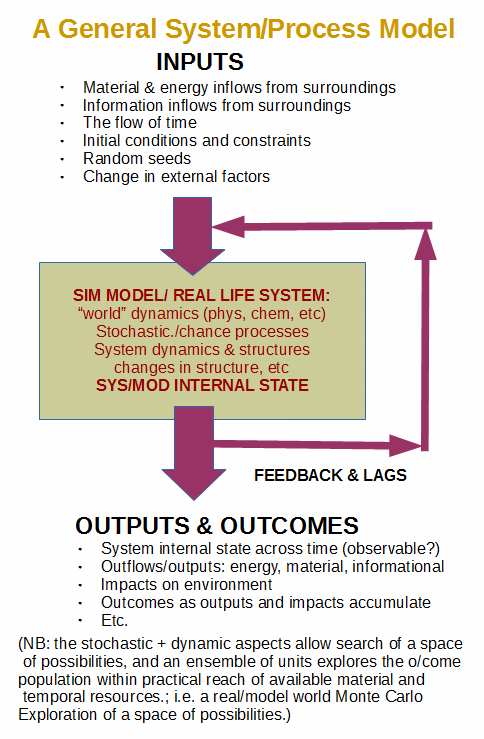
As it just came up again, let me again document how the ID explanatory filter does not impose design as a default but instead infers across three broad explanatory forces, blind chance and/or mechanical necessity and/or design . . . and yes all three factors can be jointly at work so we need to examine an entity, network, structure or process per aspect:
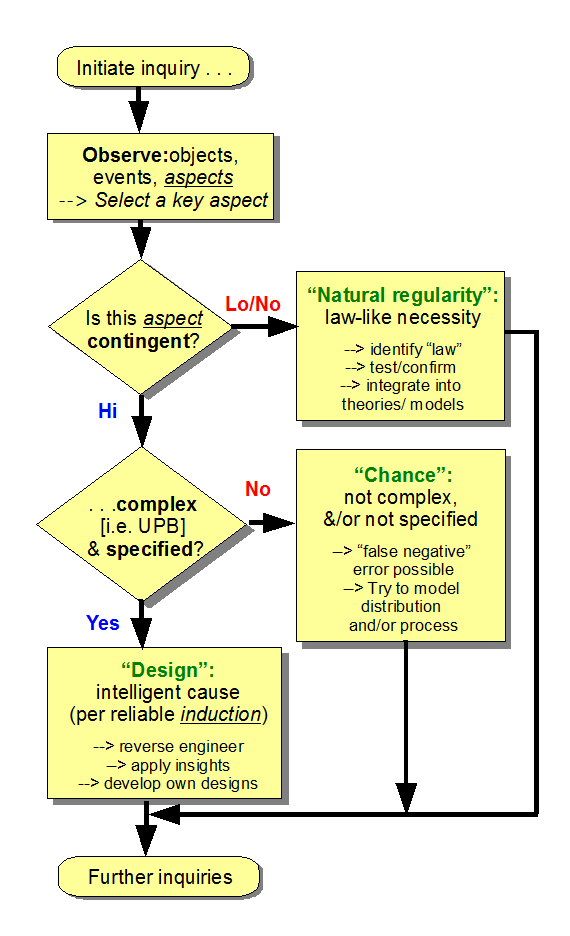
The ID Inference Explanatory Filter.

We thus see modus ponens [direct implication] and modus tollens [denial of the consequent]. A classic application of the latter, is that once a chain of implications terminates in a falsehood, this upends the chain. This is used in proof by reductio ad absurdum.

Related, p –> q and q –> r entails, p –> r, which extends to any chain we may warrant. That is, truth of an initial proposition chains downstream. This truth transmission property is an important power of implication.

Bearing in mind that time may be a factor in causal chains, cause-effect bonds, likewise, will flow from initial conditions to outcome. Hence, the issue of a first-cause agent, something which is self-moved and initiates chains of consequences. To type, I move a finger to and press a key initiating a keyboard scan and ultimately screen display, etc.

This points to the explanation argument, inference to the best explanation, aka abductive reasoning. (Abductive reasoning also includes the educated guesswork of spotting candidate patterns, hypothesis creation.)

The idea here is that facts of observation f1, f2, . . . fn = F, require a common explanation, so, we have candidate explanations e1, e2 . . . em that can be tested for implying the span of facts F. We also look for coherence and for balanced explanatory power [neither an ad hoc patchwork nor simplistic], picking the best, where E –> F. Power to predict future facts is a further important test. Such explanations, are not proved, nor can abduction — an inductive form of reasoning — prove, though it can support high reliability in a tested zone of application. However, implications are such that a false explanation or model can also be highly reliable.

Underneath, is the meaning of IF — THEN –, that is sufficiency:

p –> q is equivalent to ~ [p AND ~q], we cannot have p true and q false. This does not mean, p is true. To get there, we would need EQUIVALENCE, i.e. p –> q and q –> p. That is p is necessary and sufficient for q. The fallacy of affirming the consequent confuses p –> q with that equivalence.

Linked, q is necessary for p, that is, ~p OR q. This can be shown by using truth tables for what is called material implication.
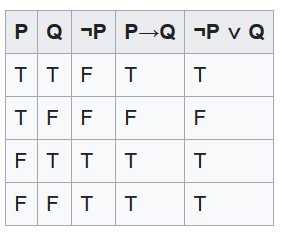
Hence, the peculiar phrase for equivalence, “necessary and sufficient.” In Mathematical contexts, we may see p IFF q, p if and only if q. Notice, a false p can properly imply a true q, which is a subtlety that is the root of many errors of thought.

Also related, is the disjunctive syllogism:

The conjunctive syllogism is p AND q, so that for and to be true both must be. This can be chained, and of course we then see if a chain has in it x and y so y = ~x, then the whole is inconsistent logically. One use of this is in a coherence defence by augmenting explanation. If claims p1, p2, . . . pn = P are suspected to be inconsistent but on augmenting with some e, e AND P is coherent, P must be coherent. This is the heart of Plantinga’s free will defence of the coherence of the concept of God in ethical theism. It also allows us to see that we can for example make a coherent account of the passion-resurrection narratives in the gospels. Weakening, to the case where there are contradictions, we may be able to identify which of x or y to choose, or we may be able to footnote the matter and set it aside as a difficulty. In short, it can be very hard to demonstrate substantial and irretrievable inconsistency in a string of propositions forming a narrative.

The celebrated case of the six blind men of Hindustan encountering the elephant and having partial patterns (beloved of post modernists and those who try to reduce differences to relativism), is a subtle lesson:

The onlooker with a broader picture and better explanation illustrates the power of a best explanation. Notice, here, it is Jesus of Nazareth!

Such various real-world syllogisms, however, are important.

In particular, implication used for explanation or prediction has utility in planning or modelling. We propose a “simplified” or proposed or candidate, p and explore its implications or what it explains. We may look at several, then choose the best, which we then implement.

In short, the logic of implication is powerful, subtle, useful but a source of many pitfalls. We would to well to study it. END

Comments
MNY, logic, once existential and universal quantifiers and the issue of "existential import" was on the table, has had to face the issue of empty reference. As I noted, this shifted the framework for the square of opposition that is at the heart of syllogisms. There are further subtleties as the IIRC C18 interpretation of the claims, on rechecking original Greek, can be reassessed but what it means is that as a fact of current thought we have to bear in mind empty reference. KFkairosfocus
June 20, 2021
June
06
Jun
20
20
2021
12:57 AM
12
12
57
AM
PST
MNY, BTW, the possibility of empty references is one reason why it is so important, today, to address the logic of being and for example God as a serious candidate necessary, world framework being who is a required part of the fabric for any possible or actual world, i.e. eternal Creator. KFkairosfocus
June 20, 2021
June
06
Jun
20
20
2021
12:52 AM
12
12
52
AM
PST
kf @ 6 - but you still haven't explained how you can show that an unidentified designer has the power to do the designing you're inferring. And you you (via Newton's rules) "demand causal adequacy be shown before assigning powers to claimed causes, especially for things we cannot directly observe." You raise computer technology, but there we know that the designers are human (or are computers designed by humans), and they have causal adequacy.Bob O'H
June 20, 2021
June
06
Jun
20
20
2021
12:49 AM
12
12
49
AM
PST
5 Habits That Will Make You POWERFUL Beyond Belief I guess JP has a simpler way to explain what KF is trying to explain for some time , but in reverse , from finality to roots . @Mohammadnursyamsu I guess you had no contact with western civilisation. This is not necessarily a bad thing but when you try to convince someone about your ideas and you use terms that are not used in western world you can't make yourself understood . :) "Therefore it is equally logically valid to say a painting is beautiful or ugly, in spontaneous expression of emotion with free will, but to be forced to say the painting is beautiful, or ugly, provides an invalid opinion." Nope, it's not equally logically if morality is involved. If is not involved you talk about a simple preference :I like coca-cola ,Ronaldo prefer sprite, you like cricket ,John prefer football. When is about moral value or moral hierarchy then duty is "activated" and is not anymore a simple preference. Tricky part: a tool called "free will" allows you to interchange atributes of objective moral law with your subjective preference.Sandy
June 19, 2021
June
06
Jun
19
19
2021
07:53 PM
7
07
53
PM
PST
That's not how the logic works in common discourse. Nor I suspect, generally. And take a look at the logic of subjectivity, something you don't know about. The basic logic of subjectivity: Subjective things make choices, and subjective things can only be identified with a chosen opinion. If there are the alternative possibilities A and B, and A is chosen, then the question, "what made the decision turn out A?", must be a choice between subjective words P and Q. Either chosen answer P or Q, is equally logically valid. But a forced answer P or Q is invalid. Therefore it is equally logically valid to say a painting is beautiful or ugly, in spontaneous expression of emotion with free will, but to be forced to say the painting is beautiful, or ugly, provides an invalid opinion. Say the answer P is chosen, then the opinion is that P made the choice turn out A. And because P is chosen, then we can start the logic again, and ask the question, "what was it that made the choice turn out P?". And the answer would be a choice between subjective words P and Q. If someone chooses the opinion that a choice was made out of hate, then in turn one can choose the opinion that it is hateful to choose the opinion that the choice was made out of hate. 1. Creator / chosen / subjective / spiritual / opinion 2. Creation / chosen / objective / material / fact Emotions, like love and hate, personal character, like courage and kindness, God, the soul, the spirit, they are all in category 1. They all make choices, and they all can only be identified with a chosen opinion.mohammadnursyamsu
June 19, 2021
June
06
Jun
19
19
2021
06:50 PM
6
06
50
PM
PST
MNY, the lecture is solid. The context is that "Paul" may refer to an empty set. That dramatically modifies the square of opposition. KFkairosfocus
June 19, 2021
June
06
Jun
19
19
2021
06:24 PM
6
06
24
PM
PST
That lecture is bogus. To say, Paul does not work, means Paul exists, and doesn't work. It doesn't mean that it is a questionmark whether or not Paul exists.mohammadnursyamsu
June 19, 2021
June
06
Jun
19
19
2021
04:03 PM
4
04
03
PM
PST
BO'H, the focus of this thread is implication logic, foundational to a lot of our thinking. The side issues and long since adequately answered objections come across as a distraction from far more serious matters, Besides, you are a highly educated person and you know the difference between acts of intelligence and identification of particular agents. There is no contradiction as you try to allege, you know full well that causal efficacy of intelligence brims over from the computer technology we are using, and that the technology is replete with signs of such. So, we identify design as an effective process which may leave reliable signs. Cell based life is replete with those signs and we may infer abductively to intelligent cause. However, that is worlds apart from say identifying that a ship from the Andromeda galaxy visited our sol system and used its molecular nanotech lab to seed our primitive planet with terraforming first life etc, or that they did it on orders of their high Senate. Or some other such thing. Your objection fails, and fails in ways that raise questions. KFkairosfocus
June 19, 2021
June
06
Jun
19
19
2021
01:45 PM
1
01
45
PM
PST
kf @ 8 -
Where, we routinely observe such traces and intelligent causes, so causal adequacy is not the issue.
kf @ OP -
Connected to ID, Newton’s rules demand that causal adequacy be shown before assigning powers to claimed causes, especially for things we cannot directly observe.
OK, so causal adequacy is not the issue because you're not assigning powers to claimed causes? IOW you're not saying that intelligent designers can design intelligently? Can you not see the contradiction?Bob O'H
June 19, 2021
June
06
Jun
19
19
2021
01:09 PM
1
01
09
PM
PST
BO'H, it corrects your distortion of the design inference. We know designers are possible, that design is a process of intelligently directed configuration and that it often leaves characteristic signs. Where, we routinely observe such traces and intelligent causes, so causal adequacy is not the issue. What has never been observed is blind, undirected dynamic stochastic processes creating FSCO/I beyond 500 - 1,000 bits. Your own comments above exceed that threshold; you just added to the trillions strong observational base on causal sources and causal adequacy. That such a process is shown to produce the like effect, as you know from the comparison of arson, does not in itself directly identify any particular agent. That such a straightforward and obvious point should be stretched and wrenched into the sort of weak objection being made is a mark of frankly desperation. It tells us that the basic design inference is solid, and it tells us that the material signs in the living cell, of language and goal directed stepwise process, are especially strong. KFkairosfocus
June 19, 2021
June
06
Jun
19
19
2021
10:16 AM
10
10
16
AM
PST
kf @ 4 - none of that answers my question, and seems to be pointedly avoiding it. If, as you write, "Newton’s rules demand that causal adequacy be shown before assigning powers to claimed causes, especially for things we cannot directly observe", how is this really a tenable position for you?Bob O'H
June 19, 2021
June
06
Jun
19
19
2021
08:46 AM
8
08
46
AM
PST
BO'H: we see design as a process, one commonly observed and seen to commonly show reliable signs in effects of design. So, as long as a designer is possible, then signs of design provide evidence that such has been active. It is not that ID bans inference to a designer but that design as process can trace to different possible candidates, as there's more than one way to skin a cat-fish. So, just as with arson, we can identify signs [say, accelerants] before we can credibly identify any particular designer as definitive "suspect." For the cell, complex coded algorithms, so language and goal-directed stepwise processes. All of which has been pointed out to you or in your presence many times. KFkairosfocus
June 19, 2021
June
06
Jun
19
19
2021
07:59 AM
7
07
59
AM
PST
Connected to ID, Newton’s rules demand that causal adequacy be shown before assigning powers to claimed causes, especially for things we cannot directly observe.
So, in connection to ID, how can you do that when you refuse to identify the claimed cause (i.e. the designer)?Bob O'H
June 19, 2021
June
06
Jun
19
19
2021
07:43 AM
7
07
43
AM
PST
Applications of right reason towards the naturally evident end of our faculty of reason, truth. The accurate apprehension, description and assertion of actual states of affairs. To say of what is, that it is; and of what is not, that it is not. And here, to draw out why and/or how, with what warrant.kairosfocus
June 19, 2021
June
06
Jun
19
19
2021
02:14 AM
2
02
14
AM
PST
L&FP 45: The Hypothetical Syllogism — a lecture, drawing out subtleties of if-then reasoning.kairosfocus
June 19, 2021
June
06
Jun
19
19
2021
12:43 AM
12
12
43
AM
PST
1 2