Uncommon Descent Serving The Intelligent Design Community

ID Foundations, 15(a): A Testable ID Hypothesis — Front-Loading, part A (a guest-post by Genomicus)

Categories
Biology
Design inference
Genetics
ID Foundations
Intelligent Design
Share
Facebook
Twitter/X
LinkedIn
Flipboard
Print
Email

(Series on Front-loading continues, here)

As we continue the ID Foundations series, it will be necessary to reflect on a fairly wide range of topics, more than any one person can cover. So, when the opportunity came up to put Front-Loading on the table from a knowledgeable advocate of it, Genomicus, I asked him if he would be so kind as to submit  such a post.

He graciously agreed, and so, please find the below for our initial reflections; with parts B and C (and maybe, more? please, please, sir . . . 😆 ) to follow shortly, DV:

____________________

>> Critics of intelligent design (ID) often argue that ID does not offer any testable biological hypotheses. Indeed, often times ID proponents seem to be content with simply attacking Darwinian theory, while not offering a testable hypothesis of their own. There’s no problem with pointing out flaws in a given theory, of course, but I think it’s time that ID proponents (myself included) begin to seriously develop a robust, testable design hypothesis in biology, and devote much of their energy to doing so. To quote from Intelligent design: The next decade, an Uncommon Descent article:

“As for the next decade, with luck, we are reaching the point where it’s safe to test design hypotheses, in the sense that many might fail and a few succeed. That’s the usual way with any endeavour in science, of course.”

I more than agree with that.

And so, in the spirit of developing a robust ID hypothesis in biology, I’ll be discussing the idea of front-loading, an inherently ID hypothesis.

What is the front-loading hypothesis? As far as I know, Mike Gene first proposed the front-loading hypothesis, and formally presented it in his book, The Design Matrix. On page 147 of The Design Matrix, we find a succinct definition of front-loading:

“Front-loading is the investment of a significant amount of information at the initial stage of evolution (the first life forms) whereby this information shapes and constrains subsequent evolution through its dissipation. This is not to say that every aspect of evolution is pre-programmed and determined. It merely means that life was built to evolve with tendencies as a consequence of carefully chosen initial states in combination with the way evolution works.”

In short, this ID hypothesis proposes that the earth was, at some point in its history, seeded with unicellular organisms that had the necessary genomic information to shape future evolution. Necessarily, this genomic information was designed into their genomes. Also note that under this hypothesis, the genetic code was efficient from the start, since it was, again, intelligently designed by some mind or minds. Further, the proof-reading machinery of the cell, the transcription machinery, etc., would have been present with the genetic code at the dawn of life because the first life forms on earth would have been far more complex than the simple proto-life forms envisioned by opponents of ID. To quote from The Design Matrix again, front-loading is “using evolution to carry out design objectives.”

To be sure, the front-loading hypothesis is not consistent with the non-teleological view that intelligence was never involved with the origin of the genetic code, or the origin of the molecular machinery in prokaryotes, etc.

This is a tantalizing hypothesis, and if positive evidence was advanced in its favor, then this would be positive evidence that teleology has played a role in the history of life on earth. The question of “what was front-loaded” is an interesting one, and is a good research question. Suffice it to say that multicellular life, vertebrates, plants, and animals were probably front-loaded.

What front-loading is not

Front-loading does not propose that the initial life forms contained a massive amount of genes/genomic information. It does not propose that the first cells carried every single gene that we find throughout life. Nor does it propose that every single aspect of evolution was front-loaded. There is also the common misconception that front-loading entails the first cells carrying around genes that are turned off, and then suddenly they get turned on. This could be a feasible mechanism in isolated cases, but on the whole it suffers from the problem that genes that are turned off are likely to accumulate mutations that simply destroy the original gene sequence. This problem could be countered, I suppose, by overlapping genes (although overlapping genes aren’t nearly as pervasive in prokaryotes as in eukaryotes), and this is one area of the front-loading hypothesis that can be researched. Nevertheless, on the whole, front-loading most likely was not carried out by simply turning genes on and off.

Testable predictions of the front-loading hypothesis

The cool thing about the ID hypothesis of front-loading is that it’s testable in a very real sense, meaning we can actually do some bioinformatics analyses to test its predictions. What are some of the predictions it makes? Let’s consider a couple of them, outlined below.

  1. Firstly, the front-loading hypothesis predicts that important genes in multicellular life forms will share deep homology with genes in prokaryotes. However, one might object that Darwinian evolution also predicts this. However, from a front-loading perspective, we can go a step further and predict that genes that really aren’t that important to multicellular life forms (but are found in them nevertheless) will generally not share as extensive homology with prokaryote genes.
  2. With regards to the next prediction I will discuss, we will go very molecular, so hang on tightly. In eukaryotes, there are certain proteins that are extremely important. For example, tubulin is an important component of cilia; actin plays a major role in the cytoskeleton and is also found in sarcomeres (along with myosin), a major structure in muscle cells; and the list could go on. How could such proteins be front-loaded? Of course, with some of these proteins they could be designed into the initial life forms, but some of them are specific to eukaryotes, and for a reason: they don’t function that well in a prokaryotic context. For these proteins, how would a designer front-load them? Let’s say X is the protein we want to front-load. How do we go about doing this? Well, firstly, we can design a protein, Y, that has a very similar fold to X, the future protein we want to front-load. Thus, a protein with similar properties to X can be designed into the initial life forms. But what is preventing random mutations from basically destroying the sequence identity of Y, over time, such that the original fold/sequence identity of Y is lost? To counter this, Y can also be given a very important function so that its sequence identity will be well conserved.

Thus, we can make this prediction from a front-loading perspective: proteins that are very important to eukaryotes, and specific to them, will share deep homology (either structurally or in sequence similarity) with prokaryotic proteins, and importantly, that these prokaryotic proteins will be more conserved in sequence identity than the average prokaryotic protein.

Darwinian evolution only predicts the first part of that: it doesn’t predict that part that is in bold text. This is a testable prediction made exclusively by the front-loading hypothesis.

  1. The front-loading hypothesis also predicts that the earliest life forms on earth were quite complex, complete with ATP synthases, sophisticated proof-reading machinery, and the like. Figure:
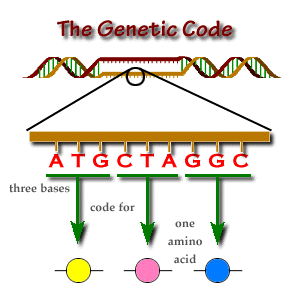
Figure: The front-loading hypothesis predicts that the genetic code in the first life forms was as optimized as it is today. It thus predicts that we will not find any less optimized genetic code at the root of the tree of life. Image from CUNY as linked, per fair use. [WP will not pass a link in a caption, KF]

Thus, we can see that the front-loading hypothesis is indeed testable, and so the claim that ID offers no testable hypotheses is simply not true.

Research Questions

Another neat thing about the front-loading hypothesis is that there are a number of research questions we can ask with regards to the front-loading hypothesis.

I have already mentioned the question of “what was front-loaded,” but we can go deeper than that. Below are some research questions generated by the front-loading hypothesis: research questions we can investigate to further understand biological reality. In another essay, I’ll be exploring these rather

interesting research questions (for example: was the bacterial flagellum front-loaded or designed at the dawn of life? Or: how might the cilium have been front-loaded? And so on).

Conclusion

We’re getting to the point where we can begin developing a rigorous design hypothesis in biology, and where we can make testable predictions about the world of life based on an ID model. In the first stages of formulating this ID hypothesis, we need a lot of imagination and folks who can think outside the box. And so let’s start proposing ID hypotheses that can be tested, and prove that ID does indeed offer testable hypotheses in biology.

About me

Over the years, I have become quite interested in the discussion over biological origins, and I think there is “something solid” behind the idea that teleology has played a role in the history of life on earth. When I’m not doing multiple sequence alignments, I’m thinking about ID and writing articles on the subject, which can be found on my website, The Genome’s Tale.

I am grateful to UD member kairosfocus for providing me with this opportunity to make a guest post on UD. Many thanks to kairosfocus.

Also see The Design Matrix, by Mike Gene.>>

_____________________

The above is of course quite interesting, and presents a particular hypothesis for design of life. Others are of course possible, but if we take front loading in (a) restricted [“island of function”] and (b) general [universal common descent] senses,  we see that one may accept a and b, accept a but not b (or, b but not a!), or reject both a and b. So, it is a useful, flexible, testable hypothesis that underscores how “evolution” as such is not the opposite of design.

Let the unfettered observational evidence decide what is true!

The issue design theory takes  is with a priori, Lewontinian evolutionary materialism dressed up in the holy lab coat and improperly inserted into the definition and methods of science under the label “methodological naturalism,” not with even the universal common descent of life forms from one or a cluster of unicellular ancestral forms. For instance, well-known ID researcher prof Michael Behe, accepts universal common descent.

I would add, that design theory has in it a great many other testable, and indeed well tested hypotheses, such as that:

1] irreducibly complex systems constrained by Mengue’s criteria C1 – C5, will be hard or impossible to come about by chance variation and blind natural selection,

2] complex specified information, especially functionally specific complex information,  as can be expressed in the log-reduced form:

Chi_500 = Ip*S – 500,
bits beyond the Solar System threshold of complexity

. . . is an empirically reliable sign of origin by intelligently directed choice contingency, aka design,

3] The per aspect explanatory filter [as an explicit expansion and detailing of the classic “scientific method”] will reliably allow us to assign causes for observed aspects of phenomena, objects or processes, across chance, law-like mechanical necessity and design:
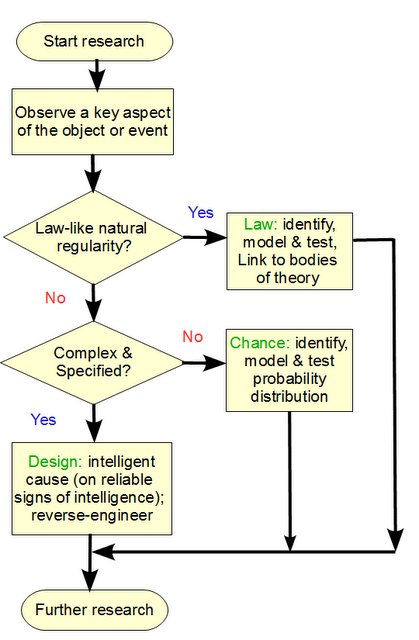
The per aspect design inference explanatory filter

4] That cost of search compounded by search for a search etc, leads to a “no free informational lunch” consequence (once we are at a reasonable threshold of complexity, tied to the universal or restricted plausibility bounds as described by Abel).

5] That physicodynamically inert prescriptive information joined to implementing machinery etc, and sources of energy, materials and components, imposes a cybernetic cut or chasm not bridgeable by blind chance and necessity.

6] Etc, etc.

So, we are in a position to have a pretty useful onward discussion, thanks (again) to Genomicus. END

(Series on front-loading continues here)

Comments
Genomicus continues the discussion here. Accordingly, I will close off comments here. KFkairosfocus
January 26, 2012
January
01
Jan
26
26
2012
02:46 AM
2
02
46
AM
PDT
Genomicus said: "The prediction I proposed goes like this: you find a gene in all eukaryotes, and by comparing its sequences across various eukaryotic taxa, you find that it’s probably very important to eukaryotes. On the other hand, you find a gene in all eukaryotic taxa, but it doesn’t seem to be all that important. Front-loading predicts that the former gene is far more probable to share deep homology with prokaryotic genes than the latter gene." So, what you are saying here is the following: A gene that is highly homologous across eukaryotic taxa is more likely to also be highly homologous in prokaryotic taxa than a gene that is not highly homologous among eukaryotes. That would be a pretty straightforward prediction of ANY theory that assumes common descent. I don't understand why you think that only frontloading would make this prediction?molch
January 25, 2012
January
01
Jan
25
25
2012
09:36 AM
9
09
36
AM
PDT
Geno: Beyond a certain level of nesting [about four sub-dots in], the "reply" option vanishes. Just one more of the "it's not a bug it's a feature" points. We need that chrono timeline view option! Anyway, let's be thankful, WP has many good points! KFkairosfocus
January 25, 2012
January
01
Jan
25
25
2012
05:57 AM
5
05
57
AM
PDT
Dr. Liddle: For some reason, I don't find any reply button below your comments, so I'm replying here.
“But if it “shares deep homology” with prokaryotic genes, then, by definition, it is highly conserved in both groups, suggesting not only common descent, but that one group evolved from the other following a small change in the sequence that changed its function. Why would this suggest “front-loading” rather than Darwinian evolution?”
I think there's a bit of a misunderstanding going on here. The prediction I proposed goes like this: you find a gene in all eukaryotes, and by comparing its sequences across various eukaryotic taxa, you find that it's probably very important to eukaryotes. On the other hand, you find a gene in all eukaryotic taxa, but it doesn't seem to be all that important. Front-loading predicts that the former gene is far more probable to share deep homology with prokaryotic genes than the latter gene.Genomicus
January 23, 2012
January
01
Jan
23
23
2012
02:42 PM
2
02
42
PM
PDT
Let me rapidly rephrase that last post (hit submit too early!) "But if it “shares deep homology” with prokaryotic genes, then, by definition, it is highly conserved in both groups, suggesting not only common descent, but that one group evolved from the other following a small change in the sequence that changed its function. Why would this suggest “front-loading” rather than Darwinian evolution?"Elizabeth Liddle
January 23, 2012
January
01
Jan
23
23
2012
03:28 AM
3
03
28
AM
PDT
But if it "shares deep homology" with prokaryotic genes, then, by definition, it is highly conserved in both groups, suggesting not only common descent, but that one group is ancestral to the other. Why would this suggest "front-loading" rather than Darwinian evolution?Elizabeth Liddle
January 23, 2012
January
01
Jan
23
23
2012
03:26 AM
3
03
26
AM
PDT
As I described above, because it’s circular, of course. If you are using the sequence conservation as the BASIS for your prediction (in identifying what genes are “important”) as well as the TEST of that SAME prediction, you are simply giving us a definition, not a prediction in the scientific sense of the term.
Well, actually, I'm not sure you quite understand exactly what this prediction entails. To test if a gene is of importance in eukaryotic lineages, for example, we can check its degree of sequence conservation in terms of sequence identity across eukaryotic taxa. We're limiting our analysis strictly to eukaryotic taxa, not prokaryotic taxa. If, then we find that a gene is important in eukaryotic taxa through this method, from a front-loading perspective we would predict that this gene will share deep homology with prokaryotic genes. This isn't tautological in any way. From the basis of pure logic, there's no reason why a highly conserved eukaryotic gene should share deep homology with prokaryotic genes any more than a not-so-highly-conserved eukaryotic gene. Thus,I'm afraid I'm not seeing any tautology here.Genomicus
January 23, 2012
January
01
Jan
23
23
2012
12:56 AM
12
12
56
AM
PDT
F/N: The redirected discussion in the thread IF Founds 11, is here on. An examination of what FSCO/I means in the case of the ribosome is here. Now, let us continue to discuss front-loading. G' mornin' KFkairosfocus
January 23, 2012
January
01
Jan
23
23
2012
12:52 AM
12
12
52
AM
PDT
As I described above, because it's circular, of course. If you are using the sequence conservation as the BASIS for your prediction (in identifying what genes are "important") as well as the TEST of that SAME prediction, you are simply giving us a definition, not a prediction in the scientific sense of the term. Here's an example from outside of genetics that illustrates this point. If I develop a theory regarding who are the best baseball hitters, and I predict that the best baseball hitters will have a) high batting averages (BA), high on-base percentages (OBP), and lots of RBIs, I haven't made a prediction as part of my theory, but rather just offered a trivial tautology. High batting average, and lots of RBIs,etc. are how we DEFINE good hitting and measure it. So it's not a prediction, scientifically, but a truism -- it cannot be false; by definition, the best hitters will be the ones who have the best hitting stats. Back to your prediction, if you are going to "predict" that the most important genes will be most conserved, you've committed the same error. It's not a prediction, but just a definition restated. Most conserved is what we MEAN when we say "most important". Unless you can provide an independent basis for predicting which genes will be more conserved (and thus "more important"), you've done nothing more than the baseball theorist who predicts the best battes will have the best stats. Now, if I, as a baseball theorist, were to predict that batters who have blue eyes and are taller than 6'2" would be the best batters, which is to say they would have the best stats, then I would have a substantial prediction. Whether it is entailed by my model isn't established yet, but assuming for the moment it is, this is a non-tautologous prediction. It may fail as a prediction against empirical tests, but it is structurally and epistemically sound. Can you see the difference between the two baseball predictions? Back to your case, checking a given gene's sequence conservation is just trafficking in tautology. Your mention earlier about "identifying its role in the cell" might be analogous to the valid baseball prediction (tall, blue eyed batters perform best because the combination of that height and blue irises produces maximal tracking, targeting and power in hitting a baseball, etc.). I haven't seen any expansion on that angle from you, but am open to it (it seems like hard work to supply, so I'm not really expecting such a treatise). But as you have it with checking gene conservation, your criterion for forming your prediction is the same as your means of testing that same prediction. It's guaranteed to be "true", any time, for any case, for the same reason "the best hitters will have the best stats" is an always-true prediction.eigenstate
January 23, 2012
January
01
Jan
23
23
2012
12:45 AM
12
12
45
AM
PDT
Hello, I'm not sure why you think that checking a given gene's sequence conservation across metazoan lineages would reduce my front-loading prediction to a tautology. Please elaborate. Thanks.Genomicus
January 22, 2012
January
01
Jan
22
22
2012
11:56 PM
11
11
56
PM
PDT
@Genomicus, Thanks for the reply. I think it does clarify things somewhat, but that clarity just confirms the problem the non-predictiveness (in the scientific sense) of you putative prediction. Having to check ANY of the tree as means fo FORMULATING your prediction is problematic, and reduces your proposed prediction to a tautology. Deleting the gene, and checking conservation across taxa both commit precisely the error I mentioned with regard to evolutionary "predictions" regarding "survival of the fittest". Like those who look at the truism of "survival of the fittest", and suppose that is a prediction of evolutionary theory rather than a tautology (admittedly it's somewhat nuanced because that tautology *is* entailed by the theory, it's just an entailed definition, given the processes the theory proposed.), your first two ways are commit the error I was pointing to above. If you have to go LOOK at the tree and say "Yep, those are the important ones that got front loaded" -- even a small part of the tree, you've invalidated that as a prediction. If you have to delete genes to see what happens in term of differential survival, you're out of luck as well. On your third case, I can see some daylight, conceptually. If you are able to identify functions and roles for particular genes and arrive at an INDEPENDENT basis for what these genes are "important", and those other genes are not, then you have created the proper predicate for the prediction you are hoping to establish. If you can identify, say, some group of "most important genes", and from their particular stereochemistry or other features establish why your filter identifies them as important and "overarching" for some future phylogeny, then, happily, when you set that aside as an entailed product of your theory, you have a prediction which can actually be tested by then looking at the actually observed hierarchy. So if that way is what you meant, then a) it's odd, that you offered two other "ways" in your list which appear to be valid responses in your view, but which render your prediction void as a prediction, and b) you have an enormous, but interesting and well grounded challenge ahead of you in producing the objective filter that establishes gene importance WITHOUT looking at the test evidence (the observed hierarchy). Just to make sure that's clearly, pedagogically, consider a computer simulation of key dynamics in evolution. Without depending on any input from the observed hierarchies in the evidential record, we can implement an algorithm that provides for reproduction with variation, speciation, fitness testing and accumulation of beneficial traits. That will produce nested hierarchies. It's the deterministic consequence of the dynamics involved (implemented in software, here). That non-dependence on hierarchy data, as a basis for establishing nested hiearchies, and demonstrating WHY those nested hierarchies occur, is why the evolutionary biologist's prediction of nested hierarchies is an actual prediction not a tautology. We don't need to implement a program in software to get there, it can be done in maths, but it's a clear way to see the entailments of the theory come to production. Similarly, then, what program could you write that identified the "importance of genes" when run across available candidates? It would need to make its judgments independent of a retrospective look at the observed hierarchy. Is this something your proposed prediction can support? I'd be impressed if so.eigenstate
January 22, 2012
January
01
Jan
22
22
2012
03:49 PM
3
03
49
PM
PDT
eigenstate: "So when you wonder what set the particular mappings for the four bases" More of what I was getting at pertains to the particular specification of the sequences. To re-cap (paraphrase) what you are saying: If we walk up to a roulette wheel and look at the last 10 spins posted on the board: {2,4,10,00,17,23,21,13,29,12} that we shouldn't be surprised to find that specific sequence because any 10 spin roulette sequence is equally probable, and we just happened to stumble upon this particular one. Absolutely agree. However if we then decide to use that specific sequence to represent some other thing: var 2,4,10,00,17,23,21,13,29,12 = x var atg,gtc,aat,tta = protein(a) then setting that specific 10 spin roulette sequence (or specific a,t,g,c string) as a variable would seem to require an intelligence. So it is not so much the finding of that specific sequence that matters, the sequence itself can be perfectly accounted for by physics, rather it is the assignment or setting of that specific sequence as a variable that will execute some function that seems unusual. [This group of sequences cut from the matrix and assigned values that execute some function are what KF refers to as the "islands of function"]. My issue is that of all the possible a,t,g,c string combinations, only a certain few strings execute a function, and the rest do nothing. This would IMO indicate a fundamental intelligence. ---- So much of the analogies I here, (liz and the snowlflakes or the tree rings) do not apply unless: var snowflake.pattern.1 = worms mate var snowflake.pattern.2 = worms fight var tree.rings.pattern.1 = birds dry hump If these specific snowflake/tree-ring patterns do not execute some function, then the "stumbling upon the roulette wheel" analogy simply applies.junkdnaforlife
January 22, 2012
January
01
Jan
22
22
2012
01:26 PM
1
01
26
PM
PDT
eigenstate (and Elizabeth): Let's do it this way: I am going to answer you in the other thread, and we can go on from that.gpuccio
January 22, 2012
January
01
Jan
22
22
2012
11:35 AM
11
11
35
AM
PDT
No, because you're not checking its degree of sequence conservation across all phyla, just across metazoan or eukaryotic or vertebrate phyla.Genomicus
January 22, 2012
January
01
Jan
22
22
2012
10:23 AM
10
10
23
AM
PDT
Yeah, I know. But I did (badly) copy your post into that thread in one of mine to at least show willing :) I think we are both innocent. Let's blame WordPress.Elizabeth Liddle
January 22, 2012
January
01
Jan
22
22
2012
10:13 AM
10
10
13
AM
PDT
Hi Elizabeth, I get that KF said he wanted to move the sub-thread discussion over there, but he's not done so. Why not, I don't know, maybe it's just he hasn't gotten around to it, yet. I certainly don't have the ability to move things between threads on this blog. If he wants to complain because I haven't been able to move this cluster of posts to a different thread, well, more impossible demands are made of the ID critics here, I guess. But I can't do what I can't do.eigenstate
January 22, 2012
January
01
Jan
22
22
2012
09:55 AM
9
09
55
AM
PDT
But "checking its degree of sequence conservation across taxa" IS going to indicate "deep homology" isn't it? It seems to me that your dependent and independent variables are confounded :)Elizabeth Liddle
January 22, 2012
January
01
Jan
22
22
2012
09:52 AM
9
09
52
AM
PDT
@kf,
As to your rudely and snidely disrespectful remark about handwaving, that speaks to basic manners problems on your part — and that swishing noise you hear is old Mr Leathers limbering up, and to a want of basic familiarity with the background for information theory, on the charitable interpretation. (On the suspicious interpretation, it is an attempt to mislead the naive onlooker who would trust you to know what you are talking about, that the more or less standard background for info theory and its extension on glorified common sense to speak of application program files that do work, or computer motherboards hooked up on a wiring diagram, or a house built in accordance with a blueprint, or a geoglyph in Amazonia, etc, is irrelevant.)
I don't know why you insist on such cryptic language, but as far as I can parse this, you are referring to, uh, getting ready to *spank* me with a leather something-or-other? "Mr. Leathers" doesn't register for me, except for a maker of protective clothing for motorcycle riding. That doesn't seem to fit in with what you are saying, so my best guess you are making some kind of spanking-with-leather reference? That is quite a peculiar way to respond if that's the case. How about we keep this at a grown up level and talk about symbols, phase spaces, specifications, functions and objective metrics as means of detecting design or not. Handwaving, by the way, is certainly not something to be proud of for the hand-waver as a tactic in debate. But it's not the least bit rude or bad manners to point handwaving out, anymore than it is rude to point out that you have not answered key and relevant questions put to you. It makes you uncomfortable perhaps (it does me when it's put to me that I'm engaging in handwaving), but that's the price of handwaving for whoever engages in it. Either you can reduce this to applied math we can look at and test for precision and coherence, or you cannot. You post lots and lots about the importance and power of your metric, but you can't or don't apply it in a way a fair observer or critic can see and test. That's handwaving. There's nothing rude in pointing it -- it (hopefully) drives the discussion toward substance and constructive discussion: applied math and substance supplied for your ambitious and pervasive claims, in this case.eigenstate
January 22, 2012
January
01
Jan
22
22
2012
09:52 AM
9
09
52
AM
PDT
Hello,
How is this not just a tautology, a self-fulfilling prediction? My reaction to this is, “Of course, the genes we deep most deeply anchored in the hierarchy are BY DEFINITION the “most important”. That’s what “most important” *means* in terms of the hierarchy.
Well, actually, to tell if a gene is important to eukaryotes we don't need to look at its entire phylogeny. There are many ways to see if a gene is important: deleting the gene, checking its degree of sequence conservation across taxa, identifying its role in the cell, etc. Hope this clarifies things!Genomicus
January 22, 2012
January
01
Jan
22
22
2012
09:27 AM
9
09
27
AM
PDT
psst, gpuccio and eigenstate: We are supposed to be here. Get your butts out of here if you want to avoid a leathering :)Elizabeth Liddle
January 22, 2012
January
01
Jan
22
22
2012
09:17 AM
9
09
17
AM
PDT
Hey there,
This is somewhat problematic. Deleting the keystone of an arch will cause the arch to fall down. That doesn’t mean that the keystone was always necessary to keep up the arch, merely that it became so when other elements were removed. This is the problem with Behe’s IC concept of course – undoing something isn’t the same as doing it!
Deletion of a gene isn't the only way to detect if a gene is of great importance to multicellular life forms. Firstly, if we delete a gene from many genomes belonging to many different multicellular life forms, and the results were practically the same, it would at least make us suspicious that it plays a key role in multicellular life. Further, if the gene is well conserved in sequence identity across multicellular taxa, this would strengthen the position. So, if we analyze a gene based on various criteria, and all these criteria support the suspicion that this gene is important, then there'd be good reason for thinking that it is.
OK. So essentially, you are saying that frontloading will product highly similar, but also highly conserved, sequences in the two different groups that nonetheless code for very different proteins? To be different from a Darwinian prediction, you would also specify, I think, that, homologous as the two sequences are, that there are no non-lethal pathways between the two, right?
Okay, let me try to make this particular prediction a bit clearer. Let's use an actual example, tubulin for example. Tubulin is almost certainly a very important protein in eukaryotes. Tubulin is not found in prokaryotes, but it shares structural and some sequence homology with a prokaryotic protein called FtsZ. The front-loading hypothesis predicts that if we take a bunch of FtsZ sequences and align them, a higher degree of sequence similarity will be observed among these FtsZ sequences than if we did the same with the average prokaryotic protein. Darwinian evolution makes no such prediction. Under a Darwinian framework, there's no reason at all for FtsZ to be more well conserved in sequence identity than the average prokaryotic protein. Regarding the latter part of your response, I think it's a bit of an unrelated topic - whether it's easy for highly conserved proteins to be co-opted. To clarify what's going on here, basically I'm just saying that it'd be easier (in the sense that it wouldn't be as likely to disrupt cellular function) to co-opt a loosely conserved protein than a highly conserved sequence.Genomicus
January 22, 2012
January
01
Jan
22
22
2012
09:17 AM
9
09
17
AM
PDT
@gpuccio,
That’s the basic point. You are wrong here. Defining explicitly a function that can be objectively neasured does generate a functional subset in the set of possible outcomes. As the function objectively exists, you cannot say that we have invented if “post hoc”. I will refer to the function of an enzyme that amazingly accelerates a biochemical reaction, that otherwise could never happen or would be extremely slow. That function is objective. We need a conscious observer to recognize it and define it (because the concept itself of function is a cosncious concept). So, I am not saying that there is not a subjective aspect in the function. There is, always. What I am saying is that the function, once recognized and defined consciously, can be objectively observed and measured ny any conscious observer, for instance in a lab.
It's the "conscious observer to recognize it and define it" part that is the big problem, here. The reaction acceleration is not a problem -- I have no issues with identifying such a reaction as an objectively observable physical process. But the metric fails to be an objective metric if it depends on "conscious recognition". If you think about why "conscious recognition" is required here by you, it should be evident that such "non-algorithmic steps" are needed because it defies objective formalization. Or to put a more fine point on it, it enables us to put our own subjective spin on it, and not just as a qualitative assessment around the edges, but as a central predicate for the numbers you may apply. That;'s why I say this is question-begging in its essence; unless one BEGINS with prior recognition ("conscious observer" recognizing function), the metric doesn't get off the ground. If you BEGIN with such conscious recognition, the game's over, and FSCI, or whatever acronym you want to use to apply to this idea, won't tell you anything you haven't already previously concluded about the designedness (or not) of any given phenomenon.
So, I can compute the probability of such a sequence, with such a property, emerging in a purely random system.
There is no such thing as a "purely random system". "System" implies structure, constraint, rule, and process. But that's not just being pedantic on casual speaking on your part, it's the core problem here. The AA sequence is not thought to be emergent in a random way. There's a fundamental difference between one-time "tornado in a junkyard" sampling of a large symbol set from a huge phase space, and the progressive sampling of that same large symbol set as the result of a cumulative iteration that incorporates positive and negative feedback loops in its iteration. So the probability of the sequence is NOT a matter of 1 shot out of n where n is vast. If, in my card deck example, we keep after each shuffle, the highest two cards we find out of the 104 (per poker rules, say), and set them aside as "fixed" and continue to shuffle the remaining cards, and repeat, we very quickly arrive at very powerful and rare (versus the 104 card phase space) deck after just a few iterations. That's brutally quick as an "iterative cycle", but it should convey the point, and the problem with "tornado in a junkyard" type probability assignments.
Let’s go to your examples of the lottery and the deck of cards. The example of the lottery is simply stupid (please, don’t take offense). The reason is the following: in a lottery, a certain number of tickets is printed, let’s say 10000, and one of them is extracted. The “probability” of a ticket winning the lottery is 1: it is a necessity relationship. But a protein og, say, 120 AAs, has a search space of 20^120 sequences. To think that all the “tickets” have been printed would be the same as saying that those 20^120 sequences have been really generated, and one of them is selected (wins the lottery). But, as that number is by far greater than the number of atoms in the universe (and of many other things), that means that we have a scenario where 10000 tickets are printed, each with a rnadom numbet between 1 and 20^120, and one random number between 1 and 20^120 is extracted. How probable is then that someone “wins the lottery”?
No one I've ever read on this supposes that all the possible permutations have been generated, nor that they need be generated for the theory to hold. Note the phase space for for the double deck of 104 cards - there are 10^166 possible sequences there, more combinations than you amino acid sequences. The question is not a math question, wondering how likely 1 chance in 20^120 is, that's evident in the expression of the question. The question is the "recipe" for coming to an AA sequence that achieves something we deem "functional". If you have a a cumulative filter at work - environmental conditions which narrow the practical combinations in favorable ways, stereochemical affinities that "unflatten" the phase space so that some permutations are orders of magnitude more likely to occur, including permutations that contribute to the functional configuration we are looking at, then the "1 in 20^120" concern just doesn't apply. It's not an actual dynamic in the physical environment if that's the case. Or, cumulative iterative processes with feedback loops completely change probability calculations. That is why scientists laugh at the absurd suggestion that these processes are like expecting a tornado in a junkyard to produce a 747. Your "100000 in 20^120" depends on this same kind of simplistic view of the physical dynamic.
So, I will simply state that your sequence has no dFSCI, because it is not functionally specified, and that therefore we cannot infer design for it. You say: Is it SPECIFIC? Yes, it is a single, discrete configuration out of a phase space of 104! = 10^166 available configurations. This configuration is as constricted as the choices get. Well, specific does not mean functionally specified. Each sequence is specific. If used as a pre-specification, each sequence is a good specification. But that has nothing to do with functional specification, that can be used “post hoc”.
This is, again, where the question-begging obtains. If you are going to assert that it is only "functionally specified" if it's the product of intelligent choices or a will toward some conscious goal, then (d)FSCI *is* a ruse as a metric, not a metric toward investigating design, but a means of attaching post-hoc numbers to a pre-determined design verdict. Which just demands a formalism around "functionally specific"? That seems to be the key to what you are saying. Can you point me to some symbolic calculus that will provide some objective measurement of a candidate phenomenon's "functional specifity"? If you cannot, and I think you cannot, else you'd have provided that in lieu of the requirement of a conscious observer who "recognizes" functional specificity, then I think my case is made that you are simply begging the question of design in all of this, and (d)FSCI is irrelevant to the question, and only a means for discussing what you've already determined to be designed by other (intuitive) means.
That is not a functional specification. Or, if it is, is a very wide one. I will be more clear. According to my definition od dFSCI, the first step is that a conscious observer must recognize and define a function in the digital sequence, and specify a way to objectively measure it. Any function will do, because dFSCI will be measured for thet function. IOWs, dFSCI is the complexity necessary to implement the function, not the complexity of the object. That is a very important point.
This renders dFSCI completely impotent on the question of design, then! That requirement -- that a "conscious observer must recognize and define a function in the digital sequence" -- you've already past the point where dFSCI is possibly useful for investigation. Never mind that the requirement is a non-starter from a methodological standpoint - "recognize" and "defined" and "function" are not objectively defined here (consider what you'd have to do to define "function" in formal terms that could be algorithmically evaluated!), even if that were not a problem, it's too late. dFSCI, per what you are saying here, cannot be anything more than a semi-technical framework for discussing already-determined design decisions. And even then, you have a "Sophie's Choice" so to speak in terms of how you define "function". Either you make it general and consistent, in which case it doesn't rule out natural, impersonal design processes (i.e. mechanisms materialist theories support), or you define 'functional' in a subjective and self-serving way, gerrymandering the term in such a way as to admit those patterns that you suppose (for other reasons) are intelligently design, and to exclude those (for other reasons) which you suppose are not.
So, trying to interpret your thought, I could define the following fucntions for your sequence: a) Any sequence of that length that can be statistically analyzed b) (I don’t know, you say: I don’t understand well your second point) c) Any sequence of that length that can be good for encrypting data. While I wait for a clarification about b) (or for other possible definitions of function for your sequence), I will notice that both a) and c) have practically no dFSCI, because any sequence would satisfy a) (the functional space is the same as the search space, and the probability is 1), ans all random sequences, for all I know of crypting data, would satisfy c) at least as well as your sequence (the functional space is almost as big as the search space, the probability is almost one). I hope that is clear.
I think you are close to getting my point. A random sequence is highly function, just as a random sequence. It's as information rich as a sequence can be, by definition of "random" and "information", which means, for any function which requires information density -- encryption security, say -- any random string of significant length is highly functional, optimally functional. If my goal is to secure access to my account and my password is limited to 32 characters, a random string I generate for the full 32 characters is the most the most efficient design possible. Sometimes the the design goal IS random or stochastic input. Not just for unguessability but for creativity. I feed randomized data sets into my genetic algorithms and neural networks because that is the best intelligent design for the system -- that is what yields the optimal creativity and diversity in navigating a search landscape. Anything I would provide as "hand made coaching" is sub-optimal as an input for such a system; if I'm going to "hand craft" inputs, I'm better off matching that with hand-crafted processes that share some knowledge of the non-random aspects of that input. When you say "That is not a functional specification. Or, if it is, is a very wide one." I think that signals the core problem. It's only a "wide" specification as a matter of special pleading. It's not "wide" in an algorithmic, objective way. If you think it is, I'd be interested to see the algorithm that supports that conclusion. Which is just to say you are, in my view, smuggling external (and spurious) design criteria into your view of "function" here. This explains why you do not offer an algorithm for determining function -- not measuring it but IDENTIFYING it. If you were to try to do so, to add some rigor to the concept, I believe you would have to confront the arbitrary measures you deploy and require for (d)FSCI. If I'm wrong, providing that algorithm would be a big breakthrough for ID, and science in general.eigenstate
January 22, 2012
January
01
Jan
22
22
2012
08:47 AM
8
08
47
AM
PDT
{SNIP, you were warned. But, since I am feeling somewhat less livid, I will put the comment next thread and reply there. ES, take this as a warning that any further side tracking will be dealt with quite seriously. KF.}eigenstate
January 22, 2012
January
01
Jan
22
22
2012
06:03 AM
6
06
03
AM
PDT
Thanks for your comment, Dr. Liddle.
As I understand it, your hypothesis could be summarised as: What was designed was an organism, ancestral to all life, and from which all live evolved by Darwinian mechanisms, but which had characteristics such that what did in fact evolve was unlikely not to have evolved?
That’s sort of close, but not quite close enough to what the front-loading hypothesis proposes. Firstly, the front-loading hypothesis doesn’t propose that a single cell was designed. Instead, a population of designed cells were seeded on earth (and were probably able to communicate with each other in some way). These cells contained the genes necessary for the origin of multicellular life, for example, and the genes belonging to components of molecular machines such that molecular machines to be front-loaded.
OK, thanks for the clarification.
Can you unpack this? How do we identify those “genes that really aren’t that important to multicellular life forms”? How unimportant is “not that important?” And “as extensive a homology with prokaryote genes” as what? What is the comparison here?
Genes important in development in all multiceullular life, wherein deletion of them results in death or a similar fate would be considered “important genes” for multicellular life forms.
This is somewhat problematic. Deleting the keystone of an arch will cause the arch to fall down. That doesn't mean that the keystone was always necessary to keep up the arch, merely that it became so when other elements were removed. This is the problem with Behe's IC concept of course - undoing something isn't the same as doing it!
On the other hand, if genes aren’t really that important for the existence of multicellular life, then the FLH doesn’t predict them to share as deep homology with prokaryotic genes compared with genes important to multicellular life.
OK.
Are you saying that if frontloading is true, the sequences that code for proteins that are essential for eukaryotes will also be found in prokaryotes, but with slight difference that mean that it codes for a different protein but one important to prokaryotes? In what sense would this prediction distinguish front-loading from a Darwinian scenario?
Not quite. If front-loading is correct, then we’d expect that important proteins in eukaryotes will share deep homology with prokaryotic proteins, either in sequence similarity or similar tertiary structure. However, again, non-teleological evolution predicts this, so we go a step further: we also predict that such prokaryotic homologs will be well conserved, among themselves, in sequence identity, such that it would be hard for their basic 3D shape to be destroyed by random mutations, genetic drift, etc.
OK. So essentially, you are saying that frontloading will product highly similar, but also highly conserved, sequences in the two different groups that nonetheless code for very different proteins? To be different from a Darwinian prediction, you would also specify, I think, that, homologous as the two sequences are, that there are no non-lethal pathways between the two, right? If so, this is sort of interesting, because it's a variant on the IC story, but predictive. However, I think it suffers from exactly the same problem, which is that, a posteriori, we cannot establish what a lethal (or even seriously disadvantageous) intermediate step is. This is because the selection coefficient of a sequence is not simply a property of the sequence, but of a sequence within its environment, which includes the genetic environment. So it seems to me this remains as untestable as IC.
Darwinian evolution doesn’t predict this at all. In fact, when it comes to molecular machines, one could even say that Darwinian evolution expects homologs of components of these molecular machines to be not be very well conserved in sequence identity, since this would make it easier for them to be co-opted into a molecular machine.
Well, no. A sequence can be highly conserved AND co-opted for a function that subsumes the earlier function. For example, a sequence that is highly conserved because it serves to increases the mobility of a unicellular organism by raising it above the boundary layer (to pinch Nick Matske's scenario for the flagellum) could be co-opted as a flagella, because the old function is subsumed by the new. And it can also be highly conserved, then copied, and one of the copies coopted for an unrelated function. It can also be highly conserved in one environment, then not be in a new environment, leaving it available for co-option. For instance the vitamin C gene is highly conserved in most environments, but this didn't stop it being lost from a branch of primates, who, presumably, lived in an environment with plenty of vitamin C in the diet. This is my point about the importance of modelling changing environment as well as changing sequence. Which raises a whole host of unknowables. Known unknowns.
It is my position that there were no “nudges” or “side-loading,” though of course, this position could change with new data.
OK. A more elegant position, I think :) Not unlike Darwin's, as it happens. Or the one he expressed at the end of "Origin". Nice to talk to you! I've been hoping someone would do this for ages :) LizzieElizabeth Liddle
January 22, 2012
January
01
Jan
22
22
2012
05:17 AM
5
05
17
AM
PDT
Okay, pardon my own livid response, which is in a context that should be plain. KF
No problem :)Elizabeth Liddle
January 22, 2012
January
01
Jan
22
22
2012
03:39 AM
3
03
39
AM
PDT
Joe: Thanks for a good response on the tangential matter, as you will see, I am redirecting discussion of the tangential issue elsewhere. KFkairosfocus
January 22, 2012
January
01
Jan
22
22
2012
03:36 AM
3
03
36
AM
PDT
FWIW, I have from the first few days of nesting requested a chrono sequence view option. I've been told, significant coding, no time soon. Every alternative has problems, I think. We will have to wait; it should be possible, as posts are time stamped. KFkairosfocus
January 22, 2012
January
01
Jan
22
22
2012
03:34 AM
3
03
34
AM
PDT
Okay, pardon my own livid response, which is in a context that should be plain. KFkairosfocus
January 22, 2012
January
01
Jan
22
22
2012
03:28 AM
3
03
28
AM
PDT
I agree that it would be nice to see KF's proposed method and metric worked through and used as a standard 'textbook' example, but I also agree that it is a topic for a different thread so I'm sure KF will be more than willing to provide a worked through example as a new topic for discussion.GCUGreyArea
January 22, 2012
January
01
Jan
22
22
2012
02:59 AM
2
02
59
AM
PDT
Why don't you actually move the posts to that thread, kf, if you have that ability? Then we have all the stuff in the same place. Genomicus, responding to your response to me shortly! Apologies for delay!Elizabeth Liddle
January 22, 2012
January
01
Jan
22
22
2012
02:34 AM
2
02
34
AM
PDT
1 2 3 … 5