Uncommon Descent Serving The Intelligent Design Community

It seems that TSZ objector to design, AF, insists on the long since corrected canard that design is a “default” inference

Categories
Design inference
ID Foundations
specified complexity
Share
Facebook
Twitter/X
LinkedIn
Flipboard
Print
Email

UD commenter Joe notes:

Alan [Fox] amuses by not understanding the definition of “default”. He thinks the design inference is the default even though it is reached via research, observations, knowledge and experiences.

To put this ill-founded but longstanding objection to the design inference — it is tantamount to an accusation of question-begging —  to bed permanently, I note:

____________

>> . . . a year after Dr Liddle was repeatedly and specifically corrected that the inference to design is after rejecting not one but TWO defaults, that is still being raised as an objection over at TSZ.

That speaks volumes.

Let’s outline again, for those unable to understand a classic flowchart [even UML preserves a version of this . . .).

{Flowchart of the explanatory filter:
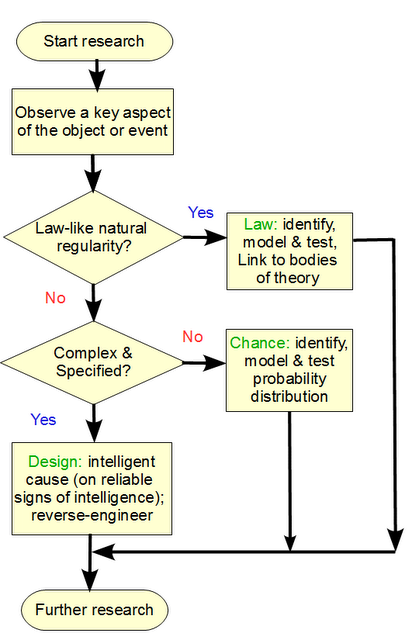
 

1: Step one, we examine an aspect of an object, phenomenon or process (in science we examine relevant aspects, it did not matter what colour they painted the pendulum bob in assessing its oscillations).

2: Observe enough to see whether we have low or high contingency, i.e. high variability on similar initial conditions.

3: Lawlike regularities lead to inference of mechanical necessity expressible in deterministic laws, like Kepler’s laws of planetary motion, or the law of the simple pendulum with small swings. Or, the observation that dropped heavy objects reliably fall under g = 9.8 N/kg near earth’s surface.

4: If an aspect shows high contingency, this is not reasonably explicable on such a law.

5: Thus, we have to look at the two known sources of high contingency, chance and design. For instance, a dropped die that tumbles and settles can be fair and showing a flat distribution across {1, 2, . . . 6} or it can be artfully loaded. (This example has been cited over and over for years, that it has not sunk in yet is utterly telling on closed mindedness.)

6: The presumed default on high contingency, is chance, showing itself in some typical stochastic distribution, as is say typical of the experimental scatter studied under the theory of errors in science. Dice show a flat distribution if they are fair. Wind speed often follows a Weibull distribution, and so forth.

7: Sampling theory tells us that when we observe such a distribution, we tend to reflect the bulk of the population, and that rare, special zones are unlikely to come up in a sample that is too small. This is the root of Fisherian hypothesis testing commonly used in statistical studies. (As in far tails are special rare zones so if you keep on hitting that zone, you are most likely NOT under a chance based sample. Loaded dice being a typical case in point: as you multiply the number of dice, the distribution tends to have a sharp peak in the middle and for instance, you are very unlikely to get 1,1,1, .. or all sixes etc. The flipped coin as a two sided die, is a classic studied under statistical mechanics.)

8: So, once we have a complex enough case that deeply isolates special zones, we are maximally unlikely to see such by chance. But, the likelihood of seeing such under loading or similar manipulation is a different proposition altogether.

9: WLOG, we may consider a long covered tray of 504 coins in a string with a scanner that reports the state when a button is pushed:

)) — || Tray of coins Black Box || –> 504 bit string

10: Under the chance hyp, with all but certainty, on the gamut of the solar system, we would find the coins with near 50:50 distribution H/T, in no particular order.

11: That is an all but certain expectation on the gamut of the solar system.

12: But if instead we found the first 72 ASCII characters of this post in the 504 bits, we would have strong reason to suspect IDOW as the best explanation. There is no good reason otherwise to see the highly contingent outcome in so isolated a functional state.

13: Thus, having rejected the two defaults, coins are highly contingent and chance is maximally unlikely per the relevant distribution to provide such an outcome with FSCO/I, we infer to design.

14: In short, the logic involved is not so difficult or dubious, it is glorified common sense, backed up by billions of examples that ground an inductive generalisation, and by the needle in the haystack analysis that shows why it is eminently reasonable.

15: What needs to be explained is not why inference to design is reasonable, on seeing FSCO/I. Instead, it is why this is so controversial, given the strength of the case.

16: The answer to that is plain: it cuts across a dominant ideology in our day, evolutionary materialism, which likes to dress itself up in the lab coat and to fly the flag of science.

That, it seems, is the real problem . . . >>

____________

Let’s see if this is enough to settle the matter, and if not, why not. END

Comments
Out of concern for the UD bandwidth, and how slow this thread now is, I am closing and continuing here on. Pardon inconvenience. KFkairosfocus
September 30, 2012
September
09
Sep
30
30
2012
10:15 AM
10
10
15
AM
PDT
Mung- page 148-49 of "NFL":
Darwinist Richard Dawkins cashes out biological specification [what Lizzie is trying to demonstrate NS can produce] in terms of the reproduction of genes. Thus, in The Blind Watchmaker Dawkins writes, "Complicated things have some quality, specifiable in advance, that is highly unlikely to have been acquired by randomchance alone. In teh case of of living things, the quality that is specified in advance is...the ability to propogate genes in reproduction."
The point is if you want to demonstrate that blind and undirected processes can produce biological specification you need to demonstrate they can gain the ability to reproduce, as opposed to just starting with it. If you start with that which needs to be explained in the first place, what is it you are trying to demonstrate? "Hey look if I start with dFSCI I can get dFSCI without agency input"- well, duh. Just sayin'...Joe
September 30, 2012
September
09
Sep
30
30
2012
09:08 AM
9
09
08
AM
PDT
oh, joe. I think i misunderstood your point. yes, but gpuccio is willing to grant the existence of replication.Mung
September 30, 2012
September
09
Sep
30
30
2012
09:00 AM
9
09
00
AM
PDT
Jerad:
I’ll have a look but I was speaking of a very particular experiment in hopes to make my own limited point about probabilities clearer.
Putting together a program that generates a 72 character ASCII string is pretty simple. Beyond that what do you need it to do? In addition to using Ruby, I'd like to learn the R programming language. This might be a good opportunity, hehe. Depending on the requirements.Mung
September 30, 2012
September
09
Sep
30
30
2012
08:59 AM
8
08
59
AM
PDT
Joe, That is where they may actually have a point about a model. I don't know that you have to have a self-replicating digital organism in order to model replication. I would think a simple copy function could suffice. Many programming languages even include a clone function. a = Object.new b = a.clone a == b # false (not the same object) Seems close to self-replication to me. :)Mung
September 30, 2012
September
09
Sep
30
30
2012
08:56 AM
8
08
56
AM
PDT
Jerad, It may be best to just leave TSZ to play with themselves as their obvious interests lie in erecting strawmen, flase accusations and other misrepresentations. As for your posts getting lost, well just find some supporting evidence for your position, post it and someone will care enough about your post to keep it alive for days and days.Joe
September 30, 2012
September
09
Sep
30
30
2012
08:50 AM
8
08
50
AM
PDT
Mung (930): I'll have a look but I was speaking of a very particular experiment in hopes to make my own limited point about probabilities clearer.Jerad
September 30, 2012
September
09
Sep
30
30
2012
08:48 AM
8
08
48
AM
PDT
Jerad:
Write a program to do the above and see what you get. Do an experiment!!
http://evoinfo.org/weasel You'll find a number of programs at that site. You see, some of us ID types don't spend ALL our time on the internet. ;)Mung
September 30, 2012
September
09
Sep
30
30
2012
08:46 AM
8
08
46
AM
PDT
Mung- The main problem with Lizzie World is that the ability to replicate, the very thing that requires an explanation, is just granted.Joe
September 30, 2012
September
09
Sep
30
30
2012
08:46 AM
8
08
46
AM
PDT
Mung (926):
Just look for your name. If I am responding directly to you I do try to indicate that fact near the top of my post by explicitly using your name.
I know but it would be much easier if all the TSZ stuff was on it's own. I used to occasionally check out the thread on my iPhone but it's too long and full of stuff I'm not participating in to make it even close to worthwhile to do that now. Anyway, if I do miss something just point it out. If I skip a day on UD I'm afraid my stuff will be so far back from the current post I'll give up trying to catch up.Jerad
September 30, 2012
September
09
Sep
30
30
2012
08:46 AM
8
08
46
AM
PDT
Mung (925):
Recalcitrant was a good choice, and at least you are aware of it.
I'm not as dumb as I sometimes appear to be!Jerad
September 30, 2012
September
09
Sep
30
30
2012
08:41 AM
8
08
41
AM
PDT
Jerad:
Mung responds so often to so many different people I’m afraid I’m going to miss one of his posts directed at me.
Just look for your name. :) If I am responding directly to you I do try to indicate that fact near the top of my post by explicitly using your name. cheersMung
September 30, 2012
September
09
Sep
30
30
2012
08:40 AM
8
08
40
AM
PDT
Jerad:
I keep wondering why you keeping replying considering how recalcitrant I am!!
That's no doubt part of the reason he keeps replying, to make it plain for all to see that you cannot be convinced by evidence and reason, no matter what. Recalcitrant was a good choice, and at least you are aware of it. :)Mung
September 30, 2012
September
09
Sep
30
30
2012
08:37 AM
8
08
37
AM
PDT
PS to KF: Or any other forum monitor/author. Could you do me a big favour and get the TSZ related posts their own thread? My ego loves making post number 922 but it's taking me a long time to search through all the responses which are not pertinent to my discussions with you and others. Mung responds so often to so many different people I'm afraid I'm going to miss one of his posts directed at me. He and Joe seem pretty occupied at the moment but I don't want to be rude and miss something that needs my attention. My time for UD is somewhat limited and I've decided to be very selective about what threads and conversations I participate in. I hope you can do that, it would make things a lot easier for all of us I think. _________ The problem is, from the OP on, that is a main focus for this thread. KFJerad
September 30, 2012
September
09
Sep
30
30
2012
08:34 AM
8
08
34
AM
PDT
Lizzie World 1.) The original genomes in Lizzie World are designed to be randomly generated strings. What, in the name of biological reality does that model? Are genomes in a natural population of organisms randomly generated? What happens in Lizzie World if we don't randomly generate the strings (see #2)? 2.) The genomes of the initial population in Lizzie World are designed to be, at least initially, highly dissimilar (or should be) due to the fact that they are randomly generated strings. What, in the name of biological reality does that model? Are genomes in a natural population of organisms highly dissimilar? What happens in Lizzie World if we use highly similar strings for the initial population? 3.) The genomes in Lizzie World are designed to be a specified length. Is that length at all related to the problem the program is attempting to solve? What happens of we change the length of the genomes? 4.) The genomes in Lizzie World are designed to consist of a sequence of only two symbols and each position is designed to be in one of two states. Is that fact at all related to the problem the program is attempting to solve? What happens of we change those design parameters? And that's just for starters. It's just absurd to claim this is a model of evolution. Unless, of course, you want to maintain that natural populations and even evolution itself are in fact designed.Mung
September 30, 2012
September
09
Sep
30
30
2012
08:30 AM
8
08
30
AM
PDT
KF (916):
Pardon a quick and dirty markup at 912. Gotta go.
Please do not apologise! I know you're busy and, anyway, I prefer that method of response. I keep wondering why you keeping replying considering how recalcitrant I am!! KF (912): Just a couple of general points: I agree that the number of viable/functional/interpretable configs in the kind of config spaces we are talking about is very likely to be a very small compared to the whole space. And that most of the time, a single random sample is going to return garbage. Those are given as far as I am concerned. If I ever gave the impression I was disputing that then I apologise for my poor exposition.
samples on the gamut of solar system or even cosmos that are blind are maximally improbable to hit on the functional clusters.
'[S]amples on the gamut of the solar system' doesn't make sense to me but it's not a big deal. '[M]aximally improbable' doesn't make sense to me either. The maximum improbability would be a probability of zero which no thing in a sample space (of the type we're discussing) would have. Each config in our discussed config spaces would have a very, very, very small probability of being selected in a random search but it would never be zero. Me:
Given a single random selection out of the whole config space where every config is equally likely then no, you cannot assume it was not a blind sample AFTER getting a config you find surprising or meaningful.
KF:
Oh yes you can, if say you saw the first 72 letter for this post in ASCII code, given the utter unlikelihood of finding such a functional cluster by chance as opposed to the very many more non functional ones.
I'm sorry but that is just not right. In a purely random search each config is just as likely as any other. Each has a miniscule probability of being picked if the config space is large. This kind of situation is exactly why medical trials are based on large trials with multiple subjects and control groups. And then you generate p-values and confidence intervals. That's an accepted way to use mathematics to make decisions of alternative over null hypothesis. I think we both agree that a diagram found on Mars would have to be more compelling than some vague blobs so there's no need to go over those points really. Obviously we'd both say something that looked like the London Underground Map was designed no matter where it was found.
Strawman, you are ducking the point that samples taken at random are overwhelmingly likely to come from the bulk not narrow special far skirt zones. You are obviously going our of your way to avoid acknowledging this well known point.
I think I've already shown that I agree with this. It's the conclusion after getting a specified and complex pattern where we differ.
But you wish to impose an inappropriate standard because the empirically grounded best warranted explanation does not fit your worldview preferences
That is not true. I am suggesting a method of analysis quite common when trying to prove an alternate over a null hypothesis. To be sure your alternate hypothesis is correct you have to establish that an event was not just a random occurrence by repeating the 'trial' many times. (As the null hypothesis is the 'default' hypothesis I am picking the design hypothesis to be the alternate but it's possible to do the same analysis the other way around. But the testing would be different.) If you roll a 20-sided fair die each side is equally likely to come up on any given roll. It's only after multiple rolls that you will empirically see (as opposed to figuring it out analytically) the probability distribution of the outcomes. If the die is fair/random then after 100s of rolls you should see each outcome occurring about 5% of the time. But on any given roll you have no idea what's going to come up. And any given sequence of outcomes is just as likely as any other. So a sequence of 1, 1, 1 on three rolls is just as likely/unlikely as 1, 2, 3 or 3, 3, 3 or 2, 4, 6 or any sequence of the numbers 1 - 20 you want to pick. IF the die is weighted and not really fair/random you will only be able to determine that after multiple rolls. I have some weighted dice. The tend to come up 6. But not every time. It usually takes people 4 or 5 rolls before they believe there's something going on. But they don't blink an eye when a 6 comes up first. I agree that if I randomly generated a sequence of 504 0s and 1s, converted it to ASCII text and found that I'd got anything which made sense as an English phrase I'd be extremely surprised. But one trial is not enough to establish that the procedure is anything other than random. You have to do many. Write a program to do the above and see what you get. Do an experiment!!Jerad
September 30, 2012
September
09
Sep
30
30
2012
08:28 AM
8
08
28
AM
PDT
olegt:
gpuccio, once you knee-jerk reaction subsides, let us know what you think of their fitness landscape that rises continuously at low levels of fitness.
First define "fitness". In biology fitness refers to reproductive success. Is that how you are using it?Joe
September 30, 2012
September
09
Sep
30
30
2012
08:22 AM
8
08
22
AM
PDT
olegt:
As keiths has already noted, gpuccio can’t stake out a position and defend it.
Neither can any of you, oleg. All you can do is attack ID and IDists with strawmen and other misrepresentations. Perhaps if you guys had some actual supporting evidence for your position, we could discuss that as opposed to discussing models and their validity to what they are supposed to be modeling. But you don't. You can't even make a positive case for your position. But hey, you sure as heck can erect strawman after strawman when one of your opponents actually ante's up. Pathetic...Joe
September 30, 2012
September
09
Sep
30
30
2012
08:13 AM
8
08
13
AM
PDT
To olegt (at TSZ): Ah, the good old rugged landscape paper! One of the best pro ID papers I know! The one that says, in the conclusions: "The question remains regarding how large a population is required to reach the fitness of the wild-type phage. The relative fitness of the wild-type phage, or rather the native D2 domain, is almost equivalent to the global peak of the fitness landscape. By extrapolation, we estimated that adaptive walking requires a library size of 10^70 with 35 substitutions to reach comparable fitness."gpuccio
September 30, 2012
September
09
Sep
30
30
2012
08:03 AM
8
08
03
AM
PDT
To Zachriel (at TSZ): Hi, Zachriel. It's a pleasure to hear from you again (seriosly!). Did my Hamlet example remind you of something personal?gpuccio
September 30, 2012
September
09
Sep
30
30
2012
07:12 AM
7
07
12
AM
PDT
GA Models are invalid except when Creationists build them to disprove evolution or promote some End-is-Nigh tooth-gnashing?
Who says GAs are invalid? Who is trying to disprove evolution?Joe
September 30, 2012
September
09
Sep
30
30
2012
06:38 AM
6
06
38
AM
PDT
F/N: Pardon a quick and dirty markup at 912. Gotta go. KFkairosfocus
September 30, 2012
September
09
Sep
30
30
2012
06:25 AM
6
06
25
AM
PDT
Both genetic and evolutionary algorithms have a goal. Natural selection does not. That alone says they are not the same, which means GAs/EAs cannot model natural selection. Also in the real world there is more than one selection coefficient, which means several, or more, variations get through the filter. So if you have a GA/EA with only one selection coefficient, you ain't modeling the real world. Next, selection coefficients change in the real world. So if your EA/GA doesn't take that into account you ain't modeling the real world. And finally, AVIDA-> when given proper parameters it demonstrates that the proposed evolutionary mecahnsims cannot do anything. Strange how the evos are avoiding that like the plague- very telling though...Joe
September 30, 2012
September
09
Sep
30
30
2012
05:58 AM
5
05
58
AM
PDT
To all TSZers: Just to restate some important conclusions (and maybe give Keiths some other chance to say that I am changing my ideas) I would say: a) An algorithm can generate new dFSI only in a measure strictly limited by the functional information it already contains. In the case of Lizzie's algorithm, a solution can be found by RV and IS because enough information is in the algorithm to allow an IS process that can yield the solution. b) I don't think that any algorithm can generate truly new dFSCI (for example, about some new function about which the algorithm has no direct or indirect information). Lizzie's algorithm, for example, can only find the solution to the question for which it was designed. c) In the case of Lizzie's problem, a valid solution can be found much more easily by a simple top down mathemathical reasoning. d) The main differences between Lizzie's algorithm centered on IS, and a true process of NS, are evident by a simple analysis of Lizzie's algorithm itself. IS, in the algorithm, selects according to a numerical value (the product). The result is that each random variation, even of 1 bit, generates selectable intermediates, subject to either positive or negative selection. Nothing like that is true for NS. e) In the process of NS, be it in an informational environment or in the biological context, the only "added information" that the system has, and that is the true source of the process of NS itself, is the existence of replicators which use the resources of the environment (in the case of biology, replicators with metabolism). That is the only reason that makes NS possible. That is also the source of its intrinsic limits. f) The limits of NS are not an accident of a particular scenario: they are intrinsic to the process itself. The main limits are: 1) Anything that is selected must be able to influence reproductive success. 2) New functions that can influence reproductive success in a complex replicator are usually very complex, because they have to integrate themselves in a complex, integrated scenario (the replicator itself and its metabolism). 3) In biology, this is made worse by the observation that new biochemical functions are usually supported by new sequences and structures, unrelated to what already exists. 4) Complex functions are not decostructible into simpler, small, functional selectable steps. There is no logical argument for that to be generally true, and there are not empirical examples that this is generally possible, least of all in biology. 5) Therefore, NS cannot generate new dFSCI. This is an intrinsic limit of the process. On the other end, if we use an implementation of IS that creates selectable intermediates at each single bit variation, and therefore a continuous functional space to some target, we can easily reach that target. Saying that this is a model of NS, and that therefore we can draw conclusions about NS and biology from that, is simply a lie.gpuccio
September 30, 2012
September
09
Sep
30
30
2012
05:05 AM
5
05
05
AM
PDT
To Keiths (at TSZ): You see, I sincerely try to refine my thoughts, often stimulated by the comments of my adversaries. I think that truth is what counts. In any case, you can consider my latest explanations as the most complete and accurate. You, on the other hand, seem to be more interested in finding contradictions in what I say than in truth. I have made an example of how Lizzie's algorithm should be modified just to show that, as it is, it is no model of NS. onlooker had argued: "What you seem to be ignoring here and throughout your summary is that the algorithm being used is a model of a small number of known, observed mechanisms that are part of the modern synthesis. This is not an algorithm invented by a human with knowledge of the problem domain. Any conclusions you draw about the algorithm are therefore applicable to biological evolution." I have simply shown that any conclusion you draw about the algorithm is no way applicable to biological evolution. I have clearly shown that Lizzie's algorithm is an "implementation" of IS, and not a "model" of NS. That is the important point. I am not interested in modeling NS. What I suggested (the computer virus experiment) would be an "implementation" of NS in an informational environment, that could be considered a "model" of a biological environment, or not. At least, in that implementation, true replicators are present, that use the environmental resources to replicate. I don't know if the modifiections I proposed to Lizzie's algotithm make it a "model" of NS, or if what I have proposed can be considered a "fitness function", be it with my "stamp". I just wanted to show that, if you drop the essential properties of IS from the algorithm, it cannot find the solution. As I said, I am not interested in modeling NS, but I am very much interested in not allowing false models to be described as modeling it. If you can give a realistic model of NS, and show that it can generate new dFSCI, please let me know. I could even give my stamp to it.gpuccio
September 30, 2012
September
09
Sep
30
30
2012
04:42 AM
4
04
42
AM
PDT
KF (911) - ooo, spooky
Are you unable to see that when those individual configs come in clusters that are functionally distinct, it is relevant to think about the relative statistical weights of the clusters?
Hitting a cluster would have a higher probability than hitting a single configs but only because a cluster consists of many configs. [a --> The precise point, now work on the implications of this] A purely blind random search means every config is equally likely so groups or clusters of configs would have higher probability, how high would depend on how big they are not their functionality. [b --> Strawman, I never said that he likelihood of finding directly depended on functionality or not, just that because the constraints of multiple well matched parts arranged correctly to function means FSCO/I comes in narrow sectors of the space W. And to see why this is so I gave mechanical and molecular nanotech cases.]
Consider a Cardinal spinning reel. The atoms and parts it is made of can be in certain functional configs, or non-functional ones, including scatered all over the earth. Obviously there are far more non-functional than functional ways. If the individual way is equiprobable, the non functional cluster is far more likely on a blind pick than a functional one.
Yup, under the assumption there are more non-functional configs than functional configs. [c --> Bit this is illustrative of the general pattern as well, and BTW this is why the pricked cell Humpty Dompty experiments are also relevant.]
This is the reasoning behind the 1,000 LY cubical hay bale and our galactic neighbourhood. The star systems are special zones, but the space between so dominates that a blind 1-straw size sample will all but certainly come up straw. In fact, the likelihood of so getting anything but straw is negligibly different from zero. Where of course our solar system is in effect only able to take a one straw sample of the config space for just 500 bits.
Operating under the assumption that there are few functional states, of course. [e --> Not a dismissible assumption, which is tantamount to saying question begging. I explained and exemplified why I asserted that FSCO/I naturally comes in narrow zones T in W. if you dispute this, which I have many cases for, you need to show the counterexamples, all you have done is say yes under the assumptions. Not an assumption a fact, the atoms of the Cardinal were originally scattered all over the planet, but showed no function until intelligence led to their assembly into that famous fishing reel] But we don't know the number of functional configs. I agree, it's probably small compared to the whole space. [f --> Grudging concession, but the crucial one, what follows is given the exponential nature of the config space, that samples on the gamut of solar system or even cosmos that are blind are maximally improbable to hit on the functional clusters.]
The best explanation for seeing the 500 coin BB in a special state, under such circumstances, is that we are not looking at a blind sample.
Given a single random selection out of the whole config space where every config is equally likely then no, you cannot assume it was not a blind sample AFTER getting a config you find surprising or meaningful. [f --> Oh yes you can, if say you saw the first 72 letter for this post in ASCII code, given the utter unlikelihood of finding such a functional cluster by chance as opposed to the very many more non functional ones.] If you got 5 or 10 or 250 meaningful configs on successive independent random samples THEN you might have an argument that the sample was biased, the null hypothesis is wrong. Or even 250 functional configs out of 400 random samples. [g --> Irrelevant. You know or should know that given the overwhelming imbalance in the statistical weight of the clusters, FSCO/I will to all but absolute certainty be unobservable on blind sampling. AND in the material case, life forms we start at about 100 - 1,000 k bits, that is 200 - 2,000 times over getting samples from the odd and isolated zone of 500 bits apiece.] If you argue that we effectively have 1000s of random samples that turned out to be functional life forms then you are a) not accounting for samples that turned out not to be functional (we would have no record of those) and b) arguing against a proposition that is not being made by evolutionary theory. [h --> Strawman.] You would be assuming [i --> Strawman, and turnabout of the reasonable burden of empirical warrant.] there exist islands of function in the life config space and that some of our existing life forms come from different islands. Even if there are different islands how do you know our existing life forms are from different ones? [j --> Check out the was it 6,00 protein fold domains to see islands of function as empirically warranted, and then move on up to the 10 - 100 million bits of fresh FSCO/I to make new body plans dozens of times over, then cf the characteristic pattern of sudden appearances, stasis and gaps int eh fossil record. The evidence of islands is there if you are willing to look it in the eye.]
Instead, we know from observation that say coins arranged in the first 72 or so ASCII characters for this comment would be very easily explained on design. And if the Mars rover were to run into a crater with a wall and an inscription or diagram on it, we would instantly and properly infer to design.
A diagram on a wall is not coin tosses or living systems so the analysis is different. [k --> And did you notice how we have consistently shown how to reduce FSCO/I to coded strings, which are equivalent to text on the wall? Where also DNA code in the living cell to assemble proteins and to regulate is text strings, equivalent to writing on the wall.] You have to be very, very sure the diagram has meaning. [l --> You don't have to know the meaning, once you see a diagram pattern it would be proof positive. Cf the Voynich manuscript, discussed in IOSE.] People see Jesus's picture on pieces of toast all the time but that doesn't mean it was put there or designed. [m --> Well within the FSCO/I limits, cf the IOSE discussion of Man of the Mountain vs Mt Rushmore, you have not done your homework.] Consider the config space of a piece of toast, all the possible 'looks' you could get. I bet the space has cardinality bigger than 2^1000. And yet, every so often, a Jesus toast pops up. Paradolia can be very misleading. [n --> Do you see the problem of S = 0 as default, i.e lacking functional specificity? Burn marks on toast are not equivalent to a diagram and you know it.]
Can you see why I have argued as just above? Can you agrre that the argument is reasonable? Why, or why not?
I only disagree that a single randomly selected config out of a huge config space can imply design. [o --> Strawman, the point was that random selection will not credibly hit on FSCO/I, for reasons given in detail. ] The math just doesn't support that contention.
If not, then kindly explain to us the logic used in Fisherian hypothesis testing on whether an observation is in the bulk or the far skirt of a distribution premised on the null hyp.
Those kinds of analysis are based on (hopefully) large samples and come with confidence intervals. If you want to set up that kind of hypothesis testing please do so. [p --> you are slipping and sliding to a strawman, the issue is, the point of the analysis is that random samples will predominantly come from the bulk not the far tails, which are special zones.] BUT, the point of the confidence interval is to indicate that the conclusion can STILL be wrong. [q --> And any inductive conclusion can be wrong, hence best CURRENT explanation, however there are any number of such that are morally certain, e.g the sun will rise tomorrow, and error exists. That you will not pick up deeply isolated special zones on a sample comparable to 1 straw to a hay bale as thick as our galaxy is the same.] And again, medical trials and the kind of situations that use Fisherian analysis are not based on a single sample. Your confidence interval in such a situation would be very nearly zero. [r --> Strawman, you are ducking the point that samples taken at random are overwhelmingly likely to come from the bulk not narrow special far skirt zones. You are obviously going our of your way to avoid acknowledging this well known point.]
Just to pick up what caught my eye, do you not know that a living cell is encapsulated and has smart gates that control what comes in or goes out? That, it is a metabolising device, and that it self replicates on a vNSR, using codes and algorithms executed through molecular nanotech devices?
I just didn't get the reference in the context of talking about sample spaces and random searches.
Similarly, you have been TAUGHT that all the evidence supports common descent, and that such is only to be explained on NATURAL CAUSES. In fact design is compatible with common descent, in several possible ways, but the evidence does not substantiate blind watchmaker naturalistic common descent.
I see no need for the designer hypothesis. [r --> Personal perception has nothing to do with objective warrant.] I agree there are aspects where design and undesigned could look the same depending on the intent of the designer. But I don't think you can look at life on earth, with no other examples of life on other planets, and claim life is designed without making more complicated arguments and/or finding more evidence. [s --> remember, a self replicating automaton that uses CODED algorithms to control NC machines assembled using molecular nanotech. What empirically warranted chance and necessity model have you got to explain such, and what serious counter do you have to the billions of test cases and needle in haystack analysis that warrant that FSCO/I is a reliable sign of design?] You can hypothesise that it is of course. But you can't prove it by making simple probabilistic arguments. [t --> Selective hyperskepticism, you are choosing an explanation without empirical warrant of adequacy over one with such warrant, on clearly ideological grounds.]
Routinely, on billions of cases, FSCO/I is seen as caused by design.
Quite true, regarding inanimate outcomes and when there is a designer present with the requisite skills and equipment. [u --> Irrelevancies, as algorithmic code is algorithmic code; you have no empirically warranted mechanism, and wish to object to that which does have empirical warrant.]
This is backed up by needle in the haystack analysis as in the main comment. Indeed, it would be far more reasonable on the evidence to infer to common design, which is perfectly compatible with what we see and is the empirically reliable cause of FSCO/I. The cell is chock full of FSCO/I.
I disagree. I don't think you have proven the case mathematically. [v --> this is the proof that you are not examining on the correct grounds of warrant. Inductive matters are not amenable to deductive proof. But you wish to impose an inappropriate standard because the empirically grounded best warranted explanation does not fit your worldview preferences] Now you might be able to by using more complicated Fisherian-type methods. I'd recommend Bayesian myself, that carries a lot more weight. But you haven't done that yet. [w --> Strawman, the issue is that a blind sample comes form the bulk with high odds, this you cannot deny.] But this is all just my opinion. I'm not trying to inflict my views on anyone. I am trying to answer your posts with little rancour or putting words into your mouth. I'm not always successful of course (being a dopey human being really) but I am trying to be civil. I don't expect us to ever really agree and I'm not trying to influence anyone. But I will answer queries as best I can given my time constraints. If I've missed any or misinterpreted any then let me know and I will make another attempt when I can. Today is not looking good though. Oh well. { --> I thought it necessary to do a quick note on points, sorry if rough around the edges, gotta get ready to go now. KF] Jerad
September 30, 2012
September
09
Sep
30
30
2012
03:07 AM
3
03
07
AM
PDT
Jerad, 884:
KF: (863):Do you understand the concept of a predominant cluster? The 1,000 Ly on the side hay bale may help. If you get it superposed on the galaxy and get to pick just one straw sized sample it will overwhelmingly be a straw, because one straw state is as good as another and the cumulative statistical weight overwhelms anything else. Star systems etc are special zones but are so rare that the relevant sort of blind sample will all but certainly miss them. zones T are special and rare in W, W being overwhelmingly dominate by a bulk predominant cluster of configs that are non functional. You are not comparing individual states but clusters, and relative weight of a cluster counts a great deal. This BTW is the statistical reasoning that undergirds the 2nd law of thermodynamics J: I’m just saying that a blind/random search on a sample space means every element or configuration is equally likely. In a blind/random sample clusters don’t come into it.
Are you unable to see that when those individual configs come in clusters that are functionally distinct, it is relevant to think about the relative statistical weights of the clusters? Here, we have W partitioned into a key zone T (or even T1, T2, . . . Tn), and another zone [W - (T1, T2, . . . Tn)] The former being observably functional clusters, the latter, non-functional. Consider a Cardinal spinning reel. The atoms and parts it is made of can be in certain functional configs, or non-functional ones, including scatered all over the earth. Obviously there are far more non-functional than functional ways. If the individual way is equiprobable, the non functional cluster is far more likely on a blind pick than a functional one. But that is a mechanical system! Yes. Consider a ribosome making a protein by passing through a mRNA control tape and adding successive AA's using tRNA's as position-arm devices that are loaded with the right AA based on their configs by loading enzymes. We start, loading Methionine, then go in succession until a stop codon is reached, then the protein is released and the ribosome goes back to resting state. (Simple vid animation here.) Is that any whit less mechanical and functional? Do we not here have a numerically controlled automatic processing unit that runs on a coded tape? Only, that it is built using molecular nanotech, and is found in the living cell. In thermodynamics, that issue of weight, joined to the thesis that there is no reason to prefer individual states, leads to the directionality to the predominant -- equilibrium -- cluster of microstates associated with an observable macrostate. This boils down to maximising missing info on specific microstate on a given macrostate, i.e. entropy tends to a maximum. LK Nash's intro example is a coin flipped 1,000 times, in effect the scanned 1,000 coin stick. The binomial distribution so sharply peaks near 50:50 that this is the predominant cluster. Hence the layman's law of averages, or more technically the results on fluctuations. This is the reasoning behind the 1,000 LY cubical hay bale and our galactic neighbourhood. The star systems are special zones, but the space between so dominates that a blind 1-straw size sample will all but certainly come up straw. In fact, the likelihood of so getting anything but straw is negligibly different from zero. Where of course our solar system is in effect only able to take a one straw sample of the config space for just 500 bits. The best explanation for seeing the 500 coin BB in a special state, under such circumstances, is that we are not looking at a blind sample. Instead, we know from observation that say coins arranged in the first 72 or so ASCII characters for this comment would be very easily explained on design. And if the Mars rover were to run into a crater with a wall and an inscription or diagram on it, we would instantly and properly infer to design. Indeed, if the perceptions of 100+ years ago that there were canals in an organised pattern on Mars had been correct, we would similarly have been right to infer to design. In the event the sketches were designed, to reflect what the astronomers THOUGHT they saw. I am going to pause here for the moment, this is critical. Can you see why I have argued as just above? Can you agrre that the argument is reasonable? Why, or why not? If not, then kindly explain to us the logic used in Fisherian hypothesis testing on whether an observation is in the bulk or the far skirt of a distribution premised on the null hyp. KF PS: Just to pick up what caught my eye, do you not know that a living cell is encapsulated and has smart gates that control what comes in or goes out? That, it is a metabolising device, and that it self replicates on a vNSR, using codes and algorithms executed through molecular nanotech devices? PPS: Similarly, you have been TAUGHT that all the evidence supports common descent, and that such is only to be explained on NATURAL CAUSES. In fact design is compatible with common descent, in several possible ways, but the evidence does not substantiate blind watchmaker naturalistic common descent. That is why I have pointed to origin of cell based life and origin of major body plans. When it comes to origin of mind, blind watchmaker hypotheses predictably fall into radical self referential incoherence and self-contradictions, refuting themselves. At no point has there been a successful chance and necessity only explanation -- per observed cases -- that the requisite FSCO/I is credibly caused by chance and necessity. Routinely, on billions of cases, FSCO/I is seen as caused by design. This is backed up by needle in the haystack analysis as in the main comment. Indeed, it would be far more reasonable on the evidence to infer to common design, which is perfectly compatible with what we see and is the empirically reliable cause of FSCO/I. The cell is chock full of FSCO/I.kairosfocus
September 30, 2012
September
09
Sep
30
30
2012
01:52 AM
1
01
52
AM
PDT
Mung (895)
I blame Richard Dawkins. :-)
Yeah but you blame him for lots of things! :-DJerad
September 29, 2012
September
09
Sep
29
29
2012
11:43 PM
11
11
43
PM
PDT
To all TSZers: I will give it a last try. Let's see if you can get it. I will stick to Lizzie's GA, to make the discussion as simple as possible. Please, refer to my definitions of IS and NS in post #856. I will show first why Lizzie's GA is an example of IS, and not of NS. I will then show how it should be modified to drop IS and generically "model" NS. a) The IS algorithm. Acoording to my definition, here the function is predefined as a string in which the product is higher than 10^60. We introduce in the algorithm the minimal information necessary to implement a process of IS: 1) A mechanism creating random strings, and RV of the existing strings. 2) The function to be measured (the product) and the target function to be reached (a product higher than 10^60). 3) The ability to measure the product for each new string. 4) The ability to select each new string negatively or positively according to the calculated product. 5) The ability to stop when the target level is reached. That is a GA implementing IS. In Lizzie's GA, the probability that each new string is positively selected and expanded at each round is 0.5. The probability that each new string is selected (either positively or negatively) at each round is 1. Each positive selection and expansion takes us nearer to the target level. The probabilities to reach the target level of the product in a limited number of attempts (that is, of tested strings) is very high. Indeed, the algorithm succeeds in doing that. b) The "NS" algorithm. Now I will show how that algorithm must be modified so that it drops the IS process, and in some way resembles more a process of NS. So, let's imagine that our strings are some gene in a biological replicator, for instance a duplicated and inactivated gene where some completely new functional arrangement (new dFSCI) is supposed to emerge. So that the algorithm may work, we have certainly to introduce in it the first 3 points, otherwise no simulation could be possible: 1) A mechanism creating random strings, and RV of the existing strings. 2) The function to be measured (the product) and the target function to be reached (a product higher than 10^60). 3) The ability to measure the product for each new string. Now, here comes the difference. We are measuring the product in each new string, but NS cannot really do that. So, we must modify point 4) so that it resembles more what NS can really do. Let's say that a product higher than 10^60 is the threshold where a new biochemical function emerges, in the gene, that can affect positively the reproduction of our hypothetical replicators. If the product is lower, the gene remains non functional. Obviously, there are different possible scenarios here. I am using the scenario of a duplicated, inactivated gene because it is the one that allows us to reason in terms of a single biochemical function, the new function that should emerge, and therefore it is the only scenario that can be simulated in a simple algorithm like Lizzie's. We could consided the scenario where the original strings are functional, but their biochemical function is different and unrelated to the new biochemical function that should emerge, but that would create a different level of complexity that cannot be faced by Lizzie's GA. But, if any of you wants to model that situation too, it's fine with me. So, let's go back to Lizzie's algorithm. The important point now is: the algorithm can measure a product for each new string, but it must not be able to select for that product unless and until it is higher than 10^60. Indeed, that product level is our threshold for the new biochemical function to appear. And only if the new biochemical function appears, it can be positively selected and expanded by NS. Therefore, point 4 becomes: 4) The ability to positively select and expand each new string according to the calculated product if, and only if, the product is higher than 10^60. Let's remember that, apparently, the probability to get a string whose product is higher than 10^60 is 1:2^394 (information kindly provided by olegt). So, the probability that each new string is positively selected and expanded at each round is 1:2^394. Quite a difference with the previous situation (probability = 0.5). That's what I mean when I say that IS and NS are completely different, and have completely different probabilistic power. I can already hear your objections: First objection: but in that way, the final target is the only thing that can be selected! What's the sense of the simulation, then? OK, we can change it a little to be more interesting. So, let's change our assumption, and let's say that a product higher than 10^60 is the target level (a full, well developed new biochemical function that positively affect reproduction), but that the same function can start affecting positively reproduction at lower levels. Let's hypothesize that a product higher than 10^58 is the threshold, and that the probability to have that product is 1:2^300 (purely hypothetical, and not really important what it is). So, now point 4 becomes: 4) The ability to positively select and expand each new string according to the calculated product if, and only if, the product is higher than 10^58. So, the probability that each new string is positively selected and expanded at each round is now 1:2^300. Quite a difference with the previous situation (probability = 0.5). That's what I mean when I say that IS and NS are completely different, and have completely different probabilistic power. Of course, we can hypothesize higher threshold probabilities. That would correspond to higher probabilities of finding a new island of naturally selectable functionality in the search space of possible protein sequences. And we are well aware that this is the main controversial point in the whole discussion about neo darwinism and ID. But, anyway, I suppose that assuming a probability of 0.5 that each new random arrangement is positively selected and expanded would be too much even for a darwinist! Therefore, the probabilistic powers of IS and NS remain vastly different in any case. QED. Second objection: But you are nor considering negative selection in this scenario. That's true, but as I have said, it is only because Lizzie's algorithm is too simple to do that. It considers only one function, and it can only simulate the function to be developed, and not other, already existing, functions. That's why it can only apply to the scenario of a duplicated, inactivated gene, which by definition is not subject to negative selection, but only to neutral mutation (and, obviously, to positive selection if and only if a new naturally selectable function appears, as discussed). A more complex algorithm could implement a simulation of the effects of negative selection on already existing functions. But I don't see how that would help the darwinist cause. The main effect of negative selection is to preserve the already existing functions. It is not certainly a help in allowing new, unrelated sequences and functions to emerge, unless the variation becomes mainly neutral, like in the case of an inactivated gene, or of non coding, non functional DNA. It is also usually recognized that, even in functional genes, most mutations are probably neutral. Anyway, the huge differences between IS and NS remain in all cases. So, I will restate my point: You cannot model NS by IS. They are two completely different things, and have completely different form and probabilistic power. Lizzie's algorithm, as it is, is an implementation of IS, and has nothing to do with NS.gpuccio
September 29, 2012
September
09
Sep
29
29
2012
11:36 PM
11
11
36
PM
PDT
Toronto, in that inimitable style:
We see the same thing when the term “search space” is used. IDists literally believe that a “search” for a particular “target” has been undertaken.
No, we believe someone can go out searching for gold, without searching for a particular pre-specified piece of gold. But we also think it's pretty silly to just go searching for. In fact, we wouldn't call that a search at all. If evolution cannot be modeled as a search, why do you guys keep appealing to GA's?Mung
September 29, 2012
September
09
Sep
29
29
2012
07:25 PM
7
07
25
PM
PDT
1 2 3 … 32