Uncommon Descent Serving The Intelligent Design Community

Does ID ASSUME “contra-causal free will” and “intelligence” (and so injects questionable “assumptions”)?

Categories
Atheism
ID Foundations
mind and brain
specified complexity
Share
Facebook
Twitter/X
LinkedIn
Flipboard
Print
Email

Those who have been following recent exchanges at UD will recognise that the headlined summarises the current objection highlighted by objector RDFish, an AI advocate and researcher.

A bit of backdrop will be useful; a clip from Luke Muehlhauser in the blog/site “Common Sense Atheism” will aid us in understanding claim and context:

Contra-causal free will is the power to do something without yourself being fully caused to do it. This is what most people mean by “free will.” Contra-causal free will is distinct from what you might call caused free will, which is the type of free will compatibilists like Frankfurt and Dennett accept. Those with caused free will are able to do what they want. But this doesn’t mean that their actions are somehow free from causal determination. What you want, and therefore how you act, are totally determined by the causal chain of past events (neurons firing, atoms moving, etc.) Basically, if humans have only caused free will, then we are yet another species of animal. If humans have contra-causal free will, then we have a very special ability to transcend the causal chain to which the rest of nature is subject.

This obviously reflects the underlying view expressed by William Provine in his well known 1998 U Tenn Darwin Day keynote address:

Naturalistic evolution has clear consequences that Charles Darwin understood perfectly. 1) No gods worth having exist; 2) no life after death exists; 3) no ultimate foundation for ethics exists; 4) no ultimate meaning in life exists; and 5) human free will is nonexistent . . . .  The first 4 implications are so obvious to modern naturalistic evolutionists that I will spend little time defending them. Human free will, however, is another matter. Even evolutionists have trouble swallowing that implication. I will argue that humans are locally determined systems that make choices. They have, however, no free will . . .

However, it is hard to see how such views — while seemingly plausible in a day dominated by a priori evolutionary Materialism  and Scientism — can escape the stricture made by J B S Haldane at the turn of the 1930s:

“It seems to me immensely unlikely that mind is a mere by-product of matter. For if my mental processes are determined wholly by the motions of atoms in my brain I have no reason to suppose that my beliefs are true. They may be sound chemically, but that does not make them sound logically. And hence I have no reason for supposing my brain to be composed of atoms. In order to escape from this necessity of sawing away the branch on which I am sitting, so to speak, I am compelled to believe that mind is not wholly conditioned by matter.” [“When I am dead,” in Possible Worlds: And Other Essays [1927], Chatto and Windus: London, 1932, reprint, p.209.]

It is not helpful to saw off the branch on which we all must sit: in order to do science, as well as to think, reason and know we must be sufficiently free and responsible to be self-moved by insight into meanings and associated ground-consequent relationships not blindly programmed and controlled by mechanical necessity and/or chance, directly or indirectly. (It does not help, too, that the only empirically known, adequate cause of functionally specific, complex organisation and associated information — FSCO/I — is design.)

That is, we must never forget the GIGO-driven limitations of blindly mechanical cause-effect chains in computers:
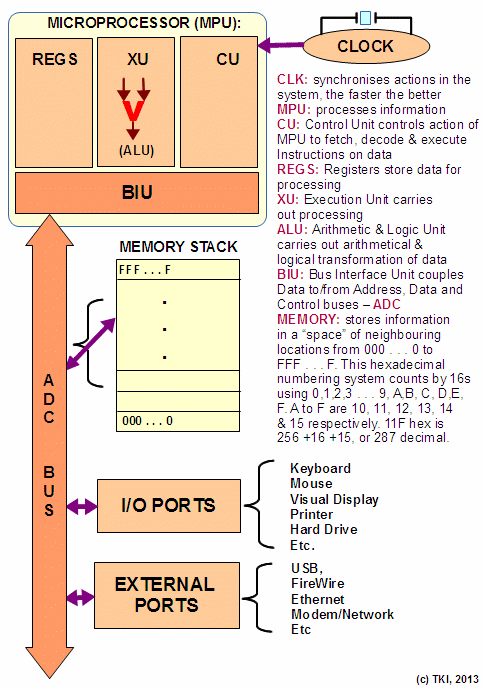
mpu_model

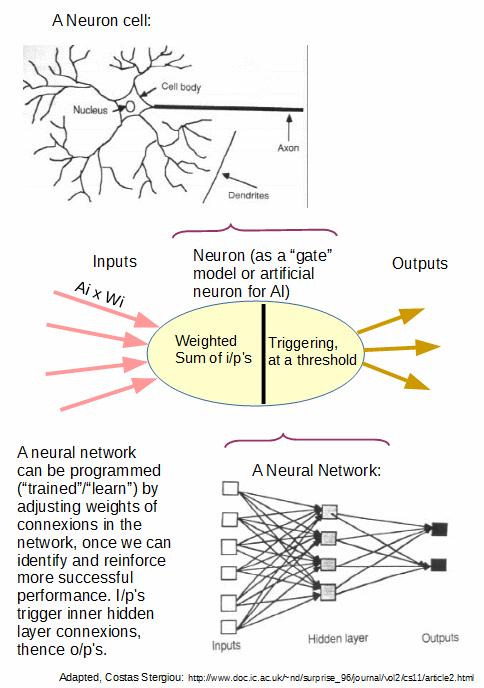
. . . and in neural networks alike:

A neural network is essentially a weighted sum interconnected gate array, it is not an exception to the GIGO principle


That is, it is quite evident that for cause, we can reasonably conclude that mechanical cause-effect chain based computation is categorically distinct from self-aware, self-moved responsible, rational contemplation.

[U/D Aug. 21:] Where, it will help to note on the classic structured programming structures, which — even if they incorporate a stochastic, chance based process — are not examples of freely made insight based decisions (save those of the programmer) but instead are cases of blind GIGO-limited computation based on programmed cause-effect sequences:
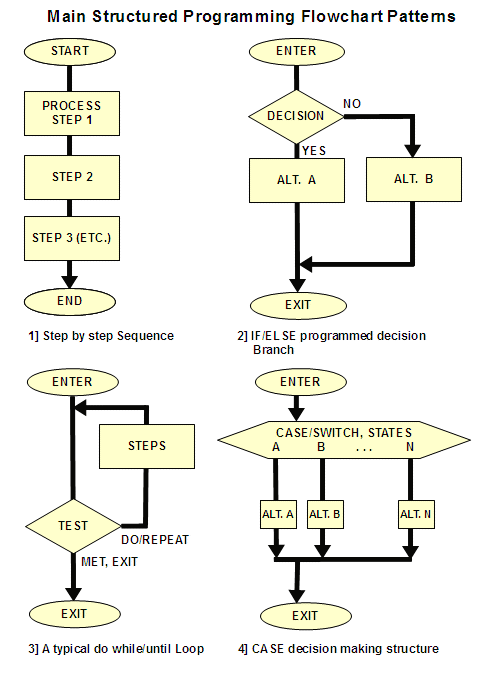
The classic programming structures, which are able to carry out any algorithmic procedure

In turn, that points to intelligence, an observed and measurable phenomenon.

This, too, is being stridently dismissed as a dubious metaphysically driven assumption; so let us note from an Educational Psychology 101 site:

E. G. Boring, a well-known Harvard psychologist in the 1920′s defined intelligence as whatever intelligence tests measure. Wechsler, one of the most influential researchers in the area of intelligence defined it as the global capacity of a person to act purposefully, to think rationally, and to deal effectively with his/her environment. Notice that there is a conative aspect to this definition. [–> AmHD: co·na·tion (k-nshn) n. Psychology The aspect of mental processes or behavior directed toward action or change and including impulse, desire, volition, and striving.] Many modern psychology textbooks would accept a working definition of intelligence as the general ability to perform cognitive tasks. Others might favor a more behaviorally-oriented definition such as the capacity to learn from experience or the capacity to adapt to one’s environment. Sternberg has combined these two viewpoints into the following: Intelligence is the cognitive ability of an individual to learn from experience, to reason well, to remember important information, and to cope with the demands of daily living.

That is, we have an empirically founded, measurable concept. One that sees major application in science and daily life.

Where, further, design can then be understood as intelligently, purposefully directed contingency — that is, design (and its characteristic outputs such as FSCO/I) will be manifestations of intelligent action. So, it is unsurprising to see leading ID researcher William Dembski remarking:

We know from experience that intelligent agents build intricate machines that need all their parts to function [–> i.e. he is specifically discussing “irreducibly complex” objects, structures or processes for which there is a core group of parts all of which must be present and properly arranged for the entity to function (cf. here, here and here)], things like mousetraps and motors. And we know how they do it — by looking to a future goal and then purposefully assembling a set of parts until they’re a working whole. Intelligent agents, in fact, are the one and only type of thing we have ever seen doing this sort of thing from scratch. In other words, our common experience provides positive evidence of only one kind of cause able to assemble such machines. It’s not electricity. It’s not magnetism. It’s not natural selection working on random variation. It’s not any purely mindless process. It’s intelligence  . . . . 

When we attribute intelligent design to complex biological machines that need all of their parts to work, we’re doing what historical scientists do generally. Think of it as a three-step process: (1) locate a type of cause active in the present that routinely produces the thing in question; (2) make a thorough search to determine if it is the only known cause of this type of thing; and (3) if it is, offer it as the best explanation for the thing in question. 

[William Dembski and Jonathan Witt, Intelligent Design Uncensored: An Easy-to-Understand Guide to the Controversy, pp. 20-21, 53 (InterVarsity Press, 2010). HT, CL of ENV & DI.]

But, one may ask, why is it that FSCO/I and the like are observed as characteristic products of intelligence? Is that a mere matter of coincidence?

No.

Because of the blind, needle- in- haystack challenge (similar to that which grounds the second law of thermodynamics in its statistical form) faced by a solar system of 10^57 atoms or an observed cosmos of some 10^80 atoms, a 10^17 s blind chance and mechanical necessity driven search process faces empirically insuperable odds:
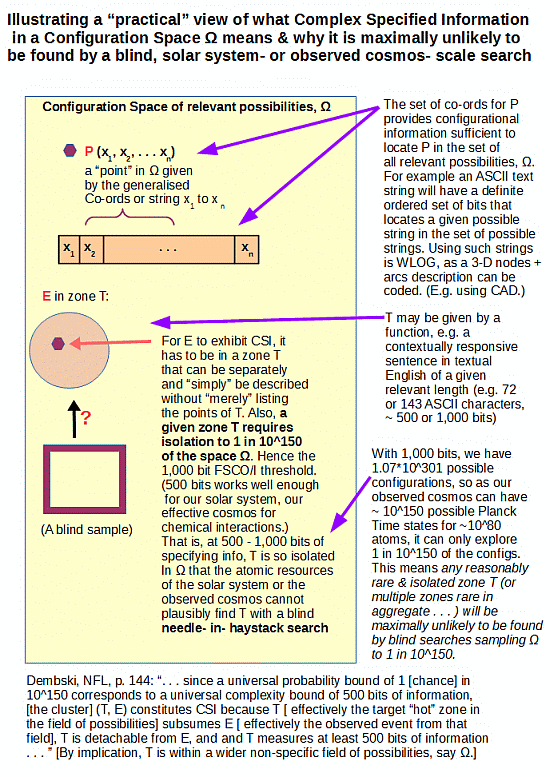
csi_defnSo, even the notion that our brains have been composed and programmed by a blind chance and necessity search process over 4 bn years of life on earth is dubious, once we see that FSCO/I beyond 500 – 1,000 bits faces a super-search challenge.

As for the notion that blind chance and mechanical necessity adequately account for the origin and diversification across major body plans, of cell based life, let the advocates of such adequately account — on observed evidence not a priori materialist impositions dressed up in lab coats — for something like protein synthesis (HT, VJT, onward thanks Wiki Media):
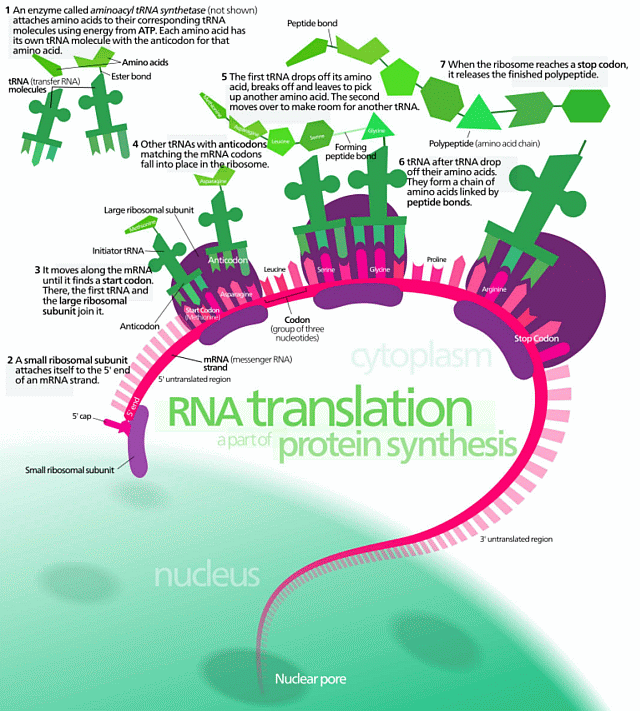
Protein Synthesis (HT: Wiki Media)


That is the context in which, on Sunday, I responded to RDF at 235 in the Do We Need a Context thread, as follows — only to be studiously ignored (as is his common tactic):

______________

>>I find it important to speak for record:

[RDF to SB:] . . . ID rests on the assumption of libertarianism, an unprovable metaphysical assumption

This characterisation of SB’s reasoning is false to the full set of options he puts on the table, but I leave answering that to SB.

What is more interesting is how you[–> RDF]  switch from an empirical inference to projection of a phil assumption you reject while ignoring something that is easily empirically and analytically verifiable. Which, strongly implicates that the root problem we face is ideological, driven and/or influenced by a priori evolutionary materialism [perhaps by the back door of methodological impositions] and/or its fellow travellers.

First, intelligence is a summary term for the underlying capacity of certain observed beings to emit characteristic behaviours, most notably to generate FSCO/I in its various forms.

For example as your posts in this thread demonstrate, you understand and express yourself in textual language in accord with well known specifications of written English. It can be shown that it is extremely implausible for blind chance and/or mechanical necessity to stumble upon zones of FSCO/I in the sea of possible configurations, once we pass 500 – 1,000 bits of complexity. Where as 3-d descriptions of complex functional objects can easily be reduced to strings [cf. AutoCAD etc], discussion on strings is WLOG.

At no point in years of discussion have you ever satisfactorily addressed this easily shown point. (Cf. here.)

Despite your skepticism, the above is sufficient to responsibly accept the significance of intelligence per a basic description and/or examples such as humans and dam-building beavers or even flint-knapping fire-using omelette-cooking chimps — there is reportedly at least one such. Then there was a certain bear who was a private in the Polish Army during WW II. Etc.

Being human is obviously neither necessary to nor sufficient for being intelligent.

Nor for that matter — given the significance of fine tuning of our observed cosmos from its origin, would it be wise to demand embodiment in a material form. Where also, it has been sufficiently pointed out — whether or no you are inclined to accept such — that a computational material substrate is not enough to account for insightful, self-aware rational contemplation.

We should not ideologically lock out possibilities.

Where also, the notion of “proof” — as opposed to warrant per inference to best explanation — is also material. In both science and serious worldviews discussion, IBE is more reasonable as a criterion of reasonableness than demonstrative proof on premises acceptable to all rational individuals etc. The projection of such a demand while one implicitly clings to a set of a prioris that are at least as subject to comparative difficulties challenge is selective hyperskepticism.

So, already we see a functional framework for identifying the attribute intelligence and using it as an empirically founded concept. One that is in fact a generally acknowledged commonplace. Let me again cite Wiki, via the UD WACs and Glossary as at 206 above . . . which of course you ignored:

Intelligence – Wikipedia aptly and succinctly defines: “capacities to reason, to plan, to solve problems, to think abstractly, to comprehend ideas, to use language, and to learn.” . . . .

Chance – undirected contingency. That is, events that come from a cluster of possible outcomes, but for which there is no decisive evidence that they are directed; especially where sampled or observed outcomes follow mathematical distributions tied to statistical models of randomness. (E.g. which side of a fair die is uppermost on tossing and tumbling then settling.)

Contingency – here, possible outcomes that (by contrast with those of necessity) may vary significantly from case to case under reasonably similar initial conditions. (E.g. which side of a die is uppermost, whether it has been loaded or not, upon tossing, tumbling and settling.). Contingent [as opposed to necessary] beings begin to exist (and so are caused), need not exist in all possible worlds, and may/do go out of existence.

Necessity — here, events that are triggered and controlled by mechanical forces that (together with initial conditions) reliably lead to given – sometimes simple (an unsupported heavy object falls) but also perhaps complicated — outcomes. (Newtonian dynamics is the classical model of such necessity.) In some cases, sensitive dependence on [or, “to”] initial conditions may leads to unpredictability of outcomes, due to cumulative amplification of the effects of noise or small, random/ accidental differences between initial and intervening conditions, or simply inevitable rounding errors in calculation. This is called “chaos.”

Design — purposefully directed contingency. That is, the intelligent, creative manipulation of possible outcomes (and usually of objects, forces, materials, processes and trends) towards goals. (E.g. 1: writing a meaningful sentence or a functional computer program. E.g. 2: loading of a die to produce biased, often advantageous, outcomes. E.g. 3: the creation of a complex object such as a statue, or a stone arrow-head, or a computer, or a pocket knife.) . . . .

Intelligent design [ID] – Dr William A Dembski, a leading design theorist, has defined ID as “the science that studies signs of intelligence.” That is, as we ourselves instantiate [thus exemplify as opposed to “exhaust”], intelligent designers act into the world, and create artifacts. When such agents act, there are certain characteristics that commonly appear, and that – per massive experience — reliably mark such artifacts. It it therefore a reasonable and useful scientific project to study such signs and identify how we may credibly reliably infer from empirical sign to the signified causal factor: purposefully directed contingency or intelligent design . . .

Indeed, on just this it is you who have a burden of warranting dismissal of the concept.

Where also, design can be summed up as intelligently directed contingency that evidently targets a goal, which may be functional, communicative etc. We easily see this from text strings in this thread and the PCs etc we are using to interact.

Again, empirically well founded.

So, the concept of intelligent design is a reasonable one, and FSCO/I as reliable sign thereof is also reasonable.

In that context the sort of rhetorical resorts now being championed by objectors actually indicate the strength of the design inference argument. Had it been empirically poorly founded, it would long since have been decisively undermined on those grounds. The resort instead to debating meanings of widely understood terms and the like is inadvertently revealing.

But also, this is clearly also a worldviews level issue.

So, I again highlight from Reppert (cf. here on) on why it is highly reasonable to point to a sharp distinction between ground-consequent rational inference and blindly mechanical cause effect chains involved in the operation of a computational substrate such as a brain and CNS are:

. . . let us suppose that brain state A, which is token identical to the thought that all men are mortal, and brain state B, which is token identical to the thought that Socrates is a man, together cause the belief that Socrates is mortal. It isn’t enough for rational inference that these events be those beliefs, it is also necessary that the causal transaction be in virtue of the content of those thoughts . . . [[But] if naturalism is true, then the propositional content is irrelevant to the causal transaction that produces the conclusion, and [[so] we do not have a case of rational inference. In rational inference, as Lewis puts it, one thought causes another thought not by being, but by being seen to be, the ground for it. But causal transactions in the brain occur in virtue of the brain’s being in a particular type of state that is relevant to physical causal transactions.

Unless we are sufficiently intelligent to understand and infer based on meanings, and unless we are also free enough to follow rational implications or inferences rather than simply carry out GIGO-limited computational cause-effect chains, rationality itself collapses. So, any system of thought that undermines rationality through computational reductionism, or through dismissing responsible rational freedom is delusional and self referentially incoherent.

You may wish to dismissively label responsible freedom as “contra-causal free will,” or the like and dismiss such as “unprovable.” That is of no effective consequence to the fact of responsible rational freedom that is not plausibly explained on blindly mechanical and/or stochastic computation. Which last is a condition of even participating in a real discussion — I dare to say, a meeting of minds.

That is, we again see the fallacy of trying to get North by heading due West.

It is time to reform and renew our thinking again in our civilisation, given the patent self-refutation of the ever so dominant evolutionary materialism. As Haldane pointed out so long ago now:

“It seems to me immensely unlikely that mind is a mere by-product of matter. For if my mental processes are determined wholly by the motions of atoms in my brain I have no reason to suppose that my beliefs are true. They may be sound chemically, but that does not make them sound logically. And hence I have no reason for supposing my brain to be composed of atoms. In order to escape from this necessity of sawing away the branch on which I am sitting, so to speak, I am compelled to believe that mind is not wholly conditioned by matter.” [[“When I am dead,” in Possible Worlds: And Other Essays [1927], Chatto and Windus: London, 1932, reprint, p.209.]

It is time for fresh, sound thinking.  >>

______________

I actually think this is a good sign. In the 1980’s and 90’s as Marxism gradually crumbled, many Marxists redoubled their efforts, until the ship went down under them. So, the trend that objections to the design inference are now being commonly rooted in hyperskeptically challenging common sense, empirically warranted concepts such as design, intelligence and functionally specific quantifiably complex organisation and associated information all point to the gradual crumbling of the objector case on the actual empirical and analytical merits. END

Comments
That would be human design theory, which is a good explanation for human designed things, but rather problematic as an explanation for the design of human beings.
This goes back to the original question I asked you. The "explanatory content" of ID theory includes the intractable observation that human design and biological design share the exact same physical conditions by which those designs are imparted into physical form. Only human design and biological design can be demonstrated (at the physical/material level) to exhibit these unique qualities. They are found no where else in the cosmos. You are asking ID theorist to ignore these demonstrable facts, but you are not giving the reasons why such demonstrable facts should be ignored. At the very least, you could tell us why you ignore them.Upright BiPed
August 26, 2014
August
08
Aug
26
26
2014
09:21 AM
9
09
21
AM
PDT
P: The designer represented by the explanatory content presented in Intelligent design theory. M: So human designers. That would be human design theory, which is a good explanation for human designed things, but rather problematic as an explanation for the design of human beings.Popperian
August 26, 2014
August
08
Aug
26
26
2014
06:59 AM
6
06
59
AM
PDT
kairosfocus, It's unclear how your references in [155] address the criticism of induction I raised in [140.]. For example... the very idea that something has been repeated is not a sensory experience. Theory aways comes first. For example, theories of optics and geometry tell us not to experience seeing the sun rise on a cloudy day, even if a sunrise is really happening in the unobserved world behind the clouds. It’s only though theory that not observing the sun in those cases does not constitute an instance of the sun not rising. And the same can be said if we observe the sun rising in a mirror or on video. It’s those same theories of optics and geometry that tells us we’re not experiencing the sun rise twice. In orbit, we observe the sun rising every 90 minutes or not at all. And we knew this would occur, long before we actually orbited the earth, though theory. Nor does it address quotes, such as the following, in [154] “Inductive inference can generate empirical generalizations, but not explanatory theories … Newton’s theory of universal gravitation cannot be inductively inferred from the data on planetary motion and even not from Kepler’s laws …inductive generalization cannot lead from the data on gas behaviour, or from the empirical gas laws, to the kinetic theory of gases” (p66). There is no "theory" of design presented in intelligent design. Being abstract and having no defined limitations, it has been reduced to merely an authoritative source, which is a philosophical position that knowledge in specific spheres comes from authoritative sources.Popperian
August 26, 2014
August
08
Aug
26
26
2014
06:57 AM
6
06
57
AM
PDT
P: As for ID being the best explanation, ID’s designer is abstract and has no defined limitations. M: Which designer? P: The designer represented by the explanatory content presented in Intelligent design theory. So human designers.Mung
August 25, 2014
August
08
Aug
25
25
2014
11:51 AM
11
11
51
AM
PDT
P: Strawman, driven by failure to see that abductive inference to best explanation is inherently an inductive argument:
The inductive argument is based on evidence from the History of Science, namely the many instances where empirical methods produced significantly less useful knowledge products than theoretical methods. · Empirical methods merely enabled Galileo to discover the law of falling, whereas theoretical methods enabled Newton to discover the theory of Mechanics. · Empirical methods merely enabled Ohm to discover the law of electrical resistance, whereas theoretical methods enabled Maxwell to discover the theory of electrodynamics. · Empirical methods merely enabled Proust to discover the law of constant proportions in chemical reactions, whereas theoretical methods enabled Dalton to discover the atomic the- ory of chemistry. · Empirical methods merely enabled Darwin to discover new biological species, whereas theoretical methods enabled him to discover the theory of biological evolution. · etc., etc. So, empirical methods were often less useful than theoretical methods.
Inductive arguments, as currently understood (yes, there has been a development of our understanding), denote arguments where the premises provide some degree of support to the inferred conclusion, rather than simply cases of generalisation on cases to a general pattern. For instance, here is SEP on contrasting the two types of reasoning:
An inductive logic is a system of evidential support that extends deductive logic to less-than-certain inferences. For valid deductive arguments the premises logically entail the conclusion, where the entailment means that the truth of the premises provides a guarantee of the truth of the conclusion. Similarly, in a good inductive argument the premises should provide some degree of support for the conclusion, where such support means that the truth of the premises indicates with some degree of strength that the conclusion is true. Presumably, if the logic of good inductive arguments is to be of any real value, the measure of support it articulates should meet the following condition: Criterion of Adequacy (CoA): As evidence accumulates, the degree to which the collection of true evidence statements comes to support a hypothesis, as measured by the logic, should tend to indicate that false hypotheses are probably false and that true hypotheses are probably true.
The difference where we have long since moved on from understanding induction as a matter of generalisations and analogies, is material. In the case of inference to best explanation, on relevant facts F1, F2, . . Fn, which are puzzling, on explanation E, they would follow on E being true, often, E entails F1 . . . Fn, and of course this can be extended to predictions Pm , Pm+1 . . . Pr, too. Which can then be tested. Predictions include predicting as yet unknown facts or traces of the past or the like, sometimes termed retrodictions. Then we may have cases where alternative explanations E1, E2, . . . Eq may cover the same set of facts and make predictions, which may agree or disagree. Inference to best explanation, then compares on factual [including predictive] adequacy, coherence and explanatory power, inferring that some explanation Ek is superior, on given grounds, overall. When that obtains Ek is the best explanation, and is held the best current explanation. This is inductive as, E => (F1, . . . Fn, Pm . . . Pr) -- per properties of implications -- does not entail the truth of E; though were E true, it would make only true implications. But, the power of E to cover facts and make successful predictions makes it more likely to be so than otherwise. Thus, we have the observations, present and cumulative, providing provisional support for the belief that E is more likely to be true than otherwise. Thus, IBE is inductive in character. In some cases, the cumulative force of the support is so strong that we have moral certainty, it would be a failure of duties of care, on the strength of evidence, to assume that E is false and act as though it is false. At this level of course, deductive aspects are involved, but the overall argument pattern is inductive. I trust this will help put the matters on a better balance, and will help us appreciate why the inference to best explanation supports the conclusion that design is the best (and in fact only observed -- billions trillions of cases) cause of FSCO/I. KFkairosfocus
August 25, 2014
August
08
Aug
25
25
2014
11:22 AM
11
11
22
AM
PDT
Popperian: OK, maybe we are going nearer to real points that have top be addressed. Let's see. 1) It is still not clear to me what you mean by "a distinction between knowledge and specific designs based on that knowledge". Maybe I have missed something in your answers to others. Could you please elaborate on that, as you state that "that ID grossly underestimates the role that knowledge plays in design"? A formal definition of "knowledge" would be appreciated. I have given my definition of "design" in post #150. Do you agree? If not, please provide yours. 2) You say: "Since X is designed and since X was gradually deigned then the designer of X must have limitations of gradual design. But that begs the question that X actually was designed. Gradual design isn’t a necessary consequence of ID’s designer. At best, you could say, that’s just what the designer must have wanted," But I have argued in some detail that the design inference is based on the observation/assumption/theory that dFSCI originates only by design processes. The "limitations" of the designer have no part in that. Gradual design is simply a characteristic of all forms of design we know, I would say of anything that happens in time. Design is always gradual, never instantaneous. It can take longer in some cases, and it can be quicker in others. But obviously, longer and quicker are very relative terms. I do believe that your criticism here is really unwarranted. 3) You say: "Again, human beings are good examples of human designed things because of their limitations." Again, you miss the point. Human beings are good examples of designers because they can design things (they have conscious intelligent representations, and they can intentionally output them to material objects). And they can easily generate new original dFSCI, something that no non conscious physical system known by us can do. Human limitations have nothing to do with this reasoning. 4) You say: " Again, ID’s designer is under no such limitation. Nothing prevents it from changing the laws of physics and everything it created to adapt to those changes." ??? What do you mean? If we are talking of biological design (which is exactly what I am talking about) your statement is completely unwarranted. You are assuming: a) That the biological designer has created the physical universe, or any other thing. IOWs, that he is a creator. On what basis? The only thing needed is that he is a designer, not a creator. b) That he can "change the laws of physics". Are you out of your mind? I think you are referring to the argument of design for the whole universe. But that is a different problem. I have always argued that the fine tuning argument for the universe is a valid philosophical argument with scientific support. But the application of design detection to biological information has nothing to do with that. It is not a philosophical argument, but a purely scientific theory. It infers a designer, not a god. The laws of physics are not involved. 5) You say: "If ID’s designer is limited to what it has to work with, then did it fine tune the laws of an existing universe, rather than create it out of nothing? I’m trying to take your theory seriously, for the purpose of criticism. See my software analogy above." See previous point. 6) Finally, I have read you post #142 (it was not addressed to me, so I had not read it before). I am frankly confused. What do you mean? Let's see. I think I am OK with your use of the word "knowledge", which IMO more or less corresponds to my concept of "functional information" in a material object. Then you say: "The genome contains the knowledge of how to adapt air, water, etc. into the biological “qualities” of organisms, which is encoded into their DNA. I think we’re both in agreement that, when an organism reproduces, its offspring effectively builds a copy of itself based on those instructions." That's perfectly OK. "So, the question becomes: what theory best explains the concrete knowledge we actually observe in the genome’s of organisms?" Yes. That's the question, indeed. You go on: "Human designers are people. We can conceive of problems, conjecture explanatory theories about how the world works, in reality, in an attempt to solve them, criticize those theories and discard errors they find. This results in the creation of explanatory knowledge, which only people can create. And has significant reach, because it’s explanatory rather than merely a useful rule of thumb." Ehm... OK, I think I agree more or less. Let's go on. "This is in contrast to biological Darwinism, which is the theory that the knowledge of how to build biological adaptations in an organism’s genome was created by conjecture, in the form of genetic variation that is random to any problem to solve and criticism, in the form of natural selection. This would result in the creation of non-explanatory knowledge, which has significantly less reach. Nature cannot conceive of problems, let alone create explanatory theories about how the world works. Being merely a useful rule of thumb, it would have significantly less reach." Well, I would never use the terms "conjecture" and "criticism" for non conscious processes, but you are free to do that, given that you specify top what you are referring (RV and NS). The fact that "non-explanatory knowledge" has "significantly less reach" seems to mean exactly what I mean when I say that non conscious systems cannot generate complex functional information (they can certainly generate simple functional information, your "non explanatory knowledge"). I think you are probably overestimating that "useful rule of thumb", however: its "reach" is really limited. ID is simply trying to quantify that "reach", and believe me, it is almost nothing. But then you say: "So, what would refute the latter explanation? Observing all, or a majority of, genetic variations in an organism’s genome to have solved problems. This would be due to a designer having conjectured those variations for the expressed purpose of solving that organism’s problems. Or the spontaneous generation of new knowledge in a organisms genome, which would refute both above theories. What else would refute Darwin’s explanation? Observing offspring born with new, complex adaptions for which there were no precursors in their past. Another observation would be an offspring born with a complex adaptation that has survival value today, yet was not favored by selection pressure in ancestry, such as an ability to detect and use internet weather forecasts, as non-explanatory knowledge has significantly less reach." I think I have lost you here. What in the world do you mean? Let me recall a classical example which I mention often: ATP synthase. It is found in all living beings. It is so functionally complex that it is certainly beyond any non conscious "conjecture" or "criticism". It has no relevant precursors. It exhibits tons of dFSCI. And yet darwinism pretends to explain it by RV and NS, without a trace of empirical support. What is your "best explanation" of that? Or do you deny that ATP synthase "solves a problem"? What is your best explanation for the 2000 basic proteins with all their biochemical functions? Do you deny that they "solve problems"? What is your explanations for body plans, for tha differentiation of 500 specific transcriptomes in human cells? And so on, and so on. Finally: "I’d point out that neither of these explanations line up with the current crop of ID theory, as its designer is abstract and has no defined limitations. This leaves ID’s designer as having the property of design. One might suggest that ID’s designer has the quality of being an authoritative source of knowledge. However this reflects a philosophical explanation about how knowledge grows which differs from both explanations above. Nor does it explain the origin of the knowledge the designer supposedly put in those organisms." My confusion is complete. To what explanations are you referring? ID's point is that all that we can observe in biological function clearly is "explanatory knowledge", complex functional information, from which indeed we are constantly drawing to solve "our" problems, because we, with all our "explanatory knowledge", still cannot build one proteins which is worth something. Biological function is the result of an explanatory knowledge which is much better than ours. ID's point is that what you call "conjecture" and "criticism" is completely away, in reach, from even the simplest functional protein. For things like ATP synthase, there is simply no game at all. So, what in the world do you mean by "neither of these explanations line up with the current crop of ID theory", and why do you repeat the nonsense that "its designer is abstract and has no defined limitations"? Even better, you say: "This leaves ID’s designer as having the property of design". ??? I would simply remind you that, if we infer a designer, that designer must have the property of being able to design. Which is exactly the property that a non conscious system has not. A designer has the property of being able to design, but a designer who can generate detectable design must also have the property of being able to generate dFSCI. Which is the point of ID, and which is the point that you obstinately ignore! You say: "One might suggest that ID’s designer has the quality of being an authoritative source of knowledge." Which, if I understand your bizarre language, just means that ID's designer must be able to generate complex functional information. OK, that's true. But why do you call that "authoritative"? What has authority to do with that? "However this reflects a philosophical explanation about how knowledge grows which differs from both explanations above." Why? Designed function information ("knowledge") grows because the designer applies his faculties (cognition, feeling, purpose) to empirical experiences. You yourself have (correctly) emphasized the important role of inner faculties in building knowledge about empirical things. And I agree. So, why are you so surprised that any conscious intelligent agent could generate "knowledge", and cause it to grow? You conclude: "Nor does it explain the origin of the knowledge the designer supposedly put in those organisms" I can agree with that. It does not mean that we cannot try to enquire about that in the future. First of all we must admit the obvious, IOWs that such a knowledge exists in biological beings, and that the best explanation for it is that a conscious intelligent agent generated it. Then we can wonder about the nature of that knowledge, its modalities of implementation and growth, and every other possible and legitimate question.gpuccio
August 25, 2014
August
08
Aug
25
25
2014
10:39 AM
10
10
39
AM
PDT
G: 1) I don’t understand what you mean by the 3D printing example, but it’s probably not important. I'm making a distinction between knowledge and specific designs based on that knowledge. It's key aspect of the argument that ID grossly underestimates the role that knowledge plays in design. G: 2) You are simply saying that an omniscient being would also be omnipotent. And therefore would obey no rules. I'm saying that good explanations are those that are hard to vary without significantly reducing it's ability to explain the phenomena it purports to explain. Based on this criteria, the designer presented by ID is a bad explanation because it is abstract and had no defined limitations. This criticism is not specific to supernatural contexts or omnipotent beings. G: Regarding his limitations, we can say that he is certainly constrained by his interface, that he has to build design gradually (like humans), that he makes choices in terms of efficiency (for example, he certainly cannot fix all possible error in his design, or it would just be inefficient for him to do that). And so on. As in the case of humans, we can derive those limitations from the designed things, when we know not from the beginning what they are. It’s called empirical inference. Since X is designed and since X was gradually deigned then the designer of X must have limitations of gradual design. But that begs the question that X actually was designed. Gradual design isn't a necessary consequence of ID's designer. At best, you could say, that's just what the designer must have wanted, Again, human beings are good examples of human designed things because of their limitations. Even human beings can update existing created things to match new standards. When an existing computer operating system is released, we can update existing applications to support incompatible changes and take advantage of new features. And while it takes significant time and resources, we can completely convert an existing application to use an entirely new operating system. Again, ID's designer is under no such limitation. Nothing prevents it from changing the laws of physics and everything it created to adapt to those changes. So, this inferences does not hold even with limited human beings. These are the sorts of observations that ID proponents are not taking into account. G: For example, if we get to a planet and find obvious designed artifacts of an old civilization (machines exhibiting obvious CSI/dFSCI), we can certainly infer much about the limitations (and abilities) of those old aliens, even if we know nothing about them directly. Again, it’s called empirical inference. It’s not begging the question, as you wrongly state. You're assuming there is no distinction to be made between different kinds of knowledge, such as explanatory and non-explanatory, and the impact that would have on the concrete features of the "designs" in question. You're underestimating the role that knowledge plays in designing things and progress we've made in epistemology. See [142] G: Which claims? Please, explain. P: “Just so I’m clear, you’re not disagreeing with me, but claiming my methodology is wrong?” G: I always disagree with the conclusions derived from a wrong methodology. I believe that’s good methodology. I realize you think it's a wrong methodology. I'm asking you to elaborate on why with a criticism of that methodology. You wrote: There are obvious constraints in the work of any designer. Any designer is constrained by the material he has to work with, by the modalities of implementation, by what has already been designed, just to make a few examples. If ID's designer is limited to what it has to work with, then did it fine tune the laws of an existing universe, rather than create it out of nothing? I'm trying to take your theory seriously, for the purpose of criticism. See my software analogy above. G: And I am suggesting (with ID theory) that conscious design is the only available explanation for “the concrete adaptations of biological organisms we observe”, IOWs for observed facts. And I am giving detailed considerations to prove that. You have addressed none of my considerations (indeed, none of ID’s arguments about CSI/dFSCI), and offered nothing concrete to support your “suggestion”. I've provided a theory that explains how non-explanatory knowledge can be created without intent, conciseness, etc., in [142] What criticism do you have of that theory?Popperian
August 25, 2014
August
08
Aug
25
25
2014
07:21 AM
7
07
21
AM
PDT
F/N: Definition of design, courtesy Wiki speaking against interest:
Design is the creation of a plan or convention for the construction of an object or a system (as in architectural blueprints, engineering drawings, business processes, circuit diagrams and sewing patterns).[1] Design has different connotations in different fields (see design disciplines below). In some cases the direct construction of an object (as in pottery, engineering, management, cowboy coding and graphic design) is also considered to be design. More formally design has been defined as follows.
(noun) a specification of an object, manifested by an agent, intended to accomplish goals, in a particular environment, using a set of primitive components, satisfying a set of requirements, subject to constraints; (verb, transitive) to create a design, in an environment (where the designer operates)[2]
Another definition for design is a roadmap or a strategic approach for someone to achieve a unique expectation. It defines the specifications, plans, parameters, costs, activities, processes and how and what to do within legal, political, social, environmental, safety and economic constraints in achieving that objective.[3] Here, a "specification" can be manifested as either a plan or a finished product, and "primitives" are the elements from which the design object is composed.
KFkairosfocus
August 25, 2014
August
08
Aug
25
25
2014
07:11 AM
7
07
11
AM
PDT
GP & P, It's nomination day and that is a bit of a bother, but I have a moment. I have pointed out that theoretical analysis responds to evident patterns in observation, using the example that established modern astronomy and started astrophysics. Further to this, there is a process of inference to best explanation, across competing explanations, which famously happened with the Ptolemaic, Copernican and Tychonian systems for the planets. C 1600, the balance of empirical data favoured Tycho Brahe's system in fact. (Cf. here.) Inference to best explanation across live options uses deductions in explicating implications of models, but it is fundamentally inductive and provisional. The amount of mental effort being exerted to avoid what should be fairly obvious amazes me. KFkairosfocus
August 25, 2014
August
08
Aug
25
25
2014
07:08 AM
7
07
08
AM
PDT
Popperian: "If, by design, you mean the philosophical idea that knowledge comes from an authoritative source, then yes. But that’s the questionable assumption that is specific to ID." What about: 1) Design = any process where a conscious intelligent agent purposefully outputs some represented form from his consciousness to a material object. (definition) 2) Digital functional information in a digital sequence in a material object (for one defined function) = -log2 of the rate between the minimum number of bits necessary to implement the defined function, and the maximum information carrying capacity of the sequence in the object (in bits). 3) Complex digital functional information (in a digital sequence in a material object): a binary value (yes, no) which categorizes the digital functional information according to an appropriate threshold (for the object and for the system where the object originated) 4) All objects exhibiting dFSCI (digital functionally specified complex information, as in 3) originate from design. (ID theory). Another way of saying it, is that conscious intelligent representations are the only known source of dFSCI in the material world. 5) Verification of the theoretical assumption in 4 in all cases where the origin of the objects is independently known (100% specificity, no false positives). 6) Application of the theory to objects whose origin is not indepedently known (the design inference). How do your concepts of "knowlegde" and "authoritative source" comply with that?gpuccio
August 25, 2014
August
08
Aug
25
25
2014
06:59 AM
6
06
59
AM
PDT
UB: Of course … you can’t name a single thing that would make you consider design. If, by design, you mean the philosophical idea that knowledge comes from an authoritative source, then yes. But that's the questionable assumption that is specific to ID. Nor would I say that I haven't previously considered that philosophical idea, or that I wouldn't be open to new criticism of alternatives.Popperian
August 25, 2014
August
08
Aug
25
25
2014
06:20 AM
6
06
20
AM
PDT
Popperian: Just to be clear, I don't think that anyone here is defending a mere generalization of observed things as the basis of science. Why do you believe that? Of course observations pose problems and questions, and we build theories using our imagination, our intuition, our logic and our mathematics to solve those problems aw we deem best. IOWs, we look for the best explanation, and explanations are not in facts. They are in our minds, but their purpose is to explain facts. If a theory cannot explain facts, it is a bad theory indeed (any reference to neo darwinism is absolutely intentional!) That's exactly what ID theory is: the best explanation (indeed the only one available) for observed facts. I would not agree, however, that even our theories are completely deductive. There is obviously a strong deductive component in them, but there is also a lot of intuition, imagination, creativity, and other components of cognition. That is true of ID theory, as much as of any other good scientific theory.gpuccio
August 25, 2014
August
08
Aug
25
25
2014
06:17 AM
6
06
17
AM
PDT
From the Poverty of Empiricism article I referenced earlier...
The inductive argument is based on evidence from the History of Science, namely the many instances where empirical methods produced significantly less useful knowledge products than theoretical methods. · Empirical methods merely enabled Galileo to discover the law of falling, whereas theoretical methods enabled Newton to discover the theory of Mechanics. · Empirical methods merely enabled Ohm to discover the law of electrical resistance, whereas theoretical methods enabled Maxwell to discover the theory of electrodynamics. · Empirical methods merely enabled Proust to discover the law of constant proportions in chemical reactions, whereas theoretical methods enabled Dalton to discover the atomic the- ory of chemistry. · Empirical methods merely enabled Darwin to discover new biological species, whereas theoretical methods enabled him to discover the theory of biological evolution. · etc., etc. So, empirical methods were often less useful than theoretical methods. Now if today’s researchers were trapped into empiricism, they would be restricted to empirical methods, and would be unable to produce the more useful theories. Therefore empiricism would impoverish research. The deductive argument against the positivist empiricist doctrines is based on two propositions of the modern Philosophy of Science: 1. A true science has an explanatory theory that is organized as a deductive system. 2. Empirical methods are inappropriate for creating explanatory theories. Proposition 1 means that an academic discipline does not qualify for the status of a science until it has progressed beyond empirical generalizations to explanatory theories. For example, the branches of Physics and Astronomy now called Dynamics and Celestial Mechanics were labelled ‘natural philosophy’ at the time Galileo formulated his empirical laws of motion and Kepler formulated his empirical laws of planetary orbits. They only achieved the status of sciences after Newton devised a deductive theory to explain Galileo’s laws and Kepler’s laws ?????????????Proposition 2, which asserts that empirical methods are inappropriate for creating explanatory theories, follows from the fact that empirical research involves inductive reasoning, whereas theoretical research involves deductive reasoning. Empirical methods induce generalizations from facts. Theoretical methods then explain the empirical generalizations by generating deductive arguments to the generalizations from first causes, which are usually unobservable. So inductive methods are useless for devising deductive explanatory theories. This proposition is easy to confirm from cases in the History of Science. For instance, Newton made no observations or experiments, and analyzed no data in devising the theory of Mechanics; neither did Dalton in devising the atomic theory of Chemistry, nor Darwin in devising the biological theory of evolution, nor Einstein in devising the relativity theory.
Note: as I'm sure someone will suggest it's a contradiction, the "inductive argument" section is unfortunately and misleadingly named. These facts represnt criticism of the theory that the contents of theories come from observations. They are facts to be explained, which occurs in the deductive argument section. Furthermore, observations are themselves, theory laden. What counts a repition is not a sensory experience. Theory aways comes first. As for the accusation of being merely overinthused by Popper, here are a list of quotes from the paper...
“No mere list or catalog of truths is ever said to constitute a system of knowledge or a science. We have scientific knowledge only when the propositions setting forth what we know are organized in a systematic way, to display their interrelations ... one important relationship among the propositions of a science is deducibility. Propositions that embody knowledge about a subject become a science of that subject when they are arranged or ordered by displaying some of them as conclusions deduced from others” (p157). - Copi, 1979
“the more purely phenomenal a proposition is and the less the element of theory associated with it, the less is its certainty ... For why do we call some laws ‘empirical’ and associate with that term a slight element of distrust? Because such laws are not explained by any theory” (p153). - Campbell, N. R., 1920
“it has been one of the fundamental aims of science to reach deductive systems of knowledge” (p39). - Harre, 1960
“The experimental work of Hooke and Boyle by which they established the empirical patterns in the behavior of confined samples of gas that we express as PV = K ... was proto-scientific. We do not have real science until we know why P varies inversely as V, knowledge which became available only after the molecular theory of gases was formulated to provide us with an idea of the causal mechanism by which this pattern was produced ... Science proper starts when the question ‘Why?’ is put and theory develops to answer it.” (p130-1). - Harre & Secord, 1972
“theory is one of the distinguishing characteristics of modern science” (p16). - Kantorovich, 1993
“explanation [is] the main business of science” (p4). - Klee, 1997
“the purpose of science is to develop theory, which can be defined as a set of formulations designed to explain and predict phenomena” (p3). - Mason & Bramble, 1978
“One goal of the scientific method is explanation: a theory as to the causes and/or effects surrounding a given phenomenon” (p10). - Phillips, 1985
“The ultimate goal of a science is the development of a theory to explain the lawful relationships that exist in a particular field” (p40). - McBurney, 1994????
“Theory cannot be derived from observation and generalizations merely by means of rigorous induction”. ?- Timasheff, 1957
“a theory cannot be an empirical generalization from observational data” (p85). - Nagel, 1961
"on Einstein’s own testimony the Michelson-Morley experiment ‘had no role in the foundation of the theory’ .... [It] was laid on theoretical, indeed speculative, considerations" (p243-4). - Koestler, 1969
“But what about the method by which we obtain our theories or hypotheses? ... I do not believe that we ever make inductive generalizations in the sense that we start with observations and try to derive our theories from them” (p19). - Popper, 1978
“All the ‘facts’ Darwin used as evidence for his theory of evolution were known before he used them ... What Darwin contributed was a profoundly radical way of rearranging these materials” (p38). - Hughes, 1990
“Inductive inference can generate empirical generalizations, but not explanatory theories ... Newton’s theory of universal gravitation cannot be inductively inferred from the data on planetary motion and even not from Kepler’s laws ...inductive generalization cannot lead from the data on gas behaviour, or from the empirical gas laws, to the kinetic theory of gases” (p66). - Kantorovich, 1993
Popperian
August 25, 2014
August
08
Aug
25
25
2014
05:41 AM
5
05
41
AM
PDT
P: Above, you will see a clip at 134 from Avi Sion on the principle of provisional universality; which reflects BTW some of Newton's thought on provisional generalisation -- the regular diurnal and annual pattern of the Sun reflected in the seasons being perhaps the longest scientifically observed regularity. Along with the phases of the Moon and the onward interaction forming the 19-year Saros cycle that is still relevant to things like determining what sea level is. At core, is the point that there are in fact fairly commonplace patterns where there are observable regularities, and though if we see a "break" we should be open to change, we have an epistemic right to infer that observed stable patterns (think, a dropped heavy object near Earth falls at 9.8 m/s etc, where also the centripetal acceleration of the Moon fits in with an inverse square law attenuation of the same force field at that distance, which led to Newton's inference of his Universal Law of Gravitation . . . ) are just that. In fact, we rely on that in our daily existence and decision making. Let me cite Newton from Opticks, Query 31, 1704:
As in Mathematicks, so in Natural Philosophy [~ Roughly, Physical science], the Investigation of difficult Things by the Method of Analysis, ought ever to precede the Method of Composition. This Analysis consists in making Experiments and Observations, and in drawing general Conclusions from them by Induction, and admitting of no Objections against the Conclusions, but such as are taken from Experiments, or other certain Truths. For Hypotheses [--> speculative metaphysical theses without empirical grounding] are not to be regarded in experimental Philosophy. And although the arguing from Experiments and Observations by Induction be no Demonstration of general Conclusions; yet it is the best way of arguing which the Nature of Things admits of, and may be looked upon as so much the stronger, by how much the Induction is more general. And if no Exception occur from Phaenomena, the Conclusion may be pronounced generally. But if at any time afterwards any Exception shall occur from Experiments, it may then begin to be pronounced with such Exceptions as occur. By this way of Analysis we may proceed from Compounds to Ingredients, and from Motions to the Forces producing them; and in general, from Effects to their Causes, and from particular Causes to more general ones, till the Argument end in the most general. This is the Method of Analysis: And the Synthesis consists in assuming the Causes discover'd, and establish'd as Principles, and by them explaining the Phaenomena proceeding from them, and proving the Explanations.
So, there is in fact a longstanding appreciation of the provisionality of inductive arguments, as applied to science. Where, the old saying that "the exception proves the rule" is often misunderstood to mean substantiates, when in fact it means properly, tests and gives limitations, or even possibly overturns. As Newton explicitly states. And Newton, probably consciously, echoes Locke as already cited on the limitations of human understanding. In effect, the long accepted point is that we do live in an orderly cosmos, where predictable order is a major part of why we recognise a cosmos and can operate based on reason and provisional understanding. Absent that, we would live in a chaos not a cosmos. And, as Sion aptly pointed out -- which you seemed to have simply ignored -- we cannot overturn this provisional universality on grounds that some cases have been overturned, as there are ever so many cases where in fact that is not the case. That is, we may not fully or fully accurately grasp the order in our world, but we do grasp enough of it to be willing to provisionally infer principles of order, open to correction. And indeed, sometimes there are actual or potential "exceptions" that are part of a wider pattern. As any statistician worth his or her salt will tell you. (And, as will any theologian worth his salt on the subject of miracles. That is, the inference to natural regularities that are empirically reliable is an implicit inference to a conditional probability, where the One who made an orderly world has an obvious right to act beyond the usual order for good reasons of his own -- which BTW means that miracles would be quite rare. Which does nothing to the significance and reality of orderly patterns, contrary to what Lewontin's allusion to Beck's errors suggested:
It is not that the methods and institutions of science somehow compel us to accept a material explanation of the phenomenal world, but, on the contrary, that we are forced by our a priori adherence to material causes [[--> another major begging of the question . . . ] to create an apparatus of investigation and a set of concepts that produce material explanations, no matter how counter-intuitive, no matter how mystifying to the uninitiated. Moreover, that materialism is absolute [[--> i.e. here we see the fallacious, indoctrinated, ideological, closed mind . . . ], for we cannot allow a Divine Foot in the door. The eminent Kant scholar Lewis Beck used to say that anyone who could believe in God could believe in anything. To appeal to an omnipotent deity is to allow that at any moment the regularities of nature may be ruptured, that miracles may happen.
No, the possibility of miracles does not entail an unpredictable, utterly jumbled chaos rather than a cosmos, that is ill advised rhetoric driven by anti- supernaturalistic prejudice. God is the God of order, not chaos. That is, in Judaeo_Christian theism, God is Reason Himself, the purposeful, intelligent Author and Maker of Creation, so also the Ground of an orderly cosmos, sustaining that order by his word of power. So, we properly expect an orderly world, not the strawman chaos that Lewontin alludes to on the strength of Beck. But, an order that is open to acts beyond the usual course, for good reason. (In the Christian view, most significantly, this case. And on such a case, the proper assessment is therefore historical-forensic, not by resort to fallacious scientism and question-begging prejudice.) All of this then points at first level to informal assessment of order based on common sense observations; subject to the recognition of provisionality and avoiding common fallacies of induction such as faulty or hasty generalisation, or ideologically locking out live options in inference to best explanations, etc. A lot of real world science is glorified, structured common sense. For excellent reason. Beyond, of course, lies sampling and the techniques of probability, statistics and especially Bayesian type likelihood analysis. Which, for instance, is an important part of medical testing and the like. And with room enough still for old fashioned hyp testing by looking at observations being in the bulk or far skirts of expected distributions, following Fisher. So, the attempt to dismiss inductive reasoning -- a whole category of reasoning -- is plainly wrong-headed. And, remarkable. Beyond that, Popper emphasised falsification and took the view that you do not establish the [absolute] truth of a proposition based on observing a regularity of nature. Whoopee! So did Newton and Locke. The difference is, the older worthies also recognised that we live in a significantly intelligible and orderly world, as informed by their Judaeo-Christian worldview -- and in the direct context of Query 31, Newton went on to speak to that, as well as in the often overlooked General Scholium to Principia. That now so often despised view that materially helped to ground the confidence and process of science. So, what about corroboration and Popper's views? Let's clip SEP as providing a handy summary a cut above:
As Popper represents it, the central problem in the philosophy of science is that of demarcation, i.e., of distinguishing between science and what he terms ‘non-science’, under which heading he ranks, amongst others, logic, metaphysics, psychoanalysis, and Adler's individual psychology. Popper is unusual amongst contemporary philosophers in that he accepts the validity of the Humean critique of induction, and indeed, goes beyond it in arguing that induction is never actually used in science. However, he does not concede that this entails the scepticism which is associated with Hume, and argues that the Baconian/Newtonian insistence on the primacy of ‘pure’ observation, as the initial step in the formation of theories, is completely misguided: all observation is selective and theory-laden—there are no pure or theory-free observations. In this way he destabilises the traditional view that science can be distinguished from non-science on the basis of its inductive methodology; in contradistinction to this, Popper holds that there is no unique methodology specific to science. Science, like virtually every other human, and indeed organic, activity, Popper believes, consists largely of problem-solving. Popper accordingly repudiates induction and rejects the view that it is the characteristic method of scientific investigation and inference, substituting falsifiability in its place. It is easy, he argues, to obtain evidence in favour of virtually any theory, and he consequently holds that such ‘corroboration’, as he terms it, should count scientifically only if it is the positive result of a genuinely ‘risky’ prediction, which might conceivably have been false. For Popper, a theory is scientific only if it is refutable by a conceivable event. Every genuine test of a scientific theory, then, is logically an attempt to refute or to falsify it, and one genuine counter-instance falsifies the whole theory. In a critical sense, Popper's theory of demarcation is based upon his perception of the logical asymmetry which holds between verification and falsification: it is logically impossible to conclusively verify a universal proposition by reference to experience (as Hume saw clearly), but a single counter-instance conclusively falsifies the corresponding universal law. In a word, an exception, far from ‘proving’ a rule, conclusively refutes it. Every genuine scientific theory then, in Popper's view, is prohibitive, in the sense that it forbids, by implication, particular events or occurrences. As such it can be tested and falsified, but never logically verified. Thus Popper stresses that it should not be inferred from the fact that a theory has withstood the most rigorous testing, for however long a period of time, that it has been verified; rather we should recognise that such a theory has received a high measure of corroboration. and may be provisionally retained as the best available theory until it is finally falsified (if indeed it is ever falsified), and/or is superseded by a better theory . . .
With the background of Locke, Newton [no mean philosopher in his own right], scientific praxis, statistics and Bayesian likelihood analysis in mind, we can see that corroboration is little more than rephrased provisionality in knowledge claims. Which was always there. And, so was the concept that scientific inferences or laws cannot be absolutely proved, or for that matter common sense or courtroom inductions. Which does not prevent us from properly inferring high reliability, or epistemic probability. Properly tamed, Popper's emphasis that scientific theories should make an empirically observable difference that is testable, is a valid point, which draws out and elaborates things that were there all along. As touching demarcation criteria, the balance is, that there is no generally accepted set of criteria that allow us to determine that A is "science" and B is not. That is, we have no set of necessary and sufficient criteria or list of methods etc that suffice to identify any and all cases of proper science. And -- especially on matters linked to origins studies where we cannot observe the past but must analyse based on traces of it and observed causal forces in the present that give rise to similar effects [i.e. the vera causa principle that Newton emphasised in his four rules of reasoning] -- demarcation games often tend to be abused. The proper focal issue is not is A "scientific" -- an appeal to prestige, i.e. to inverted prejudice -- but instead: whether it is [provisionally] credible on evidence and associated reasoned analysis; which includes inductive techniques. If something is credible per well sampled evidence and cogent logical analysis, we should take it seriously, whether or no it can be labelled "science." To go beyond that is to fall into the error of scientism, which pretends that all or at least all significant or trustworthy knowledge is or must be "scientific." But, this is a claim about the nature and limits of knowledge, i.e. it is an epistemological claim, a philosophical one. This is clearly beyond the reaches of science and its cluster of methods, and so the principle and position of scientism is self referentially incoherent. Going on, it is true that all our observations are coloured by our prior understandings. Indeed, to understand is to come to assimilate an experience to a framework of ideas, insights, patterns etc that we hold, otherwise we will remain puzzled or even frustrated. Misunderstanding, by contrast occurs when that framework, old or new, is inappropriate. For instance, just now we showed that scientism profoundly misunderstands knowledge as well as science and its limits. But that is not the same as saying that it is inevitably theory laden or theory bound, and especially it is NOT to suggest that such necessarily warps and distorts to the point of untrustworthiness. Common sense insights, observations and inductive reasoning are a commonplace, and their extensions through instruments, measurements and statistics etc, are extensions. Where, as inductive reasoning is a large part of reasoning in general, it does not define or delimit science, that commonplace error that Popper corrected does not depend for its correction on adopting Popper's views. That is, to say there are no methods unique to science, is not a peculiarly Popperian view. Science, in the "Nat Sci" sense, can thus be understood as a largely inductive, observation and analysis based investigation of the natural world that seeks to progressively accurately describe, recognise and characterise regularities [however provisionally], and in so doing deepen our understanding. With the proviso that at any given stage the process is provisional. Likewise, there needs be no a priori commitment to evolutionary materialism or admission of censoring principles driven by that -- such as so called methodological naturalism -- by the back door. In that context, Popper's "corroboration," can be better understood as a provisional estimate of high reliability [~ high epistemic probability] attaching to findings that have withstood significant empirical test for an appreciable length of time. That is, it brings in induction in science by the back door, having dismissed it out the front one. And so, we can now return to a more reasonable focus on the matters at stake, namely the issue of responsible freedom as the basis for being able to reason, the empirical reality of intelligence and design, and the onward point of credible signs of design such as FSCO/I, and particularly digitally coded functionally specific complex information, dFSCI as GP is highlighting. Which the infographic on protein synthesis in the OP shows in action. The exception tests the rule, so, let us ask: here we see in nature a numerically controlled nanotech assembler machine, that uses coded digital information in a tape templated off a stored set of such algorithmic programs kept in the DNA . . . what sort of empirically warranted blind chance and mechanical necessity process can warrant the notion that his originated other than by design? (Where code based NC machines and their algorithmic processing, per our observations, generally are seen to arise by design, which is backed up by the needle in haystack blind search analysis also outlined int eh OP by use of another infographic.) Now that a side-track of trying to dismiss inductive reasoning is off the table, let us see a response to the issue in the main. KFkairosfocus
August 25, 2014
August
08
Aug
25
25
2014
02:50 AM
2
02
50
AM
PDT
Popperian: Just to clarify a few things: 1) I don't understand what you mean by the 3D printing example, but it's probably not important. My simple point is that all design we know of relies heavily on previously existing designs, even when it introduces original innovations. So, complex design is always gradual for some aspects. 2) You are simply saying that an omniscient being would also be omnipotent. And therefore would obey no rules. First of all, if you admit that ID's designer is not completely known (which is different from being "abstract"), then obviously you cannot imply that he is omnipotent and omniscient. You cannot have it both ways, as you say. Second, even in a theological perspective, your point is wrong. An omnipotent being can well obey his own rules. Even the Bible says that God created the world in 6 days. That's gradual design, I suppose. Why not make it all in one instant? 3) You completely ignore, in your comments, the fundamental point of ID theory: CSI/dFSCI as an empirical marker of conscious intelligent design. How can you say to me: "That’s begging the question. What’s in question is whether those things were designed." when you are completely ignoring the main point I am making? 4) You say: "In the theory that ID presents, which is supposedly the best explanation, the designer is abstract and has no defined limitations. So, in current crop of ID, design is reduced to an explanation-less theory." Again, that is simply false. The designer in ID is not abstract: he has definite properties. He must be a conscious, intelligent, purposeful being, and he must have access to an interface with physical and biological realities. Regarding his limitations, we can say that he is certainly constrained by his interface, that he has to build design gradually (like humans), that he makes choices in terms of efficiency (for example, he certainly cannot fix all possible error in his design, or it would just be inefficient for him to do that). And so on. As in the case of humans, we can derive those limitations from the designed things, when we know not from the beginning what they are. It's called empirical inference. For example, if we get to a planet and find obvious designed artifacts of an old civilization (machines exhibiting obvious CSI/dFSCI), we can certainly infer much about the limitations (and abilities) of those old aliens, even if we know nothing about them directly. Again, it's called empirical inference. It's not begging the question, as you wrongly state. 5) You say: "If you mean that intentionally solving problems implies intent and the ability to conceive of problems, that’s uncontroversial." I am happy that at least you agree on that. "What’s in question is whether either of those things are necessary to explain the concrete adaptations of biological organisms we observe. I’m suggesting it’s not." And I am suggesting (with ID theory) that conscious design is the only available explanation for "the concrete adaptations of biological organisms we observe", IOWs for observed facts. And I am giving detailed considerations to prove that. You have addressed none of my considerations (indeed, none of ID's arguments about CSI/dFSCI), and offered nothing concrete to support your "suggestion". You have only given generic criticisms about the designer being "abstract", and other nonsense. I admit that you are seriously trying to debate, and I respect you for that. But if you want to debate ID, you must address the true ID arguments, and not criticize your imaginations about ID. 6) You say: "And you’re entered to your option, even though it seems to be problematic for claims I’m guessing you would accept. However, can you point me to a reference, other than your own personal view, as a counter example?" Which claims? Please, explain. I don't understand what kind of counter example I should give. Please, you give an example of where ID states that: "ID’s designer has no defined limitation as to what it knows, when it knew it" or anything like that. But beware, let's use words correctly. "Defined" is ambiguous". Most ID supporters would agree that we know nothing of the designer, except that he must be conscious, intelligent, purposeful and able to interact with the physical world. Some would not agree even to all those properties (maybe Dembski, but I should read his last work to understand his current position). However, I think that without the basic properties that I have listed, the term "designer" has no meaning, so I stick to that list. Out of that, it is true that we currently don't know who or what the biological designer is, and therefore we can say little about his "limitation", except fro what we can reasonably infer from his designed things, after we have reasonably inferred (by the CSI/dFSCI tool) that they must have been designed. But that's completely different from your statement that "ID’s designer has no defined limitation as to what it knows, when it knew it". ID recognizes the necessity of a conscious intelligent input of information to explain things that exhibit CSI/dFSCI, That is its main point. Obviously, design detection in all its forms implies that we can get some information about the designer from his designed things (see the example of aliens, but it is perfectly valid also for old civilizations and their artifacts). But the inference that something is designed is made merely by the observation that it exhibits CSI/dFSCI, and in itself is independent from the properties of the designer (except for the basic properties that I have listed, which define what a designer is in all cases). 7) You say: "Just so I’m clear, you’re not disagreeing with me, but claiming my methodology is wrong?" I always disagree with the conclusions derived from a wrong methodology. I believe that's good methodology. 8) You say: "So the method the designer use to modify some genes, but not others, is an empirical question open to investigation?" Absolutely. I have often debated those things here in some detail. 9)You say: "You don’t actually seem to be disagreeing with me here. For example, if we cannot deduce things about ID’s designer, wouldn’t this imply it has no necessary consequences from which deduction can be made? So, you seem to what it both ways. ID’s designer has no consequences we can deduce, but supposedly explains phenomena." Nonsense. Again, you mess with deduction and empirical inference. Let's give the correct statements: a) You cannot deduce things about ID's designer from your imaginary ideas about what it should be (unsupported by anything in the ID theory). b) ID theory can infer things about the designer from empirical observations. Those inferences are of two kinds: b1) The fundamental inference of ID theory is that objects that exhibit CSI/dFSCI have always been observed to be the result of conscious intelligent purposeful design: IOWs, their complex functional form has always been represented in the consciousness of a designer before being outputted through some interface into the material object. That is called the "design inference", and practically everybody in ID agrees that it is independent from specific characteristics of the designer, except that he must be a designer (in my definition, a conscious, intelligent, purposeful being who can output his conscious representations to matter in some way). b2) Once the design inference is made for some object, we can try to infer something about other properties or limitations of the designer from the object itself. If possible, we can test those inferences with new observed objects which can be ascribed to the same type of design or designer. There is no "begging the question" in all that, no "abstract designer", no "undefined limitations". ID's methodology is very good. Design detection is a sound science.gpuccio
August 25, 2014
August
08
Aug
25
25
2014
01:23 AM
1
01
23
AM
PDT
Of course ... you can't name a single thing that would make you consider design. - - - - - - - - - - - - Popper, we've heard all this from you the last time you came through. You've created a special little place where you've rationalized the deliberate ignorance of facts. How novel.Upright BiPed
August 24, 2014
August
08
Aug
24
24
2014
08:14 PM
8
08
14
PM
PDT
P: As for ID being the best explanation, ID’s designer is abstract and has no defined limitations. M: Which designer? The designer represented by the explanatory content presented in Intelligent design theory. Perhaps we're not on the same page, in that you do not expect the contents of theories to explain things?Popperian
August 24, 2014
August
08
Aug
24
24
2014
07:20 PM
7
07
20
PM
PDT
UB: Again, what qualities would a thing have that would indicate to you that it might be designed? UB: Can you name something? To reiterate, the term knowledge, as I'm using it here, is information that tends to remain when embodied in a storage medium. It plays a causal role in being retained. The genome contains the knowledge of how to adapt air, water, etc. into the biological "qualities" of organisms, which is encoded into their DNA. I think we're both in agreement that, when an organism reproduces, its offspring effectively builds a copy of itself based on those instructions. So, the question becomes: what theory best explains the concrete knowledge we actually observe in the genome's of organisms? Human designers are people. We can conceive of problems, conjecture explanatory theories about how the world works, in reality, in an attempt to solve them, criticize those theories and discard errors they find. This results in the creation of explanatory knowledge, which only people can create. And has significant reach, because it's explanatory rather than merely a useful rule of thumb. This is in contrast to biological Darwinism, which is the theory that the knowledge of how to build biological adaptations in an organism's genome was created by conjecture, in the form of genetic variation that is random to any problem to solve and criticism, in the form of natural selection. This would result in the creation of non-explanatory knowledge, which has significantly less reach. Nature cannot conceive of problems, let alone create explanatory theories about how the world works. Being merely a useful rule of thumb, it would have significantly less reach. So, what would refute the latter explanation? Observing all, or a majority of, genetic variations in an organism's genome to have solved problems. This would be due to a designer having conjectured those variations for the expressed purpose of solving that organism's problems. Or the spontaneous generation of new knowledge in a organisms genome, which would refute both above theories. What else would refute Darwin's explanation? Observing offspring born with new, complex adaptions for which there were no precursors in their past. Another observation would be an offspring born with a complex adaptation that has survival value today, yet was not favored by selection pressure in ancestry, such as an ability to detect and use internet weather forecasts, as non-explanatory knowledge has significantly less reach. I'd point out that neither of these explanations line up with the current crop of ID theory, as its designer is abstract and has no defined limitations. This leaves ID's designer as having the property of design. One might suggest that ID's designer has the quality of being an authoritative source of knowledge. However this reflects a philosophical explanation about how knowledge grows which differs from both explanations above. Nor does it explain the origin of the knowledge the designer supposedly put in those organisms.Popperian
August 24, 2014
August
08
Aug
24
24
2014
07:09 PM
7
07
09
PM
PDT
Popperian:
As for ID being the best explanation, ID’s designer is abstract and has no defined limitations.
Which designer?Mung
August 24, 2014
August
08
Aug
24
24
2014
04:05 PM
4
04
05
PM
PDT
KF: However, once we see that by degrees [Popper] was forced to admit that cumulative inductive evidence — corroboration — carries weight, he let induction re-enter through the back door. That's a common misconception of Popper's position, which was not ampliative but critical in nature. See my quote in 119 above. KF: a –> Let’s see, when we routinely observe the Sun coming up every 24 or so hours, and infer to an empirically reliable general pattern that can be knowable, that’s mere coincidence? What I'm questioning is why we adopt an idea, rather than the details about those ideas itself. I'm suggesting that you having selected a theory that happens to have repeated itself in an unbroken pattern is a conscience, which you've mistaken for induction. As a counter example, every example of intelligence we observed has always been accompanied by a complex material brain. Yet I'm guessing you do not accept this as an obvious inference. Again, I'm not making that argument, because I'm not an inductivist. To use a contrived example, let's hypothetically say we thought the sun burns because demons constantly keep it "stoked" with fuel, and demons re-negotiate their contract every 4.5 billions years, often by going on strike. Despite the fact that we had experienced the sun rising every day in the past, we wouldn't necessarily assume it would rise tomorrow. Right? This would be due to our explanation for those observations, not the fact that they happened to have been repeated. We explain the sun's surface via it's core, which we cannot actually observe. In reality, we think the sun's core burns hydrogen, and has enough fuel to last last another 5.4 billions years. At which time, it will exit its main sequence and become a red giant, rather than explode in a supernova. The idea that the sun will rise tomorrow is baed on theory about how the world works, in reality, not repetition. Furthermore, the very idea that something has been repeated is not a sensory experience. Theory aways comes first. For example, theories of optics and geometry tell us not to experience seeing the sun rise on a cloudy day, even if a sunrise is really happening in the unobserved world behind the clouds. It's only though theory that not observing the sun in those cases does not constitute an instance of the sun not rising. And the same can be said if we observe the sun rising in a mirror or on video. It's those same theories of optics and geometry that tells us we're not experiencing the sun rise twice. In orbit, we observe the sun rising every 90 minutes or not at all. And we knew this would occur, long before we actually orbited the earth, though theory. So, without induction, so goes the inductive argument for ID. As for ID being the best explanation, ID's designer is abstract and has no defined limitations. Beyond "A designer must have wanted it that way", there is no necessary consequences for which to explain anything in particular. it's a logical possibility, but we discard an infinite number of logically possibilities every day, in every field of science. Again, I would agree that we know how designers do it. Where we disagree is the extent to which we can explain how designers do it, and if that expiation is also applicable beyond intelligent agents. ID presents design as a irreducible primitive that cannot be further explained. But that injects a questionable assumption.Popperian
August 24, 2014
August
08
Aug
24
24
2014
03:18 PM
3
03
18
PM
PDT
What’s in question is whether those things were designed.
Again, what qualities would a thing have that would indicate to you that it might be designed? Can you name something?Upright BiPed
August 24, 2014
August
08
Aug
24
24
2014
02:41 PM
2
02
41
PM
PDT
G: But that is really wrong. “advances in manufacturing, computing power, artificial intelligence” are simply examples of shared design. What you say does not make any sense. You seem to have confused shared design with creating new knowledge or creating advances in existing knowledge. For example, A 3D printer can print another 3D printer based on the same idea (3D printing), yet print parts that are incompatible with itself. As such, If you tried to replace one part that played the same role with another part, the entire system wouldn't work. And 3D printing is in its infancy. G: Similarly, it makes no sense that you say that “our limited knowledge” is reflected in “our current limited resources”. Limited knowledge is one thing, limited resources are another thing. Again, you seem to have underestimated the role that knowledge plays. For example, the last time I checked, the amount of energy that strikes the earth in the form of sunlight over 24 hours is equal to or greater to all the energy we use world wide in a year. However, we currently lack the knowledge of how to efficiently harness that energy. Things we design, such as cars and homes, reflect this limitation in our knowledge. Need more energy? Collect all of the rest of the matter in the solar system and convert it into a Dyson sphere that harness the rest of our sun's energy. However, we have yet to create the knowledge necessary to do this in an efficient and timely manner. Need still even more energy? IOW, unless something is prohibited by the laws of physics, the only thing preventing us from achieving it is knowing how. However, iD's designer has no defined limitations, including being bound to the laws of physics, which is supposedly tuned. I'm not suggesting we won't always have problems, but they will be radically different problems than those we face today. And the things we design will reflect those problems, rather than the one's we currently face. G: It is true that ID’s designer is not definitely known, but why would that mean that it is “abstract”? In the theory that ID presents, which is supposedly the best explanation, the designer is abstract and has no defined limitations. So, in current crop of ID, design is reduced to an explanation-less theory. G: At most, we could say that we don’t know its limitations, but even that is not true, because we can derive some of those limitations from its designed things. and they are essentially similar to the kind of limitations that we observe in all design processes. That's begging the question. What's in question is whether those things were designed. P: We judge ideas on their contents, not their source.” G: You may judge ideas as you like. I know very well that problem solving is the result of intelligence and purpose. That sometimes accidents can offer inputs is no confutation of that, as any intelligent and purposeful person will understand. If you mean that intentionally solving problems implies intent and the ability to conceive of problems, that's uncontroversial. What's in question is whether either of those things are necessary to explain the concrete adaptations of biological organisms we observe. I'm suggesting it's not. G: But maybe you don’t like to use intelligence and purpose, and just wait that accidents provide you with the right cognition. I prefer explanatory theories, because they have greater reach. But I'd take non-explanatory knowledge, in the form of a useful rule of thumb, can often be good enough in a pinch. However, it's unclear how my preferences are relevant. P: “Would you agree that ID’s designer has no defined limitation as to what it knows, when it knew it, etc?” G: Absolutely not. And you're entered to your option, even though it seems to be problematic for claims I'm guessing you would accept. However, can you point me to a reference, other than your own personal view, as a counter example? P: “As such, there is no necessary time when ID’s designer did not know how to build any organism that has or does exist. Right?” G: Wrong. Utter nonsense. The word “necessary” betrays your wrong methodology. Just so I'm clear, you're not disagreeing with me, but claiming my methodology is wrong? G: The properties of ID’s designer are at most an empirical problem, open to empirical investigation. So the method the designer use to modify some genes, but not others, is an empirical question open to investigation? G: They are not a logical problem, to be solved by abstract deduction. You don't actually seem to be disagreeing with me here. For example, if we cannot deduce things about ID's designer, wouldn't this imply it has no necessary consequences from which deduction can be made? So, you seem to what it both ways. ID's designer has no consequences we can deduce, but supposedly explains phenomena.Popperian
August 24, 2014
August
08
Aug
24
24
2014
01:39 PM
1
01
39
PM
PDT
UB (attn P): As Avi points out, in many cases key aspects of the future are indeed rather like what went on before. Try the regular rising and setting of the sun in its annual cycle for a first example. So a principle of provisional uniformity makes sense and is important to science etc. KF PS: Observe, objections are now going after the inductive reasoning at the foundation of science. That speaks inadvertent volumes.kairosfocus
August 24, 2014
August
08
Aug
24
24
2014
01:23 PM
1
01
23
PM
PDT
Pop: empiricism says that all knowledge comes through the senses. However, should we take that seriously, this would include the contents of scientific theories – which do not actually come to us from our senses. For example, no one first experienced an atom or a quark UB: Just for clarification, if Democritus did not posit the atom from his experience of the material world, from where did he get it? Pop: It came from intuition, an educated guess – conjecture.
Unless you are suggesting that such things as intuition and educated guesses exist without content, then the conjecture of the atom came from sensory experience.
Pop:my criticism is there are relevant observations that ID proponents should stop ignoring. UB: By all means, tell us what are these? POP: The future is unlike the past in countless ways.
Yes, I can see how that tidbit of information would be clarifying, particularly to those who were previously confused by such things.Upright BiPed
August 24, 2014
August
08
Aug
24
24
2014
11:21 AM
11
11
21
AM
PDT
P: I suggest you take a look at Avi Sion's discussion of the provisional uniformity principle as applicable to inductive reasoning. KFkairosfocus
August 24, 2014
August
08
Aug
24
24
2014
10:52 AM
10
10
52
AM
PDT
F/N: On the provisional uniformity principle used in inductive reasoning. Avi Sion has an interesting argument:
We might speak of repetition, of two or more particular things seeming the same to us; but we are well aware that such regularity does not go on ad infinitum. On the contrary, we well know that sooner or later, something is bound to be different from the preceding things, since the world facing us is one of multiplicity. Therefore, this “principle” may only be regarded as a heuristic idea, a rule of thumb, a broad but vague practical guideline to reasoning. It makes no specific claims in any given case. It just reminds us that there are (or seem to us to be) ‘similarities’ in this world of matter, mind and spirit. It is not intended to deny that there are also (apparent) ‘dissimilarities’. It is obviously not a claim that all is one and the same, a denial of multiplicity and diversity (in the world of appearances, at least[1]). To speak of uniformity in Nature is not to imply uniformity of Nature. We might also ask – can there be a world without any ‘uniformities’? A world of universal difference, with no two things the same in any respect whatever is unthinkable. Why? Because to so characterize the world would itself be an appeal to uniformity. A uniformly non-uniform world is a contradiction in terms. Therefore, we must admit some uniformity to exist in the world. The world need not be uniform throughout, for the principle of uniformity to apply. It suffices that some uniformity occurs. Given this degree of uniformity, however small, we logically can and must talk about generalization and particularization. There happens to be some ‘uniformities’; therefore, we have to take them into consideration in our construction of knowledge. The principle of uniformity is thus not a wacky notion, as Hume seems to imply. It is just a first attempt by philosophers to explain induction; a first try, but certainly not the last. After that comes detailed formal treatment of the topic. This proceeds with reference to specifics, symbolized by X’s and Y’s, and to strict logic. The uniformity principle is not a generalization of generalization; it is not a statement guilty of circularity, as some critics contend. So what is it? Simply this: when we come upon some uniformity in our experience or thought, we may readily assume that uniformity to continue onward until and unless we find some evidence or reason that sets a limit to it. Why? Because in such case the assumption of uniformity already has a basis, whereas the contrary assumption of difference has not or not yet been found to have any. The generalization has some justification; whereas the particularization has none at all, it is an arbitrary assertion. It cannot be argued that we may equally assume the contrary assumption (i.e. the proposed particularization) on the basis that in past events of induction other contrary assumptions have turned out to be true (i.e. for which experiences or reasons have indeed been adduced) – for the simple reason that such a generalization from diverse past inductions is formally excluded by the fact that we know of many cases that have not been found worthy of particularization to date. That is to say, if we have looked for something and not found it, it seems more reasonable to assume that it does not exist than to assume that it does nevertheless exist. Admittedly, in many cases, the facts later belie such assumption of continuity; but these cases are relatively few in comparison. The probability is on the side of caution. In any event, such caution is not inflexible, since we do say “until and unless” some evidence or argument to the contrary is adduced. This cautious phrase “until and unless” is of course essential to understanding induction. It means: until if ever – i.e. it does not imply that the contrary will necessarily occur, and it does not exclude that it may well eventually occur. It is an expression of open-mindedness, of wholesome receptiveness in the face of reality, of ever readiness to dynamically adapt one’s belief to facts. In this way, our beliefs may at all times be said to be as close to the facts as we can get them. If we follow such sober inductive logic, devoid of irrational acts, we can be confident to have the best available conclusions in the present context of knowledge. We generalize when the facts allow it, and particularize when the facts necessitate it. We do not particularize out of context, or generalize against the evidence or when this would give rise to contradictions.
So, provisional uniformity is a very reasonable view for finite, fallible thinkers. KFkairosfocus
August 24, 2014
August
08
Aug
24
24
2014
10:48 AM
10
10
48
AM
PDT
UB: Just for clarification, if Democritus did not posit the atom from his experience of the material world, from where did he get it? It came from intuition, an educated guess - conjecture. We start out with a problem, conjecture an explanatory theory about how the world works, in reality, that we hope will solve it, then criticize that theory and discard errors we might find. In the case of science, criticism takes the form of empirical observations. Then, the process starts again when new observations indicate there is a problem in one of our ideas. This is in contrast to the idea that we start out with observations, generalize those observations to form a theory, then perform more observations to prove that theory is true or probably true. P: So, if anything, my criticism is there are relevant observations that ID proponents should stop ignoring. UB: By all means, tell us what are these? The future is unlike the past in countless ways. For example, see this cartoon from XKCD on the problem with presidential precedent. For each year the US elected a president, it lists at least one streak that had never previously been broken.Popperian
August 24, 2014
August
08
Aug
24
24
2014
10:43 AM
10
10
43
AM
PDT
F/N: John Vickers at SEP, has a helpful comment -- one that rather reminds me of my frustration on first learning that there are no global one size fits all integration rules that neatly cover all cases . . . which hit me hard at the time (I still can see my Math Teacher telling us this shocking fact in that 4th form classroom, in my mind's eye):
Although inductive inference is not easily characterized, we do have a clear mark of induction. Inductive inferences are contingent, deductive inferences are necessary [--> once premises P are accepted, on logic, conclusions Q must follow . . . unless the premises beg the question or fall into self-contradiction etc]. Deductive inference can never support contingent judgments such as meteorological forecasts, nor can deduction alone explain the breakdown of one's car, discover the genotype of a new virus, or reconstruct fourteenth century trade routes. Inductive inference can do these things more or less successfully because, in Peirce's phrase, inductions are ampliative. Induction can amplify and generalize our experience, broaden and deepen our empirical knowledge. Deduction on the other hand is explicative. Deduction orders and rearranges our knowledge without adding to its content. [--> and can often surprise us by what it brings out.] Of course, the contingent power of induction brings with it the risk of error. Even the best inductive methods applied to all available evidence may get it wrong; good inductions may lead from true premises to false conclusions. (A competent but erroneous diagnosis of a rare disease, a sound but false forecast of summer sunshine in the desert.) An appreciation of this principle is a signal feature of the shift from the traditional to the contemporary problem of induction. How to tell good inductions from bad inductions? That question is a simple formulation of the problem of induction. In its general form it clearly has no substantive answer, but its instances can yield modest and useful questions . . .
In short, our circumstances compel us to develop cumulative bodies of provisional, inductively grounded knowledge. This points to the progressive nature of such. Later on, he therefore summarises:
The problem of induction for Armstrong is to explain why the rationality of induction is a necessary truth (Armstrong 1983, 52). Or, in a later formulation, to “lay out a structure of reasoning which will more fully reconcile us (the philosophers) to the rationality of induction” (Armstrong 1991, 505). His resolution of this problem has two “pillars” or fundamental principles. One of these is that laws of nature are objective natural necessities and, in particular, that they are necessary connections of universals. The second principle is that induction is a species of inference to the best explanation (IBE), what Peirce called ‘abduction’.
[T]he core idea is very simple: observed regularities are best explained by hypotheses of strong laws of nature [i.e., objective natural necessities], hypotheses which in turn entail conclusions about the unobserved. (Armstrong 2001, 503)
IBE, as its name suggests, is an informal and non-metric form of likelihood methods. Gilbert Harman coined the term in “The Inference to the Best Explanation,” (Harman 1965, see also Harman 1968) where he argued that enumerative induction was best viewed as a form of IBE: The explanandum is a collection of statements asserting that a number of F's are G's and the absence of contrary instances, and the explanans, the best explanation, is the universal generalization, all F's are G's. IBE is clearly more general than simple enumerative induction, can compare and evaluate competing inductions, and can fill in supportive hypotheses not themselves instances of enumerative induction . . .
In short, we cumulatively accept an orderly world, and on that we ground a pattern of provisional inference with many specific sub-patterns, which collectively are termed induction -- with the inference to best explanation being a pivotal facet. As some examples, we also see:
Carnap's taxonomy of the varieties of inductive inference (LFP 207f) may help to appreciate the complexity of the contemporary concept. Direct inference typically infers the relative frequency of a trait in a sample from its relative frequency in the population from which the sample is drawn. Predictive inference is inference from one sample to another sample not overlapping the first. This, according to Carnap, is “the most important and fundamental kind of inductive inference” (LFP, 207). It includes the special case, known as singular predictive inference, in which the second sample consists of just one individual. Inference by analogy is inference from the traits of one individual to those of another on the basis of traits that they share. Inverse inference infers something about a population on the basis of premises about a sample from that population. Universal inference, mentioned in the opening sentence of this article, is inference from a sample to a hypothesis of universal form.
In short, the attempt to dismiss induction as "impossible" is ill-advised. And to draw out facets of what happens in induction, re-label and use them to dismiss induction is even more ill advised. KFkairosfocus
August 24, 2014
August
08
Aug
24
24
2014
04:00 AM
4
04
00
AM
PDT
Popperian: You say: "For example, I’ve provide a counter example, in that people sometimes accidentally solve problems they didn’t intend to solve. So, purpose does not always come into play." Can you please offer even one example where new complex functional information was created "without intention"? Like some long and meaningful poem coming out of random movements of the hand? Or some new complex software coming out of random typing? ID has never said that functional information cannot come out of accident. ID says that "complex" functional information is always a mark of intentional design. If you cannot understand this simple concept, then you don't understand ID theory. You are conflating ID with wild creationism. That is a big error. So, ID does not try to "explain any possible thing". Not in any way. ID tries to explain a very specific kind of things: those which exhibit CSI/dFSCI. Your epistemological position seems to be one of complete neo-platonism/innatism. I agree with a neo-platonic approach only for logic and mathematics. But for empirical sciences, that position is completely inappropriate. While it is certainly not true that: "all knowledge comes through the senses." your statement that: "The contents of theories are tested by observations, not derived from them." is equally wrong. The contents of theories are obviously derived from observations, but it is equally obvious that theories are built by applying innate concepts and abilities (logic, mathematics) to observed things. After that comes the "testing". I don't know how you can believe that empirical scientific theories are not derived from observations. They are. But certainly, mere observation is not enough. Empirical science is observation + cognitive processes + new observations. How can you deny that? ID theory uses the same exact methodology as all other empirical sciences.gpuccio
August 24, 2014
August
08
Aug
24
24
2014
03:23 AM
3
03
23
AM
PDT
PS: I clip, as one slice of a cake that we may inductively infer has in it all the ingredients:
I’m suggesting when people adopt an idea that happens to conform to past experience, that’s a coincidence which can be mistaken for induction. If I was an inductivist, which I’m not, I could just as well argue that the idea of a designer without a material brain conflicts with past experience. But that would just be a coincidence as well. Rather, adoption in both cases is based on a theory of some sort, regardless of how poorly defined. Induction is impossible because theory, in one form or another, always comes first. It’s not about evidence, but good explanations for that evidence.
a --> Let's see, when we routinely observe the Sun coming up every 24 or so hours, and infer to an empirically reliable general pattern that can be knowable, that's mere coincidence? b --> So, when on experience we infer that certain snakes are dangerous, or that even an hour after chopping off the head of a snake, it might reflexively strike -- a chef in China just died because of that -- that's just coincidence? c --> I suggest to you, that you have re-labelled what we routinely do, make inductive inferences that are often quite cogent, as "coincidence" and have erected a strawman caricature. d --> Inductive arguments are those of form: A grounds B, with confidence level C [often implicit], on evidence E. That is, the premises work together in a structured way that makes the conclusion B more credibly true than it would be in absence of the premises and evidence. Which can in cases rise to the certainty of the sun rising on the morrow -- all but absolute. e --> Covering yourself with that, you proceeded to the it's brains argument. To which, the answer is, as pointed out, that there is an issue of cogency, materiality and relevance. As was just pointed out. f --> But of course, the first step allows you to then say, but you are assuming induction, providing a distractive Matador's cape to allow the underlying dismissal through. g --> The only problem is, you too cannot escape induction, and so you have gored yourself first of all. The skepticism if global is self refuting and if selective is inconsistent. h --> You go on to dismissively characterise underlying theories, setting up another level of selective hyperskepticism. The only problem is, when people first appreciated that the sun reliably rises in the East day by day, they did not have a theory. They were inferring that reliable experience can be further relied on. i --> You can relabel this a "theory" if you will, but that is simply a case of calling a sheep's tail its fifth leg. Inductive argument is a matter of common sense response to patterns, then of logic. It is prior to theories in any proper sense of the term. j --> The dismissal, induction is impossible is built on circular reasoning and conveniently re-labelling inductive steps as not being what they are. A sheep's tail is a tail per its functions and structure, it is not a fifth leg. k --> Then, inference to best explanation on factual adequacy, coherence and explanatory power is a species of inductive reasoning. Arguments where premises and associated evidence are held to support a conclusion, not render it as necessarily true given certain axioms. l --> In short, despite what some have argued, inductive, empirically grounded reasoning -- as opposed to empiricism [another loaded projection] -- is not so easily got rid of. It is fundamental.kairosfocus
August 24, 2014
August
08
Aug
24
24
2014
03:14 AM
3
03
14
AM
PDT
1 … 3 4 5 6 7 … 10