Uncommon Descent Serving The Intelligent Design Community

Durston and Craig on an infinite temporal past . . .

Categories
Atheism
Mathematics
rhetoric
worldview
Share
Facebook
Twitter/X
LinkedIn
Flipboard
Print
Email

In recent days, the issue of an infinite temporal past as a step by step causal succession has come up at UD. For, it seems the evolutionary materialist faces the unwelcome choice of a cosmos from a true nothing — non-being or else an actually completed infinite past succession of finite causal steps.

Durston:

>>To  avoid  the  theological  and  philosophical  implications  of  a  beginning  for the  universe,  some  naturalists  such  as  Sean  Carroll  suggest  that  all  we  need  to  do  is  build  a  successful  mathematical  model  of  the  universe  where  time  t runs  from  minus  infinity  to  positive  infinity. Although  there  is  no  problem  in  having  t run  from  minus  infinity  to  plus  infinity with  a  mathematical  model,  the real past  history  of  the  universe  cannot  be  a  completed  infinity  of  seconds  that  elapsed,  one  second  at  a  time. There  are at  least  two  problems.  First,  an  infinite  real  past  requires  a  completed  infinity, which  is  a  single  object and  does  not  describe  how  history  actually  unfolds.  Second,  it  is  impossible  to  count  down  from  negative  infinity  without  encountering the  problem  of  a  potential infinity  that  never  actually  reaches  infinity. For  the  real  world,  therefore,  there  must  be  a  first  event  that  occurred  a  finite  amount  of  time  ago  in  the  past . . . [More] >>

Craig:

>Strictly speaking, I wouldn’t say, as you put it, that a “beginningless causal chain would be (or form) an actually infinite set.” Sets, if they exist, are abstract objects and so should not be identified with the series of events in time. Using what I would regard as the useful fiction of a set, I suppose we could say that the set of past events is an infinite set if the series of past events is beginningless. But I prefer simply to say that if the temporal series of events is beginningless, then the number of past events is infinite or that there has occurred an infinite number of past events . . . .

It might be said that at least there have been past events, and so they can be numbered. But by the same token there will be future events, so why can they not be numbered? Accordingly, one might be tempted to say that in an endless future there will be an actually infinite number of events, just as in a beginningless past there have been an actually infinite number of events. But in a sense that assertion is false; for there never will be an actually infinite number of events, since it is impossible to count to infinity. The only sense in which there will be an infinite number of events is that the series of events will go toward infinity as a limit.

But that is the concept of a potential infinite, not an actual infinite. Here the objectivity of temporal becoming makes itself felt. For as a result of the arrow of time, the series of events later than any arbitrarily selected past event is properly to be regarded as potentially infinite, that is to say, finite but indefinitely increasing toward infinity as a limit. The situation, significantly, is not symmetrical: as we have seen, the series of events earlier than any arbitrarily selected future event cannot properly be regarded as potentially infinite. So when we say that the number of past events is infinite, we mean that prior to today ℵ0 events have elapsed. But when we say that the number of future events is infinite, we do not mean that ℵ0 events will elapse, for that is false. [More]>>

Food for further thought. END

PS: As issues on numbers etc have become a major focus for discussion, HT DS here is a presentation of the overview:
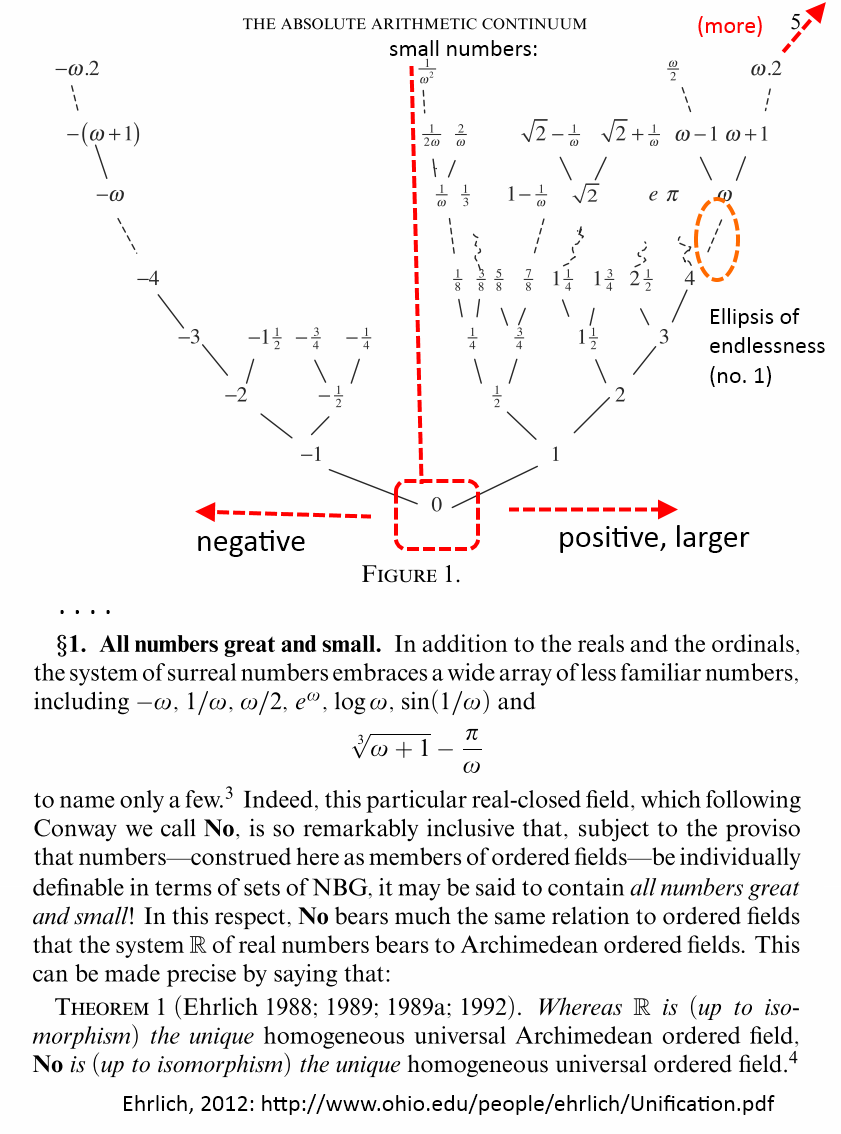
unity

Where also, this continuum result is useful:
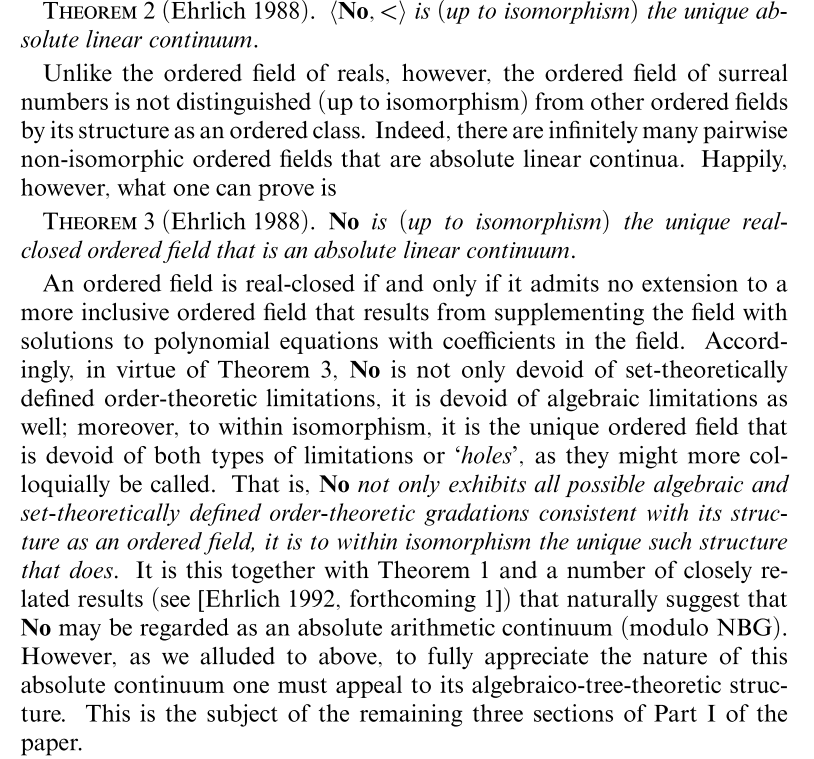
unified_continuum

PPS: As a blue vs pink punched paper tape example is used below, cf the real world machines
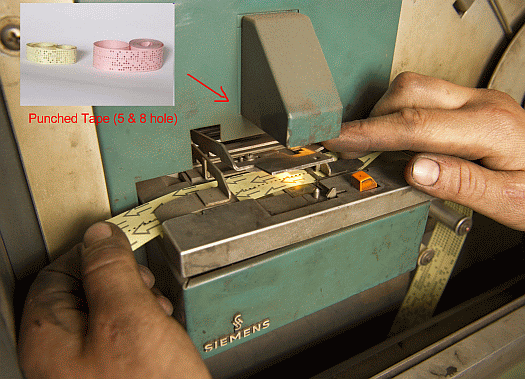
Punched paper Tape, as used in older computers and numerically controlled machine tools (Courtesy Wiki & Siemens)

and the abstraction for mathematical operations:
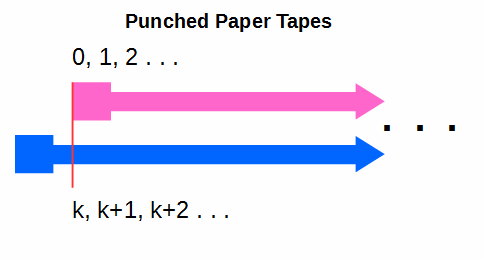
punchtapes_1-1

Note as well a Turing Machine physical model:
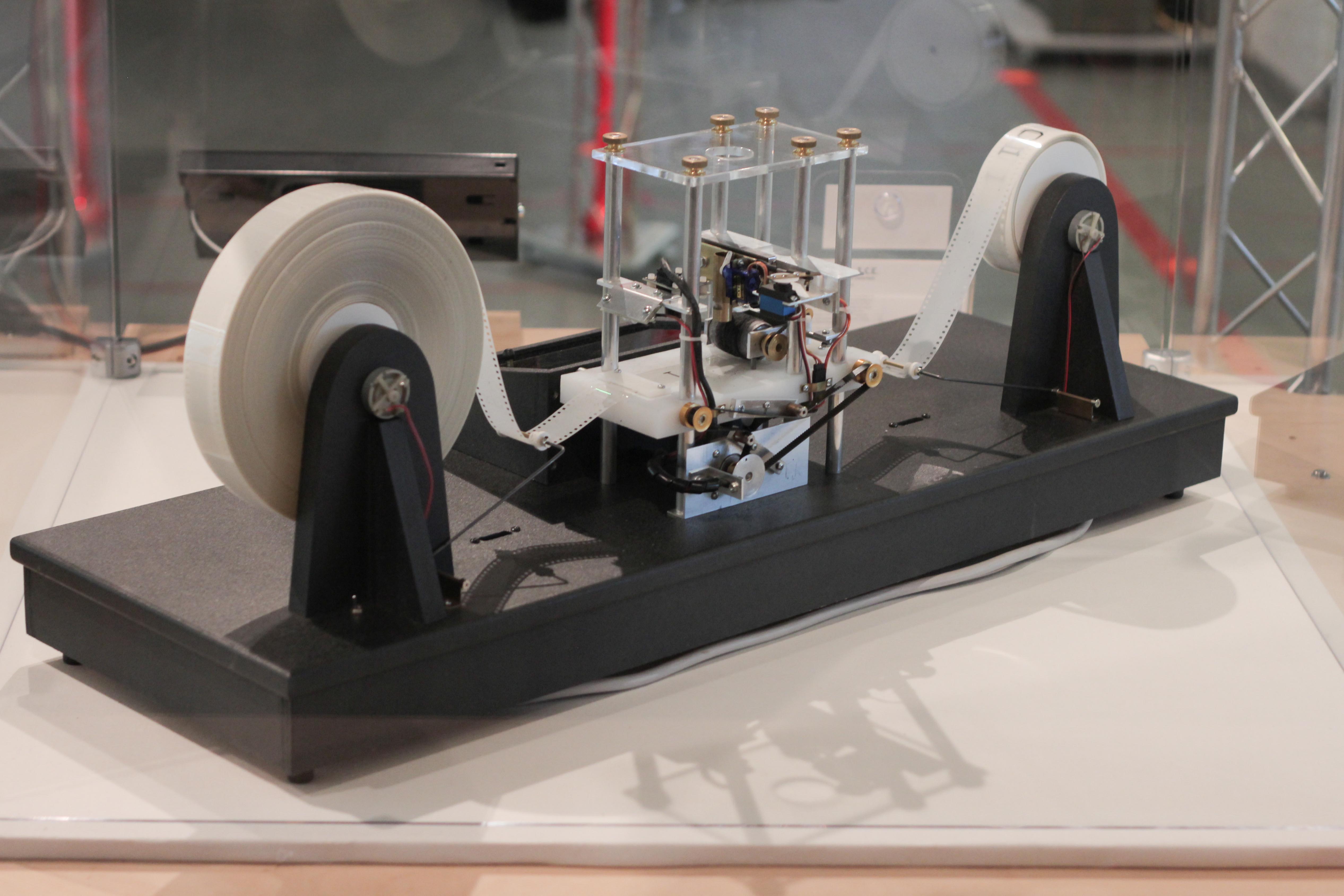
Turing_Machine_Model_Davey_2012

and its abstracted operational form for Mathematical analysis:
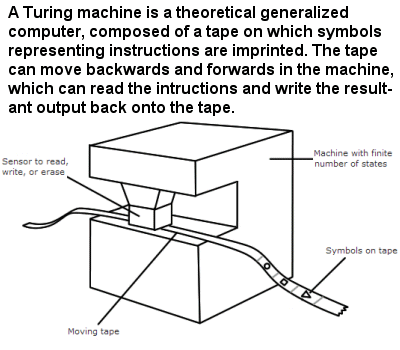
turing_machine

F/N: HT BA77, let us try to embed a video: XXXX nope, fails XXXX so instead let us instead link the vid page.

Comments
KF,
It comes to a point that if after that degree of emphasis has been put up, inquisitorial yes/no answers are repeatedly demanded, that is a sign that something is very wrong. And not with what I have said.
When Aleta and I ask for yes/no answers, that's exactly what we mean. We would like you to literally type "Y-E-S" or "N-O" in your reply, because we have such a hard time figuring out what you are saying. At this point, I'm still not clear what your position is. If you would actually answer yes or no, then it would save us a lot of guesswork.daveS
February 15, 2016
February
02
Feb
15
15
2016
02:40 PM
2
02
40
PM
PDT
Aleta,
I’m sorry to have to interrupted Dave’s conversation with you (sorry, Dave), but it is not clear what your answer is because of all the confusion about what you think endless and infinite mean.
No problem at all!daveS
February 15, 2016
February
02
Feb
15
15
2016
02:34 PM
2
02
34
PM
PDT
"Inquisitorial yes/no" questions!? OK, here is what I think your answer is. There are no cells (numbers) which are infinitely far from the end of the tape (that is infinitely far from zero). Infinite means "beyond any even arbitrarily large but finite value". No matter how long the tape runs (no matter how far we count), we will never be infinitely far from zero. We will always be a finite distance from zero. I would agree with both of those propositions. Have I stated them in a way that you could agree with? If we knew we agreed with each other on this, then maybe it would clear up some confusion.Aleta
February 15, 2016
February
02
Feb
15
15
2016
02:28 PM
2
02
28
PM
PDT
KF,
See where oh the set is infinite but every number in it is only finitely large becomes of significant concern?
Erm, no, I don't understand the concern, tbh.
Indeed, meaning 3c above exploits that, as the reason a certain proper subset can be matched 1:1 with the original transfinite set is that both are endless. And with the punched tape illustration, every successive row is a standard 0.1 inches further along. So endless values in succession implies endless distance, giving punch to the meaning. If it is not REALLY that, go get your own words, infinite is already occupied.
But it is. It's trivial to see that the cells in the infinite tape can be put into 1-1 correspondence with a proper subset of its cells. We've already been over that. Associate each cell to its neighbor on its right (for the tape in the picture). I have yet to see a yes-no answer to my question. My best guess is that now you are saying that the thing I've been calling an "infinite Turing Machine tape" is not actually infinite??daveS
February 15, 2016
February
02
Feb
15
15
2016
02:27 PM
2
02
27
PM
PDT
Aleta (attn HRUN), I have been crystal clear and consistent, from laid out sequences of ordinals to dictionaries to concrete examples and on to asking pointed questions in that light. If infinite does not mean "endlessly beyond any even arbitrarily large but finite value or things tantamount to that," then it has been turned into a synonym for finite. It comes to a point that if after that degree of emphasis has been put up, inquisitorial yes/no answers are repeatedly demanded, that is a sign that something is very wrong. And not with what I have said. Where, it is precisely because the infinite as far as I can reasonably gather means as I have again summarised, that I find something jarring in the claim that per induction the set of naturals has only finite members in it although the set as a whole is transfinite in cardinality. Let me add: In terms of the punch tape example, if the endless extension of the tape does NOT have in it rows that are endlessly far from the originating end, something is wrong. So far, that we can take away any arbitrarily large but finite initial range from the tape and it would still be endless beyond. In that context I have repeatedly pointed to the importance of the ellipsis of endlessness, and have further noted that the EoE is in the LHS of the assignment of ordinal value: {0, 1, 2 . . . } --> w. (I have even gone so far as to examine the difference between unlimited extension of a chain of inferences per implication from case k to case k +1 in steps from an initial value and spanning the endless. In effect, there seems to be an often unstated but implicit sub axiom of spanning the endless through pointing onwards from a potentially transfinite chain, that is doing a lot of work and carrying a heavy load.) KFkairosfocus
February 15, 2016
February
02
Feb
15
15
2016
02:21 PM
2
02
21
PM
PDT
So your answer is "Yes"??? Or is it "No" Please, answering the question with a paragraph with lots of rhetorical questions isn't useful. Just answer, with one word, Yes or No. Are you asserting that the infinite Turing Machine tape pictured here has cells which are infinitely far from the end?Aleta
February 15, 2016
February
02
Feb
15
15
2016
01:50 PM
1
01
50
PM
PDT
Must. Not. Ever. Answer. Simple. Question!hrun0815
February 15, 2016
February
02
Feb
15
15
2016
01:42 PM
1
01
42
PM
PDT
Aleta, I have actually gone back to ensure that the opposite is clearly intended. Let me put the just adjusted up again:
if infinite does not mean endlessly remote beyond any finite but arbitrarily large value, what does it mean? And, if it does not mean that any actually finite value is not endlessly remote beyond any arbitrarily large finite value — here at 0.1 inch per row, what does it mean? Where, too, if it does not mean that one may repeatedly — an arbitrary number of times, even with an endless loop algorithm — pull in any arbitrarily large but finite range (I picked 10^150 and its square to draw out the point) endlessly but have no effect on the remaining endlessness, what does it mean?
If your conception of the infinite is so radically diverse, why use the same terms? KF PS: I add that this includes that if one claims an infinite past of the observed cosmos and its physical predecessors, then one claims a past that is endlessly remote and spanning beyond any arbitrarily large but finite time of the past, e.g. 10^150 s or its square or its square of 10^300 s taken any number of times in succession without scratching the surface of the endlessness, etc.kairosfocus
February 15, 2016
February
02
Feb
15
15
2016
01:39 PM
1
01
39
PM
PDT
Then your answer is No: there are no cells which are infinitely far from the end. Is this correct?Aleta
February 15, 2016
February
02
Feb
15
15
2016
01:26 PM
1
01
26
PM
PDT
Aleta, if infinite does not mean endlessly remote beyond any finite but arbitrarily large value, what does it mean? And, if it does not mean that any actually finite value is not endlessly remote beyond any arbitrarily large finite value -- here at 0.1 inch per row, what does it mean? Where, too, if it does not mean that one may repeatedly -- an arbitrary number of times, even with an endless loop algorithm -- pull in any arbitrarily large but finite range (I picked 10^150 and its square to draw out the point) endlessly but have no effect on the remaining endlessness, what does it mean? KFkairosfocus
February 15, 2016
February
02
Feb
15
15
2016
01:20 PM
1
01
20
PM
PDT
No, you haven't "given and emphatically underscored" an answer. You've repeated your concerns, but I can't tell whether your answer is yes or no. I'm sorry to have to interrupted Dave's conversation with you (sorry, Dave), but it is not clear what your answer is because of all the confusion about what you think endless and infinite mean. So Dave's question is trying to get to some specifics that clarify the concepts: Are you asserting that the infinite Turing Machine tape pictured here has cells which are infinitely far from the end? Yes or NoAleta
February 15, 2016
February
02
Feb
15
15
2016
01:05 PM
1
01
05
PM
PDT
Aleta, already given and emphatically underscored. If not actually infinitely -- endlessly -- remote in the far left zone, then finite and not infinite. With the tape going at 0.1 inch per row leftwards. Hence, my conceptual concerns. KFkairosfocus
February 15, 2016
February
02
Feb
15
15
2016
12:47 PM
12
12
47
PM
PDT
We know all this. What is your answer to dave's question?Aleta
February 15, 2016
February
02
Feb
15
15
2016
12:39 PM
12
12
39
PM
PDT
F/N: Collins ED is even better:
infinite (??nf?n?t) adj 1. a. having no limits or boundaries in time, space, extent, or magnitude b. (as noun; preceded by the): the infinite. 2. extremely or immeasurably great or numerous: infinite wealth. 3. all-embracing, absolute, or total: God's infinite wisdom. 4. (Mathematics) maths a. having an unlimited number of digits, factors, terms, members, etc: an infinite series. b. (of a set) able to be put in a one-to-one correspondence with part of itself c. (of an integral) having infinity as one or both limits of integration. Compare finite2
KFkairosfocus
February 15, 2016
February
02
Feb
15
15
2016
12:24 PM
12
12
24
PM
PDT
DS: AmHD:
in·fi·nite (?n?f?-n?t) adj. 1. Having no boundaries or limits; impossible to measure or calculate. See Synonyms at incalculable. 2. Immeasurably great or large; boundless: infinite patience; a discovery of infinite importance. 3. Mathematics a. Existing beyond or being greater than any arbitrarily large value. b. Unlimited in spatial extent: a line of infinite length. c. Of or relating to a set capable of being put into one-to-one correspondence with a proper subset of itself.
If it is not endless it is not infinite. If the far zone is such that every row of holes is finitely many times 0.1 inch away, it is not infinite. Begin to see where some of my concerns lie? See where oh the set is infinite but every number in it is only finitely large becomes of significant concern? See where issues of concept arise? Infinite implies boundless, beyond ending, not finite. Indeed, meaning 3c above exploits that, as the reason a certain proper subset can be matched 1:1 with the original transfinite set is that both are endless. And with the punched tape illustration, every successive row is a standard 0.1 inches further along. So endless values in succession implies endless distance, giving punch to the meaning. If it is not REALLY that, go get your own words, infinite is already occupied. KF PS: For meaning 3c, try starting the count over from k = 10^150, recognising that this is simply a finite subset capable of being put into 1:1 correspondence with the original set. Think, a pink and a blue tape, only you pull in the blue 10^150 holes (~10^144 miles) and then match it against the pink tape's 0 end. Endlessness is endlessness, it makes no difference. PPS: After you do that, pull in to the 10^300th hole, 10^150 times the first distance . . . use the first pull as a yardstick and do it 10^150 times over. Then put the blue tape in match with the pink -- conveniently, holes can be optically lined up. There is still no difference. PPPS: Do it over and over again with no end (use an endless loop algorithm), no difference. Endlessness is endlessness. P^4S: the observed cosmos is about 5 * 10^23 mi across.kairosfocus
February 15, 2016
February
02
Feb
15
15
2016
11:32 AM
11
11
32
AM
PDT
Gotta run now, but is that a "yes"?daveS
February 15, 2016
February
02
Feb
15
15
2016
10:49 AM
10
10
49
AM
PDT
DS, endlessness is endlessness, it cannot be finite. There is no LH end and the remote zone is infinitely far away, with endless holes 0.1 inch apart all the way. KFkairosfocus
February 15, 2016
February
02
Feb
15
15
2016
10:47 AM
10
10
47
AM
PDT
KF, I guess you're talking about an infinite Turing Machine tape with an end on the right but no end on the left? Like in the picture, but with directions reversed? If so, that's what I have in mind. [Edit: To be clear, my tape consists of just a single row of cells.] My question (for the third time) is:
Ok let’s be very clear. Are you asserting that the infinite Turing Machine tape pictured here has cells which are infinitely far from the end? This is a yes/no question.
daveS
February 15, 2016
February
02
Feb
15
15
2016
10:28 AM
10
10
28
AM
PDT
DS: Okie, let us compare, showing end to RHS and endlessness to LHS: Counting No's N: . . . EoE . . . k+1, k, . . . 2, 1, 0 Tape Rows: T: . . . EoE . . . R_k+1, R_k, . . . R_2, R_1, R_0 All at 0.1 inch pitch, per standard. The relevant part in both cases is. . . . EoE . . . Endlessness to LHS means for the tape unending rows at 0.1 in pitch. Set k = 10^150 and it would be 1.58*10^144 miles from the start with no end of onward rows to come, indeed, you could start the count from k (just use the subscripts) and it would make no difference to what is to the L. An actual infinite tape would have to be endless to the L, and an actual endless timeline of causal events and entities would be the same, only in time. KFkairosfocus
February 15, 2016
February
02
Feb
15
15
2016
10:16 AM
10
10
16
AM
PDT
KF, By an infinite Turing Machine tape, I mean one in which the cells are in 1-1 correspondence with the set of natural numbers. In the picture I linked to, the leftmost cell is cell 0, the first one to its right is cell 1. Cell n is n steps to the right from cell 0, for any natural n. I don't know what you mean by "remote zone" here, but I will say that if you took two of these tapes and cut off the first 10^150 cells of one of them, they would remain indistinguishable (assuming no symbols had been written in the cells). And obviously I can't draw a picture of the entire tape. Nevertheless, we have been talking about an infinite Hilbert Hotel without any pictures. So again, are there any cells in this tape infinitely many steps from cell 0? Edit:
The tape, so far as I can understand, must be endless to be infinite. KF
Well, in the picture, there is no right-hand end to the tape. Each cell has an adjacent neighbor to its right.daveS
February 15, 2016
February
02
Feb
15
15
2016
09:09 AM
9
09
09
AM
PDT
DS, you tell me what infinity means to you, please. Then, let us see an actual picture or drawing without ellipses or open ended lines or perspectival tapering to a point at the horizon or other vanishing point, of what an actual 0.1 inch pitch 8-wide paper tape would look like. Row 10^150 would be 10^149 inches off or 1.58*10^144 miles from the start with no end of onward rows to come -- row k here would be formally equivalently far from the remote zone as row 0. The tape, so far as I can understand, must be endless to be infinite. KFkairosfocus
February 15, 2016
February
02
Feb
15
15
2016
08:59 AM
8
08
59
AM
PDT
KF,
In rejecting that by claiming every past point is finitely remote, that is tantamount to a finite past. If every “milestone marker” to the left — pastwards direction — is finitely remote the total increment of necessity will be finite. KF PS: Same, for a paper tape
Ok let's be very clear. Are you asserting that the infinite Turing Machine tape pictured here has cells which are infinitely far from the end? This is a yes/no question.daveS
February 15, 2016
February
02
Feb
15
15
2016
07:34 AM
7
07
34
AM
PDT
Aleta & DS, Don't you see that you agree with me by implication? Take the model: // . . . H:k+1, k, . . . 2, 1, 0. At every finitely remote k + 1, k, the H shows that was once the present. But the subscripts allow us to lop off the tail and go: // . . . H:k+1, k | Obviously this is formally equivalent to (using primes for the new onward k's): // . . . k'+1, k', . . . 2, H:1, 0 | which is just as remote from any infinite past to the left beyond the "break" marks. The claim of an infinite past looks to be meaningless, it is reducing to claims of a finite past (of whatever extent) but with an endlessness tacked on that cannot be represented or accepted. If there were an infinite causal, temporal past succession of events and entities, the past would have to stretch off leftwards like the negative x axis with an arrow pointing to infinity in the past or off to the left. In rejecting that by claiming every past point is finitely remote, that is tantamount to a finite past. If every "milestone marker" to the left -- pastwards direction -- is finitely remote the total increment of necessity will be finite. KF PS: Same, for a paper tapekairosfocus
February 15, 2016
February
02
Feb
15
15
2016
07:26 AM
7
07
26
AM
PDT
KF,
DS, Let us look at two managers, one who starts at the far zone of the hotel infinity and inspects rooms, one from the near zone. Both set out at one room per second and have to inspect all rooms. Will either ever complete, why? KF
Aleta is right, there is no such "far zone". Also, the manager we have been talking about, who is just finishing the tour now, never "set out". If you had simply asked whether a second manager, starting now at the front desk and working backward would ever finish, the answer is no. But again, the situation is not symmetric; one manager began at a specific point, the other one was on a beginningless tour. Now, can you answer my simple yes/no question: Are any cells on the infinite Turing Machine Tape infinitely far from the end? You can explain all you want, but I'm requesting that you first respond with either "Yes" or "No".daveS
February 15, 2016
February
02
Feb
15
15
2016
07:05 AM
7
07
05
AM
PDT
You can't start in the "far zone". There is no "place" at negative infinity to start. You can inductively move towards infinity, so to speak (an informal way of saying going on endlessly), but you can't move from infinity back to zero. It makes no sense to speak of "starting in the far zone." If you want to start someplace a long ways before zero, you still have to start at some finite number. So, meaningless question.Aleta
February 15, 2016
February
02
Feb
15
15
2016
06:38 AM
6
06
38
AM
PDT
DS, Let us look at two managers, one who starts at the far zone of the hotel infinity and inspects rooms, one from the near zone. Both set out at one room per second and have to inspect all rooms. Will either ever complete, why? KF PS: I add, an endless paper tape has rows of dots, as follows: r0, r1, r2 . . . . EoE . . . Whichever way you pass it through a read/write head -- say it is the way clean/dirty rooms are recorded -- it is the same, and to have been going from the infinite past and have reached a finitely remote k from 0 is like: . . . EoE . . . H:k+1, k, . . . 2, 1, 0. But to get to k, first you have to do: . . . EoE . . . H:p+1, p, . . . EoE . . . k+1, k, . . . 2, 1, 0 You cannot traverse either of the two EoEs in steps. PPS: Any 0, k, or p will be infinitely far from the far zone of the tape, which is endless. And p will be transfinitely remote from both the far zone and the 0 end. In short you cannot have your cake and eat it. My point is, no transfinitely long tape or tape r/w process proceeding in steps will be actualisable. A tape may loop in a finite span or run finitely in a line but it will not be open ended and transfinite. Or, loop and be transfinite. PPPS: Let me symbolise a transfinite loop, the :0* being plugged into the ^0 to loop. ^0 . . . EoE . . . H:k+1, k, . . . 2, 1, 0*kairosfocus
February 15, 2016
February
02
Feb
15
15
2016
06:32 AM
6
06
32
AM
PDT
KF, An infinite Turing Machine tape with a single end is a good model for the HH, with each cell representing a single room, and the "last" cell representing the front desk. Given such a tape, how many cells are infinitely many steps from the last cell? None, right? Edit: Here's a picture. I am thinking of the tape oriented in the opposite direction so that the last cell is on the right (so the manager moves from left to right), but of course that makes no essential difference. Which cell is infinitely far from the end?daveS
February 15, 2016
February
02
Feb
15
15
2016
06:04 AM
6
06
04
AM
PDT
KF, I'm going to insist on no rephrasings here. If you have a critique, please use the same language I am using. What I'm saying is that the manager completes a tour of the HH presently, according to the schedule I laid out. The process is beginningless, it is true. Edit:
Where if infinite past means anything at all, it means that at some point in the causal succession there was an endless span of steps to be bridged to reach here.
No, that's not what I understand it to mean. We've been over this repeatedly, but the manager was never more than finitely many rooms away from the front desk.daveS
February 15, 2016
February
02
Feb
15
15
2016
05:55 AM
5
05
55
AM
PDT
DS, And so you are trying to span the endless in steps from the suggested infinite past. But, you do not even have a first step, just a claimed forever continuation. Where if infinite past means anything at all, it means that at some point in the causal succession there was an endless span of steps to be bridged to reach here. This is a contradiction in terms and in concept as well as a failure of the sequence to span in steps. If we cannot ascend to the endless and the transfinite, apply the mirror reflection, we cannot descend from it either. And in HGHI, the manager cannot inspect the rooms in toto in steps for the same reason. KFkairosfocus
February 15, 2016
February
02
Feb
15
15
2016
05:50 AM
5
05
50
AM
PDT
kf, we agree: "No step by step unlimited process can exhaust the endless", given that is what "endless" means. Going on endlessly doesn't "span" anything - it just goes on and on and on ..."Aleta
February 15, 2016
February
02
Feb
15
15
2016
05:47 AM
5
05
47
AM
PDT
1 36 37 38 39 40 48

Leave a Reply