Uncommon Descent Serving The Intelligent Design Community
Author

niwrad

Sequences Probability Calculator

You can find here an utility to calculate the probabilities of random sequences of symbols. It tries to answer questions like this: “a random process generating sequences of length L from an alphabet of S symbols in T trials of t seconds each, involving c chemical reactions, does exceed the resources of the universe (age, max number of chemical reactions, universal probability bound)?”. The user interface is meant to be self-explanatory. The “Demo” button has the function to preset an example of input values. After the “Demo” you can eventually change some or all inputs and click the “Calculate” button to obtain your new output results. Otherwise if you want to start from entirely different inputs you may click the Read More ›
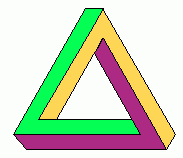
The superiority of the designer compared to his design

According to Richard Dawkins, Intelligent Design does not explain complexity because the designer must be even more complex than the design. In my opinion, it is like to claim that the car industry doesn’t explain cars because the mechanical engineers are more complex than cars. Dawkins says that because has a priori commitment to reductionism/evolutionism, according to which the explanation/cause must always be simpler than the data/effects. What for Dawkins is a supposed “defect” of ID, for me — who haven’t such commitment — is a great merit. Specifically it is a value of coherence with self-evident principles, first of all, the intuitive principle that more cannot come from less. However Dawkins offers us the opportunity of asking some interesting Read More ›

On the Impossibility of Abiogenesis

Modern science takes for granted that the naturalistic origin of life, called “abiogenesis” or “chemical evolution” or “pre-biotic evolution” is extremely improbable but not impossible. “Life” here means a single self-reproducing and self-sustaining biological cell. Science claims that life can arise from inorganic matter through natural processes. This unsupported claim is based on the conviction that all arrangements of atoms are possible and life is considered merely one such arrangement. In what follows I try to explain that such a believe is unfounded because abiogenesis is impossible in principle. My argument, expressed in its simplest form, has two main steps: (1) to show that a computer cannot be generated naturalistically; (2) to show that biological systems contain computers. From #1 and #2 I will argue the impossibility of abiogenesis. Read More ›

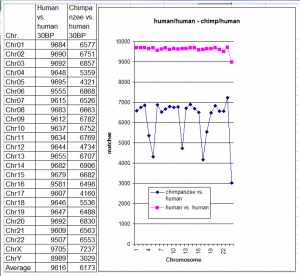
graph

A statistical comparison of two human genomes

In a previous post I provided a statistical test to compare chimpanzee and human genomes. As you can read there, the post generated a very interesting discussion among the readers, and it seemed to me that the general feeling at the end was that my statistical method for performing genome-wide comparisons might have some merit, after all.

One reader suggested applying an identical test in order to compare two human genomes. That sounded like a very good idea to me, so I downloaded another human genome dataset from NCBI and performed a test.

Read More ›

t

A simple statistical test for the alleged “99% genetic identity” between humans and chimps


Typical figures published in the scientific literature for the percentage similarities between the genomes of human beings (Homo sapiens) and chimpanzees (Pan troglodytes) range from 95% to 99%. However, in press releases intended for popular consumption, evolutionary biologists frequently claim that human and chimpanzee genomes are 99% identical. Skeptics of neo-Darwinian evolution have repeatedly punctured this”99% myth,” but unfortunately, it seems to have gained widespread credence, due to its being continually propagated by evolutionists! For instance, one often encounters statements like these in the literature:

“Because the chimpanzee lies at such a short evolutionary distance with respect to human, nearly all of the bases are identical by descent and sequences can be readily aligned” (The Chimpanzee Sequencing and Analysis Consortium, Initial sequence of the chimpanzee genome and comparison with the human genome, Vol. 437/1 September 2005/doi:10.1038/nature04072).

“The consortium [National Human Genome Research Institute] found that the chimp and human genomes are very similar and encode very similar proteins. The DNA sequence that can be directly compared between the two genomes is almost 99 percent identical.” (here.)

“The genetic codes of chimps and humans are 99 percent identical.” (here)

Read More ›
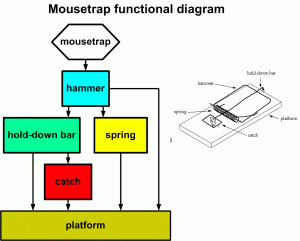
functional_mousetrap

Functional Hierarchy

tetraktys1In a comment attached to a previous post of mine (Darwinism from an informatics point of view) I wrote that “to create functioning hierarchical decision logic is a vertical job that only intelligence can do”. In that post, I provided some reasons why it is impossible for a blind evolutionary process to create new instructions. There are of course many additional reasons, over and above those I listed in my post. One of the most important of these is based on the general concept of a functional hierarchy (FH), which is what I intend to blog about today. This post can be considered as a sequel to my previous post on informatics. Read More ›
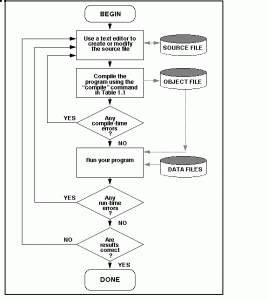
progflow

Darwinism from an informatics point of view

progflowAs everyone knows, life in all its countless instances (organisms) involves internal instructions, as well as processors that run them. Without these instructions, no organism would be able to originate in the first place, let alone develop or survive. The discovery of these instructions – contained in DNA/RNA macromolecules and the molecular machinery that reads and writes them in biological cells – has been hailed as one of the greatest theoretical and experimental breakthroughs of the 20th century. The ID movement claims that these scientific findings have only served to highlight the weaknesses and inconsistencies of the neo-Darwinian theory of macro-evolution, according to which all species have evolved from a common ancestor, as a result of random mutation and natural selection. Read More ›

The “Designer-of-the-universe-is-not-God” error


Some people who are impressed by the arguments of the intelligent design movement will finally admit that an intelligent designer may have created the universe. However, they simply refuse to believe that this designer could have been God. Although the question of the Designer’s identity goes beyond Intelligent Design theory, and belongs to the domain of metaphysics and theology, it may be worth considering why their position is fundamentally inconsistent.

Read More ›

Self-organized Criticality

Many conceptual and experimental attempts have been made by evolutionists to explain the arise of the huge complexity and organization of nature based on unguided processes, that is without the intervention of an organizing intelligence. Among them I recall those related to chaos theory, evolutionary algorithms, emergent properties, far-from-equilibrium dynamical systems, self-organized criticality (SOC). Here I will briefly focus on SOC, the last on this list though not the recent one.

Read More ›

Thomism and Intelligent Design

Given the frequent criticisms against ID by some neo-Thomists it may be useful to consider here briefly the problem of compatibility between Thomism and ID (or at least what ID is in my view). To analyze some of the neo-Thomists’ critiques I will examine for example the recent article “Intelligent Design and Me”, part I/II, by Francis Beckwith at the Darwinist Biologos site (here and here). Read More ›

Formulas and Forms

In modern mathematics fractals are complex objects generated from simple formulas. Some have found also in biology forms that seem to have fractal shapes. Before the astonishing geometric shapes of fractals one might argue something like this: as the complexity of the fractal geometries arises from simple formulas, analogously the fractal biological complexity could come from simplicity and as a consequence intelligent design is not necessary to explain it.

Read More ›

What is Intelligence?

In a previous UD discussion I started about incompleteness I made the following affirmation: intelligence and life are not computable. A commenter kindly asked me to provide justifications for my claim. Since at UD usually I try to separate different topics in different discussions, to be more focused and reader-friendly as possible, so here is my answer in a dedicated thread. My answer unavoidably implies to investigate first what intelligence is then what life is (given the latter is an effect and the former is its cause). Read More ›

The bionic antinomy of Darwinism

Do you remember when I said “when a thing is untrue, if we say it is true we get contradictions” (The Darwinism contradiction of repair systems)? Here I will deal with another contradiction of Darwinism: that we could name its “bionic antinomy”.

According to Wikipedia “Bionics (also known as biomimetics, bio-inspiration, biognosis, biomimicry, or bionical creativity engineering) is the application of biological methods and systems found in nature to the study and design of engineering systems and modern technology.” In fact, whether we analyze the history of technology, we find how often technical innovations and systems take inspiration from natural models. For some of the more recent examples of biomimetics see The 15 Coolest Cases of Biomimicry. This article synthetically defines bionics as “biologically inspired engineering”. Read More ›

The cause of incompleteness

In a previous post I promised to start at UD a discussion about the incompleteness of physics from an ID point of view. Here is the startup article.

At Aristotle’s time “physics” was the study of nature as a whole. In modern times physics seems to have a more specific meaning and is only one field among others that study nature. Nevertheless physicists (especially materialist ones) claim that physics can (or should) explain all reality. This claim is based on the gratuitous assumption that all macroscopic realities can be deduced entirely from their microscopic elements or states. Also if this assumption were true there would be the problem to understand where those fundamental objects or states came from in the first place. Many physicists even think about a “Theory of Everything” (ToE), able to explain all nature, from its lower aspects to its higher ones. If a ToE really existed a system of equations would be able to model every object and calculate every event in the cosmos, from atomic particles to intelligence. The question that many ask is: can a ToE exist in principle? If the answer is positive we could consider the cosmos as a giant system, which evolution is computable. If the answer is negative this would mean that there is a fundamental incompleteness in physics, and the cosmos cannot be considered a computable system. An additional question is: what are the relations between the above problem and ID? Read More ›

Potentiality and emergence

An UD author in a previous post asked: “would ID proponents see ID as part of emergence or as an alternative to emergence?”. I would answer: ID is not an alternative to emergence, rather the only thing that can explain emergence when it implies complex specified information (CSI), because CSI properties cannot emerge without intelligent front-loading. Here are the reasons of my answer.

“Emergence” is a key term often used in the fields of complex systems and complexity theory. Wikipedia defines it so:

“An emergent property of a system is one that is not a property of any component of that system, but is still a feature of the system as a whole.” Read More ›