Uncommon Descent Serving The Intelligent Design Community

Logic & First Principles, 14: Are beauty, truth, knowledge, goodness and justice merely matters of subjective opinions? (Preliminary thoughts.)

Categories
Culture
Logic and Reason
Share
Facebook
Twitter/X
LinkedIn
Flipboard
Print
Email

We live in a Kant-haunted age, where the “ugly gulch” between our inner world of appearances and judgements and the world of things in themselves is often seen as unbridgeable. Of course, there are many other streams of thought that lead to widespread relativism and subjectivism, but the ugly gulch concept is in some ways emblematic. Such trends influence many commonly encountered views, most notably our tendency to hold that being a matter of taste, beauty lies solely in the eye of the beholder.

And yet, we find the world-famous bust of Nefertiti:
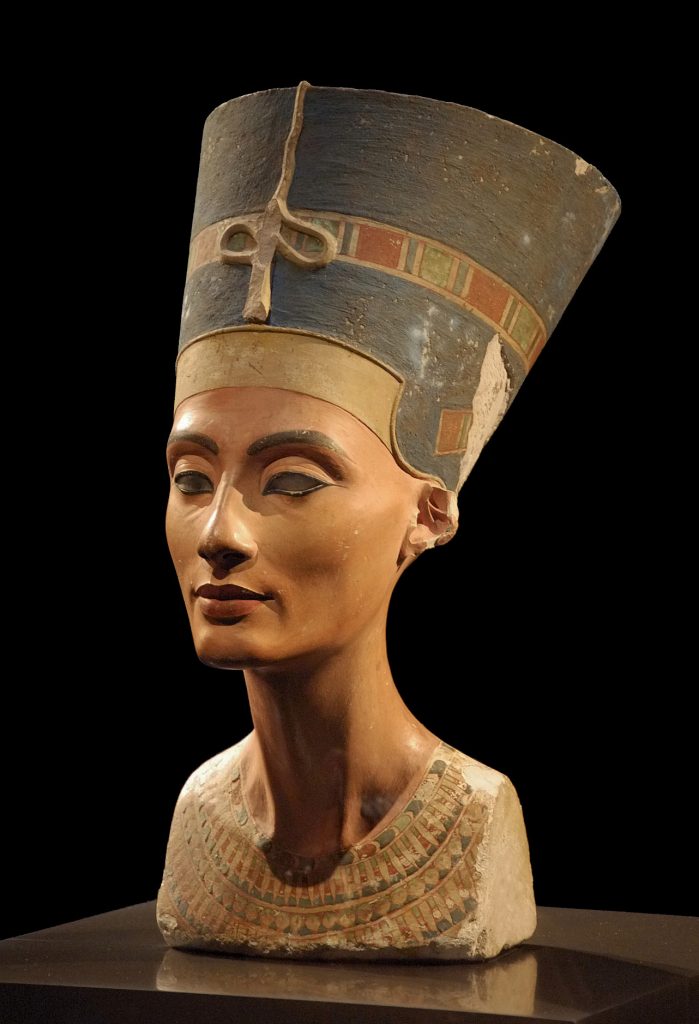
The famous bust of Nefertiti, found in Thutmose’s workshop (notice, how subtle smiles will play a role in portraits of beautiful women)

Compare, 3400 years later; notice the symmetry and focal power of key features for Guinean model, Sira Kante :


Sira Kante

And then, ponder the highly formal architecture of the Taj Mahal:
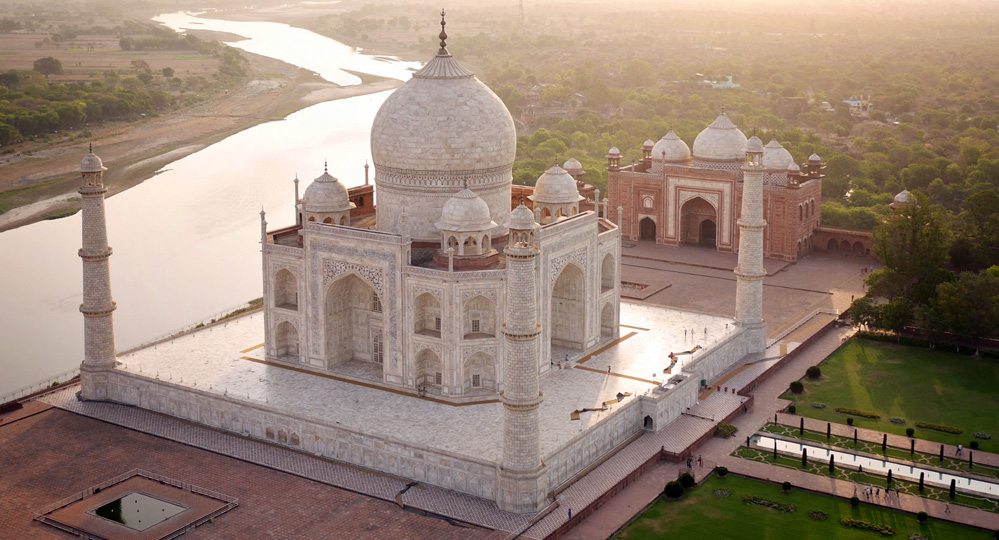
The Taj Mahal

ADDED: To help drive home the point, here is a collage of current architectural eyesores:
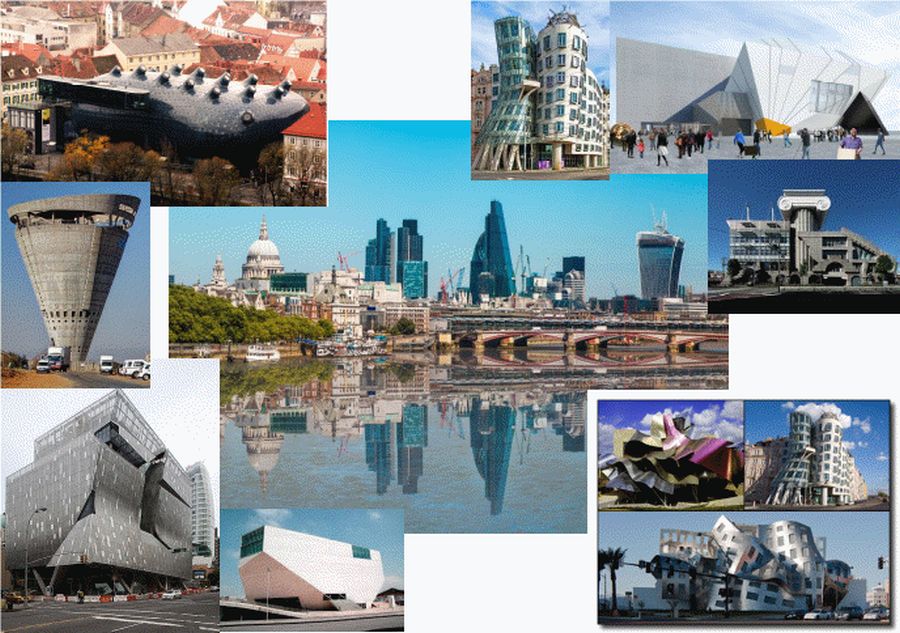
Current Eyesores

Added, Mar 23 — Vernal Equinox: The oddly shaped building on London’s skyline is called “Walkie-Talkie” and due to its curved surface creates a heating hazard at the height of summer on a nearby street — yet another aspect of sound design that was overlooked (this one, ethical):

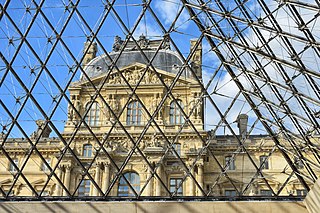
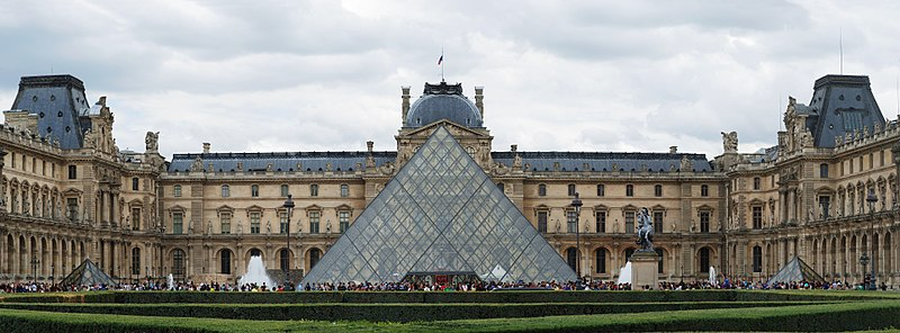
Louvre as seen from inside the Pei pyramid

Since it has come up I add the Louvre’s recent addition of a Pyramid (which apparently echoes a similar temporary monument placed there c. 1839 to honour the dead in an 1830 uprising). Notice, below, how symmetric it is in the context of the museum; where triangular elements are a longstanding part of the design as may be seen from the structure below the central dome and above many windows. Observe the balance between overall framework and detailed elements that relieve the boredom of large, flat blank walls. Historically, also, as Notre Dame’s South Rose Window so aptly illustrates, windows and light have been part of the design and function of French architecture. Notice, how it fits the symmetry and is not overwhelmingly large, though of course those who objected that it is not simply aligned with the classical design of the building have a point:
Yet again, the similarly strongly patterned South Rose Window at Notre Dame (with its obvious focal point, as well as how the many portraits give delightful detail and variety amidst the symmetry) :
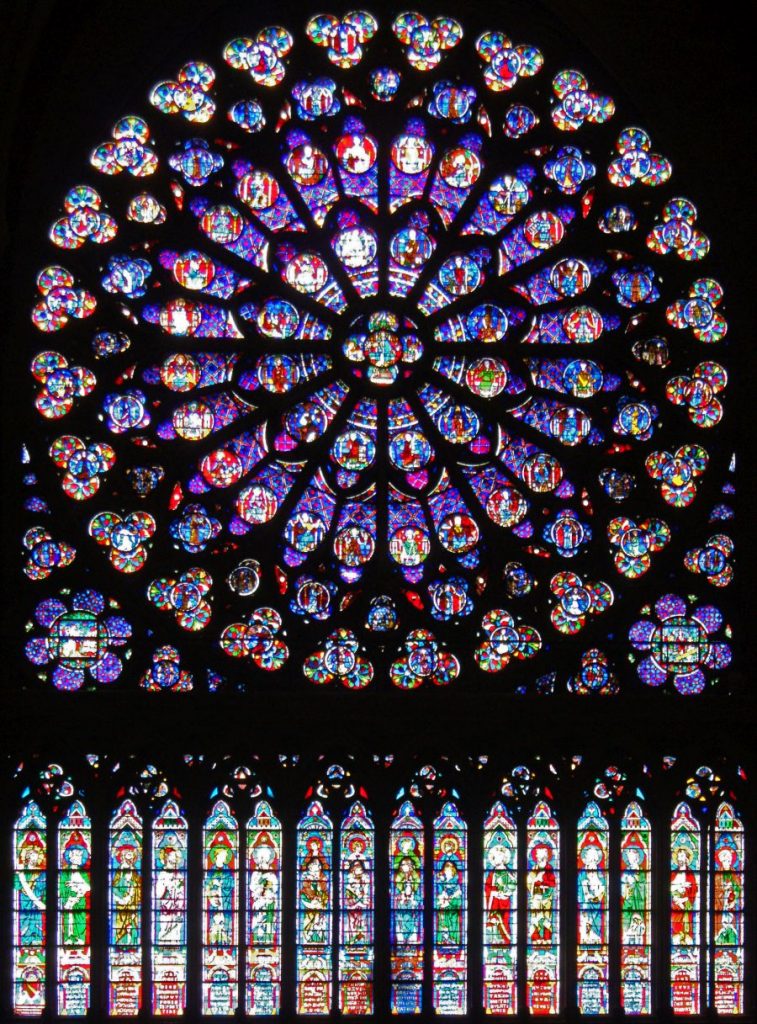
Notre Dame, South Rose Window

Compare, patterning, variety and focus with subtle asymmetry in part of “Seahorse Valley” for the Mandelbrot set:
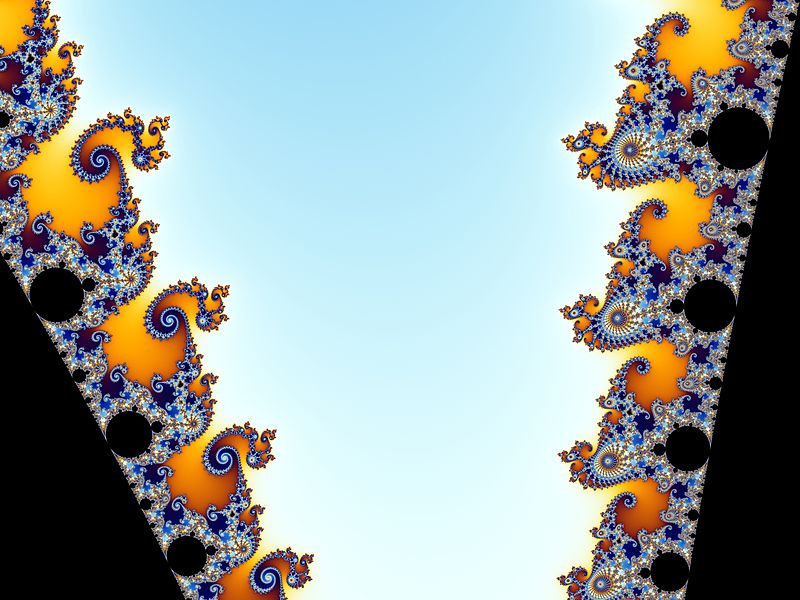
Seahorse Valley zoom, Mandelbrot set

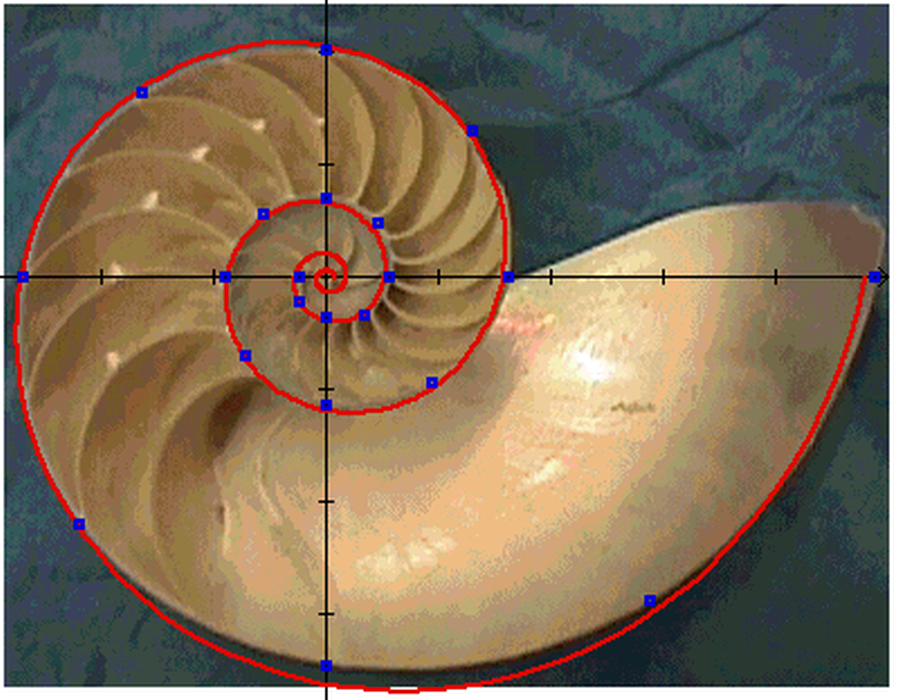
I add, let us pause to see the power of spirals as a pattern, tying in the Fibonacci sequence and thus also the Golden Ratio, Phi, 1.618 . . . (where concentric circles as in the Rose Window, have much of the same almost hypnotic effect and where we see spirals in the seahorse valley also):
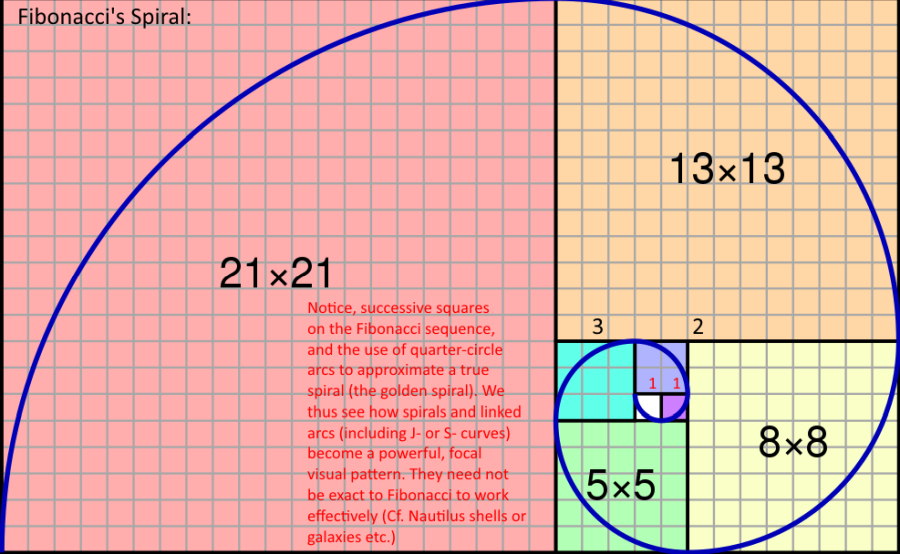
Here, let us observe a least squares fit logarithmic spiral superposed on a cut Nautilus shell:
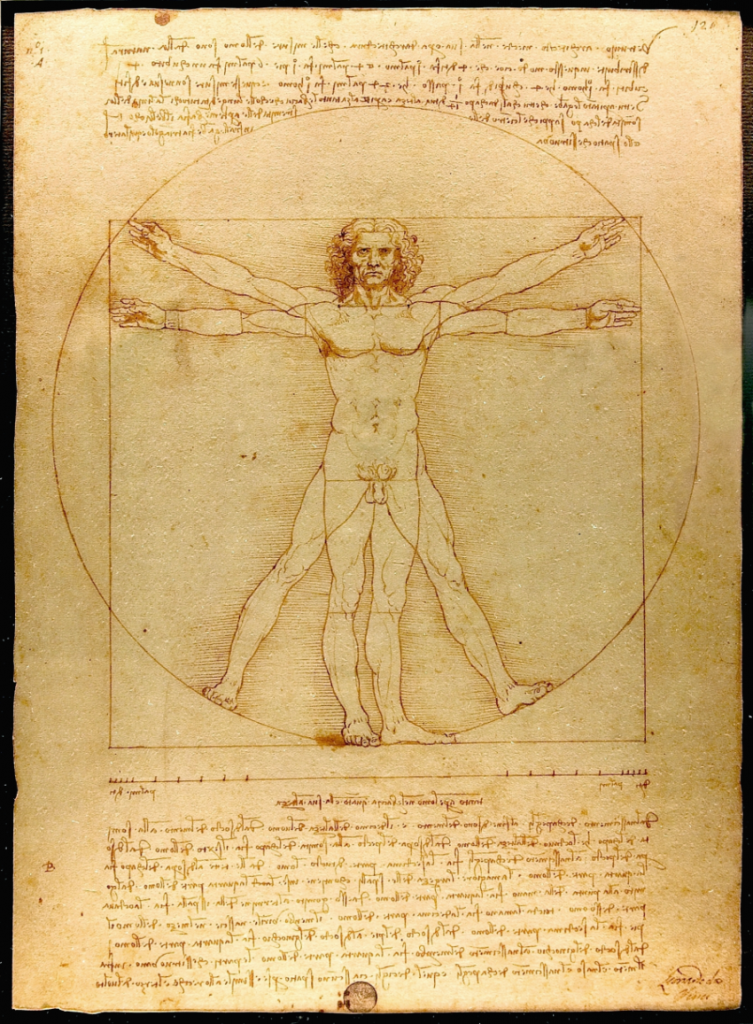
Let us also note, Da Vinci’s Vitruvian Man, as an illustration of patterns and proportions, noting the impact of the dynamic effect of the many S- and J-curve sculptural forms of the curved shapes in the human figure:
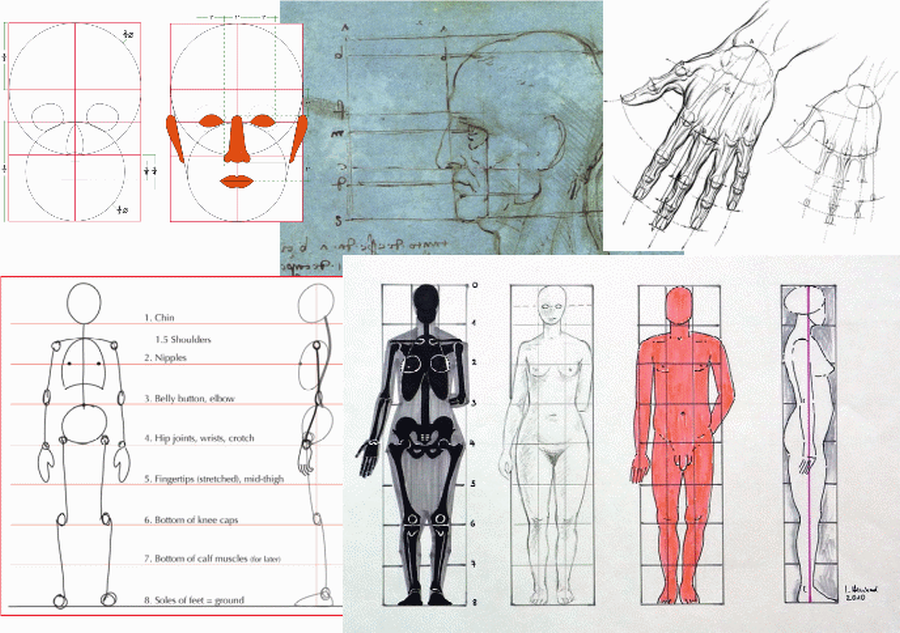
Note, a collage of “typical” human figure proportions:
Contrast the striking abstract forms (echoing and evoking human or animal figures), asymmetric patterning, colour balances, contrasts and fractal-rich cloudy details in the Eagle Nebula:
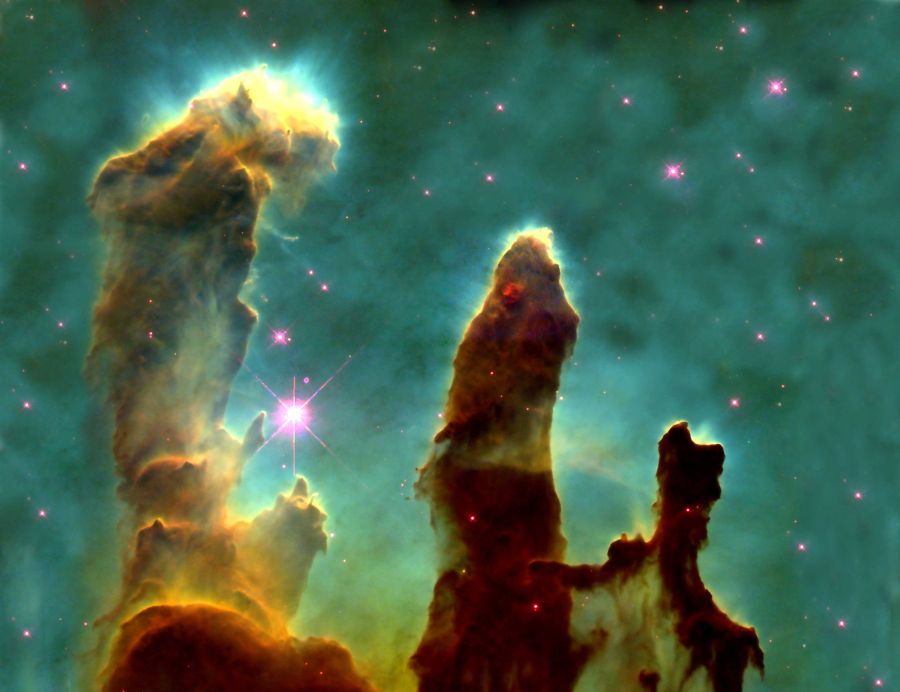
The Eagle Nebula

Also, the fractal patterning and highlighted focus shown by a partially sunlit Grand Canyon:

Grand Canyon

And then, with refreshed eyes, ponder Mona Lisa, noticing how da Vinci’s composition draws together all the above elements:
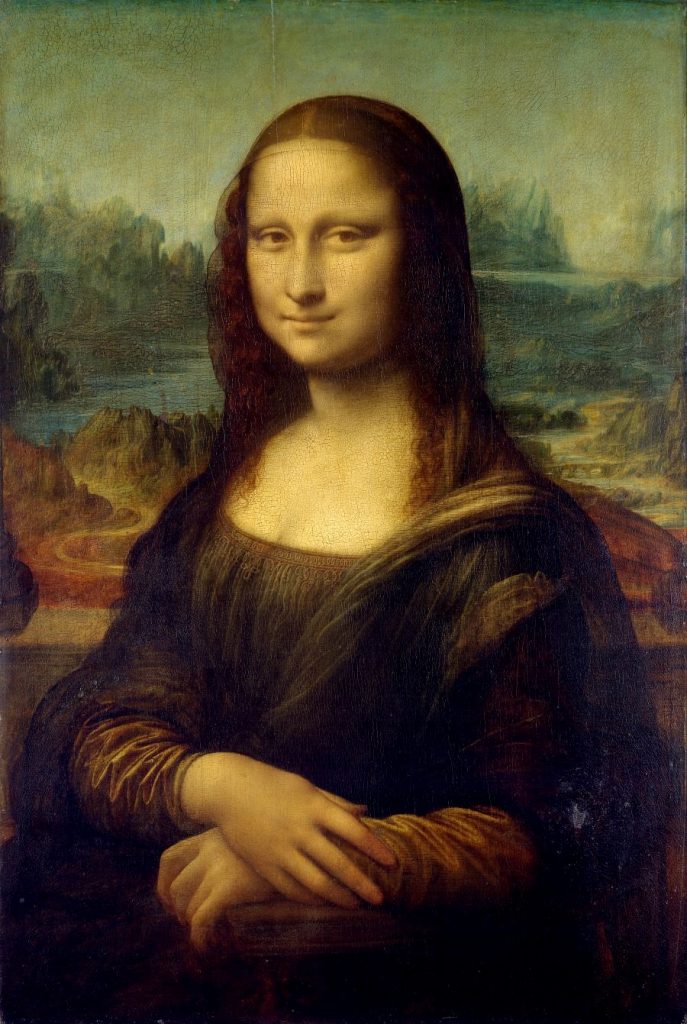
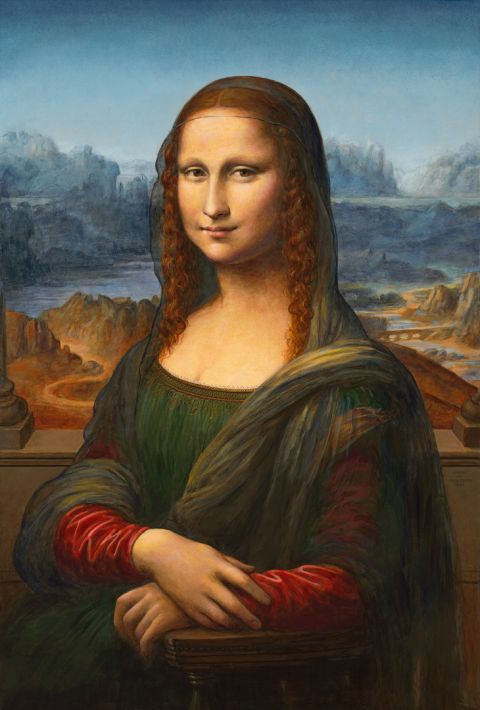
Mona Lisa — the most famous portrait
A modern reconstruction of what Mona Lisa may have looked like on completion

Let me also add, in a deliberately reduced scale, a reconstruction of what the portrait may have originally looked like. Over 400 years have passed, varnish has aged and yellowed, poplar wood has responded to its environment, some pigments have lost their colour, there have apparently been over-zealous reconstructions. Of course, the modern painter is not in Da Vinci’s class.

However, such a reconstruction helps us see the story the painting subtly weaves.

A wealthy young lady sits in a three-quarters pose . . . already a subtle asymmetry, in an ornate armchair, on an elevated balcony overlooking a civilisation-tamed landscape; she represents the upper class of the community that has tamed the land. Notice, how a serpentine, S-curved road just below her right shoulder ties her to the landscape and how a ridge line at the base of her neck acts as a secondary horizon and lead in. Also, the main horizon line (at viewer’s eye-level) is a little below her eyes; it is relieved by more ridges. She wears bright red, softened with dark green and translucent layers. Her reddish brown hair is similarly veiled. As a slight double-chin and well-fed hands show, she is not an exemplar of the extreme thinness equals beauty school of thought. The right hand is brought over to the left and superposed, covering her midriff — one almost suspects, she may be an expectant mother. Her eyes (note the restored highlights) look to her left . . . a subtle asymmetry that communicates lifelike movement so verisimilitude, as if she is smiling subtly with the painter or the viewer — this is not a smirk or sneer. And of course the presence of an invited narrative adds to the aesthetic power of the composition.

These classics (old and new alike) serve to show how stable a settled judgement of beauty can be. Which raises a question: what is beauty? Like unto that: are there principles of aesthetic judgement that give a rational framework, setting up objective knowledge of beauty? And, how do beauty, goodness, justice and truth align?

These are notoriously hard questions, probing aesthetics and ethics, the two main branches of axiology, the philosophical study of the valuable.

Where, yes, beauty is recognised to be valuable, even as ethics is clearly tied to moral value and goodness and truth are also valuable, worthy to be prized. It is unsurprising that the Taj Mahal was built as a mausoleum by a King to honour his beautiful, deeply loved wife (who had died in childbirth).

AmHD is a good place to start: beauty is “[a] quality or combination of qualities that gives pleasure to the mind or senses and is often associated with properties such as harmony of form or color, proportion, authenticity, and originality. “

Wikipedia first suggests that beauty is:

a property or characteristic of an animal, idea, object, person or place that provides a perceptual experience of pleasure or satisfaction. Beauty is studied as part of aesthetics, culture, social psychology, philosophy and sociology. An “ideal beauty” is an entity which is admired, or possesses features widely attributed to beauty in a particular culture, for perfection. Ugliness is the opposite of beauty.

The experience of “beauty” often involves an interpretation of some entity as being in balance and harmony with nature, which may lead to feelings of attraction and emotional well-being. Because this can be a subjective experience, it is often said that “beauty is in the eye of the beholder.” However, given the empirical observations of things that are considered beautiful often aligning with the aforementioned nature and health thereof, beauty has been stated to have levels of objectivity as well

It then continues (unsurprisingly) that ” [t]here is also evidence that perceptions of beauty are determined by natural selection; that things, aspects of people and landscapes considered beautiful are typically found in situations likely to give enhanced survival of the perceiving human’s genes.” Thus we find the concepts of unconscious programming and perception driven by blind evolutionary forces. The shadow of the ugly gulch lurks just beneath the surface.

Can these differences be resolved?

At one level, at least since Plato’s dialogue Hippias Major, it has been well known that beauty is notoriously hard to define or specify in terms of readily agreed principles. There definitely is subjectivity, but is there also objectivity? If one says no, why then are there classics?

Further, if no, then why could we lay out a cumulative pattern across time, art-form, nature and theme above that then appears exquisitely fused together in a portrait that just happens to be the most famous, classic portrait in the world?

If so, what are such and can they constitute a coherent framework that could justify the claim to objective knowledge of aesthetic value?

Hard questions, hard as there are no easy, simple readily agreed answers. And yet, the process of addressing a hard puzzle where our intuitions tell us something but it seems to be forever just beyond our grasp, is itself highly instructive. For, we know in part.

Dewitt H. Parker, in opening his 1920 textbook, Principles of Aesthetics, aptly captures the paradox:

Although some feeling for beauty is perhaps universal among men, the
same cannot be said of the understanding of beauty. The average man,
who may exercise considerable taste in personal adornment, in the
decoration of the home, or in the choice of poetry and painting, is
at a loss when called upon to tell what art is or to explain why he
calls one thing “beautiful” and another “ugly.” Even the artist and
the connoisseur, skilled to produce or accurate in judgment, are often
wanting in clear and consistent ideas about their own works or
appreciations. Here, as elsewhere, we meet the contrast between feeling
and doing, on the one hand, and knowing, on the other.

Of course, as we saw above, reflective (and perhaps, aided) observation of case studies can support an inductive process that tries to identify principles and design patterns of effective artistic or natural composition that reliably excite the beauty response. That can be quite suggestive, as we already saw:

  • symmetry,
  • balance,
  • pattern (including rhythms in space and/or time [e.g. percussion, dance]),
  • proportion (including the golden ratio phi, 1.618 etc)
  • unity or harmony (with tension and resolution), highlighting contrast,
    variety and detail,
  • subtle asymmetry,
  • focus or vision or theme,
  • verisimilitude (insight that shows/focusses a credible truth/reality)
  • echoing of familiar forms (including scaled, fractal self-symmetry),
  • skilled combination or composition
  • and more.

We may see this with greater richness by taking a side-light from literature, drama and cinema, by using the premise that art tells a story, drawing us into a fresh vision of the world, ourselves, possibilities:
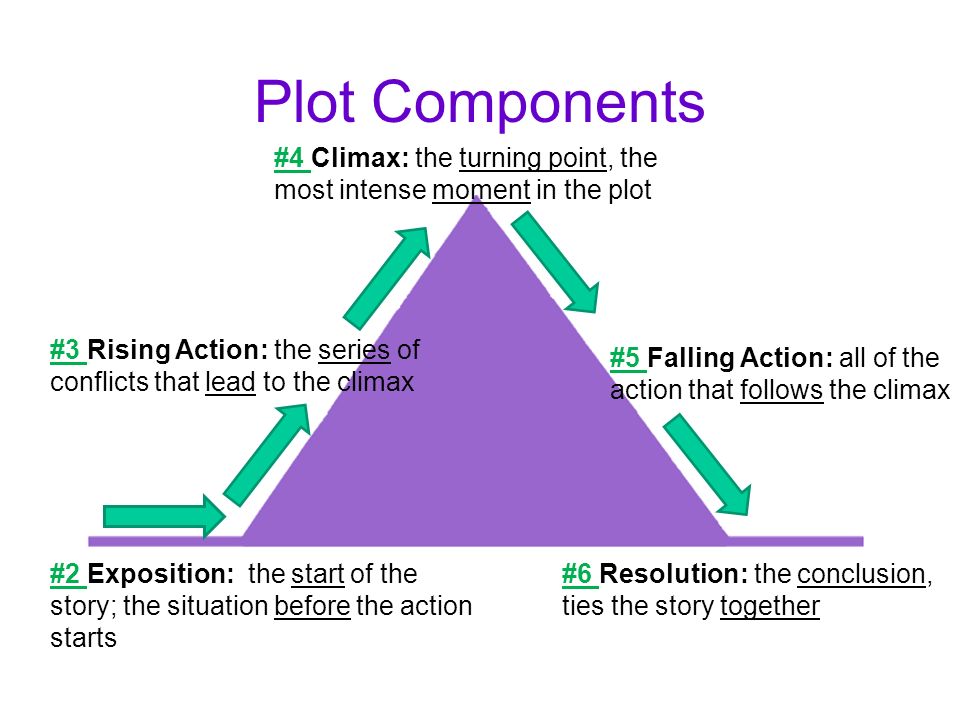
Already, it is clear that beauty has in it organising principles and that coherence with variety in composition indicates that there is indeed organisation, which brings to bear purpose and thus a way in for reflective, critical discussion. From this, we reach to development of higher quality of works and growing knowledge that guides skill and intuition without stifling creativity or originality. So, credibly, there is artistic — or even, aesthetic — knowledge that turns on rational principles, which may rightly be deemed truths.

Where, as we are rational, responsible, significantly free , morally governed creatures, the ethical must also intersect.

Where also, art has a visionary, instructive function that can strongly shape a culture. So, nobility, purity and virtue are inextricably entangled with the artistic: the perverse, ill-advised, unjust or corrupting (consider here, pornography or the like, or literature, drama and cinema that teach propaganda or the techniques of vice) are issues to be faced.

And, after our initial journey, we are back home, but in a different way. We may — if we choose — begin to see how beauty, truth, knowledge, goodness and justice may all come together, and how beauty in particular is more than merely subjective taste or culturally induced preference or disguised population survival. Where also, art reflecting rational principles, purposes and value points to artist. END

PS: To document the impact of the beauty of ordinary things (we have got de-sensitised) here are people who thanks to filtering glasses are seeing (enough of) colour for the first time:

Similarly, here are people hearing for the first time:

This will be a bit more controversial, but observe these Korean plastic surgery outcomes:

Comments
BB, I have already pointed out from when it was first raised, the cognitive gap problem and its key index, abstract verbal language. As it was brought back up as though un-answered, I again pointed this out. Enough has been said for record: absent cognitive ability to handle high order abstracta (for which abstract verbal language is a key index) there is no basis for aesthetic reflection and conceptualisation. Monkeys simply do not have that capability, which is why they have not developed a civilisation. KFkairosfocus
March 19, 2019
March
03
Mar
19
19
2019
12:55 AM
12
12
55
AM
PST
Look up Greg Chaitin's halting constant. This is a positive real number, of which only a few decimal digits can actually be computed. The number provably exists, but cannot reside in a human mind. Where is it?math guy
March 18, 2019
March
03
Mar
18
18
2019
09:43 PM
9
09
43
PM
PST
This appears to be an issue for abstract objects that require a mind to live in because the truth or falsity of the conjecture (or septillionth decimal digit of pi) appear to be independent of any mind. In fact, Gödel's second incompleteness theorem implies an infinite hierarchy of ever more complicated (but true) statements. Since human minds are bounded at some level and an infinite hierarchy is unbounded, there will be theorems too complicated to be comprehensible by human minds. Where do these theorems reside?math guy
March 18, 2019
March
03
Mar
18
18
2019
09:38 PM
9
09
38
PM
PST
Hi MG. I think the conjectures are either true or false, even though we haven't figured out yet whether they are or not. In a thread last fall, I gave some examples such as the 1 billionth digit of pi, base 17, or the 1000 generation of a generation 0 of 1000 random live cells in a 50 x 50 grid in the game of Life, or the area of a triangle with sides of 2345, 78,890, and 620*pi. All of those situations have definite answers that follow logically from accepted premises, and in theory could be figured out even though they never have been. So your conjectures are either true or false, and maybe you'll figure out how to prove that some of them are, or perhaps that some of them aren't. Good luck.hazel
March 18, 2019
March
03
Mar
18
18
2019
08:57 PM
8
08
57
PM
PST
H @ 185 writes "If you mean do abstract concepts exist in some form outside of minds, I certainly have no experiences that make me think that is so. We certainly can, and do, form abstract ideas and more complete models about the world we experience, and in many cases, to varying degrees, those models accurately correspond to the world. However, and this is the place where I believe kf and I disagree, I don’t believe the abstractions exist in the world: rather they are abstractions about the world." My research is in "pure math" (i.e. not applied math, not modeling anything in the physical universe). There are various well-formed logical statements that I am trying to prove or refute. I can think of several that I'm 99% convinced are true although I lack formal proofs at this point. (Let us assume that we don't need a new axiom outside ZFC to deal with the proofs). What is the status of such a conjecture? The platonist says that such a conjecture is either true or false, we just don't know at present (this seems to be an application of the Law of Excluded Middle). The second-rate philosopher A.J. Ayers dodges the issue entirely by claiming that such a well-formed logical statement has no meaning. (But after its valid proof is established, then meaning is suddenly assigned, like Athena emerging fully formed from Zeus' head?) I am only a third-rate philosopher so I side with Plato's viewpoint. How does Hazel view the truth status of an unproved conjecture?math guy
March 18, 2019
March
03
Mar
18
18
2019
08:15 PM
8
08
15
PM
PST
ET is right, which is another reason why, as I wrote at 21, "Once again, commonalities that are shared by all humans does not mean that those commonalities have some transcendental existence apart from their widespread and subjective manifestation in the minds of individual human beings."hazel
March 18, 2019
March
03
Mar
18
18
2019
06:14 PM
6
06
14
PM
PST
This isn't a digital either/ or situation. People have been using scales, for example: 1-10, forever when describing other people. And it is always relative.ET
March 18, 2019
March
03
Mar
18
18
2019
05:45 PM
5
05
45
PM
PST
KF, you still haven’t responded to the idea that a monkey, that doesn’t have the capability of abstract thinking like humans do, might still have the sense of aesthetic beauty. Is that impossible? And, if so, why?Brother Brian
March 18, 2019
March
03
Mar
18
18
2019
05:39 PM
5
05
39
PM
PST
It is also possible for someone to think that something is beautiful because it's functionality and utility are aesthetically pleasing. -hazel
March 18, 2019
March
03
Mar
18
18
2019
05:20 PM
5
05
20
PM
PST
BB (& H), the functional utility and beauty of a flower are categorically distinct. It is possible to be ugly and utilitarian, to be beautiful and otherwise non-functional and to be both functional and beautiful -- think here, cars. In user interface design it has been learned that beauty confers a halo effect so the user experience is heightened and estimate of performance is also heightened. KFkairosfocus
March 18, 2019
March
03
Mar
18
18
2019
05:02 PM
5
05
02
PM
PST
KF
BB, again, utility is not beauty, that is a categorical error. KF
Why not? A flower is beautiful yet it has a utility.Brother Brian
March 18, 2019
March
03
Mar
18
18
2019
04:35 PM
4
04
35
PM
PST
Why can't one see utility as beautiful?hazel
March 18, 2019
March
03
Mar
18
18
2019
03:47 PM
3
03
47
PM
PST
BB, again, utility is not beauty, that is a categorical error. KFkairosfocus
March 18, 2019
March
03
Mar
18
18
2019
03:44 PM
3
03
44
PM
PST
Hazel
Some people think parts of the “sewage system” are beautiful!
Having worked at a sewage plant for over a decade, I agree with this. Without the sewage system, the downstream of any moderate sized city would be a cess pool (no pun intended). Aquatic populations would be decimated. Fish caught from the river, lake or ocean would be toxic. But the sewage system keeps “sh__” off the streets, prevents cholera, typhoid and numerous other diseases. Allows us to use the methane generated by sewage to produce electricity, the biosolids produced to fertilize farmers field, the discharge to be “relatively” clean and safe. If that isn’t beautiful, I don’t know what is.Brother Brian
March 18, 2019
March
03
Mar
18
18
2019
03:35 PM
3
03
35
PM
PST
kf, some major parts of the external genitals are used for sex as well as excretion, and some people find the organs thereof beautiful.hazel
March 18, 2019
March
03
Mar
18
18
2019
03:29 PM
3
03
29
PM
PST
H, including its normal contents? KFkairosfocus
March 18, 2019
March
03
Mar
18
18
2019
03:22 PM
3
03
22
PM
PST
BB, I have long since been confident that I should only aim to speak for record in cases such as this. If it has not registered that aesthetic thought (not mere pleasure) is a high order cognitive function involving all sorts of abstracta, for which conceptual language is a good index, then I have to simply note the fact. KFkairosfocus
March 18, 2019
March
03
Mar
18
18
2019
03:21 PM
3
03
21
PM
PST
F/N: Vitruvius has some interesting words:
Moral philosophy will teach the architect 10 be above meanness in his dealings, and to avoid ar- rogance: and will make him just, compliant and faithful to his employer; and what is of the highest importance, it will prevent avarice gaining an ascendancy over him: for he should not be occupied with the thoughts of ?lling his co?'ers, nor with the desire of grasping every thing in the shape of gain, but, by the gravity of his manners, and a. good character, should be careful to preserve his dignity. In these respects we see the importance of moral philosophy; for such are her precepts.
And again:
Mu_s_i_c_assists him in the use of harmonic and mathematical proportion. . . . So the vessels called echeia by the Greeks, which are placed in certain recesses under the seats of theatres, are ?xed and arranged with a due regard to the laws of harmony and physics, their tones being fourths, ?fths, and octaves; so that when the voice of the actor is in unison with the pitch of these instruments, its power is increased and mellowed by impinging thereon.
And again:
The design of Temples depends on symmetry, the rules of which Architects should be most careful to observe. Symmetry is dependent on proportion, which the Greeks call analogia. Proportion is a due adjustment of the size of the different parts to each other and to the whole; on this proper adjustment symmetry depends. Hence no building can be said to be well designed which wants symmetry and proportion. In truth they are as necessary to the beauty of a building as to that of a well formed human ?gure, which nature has so fashioned, that in the face, from the chin to the top of the forehead, or to the roots of the hair, is a tenth part of the height of the whole body. From the chin to the crown of the head is an eighth part of the whole height, and from the nape of the "neck to the crown of the head the same. From the upper part of the‘ breast to the roots of the hair a sixth; to the crown of the head a fourth. A third part of the height of the face is equal to that from the chin to the under side of the nostrils, and thence to the middle of the eyebrows the same; from the last to the roots of the hair, where the forehead ends, the re- maining third part. The length of the foot is a sixth part ot' me height of the body. The fore-arm a fourth part. The width of the breast a fourth part. Simi- larly have the other members their due proportions, by attention to which the ancient Painters and Sculptors obtained so much reputation. Just so the parts of Tem- ples should correspond with each other, and with the whole. The navel is naturally placed in the centre of the human body, and, if in a man lying with his face upward, and his hands and feet extended, from his navel as the centre, a circle be described, it will touch his ?ngers and toes. It is not alone by a circle, that the human body is thus circumscribed, as may be seen by placing it within a square. For measuring from the feet to the crown of the head, and then across the arms fully extended, we ?nd the latter measure equal to the former; so that lines at right angles to each other, en- closing the ?gure, will form a square. If Nature, there- fore, has made the human body so that the different members of it are measures of the whole, so the ancients have, with great propriety, determined that in all perfect works, each part should be some aliquot part of the whole; and since they direct, that this be observed in all works, it must be most strictly attended to in temples of the gods, wherein the faults as well as the beauties remain to the end of time. It is worthy of remark, that the measures necessarily used in all buildings and other works, are derived from the members of the human body, as the digit, the palm, the foot, the cubit, and that these form a perfect number, called by the Greek teleios. The ancients considered ten a perfect number, because the ?ngers are ten in number, and the palm is derived from them, and from the palm is derived the foot..
This is of course the text behind Da Vinci's famous study as is in the OP. KFkairosfocus
March 18, 2019
March
03
Mar
18
18
2019
03:17 PM
3
03
17
PM
PST
KF, this still does not prove that the monkey cannot have their own perception of aesthetic beauty. If this is even remotely possible, then the idea of objective measures of beauty, unless they share the same ones with us, is a non-starter.Brother Brian
March 18, 2019
March
03
Mar
18
18
2019
02:47 PM
2
02
47
PM
PST
H (& BB), the monkey is not an abstract thinker as is manifest in its lack of abstract conceptual language. It may well respond with pleasure to some aspects of its body (even as we do with some aspects of our own bodies -- hence mirrors and the selfie culture) but that does not bind either it or us to hold all of our bodily features as equally attractive. We do not have our bathroom features such as water closets and tubs openly displayed in our living rooms. KFkairosfocus
March 18, 2019
March
03
Mar
18
18
2019
02:32 PM
2
02
32
PM
PST
Hazel, and if they have some appreciation for some type of aesthetic beauty, without having the ability to think in the abstract, wouldn’t that run counter to KF’s hypothesis?Brother Brian
March 18, 2019
March
03
Mar
18
18
2019
02:29 PM
2
02
29
PM
PST
Some people think parts of the "sewage system" are beautiful!hazel
March 18, 2019
March
03
Mar
18
18
2019
02:29 PM
2
02
29
PM
PST
DS, Eagle nebula illustrates naturally occurring fractal rich patterns and abstract patterns, likewise Grand Canyon. There is natural beauty. Our monkey is an animal, but not an abstractly thinking one. It;s nose is a functional feature. likewise not everything in the human body is attractive or even pleasant to behold, e.g. we host a built in sewage system. KF PS: Paul touches on a relevant theme:
1 Cor 12: 22 But quite the contrary, the parts of the body that seem to be weaker are [absolutely] necessary; 23 and as for those parts of the body which we consider less honorable, these we treat with greater honor; and our less presentable parts are treated with greater modesty, 24 while our more presentable parts do not require it. But God has combined the [whole] body, giving greater honor to that part which lacks it, 25 so that there would be no division or discord in the body [that is, lack of adaptation of the parts to each other], but that the parts may have the same concern for one another.
kairosfocus
March 18, 2019
March
03
Mar
18
18
2019
02:26 PM
2
02
26
PM
PST
Good question, BB. We know that the monkey doesn't have the abstract symbolic thinking skills we do, but do we really know if they don't have appreciative notions of some level of aesthetic pleasure? They certainly have a range of positive and negative emotions, at least judging by their behavior.hazel
March 18, 2019
March
03
Mar
18
18
2019
02:21 PM
2
02
21
PM
PST
KF
As I already noted, the monkey does not have the cognitive level to deal with the aesthetic.
Is this a proven fact or simply an assumption based on our egocentric concept of human exceptionalism?Brother Brian
March 18, 2019
March
03
Mar
18
18
2019
02:05 PM
2
02
05
PM
PST
KF,
As I already noted, the monkey does not have the cognitive level to deal with the aesthetic.
Neither does the Eagle Nebula.daveS
March 18, 2019
March
03
Mar
18
18
2019
01:38 PM
1
01
38
PM
PST
DS, it seems, yet another Hollywood celebrity, sad, Money, looks and fame don't buy happiness and virtue. Our monkey's nose is not the prettiest but is quite functional for a very significant signalling purpose, I guess like the sperm whale's head. As I already noted, the monkey does not have the cognitive level to deal with the aesthetic. KFkairosfocus
March 18, 2019
March
03
Mar
18
18
2019
01:35 PM
1
01
35
PM
PST
KF,
DS, I had to look up who Ms Jenner is, I am not part of American culture. She is a reasonably attractive young lady though it seems from time to time she has done some pretty wild things with her hair — there is a bright yellow that is a bit unnatural.
If you are documenting the collapse of western civilization, you should definitely familiarize yourself with her and her clan. :P
The proboscis monkey’s nose is a signalling device tied to survival of the troop or whatever they may call it. Beauty is very much secondary to function.
But the question is, which is objectively more beautiful? I'm repeating myself again, so this is the last time I'll ask.daveS
March 18, 2019
March
03
Mar
18
18
2019
01:29 PM
1
01
29
PM
PST
BB, time will tell, but it is not hard to see the progressive, chaotic breakdown of a civilisation and where it leads. The arts of our time, popular and highbrow alike, too often tell the same tale. Where, the very vision of the heroic rebel casting off "stodgy" and perceived stifling or oppressive rules speaks volumes about the inner turmoil that drives so much of what we see. To that, I suggest that there is a reason why it is futile to expect water to flow uphill, i.e. there are natural principles all across our world that one would be well advised to align with, even if one seeks to overcome natural limitations. I therefore take your heroic rebel and raise him by billions of dollars worth of grotesque, unharmonious eyesores imposed by the powerful, wealthy and influential on a public that is clearly not amused. A building that looks like a crushed sheet of paper or a blob uncannily like a cow pie actually sends yet another level of message, as does one that obviously parodies and mocks a classical column. I remember here the logo on tee shirts at the low end that read $exact$change in two telling lines -- yes, there can be subtext messages in art, low brow and high brow alike. I already clipped a few remarks on the points. And last but not least we must not forget the message of demographics in all of this; which definitively points to fatal decline as fecundity plunges towards one per woman in many countries. KF PS: A reminder from the Current Affairs article:
The fact is, contemporary architecture gives most regular humans the heebie-jeebies. Try telling that to architects and their acolytes, though, and you’ll get an earful about why your feeling is misguided, the product of some embarrassing misconception about architectural principles. [–> translation: they KNOW they are flouting long established aesthetics principles, where they also are looking down on those who adhere to them or those who simply intuitively find the results of such avant gardism apalling] One defense, typically, is that these eyesores are, in reality, incredible feats of engineering. After all, “blobitecture”—which, we regret to say, is a real school of contemporary architecture—is created using complicated computer-driven algorithms! You may think the ensuing blob-structure looks like a tentacled turd, or a crumpled kleenex, but that’s because you don’t have an architect’s trained eye. [–> Thank God I do not have a mis-trained eye that cannot see the Emperor’s wardrobe malfunction for what it is! And when a classic story like that speaks . . . ] Another thing you will often hear from design-school types is that contemporary architecture is honest. It doesn’t rely on the forms and usages of the past, and it is not interested in coddling you and your dumb feelings. Wake up, sheeple! Your boss hates you, and your bloodsucking landlord too, and your government fully intends to grind you between its gears. That’s the world we live in! Get used to it! Fans of Brutalism—the blocky-industrial-concrete school of architecture—are quick to emphasize that these buildings tell it like it is, as if this somehow excused the fact that they look, at best, dreary, and, at worst, like the headquarters of some kind of post-apocalyptic totalitarian dictatorship.
kairosfocus
March 18, 2019
March
03
Mar
18
18
2019
12:37 PM
12
12
37
PM
PST
KF
And this thread is telling quite a story, where deterioration in the arts and of taste is one of the signs of civilisational decay. KF
I'm afraid that I can't draw the link between buildings that you do not find aesthetically pleasing and the downfall of civilization. I see attempts to break the staid and stodgy "rules" of architecture (and other arts) as something that should be celebrated. Sometimes they will be soundly trashed but in other cases they may grow on you (or on most people, probably not you. :) ).Brother Brian
March 18, 2019
March
03
Mar
18
18
2019
12:13 PM
12
12
13
PM
PST
1 … 4 5 6 7 8 … 14