Uncommon Descent Serving The Intelligent Design Community

Logic & First Principles, 14: Are beauty, truth, knowledge, goodness and justice merely matters of subjective opinions? (Preliminary thoughts.)

Categories
Culture
Logic and Reason
Share
Facebook
Twitter/X
LinkedIn
Flipboard
Print
Email

We live in a Kant-haunted age, where the “ugly gulch” between our inner world of appearances and judgements and the world of things in themselves is often seen as unbridgeable. Of course, there are many other streams of thought that lead to widespread relativism and subjectivism, but the ugly gulch concept is in some ways emblematic. Such trends influence many commonly encountered views, most notably our tendency to hold that being a matter of taste, beauty lies solely in the eye of the beholder.

And yet, we find the world-famous bust of Nefertiti:

The famous bust of Nefertiti, found in Thutmose’s workshop (notice, how subtle smiles will play a role in portraits of beautiful women)

Compare, 3400 years later; notice the symmetry and focal power of key features for Guinean model, Sira Kante :


Sira Kante

And then, ponder the highly formal architecture of the Taj Mahal:
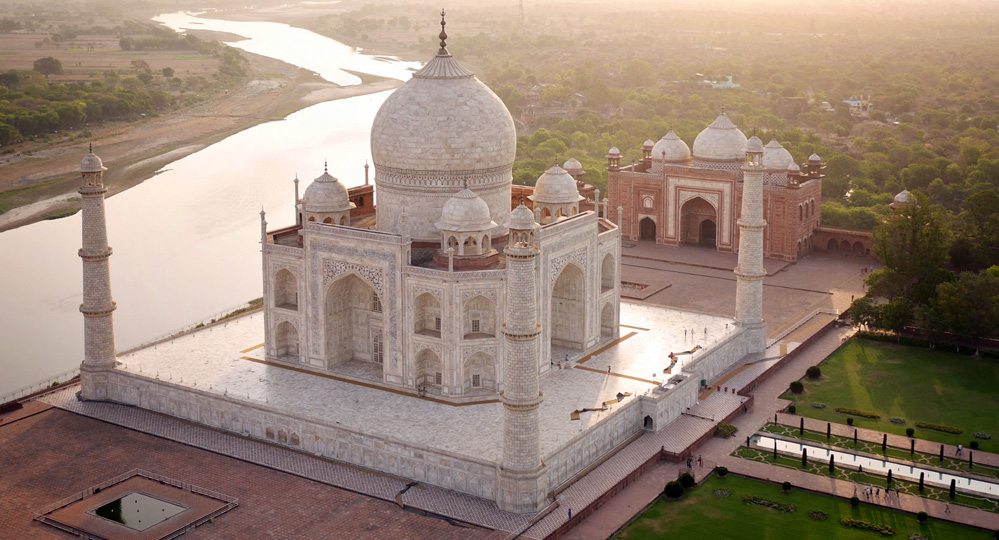
The Taj Mahal

ADDED: To help drive home the point, here is a collage of current architectural eyesores:
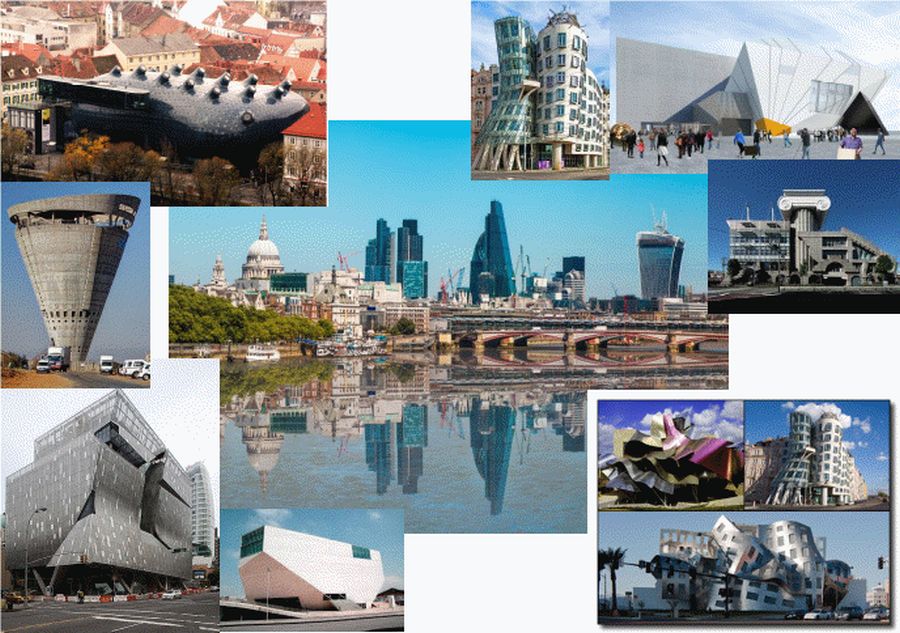
Current Eyesores

Added, Mar 23 — Vernal Equinox: The oddly shaped building on London’s skyline is called “Walkie-Talkie” and due to its curved surface creates a heating hazard at the height of summer on a nearby street — yet another aspect of sound design that was overlooked (this one, ethical):

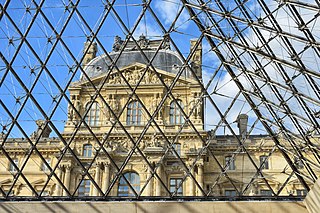
Louvre as seen from inside the Pei pyramid

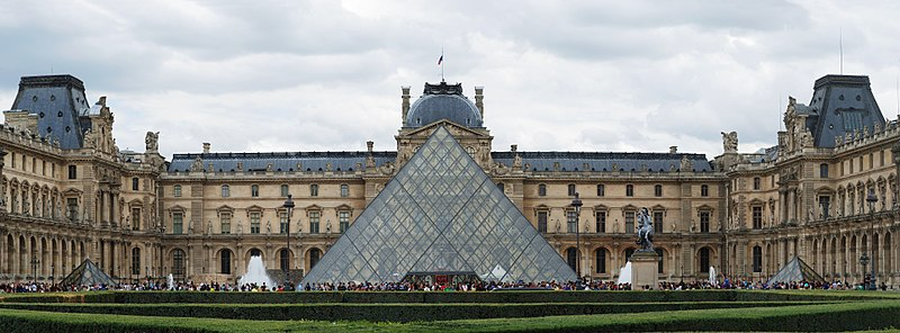
Since it has come up I add the Louvre’s recent addition of a Pyramid (which apparently echoes a similar temporary monument placed there c. 1839 to honour the dead in an 1830 uprising). Notice, below, how symmetric it is in the context of the museum; where triangular elements are a longstanding part of the design as may be seen from the structure below the central dome and above many windows. Observe the balance between overall framework and detailed elements that relieve the boredom of large, flat blank walls. Historically, also, as Notre Dame’s South Rose Window so aptly illustrates, windows and light have been part of the design and function of French architecture. Notice, how it fits the symmetry and is not overwhelmingly large, though of course those who objected that it is not simply aligned with the classical design of the building have a point:
Yet again, the similarly strongly patterned South Rose Window at Notre Dame (with its obvious focal point, as well as how the many portraits give delightful detail and variety amidst the symmetry) :
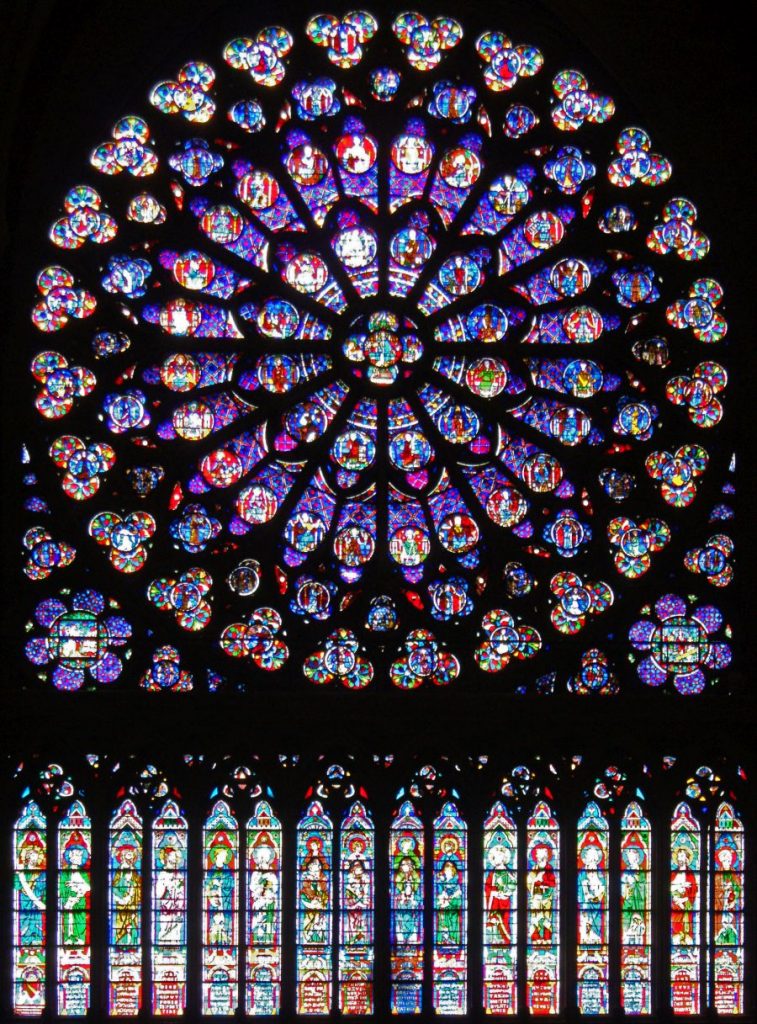
Notre Dame, South Rose Window

Compare, patterning, variety and focus with subtle asymmetry in part of “Seahorse Valley” for the Mandelbrot set:
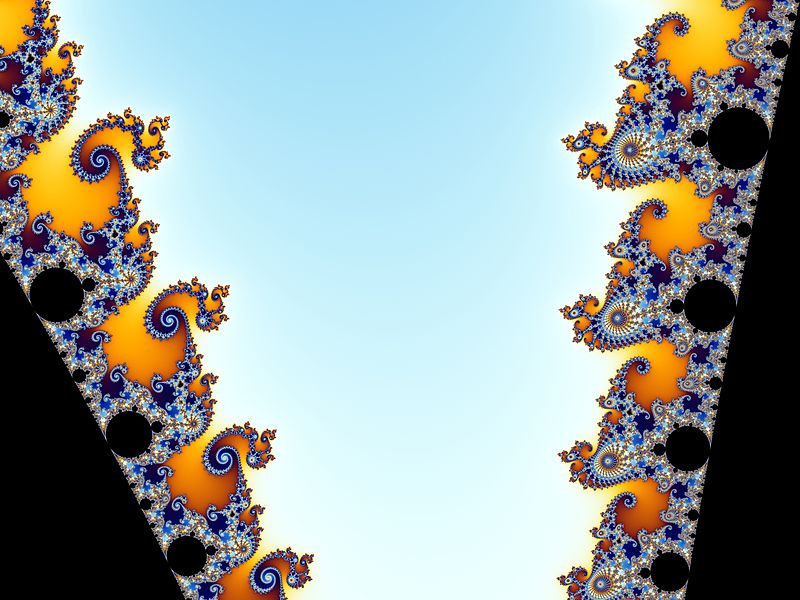
Seahorse Valley zoom, Mandelbrot set

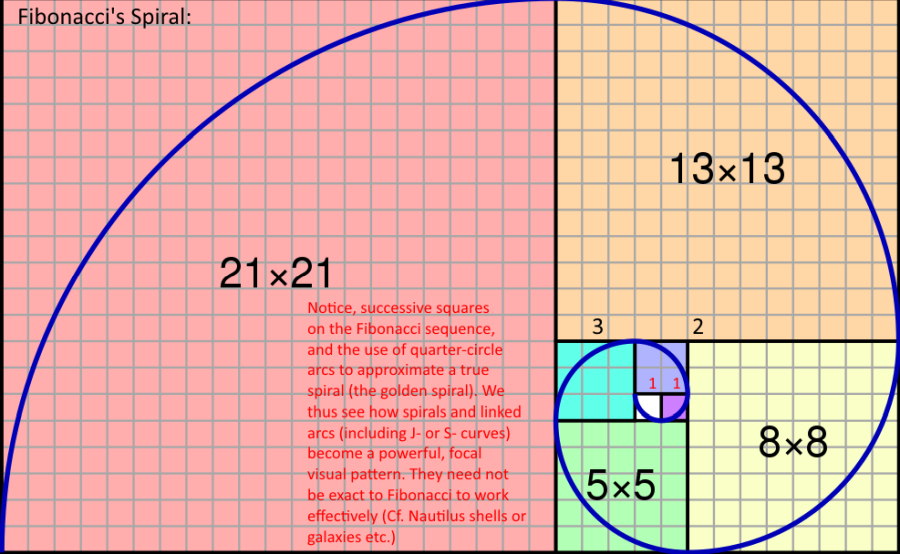
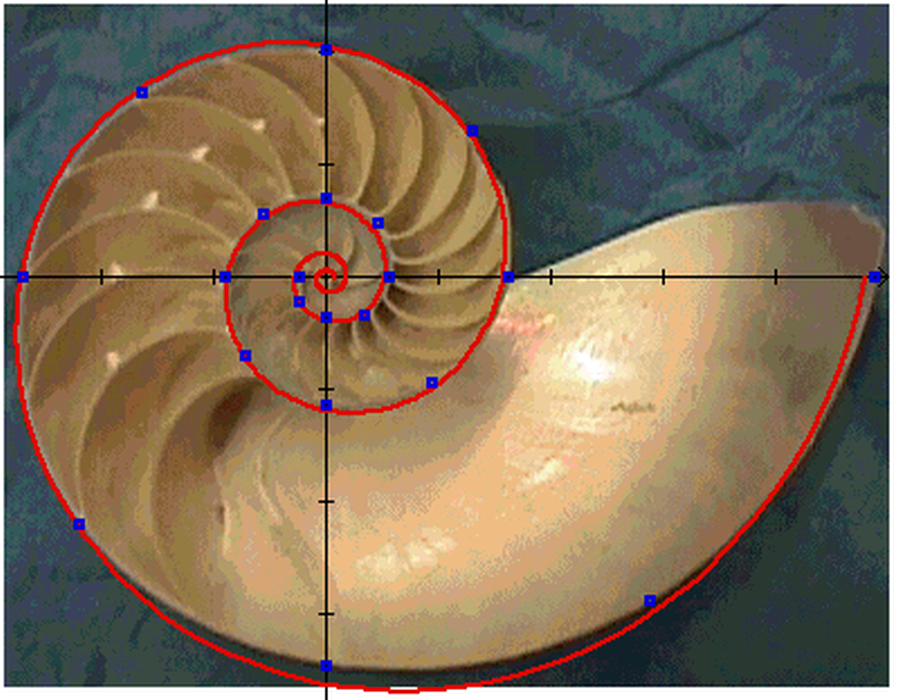
I add, let us pause to see the power of spirals as a pattern, tying in the Fibonacci sequence and thus also the Golden Ratio, Phi, 1.618 . . . (where concentric circles as in the Rose Window, have much of the same almost hypnotic effect and where we see spirals in the seahorse valley also):
Here, let us observe a least squares fit logarithmic spiral superposed on a cut Nautilus shell:
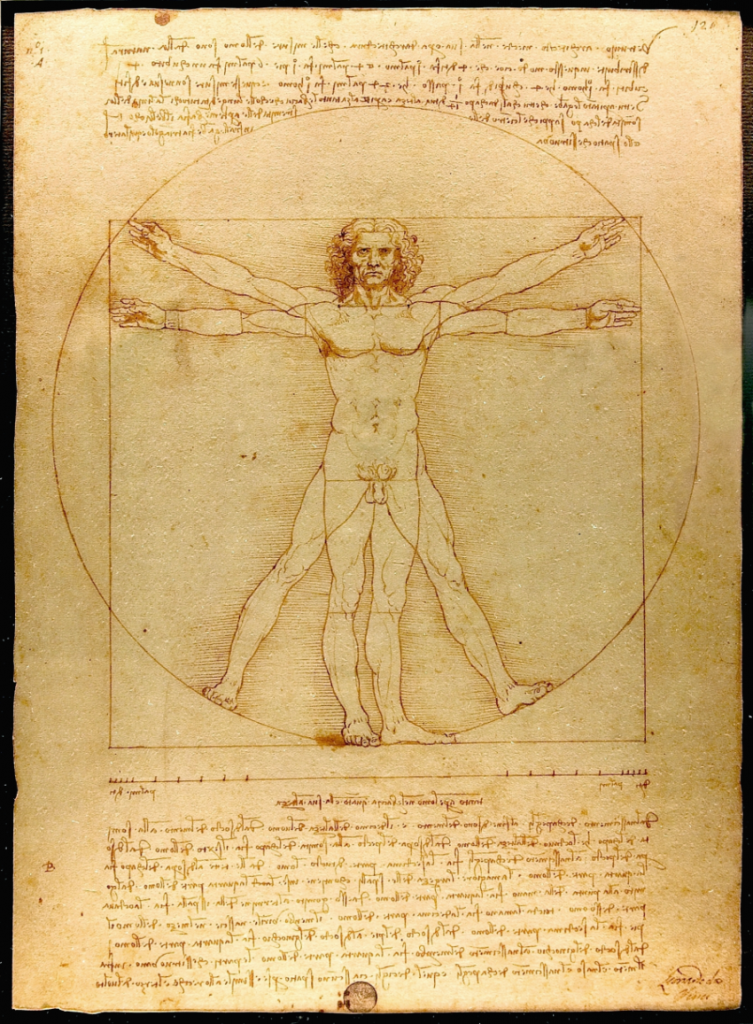
Let us also note, Da Vinci’s Vitruvian Man, as an illustration of patterns and proportions, noting the impact of the dynamic effect of the many S- and J-curve sculptural forms of the curved shapes in the human figure:
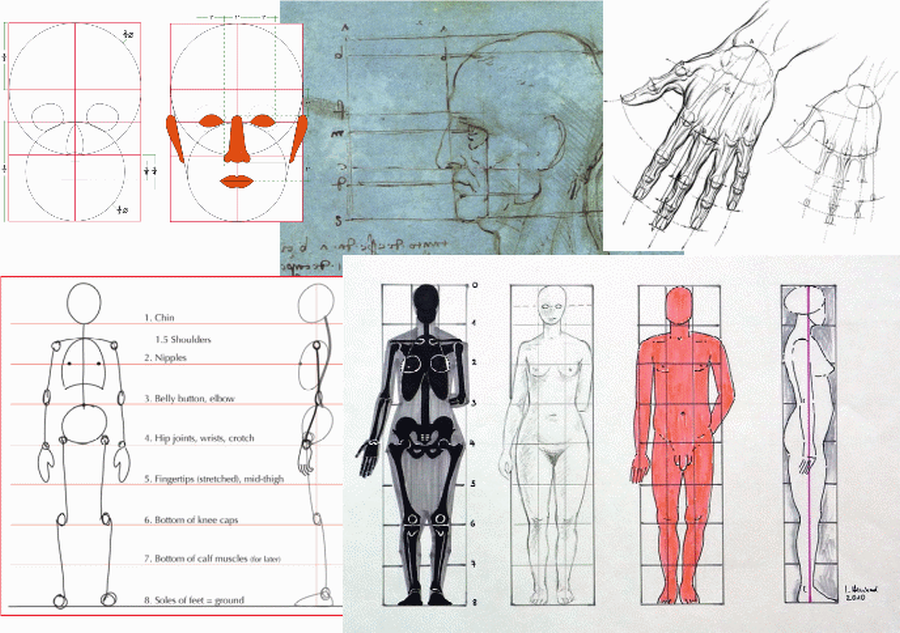
Note, a collage of “typical” human figure proportions:
Contrast the striking abstract forms (echoing and evoking human or animal figures), asymmetric patterning, colour balances, contrasts and fractal-rich cloudy details in the Eagle Nebula:
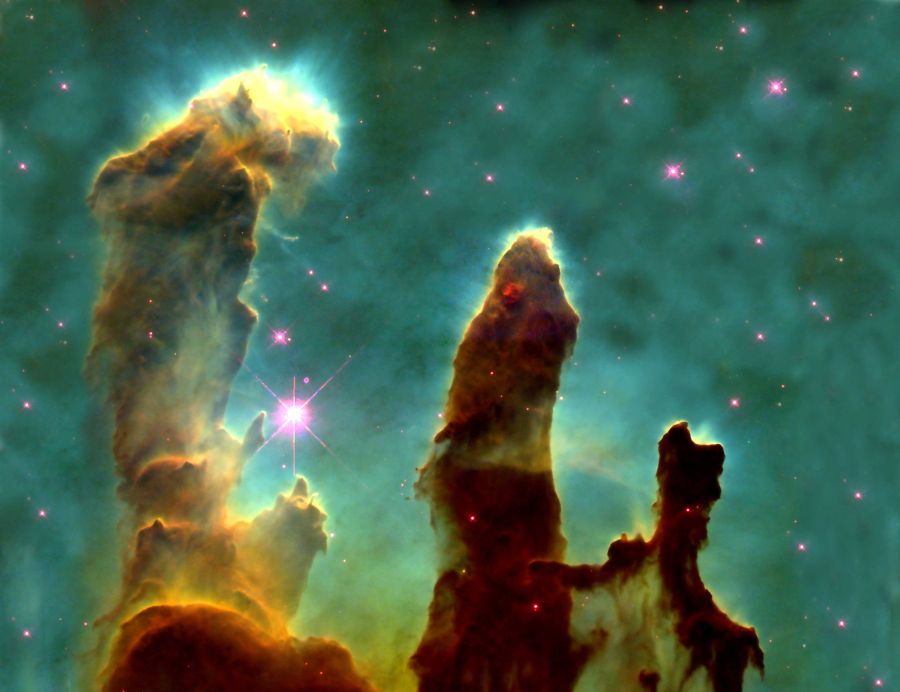
The Eagle Nebula

Also, the fractal patterning and highlighted focus shown by a partially sunlit Grand Canyon:

Grand Canyon

And then, with refreshed eyes, ponder Mona Lisa, noticing how da Vinci’s composition draws together all the above elements:
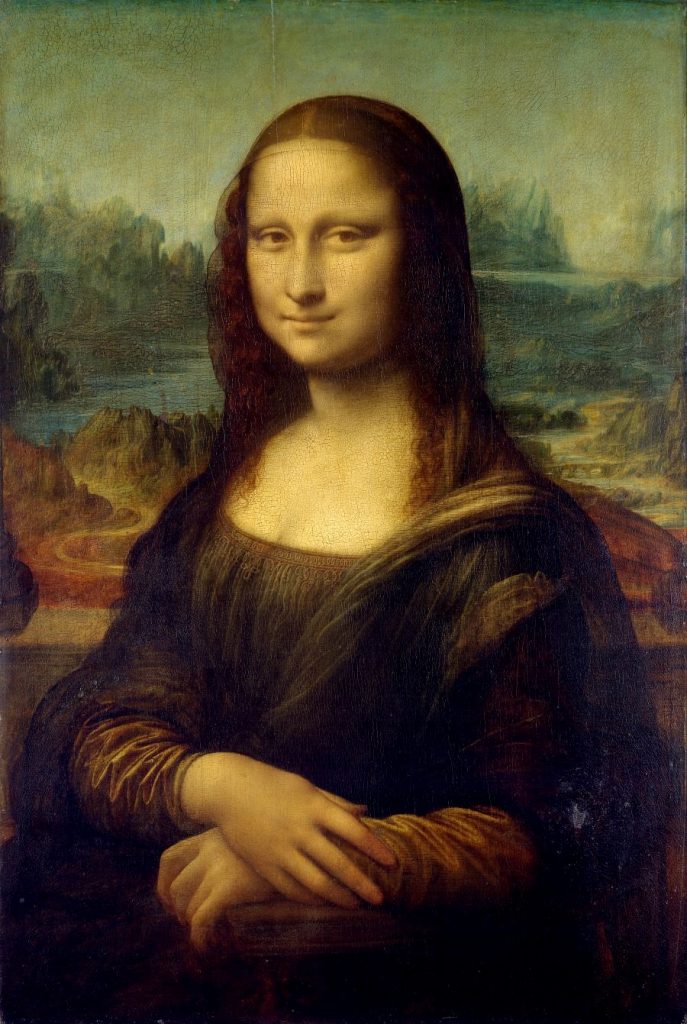
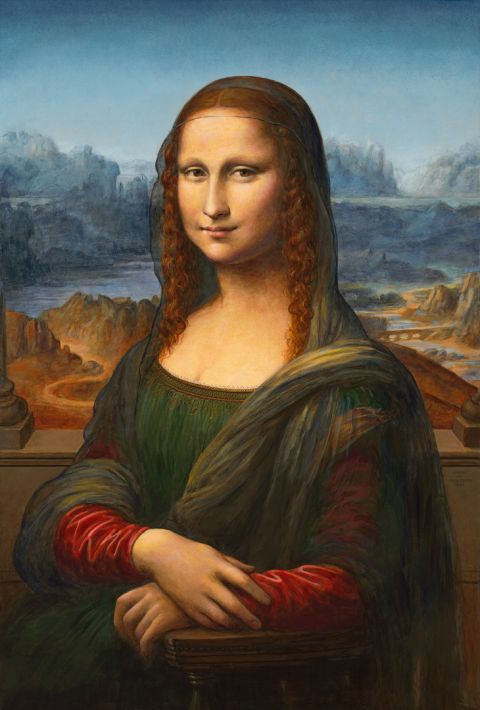
Mona Lisa — the most famous portrait
A modern reconstruction of what Mona Lisa may have looked like on completion

Let me also add, in a deliberately reduced scale, a reconstruction of what the portrait may have originally looked like. Over 400 years have passed, varnish has aged and yellowed, poplar wood has responded to its environment, some pigments have lost their colour, there have apparently been over-zealous reconstructions. Of course, the modern painter is not in Da Vinci’s class.

However, such a reconstruction helps us see the story the painting subtly weaves.

A wealthy young lady sits in a three-quarters pose . . . already a subtle asymmetry, in an ornate armchair, on an elevated balcony overlooking a civilisation-tamed landscape; she represents the upper class of the community that has tamed the land. Notice, how a serpentine, S-curved road just below her right shoulder ties her to the landscape and how a ridge line at the base of her neck acts as a secondary horizon and lead in. Also, the main horizon line (at viewer’s eye-level) is a little below her eyes; it is relieved by more ridges. She wears bright red, softened with dark green and translucent layers. Her reddish brown hair is similarly veiled. As a slight double-chin and well-fed hands show, she is not an exemplar of the extreme thinness equals beauty school of thought. The right hand is brought over to the left and superposed, covering her midriff — one almost suspects, she may be an expectant mother. Her eyes (note the restored highlights) look to her left . . . a subtle asymmetry that communicates lifelike movement so verisimilitude, as if she is smiling subtly with the painter or the viewer — this is not a smirk or sneer. And of course the presence of an invited narrative adds to the aesthetic power of the composition.

These classics (old and new alike) serve to show how stable a settled judgement of beauty can be. Which raises a question: what is beauty? Like unto that: are there principles of aesthetic judgement that give a rational framework, setting up objective knowledge of beauty? And, how do beauty, goodness, justice and truth align?

These are notoriously hard questions, probing aesthetics and ethics, the two main branches of axiology, the philosophical study of the valuable.

Where, yes, beauty is recognised to be valuable, even as ethics is clearly tied to moral value and goodness and truth are also valuable, worthy to be prized. It is unsurprising that the Taj Mahal was built as a mausoleum by a King to honour his beautiful, deeply loved wife (who had died in childbirth).

AmHD is a good place to start: beauty is “[a] quality or combination of qualities that gives pleasure to the mind or senses and is often associated with properties such as harmony of form or color, proportion, authenticity, and originality. “

Wikipedia first suggests that beauty is:

a property or characteristic of an animal, idea, object, person or place that provides a perceptual experience of pleasure or satisfaction. Beauty is studied as part of aesthetics, culture, social psychology, philosophy and sociology. An “ideal beauty” is an entity which is admired, or possesses features widely attributed to beauty in a particular culture, for perfection. Ugliness is the opposite of beauty.

The experience of “beauty” often involves an interpretation of some entity as being in balance and harmony with nature, which may lead to feelings of attraction and emotional well-being. Because this can be a subjective experience, it is often said that “beauty is in the eye of the beholder.” However, given the empirical observations of things that are considered beautiful often aligning with the aforementioned nature and health thereof, beauty has been stated to have levels of objectivity as well

It then continues (unsurprisingly) that ” [t]here is also evidence that perceptions of beauty are determined by natural selection; that things, aspects of people and landscapes considered beautiful are typically found in situations likely to give enhanced survival of the perceiving human’s genes.” Thus we find the concepts of unconscious programming and perception driven by blind evolutionary forces. The shadow of the ugly gulch lurks just beneath the surface.

Can these differences be resolved?

At one level, at least since Plato’s dialogue Hippias Major, it has been well known that beauty is notoriously hard to define or specify in terms of readily agreed principles. There definitely is subjectivity, but is there also objectivity? If one says no, why then are there classics?

Further, if no, then why could we lay out a cumulative pattern across time, art-form, nature and theme above that then appears exquisitely fused together in a portrait that just happens to be the most famous, classic portrait in the world?

If so, what are such and can they constitute a coherent framework that could justify the claim to objective knowledge of aesthetic value?

Hard questions, hard as there are no easy, simple readily agreed answers. And yet, the process of addressing a hard puzzle where our intuitions tell us something but it seems to be forever just beyond our grasp, is itself highly instructive. For, we know in part.

Dewitt H. Parker, in opening his 1920 textbook, Principles of Aesthetics, aptly captures the paradox:

Although some feeling for beauty is perhaps universal among men, the
same cannot be said of the understanding of beauty. The average man,
who may exercise considerable taste in personal adornment, in the
decoration of the home, or in the choice of poetry and painting, is
at a loss when called upon to tell what art is or to explain why he
calls one thing “beautiful” and another “ugly.” Even the artist and
the connoisseur, skilled to produce or accurate in judgment, are often
wanting in clear and consistent ideas about their own works or
appreciations. Here, as elsewhere, we meet the contrast between feeling
and doing, on the one hand, and knowing, on the other.

Of course, as we saw above, reflective (and perhaps, aided) observation of case studies can support an inductive process that tries to identify principles and design patterns of effective artistic or natural composition that reliably excite the beauty response. That can be quite suggestive, as we already saw:

  • symmetry,
  • balance,
  • pattern (including rhythms in space and/or time [e.g. percussion, dance]),
  • proportion (including the golden ratio phi, 1.618 etc)
  • unity or harmony (with tension and resolution), highlighting contrast,
    variety and detail,
  • subtle asymmetry,
  • focus or vision or theme,
  • verisimilitude (insight that shows/focusses a credible truth/reality)
  • echoing of familiar forms (including scaled, fractal self-symmetry),
  • skilled combination or composition
  • and more.

We may see this with greater richness by taking a side-light from literature, drama and cinema, by using the premise that art tells a story, drawing us into a fresh vision of the world, ourselves, possibilities:
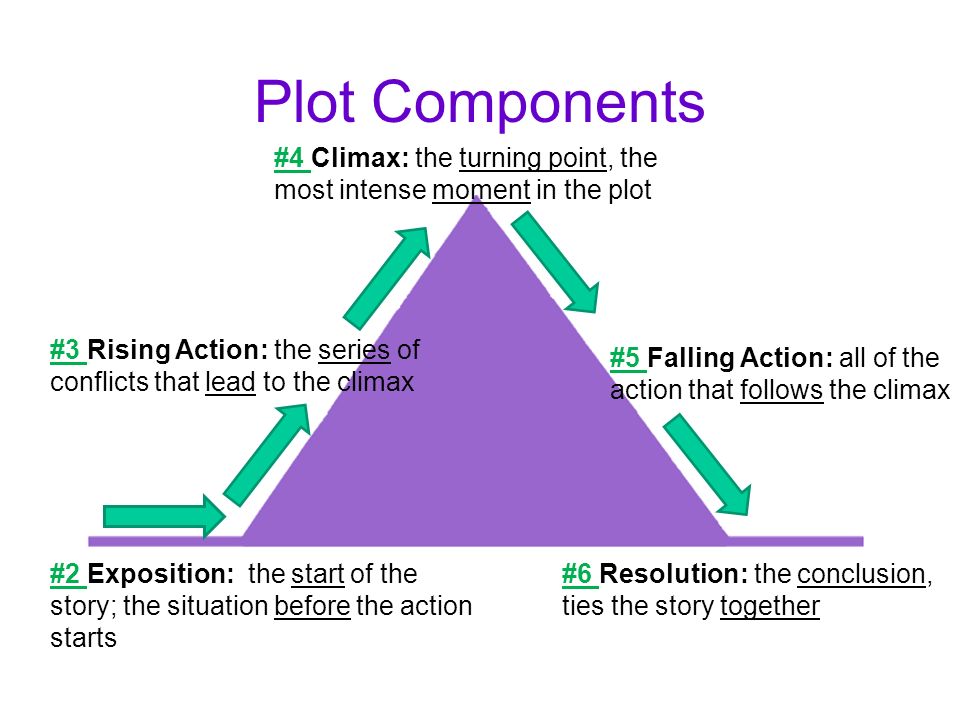
Already, it is clear that beauty has in it organising principles and that coherence with variety in composition indicates that there is indeed organisation, which brings to bear purpose and thus a way in for reflective, critical discussion. From this, we reach to development of higher quality of works and growing knowledge that guides skill and intuition without stifling creativity or originality. So, credibly, there is artistic — or even, aesthetic — knowledge that turns on rational principles, which may rightly be deemed truths.

Where, as we are rational, responsible, significantly free , morally governed creatures, the ethical must also intersect.

Where also, art has a visionary, instructive function that can strongly shape a culture. So, nobility, purity and virtue are inextricably entangled with the artistic: the perverse, ill-advised, unjust or corrupting (consider here, pornography or the like, or literature, drama and cinema that teach propaganda or the techniques of vice) are issues to be faced.

And, after our initial journey, we are back home, but in a different way. We may — if we choose — begin to see how beauty, truth, knowledge, goodness and justice may all come together, and how beauty in particular is more than merely subjective taste or culturally induced preference or disguised population survival. Where also, art reflecting rational principles, purposes and value points to artist. END

PS: To document the impact of the beauty of ordinary things (we have got de-sensitised) here are people who thanks to filtering glasses are seeing (enough of) colour for the first time:

Similarly, here are people hearing for the first time:

This will be a bit more controversial, but observe these Korean plastic surgery outcomes:

Comments
BB, I have not given scales and measures but examples of principles tied to case studies. For example symmetry is often measurable mathematically on its own (by way of some sort of reflection) but that by itself does not make beauty, a balance of factors is involved. What I spoke to is readily observable, the willful flouting of longstanding principles and practices leading to architectural eyesores to the cumulative direct cost in the billions. That result is not on trial, our response to it, why, is. And this thread is telling quite a story, where deterioration in the arts and of taste is one of the signs of civilisational decay. KFkairosfocus
March 18, 2019
March
03
Mar
18
18
2019
11:59 AM
11
11
59
AM
PDT
KF
BB, no. there are identifiable principles that were honoured but are now being flouted, to awful result. Some modern forms are lovely in themselves because they do not violate the canons, and they also respect the existing built environment. What we are seeing is very different and needlessly, heedlessly so. KF
I'm afraid that we will just have to agree to disagree on the existence of objective (outside the mind) measures of aesthetic beauty.Brother Brian
March 18, 2019
March
03
Mar
18
18
2019
11:11 AM
11
11
11
AM
PDT
ET, beauty is the general term, aesthetics is the branch of phil that studies the principles of beauty and its value. The term you give may be emphasising the role of aesthetics in beauty, as in knowing application of such principles (see OP) is historically a part of sophisticated artistry. Da Vinci's work on Mona Lisa is a classic in point, look at how many aesthetics factors are at work in it. KFkairosfocus
March 18, 2019
March
03
Mar
18
18
2019
10:39 AM
10
10
39
AM
PDT
If Aesthetics (/?s???t?ks, i?s-, æs-/) is a branch of philosophy that deals with the nature of art, beauty and taste and with the creation or appreciation of beauty, then what is "aesthetic beauty"?ET
March 18, 2019
March
03
Mar
18
18
2019
10:23 AM
10
10
23
AM
PDT
DS, second bite. I think the Mobius strip exercise gives us direct reason to see that structure and quantity are in fact embedded in the world and through logic of being affect behaviours of objects etc. Similarly, I am confident that no possible world can be such that twoness will not be present in it [note above on what the distinguishing partition presents, W = {A|~A}, thus we find embedded structure and quantity. Here, that abstract entities such as numbers have necessary existence as part of the framework for a world to be. Yes, philosophers, notoriously, are all over the map and can make cases for almost anything. But it is then a very different story when one has a pair of scissors, and has some twisted loops of paper. Empirical, direct evidence has a force all of its own.Hence the apocryphal balls falling from the leaning tower of Pisa, the pulse-timed chandelier as pendulum in the uni chapel and the apple falling from the tree as the moon swings by in orbit. Or, Young's double slit and its quantum extension, or the dot of light in the middle of the shadow of a ball. KFkairosfocus
March 18, 2019
March
03
Mar
18
18
2019
09:14 AM
9
09
14
AM
PDT
DS, I had to look up who Ms Jenner is, I am not part of American culture. She is a reasonably attractive young lady though it seems from time to time she has done some pretty wild things with her hair -- there is a bright yellow that is a bit unnatural. The proboscis monkey's nose is a signalling device tied to survival of the troop or whatever they may call it. Beauty is very much secondary to function. KFkairosfocus
March 18, 2019
March
03
Mar
18
18
2019
08:59 AM
8
08
59
AM
PDT
BB, no. there are identifiable principles that were honoured but are now being flouted, to awful result. Some modern forms are lovely in themselves because they do not violate the canons, and they also respect the existing built environment. What we are seeing is very different and needlessly, heedlessly so. KFkairosfocus
March 18, 2019
March
03
Mar
18
18
2019
08:53 AM
8
08
53
AM
PDT
KF, Yes, I think everyone in this thread has done those Möbius strip exercises since primary school. I've already said that I consider myself a neoplatonist. I even said something about an argument similar to yours involving Turing Machines a while back, so I don't know what we're arguing about. On the other hand, I fully expect that an actual philosopher of mathematics could quickly reduce me to incoherence in a debate. I'm expressing doubts about my ability to defend my position adequately, not necessarily doubts about neoplatonism itself.
On beauty, kindly note that I am not pointing to our experience of being impacted by beauty (and those colour blind people putting on filter glasses remind me to respect “ordinary” beauty that I have become benumbed to) but to the objectivity of aesthetics principles that allow us to objectively understand and then actually control the phenomenon of beauty.
So am I. So which is more beautiful, Kylie Jenner or a proboscis monkey?daveS
March 18, 2019
March
03
Mar
18
18
2019
08:37 AM
8
08
37
AM
PDT
KF
Similarly, in the wrecked city skyline we can see a progression from left to right: a beautiful domed cathedral once ruled the skyline with a traditional city profile. Then came the stacks of dominoes on end, then the increasingly asymmetric towers and the skyline is now spoiled.
Your own wording here is a little strange, and quite revealing. You found the original skyline dominated by the cathedral as being aesthetically beautiful. But rather than say that, you said traditional. This supports my opinion that much of what we accept as aesthetically beautiful has to do with what we get used to. For example, there are very few skylines in North America that are old enough to have enjoyed one of these "traditional" skylines. However, I find many of them to be aesthetically appealing. Examples would include Seattle, San Francisco, Toronto and New York. I think that it is important to maintain heritage buildings whenever possible, but this is more to honor history rather than to retain beauty. With regard to you saying that the skyline posted in your OP is spoiled, that is purely a subjective conclusion. I, for one, have no problem with that skyline. I think the mixture of old and new is aesthetically pleasing. I prefer that to simply tearing down the cathedral and all of the older structures and replacing them with skyscrapers and towers. Not that one is more beautiful than the other, but because I think it is important to retain history.Brother Brian
March 18, 2019
March
03
Mar
18
18
2019
08:24 AM
8
08
24
AM
PDT
DS, I was not speaking of you but of a broad, generations deep, disturbing trend. However, I find it interesting to hear your doubts. Have you done or watched a vid on the mobius strip exercise? If so, do you accept that the twisted paper loop is independent of what we believe, conceive, think or understand? In which case, does it or does it not manifest quantitative structural effects reflecting rationally intelligible properties of those bodies in space? If not, could you please do the exercise, including the contrast between cutting in the middle vs 1/3 way across? Going beyond, is it possible to have a world in which oneness or twoness do not appear? If not, is that not evidence of necessary being embedded in the framework for such a world? On beauty, kindly note that I am not pointing to our experience of being impacted by beauty (and those colour blind people putting on filter glasses remind me to respect "ordinary" beauty that I have become benumbed to) but to the objectivity of aesthetics principles that allow us to objectively understand and then actually control the phenomenon of beauty. The most obvious case being the photo of Grand Canyon, which was very carefully framed just so to pick up the highlight of the sun peeking out behind clouds. Then, look at Mona Lisa and the reconstruction, and at how this number one masterpiece combines ever so many aesthetics principles to epochal result that has been a landmark for five hundred years. KF PS: Pardon a clip from the OP:
a reconstruction helps us see the story the painting subtly weaves. A wealthy young lady sits in a three-quarters pose, in an ornate armchair, on an elevated balcony overlooking a civilisation-tamed landscape; she represents the upper class of the community that has tamed the land. Notice, how a serpentine, S-curved road just below her right shoulder ties her to the landscape and how a ridge line at the base of her neck acts as a secondary horizon and lead in. Also, the main horizon line (at viewer’s eye-level) is a little below her eyes; it is relieved by more ridges. She wears bright red, softened with dark green and translucent layers. Her reddish brown hair is similarly veiled. As a slight double-chin and well-fed hands show, she is not an exemplar of the extreme thinness equals beauty school of thought. The right hand is brought over to the left and superposed, covering her midriff — one almost suspects, she may be an expectant mother. Her eyes (note the restored highlights) look to her left, as if she is smiling subtly with the painter or the viewer — this is not a smirk or sneer. And of course the presence of an invited narrative adds to the aesthetic power of the composition. These classics (old and new alike) serve to show how stable a settled judgement of beauty can be. Which raises a question: what is beauty? Like unto that: are there principles of aesthetic judgement that give a rational framework, setting up objective knowledge of beauty? And, how do beauty, goodness, justice and truth align? These are notoriously hard questions, probing aesthetics and ethics, the two main branches of axiology, the philosophical study of the valuable. Where, yes, beauty is recognised to be valuable, even as ethics is clearly tied to moral value and goodness and truth are also valuable, worthy to be prized.
kairosfocus
March 18, 2019
March
03
Mar
18
18
2019
08:10 AM
8
08
10
AM
PDT
BB, While, yes, things that seem structurally unsound will be disturbing, many manifestly structurally sound things are still patent eyesores. For instance in the collection in the OP, the black blob that looks like an upside-down cleated football shoe is manifestly sound but utterly ugly. If it were say an antiaircraft bunker we would not complain [such need to be structurally and militarily sound not pretty and are often deliberately brutal in appearance], but that is just what it is not. Similarly, in the wrecked city skyline we can see a progression from left to right: a beautiful domed cathedral once ruled the skyline with a traditional city profile. Then came the stacks of dominoes on end, then the increasingly asymmetric towers and the skyline is now spoiled. The others that look like random blocks and/or tornado-twisted wreckage are doubtless structurally sound, high strength alloy steel frameworks can cover a multitude of sins. But, they are blatantly chaotic eyesores that are impositions on the longsuffering public. In the same article I quoted earlier, we find these disturbing words which I think we should now ponder:
The fact is, contemporary architecture gives most regular humans the heebie-jeebies. Try telling that to architects and their acolytes, though, and you’ll get an earful about why your feeling is misguided, the product of some embarrassing misconception about architectural principles. [--> translation: they KNOW they are flouting long established aesthetics principles, where they also are looking down on those who adhere to them or those who simply intuitively find the results of such avant gardism apalling] One defense, typically, is that these eyesores are, in reality, incredible feats of engineering. After all, “blobitecture”—which, we regret to say, is a real school of contemporary architecture—is created using complicated computer-driven algorithms! You may think the ensuing blob-structure looks like a tentacled turd, or a crumpled kleenex, but that’s because you don’t have an architect’s trained eye. [--> Thank God I do not have a mis-trained eye that cannot see the Emperor's wardrobe malfunction for what it is! And when a classic story like that speaks . . . ] Another thing you will often hear from design-school types is that contemporary architecture is honest. It doesn’t rely on the forms and usages of the past, and it is not interested in coddling you and your dumb feelings. Wake up, sheeple! Your boss hates you, and your bloodsucking landlord too, and your government fully intends to grind you between its gears. That’s the world we live in! Get used to it! Fans of Brutalism—the blocky-industrial-concrete school of architecture—are quick to emphasize that these buildings tell it like it is, as if this somehow excused the fact that they look, at best, dreary, and, at worst, like the headquarters of some kind of post-apocalyptic totalitarian dictatorship.
In short, power imposition on hoi polloi, the despised deplorables who actually like pretty things. We need to do some re-thinking. KFkairosfocus
March 18, 2019
March
03
Mar
18
18
2019
07:56 AM
7
07
56
AM
PDT
With respect to beauty and aesthetics in architecture, I suspect that KF is reacting to our innate reluctance to accept structures that appear to be structurally unsound, rather than to any objective nature of aesthetics or beauty. For example, many of the "eyesores" that are posted in the OP appear to defy structural integrity. For whatever reason, we expect buildings to have vertical walls (for maximum strength) or to be buttressed by support structures (as seen in many cathedrals). Buildings that appear to defy this structural integrity, even though it is just an illusion, seem odd to us at first glance. But there are plenty of examples of this "oddness" that grow on people.Brother Brian
March 18, 2019
March
03
Mar
18
18
2019
07:31 AM
7
07
31
AM
PDT
KF,
One of the things that seems clear to me is that there is a cultural trend that finds the idea of intelligible, rationally ordered principles — which are inherently abstracta — that frame a cosmos to be somehow unacceptable.
Speaking for myself, I am simply reluctant to posit the existence of things which I'm not convinced exist. I don't find anything unacceptable about what you have described above. I am more or less a neoplatonist about mathematical-ish things because I believe these things exist independently of my mind in some sense (not that I have a great defense of this position). I am not convinced that "beauty" exists independently of our minds. For example, I don't know that Kylie Jenner is objectively more beautiful than a proboscis monkey. Furthermore, I don't know how to test that claim. Therefore I'm going to hold off on asserting that "beauty" exists objectively.daveS
March 18, 2019
March
03
Mar
18
18
2019
07:19 AM
7
07
19
AM
PDT
F/N: One of the things that seems clear to me is that there is a cultural trend that finds the idea of intelligible, rationally ordered principles -- which are inherently abstracta -- that frame a cosmos to be somehow unacceptable. This seems to be part of what drives the kantian ugly gulch (which isolates the ordering to our inner cognitive world and sees us as projecting order unto the world but being inevitably unable to bridge the gap). Nominalism in its various forms runs along similar lines, here AmHD: "n. Philosophy The doctrine holding that abstract concepts, general terms, or universals have no independent existence but exist only as names." Likewise, the ultramodernism commonly termed postmodernism puts up the metanarrative that suspects and eschews metanarratives -- the sighted man looking on as the six blind men feel their way around an elephant implies a superior, more complete, objective perspective. As was pointed out above, such schemes consistently fall into self-referential incoherence. And of course, insofar as our experience of beauty is not merely a matter of idiosyncratic and/or culturally conditioned tastes, it would reflect rational, intelligible, harmonious and satisfying ordering -- seemingly an anathema to many today despite the evidence that on billions of dollars worth of flouting canons of aesthetics, such predictably ends in chaos and ugliness. Can we point to the power of science and mathematics as at least reason to be open to the possibility that we live in a cosmos marked by embedded intelligible, rational ordering principles? Which we may at least partially elucidate through careful reflection on cases? KFkairosfocus
March 18, 2019
March
03
Mar
18
18
2019
06:01 AM
6
06
01
AM
PDT
H, Let me clip from 189:
The world doesn’t need an embedded mathematical abstraction in order to be the world, I don’t think. The world is what it is, and at the most basic level is, I think, not only incomprehensible but beyond any investigation we might devise. Given the level we can access and the investigatory approach we take, we can devise mathematical models that describe the world. That, to me, does not mean that our mathematical descriptions, or that the abstractions they represent, are actually in the world.
This shows some of the key gaps. I have spoken primarily to structure and quantity, noting that Mathematics has two aspects. First, the intelligible, rational principles of structure and quantity which are patently manifested in the world, part being necessary to any distinct possible world, part being contingent to framing a particular world. Second, how we go about studying structure and quantity. Mathematics is a label for both; where, surely, the abstract ordering principles of the world that exhibit coherent structure and quantity are antecedent to our attempts to study such in a logically, rationally disciplined fashion. I should also note on some underlying logic of being. Nothing, properly, denotes non-being. Such, patently, can have no causal powers. Were there ever utter nothing, utter non-being (and "were" here is problematic, save as putting up a case), such would forever obtain. There would be no world, no reality. So, we start with, a world is and for all we know many worlds are or are possible, i.e. reality is wider than world. Where, if a world is, something of some form always was, i.e. reality in some form always was. On the alternative -- utter non-being -- there would be no causally effective root for a world to ever be. Down that line lies the distinction between contingent beings and necessary ones, contingent ones being dependent on some factor or factors that enable their existence. Necessary ones will be present in any possible world, arguably as they are part of the framework for a world to exist, inherently part of the roots of reality. In that context, we see that on distinct identity, a possible world W will have some particular characteristic A that marks it out from near neighbour possible worlds, allowing the partition: W = {A|~A}. Such an A is arguably connected to the causal factors/circumstances that would enable the specific world W to be. As we noted, by simple inspection this world has unity, duality and nullity as corollaries directly connected to the partition, showing embedded structure and quantity. A is a unit, there is nothing inside the partition, no x in W is not in A or ~A. ~A is a distinct form of unity, complex unity (which is already a structure . . . the unified many -- so, ordered in some sense). Applying the von Neumann construction (which to me gives teeth to Peano's idea of succession) we see N, and can see Z, Q, R and C as associated systems of quantities and structures. We may extend to transfinites. Such will be abstracta present in any given possible world. That is, they are inherently part of the requisites of any distinct possible world, part of the ordering principles and structures that frame it. In many cases, they may then be discerned from observing the order and structure. We may thus contemplate the rational principles as embedded and/or as abstracta in their own right. Possible worlds in some cases are physically actualised (this one) but may be entirely conceptual, being sufficiently complete descriptions of compossible states of affairs, i.e. structured, coherent collections of propositions specifying the possible states of affairs. That is the context in which I have spoken of mathematical domains as abstract logic model worlds that express structure and quantity. Of course, if in exploring such a world we encounter a necessary being, that entity will be present in all possible worlds. It is in that sense that structure and quantity are inherently in any possible world, part of its fabric. A cosmos is not an atomised, chaotic phenomenon of accidents that coincidentally happen to be there (and already, one ordering point is, we cannot have x and ~x being so in the same circumstances . . . no square circles). No, a cosmos is an ordered system of reality. The ordering is as much in the world as are whatever particular entities are there. Order implies rational principle, which in at least some cases will be intelligible. As opposed to "simple." In our context, Dirac's equation seems to aptly capture part of the relevant structural and quantitative ordering principles. BTW, the same would obtain for E = m_0*c^2, Einstein's energy-mass relationship (key to understanding stars and atoms) and many other expressions. For example, we can contemplate c or h or Boltzmann's k taking other values and where that would take physics and cosmology. So far as I understand, the Dirac eqn is not in itself a necessary aspect of any possible world, it is contingent. KF PS: Let me observe, that such ordering insofar as it is tied to symmetry, harmony, balance, self-similar scaling, subtle focussing or highlighting asymmetry and variety etc, gives a rational, intelligible, objective framework for what we experience and enjoy as beauty.kairosfocus
March 18, 2019
March
03
Mar
18
18
2019
03:40 AM
3
03
40
AM
PDT
DS, I forgot to note, the terminal turned hotel was modelled on a bird's body form (with wings extended), which is highly symmetrical in order to better fit the requisites of flight. This is also linked to the general close symmetry of animals. There is an old saying that by and large beautiful aircraft will fly well. KFkairosfocus
March 18, 2019
March
03
Mar
18
18
2019
03:13 AM
3
03
13
AM
PDT
H, I have always pointed out that only a core of structure and quantity would be necessary entities embedded in the fabric of any world; indeed, I specifically derived a cluster of such, starting from corollaries of distinct identity of a possible world. The Dirac function, Cosmology, Newtonian Dynamics, Electromagnetism and other theories and models in physics, in key respects are highly contingent (though obviously, they use a lot of that core). For that matter, there is a reason why we contrast Euclidean and alternative Geometries. These systems insofar as they are contingent are examples of abstract, logic model worlds that we can create and write down on a chalkboard, on the chalkboards in our heads or in computer programs etc; but all of such will make use of ever so many abstract entities that are necessary structures and quantities integral to the framework of any possible world. Zero is an abstract but very real entity, as are 1, 2 etc. We cannot invent them, no world is possible where they do not obtain, we cannot make them disappear: abstract but very real and relevant to the logic of being. See the difference? Where, kindly note, most supporters of intelligent design will accept that there is a strong body of evidence showing that our cosmos is fine tuned. That implies, highly contingent. Last but not least, one of the reasons I have pointed to the mobius strip exercise is because it directly demonstrates the sort of embedding that is independent of our concepts, symbols and reasoning. How many edges does such a strip have, and what happens when you cut going around in the middle? Is that result something we invent or do we not notice it as a property of a peculiarly shaped body? I add, when we measure and observe behaviours and physical constants of the world (e.g. in vacuo speed of light, Planck's constant, Boltzmann's constant, heat capacity of water, density of lead, 1/2 life of U-238, Hertzsprung-Russell pattern of distribution of absolute magnitude vs surface temperature of stars etc.), are those invented by us, or are they not structures and quantities that we find embedded in this world? KFkairosfocus
March 17, 2019
March
03
Mar
17
17
2019
01:48 PM
1
01
48
PM
PDT
So kf, you seem to agree (although if you don't like my wording, please improve it) that at least some mathematics (such as the formal statement of the Dirac equation) exists as models of the physical world, in our minds and in our symbol systems, but don't exist "embedded in the world". Is this true? Question #2: does the Dirac equation exists as a Platonic ideal? That is, even if it is not embedded in the world, does it exist anywhere other than in our minds and symbol systems?hazel
March 17, 2019
March
03
Mar
17
17
2019
12:26 PM
12
12
26
PM
PDT
KF, Yes, I think it's quite beautiful. Edit: Note that the roof is a hyperbolic paraboloid.daveS
March 17, 2019
March
03
Mar
17
17
2019
09:57 AM
9
09
57
AM
PDT
DS, it seems the former terminal is now a hotel. It is modernist but is in a location where that will not upset an ambiance. As may be seen, it respects canons of symmetry etc, which keeps it out of the chaos we have seen elsewhere. It may be a bit sterile for some (modernism too often eschewed the interesting variety provided by details) but it is not in the chaotic eyesore class. KFkairosfocus
March 17, 2019
March
03
Mar
17
17
2019
09:55 AM
9
09
55
AM
PDT
EG & H (also DS), coherent structure and quantity are manifestly part of the fabric of our world -- that's a lesson hammered home by snipping mobius strips around, in the middle vs 1/3 way across. This is not equal to all of possible mathematical systems or entities are part of the fabric of any possible world or even the one we share. Just, that certain core mathematical facts will be so placed as they are connected to what is required for a distinct possible world to have its distinct identity. We may formulate abstract logic model worlds at will as possible worlds, and part of that is that certain propositions stipulating a possible world may and do often take the form of equations. In some cases, in exploring such abstract models, we discover necessary entities which will be present in any possible world. Others are contingent and obtain for some worlds but not others. Such worlds may be sufficiently analogous to our own to be useful in predicting phenomena (but such validation is provisional always). However, the study of setting up such schemes is not equal to the antecedent issue that some abstract structures and quantities, being necessary, are prior to and properly limit the construction of such models. That is, the creative study of Mathematics by which we may set up a model world is constrained by prior necessary entities, especially those that are corollaries or extensions of distinct identity -- we may not set up worlds in an entirely arbitrary way, e.g. there is no coherent world in which 2 + 3 = 5 is false or where a square circle can be instantiated. Such necessary, world-framework entities are discovered, not invented and are part of the fabric for any distinct world to exist; e.g. N, Z, Q, R and C (taken as a vector-rotation structure). That is, Mathematical entities -- entities exhibiting structure and/or quantity -- as an overall class, are in part independent of our particular concepts, constructions, inventions, conventions and the like; that part, we discover. We are free to formulate a cosmology with novel entities to our heart's content, and articulate it, simulating how it plays out, but in so doing we are aware that it needs not map exactly to our world and that we would be ill advised to flout core necessary structures and quantities. All of this reflects the view that Mathematics embraces two aspects: a culturally influenced study and a substance of structure and quantity that is in part made up from necessary entities which we cannot invent or dispense with at will. This is of course a partial summary of things put forward over the past few months. KFkairosfocus
March 17, 2019
March
03
Mar
17
17
2019
09:46 AM
9
09
46
AM
PDT
Thanks, hazel, I skimmed it before, but understand it better after post #193.daveS
March 17, 2019
March
03
Mar
17
17
2019
07:17 AM
7
07
17
AM
PDT
Dave, if you are at all interested and haven't already, read my post at 189 for perhaps a succinct summary of the issue.hazel
March 17, 2019
March
03
Mar
17
17
2019
06:59 AM
6
06
59
AM
PDT
hazel,
The equation is “an abstract logic model” which exists in a symbol system which is understood abstractly by the cognitive, rational abilities of our mind, but is not actually embedded in the world.
Ah, that makes the issue clearer to me.daveS
March 17, 2019
March
03
Mar
17
17
2019
06:36 AM
6
06
36
AM
PDT
Just dropped by and saw that this thread has morphed into an extension of the previous thread on the inherent nature of mathematics. I haven’t read this thread in detail but I am sure that I can predict the issue. There are two opposing views. One is that mathematics exists in the universe and that all we do is discover it. The other is that mathematics is not inherent to the universe and that we have developed them to model the universe. One side concludes that there is adequate warrant to support their view and, therefore, the other side is being disingenuous for ignoring this warrant. Frankly, I don’t see the point of continuing this argument. Neither side is likely to change their minds. But not that anyone cares, my view is much closer to Hazel’s.Ed George
March 17, 2019
March
03
Mar
17
17
2019
06:34 AM
6
06
34
AM
PDT
KF,
The problem here is not the strength of the warrant, but a prevailing mindset that imposes the notion that Mathematics and sense experiences are radically disconnected from the world of things in themselves, whatever that is — being presumably forever beyond our grasp.
FTR, I'm definitely not saying that. (jumping in here since I was involved in the quoted exchange). Edit: I think this article is on-topic: TWA Hotel inside Eero Saarinen's JFK Airport terminal open for reservationsdaveS
March 17, 2019
March
03
Mar
17
17
2019
06:33 AM
6
06
33
AM
PDT
kf, you write of Dirac's equation "an abstract logic model on such structures and quantities. It is not this eqn or the like which are embedded." Yep, that is what I am saying. The equation is "an abstract logic model" which exists in a symbol system which is understood abstractly by the cognitive, rational abilities of our mind, but is not actually embedded in the world. Yea, we agree! Discussion is over!!!!hazel
March 17, 2019
March
03
Mar
17
17
2019
06:29 AM
6
06
29
AM
PDT
Hmmm. You quoted MG's post where he wrote, "H @ 161 has again dodged the question. ..." Sort of would have been nice to maybe have pointed out that I responded to MG at 185. Just sayin' ..., but in your frequently used phrase, telling. :-)hazel
March 17, 2019
March
03
Mar
17
17
2019
06:07 AM
6
06
07
AM
PDT
PS: Further stuff, later. Let me note that for instance the famous Dirac eqn of relativistic quantum dynamics -- which famously captures half of physics and all of chemistry -- addresses the evident structure and quantity of the micro world through an abstract logic model on such structures and quantities. It is not this eqn or the like which are embedded (save perhaps insofar as Mathematics was part of the design of the cosmos) as structure and quantity, starting with the substance in N, Z, Q, R, C etc, all of which are embedded in the relevant Physics. Recall, those sets grow out of the import of distinct identity of a possible world W = {A|~A} involving unity, duality and nullity; where A is the unique feature of W that distinguishes it from close neighbours e.g. W' and W".kairosfocus
March 17, 2019
March
03
Mar
17
17
2019
12:11 AM
12
12
11
AM
PDT
H, The substantial argument at 126:
KF: >>the issue on objectivity is not intersubjective agreement or subjectivity (only subjects can know) but warrant. In this case we have a widely recognised (across time and culture, styles differ but these sorts of patterns are consistent), named phenomenon — not typical marks of delusions or ill-founded ideological claims. It is associated with certain aesthetics principles which are in many cases mathematically addressable (e.g. symmetry, harmony) and we can see the effects on for instance faces or buildings as such principles are fulfilled or not fulfilled. In this case, with billion dollar investments in proof. Observable, in significant part mathematically accessible, go/no go demonstrations seen. If after this you still will not accept that there is significant objective warrant that aesthetic principles are objectively warranted and give us an objective understanding of beauty commonly used by painters, decorators, architects, etc, then I do not think the issue is on the side of adequate warrant, it is that there is an underlying implicit influence by nominalistic views in this regard. There are a lot of other things that are warranted in much the same way that we routinely accept. I suggest a good cross check would be does evil have reality beyond subjective opinion and agreement in some community or other? Likewise, do numbers have reality beyond our labels, operations on imagined collections, etc, are they embedded in the framework for a world to exist? What would it mean for a scientific theory to have objective status? Is there an objective shared world that we participate in (as opposed to say some sort of Matrix-like simulation world), on what grounds? What accessible evidence or argument would lead you to accept that there is a reality to beauty beyond agreement within a subject or between some circle of subjects or other, e.g. would the eyesore buildings be beautiful if somehow a significant circle were to say so? Or have you reduced beauty to, in accord with the tastes of some reference group or other. Etc.>>
At 123, I commented to you and DS jointly, starting:
In effect, what I think we are seeing is the effect of a subtle controlling worldview concept, nominalism — which is of course an issue in Mathematics, hence my comparative
In 113, when I compared Aesthetic sense as raised by DS to Mathematical sense, I noted: "The issue is not intersubjective agreement, it is not culture, it is not tastes, it is warrant." Which was about nominalism, which affects both, as your comment clipping Wikipedia at 120 noted: "McDowell’s conceptualism, though rather distinct (philosophically and historically) from conceptualism’s genesis, shares the view that universals are not “given” in perception from outside the sphere of reason. Particular objects are perceived, as it were, already infused with conceptuality stemming from the spontaneity of the rational subject herself." Such is of course, directly, the associated Kantian ugly gulch between our inner world of appearances and things in themselves that actually leads the OP, which falls afoul of F H Bradley's observation (as was already noted by me at 123 but it bears repetition as reminder):
We may agree, perhaps, to understand by metaphysics an attempt to know reality as against mere appearance, or the study of first principles or ultimate truths, or again the effort to comprehend the universe, not simply piecemeal or by fragments, but somehow as a whole [--> i.e. the focus of Metaphysics is critical studies of worldviews] . . . . The man who is ready to prove that metaphysical knowledge is wholly impossible . . . himself has, perhaps unknowingly, entered the arena . . . To say the reality is such that our knowledge cannot reach it, is a claim to know reality ; to urge that our knowledge is of a kind which must fail to transcend appearance, itself implies that transcendence. For, if we had no idea of a beyond, we should assuredly not know how to talk about failure or success. And the test, by which we distinguish them, must obviously be some acquaintance with the nature of the goal. Nay, the would-be sceptic, who presses on us the contradictions of our thoughts, himself asserts dogmatically. For these contradictions might be ultimate and absolute truth, if the nature of the reality were not known to be otherwise . . . [such] objections . . . are themselves, however unwillingly, metaphysical views, and . . . a little acquaintance with the subject commonly serves to dispel [them]. [Appearance and Reality, 2nd Edn, 1897 (1916 printing), pp. 1 - 2; INTRODUCTION. At Web Archive.]
Tied to such, I earlier had commented (mainly to DS):
KF, 100 after a description at 95 of how musical octaves and fifths arise as sufficiently harmonious patterns had been put on the table but more or less set aside with a comment in 96 beginning "Does this mathematical analysis provide evidence that certain pieces of music are objectively beautiful?": >> aesthetic enjoyment (as opposed to sensuality) is indeed a personal experience. The point is, that it is observably directly tied to mathematical and physical phenomena which are objective, many embedded in the world. For example, the phenomenon of harmonics and fundamentals is a property of an inertial, elastic body. The octave pattern turns out to be tied to frequency, wavelength, wave velocity, reflections and standing waves. That notes in octave have a similarity because of how onward harmonics behave (waves out of such symmetric alignment will have odd interference effects), and that notes in the fifth relationship are similar and can come close enough to alignment to fit in well enough (but not perfectly) actually provides an objective basis for musical scales. Similarly, given our vocal tracts as musical instruments and given interference and the related phenomenon of Fourier summing of harmonics to yield a waveform, it is unsurprising that our auditory system uses a basilar membrane set up so frequencies cause resonant peaks at particular points along the coil of the cochlea, which then goes in like pattern to the brain. All of this comes together as objective phenomena tied to aesthetic principles that help us understand the enjoyable structure of music. Such phenomena are clearly objective, and point again to how the aesthetic principles guide creativity in making beautiful music. Where of course, tastes can be outright bizarre, not just abnormal or culture-bound. One may always stoutly resist the conclusion of a convergent pattern of evidence and argument, but it is clear enough that there are aesthetic principles that are readily intelligible, are rooted in observable structural, quantitative and physical phenomena, and contribute to the patterns and phenomena we enjoy as beautiful. When they are willfully discarded as a bloc, it is equally clear that the result is chaotic and ugly. Billions of dollars of recent architectural eyesores are literally massive evidence on the point. I repeat, the subjective is not the opposite of the objective and the presence of intelligible, objective frameworks for aesthetics demonstrates that yes, beauty is in material part an objective predictable phenomenon, amenable to controlled, insightful skill rather than a hit and miss affair — indeed the art of photography is also evident in the cases above. It is not an accident that Grand Canyon was photographed at just that moment, from that angle with settings, filters, focus etc.>> 102, citing IEP: >>Objectivity The terms “objectivity” and “subjectivity,” in their modern usage, generally relate to a perceiving subject (normally a person) and a perceived or unperceived object. The object is something that presumably exists independent of the [I add, particular] subject’s perception of it. In other words, the object would be there, as it is, even if no subject perceived it. Hence, objectivity is typically associated with ideas such as reality, truth and reliability.>> 107: >>I already pointed out how intersubjective agreement fails: a consensus of bad tastes has created a billion dollar exercise of imposing the grotesque in the name of being fresh architecture. The issue is warrant, and it has long been clear that the determined will never concede warrant even in the face of the equivalent of a plumb line example. BTW, that is where I have now reached on the design inference: it is abundantly well warranted but there are those who will never concede that such could even be possible>> 109: >>we find them [the referred buildings, note the remarks by Rennix and Robinson cited at 182 in response to you] ugly not just as clashing with our tastes — I hate prunes (an acquired taste for some) — but for good reason. The architects, caught up in a rebellion against long known aesthetics principles, induced decision-makers to spend billions. They only managed to create eyesores — exactly as the canons predicted: too much asymmetry leads to incoherence, incongruity and chaos, which for good reason is repulsive save to those whose inner riot seeks an outer reinforcement. I doubt the lesson has been duly learned. Ponder the contrast between the sad man who has spent US$ 200k on trying to make himself look like a tiger, and those who sought plastic surgery to relieve deformities. Note also the impact of “ordinary” beauty we have become benumbed to, on those who see colour or hear in reasonable fidelity for the very first time.>>
In short, the underlying in-common point on objectivity was that even mathematically anchored physical phenomena, principles and patterns (we used to speak of and seek out mathematically connected natural laws, rejoicing when we found such) will not be regarded as adequate evidence of objectivity and warrant, once nominalism and/or the kantian ugly gulch are in play. The problem here is not the strength of the warrant, but a prevailing mindset that imposes the notion that Mathematics and sense experiences are radically disconnected from the world of things in themselves, whatever that is -- being presumably forever beyond our grasp. Such will naturally seek to redefine truth in terms of a world of concepts, labels (names, hence nominalism) and inner logic games, rather than accurate reference to reality. Which is already why F H Bradley's point is so pivotal. Likewise, such thinking is in fact a reduction to grand delusion, due to the radical disconnect. Such brings us full circle to MG at 158 - 159:
158 math guy March 15, 2019 at 7:56 pm (Edit) KF @ 123 Sometimes your arguments are excessively complicated (albeit correct IMHO), but the following is a succinct jewel: “However, it is patent that Nominalism is self-referentially incoherent, as universals and abstracta are inescapable in our thinking and reasoning, including in stating the claim that roughly runs: [we know, per some warrant that] there are no universals or abstracta, only names for collectives we impose. In effect, it affirms what it would deny. It is inescapably incoherent.” 159 math guy March 15, 2019 at 7:59 pm Since Hazel claims that mathematics is true but exists only inside minds, evidently Hazel’s nominalist viewpoint fits this category: (1) that mathematics is about concrete mental objects in people’s heads (psychologism) How does Hazel reconcile that viewpoint with the inconsistency expressed by KF in 123 and summarized in post 158?
He followed up overnight, at 184:
184 math guy March 16, 2019 at 6:48 pm H @ 161 has again dodged the question. Does Hazel deny the existence of abstracta and/or universals? If so, how can that viewpoint avoid the logical contradiction posted in 123 (and again in 158). Does Hazel accept the existence of some abstract or universals? If so, which ones are accepted? Does Hazel reject the Law of Excluded Middle and claim some third option?
So, Mathematical considerations and physical observations are closely connected to warrant for the objectivity of aesthetic principles based on symmetry, harmony and the like, but if the sort of radical disconnect we saw is imposed, such evidence will be refused its due weight. So, an underlying issue is that the grand delusion and ugly gulch issues must be resolved sufficiently to restore confidence in observations and in reason, including the logic of structure and quantity. KFkairosfocus
March 17, 2019
March
03
Mar
17
17
2019
12:08 AM
12
12
08
AM
PDT
1 … 5 6 7 8 9 … 14