Uncommon Descent Serving The Intelligent Design Community

The TSZ and Jerad Thread, III — 900+ and almost 800 comments in, needing a new thread . . .

Categories
Culture
Design inference
Education
Evolution
ID Foundations
science education
specified complexity
worldview
Share
Facebook
Twitter/X
LinkedIn
Flipboard
Print
Email

Okay, the thread of discussion needs to pick up from here on.

To motivate discussion, let me clip here comment no 795 in the continuation thread, which I have marked up:

_________

>> 795Jerad October 23, 2012 at 1:18 am

KF (783):

At this point, with all due respect, you look like someone making stuff up to fit your predetermined conclusion.

I know you think so.

[a –> Jerad, I will pause to mark up. I would further with all due respect suggest that I have some warrant for my remark, especially given how glaringly you mishandled the design inference framework in your remark I responded to earlier.]

{Let me add a diagram of the per aspect explanatory filter, using the more elaborated form this time}
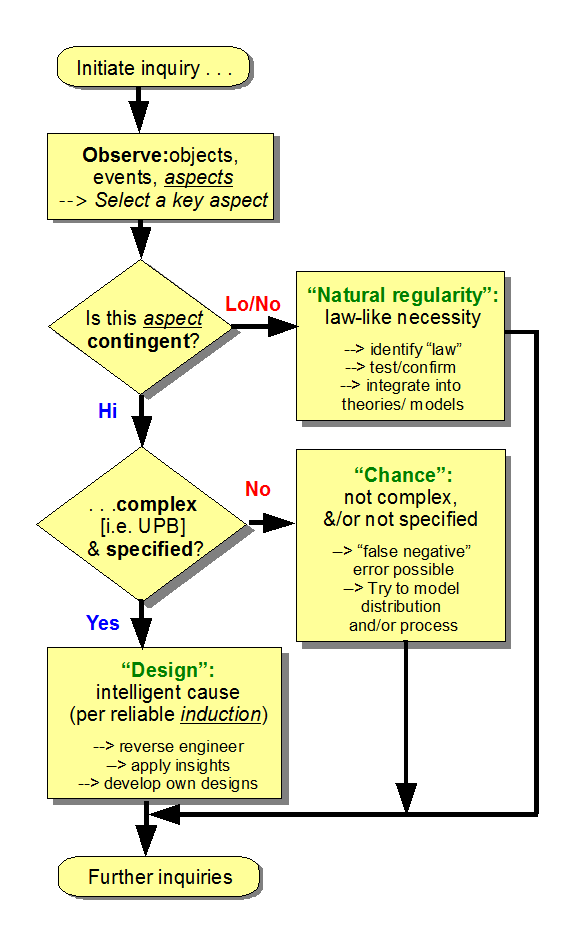
The ID Inference Explanatory Filter. Note in particular the sequence of decision nodes


You have for sure seen the per apsect design filter and know that the first default explanaiton is that something is caused by law of necessity, for good reason; that is the bulk of the cosmos. You know similarly that highly contingent outcomes have two empirically warrantged causal sources: chance and choice.

You kinow full well that he reason chance is teh default is to give the plain benefit of the doubnt to chance, even at the expense of false negatives.

I suppose. Again, I don’t think of it like that. I take each case and consider it’s context before I think the most likely explanation to be.

[b –> You have already had adequate summary on how scientific investigations evaluate items we cannot directly observe based on traces and causal patterns and signs we can directly establish as reliable, and comparison. This is the exact procedure used in design inference, a pattern that famously traces to Newton’s uniformity principle of reasoning in science.]

I think SETI signals are a good example of really having no idea what’s being looked at.

[c –> There are no, zip, zilch, nada, SETI signals of consequence. And certainly no coded messages. But it is beyond dispute that if such a signal were received, it would be taken very seriously indeed. In the case of dFSCI, we are examining patterns relevant to coded signals. And, we have a highly relevant case in point in the living cell, which points to the origin of life. Which of course is an area that has been highlighted as pivotal on the whole issue of origins, but which is one where you have determined not to tread any more than you have to.]

I suppose, in that case, they do go through something like you’re steps . . . first thing: seeing if the new signals is similar to known and explained stuff.

[d –> If you take off materialist blinkers for the moment and look at what the design filter does, you will see that it is saying, what is it that we are doing in an empirically based, scientific explanation, and how does this relate to the empirical fact that design exists and affects the world leaving evident traces? We see that the first thing that is looked for is natural regularities, tracing to laws of mechanical necessity. Second — and my home discipline pioneered in this in C19 — we look at stochastically distributed patterns of behaviour that credibly trace to chance processes. Then it asks, what happens if we look for distinguishing characteristics of the other cause of high contingency, design? And in so doing, we see that there are indeed empirically reliable signs of design, which have considerable relevance to how we look at among other things, origins. But more broadly, it grounds the intuition that there are markers of design as opposed to chance.]

And you know the stringency of the criterion of specificity (especially functional) JOINED TO complexity beyond 500 or 1,000 bits worth, as a pivot to show cases where the only reasonable, empirically warranted explanation is design.

I still think you’re calling design too early.

[e –> Give a false positive, or show warrant for the dismissal. Remember, just on the solar system scope, we are talking about a result that identifies that by using the entire resources of the solar system for its typically estimated lifespan to date, we could only sample something like 1 straw to a cubical haystack 1,000 light years across. If you think that he sampling theory result that a small but significant random sample will typically capture the bulk of a distribution is unsound, kindly show us why, and how that affects sampling theory in light of the issue of fluctuations. Failing that, I have every epistemic right to suggest that what we are seeing instead is your a priori commitment to not infer design peeking through.]

And, to be honest, the only things I’ve seen the design community call design on is DNA and, in a very different way, the cosmos.

[f –> Not so. What happens is that design is most contentious on these, but in fact the design inference is used all the time in all sorts of fields, often on an intuitive or semi intuitive basis. As just one example, consider how fires are explained as arson vs accident. Similarly, how a particular effect in our bodies is explained as a signature of drug intervention vs chance behaviour or natural mechanism. And of course there is the whole world of hypothesis testing by examining whether we are in the bulk or the far skirt and whether it is reasonable to expect such on the particularities of the situation.]

The real problem, with all respect, as already highlighted is obviously that this filter will point out cell based life as designed. Which — even though you do not have an empirically well warranted causal explanation for otherwise, you do not wish to accept.

I don’t think you’ve made the case yet.

[f –> On the evidence it is plain that there is a controlling a priori commitment at work, so the case will never be perceived as made, as there will always be a selectively hyperskeptical objection that demands an increment of warrant that is calculated or by unreflective assertion, unreasonable to demand, by comparison with essentially similar situations. Notice, how ever so many swallow a timeline model of the past without batting an eye, but strain at a design inference that is much more empirically reliable on the causal patterns and signs that we have. That’s a case of straining at a gnat while swallowing a camel.]

I don’t think the design inference has been rigorously established as an objective measure.

[g –> Dismissive assertion, in a context where “rigorous’ is often a signature of selective hyperskepticism at work, cf, the above. The inference on algorithmic digital code that has been the subject of Nobel Prize awards should be plain enough.]

I think you’ve decided that only intelligence can create stuff like DNA.

[h –> Rubbish, and I do not appreciate your putting words in my mouth or thoughts in my head that do not belong there, to justify a turnabout assertion. You know or full well should know, that — as is true for any significant science — a single well documented case of FSCO/I reliably coming about by blind chance and/or mechanical necessity would suffice to break the empirical reliability of the inference that eh only observed — billions of cases — cause of FSCO/I is design. That you are objecting on projecting question-begging (that is exactly what your assertion means) instead of putting forth clear counter-examples, is strong evidence in itself that the observation is quite correct. That observation is backed by the needle in the haystack analysis that shows why beyond a certain level of complexity joined to the sort of specificity that makes relevant cases come from narrow zones T in large config spaces W, it is utterly unlikely to observe cases E from T based on blind chance and mechanical necessity.]

I haven’t seen any objective way to determine that except to say: it’s over so many bits long so it’s designed.

[i –> Strawman caricature. You know better, a lot better. You full well know that we are looking at complexity AND specificity that confines us to narrow zones T in wide spaces of possibilities W such that the atomic resources of our solar system or the observed cosmos will be swamped by the amount of haystack to be searched. Where you have been given the reasoning on sampling theory as to why we would only expect blind samples comparable to 1 straw to a hay bale 1,000 light years across (as thick as our galaxy) will reliably only pick up the bulk, even if the haystack were superposed on our galaxy near earth. Indeed, just above you had opportunity to see a concrete example of a text string in English and how easily it passes the specificity-complexity criterion.]

And I just don’t think that’s good enough.

[j –> Knocking over a strawman. Kindly, deal with the real issue that has been put to you over and over, in more than adequate details.]

But that inference is based on what we do know, the reliable cause of FSCO/I and the related needle in the haystack analysis. (As was just shown for a concrete case.)

But you don’t know that there was an intelligence around when one needed to be around which means you’re assuming a cause.

[k –> Really! You have repeatedly been advised that we are addressing inference on empirically reliable sign per patterns we investigate in the present. Surely, that we see that reliably, where there is a sign, we have confirmed the presence of the associated cause, is an empirical base of fact that shows something that is at least a good candidate for being a uniform pattern. We back it up with an analysis that shows on well accepted and uncontroversial statistical principles, why this is so. Then we look at cases where we see traces from the past that are comparable to the signs we just confirmed to be reliable indices. Such signs, to any reasonable person not ideologically committed to a contrary position, will count as evidence of similar causes acting in the past. But more tellingly, we can point to other cases such as the reconstructed timeline of the earth’s past where on much weaker correlations between effects and putative causes, those who object to the design inference make highly confident conclusions about the past and in so doing, even go so far as to present them as though they were indisputable facts. The inconsistency is glaringly obvious, save to the true believers in the evo mat scheme.]

And you’re not addressing all the evidence which points to universal common descent with modification.

[l –> I have started form the evidence at the root of the tree of life and find that there is no credible reason to infer that chemistry and physics in some still warm pond or the like will assemble at once or incre4mentally, a gated, encapsulated, metabolising entity using a von Neumann, code based self replicator, based on highly endothermic and information rich macromolecules. So, I see there is no root to the alleged tree of life, on Darwinist premises. I look at the dFSCI in the living cell, a trace form the past, note that it is a case of FSCO/I and on the pattern of causal investigations and inductions already outlined I see I have excellent reason to conclude that the living cell is a work of skilled ART, not blind chance and mechanical necessity. thereafter, ay evidence of common descent or the like is to be viewed in that pivotal light. And I find that common design rather than descent is superior, given the systematic pattern of — too often papered over — islands of molecular function (try protein fold domains) ranging up to suddenness, stasis and the scope of fresh FSCO/I involved in novel body plans and reflected in the 1/4 million plus fossil species, plus mosaic animals etc that point to libraries of reusable parts, and more, give me high confidence that I am seeing a pattern of common design rather than common descent. This is reinforced when I see that ideological a prioris are heavily involved in forcing the Darwinist blind watchmaker thesis model of the past.]

We’re going around in circles here.

[m –> On the contrary, what is coming out loud and clear is the ideological a priori that drives circularity in the evolutionary materialist reconstruction of the deep past of origins. KF]>>

___________

GP at 796, and following,  is also a good pick-up point:

__________

>>796

  1. Joe:

    If a string for which we have correctly assesses dFSCI is proved to have historically emerged without any design intervention, that would be a false positive. dFSCI has been correctly assessed, but it does not correspond empirically to a design origin.

    It is important to remind that no such example is empirically known. That’s why we say that dFSCI has 100% specificity as an indicator of design.

    If a few examples of that kind were found, the specificity of the tool would be lower. We could still keep some use for it, but I admit that its relevance for a design inference in such a fundamental issue like the interpretation of biological information woudl be heavily compromised.

  2. If you received an electromagnetic burst from space that occurred at precisely equal intervals and kept to sidereal time would that be a candidate for SCI?

  3. Are homing beacons SCI?

  4. Jerad:

    As you should know, the first default is look for mechanical necessity. The neutron star model of pulsars suffices to explain what we see.

    Homing beacons come in networks — I here look at DECCA, LORAN and the like up to today’s GPS, and are highly complex nodes. They are parts of communication networks with highly complex and functionally specific communication systems. Where encoders, modulators, transmitters, receivers, demodulators and decoders have to be precisely and exactly matched.

    Just take an antenna tower if you don’t want to look at anything more complex.

    KF>>

__________

I am fairly sure that this discussion, now in excess of 1,500 comments, lets us all see what is really going on in the debate over the design inference. END

Comments
petrushka:
It would seem that the only suggested use for dFSCI would be to distinguish biological sequences that could be the result of incremental evolution form those that could not.
As usual, we are left to wonder what on earth you mean. How could dFSCI possibly distinguish between the two? As gpuccio has explained many times, a biological sequence either exhibits dFSCI or it doesn't. dFSCI cannot, even in principle, distinguish between two biological sequences that exhibit dFSCI. So what that means is, you need to identify a biological sequence that exhibits dFSCI, get gpuccio to agree that it exhibits dFSCI, then show how it had it's origin in something other than design. That would, to say the least, weaken the design inference for biological strings that exhibit dFSCI, wouldn't you agree? But you won't. You can't. Neither can any of the other nay-sayers over there at TSZ. At lest keiths knows this, which is why he clings, against all evidence to the contrary, to assert that dFSCI is circular.Mung
November 11, 2012
November
11
Nov
11
11
2012
07:15 PM
7
07
15
PM
PDT
As I said over in the Upright BiPed thread, I’m willing to take you seriously if you’re willing to carry on a serious discussion. We probably all are. (Except Joe.)
Because Joe knows, and history confirms, there ain't any such thing as carrying on a serious discussion with that ilk. OTOH Mung and the rest are hopeful that the most dense material known to exist- the skull of a materialist- can be breached and then reasoned with.Joe
November 11, 2012
November
11
Nov
11
11
2012
07:04 PM
7
07
04
PM
PDT
Toronto:
The improbability argument does not apply to “computer” structures any more than it does to biology.
Sure it does. Try running x86 machine code on some other architecture. There is a subset of all possible strings of bits that are functional as machine code. If you came across a sequence that was functional as machine code and of sufficient complexity you would not attribute the sequence to chance or necessity. If SETI received a message from outer space that upon conversion to a sequence of 0s and 1s was executable on an x86 computer it would be big news. Your objections to gpuccio's argument are just not believable. Do try again.Mung
November 11, 2012
November
11
Nov
11
11
2012
06:58 PM
6
06
58
PM
PDT
Toronto:
You keep misunderstanding that computer programming languages as seen by the programmer do not exist in text format at execution time.
lol. Listen, you are very sloppy with your language. No wonder gpuccio has a problem understanding you. I have problems understanding you, and English is my first language. Is English your first language? I have programmed in interpreted languages, such as Ruby and Perl, in compiled languages, such as C and Java, and in assembly language (in ASA, among others). I am not misunderstanding what goes on when computers execute instructions. I can write code in Ruby and save it to a file. I can launch the Ruby interpreter and it will read and process the file. The file and the ASCII text it contains does not disappear just because it is being executed. The file continues to exist along with the instruction in it, in text format, at execution time. So maybe you meant to say something else, because that was a really dumb statement. Toronto:
...so claiming 80 bits of complexity for 10 characters is misleading as the tokenized executable code might be smaller or larger.
ok, you got me here. What is 'tokenized executable code'? My point was, and this seems to be a point lost on you, that the text has to be turned into 'bits'. Why must it be turned into bits? Maybe I don't misunderstand after all. Toronto:
For instance, the “return’ command in “C” does not necessarily generate any more code than typing “ret” in an assembler language.
and? my examples were def and end, two more three letter words. Even assembly language typically uses three characters or more. At some point the instructions have to be converted to bits that are meaningful. I challenge you to show a 16 bit 'function.' Toronto:
Like this: Memory[x] = 0xF2; Memory[x+1] = 0xAE; Those 16 bits are the machine code for “REPNE scansb” for an x86 CPU which will search through sequential memory, i.e. a “string”, until a match is found.
That's not machine code. How did you arrive at a figure of 16 bits? Toronto:
As an example, the function of ‘XOR’ing two registers takes one byte (8 bits), in most micros.
That's a function that already exists. How many bits did it take to define it? Wikipedia:
XOR CL, [12H] = 00110010 00001110 00010010 00000000 = 32H 0EH 12H 00H
32 bits, just for an XOR, a pre-defined function. Try again.Mung
November 11, 2012
November
11
Nov
11
11
2012
06:46 PM
6
06
46
PM
PDT
Alan Fox:
Gpuccio seems to be saying he can distinguish between a sequence of symbols that are not random from a sequence of randomly generated symbols.
I don't think I've ever seen him make any such claim. petrushka was on to something, but never followed up on it. Shame.
Leaving aside the impression that this is yet to be convincingly demonstrated...
What would convince you?
Accepting for the sake of argument that there is a universal way (gpuccio’s method) to tell if a string of numbers were either random or non-random, how does this advance ID? What am I missing?
The middle way. As I said over in the Upright BiPed thread, I'm willing to take you seriously if you're willing to carry on a serious discussion. We probably all are. (Except Joe.) 1. Do you dispute that there is a way to distinguish random sequences from non-random sequences? mark frank seemed to have no problem. 2. Do you understand why informational sequences will appear to be random rather than non-random? 3. Do you know that DNA sequences that appear to be random actually code for functional proteins? 4. Do you see what you're missing. yet? 5. Are you familiar with the Explanatory Filter? 6. Do you see that both random sequences and designed sequences are a subset of contingent sequences? 7. Might we then expect that random and designed sequences have something in common not exhibited by strings produced by a necessity mechanism. 8. Do you grasp yet, that designed sequences may well appear to be random? 9. Do you see what you're missing. yet?Mung
November 11, 2012
November
11
Nov
11
11
2012
05:07 PM
5
05
07
PM
PDT
Do you have any actual quotes from gpuccio saying he doesn’t need to apply dFSCI to biological examples, or are you just in the mood to make things up?
Well, the quote was in the quote I quoted! To save you the trouble of looking back at the quote, here it is again:
Your need to read an assessment of dFSCI on Nature is only your personal need. I am happy that I do not need that, because I am afraid I would have to wait some time.
Alan Fox
November 11, 2012
November
11
Nov
11
11
2012
04:58 PM
4
04
58
PM
PDT
Alan Fox:
gpuccio seems to say that he does not need to apply his method to Nature (a biological example, I assume he means) presumably because all life is designed anyway and he doesn’t need to check.
Do you have any actual quotes from gpuccio saying he doesn't need to apply dFSCI to biological examples, or are you just in the mood to make things up? In fact, that seems to be the exact opposite of what he does say. Did you miss his cites of the Durston paper? How about his continual refrain about protein domains, to which no one over at TSZ can ever bring themselves to bear upon and actually debate? You're off to a rousing beginning. Grats.Mung
November 11, 2012
November
11
Nov
11
11
2012
04:49 PM
4
04
49
PM
PDT
Alan, The simplest living organisms exhibit dFSCI. And what they acheive as concepts is they allow for objective design detection. And as anyone who has actually conducted an investigation knows, the mere determination of design changes the investigation and changes the way we look at it. You do realize that we investigate a pile of rocks differently than we do a pile of artifacts (made from rocks), and that we investigate a crime differently than we investigate natural phenomena? So THAT is what you are missing Alan-> knowledge of investigation.Joe
November 11, 2012
November
11
Nov
11
11
2012
04:37 PM
4
04
37
PM
PDT
Gpuccio writes
Everybody here is well aware that it is extremely easy to distinguish designed strings from randomly generated strings by the use of dFSCI. The specificity of dFSCI for design can be tested everywhere, in every setting, just by respecting a few simple rules. I have shown you how to do that. Your need to read an assessment of dFSCI on Nature is only your personal need. I am happy that I do not need that, because I am afraid I would have to wait some time.
Gpuccio seems to be saying he can distinguish between a sequence of symbols that are not random from a sequence of randomly generated symbols. Leaving aside the impression that this is yet to be convincingly demonstrated, gpuccio seems to say that he does not need to apply his method to Nature (a biological example, I assume he means) presumably because all life is designed anyway and he doesn’t need to check. I am left wondering what it is that CSI and dFSCI (is that a typo; should it be dFCSI?) can achieve as concepts. Accepting for the sake of argument that there is a universal way (gpuccio’s method) to tell if a string of numbers were either random or non-random, how does this advance ID? What am I missing? _____ F/N: Mr Fox, it is you who have the variant. dFSCI stands for digitally coded, functionally specific complex information, and means a digital string of sufficient length that in a given context (e.g. 500 bits for our solar system), blind chance and/or mechanical necessity would be maximally unlikely to hit on it or the functional equivalent. Empirically, every case of dFSCI of known origin -- e.g. the contents of libraries, files on computers, etc, posts in this thread -- is the product of intelligent design. On both inductive generalisation and the needle in the haystack analysis, we have good reason to infer that such dFSCI is an empirically reliable and analytically plausible sign of design as best causal explanation. Why this is controversial is not because it lacks such a warrant as just outlined, but because it assigns DNA and related entities to design, which is a challenge to an established school of thought. never mind, that the members of that school, on being pressed, have to admit that they do not have a cogent, empirically well warranted explanation of OOL, the first biologically relevant case. KFAlan Fox
November 11, 2012
November
11
Nov
11
11
2012
04:11 PM
4
04
11
PM
PDT
Toronto:
Our problems with gpuccio are mainly in trying to understand what he means.
Well maybe you should find out before launching unfounded accusations and then cheering your success. He's shown every willingness to clarify. Like I said. He withstood the logical challenge. Then he withstood the empirical challenge. I predict that it won't be too long before you all will be crowing about his defeat over there at TSZ and accusing him of intellectual cowardice.Mung
November 11, 2012
November
11
Nov
11
11
2012
04:00 PM
4
04
00
PM
PDT
Toronto:
Just to be “clear”, a “method” can be as short as 16 bits.
So? First, I thought we were talking objects and defining methods on objects, which I presume means we were talking about object-oriented languages. What language are you using to define your 16-bit method? Second, you were specifically talking about building up objects from small methods. Third, you explicitly mentioned object-oriented programming. So, are we talking about an OO language, or something else? As you must know by now, I like Ruby. A short method that does absolutely nothing can be defined as follows: def a;end; try it: http://tryruby.org/levels/1/challenges/0 That's 10 characters, minimum. 80 bits. And that method does nothing, so it can hardly be used to build up an object. So what language are you talking about? And actually code, please. You seem long on talk and short on functional code. And what on earth is your point in all this, or do you even have one?Mung
November 11, 2012
November
11
Nov
11
11
2012
03:53 PM
3
03
53
PM
PDT
Mark Frank:
Incidentally none of the examples you offer have dFSCI as I understand your rules. 1) You have failed to define the function for any of them.
So? You think for a string to exhibit dFSCI the function has to be defined by gpuccio? I thought gpuccio said the function needed to be objective.
2) I know the origin of the first one – so that is no good.
Your first objection is therefore without merit. gpuccio did not have to define the function for it to be recognizable and for you to apply that recognition to identifying the source. So now what is your basis for asserting his first string does not exhibit dFSCI?Mung
November 11, 2012
November
11
Nov
11
11
2012
03:34 PM
3
03
34
PM
PDT
Mark Frank:
I see you talk a lot of honesty. Do you accept that you don’t know of any instances where the dFSCI design relationship has been demonstrated outside of examples put forward in debates like this? I have asked you several times to provide an example and on every occasion you have failed to do this. Remember that you yourself said that demonstrating this relationship requires the observer not to know the origin.
I also find this remark very strange. gpuccio has never shied away from the fact that we don't have complete knowledge about the origin. That's why his argument is based upon inference, and he's never claimed otherwise. Now your position is really very weak mark, if you're reduced to, at this time we don't know the origin, therefore we never will. How anti-science is that? ;) It's my understanding that we have the technology to encode English text into DNA. Now all gpuccio has to do is find a case where this has been done where the sequence is of sufficient complexity, and then where will your argument stand? An Entire Book Written in DNA Future of Data: Encoded in DNA http://code.google.com/p/text2dna/ I predict that we will be able to find encoded in the DNA of a living organism information for which we can demonstrate the origin has an intelligent cause. If we can't already do that, it's only a matter of time.
How can we be sure that the M. mycoides is synthetic? When recreating it, the team added a number of non-functional "watermarks" to the genome, making it distinct from the wild version. Scientists create “artificial life” – synthetic DNA that can self-replicate
Show me the string(s). The function, to serve as a 'watermark' identifying this organism as synthetic.Mung
November 11, 2012
November
11
Nov
11
11
2012
01:49 PM
1
01
49
PM
PDT
Mark: I see you talk a lot of honesty. Do you accept that you don’t know of any instances where the dFSCI design relationship has been demonstrated outside of examples put forward in debates like this? I have asked you several times to provide an example and on every occasion you have failed to do this. Remember that you yourself said that demonstrating this relationship requires the observer not to know the origin. I don't know what you want from me. The connection between CSI and design has been repeatedly observed by all those who have developed the ID theory. As I have formalized a special definition and procedure here in this blog, that IMO allows a better clarity of the concept and an easier application to digital strings, I have challenged you to verify my statement that dFSCI could be easily observed to have 100% specificity for design in all possible settings where the origin is independently known. We have tried together to verify that affirmation of mine, with the results that you know as much as I do. The connection between CSI and design is universally affirmed in all ID literature. That's very natural, because the definition of CSI and its role in design detection are a product of ID theory. Obviously, much less interest in the subject can be found in the official literature. dFSCI is my personal form of CSI, with some personal aspects, although it is essentially a subset of CSI. Everybody here is well aware that it is extremely easy to distinguish designed strings from randomly generated strings by the use of dFSCI. Those who understand well the concept are also aware that it is easy also to exclude strings that can have a necessity origin. You at TSZ have expressed many doubts about dFSCI, its definition, its procedure, its results, its specificity for design. I have challenged you to test all that here, and we have done it. Now, you want "instances where the dFSCI design relationship has been demonstrated outside of examples put forward in debates like this". Do you want papers on Nature about dFSCI specificity? I cannot give them. But you certainly know that. The specificity of dFSCI for design can be tested everywhere, in every setiing, just by respectinbg a few simple rules. I have shown you how to do that. As KF always says, anyone who recognizes language as designed, every day, is using the same principle, although certainly less formally. You will say that Bayesian inference can give the same results. I have nothing against that. If Bayesian inference can show that a string is designed, so it be. My non Bayesian method certainly can. The problem of the final inference for biological strings remains the same. I think we have clarified enough the terms of the problem, and why, IMO, you choose one way, and why, in your opinion, I choose another way. The simple truth is, we have different vies, different cognitive approaches, and certainly different committments. All that can influence our choices, but it is our responsibility to make our choice as adherent to truth as we feel possible. I hope that answers your request. Your need to read an assessment of dFSCI on Nature is only your personal need. I am happy that I do not need that, because I am afraid I would have to wait some time. If, on the pother havd, your strange request is only a new form of appeal to authority and to conformist thought from a "skeptic", I have already commented on that. Truth is truth, wherever observe it, or debate it, or try to catch it. As I have said, I love this place, because this is a place where we are seeking truth together. Finally, it is obvious that the testing requires the observer not to know the origin. That's exactly what we have done here. If you are worried that I could guess the origin from the person who proposes the string, we can repeat the experiment. You can get strings form people here or from people at TSZ (you think how, at some e-mail address for instance), and then give them to me anonimously, here, in a single document. I will assess dFSCI for them by my procedure, and then you will verify the results. We can do that whenever you like.gpuccio
November 11, 2012
November
11
Nov
11
11
2012
12:21 PM
12
12
21
PM
PDT
Is that clear, or still vague?
It doesn't matter how clear you make it, Toronto will still twist it.Mung
November 11, 2012
November
11
Nov
11
11
2012
12:00 PM
12
12
00
PM
PDT
Toronto: Just to be disgustingly clear: In my theory, both "the “information” to make corn bug resistant and also the code to make it 12? tall" would qualify as dFSCI if they have the requirements. That has nothing to do with the iontentions of tyhe designer, that we obviously do not know. In my theory, a separate functional complexity would be computed for each of those two codes (and functions), and a separate judgement about dFSCI would be given for each of them. In my theory, intent is certainly part of the design process, but information or inference about the intents of the designer is not part of the assessment of dFSCI, and therefore of the design inference for the observed object. Is that clear, or still vague?gpuccio
November 11, 2012
November
11
Nov
11
11
2012
11:26 AM
11
11
26
AM
PDT
Toronto:
Imagine a pool of 1000 text strings you could choose from. Half of the strings are proper English sentences and the other half are random nonsense. The odds of my randomly sending you a valid text string is 1 in 2 but the odds of my sending you any “specific” message from that pool is one 1 in a 1000. Now let’s apply it to biological “design”. If I as the “intelligent designer”, have a pool of “genetic code” that contains the “information” to make corn bug resistant and also the code to make it 12? tall, and my intention is to make the corn bug resistant, I must send you that “specific” code. An IDist cannot in this case, look at a field of 12? tall corn and say, “There is no way corn can so quickly change from being 8? tall to being 12? tall without being “designed” that way. As the “intelligent designer”, I would have failed in this case as the “design” I intended, clearly did not get into the organism. That is the whole point of these discussions, that ID is a “theory of intent”, and should not accept “random variation” as acceptable evidence of “design”, which is what would have happened in this case. Despite the facts that the strings themselves qualify as “dFSCI”, you cannot claim “design” unless you know what the designer’s intentions were.
Well, now it is more clear. What can I say? You are pparently elaborating your own theory of Intelligent Designed, and you are entitled to that. But your theory has nothing in common with mine, or with anyone else's here. So, if we want to discuss my theory, we should discuss it, and not confound it with yours. In my theory, there is nothing like what you describe. In my theory, an object is designed if, and only if, the arrfangement of the information in the object is given by a conscious intelligent being, who purposefully outputs his conscious representations to the object. In my theory, the only intention of the designer is to design the object according to his conscious representations. In my theory, there is a property that can be assessed in some digital strings, and not in others, that I call dFSCI. It has nothing to do with the origin of the information in the string. In my theory, there is a procedure to assess if that property is present or not. In my theory, a connection is empirically observed between the presence of dFSCI and a design origin of the information. The connection is: if dFSCI is present, the information in the object has a design origin. If dFSCI is not affirmed in the string, the origin can be either design or a random system or a necessity mechanism. That is the same as saying that dFSCI is an indicator of a dersign origin with 100% specificity and low sensitivity. Obviously, the measurement of dFSCI's specificity is made with strings whose true origin can be independently known. In my theory, dFSCI can ne ueds to infer design for strings whose true origin is not know, like biological strings. That is the essence of ID theory for biological information. This is my theory, and I believe it is essentially what the ID theory is about. Your theory is something else.gpuccio
November 11, 2012
November
11
Nov
11
11
2012
11:21 AM
11
11
21
AM
PDT
Toronto:
Our problems with gpuccio are mainly in trying to understand what he means. At one point it seemed that gpuccio, Joe and I agreed that “dFSCI” was not dependent on its origin. Soon after that, Joe and I both seemed to think that gpuccio had made statements to the effect that in certain cases, “dFSCI” was dependent on its origin. Further on I found out that gpuccio didn’t mean origin of the string as much as he meant the “content” of the string, but he doesn’t use terms as I understand them. It’s the same sort of confusion with Upright BiPed’s use of “arbitrary”. Using the term “materially arbitrary” however, is as clear as using the term “aggressively passive”. Please don’t anyone ask me to clarify what the word “passive” means as you could easily Google it and get a clear definition.
Ehm... Just to be clear: a) When we assess dFSCI in a string, we have no idea of its origin (said as clearly as possible at least 20 times in the last week). b) The origin of a string is the simple observable fact of how it is generated: I see you writing a poem to express your feelings, I know its origin is from you, a conscious intelligent beings: the string is designed. I see you tossing a coin and just writing the results, I know that the origin of the string is from a random system (the coin tossing). Obviously, we are referring here to the origin of the information in the string, of the arrnagement of values: it is not important if the string is written by you, or by the rain, or by a computer. c) The content of a string is the content, the infromation, the arrangement, you name it. What is not clear in the word? All that has been clarified a lot of times. You have problems? Maybe, but I can't understand why.gpuccio
November 11, 2012
November
11
Nov
11
11
2012
10:45 AM
10
10
45
AM
PDT
Toronto:
No, what you have done is make a “functional description”, not a “functional specification”. As an example, if someone asks kairosfocus to look at an electronic circuit and find out what it does, he could perform tests and then render his description of how it operates. If the builder of the board then disagrees and quotes his “functional specification” as stating a completely different functionality, KF gets to say, your “specification” has not been met. What KF cannot do, is proclaim that what he has observed is the “functional specification”, as clearly he had no way of knowing what was actually intended. A design that has an unintended result, has not been “specified”.
I am in complete amazement. What you say is beyond any reasonable interpretation. Please. go back to my definition of dFSCI. d is for "digital" FS is for "functionally specified" C is for "complex" I is for "information". I don't know what you mean for "specification", but I certainly know what I mean for "functional specification". It happens that I have defined that vague term many times here. Maybe you were distracted. "Functional specification" means that an observer recognizes a function in the string, whatever function he likes, defines it explicitly, and gives some objective method to recognize that function and measure it in any possible string. That is a specification, because it defines a subset of the search space, the target space: the set of all strings (usually, for simplicity, of the same length) that express the function as defined. the ration of the target space to the search space will be the functional complexity for that functional specification. This is all in the definition and procedure. You will certainly find it vague, but I cannot help you for that. The obvious thing is that my definition and procedure have nothing to do with the strange, rambling comments in your post.gpuccio
November 11, 2012
November
11
Nov
11
11
2012
10:37 AM
10
10
37
AM
PDT
Toronto: How can I believe that you are not intentionally generating confusion, just for the hell of it? But then you have failed a design connection! The whole point of “designing” something is to get the result you intend. Please, this is ridiculous. What I said was: " We don’t assess function as a specific intention. We are not mind readers. We just recognize a possible function, define it appropritaely, and compute the complexity linked to the function we have defined." It is very clear what I am speaking of: the procedure to assess dFSCI in a string. In that procedure, there is no discussion about "intention", least of all "specific intention". If we affirm dFSCI, we infer design. Design is obviously an intentional process, but what has that to do with the assessment of dFSCI as described? I affirm dFSCI for the sonnet. Then I infer design for it. Correctly. The sonnet is obviously intentional: Shakespeare certainly intended for it to express a definite meaning (not always easy to understand, but that's another story). But you and I have nothing to do with Shakespeare's intention, least of all with the evaluatio of dFSCI in his sonnet. Is this vague, again? If you don’t get the result you intend, your design has failed to meet its specified functionality. And so? what has that to do with the assessment of dFSCI? If you’re saying a designer would accept a result that exists in a “set of results”, then any improbability assigned to a “target” in a “search space”, drops drastically. I don't know if this is vague, but certainly I don't understand what it means! Please, explain better. If the “intelligent designer” of life is willing to accept one of a number of “configurations” for his “designs”, then Behe, kairosfocus and Dembski can no longer use the improbability argument. Again, not very clear, but I will try to interpret it in some way. A designer can choose any configuration he likes, but obviously, if he is a good designer, he will choose a configuration that expresses well the desired function. That is very trivial. But it is certainly possible that many different configurations can express the function well enough. That is certainly the case with proteins. We know that many configurations can still express the function. That's why, in evaluation dFSCI, we try to compute the target space/search space ration to calculate the dFSI. That's why, in Durston's paper, the functional complexity of protein is much lower that the maximum complexity derived from the length of the sequence. But we can still use the improbability argument, obviously in reference to the functional complexity, and not to the complexity of the search space. I don't know if these vague comments can answer your "point", because I am not sure I have understood your point.gpuccio
November 11, 2012
November
11
Nov
11
11
2012
10:27 AM
10
10
27
AM
PDT
Mark Frank:
That’s a strange inference because it means there is no way of correlating dFSCI with design at the molecular level as we do not know the origin of any strings with dFSCI.
Thanks for that admission.Mung
November 11, 2012
November
11
Nov
11
11
2012
10:23 AM
10
10
23
AM
PDT
Mark: That’s a strange inference because it means there is no way of correlating dFSCI with design at the molecular level as we do not know the origin of any strings with dFSCI. Let's put it this way: a) either biological strings are the only exception in the whole universe to the repeatedly observe connection between dFSCI and design origin or: b) they are designed, like all other strings exhibiting dFSCI. So, we in ID choose b) and infer design. It can seem strange to you. It seems very natural to us. Again, choices.gpuccio
November 11, 2012
November
11
Nov
11
11
2012
10:12 AM
10
10
12
AM
PDT
gpuccio, Again, you have our respect. The announcement at TSZ that your definition of dFSCI was circular was met with great fanfare and many cheers from the peanut gallery. Strangely, when that line of attack failed, many of them just fell silent. You passed the logical test. Then came the empirical test. As you point out, the main thrust was to have you give a false positive. What does that tell us? They understood, at whatever level, that giving you strings with objectively defined functions that were in fact designed was not going to help their cause. It means that in the main, they full well know that you are correct.Mung
November 11, 2012
November
11
Nov
11
11
2012
10:04 AM
10
10
04
AM
PDT
mark frank:
The problem now is that carbon chains are the only digital strings with any kind of complexity and these are just the one’s we are trying to evaluate. There are no digital strings at the molecular level with dFSCI except for those involved in life.
why carbon? pure coincidence? a miracle?Mung
November 11, 2012
November
11
Nov
11
11
2012
09:51 AM
9
09
51
AM
PDT
Mark: I have read you new summary. I find ot honest enough. I disagree on many points, but I believe I have already explained why, so I will not repeat myself. Let's say it is a honest summary of you views about my arguments. But I fully agree on this conclusion: The problem now is that carbon chains are the only digital strings with any kind of complexity and these are just the one’s we are trying to evaluate. There are no digital strings at the molecular level with dFSCI except for those involved in life. That's exactly what makes me so certain about the design inference for biological strings. Again, different choices.gpuccio
November 11, 2012
November
11
Nov
11
11
2012
08:46 AM
8
08
46
AM
PDT
Toronto: You have might a false negative if you decide the part you cannot read from a human point of view is not designed. As an example, it might be the header for the communications packet that ensured the data payload was properly received by a slave terminal. And so? I will have a false negative for that part. What's the problem? What is vague in my definition of dFSCI, where I say that there can be many false negatives? Suspiciously, the bottom unreadable portion could be a trailer for this packet and/or the header for the next one. Anything could be. And so? Even worse is the fact that you have a false positive here for any data string you handle in this manner, since the content of the string was not “specified” by me for you to receive, it was “specific” only to you, which means you painted a target around the arrow. Utter nonsense, to say the least. I have no interest in you specifying anything, especially "for me". Your imagination runs wild. I recognize the meaningful part as exhibiting dFSCI. It does. It is a true positive. The information in that part is designed. Are you denying that? Since I had no intention of conveying that “specific” message to you, it fails the ‘S’ portion of “dFSCI”. Srange, in my definition of dFSCI you and I were not quoted. The "S" portion of the name was not even considered as you seem to do. Indeed, my concept is simply about "functional specification", the specification given by a function. Here, the function is the conveying of the meaning in the sonnet. What have you or I to do with that? That would be like the “intelligent designer” assembling portions of DNA out of order and yet expecting that “string” to be functional. The string could still be considered functional, but the function should be defined in a wider way, such as "a string made of single phrases that are correct in english and meaningful, but that do not have a genral meaning as they are assembled". With that definition, the functional complexity would be lower, and should be computed differently. At this point it may probably not be “functional” as well as being not “specifically” intended. We don't assess function as a specific intention. We are not mind readers. We just recognize a possible function, define it appropritaely, and compute the complexity linked to the function we have defined. We are really discussing ID as it applies to biology and the sonnets are analogies. No. We were discussing my challenge. My challenge was about string whose origin we know, such as sonnets, software, or random strings. Not biological strings. We do not know the origin of biological strings. That's why I have used the sonnets as an example. I can live with Shakespeare out of order, but not my DNA. I am glad to know that. So, that's all for now. Have I been vague?gpuccio
November 11, 2012
November
11
Nov
11
11
2012
08:38 AM
8
08
38
AM
PDT
Toronto: OK, you admitted a very obvious thing once. And I recognized that (as a rare event). All the other times, your behaviour has been obstinately reticent, and many times, like the last one that earned you the liar thing, explicitly unfair, arrogant and insultant. You know, people are often mixed realities. I can live with that. People are trying to understand your points, because we need a good understanding of exactly what you are trying to say, in order to generate a proper response. I don't agree. If you guys are trying to understand my points, either you are not making any serious effort, or you afre seriously habdicapped, or more likely you are only trying to understand any possible weak aspect in my points. In a Bayesian mood, I would definitely bet on option number three. Therefore, your attention and memory is strangely selective and biased, and even the simple understanding of simple terms, however many times explicitly defined by me, seems targeted only to find fault with them, not certainly to understand what I mean with them. The general attitude of all of you is much more than biased, many times intentionally offending and cheating. As I like to give thanks for good things, I have always recognized the few good things that have come from some of you, including the one from you: they can be counted on the fingers of one hand. What have you all done, on the otgher hand? Let's see. You have attacked me with a false accusation of circularity for days or weeks, explcitly ignoring, rephrasing, or simply lying about my detailed explanations. Well, now the argument of circularity seems less popular, and a couple of you has in some way admitted, through their teeth, that my argument is not circular. And yet, my argument has never changed in all this time. You have challenged me to apply dFSCI to strings provided by you. I have done it. All the strings provided by you have been tricky attempts to demonstrate that dFSCI is false, or ambiguous. All have failed. Nobody among you has even tried to do what the challenge was about: provide a series of strings, designed or not designed, to verify if dFSCI really can infer deisgn. All you strings were negatives, more or less smart attempts to affirm a false positive. All were easily recognizable for what they were: negatives, string where no dFSCI was recognizable. Only Mung has provided a designed string, and I have promptly recognized it as exhibiting dFSCI. A true positive, the only one. And yet, what happens? Mark, who is certainly the most sincere among you all, after having debated that, after having had a fulll response by me about the only true positive in our "challenge", suddenly forgets everything about it, and write a series of wrong considerations! Not intentional certainly, but a clear demonstration of the strong cognitive bias, and scarce fairness, that all of you show for my arguments. Abd you say that you don't understand what I say because of my terns, or because I don't answer your legitimate questions? Liar, liar, liar. You understand only what is convenient for you. You are so slectively biased that usually I must explain the same obvious thing at leat ten times before you are forced to step back a little. You should be ashamed. Why would you bother to formulate your “dFSCI” argument if your only intention was for it to be accepted by those who already share your convictions? Clearly they don’t need convincing, we do. I have no intention to convince any of you. I would be a stupid optimist if I thought that. What I do want to do, is to show how my arguments are perfectly sound and convincing, even in the face of unfair and unreasonable criticism form biased adversaries. I want to show that to all sincere readers of this blog, and that's why I discuss with you, either you deserve it or not. You know, the world is not made only of people who have already embraced ID and of people who will never consider it, not even in the facte of overwhelming evidence. There are many paople there who still have an open mind, and are interested in deciding what is true and what is not. If your terms are vague to the very audience you are trying to reach, why would you continue with them? My terms are not vague.gpuccio
November 11, 2012
November
11
Nov
11
11
2012
08:25 AM
8
08
25
AM
PDT
When GP is reduced at length to such a conclusion, that is pointing to a truly sad state.kairosfocus
November 11, 2012
November
11
Nov
11
11
2012
08:17 AM
8
08
17
AM
PDT
Toronto: If you were teaching something to a child and they said they didn’t understand you, would you just keep repeating yourself instead of adapting yourself to your listener? I have never refused to clarify. I have clarified a lot of times. I refuse to adopt your terms instead of mine, for the simple reason that mine are better. If instead you just answered questions as asked, you would actually be typing less and putting the pressure on our side to answer your clarified position. You are a liar, and believe me, this is really a compliment. I have always answered questions, if they has a minimum sense. Your side, including you, very often does not asnwer my answers, or rephrases them with malice or arrogance or both. Your side (with few exceptions, and you are not one of them) would never admit any true thing about ID or dFSCI, whatever the pressure. You are fanatics, and many of you are liars.gpuccio
November 11, 2012
November
11
Nov
11
11
2012
04:26 AM
4
04
26
AM
PDT
Mark: But more to the point – you repeatedly said before we embarked on this that there were many, many cases of dFSCI which have all proved to be designed. When challenged you seem to try any other response than describing a single one. You must be kidding. Let's reverse the challenge. I give you a few strings, and you decide f you want to affirm dFSCI and infer design: 1) "Feedback is a process in which information about the past or the present influences the same phenomenon in the present or future. As part of a chain of cause-and-effect that forms a circuit or loop, the event is said to "feed back" into itself. Ramaprasad (1983) defines feedback generally as "information about the gap between the actual level and the reference level of a system parameter which is used to alter the gap in some way", emphasising that the information by itself is not feedback unless translated into action" 2) "athsisnbdo psiuai kmnxopop m iisuaiooaopp xcdpzspp lcspppdkè klkpsoppès+è+,cèà diusatuiaoò-c à òdlsn so 132 kw09s nal xkoia9m òpòòòò spopospòlw zabayhaon ertysino xdp,amspèa ,XPPSPOJK LXMKLP mkxllzpppzp òèèc 38 sn9su3’, ,mòòààà còòsè copkiziioppp" 3) "0101010101010101010101010101010101010101010101010101010101010101010101010101010101010101010101010101010101010101010101010101010101010101010101010101010101010101010101010101010101010101010101010101010101010101010101010101010101010101010101010101010101010101010101010101010101010101010101010101010101010101010101010101010101010101010101010101010101010101010101010101010101010101010101010101010101010101010101010101010101010101010101010101010101010101010101010101010101010101010101010101010101010101010101010101010101010101010101010101010101010101010101010101010101010101010101010101010101010101" These are three examples, I suppose. I could easily affirm or not affirm dFSCI for each one of them, but I will not do it, because I know their origin. So, please go on.gpuccio
November 11, 2012
November
11
Nov
11
11
2012
04:18 AM
4
04
18
AM
PDT
1 22 23 24 25 26 37

Leave a Reply