Uncommon Descent Serving The Intelligent Design Community

The TSZ and Jerad Thread, III — 900+ and almost 800 comments in, needing a new thread . . .

Categories
Culture
Design inference
Education
Evolution
ID Foundations
science education
specified complexity
worldview
Share
Facebook
Twitter/X
LinkedIn
Flipboard
Print
Email

Okay, the thread of discussion needs to pick up from here on.

To motivate discussion, let me clip here comment no 795 in the continuation thread, which I have marked up:

_________

>> 795Jerad October 23, 2012 at 1:18 am

KF (783):

At this point, with all due respect, you look like someone making stuff up to fit your predetermined conclusion.

I know you think so.

[a –> Jerad, I will pause to mark up. I would further with all due respect suggest that I have some warrant for my remark, especially given how glaringly you mishandled the design inference framework in your remark I responded to earlier.]

{Let me add a diagram of the per aspect explanatory filter, using the more elaborated form this time}
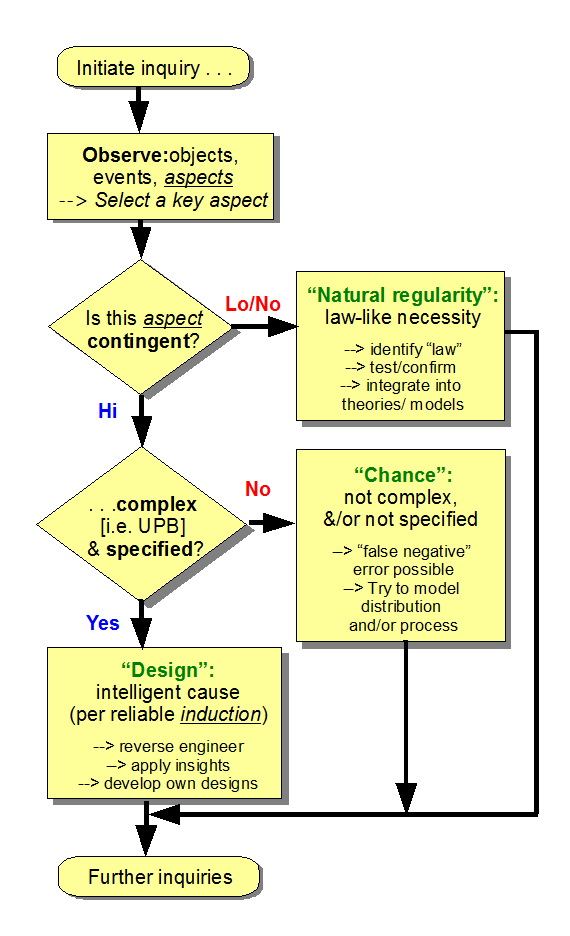
The ID Inference Explanatory Filter. Note in particular the sequence of decision nodes


You have for sure seen the per apsect design filter and know that the first default explanaiton is that something is caused by law of necessity, for good reason; that is the bulk of the cosmos. You know similarly that highly contingent outcomes have two empirically warrantged causal sources: chance and choice.

You kinow full well that he reason chance is teh default is to give the plain benefit of the doubnt to chance, even at the expense of false negatives.

I suppose. Again, I don’t think of it like that. I take each case and consider it’s context before I think the most likely explanation to be.

[b –> You have already had adequate summary on how scientific investigations evaluate items we cannot directly observe based on traces and causal patterns and signs we can directly establish as reliable, and comparison. This is the exact procedure used in design inference, a pattern that famously traces to Newton’s uniformity principle of reasoning in science.]

I think SETI signals are a good example of really having no idea what’s being looked at.

[c –> There are no, zip, zilch, nada, SETI signals of consequence. And certainly no coded messages. But it is beyond dispute that if such a signal were received, it would be taken very seriously indeed. In the case of dFSCI, we are examining patterns relevant to coded signals. And, we have a highly relevant case in point in the living cell, which points to the origin of life. Which of course is an area that has been highlighted as pivotal on the whole issue of origins, but which is one where you have determined not to tread any more than you have to.]

I suppose, in that case, they do go through something like you’re steps . . . first thing: seeing if the new signals is similar to known and explained stuff.

[d –> If you take off materialist blinkers for the moment and look at what the design filter does, you will see that it is saying, what is it that we are doing in an empirically based, scientific explanation, and how does this relate to the empirical fact that design exists and affects the world leaving evident traces? We see that the first thing that is looked for is natural regularities, tracing to laws of mechanical necessity. Second — and my home discipline pioneered in this in C19 — we look at stochastically distributed patterns of behaviour that credibly trace to chance processes. Then it asks, what happens if we look for distinguishing characteristics of the other cause of high contingency, design? And in so doing, we see that there are indeed empirically reliable signs of design, which have considerable relevance to how we look at among other things, origins. But more broadly, it grounds the intuition that there are markers of design as opposed to chance.]

And you know the stringency of the criterion of specificity (especially functional) JOINED TO complexity beyond 500 or 1,000 bits worth, as a pivot to show cases where the only reasonable, empirically warranted explanation is design.

I still think you’re calling design too early.

[e –> Give a false positive, or show warrant for the dismissal. Remember, just on the solar system scope, we are talking about a result that identifies that by using the entire resources of the solar system for its typically estimated lifespan to date, we could only sample something like 1 straw to a cubical haystack 1,000 light years across. If you think that he sampling theory result that a small but significant random sample will typically capture the bulk of a distribution is unsound, kindly show us why, and how that affects sampling theory in light of the issue of fluctuations. Failing that, I have every epistemic right to suggest that what we are seeing instead is your a priori commitment to not infer design peeking through.]

And, to be honest, the only things I’ve seen the design community call design on is DNA and, in a very different way, the cosmos.

[f –> Not so. What happens is that design is most contentious on these, but in fact the design inference is used all the time in all sorts of fields, often on an intuitive or semi intuitive basis. As just one example, consider how fires are explained as arson vs accident. Similarly, how a particular effect in our bodies is explained as a signature of drug intervention vs chance behaviour or natural mechanism. And of course there is the whole world of hypothesis testing by examining whether we are in the bulk or the far skirt and whether it is reasonable to expect such on the particularities of the situation.]

The real problem, with all respect, as already highlighted is obviously that this filter will point out cell based life as designed. Which — even though you do not have an empirically well warranted causal explanation for otherwise, you do not wish to accept.

I don’t think you’ve made the case yet.

[f –> On the evidence it is plain that there is a controlling a priori commitment at work, so the case will never be perceived as made, as there will always be a selectively hyperskeptical objection that demands an increment of warrant that is calculated or by unreflective assertion, unreasonable to demand, by comparison with essentially similar situations. Notice, how ever so many swallow a timeline model of the past without batting an eye, but strain at a design inference that is much more empirically reliable on the causal patterns and signs that we have. That’s a case of straining at a gnat while swallowing a camel.]

I don’t think the design inference has been rigorously established as an objective measure.

[g –> Dismissive assertion, in a context where “rigorous’ is often a signature of selective hyperskepticism at work, cf, the above. The inference on algorithmic digital code that has been the subject of Nobel Prize awards should be plain enough.]

I think you’ve decided that only intelligence can create stuff like DNA.

[h –> Rubbish, and I do not appreciate your putting words in my mouth or thoughts in my head that do not belong there, to justify a turnabout assertion. You know or full well should know, that — as is true for any significant science — a single well documented case of FSCO/I reliably coming about by blind chance and/or mechanical necessity would suffice to break the empirical reliability of the inference that eh only observed — billions of cases — cause of FSCO/I is design. That you are objecting on projecting question-begging (that is exactly what your assertion means) instead of putting forth clear counter-examples, is strong evidence in itself that the observation is quite correct. That observation is backed by the needle in the haystack analysis that shows why beyond a certain level of complexity joined to the sort of specificity that makes relevant cases come from narrow zones T in large config spaces W, it is utterly unlikely to observe cases E from T based on blind chance and mechanical necessity.]

I haven’t seen any objective way to determine that except to say: it’s over so many bits long so it’s designed.

[i –> Strawman caricature. You know better, a lot better. You full well know that we are looking at complexity AND specificity that confines us to narrow zones T in wide spaces of possibilities W such that the atomic resources of our solar system or the observed cosmos will be swamped by the amount of haystack to be searched. Where you have been given the reasoning on sampling theory as to why we would only expect blind samples comparable to 1 straw to a hay bale 1,000 light years across (as thick as our galaxy) will reliably only pick up the bulk, even if the haystack were superposed on our galaxy near earth. Indeed, just above you had opportunity to see a concrete example of a text string in English and how easily it passes the specificity-complexity criterion.]

And I just don’t think that’s good enough.

[j –> Knocking over a strawman. Kindly, deal with the real issue that has been put to you over and over, in more than adequate details.]

But that inference is based on what we do know, the reliable cause of FSCO/I and the related needle in the haystack analysis. (As was just shown for a concrete case.)

But you don’t know that there was an intelligence around when one needed to be around which means you’re assuming a cause.

[k –> Really! You have repeatedly been advised that we are addressing inference on empirically reliable sign per patterns we investigate in the present. Surely, that we see that reliably, where there is a sign, we have confirmed the presence of the associated cause, is an empirical base of fact that shows something that is at least a good candidate for being a uniform pattern. We back it up with an analysis that shows on well accepted and uncontroversial statistical principles, why this is so. Then we look at cases where we see traces from the past that are comparable to the signs we just confirmed to be reliable indices. Such signs, to any reasonable person not ideologically committed to a contrary position, will count as evidence of similar causes acting in the past. But more tellingly, we can point to other cases such as the reconstructed timeline of the earth’s past where on much weaker correlations between effects and putative causes, those who object to the design inference make highly confident conclusions about the past and in so doing, even go so far as to present them as though they were indisputable facts. The inconsistency is glaringly obvious, save to the true believers in the evo mat scheme.]

And you’re not addressing all the evidence which points to universal common descent with modification.

[l –> I have started form the evidence at the root of the tree of life and find that there is no credible reason to infer that chemistry and physics in some still warm pond or the like will assemble at once or incre4mentally, a gated, encapsulated, metabolising entity using a von Neumann, code based self replicator, based on highly endothermic and information rich macromolecules. So, I see there is no root to the alleged tree of life, on Darwinist premises. I look at the dFSCI in the living cell, a trace form the past, note that it is a case of FSCO/I and on the pattern of causal investigations and inductions already outlined I see I have excellent reason to conclude that the living cell is a work of skilled ART, not blind chance and mechanical necessity. thereafter, ay evidence of common descent or the like is to be viewed in that pivotal light. And I find that common design rather than descent is superior, given the systematic pattern of — too often papered over — islands of molecular function (try protein fold domains) ranging up to suddenness, stasis and the scope of fresh FSCO/I involved in novel body plans and reflected in the 1/4 million plus fossil species, plus mosaic animals etc that point to libraries of reusable parts, and more, give me high confidence that I am seeing a pattern of common design rather than common descent. This is reinforced when I see that ideological a prioris are heavily involved in forcing the Darwinist blind watchmaker thesis model of the past.]

We’re going around in circles here.

[m –> On the contrary, what is coming out loud and clear is the ideological a priori that drives circularity in the evolutionary materialist reconstruction of the deep past of origins. KF]>>

___________

GP at 796, and following,  is also a good pick-up point:

__________

>>796

  1. Joe:

    If a string for which we have correctly assesses dFSCI is proved to have historically emerged without any design intervention, that would be a false positive. dFSCI has been correctly assessed, but it does not correspond empirically to a design origin.

    It is important to remind that no such example is empirically known. That’s why we say that dFSCI has 100% specificity as an indicator of design.

    If a few examples of that kind were found, the specificity of the tool would be lower. We could still keep some use for it, but I admit that its relevance for a design inference in such a fundamental issue like the interpretation of biological information woudl be heavily compromised.

  2. If you received an electromagnetic burst from space that occurred at precisely equal intervals and kept to sidereal time would that be a candidate for SCI?

  3. Are homing beacons SCI?

  4. Jerad:

    As you should know, the first default is look for mechanical necessity. The neutron star model of pulsars suffices to explain what we see.

    Homing beacons come in networks — I here look at DECCA, LORAN and the like up to today’s GPS, and are highly complex nodes. They are parts of communication networks with highly complex and functionally specific communication systems. Where encoders, modulators, transmitters, receivers, demodulators and decoders have to be precisely and exactly matched.

    Just take an antenna tower if you don’t want to look at anything more complex.

    KF>>

__________

I am fairly sure that this discussion, now in excess of 1,500 comments, lets us all see what is really going on in the debate over the design inference. END

Comments
gpuccio, Are you saying that a computer program is a "necessity mechanism" because the computer has to run it as it is? Or why are you agreeing that a computer program is a necessity mechanism? To me it is a design mechanism.Joe
November 9, 2012
November
11
Nov
9
09
2012
05:17 AM
5
05
17
AM
PDT
Toronto: Is a computer program a “necessity mechanism”? Yes, obviously. I works by necessity algorithms (unless it also includes random components, which is possible). And so?gpuccio
November 9, 2012
November
11
Nov
9
09
2012
05:14 AM
5
05
14
AM
PDT
Toronto: While the “engineers of life”, .i.e. IDists, point to human engineering examples when explaining biology, they refuse to accept that the concept of “inheritance” as used by software, is also applicable to biology. It certainly is. Why should I refuse to accept that? Biological design is, at least in good part, "object oriented". Every test of evolution ends up with the “improbability” argument that insists all “functionality” appears at once. Object oriented design is still design. You have to design the objects that will be inherited. and the inheritance itself is designed and controlled. I can't see your "point".gpuccio
November 9, 2012
November
11
Nov
9
09
2012
05:12 AM
5
05
12
AM
PDT
Joe Felsenstein: Finally, given these statements by gpuccio, gpuccio’s inference to Design is not circular. gpuccio intends not to exclude cases that later turn out to have a natural mechanism for the CSI. Instead of being circular it is based on a faith that cases of dFCSI that have not yet been investigated will always turn out to be cases of Design. Correct. Thank you for the non circularity admission. I had noticed that the circularity argument was no more very popular, but you were very kind to state that explicitly. I have no problems with your review of my position, even if, obviously, I would describe some points with different words. For example, you say: "I think that this makes it almost inevitable that the argument will fail, since sooner or later someone will study one of these unstudied cases and find a plausible nondesign pathway." I am happy for your faith and hope (which are anyway good qualities of the soul). I humbly remind, however, that the problem is not that we have hundreds of cases where macroevolutionary complex molecular events have alredy been explained by RV + NS, and a few cases that still need to be explained for lack of time and resources to study them. Indeed, it is exactly the other way round: no macroevolutionary complex molecular event has been ever explained by RV + NS. Maybe fro you it's the same thing. For me, it is not. For GAs, I have explained that we could model RV and NS with a GA (I have also suggested how Lizzie's algorithm could be chabged to apèproach such a result). The simple fact is that existing GAs do all expcept modeling NS. Finally, you say that my inference "is based on a faith that cases of dFCSI that have not yet been investigated will always turn out to be cases of Design". That is true, but IMO it is not faith, here, but a very reasonable scientific conviction. I prefer to consider faith the hope that something that has never been shown, and that has logical reason to exist, will one day be shown to exist. Again, it's always a problem of choices. In this case, specific cognitive choices and cognitive styles. You write on a blog that is, admittedly, for "skeptics". As I have said, I hate the word. But you could probably say that I am completely skeptic about you conviction that those things will be found.gpuccio
November 9, 2012
November
11
Nov
9
09
2012
04:27 AM
4
04
27
AM
PDT
keiths:
Evolutionary theory predicts that the two trees will be highly congruent, if not identical. In other words, evolution predicts that given a morphological tree, the molecular tree will come from the tiny sliver of possible trees that are highly congruent to the morphological tree.
1- There isn't any "tree" amongst prokaryotes- more of a web and evolutionary theory is OK with that. 2- Different trees result from different molecules from the same organisms and evolutionary theory is OK with that 3- Evolutionary theory would be perfectly OK with a prokaryote-only, ie non-tree, world. 4- Evolutionary theory would be OK with a non-branching lineage formed by descent with modification 5- Evolutionary theory would be perfectly OK with any of the alleged possible 10^38 nested hierarchies And finally keiths still has not demonstrated any understanding of neither nested hierarchies nor evidence.Joe
November 8, 2012
November
11
Nov
8
08
2012
05:05 PM
5
05
05
PM
PDT
RB chimes in:
It’s dFSCI of the gaps, and not much more.
And archaeology is a scribe of the gaps and forensics is a criminal of the gaps...Joe
November 8, 2012
November
11
Nov
8
08
2012
02:55 PM
2
02
55
PM
PDT
“No, evolution proceeds BY DESIGN, just as I have been telling you for years.” toronto:
Does the “intelligent designer” intervene in a life-form’s “information”, i.e. “dFSCI” or “semiotic codes”, in order to for evolution to occur?
Not required but it is a possibility. However evolution by design contradicts Darwinism/ METJoe
November 8, 2012
November
11
Nov
8
08
2012
02:52 PM
2
02
52
PM
PDT
“Built-in responses to environmental cues- ie genetic programming. IOW the designer does NOT fine-tune life. Thanks to the designer(s) life fine-tunes itself. “ toronto:
So evolution proceeds without “intelligent designer” intervention, but our only real difference with IDists is the “OOL”?
No, evolution proceeds BY DESIGN, just as I have been telling you for years.
Are we close to an understanding Joe?
No, obvioulsy you are incapable of understanding.Joe
November 8, 2012
November
11
Nov
8
08
2012
02:09 PM
2
02
09
PM
PDT
the modern ID synthesis lolMung
November 8, 2012
November
11
Nov
8
08
2012
10:22 AM
10
10
22
AM
PDT
Toronto:
That doesn’t save you from “gpuccio’s law”. Any string that is a result of a “necessity mechanism”, such as a computer program, does NOT contain “dFSCI”. That means you are going to have to manually put together any string that you wish to assert “dFSCI” for. It also means the “intelligent designer” of life is also forbidden from using computers as the resulting life-forms would NOT have “dFSCI” and therefore would not be considered as “designed” by gpuccio.
You win a special prize for the best misunderstanding of the week.gpuccio
November 8, 2012
November
11
Nov
8
08
2012
05:16 AM
5
05
16
AM
PDT
Zachriel:
Inheritance just so happens to be a natural property of life.
Most likely it is a DESIGNED property.
Life naturally forms the tree.
That all depends on what you call a "tree". Design theorists are OK with a orchard or a lawn.Joe
November 8, 2012
November
11
Nov
8
08
2012
05:14 AM
5
05
14
AM
PDT
Joe Felsenstein: I am still wondering what gpuccio would have us do when a sequence is designated as having dFCSI because there is not a sufficiently detailed explanation of it by RV+NS, but later such a detailed explanation is found. Strange. I believe I have answered that at least 10 times in the last few days. (1) Would gpuccio then concede that dFCSI is not a good indicator of Design? Yes. It will be interesting to see which of those gpuccio would choose. I hope you find my choice interesting. In the meantime gpuccio’s dFCSI appears to be an attempt to formalize Michael Behe’s irreducible complexity argument in terms derived from William Dembski’s CSI argument. I have no objections to that. In a moment of huge narcissism, I would call it "the modern ID synthesis" (just kidding! :) ). The attempt does not seem to me to be successful. You cannot convince everybody... There are important unanswered questions — so far no one here on TSZ can claim that they know how to apply the dFCSI concept. That is probably not good, either for my clarity, or for TSZ's understanding ability :). I don’t think that dFCSI adds anything to Behe’s argument, and I don’t think we’ll be seeing Behe switch to describing his argument in terms of dFCSI. Why should he? His argument is great as it is.gpuccio
November 8, 2012
November
11
Nov
8
08
2012
05:14 AM
5
05
14
AM
PDT
He disregards inner ear evolution because we don’t have the molecular history.
Or because no one knows if it is possible because there is no way to test the claim.Joe
November 8, 2012
November
11
Nov
8
08
2012
05:11 AM
5
05
11
AM
PDT
Petrushka: He disregards inner ear evolution because we don’t have the molecular history. He disregards detailed molecular histories because they aren’t sufficiently complex. He disregards simulations because the undermine the mathematical basis of his belief system. I disregard "evolution" without molecular history because all my arguments are based on the complexity of molecular history. I disregard detailed molecular histories of microevolution because they are not complex, and all my arguments are based on complexity. I disregard simulations because they are not simulations if RV + NS. I can see nothing odd in that.gpuccio
November 8, 2012
November
11
Nov
8
08
2012
05:07 AM
5
05
07
AM
PDT
Petrushka: Perhaps it would be clearer if it were called dIC. Digital Irreducible Complexity. I think what gpuccio is arguing is there are sequences for which there can be no incremental history. Perhaps he avoids making this expllcit because it removes the argument from the realm of mathematics and into the realm of chemistry. No, we could discuss that aspect, and I believe you are essentially right. Obviously, I would say "there are sequences for which there is no known, or reasonably expectable, incremental history". Otherwise, you would pretend that I demostrate a logical impossibility, which is in no way my intention. The simple fact is: there is no logical reason why complex sequences should as a rule be universally deconstructable into an incremental histopry with very specific requirement, such as that each ioncrement should give a reproductive advantage. Indeed, there are many logical reasons, especially perteining to protein sequences, why that should not be the case. So, if such a result is in no way expected logically, or biochemically, I really need to see real demonstrations of its existence before believing in it. Is that clear enough?gpuccio
November 8, 2012
November
11
Nov
8
08
2012
04:57 AM
4
04
57
AM
PDT
Keiths: gpuccio is saying that Durston’s FSC is the same as dFSI, not dFSCI. The “necessity clause” applies to dFSCI but not to dFSI. Perfectly correct. My compliments!gpuccio
November 8, 2012
November
11
Nov
8
08
2012
04:51 AM
4
04
51
AM
PDT
Mark: I don’t think there is a “necessity clause” in Durston’s definition which means, unlike dFSCI, his definition is not to relative an observer’s knowledge at a given time. Durston gives a method to approximate the functional information in proteins, IOWs to get an approximation of the target/search ratio with an indirect biological method. He says nothing in the paper about a design inference, so he does not need a "necessity clause" at that level. However, the whole theoretical framework of his paper is based on Abel's concepts, so it is rather obvious that he does not think that any necessity mechanism can explain that kind of inforamtion that is found in proteins. I use Durston's data to assess the quantitative values of dFSI in real proteins. The design inference is mine, and only mine: Durston has no responsibility for it (although I believe he would agree).gpuccio
November 8, 2012
November
11
Nov
8
08
2012
04:50 AM
4
04
50
AM
PDT
Mark: Why do you always complicate things without any need? 1) Then the gene had dFSCI relative to Gpuccio’s knowledge at time t0 but the string was not designed That's OK. So, dFSCI here is responsible for a false design inference (a false positive). 2) At time t1 the gene no longer has dFSCI relative to Gpuccio’s knowledge because string was not designed. No, at time t1 we have no need to "reassess" dFSCI: we have already made a mistake in that case. It is a false positive, and a serious falsification if the utility of dFSCI as a design indicator. What it does mean is that if inspecting strings for which the origin is already known then by definition any string with a known natural origin has not got dFSCI at the time of inspection. No, you are making a great confusion between different things. In the process of testing the specificity of dFSCI for design inference, we use strings whose origin is known, but we still assess dFSCI without being aware of that knowledge of the true origin of the string. As explained, that is a simple process of testing a diagnostic tool. In the (very hypothetical) case that RV + NS were shown capable to explain what it has never explained, that would show that our appication of the concept of dFSCI to biological information gave false results (false positives). dFSCI would be no more a reliable diagnostic tool, and the ID theory for biological information would be definitely weakened. Although it would probably still be possible to make an argument for OOL, I would consider such a result as a very strong argument in favour of the neo darwinain theory anyway. I have always been very clear on that: I believe that a same mechanism should explain both OOL and the successive evolution of biological complexity. I believe that only design can explain those things. If you show that RV + NS can really explain the evolution of biological complexity, I would recognize your success, and I don't think I would shift the argument to OOL alone. So any attempt to correlate design with dFSCI would have to somehow imagine whether the string had dFSCI before the origin was known. But this is an almost meaningless exercise. This makes no sense. dFSCI is clearly correlated to design in human artifacts, and my process of testing demonstrates that, as long as human artifacts and natural non biological strings are compared, dFSCI has 100% specificity. The controversial point is its application to biological information. We in ID believe that dFSCI reamins a perfectly valid diagnostic tool for design even in the buiological field, and we base this conviction on known facts. You, neo darwinists, belive on the contrary that biological information behaves in a completely different way from all other things, and rely on an explanatory mechanism that has not explained anything for your personal hopes. OK. Our choice, your choice.gpuccio
November 8, 2012
November
11
Nov
8
08
2012
04:44 AM
4
04
44
AM
PDT
keiths finally admits his position is not a good theory:
Good theories are those that fit the evidence without the need for arbitrary, extraneous and ad hoc assumptions.
True and YOUR position is so vague all it does is use arbitrary, extraneous and ad hoc assumptions.Joe
November 8, 2012
November
11
Nov
8
08
2012
04:34 AM
4
04
34
AM
PDT
toronto:
We are not talking about Dolly here or modifying corn but rather what ID claims is the mechanism by which the “intelligent designer”, fine-tunes life.
Built-in responses to environmental cues- ie genetic programming. IOW the designer does NOT fine-tune life. Thanks to the designer(s) life fine-tunes itself.Joe
November 8, 2012
November
11
Nov
8
08
2012
04:30 AM
4
04
30
AM
PDT
1) Would gpuccio then concede that dFCSI is not a good indicator of Design?
gpuccio, Behe, Dembski, Meyer, myself, Mung, kairosfocus, PaV, vjtorley, bornagain77, Eric- well every IDist I know of would say that dFSCI is not a design indicator if and only if blind and undirected processes can be demonstrated to be able to produce it. And that is in writing too...Joe
November 8, 2012
November
11
Nov
8
08
2012
04:28 AM
4
04
28
AM
PDT
Petrushka: I can’t see any scenario in which gpuccio would concede. That is not fair. And not true. From previous discussions at UD and at Mark’s blog, I think gpuccio believes the designer twiddles the bits in a way that is indistinguishable from naturalism. That is simply wrong, indeed the opposite of what I believe. I believe that the act of design needs not violate physical laws (although it could). In no way that means that it is "indistinguishable from naturalism". Otherwise, why would ID theory exist? In other words the dice are occasionally, but not always, loaded. the history we infer is the correct history, but occasionally key mutations are forced by an immaterial designer. That is correct, but it dopes not mean that the result is "indistinguishable from naturalism". The results of a design process are completely different from natural results, because they exhibit abundant dFSCI. On the contrary, if RV + NS were true, the natural history should be very different from the history of a design process. In design, intelligent information can be inputted in abundance, without violating physical laws, but certainly violating all probabilistic laws. A natural process cannot do that. GP is free to correct my understanding of this. I hope I have clarified my real views.gpuccio
November 8, 2012
November
11
Nov
8
08
2012
04:26 AM
4
04
26
AM
PDT
Joe Felsenstein: OK, that clarifies things. In cases where RV+NS is not ruled out, but still possible, but where we have not investigated enough to say much further about whether RV+NS accounts for the adaptation, gpuccio considers “that no necessity mechanism is known”. What a pity that such a mechanism has never been shown to be existing for any molecular macroevolutionary transition, such as the emergence of a new protein domain! Alan Miller simply believes that it is not possible to find evidence for any such transition. You say it's just a question that "we have not investigated enough". The simple truth is that the neodarwinian algorithm has been considered for decade one of the most important triumphs of moderb science, has been declared a fact, more certian than the theory of gravity, and still cannot explain one single macroevolutionary event. What a shame! 1) Would gpuccio then concede that dFCSI is not a good indicator of Design? Yes. I have said that many times, very explicitly.gpuccio
November 8, 2012
November
11
Nov
8
08
2012
04:19 AM
4
04
19
AM
PDT
Mung: thank you for the clarifications about the string. If I understand well, then, it is however a data string. Therefore, no dFSCI in the string (again, maybe the mechanism).gpuccio
November 8, 2012
November
11
Nov
8
08
2012
01:04 AM
1
01
04
AM
PDT
Toronto:
This still leaves you with the question of how the designer would change “semiotic codes” in the cells of a living body.
You claimed this could not be done. You were proved wrong. What's your point in simply repeating your previously refuted assertion? Genetic Engineering. Genetically Modified Organisms. Heard of them?Mung
November 7, 2012
November
11
Nov
7
07
2012
09:28 PM
9
09
28
PM
PDT
Toronto on November 8, 2012 at 4:59 am said:
Mung: So, you haven’t been paying attention. Why am I not surprised. My first string was not generated by a computer program. That doesn’t save you from “gpuccio’s law”.
So? It saves us from your obvious ignorance, and that's good enough for me. What is "gpuccio's law"?
Any string that is a result of a “necessity mechanism”, such as a computer program, does NOT contain “dFSCI”.
Is that what you're calling "gpuccio's law"? What about strings that specify a computer program?
That means you are going to have to manually put together any string that you wish to assert “dFSCI” for.
So? I manually put together the first string I posted and I manually put together the strings that generated my second string.
It also means the “intelligent designer” of life is also forbidden from using computers as the resulting life-forms would NOT have “dFSCI” and therefore would not be considered as “designed” by gpuccio.
Your conclusion does not follow from your premise.Mung
November 7, 2012
November
11
Nov
7
07
2012
09:21 PM
9
09
21
PM
PDT
Joe Felsenstein on November 7, 2012 at 2:57 pm said:
I also don’t care what gpuccio’s motivation is, the issue is whether gpuccio has a method (dFCSI) that can be carried out by other people, and that is evidence that RV+NS cannot explain an adaptation.
You want to know what we care about Joe? Published results. In peer reviewed journals. Where are the papers you had published in peer reviewed journals in response to the results published by Durston et al.? http://www.ncbi.nlm.nih.gov/pubmed/18062814 Of possible interest to the current duscussion:
Abstract The fields of molecular biology and computer science have cooperated over recent years to create a synergy between the cybernetic and biosemiotic relationship found in cellular genomics to that of information and language found in computational systems. Biological information frequently manifests its "meaning" through instruction or actual production of formal bio-function. Such information is called prescriptive information (PI). PI programs organize and execute a prescribed set of choices. Closer examination of this term in cellular systems has led to a dichotomy in its definition suggesting both prescribed data and prescribed algorithms are constituents of PI. This paper looks at this dichotomy as expressed in both the genetic code and in the central dogma of protein synthesis. An example of a genetic algorithm is modeled after the ribosome, and an examination of the protein synthesis process is used to differentiate PI data from PI algorithms. http://www.ncbi.nlm.nih.gov/pubmed/22413926
Mung
November 7, 2012
November
11
Nov
7
07
2012
09:07 PM
9
09
07
PM
PDT
Toronto:
How can you say a necessity mechanism is NOT generating something specific?
Who said that? dFSCI, what does the 'I' stand for? How much information is generated by the following 'necessity mechanism': def print_random_character puts ‘A’ endMung
November 7, 2012
November
11
Nov
7
07
2012
08:44 PM
8
08
44
PM
PDT
Toronto:
Show me from the perspective of the “designer”, how I change the semiotic codes in living cells.
Is this an admission that living cells actually have semiotic codes that can [potentially] be changed?Mung
November 7, 2012
November
11
Nov
7
07
2012
08:40 PM
8
08
40
PM
PDT
Toronto:
The whole point of my asking a question is to get your answer.
I gave you an answer. Now you pretend like I didn't. If you've been banned from UD, I can see why.Mung
November 7, 2012
November
11
Nov
7
07
2012
08:22 PM
8
08
22
PM
PDT
1 24 25 26 27 28 37

Leave a Reply