Uncommon Descent Serving The Intelligent Design Community

The TSZ and Jerad Thread, III — 900+ and almost 800 comments in, needing a new thread . . .

Categories
Culture
Design inference
Education
Evolution
ID Foundations
science education
specified complexity
worldview
Share
Facebook
Twitter/X
LinkedIn
Flipboard
Print
Email

Okay, the thread of discussion needs to pick up from here on.

To motivate discussion, let me clip here comment no 795 in the continuation thread, which I have marked up:

_________

>> 795Jerad October 23, 2012 at 1:18 am

KF (783):

At this point, with all due respect, you look like someone making stuff up to fit your predetermined conclusion.

I know you think so.

[a –> Jerad, I will pause to mark up. I would further with all due respect suggest that I have some warrant for my remark, especially given how glaringly you mishandled the design inference framework in your remark I responded to earlier.]

{Let me add a diagram of the per aspect explanatory filter, using the more elaborated form this time}
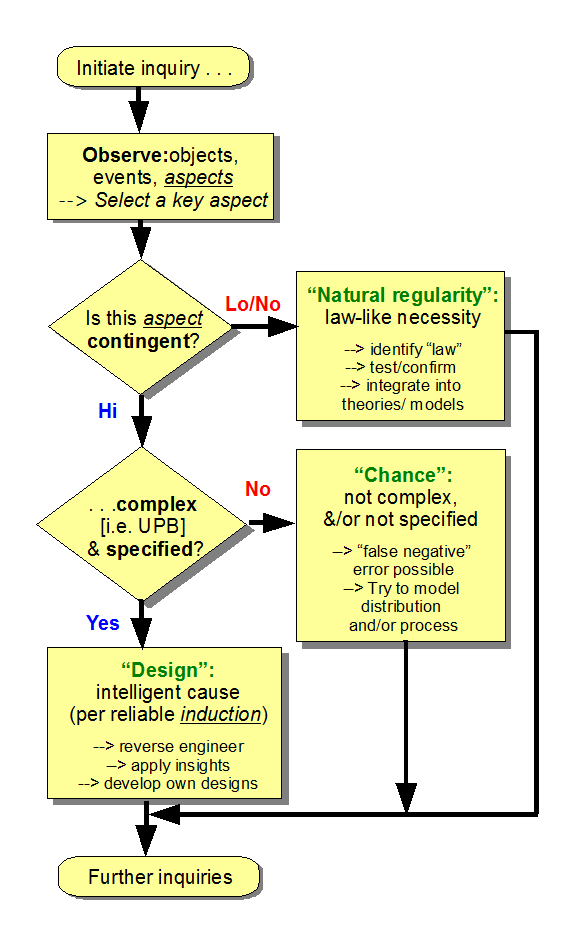
The ID Inference Explanatory Filter. Note in particular the sequence of decision nodes


You have for sure seen the per apsect design filter and know that the first default explanaiton is that something is caused by law of necessity, for good reason; that is the bulk of the cosmos. You know similarly that highly contingent outcomes have two empirically warrantged causal sources: chance and choice.

You kinow full well that he reason chance is teh default is to give the plain benefit of the doubnt to chance, even at the expense of false negatives.

I suppose. Again, I don’t think of it like that. I take each case and consider it’s context before I think the most likely explanation to be.

[b –> You have already had adequate summary on how scientific investigations evaluate items we cannot directly observe based on traces and causal patterns and signs we can directly establish as reliable, and comparison. This is the exact procedure used in design inference, a pattern that famously traces to Newton’s uniformity principle of reasoning in science.]

I think SETI signals are a good example of really having no idea what’s being looked at.

[c –> There are no, zip, zilch, nada, SETI signals of consequence. And certainly no coded messages. But it is beyond dispute that if such a signal were received, it would be taken very seriously indeed. In the case of dFSCI, we are examining patterns relevant to coded signals. And, we have a highly relevant case in point in the living cell, which points to the origin of life. Which of course is an area that has been highlighted as pivotal on the whole issue of origins, but which is one where you have determined not to tread any more than you have to.]

I suppose, in that case, they do go through something like you’re steps . . . first thing: seeing if the new signals is similar to known and explained stuff.

[d –> If you take off materialist blinkers for the moment and look at what the design filter does, you will see that it is saying, what is it that we are doing in an empirically based, scientific explanation, and how does this relate to the empirical fact that design exists and affects the world leaving evident traces? We see that the first thing that is looked for is natural regularities, tracing to laws of mechanical necessity. Second — and my home discipline pioneered in this in C19 — we look at stochastically distributed patterns of behaviour that credibly trace to chance processes. Then it asks, what happens if we look for distinguishing characteristics of the other cause of high contingency, design? And in so doing, we see that there are indeed empirically reliable signs of design, which have considerable relevance to how we look at among other things, origins. But more broadly, it grounds the intuition that there are markers of design as opposed to chance.]

And you know the stringency of the criterion of specificity (especially functional) JOINED TO complexity beyond 500 or 1,000 bits worth, as a pivot to show cases where the only reasonable, empirically warranted explanation is design.

I still think you’re calling design too early.

[e –> Give a false positive, or show warrant for the dismissal. Remember, just on the solar system scope, we are talking about a result that identifies that by using the entire resources of the solar system for its typically estimated lifespan to date, we could only sample something like 1 straw to a cubical haystack 1,000 light years across. If you think that he sampling theory result that a small but significant random sample will typically capture the bulk of a distribution is unsound, kindly show us why, and how that affects sampling theory in light of the issue of fluctuations. Failing that, I have every epistemic right to suggest that what we are seeing instead is your a priori commitment to not infer design peeking through.]

And, to be honest, the only things I’ve seen the design community call design on is DNA and, in a very different way, the cosmos.

[f –> Not so. What happens is that design is most contentious on these, but in fact the design inference is used all the time in all sorts of fields, often on an intuitive or semi intuitive basis. As just one example, consider how fires are explained as arson vs accident. Similarly, how a particular effect in our bodies is explained as a signature of drug intervention vs chance behaviour or natural mechanism. And of course there is the whole world of hypothesis testing by examining whether we are in the bulk or the far skirt and whether it is reasonable to expect such on the particularities of the situation.]

The real problem, with all respect, as already highlighted is obviously that this filter will point out cell based life as designed. Which — even though you do not have an empirically well warranted causal explanation for otherwise, you do not wish to accept.

I don’t think you’ve made the case yet.

[f –> On the evidence it is plain that there is a controlling a priori commitment at work, so the case will never be perceived as made, as there will always be a selectively hyperskeptical objection that demands an increment of warrant that is calculated or by unreflective assertion, unreasonable to demand, by comparison with essentially similar situations. Notice, how ever so many swallow a timeline model of the past without batting an eye, but strain at a design inference that is much more empirically reliable on the causal patterns and signs that we have. That’s a case of straining at a gnat while swallowing a camel.]

I don’t think the design inference has been rigorously established as an objective measure.

[g –> Dismissive assertion, in a context where “rigorous’ is often a signature of selective hyperskepticism at work, cf, the above. The inference on algorithmic digital code that has been the subject of Nobel Prize awards should be plain enough.]

I think you’ve decided that only intelligence can create stuff like DNA.

[h –> Rubbish, and I do not appreciate your putting words in my mouth or thoughts in my head that do not belong there, to justify a turnabout assertion. You know or full well should know, that — as is true for any significant science — a single well documented case of FSCO/I reliably coming about by blind chance and/or mechanical necessity would suffice to break the empirical reliability of the inference that eh only observed — billions of cases — cause of FSCO/I is design. That you are objecting on projecting question-begging (that is exactly what your assertion means) instead of putting forth clear counter-examples, is strong evidence in itself that the observation is quite correct. That observation is backed by the needle in the haystack analysis that shows why beyond a certain level of complexity joined to the sort of specificity that makes relevant cases come from narrow zones T in large config spaces W, it is utterly unlikely to observe cases E from T based on blind chance and mechanical necessity.]

I haven’t seen any objective way to determine that except to say: it’s over so many bits long so it’s designed.

[i –> Strawman caricature. You know better, a lot better. You full well know that we are looking at complexity AND specificity that confines us to narrow zones T in wide spaces of possibilities W such that the atomic resources of our solar system or the observed cosmos will be swamped by the amount of haystack to be searched. Where you have been given the reasoning on sampling theory as to why we would only expect blind samples comparable to 1 straw to a hay bale 1,000 light years across (as thick as our galaxy) will reliably only pick up the bulk, even if the haystack were superposed on our galaxy near earth. Indeed, just above you had opportunity to see a concrete example of a text string in English and how easily it passes the specificity-complexity criterion.]

And I just don’t think that’s good enough.

[j –> Knocking over a strawman. Kindly, deal with the real issue that has been put to you over and over, in more than adequate details.]

But that inference is based on what we do know, the reliable cause of FSCO/I and the related needle in the haystack analysis. (As was just shown for a concrete case.)

But you don’t know that there was an intelligence around when one needed to be around which means you’re assuming a cause.

[k –> Really! You have repeatedly been advised that we are addressing inference on empirically reliable sign per patterns we investigate in the present. Surely, that we see that reliably, where there is a sign, we have confirmed the presence of the associated cause, is an empirical base of fact that shows something that is at least a good candidate for being a uniform pattern. We back it up with an analysis that shows on well accepted and uncontroversial statistical principles, why this is so. Then we look at cases where we see traces from the past that are comparable to the signs we just confirmed to be reliable indices. Such signs, to any reasonable person not ideologically committed to a contrary position, will count as evidence of similar causes acting in the past. But more tellingly, we can point to other cases such as the reconstructed timeline of the earth’s past where on much weaker correlations between effects and putative causes, those who object to the design inference make highly confident conclusions about the past and in so doing, even go so far as to present them as though they were indisputable facts. The inconsistency is glaringly obvious, save to the true believers in the evo mat scheme.]

And you’re not addressing all the evidence which points to universal common descent with modification.

[l –> I have started form the evidence at the root of the tree of life and find that there is no credible reason to infer that chemistry and physics in some still warm pond or the like will assemble at once or incre4mentally, a gated, encapsulated, metabolising entity using a von Neumann, code based self replicator, based on highly endothermic and information rich macromolecules. So, I see there is no root to the alleged tree of life, on Darwinist premises. I look at the dFSCI in the living cell, a trace form the past, note that it is a case of FSCO/I and on the pattern of causal investigations and inductions already outlined I see I have excellent reason to conclude that the living cell is a work of skilled ART, not blind chance and mechanical necessity. thereafter, ay evidence of common descent or the like is to be viewed in that pivotal light. And I find that common design rather than descent is superior, given the systematic pattern of — too often papered over — islands of molecular function (try protein fold domains) ranging up to suddenness, stasis and the scope of fresh FSCO/I involved in novel body plans and reflected in the 1/4 million plus fossil species, plus mosaic animals etc that point to libraries of reusable parts, and more, give me high confidence that I am seeing a pattern of common design rather than common descent. This is reinforced when I see that ideological a prioris are heavily involved in forcing the Darwinist blind watchmaker thesis model of the past.]

We’re going around in circles here.

[m –> On the contrary, what is coming out loud and clear is the ideological a priori that drives circularity in the evolutionary materialist reconstruction of the deep past of origins. KF]>>

___________

GP at 796, and following,  is also a good pick-up point:

__________

>>796

  1. Joe:

    If a string for which we have correctly assesses dFSCI is proved to have historically emerged without any design intervention, that would be a false positive. dFSCI has been correctly assessed, but it does not correspond empirically to a design origin.

    It is important to remind that no such example is empirically known. That’s why we say that dFSCI has 100% specificity as an indicator of design.

    If a few examples of that kind were found, the specificity of the tool would be lower. We could still keep some use for it, but I admit that its relevance for a design inference in such a fundamental issue like the interpretation of biological information woudl be heavily compromised.

  2. If you received an electromagnetic burst from space that occurred at precisely equal intervals and kept to sidereal time would that be a candidate for SCI?

  3. Are homing beacons SCI?

  4. Jerad:

    As you should know, the first default is look for mechanical necessity. The neutron star model of pulsars suffices to explain what we see.

    Homing beacons come in networks — I here look at DECCA, LORAN and the like up to today’s GPS, and are highly complex nodes. They are parts of communication networks with highly complex and functionally specific communication systems. Where encoders, modulators, transmitters, receivers, demodulators and decoders have to be precisely and exactly matched.

    Just take an antenna tower if you don’t want to look at anything more complex.

    KF>>

__________

I am fairly sure that this discussion, now in excess of 1,500 comments, lets us all see what is really going on in the debate over the design inference. END

Comments
Mark: Thank you for the interesting contribution. I paste here your post, before commenting on it:
Gpuccio I am going to have to abandon my attempt to produce a binary string which idenitifies when London temperatures were above average. I can’t get the data I need consistently and accurately enough. It might be interesting to explain what I was trying to do. I was looking for two events A and B which satisfy these properties: A happens if and only if B happens A (and therefore B) happen on an unpredictable schedule No living thing in involved with either A nor B The schedule for A and B is publically available Under those conditions the string of when A happens (if long enough) would appear to have the function of identifying B, be complex, incompressible, digital and prespecified. I thought being above average temperature in London and being above average temperature in somewhere else very close woud satisfy these conditions but it is vital to have temperature records to high degree of accuracy and averages taken over the same periods. I can’t seem to find that data. Nevertheless I wonder if you agree that the conditions I set out would be a case of dFSCI which is not designed?
Well, this is really interesting because it allows me to clarify some aspects of the dFSCI reasoning. It requires, IMO, no "refinement" of the procedure, but certainly a good understanding of the concepts. I must say that I has in some way anticipated your example, and already given it some thought. I am not really sure that I understand correctly in detail what you wanted to do, so I will make some assumptions and some general reasoning to clarify my views. First of all, I believe we are dealing here with data that are derived from natural phenomena, and that can be read in some digital string. Now, let's say that we have a measurin system that registers the highest temperature in London each day. After a long enough time, we will have a string of values complex enough. Now, it is rather obvious that the whole system that produces the string is designed, but that is not the point here. We could in principle imagine that some natural object can store some record of the highest daily temperature for us. The interesting point is that the specific sequence of values is obviously not designed. And it is complex. It has not, in principle, a specific function, but you could say that it is functional because it can give us information about past temperatures. I can agree on that. So, has it dFSCI? No. Why? because it is perfectly explained by necessity mechanisms. Given the temperature, and the meausirng system, be it some analogic natural system, or a designed digital measurement, the string is determined by the necessary measurement if the temperature. So, in general, a complex string of data about some natural phenomena is a string complex, certainly functional, but does not exhibit dFSCI because it has a complete necessary explanation given the natural phenomena. which, I believe, are supposed to be explained also by necessity, or random, mechanisms. I believe that, in your general formulation, the original data string would be "B". So, my first point is that B is complex, in a sense functional, but does not exhibit dFSCI. What about "A"? If I understand well, A would be a string derived from B, through some form of simple computation. It could be some mathemathical derivation of the data in B, or, as I believe was your initial proposal, a comparison of two sets of data. Now, the important point here is: some complexity is implied by the procedure of derivation, whatever it is. But most complexity would be still derived from the original complexity of the data in B. So, again, the new string would probably not exhibit dFSCI. Obviously, if the derivation procedure is complex enough for the system and the time span, dFSCI could be affirmed. Three important points: a) In a data string, or in a string derived form a data string, the origin of the data complexity is alresy known, because it is implied by the definition. We have to infer nothing. For example, if you give me a complex random string, and you tell me that it is the registration of highest daily temperatures in London in a certain period, I already know how the complexity of the string arose: by measuring the temperature in London. So, I already know that the complexity in the data srtring is explained by a necessity mechanism. I have not to infer that information. b) Any process of derivation from a data string by a necessity mechanism still retains a complexity that can be explained by necessity mechanisms. In a way, the situation is not very different from a copy of the original information, like in DNA duplication, only here the necessity mechanism does not imply simple copying, but some form of computation. c) The original data string is impredictable because the original natural events can be described as a mixed system: necessity laws, and random variation. In the case of meteorology, we known that the original natural system can have the properties of a chaotic system, and therefore be specially impredictable. However, there is no doubt that we all agree that those events are anyway explained as the result of random configurations plus necessity laws. So, the impredictability of the original events is perfectly natural and explained. The derivation of B from the events, and of A from B, instead, is usually perfectly explained by strict necessity mechanisms. Well, that's all for the moment. I hpe I have interpreted your points correctly. If not, please clarify better what you think.gpuccio
November 4, 2012
November
11
Nov
4
04
2012
01:58 AM
1
01
58
AM
PDT
keiths:
The ‘problem of evil’ is a problem for anyone who 1) believes that God exists; 2) believes that he is omniscient, omnipotent, and perfectly good; and 3) believes that evil things happen in the world. Most Christians hold all three of these beliefs, so for them, the problem of evil is a major issue. Atheists deny #1 and #2, so the problem doesn’t affect them.
Most Christians do not ignore their Scripture and they understand why evil exists. So the "major issue" for Christians wrt evil is how to deal with it. OTOH your major issue seems to be that you have stopped taking your medicationJoe
November 3, 2012
November
11
Nov
3
03
2012
06:02 PM
6
06
02
PM
PDT
Mark: I have read your interesting post. I have tried to answer today, but I had not enough time. I hope I can answer tomorrow.gpuccio
November 3, 2012
November
11
Nov
3
03
2012
10:59 AM
10
10
59
AM
PDT
keiths, You might have better success by posting Part II of your series on why ID is not compatible with the evidence for common descent. But somehow, I doubt it.Mung
November 2, 2012
November
11
Nov
2
02
2012
07:18 PM
7
07
18
PM
PDT
keiths:
So if some stranger overpowers and forcibly penetrates your mother, your sister, or you — you don’t think they’ve committed an evil act?
Is that your definition of rape, finally? So rape is only an act committed by strangers?
What about murder? God allows it. Would you argue that it’s not evil?
Define murder and put forth an argument as to why murder is evil.Mung
November 2, 2012
November
11
Nov
2
02
2012
07:06 PM
7
07
06
PM
PDT
Mark Frank:
So here are the three strings I would like to apply your procedure to:
gpuccio, mark, Continuing the analysis of your strings. You were kind enough to add blanks to separate out the individual PMIDs, but I’m not sure that was necessary. I decided to ignore your scheme of separation and devise my own, just to see what would happen. I used your first string, but took each sequence of six numbers. They also identified specific PubMed papers:
206768 813885 305238
But they also identified other papers also searchable from the PubMed site:
206768 813885 305238
Again, admitting this is based upon minimal analysis, I would still have to conclude that your strings are neither specific nor objective. Now, I will say that you said your string specified an ordered list. I don't want you to think that I either missed that or ignored it. But I'd appreciate some feedback from you before I continue with any further analysis. Do you still think your strings exhibit dFSCI? Did you ever think they exhibited dFSCI, lol? (Just thought I'd ask.) You also say that each string represents a specific set of papers. I take that to mean that all the papers identified by each string have something in common, other than the fact that they are available through PubMed. Did you ever identify the three sets? So again consider that the question is not simply do they perform the specifi4d function, but how many other functions do they specify. If they can be shown to specify any other function, then would you agree that your function is not objective? Where do we stand now?Mung
November 2, 2012
November
11
Nov
2
02
2012
06:44 PM
6
06
44
PM
PDT
Mark Frank:
So here are the three strings I would like to apply your procedure to:
gpuccio, mark, I've begun an analysis of your strings. You were kind enough to add blanks to separate out the individual PMIDs, but I'm not sure that was necessary. Your first three do indeed identify PubMed papers:
20676881 3885305 238342
But they also identify other papers also searchable from the PubMed site:
20676881 3885305 238342
So I would (admittedly based upon minimal analysis) conclude that your strings are neither specific nor objective. (continued in my next post)Mung
November 2, 2012
November
11
Nov
2
02
2012
06:22 PM
6
06
22
PM
PDT
Mark Frank:
Even my own comments are going into moderation!
I blame it on petrushka Bet you guys would pay a fortune for an intelligently designed moderator now!Mung
November 2, 2012
November
11
Nov
2
02
2012
05:13 PM
5
05
13
PM
PDT
keiths:
That means that the excuse you’ve been giving for the Christian God — that he allows rape because he values free will — is bogus. He can value free will and prevent rape at the same time.
Your problem, among other things, is that you don't pay attention and you make things up. I never argued that God allows rape because He values free will. If I were to make some sort of assertion, it would be that God allows rape because there's nothing evil about it. So now what? You need to define rape, and make an argument as to why rape is evil. You've done neither. You have no argument.Mung
November 2, 2012
November
11
Nov
2
02
2012
04:30 PM
4
04
30
PM
PDT
keiths:
You haven’t thought this through. An omniscient and omnipotent God could prevent rapes from happening, and he could even prevent the desire to rape from happening, all without controlling anyone’s thoughts and desires.
You have not: 1.) provided a definition of rape. 2.) provided an argument for why rape is evil. It's clear to me that you have no argument. So here's what you have to do. Explain how you can make an argument about rape being a specific instance of the problem of evil without either defining rape or explaining why rape is evil. Then try to make your argument without begging the question of OUGHT and FREE WILL. You can't. That's why your "argument" is so obviously amateurish. Your latest god is not the christian God that your OP is intended to mock. He/she/it is an ad hoc god you invented to support your flailing attempts at reason, so I could care less about your special pleading. I could with as much force of reason argue that this latest ad hoc god you've described is not be compatible with the god in your OP. You need to meet your obligations with regard to your original claim. You haven't. Until you do, you have no argument.Mung
November 2, 2012
November
11
Nov
2
02
2012
07:23 AM
7
07
23
AM
PDT
Mark: That’s false. For the other two examples if they were post-specified this would be something like taking the string, studying the papers it points to, and seeing what you can find that they had in common. As all papers have something in common (even if it is just a distinctive phrase somewhere in the text) then the probability of success is 100%. That’s why I suggest you simply amend the process to say no post-specified functions. Any function could potentially be post-specified. No. That is wrong. First of all, we must obviously stick to keywords, and not to any possible word in the papers, otherwise ot is obvious that any paper has something in common with any other, and there would be no complexity in a definition "a string pointing to 5 paper that have at least one word in common". That is trivial. We could give a definition this way: "a string pointing to 5 papers that have a keyword in common". That would be more restricted, but still the tyarget space would be very big. As I have shown, some keywords, like "disease", are very common. we are distant from a high complexity result. But when I give the definition "a string pointing to 5 papers who share the keyword "elaprase", the situation is much different. That keyword is very rare. the probability of having a string that points only to 5 papers indexed by that word, as I have shown, is rather low. Maybe not so low that we can in any case affirm dFSCI (here we should discuss the problem of the threshold for this particular problem), but we would anyway observe high compexity. And you are wrong that the situation is the same as in your original definition. It is not. As I have alredy said, if I observe that a string points to 5 papers indexed by the keyword "elaprase", the factc itself is very strange. I believe that you are confounded about the real meaning of the word "postspecifiction" as applied to the two cases. The definition "a string pointing to 5 papers indexed bu the keyword "elaprase" " is postspecified only in the sense that we observe the property in the string, a property that is in itself surprising, and we just define it. But we could have well defined the same property as a prespecification without knowing any special string. The keywords for PM are publicly known, we could have just looked for a rare keyword and defined the property (indeed, that's exactly what I did, and I had no particular string available). Here, even if we had first observed the property in a string of which we are assessing dFSCI, and then defined the property, the complexity would be rather high. Indeed, the question we are trying to answer is: we observe here a string that has a property that defines a tiny subset of a search space. How likely is for that string to emerge in a random system? Instead, in your original definition, the definition itself is postspecified not only because you define it after you oberve the string, but also because you define it from the string sequence. You could have never defined this particular definition, with this contingent list of papers, in prefernec to any other similar definition with any other contingent list of papers, if you had not known in advance the sequence of the string. I hate to say this, but I am afraid that your definition smells a little bit of circularity :) . Without knowing the exact sequenc of an already existing string (the one about which we should assess complexity) you could have done only two things: a) Give a general definition, as I have suggested, of !any string that can point to 5 papers, that can easily be listed after we observe the string. That definition, as I have repeatedly pointed out, is correct, but is not complex. b) Give a huge set of different definitions, each with one of all the combinatorial lists of papers you can extract from a database of 20x10^6 papers. Not a satisfying alternative! So, you are wrong. The situation is not the same. There is a definite logical difference between the two cases, and I am surprised that you, who are so well acquainted with logic, still can't see it. I was thinking of the last 10 years – 2002 to 2012 – I could do a longer period but it would be tedious. I was going to use http://www.holiday-weather.com/london/averages/ for the averages. Although the values for 2002 to 2012 are known I was not going to use them to generate the string. That’s why I said “identify” rather than “predict”. I will not even look at the actual temperatures until after I have generated the string – although I won’t be able to resist checking it has worked when I have finished. The string will simply be a string of 120 bits with 1 for above average and 0 for below average. I realise you want 500 bits but that would be really tedious to look up all the data, so I hope 120 will be sufficient to prove the case. OK. Go on, and I will certainly understand better your intentions.gpuccio
November 2, 2012
November
11
Nov
2
02
2012
07:09 AM
7
07
09
AM
PDT
keiths:
You haven’t thought this through.
Sed the chump who cannot thnk anything through- well obviuously keiths can think through his strawmen.
An omniscient and omnipotent God could prevent rapes from happening, and he could even prevent the desire to rape from happening, all without controlling anyone’s thoughts and desires.
Prove it- and then prove that God wants or needs to do this. Then tell us how we could be judged as individuals when we are not in total control of ourselves. If the whole point is to see who can be good in a world full of crap then keiths is a clueless dolt. Well the evidence supports that claim regardless...Joe
November 2, 2012
November
11
Nov
2
02
2012
04:33 AM
4
04
33
AM
PDT
Mark: OK, maybe we don't really disagree at this point. My simple argument is that I asked you if your definition was prespecified or postspecified, because the evaluation of dFSI in this particular case would have been completely different in the two cases, because of the special nature of the definition (relying on a contingent list). As I have explained, dFSI would be rather high in the case of a prespecified function (target space equal to 1), almost zero in the case of a postspecified one (target space extremely big). That's all. With the other two functions, instead, relying only on an explicit, non contingent property, the computation of dFSI would not change in the prespecified or postspecified case. The target space and the search space remain the same in both cases. “The string identifies for each month over a period of 120 months whether the London monthly mean high temperature is above or below long-term average.” Yes, I think the function is acceptable. But, to be complete, I would obviously ask what the period is (and in particular, if it is a future period or a past period whose values are already known), and what the long term average reference is. Just to have a completely explicit definition. That said, I am ready to follow your reasoning.gpuccio
November 2, 2012
November
11
Nov
2
02
2012
01:15 AM
1
01
15
AM
PDT
Mark: Thank you for your Bayesian answer. Still, I don't think you have caught the meaning of my question. Indeed, you say: I don’t recognise function (a) and can’t make much sense of it. My function was “refers to 5 specific papers in the PubMed database” – as I have said they can easily be listed even if the string was never thought of. In fact I don’t see how you could create a list such that “We can explicitly list the entries, if and only if the string is already known”. There will always be other ways of listing them – such as the titles or the URLs. That is the simple problem. If you don't understand function (a), and change it, my question has no more sense. Let's see. As I defined it in my question, function a) was: a) The string you proposed, whose function can be defined as follows: “It points to 5 entries in the PubMed databases. We can explicitly list the entries, if and only if the string is already known.” Why cannot you make sense of it? You have given: - a string - a list of papers in the PubMed database. Now, please, there is no difference if the list is given in the form of the numbers in the string, or of the titles. The only important point is: the numbers in the string correspond to the papers. But, when I asked, you admitted that you chose the papers by looking at the numbers in the string. Therefore, the correspondence of the numbers in the string to those 5 papers is a consequence of your post-specification. Is that clear? Now, how likely is it to have, in a RSG, a string for which we can create such a scenario? It is extremely likely. Therefore, we are observing a scenario (string + post-defined function) that is extremely likely. IOWs, there is no dFSCI, no complexity. If the original string emerged really in a RSG, no probability law was violated, no extremely unlikely event happened. Can you agree on that? Let's go, instead, for instance, to string c). My definition: c) A string whose function can be defined as follows: “It points to 5 entries in the PubMed databases, all of them indexed by the keyword: “elaprase” ". So, here the scenario is: we see a string, and we read the five parts of it as PMIDs. We check the 5 corresponding papers (up to now, no differences with the previous case). Now comes the difference: we see that all 5 papers are referenced by the keyword "elaprase", a rather rare keyword in the database. Now, that is strange. As you can see, the problem here is not if the function is pre-specified or post-specified. It is post-specified here too, because we observe it in the string. But we are not "creating" that strange property of the string by choosing an ad hoc list of papers, as we could have done for any random string. Here, we jusr observe a strange fact that requires some inquiry; the 5 papers have a remarkable property in common, and it was not us who acted to crerate that situation. It was the string itself that pointed to 5 papers with a common property. So, the fact here is: either the function is pre-specified, or post-specified (because observed in an already existing string), the probability of such an event remains extremely low in a random system. That's exactly the reason why it is perfectly reasonable to suspect design in the case of string c). It is very simple, and I really can't understand why you cannot see it. Your "argument" is, unfortunately, a new version of the old, and rtaher infamous, argument of the "deck of cards". So, let's say that we observe a deck of cards sequence which is apparently perfectly random. We rae not surprised at all. Although that particular sequence is certainly as unlikely as any other, it is perfectly natural that we observe it, because it is in no way special, it is not recognizable from any other random sequence. We can, just the same, find some post-specification for the sequence, either just by giving the sequence itself as a specification, or by finding some connection as you did with the Pubmed papers. But, if we do that as a post-specification, it remains perfectly compatible with the random origin of the sequence. But let's say that the sequence we observe is perfeclty oredered: 4 1s of Spades, Hearts, Diamonds, Clubs, then 4 2s in the same order, and so on. Can you dany that, even though the order is observed after we see the sequence, and is therefore post-specified, we would correctly have a lot of doubts about the random origin of the sequence? We would naturally look for some other explanation: a necessity mechanism here could be considered, and certainly we could consider design (a designer ordered the deck). Why? Because the ordered sequence is extremely unlikely as a random result. It is not importan if we pre-specify the sequence and then get it, or if we just get the sequence and observe that it is strangely ordered. The result remains extremely unlikely in a random system. On the contrary, a random sequence is perfectly likely because a lot of random sequences exist, and there is no special way to distinguish one from another. For each of those random sequences, however, we can post-specify some "function" that can only be defined after the string is explicitly know. Such a procedure does not change the probability of having a string of that kind (a string for which an ad hoc post-specification can be easily created). Obviously, if we use that ad hoc post-specification as a pre-specification, everything changes: the probability of having the same string a second time becomes, naturally, an almost impossible event in a random system. If we really observe it, we are prefectly justified in suspecting design. Please, consider what I have said here. And comment on that. Don't change the cards. And, in the light of what I have said, please answer simply my question in post #238. I will certainly bet on statement 1) as the true statement. And you? You say: I don’t see the relevance of your Bayesian challenge – I thought we were trying to define a process with 100% specificity – not estimate which hypothesis is most likely. But it is the same thing! When we evaluate dFSI in a string, we are just answering this simple question: is this string objectively unlikely as the output of a random system? How unlikely is it? The string for which you post-specified that kind of function is not unlikely at all. That's because the function you post-specified makes that result "unlikely" only as a seocn result (IOWs,only if used as a pre-specification). On the contrary, the functions defined in b) and c) meausre the probability of that kind of result, either as pre-specification, or as post-specifications. If I say: let's try to get a string that points to 5 papers reference by the keyword "elaprase". How unlikely is that event in a random system? Or if I say: I observe a string that points to 5 papers referenced by the keyword "elaprase". How unlikely is it to oberve that string as an event in a random system? In both cases, the probability is extremely low.gpuccio
November 1, 2012
November
11
Nov
1
01
2012
05:37 PM
5
05
37
PM
PDT
keiths:
If the desire to rape is all that matters, then why does God allow the rapist to go through with the act? Why subject the victim to that horrifying experience?
Why does God allow the desire? Surely it's the desire that is the root cause of the act itself. Or are you just pretending to know Scripture? Why subject the perpetrator to that horrifying experience? Define rape. You won't. So you really don't have an argument. So don't expect me to address myself to your non-argument. You prefer a god that controls all your thoughts and desires?Mung
November 1, 2012
November
11
Nov
1
01
2012
05:11 PM
5
05
11
PM
PDT
Mung: I would disagree with that statement. NS has no visibility of DNA sequences. DNA sequences are not functional and cannot be selected. Well, I would say that, according to the proposed algorithm, they are selected for their phenotypic effects (through the proteins they encode). In the simple form of antibiotic resistance explained by the darwinian algorithm, the genetic variant is selected necause of its phenotypic effects, and so in all known forms of microevolution.gpuccio
November 1, 2012
November
11
Nov
1
01
2012
08:14 AM
8
08
14
AM
PDT
gpuccio:
In the neodarwinian algorithm, “DNA sequences are generated by RV and selected by NS”.
I would disagree with that statement. NS has no visibility of DNA sequences. DNA sequences are not functional and cannot be selected.
In the design theory, “DNA sequences are generated and/or selected by an intelligent designer”.
Intelligent selection is the only reasonable explanation for selection at the nucleotide level. NS isn't even an option.Mung
November 1, 2012
November
11
Nov
1
01
2012
07:27 AM
7
07
27
AM
PDT
Petrushka: The process I have modeled is not limited to eight or ten characters It can reasonably be extended to hundreds. It does not require resources beyond those of the universe. It scarcely requires a fast computer. I have never doubted you are a good designer.gpuccio
November 1, 2012
November
11
Nov
1
01
2012
01:57 AM
1
01
57
AM
PDT
Cubist: Why does gpuccio insist on knowing the origin of a string before he’ll try to use his dFCSI-determining protocol on it? Complete nonsense. Please, read my post #204 here, to Petrushka. It clearly explains what we are doing here. The whole purpose of all this discussion is to test dFSCI's specificity. That's exactly what you folks have doubts about. I think you are really desperate now. The intellectual level of posts at TSZ has never been so low. At this point, I feel confident in making a prediction about the results of gpuccio’s challenge, assuming he manages to disgorge any results thereto: For any string X, the answer to the question “has gpuccio determined that string X has dFCSI?”, and the answer to the question “has gpuccio been told, up front, that string X was Designed?”, will always be the same answer. And I make a very simple statement: you are a liar. I have determined dFSCI for all the strings that have been proposed here. And for none of them I have been told, up front, if the string was designed. So, you are a liar. It's as simple as that.gpuccio
November 1, 2012
November
11
Nov
1
01
2012
01:56 AM
1
01
56
AM
PDT
Petrushka: What you say has no sense. You have given a long list of words. None of them obviously exhibits dFSCI. What else do you want to know from me? You know nothing about how DNA sequences were generated or selected, and yet you speak with authority about it. This is simply not true. I speak with "authority" (just to use your senseless word) about a specific explanation that has been proposed, that is the neo darwinian algorithm, and its only available alternative. In both explanations, it is very clear how "DNA sequences were generated or selected" (according to the explanation, I mean). In the neodarwinian algorithm, "DNA sequences are generated by RV and selected by NS". In the design theory, "DNA sequences are generated and/or selected by an intelligent designer". As you can see, we all know those things. Those are the explanations that we test against known facts. With or without "authority" (whatever it means).gpuccio
November 1, 2012
November
11
Nov
1
01
2012
01:05 AM
1
01
05
AM
PDT
Mark: It's not my fault if you use silly and useless arguments. You take the responsibility of what you do. I simply state what I think of your output. Now, if you agree, let's play a little game. That will show why your argument is silly and useless. I appeal to your Bayesian heart. Now let's say that I give you three strings that all look alike (apparently random). And I give you three functional definitions, according to the concepts we have already discussed (please, reread also my computations in my post #235). The three string are as follows: a) The string you proposed, whose function can be defined as follows: "It points to 5 entries in the PubMed databases. We can explicitly list the entries, if and only if the string is already known." b) A string whose function can be defined as follows: "It points to 5 entries in the PubMed databases, all of them indexed by the keyword: "disease" ". c) A string whose function can be defined as follows: "It points to 5 entries in the PubMed databases, all of them indexed by the keyword: "elaprase" ". OK with that? Now, let's say that you have 1000 euros and you must bet. The bet is as follows. We have three different statements: 1) String a) was generated in a Random String Generator, in one single attempt. 2) String b) was generated in a Random String Generator, in one single attempt. 3) String c) was generated in a Random String Generator, in one single attempt. I tell you that only one of these three statements is true. You have to bet your 1000 euros on one of them. If you guess the one that is true, you win 2000 euros. If you bet on a false one, you lose your 1000 euros. Bayesian, isn't it? Now, my question is simple: On what statement will you bet? And why? Please, answer that. (By the way: it is not virtual money. Let's say that it is real money, that you earned through hard work. And you really want to keep your money, and win more).gpuccio
November 1, 2012
November
11
Nov
1
01
2012
12:56 AM
12
12
56
AM
PDT
Mark Frank:
It is just that my definition “represents these papers” is equally testable and equally independent of the string – as I discussed above it could be performed in many different ways without the string ever coming into it.
I think there are at least three questions raised: 1.) How many other strings could perform the same function? 2.) How many different functions can be defined for your string? 3.) Is the function of the string distinct and separate from the string itself.Mung
October 31, 2012
October
10
Oct
31
31
2012
04:15 PM
4
04
15
PM
PDT
Allan Miller: You seem to be the only one still outputting arguments, although wrong. I have no reason to ignore them. a) You say: As interesting as all this ‘string theory’ is, I feel it completely misses the bus, certainly in terms of proteins, which are nothing without their 3D structure. But you seem to forhet that RV acts at the sequence level, and in the gene, not in the protein. It knows nothing of protein sequence level. The search space for RV is only the sequence space in the genes. This is a very serious mistake in your reasoning. b) You say: Two protein domains can bear no sequence similarity yet have a high degree of structural congruence. That's absolutely correct. c) You say: And they can still derive from a common ancestor by stepwise substitution of every single part. If the structure and function are maintained, that is certainly possible. Indeed, the great variety of primary structure in simnilar proteins with similar functions can easily be explained by neutral variation. Negative selection can certainly allow sequenc variation that does not change structure and function. That's the whole ppoint in the model of "prtoein big bang theory". What this mechanism cannot do is to create a new structure with a new function. Exactly our problem when we have to explain the emergence of new basic protein domains. c) You say: Each amino-acid ‘letter’ is taken to be an equal distance from all others, and this is simply not the case Yes, it is. Because, as said, RV acts on nucleotides, not on aminoacids. The variation in the genome knows nothing of the effect in the protein. It isn’t the case in general, because amino acids cluster on properties, nor in specific instances, where the ‘distance’ between two substitutions, as determined by the 3D effect, is entirely dependent on the position in the broader matrix. Again, you make the same mistake: you are reasoning in terms of the protein, that is in terms of NS. But the new arrnagements are created in the genome, by RV. dFSCI has to do with RV, not with NS, as many times explained. If dFCSI takes no account of higher dimensionality, it is not likely to be a useful tool for determining protein ‘design’, even with a clear methodology for applying it to 1D structure. Again, see previous points. dFSCI measures the probability of new arrangements by RV in the genome. The "natural selectability" of proposed intermediates must instead be verified in the lab, and then, and only then, added to the computation model. Elements many bits apart come together in a manner vital for ‘function’. Not certainly by unguided RV. d) You say: A further point relates to ‘function’. Function is frequently partitioned protein by protein, but the very modularity of protein domains means that the same domain can appear in proteins of widely different ‘function’. And the ‘function’ of the domain in each protein may itself be widely different, yet retaining the same 3D structure. So we have these sub-protein elements that display substantial phylogenetic congruence, some on sequence, some on structure, and some on both, scattered about the proteome. That's more or less true. That's why I refer to the origin of basic protein domains, as you may have noticed. Let's postpone the discussion about multi-domain proteins to when we have explained single domains. Their integration from one protein to another is entirely within the capacity of ‘RM + NS’. How do you know that? Such practical, chemical considerations, of course, part of the general “things that come out at TSZ [...] better ignored”. No. They are simply easily falsified.gpuccio
October 31, 2012
October
10
Oct
31
31
2012
03:25 PM
3
03
25
PM
PDT
Mark: This would greatly decrease the complexity as by your argument the real function should be “can represent some set of papers”. The fact it was a CHD set was determined by the string. But you do not feel it necessary to ask the how the CHD function was arrived at. I can see no logical difference in the situations except a matter of degree. But I can. Try this. We can define a function this way: a) Do a search on Pubmed with the keyword "disease". You will get 2836651 results. Always assuming 20x10^6 voices in the database, the probability of getting one item in the subset "disease" is 0,14183255. The probability of getting a list pointing to 5 such items (form value under 20x10^6) is therefore 5.739573e-05 (a perfectly likely event, in any decent random system). b) Now, do a search with the keyword "elaprase". You get 49 results. The probability of getting one item is now 0.00000245. The probability of getting 5 such items is now 8.827352e-29. You see no logical difference. As you can see, when the subset is objectively defined, there is huge empirical difference according to the definition. Here, I see 79 bits of empirical difference. Can your "logic" explain that?gpuccio
October 31, 2012
October
10
Oct
31
31
2012
03:08 PM
3
03
08
PM
PDT
Mark: I will not go on forever with this. I don't agree with you. With my disagreement, strangely, I can infer design correctly. With your loigcal fallacies, strangely, you would affirm false positives everywhere, which seems to be your hidden dream. You say: It is utterly clear which strings can be used to represent that list of names whether the function be prespecified or not. What a pity that the list of names cannot be known until the string is there. Try to specify a list of names, and then try to get a string that specifies them in a random system. In fact it is clearer than a rule such as “papers about CHD” as one could argue about which papers are about CHD. That's really silly. You can give a very simple rule for measuring that: you go to the Pubmed site, and just perform a search with "CHD" as keyword. You immediately get a specific number. The function you want to substitute if I did not “prespecify” points to a different subset – but is clearly a different function. It is the function of representing any list of papers. Yes. And it is the only function that makes sense if the list is not pre-specified. Because, you see, if the list is not pre-specified, you matching a specific list to a specific string, and you can do that with any string. You seem to just play (and not well) with logic. You seem to forget that we are dealing, here, with empirical science. We need a functional specification that points to a specific subset of strings in a search space. but why are we doing that? Because we want to know the probability of getting a string with that function by RV. Now, just answer this simple question: if your function (and list) is not pre-specified, of which subset is it measuring the probability in a random system? You seem to affirm that it is specifying the probability of getting by RV a string that exactly matches that list. OK, I can accept that. But then it is the probability of getting such a string in a new search, not certainly in the search that gave you a string to define the list from! Obviously, that string is already available. Does that contradict the ID procedure? No, because that string has nothing special: it is a random string, that cannot be distinguished in any way from any other random string. It is one item in an extremely large subset: purely random strings, with no special function. It's you who have built a function for that random string, with a procedure by which you could have built a function for any other random string. Your argument is silly and useless. I am amazed that you still stick to it. It must really be cognitive desperation. I will not go on with this "argument" any more. Please, find other tricks, or let's stop it here.gpuccio
October 31, 2012
October
10
Oct
31
31
2012
02:50 PM
2
02
50
PM
PDT
Mark Frank on October 31, 2012 at 4:20 pm said:
I don’t have a problem with your source code as an example of a function. Is there anyone who does? It is just that my definition “represents these papers” is equally testable and equally indepedent of the string – as I discussed above it could be performed in many different ways without the string ever coming into it. Gpuccio’s example of “Any string that has the following sequence: HHTHTHTTTHHTHTTTTHHTHHHTHTT” is not even a function and not at all similar to my example.
I haven't seen any complaining about my string. I wrote it specifically as an example of a string with objective functionality. You can even plug it in to a page on a web site and validate that it performs the stated function. I haven't really looked at your string(s) yet. Was there just one string, and it's composed of sub-strings, with each sub-string being a reference to a document? A suppose we can say it then has a function. And thus the question becomes is that function specific and complex enough. I'm trying to think of analogies that might be useful. We probably have differing levels of complexity and functionality, so the question is probably not easy to answer. For example, needing to divide the string into sub-strings of a specific length. But numbers can represent a very great many documents. So if we were to find some strings of numbers that made reference to other documents, then we'd say the string lacks specificity. If we change the "reading frame" will we get different and yet still valid pubmed documents?
Given a set of PubMed IDs (PMIDs) you can use this converter to obtain the corresponding PMCIDs and/or NIHMS IDs if they exist. A PMCID will be available if the article is in PubMed Central (PMC). An NIHMS ID will be available if the manuscript has been deposited via the NIH Manuscript Submission (NIHMS) system.
http://www.ncbi.nlm.nih.gov/pmc/pmctopmid/Mung
October 31, 2012
October
10
Oct
31
31
2012
12:59 PM
12
12
59
PM
PDT
Who wants to have cake and not eat it?Joe
October 31, 2012
October
10
Oct
31
31
2012
12:23 PM
12
12
23
PM
PDT
keiths:
Poor Mung. He can’t defend ID, and he can’t defend his faith.
Poor keiths. Having given no definition of rape he thinks he's made an argument. But he asks us to suppose that tomorrow he decides to blow up the entire earth. If he knew his Scripture, he'd know having the desire is as good as having done the deed. So if he desires to rape a woman, it's no different than if he had raped a woman. And we wants to blame God for not preventing the action, when the thing that needed preventing was the thought. So what he wants is a god that controls all his thoughts and desires. And because he doesn't have such a god, he thinks it's a problem for Christians. Of course, a god that did exercise such control would no doubt be evil. So keiths wants to have his cake and eat it too.Mung
October 31, 2012
October
10
Oct
31
31
2012
12:10 PM
12
12
10
PM
PDT
Petrushka: So how do you account for the accumulation of ten or so changes to form a new function? Petrushka, how were the words generated and selected? How can I answer that question if I know nothing of what you are talking about?gpuccio
October 31, 2012
October
10
Oct
31
31
2012
11:44 AM
11
11
44
AM
PDT
Mark: Rule 0: No definition of functuion can be used to compute dFSI if it does not point unequivocally to a specific subset of the search space. This is the first rule you violated: your definition could point both to a subset of one string (if it was a pre-specification, or to a subset of 20*10^6 strings (if it was a function derived from the string itself). Rule 1: You ask: When confronted with a proposed function how do I decide if I need to know how the proposer came up with the function? I will use your template: "If a proposed function does not point unequivocally to a specific subset of the search space, for instance if it introduces contingent elements (like a paper list) whose logical relationship with the emergence of the function itself in the system is not clear, then it is necessary to find out how the proposer came up with the unexplained elements in the definition”. Rule 2: You ask: Having investigated how the proposer came up with the function and determined that it was by inspecting the digital string and then finding a function it could perform (I assume this is right so far – feel free to correct), how do you decide what function to replace it with? I will use your template: "The replacement function has features: "Any function with which an observer can perform a similar procedure, and obtain similar results (for instance, a function of the same form that differs only for the list of contingent elements). All that is really useless. Rule 0 should be enough. Any intelligent person, in the presence of an ambiguous functional definition, will naturally ask the definer the correct questions to solve the problem as I have done with you. Anyway, you asked for those unnecessary rules, and I tried to give them. The problem is really with the list of papers. A list of papers that have nothing in common is not a logical categoy. It is just a contingent list of elements, whose only logical connection is that they were derived from the existing string. The biochemical function of a protein has nothing contingent. Indeed, we can observe the function work in reality, and we did nothing for it, except observing and defining: but the function was already working before our observing and our defining. the biochemical reaction has been accelerated for million of yeras, before human observers even existed. Now, I am not saying that to create new rules: I just want to show you why your trick is so different from a true functional definition. However, the real rule is rule 0. And the reason should be obvious. The whole purpose of measuring dFSI is to measure the probability of a string arising in the system by RV with the defined function. If we define the function to match an existing random string, and the function has no universla meaning except the correspondence between the existin sring and some use we have defined for iots specific sequence, then we are measuring nothin, except the generic property that a string can be used that way. We could even do that for a protein sequence. We can, for instance, define a rule that transforms the sequence into a sequence of numbers, and then use that sequence as a key to an electronic safe. And so? We can do that with any protein sequence. But we can have a specific enzymatic activity only with certain sequences, and not with others. And please. take notice that all your "problems" in no way have created any difficulty to my assessment of dFSCI in all the strings that have been proposed. I have given a specific judgement for all of them, including yours. I have even given a specific judgement for your string in its original, ambiguous form: no dFSCI can be affirmed, because the defined function is ambiguous.gpuccio
October 31, 2012
October
10
Oct
31
31
2012
11:32 AM
11
11
32
AM
PDT
1 27 28 29 30 31 37

Leave a Reply