Uncommon Descent Serving The Intelligent Design Community

The TSZ and Jerad Thread, III — 900+ and almost 800 comments in, needing a new thread . . .

Categories
Culture
Design inference
Education
Evolution
ID Foundations
science education
specified complexity
worldview
Share
Facebook
Twitter/X
LinkedIn
Flipboard
Print
Email

Okay, the thread of discussion needs to pick up from here on.

To motivate discussion, let me clip here comment no 795 in the continuation thread, which I have marked up:

_________

>> 795Jerad October 23, 2012 at 1:18 am

KF (783):

At this point, with all due respect, you look like someone making stuff up to fit your predetermined conclusion.

I know you think so.

[a –> Jerad, I will pause to mark up. I would further with all due respect suggest that I have some warrant for my remark, especially given how glaringly you mishandled the design inference framework in your remark I responded to earlier.]

{Let me add a diagram of the per aspect explanatory filter, using the more elaborated form this time}
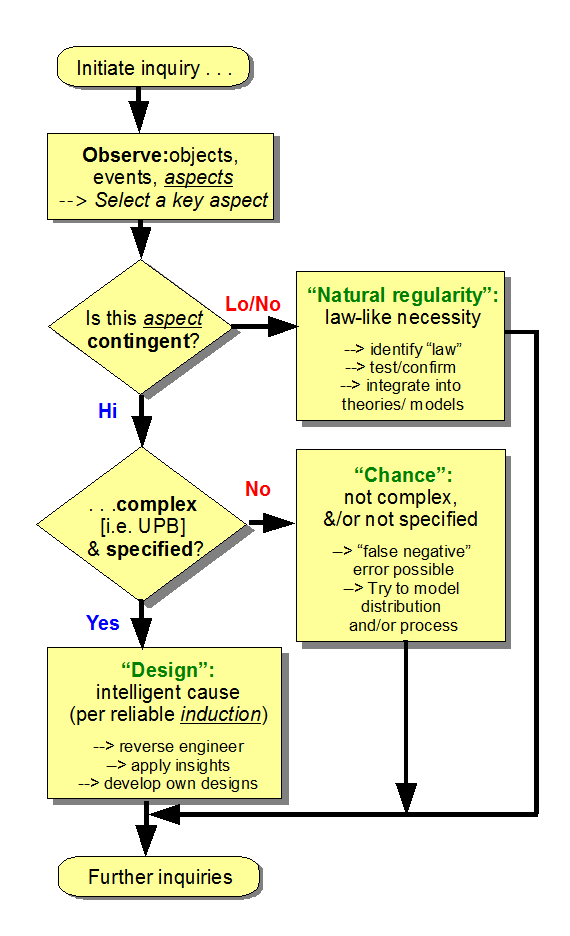
The ID Inference Explanatory Filter. Note in particular the sequence of decision nodes


You have for sure seen the per apsect design filter and know that the first default explanaiton is that something is caused by law of necessity, for good reason; that is the bulk of the cosmos. You know similarly that highly contingent outcomes have two empirically warrantged causal sources: chance and choice.

You kinow full well that he reason chance is teh default is to give the plain benefit of the doubnt to chance, even at the expense of false negatives.

I suppose. Again, I don’t think of it like that. I take each case and consider it’s context before I think the most likely explanation to be.

[b –> You have already had adequate summary on how scientific investigations evaluate items we cannot directly observe based on traces and causal patterns and signs we can directly establish as reliable, and comparison. This is the exact procedure used in design inference, a pattern that famously traces to Newton’s uniformity principle of reasoning in science.]

I think SETI signals are a good example of really having no idea what’s being looked at.

[c –> There are no, zip, zilch, nada, SETI signals of consequence. And certainly no coded messages. But it is beyond dispute that if such a signal were received, it would be taken very seriously indeed. In the case of dFSCI, we are examining patterns relevant to coded signals. And, we have a highly relevant case in point in the living cell, which points to the origin of life. Which of course is an area that has been highlighted as pivotal on the whole issue of origins, but which is one where you have determined not to tread any more than you have to.]

I suppose, in that case, they do go through something like you’re steps . . . first thing: seeing if the new signals is similar to known and explained stuff.

[d –> If you take off materialist blinkers for the moment and look at what the design filter does, you will see that it is saying, what is it that we are doing in an empirically based, scientific explanation, and how does this relate to the empirical fact that design exists and affects the world leaving evident traces? We see that the first thing that is looked for is natural regularities, tracing to laws of mechanical necessity. Second — and my home discipline pioneered in this in C19 — we look at stochastically distributed patterns of behaviour that credibly trace to chance processes. Then it asks, what happens if we look for distinguishing characteristics of the other cause of high contingency, design? And in so doing, we see that there are indeed empirically reliable signs of design, which have considerable relevance to how we look at among other things, origins. But more broadly, it grounds the intuition that there are markers of design as opposed to chance.]

And you know the stringency of the criterion of specificity (especially functional) JOINED TO complexity beyond 500 or 1,000 bits worth, as a pivot to show cases where the only reasonable, empirically warranted explanation is design.

I still think you’re calling design too early.

[e –> Give a false positive, or show warrant for the dismissal. Remember, just on the solar system scope, we are talking about a result that identifies that by using the entire resources of the solar system for its typically estimated lifespan to date, we could only sample something like 1 straw to a cubical haystack 1,000 light years across. If you think that he sampling theory result that a small but significant random sample will typically capture the bulk of a distribution is unsound, kindly show us why, and how that affects sampling theory in light of the issue of fluctuations. Failing that, I have every epistemic right to suggest that what we are seeing instead is your a priori commitment to not infer design peeking through.]

And, to be honest, the only things I’ve seen the design community call design on is DNA and, in a very different way, the cosmos.

[f –> Not so. What happens is that design is most contentious on these, but in fact the design inference is used all the time in all sorts of fields, often on an intuitive or semi intuitive basis. As just one example, consider how fires are explained as arson vs accident. Similarly, how a particular effect in our bodies is explained as a signature of drug intervention vs chance behaviour or natural mechanism. And of course there is the whole world of hypothesis testing by examining whether we are in the bulk or the far skirt and whether it is reasonable to expect such on the particularities of the situation.]

The real problem, with all respect, as already highlighted is obviously that this filter will point out cell based life as designed. Which — even though you do not have an empirically well warranted causal explanation for otherwise, you do not wish to accept.

I don’t think you’ve made the case yet.

[f –> On the evidence it is plain that there is a controlling a priori commitment at work, so the case will never be perceived as made, as there will always be a selectively hyperskeptical objection that demands an increment of warrant that is calculated or by unreflective assertion, unreasonable to demand, by comparison with essentially similar situations. Notice, how ever so many swallow a timeline model of the past without batting an eye, but strain at a design inference that is much more empirically reliable on the causal patterns and signs that we have. That’s a case of straining at a gnat while swallowing a camel.]

I don’t think the design inference has been rigorously established as an objective measure.

[g –> Dismissive assertion, in a context where “rigorous’ is often a signature of selective hyperskepticism at work, cf, the above. The inference on algorithmic digital code that has been the subject of Nobel Prize awards should be plain enough.]

I think you’ve decided that only intelligence can create stuff like DNA.

[h –> Rubbish, and I do not appreciate your putting words in my mouth or thoughts in my head that do not belong there, to justify a turnabout assertion. You know or full well should know, that — as is true for any significant science — a single well documented case of FSCO/I reliably coming about by blind chance and/or mechanical necessity would suffice to break the empirical reliability of the inference that eh only observed — billions of cases — cause of FSCO/I is design. That you are objecting on projecting question-begging (that is exactly what your assertion means) instead of putting forth clear counter-examples, is strong evidence in itself that the observation is quite correct. That observation is backed by the needle in the haystack analysis that shows why beyond a certain level of complexity joined to the sort of specificity that makes relevant cases come from narrow zones T in large config spaces W, it is utterly unlikely to observe cases E from T based on blind chance and mechanical necessity.]

I haven’t seen any objective way to determine that except to say: it’s over so many bits long so it’s designed.

[i –> Strawman caricature. You know better, a lot better. You full well know that we are looking at complexity AND specificity that confines us to narrow zones T in wide spaces of possibilities W such that the atomic resources of our solar system or the observed cosmos will be swamped by the amount of haystack to be searched. Where you have been given the reasoning on sampling theory as to why we would only expect blind samples comparable to 1 straw to a hay bale 1,000 light years across (as thick as our galaxy) will reliably only pick up the bulk, even if the haystack were superposed on our galaxy near earth. Indeed, just above you had opportunity to see a concrete example of a text string in English and how easily it passes the specificity-complexity criterion.]

And I just don’t think that’s good enough.

[j –> Knocking over a strawman. Kindly, deal with the real issue that has been put to you over and over, in more than adequate details.]

But that inference is based on what we do know, the reliable cause of FSCO/I and the related needle in the haystack analysis. (As was just shown for a concrete case.)

But you don’t know that there was an intelligence around when one needed to be around which means you’re assuming a cause.

[k –> Really! You have repeatedly been advised that we are addressing inference on empirically reliable sign per patterns we investigate in the present. Surely, that we see that reliably, where there is a sign, we have confirmed the presence of the associated cause, is an empirical base of fact that shows something that is at least a good candidate for being a uniform pattern. We back it up with an analysis that shows on well accepted and uncontroversial statistical principles, why this is so. Then we look at cases where we see traces from the past that are comparable to the signs we just confirmed to be reliable indices. Such signs, to any reasonable person not ideologically committed to a contrary position, will count as evidence of similar causes acting in the past. But more tellingly, we can point to other cases such as the reconstructed timeline of the earth’s past where on much weaker correlations between effects and putative causes, those who object to the design inference make highly confident conclusions about the past and in so doing, even go so far as to present them as though they were indisputable facts. The inconsistency is glaringly obvious, save to the true believers in the evo mat scheme.]

And you’re not addressing all the evidence which points to universal common descent with modification.

[l –> I have started form the evidence at the root of the tree of life and find that there is no credible reason to infer that chemistry and physics in some still warm pond or the like will assemble at once or incre4mentally, a gated, encapsulated, metabolising entity using a von Neumann, code based self replicator, based on highly endothermic and information rich macromolecules. So, I see there is no root to the alleged tree of life, on Darwinist premises. I look at the dFSCI in the living cell, a trace form the past, note that it is a case of FSCO/I and on the pattern of causal investigations and inductions already outlined I see I have excellent reason to conclude that the living cell is a work of skilled ART, not blind chance and mechanical necessity. thereafter, ay evidence of common descent or the like is to be viewed in that pivotal light. And I find that common design rather than descent is superior, given the systematic pattern of — too often papered over — islands of molecular function (try protein fold domains) ranging up to suddenness, stasis and the scope of fresh FSCO/I involved in novel body plans and reflected in the 1/4 million plus fossil species, plus mosaic animals etc that point to libraries of reusable parts, and more, give me high confidence that I am seeing a pattern of common design rather than common descent. This is reinforced when I see that ideological a prioris are heavily involved in forcing the Darwinist blind watchmaker thesis model of the past.]

We’re going around in circles here.

[m –> On the contrary, what is coming out loud and clear is the ideological a priori that drives circularity in the evolutionary materialist reconstruction of the deep past of origins. KF]>>

___________

GP at 796, and following,  is also a good pick-up point:

__________

>>796

  1. Joe:

    If a string for which we have correctly assesses dFSCI is proved to have historically emerged without any design intervention, that would be a false positive. dFSCI has been correctly assessed, but it does not correspond empirically to a design origin.

    It is important to remind that no such example is empirically known. That’s why we say that dFSCI has 100% specificity as an indicator of design.

    If a few examples of that kind were found, the specificity of the tool would be lower. We could still keep some use for it, but I admit that its relevance for a design inference in such a fundamental issue like the interpretation of biological information woudl be heavily compromised.

  2. If you received an electromagnetic burst from space that occurred at precisely equal intervals and kept to sidereal time would that be a candidate for SCI?

  3. Are homing beacons SCI?

  4. Jerad:

    As you should know, the first default is look for mechanical necessity. The neutron star model of pulsars suffices to explain what we see.

    Homing beacons come in networks — I here look at DECCA, LORAN and the like up to today’s GPS, and are highly complex nodes. They are parts of communication networks with highly complex and functionally specific communication systems. Where encoders, modulators, transmitters, receivers, demodulators and decoders have to be precisely and exactly matched.

    Just take an antenna tower if you don’t want to look at anything more complex.

    KF>>

__________

I am fairly sure that this discussion, now in excess of 1,500 comments, lets us all see what is really going on in the debate over the design inference. END

Comments
Toronto:
In short, he does not claim that you can know if a string is designed simply by looking at the string itself.
IOW, the definition of dFSCI is not circular.Mung
October 29, 2012
October
10
Oct
29
29
2012
08:19 PM
8
08
19
PM
PDT
Toronto, in yet another display of ignorance, says:
Amazingly, even Mung agrees that the search space might be less than 2**X in an analogy he gave where one bit in a string is directly related to another bit in that string, thus showing that “information” in a string is not completely “arbitrary”
What I said has nothing to do with the size of some search space. There is nothing "amazing" about it. There was no "analogy" involved. In my example, there was one bit that was determined by the state of two bits and a rule. Your assertion that "one bit in a string is directly related to another bit in that string" doesn't accurately capture what I said. I could even argue that it's false.
...thus showing that “information” in a string is not completely “arbitrary”
I don't even know what that means. Do you? Assume there exists a rule which states that if the first bit is 0 and the second bit is 1, then the third bit shall be 0. 010 Assume there exists a rule which states that if the first bit is 1 and the second bit is 0, then the third bit shall be 0. 100 Can we, by the fact that the third bit is 0, determine the value of the first bit? The answer should be obvious. NO.Mung
October 29, 2012
October
10
Oct
29
29
2012
08:15 PM
8
08
15
PM
PDT
petrushka on October 25, 2012 at 1:11 pm said:
All I will say about my string is that it is a subset of a highly useful and lucrative set of strings. What I want to see is gpuccio’s methodology for determining whether the string can be produced by necessity mechanisms.
gpuccio hasn't claimed to be in possession of a methodology to identify strings generated by a necessity mechanisms. Sorry to disappoint.
The article I quoted indicates that 75 percent of bases are noise — any value is equivalent to any other value.
That's not noise.
So the search space to be considered is not the number of possible strings of length x; it is significantly less than the length of string x.
But evolution can compute any string, right? Including strings of length x + 1 and strings of length x + x.Mung
October 29, 2012
October
10
Oct
29
29
2012
07:49 PM
7
07
49
PM
PDT
Cubist on October 25, 2012 at 10:16 am said:
Why is gpuccio putting these restrictions on his challenge? Any protocol for measuring stuff has its operational limits; to cite the first example that comes to mind, C14-based radiometric dating doesn’t work so good on specimens that are 50,000+ years old.
How do we know that?
Any protocol for measuring stuff has its operational limits;
ok
Why is gpuccio putting these restrictions on his challenge?
Because any protocol for measuring stuff has its operational limits?Mung
October 29, 2012
October
10
Oct
29
29
2012
07:35 PM
7
07
35
PM
PDT
The difference between me and keiths: If someone put a gun to my head and said, rape that child or I will kill you, I would choose to not rape the child and take my chances. keiths, otoh, would rape the child and say he had no choice.Mung
October 29, 2012
October
10
Oct
29
29
2012
07:29 PM
7
07
29
PM
PDT
keiths: Here’s a hint. Read through my OP, looking for the sentences that end in question marks. Those are known as questions. See if you can answer them. Why should I answer your questions? Do you think that asking questions is a substitute for making an argument? Put forth an argument, if you can. One that makes sense would be nice. What is the "specific instance of the problem of evil" your OP raises? Rape? That's not a specific instance. Your specific decision to rape a specific person, otoh, might qualify. Your specific decision to "blow up the entire earth," otoh, might not qualify. If we're not talking specifics, please, let's get that out of the way right now. I don't want to get way down the road just to find out that you didn't really mean what you said in the title of your OP, like last time. Define rape. Identify the specific instance of rape you're talking about. Can't you do those two things without asking questions? Admit you don't have a specific instance of the problem of evil. Admit you don't know how to define rape. Admit you never actually responded to my post. You want us to set aside the issue of free will, right?Mung
October 29, 2012
October
10
Oct
29
29
2012
07:24 PM
7
07
24
PM
PDT
Mark Frank, To your OP On the Circularity of the Argument from Intelligent Design I posted somewhat in the area of 15 responses. I saw a total of two replies from you. Is that how you deal with refutations of your arguments? Just ignore them?Mung
October 29, 2012
October
10
Oct
29
29
2012
07:07 PM
7
07
07
PM
PDT
hotshoe on October 30, 2012 at 12:20 am said:
Gpuccio – since you’re reading this thread, why under god’s blue heaven are you not over here posting your responses/questions, instead of hiding at UD where everyone is banned?
liar Meanwhile, Mark Frank continues to allows lying liars to post in threads under his direct control. So maybe that answers the question.Mung
October 29, 2012
October
10
Oct
29
29
2012
06:56 PM
6
06
56
PM
PDT
petrushka on October 25, 2012 at 1:11 pm said:
All I will say about my string is that it is a subset of a highly useful and lucrative set of strings. What I want to see is gpuccio’s methodology for determining whether the string can be produced by necessity mechanisms.
It cannot. If it could, it would not be lucrative. And you need to talk to onlooker, who doesn't understand the meaning of arbitrary.
I might say that one of the folks often cited by ID advocates –Hubert Yockey–is on record saying evolution can “compute” any string.
And many anti-ID'ers meanwhile, are on record claiming it cannot.Mung
October 29, 2012
October
10
Oct
29
29
2012
06:46 PM
6
06
46
PM
PDT
Allan Miller on October 25, 2012 at 10:27 am said:
So apparently the only ‘dFCSI’***-generating mechanism we would propose is excluded from the challenge.
You're confused. The only 'generative' mechanism you have is random variation. At best, NS can merely spread the dFSCI through the population. [Yet another reason GA's are not like evolution.]Mung
October 29, 2012
October
10
Oct
29
29
2012
06:41 PM
6
06
41
PM
PDT
keiths:
Setting aside the issue of whether free will exists, this argument has always seemed bogus to me. Suppose that tomorrow I decide to blow up the entire earth. Does the mere fact that I’m incapable of carrying out my plan mean that my free will has been denied? I don’t think so. If it did, it would mean that God is constantly denying our free will, because there are always things that we want to do but can’t. If that’s permissible, then why isn’t it okay for God to prevent us from raping?
So keiths puts forth a free will response to the problem of evil, then immediately says we should set that argument aside. Yes, this is the level of intelligence we are dealing with. So say tomorrow keiths decides to blow up the whole earth. He's obviously deluded. He lacks the capacity to blow up the whole earth. Then he asks if his free will has been denied. This while we're supposed to be setting aside the question of whether free will exists. Yes, it's true. So then he asks, if God isn't denying his [keiths's] free will by preventing him from carrying out some act which he is incapable of carrying out, then why isn't it ok for God to prevent him from raping some unspecified something. I have to ask, who did you [keiths] decide to rape, and can you please define rape for us? Mark Frank:
I too would love to see a response from a theist as your argument seems pretty watertight to me.
lol. REALLY? WATERTIGHT? He can barely form an intelligible sentence, much less a watertight argument. 1) What is his definition of rape? If he doesn't have one, then he doesn't have an argument.Mung
October 29, 2012
October
10
Oct
29
29
2012
06:30 PM
6
06
30
PM
PDT
Jerad,
As is your right, even if you do not hold yourself to the same criteria. But I do have the fossil, genetic, morphologic, geographic and breeding records to back me up.
Back up what exactly? That the micro mutations we see today are sufficient to account for the known varieties of cell types, tissue types, organs and body plans? How so?
I do not know your particular flavour of ID but does it exhibit the same level of detail and explanation you are asking of the modern evolutionary synthesis?
I assert no ID at all presently for this discussion.
CS: Show us how the known processes can generate novel cell types, tissue types, organs and body plans. Prove your concept to the scale you claim. Jared: I do not claim to be able to elucidate the exact molecular pathway that occurred to produce any modern life form.
You can throw out "exact" and you'd still be right. At any rate, thank you for the admission. Now, what pathways can you demonstrate?
But I’ve got a lot of consistent and coherent evidence which points in that direction.
Such as?
CS: P.S. please demonstrate that even the known types of genomic variation existed 500 millions years ago. Jared:Without assuming uniformity you can’t really ‘do’ historical science. If you throw away that assumption then everything is unknown and nothing can be established.
Not true. Without uniformity in *physics* you cannot really do historical science. However, when talking about putative controversial processes, such as what you propose, that are not basic to physics, you must demonstrate your uniformity. At any rate, before uniformity is even a viable lynchpin to your thesis, you have to establish that the known sources of genomic mutation that exist *today* are sufficient for such a development of the known variety of cell types, tissie types, organs and body plans. Can you do that?CentralScrutinizer
October 29, 2012
October
10
Oct
29
29
2012
02:18 PM
2
02
18
PM
PDT
haha, keiths is at it again. Another OP that has nothing to do with demonstrating that ID is not compatible with the evidence for common descent. Yes, keiths, we're still waiting for Part II. Nice to know though that he doesn't think the problem of evil has anything to do with ID. keiths:
This is The Skeptical Zone, so it’s only fitting that we turn our attention to topics other than ID from time to time.
His OP has the title A specific instance of the problem of evil. But where does he say what that specific instance of the problem of evil is? Maybe the specific instance of the problem of evil is him not being able to ascertain whether some guy means a rape or a pregnancy when he says it was intended by God. Yeah, that's probably it. Or maybe the specific instance of the problem of evil he is referring to is people being able to make choices. I guess that he thinks that's somehow not compatible with the idea of God. Maybe he should have used a different title. Intelligent Design is not compatible with the evidence for evil. After all, evil is explained trillions and trillions of times better on the theory of unguided evolution. As is rape.Mung
October 29, 2012
October
10
Oct
29
29
2012
01:18 PM
1
01
18
PM
PDT
Talk about stupidity:
I’m disappointed that no theists have shown up here to defend their God.
As if- 1- As If God needs defending 2- As if humans could 3- As if anyone cares what keiths sez But anyway, being brought up in a Christian family and having attended catholic schools, it is clear to anyone with an IQ over 50, that pain and suffering are the result of the fall of man. We brought it upon ourselves, with a lttle help from below. Now we have to deal with it. Individual salvation can be had, as can individual damnation- equal opportunity. The choice is yours. So that is how Christians explain and accept the world, keiths- unless they have changed in the past thirty + years.Joe
October 29, 2012
October
10
Oct
29
29
2012
12:27 PM
12
12
27
PM
PDT
Mark: I didn’t design the function. I identified it from all the many things that could be done with that string. In fact the exact process was I took parts of the string and entered them into Google to see what they might be used for. I started with the whole string and progressively broke it down into smaller parts. It only took about 20 minutes. The function of representing that list of papers was a property of that string even if I had never engaged in the search. I expect there are very many other such functions should I stumble across them. So, the answer is very simple: let's say that, given a numerical string, it is very easy to find some use for those numbers, whatever they are, just by using google. So, the only function that I see defined here is: "A string of numbers such that we can find any use or function for it, sfter we see it, by using google". OK, this is the only function that I can see in your string. You did not give me a specific list of papers. You did not explain how such a list was found. So I look at your string, and I can find no complex function for it. As you say, almost any random string can be used for something, a posteriori. So, that is a function, but it is in no way complex. It would be complex to generate a string that points to a pre defined list of papers. It would be complex to generate a string that point only to papers about cystic fibrosis. It would be complex to generate a string that is the exact key to a specific case. It is not complex to generate a string that point to any generic list of papers. Almost all strings of a certain type, or interpreted in a certain way, will do. It is not complex to generate a key that can be used as a key for a generic safe, by setting it as a key: any string of the correct length will do. But it is always complex to generate a key that points only to the papers in Pubmed which deal with cystic fibrosis. Tha definition, and only that one, popints to an objective function, that objectively defines a subset of all Pubmed papers. Let's say that Pubmed has about 20 million IDs. I searched "cystic fibrosis", and it gave me 36969 results. So, let's say that the probability for a number under 20 x 10^6 of pointing to a paper about cystic fibrosis is about 0.00184845. Let's say that we have a list of five numbers under 20 x 10^6, all of them pointing to a paper about cystic fibrosis. Using the binomial distribution, the probability of having 5 successes in 5 events with such a p is of the order of 45 bits, if I am not wrong. So, we are not at any high threshold here, not even the 150 bits threshold. But it is quite an unlikely result just the same. For a simple system, like a RSG with limited resources, 45 bits could be enough to affirm dFSCI and infer design. That's where we need to define better the system and the time span, as I have always argued. This is a good example of the concepts, and of the procedure.gpuccio
October 29, 2012
October
10
Oct
29
29
2012
12:10 PM
12
12
10
PM
PDT
Mark: Here is the evidence of your error: Independent of the string – the function is to list a set of papers in order. This list of papers is independent of the string. Absolutely not. You created the list of papers from the string: you took the numbers, looked for the corresponding papers, and created the list. IOWs the list of papers was designed from the string. How can it be independent? The other possibility is that you first created the list of papers, and then designed the string to fit it. That would be a correct pre-specification. And I could possibly infer design, if you guarantee that the list was specified before the string was generated, and if the dFSI is high enough. IOWs, you either designed the list, or designed the string.gpuccio
October 29, 2012
October
10
Oct
29
29
2012
10:49 AM
10
10
49
AM
PDT
Mark: No. You are wrong. Pre-specification is a very special case of specification. Dembski has dealt with that explicitly. If you pre specify an output, and then the output comes, then you have a strange event. If you specify the output after you look at it, simply defining the outpu, not because it has an objective function, then you are only joking. Let's make it more clear. Let's take the classical example of an arrow that hits a wall. If it hits a target that was pre-existing in the wall, that is a sing of design. If you design the target after the arrow was thrown, what does that mean? Nothing. You are doing the same thing, You look at an arrow in the wall, and then say: "Well, I define a function for this arrow as being exactly at the point that is such and such centimeters from the floor and from the left angle. So, the position of the arrow is functional". That is nonsense, and has nothing to do with a functional specification. The correct way to describe your specification is: "An arrow on the wall that is exactly where it is". The complexity of such a definition is extremely low: only arrowa that are not in the wall will not comply. But let's say that the arrow is in the center of a target drwan on the wall, and that you know very well that the target was not drawn there because the arrow was alredy there. You see the arrow after it reached the target (post-specification), but the target was there independently. And it is the only target in the wall. Or still, you may have 10 targets on the wall, on a very bign wall, and in 5 of them you see an arrow. That is functional spèecification: you define a small subset among all possible arrows in the wall. I am very amazed that you are confused about these very simple aspects of design theory. As I said, Dembski has analyzed them very well in his first works. So, to sum up: Correct functional specifications: a) I give you a list of papers. After that, a string is generated, and it correspinds to the list I had given before (pre-specification). b) I give a list of papers that can be objectively defined: for instance, all the papers dealing with cystic fibrosis. That defines a very objective subset of all papers, and of all valid PMIDs. If you give me a string whise numbers, correctly separated, all correspond to that subset of papers, I will have to evaluate dFSCI for it. And, in this case, it will be specially easy, because the functional subset can be easily measured by a search (but we should also consider the probability of having numbers correctly spaced so that all of them are below the highest of PMIDs). I am afraid, Mark, that you are only creating unnecessary confusion. dFSCI measures the improbability of a string arising by chance, by evaluating the complexity tied to the functional definition. If you observe the string, and then look for some way to give it a function (for example building an appropriate list of papers that correspond to the random string), then it is not then complexity of the string that is functionally linked to the list: it is rather the complexity of the designed list (you selected the appropriate papers amonf all the possible ones, just with the purpose to have them correspong to tyhe random string) that corresponds to the random string. IOWs, you designed a list of papers that has the function of corresponding to an already existing random string. As you can see, design theory, if correctly understood and applied, can explain many different situations.gpuccio
October 29, 2012
October
10
Oct
29
29
2012
10:36 AM
10
10
36
AM
PDT
Mung: Thank you! I will consider you an intelligent designer :) So, at present we have: a) One true positive (your string) b) One false negative (Petrushka's string) c) Some true negatives, IMO (Mark's examples, if they were randomly generated), or some false negatives if Mark purposefully wrote the sequences (by the way, Mark, the strings were lacking a separator, in that way they are useless). No false positive up to now, I suppose.gpuccio
October 29, 2012
October
10
Oct
29
29
2012
10:15 AM
10
10
15
AM
PDT
Petrushka: There is no way to “weasel” this, What do you mean? Why should I want to "weasel" that (whatever it may mean)?gpuccio
October 29, 2012
October
10
Oct
29
29
2012
10:11 AM
10
10
11
AM
PDT
I designed the code. It could probably be more compact, but it did what I wanted it to. It was good enough for government work, as the saying goes. It was generated by random firings of neurons in my brain from which I made selections (RV+IS) with future potential function in mind. I wonder if I could write a GA to do the same thing and whether it would come up with a better solution.Mung
October 29, 2012
October
10
Oct
29
29
2012
09:56 AM
9
09
56
AM
PDT
Petrushka: Thank you for the information. So, if I understand well, the list was designed. Very well. So, this is a false negative. OK.gpuccio
October 29, 2012
October
10
Oct
29
29
2012
09:54 AM
9
09
54
AM
PDT
Mung: Thank you for the information! Then, I think I can say that the string exhibits dFSCI. Now, please tell us the truth: was it written by you (or somebody else), or was it generated in a random system (or by natural laws)? IOWs, was it designed or not? Is it a true positive, or a false positive? These questions could seem trivial, but they are not. I am just showing how the testing works.gpuccio
October 29, 2012
October
10
Oct
29
29
2012
09:50 AM
9
09
50
AM
PDT
Petrushka: I eagerly await his objective method of detecting design that does not involve first calculating dFSCI. Isn’t that the part where the argument goes circular? And you will wait forever. I have no "objective method of detecting design that does not involve first calculating dFSCI". Where did you take that strange idea? I just asked for strings whose origin is known. To you. IOWs, I suppose that, if you yourself wrote a string of language or a piece of software, you certainly know that its origin is from design. I accept that. In the same way, if you generated a string by tossing a coin, you know that it was generated in a random system, without any design intervention. The same is true, as I have explained, for a string generated in a RSG. IOWs, you who propose the string must know its origin, I have nothing to "detect". I only assess dFSCI, and in some cases infer design.gpuccio
October 29, 2012
October
10
Oct
29
29
2012
09:44 AM
9
09
44
AM
PDT
Jerad:
I just don’t find the need to bring in any ’causes’ other than those natural, undirected processes we have observed and measured and defined already.
Jerad:
I think undirected natural causes are adequate so it doesn’t embarrass me at all.
Mung
October 29, 2012
October
10
Oct
29
29
2012
09:40 AM
9
09
40
AM
PDT
Toronto:
According to gpuccio, it is “dFSCI” that doesn’t care about the generating function. When you go to attribute “design” to a string however, the generating function is then taken into consideration. That’s where his terms “False Positive”, “False Negative” etc., come into play. In short, he does not claim that you can know if a string is designed simply by looking at the string itself.
Thank you for understanding and correctly expressing my points. That is appreciated (and rare).gpuccio
October 29, 2012
October
10
Oct
29
29
2012
09:38 AM
9
09
38
AM
PDT
Mark: No, now I understand waht you mean. You can certainly predefine a list of papers. That would be a pre-specification, because the papers have nothing in common, and cannot be defined in any other way than listing them. So, if you predefine a list of papers before the string is generated, then you are right, the string that is generated exhibits dFSCI. The situation would be similar to specifying a definite sequence of a deck of cards, and then having it coming out. A very strange event, that would suggest design in the form of cheat! But if you define the deck of cards after it was obtained, you are obviously simply "post-specifying" a random event that alreadt occurred. That is not a valid specification. Pre-specification is a valid specification (indeed, not a functional one in the proper sense, but I can accept it as a "stretched" form of function). But it is of no practical use. But yours is not a prespecification. You are saying: "I give you a list of numbers that correspond to certain papers. They are specified and complex because they correspnd to the papers to which they correspond". That makes obviously no sense. I will remind here that a true functional specification, while being certainly a post-specification (we recognize the function in th object and define it), is an objective kind of specification, and therefore is valid as a post-specification. When we define the function of an enzyme, we are objectively describing and measuring what theb protein can do, but we are not, in any way, defining the protein as: "a protein that has the following sequence of AAs". IOWs, our definition is objective, and completely independent from the sequence of the string, and from the events that should generate that sequence. So, your definition: "any sequence of IDs, that corresponds to the papers to which it corresponds" is the same as saying "any protein which has the sequence that it has". They are valid specifications, but they are not certainly complex. They don't define objectively a small target space. Any protein has the sequence that it has (complexity zero). And practically all the numbers under a certain value are valid PMIDs (extremely low complexity). Is that clear?gpuccio
October 29, 2012
October
10
Oct
29
29
2012
09:34 AM
9
09
34
AM
PDT
Jerad:
Just out of curiosity . . if my position is so week (sic) why do you continue to argue with me?
lol. Upright BiPEd:
As a simple observation of your words, you live in a self-sustained, self-affirming, self-isolating cocoon.
But it's warm and comfy in here. Jerad:
Just out of curiosity . . if my position is so weak why do you continue to argue with me?
Are you serious? Is this supposed to be an argument for why you are correct? Because we argue with you? Jerad:
Just out of curiosity . . if my position is so weak why do you continue to argue with me?
Because if your position was true we wouldn't need to argue with you.Mung
October 29, 2012
October
10
Oct
29
29
2012
09:33 AM
9
09
33
AM
PDT
Petrushka: So how can he place conditions on how the string is generated? Conditions? What do you mean? Are you referring to my request not to use the output of GAs? As I have explained in my post #162: "That’s why I objected to GAs: not because I would have any problems in applying the procedure to any string produced by a GA. As sais many times, when we apply the procedure we know nothing of the origin of the string. The problem is, how would you comsider a string outputted by a GA? I would obviously consider it as a string that has a design origin. Some of you would probably try to affirm that it has not a designed origin, but on what basis? There can be no doubt that the origin of the string is from design. You may ask: waht if I use a Random String Generator? I think we can accept that as an algorithm producing random strings, if it really work only as a RSG. Well, the algorithm would still be designed, but I think we can agree to accept that as a reasonable substitute for a slower random system, such as a coin tossing system. So, I would certainly accept the output of such a software as “non designed strings”."gpuccio
October 29, 2012
October
10
Oct
29
29
2012
09:20 AM
9
09
20
AM
PDT
gpuccio:
It clearly appears to be source code. At this point, I would kindly ask Mung if he can offer the following information: a) The language b) If it is a complete source code, or just a piece of it c) If it can be compiled as it is d) What would the compiled software do, and in what environment?
a) Ruby b) The code defines a function (aka method). In that sense it is complete. (see d) c) Ruby is an interpreted language, so no compilation is required. d) The function accepts a binary string and returns an ascii string by scanning the input string and taking each sequence of 7 bits and converting the seven bits to an ascii character. You can copy and past the code into this web page: http://tryruby.org/levels/1/challenges/0 Hit the enter key after pasting it in. You should see: => nil Then copy and paste in the following to see it in action: to_ascii '1011111' Hit the enter key. You should see: => "_"Mung
October 29, 2012
October
10
Oct
29
29
2012
09:20 AM
9
09
20
AM
PDT
Petrushka: Was your last post an answer to my analysis? If so, please explain better. I don't understand your point (if there is a point).gpuccio
October 29, 2012
October
10
Oct
29
29
2012
07:56 AM
7
07
56
AM
PDT
1 29 30 31 32 33 37

Leave a Reply