Uncommon Descent Serving The Intelligent Design Community

Dinesh D’Souza on socialism:

Categories
Defending our Civilization
Geo-strategic issues
Lessons of History
rhetoric
Share
Facebook
Twitter/X
LinkedIn
Flipboard
Print
Email

Let us watch:

Food for thought. END

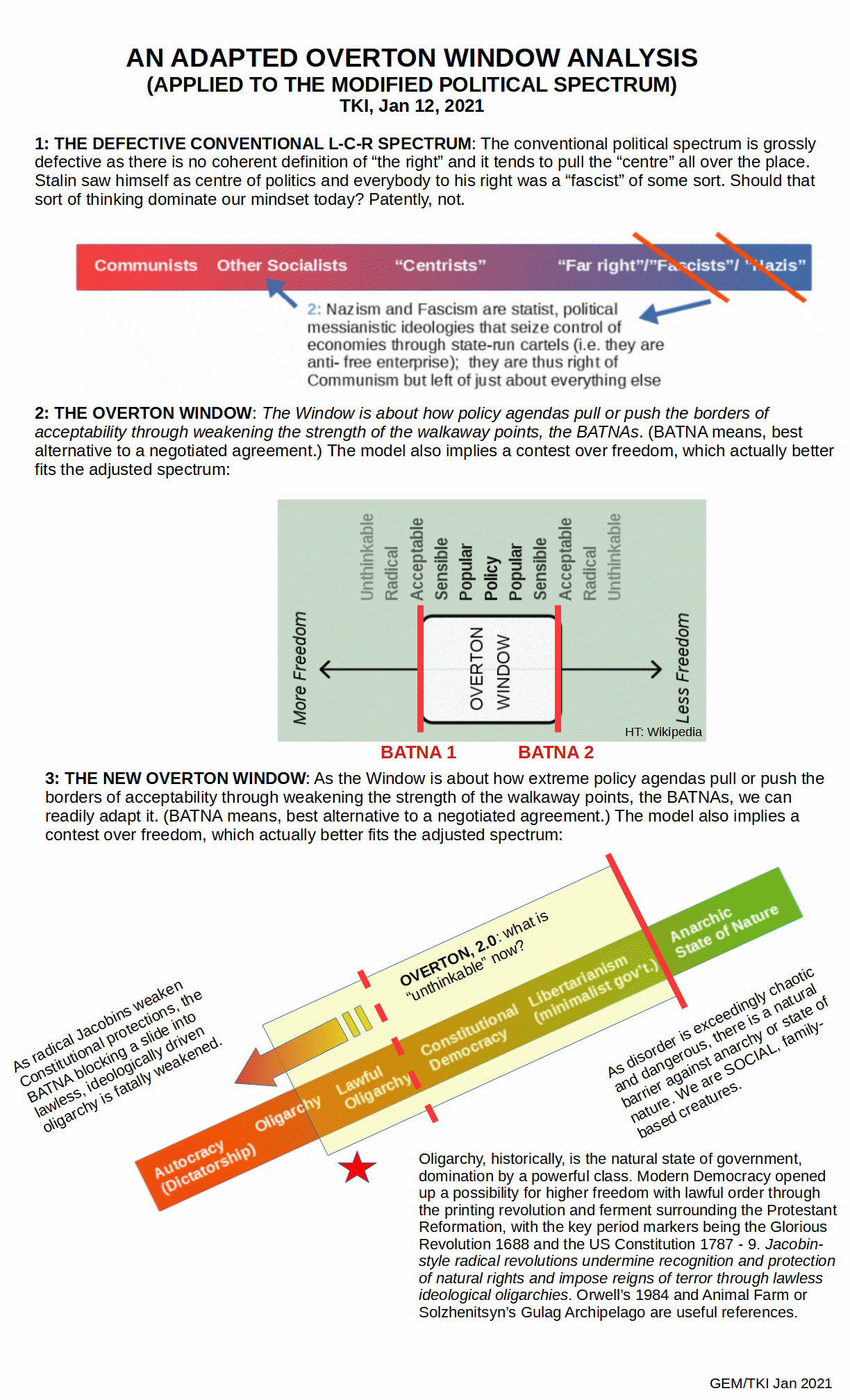
PS: As it seems necessary here is the historically anchored political spectrum with Overton Window:
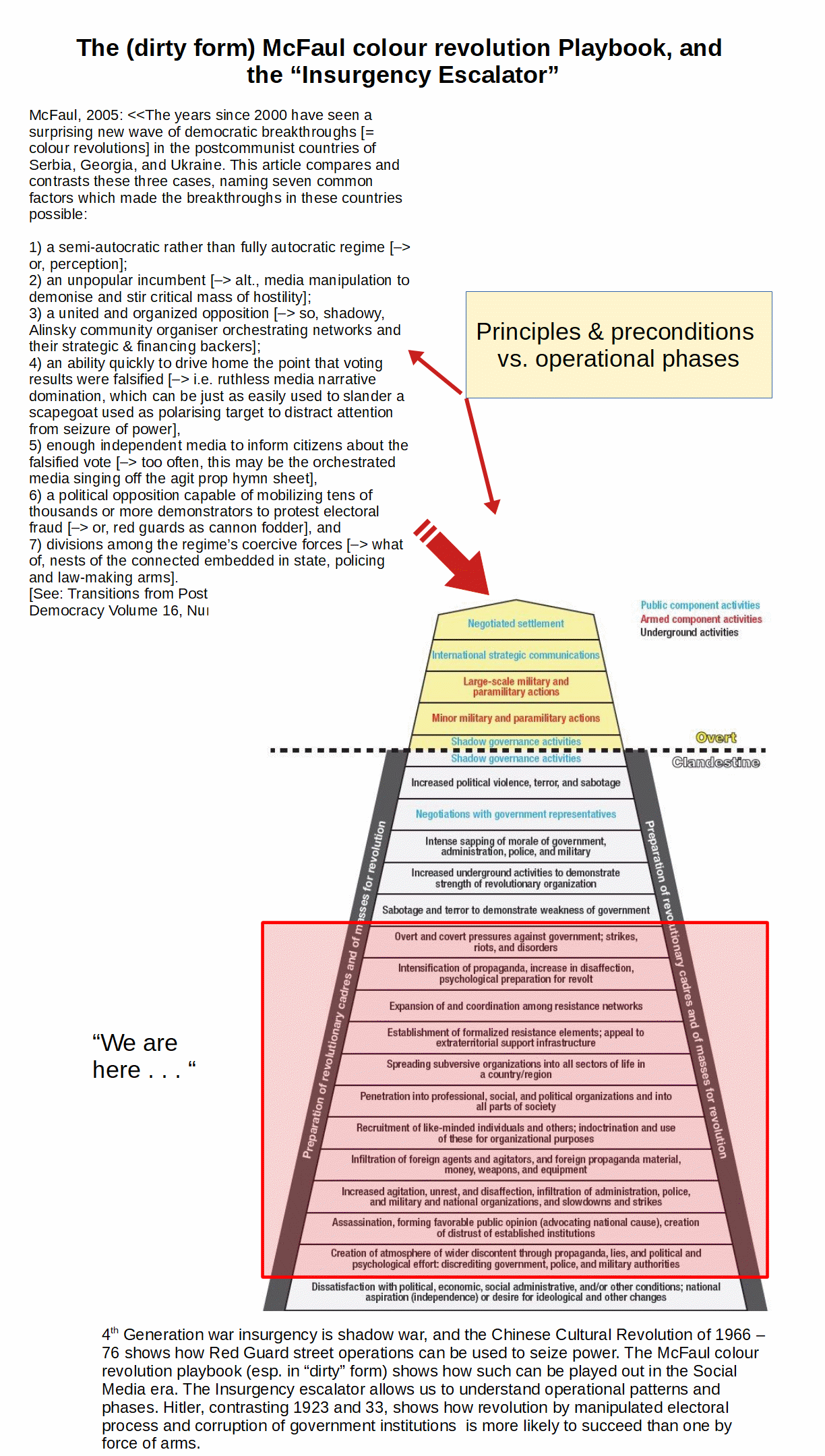
And, here is what we need to know on culture/colour revolution pushes
Comments
JVL, I give you a word from sustainability circles, problematique. Where, even the simple is difficult. KF PS: When explaining systematic mutually supporting thorny challenges here, I simply point to a local weed with particularly vicious V-shaped nail-sized needle sharp thorns -- yes, 2 for 1 deal -- that grows in thickets and say, kusha thicket. The message gets through instantly. PPS: Kindly, show me a square circle.kairosfocus
November 25, 2021
November
11
Nov
25
25
2021
04:58 AM
4
04
58
AM
PST
How would you decide if climate change is happening because of human interventions?
Concluding that climate change is happening is not difficult. Just look at trends in global temperature and frequency of severe climate events. Conclusively deciding that it is man-made is far more difficult.
How would you decide if same-sex marriage should be made legal?
If it’s consensual and does no harm then it should be legal.Joe Schooner
November 25, 2021
November
11
Nov
25
25
2021
04:58 AM
4
04
58
AM
PST
Mohammadnursyamsu: I already explained this perfectly with reference to the concept of choice as like a computer calculating a move, but you just totally ignored the explanation. Computers don’t have emotions, if you explain choice like how a computer does it, then you have thrown out your emotions. Throwing out emotions, is a very bad idea. You seem to think there is some very simple and easy criterium or way to make a decision but you don't explicitly state how to do it. Perhaps a couple of examples would help . . . How would you decide if climate change is happening because of human interventions? How would you decide if same-sex marriage should be made legal?JVL
November 25, 2021
November
11
Nov
25
25
2021
02:50 AM
2
02
50
AM
PST
@JVL When kids are very young, then generally kids are more spontaneous. And then they would have the correct fundamental understanding of choice still, in terms of spontaneity. When they get older, and especially when they go to school, then the pressure is piled unto them, to think of making a choice in terms of figuring out the best option. And those kids who are under a lot of pressure of this kind, will become materialists and socialists later on in life. I already explained this perfectly with reference to the concept of choice as like a computer calculating a move, but you just totally ignored the explanation. Computers don't have emotions, if you explain choice like how a computer does it, then you have thrown out your emotions. Throwing out emotions, is a very bad idea. I am not saying it is wrong to do your best. I am saying it is wrong to make that the fundamental definition of making a choice. And that these socialists may look emotional, does not mean that they acutally have a mature well developed emotional life. On the contrary. They don't have a mature emotional life, because they are obssed with objectivity, and clueless about subjectivity. You can see the socialists when they talk about justice, they calculate it in terms of everyone getting the same amount of money, and things like that. They calculate everything, and all the socialist intellectuals are all materialists, who do not accept the reality of the subjective human spirit making a choice.mohammadnursyamsu
November 24, 2021
November
11
Nov
24
24
2021
01:30 PM
1
01
30
PM
PST
Jerry I personally prefer objective minds. But there are not many here.
Many can't bear the pain of objectivity. To be objective is to be nailed on the Cross.Lieutenant Commander Data
November 24, 2021
November
11
Nov
24
24
2021
12:55 PM
12
12
55
PM
PST
I personally prefer objective minds. But there are not many here.jerry
November 24, 2021
November
11
Nov
24
24
2021
11:19 AM
11
11
19
AM
PST
Hmm, I thought some of them came from subjunctive minds but that's just my subjective opinion. -QQuerius
November 24, 2021
November
11
Nov
24
24
2021
10:48 AM
10
10
48
AM
PST
All of these utterances are proceeding from subjective minds. --Ramram
November 24, 2021
November
11
Nov
24
24
2021
09:36 AM
9
09
36
AM
PST
For what it's worth . . .
A socialist is: – Always overachieverish, wanting to their best
Opposite of my own experience. Socialists always have someone to blame for their indolence. Or they become socialist to atone for their ill-gotten wealth.
– By their definition of choice that they use, any choice they make is per definition for the best. So they lack conscience.
They justify disastrous outcomes by asserting their good intentions. It used to be common to see ecology- and socialism-themed bumper stickers plastered all over Volvo station wagons belching black smoke from their exhausts. I was once tempted to make them go crazy with my own custom bumper stickers: GIVE WAR A CHANCE NUKE THE WHALES CELEBRATE GLOBAL WARMING But I didn't want to get rammed by wild-eyed eco terrorist in a smoking Volvo station wagon.
– Socialists are generally emotionless, calculating people.
In my experience, they are constantly whipped into a frenzy by appeals to their emotions. They don't know how to use calculators or balance a checkbook. They think they have money as long as they still have checks. Here's a quote variously attributed: "A young person who's not a socialist has no heart; an older person who's a socialist has no brains."
– Mental illness runs rampant among socialists.
Not sure about this one. I've seen plenty of wackos on all extremes.
– They make formulaic policy of what is good and bad, instead of having common sense judgement.
They consider themselves "intellectuals," but have neither consistent policy nor common sense. They love to be generous with other people's money, but they're lousy tippers. Just my opinion. -QQuerius
November 24, 2021
November
11
Nov
24
24
2021
09:07 AM
9
09
07
AM
PST
Mohammadnursyamsu: I will again explain the obvious problem that causes socialism. Forgive me if I ask a really stupid question but it's in an attempt to understand your worldview. When we're young we tend to view the world from an extremely self-centric, short-term point of view. Quite naturally. We don't yet understand how our decisions and actions affect other people and carry forward. We don't understand consequences, everything seems to be NOW. As we age we remember some events in our past and how certain actions and decisions carried forward and affected things that happened later. So, partly, we start making choices in an attempt to avoid negative repercussions, some immediate, some later. We start to consider 'better' options as those which avoid 'bad' futures and tend to bring about 'good' futures. This is all very natural and obvious. Are you saying that we can get too fixated on trying to analyse decisions in an attempt to reach an optimal outcome OR are you saying we should just keep reacting in the moment without consideration of the future? They make formulaic policy of what is good and bad, instead of having common sense judgement. Are you saying we should not use data and rationality in an attempt to improve our policy and legal choices?JVL
November 24, 2021
November
11
Nov
24
24
2021
08:23 AM
8
08
23
AM
PST
I will again explain the obvious problem that causes socialism. In growing up society puts pressure on people to do their best. School, parents, government, and people's own ideals, puts enormous pressure on the individual, to do their best. This pressure to do their best, leads people to conceive of making a choice, in terms of figuring out the best option. However, the correct fundamental definition of making a choice is in terms of spontaneity, and to choose in terms of what is best is only a complex way of choosing, involving sorting out options. The definition of choice in terms of what is best, degrades into the logic of like a chesscomputer calculating the best move, in a completely forced way. So then the idea of freedom becomes divorced from the idea of choice. Choices become to be understood as forced. More importantly, also the idea the subjective spirit making the choice, is cut out of the concept of choice. In the correct definition of making a choice the alternatives are in the future, and then the subjective spirit makes one of the alternatives the present. But in the concept of choice in terms of what is best, there the alternatives are in the present, where they are being sorted, and then the option which is best is performed. All subjecitivity, like the love in personal relationships, and the expression on beauty and so on, is in reference to the agency of a choice, the subjective spirit. The spirit makes a choice, and the spirit can only be identified with a chosen opinion. So one can only choose an opinion whether some decisions was made out of love, and not measure the love as fact. So having thrown out the subjective spirit from the concept of choice, it means all subjectivity is destroyed, and people become materialists. Socialism is just the political application of this materialism. You can see that this is how socialism is produced, by that it accurately explains the psychogological profile of socialists. A socialist is: - Always overachieverish, wanting to their best - By their definition of choice that they use, any choice they make is per definition for the best. So they lack conscience. - Socialists are generally emotionless, calculating people. - Mental illness runs rampant among socialists. - They make formulaic policy of what is good and bad, instead of having common sense judgement.mohammadnursyamsu
November 23, 2021
November
11
Nov
23
23
2021
10:26 PM
10
10
26
PM
PST
PPS: It is worth pausing to note Plato's ship of state:
It is not too hard to figure out that our civilisation is in deep trouble and is most likely headed for shipwreck. (And of course, that sort of concern is dismissed as “apocalyptic,” or neurotic pessimism that refuses to pause and smell the roses.) Plato’s Socrates spoke to this sort of situation, long since, in the ship of state parable in The Republic, Bk VI:
>>[Soc.] I perceive, I said, that you are vastly amused at having plunged me into such a hopeless discussion; but now hear the parable, and then you will be still more amused at the meagreness of my imagination: for the manner in which the best men are treated in their own States is so grievous that no single thing on earth is comparable to it; and therefore, if I am to plead their cause, I must have recourse to fiction, and put together a figure made up of many things, like the fabulous unions of goats and stags which are found in pictures. Imagine then a fleet or a ship in which there is a captain [–> often interpreted, ship’s owner] who is taller and stronger than any of the crew, but he is a little deaf and has a similar infirmity in sight, and his knowledge of navigation is not much better. [= The people own the community and in the mass are overwhelmingly strong, but are ill equipped on the whole to guide, guard and lead it] The sailors are quarrelling with one another about the steering – every one is of opinion that he has a right to steer [= selfish ambition to rule and dominate], though he has never learned the art of navigation and cannot tell who taught him or when he learned, and will further assert that it cannot be taught, and they are ready to cut in pieces any one who says the contrary. They throng about the captain, begging and praying him to commit the helm to them [–> kubernetes, steersman, from which both cybernetics and government come in English]; and if at any time they do not prevail, but others are preferred to them, they kill the others or throw them overboard [ = ruthless contest for domination of the community], and having first chained up the noble captain’s senses with drink or some narcotic drug [ = manipulation and befuddlement, cf. the parable of the cave], they mutiny and take possession of the ship and make free with the stores; thus, eating and drinking, they proceed on their voyage in such a manner as might be expected of them [–> Cf here Luke’s subtle case study in Ac 27]. Him who is their partisan and cleverly aids them in their plot for getting the ship out of the captain’s hands into their own whether by force or persuasion [–> Nihilistic will to power on the premise of might and manipulation making ‘right’ ‘truth’ ‘justice’ ‘rights’ etc], they compliment with the name of sailor, pilot, able seaman, and abuse the other sort of man, whom they call a good-for-nothing; but that the true pilot must pay attention to the year and seasons and sky and stars and winds, and whatever else belongs to his art, if he intends to be really qualified for the command of a ship, and that he must and will be the steerer, whether other people like or not-the possibility of this union of authority with the steerer’s art has never seriously entered into their thoughts or been made part of their calling. Now in vessels which are in a state of mutiny and by sailors who are mutineers, how will the true pilot be regarded? Will he not be called by them a prater, a star-gazer, a good-for-nothing? [Ad.] Of course, said Adeimantus. [Soc.] Then you will hardly need, I said, to hear the interpretation of the figure, which describes the true philosopher in his relation to the State [ --> here we see Plato's philosopher-king emerging]; for you understand already. [Ad.] Certainly. [Soc.] Then suppose you now take this parable to the gentleman who is surprised at finding that philosophers have no honour in their cities; explain it to him and try to convince him that their having honour would be far more extraordinary. [Ad.] I will. [Soc.] Say to him, that, in deeming the best votaries of philosophy to be useless to the rest of the world, he is right; but also tell him to attribute their uselessness to the fault of those who will not use them, and not to themselves. The pilot should not humbly beg the sailors to be commanded by him –that is not the order of nature; neither are ‘the wise to go to the doors of the rich’ –the ingenious author of this saying told a lie –but the truth is, that, when a man is ill, whether he be rich or poor, to the physician he must go, and he who wants to be governed, to him who is able to govern. [--> the issue of competence and character as qualifications to rule] The ruler who is good for anything ought not to beg his subjects to be ruled by him [ --> down this road lies the modern solution: a sound, well informed people will seek sound leaders, who will not need to manipulate or bribe or worse, and such a ruler will in turn be checked by the soundness of the people, cf. US DoI, 1776]; although the present governors of mankind are of a different stamp; they may be justly compared to the mutinous sailors, and the true helmsmen to those who are called by them good-for-nothings and star-gazers. [Ad.] Precisely so, he said. [Soc] For these reasons, and among men like these, philosophy, the noblest pursuit of all, is not likely to be much esteemed by those of the opposite faction [--> the sophists, the Demagogues, Alcibiades and co, etc]; not that the greatest and most lasting injury is done to her by her opponents, but by her own professing followers, the same of whom you suppose the accuser to say, that the greater number of them are arrant rogues, and the best are useless; in which opinion I agreed [--> even among the students of the sound state (here, political philosophy and likely history etc.), many are of unsound motivation and intent, so mere education is not enough, character transformation is critical]. [Ad.] Yes. [Soc.] And the reason why the good are useless has now been explained? [Ad.] True. [Soc.] Then shall we proceed to show that the corruption of the majority is also unavoidable [--> implies a need for a corruption-restraining minority providing proverbial salt and light, cf. Ac 27, as well as justifying a governing structure turning on separation of powers, checks and balances], and that this is not to be laid to the charge of philosophy any more than the other? [Ad.] By all means. [Soc.] And let us ask and answer in turn, first going back to the description of the gentle and noble nature.[ -- > note the character issue] Truth, as you will remember, was his leader, whom he followed always and in all things [ --> The spirit of truth as a marker]; failing in this, he was an impostor, and had no part or lot in true philosophy [--> the spirit of truth is a marker, for good or ill] . . . >>
(There is more than an echo of this in Acts 27, a real world case study. [Luke, a physician, was an educated Greek with a taste for subtle references.] This blog post, on soundness in policy, will also help)
With, Luke's case study, doubtless influenced by awareness of the just above:
[On Luke's microcosm on the ship of state, Jan 1, 2013:] Entrenched highly ideological orthodoxies — and this includes successful revolutionaries, whether on institutional or community scale — that control resource flows to their benefit and which exert enormous power in institutions and society [I was speaking here about today's evolutionary materialism dominated science], tend to be very resistant to what is new and unsettling to their comfort zones and interests. Where there has been indoctrination and polarisation, we can see this multiplied by the problem of lack of logical thinking ability and sheer lack of awareness of the true state of the balance of warrant on the merits of facts and evidence. The perceived heretic, then is a threat to be fought off, marginalised, discredited and if necessary destroyed. By any and all means, fair or foul. (I find the obsession with suggestions of a threat of religious subversion of [scientific, political, education, media and cultural] institutions long since subverted by radical secularists slightly amusing but quite sad in the end. The key threat is unaccountable, out of control power in the hands of elites prone to corruption, not that this once happened with religious elites. In the past 100 years, we saw major secularist movements and neopagan movements of political messianism that did much the same to horrific cost. And the welfare state of the past generation has not been a whole lot better. [Just ask the ghosts of the dozens of millions who have been aborted for convenience.]) Where is there a solution? Frankly, at this stage, I think things are going to have to crash so badly and some elites are going to have to be so discredited by the associated spreading failure, that media propaganda tactics cannot cover it up anymore. My model for that comes from one of the red-flag sources that will give some of the objectors [to the design theory movement in science] the vapours. Acts 27. What, how dare you cite that, that . . . that . . . textbook for theocratic tyranny by the ignorant, insane, stupid and/or wicked followers of that bronze age misogynistic homophobic genocidal racist war god! (Do you hear how your agit-prop talking points are enmeshing you in the classic trap of believing your own propaganda?) Let’s start with, Paul of Tarsus, c. AD 59, was not in the Bronze Age but was an appellate prisoner in chains on early Imperial era grain ships having a hard time making way from the Levant and Asia Minor to Rome, in the second case ending up in a bay on Crete. What followed is a classic exercise in the follies of manipulated democracy, a case study that will well repay study in our time.
It was late in the sailing season, and the merchant-owner was worried about his ship in an open bay at Fair Havens, given what winter storms can do. The passengers were not too impressed by the nearby settlements as a wintering place. (Sailing stopped in Autumn and opened back up in Spring. [--> EVERYONE knew why, the ships of that day could not bear up the storms of winter, and as time wore on in the fall, sailing became increasingly dangerous]) The key technico, the kubernete — steersman, more or less like a pilot of an airliner — knew where his bread was buttered, and by whom. In the middle was a Centurion of the elite messenger corps. We are at ship’s council, and Paul, in chains, is suggesting that the suggestion to venture our with a favourable wind to try to make it to a more commodious port down-coast was excessively risky not only to boat but life. The financial and technical talking heads and the appeal of comfort allowed him to be easily marginalised and dismissed. Then we saw a gentle south breeze, that would have allowed a reach down the coast. (The technicos probably knew this could be a precursor to a storm, but were not going to cut across the dominant view. [Let's add, how many days would it have taken to simply WALK to Phoenix, 40 mi away by sea? 3 - 4? We can readily see how the implicit, you won't get money back if you "abandon" the voyage and the rosy description of a smooth, low risk afternoon's sail could easily have swayed opinions.]) They sailed out. Bang, an early winter noreaster hit them and sprang the boat’s timbers (why they tried to hold together with ropes [--> called frapping]) so the ship was in a sinking condition from the beginning. Worse, they were heading for sandbars off the coast of today’s Libya. For two weeks all they could do was use a sea anchor to control drift and try to steer vaguely WNW. Forget, eating. That is when Paul stood forth as a good man in a storm, and encouraged them with a vision from God. By this time, hope was to be shipwrecked on a coast. (Turned out, [probably] north coast of Malta [possibly, east end].) While the ship was at risk of being driven aground and set out four anchors by the stern from midnight on, the sailors tried to abandon the passengers on a ruse, spotted by Paul and/or Luke his travelling companion. By this time, the Centurion knew who to take seriously and the ship’s boat was cut away. He then took the decision to save Paul and refused the soldiers’ request to kill the prisoners to prevent escape (for which their lives would have been forfeit). So, they made it to a beach on Malta, having lost the ship in any case AND nearly their own lives.
We can go on to Ac 17, which outlines the Christian worldview before an Athenian audience, noting the offer of proof for the gospel, resurrection witnessed by 500 who could not be broken:
[Ac 17, being Paul's Mars Hill Speech c. AD 50, most likely given in the Agora:] 16 Now while Paul was waiting for them at Athens, his spirit was provoked within him as he saw that the city was full of idols. 17 So he reasoned [--> notice, reasoned, starting with . . . ] in the synagogue with the Jews and the devout persons [--> informal, God-fearing adherents to OT theism], and in the marketplace every day with those who happened to be there [--> directly echoing Socrates at the time of the Peloponnesian war, as Athenian democracy disintegrated under factionalism outlined in Plato's Ship of State parable, leading to his judicial murder c 400 BC at hands of the Areopagus, serving as high court of Athens]. 18 Some of the Epicurean and Stoic philosophers also conversed with him. And some said, “What does this babbler [--> spermologos, seed picking birds picking up scraps in the Agora, used to imply purveyor of bits and pieces of undigested knowledge] wish to say?” Others said, “He seems to be a preacher of foreign divinities”—because he was preaching Jesus and the resurrection. 19 And they took him and brought him to the Areopagus [--> probably looking for intellectual entertainment at his anticipated discrediting under pointed questions etc], saying, “May we know what this new teaching is that you are presenting? 20 For you bring some strange things to our ears. We wish to know therefore what these things mean.” 21 Now all the Athenians and the foreigners who lived there would spend their time in nothing except telling or hearing something new. 22 So Paul, standing in the midst of the Areopagus, said: “Men of Athens, I perceive that in every way you are very religious. 23 For as I passed along and observed the objects of your worship, I found also an altar with this inscription, ‘To the unknown god.’ [--> cultural point of contact] What therefore you worship as unknown [--> then, our civilisation's main centre of learning, and here they had to maintain a monument to ignorance on the pivot of all knowledge, the root of reality] , this I proclaim [--> alludes to the power of inscripturated prophetic revelation backed up by miraculous power as providing warrant, cf Isa 48:1 - 8 with 2 Pet 1:16 - 21, also Isa 52:13 - 53:12, 1 Cor 15:1 - 11] to you. 24 The God who made the world and everything in it [--> declares the inherently good, utterly wise creator God to be root of reality], being Lord of heaven and earth, does not live in temples made by man,3 25 nor is he served by human hands, as though he needed anything, since he himself gives to all mankind life and breath and everything. 26 And he made from one man every nation of mankind to live on all the face of the earth, having determined allotted periods [--> kairous, the hinges of history, of which this incident was one] and the boundaries of their dwelling place, 27 that they should seek God, and perhaps feel their way toward him and find him [--> i.e. blind groping, cf sim phrasing in Homer about Cyclops with his eye put out, likely a literary allusion, with further reference to groping in Plato's Cave blindly]. Yet he is actually not far from each one of us, 28 for “‘In him we live and move and have our being’;4 as even some of your own poets have said, “‘For we are indeed his offspring.’5 ________ [F/N 4: Probably from Epimenides of Crete F/N 5: From Aratus's poem"Phainomena"] 29 Being then God's offspring [--> notice, all truth belongs to God, Truth Himself], we ought not to think that the divine being is like gold or silver or stone, an image formed by the art and imagination of man. [--> Athens was full of idols, he here corrects the abuse of culture, creativity and artistic skill to perpetuate manifestly false myths as pivot of self understanding, cultural agenda and moral government] 30 The times of ignorance God overlooked, but now he commands all people everywhere to repent, 31 because he has fixed a day on which he will judge the world in righteousness by a man whom he has appointed; and of this he has given assurance to all by raising him from the dead [--> with 500 witnesses, cf Isa 52:13 - 53:12 and ! Cor 15:1 - 11 as linked already . . . offer of decisive warrant].” 32 Now when they heard of the resurrection of the dead, some mocked. But others said, “We will hear you again about this.” 33 So Paul went out from their midst. 34 But some men joined him and believed, among whom also were Dionysius the Areopagite [--> 1st Bishop of Athens, where Athens took up the torch, the future belonged to the gospel, transforming worldviews and civilisation through integral gospel of the Kingdom of God ethics] and a woman named Damaris [--> a resident non Athenian, likely a merchant] and others [--> onlookers, likely, the church begins in the pivotal centre of learning] with them.
kairosfocus
November 23, 2021
November
11
Nov
23
23
2021
10:15 PM
10
10
15
PM
PST
Querius, context is key. Being a Roman subject (as opposed to citizen) with Roman auxiliaries -- as opposed to legionaries -- recruited by policy from known enemy states as main occupying troops with associated general issues of oligarchy is one thing, learning lessons of discipleship (not being waspish or full of seething anger etc) is another, the issues of one's own government are a third. There are many other texts and contexts which become relevant and Vindiciae is a discussion of such; in short there needs to be a systematising balance to our theology of nationhood and government under God, where for example Ac 17 and 27 are very relevant respectively. This is not the place for drawing that out in detail, nor is this thread primarily about that. Where, we should further realise that not every relevant truth is found in the Bible, where also truths will be mutually compatible on the thesis that we live in a cosmos, an ordered, coherent system of reality, rather than a chaos: truths that accurately describe the various aspects must and will all be so together. For instance, in no possible world can a square circle be instantiated. Similarly, we will find nowhere in Scripture an elaboration of Arithmetic or textbooks of Hebrew, Aramaic, or Greek. Yes, there is a statement of the Law of Identity but no elaboration of systematic logic. And more. As for the self-evidence, are we equally human beings or not, do we share a common rationality, with conscience guarded moral government? So, do we face neighbour-love as a basic premise of law or not, rather than nihilistic will to power that cares not one whit beyond what can I get away with? The self-evidence grows from recognition of such factors tied to observing the patent absurdities of the rejection of such principles. I pause to show again an extended citation from Locke, which draws out the Biblical and natural law influences at work:
[Locke, in 2nd Treatise on Civil Govt Ch 2 Sec 5, citing "the judicious [Anglican Canon Richard] Hooker [in his Ecclesiastical Polity]"]. . . if I cannot but wish [--> accurately perceiving my own moral worth and so my rights] to receive good, even as much at every man’s hands, as any man can wish unto his own soul, how should I look to have any part of my desire herein satisfied, unless myself be careful to satisfy the like desire which is undoubtedly in other men [--> accurately perceiving that here are others of like nature] . . . my desire, therefore, to be loved of my equals in Nature, as much as possible may be, imposeth upon me a natural duty of bearing to themward fully the like affection. [--> notice, imposes, by the sense of my own moral state and the perception of others who are as I am, I have reciprocity of duties of care in community] From which relation of equality between ourselves and them that are as ourselves, what several rules and canons natural reason hath drawn for direction of life no man is ignorant
[--> these teach us so that we come to knowledge of morality: warranted, credibly true beliefs; of course, this is not the basis for that warrant, that lies in a world-foundational, world-root, world-source IS that inherently grounds OUGHT. And therein lieth a deep root of hyperskepticism on this, for if we are inherently -- by patent facts of our nature as responsibly free and rational, valuable beings -- under moral government and moral law, it points straight to a world root level Lawgiver and Governor. That is, to the inherently good Creator God, a necessary and maximally great being worthy of ultimate loyalty and the reasonable service of doing the good in accord with our nature]
. . . [Hooker then continues, citing Aristotle in The Nicomachean Ethics, Bk 8:] as namely, That because we would take no harm, we must therefore do none; That since we would not be in any thing extremely dealt with, we must ourselves avoid all extremity in our dealings; That from all violence and wrong we are utterly to abstain, with such-like [--> being core principles of law derived from reciprocity and my sense of my own worth and quite evident to such as Aristotle] . . . [Eccl. Polity, preface, Bk I, “ch.” 8, p.80]
Hobbes and others discussions reflect the too often unacknowledged influence of the Scripturally derived double covenant understanding of nationhood and government under God. This has been further amplified in recent generations by radical and now cynical secularist humanism. We are beginning to reap the fruit of our collective folly and errors, much along the lines Plato warned of. And, again, this thread is not the place for elaborating essays on political theory and its links to theology, philosophy, ethics, history etc. or the failings and bias-driven errors of current theorists. I outline, there is much elsewhere. The thread is about a specific issue, following up from the identification of how so many millennials have been led to imagine that Socialism is a superior principle of economic, political and societal organisation only thirty years after the events at the turn of the 90's plus the technological and prosperity transformation of recent generations have decisively answered in favour of lawful state, free enterprise, market driven economics with markets for finance and investment etc. We need to see our way through a current peril implicating much of our so called intellectual, educational, media and opinion forming leadership in a plain and highly material betrayal of duty to civilisation. Which inter alia goes to how we evaluate the balance of scholarship on the merits. KF PS: I must correct a tendency to speak as though Tho Jefferson was sole author and idea-source of the US DoI. Compare his draft with the final and you will see that much of the very phrasing was adjusted and there were clear negotiations on specific points. In which context, there is the further factor of a broad range of thought and history of ideas and theology etc behind it. So recall, there were 55 or 56 IIRC signers and it was issued by a Continental Congress with John Hancock, then president, as first signatory.kairosfocus
November 23, 2021
November
11
Nov
23
23
2021
09:22 PM
9
09
22
PM
PST
Kairosfocus @56,
Querius, this is not a Bible and theology site, but I will give a couple of notes. First, the quiet premise is, what belongs to Caesar and how did he come by it.
Yes, understood. That's not my point. My point is to question the source of "self evident" truths referenced by the founders of the United States. For example, Caesar's face is on his coinage, which Jesus asserted belongs to Caesar, but humans bear the image of God. If a Roman soldier legally demands a civilian to carry his pack for a mile Jesus advocated carrying the pack for two miles. If someone sues you for your coat, give him also your cloak. The early church distributed contributions to the needy among them, which sounds socialistic. And Jesus told the Judeans to pay their taxes to Rome despite their not consenting to be governed by Rome. My point is that founding documents of the United States don't seem to be founded on biblical principles, but on other principles including "the consent of the governed." Surely the Romans did not have any such consent from the Judeans! Instead, in 70 A.D., they made the source of their rule quite clear by crucifying perhaps up to a million Judeans by some estimates. So, where did Thomas Jefferson get his ideas?
Competing visions of both the basis for or origin of sovereignty (was sovereignty based on raw power or consent of the governed?) and its ultimate location (did it reside in Parliament or in the constitution?), led Hobbes and Locke, Blackstone and Bolingbroke, Harrington and Montesquieu, to devise and refine intricate and conflicting theories of government based on rational enlightenment principles, rather than on the pre-Enlightenment religious tradition. - Suzanna Sherry, The Intellectual Origins of the Constitution: A Lawyers' Guide to Contemporary Historical Scholarship, Vanderbilt University Law School, 1988
But the answer, as far as I've been able to determine, is that these concepts originated with Thomas Hobbes.
Due to Hobbes’ ideas, they saw that people cannot survive without a strong central government that would protect them. His social contract theory established that a government should serve and protect all the people in the society. acting only with the “consent of the governed”, this influenced the U.S constitution. Hobbes is famous for his early and elaborate development of what has come to be known as “social contract theory”, the method of justifying political principles or arrangements by appeal to the agreement that would be made among suitably situated rational, free, and equal persons. - https://colors-newyork.com/how-did-thomas-hobbes-influence-american-government/
Thus, Thomas Jefferson's "self-evident truths," were self-evident to Thomas Jefferson because he apparently chose not to cite Thomas Hobbes for some reason, nor build a case for the "consent of the governed." Or have I missed something? -QQuerius
November 23, 2021
November
11
Nov
23
23
2021
07:50 PM
7
07
50
PM
PST
Querius, this is not a Bible and theology site, but I will give a couple of notes. First, the quiet premise is, what belongs to Caesar and how did he come by it. The answer is, effectively, in Rom 13:4 --
4 for he [the civil magistrate] is God's servant for your good. But if you do wrong, be afraid, for he does not bear the sword in vain. For he is the servant of God, an avenger who carries out God's wrath on the wrongdoer.
That is, the primary task of the civil authority as God's servant is to do good and particularly by upholding, exemplifying and defending the civil peace of justice from WRONG-doers. There is no "property" of the civil authority that allows for him to turn evildoer and expect us to support him in and carry out evil. So, taxes of prudent proportion are due to support reasonable government services in that context. Likewise, general good citizenship and prayer that said civil peace would prevail as that is the best context to live a godly life. And more. As for Plato, he wrote after the suicide of Athenian direct democracy through the Peloponnesian war, with the added matter of judicial murder of Socrates, Plato's teacher. Such Democracy was unworkable at the time and would be so today. Constitutional, representational democracy in a literate, informed culture with effective media watchdogs, the classic liberties found in bills of rights etc and a community that recognises the built in law of our nature can work. Until people take it for granted and begin to play the dirty faction games Plato skewered in The Laws and in the parable of the ship of state in The Republic. Look all around us. KFkairosfocus
November 23, 2021
November
11
Nov
23
23
2021
12:11 PM
12
12
11
PM
PST
Kairosfocus @53, Thank you, I'll look up the references you cited. I consider myself more of a libertarian rather than a statist, and by today's shifting standards, a centrist. The Roman government at the time of Jesus was highly oppressive in Israel and extremely corrupt. So the religious leaders in his society asked Jesus whether it was lawful under Torah to pay taxes to Rome. Should an observant Jew fund the monster or resist it? Of course, you know the shocking answer that Jesus gave. I could easily accept that the founders of the U.S. were thinking of Plato's Republic, in which Plato viewed democracy as a pathological manifestation of self government, but I don't know whether this was actually the case. Perhaps, the subject is covered in one of your links. Thank you. -QQuerius
November 23, 2021
November
11
Nov
23
23
2021
11:05 AM
11
11
05
AM
PST
The Cato Institute publishes a free book on economics for anyone interested
ECONOMICS AND FREE MARKETS: AN INTRODUCTION A short guide to economics and the market economy.
https://www.libertarianism.org/books/economics-free-markets-introduction The Cato Institute is a libertarianism organization. I personally don't consider my self a libertarian so this is not a recommendation based on that ideology. I do however believe free markets are the best way to run an economy.jerry
November 23, 2021
November
11
Nov
23
23
2021
09:06 AM
9
09
06
AM
PST
Querius, have you read Vindiciae Contra Tyrannos or other similar works? [Try p 60 on here] Note I mention the double covenant view of nationhood and government under God. Consent of the governed appears in that context, with several key examples and with say Nimrod as counter-example of a man setting up in power in defiance of God with scattering of nations as direct result. Note too how when Saul went bad dynasty was changed and similarly with Solomon and Rehoboam. The principle of consent in covenant and maintained in context of good stewardship is a bulwark against Nimrod-like oppression. Where, intercession of prophets and lower magistrates is also exemplified (note the principle of instructive example established in NT) as a means of remonstrance, with reformation and replacement as onward sanctions in face of defiance. In this context, rights-recognising and protective Constitutional democratic self-government through elected representatives with limited terms is a blessing and privilege bought at great cost; note the long shadow of Ac 27 on Christians as good citizens. It is also unstable requiring buttressing from the community, with a culture of Scripture-guided godliness a key part. As the West becomes increasingly apostate, a Rom 1 world emerges with many a Nero or Caligula waiting in the wings to be pervert in chief and domineering lord. This outline, given a link already provided here, should be enough for UD, which is not a site about Bible, theology and related matters. This thread is a supplement to the Barna thread that identified that a large proportion of millennials have been mis-taught to imagine that socialist utopianism is solution to the ills of the post WW3 west. Somehow the voices of 100's of millions of eyewitnesses to the fiascos of such statism on steroids have been sidelined. Which cannot be an accident, we are looking at willful betrayal of civilisation by those pretending to be the luminaries and anointed leaders. KFkairosfocus
November 23, 2021
November
11
Nov
23
23
2021
02:52 AM
2
02
52
AM
PST
Kairosfocus @51, Again, I agree with everything you stated, including the implication that voter/voting fraud is tantamount to taxation without (proper) representation. But . . . Upon what foundation, biblical or philosophical, is the concept of "with the consent of the governed" based upon? I've never been able to come up with a satisfactory answer. -QQuerius
November 22, 2021
November
11
Nov
22
22
2021
08:50 PM
8
08
50
PM
PST
Querius, rights are first individual, and nations are founded on individuals in families. The context is the double covenant of nationhood and government under God with consent of the governed. Such includes that taxation is a due and moderate agreed sum proportionate to the proper work of government otherwise it becomes arbitrary power, oppression and theft. Similarly the power of regulation and making civil laws. Government grown too big for its britches becomes a usurper subject to remonstrance, reform and if necessary revolution led by lower magistrates or emerging representatives. Today, the sound general election is a solemn assembly to audit, reform and replace failed government. Which is why electoral fraud of material scope is treasonous, an invitation to bloodshed. KFkairosfocus
November 22, 2021
November
11
Nov
22
22
2021
03:46 PM
3
03
46
PM
PST
JS, happiness is in the context of fulfilling one's proper ends and calling, consistent with his or her nature, individuality and common humanity. KFkairosfocus
November 22, 2021
November
11
Nov
22
22
2021
03:36 PM
3
03
36
PM
PST
It is not “happiness” that you have a right to, but you have the right to pursue it. In short, there should be no unjustified roadblocks or impediments to prevent you from happiness. For example, segregation was an impediment to black people in their attempt to pursue happiness.Joe Schooner
November 22, 2021
November
11
Nov
22
22
2021
02:23 PM
2
02
23
PM
PST
Kairosfocus @33, As I often complain regarding certain posters here about their assumption that their unsupported assertions do not constitute irrefutable proof (after which their heads explode), I'm attempting to apply the same standards to the famous portion of the U.S. Declaration of Independence:
We hold these truths to be self-evident, that all men are created equal, that they are endowed by their Creator with certain unalienable Rights, that among these are Life, Liberty and the pursuit of Happiness.--That to secure these rights, Governments are instituted among Men, deriving their just powers from the consent of the governed, --That whenever any Form of Government becomes destructive of these ends, it is the Right of the People to alter or to abolish it, and to institute new Government, laying its foundation on such principles and organizing its powers in such form, as to them shall seem most likely to effect their Safety and Happiness.
The equality of all men and women in the judgment of God and under law seems implicit in reason and in the Bible. Likewise the "right" to life is expressed in the negative in the sixth commandment, Thou shalt not murder." However, society and its government is obligated to take someone's life only in prescribed circumstances by due process and evidence when specified laws have been broken. The right to "Liberty" can also be discussed from the negative in the form of two social institutions: imprisonment and slavery. As to imprisonment, it is mentioned clearly in Ezra 7:26:
And whosoever will not do the law of thy God, and the law of the king, let judgment be executed speedily upon him, whether it be unto death, or to banishment, or to confiscation of goods, or to imprisonment.
Similarly, slavery is tolerated but heavily restricted in the Bible (a whole different discussion). However, these apply to individuals rather than a societal right to Liberty from seemingly arbitrary and capricious laws . . . and reasonable ones such as speed limits on streets to name one of them. The examples included in the Declaration of Independence list a number of complaints, for example
For imposing Taxes on us without our Consent:
Upon what "self evident" and "unalienable" right is this based on? And finally, what is the "right" to the "pursuit of happiness" based on and what does its removal look like? Restricting the use of psychoactive drugs? Restricting prostitution, pornography, or alcohol (as during prohibition)? It's my understanding that this last "right" was originally the right to Property, which does seem more reasonable in that it's violation would be confiscation or "civil forfeiture" as is still commonly practiced in the U.S. where cash, land, and vehicles are confiscated by the authorities when suspected of being involved in some unspecified crime. Or perhaps this last "right" is now being interpreted as the right to be happy, and not being happy means you're been oppressed somehow requiring governmental intervention in the name of "fairness." -QQuerius
November 22, 2021
November
11
Nov
22
22
2021
01:38 PM
1
01
38
PM
PST
JS, further doubling down, just noted for record. Policies are chosen for ends they credibly achieve and socialism fails to deliver economically while landing us back in lawless oligarchy. History shows that getting back out of loss of liberty is difficult and dangerous and economic damage can linger for generations. Specifically, the imposition of legal positivism has been known from Plato on to be conducive to lawless oligarchy. As for the absurdity that might makes right, that speaks for itself. KFkairosfocus
November 22, 2021
November
11
Nov
22
22
2021
10:27 AM
10
10
27
AM
PST
JS, no, another fallacy on your part. You confuse reduction to absurdity with I don’t like consequences. However, on this matter the ideology is conducive to lawless oligarchy and so fails to break out of the historic problem of misgovernment by the lawless entrenched in power; never mind progressive branding, regressive. It is therefore a danger to lawful freedom and should be rejected as an economic and political organising principle.
Once again you are appealing to consequences rather than presenting a sound argument for the inherent nature human rights.Joe Schooner
November 22, 2021
November
11
Nov
22
22
2021
09:22 AM
9
09
22
AM
PST
Unfortunately for some, even if we have inherent rights and responsibilities imbued in us by our creator, it is still a case of might makes right. It doesn't matter if one finds it absurd or not; there's no escaping it regardless of your ontological perspective. It's either humans using some form of might or God. You can justify it any way that pleases you, and/or punt it back to some other entity, but at the end of the day, might makes right.William J Murray
November 22, 2021
November
11
Nov
22
22
2021
09:20 AM
9
09
20
AM
PST
JS, no, another fallacy on your part. You confuse reduction to absurdity with I don't like consequences. However, on this matter the ideology is conducive to lawless oligarchy and so fails to break out of the historic problem of misgovernment by the lawless entrenched in power; never mind progressive branding, regressive. It is therefore a danger to lawful freedom and should be rejected as an economic and political organising principle. KFkairosfocus
November 22, 2021
November
11
Nov
22
22
2021
09:12 AM
9
09
12
AM
PST
JS, you are stuck in a rut, legal positivism, which is an open door to nihilism and fails.
An excellent example of the appeal to consequences fallacy.Joe Schooner
November 22, 2021
November
11
Nov
22
22
2021
09:05 AM
9
09
05
AM
PST
CD, you obviously failed to even listen to the first few moments before leaping to your favourite ad hom beatdowns to dismiss. Mr D'Sousa grew up in India and so whatever his relative privilege he saw the dislocations of socialistic ideology even in fairly moderate forms. So did I in my homeland, and I heard all the excuses and blame projections. There is already an outline above on why socialistic ideological central planning or just control of "commanding heights of the economy" so reliably falters and fails; it is an information and control problem and it can only be solved by distributed decision-making coupled through markets; yes, we can address welfare provisions etc (as was done from Moses' day) but that has nothing to do with the fallacy of socialistic macroeconomic planning and the loss of liberty implications of such control. All you are managing to do is to inadvertently demonstrate how the lesson definitively shown in 1989 - 91 has been willfully suppressed by those who should know a lot better. KFkairosfocus
November 22, 2021
November
11
Nov
22
22
2021
08:42 AM
8
08
42
AM
PST
JS, you are stuck in a rut, legal positivism, which is an open door to nihilism and fails. Your refusal to acknowledge that we are responsible, rational, significantly free and thus morally governed creatures so that rights inhere as inherently binding mutually compossible expectations that we be upheld and respected in our lives, persons, innocent reputations, honestly acquired property and achievements etc leads to might/manipulation makes "right," etc. Instead of recognising the error and longstanding corrections (e.g. in Plato much less US DoI), you have further doubled down. Duly noted, negative credibility confirmed. KFkairosfocus
November 22, 2021
November
11
Nov
22
22
2021
08:31 AM
8
08
31
AM
PST
1 2 3 4 5 6

Leave a Reply