Uncommon Descent Serving The Intelligent Design Community
graph

A statistical comparison of two human genomes

Categories
Genomics
Intelligent Design
Share
Facebook
Twitter/X
LinkedIn
Flipboard
Print
Email

In a previous post I provided a statistical test to compare chimpanzee and human genomes. As you can read there, the post generated a very interesting discussion among the readers, and it seemed to me that the general feeling at the end was that my statistical method for performing genome-wide comparisons might have some merit, after all.

One reader suggested applying an identical test in order to compare two human genomes. That sounded like a very good idea to me, so I downloaded another human genome dataset from NCBI and performed a test.

For the benefit of readers, I’ll briefly recapitulate the simple comparison algorithm used in my previous test. 10,000 different sequences, each composed of 30 consecutive DNA bases (possible values: A, T, G and C) were randomly selected from chromosome N of genome A. A search for a matching pattern was then performed on the corresponding chromosome N of genome B. A pattern match was deemed to occur only when all 30 base pairs coincided perfectly – in other words, the head-to-head comparison between these DNA sub-strings was not relaxed, as occurs in many other tests in evolutionary comparative genomics. The total number of pattern matches found for that particular chromosome was then recorded. All chromosomes were tested in a similar fashion. Readers can view the latest results in the table and chart below, and compare them with the earlier results for the chimpanzee vs. human comparison.
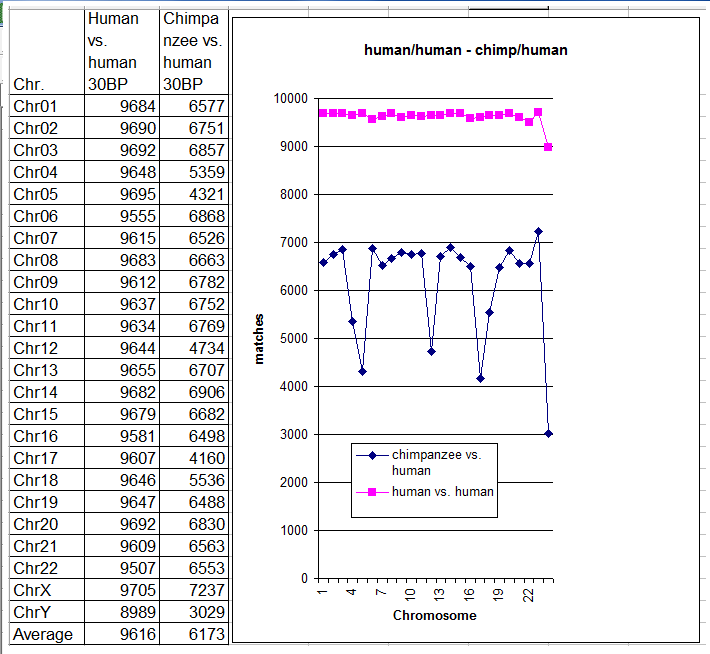
As expected, the number of pattern matches was always significantly greater when comparing two humans than when comparing a chimpanzee with a human. As the chart above clearly shows, the number of matches in human vs. human comparisons was quite stable, ranging from 9507 to 9705 (chromosome Y is the sole exception, with 8989). However, the same did not hold for chimpanzee vs. human comparisons, where the values were much more scattered.

Finally, the average number of pattern matches per chromosome, shown at the bottom of the table, was very different in the two cases: 9616 for human vs. human comparisons, but only 6173 for chimp vs. human comparisons. The average number of patterns without a match for human vs. human comparisons was (10000 – 9616) = 384, or in percentage terms, 384/10000 = 3.84%. The average number of patterns without a match in human vs. chimp comparisons was (10000 – 6173) = 3827, or in percentage terms, 3827/10000 = 38.27%, which is almost ten times greater.

So the bottom-line question is: if, as many evolutionists say, chimpanzee and human genomes are 99% identical, how “identical” are two human genomes?

Comments
28 bornagain77 ",,, The claim going around is something like this ‘the proteins between chimps and humans are virtually the same but differ by only a few amino acids here and there’,,,, Yet do neo-Darwinists have foundation to make claim???" Both genomes are sequenced. You can do the BLAST searches yourself. How do Alternative splicing and RNA editing affect what we're talking about here? niwrad has presented a metric for genomic similarity. Everyone knows transcriptional, post-transcriptional, and post-translational control will effect expression and diversity of products. This is not new. As for chaperones, they function by a very simple principle-hydrophobic amino acids belong on the inside of a protein, and hydrophilic on the outside. Chaperones tend to have high affinity for the extended and hydrophobic bits of an unfolded protein, and less affinity for the compact, folded bit. No foresight and imagination-just physical properties of protein folding. Steric chaperones are basically folding buddies for other proteins. Molecular recognition: "Several proteins do not fold correctly into their native structures without the help of steric chaperones. These chaperones imprint unique structural information onto target proteins while lowering the entropic (un)folding barrier between the native and partially folded states." http://www.nature.com/nsmb/journal/v13/n4/full/nsmb1065.htmlDrREC
May 24, 2011
May
05
May
24
24
2011
09:02 AM
9
09
02
AM
PDT
"May I refer you to your post #20, in which you “spew” four links. Here’s an excerpt from the first one at http://www.genetics.org/content/179/1/487.short : De Novo Origination of a New Protein-Coding Gene in Saccharomyces cerevisiae" Sorry. I confess these 'link wars' do little for the discussion. In short, I was responding to BA77's claim that origins of novel genes could not be accounted for. In this case, a transcribed RNA acquired mutations that led to the loss of in-frame stop codons that. The resulting protein provides a apparent fitness boost to one yeast, where the remainder of its close relatives seem to not make it. It shows strong signs of purifying selection. The other papers describe origins of genes in flies and humans, I believe.DrREC
May 24, 2011
May
05
May
24
24
2011
08:39 AM
8
08
39
AM
PDT
@ 24 Eric Anderson "Would it be fair to say that proteins are properly categorized by their function, rather than the specific sequence?" Sort of-for example, Enzymes are classified a few different ways. One is by their catalytic activity-this is the Enzyme Commission number. They can be classified by fold, and also by sequence. "I’m wondering if, as we learn more and have a more complete database, we might ultimately start categorizing by specific sequence or at least having sub-categories for known variants which perform the same essential function." I would say that is ongoing in the way things are named. Take a histone methyltransferase-EC 2.1.1.43. We divide them into two folds-SET domain and non-SET (Dot1). Then subfamilies based on structural features and flanking domains. Then sequences into very related groups. "Also, my understanding was that additional error-correction mechanisms exist even in the translation stage (for example in the ribosome). Do we know if the ribosome ever identifies an “incorrect” amino acid and swaps it out for the correct one? In other words, is it possible that a change in a gene could result in a changed amino acid in a protein sequence, but we see the same functional protein produced and assume the amino acid change doesn’t matter, when in fact the amino acid was “corrected” prior to completion of the protein synthesis?" Ribosomes detect mispairing of tRNAs anticodons with the codon, and can eject the wrong tRNA. But usually what is on the mRNA is what enters the protein, for better or worse. Ribosomes don't have the insight to correct genetically encoded mutations. One exception is nonsense suppression, where premature stop codons are read through by inserting some amino acid. In this case, it is the missing context of a genuine stop that allows the ribosome to keep making a product.DrREC
May 24, 2011
May
05
May
24
24
2011
08:35 AM
8
08
35
AM
PDT
BA77: Well, the research examined human sequences with no attempt to compare them to chimp DNA. But I was more interested to note that purely mechanical processes seems to be adequate to the task of creating new human proteins. Or do you think someone has/will observe design in action? " . . . how do actually explain ‘evolution’ finding a new functional sequence for these ‘new human proteins’?? I explain it based on the work quoted in the study. That the plasticity is sufficient for the creation of new proteins. That's why I was wondering why you were using it as support for your view. It sounds to me like it contradicts some of your beliefs. "How does the protein machine at the end of the preceding video (Chaperone) know exactly how to fold each unique protein into its proper, and unique, structure?" From Wikipedia: "Each protein exists as an unfolded polypeptide or random coil when translated from a sequence of mRNA to a linear chain of amino acids. This polypeptide lacks any developed three-dimensional structure. Amino acids interact with each other to produce a well-defined three-dimensional structure, the folded protein, known as the native state. The resulting three-dimensional structure is determined by the amino acid sequence " Is that the sort of answer you wanted? The protein machine does no thinking, has no foresight. The whole paragraph from Wikipedia that you clipped a segment from: "Chaperones do not necessarily convey steric information required for proteins to fold: thus statements of the form 'chaperones fold proteins' can be misleading. One major function of chaperones is to prevent both newly synthesised polypeptide chains and assembled subunits from aggregating into nonfunctional structures. It is for this reason that many chaperones, but by no means all, are also heat shock proteins because the tendency to aggregate increases as proteins are denatured by stress. However, 'steric chaperones' directly assist in the folding of specific proteins by providing essential steric information, e.g. prodomains of bacterial proteases, lipase-specific foldases, or chaperones in fimbrial adhesion systems." Thought I'd look up 'steric' as well: "Steric effects arise from the fact that each atom within a molecule occupies a certain amount of space. If atoms are brought too close together, there is an associated cost in energy due to overlapping electron clouds (Pauli or Born repulsion), and this may affect the molecule's preferred shape (conformation) and reactivity." I don't see any intelligent processing going on, sorry.ellazimm
May 24, 2011
May
05
May
24
24
2011
08:31 AM
8
08
31
AM
PDT
Here is another question that will go unanswered by neo-Darinism,,,, How does the protein machine at the end of the preceding video (Chaperone) know exactly how to fold each unique protein into its proper, and unique, structure??? That machine, by itself, clearly displays 'foresight and planning' in molecular biology that is simply unavailable to neo-Darwinian processes. Chaperone (protein) Excerpt: However, 'steric chaperones' directly assist in the folding of specific proteins by providing essential steric information, http://en.wikipedia.org/wiki/Chaperone_%28protein%29bornagain77
May 24, 2011
May
05
May
24
24
2011
06:20 AM
6
06
20
AM
PDT
OT; Here is a brand new Video on the molecular machinery of Protein Synthesis Protein synthesis (DNA transcription, translation and folding) - May 2011 - video http://www.youtube.com/watch?v=erOP76_qLWAbornagain77
May 24, 2011
May
05
May
24
24
2011
05:31 AM
5
05
31
AM
PDT
ellazimm, last sentence you quoted states: 'these intron-breeding repeats may provide the plasticity required for the rapid evolution of new human proteins.” ,,, so do you concede that there are now shown to be 'new human proteins' that are unique to humans, that differ by more than a few amino acids from chimp proteins??? If you do concede 'new human proteins', then besides just presuming that new proteins in humans evolved because they had to evolve because that is what you believe what happened, and making up a neo-Darwinian 'just so' story to fit that preconceived conclusion, how do actually explain 'evolution' finding a new functional sequence for these 'new human proteins'????? i.e. ellazimm, not that I don't appreciate such blind faith in the almighty power of Darwinism, but what is your foundational empirical support that purely random processes can actually find 'new human proteins' which are functional instead of just functionless protein junk??? How Proteins Evolved - Cornelius Hunter - December 2010 Excerpt: Comparing ATP binding with the incredible feats of hemoglobin, for example, is like comparing a tricycle with a jet airplane. And even the one in 10^12 shot, though it pales in comparison to the odds of constructing a more useful protein machine, is no small barrier. If that is what is required to even achieve simple ATP binding, then evolution would need to be incessantly running unsuccessful trials. The machinery to construct, use and benefit from a potential protein product would have to be in place, while failure after failure results. Evolution would make Thomas Edison appear lazy, running millions of trials after millions of trials before finding even the tiniest of function. http://darwins-god.blogspot.com/2010/12/how-proteins-evolved.html Signature In The Cell - Review Excerpt: Even if you grant the most generous assumptions: that every elementary particle in the observable universe is a chemical laboratory randomly splicing amino acids into proteins every Planck time for the entire history of the universe, there is a vanishingly small probability that even a single functionally folded protein of 150 amino acids would have been created. http://www.fourmilab.ch/documents/reading_list/indices/book_726.html Estimating the prevalence of protein sequences adopting functional enzyme folds: Doug Axe: Excerpt: The prevalence of low-level function in four such experiments indicates that roughly one in 10^64 signature-consistent sequences forms a working domain. Combined with the estimated prevalence of plausible hydropathic patterns (for any fold) and of relevant folds for particular functions, this implies the overall prevalence of sequences performing a specific function by any domain-sized fold may be as low as 1 in 10^77, adding to the body of evidence that functional folds require highly extraordinary sequences. http://www.ncbi.nlm.nih.gov/pubmed/15321723 Correcting Four Misconceptions about my 2004 Article in JMB — May 4th, 2011 by Douglas Axe http://biologicinstitute.org/2011/05/04/correcting-four-misconceptions-about-my-2004-article-in-jmb/ Extreme functional sensitivity to conservative amino acid changes on enzyme exteriors - Doug Axe Excerpt: Contrary to the prevalent view, then, enzyme function places severe constraints on residue identities at positions showing evolutionary variability, and at exterior non-active-site positions, in particular. http://nsmserver2.fullerton.edu/departments/chemistry/evolution_creation/web/AxeProteinEvolution.pdf Stability effects of mutations and protein evolvability. October 2009 Excerpt: The accepted paradigm that proteins can tolerate nearly any amino acid substitution has been replaced by the view that the deleterious effects of mutations, and especially their tendency to undermine the thermodynamic and kinetic stability of protein, is a major constraint on protein evolvability,, http://www.ncbi.nlm.nih.gov/pubmed/19765975 When Theory and Experiment Collide — April 16th, 2011 by Douglas Axe Excerpt: Based on our experimental observations and on calculations we made using a published population model [3], we estimated that Darwin’s mechanism would need a truly staggering amount of time—a trillion trillion years or more—to accomplish the seemingly subtle change in enzyme function that we studied. http://biologicinstitute.org/2011/04/16/when-theory-and-experiment-collide/ ,,, ellazimm, when you remove the neo-Darwinian just so story for how new human proteins may have evolved, and look at the cold hard facts of science itself, finding a 'new human protein' is anything but the easy as pie story that neo-Darwinists portray it to be!!!bornagain77
May 24, 2011
May
05
May
24
24
2011
04:20 AM
4
04
20
AM
PDT
vjtorley: Translation, please? http://www.genetics.org/content/179/1/487.short : De Novo Origination of a New Protein-Coding Gene in Saccharomyces cerevisiae New origination of a gene that codes for a protein in the yeast Saccharomyces cerevisiae Making new genes is an important way of generating novelties during the evolution of an organism. Making new genes from chunks of existing genes is well known, using processes such as shuffling the parts of existing genes, breaking parts off existing genes, joining two existing genes to make a new one, duplicating (and modifying) existing genes, etc. However, little is known about making a new gene “from scratch” using chunks of DNA that don't code for a protein. By comparing the genomes of several different species of yeaste, the authors have identified a brand new gene, called BSC4 in the yeast Saccharomyces cerevisiae. The new BSC4 gene has a start codon followed by a stretch of DNA that codes for a 132 amino acid long peptide, which is a short piece of protein. This Open Reading Frame does not exist in any of the other fungal species that have had their DNA sequenced, including the closely related species Saccharomyces paradoxus and Saccharomyces mikatae . We know that the new BSC4 is a gene because we’ve detected the new protein that it makes. Population genetics,proteomics and synthetic lethal data also support this. (Not sure what that last one is.) The evidence shows that BSC4 may be involved in repairing DNA during the part of the yeast’s life cycle where it is not dividing. It also appears to make the yeast more likely to survive if shifted to a nutrient-poor environment. Because the same sequence in three other species of yeast are transcribed into peptides, we propose that BSC4 may be a brand new gene. Scientific papers do have translations. I don't think you'll be able to translate Dr. Abel’s paper. I’ve read it and as far as I can tell, it’s gibberish.dmullenix
May 24, 2011
May
05
May
24
24
2011
03:33 AM
3
03
33
AM
PDT
BA77: Continuing the quote you give from a paper reviewed at pnas.org: "Finally, we show that these human introns are alternatively spliced with exceptionally high frequency. Our study indicates that genomic duplication has been an important mode of intron gain in mammals. The alternative splicing of transcripts containing these intron-breeding repeats may provide the plasticity required for the rapid evolution of new human proteins." Are you sure you want to use this reference?ellazimm
May 24, 2011
May
05
May
24
24
2011
12:32 AM
12
12
32
AM
PDT
BA77: The next review you site, "Canadian Team Develops Alternative Splicing Code from Mouse Tissue Data" may even be referencing the same bit of research. The names of the researchers are the same, the date the reviews were published is very close . . . . the first time I clicked on the link for the genomeweb review I was able to view the whole article but when I tried again I was blocked; I guess you have to pay! The second review clearly mentions mouse DNA whereas the first review does not actually say what DNA was used. (I was wrong earlier, human DNA is mentioned but not in association with the research.) And NOWHERE is it mentioned that this can be used to distinguish between human and chimp DNA. Also, neither of the reviews used the phrase "junk intron sequences". In the excerpt you reproduce the researchers are quoted as saying “Our method takes as an input a collection of exons and surrounding intron sequences and data profiling how those exons are spliced in different tissues.” I'm not sure those two reviews actually make the point you want. Have a look again and see what you think.ellazimm
May 24, 2011
May
05
May
24
24
2011
12:13 AM
12
12
13
AM
PDT
BA77: In the review of the study you site above, "Researchers Crack ‘Splicing Code,’ Solve a Mystery Underlying Biological Complexity" at Science Daily your seem to draw the following conclusions: "The preceding study put a ‘unique signature of individuality’ upon the human genome that sets it completely apart from the chimpanzee genome since functional ‘junk intron sequences’ were used in deciphering the ‘second genetic code’ (the splicing code),,,," I could find no indication in the review that the researchers suggested that the splicing code they found was unique to humans (the study was done on human DNA) or any mention of 'junk intron sequences'. In fact, if intron sequences were used I would think there would be a high probability that some of those sequences were also present in the chimp genome.ellazimm
May 24, 2011
May
05
May
24
24
2011
12:00 AM
12
12
00
AM
PDT
Thanks to all for the comments. Eric Anderson #1 The test is purely statistical, it doesn't take into account moves, introns, orphans and any functional concept. This is the reason why the test is so simple to do and, as DrREC noted, in the same time is fast and effective. About the difficulty of representing by a single number the genomic similarity you could read my previous post and all its comments (now the link works, thank you for alerting me of the fault). ellazimm #5 I was unable to find in the data-banks the information about the race or country of the human genomes provided. I don't exclude a-priori it exists somewhere.niwrad
May 23, 2011
May
05
May
23
23
2011
11:35 PM
11
11
35
PM
PDT
DrREC you say you aren't a neo-Darwinists yet you defend every precept they preach with as much, or more, vigor than many of them do. So what should I believe??? your actions or your empty words??? This following site has a brief, and sobering, discussion on the extremely biased methodology of the "kick the ORFans genes out in the street" study: https://uncommondescent.com/intelligent-design/proteins-fold-as-darwin-crumbles/#comment-358505 ,,, DrREC, You tell more shallow falsehoods in defense of the other points, so I'll go on to another point that is worth making; ,,, The claim going around is something like this 'the proteins between chimps and humans are virtually the same but differ by only a few amino acids here and there',,,, Yet do neo-Darwinists have foundation to make claim??? this study that came out just recently stated,,, Most Detailed Annotation of Fruit-Fly Genome Points Way to Understanding All Organisms’ Genomes – December 2010 Excerpt: “We also found an order-of-magnitude increase in the ways that genes are spliced and edited to produce alternate forms of known proteins, thus significantly increasing the complexity of the proteome.”,,, Despite the scrutiny to which the Drosophila genome has been subjected, the researchers found new or altered exons or splice forms in almost three-quarters of Drosophila’s previously annotated genes,,, http://www.sciencedaily.com/releases/2010/12/101222131131.htm ,,, from this preceding study, I am VERY certain that the neo-Darwinists are not giving us the straight scoop on protein dissimilarity between chimps and humans,,, indeed how can they possibly give us anything when they just discovered regulation that 'significantly increased the complexity of the proteome.',,, ,,,,as well as this testifies against the neo-Darwinists.... New level of genetic diversity in human RNA sequences uncovered Excerpt: They call these sites RNA-DNA differences, or RDDs. They found at least one RDD site in about 40 percent of genes, and many of these RDDs cause the cell to produce different protein sequences than would be expected based on the DNA. In the cells they studied, the sequences of thousands of proteins may be different from their corresponding DNA, the scientists say. http://www.physorg.com/news/2011-05-genetic-diversity-human-rna-sequences.html ,,,Thus if they just discovered 'thousands of new proteins' that were completely different from what they expected from the DNA sequences alone, how in the world are neo-Darwinists justified in making the claim that virtually all chimp proteins are only a few amino acids different from human proteins or are the exact same, when they just discovered this??? ,,, single genes are now shown to code for multiple 'different' protein products: Human genes are multitaskers: Abstract: Genome-wide surveys of gene expression in 15 different tissues and cell lines have revealed that up to 94% of human genes generate more than one (protein) product. http://www.nature.com/news/2008/081102/full/news.2008.1199.html Human Genes: Alternative Splicing (For Proteins) Far More Common Than Thought: Excerpt: two different forms of the same protein, known as isoforms, can have different, even completely opposite functions. For example, one protein may activate cell death pathways while its close relative promotes cell survival. http://www.sciencedaily.com/releases/2008/11/081102134623.htm This is particularly interesting,,, Researchers Crack ‘Splicing Code,’ Solve a Mystery Underlying Biological Complexity Excerpt: “For example, three neurexin genes can generate over 3,000 genetic messages that help control the wiring of the brain,” says Frey. “Previously, researchers couldn’t predict how the genetic messages would be rearranged, or spliced, within a living cell,” Frey said. “The splicing code that we discovered has been successfully used to predict how thousands of genetic messages are rearranged differently in many different tissues. http://www.sciencedaily.com/releases/2010/05/100505133252.htm The preceding study put a 'unique signature of individuality' upon the human genome that sets it completely apart from the chimpanzee genome since functional 'junk intron sequences' were used in deciphering the 'second genetic code' (the splicing code),,,, Canadian Team Develops Alternative Splicing Code from Mouse Tissue Data Excerpt: “Our method takes as an input a collection of exons and surrounding intron sequences and data profiling how those exons are spliced in different tissues,” Frey and his co-authors wrote. “The method assembles a code that can predict how a transcript will be spliced in different tissues.” http://www.genomeweb.com/informatics/canadian-team-develops-alternative-splicing-code-mouse-tissue-data ,,, and yet these 'junk intron sequences', that were used to decipher the splicing code of different tissue types in an organism, are found to be 'exceptionally different' between chimpanzees and Humans: Modern origin of numerous alternatively spliced human introns from tandem arrays – 2006 Excerpt: A comparison with orthologous regions in mouse and chimpanzee suggests a young age for the human introns with the most-similar boundaries. Finally, we show that these human introns are alternatively spliced with exceptionally high frequency. http://www.pnas.org/content/104/3/882.full This following paper is brutally honest as to what ignoring 'Junk introns' means for the future of molecular biology: Matheson's Intron Fairy Tale - Richard Sternberg - June 2010 Excerpt: The failure to recognize the importance of introns "may well go down as one of the biggest mistakes in the history of molecular biology." --John Mattick, Molecular biologist, University of Queensland, quoted in Scientific American,,, So let's do the math. At least ninety percent of gene transcripts undergo alternative splicing, and there are at least 190,000 introns in the human genome. That means we have at least 0.90 x 190,000 = 171,000 introns that participate in the alternative-splicing pathway(s) available to a cell. http://www.evolutionnews.org/2010/06/mathesons_intron_fairy_tale035301.html ,,,, etc.. etc.. etc.. continued falsification of all claims is just the way life is for neo-Darwinists, but don't worry they will be back tomorrow forgetting everything they have been corrected on. The circus never ends! :)bornagain77
May 23, 2011
May
05
May
23
23
2011
11:30 PM
11
11
30
PM
PDT
Dr REC: In response to bornagain77, you wrote (#23):
Abel is incomprehensible. Look at the Pubmed record for the article - he’s only been cited by himself. http://www.ncbi.nlm.nih.gov/pubmed/19273248 Maybe it is interesting, but no one else has parsed it. Again, present the salient argument from the paper in your own words, and we’ll debate it.... Again, please summarize the salient argument and we can debate it. I simply refuse to guess at the point you are trying to make in all these links. A key part of rational discussion is synthesis-where you take the facts, and present them in your own (concise) language. Spewing links is not dignified.
May I refer you to your post #20, in which you "spew" four links. Here's an excerpt from the first one at http://www.genetics.org/content/179/1/487.short :
De Novo Origination of a New Protein-Coding Gene in Saccharomyces cerevisiae Jing Cai, Ruoping Zhao, Huifeng Jiang and Wen Wang Abstract Origination of new genes is an important mechanism generating genetic novelties during the evolution of an organism. Processes of creating new genes using preexisting genes as the raw materials are well characterized, such as exon shuffling, gene duplication, retroposition, gene fusion, and fission. However, the process of how a new gene is de novo created from noncoding sequence is largely unknown. On the basis of genome comparison among yeast species, we have identified a new de novo protein-coding gene, BSC4 in Saccharomyces cerevisiae. The BSC4 gene has an open reading frame (ORF) encoding a 132-amino-acid-long peptide, while there is no homologous ORF in all the sequenced genomes of other fungal species, including its closely related species such as S. paradoxus and S. mikatae. The functional protein-coding feature of the BSC4 gene in S. cerevisiae is supported by population genetics, expression, proteomics, and synthetic lethal data. The evidence suggests that BSC4 may be involved in the DNA repair pathway during the stationary phase of S. cerevisiae and contribute to the robustness of S. cerevisiae, when shifted to a nutrient-poor environment. Because the corresponding noncoding sequences in S. paradoxus, S. mikatae, and S. bayanus also transcribe, we propose that a new de novo protein-coding gene may have evolved from a previously expressed noncoding sequence.
Translation, please? One person's "standard scientific terminology" is another person's gibberish.vjtorley
May 23, 2011
May
05
May
23
23
2011
10:55 PM
10
10
55
PM
PDT
Sorry, my bad, Lynn Margulis. I need more tea.ellazimm
May 23, 2011
May
05
May
23
23
2011
10:44 PM
10
10
44
PM
PDT
BA77: In the Lynn Margolis interview you reference via a review by Casey Luskin she says: "All scientists agree that evolution has occurred - that all life comes from a common ancestry, that there has been extinction and that new taxa, new biological groups, have arisen. The question is, is natural selection enough to explain evolution? Is it the driver of evolution?" I'd reproduce more but I can't copy-and-paste from the website, clever materialists! :-)ellazimm
May 23, 2011
May
05
May
23
23
2011
10:42 PM
10
10
42
PM
PDT
DrREC: Thanks for the thoughts. ". . . most proteins tend to be fairly robust to changes . . ." Would it be fair to say that proteins are properly categorized by their function, rather than the specific sequence? I'm sure that is the case historically, as many functions were able to be discerned, but not the individual sequences. Do you know if there is any movement toward identifying proteins by specific sequence, or perhaps family of sequences that result in effectively the same protein? I'm wondering if, as we learn more and have a more complete database, we might ultimately start categorizing by specific sequence or at least having sub-categories for known variants which perform the same essential function. Also, my understanding was that additional error-correction mechanisms exist even in the translation stage (for example in the ribosome). Do we know if the ribosome ever identifies an "incorrect" amino acid and swaps it out for the correct one? In other words, is it possible that a change in a gene could result in a changed amino acid in a protein sequence, but we see the same functional protein produced and assume the amino acid change doesn't matter, when in fact the amino acid was "corrected" prior to completion of the protein synthesis?Eric Anderson
May 23, 2011
May
05
May
23
23
2011
10:02 PM
10
10
02
PM
PDT
I'm not sure I should really indulge the avalanche of irrelevant links you think passes for debate, but I'm tempted to see how deep the rabbit hole goes.... REC: "What is the mechanism of ID again? BA: Intelligence!!!" Intelligence is a noun. I was looking for a bit of verbage, I guess. "ID is not a mechanistic theory, and it’s not ID’s task to match your pathetic level of detail in telling mechanistic stories." Right? BA: "The GS (genetic selection) Principle – David L. Abel – 2009" Abel is incomprehensible. Look at the Pubmed record for the article-he's only been cited by himself. http://www.ncbi.nlm.nih.gov/pubmed/19273248 Maybe it is interesting, but no one else has parsed it. Again, present the salient argument from the paper in your own words, and we'll debate it. REC: "‘Genetic reductionism is not the central dogma.’ BA: FALSE!!" Analysis? Or just shouting? What is the central dogma? What is genetic reductionism? Are they equivalent? REC: "‘I am not a neo-Darwinist.’ BA: FALSE!!" You Know me better than myself? Interesting. Lol. BA: completely unique genes in humans were removed from consideration simply because no corresponding sequences could be found in any other primate or mammal???” REC: No. It was a reasonable approach. BA: FALSE!! No analysis. I defend the approach and describe its positive outcome above. REC: You should really investigate how molecular phylogenies are constructed. There is not bias loaded into the algorithms. BA: FALSE for a vast majority of neo-Darwinian studies!! Could you provide an example of a biased algorithm used to construct a phylogenetic tree? How was the bias programmed in? REC:I’m not listening to 20 minutes of Luskin. BA:YOUR LOSS!!! Again, please summarize the salient argument and we can debate it. I simply refuse to guess at the point you are trying to make in all these links. A key part of rational discussion is synthesis-where you take the facts, and present them in your own (concise) language. Spewing links is not dignified. Koonin is a premier evolutionary biologist. You're quote mining quote mines. Is there anything relevant in the YEC Paul Nelson's video? Or just another link to drown me with?DrREC
May 23, 2011
May
05
May
23
23
2011
08:47 PM
8
08
47
PM
PDT
DrREC, What is the mechanism of ID again? Intelligence!!! Alain Aspect and Anton Zeilinger by Richard Conn Henry - Physics Professor - John Hopkins University Excerpt: Why do people cling with such ferocity to belief in a mind-independent reality? It is surely because if there is no such reality, then ultimately (as far as we can know) mind alone exists. And if mind is not a product of real matter, but rather is the creator of the "illusion" of material reality (which has, in fact, despite the materialists, been known to be the case, since the discovery of quantum mechanics in 1925), then a theistic view of our existence becomes the only rational alternative to solipsism (solipsism is the philosophical idea that only one's own mind is sure to exist). (Dr. Henry's referenced experiment and paper - “An experimental test of non-local realism” by S. Gröblacher et. al., Nature 446, 871, April 2007 - “To be or not to be local” by Alain Aspect, Nature 446, 866, April 2007 http://henry.pha.jhu.edu/aspect.html “since natural selection and random mutations both reduce genetic information???" The GS (genetic selection) Principle – David L. Abel – 2009 Excerpt: Stunningly, information has been shown not to increase in the coding regions of DNA with evolution. Mutations do not produce increased information. Mira et al (65) showed that the amount of coding in DNA actually decreases with evolution of bacterial genomes, not increases. This paper parallels Petrov’s papers starting with (66) showing a net DNA loss with Drosophila evolution (67). Konopka (68) found strong evidence against the contention of Subba Rao et al (69, 70) that information increases with mutations. The information content of the coding regions in DNA does not tend to increase with evolution as hypothesized. Konopka also found Shannon complexity not to be a suitable indicator of evolutionary progress over a wide range of evolving genes. Konopka’s work applies Shannon theory to known functional text. Kok et al. (71) also found that information does not increase in DNA with evolution. As with Konopka, this finding is in the context of the change in mere Shannon uncertainty. The latter is a far more forgiving definition of information than that required for prescriptive information (PI) (21, 22, 33, 72). It is all the more significant that mutations do not program increased PI. Prescriptive information either instructs or directly produces formal function. No increase in Shannon or Prescriptive information occurs in duplication. What the above papers show is that not even variation of the duplication produces new information, not even Shannon “information.” http://www.bioscience.org/2009/v14/af/3426/3426.pdf Falsification of Natural Selection https://docs.google.com/document/pub?id=10WqN_Z_2GjzhPQUVe7QmcMZDPObJCG45XqgF7pZVcVM 'Does it not bother you in the least that evolution cannot even explain the fixation of a SINGLE beneficial mutation??? ” You cite quickly googled crap, and I cited the most rigorous study and mathematics available, and this is you being fair with the evidence to you DrREC??? 'Genetic reductionism is not the central dogma.' FALSE!! 'I am not a neo-Darwinist.' FALSE!! “completely unique genes in humans were removed from consideration simply because no corresponding sequences could be found in any other primate or mammal???” No. It was a reasonable approach. FALSE!! “pretend that if you can just find a study, any study, that shows sequences to match your preconceived conclusion then that will somehow overrule the fact that you have no foundation in the first place???” You should really investigate how molecular phylogenies are constructed. There is not bias loaded into the algorithms. FALSE for a vast majority of neo-Darwinian studies!!! I’m not listening to 20 minutes of Luskin. YOUR LOSS!!! The Origin at 150: is a new evolutionary synthesis in sight? - Koonin - Nov. 2009 Excerpt: The edifice of the modern synthesis has crumbled, apparently, beyond repair. http://www.arn.org/blogs/index.php/literature/2009/11/18/not_to_mince_words_the_modern_synthesis Modern Synthesis of Neo-Darwinism Is Dead - Paul Nelson - video http://www.metacafe.com/watch/5548184/bornagain77
May 23, 2011
May
05
May
23
23
2011
08:05 PM
8
08
05
PM
PDT
"OK, thanks. Just to make sure I’ve got my terminology correct, I think what you’re saying is not that 29% of the genes are necessarily identical at every base pair on the DNA, but that 29% of protein coding genes code for identical amino acids (presumably resulting in an identical protein, although that could be an interesting additional line of inquiry). " Right-they'll yield the same protein, thought the nucleotide differences could be interesting. A change at the nucleotide level could alter RNA stability, or transcription rate, or RNAi pairing, where there is no change at the protein level. "For the other 61%, there are enough differences at the DNA level to result in at least one different amino acid in the chain. Presumably some (most?) of those would be due to different base pairs, but perhaps also there might be differences in introns, splicing, etc. that result in a different amino acid?" Most of what we're talking about here is a single base pair change that results in a different amino acid. There could be differential alternative splicing-but there is pretty limited data on that from many species. "Also interesting to know would be to what extent the different amino acid(s) result in a different functional protein. In other words, with a single different amino acid in the chain, I could presumably get: (i) a broken protein that doesn’t function, (ii) a protein that performs the same function, though not as well, (iii) a protein that performs the same function, just as well, or (iv) a protein that performs a completely different function." Yep. Until tested biochemically, you wouldn't know, though most proteins tend to be fairly robust to changes-so I'd bet on (iii) being more populated than (ii) and (i) which would be more abundant than (iv). "We haven’t of course focused at all on gene expression (timing and quantity), where I understand there are additional differences" And that is probably where the big differences in mammals are.DrREC
May 23, 2011
May
05
May
23
23
2011
07:47 PM
7
07
47
PM
PDT
"DrREC, does it not bother you in the least that you have no mechanism from which to extrapolate?" Random mutation/recombination/gene duplication+ natural selection What is the mechanism of ID again? "since natural selection and random mutations both reduce genetic information??? No. http://www.genetics.org/content/179/1/487.short http://genome.cshlp.org/content/19/10/1693.full.html http://www.ncbi.nlm.nih.gov/pubmed/18550802 "Does it not bother you in the least that evolution cannot even explain the fixation of a SINGLE beneficial mutation??? " http://www.ncbi.nlm.nih.gov/pubmed?term=fixation%20gene Results=6448 "Does it not bother you in the least that genetic reductionism (the central dogma), which is the entire neo-Darwinian premise you are working from, is falsified??? " Genetic reductionism is not the central dogma. Neo-Darwinian evolutionary biology is not the central dogma. I am not a neo-Darwinist. "completely unique genes in humans were removed from consideration simply because no corresponding sequences could be found in any other primate or mammal???" No. It was a reasonable approach. Unique genes can be added back if their transcription and expression can be verified by RNA/proteomic approaches. To my knowledge, 3 of these 1000 have been shown to be real genes. "pretend that if you can just find a study, any study, that shows sequences to match your preconceived conclusion then that will somehow overrule the fact that you have no foundation in the first place???" You should really investigate how molecular phylogenies are constructed. There is not bias loaded into the algorithms. Just pattern matching, parsimony and maximum likelyhood, backed by bootstrap and other statistical methods. "Actually preliminary (hopefully unbiased) results are already in and you would lose that bet!!! Primate Phylogenetics Challenge Darwin’s Tree of Life – Casey Luskin – audio podcast http://intelligentdesign.podom.....2_00-07_00" I'm not listening to 20 minutes of Luskin. Any salient point you'd like to condense and discuss? Or perhaps you'd like to perform a statistical analysis like the original post, and prove me wrong? The data sets and algorithms are available to the public.DrREC
May 23, 2011
May
05
May
23
23
2011
07:38 PM
7
07
38
PM
PDT
DrRec @ 13: "It means 29% of the protein coding genes are identical at each and every amino acid. The rest differ usually only at a single amino acid (out of hundreds)." OK, thanks. Just to make sure I've got my terminology correct, I think what you're saying is not that 29% of the genes are necessarily identical at every base pair on the DNA, but that 29% of protein coding genes code for identical amino acids (presumably resulting in an identical protein, although that could be an interesting additional line of inquiry). That doesn't necessarily mean that the gene is identical in all base pairs or in location, correct? In other words, there could be small differences at the DNA scale, but still result in the same amino acid sequence. For the other 61%, there are enough differences at the DNA level to result in at least one different amino acid in the chain. Presumably some (most?) of those would be due to different base pairs, but perhaps also there might be differences in introns, splicing, etc. that result in a different amino acid? Also interesting to know would be to what extent the different amino acid(s) result in a different functional protein. In other words, with a single different amino acid in the chain, I could presumably get: (i) a broken protein that doesn't function, (ii) a protein that performs the same function, though not as well, (iii) a protein that performs the same function, just as well, or (iv) a protein that performs a completely different function. We haven't of course focused at all on gene expression (timing and quantity), where I understand there are additional differences, and that is probably a topic for another time, but I just want to make sure I'm understanding the comparative approach that is being taken in looking at the gene-protein comparison.Eric Anderson
May 23, 2011
May
05
May
23
23
2011
07:28 PM
7
07
28
PM
PDT
DrREC you state; I bet if he repeats the analysis with gorillas and orangutans he’ll be able to make a phylogenetic tree. Actually preliminary (hopefully unbiased) results are already in and you would lose that bet!!! Primate Phylogenetics Challenge Darwin’s Tree of Life – Casey Luskin – audio podcast http://intelligentdesign.podomatic.com/player/web/2011-05-09T16_32_00-07_00bornagain77
May 23, 2011
May
05
May
23
23
2011
06:07 PM
6
06
07
PM
PDT
DrREC, does it not bother you in the least that you have no mechanism from which to extrapolate? since natural selection and random mutations both reduce genetic information??? Does it not bother you in the least that evolution cannot even explain the fixation of a SINGLE beneficial mutation??? Does it not bother you in the least that genetic reductionism (the central dogma), which is the entire neo-Darwinian premise you are working from, is falsified??? Does it not bother you in the least that over 1000 completely unique genes in humans were removed from consideration simply because no corresponding sequences could be found in any other primate or mammal??? ,,, So DRREC, I have shown you that you have no basis from which to work from scientifically, plus I have shown sheer intellectually dishonesty by neo-Darwinists in excluding completely unique genes in humans, but all this matters not to you and you pretend that if you can just find a study, any study, that shows sequences to match your preconceived conclusion then that will somehow overrule the fact that you have no foundation in the first place??? DrREC, this is science this is not Alice in wonderland!!! If you want to stay credible you must countermand the evidence I have marshaled that shows you to have no coherent mechanism for your conjectures!!!bornagain77
May 23, 2011
May
05
May
23
23
2011
05:49 PM
5
05
49
PM
PDT
"i.e. the only way a ‘tree’ emerges from genetic data sets is if neo-Darwinism is assumed to be true in the first place and then computers are programmed to ‘find’ that unproven assumption,, all the while ignoring all dis-confirming sequences,,," This is not true. For example, niwrad has developed a metric that definitively shows humans are more related to each other than chimps. I bet if he repeats the analysis with gorillas and orangutans he'll be able to make a phylogenetic tree. Does it depend on trickery, or messing with the data? Does this paper, for example, pull some tricks I missed? A Molecular Phylogeny of Living Primates http://www.plosgenetics.org/article/info%3Adoi%2F10.1371%2Fjournal.pgen.1001342DrREC
May 23, 2011
May
05
May
23
23
2011
05:07 PM
5
05
07
PM
PDT
further notes: Stephen Meyer - Functional Proteins And Information For Body Plans - video http://www.metacafe.com/watch/4050681 “Yet by the late 1980s it was becoming obvious to most genetic researchers, including myself, since my own main research interest in the ‘80s and ‘90s was human genetics, that the heroic effort to find the information specifying life’s order in the genes had failed. There was no longer the slightest justification for believing that there exists anything in the genome remotely resembling a program capable of specifying in detail all the complex order of the phenotype (Body Plan)." Michael John Denton page 172 of Uncommon Dissent This following study is very interesting for the researcher surveyed 130 DNA-based evolutionary trees to see if the results matched what 'natural selection' predicted for speciation and found: Accidental origins: Where species come from - March 2010 Excerpt: If speciation results from natural selection via many small changes, you would expect the branch lengths to fit a bell-shaped curve.,,, Instead, Pagel's team found that in 78 per cent of the trees, the best fit for the branch length distribution was another familiar curve, known as the exponential distribution. Like the bell curve, the exponential has a straightforward explanation - but it is a disquieting one for evolutionary biologists. The exponential is the pattern you get when you are waiting for some single, infrequent event to happen.,,,To Pagel, the implications for speciation are clear: "It isn't the accumulation of events that causes a speciation, it's single, rare events falling out of the sky, so to speak." http://www.newscientist.com/article/mg20527511.400-accidental-origins-where-species-come-from.html?page=2 The Biological Big Bang model for the major transitions in evolution - Eugene V Koonin - Background: "Major transitions in biological evolution show the same pattern of sudden emergence of diverse forms at a new level of complexity. The relationships between major groups within an emergent new class of biological entities are hard to decipher and do not seem to fit the tree pattern that, following Darwin's original proposal, remains the dominant description of biological evolution. The cases in point include the origin of complex RNA molecules and protein folds; major groups of viruses; archaea and bacteria, and the principal lineages within each of these prokaryotic domains; eukaryotic supergroups; and animal phyla. In each of these pivotal nexuses in life's history, the principal "types" seem to appear rapidly and fully equipped with the signature features of the respective new level of biological organization. No intermediate "grades" or intermediate forms between different types are detectable; http://www.biology-direct.com/content/2/1/21 Biological Big Bangs - Origin Of Life and Cambrian - Dr. Fazale Rana - video http://www.metacafe.com/watch/4284466bornagain77
May 23, 2011
May
05
May
23
23
2011
04:42 PM
4
04
42
PM
PDT
DrREC and ellazimm, you guys have either willingly, or have been deceived into buying into perhaps the shoddiest science in history, of there actually being a coherent 'tree of life' for neo-Darwinism from genetic similarities alone,,, i.e. the only way a 'tree' emerges from genetic data sets is if neo-Darwinism is assumed to be true in the first place and then computers are programmed to 'find' that unproven assumption,, all the while ignoring all dis-confirming sequences,,, Pattern pluralism and the Tree of Life hypothesis - 2006 Excerpt: Hierarchical structure can always be imposed on or extracted from such data sets by algorithms designed to do so, but at its base the universal TOL rests on an unproven assumption about pattern that, given what we know about process, is unlikely to be broadly true. http://www.pnas.org/content/104/7/2043.abstract A Primer on the Tree of Life - Casey Luskin - 2009 Excerpt: The truth is that common ancestry is merely an assumption that governs interpretation of the data, not an undeniable conclusion, and whenever data contradicts expectations of common descent, evolutionists resort to a variety of different ad hoc rationalizations to save common descent from being falsified. http://www.discovery.org/a/10651 ,,, Moreover you guys have completely forgotten that you have no scientific basis in which to rest your evidence for genetic similarities, even if you had such 'suggestive similarity evidence' to start with; i.e you have NO FOUNDATIONAL MECHANISM from which to extrapolate your unwarranted conclusion,,, For instance,,, #1 both natural selection and random mutations reduce genetic information: Lynn Margulis Criticizes Neo-Darwinism in Discover Magazine (Updated) Casey Luskin April 12, 2011 Excerpt; This is the issue I have with neo-Darwinists: They teach that what is generating novelty is the accumulation of random mutations in DNA, in a direction set by natural selection. If you want bigger eggs, you keep selecting the hens that are laying the biggest eggs, and you get bigger and bigger eggs. But you also get hens with defective feathers and wobbly legs. Natural selection eliminates and maybe maintains, but it doesn't create....[N]eo-Darwinists say that new species emerge when mutations occur and modify and organism. I was taught over and over again that the accumulation of random mutations led to evolutionary change-led to new species. I believed it until I looked for evidence. http://www.evolutionnews.org/2011/04/lynn_margulis_criticizes_neo-d045691.html Natural Selection Reduces Genetic Information - No Beneficial Mutations - Spetner - Denton - video http://www.metacafe.com/watch/4036816 #2 neo-Darwinists have not even shown it to be possible to 'fix' a single beneficial mutation; Experimental Evolution in Fruit Flies (35 years of trying to force fruit flies to evolve in the laboratory fails, spectacularly) - October 2010 Excerpt: "Despite decades of sustained selection in relatively small, sexually reproducing laboratory populations, selection did not lead to the fixation of newly arising unconditionally advantageous alleles.,,, "This research really upends the dominant paradigm about how species evolve," said ecology and evolutionary biology professor Anthony Long, the primary investigator. http://www.arn.org/blogs/index.php/literature/2010/10/07/experimental_evolution_in_fruit_flies Dr. Sanford calculates it would take 12 million years to “fix” a single base pair mutation into a population. He further calculates that to create a gene with 1000 base pairs, it would take 12 million x 1000 or 12 billion years. This is obviously too slow to support the creation of the human genome containing 3 billion base pairs. http://www.detectingtruth.com/?p=66 Waiting Longer for Two Mutations - Michael J. Behe Excerpt: Citing malaria literature sources (White 2004) I had noted that the de novo appearance of chloroquine resistance in Plasmodium falciparum was an event of probability of 1 in 10^20. I then wrote that 'for humans to achieve a mutation like this by chance, we would have to wait 100 million times 10 million years' (1 quadrillion years)(Behe 2007) (because that is the extrapolated time that it would take to produce 10^20 humans). Durrett and Schmidt (2008, p. 1507) retort that my number ‘is 5 million times larger than the calculation we have just given’ using their model (which nonetheless "using their model" gives a prohibitively long waiting time of 216 million years). Their criticism compares apples to oranges. My figure of 10^20 is an empirical statistic from the literature; it is not, as their calculation is, a theoretical estimate from a population genetics model. http://www.discovery.org/a/9461 #3 epigentics has falsified the 'central dogma' (modern synthesis) of neo-Darwinism, which is the premise that you are working from to try to establish genetic similarity as proof of common ancestry in the first place! i.e. you can mutate DNA till the cows come home and you will not effect body plan morphogenesis in any significant way!!! The Origin of Biological Information and the Higher Taxonomic Categories - Stephen Meyer "Neo-Darwinism seeks to explain the origin of new information, form, and structure as a result of selection acting on randomly arising variation at a very low level within the biological hierarchy, mainly, within the genetic text. Yet the major morphological innovations depend on a specificity of arrangement at a much higher level of the organizational hierarchy, a level that DNA alone does not determine. Yet if DNA is not wholly responsible for body plan morphogenesis, then DNA sequences can mutate indefinitely, without regard to realistic probabilistic limits, and still not produce a new body plan. Thus, the mechanism of natural selection acting on random mutations in DNA cannot in principle generate novel body plans, including those that first arose in the Cambrian explosion." http://eyedesignbook.com/ch6/eyech6-append-d.html Getting Over the Code Delusion (Epigenetics) - Talbot - November 2010 - Excellent Article for explaining exactly why epigentics falsifies the neo-Darwinian paradigm of genetic reductionism: http://www.thenewatlantis.com/publications/getting-over-the-code-delusion etc.. etc...bornagain77
May 23, 2011
May
05
May
23
23
2011
04:38 PM
4
04
38
PM
PDT
Eric-"paulmc @4: “At the protein level, 29 percent of genes code for the same amino sequences in chimps and humans.” Just trying to figure out what this means. Does it mean that 61% of our genes code for different amino acid sequences than in chimps?" It means 29% of the protein coding genes are identical at each and every amino acid. The rest differ usually only at a single amino acid (out of hundreds).DrREC
May 23, 2011
May
05
May
23
23
2011
04:02 PM
4
04
02
PM
PDT
paulmc @4: "At the protein level, 29 percent of genes code for the same amino sequences in chimps and humans." Just trying to figure out what this means. Does it mean that 61% of our genes code for different amino acid sequences than in chimps?Eric Anderson
May 23, 2011
May
05
May
23
23
2011
03:12 PM
3
03
12
PM
PDT
BA77: Is there a major refutation to neo-Darwinism if the 'tree' of life is more of a rhizome? From the source paper: "A post-Darwinist concept of the living species can be proposed, to integrate the theories of multiplicity and de-novo creation … I believe that the evolution of species looks much more like a rhizome (or a mycelium). Consequently, this view of evolution resembles a clump of roots that considers the occurrence of multiplicities. Emerging species grow from the rhizome with gene repertoires of various origins that will allow, under favourable environmental conditions, the multiplication and perpetuation of this species. As such, potential new species and new genes are continuously appearing." A clump of roots but not species appearing with no antecedents. I do appreciate your links and references but mostly they are to ID favourable blogs or websites. I know those blogs and websites are referencing mainstream research but I think it's important to look at the source material and its interpretation by the majority of people working in the field. It's important to consider all the data and all the interpretations.ellazimm
May 23, 2011
May
05
May
23
23
2011
02:34 PM
2
02
34
PM
PDT
1 2 3 4 5