Uncommon Descent Serving The Intelligent Design Community

Does Bayesian Fuzziness Add to the Analysis?

Categories
Intelligent Design
Share
Facebook
Twitter/X
LinkedIn
Flipboard
Print
Email

In comment 30 to this post Elizabeth Liddle writes:

I can think of lots of ways of testing specific design hypotheses, but they all involve a hypothesis involving a postulated designer. And IDists insist that this is irrelevant – that “Design detection” should only involve the observed pattern, not any hypothesis about the designer. This is ludicrous, frankly.

Let’s explore one of Lizzie’s prior forays into design detection, and we’ll leave it up to the onlookers to decide which side is “ludicrous.”

In a prior post I posed the following question to Dr. Liddle:

If you were to receive a radio signal from outer space that specified the prime numbers between 1 and 100 would you conclude (provisionally pending the discovery a better theory, of course) that the best theory to account for the data is ‘the signal was designed and sent by an intelligent agent?’

Dr. Liddle responded:

Yes. And I’ve explained why.

She expanded on her explanation:

Barry, I did NOT make the inference ‘based upon nothing but the existence of CSI’!

My inference had nothing to do with CSI.

It was a Bayesian inference based on two priors:

My priors concerning the probability that other parts of the universe host intelligent life forms capable of sending radio signals (high)

My priors concerning the probability that a non-intelligent process might generate such a signal (low).

Dr. Liddle’s problem can be summarized as follows:

1.  Denying the design inference based on the prime number sequence is not an option.  The inference is so glaringly obvious that to deny it would be absurd.  Even arch-atheist Carl Sagan admitted this signal was obviously designed (when he used it as the basis of his book “Contact”).  Therefore, were Dr. Liddle to deny the obvious design inference she would instantly lose all credibility.

2.  So she asks herself:  “How can I admit the design inference while continuing to deny the methods of ID proponents?”

3.  Her solution:   “I know.  I’ll admit the design inference but cover up my admission with Bayesian fuzziness, and that will obscure the fact that I used the methods of the ID proponents while I continue to denounce those very methods.”

Notice how Dr. Liddle’s Bayesian “priors” add absolutely nothing to the design detection methods advocated by ID proponents.  Here is a graph of the explanatory filter:
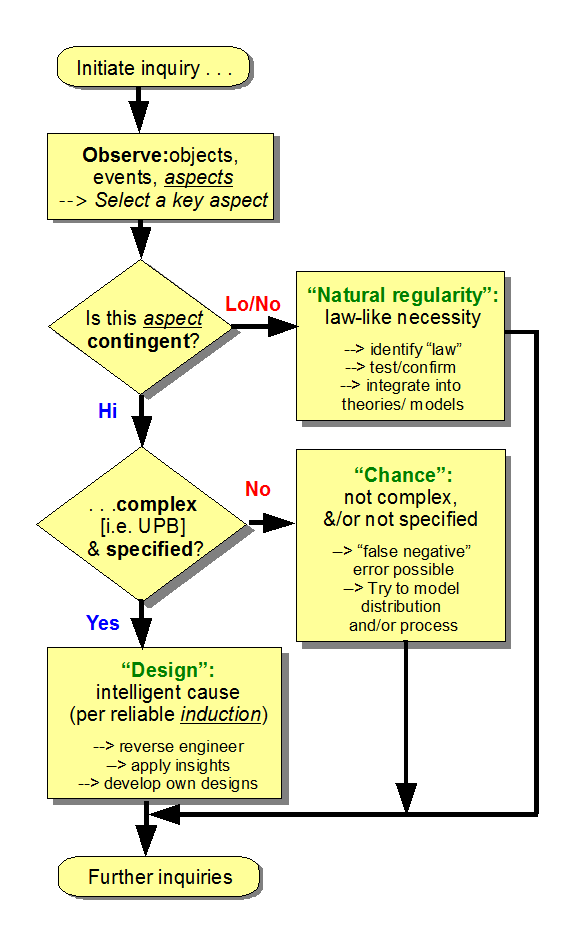
Explanatory FilterExplanatory Filter

Let’s run the prime number sequence through the explanatory filter to see how.

1.  We observe an event (i.e. a radio signal specifying the prime numbers between 1 and 100).

2.  Is it highly contingent?  Yes.  We can exclude mechanical necessity.

3.  Is it highly complex and specified?  Yes.  We can exclude chance.

4.  The best explanation for the data:  Design.

Now let’s see if Dr. Liddle’s Bayesian analysis adds anything to what we already have.

Prior 1:  Estimate of the probability that other parts of the universe host intelligent life forms capable of sending radio signals:  High

It is obvious that one’s prior estimate of the probability of the existence of intelligent life forms in other parts of the universe is utterly irrelevant to the design inference.  How do I know?  By supposing the exact opposite of course.  Let’s assume that a person believes there is practically zero chance that other parts of the universe have intelligent life (as we have seen on this site, there is very good reason to believe this).  If that person were to receive this signal he would have to revise his conclusion, because the signal is obviously designed.

We see, therefore, that whether one’s Bayesian prior regarding the probability of the existence of intelligence life forms is 0% or 100% makes absolutely no difference to the design inference.  From this we conclude that Dr. Liddle’s first prior adds nothing to the analysis.

Prior 2:  Estimate of the probability that a non-intelligent process might generate such a signal:  Low

This, of course, is the explanatory filter by another name.  How do we know that the probability that a non-intelligent process might generate such a signal is low?  Because it is highly continent, complex and specified.

It is important to see two things:

1.  When Dr. Liddle correctly inferred design from the prime number sequence she had one and only one data point:  A radio signal specifying the primes between 1 and 100.

2.  Dr. Liddle knew nothing about the provenance of the radio signal.  In other words she made a design inference based on nothing but the pattern itself while knowing absolutely nothing about the designer.  When she made her design inference she did not first make a hypothesis based on the “postulated designer,” for the simple reason that there was not a scintilla of data upon which to base that hypothesis other than the pattern itself.

Conclusion:  Though she tried to cover it up with Bayesian fuzziness, Dr. Liddle did the very thing she now says is “ludicrous.”


Comments
Dr Liddle: [Humans] can, in other words, exert force on matter, so that it travels through a distance. Molecular forces can do this two. But I have no evidence that anything can move anything without exerting a force on it.
Humans do more than merely exert force on matter, they can do so with foresight. What biochemical force does that?CentralScrutinizer
July 15, 2013
July
07
Jul
15
15
2013
04:27 PM
4
04
27
PM
PDT
Nobody want to have a go at my puzzle at 29?
I'd hit the guard over the head with the bag and grab his gun.CentralScrutinizer
July 15, 2013
July
07
Jul
15
15
2013
04:23 PM
4
04
23
PM
PDT
re: Liz a at 29. I'd call red. Prior to the 1st draw we know nothing about the relative frequency of red or blue. The first draw gives us some information, no matter how meagre about what the frequency of red balls is likely to be so we stick and hope. (working on the back on an envelope, presuming uniform distribution of the frequency of red balls across trials, each with 100 balls per bag, you survive about 65% of the time with this strategy )wd400
July 15, 2013
July
07
Jul
15
15
2013
04:22 PM
4
04
22
PM
PDT
Lizzie,
But in specific response to the passage you cite: I am not necessarily asking that the null embrace every possible unknown non-design hypothesis, but Dembski specifically requires that when computing P(T|H), H should be “the relevant chance hypothesis that takes into account Darwinian and other material mechanisms“. Darwinian mechanisms are not “unknown material mechanisms”.
I certainly agree that Darwinian mechanisms aren't unknown. However, you seemed to be making a stronger claim earlier:
You can only reject “mechanical necessity” if we have exhausted not only known mechanisms but also unknown mechanisms. Which is clearly impossible. So the filter is doomed from the start.
My point is that you can salvage the filter if you can make a decent argument for why this probability is low:
3a. The probability that there exists an unknown unintelligent mechanism capable of producing the pattern...
It isn't ironclad; you can get false positives if your estimate is wrong. But at least the filter isn't doomed. And of course I agree that the bigger problem with P(T|H) is that nobody can compute it for the known mechanisms (including Darwinian evolution), much less the unknown ones!keiths
July 15, 2013
July
07
Jul
15
15
2013
04:21 PM
4
04
21
PM
PDT
CS: Humans can move things. They can use tweezers, and Gene guns and test-tubes. They can, in other words, exert force on matter, so that it travels through a distance. Molecular forces can do this two. But I have no evidence that anything can move anything without exerting a force on it. So, absent evidence for some additional force in the universe we have not yet discovered, I'd back the ones we know about. Of course the those forces themselves could have been designed to do the job. But in that case all we will be able to detect from withinthe universe are tne natural forces that the Designer created.Elizabeth B Liddle
July 15, 2013
July
07
Jul
15
15
2013
04:20 PM
4
04
20
PM
PDT
Dr Liddle: My prior for natural forces is higher because I know that biochemical forces exist
What evidence exists that chance and necessity of biochemical forces led to the self-replicator we have?
whereas I have no evidence of any other force that can move molecules around and make them inter-react.
Humans can do that, with understanding, foresight, and intent. Moreover, we have a pretty decent understanding of Earth's self-replicator, and there is no obvious reason why we shouldn't be able to master the whole shebang some day.
...that with my back to the wall, I’d go for natural forces.
Why?CentralScrutinizer
July 15, 2013
July
07
Jul
15
15
2013
04:15 PM
4
04
15
PM
PDT
RDFish: What would you call something that has the following properties: 1) Running, 2) Jumping, 3) Throwing. I call it “athleticism”
That's perfectly legit. If we define athleticism as the properties that an entity can have of being able to run, jump and throw, then there's no reason why "athleticism" can't be used as a shorthand to explain a certain effect. Q: Why did Joe win Olympic Gold in the Marathon? A: Because of his superior athleticism IOW, because of his superior skills in running, jumping and throwing. It's a valid explanation. So you didn't make your point.CentralScrutinizer
July 15, 2013
July
07
Jul
15
15
2013
04:05 PM
4
04
05
PM
PDT
CentralScrutinizer:
So, Dr Liddle, I’m wondering, when it comes to the particular DNA replication system that we find in nature, and the processes going on within cells, what do you consider the probably of those being the result of natural forces, and what probably of them being the result of a human-like intelligence?
I don't know CS. I don't have enough information to be able to make decently informed priors. My prior for natural forces is higher because I know that biochemical forces exist, whereas I have no evidence of any other force that can move molecules around and make them inter-react. As Barry says, it's pretty well GIGO at this point, except that with my back to the wall, I'd go for natural forces. Nobody want to have a go at my puzzle at 29? It's quite relevant :)Elizabeth B Liddle
July 15, 2013
July
07
Jul
15
15
2013
04:04 PM
4
04
04
PM
PDT
Barry, If we can get back to the OP, I think we'll find where you are going wrong here.
It is obvious that one’s prior estimate of the probability of the existence of intelligent life forms in other parts of the universe is utterly irrelevant to the design inference. How do I know? By supposing the exact opposite of course. Let’s assume that a person believes there is practically zero chance that other parts of the universe have intelligent life (as we have seen on this site, there is very good reason to believe this). If that person were to receive this signal he would have to revise his conclusion, because the signal is obviously designed
Nah. The heart of Bayesianism that you update your beliefs based on evidence. If you data that very strongly supports an hypothesis (that is the likelihood, P(data|h) is high, and P(data|!h) is low) then you will rightly update your prior and have strong belief in h. But your prior still matters, if you have very good reason to belive there is no life outside of earth, then same data will give you a different posterior probability. The prior might be of little practical importance when data is absolutely overwhelming supportive of an hypothesis. That might be the case for 100 primes (though you cold possibly imagine other generating processes (they could even, like cicada lifecycles, evolve!). But it's certainly not the case for biology. The Bayesian formulation also makes the glaring importance (biology|no-design) stand out. That's what was missing in the original formulation of CSI, and something many authors here don't seem to grasp.wd400
July 15, 2013
July
07
Jul
15
15
2013
03:42 PM
3
03
42
PM
PDT
No, RDF. 'Trying explain how a cheetah runs so fast by saying it is because of “athleticism” is ridiculous. But to attribute it to the cheetah's natural athleticism makes perfect sense.Axel
July 15, 2013
July
07
Jul
15
15
2013
03:13 PM
3
03
13
PM
PDT
'This doesn’t actually make any sense at all. “Intelligence” is not the “root cause” of anything at all. This is like saying “athleticism” is the root cause of running.' No. That is a false analogy, RDF. They are derived from different parts of speech. It is not given to us mortals 'to athleticism', but it is given to us 'to perceive'. 'intelligent': Interesting derivation... the present participle of the verb, 'intellegere' - 'to perceive' (literally, to 'choose between'). Athletes don't athlete, but intelligence may perceive, discriminate, judge, select, etc. The confusion arises from their both being definable as, showing a particular functional aptitude, whereas, 'intelligent' may also answer to the definition of 'perceptive', 'perceiving', discriminating, etc. One example give in the Free Dictionary is: 3. Showing sound judgment and rationality: an intelligent decision; an intelligent solution to the problem. [Latin intelligns, intelligent-, present participle of intellegere, intelligere, to perceive : inter-, inter- + legere, to choose; see leg- in Indo-European roots.] - Free Dictionary Note the infinitive, 'to choose', akin to 'to discriminate, to select, to judge, etc. In computer science, they apparently talk about 'data-storage, intelligent terminals'. 'athleticism', however, is a simple, abstract noun, describing a general physical aptitude or compendium of physical aptitudes, while 'intelligence' is far less limited in the scope of its functioning than the human body and its parts, yet is far more specific in its operation and purposiveness; while its root meaning is closely associated with that of an active verb, 'to perceive'. The one describes possession of marked, physical aptitudes, gererally; the other, a marked aptitude closely associated with a very particular verb - with an end product, of which it is the root cause!Axel
July 15, 2013
July
07
Jul
15
15
2013
03:07 PM
3
03
07
PM
PDT
RDFish: Like the SETI folks say, we’d tag it “life as we know it” – the only things we know of that might produce such a signal are complex life forms like us (which is precisely the sort of thing ID attempts to explain!).
As I understand them, ID "attempts to explain" the proximate source of life on earth. (BTW, SETI's "life as we know it" falls under their Astro-Biology section, not their SETI Observing Projects section. see http://www.seti.org/faq#csc24 ) For all we know, extra-terrestrial intelligent life may be "implemented" by very different means. Who's to say to the contrary? SETI can say nothing about this in advance and neither can you. All that matters are signs of intelligence. What SETI observation projects are interested in is "coded information." See http://www.seti.org/faq#obs9 I think the first 100 primes would qualify, regardless of the nature of the sender, that we're dealing with an "intelligent source", don't you?CentralScrutinizer
July 15, 2013
July
07
Jul
15
15
2013
02:58 PM
2
02
58
PM
PDT
keiths: Yes indeed. I addressed this in my response to Winston Ewart, who also raised it, and I look forward to Winston's response. Here is what I wrote at TSZ (the relevant portion) ************************************************** Me at TSZ: But how does Dembski defend this approach? He writes
At this point, critics of specified complexity raise two objections. First, they contend that because we can never know all the chance hypotheses responsible for a given outcome, to infer design because specified complexity eliminates a limited set of chance hypotheses constitutes an argument from ignorance.
Yes, indeed, this critic does. But Dembski counters:
In eliminating chance and inferring design, specified complexity is not party to an argument from ignorance. Rather, it is underwriting an eliminative induction. Eliminative inductions argue for the truth of a proposition by actively refuting its competitors (and not, as in arguments from ignorance, by noting that the proposition has yet to be refuted). Provided that the proposition along with its competitors form a mutually exclusive and exhaustive class, eliminating all the competitors entails that the proposition is true.
OK, but...
But eliminative inductions can be convincing without knocking down every conceivable alternative,a point John Earman has argued effectively. Earman has shown that eliminative inductions are not just widely employed in the sciences but also indispensable to science.
  Hold it right there. When Earman makes his plea for eliminative induction, he says:
Even if we can never get down to a single hypothesis, progress occurs if we succeed in eliminating finite or infinite chunks of the possibility space. This presupposes of course that we have some kind of measure, or at least topology, on the space of possibilities.
Earman gives as an example a kind of "hypothesis filter" whereby hypotheses are rejected at each of a series of stages, none of which non-specific "Design" would even pass, as each requires candidate theories to make specific predictions. Not only that, but Earman's approach is in part a Bayesian one, an approach Dembski specifically rejects for design detection. Just because Fisherian hypothesis testing is essentially eliminative (serial rejection of null hypotheses) does not mean that you can use it for eliminative induction when the competing hypotheses do not form an exhaustive class, and Dembski offers no way of doing so. In other words, not only does Dembski offer no way of computing the probability distribution under P(T|H) unless H is extremely limited, thereby precluding any Design inference anyway, he also offers no way of computing the topology of the space of non-Design Hypotheses, and thus no way of systematically eliminating them other than one-by-one, never knowing what proportion of viable hypotheses have been eliminated at any stage. In other words, his is, indeed, an argument from ignorance. Earman's essay simply does not help him. Dembski comments:
Suffice it to say, by refusing the eliminative inductions by which specified complexity eliminates chance, one artificially props up chance explanations and (let the irony not be missed) eliminates design explanations whose designing intelligences don’t match up conveniently with a materialistic worldview.
The irony misser here, of course, is Dembski. Nobody qua scientist has "eliminated" a "design explanation". The problem for Dembski is not that those with a "materialistic worldview" have eliminated Design, but that the only eliminative inductionist approach he cites (Earman's) would eliminate his Design Hypothesis out of the gate. That's not because there aren't perfectly good ways of inferring Design (there are), but because by refusing to make any specific Design-based predictions, Dembski's hypothesis remains (let the irony not be missed) unfalsifable. ******************************************************* But in specific response to the passage you cite: I am not necessarily asking that the null embrace every possible unknown non-design hypothesis, but Dembski specifically requires that when computing P(T|H), H should be "the relevant chance hypothesis that takes into account Darwinian and other material mechanisms". Darwinian mechanisms are not "unknown material mechanisms". And I have never seen any attempt to do this. I simply do not know how you would begin. That's why no-one would ever use Fisherian null hypothesis testing in the way Dembski proposes. Better to be explicit about your prior for P(T|¬Design) as in the Bayesian formulation and go with your hunch. The CSI calculation merely disguises what Bayes makes explicit. And indeed, boils down, given so little data on which to make an informed guess, to your reasoning steps above. Your last sentence is as true of CSI as it is of any overtly Bayesian method.Elizabeth B Liddle
July 15, 2013
July
07
Jul
15
15
2013
02:49 PM
2
02
49
PM
PDT
Hi CentralScrutinizer, My point above is that it is a mistake to reify intelligence. Intelligence and athleticism are analogous concepts, but we do not tend to reify primarily physical abilities in the way we reify primarily mental abilities. Trying explain how a cheetah runs so fast by saying it is because of "athleticism" is ridiculous. It is equally ridiculous to try and explain how a human being designs a computer by saying it is because of "intelligence". Cheers, RDFishRDFish
July 15, 2013
July
07
Jul
15
15
2013
02:41 PM
2
02
41
PM
PDT
Hi CentralScrutinizer,
Because designers are intelligent, that is, intelligence manifests various properties.
Saying "designers are intelligent" is like saying "runners are athletic". It is simply true by definition.
What would you call something that has the following properties? … 1. “Understanding” of natural forces. 2. “Foresight” of future events based on the arrangements and relationships of various natural forces. 3. “Intent” to alter the course of future events. I call it “intelligence.”
What would you call something that has the following properties: 1) Running 2) Jumping 3) Throwing I call it "athleticism" Now, imagine we look through a telescope at another planet and see traces of movements that look like running, jumping and throwing. How would you explain these traces? What would you learn by saying "the cause of these traces is athleticism"? Cheers, RDFishRDFish
July 15, 2013
July
07
Jul
15
15
2013
02:37 PM
2
02
37
PM
PDT
Lizzie:
It’s the error at the heart of Dembski’s method. And it’s hiding there, in plain site, in the old EF: You can only reject “mechanical necessity” if we have exhausted not only known mechanisms but also unknown mechanisms. Which is clearly impossible. So the filter is doomed from the start.
In fairness to Dembski, he does attempt to address that issue. From his article:
Granted, this would eliminate all the chance hypotheses in {Hi}i?I, but would it eliminate all chance hypotheses überhaupt? Probabilistic arguments are inherently fallible in the sense that our assumptions about relevant probability distributions might always be in error. Thus, it is always a possibility that {Hi}i?I omits some crucial chance hypothesis that might be operating in the world and account for the event E in question. But are we to take this possibility seriously in the absence of good evidence for the operation of such a chance hypothesis in the production of E? Indeed, the mere possibility that we might have missed some chance hypothesis is hardly reason to think that such a hypothesis was operating. Nor is it reason to be skeptical of a design inference based on specified complexity. Appealing to the unknown to undercut what we do know is never sound epistemological practice. Sure, we may be wrong. But unknown chance hypotheses (and the unknown material mechanisms that supposedly induce them) have no epistemic force in showing that we are wrong. Inquiry can throw things into question only by taking other things to be fixed. The unknown is not a fixed point. It cannot play such a role.
I would argue that in the case of SETI, we are reasoning as follows:
1. We are unaware of any unintelligent mechanism that could produce the pattern in question. 2. We are aware that intelligence can produce the pattern in question. 3. When we receive such a pattern, we are weighing two (partly subjective) probabilities against each other: 3a. The probability that there exists an unknown unintelligent mechanism capable of producing the pattern, versus 3b. The probability that there exists an intelligent being (or beings), besides us, capable of producing the pattern and within sending distance of Earth.
If you regard 3b as more probable than 3a, you'll infer design. If you regard 3a as more probable than 3b, you'll infer unintelligent causes. If you're uncertain about the relative probabilities, or if it's "too close to call", you'll remain agnostic.keiths
July 15, 2013
July
07
Jul
15
15
2013
02:23 PM
2
02
23
PM
PDT
Hi Axel,
RDF: ‘It is not “intelligence” that designs cars and computers and Mt. Rushmore, it is “human beings”. It is not “intelligence” that designs eyeballs and blood clotting cascades and flagella, it is… nobody has any idea.’ AXEL: How about a comatose ‘human being’? Do you really think, a comatose ‘human being’ is a better candidate as the likely designer.
Sorry, I don't understand. Humans are only capable of designing and building things when their brains are in good working order. However, many people (including me) often have the experience of solving technical (design) problems during sleep, because conscious thought is not necessary in order to accomplish many complex tasks.
There is no design without intelligence.
This is like saying there is no running without athleticism. It's just true by definition.
...in this case the soul (memory, will and understanding)....
Do you not believe that memories are stored in the brain? How would you explain our neuroscientific findings regarding memory formation, retrieval, loss, etc. if memories are not dependent upon neurological processes?
So, reason demands, surely, that we extrapolate from our own relatively clumsy designs that intelligence and purpose are invariably characteristic properties of a sentient being, who must have employed such artifice in creating the natural order.
Sentient beings are, as far as we know from our uniform and repeated experience, chock-full of exactly the sort of complex form and function ID attempts to explain. So it doesn't seem to be possible for a sentient being to produce the first complex form and function - it's a bootstrapping problem, you know? There is no CSI without thinking, no thinking without CSI. Quite a mystery! Cheers, RDFishRDFish
July 15, 2013
July
07
Jul
15
15
2013
02:16 PM
2
02
16
PM
PDT
Hi Sal, I still have not successfully made my point regarding the equivocations surrounding "intelligence". Let me try again:
RDF: The “design hypothesis” is not a meaningful explanation of anything at all. It is like trying to explain planetary motion with the “movement hypothesis” without saying what is doing the moving – it tells us precisely nothing. SAL: A slight but respectful disagreement. Planets move according to an elipse. It would be wrong to say the mechanism is an elipse, the mechanism is gravity that creates the elliptical motion.
Here is what I mean: Imagine being a pre-Newtonian who does not know that the same force that causes apples to fall from trees is what causes planets to move around the Sun. Then you try to explain observed planetary motions by saying "Ah - I believe it is movement that accounts for it!" and proceed to explain that only the "movement hypothesis" can explain what we see in the night sky. Obviously this would be a meaningless hypothesis - it tells us precisely nothing about what is going on, and simply says that something (what don't know what) explains the movements we observe. My point is that saying the "design hypothesis" accounts for the designs we observe in biology, etc. is just as vacuous - it tells us precisely nothing. It simply says that something (we don't know what) explains the complex form and function we see in biology.
Designs look to be designed.
I don't know what this means. It's like saying "Blue things look to be blue".
It is formally wrong to say design is the mechanism of design.
I don't understand this either.
It is correct however to say it looks analogous to something a human could design if the human hand the resources and intelligence.
I do understand what "human design" means - it means a human being devised a plan for something.
Whether intelligence is the root cause,
This doesn't actually make any sense at all. "Intelligence" is not the "root cause" of anything at all. This is like saying "athleticism" is the root cause of running. Cheers, RDFishRDFish
July 15, 2013
July
07
Jul
15
15
2013
02:12 PM
2
02
12
PM
PDT
Hi CentralScrutinizer,
So if we were to continously detect the first 100 primes from 2 to 541 from a distant source, you would not at least provisionally put the tag of “intelligently generated” on the phenomenon? How would you tag it?
Like the SETI folks say, we'd tag it "life as we know it" - the only things we know of that might produce such a signal are complex life forms like us (which is precisely the sort of thing ID attempts to explain!).RDFish
July 15, 2013
July
07
Jul
15
15
2013
02:10 PM
2
02
10
PM
PDT
We see in nature, what we see in artifice, i.e. intelligence and purpose - although to a virtually supernaturally exalted degree? So, reason demands, surely, that we extrapolate from our own relatively clumsy designs that intelligence and purpose are invariably characteristic properties of a sentient being, who must have employed such artifice in creating the natural order. How could random chance mimic a brilliantly subtle mind, such as that of say, David Berlinsky - never mind, to the point of being such a creative thaumaturge as would be required to design and create the universe? It is not just a question of random chance's ability (or otherwise) to create, is it? It's the question of how such consummately, such sublimely, beautiful artistry, and the power to construct the universe (not to mention, keep it going), could converge at such an impossible height of perfection. By random chance? Likely? Surely not.Axel
July 15, 2013
July
07
Jul
15
15
2013
01:52 PM
1
01
52
PM
PDT
Elizabeth proves that she doesn't understand how science operates:
It’s the error at the heart of Dembski’s method. And it’s hiding there, in plain site, in the old EF: You can only reject “mechanical necessity” if we have exhausted not only known mechanisms but also unknown mechanisms. Which is clearly impossible. So the filter is doomed from the start.
Geez if that were so then no one could ever reach any scientific inference. Science does NOT require absolute proof and that is what Lizzie is asking for. Science works with what we know- it cannot and does not wait for what tomorrow may or may not uncover. And the power is in the hands of teh anti-design people- all they have to do is actually step up and demonstrate that blind and undirected processes can do it and the design inference falls.Joe
July 15, 2013
July
07
Jul
15
15
2013
01:47 PM
1
01
47
PM
PDT
Axel:
There is no design without intelligence.
Well, said. And there is also no design without Work.Elizabeth B Liddle
July 15, 2013
July
07
Jul
15
15
2013
01:29 PM
1
01
29
PM
PDT
Barry Arrington:
Game, set, match to Barry
Barry, Your declarations of victory crack me up. Please continue.keiths
July 15, 2013
July
07
Jul
15
15
2013
01:28 PM
1
01
28
PM
PDT
'It is not “intelligence” that designs cars and computers and Mt. Rushmore, it is “human beings”. It is not “intelligence” that designs eyeballs and blood clotting cascades and flagella, it is… nobody has any idea.' - RDFish How about a comatose 'human being'? Do you really think, a comatose 'human being' is a better candidate as the likely designer. There is no design without intelligence. Materialists don't have the tools to be able to dispense with such sophistries, in favour of common sense. It doesn't matter how eminent and celebrated a philosopher, departure from a Christian understanding of the fundamental nature of man - in this case the soul (memory, will and understanding) - can only end in tears before bedtime, with endless sophistries leading up blind alleys. False assumptions are most deleteriously seminal in the thought-processes of materialists.Axel
July 15, 2013
July
07
Jul
15
15
2013
01:17 PM
1
01
17
PM
PDT
Barry
Liddle: I would consider the fact that it was a rather special signal the major reason for stacking my priors for an intelligent agent. Game, set, match to Barry
Well, as long as we use Barry's CSI definition, sure. But in that case I declare a Barry-Lizzie draw, and Dembski gets the wooden spoon.
How in the world could you say that a simple “on-off” pattern is in any conceivable sense of the word “complex”? That you would suggest that anyone would say that an on-off pattern is complex is nothing short of astounding. Elizabeth, words have meaning. It is not licit to do linguistic violence to those meanings.
Tell that to Dembski, Barry. I was using his definitions, because I thought that was what we were talking about. It was what I was talking about. In his 2005 paper, Specification: the Pattern that Signifies Intelligence, he actually gives an example of something very close to your fictional signal: a series of ones and zeros that, when interpreted as binary digits, turn out to form the Champernowne sequence: 1|00|01|10|11|000|001|010|011|100|101|110|111|0000|0001|0010|0011|0100|0101|0110|0111|1000|1001|1010|1011|1100|1101|1110|1111|00. He says that this sequence has the signature of Design because it has a combination of two properties: Pattern-simplicity, which he describes as "easy description of pattern" and Event-complexity, which he defines "difficulty of reproducing the corresponding event by chance", i.e. its Shannon entropy, namely 2^100 bits, and which would be possessed by any 100 digit string consisting of equiprobable 1s and 0s. So Dembski's "event complexity" would be identical for this sequence and a sequence of alternating ones and zeros, and "pattern simplicity" doesn't come much more simple than a repeating 2 bit pattern. So, Barry, please don't blame the messenger. I was using Dembski's own terms. If you find that it is not licit to do such linguistic violence to those meanings, then perhaps you should get in touch with the guy you inherited this blog from :)Elizabeth B Liddle
July 15, 2013
July
07
Jul
15
15
2013
12:34 PM
12
12
34
PM
PDT
Barry #19
Mark, it seems like you are saying that if we cannot reliably estimate the probability of the existence of other intelligent life prior to receiving the Signal then there is “incredible uncertainty” in the conclusion that the Signal is the result of intelligent design.
Pretty much yes.
If that is what you are saying, then your statement is preposterous and patently absurd. It is the exact opposite of the truth. Far from being incredibly uncertain, the design inference based on the signal is all but certain. As I said, even a man who was perhaps the most famous materialist atheist of the latter half of the twentieth century (Carl Sagan) would agree that the design inference is all but certain.
I don't know what Carl Sagan wrote but the only reasoning you have given to support your case is my claim is absurd. As this is a situation unlike anything we have ever had to address it would be naive to argue from "this is absurd". Meanwhile I give you some maths: Bayes formula: P(Design|Data)= P(Data|Design)*P(Design)/(P(Data|Design)*P(Design)+P(Data|Notdesign)(1-P(Design)) I take it you accept that? The formula relies heavily on P(Design). Therefore any uncertainty in P(Design) is reflected in uncertainty about P(Design|Data) If there is something wrong with this reasoning you might indicate which step.Mark Frank
July 15, 2013
July
07
Jul
15
15
2013
12:32 PM
12
12
32
PM
PDT
Liddle:
I would consider the fact that it was a rather special signal the major reason for stacking my priors for an intelligent agent.
Game, set, match to BarryBarry Arrington
July 15, 2013
July
07
Jul
15
15
2013
12:13 PM
12
12
13
PM
PDT
Liddle:
Using Dembski’s definition of a complex specified pattern, the pulsar sequences have CSI: They are binary (on off on off), and they are long (they go on interminably) and therefore any sequence of signals has vast Shannon entropy (as many bits as the sequence is long). However, they are also extremely compressible (repeat “on off” N times).
How in the world could you say that a simple “on-off” pattern is in any conceivable sense of the word “complex”? That you would suggest that anyone would say that an on-off pattern is complex is nothing short of astounding. Elizabeth, words have meaning. It is not licit to do linguistic violence to those meanings.Barry Arrington
July 15, 2013
July
07
Jul
15
15
2013
12:11 PM
12
12
11
PM
PDT
Barry:
You write that you have no reason to think a non-intelligent signaler is possible, but surely you understand this is wrong. Non-intelligent sources send out radio signals all the time (quasars, for example). It is not the fact that a signal has been sent that is important. Both intelligent and non-intelligent sources send signals. The issue is whether there is anything about this particular signal that would lead to a design inference. And obviously there is. Tell me Elizabeth, what is there about this particular signal that separates it from a signal generated by, say, a quasar. Hint: The answer has the following three words that you can arrange in the correct order: information, specified, complex.
Ah. I see the problem. I would consider the fact that it was a rather special signal the major reason for stacking my priors for an intelligent agent. No issue with that at all. I think this is going to be resolved quite easily. The issue here is, simply, the definition of "complex specified information". If you are defining CSI as something like: A signal high in Shannon entropy (which Dembski, somewhat confusingly, calls "complexity") i.e. lots of bits, but also spelling out something meaningful and thus "specified" and "information" - no problem. Yes I have certainly used CSI, thus defined, in reaching my Bayesian conclusions. The problem is: this is not how Dembski defines it, and I was assuming we were using Dembski's definition, seeing as we seemed to be using his EF! Dembski has defined CSI in a number of ways, and one of them includes what I would call the "alpha" value in Fisherian null hypothesis testing - he sets it as p<10^-150, and then includes that value in his definition of CSI, which I always found rather odd. But ignoring that part, and just concentrating on his definition of a "complex, specified" pattern, his criteria are that it should have high "complexity" which he defines, somewhat confusingly, as high Shannon entropy (lots of bits) but, in addition, high compressibility ("ease of description" as I recall), more usually referred to as low "Kolmogorov" complexity, ironically. Using Dembski's definition of a complex specified pattern, the pulsar sequences have CSI: They are binary (on off on off), and they are long (they go on interminably) and therefore any sequence of signals has vast Shannon entropy (as many bits as the sequence is long). However, they are also extremely compressible (repeat "on off" N times). So even just using that part doesn't work. But if we just define the kind of sequence we have (fictionally) observed as "a lengthy signal binary signal with high Shannon entropy (and thus large channel capacity) consisting data that can be readily interpreted as a meaningful message) - fine. It's just not how Dembski defines CSI. (Although even if we define CSI as above, it's still not the only data I used, and I would have dearly liked more).Elizabeth B Liddle
July 15, 2013
July
07
Jul
15
15
2013
11:59 AM
11
11
59
AM
PDT
RDF: Being human is neither necessary nor sufficient to be intelligent in the relevant sense of design. beavers are (albeit limitedly so) evidently intelligent in some of their dam building behaviour. Humans who do not know a fair amount of relevant things and have relevant skills cannot design computers or software, and so forth. It seems that "intelligence" is one of those things that points where you would not go. KFkairosfocus
July 15, 2013
July
07
Jul
15
15
2013
11:50 AM
11
11
50
AM
PDT
1 2 3 4

Leave a Reply