Uncommon Descent Serving The Intelligent Design Community

ID Foundations, 11: Borel’s Infinite Monkeys analysis and the significance of the log reduced Chi metric, Chi_500 = I*S – 500

Categories
ID Foundations
Intelligent Design
Share
Facebook
Twitter/X
LinkedIn
Flipboard
Print
Email

 (Series)

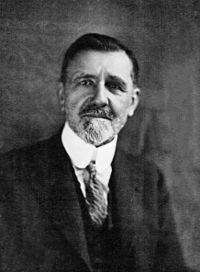
Emile Borel, 1932

Emile Borel (1871 – 1956) was a distinguished French Mathematician who — a son of a Minister — came from France’s Protestant minority, and he was a founder of measure theory in mathematics. He was also a significant contributor to modern probability theory,  and so Knobloch observed of his approach, that:

>>Borel published more than fifty papers between 1905 and 1950 on the calculus of probability. They were mainly motivated or influenced by Poincaré, Bertrand, Reichenbach, and Keynes. However, he took for the most part an opposed view because of his realistic attitude toward mathematics. He stressed the important and practical value of probability theory. He emphasized the applications to the different sociological, biological, physical, and mathematical sciences. He preferred to elucidate these applications instead of looking for an axiomatization of probability theory. Its essential peculiarities were for him unpredictability, indeterminism, and discontinuity. Nevertheless, he was interested in a clarification of the probability concept. [Emile Borel as a probabilist, in The probabilist revolution Vol 1 (Cambridge Mass., 1987), 215-233. Cited, Mac Tutor History of Mathematics Archive, Borel Biography.]>>

Among other things, he is credited as the worker who introduced a serious mathematical analysis of the so-called Infinite Monkeys theorem (just a moment).

So, it is unsurprising that Abel, in his recent universal plausibility metric paper, observed  that:

Emile Borel’s limit of cosmic probabilistic resources [c. 1913?] was only 1050 [[23] (pg. 28-30)]. Borel based this probability bound in part on the product of the number of observable stars (109) times the number of possible human observations that could be made on those stars (1020).

This of course, is now a bit expanded, since the breakthroughs in astronomy occasioned by the Mt Wilson 100-inch telescope under Hubble in the 1920’s. However,  it does underscore how centrally important the issue of available resources is, to render a given — logically and physically strictly possible but utterly improbable — potential chance- based event reasonably observable.

We may therefore now introduce Wikipedia as a hostile witness, testifying against known ideological interest, in its article on the Infinite Monkeys theorem:

In one of the forms in which probabilists now know this theorem, with its “dactylographic” [i.e., typewriting] monkeys (French: singes dactylographes; the French word singe covers both the monkeys and the apes), appeared in Émile Borel‘s 1913 article “Mécanique Statistique et Irréversibilité” (Statistical mechanics and irreversibility),[3] and in his book “Le Hasard” in 1914. His “monkeys” are not actual monkeys; rather, they are a metaphor for an imaginary way to produce a large, random sequence of letters. Borel said that if a million monkeys typed ten hours a day, it was extremely unlikely that their output would exactly equal all the books of the richest libraries of the world; and yet, in comparison, it was even more unlikely that the laws of statistical mechanics would ever be violated, even briefly.

The physicist Arthur Eddington drew on Borel’s image further in The Nature of the Physical World (1928), writing:

If I let my fingers wander idly over the keys of a typewriter it might happen that my screed made an intelligible sentence. If an army of monkeys were strumming on typewriters they might write all the books in the British Museum. The chance of their doing so is decidedly more favourable than the chance of the molecules returning to one half of the vessel.[4]

These images invite the reader to consider the incredible improbability of a large but finite number of monkeys working for a large but finite amount of time producing a significant work, and compare this with the even greater improbability of certain physical events. Any physical process that is even less likely than such monkeys’ success is effectively impossible, and it may safely be said that such a process will never happen.

Let us emphasise that last part, as it is so easy to overlook in the heat of the ongoing debates over origins and the significance of the idea that we can infer to design on noticing certain empirical signs:

These images invite the reader to consider the incredible improbability of a large but finite number of monkeys working for a large but finite amount of time producing a significant work, and compare this with the even greater improbability of certain physical events. Any physical process that is even less likely than such monkeys’ success is effectively impossible, and it may safely be said that such a process will never happen.

Why is that?

Because of the nature of sampling from a large space of possible configurations. That is, we face a needle-in-the-haystack challenge.

For, there are only so many resources available in a realistic situation, and only so many observations can therefore be actualised in the time available. As a result, if one is confined to a blind probabilistic, random search process, s/he will soon enough run into the issue that:

a: IF a narrow and atypical set of possible outcomes T, that

b: may be described by some definite specification Z (that does not boil down to listing the set T or the like), and

c: which comprise a set of possibilities E1, E2, . . . En, from

d: a much larger set of possible outcomes, W, THEN:

e: IF, further, we do see some Ei from T, THEN also

f: Ei is not plausibly a chance occurrence.

The reason for this is not hard to spot: when a sufficiently small, chance based, blind sample is taken from a set of possibilities, W — a configuration space,  the likeliest outcome is that what is typical of the bulk of the possibilities will be chosen, not what is atypical.  And, this is the foundation-stone of the statistical form of the second law of thermodynamics.

Hence, Borel’s remark as summarised by Wikipedia:

Borel said that if a million monkeys typed ten hours a day, it was extremely unlikely that their output would exactly equal all the books of the richest libraries of the world; and yet, in comparison, it was even more unlikely that the laws of statistical mechanics would ever be violated, even briefly.

In recent months, here at UD, we have described this in terms of searching for a needle in a vast haystack [corrective u/d follows]:

let us work back from how it takes ~ 10^30 Planck time states for the fastest chemical reactions, and use this as a yardstick, i.e. in 10^17 s, our solar system’s 10^57 atoms would undergo ~ 10^87 “chemical time” states, about as fast as anything involving atoms could happen. That is 1 in 10^63 of 10^150. So, let’s do an illustrative haystack calculation:

 Let us take a straw as weighing about a gram and having comparable density to water, so that a haystack weighing 10^63 g [= 10^57 tonnes] would take up as many cubic metres. The stack, assuming a cubical shape, would be 10^19 m across. Now, 1 light year = 9.46 * 10^15 m, or about 1/1,000 of that distance across. If we were to superpose such a notional 1,000 light years on the side haystack on the zone of space centred on the sun, and leave in all stars, planets, comets, rocks, etc, and take a random sample equal in size to one straw, by absolutely overwhelming odds, we would get straw, not star or planet etc. That is, such a sample would be overwhelmingly likely to reflect the bulk of the distribution, not special, isolated zones in it.

With this in mind, we may now look at the Dembski Chi metric, and reduce it to a simpler, more practically applicable form:

m: In 2005, Dembski provided a fairly complex formula, that we can quote and simplify:

χ = – log2[10^120 ·ϕS(T)·P(T|H)]. χ is “chi” and ϕ is “phi”

n:  To simplify and build a more “practical” mathematical model, we note that information theory researchers Shannon and Hartley showed us how to measure information by changing probability into a log measure that allows pieces of information to add up naturally: Ip = – log p, in bits if the base is 2. (That is where the now familiar unit, the bit, comes from.)

o: So, since 10^120 ~ 2^398, we may do some algebra as log(p*q*r) = log(p) + log(q ) + log(r) and log(1/p) = – log (p):

Chi = – log2(2^398 * D2 * p), in bits

Chi = Ip – (398 + K2), where log2 (D2 ) = K2

p: But since 398 + K2 tends to at most 500 bits on the gamut of our solar system [our practical universe, for chemical interactions! (if you want , 1,000 bits would be a limit for the observable cosmos)] and

q: as we can define a dummy variable for specificity, S, where S = 1 or 0 according as the observed configuration, E, is on objective analysis specific to a narrow and independently describable zone of interest, T:

Chi_500 =  Ip*S – 500, in bits beyond a “complex enough” threshold

(If S = 0, Chi = – 500, and, if Ip is less than 500 bits, Chi will be negative even if S is positive. E.g.: A string of 501 coins tossed at random will have S = 0, but if the coins are arranged to spell out a message in English using the ASCII code [[notice independent specification of a narrow zone of possible configurations, T], Chi will — unsurprisingly — be positive.)

r: So, we have some reason to suggest that if something, E, is based on specific information describable in a way that does not just quote E and requires at least 500 specific bits to store the specific information, then the most reasonable explanation for the cause of E is that it was intelligently designed. (For instance, no-one would dream of asserting seriously that the English text of this post is a matter of chance occurrence giving rise to a lucky configuration, a point that was well-understood by that Bible-thumping redneck fundy — NOT! — Cicero in 50 BC.)

s: The metric may be directly applied to biological cases:

t: Using Durston’s Fits values — functionally specific bits — from his Table 1, to quantify I, so also  accepting functionality on specific sequences as showing specificity giving S = 1, we may apply the simplified Chi_500 metric of bits beyond the threshold:

RecA: 242 AA, 832 fits, Chi: 332 bits beyond

SecY: 342 AA, 688 fits, Chi: 188 bits beyond

Corona S2: 445 AA, 1285 fits, Chi: 785 bits beyond

u: And, this raises the controversial question that biological examples such as DNA — which in a living cell is much more complex than 500 bits — may be designed to carry out particular functions in the cell and the wider organism.

v: Therefore, we have at least one possible general empirical sign of intelligent design, namely: functionally specific, complex organisation and associated information [[FSCO/I] .

But, but, but . . . isn’t “natural selection” precisely NOT a chance based process, so doesn’t the ability to reproduce in environments and adapt to new niches then dominate the population make nonsense of such a calculation?

NO.

Why is that?

Because of the actual claimed source of variation (which is often masked by the emphasis on “selection”) and the scope of innovations required to originate functionally effective body plans, as opposed to varying same — starting with the very first one, i.e. Origin of Life, OOL.

But that’s Hoyle’s fallacy!

Advice: when you go up against a Nobel-equivalent prize-holder, whose field requires expertise in mathematics and thermodynamics, one would be well advised to examine carefully the underpinnings of what is being said, not just the rhetorical flourish about tornadoes in junkyards in Seattle assembling 747 Jumbo Jets.

More specifically, the key concept of Darwinian evolution [we need not detain ourselves too much on debates over mutations as the way variations manifest themselves], is that:

CHANCE VARIATION (CV) + NATURAL “SELECTION” (NS) –> DESCENT WITH (UNLIMITED) MODIFICATION (DWM), i.e. “EVOLUTION.”

CV + NS –> DWM, aka Evolution

If we look at NS, this boils down to differential reproductive success in environments leading to elimination of the relatively unfit.

That is, NS is a culling-out process, a subtract-er of information, not the claimed source of information.

That leaves only CV, i.e. blind chance, manifested in various ways. (And of course, in anticipation of some of the usual side-tracks, we must note that the Darwinian view, as modified though the genetic mutations concept and population genetics to describe how population fractions shift, is the dominant view in the field.)

There are of course some empirical cases in point, but in all these cases, what is observed is fairly minor variations within a given body plan, not the relevant issue: the spontaneous emergence of such a complex, functionally specific and tightly integrated body plan, which must be viable from the zygote on up.

To cover that gap, we have a well-known metaphorical image — an analogy, the Darwinian Tree of Life. This boils down to implying that there is a vast contiguous continent of functionally possible variations of life forms, so that we may see a smooth incremental development across that vast fitness landscape, once we had an original life form capable of self-replication.

What is the evidence for that?

Actually, nil.

The fossil record, the only direct empirical evidence of the remote past, is notoriously that of sudden appearances of novel forms, stasis (with some variability within the form obviously), and disappearance and/or continuation into the modern world.

If by contrast the tree of life framework were the observed reality, we would see a fossil record DOMINATED by transitional forms, not the few strained examples that are so often triumphalistically presented in textbooks and museums.

Similarly, it is notorious that fairly minor variations in the embryological development process are easily fatal. No surprise, if we have a highly complex, deeply interwoven interactive system, chance disturbances are overwhelmingly going to be disruptive.

Likewise, complex, functionally specific hardware is not designed and developed by small, chance based functional increments to an existing simple form.

Hoyle’s challenge of overwhelming improbability does not begin with the assembly of a Jumbo jet by chance, it begins with the assembly of say an indicating instrument on its cockpit instrument panel.

The D’Arsonval galvanometer movement commonly used in indicating instruments; an adaptation of a motor, that runs against a spiral spring (to give proportionality of deflection to input current across the magnetic field) which has an attached needle moving across a scale. Such an instrument, historically, was often adapted for measuring all sorts of quantities on a panel.

(Indeed, it would be utterly unlikely for a large box of mixed nuts and bolts, to by chance shaking, bring together matching nut and bolt and screw them together tightly; the first step to assembling the instrument by chance.)

Further to this, It would be bad enough to try to get together the text strings for a Hello World program (let’s leave off the implementing machinery and software that make it work) by chance. To then incrementally create an operating system from it, each small step along the way being functional, would be a bizarrely operationally impossible super-task.

So, the real challenge is that those who have put forth the tree of life, continent of function type approach, have got to show, empirically that their step by step path up the slopes of Mt Improbable, are empirically observable, at least in reasonable model cases. And, they need to show that in effect chance variations on a Hello World will lead, within reasonable plausibility, to such a stepwise development that transforms the Hello World into something fundamentally different.

In short, we have excellent reason to infer that — absent empirical demonstration otherwise — complex specifically functional integrated complex organisation arises in clusters that are atypical of the general run of the vastly larger set of physically possible configurations of components. And, the strongest pointer that this is plainly  so for life forms as well, is the detailed, complex, step by step information controlled nature of the processes in the cell that use information stored in DNA to make proteins.  Let’s call Wiki as a hostile witness again, courtesy two key diagrams:

I: Overview:
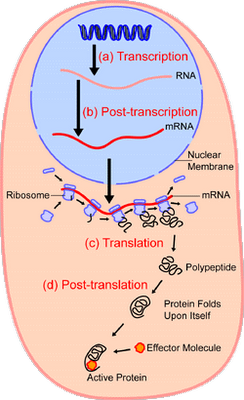
The step-by-step process of protein synthesis, controlled by the digital (= discrete state) information stored in DNA

II: Focusing on the Ribosome in action for protein synthesis:
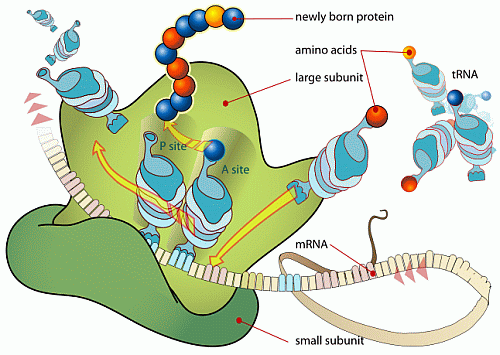
The Ribosome, assembling a protein step by step based on the instructions in the mRNA “control tape” (the AA chain is then folded and put to work)

Clay animation video [added Dec 4]:

More detailed animation [added Dec 4]:

This sort of elaborate, tightly controlled, instruction based step by step process is itself a strong sign that this sort of outcome is unlikely by chance variations.

(And, attempts to deny the obvious, that we are looking at digital information at work in algorithmic, step by step processes, is itself a sign that there is a controlling a priori at work that must lock out the very evidence before our eyes to succeed. The above is not intended to persuade such, they are plainly not open to evidence, so we can only note how their position reduces to patent absurdity in the face of evidence and move on.)

But, isn’t the insertion of a dummy variable S into the Chi_500 metric little more than question-begging?

Again, NO.

Let us consider a simple form of the per-aspect explanatory filter approach:
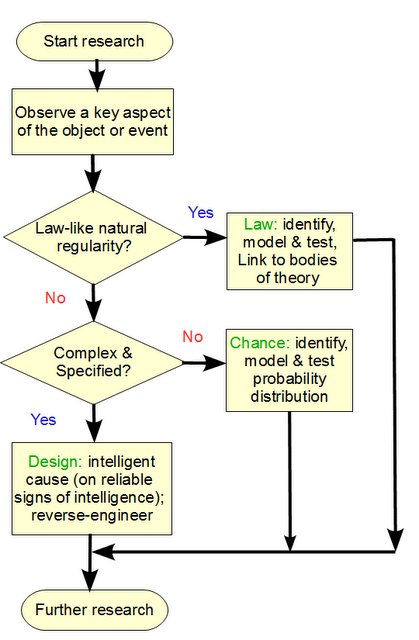
The per aspect design inference explanatory filter

You will observe two key decision nodes,  where the first default is that the aspect of the object, phenomenon or process being studied, is rooted in a natural, lawlike regularity that under similar conditions will produce similar outcomes, i.e there is a reliable law of nature at work, leading to low contingency of outcomes.  A dropped, heavy object near earth’s surface will reliably fall at g initial acceleration, 9.8 m/s2.  That lawlike behaviour with low contingency can be empirically investigated and would eliminate design as a reasonable explanation.

Second, we see some situations where there is a high degree of contingency of possible outcomes under initial circumstances.  This is the more interesting case, and in our experience has two candidate mechanisms: chance, or choice. The default for S under these circumstances, is 0. That is, the presumption is that chance is an adequate explanation, unless there is a good — empirical and/or analytical — reason to think otherwise.  In short, on investigation of the dynamics of volcanoes and our experience with them, rooted in direct observations, the complexity of a Mt Pinatubo is explained partly on natural laws and chance variations, there is no need to infer to choice to explain its structure.

But, if the observed configurations of highly contingent elements were from a narrow and atypical zone T not credibly reachable based on the search resources available, then we would be objectively warranted to infer to choice. For instance, a chance based text string of length equal to this post, would  overwhelmingly be gibberish, so we are entitled to note the functional specificity at work in the post, and assign S = 1 here.

So, the dummy variable S is not a matter of question-begging, never mind the usual dismissive talking points.

I is of course an information measure based on standard approaches, through the sort of probabilistic calculations Hartley and Shannon used, or by a direct observation of the state-structure of a system [e.g. on/off switches naturally encode one bit each].

And, where an entity is not a direct information storing object, we may reduce it to a mesh of nodes and arcs, then investigate how much variation can be allowed and still retain adequate function, i.e. a key and lock can be reduced to a bit measure of implied information, and a sculpture like at Mt Rushmore can similarly be analysed, given the specificity of portraiture.

The 500 is a threshold, related to the limits of the search resources of our solar system, and if we want more, we can easily move up to the 1,000 bit threshold for our observed cosmos.

On needle in a haystack grounds, or monkeys strumming at the keyboards grounds, if we are dealing with functionally specific, complex information beyond these thresholds, the best explanation for seeing such is design.

And, that is abundantly verified by the contents of say the Library of Congress (26 million works) or the Internet, or the product across time of the Computer programming industry.

But, what about Genetic Algorithms etc, don’t they prove that such FSCI can come about by cumulative progress based on trial and error rewarded by success?

Not really.

As a rule, such are about generalised hill-climbing within islands of function characterised by intelligently designed fitness functions with well-behaved trends and controlled variation within equally intelligently designed search algorithms. They start within a target Zone T, by design, and proceed to adapt incrementally based on built in designed algorithms.

If such a GA were to emerge from a Hello World by incremental chance variations that worked as programs in their own right every step of the way, that would be a different story, but for excellent reason we can safely include GAs in the set of cases where FSCI comes about by choice, not chance.

So, we can see what the Chi_500 expression means, and how it is a reasonable and empirically supported tool for measuring complex specified information, especially where the specification is functionally based.

And, we can see the basis for what it is doing, and why one is justified to use it, despite many commonly encountered objections. END

________

F/N, Jan 22: In response to a renewed controversy tangential to another blog thread, I have redirected discussion here. As a point of reference for background information, I append a clip from the thread:

. . . [If you wish to find] basic background on info theory and similar background from serious sources, then go to the linked thread . . . And BTW, Shannon’s original 1948 paper is still a good early stop-off on this. I just did a web search and see it is surprisingly hard to get a good simple free online 101 on info theory for the non mathematically sophisticated; to my astonishment the section A of my always linked note clipped from above is by comparison a fairly useful first intro. I like this intro at the next level here, this is similar, this is nice and short while introducing notation, this is a short book in effect, this is a longer one, and I suggest the Marks lecture on evo informatics here as a useful contextualisation. Qualitative outline here. I note as well Perry Marshall’s related exchange here, to save going over long since adequately answered talking points, such as asserting that DNA in the context of genes is not coded information expressed in a string of 4-state per position G/C/A/T monomers. The one good thing is, I found the Jaynes 1957 paper online, now added to my vault, no cloud without a silver lining.

If you are genuinely puzzled on practical heuristics, I suggest a look at the geoglyphs example already linked. This genetic discussion may help on the basic ideas, but of course the issues Durston et al raised in 2007 are not delved on.

(I must note that an industry-full of complex praxis is going to be hard to reduce to an in a nutshell. However, we are quite familiar with information at work, and how we routinely measure it as in say the familiar: “this Word file is 235 k bytes.” That such a file is exceedingly functionally specific can be seen by the experiment of opening one up in an inspection package that will access raw text symbols for the file. A lot of it will look like repetitive nonsense, but if you clip off such, sometimes just one header character, the file will be corrupted and will not open as a Word file. When we have a great many parts that must be right and in the right pattern for something to work in a given context like this, we are dealing with functionally specific, complex organisation and associated information, FSCO/I for short.

The point of the main post above is that once we have this, and are past 500 bits or 1000 bits, it is not credible that such can arise by blind chance and mechanical necessity. But of course, intelligence routinely produces such, like comments in this thread. Objectors can answer all of this quite simply, by producing a case where such chance and necessity — without intelligent action by the back door — produces such FSCO/I. If they could do this, the heart would be cut out of design theory. But, year after year, thread after thread, here and elsewhere, this simple challenge is not being met. Borel, as discussed above, points out the basic reason why.

Comments
Elizabeth: By the way, I agree with you that there are some facts in the evolutionary theory. And I absolutely agree with you that a theory never becomes a fact. I have fiercely defended that point many times here. I have no reference available now, but as soon as I find some of the many examples of darwinists claiming that their theory is a fact, or that it is more certain than the theory of gravity, or similar epistemological rubbish, I will point it out to you.gpuccio
January 25, 2012
January
01
Jan
25
25
2012
09:19 AM
9
09
19
AM
PDT
From elementary school onward students are taught that evolution is believed by most scientists to be a result of specific mechanisms. By high school graduation they have heard and read it countless times, usually unchallenged.
Well, it is absolutely true that most scientists believe that evolution comes about by Darwinian mechanisms. What is important is that students should learn that all scientific conclusions are provisional. If they are not taught that, then they are being taught badly. But that's not a question of scientific content, it's a question of scientific methodology. It is right that children are taught the consensus view, and that it is the consensus view, but that all such views are provisional. In my view they should NOT be taught ID (although they should certainly be taught that no theory is a fact, and that all theories can be challenged) because it is not, in my view, and in view of the vast majority of scientists, a legitimate inference from the data. Off for a few days now :) See you all later.... Cheers Lizzie But obviously we differ on that :)Elizabeth Liddle
January 25, 2012
January
01
Jan
25
25
2012
09:17 AM
9
09
17
AM
PDT
Elizabeth: To quote you, I clearly I understand that is your view. I beg to differ. I cannot say more.gpuccio
January 25, 2012
January
01
Jan
25
25
2012
09:15 AM
9
09
15
AM
PDT
And while you are right that we do not have a clear evolutionary account of the origin of proteins, it is not at all the only phenomenon for which we do not have, and do not claim, to have a clear evolutionary account. In fact we do not have an unambiguous evolutionary account for a single biological feature.
From elementary school onward students are taught that evolution is believed by most scientists to be a result of specific mechanisms. By high school graduation they have heard and read it countless times, usually unchallenged. It's commendable that you separate evolution from those mechanisms and realize that the evidence for their application to large-scale biological diversity is limited to irrelevant computer simulations. (I know, that's not exactly what you said.) But why is protecting students from knowing the state of the evidence for such things one of the biggest hot buttons in education? I can't think of a single other modern-day case in which so-called educators will go to great lengths to ensure that students are not educated. In 1984, words were systematically removed from the language to limit what people were able to form thoughts about. Understanding of the outside world was controlled through propaganda. What is this but a bold-faced attempt to control young persons' comprehension of reality by carefully and deliberately deciding which truths they may or may not know? Continuing the similarities, the battle is fought through the repetition of false propaganda until it sticks. War is peace. Freedom is slavery. ID is religion. Any questioning of evolution is an encroachment of religion. We're at war with Pacifica. This is institutionalized in the United States. I don't normally toss around terms like "thought control," but that is precisely what is being attempted, and with some success. If people aren't disturbed then they aren't paying attention or they are likely victims.ScottAndrews2
January 25, 2012
January
01
Jan
25
25
2012
09:08 AM
9
09
08
AM
PDT
I'm not saying that Behe was doing that, it's just that the university is entitled to issue a preventative. It's not unusual - it happens from time to time when a university member has a controversial view that the university wants to dissociate itself from without censoring the member, and while continuing to allow the member to post what s/he wants on his/her page on the university website.
The problem is that Behe’s views are not only contrversial, but highly despicable from the academic point of view, because they are critical of one of the biggest dogmas of our culture.
Well, clearly I understand that is your view, but I'd say that the reason Behe's views are regarded as controversial by most scientists is because they consider that his views are not supported by good evidence or argument. And I agree. In contrast, when someone does raise a legitimate problem with some evolutionary account of some phenomenon, then while they might have to fight a bit to get published (it's harder to get a controversial finding published than a non-controversial one, but it will make more splash when you do), published it will eventually be. Margulis is an example, and her symbiosis theory is now widely accepted - not as fact, but as a well-supported theory - for eukaryote origins. I'm not of the view that ID is not science (not in principle anyway - that's why I was interested in Genomicus's post) but I am of the view that what science I have read in support of ID is extremely poor. That's why it doesn't get into peer-reviewed journals very often, not because of censorship.Elizabeth Liddle
January 25, 2012
January
01
Jan
25
25
2012
08:50 AM
8
08
50
AM
PDT
If darwinists publicly admitted that their theory has not a single clue about how basic protein domains emerged, people could start thinking that after all evolution (theory) is not necessarily a fact, and that after all some of what those IDists are saying could be reasonable.
I would like evidence of this alleged confusion of fact with theory. Clearly evolution, when defined as "change in allele frequency over time" is a fact. Adaptation has also been directly observed. That does not make "the theory of evolution" a fact. No theory ever becomes "a fact". So whoever you are citing, mis-spoke. And while you are right that we do not have a clear evolutionary account of the origin of proteins, it is not at all the only phenomenon for which we do not have, and do not claim, to have a clear evolutionary account. In fact we do not have an unambiguous evolutionary account for a single biological feature. What we have, instead, is a theory that accounts for the distribution of those features, over extant populations and over time, which has repeatedly made predictions that were subsequently confirmed by evidence, and which invokes a mechanism (the Darwinian algorithm) that has not only been demonstrated to work in computer models but is actually used to generate novel solutions to engineering problems and aspects of AI. You seem to think that scientists are some monolithic powerful institutional body that has declared the "theory of evolution" to be an official "fact" that explains all biological phenomena, when there is, firstly, no such body, and secondly, AFAIK, no such pronouncement. It is IDists who have concluded that because Darwinian theory fails, ID is the default conclusion. Darwinians do NOT make the symmetrical claim that because ID fails, Darwinian theory is the default conclusion. Rather, evolutionary scientists have tremendous confidence, borne of experience, that evolutionary theory (and other scientific theories) can be found to account for current challenges to our understanding. Therefore we do not see any warrant to say: this is too hard to explain, therefore ID. It is not that we think that the ID hypothesis is impossible, or wrong, or verboten. It's that we find it completely unwarranted.Elizabeth Liddle
January 25, 2012
January
01
Jan
25
25
2012
08:34 AM
8
08
34
AM
PDT
Elizabeth: Well, my emotional reaction about that are quite different. Those disclaimers were for me one of the meanest things I have ever witnessed. I must specify that I intended moral censorship of a person, of his scientific dignity, of his work. I certainly understand that Behe is still allowed to speak, and is not on prison. I am absolutely against censorship, especially religious one. So, we can agree on that, at least. And I have never said that Daukins should not have written what he has written. I was just giving an example of a scientist considering his theory as something that must absolutely be believed. Moreover, Nehe was not "airing his view on the university website", least of all "using his affiliation to lend authority to his views". As far as I know, he has never done that. The university disclainer was evidently an expression of the shame that the institution felt for just his existence and his affiliation to the university, as though that simple thing were a moral and academic blemish. Now, that's not only because Behe has contrversial views. Many scientists have controversial views on many issues, and their university has never felt the necessity to defend itself from that fact. The problem is that Behe's views are not only contrversial, but highly despicable from the academic point of view, because they are critical of one of the biggest dogmas of our culture.gpuccio
January 25, 2012
January
01
Jan
25
25
2012
08:31 AM
8
08
31
AM
PDT
That is censorship. A university making it clear that it does not, as an institution, endorse a controversial view, and yet allowing that person to remain in post, and continue to air that view on the university website is not censorship.
It's not technically censorship. But it does call to mind the often misunderstood principle that the exception makes the rule. It indicates that when an exception to a rule is explicitly stated, it strengthens the rule by implying that there are no unstated exceptions. If a university were to post an disclaimer on every page indicating the views expressed by members are not necessarily those of the university, that would be one thing. But by expressing such a disclaimer regarding one member or one idea specifically, it creates an implied statement that that every other view on every other page is endorsed by the university. Those that are not endorsed are marked with a disclaimer. I wonder if that's what they had in mind.ScottAndrews2
January 25, 2012
January
01
Jan
25
25
2012
08:23 AM
8
08
23
AM
PDT
But again, a disclaimer is censorship
No, it is not. It is precisely not. Preventing him from posting his opinions on the university website would be censorship. Allowing him to do so is not. Putting up a disclaimer is simplyj a ways of informing visitors to the website that the person's views are not endorsed by the university. This is important, because it prevents the person from using his/her affiliation to lend authority to his/her views, which often happens.
is emotional propaganda
It may be propaganda but that's what websites are - sites were stuff is propagated. Behe's page is propaganda; so is the disclaimer.
But people who write here are just people writing in a blog. Dawkins is a scientist, and the quote is from one of his scientific books.
So it's OK to say that your opponents are stupid on a blog, but not in a book? Or not if you are a scientist? Or not if you are a scientist writing a book? Why not? I thought you were against censorship? OK, I'd better go and cool off for a bit, but this stuff makes me a bit cross. I am very much against censorship, but the most egregious censorship I have read about in recent times has been religious, not scientific. In fact Dembski, one-time owner of this blog was apparently censured by his university employers for having questioned the literal fact of a global biblical flood, and apparently retracted. That is censorship. A university making it clear that it does not, as an institution, endorse a controversial view, and yet allowing that person to remain in post, and continue to air that view on the university website is not censorship. It is the very antithesis of it.Elizabeth Liddle
January 25, 2012
January
01
Jan
25
25
2012
07:36 AM
7
07
36
AM
PDT
note to champignon, you had some objections to Near Death Experiences a while back. I think that Dr. Jefferey Long does a very good job, in this following lecture at 'The New York Academy of Sciences', in addressing your objections:
The Reality of Near-Death Experiences and their Aftereffects - Jeffrey Long http://www.youtube.com/watch?v=DIqKTE6jNmQ
bornagain77
January 25, 2012
January
01
Jan
25
25
2012
07:30 AM
7
07
30
AM
PDT
Dr Liddle, No offence taken. I think that mainstream science is painting itself in the corner by philosophical a-priorism in much the same way as was done in the USSR. For a fuller picture, Lysenko was not a scientist, he was a practitioner selectionist of Michurin's school. I think that he had his own career agenda. My granddad used to keep for an example of anti-science a publication of Lysenko's speech in the Academy of sciences of the USSR. That was quite an exhibit. Understandably, people often think using cliches. Especially notorious are political cliches akin to Stalin = Hitler. I think that while a person in the street can be excused for doing so, a scientist cannot. It is sad when scientists cannot see that.Eugene S
January 25, 2012
January
01
Jan
25
25
2012
06:28 AM
6
06
28
AM
PDT
Elizabeth: Fences are not necessarily political persecutions. In so called democratic countries, there are many other ways to build fences. If we were still at political persecutions, I would not be able to write here, and I would have spent in prison my last years :)gpuccio
January 25, 2012
January
01
Jan
25
25
2012
06:13 AM
6
06
13
AM
PDT
Elizabeth: Ah, I forgot. The nest scientists are obviously well aware that no explanation can be given of basci protein domains according to neo darwinian algorithm. The reason is probably, at least in part, that we in ID have been raising that issue for a few yeras (see Axe's old paper about that). But most of biologists are not aware of that. You yourself were not aware of that, until I gave evidence that that was the case. Maybe even now you don't really accept that, and will answer with some new pseudo argument against that simple point. If darwinists publicly admitted that their theory has not a single clue about how basic protein domains emerged, people could start thinking that after all evolution (theory) is not necessarily a fact, and that after all some of what those IDists are saying could be reasonable. Or not?gpuccio
January 25, 2012
January
01
Jan
25
25
2012
06:10 AM
6
06
10
AM
PDT
Elizabeth: Why should a university not issue a disclaimer? Why should people not express their views about other people’s convictions? A university should not issue a disclaimer regrding the scientiìfic views of one of its members. That's really unacceptable, and I am amazed that you don't agree. A university is a place to exchange views, not to censor them. Behe's views have been expressed in peer reviewed journals and in very serious books, and they are not a crime of which a university should be ashsmed, either one agrees with them or not. A disclaimer on the opening site of an university is certainly not the correct way to express a scientific opinion about anbother scientific opinion. The same is true for a colleague of Behe who felt the need to add a personal disclaimer to his personal page. That is not fine at all. There is nothing wrong if I discuss the opinions of my colleague in my site, and disagree with him. That's perfeslty fine. But again, a disclaimer is censorship, is emotional propaganda. It means: "Please, dont' associate me with this criminal, even if unfortunately we work in the same place!" That is shameful. Where have you read in peer-reviewed journals that “evolution is a fact not a theory?” (Evolution, by some definitions, is of course a fact, but the word is also used to refer to a theory.) I have. And it referred to the theory, not to the facts. But I cannot give you the reference. It was a few years ago. And yes, I’ve also heard/read Dawkins say that. I’ve also seen on this site people make equivalent statements about “evolutionists” – that we must be stupid, blind, or so wedded to our a priori materialism that we refuse to see the evidence staring us in the face. I see polemics on both sides. I don’t like either much. Neither do I. But people who write here are just people writing in a blog. Dawkins is a scientist, and the quote is from one of his scientific books. You had said: "There is no official, or undisputable, scientific explanation for anything. Who is supposed to be doing the “considering” here? Not any scientist I know." Well, Dawkins is a scientist, I believe. Do you know him?gpuccio
January 25, 2012
January
01
Jan
25
25
2012
06:04 AM
6
06
04
AM
PDT
Regarding putting-up-fences-for-thought paranoia:
It is not that the methods and institutions of science somehow compel us to accept a material explanation of the phenomenal world, but, on the contrary, that we are forced by our a priori adherence to material causes to create an apparatus of investigation and a set of concepts that produce material explanations, no matter how counter-intuitive, no matter how mystifying to the uninitiated. Moreover, that materialism is absolute, for we cannot allow a Divine Foot in the door.
Professor Lewontin, "Billions and Billions of Demons", emphasis mine, full version here.Eugene S
January 25, 2012
January
01
Jan
25
25
2012
06:04 AM
6
06
04
AM
PDT
Eugene, I did not mean to insult Russian scientists. I was simply acknowledging the fact that not all countries are, or have been, places were you are free to think and say what you like. One example was the championing of Lysenko's genetic ideas rather than Mendel's, for apparently ideological reasons, with disastrous results. Another was Russian psychiatry (although Russian psychology has rightly been hugely influential). In fact, the reason I added that sentence in brackets was because I am aware of your own background, and I know that I cannot assume that all posters here live in places where thought, and the expression of thought, is pretty well free. And I'd have though you would agree that with me that the suppression of free thought in your own country was to its detriment, no? Anyway, my apologies if I inadvertently insulted you and your country. I have the highest respect for Russian scientists, particularly given the repressive regime so many of them had to work under. It was not my intent to denigrate them or their achievements.Elizabeth Liddle
January 25, 2012
January
01
Jan
25
25
2012
05:53 AM
5
05
53
AM
PDT
All, Please excuse my off-topic and passionate apologetics below. Dr Liddle, Science in Russia has suffered from things foreign to science. In USSR, it was ideology but now the high education standards (the legacy of this notoriously "bad" USSR) are deliberately being destroyed by the politicians. You have to believe me when I say that because not everything is known or can be seen from outside. An indication of this is a high percentage of immigrants from Russia who do world class science in the West even today. Now about poorer Soviet times science nonsense. All I need is a handful of counter-examples. Very quickly what springs to mind concerning just space exploration, it was the USSR who - launched the first sputnik into orbit, - sent the first animal to space - sent the first man to space in spacecraft, - sent the first cosmonaut into open space. - finally, the first woman in space was also Russian. So Dr Liddle please don't. Even now when Russia is not in its best form economically and politically, it is still fighting for its own project, the Russian cosmos and an independent way of thought in general with implications in religion, science and philosophy. It will keep doing it until its last day.Eugene S
January 25, 2012
January
01
Jan
25
25
2012
05:38 AM
5
05
38
AM
PDT
Why should a university not issue a disclaimer? Why should people not express their views about other people's convictions? Where have you read in peer-reviewed journals that "evolution is a fact not a theory?" (Evolution, by some definitions, is of course a fact, but the word is also used to refer to a theory.) And yes, I've also heard/read Dawkins say that. I've also seen on this site people make equivalent statements about "evolutionists" - that we must be stupid, blind, or so wedded to our a priori materialism that we refuse to see the evidence staring us in the face. I see polemics on both sides. I don't like either much.
That basic protein domains can be explained as the result of differential reproduction due to heritable traits.
Can you give a specific citation?Elizabeth Liddle
January 25, 2012
January
01
Jan
25
25
2012
05:27 AM
5
05
27
AM
PDT
But it isn't a marker that can distinguish design intervention from evolution, because it says absolutely nothing about the landscape.Petrushka
January 25, 2012
January
01
Jan
25
25
2012
05:26 AM
5
05
26
AM
PDT
Elizabeth: It's part of the darwinists propaganda to ridiculize IDists as mere simpletons believing only that "If it looks like a duck, walks like a duck and talks like a duck, then it is a duck!". While that is not true, and ID has a lot of rigor in its reasonings, my point was that the "duck reasoning" is a perfectly correct first approach to a problem, and not something that should be considered ridicule. Again, that reversal of the natural point of view is only propaganda, and a twisting of epistemological priorities. Can you give some examples? That basic protein domains can be explained as the result of differential reproduction due to heritable traits. There is no official, or undisputable, scientific explanation for anything. Who is supposed to be doing the “considering” here? Not any scientist I know. Well, have you ever read in peer reviewed journals that evolution is a fact, and not a theory? I have. Have you ever heard Kenneth Miller, Nick Matzke and others argue that ID is wrong because trying to compute the probabilities of biological information is absurd, because someone must win the lottery, and any shuffle of a deck of cards is absolutely improbable, and yet, see, it happens? I have. Have you ever read the disclaimer put by Behe's colleagues on the site of his university? I have. Have you ever heard Dawkin's quote: ""It is absolutely safe to say that if you meet somebody who claims not to believe in evolution, that person is ignorant, stupid or insane (or wicked, but I'd rather not consider that)."? I have. And so on. I really am not in the mood to list all the shameful things made in name of the neo darwinain orthodoxy.gpuccio
January 25, 2012
January
01
Jan
25
25
2012
05:16 AM
5
05
16
AM
PDT
Exactly, I am free to think as I like. And say what I like, at least in the parts of the world where I have lived. Eugene suggested that someone (not sure who) was putting up "fences for thought". I see no-one putting up "fences for thought" (although of course there were such fences in Soviet Russia, and science was the poorer as a result).Elizabeth Liddle
January 25, 2012
January
01
Jan
25
25
2012
05:04 AM
5
05
04
AM
PDT
Joe (and Elizabeth): As it is known, I am an aspirant neo vitalist, so I join Joe in begging to differ about the "vital force" point.gpuccio
January 25, 2012
January
01
Jan
25
25
2012
05:00 AM
5
05
00
AM
PDT
Suggesting that an obvious explanation is in itself a crime
Where has anyone suggested this?
daily accepts models and theories that are both inconsistent and empirically unsupported
Can you give some examples?
and considers those models and theories to be official undisputable scientific explanations
There is no official, or undisputable, scientific explanation for anything. Who is supposed to be doing the "considering" here? Not any scientist I know.Elizabeth Liddle
January 25, 2012
January
01
Jan
25
25
2012
05:00 AM
5
05
00
AM
PDT
Elizabeth: You are free to think as you like, but believe me, your position in this case is neither acceptable nor fair. It is very much similar to accusing coloured people in the sixties of being paranoic for believing they were not treated fairly.gpuccio
January 25, 2012
January
01
Jan
25
25
2012
04:57 AM
4
04
57
AM
PDT
Joe: I see you have anticipated my basic argument :)gpuccio
January 25, 2012
January
01
Jan
25
25
2012
04:53 AM
4
04
53
AM
PDT
Elizabeth: If you reasd better what I wrote, you will see that in no way I was saying that rigor is not important. But the fact that some things appear obvious should however considered a significant clue and not, as it happens, the opposite. Hypothesizing that obvious explanations have a right to be seriously considered is healthy epistemology. Suggesting that an obvious explanation is in itself a crime, and requires extraordinary evidence to be taken into consideration is, IMO, bad propaganda. Moreover, rigor is beautiful, but it is beautiful on both sides. I really don't understand how your side (including you) is so exacting about rigor for any ID argument (which is fine), and on the other hand daily accepts models and theories that are both inconsistent and empirically unsupported, and considers those models and theories to be official undisputable scientific explanations (which is not fine at all).gpuccio
January 25, 2012
January
01
Jan
25
25
2012
04:52 AM
4
04
52
AM
PDT
Nobody is "putting up fences for thought". This kind of paranoia is certainly part of the problem though.Elizabeth Liddle
January 25, 2012
January
01
Jan
25
25
2012
04:29 AM
4
04
29
AM
PDT
GPuccio, I could not agree more. It is 100% my perception of what is happening. The only comfort is that one cannot stop fair scientific enquiry by putting up fences for thought especially in such a blind and rude way. This is a very good marker of their absolutely pathetic intellectual bankruptcy in the face of scientific findings.Eugene S
January 25, 2012
January
01
Jan
25
25
2012
04:25 AM
4
04
25
AM
PDT
Yes and it is strange that you demand rigor yet you cannot produce any rigor for your position. BTW it does appear that living things have a vital force as there isn't any evidence that they are reducible to matter, energy, chance and necessity.
Lightning was missiles fired by the gods.
Only some people thought that
The sun, stars and planets revolved around the earth.
Yup and that was science at the time.Joe
January 25, 2012
January
01
Jan
25
25
2012
04:19 AM
4
04
19
AM
PDT
He possibly isn't. But I think he is a) wrong when he says that there are islands south of the ribosome and b) probably wrong when he says the ribosome is an island. In either case, he is not so obviously right as to make a design inference on the grounds that the alternative is obviously wrong. And talking of "obvious", I think your appeal to obviousness is deeply flawed! The following things were "obvious" in the past: Lightning was missiles fired by the gods. God liked cleanliness, and hated shrimps. Gastric ulcers were caused by stress. Light did not have an speed limit. Atoms were indivisible. Distance was absolute. Cholera was caused by miasmas. Epilepsy was caused by possession by evil spirits. Living things have a vital force. The sun, stars and planets revolved around the earth. Now we know that: Lightning is electrical discharge between clouds and earth Diseases that can be avoided by hygiene are caused by germs. Gastric ulcers are also sometimes caused by bacteria. Light has an upper speed limit. Atoms not only are divisible but are largely "empty" and their contents have properties that are very different from macroscopic matter, right down to causality properties. Distance is relative. Cholera is caused by bacteria spread in water. Living things do not have a "vital force" and dead things can be revived. The earth is one of several planets that revolve around the sun, which in turn is just one of many suns that revolve around the centre of our galaxy, which is just one of many in a cluster of galaxies which is one of many clusters of galaxies. We have, therefore, no warrant to conclude anything on the basis of "obviousness". On the contrary, some of our greatest advances have been made by scientists who questioned the "obvious". Hence our demand for rigor.Elizabeth Liddle
January 25, 2012
January
01
Jan
25
25
2012
04:10 AM
4
04
10
AM
PDT
1 5 6 7 8 9 14

Leave a Reply