Uncommon Descent Serving The Intelligent Design Community

ID Foundations, 11: Borel’s Infinite Monkeys analysis and the significance of the log reduced Chi metric, Chi_500 = I*S – 500

Categories
ID Foundations
Intelligent Design
Share
Facebook
Twitter/X
LinkedIn
Flipboard
Print
Email

 (Series)

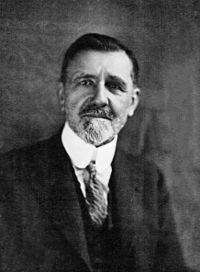
Emile Borel, 1932

Emile Borel (1871 – 1956) was a distinguished French Mathematician who — a son of a Minister — came from France’s Protestant minority, and he was a founder of measure theory in mathematics. He was also a significant contributor to modern probability theory,  and so Knobloch observed of his approach, that:

>>Borel published more than fifty papers between 1905 and 1950 on the calculus of probability. They were mainly motivated or influenced by Poincaré, Bertrand, Reichenbach, and Keynes. However, he took for the most part an opposed view because of his realistic attitude toward mathematics. He stressed the important and practical value of probability theory. He emphasized the applications to the different sociological, biological, physical, and mathematical sciences. He preferred to elucidate these applications instead of looking for an axiomatization of probability theory. Its essential peculiarities were for him unpredictability, indeterminism, and discontinuity. Nevertheless, he was interested in a clarification of the probability concept. [Emile Borel as a probabilist, in The probabilist revolution Vol 1 (Cambridge Mass., 1987), 215-233. Cited, Mac Tutor History of Mathematics Archive, Borel Biography.]>>

Among other things, he is credited as the worker who introduced a serious mathematical analysis of the so-called Infinite Monkeys theorem (just a moment).

So, it is unsurprising that Abel, in his recent universal plausibility metric paper, observed  that:

Emile Borel’s limit of cosmic probabilistic resources [c. 1913?] was only 1050 [[23] (pg. 28-30)]. Borel based this probability bound in part on the product of the number of observable stars (109) times the number of possible human observations that could be made on those stars (1020).

This of course, is now a bit expanded, since the breakthroughs in astronomy occasioned by the Mt Wilson 100-inch telescope under Hubble in the 1920’s. However,  it does underscore how centrally important the issue of available resources is, to render a given — logically and physically strictly possible but utterly improbable — potential chance- based event reasonably observable.

We may therefore now introduce Wikipedia as a hostile witness, testifying against known ideological interest, in its article on the Infinite Monkeys theorem:

In one of the forms in which probabilists now know this theorem, with its “dactylographic” [i.e., typewriting] monkeys (French: singes dactylographes; the French word singe covers both the monkeys and the apes), appeared in Émile Borel‘s 1913 article “Mécanique Statistique et Irréversibilité” (Statistical mechanics and irreversibility),[3] and in his book “Le Hasard” in 1914. His “monkeys” are not actual monkeys; rather, they are a metaphor for an imaginary way to produce a large, random sequence of letters. Borel said that if a million monkeys typed ten hours a day, it was extremely unlikely that their output would exactly equal all the books of the richest libraries of the world; and yet, in comparison, it was even more unlikely that the laws of statistical mechanics would ever be violated, even briefly.

The physicist Arthur Eddington drew on Borel’s image further in The Nature of the Physical World (1928), writing:

If I let my fingers wander idly over the keys of a typewriter it might happen that my screed made an intelligible sentence. If an army of monkeys were strumming on typewriters they might write all the books in the British Museum. The chance of their doing so is decidedly more favourable than the chance of the molecules returning to one half of the vessel.[4]

These images invite the reader to consider the incredible improbability of a large but finite number of monkeys working for a large but finite amount of time producing a significant work, and compare this with the even greater improbability of certain physical events. Any physical process that is even less likely than such monkeys’ success is effectively impossible, and it may safely be said that such a process will never happen.

Let us emphasise that last part, as it is so easy to overlook in the heat of the ongoing debates over origins and the significance of the idea that we can infer to design on noticing certain empirical signs:

These images invite the reader to consider the incredible improbability of a large but finite number of monkeys working for a large but finite amount of time producing a significant work, and compare this with the even greater improbability of certain physical events. Any physical process that is even less likely than such monkeys’ success is effectively impossible, and it may safely be said that such a process will never happen.

Why is that?

Because of the nature of sampling from a large space of possible configurations. That is, we face a needle-in-the-haystack challenge.

For, there are only so many resources available in a realistic situation, and only so many observations can therefore be actualised in the time available. As a result, if one is confined to a blind probabilistic, random search process, s/he will soon enough run into the issue that:

a: IF a narrow and atypical set of possible outcomes T, that

b: may be described by some definite specification Z (that does not boil down to listing the set T or the like), and

c: which comprise a set of possibilities E1, E2, . . . En, from

d: a much larger set of possible outcomes, W, THEN:

e: IF, further, we do see some Ei from T, THEN also

f: Ei is not plausibly a chance occurrence.

The reason for this is not hard to spot: when a sufficiently small, chance based, blind sample is taken from a set of possibilities, W — a configuration space,  the likeliest outcome is that what is typical of the bulk of the possibilities will be chosen, not what is atypical.  And, this is the foundation-stone of the statistical form of the second law of thermodynamics.

Hence, Borel’s remark as summarised by Wikipedia:

Borel said that if a million monkeys typed ten hours a day, it was extremely unlikely that their output would exactly equal all the books of the richest libraries of the world; and yet, in comparison, it was even more unlikely that the laws of statistical mechanics would ever be violated, even briefly.

In recent months, here at UD, we have described this in terms of searching for a needle in a vast haystack [corrective u/d follows]:

let us work back from how it takes ~ 10^30 Planck time states for the fastest chemical reactions, and use this as a yardstick, i.e. in 10^17 s, our solar system’s 10^57 atoms would undergo ~ 10^87 “chemical time” states, about as fast as anything involving atoms could happen. That is 1 in 10^63 of 10^150. So, let’s do an illustrative haystack calculation:

 Let us take a straw as weighing about a gram and having comparable density to water, so that a haystack weighing 10^63 g [= 10^57 tonnes] would take up as many cubic metres. The stack, assuming a cubical shape, would be 10^19 m across. Now, 1 light year = 9.46 * 10^15 m, or about 1/1,000 of that distance across. If we were to superpose such a notional 1,000 light years on the side haystack on the zone of space centred on the sun, and leave in all stars, planets, comets, rocks, etc, and take a random sample equal in size to one straw, by absolutely overwhelming odds, we would get straw, not star or planet etc. That is, such a sample would be overwhelmingly likely to reflect the bulk of the distribution, not special, isolated zones in it.

With this in mind, we may now look at the Dembski Chi metric, and reduce it to a simpler, more practically applicable form:

m: In 2005, Dembski provided a fairly complex formula, that we can quote and simplify:

χ = – log2[10^120 ·ϕS(T)·P(T|H)]. χ is “chi” and ϕ is “phi”

n:  To simplify and build a more “practical” mathematical model, we note that information theory researchers Shannon and Hartley showed us how to measure information by changing probability into a log measure that allows pieces of information to add up naturally: Ip = – log p, in bits if the base is 2. (That is where the now familiar unit, the bit, comes from.)

o: So, since 10^120 ~ 2^398, we may do some algebra as log(p*q*r) = log(p) + log(q ) + log(r) and log(1/p) = – log (p):

Chi = – log2(2^398 * D2 * p), in bits

Chi = Ip – (398 + K2), where log2 (D2 ) = K2

p: But since 398 + K2 tends to at most 500 bits on the gamut of our solar system [our practical universe, for chemical interactions! (if you want , 1,000 bits would be a limit for the observable cosmos)] and

q: as we can define a dummy variable for specificity, S, where S = 1 or 0 according as the observed configuration, E, is on objective analysis specific to a narrow and independently describable zone of interest, T:

Chi_500 =  Ip*S – 500, in bits beyond a “complex enough” threshold

(If S = 0, Chi = – 500, and, if Ip is less than 500 bits, Chi will be negative even if S is positive. E.g.: A string of 501 coins tossed at random will have S = 0, but if the coins are arranged to spell out a message in English using the ASCII code [[notice independent specification of a narrow zone of possible configurations, T], Chi will — unsurprisingly — be positive.)

r: So, we have some reason to suggest that if something, E, is based on specific information describable in a way that does not just quote E and requires at least 500 specific bits to store the specific information, then the most reasonable explanation for the cause of E is that it was intelligently designed. (For instance, no-one would dream of asserting seriously that the English text of this post is a matter of chance occurrence giving rise to a lucky configuration, a point that was well-understood by that Bible-thumping redneck fundy — NOT! — Cicero in 50 BC.)

s: The metric may be directly applied to biological cases:

t: Using Durston’s Fits values — functionally specific bits — from his Table 1, to quantify I, so also  accepting functionality on specific sequences as showing specificity giving S = 1, we may apply the simplified Chi_500 metric of bits beyond the threshold:

RecA: 242 AA, 832 fits, Chi: 332 bits beyond

SecY: 342 AA, 688 fits, Chi: 188 bits beyond

Corona S2: 445 AA, 1285 fits, Chi: 785 bits beyond

u: And, this raises the controversial question that biological examples such as DNA — which in a living cell is much more complex than 500 bits — may be designed to carry out particular functions in the cell and the wider organism.

v: Therefore, we have at least one possible general empirical sign of intelligent design, namely: functionally specific, complex organisation and associated information [[FSCO/I] .

But, but, but . . . isn’t “natural selection” precisely NOT a chance based process, so doesn’t the ability to reproduce in environments and adapt to new niches then dominate the population make nonsense of such a calculation?

NO.

Why is that?

Because of the actual claimed source of variation (which is often masked by the emphasis on “selection”) and the scope of innovations required to originate functionally effective body plans, as opposed to varying same — starting with the very first one, i.e. Origin of Life, OOL.

But that’s Hoyle’s fallacy!

Advice: when you go up against a Nobel-equivalent prize-holder, whose field requires expertise in mathematics and thermodynamics, one would be well advised to examine carefully the underpinnings of what is being said, not just the rhetorical flourish about tornadoes in junkyards in Seattle assembling 747 Jumbo Jets.

More specifically, the key concept of Darwinian evolution [we need not detain ourselves too much on debates over mutations as the way variations manifest themselves], is that:

CHANCE VARIATION (CV) + NATURAL “SELECTION” (NS) –> DESCENT WITH (UNLIMITED) MODIFICATION (DWM), i.e. “EVOLUTION.”

CV + NS –> DWM, aka Evolution

If we look at NS, this boils down to differential reproductive success in environments leading to elimination of the relatively unfit.

That is, NS is a culling-out process, a subtract-er of information, not the claimed source of information.

That leaves only CV, i.e. blind chance, manifested in various ways. (And of course, in anticipation of some of the usual side-tracks, we must note that the Darwinian view, as modified though the genetic mutations concept and population genetics to describe how population fractions shift, is the dominant view in the field.)

There are of course some empirical cases in point, but in all these cases, what is observed is fairly minor variations within a given body plan, not the relevant issue: the spontaneous emergence of such a complex, functionally specific and tightly integrated body plan, which must be viable from the zygote on up.

To cover that gap, we have a well-known metaphorical image — an analogy, the Darwinian Tree of Life. This boils down to implying that there is a vast contiguous continent of functionally possible variations of life forms, so that we may see a smooth incremental development across that vast fitness landscape, once we had an original life form capable of self-replication.

What is the evidence for that?

Actually, nil.

The fossil record, the only direct empirical evidence of the remote past, is notoriously that of sudden appearances of novel forms, stasis (with some variability within the form obviously), and disappearance and/or continuation into the modern world.

If by contrast the tree of life framework were the observed reality, we would see a fossil record DOMINATED by transitional forms, not the few strained examples that are so often triumphalistically presented in textbooks and museums.

Similarly, it is notorious that fairly minor variations in the embryological development process are easily fatal. No surprise, if we have a highly complex, deeply interwoven interactive system, chance disturbances are overwhelmingly going to be disruptive.

Likewise, complex, functionally specific hardware is not designed and developed by small, chance based functional increments to an existing simple form.

Hoyle’s challenge of overwhelming improbability does not begin with the assembly of a Jumbo jet by chance, it begins with the assembly of say an indicating instrument on its cockpit instrument panel.

The D’Arsonval galvanometer movement commonly used in indicating instruments; an adaptation of a motor, that runs against a spiral spring (to give proportionality of deflection to input current across the magnetic field) which has an attached needle moving across a scale. Such an instrument, historically, was often adapted for measuring all sorts of quantities on a panel.

(Indeed, it would be utterly unlikely for a large box of mixed nuts and bolts, to by chance shaking, bring together matching nut and bolt and screw them together tightly; the first step to assembling the instrument by chance.)

Further to this, It would be bad enough to try to get together the text strings for a Hello World program (let’s leave off the implementing machinery and software that make it work) by chance. To then incrementally create an operating system from it, each small step along the way being functional, would be a bizarrely operationally impossible super-task.

So, the real challenge is that those who have put forth the tree of life, continent of function type approach, have got to show, empirically that their step by step path up the slopes of Mt Improbable, are empirically observable, at least in reasonable model cases. And, they need to show that in effect chance variations on a Hello World will lead, within reasonable plausibility, to such a stepwise development that transforms the Hello World into something fundamentally different.

In short, we have excellent reason to infer that — absent empirical demonstration otherwise — complex specifically functional integrated complex organisation arises in clusters that are atypical of the general run of the vastly larger set of physically possible configurations of components. And, the strongest pointer that this is plainly  so for life forms as well, is the detailed, complex, step by step information controlled nature of the processes in the cell that use information stored in DNA to make proteins.  Let’s call Wiki as a hostile witness again, courtesy two key diagrams:

I: Overview:
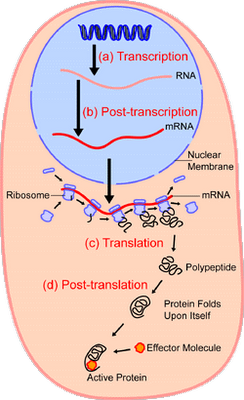
The step-by-step process of protein synthesis, controlled by the digital (= discrete state) information stored in DNA

II: Focusing on the Ribosome in action for protein synthesis:
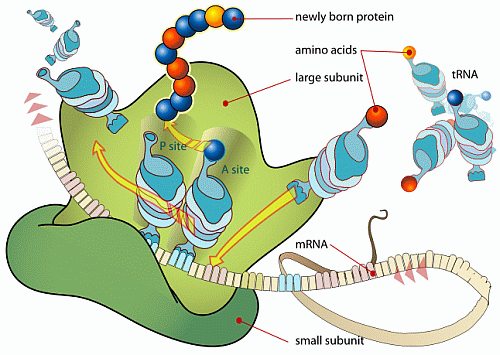
The Ribosome, assembling a protein step by step based on the instructions in the mRNA “control tape” (the AA chain is then folded and put to work)

Clay animation video [added Dec 4]:

More detailed animation [added Dec 4]:

This sort of elaborate, tightly controlled, instruction based step by step process is itself a strong sign that this sort of outcome is unlikely by chance variations.

(And, attempts to deny the obvious, that we are looking at digital information at work in algorithmic, step by step processes, is itself a sign that there is a controlling a priori at work that must lock out the very evidence before our eyes to succeed. The above is not intended to persuade such, they are plainly not open to evidence, so we can only note how their position reduces to patent absurdity in the face of evidence and move on.)

But, isn’t the insertion of a dummy variable S into the Chi_500 metric little more than question-begging?

Again, NO.

Let us consider a simple form of the per-aspect explanatory filter approach:
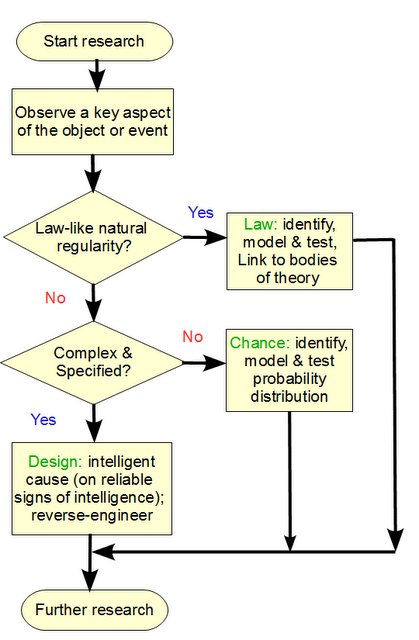
The per aspect design inference explanatory filter

You will observe two key decision nodes,  where the first default is that the aspect of the object, phenomenon or process being studied, is rooted in a natural, lawlike regularity that under similar conditions will produce similar outcomes, i.e there is a reliable law of nature at work, leading to low contingency of outcomes.  A dropped, heavy object near earth’s surface will reliably fall at g initial acceleration, 9.8 m/s2.  That lawlike behaviour with low contingency can be empirically investigated and would eliminate design as a reasonable explanation.

Second, we see some situations where there is a high degree of contingency of possible outcomes under initial circumstances.  This is the more interesting case, and in our experience has two candidate mechanisms: chance, or choice. The default for S under these circumstances, is 0. That is, the presumption is that chance is an adequate explanation, unless there is a good — empirical and/or analytical — reason to think otherwise.  In short, on investigation of the dynamics of volcanoes and our experience with them, rooted in direct observations, the complexity of a Mt Pinatubo is explained partly on natural laws and chance variations, there is no need to infer to choice to explain its structure.

But, if the observed configurations of highly contingent elements were from a narrow and atypical zone T not credibly reachable based on the search resources available, then we would be objectively warranted to infer to choice. For instance, a chance based text string of length equal to this post, would  overwhelmingly be gibberish, so we are entitled to note the functional specificity at work in the post, and assign S = 1 here.

So, the dummy variable S is not a matter of question-begging, never mind the usual dismissive talking points.

I is of course an information measure based on standard approaches, through the sort of probabilistic calculations Hartley and Shannon used, or by a direct observation of the state-structure of a system [e.g. on/off switches naturally encode one bit each].

And, where an entity is not a direct information storing object, we may reduce it to a mesh of nodes and arcs, then investigate how much variation can be allowed and still retain adequate function, i.e. a key and lock can be reduced to a bit measure of implied information, and a sculpture like at Mt Rushmore can similarly be analysed, given the specificity of portraiture.

The 500 is a threshold, related to the limits of the search resources of our solar system, and if we want more, we can easily move up to the 1,000 bit threshold for our observed cosmos.

On needle in a haystack grounds, or monkeys strumming at the keyboards grounds, if we are dealing with functionally specific, complex information beyond these thresholds, the best explanation for seeing such is design.

And, that is abundantly verified by the contents of say the Library of Congress (26 million works) or the Internet, or the product across time of the Computer programming industry.

But, what about Genetic Algorithms etc, don’t they prove that such FSCI can come about by cumulative progress based on trial and error rewarded by success?

Not really.

As a rule, such are about generalised hill-climbing within islands of function characterised by intelligently designed fitness functions with well-behaved trends and controlled variation within equally intelligently designed search algorithms. They start within a target Zone T, by design, and proceed to adapt incrementally based on built in designed algorithms.

If such a GA were to emerge from a Hello World by incremental chance variations that worked as programs in their own right every step of the way, that would be a different story, but for excellent reason we can safely include GAs in the set of cases where FSCI comes about by choice, not chance.

So, we can see what the Chi_500 expression means, and how it is a reasonable and empirically supported tool for measuring complex specified information, especially where the specification is functionally based.

And, we can see the basis for what it is doing, and why one is justified to use it, despite many commonly encountered objections. END

________

F/N, Jan 22: In response to a renewed controversy tangential to another blog thread, I have redirected discussion here. As a point of reference for background information, I append a clip from the thread:

. . . [If you wish to find] basic background on info theory and similar background from serious sources, then go to the linked thread . . . And BTW, Shannon’s original 1948 paper is still a good early stop-off on this. I just did a web search and see it is surprisingly hard to get a good simple free online 101 on info theory for the non mathematically sophisticated; to my astonishment the section A of my always linked note clipped from above is by comparison a fairly useful first intro. I like this intro at the next level here, this is similar, this is nice and short while introducing notation, this is a short book in effect, this is a longer one, and I suggest the Marks lecture on evo informatics here as a useful contextualisation. Qualitative outline here. I note as well Perry Marshall’s related exchange here, to save going over long since adequately answered talking points, such as asserting that DNA in the context of genes is not coded information expressed in a string of 4-state per position G/C/A/T monomers. The one good thing is, I found the Jaynes 1957 paper online, now added to my vault, no cloud without a silver lining.

If you are genuinely puzzled on practical heuristics, I suggest a look at the geoglyphs example already linked. This genetic discussion may help on the basic ideas, but of course the issues Durston et al raised in 2007 are not delved on.

(I must note that an industry-full of complex praxis is going to be hard to reduce to an in a nutshell. However, we are quite familiar with information at work, and how we routinely measure it as in say the familiar: “this Word file is 235 k bytes.” That such a file is exceedingly functionally specific can be seen by the experiment of opening one up in an inspection package that will access raw text symbols for the file. A lot of it will look like repetitive nonsense, but if you clip off such, sometimes just one header character, the file will be corrupted and will not open as a Word file. When we have a great many parts that must be right and in the right pattern for something to work in a given context like this, we are dealing with functionally specific, complex organisation and associated information, FSCO/I for short.

The point of the main post above is that once we have this, and are past 500 bits or 1000 bits, it is not credible that such can arise by blind chance and mechanical necessity. But of course, intelligence routinely produces such, like comments in this thread. Objectors can answer all of this quite simply, by producing a case where such chance and necessity — without intelligent action by the back door — produces such FSCO/I. If they could do this, the heart would be cut out of design theory. But, year after year, thread after thread, here and elsewhere, this simple challenge is not being met. Borel, as discussed above, points out the basic reason why.

Comments
Actually huge search spaces can be navigated, and usually more efficiently, by other algorithms and heuristics. I would hazard to predict that any ordered search space will be shown to be navigable by algorithmic methods at higher efficiency than a genetic algorithm.
Well there are contests for solving the traveling salesman problem with 10,000 stops. Feel free to enter, or feel free to locate an instance where the problem has been solved by other algorithms. this isn't rhetorical. I'm actually interested in what you might dig up. While you are at it you might tackle the problem of designing the traces for computer motherboards, or regulating power grids in real time. There's a dozen or so other industrial processes currently suffering under the yoke of Darwinism. What's interesting is your claim of foresight in the case of biological design. It really makes you wonder why most species are extinct.Petrushka
January 26, 2012
January
01
Jan
26
26
2012
11:01 AM
11
11
01
AM
PDT
Regarding intelligent searching of large spaces - it made me think of how many times I've seen a child solve a Rubik's cube, which has 43x10^18 possible combinations. Not the same thing as folding a protein, but it nonetheless demonstrates that intelligence does not depend on random searches to solve even vast problems. I did some more digging and found a number of articles such as this. The problem was presented as a game. I'm not heralding this as the end-all-be-all, but it sure is interesting.
The way proteins fold depends on thermodynamic rules that are very time-consuming to calculate out by brute force, because there are many ways to fold them but only one configuration that’s correct. But by coding these basic rules into a game, and presenting the proteins as Rubik’s-Cube-like objects to fiddle with, crowdsourced players can find correct solutions faster merely by using their intuitions. The key to this success isn’t just scale--although with players generating nearly 200,000 enzyme designs for the researchers to test, that certainly helped. The real key is the gaming interface itself, which encourages players to try out designs that would be impractical in nature or too expensive in the lab. By manipulating the intuitive, cartoon-like shapes on their screens without a need to mind or even understand the "reality" of what they represent, players "can explore things that look crazy," another researcher told Nature News. And like innovation in any other space, the crazy stuff is often what breaks through to make progress on previously intractable problems.
I should have guessed - there's already been a thread on this site. The comments only stuck to the game itself for a short time. The responses amounted to question-begging along the lines of, 'Yes, intelligence can do that, but evolution is intelligent, too.' This is that very assertion put to the test, and it did not fare well. When we present the problem of designing a protein as a cipher it follows that our brains do not process the problem particularly well. Few or none of us are wired to process numbers that way. But just because a problem poses the same complexity as a cipher does not mean that it must be processes as such. Recasting a problem as a different one of similar complexity that requires computational skills we do not possess rather than those we may distorts the comparison between what intelligence and evolution can accomplish. Researchers can accomplish by harnessing intelligence what they could not by simulating evolution. It's demonstrated. And, unlike all the other GA stories we've heard, it even pertains directly to biology. Is there a spin for this?ScottAndrews2
January 26, 2012
January
01
Jan
26
26
2012
10:56 AM
10
10
56
AM
PDT
Double secret proposals, I have to assume. I'm familiar with Behe's proposal. Others I have seen also involve non-material agents having magical powers. I have no problem if that is the claim, except that it is vacuous claim. It simply assumes the existence of something that has never been observed in action, which has no entailments, no boundaries, no limitations. I think science will stick to the drudgery of trying to find evolutionary explanations.Petrushka
January 26, 2012
January
01
Jan
26
26
2012
10:48 AM
10
10
48
AM
PDT
Then you are mocking your own ignorance, champignon. Ya see extraordinary claims require the details. And seeing that no one has ever observed CSI arising via necessity and chance then it is up to the person making the claim that it can to demonstrate it, ie provide those details on how it could happen. ------------------------------------------------------------ Note to Petrushka- ID advocates are interested in the "how" and proposals have been mde.Joe
January 26, 2012
January
01
Jan
26
26
2012
10:21 AM
10
10
21
AM
PDT
Surely "incremental change" means change by addition or accretion. It carries no baggage that I can see of the size or type of each addition. I can't see that Petrushka gave it that baggage.Bydand
January 26, 2012
January
01
Jan
26
26
2012
10:20 AM
10
10
20
AM
PDT
Petrushka, I'm going to be a bit blunt.
I notice that commercial software also seems to change incrementally.
This statement alone disqualifies you from having even the slightest idea what you are talking about. If this is your understanding of incremental change, or if your understanding of incremental change can even include both it and incremental change within biology, then the simple, fundamental concept of incremental change eludes you. Forget about randomness for now. The idea of changing content in its smallest units is mostly irrelevant when developing software. Software does not begin with a byte. The increments of software development are fully-formed instructions and new functions. The idea of changing content in increments is absolutely central to any proposed evolutionary mechanism. If you see any commonality between varying a gene and adding a function to software (any worth mentioning in this context) then it would seem impossible for you to understand the proposed mechanics of evolution enough to argue for them or against them. Your arguments are pervaded with this fundamental miscomprehension of what incremental change is. This lack of of understanding is what enables you to see incremental change and evolution at work in everything, everywhere. Your repeated assertions that 'only evolution is known to do this' or 'evolution has the power to do that' are one and all rendered meaningless. Until now I thought you were stretching the meaning of the word "evolution," and I wondered why you bothered since everyone can tell the difference. Now I realize that you actually do not see the difference. The word "evolution" has no specific meaning to you other than "change." Evolution is a tiny subset of the enormously broad concept of change. It is not a synonym. Your understanding of the word is not the same as what the mechanisms of evolution describe and propose. It follows that it is not possible for you to understand those mechanisms. You highlight your lack of understanding by comparing those mechanisms to anything and everything that changes, including computer software. Correct me if I'm wrong. Tell me how it is possible to understand the proposed mechanics of evolution or any of the evidence for or against them without knowing what 'incremental change' is.ScottAndrews2
January 26, 2012
January
01
Jan
26
26
2012
09:51 AM
9
09
51
AM
PDT
I was mocking Dembski's statement. Somehow 'Darwinists' are expected to supply detailed scenarios, while *Poof!* is sufficient for ID.champignon
January 26, 2012
January
01
Jan
26
26
2012
09:24 AM
9
09
24
AM
PDT
I get the point, but I'm not asking for detail. I'm asking for a conceptual framework that is not evolution, but which would allow finding coding sequences. I'm told they are isolated, and if that's true they are as hard to find as cipher keys of equivalent length. ID purports to be based on analogy to human intelligence. The business model of the Internet assumes that human intelligence cannot break cipher keys beyond a certain length. Military and diplomatic communication also makes this assumption. Now it is possible that there are selectable substrings that haven't been discovered. Or some other back door. But ID advocates show no interest at all in discovering how a designer might work. I've designed several original products, and I know my process is derivative, iterative and incremental. I notice that commercial software also seems to change incrementally.Petrushka
January 26, 2012
January
01
Jan
26
26
2012
09:15 AM
9
09
15
AM
PDT
Petrushka:
It’s not a double standard to ask ID to provide at least an hypothesis as to how a designer would navigate the functional landscape.
William A. Dembski:
ID is not a mechanistic theory, and it’s not ID’s task to match your pathetic level of detail in telling mechanistic stories.
champignon
January 26, 2012
January
01
Jan
26
26
2012
08:50 AM
8
08
50
AM
PDT
gpuccio,
...to affirm dFSCI we must jhave considered all known necessity explanations, and found them laking.
dFSCI, as you compute it, considers only blind search. It does not consider evolution. There's a very easy way to see this: come up with a formula for the probability of hitting a target by blind search. Express it in bits by taking the negative log base 2. What do you get? Exactly the same formula you presented for computing dFSCI. By considering only blind search, you are assuming that the probability of evolution is zero. But that's the very question we're trying to answer!
...the computation of the quantitative functional complexity means that, but it must be supported by an empirical faslification of proposed necessity mechanisms.
But then the "quantitative functional complexity" part doesn't do anything. All the work is done by the purported "empirical falsification of proposed necessity mechanisms". The dFSCI number is irrelevant.
Before the introduction of CSI and dFSCI, nobody in the darwinists field had really cared to quantify the probabilistic resources needed to get to a specific functional result.
But the only thing you are quantifying is the probability of hitting a predefined target using blind search. Evolution is not a blind search, and it does not seek a predefined target.
After the introduction of dFSCI, the question is: we are sure that this result cannot be explained by simple RV.
Nobody in the world thinks that the ribosome or the eye are the products of "simple RV", without selection. You are answering a question that nobody is asking. dFSCI changes nothing.champignon
January 26, 2012
January
01
Jan
26
26
2012
08:45 AM
8
08
45
AM
PDT
It's not a double standard. Evolution must demonstrate that ithas the toolkit to produceth kinds of change observed in cousin lineages. That's why tens of thousands of biologists have labored for a century and a half to document the processes. The simple fact is that your "something" is observable in case after case and can be studied in controlled experiments. It's not a double standard to ask ID to provide at least an hypothesis as to how a designer would navigate the functional landscape.Petrushka
January 26, 2012
January
01
Jan
26
26
2012
08:42 AM
8
08
42
AM
PDT
gpuccio,
dFSCI is a realiable indicator of dFSCI.
Well, that's one thing we can agree on. Does it do anything else?champignon
January 26, 2012
January
01
Jan
26
26
2012
08:35 AM
8
08
35
AM
PDT
Of course the trick is ruling out naturalistic explanations
Observe this double standard. When seeking evidence that these "natural explanations" even exist to be ruled out, one is chastised for unreasonable expectations. What do we want, a history of genetic changes over millions of years? A videotape? Ok, fine. But if such detail is unreasonable when demonstrating the positive, then how is it possible to demonstrate the converse, that such things did not happen? The naturalistic explanation, in its present form, boils down to, 'Something happened. That something likely involved some variations, and likely something was selected for some reason. Over and over and over. And likely some other stuff happened, too, details TBD.' How does one "rule out" such fluff? How does this nonsense not fall outside of science? It's a double-edged sword. You exercise special pleading to excuse the theory from providing any specifics, whether the mechanisms or the operation of those mechanisms. And then, having proposed essentially nothing, you insist that it must be ruled out. Such flimsy reasoning offers no substantial reason why it can't be completely reversed. Why not assume that what appears to be designed is, despite not knowing who, how, or why, and only resort to an undefined hodge-podge of vague things that may or may not have happened when the better option is ruled out? I'm not even proposing that. But you give no reason why one is better than or different from the other. Please don't argue natural vs. supernatural. I have referenced nothing supernatural. Please don't argue observed vs. unobserved. Nothing is observed. Everything is extrapolated or inferred.ScottAndrews2
January 26, 2012
January
01
Jan
26
26
2012
08:00 AM
8
08
00
AM
PDT
Of course the trick is ruling out naturalistic explanations. You can't use probability until after you have ruled out evolution. The Voynich manuscript is a fine example of how difficult it can be to determine the history of a sequence. It could, for example, be the result of recording coin tosses or some equivalent. The various incarnations of CSI tell nothing about the history of a sequence. If they did, they would be able to detect a partial sequence, one that would be functional with a few changes or additions or subtractions.Petrushka
January 26, 2012
January
01
Jan
26
26
2012
06:40 AM
6
06
40
AM
PDT
Petruska: "Shorter RNA chains were able to replicate faster, so the RNA became shorter and shorter as selection favored speed. After 74 generations, the original strand with 4,500 nucleotide bases ended up as a dwarf genome with only 218 bases. Such a short RNA had been able to replicate very quickly in these unnatural circumstances." Is that your idea of evolution and function?gpuccio
January 26, 2012
January
01
Jan
26
26
2012
06:26 AM
6
06
26
AM
PDT
That appears to be a difference between us. I get your points and modify my responses accordingly. I haven't seen you demonstrate any understating of your critics. When Steve Jobs said simple is hard, was he implying loss of function? What is it that makes reproductive success such a difficult concept? Why do you persist in defining function in ways that are orthagonal to differential reproductive success?Petrushka
January 26, 2012
January
01
Jan
26
26
2012
06:12 AM
6
06
12
AM
PDT
Petrushka, Common sense to me in its pristine sense is whenever you see an appearance of design is to suppose that it might not just be an appearance. What is nonsensical about it? Then comes the question of whether we can objectively test it and how. Prigogine was not the only Nobel prize winner. There are others. And I believe there may be very good scientists who don't get any prizes at all but whose work is prominent enough to direct and shape future scientific enquiry. Prigogin's work has been seriously criticised. What is IMO missing in all self-organisation research is empiricism. It just does not happen like that. Control does not emerge from chaos. As soon as processes in a system are coordinated in any way to achieve a goal (be it homeostasis or adaptation, metabolism, relication, reaction to simuli or anything else) it already points to choice contingency simply because nature does not care. This as far as I know has not been addressed in earnest by self-organisation type theories. If I am wrong please correct me. I am also curious as to why you single out GAs. IMO they are just as good or bad as any other algorithms on average. To claim that you can get a shortcut in a vast config space for free is IMO equivalent in some sense to claiming that P=NP. While this is a big question as yet unanswered, I think that it is not wise to call nonsense anything that questions spontaneous emergence of cybernetic control.Eugene S
January 26, 2012
January
01
Jan
26
26
2012
02:12 AM
2
02
12
AM
PDT
Joe: I think you are perfectly right. Thank you for the clarificationgpuccio
January 26, 2012
January
01
Jan
26
26
2012
01:22 AM
1
01
22
AM
PDT
Petrushka: What are you trying to demonstrate? From Wikipedia: "Spiegelman introduced RNA from a simple Bacteriophage Q? (Q?) into a solution which contained the RNA replication enzyme RNA replicase from the Q? virus Q-Beta Replicase, some free nucleotides and some salts. In this environment, the RNA started to replicate.[1] After a while, Spiegelman took some RNA and moved it to another tube with fresh solution. This process was repeated.[2] Shorter RNA chains were able to replicate faster, so the RNA became shorter and shorter as selection favored speed. After 74 generations, the original strand with 4,500 nucleotide bases ended up as a dwarf genome with only 218 bases. Such a short RNA had been able to replicate very quickly in these unnatural circumstances. In 1997, Eigen and Oehlenschlager showed that the Spiegelman monster eventually becomes even shorter, containing only 48 or 54 nucleotides, which are simply the binding sites for the reproducing enzyme RNA replicase.[3] M. Sumper and R. Luce of Eigen's laboratory demonstrated that a mixture containing no RNA at all but only RNA bases and Q-Beta Replicase can, under the right conditions, spontaneously generate self-replicating RNA which evolves into a form similar to Spiegelman's Monster.[4]" I would say it is a very good example of involution, of loss of information. That's what the laws of chenistry can do (of course, with the help of the functional information in Q-Beta Replicase, an enzyme of "only" 589 AAs). Sometimes I really don't understand your points...gpuccio
January 26, 2012
January
01
Jan
26
26
2012
01:20 AM
1
01
20
AM
PDT
champignon: For the nth time, you are wrong. Point 1 is wrong, because to affirm dFSCI we must jhave considered all known necessity explanations, and found them laking. Point 2 is wrong: the computation of the quantitative functional complexity means that, but it must be supported by an empirical faslification of proposed necessity mechanisms. This has always been explicit, both in Dembski's explanatory filter and in my definition of dFSCI. I have alredy answered point 3. (in my post 23.1.2.1.1 and in my post 36. I am not aware of any comment from you about those answers. Point 4. is wrong. Before the introduction of CSI and dFSCI, nobody in the darwinists field had really cared to quantify the probabilistic resources needed to get to a specific functional result. Even now, and even with all the pressure created by ID in that sense, most darwinists try to bypass the problem, or simply to believe that it does not exixt. Therefore, the neodarwinian algorithm has been for a long time an explanation based vastly on RV, without any attempt to quantify if RV could do what it was supposed to do. dFSCI is a quantitative tool to do that. Your attitude, and your repeated, unsupported attempts at denigrating it, are the best evidence of the antiscientific, irrational attitude of darwinists about a problem that evidently disturbs them very much. Point 5. is wrong. After the introduction of dFSCI, the question is: we are sure that this result cannot be explained by simple RV. Can we offer any credible detailed explanation of how it occurred? In the light of the above, point 6. is obviously wrong.gpuccio
January 26, 2012
January
01
Jan
26
26
2012
01:12 AM
1
01
12
AM
PDT
champignon: dFSCI is a realiable indicator of dFSCI. What you seem ro forget is that affirming that an object wexhibits dFSCI, and therefore allows a design inference, implies, as clearly stated in my definition, that no know algorithm exists that can explain the observed function, not even coupled to reasonable random events. That's why evaluating dFSCI and making the design inference is more complex, and complete, than simply calculating the target space search space ration. It includes also a detailed analysis of any explicitluy proposed necessity explanation of what we observe. Therefore, if correctly done, the evalòuation of dFSCI allows the design inference, and answers your objections, because affirming dFSCI equals to say: we known no credible way the observed function could have evolved. As already said, I have analyzed in detail the credibility of the neo darwinian algorithm, including its necessity component, and found it completely lacking. Therefore, my belief that protein domains exhibit true dFSCI, and allow a design inference, is well supported.gpuccio
January 26, 2012
January
01
Jan
26
26
2012
12:59 AM
12
12
59
AM
PDT
KF,
Pardon, but you are simply setting up and knocking over more strawmen.
If so, then you should be able to 1) identify specific statements of mine that are wrong, and 2) explain precisely why they are wrong. Let's try that with my comment at 40.1.1. Which of the numbered sentences do you think are false? Justify your answer.
1. As I have already explained, “X has high dFSCI” does not mean “X could not have evolved”. 2. All that “X has high dFSCI” means is that “the predefined function of X could not be found in a reasonable time by a completely random blind search.” 3. Evolution doesn’t look for single predefined functions, and it doesn’t proceed by blind search. Thus dFSCI tells us nothing about whether X could have evolved. 4. Before the introduction of dFSCI, the question was “Could X have evolved, or is it designed?” 5. After the introduction of dFSCI, the question is “Could X have evolved, or is it designed?” 6. dFSCI has contributed nothing to the discussion. It is an irrelevant metric.
champignon
January 25, 2012
January
01
Jan
25
25
2012
11:23 PM
11
11
23
PM
PDT
I don't necessarily believe that every protein sequence can be bridged to another with each step functional. That's part of the communication problem. Bear in mind that new proteins are rare. Nearly all evolution is in regulatory sequences.Petrushka
January 25, 2012
January
01
Jan
25
25
2012
10:58 PM
10
10
58
PM
PDT
I don't think Axe has demonstrated anything significant about sequence space. He didn't test evonlutionary scenarios.Petrushka
January 25, 2012
January
01
Jan
25
25
2012
10:35 PM
10
10
35
PM
PDT
Ch: Pardon, but you are simply setting up and knocking over more strawmen. Please remind yourself of the basic, generic sci method as we are all familiar with from school. The question is not whether chance variation + differential reproductive success --> descent with modification [adaptation or specialisation or loss of prior function not advantageous in a given stressed environment], or whether chance variation has a target for variation. The question is that there is a degree of complexity and specificity of configuration that achieves an observed function, that is from a relatively narrow zone of a much wider space of possible configs. Consequently, a random walk in the space that is not correlated to its structure and zones of functional configs, will be maximally unlikely to hit any such zone, precisely because it is a blind random walk on the resources of our solar system or the observed cosmos. Of course if we are in such a zone, T, we may profitably discuss incremental adaptations, but that does nothing to answer to hoe we can hit the required shorelines. And, contrary to what you wish were so, dFSCI, and similar quantifications of such search challenges, are valid, are empirically substantiated as reliable signs of cases where the sort of blind -- non foresighted -- search described will fail with maximum likelihood. In addition, we have billions of cases in point that such dFSCI, where we directly and independently know the cause, is produced by intelligence. We have every epistemic right to trust it as a reliable index of design, absent a specific counter instance that is credible. It is worth the while to remind ourselves from Newton in Opticks, Query 31, which elaborates on Newton's rules of reasoning in Principia, especially Rule 1 that Joe is so fond of naming:
As in Mathematicks, so in Natural Philosophy, the Investigation of difficult Things by the Method of Analysis, ought ever to precede the Method of Composition. This Analysis consists in making Experiments and Observations, and in drawing general Conclusions from them by Induction, and admitting of no Objections against the Conclusions, but such as are taken from Experiments, or other certain Truths. For Hypotheses are not to be regarded in experimental Philosophy. And although the arguing from Experiments and Observations by Induction be no Demonstration of general Conclusions; yet it is the best way of arguing which the Nature of Things admits of, and may be looked upon as so much the stronger, by how much the Induction is more general. And if no Exception occur from Phaenomena, the Conclusion may be pronounced generally. But if at any time afterwards any Exception shall occur from Experiments, it may then begin to be pronounced with such Exceptions as occur. By this way of Analysis we may proceed from Compounds to Ingredients, and from Motions to the Forces producing them; and in general, from Effects to their Causes, and from particular Causes to more general ones, till the Argument end in the most general. This is the Method of Analysis: And the Synthesis consists in assuming the Causes discover'd, and establish'd as Principles, and by them explaining the Phaenomena proceeding from them, and proving the Explanations.
This of course seems to be the root source for the sort of sci method summary you would have met in school. The emphasis on induction and acknowledgement of limitations and confidence are instructive. GEM of TKIkairosfocus
January 25, 2012
January
01
Jan
25
25
2012
10:16 PM
10
10
16
PM
PDT
GP: Cf here on from a recent textbook by a major US publisher, on the [darwinian macro-]evo is a fact game. Notice, onward, how Wikipedia blandly tries to redefine what "fact" means. KFkairosfocus
January 25, 2012
January
01
Jan
25
25
2012
09:45 PM
9
09
45
PM
PDT
Petrushka,
"The model for a disconnected sequence space is a cryptogram. There is no way to navigate incrementally to a solution. So GAs and evolutionary algorithms cannot break modern encryption. Only brute force."
This is exactly my problem. The islands of function that are frequently referenced on this blog likely contain well connected segments of sequence space, within the real estate of each island, corresponding directly to functional significance. So the question isn't necessarily if any of sequence space is well connected, but whether a substantial part of it is -- at least enough to provide navigation between basic protein domains. I guess in my mind, these separate domains are separate islands; so even with chunks of functionally connected sequences, which there are sure to be. The entire sequence space is vast, and there's a fairly small sliver of likelihood that any disconnected search will bridge the gap. I'll try to explain why I think so. This is the cryptograph problem, in my reasoning. If we accept for the sake of argument Axe's 10^-74 value for the ratio of folding sequences (this in a a space of 20^150) then we have essentially the same cryptographic search issue, one hit for every 10^74 values. If we generate a key in that space size, it's about the same as a 246 bit key (log2(10^74) ~= 2^246).
We consider a 128 bit key to be pretty safe, but supercomputers can break it with brute force. At some key size, the resources of the universe cannot break it.
I think that the 10^-74 folding ratio presents just such a problem.
When you argue that DNA sequence space is disconnected and cannot be navigated incrementally, you are saying it is equivalent to a cryptogram.
I believe that unless sequence space is so well connected, such that for every protein domain a bridge can be built to another, we are left with a brute force improbability/implausibility for any blind search. Of course you are aware that I don't think intelligence is limited purely to trial and error by blind search.
You then assert that something called “intelligence” can break it. I’m sorry, but I don’t buy it. I am not aware of anything intelligence brings to the table that enables breaking a modern cypher.
I definitely get the issues you have with intelligence, at least to some degree-- that you suppose intelligence can only function by evolutionary processes of trial and error. While I agree that intelligence can make use of trial and error, as is evident by our use of computers and computation to solve certain types of problems, I don't think it is limited to such. We have the ability to imagine abstractions of physical systems and then to actuate them concretely via the manipulation of matter. This isn't an ability or a property of intelligence to be trivialized, IMO.
Older cyphers are connected spaces and can trivially be broken by GAs.
Yes I think so, GAs or other heuristics.
So the problem for both evolution and ID is to characterize sequence space. Douglas Axe has notice this and has made what I consider to be an interesting attempt. I don’t buy his conclusions, but I accept his characterization of the conceptual problem.
I agree that the nature of sequence space can potentially be a problem for evolution and for ID, but not for the same reasons. I tend to hold the view, as I'm sure you're aware, that intelligence is capable of bridging disconnected spaces conceptually, although I think you have some advantage here, considering we don't yet possess the ability to understand folding and function to such an extent that we are able to engineer proteins for purpose. So to that extent I can't demonstrate that human intelligence is up to the task, I could only give rationale why I think it's not impossible to conceive of. Here is something interesting, if not relevant: Crowdsource gamers best computers on protein folding. More here: PDF And here: http://fold.it Apparently there's something about intelligence that "gets it" even when the problem is only partially defined.material.infantacy
January 25, 2012
January
01
Jan
25
25
2012
09:05 PM
9
09
05
PM
PDT
I suppose it is like the old chicken and egg problem, adding some questionable attempt to unravel it to an implication. =Dmaterial.infantacy
January 25, 2012
January
01
Jan
25
25
2012
07:58 PM
7
07
58
PM
PDT
The old chicken and egg problem. Without trying to evade the problem, I suspect the official position is that eggs (in general, not chicken eggs) preceded chickens. At the moment it seems likely that replication preceeded the code, but it's a nice problem.Petrushka
January 25, 2012
January
01
Jan
25
25
2012
07:42 PM
7
07
42
PM
PDT
"Evolution works as a property of chemistry. Spiegleman’s monster, having only a few dozen base pairs, evolved. When you bet against evolution you are betting against chemistry."
I think evolution is a property of chemistry, in the manner that computers are a property of electricity, and airplanes are a property of fluid dynamics. There is a huge issue here, to my mind. The idea of chemical necessity/evolution requires two separate theories of protein evolution that need to be detailed. The second is the algorithmically guided search through sequence space performed by living organisms to facilitate their reproduction and variation. This is a mechanism of stunning sophistication. This is the given. As the story goes, this carefully crafted mechanism gives rise to novel protein emergence by way of reproductive trials upon random variations in living organisms. We're told that this mechanism facilitates the generation of novel functional complexity, and that it's the host to both random and non-random variations which give rise to said novel complexity. This DNA-based replicator is the capable engineer of unique proteins which facilitate the hill-climb skyward, to the top of mount improbable. And yet, this process presupposes the proteins, and their integration into a system, required to make this mechanism function. DNA-based replication requires a host of functional proteins, each necessary for reproductive success. I don't think anyone would try and argue that we can explain the emergence of, say, the set of polymerases, by processes which require the presence of those same polymerases in order to function in the first place. The common interlocuter here at UD would say, that the origin of life problem is distinct from Darwinian evolution, and that the two shouldn't be confused. Therefore, we're left with an entirely separate chemical process -- the first one, which requires no DNA, and requires no proteins, but can accomplish the same feat: the sequencing of proteins which can perform specific functions, by way of a blind process. This chemical mechansim must also give rise to the more sophisticated mechanism, DNA-based replication, by building the same order of highly specific proteins which allow the DNA-based replicator to perform, and itself go forward to produce more uniquie proteins. Since each distinct system relies on reproductive success, the manufactured proteins must provide functions conferring selective advantage in both types of disparately functioning systems, or they cannot be selected, within the context of either system. So where the DNA-based replicator is presupposed, in order to design and manufacture novel structures, there must exist a separate and distinct system which accomplishes the same feat, while giving rise to the successor system. Both systems are said to be evolutionary -- yet we're reminded that one has nothing to do with the other -- that Darwinian evolution is a separate problem from OOL. Assuming proteins can be designed as well as manufactured inside of a DNA-based system, those same types of proteins must also be the product of a separate chemical system, antedating the first, which functions by different rules yet produces a similar product. Both systems must be able find sequences which fold, and have a function which confers a selective advantage at that specific time in the organism's history. Both processes must be linked by common proteins, which confer selective advantage in both systems, if one is to give rise to the other. Both systems must possess the ability to navigate mind-explodingly vast sequence spaces to find functional configurations that not only fold, but are relevantly functional, simultaneously, to both uniquely operating processes. So I'm wondering what this all means. Is there a third, overarching force in the universe, called evolution, which readily produces similar products in differing ways -- one system giving rise to another other -- or are there two distinct phenomena which need to be explained by differing mechanisms altogether; or is it both. In either case, protein "evolution" requires at least two disparately operating mechanisms-- the simpler, antecedent one coordinating the construction of the vastly more sophisticated, DNA-based one, by constructing integrated systems required by the second, that can also confer advantage in the first. One system is a DNA-based replicator, requiring a tall minimum of preexisting function (DNA, RNA, polymerases, spliceosomes, synthases, etc., and their corresponding DNA codes) and the other, prior system produces the same or similar products, plus the entire succeeding system by a completely different mechanism, having a pittance of the functional complexity. Of course none of this is a problem for evolution. ;wink;material.infantacy
January 25, 2012
January
01
Jan
25
25
2012
07:28 PM
7
07
28
PM
PDT
1 3 4 5 6 7 14

Leave a Reply