Uncommon Descent Serving The Intelligent Design Community

ID Foundations, 17a: Footnotes on Conservation of Information, search across a space of possibilities, Active Information, Universal Plausibility/ Probability Bounds, guided search, drifting/ growing target zones/ islands of function, Kolmogorov complexity, etc.

Categories
Fine tuning
ID Foundations
Informatics
Intelligent Design
Mathematics
specified complexity
Share
Facebook
Twitter/X
LinkedIn
Flipboard
Print
Email

(previous, here)

There has been a recent flurry of web commentary on design theory concepts linked to the concept of functionally specific, complex organisation and/or associated information (FSCO/I) introduced across the 1970’s into the 1980’s  by Orgel and Wicken et al. (As is documented here.)

This flurry seems to be connected to the announcement of an upcoming book by Meyer — it looks like attempts are being made to dismiss it before it comes out, through what has recently been tagged, “noviews.” (Criticising, usually harshly, what one has not read, by way of a substitute for a genuine book review.)

It will help to focus for a moment on the just linked ENV article, in which ID thinker William Dembski responds to such critics, in part:

[L]et me respond, making clear why criticisms by Felsenstein, Shallit, et al. don’t hold water.

There are two ways to see this. One would be for me to review my work on complex specified information (CSI), show why the concept is in fact coherent despite the criticisms by Felsenstein and others, indicate how this concept has since been strengthened by being formulated as a precise information measure, argue yet again why it is a reliable indicator of intelligence, show why natural selection faces certain probabilistic hurdles that impose serious limits on its creative potential for actual biological systems (e.g., protein folds, as in the research of Douglas Axe [Link added]), justify the probability bounds and the Fisherian model of statistical rationality that I use for design inferences, show how CSI as a criterion for detecting design is conceptually equivalent to information in the dual senses of Shannon and Kolmogorov, and finally characterize conservation of information within a standard information-theoretic framework. Much of this I have done in a paper titled “Specification: The Pattern That Signifies Intelligence” (2005) [link added] and in the final chapters of The Design of Life (2008).

But let’s leave aside this direct response to Felsenstein (to which neither he nor Shallit ever replied). The fact is that conservation of information has since been reconceptualized and significantly expanded in its scope and power through my subsequent joint work with Baylor engineer Robert Marks. Conservation of information, in the form that Felsenstein is still dealing with, is taken from my 2002 book No Free Lunch . . . .

[W]hat is the difference between the earlier work on conservation of information and the later? The earlier work on conservation of information focused on particular events that matched particular patterns (specifications) and that could be assigned probabilities below certain cutoffs. Conservation of information in this sense was logically equivalent to the design detection apparatus that I had first laid out in my book The Design Inference(Cambridge, 1998).

In the newer approach to conservation of information, the focus is not on drawing design inferences but on understanding search in general and how information facilitates successful search. The focus is therefore not so much on individual probabilities as on probability distributions and how they change as searches incorporate information. My universal probability bound of 1 in 10^150 (a perennial sticking point for Shallit and Felsenstein) therefore becomes irrelevant in the new form of conservation of information whereas in the earlier it was essential because there a certain probability threshold had to be attained before conservation of information could be said to apply. The new form is more powerful and conceptually elegant. Rather than lead to a design inference, it shows that accounting for the information required for successful search leads to a regress that only intensifies as one backtracks. It therefore suggests an ultimate source of information, which it can reasonably be argued is a designer. I explain all this in a nontechnical way in an article I posted at ENV a few months back titled “Conservation of Information Made Simple” (go here).

A lot of this pivots on conservation of information and the idea of search in a space of possibilities, so let us also excerpt the second ENV article as well:

Conservation of information is a term with a short history. Biologist Peter Medawar used it in the 1980s to refer to mathematical and computational systems that are limited to producing logical consequences from a given set of axioms or starting points, and thus can create no novel information (everything in the consequences is already implicit in the starting points). His use of the term is the first that I know, though the idea he captured with it is much older. Note that he called it the “Law of Conservation of Information” (see his The Limits of Science, 1984).

Computer scientist Tom English, in a 1996 paper, also used the term conservation of information, though synonymously with the then recently proved results by Wolpert and Macready about No Free Lunch (NFL). In English’s version of NFL, “the information an optimizer gains about unobserved values is ultimately due to its prior information of value distributions.” As with Medawar’s form of conservation of information, information for English is not created from scratch but rather redistributed from existing sources.

Conservation of information, as the idea is being developed and gaining currency in the intelligent design community, is principally the work of Bob Marks and myself, along with several of Bob’s students at Baylor (see the publications page at www.evoinfo.org). Conservation of information, as we use the term, applies to search. Now search may seem like a fairly restricted topic. Unlike conservation of energy, which applies at all scales and dimensions of the universe, conservation of information, in focusing on search, may seem to have only limited physical significance. But in fact, conservation of information is deeply embedded in the fabric of nature, and the term does not misrepresent its own importance . . . .

Humans search for keys, and humans search for uncharted lands. But, as it turns out, nature is also quite capable of search. Go to Google and search on the term “evolutionary search,” and you’ll get quite a few hits. Evolution, according to some theoretical biologists, such as Stuart Kauffman, may properly be conceived as a search (see his book Investigations). Kauffman is not an ID guy, so there’s no human or human-like intelligence behind evolutionary search as far as he’s concerned. Nonetheless, for Kauffman, nature, in powering the evolutionary process, is engaged in a search through biological configuration space, searching for and finding ever-increasing orders of biological complexity and diversity . . . .

Evolutionary search is not confined to biology but also takes place inside computers. The field of evolutionary computing (which includes genetic algorithms) falls broadly under that area of mathematics known as operations research, whose principal focus is mathematical optimization. Mathematical optimization is about finding solutions to problems where the solutions admit varying and measurable degrees of goodness (optimality). Evolutionary computing fits this mold, seeking items in a search space that achieve a certain level of fitness. These are the optimal solutions. (By the way, the irony of doing a Google “search” on the target phrase “evolutionary search,” described in the previous paragraph, did not escape me. Google’s entire business is predicated on performing optimal searches, where optimality is gauged in terms of the link structure of the web. We live in an age of search!)

If the possibilities connected with search now seem greater to you than they have in the past, extending beyond humans to computers and biology in general, they may still seem limited in that physics appears to know nothing of search. But is this true? The physical world is life-permitting — its structure and laws allow (though they are far from necessitating) the existence of not just cellular life but also intelligent multicellular life. For the physical world to be life-permitting in this way, its laws and fundamental constants need to be configured in very precise ways. Moreover, it seems far from mandatory that those laws and constants had to take the precise form that they do. The universe itself, therefore, can be viewed as the solution to the problem of making life possible. But problem solving itself is a form of search, namely, finding the solution (among a range of candidates) to the problem . . . .

The fine-tuning of nature’s laws and constants that permits life to exist at all is not like this. It is a remarkable pattern and may properly be regarded as the solution to a search problem as well as a fundamental feature of nature, or what philosophers would call a natural kind, and not merely a human construct. Whether an intelligence is responsible for the success of this search is a separate question. The standard materialist line in response to such cosmological fine-tuning is to invoke multiple universes and view the success of this search as a selection effect: most searches ended without a life-permitting universe, but we happened to get lucky and live in a universe hospitable to life.

In any case, it’s possible to characterize search in a way that leaves the role of teleology and intelligence open without either presupposing them or deciding against them in advance. Mathematically speaking, search always occurs against a backdrop of possibilities (the search space), with the search being for a subset within this backdrop of possibilities (known as the target). Success and failure of search are then characterized in terms of a probability distribution over this backdrop of possibilities, the probability of success increasing to the degree that the probability of locating the target increases . . . .

[T]he important issue, from a scientific vantage, is not how the search ended but the probability distribution under which the search was conducted.

So, we see the issue of search in a space of possibilities can be pivotal for looking at a fairly broad range of subjects, bridging from the world of Easter egg hunts, to that of computing to the world of life forms, and onwards to the evident fine tuning of the observed cosmos and its potential invitation of a cosmological design inference.

That’s a pretty wide swath of issues.

However, the pivot of current debates is on the design theory controversy linked to the world of life. Accordingly Dembski focuses there, and it is worth pausing for a further clip so that we can see his logic (and not the too often irresponsible caricatures of it that so often are frequently used to swarm down what he has had to say):

[I]nformation is usually characterized as the negative logarithm to the base two of a probability (or some logarithmic average of probabilities, often referred to as entropy). This has the effect of transforming probabilities into bits and of allowing them to be added (like money) rather than multiplied (like probabilities). Thus, a probability of one-eighths, which corresponds to tossing three heads in a row with a fair coin, corresponds to three bits, which is the negative logarithm to the base two of one-eighths.

Such a logarithmic transformation of probabilities is useful in communication theory, where what gets moved across communication channels is bits rather than probabilities and the drain on bandwidth is determined additively in terms of number of bits. Yet, for the purposes of this “Made Simple” paper, we can characterize information, as it relates to search, solely in terms of probabilities, also cashing out conservation of information purely probabilistically.

Probabilities, treated as information used to facilitate search, can be thought of in financial terms as a cost — an information cost. Think of it this way. Suppose there’s some event you want to have happen. If it’s certain to happen (i.e., has probability 1), then you own that event — it costs you nothing to make it happen. But suppose instead its probability of occurring is less than 1, let’s say some probability p. This probability then measures a cost to you of making the event happen. The more improbable the event (i.e., the smaller p), the greater the cost. Sometimes you can’t increase the probability of making the event occur all the way to 1, which would make it certain. Instead, you may have to settle for increasing the probability to q where q is less than 1 but greater than p. That increase, however, must also be paid for . . . . [However,] just as increasing your chances of winning a lottery by buying more tickets offers no real gain (it is not a long-term strategy for increasing the money in your pocket), so conservation of information says that increasing the probability of successful search requires additional informational resources that, once the cost of locating them is factored in, do nothing to make the original search easier . . . .

Conservation of information says that . . .  when we try to increase the probability of success of a search . . .   instead of becoming easier, [the search] remains as difficult as before or may even . . . become more difficult once additional underlying information costs, associated with improving the search and [which are] often hidden . . .  are factored in . . . .

The reason it’s called “conservation” of information is that the best we can do is break even, rendering the search no more difficult than before. In that case, information is actually conserved. Yet often, as in this example, we may actually do worse by trying to improve the probability of a successful search. Thus, we may introduce an alternative search that seems to improve on the original search but that, once the costs of obtaining this search are themselves factored in, in fact exacerbate the original search problem.

So, where does all of this leave us?

A useful way is to do an imaginary exchange based on many real exchanges of comments in and around UD, here by clipping a recent addition to the IOSE Intro-Summary (which is also structured to capture an unfortunate attitude that is too common in exchanges on this subject):

__________

>>Q1: How then do search algorithms — such as genetic ones — so often succeed?

A1: Generally, by intelligently directed injection of active information. That is, information that enables searching guided by an understanding of the search space or the general or specific location of a target. (Also, cf. here. A so-called fitness function which more or less smoothly and reliably points uphill to superior performance, mapped unto a configuration space, implies just such guiding information and allows warmer/colder signals to guide hill-climbing. This or the equivalent, appears in many guises in the field of so-called evolutionary computing. As a rule of thumb, if you see a “blind” search that seemingly delivers an informational free lunch, look for an inadvertent or overlooked injection of active information. [[Cf. here, here.& here.]) In a simple example, the children’s party game, “treasure hunt,” would be next to impossible without a guidance, warmer/colder . . . hot . . . red hot. (Something that gives some sort of warmer/colder message on receiving a query, is an oracle.) The effect of such sets of successive warmer/colder oracular messages or similar devices, is to dramatically reduce the scope of search in a space of possibilities. Intelligently guided, constrained search, in short, can be quite effective. But this is designed, insight guided search, not blind search. From such, we can actually quantify the amount of active information injected, by comparing the reduction in degree of difficulty relative to a truly blind random search as a yardstick. And, we will see the remaining importance of the universal or solar system level probability or plausibility bound [[cf. Dembski and Abel, also discussion at ENV] which in this course will for practical purposes be 500 – 1,000 bits of information — as we saw above, i.e. these give us thresholds where the search is hard enough that design is a more reasonable approach or explanation. Of course, we need not do so explicitly, we may just look at the amount of active information involved.

Q2: But, once we have a fitness function, all that is needed is to start anywhere and then proceed up the slope of the hill to a peak, no need to consider all of those outlying possibilities all over the place. So, you are making a mountain out of a mole-hill: why all the fuss and feathers over “active information,” “oracles” and “guided, constrained search”?

A2: Fitness functions, of course, are a means of guided search, by providing an oracle that points — generally — uphill. In addition, they are exactly an example of constrained search: there is function present everywhere in the zone of interest, and it follows a generally well-behaved uphill-pointing pattern. In short, from the start you are constraining the search to an island of function, T, in which neighbouring or nearby locations: Ei, Ej, Ek, etc . . .  — which can be chosen by tossing out a ring of “nearby” random tries — are apt to go uphill, or get you to another local slope pointing uphill. Also, if you are on the shoreline of function, tosses that have no function will eliminate themselves by being obviously downhill; which means it is going to be hard to island hop from one fairly isolated zone of function to the next.  In short, a theory that may explain micro-evolutionary change within an island or cluster of nearby islands, is not simply to be extrapolated to one that needs to account for major differences that have to bridge large differences in configuration and function. This is not going to be materially different if the islands of function and their slopes and peaks of function grow or shrink a bit across time or even move bodily like glorified sand pile barrier islands are wont to, so long as such island of function drifting is gradual. Catastrophic disappearance of such islands, of course, would reflect something like a mass extinction event due to an asteroid impact or the like. Mass extinctions simply do not create new functional body plans, they sweep the life forms exhibiting existing body plans away, wiping the table almost wholly clean, if we are to believe the reports.  Where also, the observable islands of function effect starts at the level of the many isolated protein families, that are estimated to be as 1 in 10^64 to 1 in 10^77 or so of the space of Amino Acid sequences. As ID researcher Douglas Axe noted in a 2004 technical paper: “one in 10^64 signature-consistent sequences forms a working domain . . . the overall prevalence of sequences performing a specific function by any domain-sized fold may be as low as 1 in 10^77, adding to the body of evidence that functional folds require highly extraordinary sequences.” So, what has to be reckoned with, is  that in general for a sufficiently complex situation to be relevant to FSCO/I [[500 – 1,000 or more structured yes/no questions, to specify configurations, En . . . ], the configuration space of possibilities, W, is as a rule dominated by seas of non-functional gibberish configurations, so that the envisioned easy climb up Mt Improbable is dominated by the prior problem of finding a shoreline of Island Improbable.

Q3: Nonsense! The Tree of Life diagram we all saw in our Biology classes proves that there is a smooth path from the last universal common ancestor [LUCA] to the different body plans and forms, from microbes to Mozart. Where did you get such nonsense from?

A3: Indeed, the tree of life was the only diagram in Darwin’s Origin of Species. However, it should be noted that it was a speculative diagram, not one based on a well-documented, observed pattern of gradual, incremental improvements. He hoped that in future decades, investigations of fossils over the world would flesh it out, and that is indeed the impression given in too many Biology textbooks and popular headlines about found “missing links.” But, in fact, the typical tree of life imagery:

Fig. G.11c, anticipated: A typical, popular level tree of life model/illustration. (Source.)

. . . is too often presented in a misleading way. First, notice the skipping over of the basic problem that without a root, neither trunks nor branches and twigs are possible. And, getting to a first, self-replicating unicellular life form — the first universal common ancestor, FUCA — that uses proteins, DNA, etc through the undirected physics and chemistry of Darwin’s warm little electrified pond full of a prebiotic soup or the like, continues to be a major and unsolved problem for evolutionary materialist theorising. Similarly, once we reckon with claims about “convergent evolution” of eyes, flight, whale/bat echolocation “sonar” systems, etc. etc., we begin to see that “everything branches, save when it doesn’t.” Indeed, we have to reckon with a case where on examining the genome of a kangaroo (the tammar wallaby), it was discovered that “In fact there are great chunks of the [[human] genome sitting right there in the kangaroo genome.” The kangaroos are marsupials, not placental mammals, and the fork between the two is held to be 150 million years old. So, Carl Wieland of Creation Ministries incorporated, was fully in his rights to say: “unlike chimps, kangaroos are not supposed to be our ‘close relatives’ . . . . Evolutionists have long proclaimed that apes and people share a high percentage of DNA. Hence their surprise  at these findings that ‘Skippy’ has a genetic makeup similar to ours.”  Next, so soon as one looks at molecular similarities — technically, homologies (and yes, this is an argument from similarity, i.e analogy in the end) — instead of those of gross anatomy, we run into many, mutually conflicting “trees.” Being allegedly 95 – 98+% Chimp in genetics is one thing, being what, ~ 80% kangaroo or ~ 50% banana or the like, is quite another. That is, we need to look seriously at the obvious alternative from the world of software design: code reuse and adaptation from a software library for the genome. Worse, in fact the consistent record from the field (which is now “almost unmanageably rich” with over 250,000 fossil species, millions of specimens in museums and billions in the known fossil beds), is that we do NOT observe any dominant pattern of origin of body plans by smooth incremental variations of successive fossils. Instead, as Steven Jay Gould famously observed, there are systematic gaps, right from the major categories on down. Indeed, if one looks carefully at the tree illustration above, one will see where the example life forms are: on twigs at the end of branches, not the trunk or where the main branches start. No prizes for guessing why. That is why we should carefully note the following remark made in 2006 by W. Ford Doolittle and Eric Bapteste:

Darwin claimed that a unique inclusively hierarchical pattern of relationships between all organisms based on their similarities and differences [the Tree of Life (TOL)] was a fact of nature, for which evolution, and in particular a branching process of descent with modification, was the explanation. However, there is no independent evidence that the natural order is an inclusive hierarchy, and incorporation of prokaryotes into the TOL is especially problematic. The only data sets from which we might construct a universal hierarchy including prokaryotes, the sequences of genes, often disagree and can seldom be proven to agree. Hierarchical structure can always be imposed on or extracted from such data sets by algorithms designed to do so, but at its base the universal TOL rests on an unproven assumption about pattern that, given what we know about process, is unlikely to be broadly true. This is not to say that similarities and differences between organisms are not to be accounted for by evolutionary mechanisms, but descent with modification is only one of these mechanisms, and a single tree-like pattern is not the necessary (or expected) result of their collective operation . . . [[Abstract, “Pattern pluralism and the Tree of Life hypothesis,” PNAS February 13, 2007 vol. 104 no. 7 2043-2049.]

Q4: But, the evidence shows that natural selection is a capable designer and can create specified complexity. Isn’t that what Wicken said to begin with in 1979 when he said that “Organization, then, is functional complexity and carries information. It is non-random by design or by selection, rather than by the a priori necessity of crystallographic ‘order’ . . .”?

A4: We need to be clear about what natural selection is and does. First, you need a reproducing population, which has inheritable chance variations [[ICV], and some sort of pressure on it from the environment, leading to gradual changes in the populations because of differences in reproductive success [[DRS] . . . i.e. natural selection [[NS] . . . among varieties; achieving descent with modification [[DWM]. Thus, different varieties will have different degrees of success in reproduction: ICV + DRS/NS –> DWM. However, there is a subtlety: while there is a tendency to summarise this process as “natural selection, “this is not accurate. For the NS component actually does not actually ADD anything, it is a short hand way of saying that less “favoured” varieties (Darwin spoke in terms of “races”) die off, leaving no descendants. “Selection” is not the real candidate designer. What is being appealed to is that chance variations create new varieties. So, this is the actual supposed source of innovation — the real candidate designer, not the dying off part. That puts us right back at the problem of finding the shoreline of Island Improbable, by crossing a “sea of non-functional configurations” in which — as there is no function, there is no basis to choose from. So, we cannot simply extrapolate a theory that may relate to incremental changes within an island of function, to the wider situation of origin of functions. Macroevolution is not simply accumulated micro evolution, not in a world of complex, configuration-specific function. (NB: The suggested “edge” of evolution by such mechanisms is often held to be about the level of a taxonomic family, like the cats or the dogs and wolves.)

Q5: The notion of “islands of function” is Creationist nonsense, and so is that of “active information.” Why are you trying to inject religion and “God of the gaps” into science?

A5: Unfortunately, this is not a caricature: there is an unfortunate  tendency of Darwinist objectors to design theory to appeal to prejudice against theistic worldviews, and to suggest questionable motives, that are used to cloud issues and poison or polarise discussion. But, I am sure that if I were to point out that such Darwinists often have their own anti-theistic ideological agendas and have sought to question-beggingly redefine science as in effect applied atheism or the like, that would often be regarded as out of place. Let us instead stick to the actual merits. Such as, that since intelligent designers are an observed fact of life, to explain that design is a credible or best causal explanation in light of tested reliable signs that are characteristic of design, such as FSCO/I, is not an appeal to gaps. Similarly, to point to ART-ifical causes that leave characteristic traces by contrast with those of chance and/or mechanical necessity, is not to appeal to “the supernatural,” but to the action of intelligence on signs that are tested and found to reliably point to it. Nor, is design theory to be equated to Creationism, which can be seen as an attempt to interpret origins evidence in light of what are viewed as accurate record of the Creator. The design inference works back from inductive study of signs of chance, necessity and art, to cases where we did not observe the deep past, but see traces that are closely similar to what we know that the only adequate, observed cause is design. So also, once we see that complex function dependent on many parts that have to be properly arranged and coupled together, sharply constrains the set of functional as opposed to non-functional configurations, the image of “islands of function” is not an unreasonable way to describe the challenge. Where also, we can summarise a specification as a structured list of YES/NO questions that give us a sufficient description of the working configuration. Which in turn gives us a way to understand Kolmogorov-Chaitin complexity or descriptive complexity of a bit-string x, in simple terms: “the length of the shortest program that computes x and halts.” This can be turned into a description of zones of interest T that are specified in large spaces of possible configurations, W. If there is a “simple” and relatively short description, D, that allows us to specify T without in effect needing to list and state the configs that are in T, E1, E2, . . En, then T is specific. Where also, if T is such that D describes a configuration-dependent function, T is functionally specific, e.g. strings of ASCII characters in this page form English sentences, and address the theme of origins science in light of intelligent design issues. In the — huge! — space of possible ASCII strings of comparable length to this page (or even this paragraph), such clusters of sentences are a vanishingly minute fraction relative to the bulk that will be gibberish. So also, in a world where we often use maps or follow warmer/colder cues to find targets, and where if we were to blindly select a search procedure and match it at random to a space of possibilities, we would be at least as likely to worsen as to improve odds of success relative to a simple blind at-random search of the original space of possibilities, active information that gives us an enhanced chance of success in getting to an island of function is in fact a viable concept.>>

__________

So, it seems that in the defined sense, conservation of information, search, active information, Kolmogorov complexity speaking to narrow zones of specific function T in wide config spaces W,  the viability of these concepts in the face of drift, etc. are coherent, relevant to the scientific phenomena under study, and important. Where, the pivotal challenge is that for complex, functionally specific organisation and associated or implied information, there is but one empirically — and routinely — known source: intelligence. Let us see if further discussion of same will now proceed on reasonable terms. END

PS: Since we are going to pause and markup JoeF’s article JoeG makes reference to in comment no 1, let me give a free plug to the ARN tee shirt (and calendar and prints), highlighting the artwork, under the doctrine of fair use (as it has become material to an exchange):
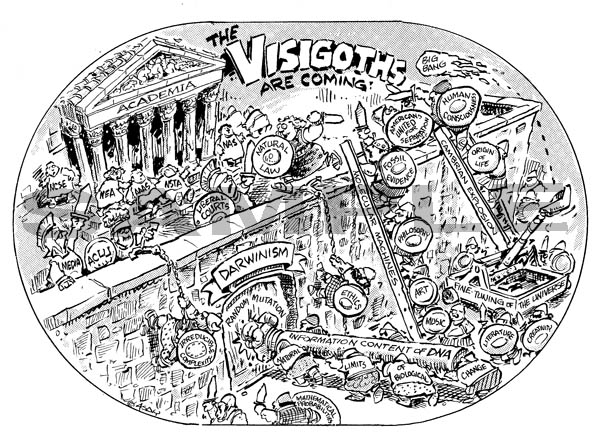
The ad blurb in part reads:

A recent book attacking intelligent design (Intelligent Thought: Science vs. the Intelligent Design Movement, ed. John Brockman, Vintage Press, May 2006), , has chapters by most of the big names in evolutionary thought: Daniel Dennett, Richard Dawkins, Jerry Coyne, Steven Pinker, Lee Smolin, Stuart A. Kauffman and others. In the introduction Brockman summarizes the situation from his perspective: materialistic Darwinism is the only scientific approach to origins, and the “bizarre” claims of “fundamentalists” with “beliefs consistent with those of the Middle Ages” must be opposed. “The Visigoths are at the gates” of science, chanting that schools must teach the controversy, “when in actuality there is no debate, no controversy.”

While Brockman intended the “Visigoths” reference as an insult equating those who do not embrace materialistic Darwinism to uneducated barbarians, he has actually created an interesting analogy of the situation, and perhaps a prophetic look at the future. For it was the Visigoths of the 3rd and 4th centuries that were waiting at the gates of the Roman Empire when it collapsed under its own weight. For years the Darwinists in power have pretended all is well in the land of random mutation and natural selection and that intelligent design should be ignored. With this book (and several others like it), they are attempting to both laugh and fight back at the ID movement. Mahatma Gandhi summarized the situation well with his quote about the passive resistive movement: “First they ignore you, then they laugh at you, then they fight you, then you win.”

Worth thinking about.

Comments
Its interesting to watch LYO emote his dissonance over these past weeks. Imagine having mockery as your only means to stave off fears and preserve your interest. :|Upright BiPed
April 9, 2013
April
04
Apr
9
09
2013
09:02 AM
9
09
02
AM
PDT
As to trusting what our technologies are telling us about reality:
'Spooky action at a distance' aboard the ISS - April 9, 2013 Excerpt: Albert Einstein famously described quantum entanglement as "spooky action at distance"; however, up until now experiments that examine this peculiar aspect of physics have been limited to relatively small distances on Earth. In a new study published today, 9 April, in the Institute of Physics and German Physical Society's New Journal of Physics, researchers have proposed using the International Space Station (ISS) to test the limits of this "spooky action",,, "According to quantum physics, entanglement is independent of distance. Our proposed Bell-type experiment will show that particles are entangled, over large distances—around 500 km—for the very first time in an experiment," continued Professor Ursin. "Our experiments will also enable us to test potential effects gravity may have on quantum entanglement." http://phys.org/news/2013-04-spooky-action-distance-aboard-iss.html
Perhaps Anthony Leggett, who is an atheist who devised the Leggett inequality to try to disprove quantum theory, will finally admit that quantum theory is correct,,
A team of physicists in Vienna has devised experiments that may answer one of the enduring riddles of science: Do we create the world just by looking at it? - 2008 Excerpt: Leggett’s theory was more powerful than Bell’s because it required that light’s polarization be measured not just like the second hand on a clock face, but over an entire sphere. In essence, there were an infinite number of clock faces on which the second hand could point. For the experimenters this meant that they had to account for an infinite number of possible measurement settings. So Zeilinger’s group rederived Leggett’s theory for a finite number of measurements. There were certain directions the polarization would more likely face in quantum mechanics. This test was more stringent. In mid-2007 Fedrizzi found that the new realism model was violated by 80 orders of magnitude; the group was even more assured that quantum mechanics was correct. Leggett agrees with Zeilinger that realism is wrong in quantum mechanics, but when I asked him whether he now believes in the theory, he answered only “no” before demurring, “I’m in a small minority with that point of view and I wouldn’t stake my life on it.” For Leggett there are still enough loopholes to disbelieve. I asked him what could finally change his mind about quantum mechanics. Without hesitation, he said sending humans into space as detectors to test the theory. In space there is enough distance to exclude communication between the detectors (humans), and the lack of other particles should allow most entangled photons to reach the detectors unimpeded. Plus, each person can decide independently which photon polarizations to measure. If Leggett’s model were contradicted in space, he might believe. When I mentioned this to Prof. Zeilinger he said, “That will happen someday. There is no doubt in my mind. It is just a question of technology.” Alessandro Fedrizzi had already shown me a prototype of a realism experiment he is hoping to send up in a satellite. It’s a heavy, metallic slab the size of a dinner plate. http://seedmagazine.com/content/article/the_reality_tests/P3/
supplemental note:
Quantum physics says goodbye to reality - Apr 20, 2007 Excerpt: They found that, just as in the realizations of Bell's thought experiment, Leggett's inequality is violated – thus stressing the quantum-mechanical assertion that reality does not exist when we're not observing it. "Our study shows that 'just' giving up the concept of locality would not be enough to obtain a more complete description of quantum mechanics," Aspelmeyer told Physics Web. "You would also have to give up certain intuitive features of realism." http://physicsworld.com/cws/article/news/27640
So lastyearon and KN, do you guys trust your cognitive faculties enough to believe what quantum mechanics is telling us??? :)
The Mental Universe - Richard Conn Henry - Professor of Physics at John Hopkins University Excerpt: The only reality is mind and observations, but observations are not of things. To see the Universe as it really is, we must abandon our tendency to conceptualize observations as things.,,, The universe is entirely mental,,,, The Universe is immaterial — mental and spiritual. Live, and enjoy. http://henry.pha.jhu.edu/The.mental.universe.pdf
bornagain77
April 9, 2013
April
04
Apr
9
09
2013
08:23 AM
8
08
23
AM
PDT
Nonsense. The practices and technologies that humans have come up with are of absolutely no use in determining what's true. So you can take your genetic analysis, and your telescopes and calculus, and shove em you know where. Because the truth is that evolution didn't happen, and the sun and everything revolves around the earth.lastyearon
April 9, 2013
April
04
Apr
9
09
2013
08:00 AM
8
08
00
AM
PDT
I just re-read Churchland's response to Plantinga, so I have a better grasp of what he's doing there. Churchland begins by conceding, or appearing to concede, the central point at issue: "Our cognitive mechanisms have been selected for their ability to sustain reproductively successful behaviors, not for their ability to track truth" (136). (I say "appearing to concede" because I think that Churchland's neurosemantics undermines how damning this is supposed to be, so everything turns on the plausibility of neurosemantics.) Having made that (apparent) concession, he nevertheless rejects Plantinga's inference:
Plantinga's argument innocently assumes that the (problematic) "truth-tracking character" of our native cognitive mechanisms is the only possible or available source of rational warrant or justification for evolutionary theory. But it isn't. Plantinga is ignoring the artificial mechanisms for theory-creation and theory-evaluation embodied in the complex institutions and procedures of modern science. These super-added mechanisms lie mostly outside the biological brain, and they provide a much more creative environment for generating interesting theories, and a much more demanding filter for evaluating them, than a single biological brain could ever provide with its native resources alone. (136-7)
Churchland then proceeds to list several of the practices and technologies he has in mind, such as double-blind studies, testing for statistical significance, comparing theories against each other, directly comparing predictions with experimental data, and also the extensive augmentation of our sensory modalities with telescopes, microscopes, nucleic-acid sequencers, and radioactive dating. The upshot of all this is that we have perfectly good reason to confer more rational warrant upon the artificial "cognitive engine of the Collective Scientific Community" (138) than on what can be produced by "a single individual with his native smarts and sensory equipment" (ibid.). So even if individual biological brains are not terribly good at tracking truth, that doesn't affect the warrant for our best scientific theories, since those theories do not derive their warrant from that source, but rather from the artificial and communal practices of scientific inquiry that have taken us thousands of years to develop, from ancient Greece (and before, no doubt) to the present day. I think that Churchland would even be willing to say that evolutionary theory can explain just why it is that our native biological endowments are often not as reliable as we take them to be, and why it took so long for us to develop a system of institutions that can reliably detect and filter out just all the ways in which our native cognitive mechanisms fail us (e.g. in judgments of probability, why we're prone to "the Gambler's fallacy," and so on). As a pragmatist, Churchland regards human inquiry as both fallible and corrigible -- he's not interested in infallible knowledge, certainty, whatever. So all he needs to do, he thinks, is show that the fallible-but-corrigible structure of inquiry is biologically grounded. And to do that, what we need is (a) an account of how our cognitive mechanisms are generally reliable for getting a partial grasp on objective reality for practical purposes and (b) an account of how we are able to detect and correct cognitive errors. (On this account, Churchland's "neuropragmatism" turns scientific inquiry itself into a self-correcting, generally reliable mechanism for getting a partial grasp on objective reality for practical purposes.) So the question that remains is this: on naturalistic grounds, do we have good reasons to think that cognitive mechanisms are even so much as generally reliable for getting a partial grasp on objective reality for practical purposes? And to that question, Churchland thinks that the answer is an unequivocal "yes", because of how brains represent the stable and fleeting features of their environments.Kantian Naturalist
April 9, 2013
April
04
Apr
9
09
2013
07:02 AM
7
07
02
AM
PDT
Kantian Naturalist:
The reason why Churchland thinks that (2) is false is because scientific theories are not based on ordinary beliefs, as myths and fables and ‘old-wives tales’ are, but on highly complex institutions and practices that have taken us the better part of two thousand years to develop.
Nonsense. If individual belief systems are unreliable from a Darwinist perspective, then so are the institutions and practices that build on and derive from those individual belief systems. Accordingly, the amount of time that it takes for an institution to develop is irrelevant since it would simply be the case of newer unreliable beliefs being piled on top of older unreliable beliefs.StephenB
April 9, 2013
April
04
Apr
9
09
2013
06:22 AM
6
06
22
AM
PDT
KN your, and other atheist's primary problem with 'science', is best summed up by these quotes from Plantinga:
Philosopher Sticks Up for God - NY TIMES Excerpt: "Theism, with its vision of an orderly universe superintended by a God who created rational-minded creatures in his own image, “is vastly more hospitable to science than naturalism,” with its random process of natural selection, he (Plantinga) writes. “Indeed, it is theism, not naturalism, that deserves to be called ‘the scientific worldview.’"" "Modern science was conceived, and born, and flourished in the matrix of Christian theism. Only liberal doses of self-deception and double-think, I believe, will permit it to flourish in the context of Darwinian naturalism." ~ Alvin Plantinga
In that atheists deny any outside perspective from the 'natural' world (i.e. they deny they have a 'mind' with free will) so as to be able to make unbiased judgements about the 'natural' world. As long as atheists maintain that they are nothing more than accidental products of the 'natural' world, with no mind, then they will always lack the proper perspective that enables people to judge whether or not our perceptions about the 'natural' world are reliable. Your predicament reminds me a little bit of David Chalmers's 'zombie argument' for consciousness:
David Chalmers on Consciousness - video http://www.youtube.com/watch?v=NK1Yo6VbRoo&feature=player_detailpage#t=127s
Moreover, consciousness is found to be a primary element of reality rather than a secondary element of reality as atheists hold:
Quantum Mechanics - Double Slit Experiment. Is anything real? (Prof. Anton Zeilinger) http://www.youtube.com/watch?v=ayvbKafw2g0 1. Consciousness either preceded all of material reality or is a 'epi-phenomena' of material reality. 2. If consciousness is a 'epi-phenomena' of material reality then consciousness will be found to have no special position within material reality. Whereas conversely, if consciousness precedes material reality then consciousness will be found to have a special position within material reality. 3. Consciousness is found to have a special, even central, position within material reality. 4. Therefore, consciousness is found to precede material reality. Four intersecting lines of experimental evidence from quantum mechanics that shows that consciousness precedes material reality (Wigner’s Quantum Symmetries, Wheeler’s Delayed Choice, Leggett’s Inequalities, Quantum Zeno effect): https://docs.google.com/document/d/1G_Fi50ljF5w_XyJHfmSIZsOcPFhgoAZ3PRc_ktY8cFo/edit Quantum Zeno effect Excerpt: The quantum Zeno effect is,,, an unstable particle, if observed continuously, will never decay. http://en.wikipedia.org/wiki/Quantum_Zeno_effect
The reason why I am fascinated with this Zeno effect in particular is, for one thing, that Entropy is, by a wide margin, the most finely tuned of the initial conditions of the Big Bang:
The Physics of the Small and Large: What is the Bridge Between Them? Roger Penrose Excerpt: “The time-asymmetry is fundamentally connected to with the Second Law of Thermodynamics: indeed, the extraordinarily special nature (to a greater precision than about 1 in 10^10^123, in terms of phase-space volume) can be identified as the “source” of the Second Law (Entropy).” How special was the big bang? – Roger Penrose Excerpt: This now tells us how precise the Creator’s aim must have been: namely to an accuracy of one part in 10^10^123. (from the Emperor’s New Mind, Penrose, pp 339-345 – 1989) For another thing, it is interesting to note just how foundational entropy is in its explanatory power: Shining Light on Dark Energy - October 21, 2012 Excerpt: It (Entropy) explains time; it explains every possible action in the universe;,, Even gravity, Vedral argued, can be expressed as a consequence of the law of entropy. ,,, The principles of thermodynamics are at their roots all to do with information theory. Information theory is simply an embodiment of how we interact with the universe —,,, http://crev.info/2012/10/shining-light-on-dark-energy/
In fact, entropy is also the primary reason why our physical bodies grow old and die,,,
*3 new mutations every time a cell divides in your body * Average cell of 15 year old has up to 6000 mutations *Average cell of 60 year old has 40,000 mutations Reproductive cells are 'designed' so that, early on in development, they are 'set aside' and thus they do not accumulate mutations as the rest of the cells of our bodies do. Regardless of this protective barrier against the accumulation of slightly detrimental mutations still we find that,,, *60-175 mutations are passed on to each new generation. - mutation rates quoted from geneticist Dr. John Sanford This following video brings the point personally home to us about the effects of genetic entropy: Aging Process - 80 years in 40 seconds - video http://www.youtube.com/watch?v=hSdxYmGro_Y
And yet, to repeat the paper,,,
Quantum Zeno effect Excerpt: The quantum Zeno effect is,,, an unstable particle, if observed continuously, will never decay. http://en.wikipedia.org/wiki/Quantum_Zeno_effect
This is just fascinating! Why in blue blazes should conscious observation put a freeze on entropic decay, unless consciousness was/is more foundational to reality than entropy is? And seeing as to how entropy is VERY foundational to reality, I think the implications are fairly obvious: Verse and Music:
Romans 8:18-21 I consider that our present sufferings are not worth comparing with the glory that will be revealed in us. The creation waits in eager expectation for the sons of God to be revealed. For the creation was subjected to frustration, not by its own choice, but by the will of the one who subjected it, in hope that the creation itself will be liberated from its bondage to decay and brought into the glorious freedom of the children of God. Evanescence – The Other Side (Lyric Video) http://www.vevo.com/watch/evanescence/the-other-side-lyric-video/USWV41200024?source=instantsearch
bornagain77
April 9, 2013
April
04
Apr
9
09
2013
03:03 AM
3
03
03
AM
PDT
The reason why Churchland thinks that (2) is false is because scientific theories are not based on ordinary beliefs, as myths and fables and ‘old-wives tales’ are, but on highly complex institutions and practices that have taken us the better part of two thousand years to develop.
This doesn't even begin to supply a response to Plantinga's argument. The complexity of the institution doesn't matter, just as the complexity of a computer does nothing to guarantee the accuracy of its results. (If you think otherwise, just ask yourself if it's possible for an incredibly complicated computer to consistently given incorrect answers.) The same holds for the complexity of the practices.
Put otherwise, all that a good naturalist (like Churchland) need be committed to is that our ordinary belief-formation mechanisms are generally reliable about some things, and that scientific procedures are highly artificial (so not “natural”, in one sense) but highly reliable techniques for arriving at much more reliable (though often counter-intuitive) beliefs.
Plantinga's argument takes aim at the very idea that our 'ordinary belief-formation mechanisms' are 'generally reliable'. Likewise, the 'artificiality' of scientific procedures lend no assistance here, because it's not as if artificiality confers accuracy. At the end of the day, you're still dealing with human beings arriving at beliefs based on what they believe to be valid data, etc. Scientific procedures and practices are themselves products of human beliefs and ideas. Really, KN, this is - certainly as you've summarized so far - really bad response to Plantinga. It's a little like saying that, while we can't trust the claims and theories of a completely irrational person, we can trust the claims and theories produced by a computer manufactured and programmed by the completely irrational person. If you see the problem with that proposition, you're going to see the problem with Churchlands' reply to Plantinga. It either sneaks in and assumes the very thing under question, or it totally ignores the problem posed to begin with.nullasalus
April 9, 2013
April
04
Apr
9
09
2013
01:36 AM
1
01
36
AM
PDT
BornAgain77, I think you've misunderstood Churchland's response to Plantinga. (Or perhaps Churchland has misunderstood Plantinga?) Churchland's response takes it that Plantinga's argument goes as follows: (1) Evolutionary biology strongly suggests that our first-order, ordinary beliefs (e.g. perceptual beliefs, beliefs about probability, memories) are much less reliable than we ordinarily take them to be; (2) But evolutionary theory, like all scientific theories, depends upon those ordinary beliefs; (3) So, evolutionary theory undermines itself -- anyone who accepts it has good reason not to accept it. Churchland thinks that (1) is true, but that (2) is not. The reason why Churchland thinks that (2) is false is because scientific theories are not based on ordinary beliefs, as myths and fables and 'old-wives tales' are, but on highly complex institutions and practices that have taken us the better part of two thousand years to develop. But, if (2) is false, then (3) doesn't follow from (1), and so evolutionary theory isn't self-undermining, even if (1) is correct.Kantian Naturalist
April 8, 2013
April
04
Apr
8
08
2013
07:34 PM
7
07
34
PM
PDT
notes:
The Heretic - Who is Thomas Nagel and why are so many of his fellow academics condemning him? - March 25, 2013 Excerpt: Neo-Darwinism insists that every phenomenon, every species, every trait of every species, is the consequence of random chance, as natural selection requires. And yet, Nagel says, “certain things are so remarkable that they have to be explained as non-accidental if we are to pretend to a real understanding of the world.” Among these remarkable, nonaccidental things are many of the features of the manifest image. Consciousness itself, for example: You can’t explain consciousness in evolutionary terms, Nagel says, without undermining the explanation itself. Evolution easily accounts for rudimentary kinds of awareness. Hundreds of thousands of years ago on the African savannah, where the earliest humans evolved the unique characteristics of our species, the ability to sense danger or to read signals from a potential mate would clearly help an organism survive. So far, so good. But the human brain can do much more than this. It can perform calculus, hypothesize metaphysics, compose music—even develop a theory of evolution. None of these higher capacities has any evident survival value, certainly not hundreds of thousands of years ago when the chief aim of mental life was to avoid getting eaten. Could our brain have developed and sustained such nonadaptive abilities by the trial and error of natural selection, as neo-Darwinism insists? It’s possible, but the odds, Nagel says, are “vanishingly small.” If Nagel is right, the materialist is in a pickle. The conscious brain that is able to come up with neo-Darwinism as a universal explanation simultaneously makes neo-Darwinism, as a universal explanation, exceedingly unlikely.,,, ,,,Fortunately, materialism is never translated into life as it’s lived. As colleagues and friends, husbands and mothers, wives and fathers, sons and daughters, materialists never put their money where their mouth is. Nobody thinks his daughter is just molecules in motion and nothing but; nobody thinks the Holocaust was evil, but only in a relative, provisional sense. A materialist who lived his life according to his professed convictions—understanding himself to have no moral agency at all, seeing his friends and enemies and family as genetically determined robots—wouldn’t just be a materialist: He’d be a psychopath. http://www.weeklystandard.com/articles/heretic_707692.html?page=3 The following interview is sadly comical as a evolutionary psychologist realizes that neo-Darwinism can offer no guarantee that our faculties of reasoning will correspond to the truth, not even for the truth that he is purporting to give in the interview, (which begs the question of how was he able to come to that particular truthful realization, in the first place, if neo-Darwinian evolution were actually true?); Evolutionary guru: Don't believe everything you think - October 2011 Interviewer: You could be deceiving yourself about that.(?) Evolutionary Psychologist: Absolutely. http://www.newscientist.com/article/mg21128335.300-evolutionary-guru-dont-believe-everything-you-think.html Evolutionists Are Now Saying Their Thinking is Flawed (But Evolution is Still a Fact) - Cornelius Hunter - May 2012 Excerpt: But the point here is that these “researchers” are making an assertion (human reasoning evolved and is flawed) which undermines their very argument. If human reasoning evolved and is flawed, then how can we know that evolution is a fact, much less any particular details of said evolutionary process that they think they understand via their “research”? http://darwins-god.blogspot.com/2012/05/evolutionists-are-now-saying-their.html “Atheism turns out to be too simple. If the whole universe has no meaning, we should never have found out that it has no meaning...” CS Lewis – Mere Christianity "But then with me the horrid doubt always arises whether the convictions of man’s mind, which has been developed from the mind of the lower animals, are of any value or at all trustworthy. Would any one trust in the convictions of a monkey’s mind, if there are any convictions in such a mind?" - Charles Darwin - Letter To William Graham - July 3, 1881
bornagain77
April 8, 2013
April
04
Apr
8
08
2013
07:24 PM
7
07
24
PM
PDT
Churchland's response is only right if evolutionary biology would be a product of the 'infallible' procedures of modern science. The few (incomplete) empirical truths that science provides us is no foundation for trusting our cognitive mechanisms if they are produced by Darwinian evolution. I say 'incomplete' because even a science as physics leaves us with many questions.
'Why do the constants and parameters of theoretical physics obey such tight constraints? If this is one question, it leads at once to another. The laws of nature are what they are. They are fundamental. But why are they true? Why do material objects attract one another throughout the universe with a kind of brute and aching inevitability? Why is space-and-time curved by the presence of matter? Why is the electron charged? Why? Yes, why?' Berlinski, p. 111, The Devil's Delusion.
Box
April 8, 2013
April
04
Apr
8
08
2013
07:22 PM
7
07
22
PM
PDT
KN, as usual you appeal to nonsense to support your nonsense:
Plantinga is ignoring the artificial mechanisms for theory creation and theory-evaluation embodied in the complex institutions and procedures of modern science.
Plantinga's point is not to refute evolution on empirical grounds (as if evolution had any observational evidence to refute), his point is to refute naturalism on cognitive reliability grounds i.e. naturalism cannot support a consistent reliable epistemology! Ironically KN, YOU YOURSELF, as well as all other atheists, are the ones who refuse to address the fact that the pseudo-science of Darwinism has no solid empirical warrant, no falsification criteria, to be considered science in the first place! And here you accuse Plantinga, in your citation, of ignoring empirical warrant. Are you completely oblivious to what you just did?
“On the other hand, I disagree that Darwin’s theory is as `solid as any explanation in science.; Disagree? I regard the claim as preposterous. Quantum electrodynamics is accurate to thirteen or so decimal places; so, too, general relativity. A leaf trembling in the wrong way would suffice to shatter either theory. What can Darwinian theory offer in comparison?” (Berlinski, D., “A Scientific Scandal?: David Berlinski & Critics,” Commentary, July 8, 2003) "nobody to date has yet found a demarcation criterion according to which Darwin(ism) can be described as scientific" - Imre Lakatos (November 9, 1922 – February 2, 1974) a philosopher of mathematics and science, quote was as stated in 1973 LSE Scientific Method Lecture Oxford University Seeks Mathemagician — May 5th, 2011 by Douglas Axe Excerpt: Grand theories in physics are usually expressed in mathematics. Newton’s mechanics and Einstein’s theory of special relativity are essentially equations. Words are needed only to interpret the terms. Darwin’s theory of evolution by natural selection has obstinately remained in words since 1859. … http://biologicinstitute.org/2011/05/05/oxford-university-seeks-mathemagician/ Macroevolution, microevolution and chemistry: the devil is in the details – Dr. V. J. Torley – February 27, 2013 Excerpt: After all, mathematics, scientific laws and observed processes are supposed to form the basis of all scientific explanation. If none of these provides support for Darwinian macroevolution, then why on earth should we accept it? Indeed, why does macroevolution belong in the province of science at all, if its scientific basis cannot be demonstrated? https://uncommondescent.com/intelligent-design/macroevolution-microevolution-and-chemistry-the-devil-is-in-the-details/
bornagain77
April 8, 2013
April
04
Apr
8
08
2013
07:04 PM
7
07
04
PM
PDT
Ok, but if Churchland's response to Plantinga is right, then appealing to Plantinga won't help you at all in attacking evolutionary biology.Kantian Naturalist
April 8, 2013
April
04
Apr
8
08
2013
06:47 PM
6
06
47
PM
PDT
KN #21: (..) Churchland’s point is that the procedures of modern science, such as evolutionary theory, do not depend on the reliability of our ordinary belief-formation mechanisms.
KN, Churchland may very well have a point about certain empirical scientific knowledge, but surely this does not include the pseudoscience called evolutionary biology!Box
April 8, 2013
April
04
Apr
8
08
2013
06:37 PM
6
06
37
PM
PDT
Fair enough, Box, but Churchland's point is that the procedures of modern science, such as evolutionary theory, do not depend on the reliability of our ordinary belief-formation mechanisms. So if evolutionary theory shows that our ordinary belief-formation mechanisms are not altogether reliable, that doesn't undermine evolutionary theory. So the EAAN doesn't work. Put otherwise, all that a good naturalist (like Churchland) need be committed to is that our ordinary belief-formation mechanisms are generally reliable about some things, and that scientific procedures are highly artificial (so not "natural", in one sense) but highly reliable techniques for arriving at much more reliable (though often counter-intuitive) beliefs. So there's no paradox involved in holding the second-order, scientifically-informed belief that our first-order, ordinary beliefs are not perfectly reliable. We do, on the whole, take our ordinary beliefs to be perfectly reliable -- and that, too, is a second-order belief. What we need, and in fact have, is the third-order belief that beliefs formed through scientific techniques tend to be more reliable than beliefs arrived at through other means. So given two competing beliefs, I have good reason to prefer the one that has been arrived at by well-established scientific practices -- even if that belief is a second-order belief about the reliability of my first-order, ordinary perceptual/empirical beliefs. The EAAN paradox is avoided because the reliability of scientific institutions and practices doesn't depend on the reliability of ordinary, first-order perceptual beliefs. More generally: the structure of beliefs is not a pyramid, with scientific beliefs at the top resting on a foundation of ordinary, perceptual beliefs at the bottom. Plantinga is so committed to foundationalism that he doesn't seem to appreciate that an anti-foundationalist epistemology is immune to his skeptical argument -- whereas Churchland, following in the footsteps of Hegel, Peirce, Sellars, and Quine, is working out a very interesting anti-foundationalistic and naturalized epistemology. Plantinga might have a point if foundationalism were the only live option in epistemology, but it isn't, so he's not.Kantian Naturalist
April 8, 2013
April
04
Apr
8
08
2013
06:06 PM
6
06
06
PM
PDT
@KN #19
Churchland: Plantinga is ignoring the artificial mechanisms for theory creation and theory-evaluation embodied in the complex institutions and procedures of modern science.
The procedures of modern science don't cover many subjects and certainly not metaphysics - e.g. naturalistic beliefs -, which is the point Plantinga wanted to make.Box
April 8, 2013
April
04
Apr
8
08
2013
05:30 PM
5
05
30
PM
PDT
Paul Churchland, perhaps one of the most forceful proponents for naturalism today, has in fact responded to Plantinga's EAAN. Here's the citation: "Is Evolutionary Naturalism Epistemologically Self-Defeating?" Paul Churchland Philo 12 (2):135-141 (2009)
Abstract: Alvin Plantinga argues that our cognitive mechanisms have been selected for their ability to sustain reproductively successful behaviors, not for their ability to track truth. This aspect of our cognitive mechanisms is said to pose a problem for the biological theory of evolution by natural selection in the following way. If our cognitive mechanisms do not provide any assurances that the theories generated by them are true, then the fact that evolutionary theory has been generated by them, and even accepted by them, provides no assurance whatever that evolutionary theory is true. Plantinga’s argument, I argue, innocently assumes that the (problematic) “truth-tracking character” of our native cognitive mechanisms is the only possible or available source of rational warrant or justification for evolutionary theory. But it isn’t. Plantinga is ignoring the artificial mechanisms for theory creation and theory-evaluation embodied in the complex institutions and procedures of modern science.
Churchland's latest, Plato's Camera, also fills in quite a bit of the story he thinks naturalism requires. I'm not entirely convinced that Churchland's approach does all the work he thinks he does, because I'm less confident than he is that we can treat brain-states as bearers of semantic content, although they are clearly implicated in the causes of semantic content. But brain-states aren't merely "syntactical", either -- they do have representational content -- but is that enough to warrant the name of semantic content? Still working on this one!Kantian Naturalist
April 8, 2013
April
04
Apr
8
08
2013
04:44 PM
4
04
44
PM
PDT
timothya: Why No One (Can) Believe Atheism/Naturalism to be True - video Excerpt: Since we are creatures of natural selection, we cannot totally trust our senses. Evolution only passes on traits that help a species survive, and not concerned with preserving traits that tell a species what is actually true about life. Richard Dawkins - quoted from "The God Delusion" http://www.youtube.com/watch?v=N4QFsKevTXsbornagain77
April 8, 2013
April
04
Apr
8
08
2013
04:25 PM
4
04
25
PM
PDT
timothya: Scientific Naturalism Will NEVER Lead to God's Existence - video http://www.youtube.com/watch?v=hhXzxE_MMGkbornagain77
April 8, 2013
April
04
Apr
8
08
2013
04:06 PM
4
04
06
PM
PDT
As to timothya's claim here:
science and theology are two incompatible modes of thought. Science works, theology doesn’t.
Actually timothya, as niwrad elegantly pointed out in the "Comprehensibility of World" thread,,,
Comprehensibility of the world Excerpt: ,,,Bottom line: without an absolute Truth, (there would be) no logic, no mathematics, no beings, no knowledge by beings, no science, no comprehensibility of the world whatsoever. https://uncommondescent.com/mathematics/comprehensibility-of-the-world/
Theism is a required presupposition in 'science'. In fact it can be forcefully argued that 'modern science' would have never even gotten off the ground in the first place without 'improperly' injecting the Theistic philosophy into science. Particularly 'improperly' injecting Christian Theism into it!
Christ and Science - Stanley L. Jaki Excerpt:,,Why is it that although that law appears to be so natural, it came to be formulated in none of the great ancient (and pagan) cultures, but in the medieval Christian West? The question is momentous because exact science assures control over nature and secures for the modern West its global dominance. As shown in this booklet, which summarizes its author's major studies on the subject, the answer to that question lies with a particular facet of belief in Christ as the "only begotten Son of God." There is, indeed, a very deep reason, both scientific and theological, that justifies the tying of Christ and science together.,,, http://www.realviewbooks.com/catalogb.html#chriscie
,,, Sure science is dependent on empirical evidence for validating various competing 'interpretations' within the Theistic philosophy, but we must never forget that unless Theism is held as unconditionally true throughout a 'scientific' investigation then the entire enterprise of science winds up in epistemological failure as is evidenced so clearly by Boltzmann’s Brain and Plantinga’s Evolutionary Argument Against Naturalism. It is not that Theists are demanding that Theism is the only answer allowed to be considered true prior to investigation, as atheist demand with their artificial imposition of methodological naturalism onto science, it is that if Theism is not held as unconditionally true prior to scientific investigation then nothing else can ever be held as unconditionally true there afterwards! Furthermore, as to Epistemological Naturalism, which holds that science is the only source of knowledge, Dr. Craig states it is a false theory of knowledge since,,,
a). it is overly restrictive and b) it is self refuting ('science' is the only source of knowledge is a philosophical claim about reality that itself not deduced from 'science')
Moreover Dr Craig states, epistemological naturalism does not imply metaphysical naturalism.,, In fact a Empistemological Naturalist can and should be a Theist, Dr. Craig observes, since Metaphysical Naturalism is reducto ad absurdum on (at least) these eight following points:
1. The argument from the intentionality (aboutness) of mental states implies non-physical minds (dualism), which is incompatible with naturalism 2. The existence of meaning in language is incompatible with naturalism, Rosenberg even says that all the sentences in his own book are meaningless 3. The existence of truth is incompatible with naturalism 4. The argument from moral praise and blame is incompatible with naturalism 5. Libertarian freedom (free will) is incompatible with naturalism 6. Purpose is incompatible with naturalism 7. The enduring concept of self is incompatible with naturalism 8. The experience of first-person subjectivity (“I”) is incompatible with naturalism
I strongly suggest watching Dr. Craig’s presentation, that I have linked, to get a full feel for just how insane the metaphysical naturalist’s position actually is.
Is Metaphysical Naturalism Viable? - William Lane Craig - video http://www.youtube.com/watch?v=HzS_CQnmoLQ
Moreover it can be forcefully argued that not only was Christian Theism required for the beginnings of 'modern science' but that to bring 'modern science' to successful completion (at least as far as physics and mathematics go for a 'theory of everything') then a understanding of Christ's centrality in reality must be once again be accepted into 'science':
The Center Of The Universe Is Life - General Relativity, Quantum Mechanics, Entropy and The Shroud Of Turin - video http://vimeo.com/34084462
bornagain77
April 8, 2013
April
04
Apr
8
08
2013
02:19 PM
2
02
19
PM
PDT
Joe: This is one form of the conflation between small increments that are not beyond the complexity threshold (where micro evo is accepted by even YECs), and the need to find new islands of function by blind search that is implied by Darwinian Macroevo, which is what the FSCO/I challenge targets. So, the real pivot of the origin of body plans question is the Darwinist tree of life implication of a vast continent of function incrementally accessible through stepwise change (which, if true, would be the dominant feature of the fossil record and the world of life as we see . . . but it obviously isn't), and the empirically supported reality of isolation of islands of function in relevant config spaces. This has been pointed out over and over, but it seems rhetorically convenient to the sort of Darwinist advocates we are facing, to substitute a convenient strawman target. Utterly revealing on the true balance on the merits. KFkairosfocus
April 8, 2013
April
04
Apr
8
08
2013
07:25 AM
7
07
25
AM
PDT
How about this strawman:
Note that if Dembski's arguments were valid, they would make adaptation by natural selection of any organism, in any phenotype, essentially impossible.
And the strawman above pertaining to reducing the uncertainty of a gene = an increase of information. I just cannot believe that Joe Felsenstein is a professor at a university.Joe
April 8, 2013
April
04
Apr
8
08
2013
04:38 AM
4
04
38
AM
PDT
Joe: Any further thoughts on the markup I have done? KFkairosfocus
April 8, 2013
April
04
Apr
8
08
2013
02:23 AM
2
02
23
AM
PDT
TA: It is clear that if to object to my comments, you have had to resort to silly schoolyard taunts and present willful false hoods as though they were facts, refuse to acknowledge that there is such a thing as a digital genetic code -- thus a linguistic phenomenon -- that functions algorithmically in the cell, and while writing posts in ASCII coded English text pretend that there is no such thing as functionally specific complex organisation and associated information [FSCO/I], that speaks volumes on the reductio ad absurdum of the objections to design. Accordingly, I have marked up your above remarks, having released them from moderation (as I recently discovered that I have power to do in my own threads). Please, do better next time. KFkairosfocus
April 8, 2013
April
04
Apr
8
08
2013
02:20 AM
2
02
20
AM
PDT
Kairosfocus posted this:
>> Critics of ID commonly argue that it is not science.>> 1 –> by begging the question by imposing a logically, epistemologically and historically unwarranted, question-begging unworkable a priori redefinition that boils down to science is applied materialist philosophy. Cf. critique here on, that gives details, without hurling an elephant.
Critics of ID commonly point out that the only difference between an evolutionary explanation of how biology works and how ID explains the same observations is that ID requires that an intelligent designer must be present. Occam's Razor applies: if two hypotheses explain the same observations with the same accuracy, but the second explanation requires an additional cause, then ditch the second one. a --> Have you consulted the definition of design theory recently? If you had, you would not make that sort of claim: ID is the scientific investigation of the possibility of and empirical warrant for signs of design in our world, where there are -- contrary to your schoolyard taunt level dismissal below -- in fact quite clear phenomena that manifest that only intelligent design is a known adequate cause. KF [My responses will be interleaved, in part in response to that decision to play taunt games.]
>> For its positive predictions of the behavior of a designer they have a good point. But not for its negative criticisms of the effectiveness of natural selection, which are scientific arguments that must be taken seriously and evaluated. >>
Valid predictions are a feature of scientific theories that are likely to be correct. It would assist ID if it were to make predictions about how biology works from its (ID's) premises about the requirement for design. For example, are there any predictions from ID about the nature of the designer? When and where the designer undertook its actions? How did it do its work? By what means? What are the characteristics of the designer? b --> The principal prediction of design theory is that some things in our world, the world of life and that of the cosmos generally, are such that they exhibit signs that are best explained causally on design and not on blind natural forces of chance and necessity. c --> As you know or should know, such is directly testable by simply providing a case, for instance of Wicken's functionally specific, information-rich complex organisation per a wiring diagram, coming about in our observation by such blind forces of chance and necessity. This is eminently empirically testable, and in fact it is subjected to routine tests, and keeps on passing. (Indeed, every post in this thread is another passed test, as NONE of these FSCO/I-rich posts has come about by lucky noise on the Internet. As also you full well know or should know.) d --> This is an issue of trying to find out a truth about our world, that is subject to empirical warrant, and the continued support of the basic contention that there are observable signs that point to design as cause has patently revolutionary implications for origins science. Hence the many attempts to shoot it down; too often by questionable means. e --> As you know or should know, it is more than enough for design theory to be a scientific undertaking, that it shows such signs. To then demand all sorts of extraneous requisites, is then a piece of red herring distraction driven by selective hyperskepticism.
2 –> Only an allusion is presented, in a context that then tries to present a tee shirt/editorial cartoon as substantially representing the design theory case. Cf just below. 3 –> As was already shown, when two scientific theoretical claims conflict, one will need to show the limitations of the other. And in the case of NS, it is neither the source of innovations in bio-function and associated information, nor has it been observed to be able to account for origin of body plans. It does not even address the origin of cell based life.
Nonsense. The whole of evolutionary biology aims to explain the origins of "body plans" and "innovations in bio-function". In the context of the debate at the UD site, the point is that evolutionary biologists think that your version of "information" is incoherent. f --> The deliberate act of JoeF to represent a serious argument and movement by using a cartoonist's cartoon on a tee shirt made in response to a snide accusation of "the Vandals are coming!" as the substantive positive case being made by design theory is an inexcusable strawman caricature and rhetorical stunt that should be apologised for. Period. g --> You change the subject to how evolutionary biology seeks to explain origin body plans etc. yes indeed, since Darwin and Wallace. The problem is, we are here seeing consistent explanatory failure and insistence on a preferred explanation in the teeth of contrary evidence, for decades. h --> As for the notion that functionally specific complex organisation and associated information is "incoherent" that is a claim to self contradiction if anything. THAT is what is nonsense, as for instance, such FSCO/I is manifest in every post in this thread, which requires string data structures with glyphs in sequences controlled by the syntax and semantics of English, further shaped by the context of the discussion in this thread. In addition, the world of technology around you manifests just such functionally constrained organisation of components and implied information as can be seen by simply consulting AutoCAD files of blueprints.
4 –> To point that out, in extensive technical arguments, as has been done for many years is to take NS seriously, so the pretence that a cartoon is an adequate summary of the case for design is a caricature of the worst sort.
A case for design, without a case for a designer, is (how can I say this politely), trivial. i --> Not at all, the very intensity and rhetorical desperation of the response is a demonstration that the simple step of identifying that there are reliable signs observable in the natural world that point to design as best causal explanation per what we know about causes, is revolutionary.
5 –> And literally, that is exhibit 1 used by JoeF >>Look at Figure 1, which shows a cartoon design from T-shirts sold by an ID website, Access Research Network, which also sells ID paraphernalia (I am grateful to them for kind permission to reproduce it). (click here for image)>>6 –> this is as classic an example of a strawman argument as I have ever seen.
I agree with you. The cartoon is a strawman en gros. i --> In short, you IMPLY that JoeF was wrong to have misrepresented Design Theory by presenting its argument as a cartoon made in reply to an irresponsible accusation of barbarism and ignorant destructiveness, i.e. "The Visigoths are coming."
>>Figure 1. A summary of the major arguments of “intelligent design”, as they appear to its advocates, from Access Research Network’s website http://www.arn.org. Merchandise with the cartoon is available from http://www.cafepress.com/accessresearch. Copyright Chuck Assay, 2006; all rights reserved. Reprinted by permission.>> 7 –> As the PS to the OP will show, this is not a scientific presentation, or a summary of it, but a retort to a declaration in the anti-ID literature, that the Visigoths (the ignorant barbarians bent on destruction and rapine) are coming.
I don't understand what you are saying here. The cartoon is a product of the creationist Access Resource Network. Do you agree with its meaning, or do you not? j --> First, your conflation of design theory with creationism is itself a case of strawman distortion and invidious comparison intended to raise the spectre of the bogeyman of right wing theocratic tyranny and the like. This is the red herring led away to the strawman caricature soaked in ad hominems and set alight through invited snide inferences. This, to cloud, confuse, poison and polarise the atmosphere. [You are hereby invited to consult the WAC's here, on this gross error.] k --> Next the cartoon as indicated, is in fact a retort by an editorial cartoonist to a similar loaded false accusation, The Visigoths are coming, as the PS to the original post above shows. Your failure to respond to easily accessible evidence, is itself a demonstration of rhetoric in bad faith, with all due respect. l --> As both the original post and its antecedent as wel as the wider context of UD shows, there is such a thing as a substantial presentation of the scientific argument of design theory, one that has little to do with a well-merited cartoon retort to the false accusation of "The Visigoths [= barbarians] are coming." m --> A cartoonist's retort to what is a poisonously loaded and studied insult, is not to be construed as the main argument of a movement. That you want to sustain the pretence, speaks sadly revealing volumes.
8 –> The design theorists took it up and laid out an OUTLINE at label level of the challenge to the Darwinian establishment, and the only thing that can be properly gleaned is that the establishment feels threatened and is challenged across a wide range of topics. Substance is not addressed in any detail in a cartoon. >>As the bulwark of Darwinism defending the hapless establishment is overcome, note the main lines of attack. In addition to recycled creationist themes such as the Cambrian Explosion and cosmological arguments about the fine-tuning of the universe, the ladder is Michael Behe’s argument about molecular machines (Behe 1996).>>
"and the only thing that can be properly gleaned is that the establishment feels threatened and is challenged across a wide range of topics." Until you supply evidence (concerning the nature of your designer, its mode of operation, and the times and places that it did its work) you should not be surprised that the "establishment" thinks you are blowing smoke. n --> Red herring-strawman tactic again. Design theory is what it is, and its point is patently revolutionary: there are credible, empirically warranted as reliable, signs of design as best causal explanation. It so happens tha the world of life is full of them, and the observed cosmos. Where does this lead a REASONABLE discussion? o --> Obviously, you do not want to go there. We can guess why, in light of the Lewontinian agenda of a priori imposed materialism redefining science, its methods and conclusions, highlighted here on. Citing a key clip:
It is not that the methods and institutions of science somehow compel us to accept a material explanation of the phenomenal world, but, on the contrary, that we are forced by our a priori adherence to material causes [[--> another major begging of the question . . . ] to create an apparatus of investigation and a set of concepts that produce material explanations, no matter how counter-intuitive, no matter how mystifying to the uninitiated. Moreover, that materialism is absolute [[--> i.e. here we see the fallacious, indoctrinated, ideological, closed mind . . . ], for we cannot allow a Divine Foot in the door. [From: “Billions and Billions of Demons,” NYRB, January 9, 1997. if you think the usual false accusation of "quote mining has merits, kindly examine the fuller cite and discussion here on.]
p --> Johnson's retort is richly deserved:
For scientific materialists the materialism comes first; the science comes thereafter. [[Emphasis original] We might more accurately term them "materialists employing science." And if materialism is true, then some materialistic theory of evolution has to be true simply as a matter of logical deduction, regardless of the evidence. That theory will necessarily be at least roughly like neo-Darwinism, in that it will have to involve some combination of random changes and law-like processes capable of producing complicated organisms that (in Dawkins’ words) "give the appearance of having been designed for a purpose." . . . . The debate about creation and evolution is not deadlocked . . . Biblical literalism is not the issue. The issue is whether materialism and rationality are the same thing. Darwinism is based on an a priori commitment to materialism, not on a philosophically neutral assessment of the evidence. Separate the philosophy from the science, and the proud tower collapses. [[Emphasis added.] [[The Unraveling of Scientific Materialism, First Things, 77 (Nov. 1997), pp. 22 – 25.]
9 –> Recycled CREATIONIST themes tries to make an invidious association, and to duck the responsibility of accounting, per observations and adequate empirical evidence, for the origin of body plans by inheritable chance variation and differential reproductive success across varieties. From Darwin’s admissions on the subject to this day, that has remained unanswered. So to label and dismiss by invidious association — we know the subtext of insinuations about right wing theocratic religious agendas with racks and thumbscrews hiding up sleeves etc — is irresponsible.
There is nothing invidious in associating you with creationism. You do it yourself. You are the one who requires that biology can only work if a supernatural entity intervenes in its processes at some point (who knows when: maybe 10,000 years ago, maybe all the time, maybe only once). q --> Insistence on a misrepresentation: continuing misrepresentation. As you full well know or should know, there is no insistence in design theory on a supernatural entity intervening, and there is no Young Earth creationist timeline imposition on the age of either the earth or the cosmos. The willful persistence in a false assertion in defiance of duties of care to truth, accuracy and fairness, is outright deceptive. r --> In correction (for onlookers at minimum) I note, for the umpteenth time, that from the days of Plato in The Laws Bk X, the proper contrast to "natural" is not "supernatural," but the ART-ificial, i.e. the intelligently designed. That is, "natural" denotes that which is by blind chance and/or mechanical necessity, and the ART-ificial, that which is by intelligent cause. Kindly, read here on. In addition, from the very first design theory technical work by Thaxton et al in the mid 1980's, it has been openly and consistently acknowledged by design thinkers that the evidence in the world of life by itself does not currently warrant an inference to whether a designer of life was within or beyond the observable cosmos. Indeed, it has been pointed out any number of times by me and by others, that some3thing like a molecular nanotech lab some generations beyond where Venter et al have reached, would be adequate. In addition there is a side of design theory that does infer to design beyond the observed cosmos, one that follows up on discoveries by Hoyle [a holder of a Nobel Equivalent prize in astrophysics and a life-long agnostic . . . not exactly the right-wing fundy, theocratic would be tyrant YECs of the slanderous caricature you have been alluding to all along . . . ] on cosmological, life sustaining fine tuning. That work pivots on evidence that is in many ways connected to the standard model of cosmological origins, i.e the Big Bang theory, which last I checked, had a timeline of 13.7 BY to date. s --> If you cannot bring yourself to acknowledge so elementary a distinction, in the interests of making an invidious association and further implying false accusations of nefarious cultural intent, that speaks volumes, sheer volumes, and none of it to your benefit. In short, this is a pons asinorum.
10 –> The shift in terminology from COSMOLOGICAL FINE TUNING (a scientific discussion since Hoyle et al, where Hoyle was a lifelong agnostic) to “cosmological arguments” is also loaded as this directly implies that the arguments in question are those of natural theology. There is a serious scientific cosmological fine tuning issue to be addressed on the scientific merits, not dodged by making snide insinuations that this is natural theology in disguise.
Hint: science and theology are two incompatible modes of thought. Science works, theology doesn't. t --> In the teeth of my pointing out in outline the cosmological design theory challenge and its roots in science, you insist on making up accusations and distortions. This speaks volumes.
11 –> the issue about the observed origin of irreducible complexity, similarly, is not to be dismissed by saying that’s Behe’s argument. Have you had an empirically warranted answer to Menuge’s C1 – 5 criteria for exaptation . . . the usual attempted counter? If not, then the issue of irreducible complexity is very definitely still on the table. The criteria: For a working [bacterial] flagellum to be built by exaptation, the five following conditions would all have to be met: C1: Availability. Among the parts available for recruitment to form the flagellum, there would need to be ones capable of performing the highly specialized tasks of paddle, rotor, and motor, even though all of these items serve some other function or no function. C2: Synchronization. The availability of these parts would have to be synchronized so that at some point, either individually or in combination, they are all available at the same time. C3: Localization. The selected parts must all be made available at the same ‘construction site,’ perhaps not simultaneously but certainly at the time they are needed. C4: Coordination. The parts must be coordinated in just the right way: even if all of the parts of a flagellum are available at the right time, it is clear that the majority of ways of assembling them will be non-functional or irrelevant. C5: Interface compatibility. The parts must be mutually compatible, that is, ‘well-matched’ and capable of properly ‘interacting’: even if a paddle, rotor, and motor are put together in the right order, they also need to interface correctly. ( Agents Under Fire: Materialism and the Rationality of Science, pgs. 104-105 (Rowman & Littlefield, 2004). HT: ENV.) >>The other main attack, the battering ram, is the “information content of DNA” which is destroying the barrier of “random mutation”.>>
And biology has demonstrated that each of these putative criteria have been met by actual biological organisms. So your point would be? u --> Bluffing based on just so stories. Simply show an example where per our observation, blind chance and mechanical necessity in an organism has constructed through incremental evolutionary steps, a significant irreducibly complex entity. Failing that, you are simply flailing.
12 –> And your evidence that per observation, FSCO/I is reasonably a product of blind chance and mechanical necessity is? ________________ 13 –> Absent such, the evidence stands, that the only known causally adequate source of FSCO/I is design. So, we have every epistemic right to infer that FSCO/I is an empirically reliable sign of design as cause.
FIASCO is your claim. Produce evidence that it exists, that it can be measured without prior knowledge of the system under observation (no smuggling allowed). v --> Descent into puerile school-yard taunts, sadly revelatory of underlying mentality. Have the common decency and respect to deal with a descriptive summary of functionally specific, complex organisation and/or associated information [FSCO/I]. And last I checked, my name was not Orgel, nor Wicken. As I have pointed out over and over again -- but the strawman distortion is too tempting to give up in the face of its being exposed as oh so inconveniently false -- FSCO/I is a summary of phenomena noted by distinguished origin of life theorists across the 1970's. Let me pause to again cite the key references:
WICKEN, 1979: ‘Organized’ systems are to be carefully distinguished from ‘ordered’ systems. Neither kind of system is ‘random,’ but whereas ordered systems are generated according to simple algorithms [[i.e. “simple” force laws acting on objects starting from arbitrary and common- place initial conditions] and therefore lack complexity, organized systems must be assembled element by element according to an [[originally . . . ] external ‘wiring diagram’ with a high information content . . . Organization, then, is functional complexity and carries information. It is non-random by design or by selection, rather than by the a priori necessity of crystallographic ‘order.’ [[“The Generation of Complexity in Evolution: A Thermodynamic and Information-Theoretical Discussion,” Journal of Theoretical Biology, 77 (April 1979): p. 353, of pp. 349-65. (Emphases and notes added. Nb: “originally” is added to highlight that for self-replicating systems, the blue print can be built-in.)] ORGEL, 1973: . . . In brief, living organisms are distinguished by their specified complexity. Crystals are usually taken as the prototypes of simple well-specified structures, because they consist of a very large number of identical molecules packed together in a uniform way. Lumps of granite or random mixtures of polymers are examples of structures that are complex but not specified. The crystals fail to qualify as living because they lack complexity; the mixtures of polymers fail to qualify because they lack specificity. [[The Origins of Life (John Wiley, 1973), p. 189.]
>>The “irreducible complexity of molecular machines” arguments of Michael Behe have received most of the publicity; William Dembski’s more theoretical arguments involving information theory have been harder for people to understand.>> 14 –> Not so as I have noticed. Both have been discussed. >>There have been a number of extensive critiques of Dembski’s arguments published or posted on the web (Wilkins and Elsberry 2001; Godfrey-Smith 2001; Rosenhouse 2002; Schneider 2001, 2002; Shallit 2002; Tellgren 2002; Wein 2002; Elsberry and Shallit 2003; Edis 2004; Shallit and Elsberry 2004; Perakh 2004a, 2004b; Tellgren 2005; Häggström 2007). They have pointed out many problems. These range from the most serious to nit-picking quibbles . . .>
This depends on what someone has read. Whether Behe's ideas or Dembski's ideas are difficult to understand depends on how clearly they are expressed and how much attention they receive from people who understand the arguments they are making. In the case of Behe and Dembski, the counter-arguments have been comprehensive. It would help if you were to lay out what critiques you think are "most serious". w --> JoeF has claimed to represent the cumulative main critiques of Behe and Dembski. I have simply taken him at his word, and his summary collapses into a collection of rhetorical stunts and refusals to engage the substance on its merits. I particularly find the attempt to present a one-step mutation taking 80-odd generations to fix itself as an adequate retort to something that addressed increments of info that require 500 - 1,000 bits to be relevant is revealing, as is his refusal to address the issue that the assumed continent of incrementally linked functional configurations is in the teeth of abundant evidence and good reasons that FSCO/I will naturally be found in islands in a space of possible configs of components overwhelmingly dominated by non-functional gibberish.
15 –> Hurling the elephant. That the ideologically committed have tried rebuttals is no news. What is not being pointed out is how such have metthe criterion of warrant that is decisive: show FSCO/I as present in life forms and other relevant contexts, produced by blind chance and mechanical necessity.
More FIASCO. First show that FIASCO exists, and then show how to measure it without any "background knowledge" (no smuggling allowed). x --> More schoolyard taunting, and refusal to acknowledge the reality of something as evident as the difference between posts in this thread in English and random strings like:fi3egwsfi or determined ones like: hhhhhhhhhh. If this is the level of denial of patent reality required to sustain the evolutionary materialism dominated neo-darwinian paradigm for macroevolution and the associated claims on origin of life on blind chemistry and physics in whatever prebiotic environment is popular just now, that is telling.
>>Digital codes Stephen Meyer, who heads the Discovery Institute’s program on ID, describes Dembski’s work in this way: We know that information — whether, say, in hieroglyphics or radio signals — always arises from an intelligent source. …. So the discovery of digital information in DNA provides strong grounds for inferring that intelligence played a causal role in its origin. (Meyer 2006) What is this mysterious “digital information”?>> 16 –> Joe F pretends here that there is no genetic code dependent on the discrete state of elements in the DNA strings for its meaning.
I am sorry, but your statement is incoherent. What do you mean? y --> Stunning revelation of stubborn, willful resort to rhetorical stunts. You full well know or should know that a genetic code exists, that has been demonstrated across the 1950's - 60's, with Nobel Prizes duly awarded. That code depends on strings of monomers used in three letter codons that specify start, stop and load with amino acid ABC just now, etc. The monomers are discrete state, symbolic elements used in protein synthesis. As is common knowledge. But no, the rhetorical pretence that design thinkers of any level are ignorant and incoherent destructive barbarians is too tempting.
>> Has a message from a Designer been discovered? When DNA sequences are read, can they be converted into English sentences such as: “Copyright 4004 bce by the intelligent designer; all rights reserved”? Or can they be converted into numbers, with one stretch of DNA turning out to contain the first 10 000 digits of ?? Of course not.>> 17 –> red herring and strawmen caricatures. DNA has been known to have digitally coded, specifically functional complex information since 1953 – 1957. That is what needs to be accounted for. That this is being diverted, speaks volumes.
I assume that means your answer is: No, I have no evidence that DNA contains any pre-determined messages. Thanks for confirming. z --> Doubling down on a misrepresentation, yet another rhetorical stunt. DNA contains digitally coded algorithmic information and associated regulatory codes, as you know or full well should know. That digital information is used by molecular nanomachines, to assemble proteins used as the workhorse molecular machines of the cell. The pretence that this is not known context and that design thinkers are ignorant, incoherent and destructive dangerous barbarians is hereby revealed to be a case of willfully speaking in defiance of duties of care to accuracy, truth, and fairness, in the hopes of profiting from such misrepreaentation. That is deception, willful deception, not to mention a waste of our time.
>> If anything like this had happened, it would have been big news indeed. You would have heard by now.>> 18 –> Strawman.
Or a missed opportunity. aa --> More of the same.
>> No, the mysterious digital information turns out to be nothing more than the usual genetic information that codes for the features of life, information that makes the organism well-adapted. The “digital information” is just the presence of sequences that code for RNA and proteins — sequences that lead to high fitness. >> 19 –> So, JoeF actually knows what is to be addressed, but by suitably setting up a strawman, he can pretend that the issue to be addressed on the merits needs not be so addressed. it is familiar so we don’t need to account for it. FAIL.
What needs to be addressed is the answer to the question: how does genetic material capture changes in the environment in which organisms live? Biology tries to do that, ID just asserts that somethingdidit (but not nature). bb --> Again, refusal to address what is material, in order to distract attention and go down the road of red herrings, led away to strawman distortions laced with ad hominems, multiplied here by drumbeat repetition of resulting big lies [case in point here complete with turnabout accusation compounding tactic that projects blame to the other side . . . ] -- and yes, for more than sufficient cause as shown above, I am saying that at this point this is an outright deceptive propaganda tactic that you are carrying forward in defiance of your own duties of care to accuracy, truth and fairness -- as though that insistent repetition would convert them into truth.
>> Now we already knew that they were there. Most biologists would be surprised to hear that their presence is, in itself, a strong argument for ID — biologists would regard them as the outcome of natural selection. To see them as evidence of ID, one would need an argument that showed that they could only have arisen by purposeful action (ID), and not by selection. Dembski’s argument claims to establish this. >> 20 –> What is the known, observed source of complex functional digital codes backed up by organised implementing machinery, again?
1. What humans do. 2. What all biological organisms do. cc --> Ducking the point: "known, observed source." dd --> As in, we did not observe the cause of biological systems, so we are here forced to use the methods of inference of historical/origins science to infer on the uniformity principle. Namely, that we have in hand credible traces of a remote, past that we did not observe and cannot observe. We are interested in understanding the processes that have shaped what we observe. We therefore examine cases in our observation of candidate causes at work and their effects and characteristic traces. We identify that certain effects are reliable -- inductively speaking -- signs of particular causes in action. We then infer that similar traces form the past, are best explained on the action of these causes. Which is a widespread practice in origins science. ee --> What is plainly happening here is that now that the uniformity principle show is on the other foot [pointing tot hat ever so unwelcome causal factor, design], ther is a game of selective hyperskepticism driven by an ideological Lewontinian a priori materialistic imposition. Boiled down: willful question-begging. ff --> Next, in that context, there is one observed source of such information processing systems, knowledgeable, skilled designers. Being human is not a sufficient or inherently relevant criterion. What is, is knowledge and skill. There is no good reason to infer that humans who are computer designers etc exhaust the set of actual or potential intelligent designers.
21 –> Has there been a surprise discovery and observation of such systems spontaneously appearing in simulations of warm little ponds or the like, so that we can show per observational warrant that FSCO/I and particularly digital codes and implementing machinery can and have been produced by blind chance and mechanical necessity. Absence of a Nobel prize for that says a loud NO.
The answer is we don't yet know. The research is continuing. Leaping to the assumption that it is impossible for life to emerge from non-life is premature. Your call. ff --> Deliberately mis-labelling as "assumption" a well-warranted inductive inference on what we do know. namely, the only known adequate cause of FSCO/I which as Wicken et al pointed out, is a known characteristic of life.
22 –> Similarly, has there been a demonstration per empirical observation to warrant he calim that the origin of novel body plans involving ~ 10 – 100+ Mn bits of additional FSCO/I dozens of times over has been accounted for? Again, NO. (And the context for this present exchange is that Meyer is about to release further documentation on the point.)
Since FIASO has not been empirically demonstrated to be measurable, your question is incoherent. gg --> Drumbeat repetition of a schoolyard taunt and a willful falsehood maintained by refusal to acknowledge what ASCII text in English is, as just one example. That, while producing such text in English. This is self-referential absurdity on TA's part.
23 –> In short, JoeF is trying to sit on the collective authority of Biologists without the necessary back up of warrant on the empirically grounded merits. This is a bluff, not a serious argument.
Hang on a sec, are you saying that the "collective authority of Biologists" has no reason to be taken seriously? I believe they do, and you are doing the bluffing. hh --> I am saying that no authority, individual or collective, is any stronger than his/her/their facts, assumptions and reasoning. As in wasn't that the alleged premise of "free thought"? (or is it that you think that dressing up in Lab coats and pronouncing solemnly in the name of Science under control of a priori materialist ideology confers a power to capture truth that wearing ecclesiastical robes does not? And BTW, in case you want it, here is a context of warrant at 101 level regarding the claims of the Christian view. The common assertions of a cook-up are patently false.)
____________ So far Joe F’s essay is — as shown in outline — long on rhetorical stunts, short on warrant. Not good enough, not by a long shot. KF
Of course. ii --> And, TA, with all due respect, you have followed exactly in the same path of rhetorical stunts and fallacies of misrepresentation and atmosphere-poisoning substituting for actual serious engagement on the merits. Please, pull up your socks. KFtimothya
April 7, 2013
April
04
Apr
7
07
2013
04:36 AM
4
04
36
AM
PDT
BA77, OT but relevant on ideology: I wonder what would happen if we were to see instead:
A significant majority – 71% of all faculty – agreed with the statement: “This country would be better off if Christian fundamentalists [ATHEISTS and fellow travellers] kept their religious [anti-theistic, radical secularist] beliefs out of politics.”
KFkairosfocus
April 7, 2013
April
04
Apr
7
07
2013
03:20 AM
3
03
20
AM
PDT
F/N: Let me continue the markup to the point where JoeF addresses CSI. This should be enough to show where the critique of design theory goes off the rails irrecoverably. And since, by his own admission, his critique is in effect a summary of those made by others he has listed, the failure extends across the board, it is not just a problem for JoeF. Now, JF introduces the concept of specified complexity reasonably well, though I am concerned about a strawmannish claim he makes:
Specified complexity does one thing — when it is observed, we can be sure that purely random processes such as mutation are highly unlikely to have produced that pattern, even once in the age of the universe . . .
The problem here is, context. By failing to adequately address specified complexity in the context of an empirically grounded per aspect explanatory filter approach, JF fails to recognise that the very first default addressed is mechanical necessity. That is, we have first of all ruled out natural regularities as the credible cause of the aspect of the phenomenon in question, as we are dealing with high contingency. There are two and only two known sources of highly contingent outcomes, chance and choice. The filter then distinguishes the two on a criterion rooted in sampling theory, that sufficiently isolated narrow and unrepresentative target zones are utterly unlikely to be hit on by sampling based on blind chance. That sets up a strawman target. To see why I say this, observe from the original post, my note on the source of variation and the actual role of differential reproductive success in populations:
Q4: But, the evidence shows that natural selection is a capable designer and can create specified complexity. Isn’t that what Wicken said to begin with in 1979 when he said that “Organization, then, is functional complexity and carries information. It is non-random by design or by selection, rather than by the a priori necessity of crystallographic ‘order’ . . .”? A4: We need to be clear about what natural selection is and does. First, you need a reproducing population, which has inheritable chance variations [[ICV], and some sort of pressure on it from the environment, leading to gradual changes in the populations because of differences in reproductive success [[DRS] . . . i.e. natural selection [[NS] . . . among varieties; achieving descent with modification [[DWM]. Thus, different varieties will have different degrees of success in reproduction: ICV + DRS/NS –> DWM. However, there is a subtlety: while there is a tendency to summarise this process as “natural selection, “this is not accurate. For the NS component actually does not actually ADD anything, it is a short hand way of saying that less “favoured” varieties (Darwin spoke in terms of “races”) die off, leaving no [oops!] descendants. “Selection” is not the real candidate designer. What is being appealed to is that chance variations create new varieties. So, this is the actual supposed source of innovation — the real candidate designer, not the dying off part. That puts us right back at the problem of finding the shoreline of Island Improbable, by crossing a “sea of non-functional configurations” in which — as there is no function, there is no basis to choose from. So, we cannot simply extrapolate a theory that may relate to incremental changes within an island of function, to the wider situation of origin of functions. Macroevolution is not simply accumulated micro evolution, not in a world of complex, configuration-specific function. (NB: The suggested “edge” of evolution by such mechanisms is often held to be about the level of a taxonomic family, like the cats or the dogs and wolves.)
And, I daresay, the root of the tree of life issue comes up, as the first body plan origin to be explained on cogent reasoning rooted in sound empirical observations of reasonable pre-life situations. Including, origin of an encapsulated, gated, metabolising entity with a built-in von Neumann kinematic self replicator [vNSR] using inter alia genetic, coded information. (Where also in basic form, that was on the table since Paley's second example of 1804, the thought exercise on the self-replicating time keeping watch; which easily explains why Darwin -- who was very familiar with Paley -- was so coy about origin of life in his Origin of Species.) The point being, no root, no shoot, no branches and no twigs, i.e. the first decisive issue is OOL. Where, there was simply no pre-existing vNSR to allow for self-replication so no differential reproductive success. So called natural selection for cell based life -- what needs to be addressed (hypothetical scenarios about self-replicating molecules don't count and in case one sees this one again, the PCR chain reaction is NOT a case of self replication) is not on the cards until one can explain an encapsulated, gated, organised metabolic automaton with vNSR. Such an entity is chock full of FSCO/I, and as has been underscored for good reason the only empirically grounded adequate cause for FSCO/I is design. So it is reasonable for design to sit at the table of explanations from OOL on up. And so thereafter it is sitting at the table -- as of right, not sufferance -- when it comes to OO body plans etc. This underlying context becomes important to understand where JoeF goes wrong in trying a game of scrambling a pixellated picture, to try to undermine the law of conservation of information outlined above in the OP:
The flaw in Dembski's argument is that, to test the power of natural selection to put specified information into the genome, we must evaluate the same specification ("codes for an organism that is highly fit") on it before and after. If you could show that the scrambled picture and the unscrambled picture do equally well in satisfying that same specification, you would go far to prove that natural selection cannot put adaptive information into the genome. Our flower example shows that there is a big difference in whether the original specification is satisfied before and after the permutation. Scrambling the sequence of a gene may not destroy its information content, if we have used a known permutation that can later be undone. But the scrambling certainly will destroy the functioning, and thus the fitness, of the gene. Likewise, unscrambling it can dramatically increase the fitness of the gene. Thus Dembski's argument, in its original form, can be seen to be irrelevant.
By failing to understand that scrambling a genome through random variations sufficient to destroy function, one is now in the sea of non-functioning configs so first the life form would be non-viable, this misses the mark decisively. Then, the notion of unscrambling runs into two difficulties: (i) the non-viable life form has been eliminated, and (ii) there is no record of the scrambling function so that it can be neatly inverted. But, what about drift among "junk" DNA? This is drifting all right, drifting in the sea of non-function. So, selection pressure per differential reproductive success is irrelevant. The only source of appeal is chance variations, and these would provide no means of guidance to where islands of function are. In short, one may scramble information easily enough by injection of noise, the problem is that it is much harder to get back to the current or another island of function than to drift in the vast sea of gibberish, per the overwhelming proportion of sequences that are gibberish. This problem comes out clearly in the next point to be clipped:
Evolution does not happen by deterministic or random change in a single DNA sequence, but in a population of individuals, with natural selection choosing among them. The frequencies of different alleles change. Considering natural selection in a population, we can clearly see that a law of conservation of specified information, or even a law of conservation of information, does not apply there.
In short, here we have a conflation of two distinct things:
(A) incremental changes well within the step size of the FSCO/I limit within an island of function that would lead to adaptive specialisation of an existing functional body plan . . . micro evolution, being confused with: (B) large step changes required to move from one island of function to another, across the sea of non-functional gibberish . . . body plan level macro evolution [which per the pattern of body plans and in the run up to the Cambrian fossil life pattern, would require moving from 1 mn or so bits of genomic info in plausible "simple" cells to 10 - 100 mn bits, dozens of times over for the different major body plans].
Patently, once we understand the evidence of deep isolation of islands of function (cf. the OP) in genomic and body plan organisation space, we are looking at very different phenomena in case A and case B. Indeed, the logic is, that if the genome that varies too much is going downhill or into the sea of non-function, the variety will lose out in the differential reproductive success contest. natural selection here functions as a conservative force, eliminating defective "sports." [E.g. most fancy goldfish would be utterly non-viable in a real world natural environment.] And if instead one appeals to non-functional DNA allowing chance variation, one is automatically drifting in the sea of gibberish. So, the following point falls apart (and points to another problem . . . time and pop size to fix changes):
If we have a population of DNA sequences, we can imagine a case with four alleles of equal frequency. At a particular position in the DNA, one allele has A, one has C, one has G, and one has T. There is complete uncertainty about the sequence at this position. Now suppose that C has 10% higher fitness than A, G, or T (which have equal fitnesses). The usual equations of population genetics will predict the rise of the frequency of the C allele. After 84 generations, 99.9001% of the copies of the gene will have the C allele. This is an increase of information: the fourfold uncertainty about the allele has been replaced by near-certainty. It is also specified information — the population has more and more individuals of high fitness, so that the distribution of alleles in the population moves further and further into the upper tail of the original distribution of fitnesses. The Law of Conservation of Information has not considered this case.
Notice, this hypothetical is about a smallest possible increment within an island of function, where there is no good evidence that there is instead a vast continent of function easily traversible by incremental changes. That runs smack into the logic of multiple part functionality dependent on proper arrangement and coupling of components. namely, the vast bulk of possible arrangements of parts will not work. So, we are again seeing a strawman argument. Of course, the FSCO/I filter does not address this case, it was never meant to. And, the real issue is ducked. The next problem is that we now see how many generations it takes to fix small increments. Blend in population sizes for say whales and generation lengths to suit, and we are in deep trouble relative to the claimed timelines for macro evolution. (Cf Sternberg's discussion as is embedded here.) The same basic problem comes out again:
evolution does not do a completely random search. A reasonable population genetic model involves mutation, natural selection, recombination and genetic drift in a population of sequences. But we can make a crude caricature of it by having only one sequence, and making, at each step, a single mutational change in it. If the change improves the fitness, the new sequence is accepted. Suppose that we continue to do this until 10 000 different sequences have been examined. We will end with the best of those 10 000. Will this do better? In the real world, it will if we start from a slightly good sequence. Each mutation carries us to a sequence that differs by only one letter. These tend to be sequences that are somewhat lower, or sometimes somewhat higher, in fitness. On average they are lower, but the chance that one reaches a sequence that is better is not zero. So there is some chance of improving the fitness, quite possibly more than once. A fairly good way to find sequences with nonzero fitnesses is to search in the neighborhood of a sequence of nonzero fitness.
In short, the matter is that a discussion of incremental changes within an island of function is conflated erroneously with the challenge of finding such islands. It is evident that by refusing to examine the issue of the threshold of complexity involved in the design inference JoeF has misled himself and those who look to him for leadership on this matter. Patently, a step change of one of four states is at most two bits of info, well within the reach of a random walk reinforced by a selection filter. Where are the other 499 required to pas the FSCO/I or CSI threshold, for something within our solar system? Missing from the account. And with that issue on the table, the whole critique collapses as misdirected at a strawman caricature. A theory that has some empirical warrant as accounting for incremental changes within islands of function for populations, is being drastically stretched to try to explain something of a different order, origin of novel body plans requiring on evidence, not 500 - 1,000 bit increments of information, but 10 - 100 mn bits. The root of that seems to be a confusion that in effect assumes without proper evidence that there is a vast continent of functional genomes that can be traverses incrementally step by step from some universal common ancestor. The phenomena of isolated protein folds speaks against that, the isolation of coded foundational descriptions speaks against that, the lack of the transitionals making up the root, trunk and branchings of the tree of life speaks against that, the population and time to fix even fairly small changes and replace a previous dominant population speaks against that, and more. Unfortunately, it seems that the blinding power of a dominant paradigm -- a way of not seeing as much as a way of seeing (paradigms are double-edged swords) -- has led to a failure to see such gaps. It seems that JF has here failed to do due diligence and needs to severely correct his critiques. KFkairosfocus
April 7, 2013
April
04
Apr
7
07
2013
02:42 AM
2
02
42
AM
PDT
In the following article Dr. Paul Nelson tells of the extreme poverty of evidence for the claim by Darwinists that mutation and selection can generate the diversity of life we see around us:: When Nature Resists: Explaining the Origin of the Animal Phyla - Paul Nelson - April 5, 2013 Excerpt: ,,,lately, I've run across something related to ontogenetic depth that is, well, mind-blowing. Since 1859, the origin of not a single bilaterian phylum (animal body plan) has been explained in a step-by-step (neo-Darwinian) fashion, where random mutation and natural selection were, as textbooks assert, the primary causal mechanisms. Take your pick of the phyla: Mollusca, Brachiopoda, Chordata, Arthropoda, you name it -- and go looking in the scientific literature for the incremental pathway, via mutation and selection, showing how that body plan was assembled from its putative bilaterian Last Common Ancestor. You'll be looking a long time.,,, http://www.evolutionnews.org/2013/04/paul_nelson_day070871.htmlbornagain77
April 6, 2013
April
04
Apr
6
06
2013
04:08 PM
4
04
08
PM
PDT
OT: kf, you might be interested in this new book that just came out in March:
Persecuted: The Global Assault on Christians http://www.amazon.com/Persecuted-The-Global-Assault-Christians/dp/1400204410
Denyse O'Leary did a limited review of it here:
Knowing our world: The three major reasons for persecution of Christians worldwide - Denyse O'Leary Excerpt: The world-wide picture is sobering. Pew Research Center, Newsweek, and The Economist all agree that Christians are the world’s most widely persecuted group. Marshall and team offer information about three quite different reasons for persecution by different types of regimes (pp. 9–11): First, there is post-Communist persecution, following the collapse of Communism in the late 1980s, where the regimes " … have since retreated to an onerous policy of registration, supervision, and control. Those who will not be controlled are sent to prison or labor camps, or simply held, abused, and sometimes tortured." The most intense persecutor is the still Communist (not post-Communist) regime, North Korea (pp. 9–10). There, “Christians are executed or sent to prison camps for lengthy terms for such crimes as the mere possession of a Bible.” Second, in some countries, “Hindu or Buddhist religious movements equate their religion with the nature and meaning of their country itself.” They persecute minority tribes as well as religions (pp. 10–11). These countries include Sri Lanka, Nepal, and Bhutan. Third, of course the Muslim world where "Even though the remaining Communist countries persecute the most Christians, it is in the Muslim world where persecution of Christians is now most widespread, intense, and, ominously, increasing. Extremist Muslims are expanding their presence and sometimes exporting their repression of all other faiths. … Even asncient churches, such as the two-thousand-year-old Chaldean and Assyrian churches of Iraq and the Coptic churches of Egypt, are under intense threat at this time. (p. 11)." http://www.thebestschools.org/bestschoolsblog/2013/03/30/knowing-world-major-reasons-persecution-christians-worldwide/
Throw on top of all that the open hostility towards Christians in Academia by atheists,,,
Majority of American University Professors have Negative View of Evangelical Christians – 2007 Excerpt: According to a two-year study released today by the Institute for Jewish & Community Research (IJCR), 53% of non-Evangelical university faculty say they hold cool or unfavorable views of Evangelical Christians – the only major religious denomination to be viewed negatively by a majority of faculty. Only 30% of faculty hold positive views of Evangelicals, 56% of faculty in social sciences and humanities departments hold unfavorable views. Results were based on a nationally representative online survey of 1,269 faculty members at over 700 four-year colleges and universities. Margin of error is +/- 3%. ,,, Only 20% of those faculty who say religion is very important to them and only 16% of Republicans have unfavorable views of Evangelicals; the percentages rise considerably for faculty who say religion is not important to them (75%) and among Democrats (65%).,,, “This survey shows a disturbing level of prejudice or intolerance among U.S. faculty towards tens of millions of Evangelical Christians,,, One-third of all faculty also hold unfavorable views of Mormons, and among social sciences and humanities faculty, the figure went up to 38%. Faculty views towards other religious groups are more positive: Only 3% of faculty hold cool/unfavorable feelings towards Jews and only 4% towards Buddhists. Only 13% hold cool/unfavorable views of Catholics and only 9% towards non-Evangelical Christians. Only 18% hold cool/unfavorable views towards atheists. A significant majority – 71% of all faculty – agreed with the statement: “This country would be better off if Christian fundamentalists kept their religious beliefs out of politics.” By comparison, only 38% of faculty disagreed that the country would be better off if Muslims became more politically organized. http://www.lifesitenews.com/news/archive//ldn/2007/may/07050808 Slaughter of Dissidents - Book "If folks liked Ben Stein's movie "Expelled: No Intelligence Allowed," they will be blown away by "Slaughter of the Dissidents." - Russ Miller http://www.amazon.com/Slaughter-Dissidents-Dr-Jerry-Bergman/dp/0981873405 Slaughter of the Dissidents - Dr. Jerry Bergman - video lecture http://www.youtube.com/watch?v=x_ygt_mqzO8
And please note that this persecution of Christians is widespread in the world in spite of the fact that it can be forcefully argued that Christianity has had, by far, the most positive impact on the world than any other group has:
From Josh McDowell, Evidence for Christianity, in giving examples of the influence of Jesus Christ cites many examples. Here are just a few: 1. Hospitals 2. Universities 3. Literacy and education for the masses 4. Representative government 5. Separation of political powers 6. Civil liberties 7. Abolition of slavery 8. Modern science 9. The elevation of the common man 10. High regard for human life The History of Christian Education in America Excerpt: The first colleges in America were founded by Christians and approximately 106 out of the first 108 colleges were Christian colleges. In fact, Harvard University, which is considered today as one of the leading universities in America and the world was founded by Christians. One of the original precepts of the then Harvard College stated that students should be instructed in knowing God and that Christ is the only foundation of all "sound knowledge and learning." http://www.ehow.com/about_6544422_history-christian-education-america.html Christianity Gave Birth To Science - Dr. Henry Fritz Schaefer - video http://vimeo.com/16523153
Supplemental note:
The Soviet Union Story - documentary video http://www.documentarytube.com/the-soviet-story
Music and Verse:
Natalie Grant - Held http://www.youtube.com/watch?v=8GDUBd2eWFw John 15:18 "If the world hates you, keep in mind that it hated me first.
bornagain77
April 6, 2013
April
04
Apr
6
06
2013
02:35 PM
2
02
35
PM
PDT
F/N 2: A DVD drive headache gives me a moment to continue the markup: >> Critics of ID commonly argue that it is not science.>> 1 --> by begging the question by imposing a logically, epistemologically and historically unwarranted, question-begging unworkable a priori redefinition that boils down to science is applied materialist philosophy. Cf. critique here on, that gives details, without hurling an elephant. >> For its positive predictions of the behavior of a designer they have a good point. But not for its negative criticisms of the effectiveness of natural selection, which are scientific arguments that must be taken seriously and evaluated. >> 2 --> Only an allusion is presented, in a context that then tries to present a tee shirt/editorial cartoon as substantially representing the design theory case. Cf just below. 3 --> As was already shown, when two scientific theoretical claims conflict, one will need to show the limitations of the other. And in the case of NS, it is neither the source of innovations in bio-function and associated information, nor has it been observed to be able to account for origin of body plans. It does not even address the origin of cell based life. 4 --> To point that out, in extensive technical arguments, as has been done for many years is to take NS seriously, so the pretence that a cartoon is an adequate summary of the case for design is a caricature of the worst sort. 5 --> And literally, that is exhibit 1 used by JoeF >>Look at Figure 1, which shows a cartoon design from T-shirts sold by an ID website, Access Research Network, which also sells ID paraphernalia (I am grateful to them for kind permission to reproduce it). (click here for image)>> 6 --> this is as classic an example of a strawman argument as I have ever seen. >>Figure 1. A summary of the major arguments of "intelligent design", as they appear to its advocates, from Access Research Network's website http://www.arn.org. Merchandise with the cartoon is available from http://www.cafepress.com/accessresearch. Copyright Chuck Assay, 2006; all rights reserved. Reprinted by permission.>> 7 --> As the PS to the OP will show, this is not a scientific presentation, or a summary of it, but a retort to a declaration in the anti-ID literature, that the Visigoths (the ignorant barbarians bent on destruction and rapine) are coming. 8 --> The design theorists took it up and laid out an OUTLINE at label level of the challenge to the Darwinian establishment, and the only thing that can be properly gleaned is that the establishment feels threatened and is challenged across a wide range of topics. Substance is not addressed in any detail in a cartoon. >>As the bulwark of Darwinism defending the hapless establishment is overcome, note the main lines of attack. In addition to recycled creationist themes such as the Cambrian Explosion and cosmological arguments about the fine-tuning of the universe, the ladder is Michael Behe's argument about molecular machines (Behe 1996).>> 9 --> Recycled CREATIONIST themes tries to make an invidious association, and to duck the responsibility of accounting, per observations and adequate empirical evidence, for the origin of body plans by inheritable chance variation and differential reproductive success across varieties. From Darwin's admissions on the subject to this day, that has remained unanswered. So to label and dismiss by invidious association -- we know the subtext of insinuations about right wing theocratic religious agendas with racks and thumbscrews hiding up sleeves etc -- is irresponsible. 10 --> The shift in terminology from COSMOLOGICAL FINE TUNING (a scientific discussion since Hoyle et al, where Hoyle was a lifelong agnostic) to "cosmological arguments" is also loaded as this directly implies that the arguments in question are those of natural theology. There is a serious scientific cosmological fine tuning issue to be addressed on the scientific merits, not dodged by making snide insinuations that this is natural theology in disguise. 11 --> the issue about the observed origin of irreducible complexity, similarly, is not to be dismissed by saying that's Behe's argument. Have you had an empirically warranted answer to Menuge's C1 - 5 criteria for exaptation . . . the usual attempted counter? If not, then the issue of irreducible complexity is very definitely still on the table. The criteria:
For a working [bacterial] flagellum to be built by exaptation, the five following conditions would all have to be met: C1: Availability. Among the parts available for recruitment to form the flagellum, there would need to be ones capable of performing the highly specialized tasks of paddle, rotor, and motor, even though all of these items serve some other function or no function. C2: Synchronization. The availability of these parts would have to be synchronized so that at some point, either individually or in combination, they are all available at the same time. C3: Localization. The selected parts must all be made available at the same ‘construction site,’ perhaps not simultaneously but certainly at the time they are needed. C4: Coordination. The parts must be coordinated in just the right way: even if all of the parts of a flagellum are available at the right time, it is clear that the majority of ways of assembling them will be non-functional or irrelevant. C5: Interface compatibility. The parts must be mutually compatible, that is, ‘well-matched’ and capable of properly ‘interacting’: even if a paddle, rotor, and motor are put together in the right order, they also need to interface correctly. ( Agents Under Fire: Materialism and the Rationality of Science, pgs. 104-105 (Rowman & Littlefield, 2004). HT: ENV.)
>>The other main attack, the battering ram, is the "information content of DNA" which is destroying the barrier of "random mutation".>> 12 --> And your evidence that per observation, FSCO/I is reasonably a product of blind chance and mechanical necessity is? ________________ 13 --> Absent such, the evidence stands, that the only known causally adequate source of FSCO/I is design. So, we have every epistemic right to infer that FSCO/I is an empirically reliable sign of design as cause. >>The "irreducible complexity of molecular machines" arguments of Michael Behe have received most of the publicity; William Dembski's more theoretical arguments involving information theory have been harder for people to understand.>> 14 --> Not so as I have noticed. Both have been discussed. >>There have been a number of extensive critiques of Dembski's arguments published or posted on the web (Wilkins and Elsberry 2001; Godfrey-Smith 2001; Rosenhouse 2002; Schneider 2001, 2002; Shallit 2002; Tellgren 2002; Wein 2002; Elsberry and Shallit 2003; Edis 2004; Shallit and Elsberry 2004; Perakh 2004a, 2004b; Tellgren 2005; Häggström 2007). They have pointed out many problems. These range from the most serious to nit-picking quibbles . . .>> 15 --> Hurling the elephant. That the ideologically committed have tried rebuttals is no news. What is not being pointed out is how such have metthe criterion of warrant that is decisive: show FSCO/I as present in life forms and other relevant contexts, produced by blind chance and mechanical necessity. >>Digital codes Stephen Meyer, who heads the Discovery Institute's program on ID, describes Dembski's work in this way:
We know that information — whether, say, in hieroglyphics or radio signals — always arises from an intelligent source. .... So the discovery of digital information in DNA provides strong grounds for inferring that intelligence played a causal role in its origin. (Meyer 2006)
What is this mysterious "digital information"?>> 16 --> Joe F pretends here that there is no genetic code dependent on the discrete state of elements in the DNA strings for its meaning. >> Has a message from a Designer been discovered? When DNA sequences are read, can they be converted into English sentences such as: "Copyright 4004 bce by the intelligent designer; all rights reserved"? Or can they be converted into numbers, with one stretch of DNA turning out to contain the first 10 000 digits of ?? Of course not.>> 17 --> red herring and strawmen caricatures. DNA has been known to have digitally coded, specifically functional complex information since 1953 - 1957. That is what needs to be accounted for. That this is being diverted, speaks volumes. >> If anything like this had happened, it would have been big news indeed. You would have heard by now.>> 18 --> Strawman. >> No, the mysterious digital information turns out to be nothing more than the usual genetic information that codes for the features of life, information that makes the organism well-adapted. The "digital information" is just the presence of sequences that code for RNA and proteins — sequences that lead to high fitness. >> 19 --> So, JoeF actually knows what is to be addressed, but by suitably setting up a strawman, he can pretend that the issue to be addressed on the merits needs not be so addressed. it is familiar so we don't need to account for it. FAIL. >> Now we already knew that they were there. Most biologists would be surprised to hear that their presence is, in itself, a strong argument for ID — biologists would regard them as the outcome of natural selection. To see them as evidence of ID, one would need an argument that showed that they could only have arisen by purposeful action (ID), and not by selection. Dembski's argument claims to establish this. >> 20 --> What is the known, observed source of complex functional digital codes backed up by organised implementing machinery, again? 21 --> Has there been a surprise discovery and observation of such systems spontaneously appearing in simulations of warm little ponds or the like, so that we can show per observational warrant that FSCO/I and particularly digital codes and implementing machinery can and have been produced by blind chance and mechanical necessity. Absence of a Nobel prize for that says a loud NO. 22 --> Similarly, has there been a demonstration per empirical observation to warrant he calim that the origin of novel body plans involving ~ 10 - 100+ Mn bits of additional FSCO/I dozens of times over has been accounted for? Again, NO. (And the context for this present exchange is that Meyer is about to release further documentation on the point.) 23 --> In short, JoeF is trying to sit on the collective authority of Biologists without the necessary back up of warrant on the empirically grounded merits. This is a bluff, not a serious argument. ____________ So far Joe F's essay is -- as shown in outline -- long on rhetorical stunts, short on warrant. Not good enough, not by a long shot. KFkairosfocus
April 6, 2013
April
04
Apr
6
06
2013
10:14 AM
10
10
14
AM
PDT
For starters we need to make sure that Joe F understands the following:
Biological specification always refers to function. An organism is a functional system comprising many functional subsystems. In virtue of their function, these systems embody patterns that are objectively given and can be identified independently of the systems that embody them. Hence these systems are specified in the same sense required by the complexity-specification criterion (see sections 1.3 and 2.5). The specification of organisms can be crashed out in any number of ways. Arno Wouters cashes it out globally in terms of the viability of whole organisms. Michael Behe cashes it out in terms of minimal function of biochemical systems.- Wm. Dembski page 148 of NFL
He doesn't deal with function- increased functionality or the production of new functional protein machinery. Joe seems to think that changing the frequency of an allele is enough to account for CSI. Earth to JF- the INDIVIDUAL needs to gain that information. The "ORGANISM is a FUNCTIONING SYSTEM comprising of many functional subsystems" I can hear it now: "They misunderstand evolution as populations evolve, not individuals." Natural selection, ie evolution, is all about individuals. You cannot have an evolving population without individuals that can imperfectly reproduce, some outreproducing the others due to heritable chance variation(s). Individuals pass on their biological information to other individuals. And if an individual never develops an IC system, no population ever will. Natural selection is not a way to produce CSI. Having more offspring does not = producing CSI and IC. To even try to make believe that it does proves that you just don't have a clue.Joe
April 6, 2013
April
04
Apr
6
06
2013
08:34 AM
8
08
34
AM
PDT
1 2 3 4

Leave a Reply