Uncommon Descent Serving The Intelligent Design Community

ID Foundations, 8: Switcheroo — the error of asserting without adequate observational evidence that the design of life (from OOL on) is achievable by small, chance- driven, success- reinforced increments of complexity leading to the iconic tree of life

Categories
ID Foundations
Intelligent Design
Share
Facebook
Twitter/X
LinkedIn
Flipboard
Print
Email
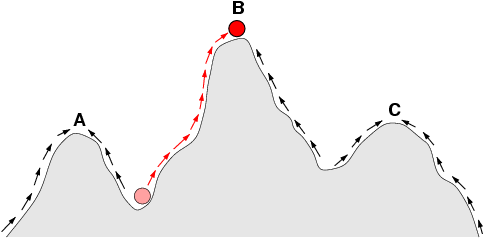
Algorithmic hill-climbing first requires a hill . .

[UD ID Founds Series, cf. Bartlett on IC]

Ever since Dawkins’ Mt Improbable analogy, a common argument of design objectors has been that such complex designs as we see in life forms can “easily” be achieved incrementally, by steps within plausible reach of chance processes, that are then stamped in by success, i.e. by hill-climbing. Success, measured by reproductive advantage and what used to be called “survival of the fittest.”

[Added, Oct 15, given a distractive strawmannisation problem in the thread of discussion:  NB: The wide context in view, plainly,  is the Dawkins Mt Improbable type hill climbing, which is broader than but related to particular algorithms that bear that label.]

Weasel’s “cumulative selection” algorithm (c. 1986/7) was the classic — and deeply flawed, even outright misleading — illustration of Dawkinsian evolutionary hill-climbing.

To stir fresh thought and break out of the all too common stale and predictable exchanges over such algorithms, let’s put on the table a key remark by Stanley and Lehman, in promoting their particular spin on evolutionary algorithms, Novelty Search:

. . . evolutionary search is usually driven by measuring how close the current candidate solution is to the objective. [ –> Metrics include ratio, interval, ordinal and nominal scales; this being at least ordinal] That measure then determines whether the candidate is rewarded (i.e. whether it will have offspring) or discarded. [ –> i.e. if further moderate variation does not improve, you have now reached the local peak after hill-climbing . . . ] In contrast, novelty search [which they propose] never measures progress at all. Rather, it simply rewards those individuals that are different.

Instead of aiming for the objective, novelty search looks for novelty; surprisingly, sometimes not looking for the goal in this way leads to finding the goal [–> notice, an admission of goal- directedness . . . ] more quickly and consistently. While it may sound strange, in some problems ignoring the goal outperforms looking for it. The reason for this phenomenon is that sometimes the intermediate steps to the goal do not resemble the goal itself. John Stuart Mill termed this source of confusion the “like-causes-like” fallacy. In such situations, rewarding resemblance to the goal does not respect the intermediate steps that lead to the goal, often causing search to fail . . . .

Although it is effective for solving some deceptive problems, novelty search is not just another approach to solving problems. A more general inspiration for novelty search is to create a better abstraction of how natural evolution discovers complexity. An ambitious goal of such research is to find an algorithm that can create an “explosion” of interesting complexity reminiscent of that found in natural evolution.

While we often assume that complexity growth in natural evolution is mostly a consequence of selection pressure from adaptive competition (i.e. the pressure for an organism to be better than its peers), biologists have shown that sometimes selection pressure can in fact inhibit innovation in evolution. Perhaps complexity in nature is not the result of optimizing fitness, but instead a byproduct of evolution’s drive to discover novel ways of life.

While their own spin is not without its particular problems in promoting their own school of thought — there is an unquestioned matter of factness about evolution doing this that is but little warranted by actual observed empirical facts at body-plan origins level, and it is by no means a given that “evolution” will reward mere novelty —  some pretty serious admissions against interest are made.

Now, since this “mysteriously” seems to be controversial in the comment thread below, courtesy Wikipedia, let us add [Sat, Oct 15] a look at a “typical” topology of a fitness landscape, noticing how there is an uphill slope all around it, i.e. we are looking at islands of function that lead uphill to local maxima by hill-climbing in the broad, Dawkinsian, cumulative steps up Mt Improbable sense:
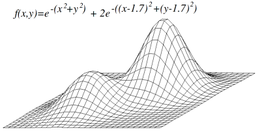
A “typical” fitness landscape, with local maxima, saddle and uphill trends

Now, too, right from the opening remarks in the clip, Stanley and Lehman acknowledge how targetted searches dominate the evolutionary algorithm field, a point often hotly denied by advocates of GA’s as good models of how evolution is said to have happened:

. . . evolutionary search is usually driven by measuring how close the current candidate solution is to the objective. [ –> i.e. if further moderate variation does not improve, you have now reached the local peak after hill-climbing . . . ] That measure  [ –> Metrics include ratio, interval, ordinal and nominal scales; this being at least ordinal] then determines whether the candidate is rewarded (i.e. whether it will have offspring) or discarded . . . .  in some problems ignoring the goal outperforms looking for it. The reason for this phenomenon is that sometimes the intermediate steps to the goal do not resemble the goal itself. John Stuart Mill termed this source of confusion the “like-causes-like” fallacy. In such situations, rewarding resemblance to the goal does not respect the intermediate steps that lead to the goal, often causing search to fail

We should also explicitly note what should be obvious, but is obviously not to many:  nice, trend-based uphill climbing in a situation where the authors of a program have loaded in a function with trends and peaks, is built-in goal-seeking behaviour (as the first illustration above shows).

Similarly, we see how the underlying assumption of a smoothly progressive Hill- Climbing trend to the goal is highly misleading in a world where there may be irreducibly complex outcomes, where the components, separately do not move you to the target of performance, but when suitably joined together we see an emergent result not predictable from projecting trend lines. (Of course, Stanley and Lehman tiptoe quietly around explicitly naming that explosive concept. But that is exactly what is at work in the case where “intermediate steps” do not lead to a goal: it is not “steps” but components that as a core cluster must all be present and must be organised in the right pattern to work together, to have the resulting function. Even something as common as a sentence tends to exhibit this pattern, and algorithm-implementing software is a special case of that. Think about how often a single error can trigger failure.)

The incrementalist claim, then, is by no means a sure thing to be presented with the usual ever so confident, breezily assured assertions that we hear ever so often. For, the fallacy of confident manner lurks.

Secondly, let us also note how the incrementalist objection actually implies a key admission or two.

For one, we can see that apparent design is a recognised fact of the world of life, i.e. as Dawkins acknowledges in opening remarks of his The Blind Watchmaker, 1986; as, Proponentist has raised in the current Free Thinker UD thread:

Biology is the study of complicated things that give the appearance of having been designed for a purpose.

Elsewhere, in River out of Eden (1995), as Proponentist also highlights, Dawkins adds:

The illusion of purpose is so powerful that biologists themselves use the assumption of good design as a working tool.

These two remarks underscore a point objectors to design thought are often loathe to acknowledge: namely, that Design Scientist, William Dembski is fundamentally right: significant increments in functionally specific complexity beyond a threshold by blind chance and/or mechanical necessity, are so improbable as to be effectively operationally impossible on the gamut of our observed universe.

Similarly, as Proponentist goes on to ask:

How does Mr. Dawkins know that something gives the appearance of design? Can his statement be tested scientifically?

Obviously, if Mr. Dawkins is correct, then he is talking about “evidence that design can be observed in nature” . . . . You can either observe design (of some kind) or not. If you can observe it, then you already distinguish it from non-design.

This is already a key point: as a routine matter, we recognise that — on a wealth of experience and observation — complex, functionally specific arrangements of parts towards a goal, are best explained as intentionally and intelligently chosen, composed or directed. That is, as designed.
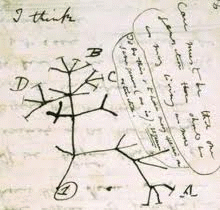
Darwin’s original sketch of his Tree of Life icon of Evolution

But, the onward Darwinist idea is that every instance of claimed design in the world of life can be reduced to a process of incremental changes that gradually accumulate from some primitive original self-replicating organism (and beyond that, original self replicating molecule or molecular cluster), through the iconic Darwinian tree of life — already, a consciously ironic switcheroo on the Biblical Tree of Life in Genesis and Revelation.

So, already, through the battling cultural icons, we know that much more than simply science is at stake here.

So also, we know to be on special guard against questionable worldview assumptions such as those promoted by Lewontin and so many others.

Now, too, Design objector Petrushka, has thrown down a rhetorical gauntlet in the current UD Freethinker thread:

One can accept the inference that a complex system didn’t arise in one step by chance without saying anything specific about its history.

The argument is about the specific history, not whether 500 or whatever bits of code arose purely by chance . . . . The word “design,” whether apparent or otherwise means nothing. It’s a smoke screen. The issue is whether known mechanisms can account for the history.

Words like “smoke screen” imply an unfortunate accusation of deception, and put a fairly stiff burden of proof on those who use them. Which — on fair comment — has not been met, and cannot be soundly met, as the accusation is simply false.

Similarly “purely by chance” is a strawman caricature.

One, that ducks the observed fact that there are exactly two observed sources of highly contingent outcomes: chance [e.g. what would happen by tossing a tray of dice] and intelligent arrangement [e.g. arranging the same tray of dice in a specific pattern]. Mechanical necessity [e.g. a dropped heavy object reliably falls at 9.8 m/s2 near earth’s surface] is not a source of high contingency. So, in the combination of blind chance and mechanical necessity, the highly contingent outcomes would be coming from the chance component.

Nevertheless, we need to show that “design” is most definitely not a meaningless or utterly confusing term, generally or in the context of the world of life.

That’s why I replied:

Design is itself a known, empirically observed, causal mechanism. Its specific methods may vary, but designs are as familiar as the composition of the above clipped sentences of ASCII text: purposeful arrangement of parts, towards a goal, and typically manifesting a coherence in light of that purpose.

The arrangement of 151 ASCII 128-state characters above as clipped [from the first part of the cite from Petrushka], is one of 1.544*10^318 possibilities for that many ASCII characters.

The Planck Time Quantum State resources of the observed universe, across its thermodynamically credible lifespan, 50 million times the time since the usual date for the big bang, could not take up as many as 1 in 10^150 of those possibilities. Translated into a one-straw sized sample, millions of cosmi comparable to the observed universe could be lurking in a haystack that big, and yet, a single cosmos full of PTQS’s sized sample would overwhelmingly be only likely to pick up a straw. (And, it takes about 10^30 PTQS’s for the fastest chemical interactions.)

It is indisputable that a coherent, contextually responsive sequence of ASCII characters in English — a definable zone of interest T, from which your case E above comes — is a tiny and unrepresentative sample of the space of possibilities for 151 ASCII characters, W.

We habitually and routinely know of just one cause that can credibly account for such a purposeful arrangement of ASCII characters in a string structure that fits into T: design. The other main known causal factors at this level — chance and/or necessity, without intelligent intervention — predictably would only throw out gibberish in creating strings of that length, even if you were to convert millions of cosmi the scope of our own observed one, into monkeys and world processors, with forests, banana plantations etc to support them.

In short, there is good reason to see that design is a true causal factor. One, rooted in intelligence and purpose, that makes purposeful arrangements of parts; which are often recognisable from the resulting functional specificity in the field of possibilities, joined to the degree of complexity involved.

As a practical matter, 500 – 1,000 bits of information-carrying capacity, is a good enough threshold for the relevant degree of complexity. Or, using the simplified chi metric at the lower end of that range:

Chi_500 = I*S – 500, in bits beyond the solar system threshold.

So, when we see the manifestation of FSCO/I, we do have a known, adequate mechanism, and ONLY one known, adequate mechanism. Design.

That is why FSCO/I is so good as an empirically detectable sign of design, even when we do not otherwise know the causal history of origin.

{Added: this can be expressed through the explanatory filter, applied per aspect of a phenomenon or process, allowing individual aspects best explained by mechanical necessity, chance and intelligence to be separated out, step by step in our analysis:

The (per aspect) Design Inference Explanatory Filter}

Do you really mean to demand of us that we believe that design by an intelligence with a purpose is not a known causal mechanism? If so, what then accounts for the PC you are using? The car you may drive, or the house or apartment etc. that you may live in?

Do you see how you have reduced your view to blatant, selectively hyperskeptical absurdity?

And, of course, the set of proteins and DNA for even the simplest living systems, is well beyond the FSCI threshold. 100,000 – 1 mn+ DNA bases is well beyond 1,000 bits of information carrying capacity.

Yes, that points to design as the best explanation of living systems in light of the known cause of FSCO/I. What’s new about that or outside the range of views of qualified and even eminent scientists across time and today?

Similarly, the incrementalist mechanism of blind chance and mechanical necessity through trial and error/success thesis has some stiff challenges to meet:

. . . the usual cases of claimed observed incremental creation of novel info beyond the FSCI threshold, as a general rule boil down to:

(a) targetted movements within an island of function, where the implicit, designed in information of a so-called fitness function of a well behaved type — trends help rather than lead to traps — is allowed to emerge step by step. (Genetic Algorithms are a classic of this.)

(b) The focus is made on a small part of the process, much like how if a monkey were to indeed type out a Shakespearean sonnet by random typing, there would now be a major search challenge to identify that this has happened, i.e. to find the case in the field of failed trials.

(c) We are discussing relatively minor adaptations of known functions, well beyond the FSCI threshold — hybridisation, or breaking down based on small mutations etc. For instance, antibiotic resistance, from a Design Theory view, must be recognised in light of the prior question: how do we get to a functioning bacterium based on coded DNA? (Somehow, the circularity of evolutionary materialism leads ever so many to fail to see that ability to adapt to niches and changes may well be a part of a robust design!)

(d) We see a gross exaggeration of the degree and kind of change involved, e.g. copying of existing info is not creation of new FSCI. A small change in a regulatory component of the genome that shifts how a gene is expressed, is a small change, not a jump in FSCI. Insertion of a viral DNA segment is creation of a copy and transfer to a new context, not innovation of information. Etc.

(e) We see circularity, e.g. the viral DNA is assumed to be of chance origin.

And so forth.

In short, some big questions were silently being begged all along in the discussions and promotions of genetic algorithms as reasonable analogies for body plan level evolution, and in the assertions that blind chance variations plus culling out of the less reproductively successful can account for complex functional organisation and associated information as we see in cell based life.

Let us therefore ask a key question about the state of actual observed evidence: has the suggested gradual emergence of life from an organic chemical stew in some warm little pond or a deep-sea volcano vent or a comet core or a moon of Jupiter, etc, been empirically warranted?

Nope, as the following recent exchange between Orgel and Shapiro will directly confirm — after eighty years of serious trying to substantiate Darwin’s warm little pond suggestion, neither the metabolism first nor the Genes/RNA first approaches work or are even promising:

[Shapiro:] RNA’s building blocks, nucleotides contain a sugar, a phosphate and one of four nitrogen-containing bases as sub-subunits. Thus, each RNA nucleotide contains 9 or 10 carbon atoms, numerous nitrogen and oxygen atoms and the phosphate group, all connected in a precise three-dimensional pattern . . . .  [[S]ome writers have presumed that all of life’s building could be formed with ease in Miller-type experiments and were present in meteorites and other extraterrestrial bodies. This is not the case.A careful examination of the results of the analysis of several meteorites led the scientists who conducted the work to a different conclusion: inanimate nature has a bias toward the formation of molecules made of fewer rather than greater numbers of carbon atoms, and thus shows no partiality in favor of creating the building blocks of our kind of life . . . .To rescue the RNA-first concept from this otherwise lethal defect, its advocates have created a discipline called prebiotic synthesis. They have attempted to show that RNA and its components can be prepared in their laboratories in a sequence of carefully controlled reactions, normally carried out in water at temperatures observed on Earth . . . .Unfortunately, neither chemists nor laboratories were present on the early Earth to produce RNA . . .
[Orgel:] If complex cycles analogous to metabolic cycles could have operated on the primitive Earth, before the appearance of enzymes or other informational polymers, many of the obstacles to the construction of a plausible scenario for the origin of life would disappear . . . .It must be recognized that assessment of the feasibility of any particular proposed prebiotic cycle must depend on arguments about chemical plausibility, rather than on a decision about logical possibility . . . few would believe that any assembly of minerals on the primitive Earth is likely to have promoted these syntheses in significant yield . . . .  Why should one believe that an ensemble of minerals that are capable of catalyzing each of the many steps of [[for instance] the reverse citric acid cycle was present anywhere on the primitive Earth [[8], or that the cycle mysteriously organized itself topographically on a metal sulfide surface [[6]? . . .  Theories of the origin of life based on metabolic cycles cannot be justified by the inadequacy of competing theories: they must stand on their own . . . .  The prebiotic syntheses that have been investigated experimentally almost always lead to the formation of complex mixtures. Proposed polymer replication schemes are unlikely to succeed except with reasonably pure input monomers. No solution of the origin-of-life problem will be possible until the gap between the two kinds of chemistry is closed. Simplification of product mixtures through the self-organization of organic reaction sequences, whether cyclic or not, would help enormously, as would the discovery of very simple replicating polymers. However, solutions offered by supporters of geneticist or metabolist scenarios that are dependent on “if pigs could fly” hypothetical chemistry are unlikely to help.  [[Emphases added.]

Of course, in the three or so years since (and despite occasional declarations to the contrary; whether in this blog or elsewhere . . . ), the case has simply not got any better. [If you doubt me, simply look for the Nobel Prize that has been awarded for the resolution of the OOL challenge in the past few years. To save time, let me give the answer: there simply is none.]

Bottomline: the proposed Darwinian Tree of Life has no tap-root.
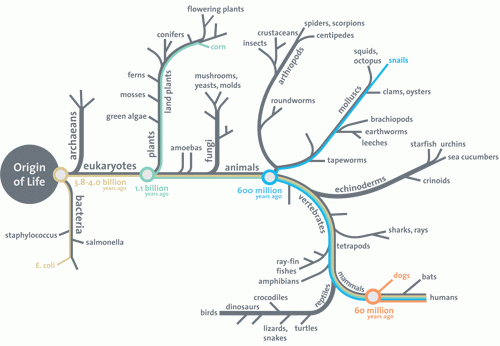
Modern presentation of the Darwinian Tree of Life — note the origin of life bubble at its root, which shows the pivotal importance of the root, the main trunk and branches

No roots, no shoots, and no branches.

[Cont’d. on  p. 2]

Comments
kf, if you are talking about how the first minimal Darwinian-capable self-replicator came about (OOL) - fine. Darwinian mechanisms can't explain the origins of a Darwinian-capable population. However, you seem to be saying that there are other islands, and that is what we dispute. Starting with a minimally functional population of self-replicators in an environment, replicating with variance, adaptation will tend to occur, as we see both in the field and the lab, and in simulations like AVIDA. These are not "hill-climbing" algorithms, and, as a result, are able to traverse a "rugged" landscape. So the "islands" argument is no longer relevant, once the Darwinian process has been initiated.Elizabeth Liddle
October 13, 2011
October
10
Oct
13
13
2011
12:26 PM
12
12
26
PM
PDT
Why can't Darwinist mechanisms explain body plans?Elizabeth Liddle
October 13, 2011
October
10
Oct
13
13
2011
12:22 PM
12
12
22
PM
PDT
Kelly: Please go look at the field of engineering, and ask yourself how important design is, and how important detection of designs on signs could be. Then, go look up key approaches such as TRIZ and reverse engineering. BTW, the conclusion that something was designed on tested reliable signs of design is an inference to best, abductive explanation argument, not a simple analogy. This pattern of reasoning happens to underlie both science and history -- and forensics. Think abouty the case of seeking the truth about the origins of our world of life and our cosmos that seems fine tuned for such life, then ask yourself what significance such could have. Gotta go now -- thankfully not on a ferry over 7 ft seas. Gotta get a son to a photographer so his pic can go on a local artists feature calendar. Later on. Maybe we can tempt StephenB out of hiding to address some of your questions, or VJT might have some interest. But for me, I'm off NOW. GEM of TKIkairosfocus
October 13, 2011
October
10
Oct
13
13
2011
12:04 PM
12
12
04
PM
PDT
Caveat: I am no biologist. What I know about fish is that it breathes in oxygen dissolved in water, right? If you are a biologist, perhaps you could tell me what happens to fish after it is taken out of water into fresh air.
It depends on whether the fish has the ability to breath air. Why not Google "air breathing fish" or "amphibious fish"?Petrushka
October 13, 2011
October
10
Oct
13
13
2011
11:47 AM
11
11
47
AM
PDT
KH: It is very important to bring out the insufficiency of Darwinist mechanisms to explain body plans, as the notion that blind chance and necessity driven incrementalism is good enough to explain the world of life has been entrenched to the point of being a quasi religious ideology. But, without adequate warrant. (Lewontinian, question-begging redefinitions of science do not count as good warrant; as Johnson pointed out -- cf. OP.)kairosfocus
October 13, 2011
October
10
Oct
13
13
2011
11:44 AM
11
11
44
AM
PDT
KF
And once design is on the table, it is also a good candidate to explain body plans for more complex organisms.
But how does "design" explain anything at all other then it allows you to say "the explanation for it's origin is that it was designed". It was designed because it appears to have been designed. It was designed because it shares features with other things that we know to be designed. But that's not an "explanation" at all, it's just changing the label.
is science about the imposition of a priori materialistic ideology a la Lewontin, or is it seriously committed to the exploration of the truth about our world insofar as we may discover it and find warrant, however provisional?
Whatever science is about I doubt it's about saying "the explanation for X is Design as Darwinism has never been observed creating X" and leaving it at that.kellyhomes
October 13, 2011
October
10
Oct
13
13
2011
11:41 AM
11
11
41
AM
PDT
5.1.1.1.8 Acipenser "Let's exam." Caveat: I am no biologist. What I know about fish is that it breathes in oxygen dissolved in water, right? If you are a biologist, perhaps you could tell me what happens to fish after it is taken out of water into fresh air. Maybe it is a stupid question, in which case you have to forgive my ignorance, but how come a chance sequence of infinitesimal changes can enable fish to start breathing in the air and decide to become something else, e.g. a pig? How exactly?Eugene S
October 13, 2011
October
10
Oct
13
13
2011
11:36 AM
11
11
36
AM
PDT
KF,
We have caught the designer in the act, through empirically tested reliable signs.
Hmm, that sounds more like fortune telling then science to me I'm afraid. What sort of signs? Red sky at night, that sort of thing?
The issue is that there has been a major attempt to deflect the significance of such signs of design, which has now plainly failed.
No, I'd really actually quite like to know what you can tell me about the origin of life. I understand that you are felling oppressed but that's neither here nor there with regard to the question.
It is always possible to move goal posts and demand more and more proofs to arbitrarily high standard — I once saw someone who wanted to demand in effect a direct video or observation of the deep past! — but that is not the material issue.
And I know somebody that even when they were presented with such video evidence they simply refused to believe what they were seeing and constructed an elaborate explanation as to why the video was not showing what it was plainly showing. The person viewing the video never latched on to it's true meaning. So even video evidence would not suffice for that sort of person. But luckily I'm not demanding that sort of evidence! In fact, I'm not asking for evidence at all, as such. Just for what you know about either the process of getting to the shorelines or the process where bodyplans are updated millions of times over millions of years. You don't even have to support it with evidence, not yet anyway! I'm just interested in what ID says rather then what ID says Darwinism is not.
That issue is that we have a field of deep past sciences of origins. Those sciences work by inferring on traces of the past in the present in light of known best-explanation causal factors on cases where we do directly observe the process in the present.
So it really just does boil down to "people design things, life was designed" then? Somewhat disappointing, to say the least! I can't say I've observed somebody designing life from scratch and then developing it gradually for millions of years over an entire planet. So I can't personally say I've directly observed such a case.
So, we start from what we can and should credibly know about the past on such terms, then we can go on to further issues of interest.
Actually, no, I'm interested in the detail and so far nothing has been said approaching any level of detail at all.
You will see that this whole series of posts is about that first stage, as thee is a plainly ideologically driven agenda of refusal to address the issues.
Ok, I get it, you won't spill the beans as that would spoil a later post you've got planned where you go into more detail on the OOL.kellyhomes
October 13, 2011
October
10
Oct
13
13
2011
11:35 AM
11
11
35
AM
PDT
Drs BOT & Liddle: Kindly observe the location of OOL in the TOL diagram just put up. Note from the OP, too that the pivotal issue in getting the observed vNSR based replicating cell, is an irreducibly complex, functionally specific, complex organised, code based info rich entity. Such plainly sits on an island of very specific function in a vast config space, relative to warm little ponds or whatnot. How you get from warm little ponds to the living cell, on observational evidence, without intelligence is a challenge. We know that intelligence can do the job, as Venter has given us proof of concept. On best explanation, in light of those observations and the analysis of config spaces and related statistical thermodynamics etc, the only plausible explanation -- hyperskeptical objectors notwithstanding -- is design. And once design is on the table, it is also a good candidate to explain body plans for more complex organisms. Which require even bigger increments of FSCI, dozens of times over, on earth. As to methods, designers have ever so many possible ways, which are secondary to the main input: smarts that allows bridging seas of non-functional configs, to reach islands of function. (An exploration of possible methods may be interesting and perhaps profitable, as in genetic engineering and nanomolecular engineering are significant possible fields.) But underneath all of this, is something even more important: is science about the imposition of a priori materialistic ideology a la Lewontin, or is it seriously committed to the exploration of the truth about our world insofar as we may discover it and find warrant, however provisional? If truth and integrity are key values to science, then the above is very, very important. (Just ask those who are beginning to feel the full impact of the climate-gate revelations.) If it is not, science is dead. Science as a branch of ideological politics and agendas, is simply yet another means of manipulation. (That is part of why I keep coming down so hard on Lewontin. Science, for the sake of civilisaitonal survival, has to break out of ideological, a priori materialism, etc.) And so, given how important science is, this stuff is important indeed. GEM of TKIkairosfocus
October 13, 2011
October
10
Oct
13
13
2011
11:34 AM
11
11
34
AM
PDT
I'm sure Upright will be happy to explain. He seems like a nice, pleasant chap to me!kellyhomes
October 13, 2011
October
10
Oct
13
13
2011
11:25 AM
11
11
25
AM
PDT
KH: We have caught the designer in the act, through empirically tested reliable signs. The issue is that there has been a major attempt to deflect the significance of such signs of design, which has now plainly failed. It is always possible to move goal posts and demand more and more proofs to arbitrarily high standard -- I once saw someone who wanted to demand in effect a direct video or observation of the deep past! -- but that is not the material issue. That issue is that we have a field of deep past sciences of origins. Those sciences work by inferring on traces of the past in the present in light of known best-explanation causal factors on cases where we do directly observe the process in the present. So, we start from what we can and should credibly know about the past on such terms, then we can go on to further issues of interest. You will see that this whole series of posts is about that first stage, as there is a plainly ideologically driven agenda of refusal to address the issues. Note what has been clipped from Lewontin -- and that can be multiplied. First things first, and not merely on a "for the sake of argument" basis. GEM of TKIkairosfocus
October 13, 2011
October
10
Oct
13
13
2011
11:19 AM
11
11
19
AM
PDT
Kairosfocus
In short, intelligent design is an empirically observed, known sufficient cause for systems with the characteristics of biological systems.
You say "in short" but is there actually any more to it then that? I'm very interested to hear what else you/ID have to say about how we got to the "shores of information". I read all the time about how people are doing research on self catalyzing systems, lipid membranes and so on and so forth. But here you are plainly stating that the biggest mystery of all has been solved, and for some time by the casual way you state it! So, if I may ask you to expand on that, what does ID tell us specifically about the origin of life? Presumably there is more to it then "it was designed" and that's what I want to hear! What can you tell me about this ultimate, first "cause"? Was it physical, as we'd understand it, or other? Any small detail would be more then I've managed to find so far here.kellyhomes
October 13, 2011
October
10
Oct
13
13
2011
11:18 AM
11
11
18
AM
PDT
Kellyholmes, "Yes you can" (have a fossil record of incremental genetic changes.) Okay, in Petrushka's example of mammalian inner ear evolution, what are the incremental genetic changes recorded in this record of incremental genetic changes? Produce the record, or do not call it a record of incremental changes.ScottAndrews
October 13, 2011
October
10
Oct
13
13
2011
11:17 AM
11
11
17
AM
PDT
Well, I'm certainly not sure what it was.Elizabeth Liddle
October 13, 2011
October
10
Oct
13
13
2011
11:14 AM
11
11
14
AM
PDT
Added a Darwinian TOL pic to show nodal root importance of OOL, whatever the rhetorical deflections may try to say. There is a Zoo shot, but not a good enough resolution.kairosfocus
October 13, 2011
October
10
Oct
13
13
2011
11:12 AM
11
11
12
AM
PDT
Thank you kairosfocus.
In computer science, hill climbing is a mathematical optimization technique which belongs to the family of local search. It is an iterative algorithm that starts with an arbitrary solution to a problem, then attempts to find a better solution by incrementally changing a single element of the solution. If the change produces a better solution, an incremental change is made to the new solution, repeating until no further improvements can be found . . . . Hill climbing is good for finding a local optimum (a solution that cannot be improved by considering a neighboring configuration) but it is not guaranteed to find the best possible solution (the global optimum) out of all possible solutions (the search space).
If this is what you mean by a "hill climbing algorithm" it is not the same thing as an evolutionary algorithm. Evolutionary algorithms are not restricted to upward steps. This means that they are far less likely to be trapped on a local optimum. Moreover, if there are multiple dimensions to the "landscape", as there are in many evolutionary algorithms, as indeed there are in nature, a population is far less likely to get stuck on a local optimum. Indeed, in any case, the population may split, with one part staying put, and another part crossing a valley to another peak. This is especially true if some kind of cross-over algorithm is implemented, as in sexual reproduction, so that bits of genome can propagate independently through the population. This is a really important point, because the criticisms leveled at hill-climbing algorithms simply do not apply to Darwinian algorithms, as we see from the AVIDA results, in which the function EQU repeatedly evolved via a path that traversed a deep fitness "valley".Elizabeth Liddle
October 13, 2011
October
10
Oct
13
13
2011
11:11 AM
11
11
11
AM
PDT
Yes Bot, the point went over your head. Don't sweat it.Upright BiPed
October 13, 2011
October
10
Oct
13
13
2011
11:11 AM
11
11
11
AM
PDT
ScottAndrews
You cannot have a fossil record of incremental genetic changes.
Yes, you can.
That, and the idea that evolution supposedly resulted in the exact same change numerous times convergently despite the fact that you try to mitigate the vast probability issues by reminding everyone that it has no specific target, should be enough to set everyone’s BS meters buzzing.
Perhaps something was common to all of the situations where these changes arose? Begins with an E? And there are only so many solutions available. And only 1 set of laws of physics. Joseph believes that there is a specific target to evolution, one that is programmed in. Programmed responses (targets) to environmental triggers (more targets). So given that it's understandable, even expected, that you'd get the 'exact same change numerous times convergently'. So, I think that Joseph's point answers your question neatly.kellyhomes
October 13, 2011
October
10
Oct
13
13
2011
11:09 AM
11
11
09
AM
PDT
They keep pulling me back in! Petrushka,
And yet we have a well preserved example of incremental changes leading to a major new function
No, no, no! In evolutionary terms, incremental changes are genetic. You cannot have a fossil record of incremental genetic changes. It I've said this before. If the hypothesis is change through incremental genetic changes, the test cannot be a series of possibly transitional fossils in which every step may consist of an unknown number of unidentified genetic changes, except that you don't even know whether they are part of a single transition and even if you did it's still beside the point. Please stop saying that the fossil record shows incremental changes. That, and the idea that evolution supposedly resulted in the exact same change numerous times convergently despite the fact that you try to mitigate the vast probability issues by reminding everyone that it has no specific target, should be enough to set everyone's BS meters buzzing.ScottAndrews
October 13, 2011
October
10
Oct
13
13
2011
11:00 AM
11
11
00
AM
PDT
KF
The issue primarily addressed by ID is getting to the shorelines of islands of complex, specific function.
Fascinating! And what does ID tell us about nothing less then the origin of life itself?
That Darwinian theory seems to crucially pivot on the opposite, incrementalism to create great complexity
So, let's take that as a given. Let's rule out Darwinian theory as an explanation for the diversity of life that we see around us both at the micro and macro level. A constantly changing diversity reflected in the fossil record everywhere on the planet for many millions of years. Billions, more, individual organisms. Trillions. So, even if we're only considering 'bodyplan level' and above it seems to me that a very large amount of near-constant changes are required to be made, given the insufficiently of Darwinian processes, in order to generate the observed diversity in the observed timescales. Given that I find it very odd that we've never 'caught the designer in the act'. A mistake, an early version of something too early in the fossil record. A tool mark. An empty gestation bottle, who knows. Given the number of interventions required once you rule out Darwin and his processes it's a remarkable state of affairs. So, anyway, if the issue primarily addressed by ID is getting to the shorelines of islands of complex, specific function then could you tell me about that explanation please, as all I've read so far is explanations of why Darwinism is insufficient.kellyhomes
October 13, 2011
October
10
Oct
13
13
2011
10:59 AM
10
10
59
AM
PDT
Venter et al have given proof of concept of design of biological self replicating systems by intelligent designers.
No he hasn't. Did he create a self replicating entity from the ground up? Nope, he re-engineered an existing one. You ask for direct observations of evolution, I ask for direct observations of the designer behind life designing - not of humans designing. Remember:
Advocates of such universal common descent by chance variation and fixation of new varieties by differential reproductive success, can make their case by simply showing how such Darwinian macroevolution at body plan level has actually been observed, rather than inferred ...
The same rules apply to you - I don't want an inference that life was designed because humans can design things, I want a direct observation of life being designed by the designer - because we can be pretty certain that Humans didn't design Humans.DrBot
October 13, 2011
October
10
Oct
13
13
2011
10:46 AM
10
10
46
AM
PDT
PS: I should note that I do not mean specific methods too precisely, but am describing the pattern of tossing out a bubble of fairly nearby variants -- per Darwinian approaches, through chance-driven, blind variation -- then cumulatively going uphill until a peak is reached.kairosfocus
October 13, 2011
October
10
Oct
13
13
2011
10:43 AM
10
10
43
AM
PDT
Dr Bot on ‘applying evolutionary thought to OOL’:
in which DrBot explains how evolution only applies to self replicators...
Dr Liddle on ‘OOL’:
In which Dr Liddle talks about self replicators ... Did you have a point?DrBot
October 13, 2011
October
10
Oct
13
13
2011
10:38 AM
10
10
38
AM
PDT
Joseph,
Yes I have programmed and used GAs to find solutions to encryption issues.
I find this very interesting. You mention that GAs have targets programmed in but I've never heard of a GA being used in relation to encryption, could you elaborate a little more? Have you published anything on this that you could refer me to perhaps? I know a little (a little little) about both fields, but obviously I'm missing something central.kellyhomes
October 13, 2011
October
10
Oct
13
13
2011
10:38 AM
10
10
38
AM
PDT
What are the mechanisms for air-breathing in fish? Do they require ‘huge changes’ or increments of tiny modifications?
Why not just look at modern amphibians? Or at modern fish that can survive out of water? I would say they illustrate the possibility of incremental adaptation.Petrushka
October 13, 2011
October
10
Oct
13
13
2011
10:33 AM
10
10
33
AM
PDT
What encryption issues exactly?
I repaired encryption devices in the Army. It strikes me that encryption would be a poster child for a landscape that wouldn't support cracking via GAs. Aside from simple substitution ciphers. Certainly no commercial or military ciphers.Petrushka
October 13, 2011
October
10
Oct
13
13
2011
10:26 AM
10
10
26
AM
PDT
"For example, I can’t see how from the classical Darwinist perspective sea creepy-crawlies could allegedly venture out without a major reorganisation as biosystems as a prerequisite to being fit for such a drastic change of habitat in the first place. Explaining such huge changes using incremental tiny modifications fixed by natural selection is simply not credible, nor, to my knowledge, is actually observed anywhere." Let's exam your presumptions a bit to see if they hold water. What are the mechanisms for air-breathing in fish? Do they require 'huge changes' or increments of tiny modifications?Acipenser
October 13, 2011
October
10
Oct
13
13
2011
10:25 AM
10
10
25
AM
PDT
Explaining such huge changes using incremental tiny modifications fixed by natural selection is simply not credible, nor, to my knowledge, is actually observed anywhere.
And yet we have a well preserved example of incremental changes leading to a major new function, the bones of the middle ear, adapting from sound transmitted through water to sound transmitted through air. Are you arguing that because we don't have videotape, it isn't observed? This is accomplished not by inventing new proteins or new genes, but by changes in gene expression. No different in principle from the changes from wolf to teacup poodle.Petrushka
October 13, 2011
October
10
Oct
13
13
2011
10:22 AM
10
10
22
AM
PDT
Dr Bot on 'applying evolutionary thought to OOL':
Yes, as we keep saying, and as every real scientist knows, evolution is a theory of what happens when you already function as a replicator ... When scientists study evolution they are studying the behavior of successive populations of replicators, they are NOT studying the origin of those replicators.
Dr Liddle on 'OOL':
And we don’t know, exactly, but what we do know is that any sequence that enhances the whole thing’s chances of self-replication will become more frequently represented in the population of self-replicators (logic dictates this), and so while we do not know the exact historical pathway by which these sequences came about, we can infer that in the proto-cell’s ancestry, certain sequences produced reproductively advantageous results.
Upright BiPed
October 13, 2011
October
10
Oct
13
13
2011
10:11 AM
10
10
11
AM
PDT
Yes I have programmed and used GAs to find solutions to encryption issues.
What encryption issues exactly? It sounds like an interesting project, I'm not aware of GA's being used in encryption at all. Can you tell us more?DrBot
October 13, 2011
October
10
Oct
13
13
2011
10:08 AM
10
10
08
AM
PDT
1 2 3 4 5 6 8

Leave a Reply