Uncommon Descent Serving The Intelligent Design Community

Logic and First Principles, 13: The challenge of creeping scientism (and of linked nominalism)

Categories
Atheism
Epistemology
Evolutionary Incoherence
Fine tuning
Intelligent Design
Logic and Reason
Mathematics
Share
Facebook
Twitter/X
LinkedIn
Flipboard
Print
Email

There is a creeping scientism in our intellectual climate.

We have been led to think that Science is the gold standard of reliable, substantial knowledge and that institutional science and its leaders are the curators of knowledge. This is of course deeply connected to the wider domination of evolutionary materialistic scientism, which compounds the above with the notion that the stuff studied by the physical and chemical sciences is effectively the limit of credibly, reliably knowable reality.

Where, let us note that scientism is a part of the defining cluster of naturalism, in both its metaphysical and “methodological” guises. We can readily see that in that ever so humble source, Wikipedia, speaking confidently and comfortably on its own philosophical bent:

“Naturalism can intuitively be separated into an ontological and a methodological component,” argues David Papineau.[3] “Ontological” refers to the philosophical study of the nature of being. Some philosophers equate naturalism with materialism. For example, philosopher Paul Kurtz argues that nature is best accounted for by reference to material principles. These principles include mass, energy, and other physical and chemical properties accepted by the scientific community. Further, this sense of naturalism holds that spirits, deities, and ghosts are not real and that there is no “purpose” in nature. Such an absolute belief in naturalism is commonly referred to as metaphysical naturalism.[4]

Assuming naturalism in working methods as the current paradigm, without the further consideration of naturalism as an absolute truth with philosophical entailment [–> as in, let’s keep it implicit], is called methodological naturalism.[5] The subject matter here is a philosophy of acquiring knowledge based on an assumed paradigm.

Notice, the latter point, suitably highlighted: “[T] he subject matter here is a philosophy of acquiring knowledge based on an assumed paradigm.”

Telling.

But, in fact, all of this is ill-informed.

Science, insofar as it creates large scale explanatory constructs, is inherently unable to rise to the first level of responsible certainty, moral certainty. That is, theories and models are inherently highly provisional and are subject to correction or replacement based on logical critique or empirical observations. That’s why we talk about paradigm shifts and scientific revolutions. Today’s dominant school of thought can become tomorrow’s dead theory, often one funeral at a time.

Scientific observations of course can indeed be morally certain, but that is if they are the testimony of reliable witnesses, not because they are scientific. This is part of why observations test and can overthrow theories. Models don’t even aspire to the possibility of truth, they only hope to give good enough results in some domain of practice or other.

So, too, we can see that the tendency to view for instance Mathematics as a Science in the modern sense, is ill-founded. Core mathematical facts and necessary realities are necessary truths or entities, they are far more strongly warranted than scientific frameworks or even observations.

Similarly, nominalism (especially as regards mathematics) is questionable. It is of course the default view of most mathematical practitioners that the substance of their practice is embedded in reality, is somehow real although abstract so that core mathematical entities and their properties are discovered rather than invented, notably if one makes a paper mobius strip and cuts it around in the centre vs 1/3 way across, one gets a dramatically different result. And again, those contrast with cutting around an ordinary cylindrical loop of paper. There are many, many other cases.

This has been challenged by nominalists, who tend to dismiss the reality of abstracta, or to hold that abstraction is “merely” a concept we form to collect phenomena we perceive as somehow related, in effect a form of words. Some would hold that the reality of mathematical entities is that we hold them in our minds (whatever such minds are and however they arise). In this context, axiomatisations then effectively determine mathematical truth as what comes from successful axioms, as we play the collective intellectual game we term Mathematics. Thus the study of the logic of structure and quantity is the focus, the notion that there is a substantial body of discoverable substance independent of our culturally influenced thought and invention is deprecated or even dismissed. As the Standford Encyclopedia of Philosophy outlines:

Nominalism about mathematics (or mathematical nominalism) is the view according to which either mathematical objects, relations, and structures do not exist at all, or they do not exist as abstract objects (they are neither located in space-time nor do they have causal powers). In the latter case, some suitable concrete replacement for mathematical objects is provided. Broadly speaking, there are two forms of mathematical nominalism: those views that require the reformulation of mathematical (or scientific) theories in order to avoid the commitment to mathematical objects (e.g., Field 1980; Hellman 1989), and those views that do not reformulate mathematical or scientific theories and offer instead an account of how no commitment to mathematical objects is involved when these theories are used (e.g., Azzouni 2004) . . . .


In ontological discussions about mathematics, two views are prominent. According to platonism, mathematical objects (as well as mathematical relations and structures) exist and are abstract; that is, they are not located in space and time and have no causal connection with us. Although this characterization of abstract objects is purely negative—indicating what such objects are not—in the context of mathematics it captures the crucial features the objects in questions are supposed to have. According to nominalism, mathematical objects (including, henceforth, mathematical relations and structures) do not exist, or at least they need not be taken to exist for us to make sense of mathematics. So, it is the nominalist’s burden to show how to interpret mathematics without the commitment to the existence of mathematical objects.

Such nominalism, however, is problematic. In a sense, such is unsurprising, all philosophically tinged schools of thought bristle with difficulties so that a key method of philosophy is comparative difficulties. However, it is arguable that in mathematics, nominalism goes a bridge too far. We can readily see that the results of making and cutting paper loops in particular ways are independent of our views, understanding, axiom systems and the like. In fact, if an axiom system would contradict the facts of structure and quantity we see on the ground, it would be severely challenged as unrealistic and likely irrelevant. More could be said, but enough is on the table that we can see why so many practitioners are firmly convinced that there is a discoverable substance of structure and quantity that is there, albeit not concrete. There is no mental or technological tool or instrument that would allow us to spy out a realm where we find a repository holding for example THE null set.

And we already see by the above, that the domain that studies degree of warrant, reliability and certainty of knowledge claims is not science, but philosophy. This is part of the task of Epistemology, one of its branches.

So, first, we must recognise the limitations of science and that the ideology of evolutionary materialistic scientism is self referentially incoherent (as Rosenberg so aptly but inadvertently demonstrates) and necessarily false. The self-refuting is logically falsified. It is worth quoting Rosenberg in his own voice, as a reminder:

Alex Rosenberg as he begins Ch 9 of his The Atheist’s Guide to Reality:

>> FOR SOLID EVOLUTIONARY REASONS, WE’VE BEEN tricked into looking at life from the inside. Without scientism, we look at life from the inside, from the first-person POV (OMG, you don’t know what a POV is?—a “point of view”). The first person is the subject, the audience, the viewer of subjective experience, the self in the mind. Scientism shows that the first-person POV is an illusion. [–> grand delusion is let loose in utter self referential incoherence] Even after scientism convinces us, we’ll continue to stick with the first person. But at least we’ll know that it’s another illusion of introspection and we’ll stop taking it seriously. We’ll give up all the answers to the persistent questions about free will, the self, the soul, and the meaning of life that the illusion generates [–> bye bye to responsible, rational freedom on these presuppositions]. The physical facts fix all the facts. [–> asserts materialism, leading to . . . ] The mind is the brain. It has to be physical and it can’t be anything else, since thinking, feeling, and perceiving are physical process—in particular, input/output processes—going on in the brain. We [–> at this point, what “we,” apart from “we delusions”?] can be sure of a great deal about how the brain works because the physical facts fix all the facts about the brain. The fact that the mind is the brain guarantees that there is no free will. It rules out any purposes or designs organizing our actions or our lives [–> thus rational thought and responsible freedom]. It excludes the very possibility of enduring persons, selves, or souls that exist after death or for that matter while we live.>>

Next, we must recognise that without people, there is no science. People, able to think rationally, responsibly and with significant freedom, a freedom that is morally governed by duty to truth, right reason, prudence, fairness etc. That is, we see here that it is inescapably true that we have minds of our own, minds that are utterly transcendent relative to what blindly mechanical and/or stochastic GIGO-limited, computing on a computational substrate, its organisation and software can do. Computers are refined, organised rocks and they have no dreams; rational, reflective, active, contemplative thought is beyond such. Even a profoundly deluded mind rises above mechanistic and/or stochastic computation, through self-awareness:
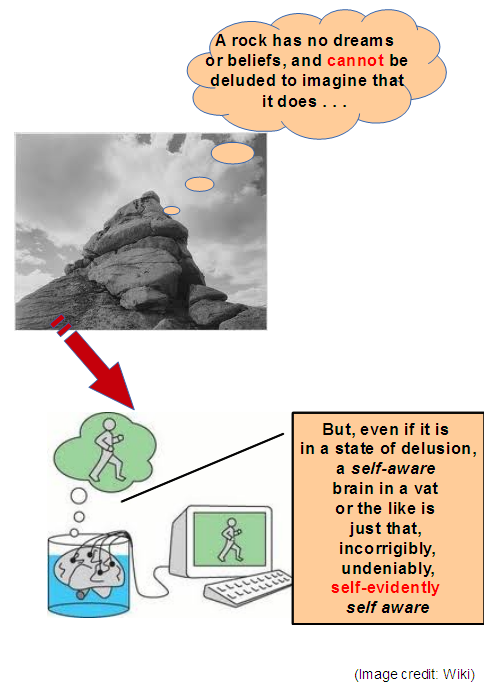
Thus, as reasoning we have reason to take seriously the view that the brain is an interface, not the de-limiting computational substrate. The Smith, two-tier controller cybernetic bio-bot model can help us catch a glimpse of how that might be:
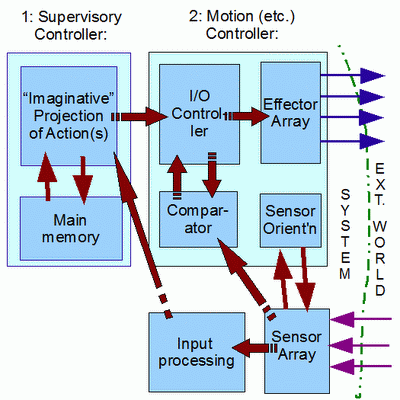
The Derek Smith two-tier controller cybernetic model

We therefore look at other philosophical issues, recognising that just to reason, we face the inescapable truth that we must have minds of our own, minds that have properties drastically different from those of dynamic-stochastic systems including computational substrates. Reppert, aptly summarised:

[L]et us suppose that brain state A [–> notice, state of a wetware, electrochemically operated computational substrate], which is token identical to the thought that all men are mortal, and brain state B, which is token identical to the thought that Socrates is a man, together cause the belief [–> concious, perceptual state or disposition] that Socrates is mortal. It isn’t enough for rational inference that these events be those beliefs, it is also necessary that the causal transaction be in virtue of the content of those thoughts . . . [But] if naturalism is true, then the propositional content is irrelevant to the causal transaction that produces the conclusion, and [so] we do not have a case of rational inference. In rational inference, as Lewis puts it, one thought causes another thought not by being, but by being seen to be, the ground for it. But causal transactions in the brain occur in virtue of the brain’s being in a particular type of state that is relevant to physical causal transactions.

Recall, our ability to be responsibly, freely rational is antecedent to science and is a condition we must implicitly accept just to credibly do scientific and linked mathematical reasoning. Therefore, it is not explanatorily empty to accept on reasoned reflection that we have reason to accept that mind reflects an order of reality that transcends the picture painted by scientism or by evolutionary materialism.

So, we now look at questions from another branch of core philosophy, the logic of being, i.e. ontology, a sub-discipline of metaphysics which studies being. What sort of thing must mind be to have the properties that are inescapable if we are to have a consensus-building community of rational, credible discussion?

We find that conscious, self-aware, reflective, volitional, conscience guided, more or less intelligent, rationally and morally governed mind is our first fact; the fact through which we process others. So, such things are inescapably certain, in many ways.

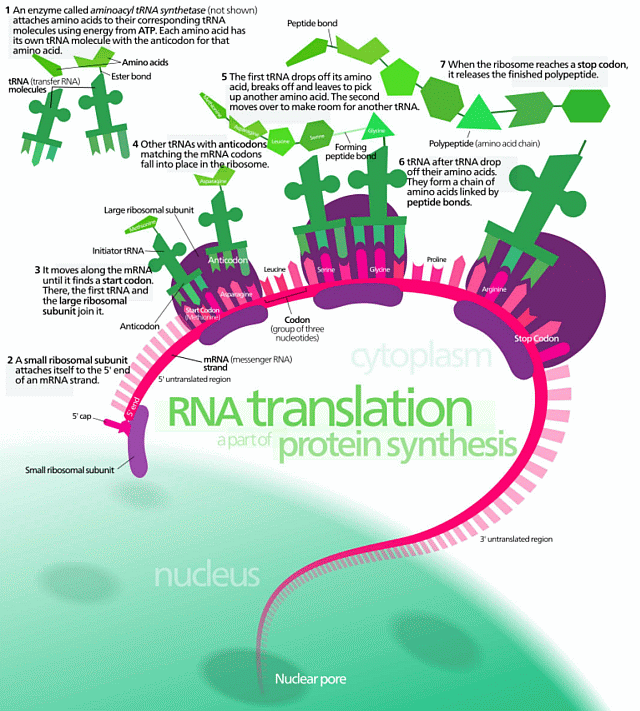
Where also, one of the empirical observations we make, is that design exists and often has in it highly reliable signs of intelligent, purposeful design that we may observe. Where also as contingent creatures, we cannot delimit possible intelligences. So, we know that where we see reliable signs of design, we are warranted to infer that as best explanation, indeed, as a scientific inference, that intelligently directed configuration — design — is a material causal factor. In the world of life, this immediately comes out when we notice the genetic code and its role in protein synthesis.

Code:
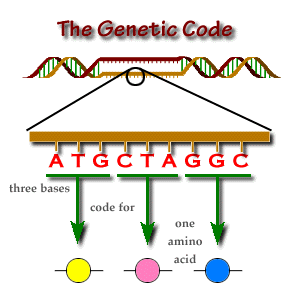
The Genetic Code in action

Synthesis:

Protein Synthesis (HT: Wiki Media)

Going further, the observed cosmos and its physics are pervaded with fine tuning, a strong sign of design. Where also atomic matter and the mathematics of cosmology point to contingency of being. As Luke Barnes summarises:
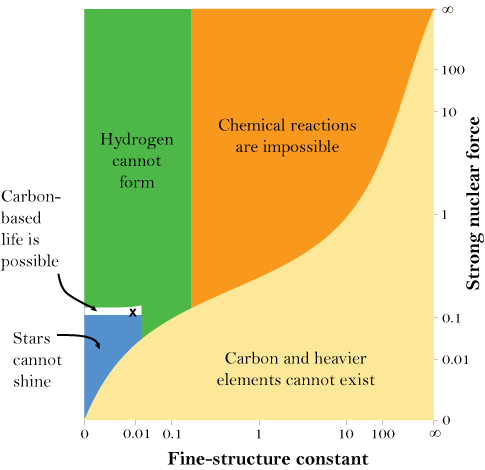
Barnes: “What if we tweaked just two of the fundamental constants? This figure shows what the universe would look like if the strength of the strong nuclear force (which holds atoms together) and the value of the fine-structure constant (which represents the strength of the electromagnetic force between elementary particles) were higher or lower than they are in this universe. The small, white sliver represents where life can use all the complexity of chemistry and the energy of stars. Within that region, the small “x” marks the spot where those constants are set in our own universe.” (HT: New Atlantis)

We need a deeper root of reality than the physical world we inhabit. One that can accommodate designers.

This is pointing to mind as antecedent to matter.

Also, as we are minded, embodied, contingent, morally governed creatures, we see that the roots of reality reflect properties of mindedness (intelligence, purpose, creative synthesis are components of designing) AND moral properties. This points to mind that is of moral character sufficient to ground our moral government. All of this is reasoned thought, not empty, woolly speculation on culturally available myths.

Evolutionary materialistic scientism (aka Naturalism) and its fellow travellers, simply cannot sufficiently address what we face in confronting and trying to understand reality. We need a fresh start as a civilisation. END

Comments
quote Kairosfocus "When it comes to the fact of self-aware agency," Yeah you read nothing of what I wrote, or you had cognitive dissonance reading what I wrote. You don't really need to read what I wrote, you just need to look at how subjective words are used in common discourse. All subjectivity applies to agency, all. For you to assert agency as fact, that is the same as stating as fact that a painting is beautiful. It is a category error. Fact belongs in the creation category, not the creator category. Now if you have investigated how subjectivity works in common discourse, and you have found it works differently as I say, only then do you have a counterargument. Your ideas about mathematics I find curious. Mathematics properly understood is the theory of everything. Every material thing, creation in it's entirety. Ofcourse the weasel words here are "properly understood", which I don't know. But it would basically involve deriving all mathematics, including the mathematical operators, from the symbol zero. And mathematics so properly ordered in relation to the zero, then the main laws of the universe would appear in the main structure of mathematics. That leaves empericism for finding out what choices have been made outside of the main structure.mohammadnursyamsu
March 6, 2019
March
03
Mar
6
06
2019
10:52 PM
10
10
52
PM
PDT
HN42, yes, there are many levels of error in the view Wikipedia summarised. However, it is easy to be blind to such. Where, if one makes a crooked yardstick one's standard for straightness, accuracy, uprightness etc, what is genuinely such will be rejected. That's the point of no 12 in the series, which is still a live discussion. KFkairosfocus
March 6, 2019
March
03
Mar
6
06
2019
09:33 PM
9
09
33
PM
PDT
MNY, actually -- and as the OP points out -- Scientism turns the methods and limitations of science into an inappropriate gold standard for creation and curation of knowledge. A good way to see this is through the concept that science and its methods delimit knowledge or credible knowledge. This is actually an epistemological claim, which is immediately self-referentially incoherent -- epistemology is a main branch of philosophy. Going beyond, our knowledge of our day to day, self aware life (through which we access other knowledge) is not scientific. History is not scientific. Mathematics is not a science, nor does it work by the empirical methods of science. And more. As was also noted, theoretical, explanatory structures of science are subject to the so-called pessimistic induction: the track record of overturned or radically modified theories is such that today's theories cannot even be morally certain, though we may have good reason in many cases to treat them as models validated for empirical reliability in many cases across some range of testing. That's before we get to peer review, replicability and ideologisation challenges. When it comes to the fact of self-aware agency, that is something you are directly and incorrigibly aware of for yourself, and which we mutually infer to extremely high confidence for others like ourselves. Where, without responsible, rational freedom and thus real choice, the entire intellectual enterprise collapses -- we must be free to follow the logic, not merely playing out GIGO-limited programming and/or statistical noise. Where also, subjectivity does not imply, delusional, or again our thought world collapses. The point of objectivity of warrant is transparency and cross checking, not that what we perceive or think internally is automatically suspect. As for the spiritual domain, there is enough evidence to take it seriously, although that is beyond the normal range for UD. KFkairosfocus
March 6, 2019
March
03
Mar
6
06
2019
09:30 PM
9
09
30
PM
PDT
quote Harry "And there is much evidence that indicates that there must be supernatural realities that transcend nature other than the evidence that indicates that the emergence of life required a supernatural intelligent designer." It is again misleading to talk about "evidence" of the supernatural. The whole point of the spiritual domain is subjectivity. That is what makes the spiritual domain distinct from the material domain. Chosen opinions apply to the spiritual, and facts forced by evidence apply to the material. Why does nobody just look at how subjective words are used in common discourse? Words like nice, beautiful, ugly, hate, etc. They are used by choice, and express what it is that makes a choice. Subjectivity is simpler than the rules of tic tac toe, yet people don't look at what is right in front of them. What they already know intuitively. They just refuse to look at what logic they use every single day of their life. Look, just look.mohammadnursyamsu
March 6, 2019
March
03
Mar
6
06
2019
08:57 PM
8
08
57
PM
PDT
"A philosophy of acquiring knowledge based on an assumed paradigm." That's a contradiction of terms. Any assertion that depends on an assumption is not knowledge.hnorman42
March 6, 2019
March
03
Mar
6
06
2019
08:41 PM
8
08
41
PM
PDT
quote "We find that conscious, self-aware, reflective, volitional, conscience guided, more or less intelligent, rationally and morally governed mind is our first fact; the fact through which we process others. So, such things are inescapably certain, in many ways." quote" All of this is reasoned thought, not empty, woolly speculation on culturally available myths." Making every issue factual is what scientism does. So it looks like the OP supports scientism, just not evolutionary scientism. It can in principle be demonstrated as fact that a choice has been made. Then there is the question of what the agency of that choice was. And that question can only be answered with a chosen opinion. If you look at how subjective words are used in common discourse, like the word beautiful, all subjective words use the logic that they are used by choice, and express what it is that makes a choice. I find it outrageous that a creationist doesn't even know how subjectivity works. Oh well. The reason one cannot obtain any facts whatsoever about what the agency of a choice was, is because facts use the logic of being forced. Facts are FORCED by evidence. So when you assert a fact about what the agency of a choice was, then you are putting the logic of being forced right in the center of the concept of choosing. That results in a logic error of contradiction between freedom and force. It breaks down the concept of choice.mohammadnursyamsu
March 6, 2019
March
03
Mar
6
06
2019
08:32 PM
8
08
32
PM
PDT
Harry, In the case of DNA, we recognise that it is alphanumerically coded, complex, algorithmically functional information. Such manifests language, in a particular application. All of these are strong signs of intelligent, purposeful source. That is so even though we may not know just how such can be done. Though, we do know from Venter et al, that genes can be engineered by dint of our actually doing so. There is even a protest movement against this. What has been observed is that such FSCO/I has been observed as caused on trillions of cases, and always, it is by intelligent action. It has never been observed to come about by blind chance and/or mechanical necessity, and we have good reason to hold that for complexity beyond 500 - 1,000 bits, search resources on the scope of our solar system to the observed cosmos are grossly inadequate and implausible. Where, we must recall, such is part of a self-replicating automaton, the cell. From von Neumann, 1948 we can see conceptually how that can work, but this is a class of machine we have not yet been able to achieve. You are right that an ideology has been imposed, though not all of its adherents are atheists. The implicit nature of evolutionary materialistic scientism in its methodological guise, is able to do that. You are correct that what has a beginning demonstrates contingency and so is caused, that is part of the logic of being. Yes, from non-being (a true nothing) we can have no cause as there is nothing there to be a cause. Likewise circular causation and infinite regress of finite stages are dubious. Given the sort of fine tuning we see, we are looking at finitely remote intelligent cosmos-building cause as best explanation. Which is utterly unwelcome in many quarters. I am not so sure that theism needs to be substituted, but at minimum, willingness to acknowledge that where there are signs of intelligent cause, we should be willing to face that. KF PS: It is almost amusing to see the side-tracked exchanges above. Yes, the Quantum view prevailed c 1905 - 1930, though it is utterly challenging to us to make full sense of it to this day. It is possible that this view accounts for ways in which mind-body interfaces happen. We do not need to belittle anyone to correct error, or recognise it -- and Rosenberg vs Reppert in the OP speaks volumes on the merits. It would be interesting to see an actual substantial engagement.kairosfocus
March 6, 2019
March
03
Mar
6
06
2019
06:44 PM
6
06
44
PM
PDT
Materialistic Scientism Is Fundamentally Irrational In order to demonstrate how a given instance of functional complexity might come about mindlessly and accidentally, one must first know how to create it intentionally. Then, one can at least begin to explain how the required steps in the functional-complexity-assembling procedure might, over enough time, happen mindlessly, accidentally, and in the necessary sequence, through some combination of chance and the laws of physics. So, until science knows how to create life – an instance of massive functional complexity – from scratch, they are in no position to insist that it came about mindlessly and accidentally over any amount of time. How can they just assume that it did? They can't. Not rationally. It seems that significant functional complexity, certainly when its construction is directed by massive quantities of extremely precise digital information like that found in life's DNA, is simply beyond the capacity of time, chance and the laws of physics to produce. If that were possible there would be naturally occurring phenomena that exhibit digital information-based functional complexity comparable to that of life. There isn't even one such natural phenomenon. So on what basis does science insist that life came about mindlessly and accidentally? There is no rational basis for that assumption whatsoever. Every instance known to us of significant functional complexity (other than that found in life), the construction of which was directed by digitally stored information, came about with intelligent agency as causal factor in its emergence. Every single one. There is simply no reason whatsoever to believe that digital information-based functional complexity can be arrived at mindlessly and accidentally. So why does science insist on this irrational assumption? It has been perverted by atheism, which denies the existence of realities outside the natural realm (in particular a supernatural, intelligent designer of life). Atheism insists on this without any rational reason to believe that there are no such realities. Ask an atheist exactly why can't there be realities outside of the realm of the natural. You will find that they have no idea. So how can they be so sure that that is the case? They can't. And there is much evidence that indicates that there must be supernatural realities that transcend nature other than the evidence that indicates that the emergence of life required a supernatural intelligent designer. For example, it is now the consensus of modern science that the natural Universe – time, space, matter and energy – had a beginning. Everything that begins to exist has a cause; of that we can be sure. Yet from nothing (nothing in terms of the absence of time, space, matter and energy), nothing comes; of that we can also be sure. This means that the Universe must have been caused by a reality outside of the natural realm – a supernatural reality. The natural Universe's cause couldn't have been a natural reality because natural realities are what began to exist. The natural Universe came into being, caused by nothing natural, but by a supernatural reality. Atheism has perverted science. Contemporary science needs to return to its theistic foundation, namely, that nature's intelligibility is what makes science possible, and that its intelligibility is due to its Intelligent Author.harry
March 6, 2019
March
03
Mar
6
06
2019
06:00 PM
6
06
00
PM
PDT
AaronS1978, I couldn’t have said it better. I have always found that those who feel it necessary to belittle theists, or atheists, or materialist, or creationists, or Darwininist, have very little of value to listen to. Atheism and theism are not the problem. Absolutism is.Brother Brian
March 6, 2019
March
03
Mar
6
06
2019
02:45 PM
2
02
45
PM
PDT
Unfortunately creationists do not comprehend creationism. Allow me to explain creationism. 1. Creator, chooses, spiritual, existence of which is a matter of chosen opinion 2. Creation, chosen, material, existence of which is a matter of fact forced by evidence All science would be in category number two. All subjectivity belongs in category number one. Creationism is the only philosophy which validates bot subjective opinion, and objective fact, each in their own right. Choice is the mechanism of creation, how any material thing originates. If I say "I find this painting beautiful", then the word "beautiful" is chosen by spontaneous expression of emotion with free will. I could have chosen the word "ugly", which would have been an equally logically valid opinion. The word "beautiful" refers to a love for the way the painting looks. Out of this love the word "beautiful" was chosen. The existence of this love is therefore a matter of chosen opinion, meaning it is equally logically valid to choose the opinion my love for the way the painting looks is not real, as to choose the opinion that it is real. A subjective statement like about beauty, addresses human beings as being creators. As having free will and choosing. Emotions, like love, are motivation to choices, they make choices, and therefore they belong in category number one, the creator category. Both God and the soul are defined in terms of that they make choices, which is why they belong in category number one, and therefore the rules of subjectivity apply to God and the soul. This is why the existence of God is a matter of faith, which faith is a form of chosen opinion. A fact is obtained by evidence of a creation forcing to produce a 1 to 1 corresponding model of it. If I say the moon is a sphere, then those words provide a 1 to 1 corresponding picture of the moon. If I say the moon is a cube, then the picture does not correspond, and therefore the stated fact is inaccurate. I guess many believers are led astray by not comprehending creationism. In the schoolbook for the Hitler Youth it talks about the spirit, and soul attributes of people. How nice, they recognize spirit and the soul, must be good people these nazi's. But they acknowledged spirit and soul as matters of FACT of biology. Meaning nazi's have a measuring calculating attititude in regards to the worth of people, the attitude that is appropiate for factual issues. How many creationists today would fall for the ruse of nazi's acknowledging the spirit and soul? Too many.mohammadnursyamsu
March 6, 2019
March
03
Mar
6
06
2019
01:59 PM
1
01
59
PM
PDT
You are right Hazel, But I think I speak for every class when it is the ignorant loudmouth Proselytizers of any religious movement or movement for that matter that everybody remembers It has been my experience that the ones with the biggest mouthes are usually the ones that are the least educated. I have unfortunately had a long history of encountering people like that and they are often Atheist. However I do not rattle all atheists into that category. I have many friends that are atheist but they aren’t anti theist. It is the anti theist that sets the image for atheist to look that way, no differently than the crazy religious zealot seems to be the image for all religious people. It is actually a very sad course of affairs. Muslims always jihad, christians are always the Westborough Baptist Church, All atheists are Richard Dawkins. These people all think they’re solving problems but they’re the ones creating every one of them, it’s a vicious little cycle and that’s why people react the way they do. But this is my honest and humble opinionAaronS1978
March 6, 2019
March
03
Mar
6
06
2019
01:45 PM
1
01
45
PM
PDT
As I have said before, no one conversant with modern physics, be they atheists or theists or something else, believes in the "‘Lego’-style, classical, physical paradigm" anymore, and haven't for decades.hazel
March 6, 2019
March
03
Mar
6
06
2019
12:14 PM
12
12
14
PM
PDT
Science left atheists and their 'Lego'-style, classical, physical paradigm, toiling in its wake, with the first discovery of a paradox/mystery ; more than 80 years ago. Go back to sleep, atheists. You are parasites. By definition paradoxes are imponderable. Get over it and onto the grown-ups' quantum paradigm, before you are permanently humiiliated. Yes we know you have to defer to it to make your living, along with the scientists properly so-called.Axel
March 6, 2019
March
03
Mar
6
06
2019
11:46 AM
11
11
46
AM
PDT
Logic and First Principles, 13: The challenge of creeping scientism (and of linked nominalism)kairosfocus
March 6, 2019
March
03
Mar
6
06
2019
05:34 AM
5
05
34
AM
PDT
1 2