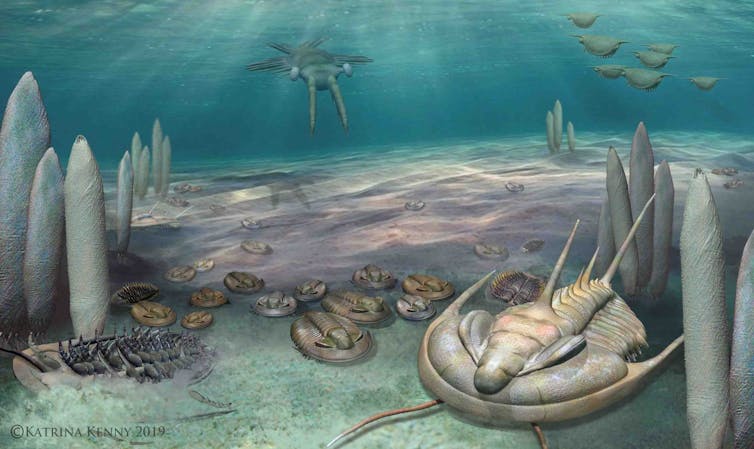
Cambrian seascape off South Australia/Katrina Kenny, (CC BY-NC-ND)
The explosion lasted only about 20 million years, their research shows, and the subsequent 520 million years featured more even rates of change:
At (or shortly before) the start of the Cambrian Period (541 million years ago), modern animals evolved. They rapidly diversified into all the major groups (phyla) of animals we see today, such as jellyfish and corals, segmented worms (such as earthworms),
molluscs (such as snails), arthropods (such as crabs), and even vertebrates (backboned animals, which eventually included ourselves)…If modern animals first evolved at the very beginning of the Cambrian, then their global adaptive radiation took a mere 20 million years. While this is still substantial, it represents only 0.5% of the 3.5-billion-year history of life on Earth: a surprisingly brief interval to fill the Earth with body plans as disparate as starfish, snails, shrimps
and fish.Mike Lee, Greg Edgecombe, and John Paterson, “Life quickly finds a way: the surprisingly swift end to evolution’s big bang” at The Conversation
If it took only .5% of the history of life for all those types of life forms to evolve, we need a new term for that type of evolution. How
Yes! It makes sense to call Lee, Edgecombe, and Paterson creationists. Look, it’s okay. We’ll share.
See also: Researchers: Ediacaran To Cambrian Transition Took “Less Than 410,000 Years” (Look! More creationists! It’s getting crowded in here… )
and
Explanations for the Cambrian explosion (scads of theories as to how it happened)
Follow UD News