Uncommon Descent Serving The Intelligent Design Community

Should we recognise that “laws of nature” extend to laws of our human nature? (Which, would then frame civil law.)

Categories
Academic Freedom
Control vs Anarchy
Defending our Civilization
Laws
Lessons of History
Logic and Reason
Share
Facebook
Twitter/X
LinkedIn
Flipboard
Print
Email

Laws of Nature are a key part of the foundation of modern science. This reflects not only natural, law-like regularities such as the Law of Gravitation that promotes the Earth to the heavens (from being the sump of the cosmos) but also the perspective of many founders that they were thinking God’s creative, ordering providential and world-sustaining thoughts after him. The focal topic asks us whether our civil law is effectively an accident of power balances, or else, could it be accountable to a built in law that pivots on first duties coeval with our humanity.

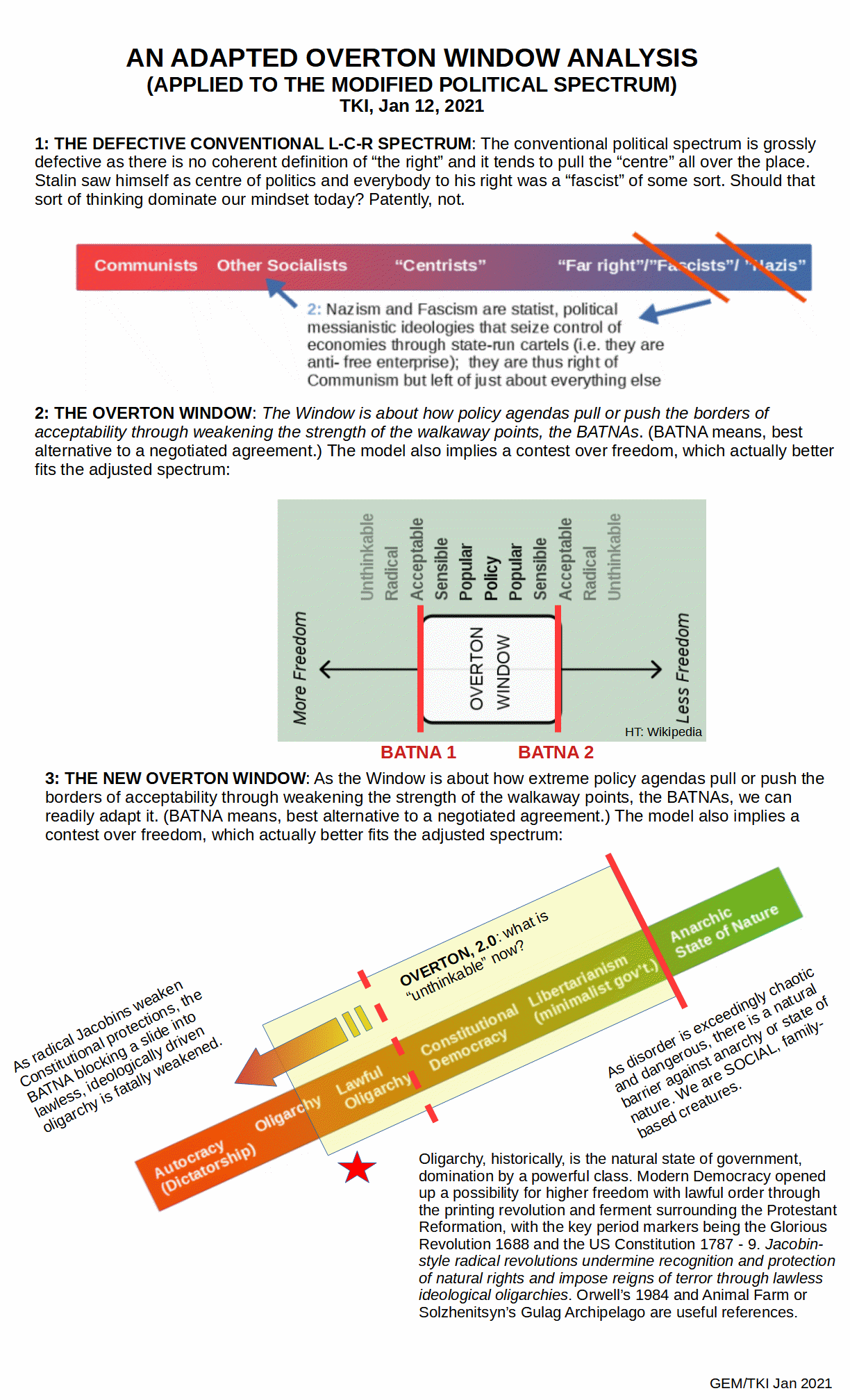
The issue becomes pivotal, once we ponder the premise that the typical, “natural” tendency of government is to open or veiled lawless oligarchy:
So, let us hear Cicero in his On The Republic, Bk 3 [c. 55 – 54 BC]:

{22.} [33] L . . . True law is right reason in agreement with nature , it is of universal application, unchanging and everlasting; it summons to duty by its commands, and averts from wrongdoing by its prohibitions. And it does not lay its commands or prohibitions upon good men in vain, though neither have any effect on the wicked. It is a sin to try to alter this law, nor is it allowable to attempt to repeal any part of it, and it is impossible to abolish it entirely. We cannot be freed from its obligations by senate or people, and we need not look outside ourselves for an expounder or interpreter of it. And there will not be different laws at Rome and at Athens, or different laws now and in the future, but one eternal and unchangeable law will be valid for all nations and all times, and there will be one master and ruler, that is, God, over us all, for he is the author of this law, its promulgator, and its enforcing judge. Whoever is disobedient is fleeing from himself and denying his human nature, and by reason of this very fact he will suffer the worst penalties, even if he escapes what is commonly considered punishment. . . . – Marcus Tullius Cicero, On the Republic, Bk 3

This, of course, is further reflected in his De Legibus, which lays out a framework:

With respect to the true principle of justice, many learned men have maintained that it springs from Law. I hardly know if their opinion be not correct, at least, according to their own definition; for “Law (say they) is the highest reason, implanted in nature, which prescribes those things which ought to be done, and forbids the contrary.” This, they think, is apparent from the converse of the proposition; because this same reason, when it [37]is confirmed and established in men’s minds, is the law of all their actions.

They therefore conceive that the voice of conscience is a law, that moral prudence is a law, whose operation is to urge us to good actions, and restrain us from evil ones.

We see in the Angelic Doctor, a broadening of the framework, elaborating four domains of law:

Thus, following Aquinas, we can see that arguably there is an intelligible core of law coeval with our responsible, rational, significantly free nature. This built-in law turns on inescapable, thus self-evident truths of justice and moral government, which rightly govern what courts may rule or parliaments legislate, per the premise of justice moderated by requisites of feasible order in a world that must reckon with the hardness of men’s hearts. Where, we are thus duty bound, morally governed creatures.

Hence, we come to the sense of duty attested to by sound conscience [“conscience is a law”], that breathes fire into what would otherwise be inert statements in dusty tomes. We may term these, by extension, the Ciceronian First Duties of Reason:

FIRST DUTIES OF RESPONSIBLE REASON

We can readily identify at least seven inescapable first duties of reason. “Inescapable,” as they are so antecedent to reasoning that even the objector implicitly appeals to them; i.e. they are self-evident. Namely, duties,

1 – to truth, 

2 – to right reason

3 – to prudence, 

4 – to sound conscience, 

5 – to neighbour; so also, 

6 – to fairness and

7 – justice 

x – etc.

[I add, Mar 12, for clarity:] {Of course, there is a linked but not equivalent pattern: bounded, error-prone rationality often tied to ill will and stubbornness or even closed mindedness; that’s why the study of right reason has a sub-study on fallacies and errors. That we seek to evade duties or may make errors does not overthrow the first duties of reason, which instead help us to detect and correct errors, as well as to expose our follies.}

Such built-in . . . thus, universal . . . law is not invented by parliaments, kings or courts, nor can these principles and duties be abolished by such; they are recognised, often implicitly as an indelible part of our evident nature. Hence, natural law,” coeval with our humanity, famously phrased in terms of “self-evident . . . rights . . . endowed by our Creator” in the US Declaration of Independence, 1776. (Cf. Cicero in De Legibus, c. 50 BC.) Indeed, it is on this framework that we can set out to soundly understand and duly balance rights, freedoms and duties; which is justice, the pivot of law.

The legitimate main task of government, then, is to uphold and defend the civil peace of justice through sound community order reflecting the built in, intelligible law of our nature. Where, as my right implies your duty a true right is a binding moral claim to be respected in life, liberty, honestly acquired property, innocent reputation etc. To so justly claim a right, one must therefore demonstrably be in the right.

Where, prudence can also be seen via Aristotle’s summary:  “. . . [who aptly] defined prudence as recta ratio agibilium, ‘right reason applied to practice.’ The emphasis on ‘right’ is important . . .  Prudence requires us to distinguish between what is right and what is wrong . . . If we mistake the evil for the good, we are not exercising prudence—in fact, we are showing our lack of it.”

Of course, we just saw a 400+ comment thread that saw objectors insistently, studiously evading the force of inescapability, where their objections consistently show that they cannot evade appealing to the same first duties that they would dismiss or suggest were so obscure and abstract that they cannot serve as a practical guide. The history of the modern civil rights movement once the print revolution, the civilisational ferment surrounding the reformation and the rise of newspapers, bills, coffee houses etc had unleashed democratising forces speaks to the contrary. The absurdity of appealing to what one seeks to overthrow simply underscores its self evidence. But free, morally governed creatures are just that, free. Even, free to cling to manifest absurdities.

This approach, of course, sharply contrasts with the idea that law is in effect whatever those who control the legal presses issue under that heading; based on power balances and so in effect might and/or manipulation. Aquinas’ corrective should suffice to show that not all that is issued under colour of law is lawful, or even simply prudent towards preserving order in a world of the hardness of men’s hearts.

Yes, obviously, if we are governed by built-in law, that raises the question that there is a cosmic law-giver, qualified to do so not by mere sheer power but also by being inherently good and utterly wise. Such a root of reality also answers the Hume Guillotine and the Euthyphro dilemma: an inherently good and utterly wise, necessary and maximally great being root of reality would bridge IS and OUGHT in the source of all reality and would issue good and wise, intelligible built-in law.

What of Mathematics? The answer is, of course, that a core of Math is inherent in the framework of any possible world. So, this would extend that core of Math tied to sets, structures and quantities expressed in N,Z,Q,R,C,R* etc to any actual world. That answers Wigner’s puzzlement on the universal power of Math and it points to, who has power to create an actual world in which we have fine tuning towards C-Chemistry, aqueous medium, cell based life? Likewise, it is suggestive on the source of the language and algorithms found in D/RNA etc.

Lest we forget, here is Crick, to his son, March 19, 1953:
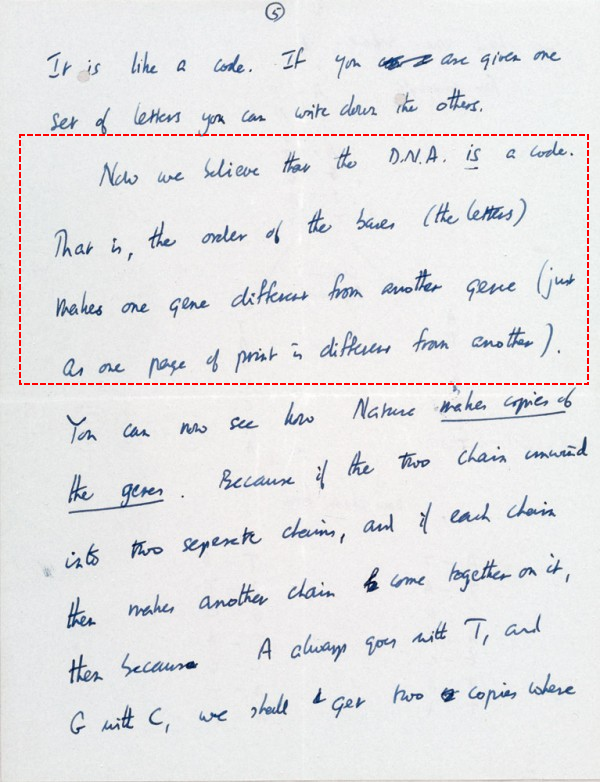
So, we have come full circle, to law as expressing ordering principles of the dynamic-stochastic physical world and those of the world of intelligent, rational, morally governed creatures. Surprise — NOT — the design thesis is central to both. END

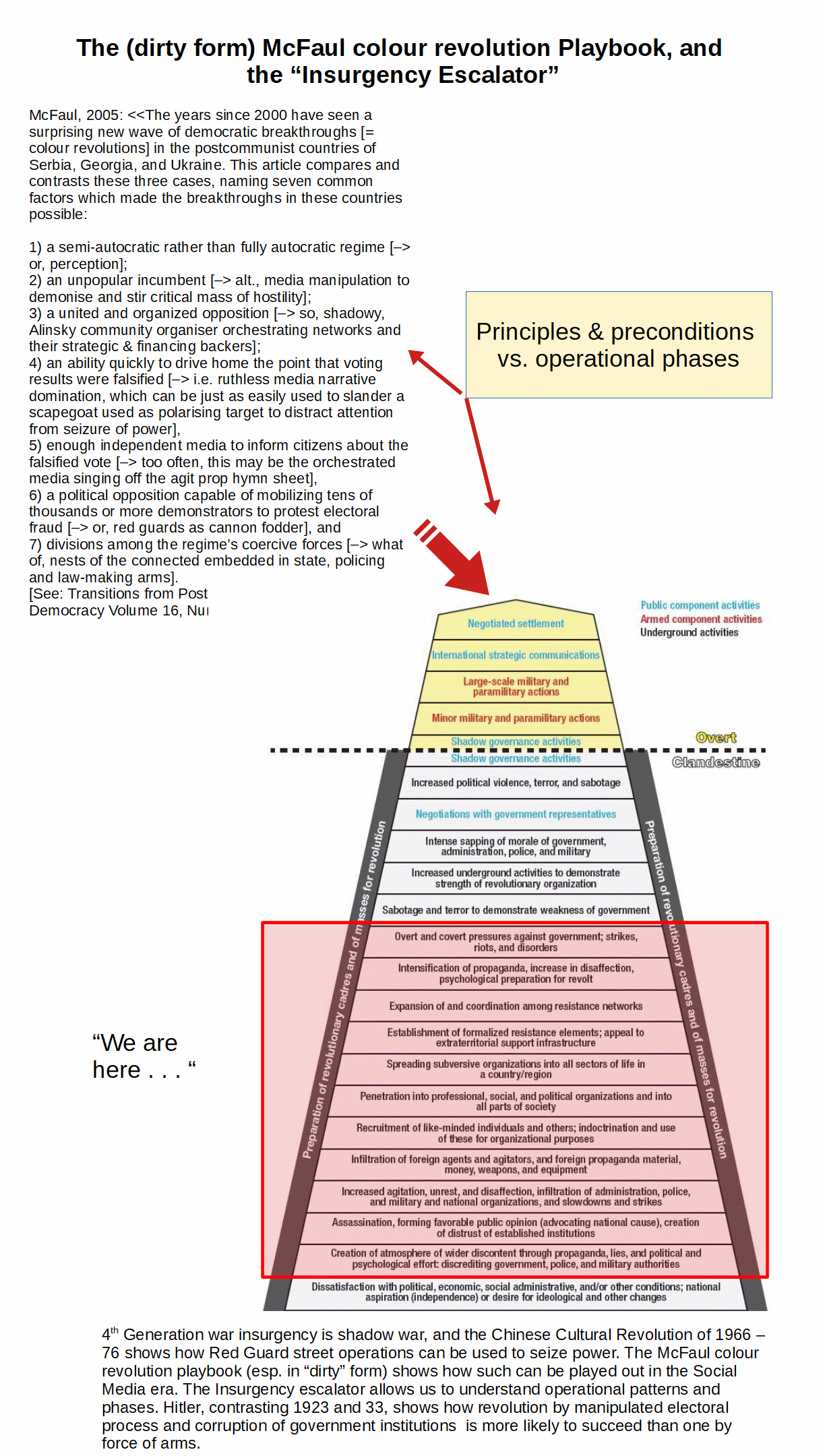
PS: As a reminder, the McFaul dirty form colour revolution framework and SOCOM insurgency escalator
U/D Feb 14: Outlines on first principles of right reason:
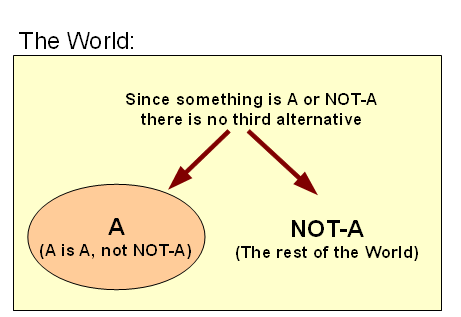
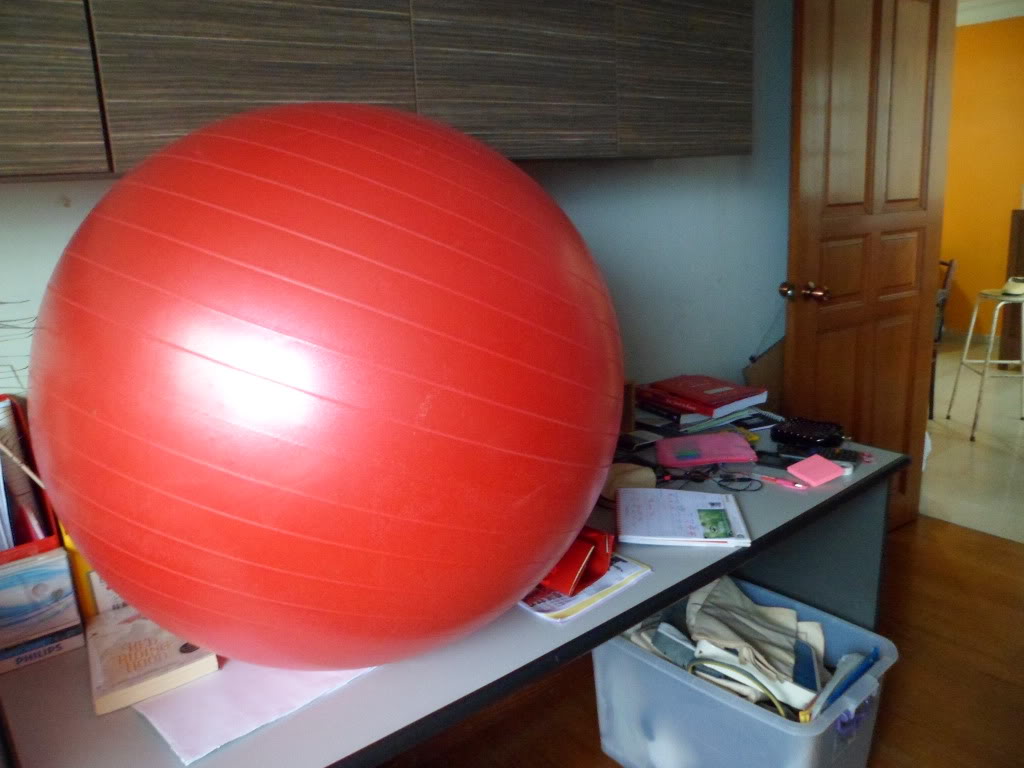
Here, we see that a distinct A — I usually use a bright red ball on a table:
and contrast a red near-ball in the sky, Betelgeuse as it went through a surprise darkening (something we observed separately and independently, it was not a figment of imagination):
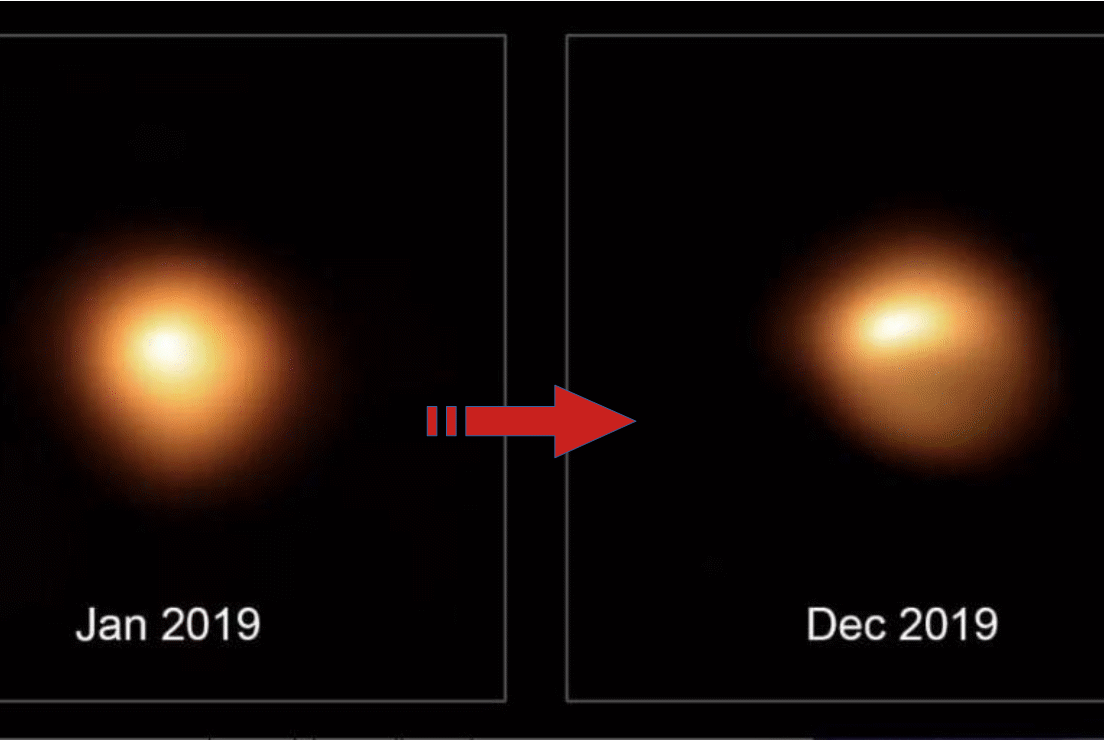
. . . is distinct from the rest of the world. A is itself i/l/o its characteristics of being, and it is distinct from whatever else is not A, hence we see that in w there is no x that is A and ~A and any y that is in W will either be A or not A but not both or neither. These three are core to logic: P/LOI, LNC, LEM.

We may extend to governing principles that we have duties toward — never mind whoever may disregard such (and thereby cause chaos):
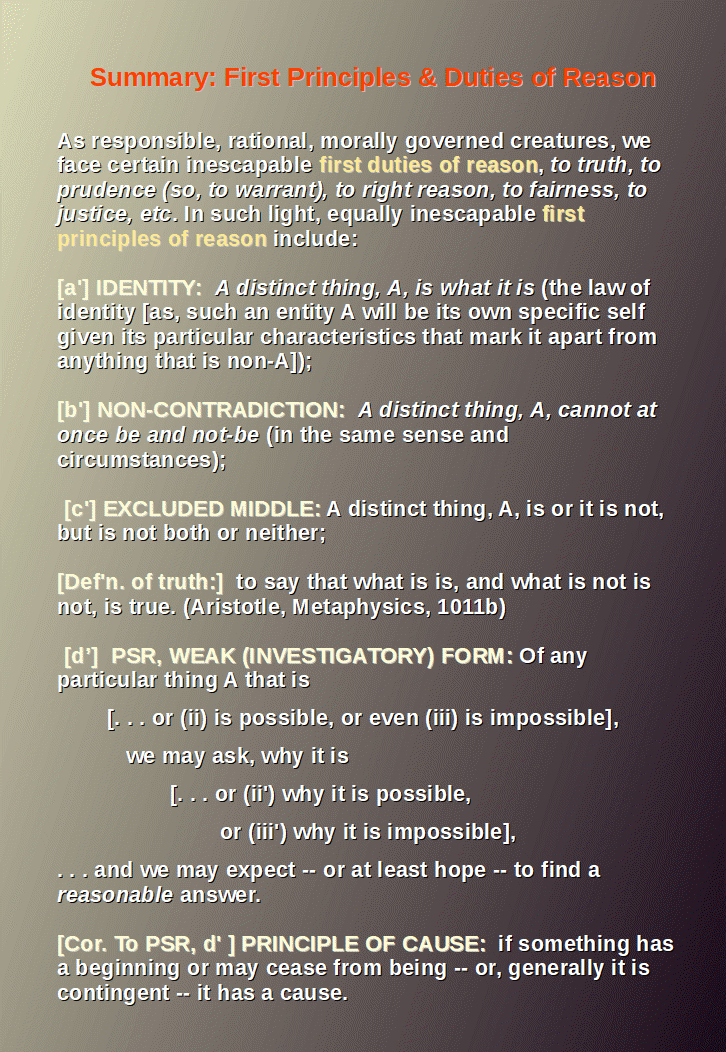
U/D March 13: The challenge of building a worldview i/l/o the infinite regress issue:
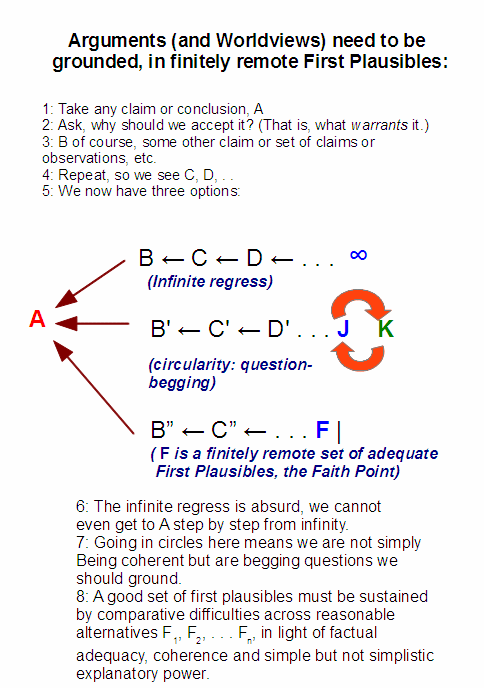
A summary of why we end up with foundations for our worldviews, whether or not we would phrase the matter that way}

Framing a ship:

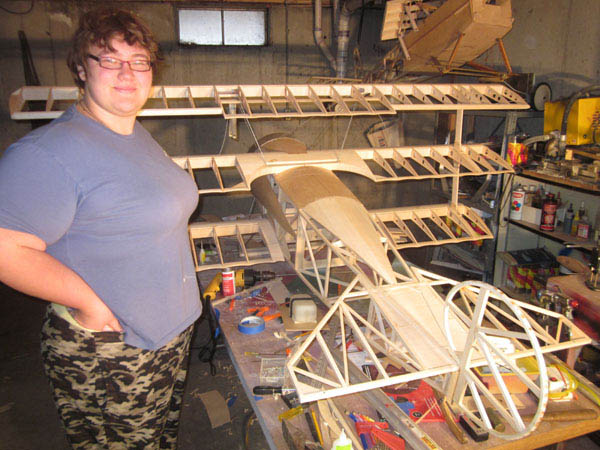
. . . compare a wooden model aircraft:
. . . or a full scale, metal framework jet:
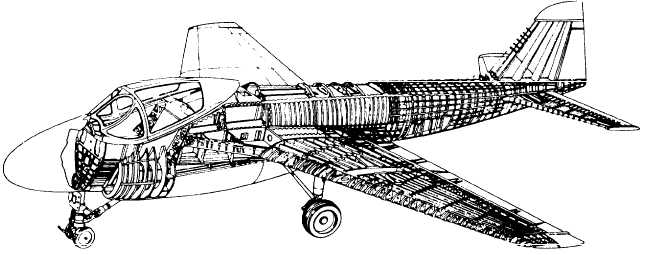
In short, there is always a foundational framework for any serious structure.

Comments
KF, did you really read what I wrote? I didn't try to redefine square and/or circle. Please quote me and show me where I did that. All I said was that the definitions of square and circle were contradictory.Viola Lee
February 8, 2021
February
02
Feb
8
08
2021
05:58 PM
5
05
58
PM
PDT
VL, a square has certain characteristics, quadrilateral with equal sides and right angle corners. No entity can at once be square and circle in any possible world. That you resort to trying to redefine square and/or circle speaks, not in your favour. KF PS: SA, the attempt to personalise and poison by projecting a psychological-rhetorical ulterior motive speaks, not in your favour. The paper I have linked arose in the end because I found Wigner's challenge fascinating. It can be seen i/l/o the principle of identity applied to possible worlds and we see a profound result. Namely, that a core of mathematics is inherently part of the fabric of any possible world. That was my motive and there is no need for you to try to taint, save that it speaks to confession by projection.kairosfocus
February 8, 2021
February
02
Feb
8
08
2021
05:36 PM
5
05
36
PM
PDT
kf, you write, "VL, you have cited schools of thought relative to theism, pantheism, possibly panentheism. Naturalism, is currently popular, especially evolutionary materialistic scientism. There is dualism. Where, polytheism & henotheism as a variant tend to be forms of or evolutions from animism. That is no great number, and at this level, you would be hard put to find significantly more basic views. Where, not many views at this level get you to genuine individuality with responsible, rational, self-moved freedom. " What! You think all the rest of the world's main religions fail to "get you to genuine individuality with responsible, rational, self-moved freedom." You are wrong, and I think you don't much about them. What you seem to know something about (inaccurately) is their ideas about God, and possibly/probably very little about their overall worldview. This explains a lot. Telling, one might say!Viola Lee
February 8, 2021
February
02
Feb
8
08
2021
05:29 PM
5
05
29
PM
PDT
AS2, the dynamics claimed are patent and the implications are clear from the words of the spokesmen, incoherence. And sufficient further has been said for now given the emerging local CV19 2nd wave crisis. KFkairosfocus
February 8, 2021
February
02
Feb
8
08
2021
05:29 PM
5
05
29
PM
PDT
Just a few quick points: 1. All your examples of "necessary in all possible worlds" come from math. What Steve said at 116 applies:
I think what Kairosfocus is attempting to do is to associate the robustness of mathematics to the robustness of his worldview claims. While it is true that reasoning and logic as it applies to real-world observations have some similarities to mathematics, where they typically differ is the sheer magnitude of assumptions and premises often involved in applying this type of reasoning and logic to the real world
Things like "two" or "circle" or "square" or the rules of logic are clearly defined. A vast amount of the other stuff you invoke is not clearly defined, and yet you make assertions and draw conclusions as if they were. Also, side note: a "square circle" is a contradiction in definitions. So is "married bachelor". The impossibility of a square circle is because of the definitions we have for those words. I don't think that says much about "possible worlds" other than in all possible worlds the words all possible beings use to describe all possible things can't contain assertions that contain internal contradictions.Viola Lee
February 8, 2021
February
02
Feb
8
08
2021
05:22 PM
5
05
22
PM
PDT
Kairosfocus “ in many cases, they are statements from the horse’s mouth, but let’s get to the claims you would sweep away as mere assumptions etc.” Saying that your claims are dependent on unproven assumptions is not the same as saying that your claims are mere assumptions. Everyone’s worldview depends on numerous unproven assumptions being true. Yours are no different. Get used to it.Steve Alten2
February 8, 2021
February
02
Feb
8
08
2021
05:22 PM
5
05
22
PM
PDT
JAD, yes, especially if broadened to include relativism and emotivism. KFkairosfocus
February 8, 2021
February
02
Feb
8
08
2021
05:13 PM
5
05
13
PM
PDT
VL, you have cited schools of thought relative to theism, pantheism, possibly panentheism. Naturalism, is currently popular, especially evolutionary materialistic scientism. There is dualism. Where, polytheism & henotheism as a variant tend to be forms of or evolutions from animism. That is no great number, and at this level, you would be hard put to find significantly more basic views. Where, not many views at this level get you to genuine individuality with responsible, rational, self-moved freedom. KFkairosfocus
February 8, 2021
February
02
Feb
8
08
2021
05:12 PM
5
05
12
PM
PDT
SA2, I am still busy, but I clip:
Kairosfocus’ worldview claims about things like necessary being, morality, free will, materialism, evolution, etc. are based on numerous assumptions that are not even close to being proven
Let's see: >>Kairosfocus’ worldview claims>> - in many cases, they are statements from the horse's mouth, but let's get to the claims you would sweep away as mere assumptions etc. >>about things like necessary being,>> - h''mm, let's try to imagine a world in which two-ness does not exist, or got turned on after a certain time, or got turned off. No such world exists, two-ness is an example of necessary being framework to any distinct possible world. - necessary vs contingent being contrasts two classes of being, and things like square circles are impossible of being. Where, it turns out that core mathematics rests on key aspects of necessary being. which gives that core connected to N,Z,Q,R,C,R* etc universal relevance and power, answering Wigner's amazement. - I suspect, such is resisted because it is unfamiliar or reflects a particular candidate necessary being you are hostile to. - further to such, we hammered out over four years give or take here at UD why an explicit or implicit transfinite stage past causal succession to now is impossible of having been traversed. That this sort of suggestion of a transfinite temporal-causal past has been on the table speaks for itself. >>morality,>> - another point of resistance, meanwhile this very objection illustrates yet again how arguments inescapably appeal to first duties of reason. Duty to right reason, truth, prudence [warrant] just for starters. I am simply pointing out a readily seen pattern, which is inescapable, so inescapably true and self evident. - the strong hostility to moral truth speaks for itself. >>free will,>> - if you are not significantly free, you have no basis for reason or argument, there is no basis for reasoned discussion. - of course, the evolutionary materialists cited above inadvertently make the problems very clear >>materialism,>> - the figures cited above are actual spokesmen for the scheme of thought, save for Haldane who was in the end a pantheist I believe and was in any case a co-founder of the neo-darwinian synthesis - the contradiction is real and inescapable >> evolution, etc.>> - actually, I haven't said much of anything about evolution as such but rather about a certain ideology, descriptively evolutionary materialistic scientism, with spokesmen speaking for themselves and revealing the incoherence. >>are based on numerous assumptions>> - assumptions, such as that spokesmen of prominence speak for a system of view? - that being or candidates can be categorised using possible worlds speak is not an assumption, it was readily demonstrated, a PW being a sufficiently complete description of a way this or another world is, was or could be. - Things impossible of being have contradictory core characteristics and cannot be instantiated, e.g. square circles. Of possible beings, contingent beings depend on prior circumstances [us], and necessary ones are framework to any PW [the number 2 in various guises]. And more. Those are not assumptoions. - that even your objections invariably appeal to first duties of reason is almost amusingly manifest, but then becomes quite sad. - as to evolutionary materialistic scientism, citing key spokesmen is not making dubious assumptions. And if you are imagining that if p => [q AND ~q] implies p is not necessarily false, then your problems are beyond the help of logic. - or, perhaps, you are trying to play the Agrippa trilemma. The problem is of course that infinite regress cannot be traversed and ultimate circularity likewise is futile. So we have finitely remote start points, which we can compare on comparative difficulties. - as to self evident truths, start with || + ||| --> ||||| and tell me if that is not a case in point. A SET is such that once one has maturity on experience to understand it, will be seen as so, as necessarily so, as such on pain of patent absurdity. And I think it is no assumption to see that it is absurd to be going from one thread to another to object to first duties of reason by using arguments that cannot but appeal to what you would deny or dismiss or sideline or distract from. [Oct 29, let me pick up a point overlooked:] >> that are not even close to being proven>> - H'mm, as in why do you emphasise "proof"? As in, right reason providing apt degree of warrant towards credible truth and high reliability? Could we have implicitly understood duties of care towards such? As in, even objectors are forced to appeal to such? - which then become, branch on which we all must sit first principles, i.e. the Ciceronian first duties of reason that as inescapable are inescapably true and so self-evident. - self evidence is not a dismissible assumption, it is an intelligible, observable phenomenon of reasoning that in the case of such first principles is antecedent to and constitutive of rational responsible freedom applied to actual acts of reason. - I think, on observation, you are trying to saw off the branch on which we all must sit because you are uncomfortable with where it points. - Instead, why not recognise that key SET's lay out our built in moral government that guides us in right use of freedom to think, decide, speak and act, thus founding a basis for sound community, law, government and knowledge-base building for sustainable civilisation? - Yes, SET's never amount to an entire worldview foundation, but that's not their job. They are plumb lines and yardsticks that naturally expose crooked yardsticks that are fallaciously warping our thought to the ruin of civilisation. KF kairosfocus
February 8, 2021
February
02
Feb
8
08
2021
05:02 PM
5
05
02
PM
PDT
On this site we have had numerous debates about moral subjectivism. But above and beyond moral subjectivism there’s another kind of subjectivism: epistemological subjectivism-- the belief there are no real objective facts, no capital T Truth, only beliefs and opinions. But if that’s true (which is of course self-refuting) how then do we decided between competing opinions? It all comes down to a power play and since there are no ethical standards anything goes, including lies, deception, intimidation and coercion. Those things are already what we see being used in politics, on college campuses and in the mainstream media. Could it get worse? If history is any guide it not only could, it will... In fact we now see this so called "wokeness" encroaching on the natural sciences. Epistemological and moral subjectivism have both become a dominate force in western culture is there any surprise that it should it should start effecting the last bastion of objective, fact based logically rigorous analytical thinking and scholarship, the natural sciences? We shouldn’t be just surprised, we should be scared.john_a_designer
February 8, 2021
February
02
Feb
8
08
2021
04:31 PM
4
04
31
PM
PDT
Acartia Stevie:
But when he throws these accusations out, all it really means is that Kairosfocus has not presented sufficient compelling evidence and arguments to be convincing.
There isn't any convincing the willfully ignorant.ET
February 8, 2021
February
02
Feb
8
08
2021
12:43 PM
12
12
43
PM
PDT
KF, You write, "There are not a lot of options that get you there." Sure there are: Hinduism, Buddhism, Islam, Confucianism, Taoism, Judaism, Christianity, all of which have subsets of beliefs that differ among themselves, and this doesn't include various unnamed composites as well as "minor" religions, current and "primitive". It's not all Plato, all the time.Viola Lee
February 8, 2021
February
02
Feb
8
08
2021
11:01 AM
11
11
01
AM
PDT
VL, I of course spoke of being genuinely self-moved, on rational, responsible freedom. There are not a lot of options that get you there. And BTW, that is the sense of soul I used, of whatever ontology, a responsible, self moved, rational creature. Not, moved unconsciously by organisation and programming of a computational substrate, nor programmed and controlled from without, not floating as an epiphenomenon of an unconscious underlying overwhelming stream, an entity free to reason, warrant, know, decide. That is hard to understand or acknowledge much less ontologically justify or found these days. KFkairosfocus
February 8, 2021
February
02
Feb
8
08
2021
10:52 AM
10
10
52
AM
PDT
KF, you write, "Volitional freedom points to Plato’s self-moved, living soul, with mind a key aspect." It points to other views, also. You write, "Here, we see that inference to best explanation is a valid frame for reasoning, one that can be very relevant and can deliver moral certainty." Here we disagree. As I wrote one other time, I believe that we have moral principles, the main one being, in Hindu terms, to be compassionate, but the actual moral situation about how to apply that in real-world situations is often uncertain and up to us to choose, and be responsible for our choices: there is no moral certainties (and of course this varies in degree) because they are so many competing issues to balance. You write, "By no means comfortable, but that was known when Plato put the parable of the cave on the table." I'm quite familiar with Plato's parable. It is not true that Plato's views about the nature of our condition or the real truth to the awakened are necessarily correct. There are a variety of other wisdom traditions that use the metaphor of now seeing what one did not see before that have reached different conclusions about these issues. You write, "In current metaphors, here is the red pill, here is the blue. One, you must pick." I am not familiar with this metaphor, so I don't know what the two pills represent. But, and this does not surprise me, it is excessively dichotomous.Viola Lee
February 8, 2021
February
02
Feb
8
08
2021
10:07 AM
10
10
07
AM
PDT
At 94 I stated,
Seversky, last time I checked, denies the existence of free will altogether, but VL does not. VL: “NOTE EXTREMELY WELL: I am not denying the existence of libertarian free will.”
VL further stated that he believes that the closing of the free will loop hole merely means,
“we,, are capable of making non-determined choices, which is a weak form of free will.”
As to whether this "weak form of free will” allows us to choose the measurement settings in our quantum experiments VL did not clarify, and indeed VL muddied the waters by further claiming that,,
However this capability, (i.e. our weak form of free will), would still be subject to the world of quantum events, of which our physical selves are a part, which derives its non-determined nature from the probabilistic nature of QM.
So whatever this 'weak form of free will' exactly is that VL believes in he did not clarify, and in so far as he did clarify what he meant he undermined its existence altogether by saying that it is subject to, and derived from, "the probabilistic nature of QM'. Yet, as I further pointed out on 94, VL's belief that our "weak form of free will' is subject to, and derived from, "the probabilistic nature of QM' is directly undermined by the simple fact that, as Weinberg himself put it, “In quantum mechanics these probabilities do not exist until people choose what to measure,,, Unlike the case of classical physics, a choice must be made,,," But anyways, despite the fact that VL's position is logically incoherent, and refuted by quantum mechanics itself, Seversky jumped in to support to VL's position. Yet, Seversky, last time I checked, denies the existence of free will altogether. So, on the surface at least, it would seem to be a major conflict between VL and Sev. And it was thus with great interest that I read what Sev. said in post 102, Sev starts by quoting me,
BA77: Too funny! Viola Lee and Seversky, who are the ones who are denying the reality of our free will choices, are acting as if I had the free will choice to believe otherwise, i.e. to believe that I don’t really have free will.
Sev starts off his response thusly,
What do you mean by “free will”? Is it the ability to make a choice between two or more options that are not subject in any way to external influences or does it also require the ability to actualize whatever choice is made? In other words, if I choose to become a Jedi Knight but am unable do actually become one because they are fictional and do not exist as such in reality in this Universe (apart from in the Star Wars movies), is that sufficient for “free will”.
Ha Ha Ha,,, where could Sev possibly be taking this 'Jedi Knight' stuff, :) ,,,, Sev continues,
As another example, I know that I did not consciously choose my sexuality. I did not sit down one day and carefully weigh up the pros and cons of heterosexuality or homosexuality and finally decide “I think I will be straight”. No, what happened was that at a certain point, I just began noticing and reacting to girls in a way I hadn’t previously. I’m pretty sure I could not become homosexual now just by an effort of will and I suspect it’s the same for most if not everyone here. What price free will here?
So that is where Sev wanted to go,,, Well, what I myself mean by free will in this thread, and as I have already pointed out, I mean that It is our ability to freely choose the measurement settings in quantum mechanics. After all, it would seem that would be the primary implication of closing the free will loop hole by Zeilinger and company where they showed that the measurement settings in their experiment were not influenced by any causal influences for at least the past 7.8 billion years. How Sev made the logical leap from freely choosing measurement settings in QM to freely choosing one's sexual orientation I have no idea. :) But anyways, there are numerous examples in church of former homosexuals who have now 'chosen' to become heterosexual. Sure, some of the changes in sexual orientation were not easy to accomplish, but even deeply homosexual people have successfully 'chosen' to live heterosexual lives.
Such Were Some Of You https://www.youtube.com/watch?v=VKSFPdyH8x4 “Such Were Some of You” (A Documentary) was inspired by the passage in 1st Corinthians 6:11? that declares that in Jesus’ day there was a population who had been so transformed by their relationship with Him that they were no longer “same-sex attracted” or at the very least, actively homosexual. They had found such a measure of healing from the brokenness and strongholds associated with what we now call homosexuality that they no longer considered themselves homosexual, nor did they act in that way. “Such Were Some of You” features interviews with a “cloud of present-day witnesses” who testify to the same life-transforming power of Jesus Christ. They describe the development of their same-sex attractions, what the gay lifestyle was like, what their conversion process was like, and the various ways that Jesus has brought healing to their broken places. “Such Were Some of You” lays out the facts about healing homosexual confusion and rejoices in the reality that Jesus Christ can heal anyone from anything while providing grace for the journey.
Apparently, according to Sev's 'Jedi Knight' definition of free will, such dramatic, even miraculous, conversions from homosexuality to heterosexuality, to even being in deeply loving heterosexual marriages, are suppose to impossible. But anyways, Seversky continues,
There is also, as has been pointed out many times before, the Biblical account of Peter’s triple denial of Christ even though he had been specifically warned beforehand by Jesus that this is what would happen. That is pretty clear anecdotal evidence that we do not have free will.
So Seversky, who I remind is an atheist, is using God's omniscience to argue against the reality of free will? First off, God being omniscient of our actions does not equal coercion and/or God determining our actions. Secondly, for Seversky to appeal to God's omniscience in order to try to argue that we do not have free will undermines Sev's foundational belief that God does not exist. i.e. If God does not exist as Sev adamantly claims, then Sev cannot then therefore use God as the primary reason why he does not believe in free will. According to Sev's worldview which denies the existence of God, Sev could just as easily have used his fictitious example of 'Jedi Knights', or even used pink unicorns, as a stand in for God. And this flaw of presupposing the existence of God in order to try to argue against God, (or against the existence of free will in this instance), is a major flaw in many of the atheist's arguments against God. In fact, Charles Darwin's book 'Origin" is chock full of this fallacious type of reasoning that Sev is currently using.
Charles Darwin, Theologian: Major New Article on Darwin's Use of Theology in the Origin of Species - May 2011 Excerpt: The Origin supplies abundant evidence of theology in action; as Dilley observes: I have argued that, in the first edition of the Origin, Darwin drew upon at least the following positiva theological claims in his case for descent with modification (and against special creation): ?1. Human beings are not justified in believing that God creates in ways analogous to the intellectual powers of the human mind. 2. A God who is free to create as He wishes would create new biological limbs de novo rather than from a common pattern. 3. A respectable deity would create biological structures in accord with a human conception of the 'simplest mode' to accomplish the functions of these structures. 4. God would only create the minimum structure required for a given part's function. 5. God does not provide false empirical information about the origins of organisms. 6. God impressed the laws of nature on matter. 7. God directly created the first 'primordial' life. 8. God did not perform miracles within organic history subsequent to the creation of the first life. 9. A 'distant' God is not morally culpable for natural pain and suffering. 10. The God of special creation, who allegedly performed miracles in organic history, is not plausible given the presence of natural pain and suffering. http://www.evolutionnews.org/2011/05/charles_darwin_theologian_majo046391.html
To this day, Darwinists, (since they have no empirical evidence supporting their grandiose claims), are still dependent of this type of flawed theological argumentation,
Methodological Naturalism: A Rule That No One Needs or Obeys - Paul Nelson - September 22, 2014 Excerpt: It is a little-remarked but nonetheless deeply significant irony that evolutionary biology is the most theologically entangled science going. Open a book like Jerry Coyne's Why Evolution is True (2009) or John Avise's Inside the Human Genome (2010), and the theology leaps off the page. A wise creator, say Coyne, Avise, and many other evolutionary biologists, would not have made this or that structure; therefore, the structure evolved by undirected processes. Coyne and Avise, like many other evolutionary theorists going back to Darwin himself, make numerous "God-wouldn't-have-done-it-that-way" arguments, thus predicating their arguments for the creative power of natural selection and random mutation on implicit theological assumptions about the character of God and what such an agent (if He existed) would or would not be likely to do.,,, ,,,with respect to one of the most famous texts in 20th-century biology, Theodosius Dobzhansky's essay "Nothing in biology makes sense except in the light of evolution" (1973). Although its title is widely cited as an aphorism, the text of Dobzhansky's essay is rarely read. It is, in fact, a theological treatise. As Dilley (2013, p. 774) observes: "Strikingly, all seven of Dobzhansky's arguments hinge upon claims about God's nature, actions, purposes, or duties. In fact, without God-talk, the geneticist's arguments for evolution are logically invalid. In short, theology is essential to Dobzhansky's arguments.",, http://www.evolutionnews.org/2014/09/methodological_1089971.html
In short, Darwinists, and atheists in general, need God to even be able to argue against his existence in the first place. As Cornelius Van Til put the dilemma for atheists, "As a child needs to sit on the lap of its father in order to slap the father’s face, so the unbeliever, as a creature, needs God",,,
"In other words, the non-Christian needs the truth of the Christian religion in order to attack it. As a child needs to sit on the lap of its father in order to slap the father’s face, so the unbeliever, as a creature, needs God the Creator and providential controller of the universe in order to oppose this God. Without this God, the place on which he stands does not exist. He cannot stand in a vacuum.” - Cornelius Van Til, Essays on Christian Education (The Presbyterian and Reformed Publishing Company: Phillipsburg, NJ, 1979).
Seversky finishes his defense of his belief that we do not have free will with a confession that "the question is not whether or not I actually have free will but to what extent I have it."
Speaking personally, I experience the exercise of free will but it is not absolute. I, like everyone else, was formed in part by influences over which I had no control and was not even aware of a the time so the question is not whether or not I actually have free will but to what extent I have it.
Ha Ha Ha,,, :) Well Seversky, I am not the one who has a irresolvable problem with the existence of free will, (to whatever extent that you think you may have it), YOU ARE the one with the irresolvable problem. You see Seversky, free will is a primary property, even a defining attribute, of the immaterial mind,, Dr. Michael Egnor, who is a neurosurgeon as well as professor of neurosurgery at the State University of New York, Stony Brook, states six properties of immaterial mind that are irreconcilable to the view that the mind is just the material brain. Those six properties are, “Intentionality,,, Qualia,,, Persistence of Self-Identity,,, Restricted Access,,, Incorrigibility,,, Free Will,,,”
The Mind and Materialist Superstition – Michael Egnor – 2008 Six “conditions of mind” that are irreconcilable with materialism: – Excerpt: Intentionality,,, Qualia,,, Persistence of Self-Identity,,, Restricted Access,,, Incorrigibility,,, Free Will,,, http://www.evolutionnews.org/2008/11/the_mind_and_materialist_super013961.html
So Seversky, in so far as you admit to the reality of free will, (to whatever extent you may think it really exists), you are in fact admitting to the reality of your own immaterial mind, even admitting to the reality of your own soul,,, As should be needless to point out to you Sev, immaterial minds, especially Intelligent Immaterial minds making free will choices and creating information, (and choosing measurement settings in quantum experiments), are simply forbidden in any self-respecting Darwinian metaphysics, Indeed it is simply forbidden in modern science altogether.
"Free will is an illusion so convincing that people simply refuse to believe that we don’t have it." - Jerry Coyne Free Will: Weighing Truth and Experience - Do our beliefs matter? - Mar 22, 2012 Excerpt: If we acknowledge just how much we don’t know about the conscious mind, perhaps we would be a bit more humble. We have so much confidence in our materialist assumptions (which are assumptions, not facts) that something like free will is denied in principle. Maybe it doesn’t exist, but I don’t really know that. Either way, it doesn’t matter because if free will and consciousness are just an illusion, they are the most seamless illusions ever created. Film maker James Cameron wishes he had special effects that good. https://www.psychologytoday.com/us/blog/social-brain-social-mind/201203/free-will-weighing-truth-and-experience Matthew D. Lieberman – neuroscientist – materialist – UCLA professor Teleology and the Mind - Michael Egnor - August 16, 2016 Excerpt: In this sense, eliminative materialism is necessary if a materialist is to maintain a non-teleological Darwinian metaphysical perspective. It is purpose that must be denied in order to deny design in nature. So the mind, as well as teleology, must be denied. Eliminative materialism is just Darwinian metaphysics carried to its logical end and applied to man. If there is no teleology, there is no intentionality, and there is no purpose in nature nor in man’s thoughts. The link between intentionality and teleology, and the undeniability of teleology, is even more clear if we consider our inescapable belief that other people have minds. The inference that other people have minds based on their purposeful (intentional-teleological) behavior, which is obviously correct and is essential to living a sane life, can be applied to our understanding of nature as well. Just as we know that other people have purposes (intentionality), we know just as certainly that nature has purposes (teleology). In a sense, intelligent design is the recognition of the same purpose-teleology-intentionality in nature that we recognize in ourselves and others. https://evolutionnews.org/2016/08/teleology_and_t/
Seversky, I would very much hope that you would continue to stay rational and not ever deny the reality of your own free will again, but I just want to be crystal clear with you that you are, in your honest admission to the reality of your own free will, are in fact adopting a essentially theological worldview where immaterial minds, and even souls, really exist.bornagain77
February 8, 2021
February
02
Feb
8
08
2021
09:53 AM
9
09
53
AM
PDT
VL, insofar as views credibly conform to reality and avoid incoherence, they take on a semblance of credibility. At least, as living options. Evolutionary materialistic scientism, for all its grip on institutions and cultural elites, is a case of rigor mortis, irretrievable self-referential incoherence is that ruinous. In this context, it is the reduction of mindedness to a computational substrate allegedly organised and programmed by blind mechanical necessity and/or equally blind stochastic forces that leads to undermining of responsible, rational freedom, the undermining of what are claimed to be rational thoughts and the undermining of both ability to decide and to do so in accord with rational, responsible moral principles. Crick's "your'e nothing but a pack of neurons" and Rosenberg's denial of the self as delusion are strong illustrations of such incoherence. Operant conditioning, blind psychosocial forces, strictness of potty training, class influences etc are further, softer but no less real forms of such incoherence. Strong emergence on the other hand both cannot explain the emergence -- poof magic [or should that be full bore magick] -- and its credibility, also ending up as implying that there is an agency at work beyond the computational substrate and its programming. Fellow traveller views strongly tend to this double-bind. That's where remarks on the so-called hard problem of consciousness come from. You have said you accept volitional freedom, and I presume you do not mean compatibilism, which is little more than an evasive discussion. Volitional freedom points to Plato's self-moved, living soul, with mind a key aspect. Whatever, the ontology involved. As you know, I have pointed to the inescapable moral government that pervades even your arguments above as a strong indication that we live in a world where moral government is possible. In a sense, that is an onward issue. My basic point is, a free mind is free to reason, warrant, observe, know and recognise limitations. Here, we see that inference to best explanation is a valid frame for reasoning, one that can be very relevant and can deliver moral certainty. That is, bring us to the point where to act as though a well warranted X were false would be irresponsible. This is the degree often encountered in engineering, where we put lives and fortunes on the line on the strengths of models found to be reliable. In criminal cases, that is the degree of warrant in anglophone jurisprudence, as sanctions are that serious. But such reasoning does not only relate to engineering, it is core to the comparative difficulties process in worldviews analysis. Where the challenge on worldviews is this: we cannot not imply a worldview, we can only resort to an implicit, go with the flow, unexamined one. Which is precisely where the fellow traveller challenge comes in. By no means comfortable, but that was known when Plato put the parable of the cave on the table. In current metaphors, here is the red pill, here is the blue. One, you must pick. KFkairosfocus
February 8, 2021
February
02
Feb
8
08
2021
09:45 AM
9
09
45
AM
PDT
Why should I, or anyone else trust, a person who has no true and “objective” basis, therefore, no real belief or respect for human rights? Unfortunately this kind of thinking is becoming more widespread and ingrained in western European and U.S. culture. Many of our regular interlocutors have swallowed this kind of thinking hook, line and sinker. Once again here is the premise I stated @ #98: Subjective beliefs and/or opinions are not a sufficient basis for interpersonal moral obligations. Did Seversky refute that premise? No he didn’t. All he did was try to argue that moral subjectivism is true for him. But as I have pointed out many times before the premise, “The truth is there is no truth,” is self-refuting. An argument that starts with a self-refuting premise goes nowhere. What is Seversky’s argument? As far as I can tell, it’s:
I don’t believe there are objective moral values, Therefore, there are no objective moral values… Therefore, moral subjectivism is true not just for me, it’s true for everyone.
By the way I have no problem if Seversky wants to believe in moral subjectivism. The U.S. Constitution gives him the right to believe in whatever nonsense he chooses… What he doesn’t have the right to do is cram his beliefs anyone else’s throat. That’s intolerance. But that is what makes his argument even more absurd and troubling, he has been here at UD (a third rate blog according to our critics) at least eight or nine years making the same redundant and irrational "arguments" over and over again. Talk about fundamentalist type bigotry and dogmatism. He fits the caricature and stereotype and then some. He certainly doesn’t know the difference between persuasion and coercion. Again, trying to force one’s self-refuting subjective opinions on someone else, is not only intolerant, it’s dishonest, disrespectful and unethical. But as subjectivist is he going to agree with any of that? Obviously not.john_a_designer
February 8, 2021
February
02
Feb
8
08
2021
09:21 AM
9
09
21
AM
PDT
Good posts, Steve. I stressed non-materialist views because the big divide here is between materialists and a narrow range of non-materialists. Broadening people's perspectives about religious and philosophical views is one of my main goals, in life in general, not just here. I am reading Huston Smith's "The World's Religions" right now, which is very interesting, although it doesn't cover any materialistic philosophies such as existentialism or humanism, FWIW.Viola Lee
February 8, 2021
February
02
Feb
8
08
2021
09:21 AM
9
09
21
AM
PDT
Good posts, Steve. I stressed non-materialist views because the big divide here is between materialists and a narrow range of non-materialists. Broadening people's perspectives about religious and philosophical views is one of my main goals, in life in general, not just here. I am reading Huston Smith's "The World's Religions" right now, which is very interesting, although it doesn't any materialistic philosophies such as existentialism or humanism, FWIW.Viola Lee
February 8, 2021
February
02
Feb
8
08
2021
09:21 AM
9
09
21
AM
PDT
Viola Lee "Or is it possible that my views, while different than yours, are also an alternative non-materialist view that should be considered on their own merits? And is it possible that my views, as well as other non-materialist worldviews, should be welcomed into the discussion on these worldview issues, if for no other reason than entertaining and supporting a broad range of non-materialist views strengthens the non-materialist case?" Why limit it to non-materialist views? Viewpoints and worldviews are either strengthened by listening to opposing views with an open mind, or they are modified accordingly. I have learned much by being open minded to people like JVL and Seversky. As I have by trying to be open minded to people like Kairosfocus and Bornagian77. Although, to be honest, I find it much harder to remain open minded to people like Kairosfocus and Bornagian77 because of their adversarial and and often dismissive approach to discussing things with those with opposing views. But I keep trying.Steve Alten2
February 8, 2021
February
02
Feb
8
08
2021
08:53 AM
8
08
53
AM
PDT
Viola Lee @108, I think what Kairosfocus is attempting to do is to associate the robustness of mathematics to the robustness of his worldview claims. While it is true that reasoning and logic as it applies to real-world observations have some similarities to mathematics, where they typically differ is the sheer magnitude of assumptions and premises often involved in applying this type of reasoning and logic to the real world. Kairosfocus' worldview claims about things like necessary being, morality, free will, materialism, evolution, etc. are based on numerous assumptions that are not even close to being proven. Yet he proceeds on the premise that they are fact. His response to any attempt to correct him with regard to this simply results in accusations of selective hyperskepticism, fellow travellers, strawman, red herring, incoherence and a failure to address issues substantially and cogently. But when he throws these accusations out, all it really means is that Kairosfocus has not presented sufficient compelling evidence and arguments to be convincing.Steve Alten2
February 8, 2021
February
02
Feb
8
08
2021
08:43 AM
8
08
43
AM
PDT
So does that mean that my views on things are automatically dismissed because I am, in your eyes, a "fellow traveller" who is "seeking to accommodate [my] views to that institutional and cultural domination. [EMS]? Or is it possible that my views, while different than yours, are also an alternative non-materialist view that should be considered on their own merits? And is it possible that my views, as well as other non-materialist worldviews, should be welcomed into the discussion on these worldview issues, if for no other reason than entertaining and supporting a broad range of non-materialist views strengthens the non-materialist case?Viola Lee
February 8, 2021
February
02
Feb
8
08
2021
08:14 AM
8
08
14
AM
PDT
VL, the issue of evolutionary materialist scientism came up and it is in fact a dominant view among many of the certificated classes. Fellow travellers are seeking to accommodate their views to that institutional and cultural domination. So, it is highly relevant to point out that this is a major and relevant example of an incoherent worldview which is self-referentially inconsistent with itself and self-falsifying. As for dividing, the world is divided at this level, and the divisions matter. KFkairosfocus
February 8, 2021
February
02
Feb
8
08
2021
07:53 AM
7
07
53
AM
PDT
KF, I am not a materialist. All your arguments against materialism don't apply to me. Your dismissing my thoughts as being that of a "fellow traveller" is just a device to divide the world into those that agree with your worldview and those that don't.Viola Lee
February 8, 2021
February
02
Feb
8
08
2021
07:17 AM
7
07
17
AM
PDT
PPPPPS: Provine:
Naturalistic evolution has clear consequences that Charles Darwin understood perfectly. 1) No gods worth having exist; 2) no life after death exists; 3) no ultimate foundation for ethics exists; 4) no ultimate meaning in life exists; and 5) human free will is nonexistent . . . . The first 4 implications are so obvious to modern naturalistic evolutionists that I will spend little time defending them. Human free will, however, is another matter. Even evolutionists have trouble swallowing that implication. I will argue that humans are locally determined systems that make choices. They have, however, no free will [--> without responsible freedom, mind, reason and morality alike disintegrate into grand delusion, hence self-referential incoherence and self-refutation. But that does not make such fallacies any less effective in the hands of clever manipulators] . . . [1998 Darwin Day Keynote Address, U of Tenn -- and yes, that is significant i/l/o the Scopes Trial, 1925]
zip, zip, zip . . . CRAAAAAACKkairosfocus
February 8, 2021
February
02
Feb
8
08
2021
06:58 AM
6
06
58
AM
PDT
PPPPS: Sir Francis Crick:
. . . that "You", your joys and your sorrows, your memories and your ambitions, your sense of personal identity and free will, are in fact no more than the behaviour of a vast assembly of nerve cells and their associated molecules. As Lewis Carroll's Alice might have phrased: "You're nothing but a pack of neurons." This hypothesis is so alien to the ideas of most people today that it can truly be called astonishing.
zip, zip, zip . . . CRAAACK!kairosfocus
February 8, 2021
February
02
Feb
8
08
2021
06:55 AM
6
06
55
AM
PDT
PPPS: Rosenberg brings out more:
Alex Rosenberg as he begins Ch 9 of his The Atheist’s Guide to Reality: >> FOR SOLID EVOLUTIONARY REASONS, WE’VE BEEN tricked into looking at life from the inside. [--> So, just how did self-aware, intentional consciousness arise on such materialism? Something from nothing through poof magic words like "emergence" won't do.] Without scientism, we look at life from the inside, from the first-person POV (OMG, you don’t know what a POV is?—a “point of view”). The first person is the subject, the audience, the viewer of subjective experience, the self in the mind. Scientism shows that the first-person POV is an illusion. [–> grand delusion is let loose in utter self referential incoherence] Even after scientism convinces us, we’ll continue to stick with the first person. But at least we’ll know that it’s another illusion of introspection and we’ll stop taking it seriously. We’ll give up all the answers to the persistent questions about free will, the self, the soul, and the meaning of life that the illusion generates [–> bye bye to responsible, rational freedom on these presuppositions]. The physical facts fix all the facts. [--> asserts materialism, leading to . . . ] The mind is the brain. It has to be physical and it can’t be anything else, since thinking, feeling, and perceiving are physical process—in particular, input/output processes—going on in the brain. We [–> at this point, what "we," apart from "we delusions"?] can be sure of a great deal about how the brain works because the physical facts fix all the facts about the brain. The fact that the mind is the brain guarantees that there is no free will. It rules out any purposes or designs organizing our actions or our lives [–> thus rational thought and responsible freedom]. It excludes the very possibility of enduring persons, selves, or souls that exist after death or for that matter while we live.>>
kairosfocus
February 8, 2021
February
02
Feb
8
08
2021
06:53 AM
6
06
53
AM
PDT
VL, the problem is that every significant scheme of thought goes beyond the directly empirical, especially if they address major domains of reality. Actually, as I pointed out to Sev, this weekend I ran through a book on figure drawing, which opened my eyes yet again to how much of what we observe is more than a direct reading of empirical facts. Indeed, that too is in significant part abductive. If you mean that worldviews are not wholly subject to empirical evidence, neither are scientific, forensic or historical explanations. It is selectively hyperskeptical to tag what you do not like for effective dismissal on something that is an in common limitation. KF PS: Locke has a few choice words, and yes the biblical allusions are real:
[Essay on Human Understanding, Intro, Sec 5:] Men have reason to be well satisfied with what God hath thought fit for them, since he hath given them (as St. Peter says [NB: i.e. 2 Pet 1:2 - 4]) pana pros zoen kaieusebeian, whatsoever is necessary for the conveniences of life and information of virtue; and has put within the reach of their discovery, the comfortable provision for this life, and the way that leads to a better. How short soever their knowledge may come of an universal or perfect comprehension of whatsoever is, it yet secures their great concernments [Prov 1: 1 - 7], that they have light enough to lead them to the knowledge of their Maker, and the sight of their own duties [cf Rom 1 - 2, Ac 17, etc, etc]. Men may find matter sufficient to busy their heads, and employ their hands with variety, delight, and satisfaction, if they will not boldly quarrel with their own constitution, and throw away the blessings their hands are filled with, because they are not big enough to grasp everything . . . It will be no excuse to an idle and untoward servant [Matt 24:42 - 51], who would not attend his business by candle light, to plead that he had not broad sunshine. The Candle that is set up in us [Prov 20:27] shines bright enough for all our purposes . . . If we will disbelieve everything, because we cannot certainly know all things, we shall do muchwhat as wisely as he who would not use his legs, but sit still and perish, because he had no wings to fly.
PPS: One aspect of the self-referential incoherence WITHIN the system not merely disagreement with another, strawman again:
"It seems to me immensely unlikely that mind is a mere by-product of matter. For if my mental processes are determined wholly by the motions of atoms in my brain I have no reason to suppose that my beliefs are true. They may be sound chemically, but that does not make them sound logically. And hence I have no reason for supposing my brain to be composed of atoms. In order to escape from this necessity of sawing away the branch on which I am sitting, so to speak, I am compelled to believe that mind is not wholly conditioned by matter.” ["When I am dead," in Possible Worlds: And Other Essays [1927], Chatto and Windus: London, 1932, reprint, p.209. Cf. here on (and esp here) on the self-refutation by self-falsifying self referential incoherence and on linked amorality.]
That's just a 101 start-point.kairosfocus
February 8, 2021
February
02
Feb
8
08
2021
06:48 AM
6
06
48
AM
PDT
re 108 Ok, I can agree with some of that, especially your last line: yes, everything we know about the world informs our larger worldview. But our worldviews also contain key beliefs which are metaphysical and contain assertions that are not based empirically available observations. Also, you say "some views are incoherent and are falsified,", but the arguments I see you use about that point are, in my opinion, faulty. It is not valid for an adherent of worldview A to look at worldview B and declare B "incoherent" because it is logically inconsistent with aspects of A. What is empirically true is that there are a number of quite different worldviews embodied in both the world's religions and various philosophical perspectives which can't be sorted out by looking at "comparative difficulties." They start with different metaphysical assumptions and chosen principles. One (you) may have carefully considered reasons for adopting your worldview and someone else (me) carefully considered reasons for adopting mine, and two people may even have constructive conversations where they share their perspectives (I don't see that much here), but I reject the idea that opposing viewpoints that are expressed here can be dismissed out of hand because of being a fellow traveller of EMS (evolutionary materialistic scientism).Viola Lee
February 8, 2021
February
02
Feb
8
08
2021
06:27 AM
6
06
27
AM
PDT
VL, no one claims that abduction has a main role in math though some conjectures come up in that way. Above, you were dismissive of metaphysics, which is about reality, and addresses a literal world of facts, seeking best explanation. That explanations are always in principle subject to correction on further evidence and reasoning is not a flaw, it is part of the nature of a dominant form of reasoning. So, we deal with warrant, which is bigger than deductive proof. And BTW, where do axioms attached to the world we live in come from. Going further, we have from Godel that axiomatisation is itself limited, giving a different form of provisionality. The reality is that we have worldviews and these are open to comparative difficulties, where on the whole we cannot warrant a worldview to utter certainty. We can see that some views are incoherent and are falsified, but as with scientific theories and historical explanations, forensic explanations etc, worldviews warrant is on a best explanation basis. The notion that metaphysical reasoning, reasoning on worldviews lacks a large empirical basis is simply false: every fact, every observation, every prediction and future experience in the world is part of the evidence base. KF PS, as for standard vacuous dismissal, you here set up and knock over a strawman. I linked a first level discussion on said incoherence, which is in fact widely recognised. That is what you need to address.kairosfocus
February 8, 2021
February
02
Feb
8
08
2021
06:05 AM
6
06
05
AM
PDT
1 35 36 37 38 39 41

Leave a Reply