Uncommon Descent Serving The Intelligent Design Community

Should we recognise that “laws of nature” extend to laws of our human nature? (Which, would then frame civil law.)

Categories
Academic Freedom
Control vs Anarchy
Defending our Civilization
Laws
Lessons of History
Logic and Reason
Share
Facebook
Twitter/X
LinkedIn
Flipboard
Print
Email

Laws of Nature are a key part of the foundation of modern science. This reflects not only natural, law-like regularities such as the Law of Gravitation that promotes the Earth to the heavens (from being the sump of the cosmos) but also the perspective of many founders that they were thinking God’s creative, ordering providential and world-sustaining thoughts after him. The focal topic asks us whether our civil law is effectively an accident of power balances, or else, could it be accountable to a built in law that pivots on first duties coeval with our humanity.

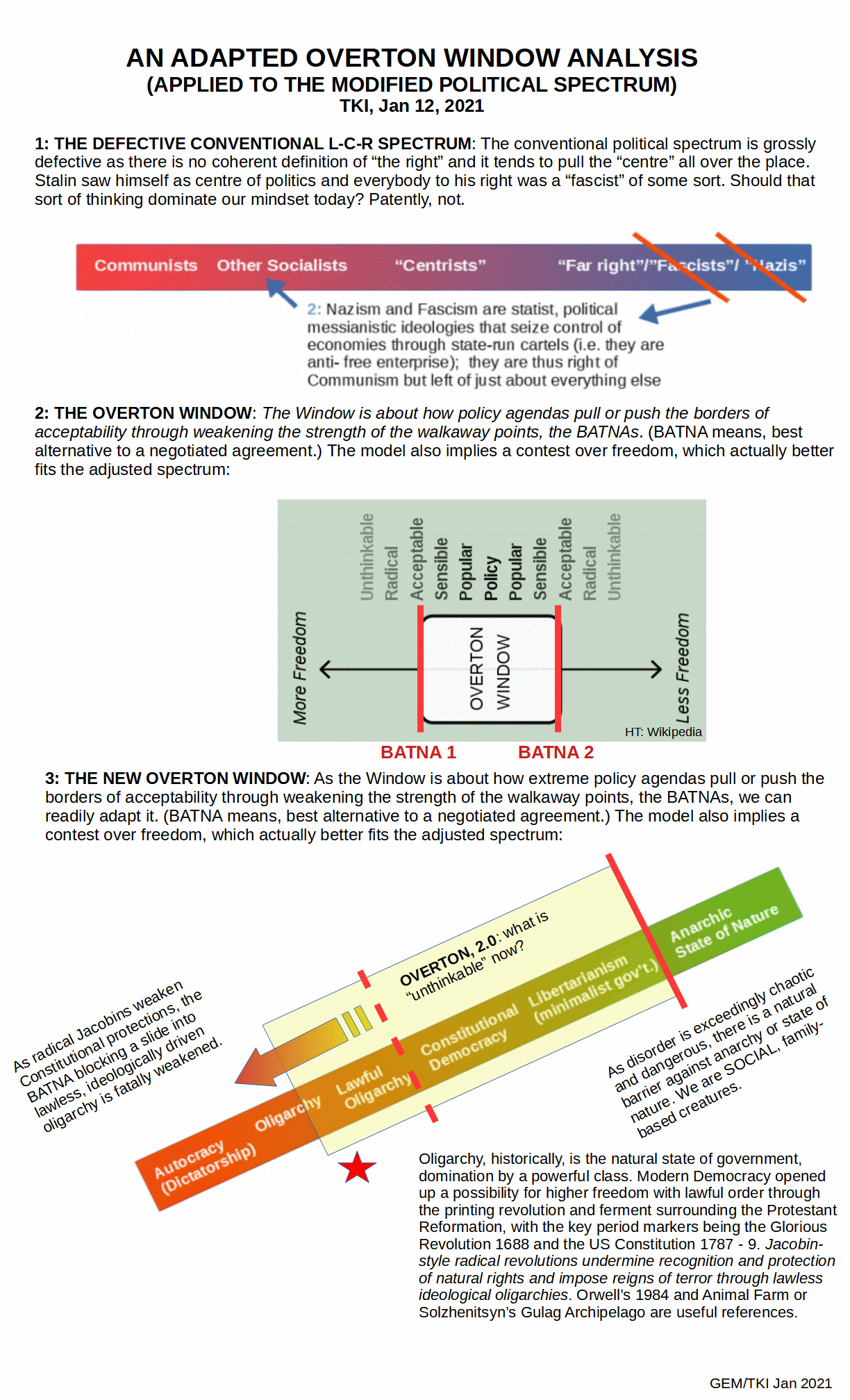
The issue becomes pivotal, once we ponder the premise that the typical, “natural” tendency of government is to open or veiled lawless oligarchy:
So, let us hear Cicero in his On The Republic, Bk 3 [c. 55 – 54 BC]:

{22.} [33] L . . . True law is right reason in agreement with nature , it is of universal application, unchanging and everlasting; it summons to duty by its commands, and averts from wrongdoing by its prohibitions. And it does not lay its commands or prohibitions upon good men in vain, though neither have any effect on the wicked. It is a sin to try to alter this law, nor is it allowable to attempt to repeal any part of it, and it is impossible to abolish it entirely. We cannot be freed from its obligations by senate or people, and we need not look outside ourselves for an expounder or interpreter of it. And there will not be different laws at Rome and at Athens, or different laws now and in the future, but one eternal and unchangeable law will be valid for all nations and all times, and there will be one master and ruler, that is, God, over us all, for he is the author of this law, its promulgator, and its enforcing judge. Whoever is disobedient is fleeing from himself and denying his human nature, and by reason of this very fact he will suffer the worst penalties, even if he escapes what is commonly considered punishment. . . . – Marcus Tullius Cicero, On the Republic, Bk 3

This, of course, is further reflected in his De Legibus, which lays out a framework:

With respect to the true principle of justice, many learned men have maintained that it springs from Law. I hardly know if their opinion be not correct, at least, according to their own definition; for “Law (say they) is the highest reason, implanted in nature, which prescribes those things which ought to be done, and forbids the contrary.” This, they think, is apparent from the converse of the proposition; because this same reason, when it [37]is confirmed and established in men’s minds, is the law of all their actions.

They therefore conceive that the voice of conscience is a law, that moral prudence is a law, whose operation is to urge us to good actions, and restrain us from evil ones.

We see in the Angelic Doctor, a broadening of the framework, elaborating four domains of law:

Thus, following Aquinas, we can see that arguably there is an intelligible core of law coeval with our responsible, rational, significantly free nature. This built-in law turns on inescapable, thus self-evident truths of justice and moral government, which rightly govern what courts may rule or parliaments legislate, per the premise of justice moderated by requisites of feasible order in a world that must reckon with the hardness of men’s hearts. Where, we are thus duty bound, morally governed creatures.

Hence, we come to the sense of duty attested to by sound conscience [“conscience is a law”], that breathes fire into what would otherwise be inert statements in dusty tomes. We may term these, by extension, the Ciceronian First Duties of Reason:

FIRST DUTIES OF RESPONSIBLE REASON

We can readily identify at least seven inescapable first duties of reason. “Inescapable,” as they are so antecedent to reasoning that even the objector implicitly appeals to them; i.e. they are self-evident. Namely, duties,

1 – to truth, 

2 – to right reason, 

3 – to prudence, 

4 – to sound conscience, 

5 – to neighbour; so also, 

6 – to fairness and

7 – justice 

x – etc.

[I add, Mar 12, for clarity:] {Of course, there is a linked but not equivalent pattern: bounded, error-prone rationality often tied to ill will and stubbornness or even closed mindedness; that’s why the study of right reason has a sub-study on fallacies and errors. That we seek to evade duties or may make errors does not overthrow the first duties of reason, which instead help us to detect and correct errors, as well as to expose our follies.}

Such built-in . . . thus, universal . . . law is not invented by parliaments, kings or courts, nor can these principles and duties be abolished by such; they are recognised, often implicitly as an indelible part of our evident nature. Hence, “natural law,” coeval with our humanity, famously phrased in terms of “self-evident . . . rights . . . endowed by our Creator” in the US Declaration of Independence, 1776. (Cf. Cicero in De Legibus, c. 50 BC.) Indeed, it is on this framework that we can set out to soundly understand and duly balance rights, freedoms and duties; which is justice, the pivot of law.

The legitimate main task of government, then, is to uphold and defend the civil peace of justice through sound community order reflecting the built in, intelligible law of our nature. Where, as my right implies your duty a true right is a binding moral claim to be respected in life, liberty, honestly acquired property, innocent reputation etc. To so justly claim a right, one must therefore demonstrably be in the right.

Where, prudence can also be seen via Aristotle’s summary:  “. . . [who aptly] defined prudence as recta ratio agibilium, ‘right reason applied to practice.’ The emphasis on ‘right’ is important . . .  Prudence requires us to distinguish between what is right and what is wrong . . . If we mistake the evil for the good, we are not exercising prudence—in fact, we are showing our lack of it.”

Of course, we just saw a 400+ comment thread that saw objectors insistently, studiously evading the force of inescapability, where their objections consistently show that they cannot evade appealing to the same first duties that they would dismiss or suggest were so obscure and abstract that they cannot serve as a practical guide. The history of the modern civil rights movement once the print revolution, the civilisational ferment surrounding the reformation and the rise of newspapers, bills, coffee houses etc had unleashed democratising forces speaks to the contrary. The absurdity of appealing to what one seeks to overthrow simply underscores its self evidence. But free, morally governed creatures are just that, free. Even, free to cling to manifest absurdities.

This approach, of course, sharply contrasts with the idea that law is in effect whatever those who control the legal presses issue under that heading; based on power balances and so in effect might and/or manipulation. Aquinas’ corrective should suffice to show that not all that is issued under colour of law is lawful, or even simply prudent towards preserving order in a world of the hardness of men’s hearts.

Yes, obviously, if we are governed by built-in law, that raises the question that there is a cosmic law-giver, qualified to do so not by mere sheer power but also by being inherently good and utterly wise. Such a root of reality also answers the Hume Guillotine and the Euthyphro dilemma: an inherently good and utterly wise, necessary and maximally great being root of reality would bridge IS and OUGHT in the source of all reality and would issue good and wise, intelligible built-in law.

What of Mathematics? The answer is, of course, that a core of Math is inherent in the framework of any possible world. So, this would extend that core of Math tied to sets, structures and quantities expressed in N,Z,Q,R,C,R* etc to any actual world. That answers Wigner’s puzzlement on the universal power of Math and it points to, who has power to create an actual world in which we have fine tuning towards C-Chemistry, aqueous medium, cell based life? Likewise, it is suggestive on the source of the language and algorithms found in D/RNA etc.

Lest we forget, here is Crick, to his son, March 19, 1953:
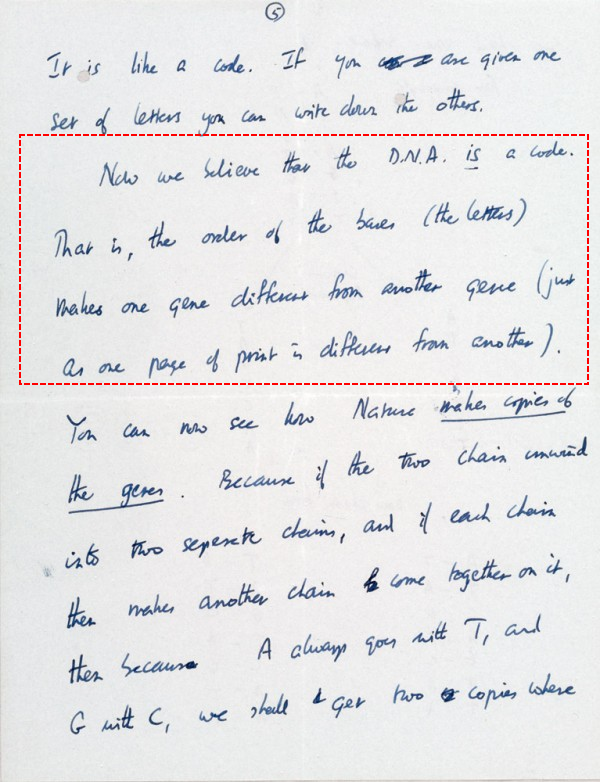
So, we have come full circle, to law as expressing ordering principles of the dynamic-stochastic physical world and those of the world of intelligent, rational, morally governed creatures. Surprise — NOT — the design thesis is central to both. END

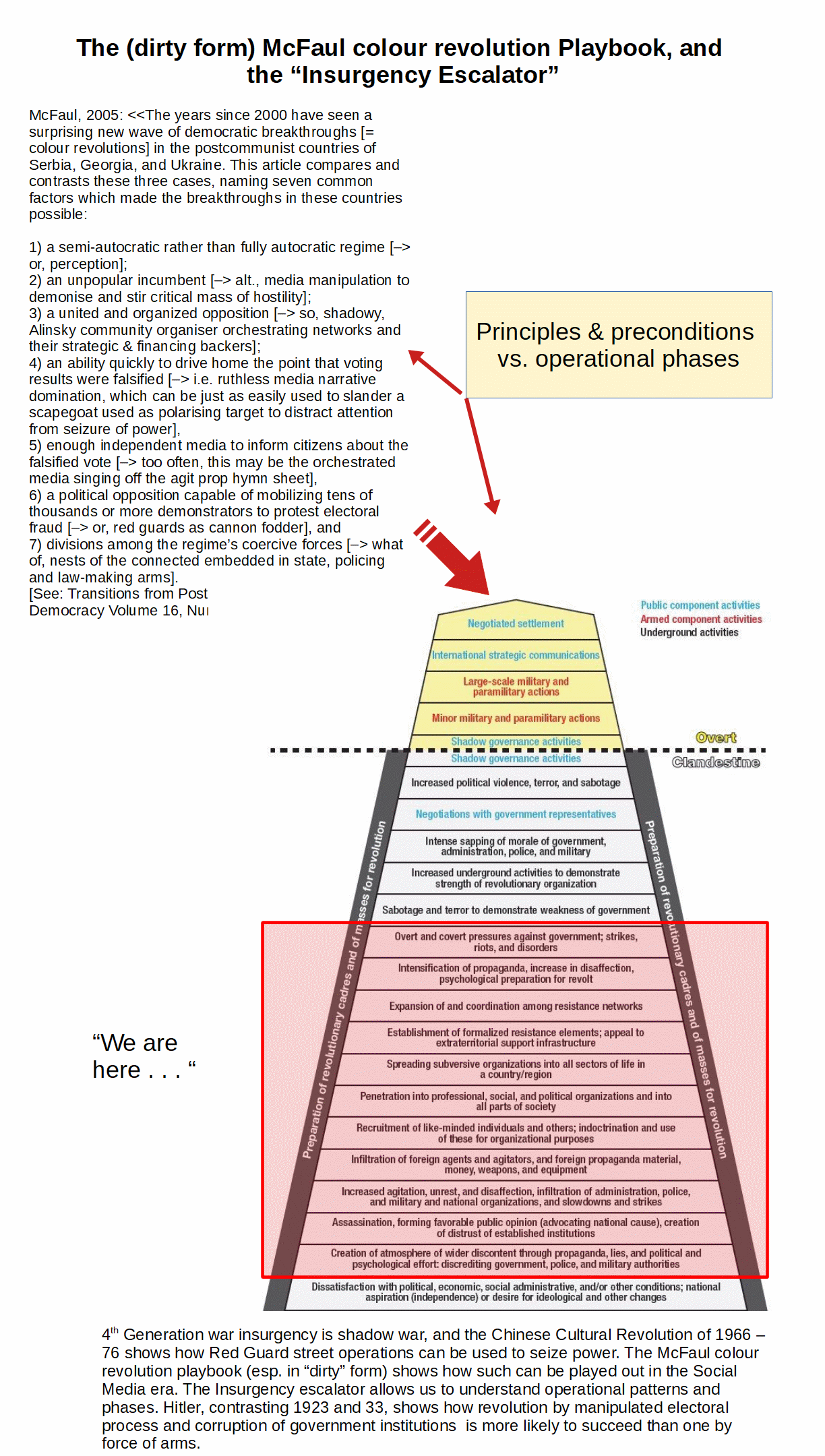
PS: As a reminder, the McFaul dirty form colour revolution framework and SOCOM insurgency escalator
U/D Feb 14: Outlines on first principles of right reason:
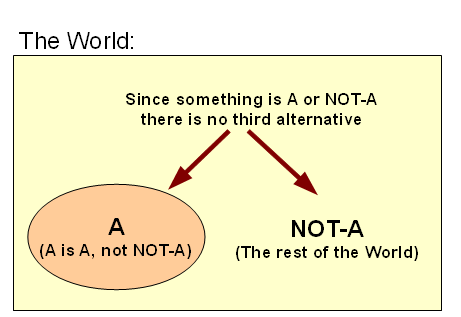
Here, we see that a distinct A — I usually use a bright red ball on a table:

and contrast a red near-ball in the sky, Betelgeuse as it went through a surprise darkening (something we observed separately and independently, it was not a figment of imagination):

. . . is distinct from the rest of the world. A is itself i/l/o its characteristics of being, and it is distinct from whatever else is not A, hence we see that in w there is no x that is A and ~A and any y that is in W will either be A or not A but not both or neither. These three are core to logic: P/LOI, LNC, LEM.

We may extend to governing principles that we have duties toward — never mind whoever may disregard such (and thereby cause chaos):
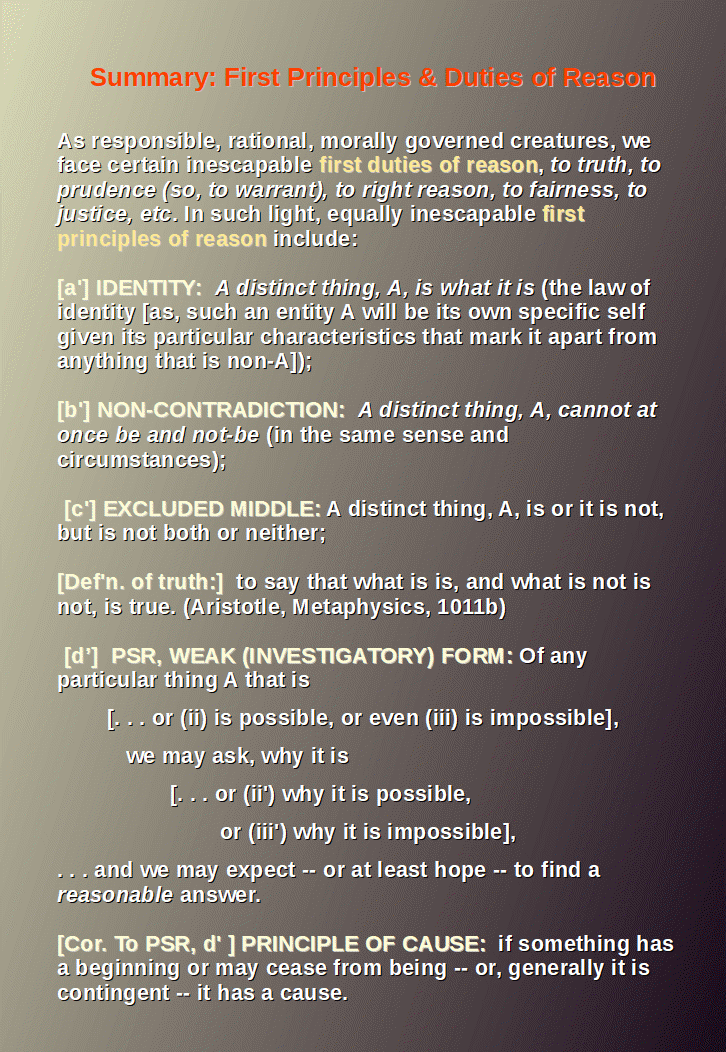
U/D March 13: The challenge of building a worldview i/l/o the infinite regress issue:
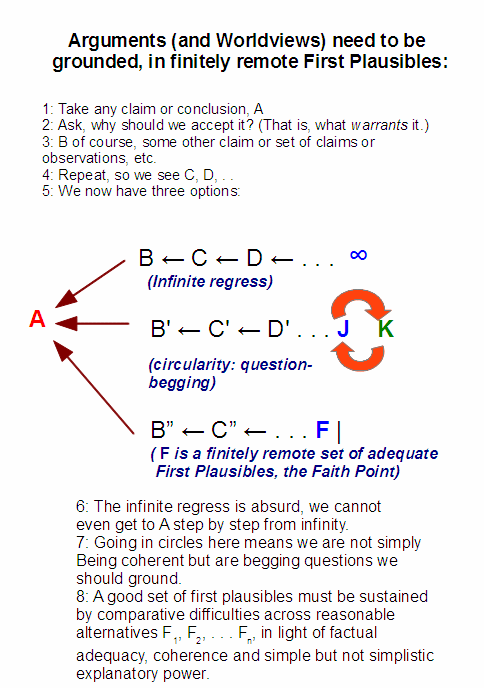
A summary of why we end up with foundations for our worldviews, whether or not we would phrase the matter that way}

Framing a ship:

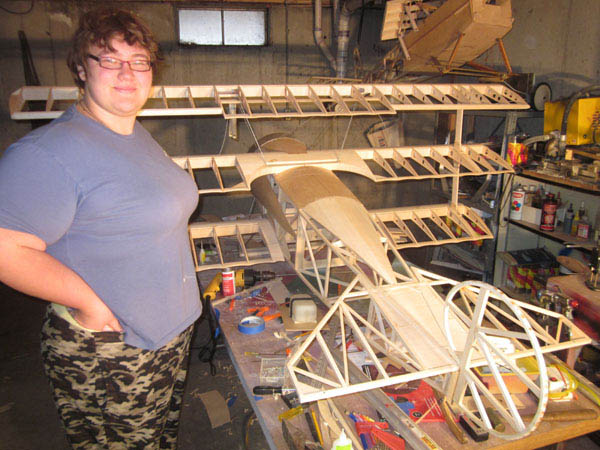
. . . compare a wooden model aircraft:
. . . or a full scale, metal framework jet:
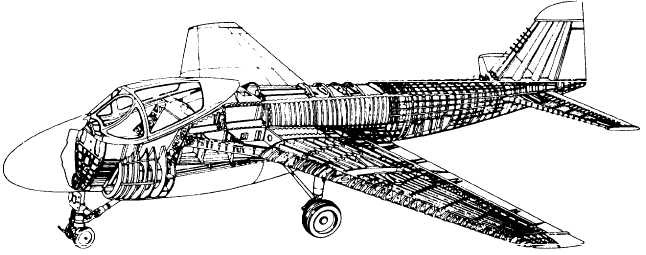
In short, there is always a foundational framework for any serious structure.

Comments
WJM, I have always spoken of us as responsibly, rationally free. That means we can refuse or turn from duties. What we cannot do in arguing, is avoid appealing to and/or implying first duties. We don't have to argue, we don't have to think, we don't have to quarrel, we can choose to be silent etc. But once we seek to gain rhetorical traction and persuade, choosing to argue or quarrel, we find ourselves appealing to said duties, thus implying their governing role. Even, when the argument is an attempted objection to said duties or their inescapability. As has been shown case after case, again and again. KFkairosfocus
March 13, 2021
March
03
Mar
13
13
2021
07:12 AM
7
07
12
AM
PST
KF said:
The definition of natural law you offer is not apt. ...... We have another level of law, duties that are built in. We can flout or ignore them, but not without damaging result. But that is not the point, it is that we see an inescapability of appealing to such in our reasoning, arguing and quarrelling. Even objections cannot get away from such appeal.
You are conflating two entirely different kinds of things: the avoidable and the unavoidable. Your own examples make this clear; there is a difference between inescapable physical laws and our options available under those physical laws. Our options only extend to the point where the physical law cannot be avoided. Duties can only extend to where options are available; they cannot extend into the arena of the existentially unavoidable. Yet, you keep repeating that because I do the unavoidable, it implies a duty. Gravitation does not imply how one should build a house or how one should walk. The only thing that can imply an "ought" is a goal; the only thing that can entail an "ought" is the existence of options available in service of, or in contradiction to, a goal. Existential unavoidables do not entail options. Existential unavoidables do not represent any goal. I literally cannot be "appealing to a duty" when I engage in unavoidable, fundamental forms of my behaviors, words or thought. "Duties" and "existential unavoidables" are necessary two irreconcilably different kinds of things which cannot, logically speaking, entail or be part of or imply the other.William J Murray
March 13, 2021
March
03
Mar
13
13
2021
07:04 AM
7
07
04
AM
PST
Here's the rest of 973: i wasn't finished and got interrupted: re 966: When I wrote to KF, "The recurring issue is your claim that conscience is necessary and inescapably part of the root of reality", you replied "As was pointed out already and linked, I have made no such claim, this is a strawman caricature." And yet the post you link to says,
We can readily identify at least seven inescapable first duties of reason. “Inescapable,” as they are so antecedent to reasoning that even the objector implicitly appeals to them; i.e. they are self-evident. Namely, duties, to truth, to right reason, to prudence, to sound conscience, to neighbour; so also, to fairness and justice etc.
The distinction you make between what I said and what you said (which I see as an attempt to understand you, not a "strawman") is that most people have a normal conscience that, but some are "defective". So what is binding (your word) and "inescapable at the root of reality" is our duty to use our conscience in response other duties such as "truth, right reason, prudence, fairness, justice, neighbour." But how do you know - what argument do you have - that the root of reality cares one bit about whether we are prudent, fair, interested in justice, and otherwise use our conscience to help guide us. Why do you think we have duties coming from the root of reality to exhibit those qualities. Why do you think it is self-evident that those are aspects of the root of reality? You point to what is commonplace, and note that there are deviations from normal, all which is true. That doesn't mean that the root of reality is responsible for, the source of, or is in any other way involved in the choices we make and the actions we take. You assume that there is a God at the root of reality: "a Supreme Law-giver, the inherently good, utterly wise and just creator-God…" That is why you think we have these duties. You state that this a philosophical position, not a religious one. Even as a philosophical position, however, it is a beginning premise, not the conclusion of an argument. You can't go back to the inescapable duties as an argument for God when you think the inescapable duties are from the roots of reality that is God. Issue two: I also find in interesting that you write things like "So, you are venturing into slander at this point" by saying that your philosophy is grounded in your Christian faith, and that "This is now insistent false accusation intended to taint through insinuation of dishonesty and/or gross defect of ability to reason." You make it sound like associating your philosophy with your Christianity is an insult. I don't mean it that way.Viola Lee
March 13, 2021
March
03
Mar
13
13
2021
06:46 AM
6
06
46
AM
PST
re 966: When I wrote to KF, "The recurring issue is your claim that conscience is necessary and inescapably part of the root of reality", you replied "As was pointed out already and linked, I have made no such claim, this is a strawman caricature." And yet the post you link to says,
We can readily identify at least seven inescapable first duties of reason. “Inescapable,” as they are so antecedent to reasoning that even the objector implicitly appeals to them; i.e. they are self-evident. Namely, duties, to truth, to right reason, to prudence, to sound conscience, to neighbour; so also, to fairness and justice etc.
Viola Lee
March 13, 2021
March
03
Mar
13
13
2021
06:15 AM
6
06
15
AM
PST
Morality as a culturally conditioned response. https://philosophynow.org/issues/82/Morality_is_a_Culturally_Conditioned_ResponseSteve Alten2
March 13, 2021
March
03
Mar
13
13
2021
06:15 AM
6
06
15
AM
PST
WJM:
My particular argument is: even though you have the best blueprint, it has a gap that cannot be – ultimately – logically reconciled: the gap between “natural law,” in terms of “unavoidable existential necessities” and oughts, or duties and “rights.” When you say that how I necessarily, unavoidable act, write, talk and think implies a “duty” to an unavoidable, existential necessity, you have made a fundamentally incoherent claim.
The definition of natural law you offer is not apt. A mechanical necessity of the world or even what is imposed by logic of being (Math stuff esp) are at a different level from laws that govern or regulate but do not determine the actions of rational, responsible, self-moved creatures. Water will boil at 100 Celsius at 1 atmosphere pressure, 760 mm Hg. A ball released initially falls at acceleration 9.8 N/kg. A die tossed, tumbling and sensitively dependent on initial and intervening circumstances, exhibits flat randomness, if fair. 3 + 2 = 5. Those are determined or determined to be stochastic per some law or other. We have another level of law, duties that are built in. We can flout or ignore them, but not without damaging result. But that is not the point, it is that we see an inescapability of appealing to such in our reasoning, arguing and quarrelling. Even objections cannot get away from such appeal. Inescapable, true, self-evident. I add, not an existential necessity, there are possible worlds without particular creatures like this, and that would include our world before we were formed. Where, we have people with defective minds and consciences who do not sense or cannot make sense of such principles. However, on the whole, key parts of soundly functioning human nature. So much so that an intelligent but conscience crippled person such as Hitler, brought before Nuremberg could have been told, did you need a formally passed regulation to know that murder is evil, wrong, inherently criminal? KFkairosfocus
March 13, 2021
March
03
Mar
13
13
2021
06:05 AM
6
06
05
AM
PST
KF, is it impossible for you to separate the idea of a "duty" from the idea of an "unavoidable, existential necessity?" Because you keep referring to them as if they are inseparable ideas. Let me try it this way. Do you agree with this statement: Any duty must entail a behavior that is avoidable.William J Murray
March 13, 2021
March
03
Mar
13
13
2021
05:51 AM
5
05
51
AM
PST
My particular argument, KF, is not intended to undermine your blueprint. I agree with the blueprint as best, most effective blueprint for the kind of ship (society) you want to build, that would be seaworthy considering the sea (ERT ) it is built to sail on. My particular argument is: even though you have the best blueprint, it has a gap that cannot be - ultimately - logically reconciled: the gap between "natural law," in terms of "unavoidable existential necessities" and oughts, or duties and "rights." When you say that how I necessarily, unavoidable act, write, talk and think implies a "duty" to an unavoidable, existential necessity, you have made a fundamentally incoherent claim. A duty, by its very nature, requires that I have the capacity to fail in performing that duty. It is logically irreconcilable that (1) I must be able to fail in my duty, or it cannot be said to be a duty, and (2) I cannot fail in any way to act or think according to unavoidable, existential necessity. Thus, the aspects of anything that I say or do that are unavoidable cannot, logically speaking, represent a duty. Even so, it's not like any significant number of people in such a society built on this premise is going to realize this, or even realizing it, is going to care that much or try to undermine the society because of it. It's still the best ship for the job, even if it is logically flawed.William J Murray
March 13, 2021
March
03
Mar
13
13
2021
05:45 AM
5
05
45
AM
PST
WJM, yes the following is absurd:
one can have a duty to behave in a way that cannot be avoided even if one tried is probably one of the most absurd ideas I’ve ever come across.
No prize for guessing why. It is a strawman caricature. Manifestly, a free, responsible, rational agent can choose to do or reject duties, no matter how well founded. Although, not without consequences, especially the cumulative impact on the good ship civilisation. What I have stated, repeated, explained, corrected regarding and more, over and over again, is differen. Repeat, different. Namely, that in our reasoning, arguing, communicating persuasively, quarrelling, we find that we cannot but appeal to the generally acknowledged first duties, which I took time to list. A list that builds on what struck me from Cicero. And yes, generally acknowledged. Truthfulness, reasonableness, prudence, heeding sound conscience, doing good by neighbour, being fair and being just are not exactly dubious resorts of some idiot on a soap box off in a corner. I particularly noted from the outset, see OP and the linked summary clip:
FIRST DUTIES OF RESPONSIBLE REASON We can readily identify at least seven inescapable first duties of reason. “Inescapable,” as they are so antecedent to reasoning that even the objector implicitly appeals to them; i.e. they are self-evident . . .
The logic is, inescapable even for those putting up an argument of objection to said duties, they are forced to appeal to them to give rhetorical traction to their claims. As I have taken time to show over and over on cases above and previously. Indeed, why are you objecting ". . . one of the most absurd ideas I’ve ever come across"? H'mm, could it be because you are assuming and appealing to our known duty to logic and the like? As in, an appeal to the second listed first duty, right reason? And with implication of need to warrant, i.e. an appeal to duty no 3, prudence? With the background, that what is a self contradictory claim cannot be true . . . i.e. duty 1, to truth given the principle of explosion [an aspect of duty 2]? That inescapability is again shown from your own objection. My onward conclusion follows this line of reasoning: inescapable so universal in acts of reasoning, so true and a first principle, one that cannot be denied or objected to without the absurdity of appealing to what one hopes to overthrow. Likewise, by that universality, unprovable as the attempted proof itself cannot but imply appeals to said duties. (The case of Epictetus and your failed objection by parody speak to this.) So, instead recognised as a self-evident first truth and used as framework for our onward reasoning. I fail to see how this can be so hard to recognise, from even a bit of self reflection on one's own arguments. However, the objection I cited shows what may be happening instead, a strawman caricature has been substituted and is what is being objected to. A strawman that for plausibility depends on the influence of certain modern and ultra modern schools of thought. So, let us note, the actual argument is not the strawman. KFkairosfocus
March 13, 2021
March
03
Mar
13
13
2021
05:40 AM
5
05
40
AM
PST
KF @ 963, I understand your argument. Moreover, I would say that under the existential premise that 99.99%+ of the people in this world operate under (ERT,) I agree with your "ship of state" argument. I agree that the principles you have laid out. Under the ERT premise, if you do not have agreed-upon, at least substantively, moral duties, which are tethered to something that can be held as objective, any ship of state other than lawless oligarchy will sink. I understand this part of your argument; it doesn't matter if it is the "will of God" or existential unavoidables or the supreme power of the government, subjective morality cannot be the blueprint by which you build that ship because it cannot produce a seaworthy ship of any sort; even a lawless oligarchy has the "moral system" of "might makes right." Building anything that endures and meets the specifications for the purpose of what is built requires a coherent blueprint that is followed by all those who are involved in building it (same analogy in essence as the "mutinous crew.") So, your question about "should we" attach the blueprint of a society to "natural law" is about finding a concept as solid and irrefutable as A=A to refer to when designing and building the ship, even if there is no way to make the case that such oughts are attached to A=A, or are< attached to God, or are< attached to a supreme government or "holy Emperor." Again, here, under our existential premise, I agree with you that "natural law," as a concept, provides an incontrovertible conceptual (not necessarily logical) basis for any moral system that doesn't depend on subjective beliefs whatsoever, or any ruler or government, or even any concept of God. Even if the nature of "duty" logically precludes their attachment to the existentially necessary and unavoidable; that doesn't mean you cannot attach a moral system to them anyway. It can obviously be done because it's been done. The logic ultimately fails, but then it's not like people operate rationally in most things, much less attempt to logically examine these things in fine detail. So, the question remains: should we? Well, it depends on the kind of ship you're trying to build and where you want it to take you. If you want to build a democratic republic where the power ultimately lies in the people (inasmuch as they are willing to hold the power,) the moral framework must put the individual in a moral landscape like gravity; it applies equally to everyone and is not generated from any monarch, government, ruling class or religious perspective. If that's your goal, then I would say that what you have outlined and argued for is the best way forward, under the ERT existential premise, whether or not it is ultimately possible to demonstrate universal conscience or that our duties are, or even logically can be, attached to unavoidable existential necessities.William J Murray
March 13, 2021
March
03
Mar
13
13
2021
05:05 AM
5
05
05
AM
PST
VL, 961: >>The recurring issue is your claim that conscience is necessary and inescapably part of the root of reality.>> 1: As was pointed out already and linked, I have made no such claim, this is a strawman caricature. 2: I have pointed out that we are radically contingent: we are born, we live some decades, we die and are often buried. Some have various handicaps or defects of body and mind, the latter including that some have damaged or defective consciences. 3: So, there is no necessity of existence in the conscience, however it is a massively evident fact and feature of the conscious life of a mature, normal person. So, those with a defect here should refer to those that are in a more normal state, here I point to the likes of a Hitler or Stalin or Mao, or individuals and groups at a lower level with similar tendencies. 4: What I have said is that duty to sound conscience is inescapable, part of the framework of similarly inescapable first duties of reason. Where, soundness is informed by those other duties, I have used the metaphor of a faceted jewel; each facet acts in part through the effect of the others and in turn contributes to them. This is the holograph-microcosm principle. 5: Indeed, it is the voice or compass-needle of conscience which motivates us in our responsiveness to duties to truth, right reason, prudence, fairness, justice, neighbour. As we are all familiar with. Such contributes materially to the rhetorical traction of argument. 6: Notice, your own objections again and again pivot on these duties, you are manifestly unable to compose an argument of objection without appealing to the binding nature of what you object to. 7: Where, there is an existential component to conscience, it is a core part of a normally functioning human being. We are conscious, embodied, mammalian [coming in two complementary sexes, with females having mammary glands], rational and conscience guided, but finite and fallible, morally struggling creatures. Some have various defects but that is the general pattern of rational animality. Where animal is actually a reference to the self-moved, reflexively active creature, living and ensouled, as Plato argued in The Laws Bk X. >> The second issue is my pointing out that ultimately your assertion>> 8: I have pointed out that ARGUMENT II is a proposal in the context of comparative difficulties across live option worldviews, and that what follows is not specifically judaeo-christian. I am pointing to ethical theism and the God who commonly comes up in philosophy, not any particular religious tradition. 9: That coming up goes back to Plato, who obviously was a pagan philosopher hardly likely to have been strongly influenced by the hebraic tradition. Later we find in Cicero, 55 - 54 BC:
, On the Republic, Bk 3: {22.} [33] L . . . True law is right reason in agreement with [--> our morally governed] nature , it is of universal application, unchanging and everlasting; it summons to duty by its commands, and averts from wrongdoing by its prohibitions. And it does not lay its commands or prohibitions upon good men in vain, though neither have any effect on the wicked. It is a sin to try to alter this law, nor is it allowable to attempt to repeal any part of it [--> as universally binding core of law], and it is impossible to abolish it entirely. We cannot be freed from its obligations by senate or people [--> as binding, universal, coeval with our humanity], and we need not look outside ourselves for an expounder or interpreter of it. [--> sound conscience- guided reason will point out the core] And there will not be different laws at Rome and at Athens, or different laws now and in the future, but one eternal and unchangeable law will be valid for all nations and all times, and there will be one master and ruler, that is, God, over us all, for he is the author of this law, its promulgator, and its enforcing judge. Whoever is disobedient is fleeing from himself and denying his human nature, and by reason of this very fact he will suffer the worst penalties, even if he escapes what is commonly considered punishment. . . . – Marcus Tullius Cicero, c. 55 - 54 BC
10: It seems you find it difficult to accept that I am speaking i/l/o the force of Cicero's remarks in De Legibus, so let me pause to clip IEP on Cicero:
Marcus Tullius Cicero was born on January 3, 106 B.C.E. and was murdered on December 7, 43 B.C.E. His life coincided with the decline and fall of the Roman Republic, and he was an important actor in many of the significant political events of his time, and his writings are now a valuable source of information to us about those events. He was, among other things, an orator, lawyer, politician, and philosopher. Making sense of his writings and understanding his philosophy requires us to keep that in mind. He placed politics above philosophical study; the latter was valuable in its own right but was even more valuable as the means to more effective political action. The only periods of his life in which he wrote philosophical works were the times he was forcibly prevented from taking part in politics. While Cicero is currently not considered an exceptional thinker, largely on the (incorrect) grounds that his philosophy is derivative and unoriginal, in previous centuries he was considered one of the great philosophers of the ancient era, and he was widely read well into the 19th century. Probably the most notable example of his influence is St. Augustine’s claim that it was Cicero’s Hortensius (an exhortation to philosophy, the text of which is unfortunately lost) that turned him away from his sinful life [--> he had rejected the Christian influence of his mother, Monica and was wandering across the world of ideas and indulgences of the flesh, a professional rhetor] and towards philosophy and ultimately to God . . .
11: Here in, condensed form is the text that struck me and led me to the reflections summarised in the OP:
—Marcus [in de Legibus, introductory remarks,. C1 BC, being Cicero himself]: . . . we shall have to explain the true nature of moral justice, which is congenial and correspondent [36]with the true nature of man [--> we are seeing the root vision of natural law, coeval with our humanity] . . . . With respect to the true principle of justice, many learned men have maintained that it springs from Law. I hardly know if their opinion be not correct, at least, according to their own definition; for . “Law (say they) is the highest reason, implanted in nature, which prescribes those things which ought to be done, and forbids the contrary” . . . . They therefore conceive that the voice of conscience is a law, that moral prudence is a law [--> a key remark] , whose operation is to urge us to good actions, and restrain us from evil ones . . . . According to the Greeks, therefore, the name of law implies an equitable distribution of goods: according to the Romans [--> esp. Cicero, speaking as a leading statesman], an equitable discrimination between good and evil. The true definition of law should, however, include both these characteristics. And this being granted as an almost self–evident proposition, the origin of justice is to be sought in the divine law of eternal and immutable morality. This indeed is the true energy of nature, the very soul and essence of wisdom, the test of virtue and vice.
[--> this points to the wellsprings of reality, the only place where is and ought can be bridged; bridged, through the inherently good utterly wise, maximally great necessary being, the creator God, which adequately answers the Euthyphro dilemma and Hume's guillotine argument surprise on seeing reasoning is-is then suddenly a leap to ought-ought. IS and OUGHT are fused from the root]
This indeed is the true energy of nature, the very soul and essence of wisdom, the test of virtue and vice.
12: You will note that first law, first duty issues are central, but the puzzle of explaining a world with a responsible, rational creature with self-moved freedom points to world roots issues. I put on the table an option ethical theism. If you can successfully pose and address on comparative difficulties an option that does not collapse into nihilism and does not sacrifice unity and diversity, while also leaving room for such first law to be binding -- as well not falling into grand delusion -- feel free to expound: _____ 13: I note, such invitations have been repeatedly made, but have not been taken up. Simply a link would be good enough at this stage. >> that stems from “our roots in the Supreme Law-giver, the inherently good, utterly wise and just creator-God…”>> 14: Note, God as philosophical entity and serious candidate necessary being world root [as opposed to say flying spaghetti monster parodies . . . ], not God as expounded in a religious tradition. >> is basically a religious view>> 15: Demonstrated false and directly testified as not what is at stake, with evidence. So, you are venturing into slander at this point, as follows . . . >> that is grounded, behind the scenes so to speak, in your Christian faith.>> 16: This is now insistent false accusation intended to taint through insinuation of dishonesty and/or gross defect of ability to reason. 17: I suggest, you would be well advised to walk back from this line of argument by insinuation. KF PS: I clip from IEP and comment:
Western concepts of God have ranged from the detached transcendent demiurge of Aristotle to the pantheism of Spinoza. Nevertheless, much of western thought about God has fallen within some broad form of theism. Theism is the view that there is a God which is the creator and sustainer of the universe and is unlimited with regard to knowledge (omniscience), power (omnipotence), extension (omnipresence), and moral perfection. [ --> hence, ethical theism] Though regarded as sexless, God has traditionally been referred to by the masculine pronoun. Concepts of God in philosophy are entwined with concepts of God in religion. [--> yes, but obviously, phil is not bound to any particular tradition, it is free to ponder, adapt, abstract, discuss, conclude, hence from Ari to Spinoza etc] This is most obvious in figures like Augustine and Aquinas, who sought to bring more rigor and consistency to concepts found in religion. [--> Augustine REJECTED Christianity and in the end was forced back as he saw alternative after alternative fail as he thought them through] Others, like Leibniz and Hegel, interacted constructively and deeply with religious concepts. Even those like Hume and Nietzsche, who criticized the concept of God, dealt with religious concepts. [--> that is they dealt with a concept of God] While Western philosophy has interfaced most obviously with Christianity, Judaism and Islam have had some influence. The orthodox forms of all three religions have embraced theism, though each religion has also yielded a wide array of other views. [--> people are free so they will think as they will] Philosophy has shown a similar variety. For example, with regard to the initiating cause of the world, Plato and Aristotle held God to be the crafter of uncreated matter. [--> notice, this is not the creator God but the forming demiurge or the like] Plotinus regarded matter as emanating from God. Spinoza, departing from his judaistic roots, held God to be identical with the universe, while Hegel came to a similar view by reinterpreting Christianity. [--> pantheism or panentheism] Issues related to Western concepts of God include the nature of divine attributes and how they can be known, if or how that knowledge can be communicated, the relation between such knowledge and logic, the nature of divine causality, and the relation between the divine and the human will.
kairosfocus
March 13, 2021
March
03
Mar
13
13
2021
04:57 AM
4
04
57
AM
PST
Kf needs an interpreter. He writes in extremely long sentences/paragraphs often repetitive, rambling that are information dense, coded and cryptic. His conclusions are often obvious but attacked because they are unpopular to some. He is not always right and then defends without right reason some of his positions. But generally he is right on but just not in simple declarative sentences.jerry
March 13, 2021
March
03
Mar
13
13
2021
04:20 AM
4
04
20
AM
PST
The idea that one can have a duty to behave in a way that cannot be avoided even if one tried is probably one of the most absurd ideas I've ever come across. Duties must be about things that provide the opportunity for failure. Unavoidable existential necessities do not proved this opportunity; they cannot be what any duty ultimately refers to. KF's worldview on duties is incoherent at the outset because of this. Unavoidable existential necessities cannot lead to, or point to, any duties because a duty requires the capacity to avoid or fail in one's duty. Nobody can fail what is unavoidably, existentially necessary.William J Murray
March 13, 2021
March
03
Mar
13
13
2021
04:02 AM
4
04
02
AM
PST
WJM, There are of course several major issues on the table, but your cross-complaint on epistemic justification and foundationalism requires some attention. My first note is that metaphors are often quite instructive, reflecting how arguments by analogy are deeply connected to inductive reasoning and the power of models. From Aristotle's recognition of the implication of successive warrant on, the need to stop at a finitely remote set of first plausibles without begging big questions has been on the table. Linked, is the matter of self-evident first truths such as we see with distinct identity; without distinct entities we cannot even think in symbols much less communicate or argue. Paul of Tarsus gives what is probably a C1 Rhetoric 101 summary, in what is in fact the most readily accessible classical text-compilation of our civilisation, by common title translated into current English, THE Book:
1 Cor 14:7 If even lifeless instruments, such as the flute or the harp, do not give distinct notes, how will anyone know what is played? 8 And if the bugle gives an indistinct sound, who will get ready for battle? 9 So with yourselves, if with your tongue you utter speech that is not intelligible, how will anyone know what is said? For you will be speaking into the air. 10 There are doubtless many different languages in the world, and none is without meaning, 11 but if I do not know the meaning of the language, I will be a foreigner to the speaker and the speaker a foreigner to me. [ESV]
Distinct identity, of course, carries with it as close corollaries non contradiction and excluded middle, as I noted in my u/d to the OP above. (I will shortly add to the OP, a summary figure on the challenge of regress of warrant.) This is actually an important point, we see here by example, a case of a self-evident first truth of logic. We cannot dispute it without using it, and we cannot prove it without using it. Our choice would be to reject rational communication or to acknowledge it. The former is patently infeasible and we all accept this principle implicitly, save when we find it inconvenient. And just to communicate the objection (usually to LNC, a corollary) as Paul noted, we are using it. So, we are forced to acknowledge POI, LNC and LEM as start points of rational communication and argument. You are doubtless aware of this paper, in which I argue that a core of Mathematics can be seen to grow from this root. (And yes, that's another instructive metaphor, trees and roots. Notice, like building foundations, trees are based on the good earth underneath, though of course we have the famous parable of building on rock vs sand and what happens when a bad storm comes to the implied flood plain. Thus architects and master-builders as well as home owners need to watch where and how they build, given plausible challenges.) Now, a little under 100 years ago, there was a contentious debate on foundationalism, with strong aftershocks to the '80's, with one result being the rise of Reformed Epistemology. Plantinga is of course yet again a big name there, including his argument that a particular person can be fully justified or warranted [the terms are significantly different] to hold as properly basic certain views based on personal experience and memory as reflected on, due to his senses and consciousness being in reasonable working order and in environments they are fitted for, delivering responsibly trustworthy results. He of course acknowledges a debt to Reidian common sense. I note, that our conscious awareness of ourselves and our world, as well as of our consciences are part of this pattern. Yes, as I augmented the OP above and in the standard clip to follow, we are also error prone but that does not fatally compromise our ability to access responsible warrant and common sense, reliable but revisable frameworks of knowledge. That's how science goes. Which brings up three key metaphors advanced during the big hot debate: Neurath's raft, Schlick's pyramid and Quine's spider web. Let me augment with Plato's ship of state, which given Luke in Ac 27, I want to further look at in terms of the ship itself and how its strengths and limitations in environments affect what a responsible crew should do. (Don't forget, they had to frap the ship to take twisting load given obviously sprung timbers and put out a sea anchor to claw away from the sandbars of Syrtis, once they had foolishly ventured out in the teeth of prudent warning; eventually by God's grace becoming a shipwreck off a beach at Malta, which means, haven.) I notice something about the metaphors. They all have some sort of underlying environmental base, relying on stable, intelligible laws, and they all have to be coherently constructed then soundly managed. The house or pyramid has a foundation meant to give strength and stability in the earth or on bedrock, which is not always present. The spider's web obviously has to be coherent, but part of that is, anchor lines running out to anchor points. A raft, yes, can be under reconstruction but must have a structural framework rooted in principles of structural integrity and strength, or it will disintegrate and leave those on the raft swimming with the big sharks. And while a pyramid is obviously a highly stable, foundation-based structure, it relies on a framework to give it structural integrity that is rooted in statics and dynamics as well as in the good spaceship earth. The ship, of course, has a keel and framework, with a web of timbers or sheeting that protects, provides flotation and allows cargo spaces, accommodations and superstructure as well as sails and these days engines, with a bridge, maps and instruments for navigation under sound management. In short, there are material, technological and intellectual foundations and coherent frameworks involved in all cases. Even, the tree, the oldest of foundation-rooted structures. The debate, then, should not be on whether worldview foundations, but in what form, with what basis and with what integrity and limitations. Including, how do we manage the relationship between the merchant-owner [cf. Plato's metaphor for the people, strong but impaired in sight, hearing and knowledge of navigation] and the potentially mutinous crew who want the helm and are prone to loot the stores, while sidelining and denigrating the actually sound navigator or prudent passenger who raises concerns about venturing out in potentially unsafe weather. In short, I think the ship of state -- or better yet, civilisation -- is perhaps the most instructive metaphor in our time. Predictably, studiously ignored and sidelined. We have already seen that at least some first principles exist and have warrant antecedent to proofs and even the exercise of having a civilisation level discussion that builds ca knowledge base. Similarly, hyperskepticism and its liked privileging of dismissive doubt refutes itself. Where does the skeptic get his coherent tune or sentences and arguments from? S/he has borrowed without acknowledgement from the civilisation's stores; in too many cases, the better to loot without needing to account to first principles and broader first duties. This includes the existence of language, funds of tradition, history [lessons paid for with blood and tears now part of our commons if we will but heed] and carefully built up bodies of credible knowledge. Knowledge, being responsibly warranted, credibly true (so reasonably reliable) beliefs with linked know-how, i.e. techniques and arts. The going concern ship of civilisation -- for all its troubles, legacy of painful events including outright crimes that in some cases have never been fully resolved, devil's bargain compromises that were struck to find a way to survive and have a hope of progress, scars, wounds, limitations -- did not poof into existence from nowhere and nothing. No, it was painfully built, rebuilt, strengthened, frapped and repaired in storms, navigated to where we now are; at great cost and across thousands of years. It is powerful, but inherently fragile, it has to navigate a potentially destructive and significantly unpredictable environment and we have to recognise that the best guide to future storms is the record of past storms and how they were managed. Let us have some basic respect and recognition. Good ship civilisation, we salute you. In that context, let us look briefly at the worldviews and warrant issue. You will recall, that over the years, I have posed the chain of warrant challenge: A requires B, B requires C and so on. Infinite regress is not going to be traversed (and long chains are error prone), simple circularity obviously fails, and mutually reinforcing webs, rafts and ships actually have foundational frameworks and are anchored to issues, contexts and principles of the environments in which they are sited and must operate. Including, in the face of storms . . . and our civilisation is currently facing a real doozy. We are left to finite scale structures, with foundational frameworks that must provide coherence, unified integrity and unified strength. Including, we probably need to do some serious frapping and putting out of sea anchors to pull us off line of drift, while sorting out a needless bridge fight and linked mutiny. Some of the mutineers are so blinded by rage, too, that they only wish to destroy: these have to be identified and curbed. Or, the ship is going to founder; at terrible cost to all. We already see that there are self-evident first truths, first principles, which are not trivial. However, it has long been patent that such will never amount to sufficiency to build or significantly repair the ship. However, plumb lines, yardsticks, squares and key tool kits are obviously useful and important. So, we need to reckon with the issue of which architecture is best for the ship, which in the meanwhile cannot be allowed to fall apart and must not be allowed to drift onward to the fatal sand banks of Syrtis. Our folly of venturing out from Fair Havens heedless of warning and by gambling all on a sweet south wind that was itself a sign of a coming storm, is coming back to haunt us. So, the point is, we are looking at worldview alternatives that must be [1] reliably factually adequate; [2] coherent logically, dynamically and yes morally; also [3] fairly simple without being either simplistic or an ad hoc patchwork. Where, simplicity in the face of a tangled problematique is rather relative. Just look at a good introduction to aerodynamics or chemistry or biology or finance etc. There are complexities, we need guide-star principles and explanatory frameworks, such are an intellectual challenge for the finite, fallible, morally struggling, too often ill willed and closed minded or agenda driven. The demand for simplistic one size fits all explanations fails. We need to carefully build up bodies of reasonably credible and reliable knowledge and best practice; understanding that we are liable to err. It is in that context, as you know from years of interaction, that I have championed comparative difficulties analysis as just outlined. Where, as a key feature, I have taken the model of science seriously: much of our knowledge is in a weak or soft form sense of that term. What is responsibly well warranted, credibly true [and so reliable so far] belief, is subject to correction, amendment and even radical paradigm shifts. No one whose core discipline is physics can responsibly hold otherwise. Such, manifestly, has been adequate to radically transform and improve our world since the 1540's. Notwithstanding, not everything is like that. What do I mean? Go back to Paul using a C1 Rhetoric 101 example to remind the Corinthians of a self-evident first principle that literally lies at the root of logic, it is even in a sense antecedent to its close corollaries, non contradiction and excluded middle. Note the chart in the OP. A is distinct from not-A, rooted in its characteristics. A is in a wider context or world of discussion or observation. Any particular x in the context is in A or not in A but not both or neither. No particular y can be in A AND in ~A, or in neither while being in the context. Those are not arbitrary rules imposed by dead white men, they are readily observable and inescapable. Just trying to think and talk about them uses them. Even, the hyperskeptical objector. So, sense is to acknowledge such, recognising that by themselves they don't frame a worldview. Hence onward constructs and comparative difficulties. Comparative as, as was noted over the years, every major worldview option bristles with difficulties. No exceptions, so our situation forces us to choose the difficulties we are willing to live with, while recognising that certain views are in fact non viable as they fail the test of undeniable first principles. For instance it is futile to assert that all truths and knowledge are relative; this is a self-defeating objective truth claim. Likewise, tolerance is a virtue but that does not extend to entertaining that one can stand by neutral between say a flawed America, France and Britain on one hand and a Hitler or a Stalin and a Mao on the other. That is, there have to be responsible start points for morality, law, ethics etc. We can even extend that to aesthetics, in the face of the follies of brutalism or London's spoiled skyline! In this context, we can observe our common consent by how we argue, quarrel and contend, or even simply reason, that we are bound by a built in law with moral roots tied to justice. That is why I am again putting on the table a key summary, duly noting how -- despite distractions and dismissals etc -- even objectors repeately show that they are forced to refer to these in order to have rhetorical . . . persuasive . . . traction. That's a big clue that the following first duties, as advertised, are inescapable and binding, coeval with our responsible rational freedom as human beings. Note, how I have augmented here and in the OP:
We can readily identify at least seven inescapable first duties of reason. "Inescapable," as they are so antecedent to reasoning that even the objector implicitly appeals to them; i.e. they are self-evident. Namely, duties, to truth, to right reason, to prudence, to sound conscience, to neighbour; so also, to fairness and justice etc. Of course, there is a linked but not equivalent pattern: bounded, error-prone rationality often tied to ill will and stubbornness or even closed mindedness; that’s why the study of right reason has a sub-study on fallacies and errors. That we seek to evade duties or may make errors does not overthrow the first duties of reason, which instead help us to detect and correct errors, as well as to expose our follies. Such built-in . . . thus, universal . . . law is not invented by parliaments, kings or courts, nor can these principles and duties be abolished by such; they are recognised, often implicitly as an indelible part of our evident nature. Hence, "natural law," coeval with our humanity, famously phrased in terms of "self-evident . . . rights . . . endowed by our Creator" in the US Declaration of Independence, 1776. (Cf. Cicero in De Legibus, c. 50 BC.) Indeed, it is on this framework that we can set out to soundly understand and duly balance rights, freedoms and duties; which is justice, the pivot of law. The legitimate main task of government, then, is to uphold and defend the civil peace of justice through sound community order reflecting the built in, intelligible law of our nature. Where, as my right implies your duty a true right is a binding moral claim to be respected in life, liberty, honestly aquired property, innocent reputation etc. To so justly claim a right, one must therefore demonstrably be in the right. Likewise, Aristotle long since anticipated Pilate's cynical "what is truth?": truth says of what is, that it is; and of what is not, that it is not. [Metaphysics, 1011b, C4 BC.] Simple in concept, but hard to establish on the ground; hence -- in key part -- the duties to right reason, prudence, fairness etc. Thus, too, we may compose sound civil law informed by that built-in law of our responsibly, rationally free morally governed nature; from such, we may identify what is unsound or false thus to be reformed or replaced even though enacted under the colour and solemn ceremonies of law. The first duties, also, are a framework for understanding and articulating the corpus of built-in law of our morally governed nature, antecedent to civil laws and manifest our roots in the Supreme Law-giver, the inherently good, utterly wise and just creator-God, the necessary (so, eternal), maximally great being at the root of reality.
Of course, we are free to disregard such or to try to carve out self-serving exceptions. But, the good ship civilisation can only take so much damage, which is cumulative and can be fatal -- witness the collapse of the W Roman Empire. Which, of course, many are disinclined to heed. A ship with sprung timbers, gapped seams and drifting to fatal sandbars in NOT a place any sane person wishes to be. Let us ponder our alternatives. KFkairosfocus
March 13, 2021
March
03
Mar
13
13
2021
03:39 AM
3
03
39
AM
PST
VL, kindly note here, my last extensive response to your remarks. KFkairosfocus
March 13, 2021
March
03
Mar
13
13
2021
01:19 AM
1
01
19
AM
PST
Let me be more specific. The recurring issue is your claim that conscience is necessary and inescapably part of the root of reality. The second issue is my pointing out that ultimately your assertion that stems from "our roots in the Supreme Law-giver, the inherently good, utterly wise and just creator-God..." is basically a religious view that is grounded, behind the scenes so to speak, in your Christian faith. Which, or some other one, are you referring to? Second, your posts are so long and varied in content is is hard to know when you are addressing what point. You return to issues that are not active in the discussion and repeatedly re-quote sections which re-assert but do not further the argument, so sorting out what is relevant to what issue is difficult. So to then to say you answered a point above is not helpful. For instance, in what post above did you address the specific argument that conscience is necessarily and inescapable based in the root of reality? And I don't mean just asserted it, or quoted someone else who also thinks that, or makes it a consequence of an inherently good God (which just moves the issues down the road.) Be specific: what post and what paragraphs "answered this issue?"Viola Lee
March 12, 2021
March
03
Mar
12
12
2021
07:45 PM
7
07
45
PM
PST
KF writes, "VL, I corrected the strawman distortion and answered the issue." Which issue are you referring to? And can you point to the specific parts of what specific posts that you did that? Just post numbers would do for a start.Viola Lee
March 12, 2021
March
03
Mar
12
12
2021
09:06 AM
9
09
06
AM
PST
VL, I corrected the strawman distortion and answered the issue, but you seem to be stuck on the strawman. KFkairosfocus
March 12, 2021
March
03
Mar
12
12
2021
08:56 AM
8
08
56
AM
PST
Conscience
conscience is defined by its inward looking and subjective character, in the following sense: conscience is always knowledge of ourselves, or awareness of moral principles we have committed to, or assessment of ourselves, or motivation to act that comes from within us (as opposed to external impositions)
https://plato.stanford.edu/entries/conscience/ One of many definitions. But it is something within the individual and can vary from individual to individual. Is there a uniformity of what individuals have committed to? Obviously not since it varies. Is their a prevalence to what individuals have committed to? Obviously yes, since certain behaviors/strategies lead to widely held objectives. What are these widely held objectives? Survival is the main one. But there are others. Maslow’s hierarchy of needs expresses this. https://www.verywellmind.com/what-is-maslows-hierarchy-of-needs-4136760 What is moral is what leads to survival and flourishing. And our conscience tells us what best does this. So conscience is at the root of human behavior to attain the goals that deem to be inherent in nearly all humans. It is necessary and inescapable otherwise we as a species would have disappeared a long time ago. A personal aside and this has religious implications: if one believes in salvation, it is difficult to understand how one could achieve this goal without wishing all could achieve this goal. If this is accurate, then a lot of “duties” become inescapable because of this wishing. But a lot of duties also become inescapable if all one wants is for humans to flourish on this earth. Just what are these? A lot of duties become inescapable if the only objective is survival. Just what are these? Where would Kf’s list of duties fall in each of these? Survival? Flourishing? Salvation? My assessment Definitely salvation. Most likely flourishing. Maybe not survival but they may improve survival.jerry
March 12, 2021
March
03
Mar
12
12
2021
06:16 AM
6
06
16
AM
PST
To argue against mental reality
I have never met anyone who ever did this. This is a nonsensical assertion. That we have minds and they are useful is one the most trivial conclusions I have ever seen.jerry
March 12, 2021
March
03
Mar
12
12
2021
05:51 AM
5
05
51
AM
PST
KF writes, "Note, objectors — consistently show that their objections cannot evade using appeals to our first duties of responsible reason." NO, FOR MANY POSTS WE HAVE FOCUSSSED ON YOUR CLAIM THAT CONSCIENCE IS EXISTENTIALLY, AT THE ROOT OF REALITY, IS NECESSARY AND INESCAPABLE. WHY CAN'T YOU GET CLEAR ON THAT???!!!! Also, you write, "Therefore, those who so eagerly branded me a Christian who actually — shudder, the horror, the shame, the demonstration of ineptitude ." That is an unfair characterization of me. I have emphasized that we all have faith beliefs, and I haven't denigrated that at all. I am just saying that your philosophically position is based on faith beliefs, and not necessary and inescapable logic.Viola Lee
March 12, 2021
March
03
Mar
12
12
2021
05:51 AM
5
05
51
AM
PST
Succinctly: No oughts can exist in the unavoidable. Thus, the unavoidable cannot be the ground for any ought.William J Murray
March 12, 2021
March
03
Mar
12
12
2021
05:28 AM
5
05
28
AM
PST
KF @ 952, No matter how many times you assert that my behavior relates to a duty, you have not established anything - logically - as a duty in the first place. At one point I gave you that arguendo, but that is no longer the case. I've explained - logically - that the concept of a duty cannot be applied to existential unavoidables. @953: That doesn't even address my rebuttal; you're just repeating what you said before my rebuttal. You'll have to do better than an out-of-context response to some line that "caught your eye" and triggered a rote repetition of what you said before the rebuttal, as if that addresses the rebuttal to the very thing you said before and just repeated.William J Murray
March 12, 2021
March
03
Mar
12
12
2021
05:15 AM
5
05
15
AM
PST
F/N: I note another thing that caught my eye: >>You have to have a better argument than “cf graveyard” to make the case we are contingent beings.>> Contingent beings are causally dependent on other entities, and show contingency through having a beginning or coming to an end. Death and graveyards are of course ends, marking the close or sunset of a life here on earth, whatever fate our souls may have. Therefore graveyards are quite adequate demonstrations of our contingency as beings. The fact of disabilities etc is another sign. KFkairosfocus
March 12, 2021
March
03
Mar
12
12
2021
05:09 AM
5
05
09
AM
PST
WJM, still busy but this particularly caught my eye: >>Absolutely not. Objective truth statements are not warranted because of definitional fiat, which your entire argument relies on>> There is no truth-warrant by definitional fiat above. I note that here again you appeal to duty to right reason and prudence [aspect, warrant], in your argument, yet again illustrating the point I have put on the table since the OP: observable inescapability. KFkairosfocus
March 12, 2021
March
03
Mar
12
12
2021
05:02 AM
5
05
02
AM
PST
Now, on to my being a "contingent" being. What is the essential nature of my "being?" Is it my biological body that begins at birth and ends at death? Nope. I am not my physical body; I'm consciousness operating a physical body. In order for me to a "contingent" being, something must have generated my consciousness. What does it mean to create a house? The house is formed from other materials that have in them the potential for the house. If that potential did not exist in the materials, the house could not be built. What then, "generated" my consciousness? Can consciousness be said to constructed from the potential that resided in the materials used to fashion consciousness? I don't see how that argument can be made; consciousness is ineffable and it seems to be fundamental and primary. You have to have a better argument than "cf graveyard" to make the case we are contingent beings.William J Murray
March 12, 2021
March
03
Mar
12
12
2021
04:58 AM
4
04
58
AM
PST
MR (mental reality) is an inescapable self-evident truth. 1. Where does the observation of any fact occur? In mind. 2. Where do theories exist? In mind. 3. Where does evaluation and interpretation of facts into theories occur? In mind. 4. Where do self-evident truths exist? In mind. 5. Where does logic (and "right reason") exist? In mind. 6. Where does every experience of any sort occur? In mind. 7. Where do prudence, warrant, justice, fairness, conscience exist? In mind. 8. Where does preference exist? In mind. 9. Where do math and geometry exist? In mind. 10. Where does consciousness itself exist? In mind. 11. Where does information exist? In mind. 12. Where and how does the processing of information occur? In mind, by mind. To argue against mental reality is the same as arguing that A does not equal A, or that 2+2=5. Every argument begins and ends in mind. You cannot avoid referring to mental reality in anything you think, say or do. Everything you think, say or do requires mental reality. You cannot escape mental reality any more than you can escape A=A or 2+2=4. In fact, A=A and 2+2=4 require mental reality to be true because those things cannot even exist unless mental reality is true. Until your argument acknowledges that you cannot even refer to anything other than mental reality, your logic fails because you have sawed yourself off of the branch that encompasses everything you can see, say, do, think or experience. IF you shut your mind off, you have no existence and nothing exists for you. There no reality - for you - anymore, because all of that - self and other - for you, exists completely in your mind.William J Murray
March 12, 2021
March
03
Mar
12
12
2021
04:27 AM
4
04
27
AM
PST
KF said:
WJM, the appeal to voice of conscience is always there when one claims to correct a fallacy.
Apparently, KF also wears conscience-colored sunglasses. When and where I point out fallacies of thought is entirely due to personal enjoyment. Note how I have, in the past, made arguments in support of objective morality, even though I didn't believe in it (and was careful not to say what I personally believed.) Was I making those arguments out of conscience? No, I made them because I enjoyed doing so. Similarly, in another long thread about politics, I kept pointing out that some of those involved were not living up to their duty of due diligence. Did I believe in duties at the time? No. I used that phrase because nobody was challenging it and it was an easy way to prevail in those arguments. Was I making that case out of conscience? No. I realize it is probably unfathomable to you, KF, but I do not operate from conscience in any ordinary sense of that word; enjoying my existence is my sole motivation and guide behind everything I think and do. I evaluate, as best I can, the enjoyment potentials available to me and that defines the entirely of my oughts and ought-nots. My "conscience," if it can be said to be such, is entirely about what enjoyments I ought or ought not select in terms of potential enjoyment outcomes and kinds of enjoyments available by either doing or not doing a thing. For example, "Smoking too much" eventually results in less physical enjoyment of it, but sometimes I do it anyway because I enjoy the psychology of smoking more than the physically unenjoyable aspects of it. When the psychology of it becomes unenjoyable, that's when I stop smoking - for a while, until it is both physically and psychologically enjoyable again. What you see as "conscience" and "duty" is your interpretation of the behavior of others through the lens of your beliefs. You don't get to assign me those things to me definitionally, and insist I am necessarily operating from them. And yes, my entire comment here inescapably refers to unavoidable existential necessities, but unavoidable existential necessities not only do not a duty make, they obviate the capacity to consider those things "duties" at all, as I have explained in prior comments.William J Murray
March 12, 2021
March
03
Mar
12
12
2021
04:00 AM
4
04
00
AM
PST
WJM, somewhere above, you inferred that I question-beggingly inserted a fallacy in pointing out that a claim of fallacy implies a call on duty to voice of sound conscience. I note from IEP: https://iep.utm.edu/fallacy/ >>A fallacy is a kind of error in reasoning. The list of fallacies below contains 230 names of the most common fallacies, and it provides brief explanations and examples of each of them. Fallacious arguments should not be persuasive, but they too often are. Fallacies may be created unintentionally, or they may be created intentionally in order to deceive other people. The vast majority of the commonly identified fallacies involve arguments, although some involve only explanations, or definitions, or other products of reasoning. Sometimes the term “fallacy” is used even more broadly to indicate any false belief or cause of a false belief. The list below includes some fallacies of these sorts, but most are fallacies that involve kinds of errors made while arguing informally in natural language. A charge of fallacious reasoning always needs to be justified. The burden of proof is on your shoulders when you claim that someone’s reasoning is fallacious. Even if you do not explicitly give your reasons, it is your responsibility to be able to give them if challenged. An informal fallacy is fallacious because of both its form and its content. The formal fallacies are fallacious only because of their logical form. For example, the Slippery Slope Fallacy has the following form: Step 1 often leads to step 2. Step 2 often leads to step 3. Step 3 often leads to … until we reach an obviously unacceptable step, so step 1 is not acceptable. That form occurs in both good arguments and fallacious arguments. The quality of an argument of this form depends crucially on the probabilities of going from one step to another. The probabilities involve the argument’s content, not merely its form.>> In short, a charge, fallacy in general or by name implies error and/or deceit or manipulation. We can take it for granted that duty to truth and to right reasoning thus prudence (here esp warrant) will make themselves felt through that inner compass-sense or voice we term conscience. KFkairosfocus
March 12, 2021
March
03
Mar
12
12
2021
03:13 AM
3
03
13
AM
PST
KF @945:
Euthyphro dilemma- is the good and just good and just because God wills it or whether God wills it because it is good and just".
The EP is based on essential assumptions that have not been established as valid, such as that “good” and “just” exist as more than individual preferences.
Hume's guillotine is the thesis that, if a reasoner only has access to non-moral and non-evaluative factual premises, the reasoner cannot logically infer the truth of moral statements.
This is the classic is-ought gap.
Agrippa trilemma - how to best justify beliefs - The three epistemological responses to Agrippa’s trilemma are Infinitism (infinite chain of justification,) Coherentism (a circular argument supported by the fact that it works in modeling the world,) and Foundationalism, which is basically the agreement that self-evident truths exist, and necessary trust that must extend from them are unarguably true.
Foundationalism only takes you so far because it goes from self-evident truths, to necessary truths, to likely truths (or well-warranted truths, as KF might say.) It seems to me that once you get to “likely” truths, you have to start adding in some Coherentism to make the case, which is apparently also how KF makes his case. KF said:
Infinite traverse of causally connected temporally successive stages is infeasible, so the past is finite, even beyond our observed world typically estimated to come from a singularity short of 14 BYA, the precise duration keeps bouncing so let’s go with the general expansion limit. That points onward to necessary being as root or source of worlds with contingent creatures including us.
This is a false dichotomy. Our only two logical options are not either an infinite past or a point of creation moving forward. There is at least one other perspective, a theory in the book “The End of Time” by science writer Julian Barbour. As far as I can tell, it’s the only theory that does not, in some way, imply infinite regress of either time or space-time sets. One might call it a scientific "Theory of the Eternal Now."
Graveyards of course definitively demonstrate that we are highly contingent.
Nope. This belief is rooted in the unsupportable inference that a world external of mind exists. That we exist entirely in and of mind is a self-evident truth. Ignoring that truth leads to all sorts of down-the-line logical and interpretive errors.
That said, it remains true that we can readily observe the pattern of first duties, …
No, we cannot, because you are applying the term “duty” assumptively. Existential necessity does not - in fact, can not imply a “duty.” Universal behavior does not imply a “duty.” Duties are, definitionally, behaviors either taken on or assigned to us whether we agree to it or not by, ultimately, other sentient beings (such as, the laws are written and enforced by sentient beings.) It cannot be rationally said that we have a duty to a thing simply because the thing is unavoidable; in fact, that would negate the “duty” aspect, because an essential aspect of “duty” is the ability to choose to not do your duty (see your 7-9.) Since we cannot avoid these fundamental aspects of our existence, it is necessarily in conflict with the nature a “duty” to say this demonstrates a “first duty" to those things because we do not even have the capacity to refuse to do our duty. Saying that the capacity to neglect our duties comes farther down the line in the application of right reason beyond the existentially necessary is fruit of a poisoned tree. You cannot say the existentially unavoidable establishes duties because one cannot choose to avoid doing those things; thus, we cannot have duties to “right reason,” etc., because those things are rooted in something that contradicts the possible “duty” value of them. This is made clear by Hume’s Guillotine; you cannot get an ought (duty) from an is. A duty (or ought) can only exist where choice is possible; the choice potential describes a non-”is” state - or: you haven’t made the choice yet. “Oughts” require there be an ought-not option available at least in thought. One cannot even think in contradiction to existential unavoidables.
..and may easily note how they are so inescapable that even objectors are forced to appeal to them to give their arguments rhetorical traction.
This assumes your definitional assertion that there are duties attached to those things in the first place. Nobody is challenging that are not referring to existential unavoidables regardless of what we say or how we say it; what we are saying is that we don’t agree that those things represent “duties.” In fact, I’ve just argued how those things cannot represent “duties” because for a thing to be a duty requires that one be able to avoid their duty; otherwise, there can be no “ought” about it.
Nothing in the above shows good cause to reject such a conclusion, indeed the objections keep showing cases of implicit appeal to the first duties.
No, the objections always refer to the existentially unavoidable; nobody is arguing against that. When you claim that the objections themselves unavoidably refer to first duties, you’re just seeing what we say through duty-colored sunglasses. You have not made the case that the existence of existential unavoidables means that they necessarily imply a duty. You just keep asserting it over and over without making that case. You don’t get to describe what we are doing as “referring to first duties” by definitional fiat.
That is ARGUMENT I.
And it has failed because you rely on definitional fiat when it comes to “duties.” It is logically absurd to say that an existential unavoidable implies a “duty” because that is the opposite of what the idea of “duties” must refer to. As to your numbered points: 1 True 2. True 3. Clearly false 4. “Duty” has not been established and is unnecessary here. 5. “Duty” has not been established in the first place except by definitional fiat. 6. See 5. 7. True 8. True 9. True 10. Yes, but a warranted truth may not be a truth. 11. True 12. Yes 13. Absolutely not. Objective truth statements are not warranted because of definitional fiat, which your entire argument relies on; and because the concept of “duty” cannot (as I have shown above) be attached to inescapable, existential qualities, we can see that your argument fails.William J Murray
March 12, 2021
March
03
Mar
12
12
2021
03:03 AM
3
03
03
AM
PST
1 … 7 8 9 10 11 … 41