Uncommon Descent Serving The Intelligent Design Community

Should we recognise that “laws of nature” extend to laws of our human nature? (Which, would then frame civil law.)

Categories
Academic Freedom
Control vs Anarchy
Defending our Civilization
Laws
Lessons of History
Logic and Reason
Share
Facebook
Twitter/X
LinkedIn
Flipboard
Print
Email

Laws of Nature are a key part of the foundation of modern science. This reflects not only natural, law-like regularities such as the Law of Gravitation that promotes the Earth to the heavens (from being the sump of the cosmos) but also the perspective of many founders that they were thinking God’s creative, ordering providential and world-sustaining thoughts after him. The focal topic asks us whether our civil law is effectively an accident of power balances, or else, could it be accountable to a built in law that pivots on first duties coeval with our humanity.

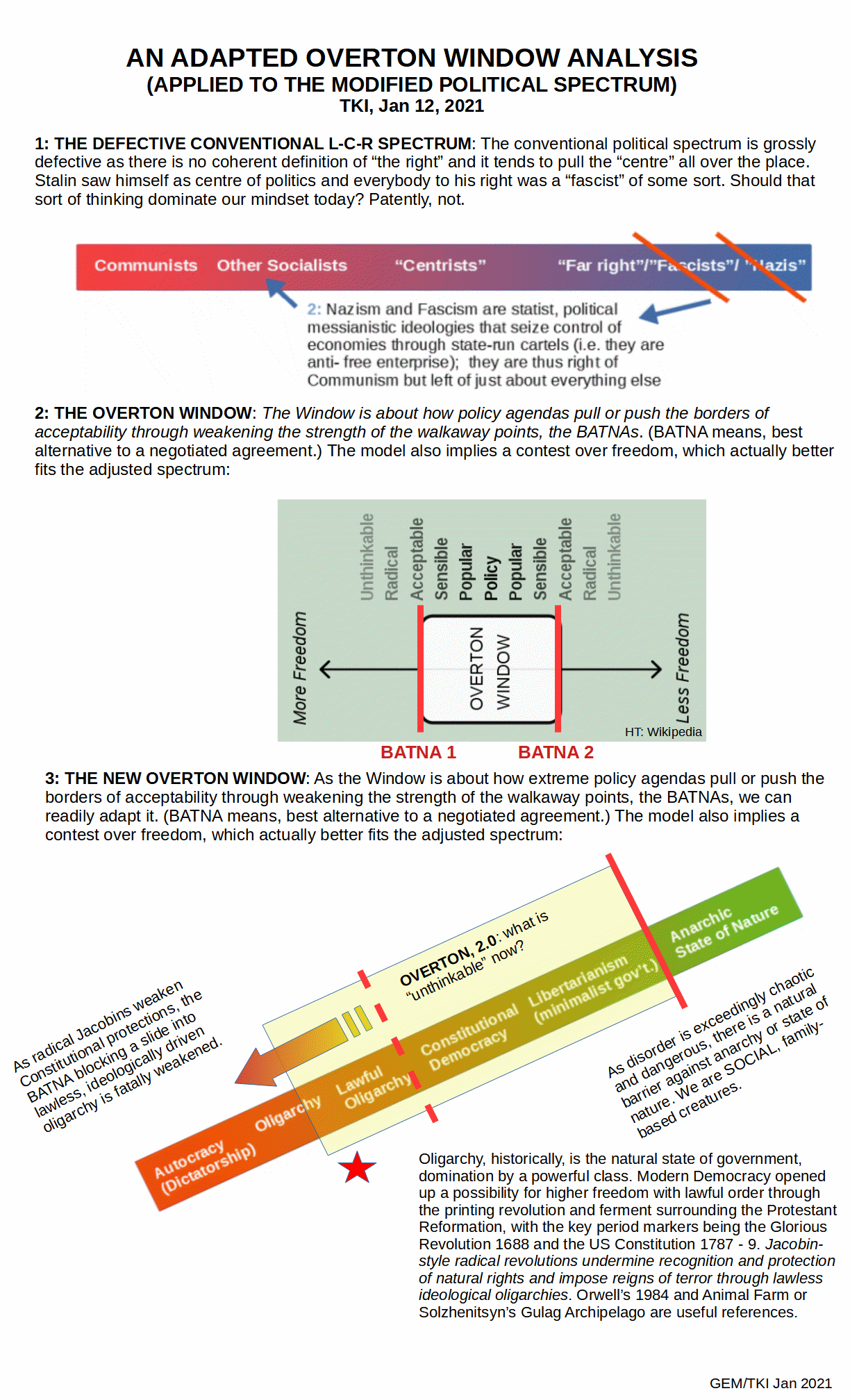
The issue becomes pivotal, once we ponder the premise that the typical, “natural” tendency of government is to open or veiled lawless oligarchy:
So, let us hear Cicero in his On The Republic, Bk 3 [c. 55 – 54 BC]:

{22.} [33] L . . . True law is right reason in agreement with nature , it is of universal application, unchanging and everlasting; it summons to duty by its commands, and averts from wrongdoing by its prohibitions. And it does not lay its commands or prohibitions upon good men in vain, though neither have any effect on the wicked. It is a sin to try to alter this law, nor is it allowable to attempt to repeal any part of it, and it is impossible to abolish it entirely. We cannot be freed from its obligations by senate or people, and we need not look outside ourselves for an expounder or interpreter of it. And there will not be different laws at Rome and at Athens, or different laws now and in the future, but one eternal and unchangeable law will be valid for all nations and all times, and there will be one master and ruler, that is, God, over us all, for he is the author of this law, its promulgator, and its enforcing judge. Whoever is disobedient is fleeing from himself and denying his human nature, and by reason of this very fact he will suffer the worst penalties, even if he escapes what is commonly considered punishment. . . . – Marcus Tullius Cicero, On the Republic, Bk 3

This, of course, is further reflected in his De Legibus, which lays out a framework:

With respect to the true principle of justice, many learned men have maintained that it springs from Law. I hardly know if their opinion be not correct, at least, according to their own definition; for “Law (say they) is the highest reason, implanted in nature, which prescribes those things which ought to be done, and forbids the contrary.” This, they think, is apparent from the converse of the proposition; because this same reason, when it [37]is confirmed and established in men’s minds, is the law of all their actions.

They therefore conceive that the voice of conscience is a law, that moral prudence is a law, whose operation is to urge us to good actions, and restrain us from evil ones.

We see in the Angelic Doctor, a broadening of the framework, elaborating four domains of law:

Thus, following Aquinas, we can see that arguably there is an intelligible core of law coeval with our responsible, rational, significantly free nature. This built-in law turns on inescapable, thus self-evident truths of justice and moral government, which rightly govern what courts may rule or parliaments legislate, per the premise of justice moderated by requisites of feasible order in a world that must reckon with the hardness of men’s hearts. Where, we are thus duty bound, morally governed creatures.

Hence, we come to the sense of duty attested to by sound conscience [“conscience is a law”], that breathes fire into what would otherwise be inert statements in dusty tomes. We may term these, by extension, the Ciceronian First Duties of Reason:

FIRST DUTIES OF RESPONSIBLE REASON

We can readily identify at least seven inescapable first duties of reason. “Inescapable,” as they are so antecedent to reasoning that even the objector implicitly appeals to them; i.e. they are self-evident. Namely, duties,

1 – to truth, 

2 – to right reason, 

3 – to prudence, 

4 – to sound conscience, 

5 – to neighbour; so also, 

6 – to fairness and

7 – justice 

x – etc.

[I add, Mar 12, for clarity:] {Of course, there is a linked but not equivalent pattern: bounded, error-prone rationality often tied to ill will and stubbornness or even closed mindedness; that’s why the study of right reason has a sub-study on fallacies and errors. That we seek to evade duties or may make errors does not overthrow the first duties of reason, which instead help us to detect and correct errors, as well as to expose our follies.}

Such built-in . . . thus, universal . . . law is not invented by parliaments, kings or courts, nor can these principles and duties be abolished by such; they are recognised, often implicitly as an indelible part of our evident nature. Hence, “natural law,” coeval with our humanity, famously phrased in terms of “self-evident . . . rights . . . endowed by our Creator” in the US Declaration of Independence, 1776. (Cf. Cicero in De Legibus, c. 50 BC.) Indeed, it is on this framework that we can set out to soundly understand and duly balance rights, freedoms and duties; which is justice, the pivot of law.

The legitimate main task of government, then, is to uphold and defend the civil peace of justice through sound community order reflecting the built in, intelligible law of our nature. Where, as my right implies your duty a true right is a binding moral claim to be respected in life, liberty, honestly acquired property, innocent reputation etc. To so justly claim a right, one must therefore demonstrably be in the right.

Where, prudence can also be seen via Aristotle’s summary:  “. . . [who aptly] defined prudence as recta ratio agibilium, ‘right reason applied to practice.’ The emphasis on ‘right’ is important . . .  Prudence requires us to distinguish between what is right and what is wrong . . . If we mistake the evil for the good, we are not exercising prudence—in fact, we are showing our lack of it.”

Of course, we just saw a 400+ comment thread that saw objectors insistently, studiously evading the force of inescapability, where their objections consistently show that they cannot evade appealing to the same first duties that they would dismiss or suggest were so obscure and abstract that they cannot serve as a practical guide. The history of the modern civil rights movement once the print revolution, the civilisational ferment surrounding the reformation and the rise of newspapers, bills, coffee houses etc had unleashed democratising forces speaks to the contrary. The absurdity of appealing to what one seeks to overthrow simply underscores its self evidence. But free, morally governed creatures are just that, free. Even, free to cling to manifest absurdities.

This approach, of course, sharply contrasts with the idea that law is in effect whatever those who control the legal presses issue under that heading; based on power balances and so in effect might and/or manipulation. Aquinas’ corrective should suffice to show that not all that is issued under colour of law is lawful, or even simply prudent towards preserving order in a world of the hardness of men’s hearts.

Yes, obviously, if we are governed by built-in law, that raises the question that there is a cosmic law-giver, qualified to do so not by mere sheer power but also by being inherently good and utterly wise. Such a root of reality also answers the Hume Guillotine and the Euthyphro dilemma: an inherently good and utterly wise, necessary and maximally great being root of reality would bridge IS and OUGHT in the source of all reality and would issue good and wise, intelligible built-in law.

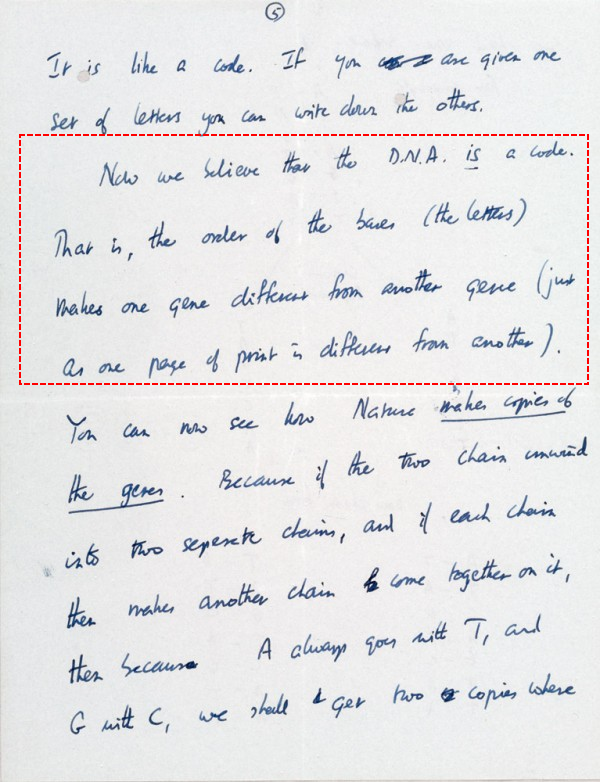
What of Mathematics? The answer is, of course, that a core of Math is inherent in the framework of any possible world. So, this would extend that core of Math tied to sets, structures and quantities expressed in N,Z,Q,R,C,R* etc to any actual world. That answers Wigner’s puzzlement on the universal power of Math and it points to, who has power to create an actual world in which we have fine tuning towards C-Chemistry, aqueous medium, cell based life? Likewise, it is suggestive on the source of the language and algorithms found in D/RNA etc.

Lest we forget, here is Crick, to his son, March 19, 1953:
So, we have come full circle, to law as expressing ordering principles of the dynamic-stochastic physical world and those of the world of intelligent, rational, morally governed creatures. Surprise — NOT — the design thesis is central to both. END

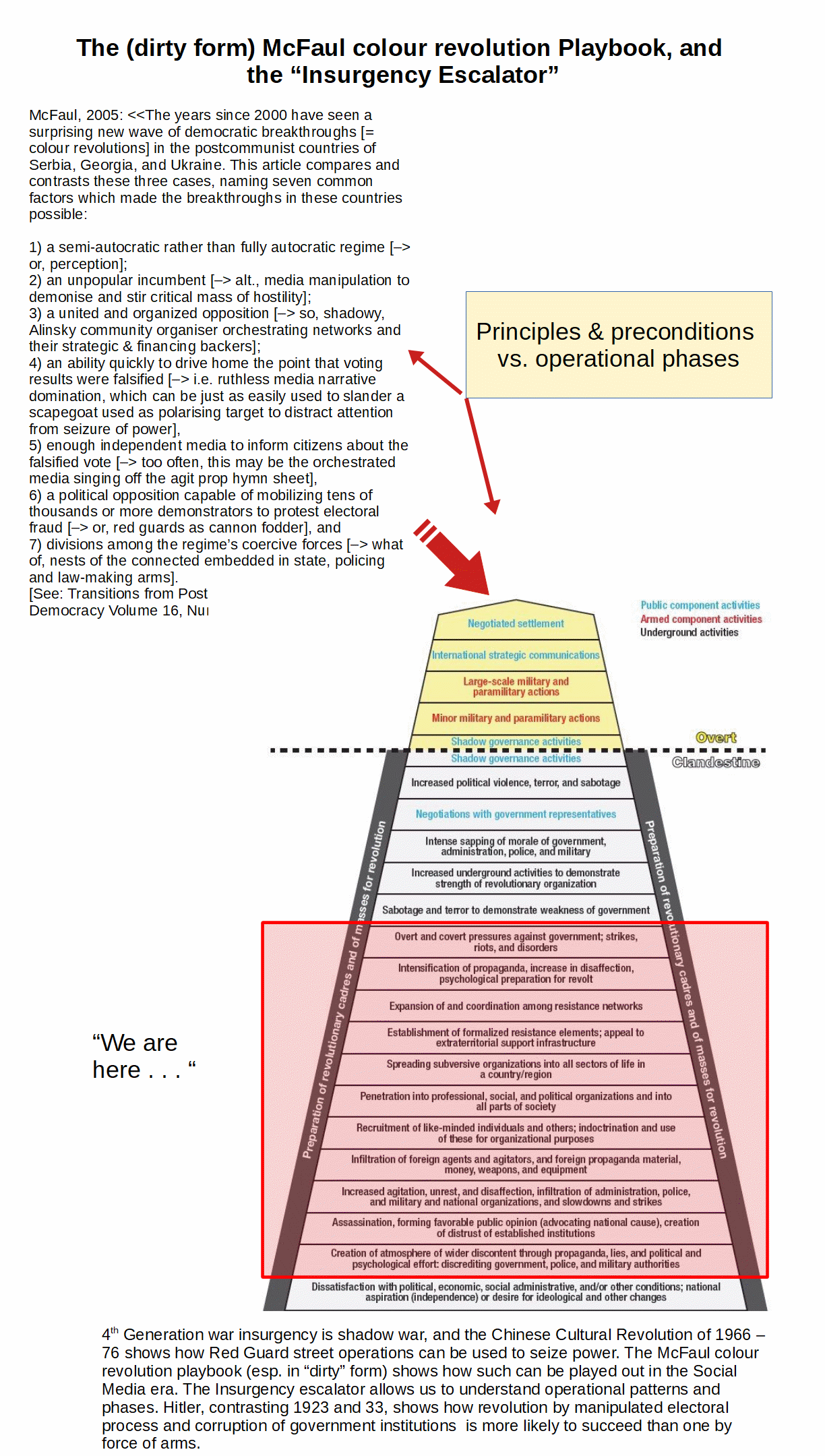
PS: As a reminder, the McFaul dirty form colour revolution framework and SOCOM insurgency escalator
U/D Feb 14: Outlines on first principles of right reason:
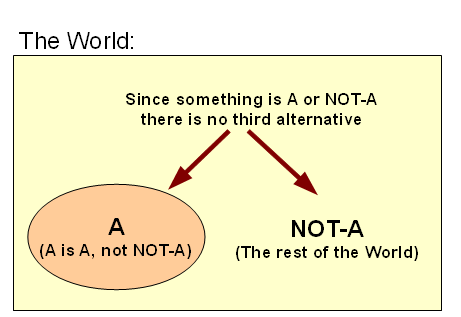
Here, we see that a distinct A — I usually use a bright red ball on a table:

and contrast a red near-ball in the sky, Betelgeuse as it went through a surprise darkening (something we observed separately and independently, it was not a figment of imagination):

. . . is distinct from the rest of the world. A is itself i/l/o its characteristics of being, and it is distinct from whatever else is not A, hence we see that in w there is no x that is A and ~A and any y that is in W will either be A or not A but not both or neither. These three are core to logic: P/LOI, LNC, LEM.

We may extend to governing principles that we have duties toward — never mind whoever may disregard such (and thereby cause chaos):
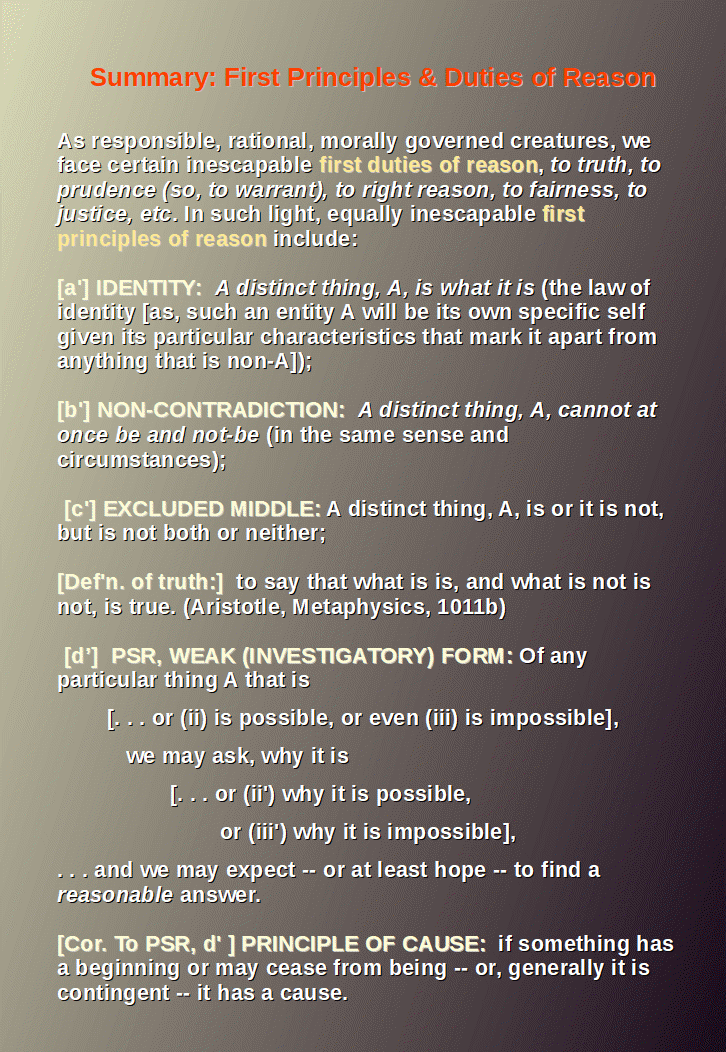
U/D March 13: The challenge of building a worldview i/l/o the infinite regress issue:
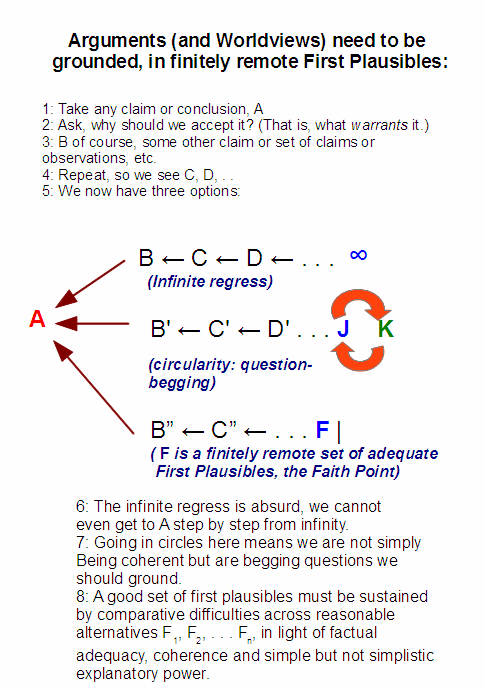
A summary of why we end up with foundations for our worldviews, whether or not we would phrase the matter that way}

Framing a ship:

. . . compare a wooden model aircraft:

. . . or a full scale, metal framework jet:

In short, there is always a foundational framework for any serious structure.

Comments
Jerry said:
An objective for humans is survival. I assume everyone agrees.
Unless survival is deemed by the human to not be as enjoyable as putting an end to their life. Enjoyment trumps survival. Everything you listed can be put in terms of enjoying one's existence and avoiding the unenjoyable aspects, even if the latter results in suicide.William J Murray
March 15, 2021
March
03
Mar
15
15
2021
08:17 AM
8
08
17
AM
PST
An objective for humans is survival. I assume everyone agrees. If not then please go some place else. To survive, which activities increase the likelihood of survival? I believe all of Kf suggested activities called duties as first enumerated by Cicero do that. If one wants to go further, and recognize all humans want to feel important and thrive let alone survive, then what activities enhance the chances of meeting that objective? I believe all of Kf’s duties as enumerated by Cicero do that. Not hard to understand. And fighting this by a few for over a 1,000 + comments because of Kf’s rhetorical style is really the interesting part of this thread. He essentially nailed it in the OP. I believe there is one other important objective in our nature, the desire for freedom. This was not addressed by those early advocates of natural law. So latter day natural law theorists have addressed this.jerry
March 15, 2021
March
03
Mar
15
15
2021
07:59 AM
7
07
59
AM
PST
To further elaborate: When KF says that everything I say or do implies a "First Duty," what I infer is that a duty is necessarily to a goal. But what is "the goal" of employing logic? Fundamental logical principles are not a "goal;" there are the necessary, inescapable foundation of how one must pursue any goal. To say that my "duty" is to "use logic properly" is only valid if "using logic properly" is my goal; to say it is an inescapable primary goal "for all sentient creatures" is obviously false. Most people are not trying to employ "right reason;" they're just using whatever they use of it in an effort to achieve whatever goal they have. It's a means to an end, not the end itself. To use any tools to achieve any goal in any coherent manner is to employ free will to imagine the potential goals and then try to instantiate those goals. This defines oughts for us. An inescapable aspect of Free Will is preference. All decisions ultimately boil down to preference, either in the direct choice or in the way we make choices, even if it is flipping a coin. Preference is also an inescapable aspect of enjoyment; our scale of enjoyment is naturally, inescapable evaluated via preference, regardless of how one sorts and organizes the many different forms of enjoyment. Thus, Free Will is inescapably used to pursue the enjoyments we prefer, however we define, organize or prioritize them. That is the fundamental nature of all sentient creatures which cannot be avoided. There is only one category of goals that can be said to be fundamental to all goals and thus, in any significant meaning of the term, be the only "first duty." The first and, ultimately, only duty a sentient being can be said to have, is to enjoyment.William J Murray
March 15, 2021
March
03
Mar
15
15
2021
06:21 AM
6
06
21
AM
PST
Jerry said:
It’s been answered several times.
I don't doubt this, I just wanted to pose the situation and get an answer for it one last time to see if I could possibly understand KF's perspective. KF is apparently referring to something that, from my perspective, doesn't even exist, so there's really no way I can "see" what he is pointing at.William J Murray
March 15, 2021
March
03
Mar
15
15
2021
05:58 AM
5
05
58
AM
PST
Thanks, KF. That does clear it up for me, at least in respect to understanding that, whatever you are talking about, it is utterly incomprehensible to me. It's probably because we have such fundamentally divergent root perspectives. I appreciate your time and effort. Now, I'm going to reveal what everyone's objective goal is, the thing that all oughts are ultimately in relation to, even down to the smallest derivative decision. It is inescapable and universal whether one is a sociopath, a Ghandhi, or anyone in-between, or **any** sentient being anywhere. Enjoyment.William J Murray
March 15, 2021
March
03
Mar
15
15
2021
05:55 AM
5
05
55
AM
PST
Could you answer the question posed @1016? I’m trying to understand what it is you are referring to when you say first duties, and I think that might clear it up for me. Thanks.
It’s been answered several times.jerry
March 15, 2021
March
03
Mar
15
15
2021
05:27 AM
5
05
27
AM
PST
WJM, I thought I already adequately gave my point. You will note that in your comment at 1016 you again make such appeals to our responsiveness to first duties. Even your description of "SOUND reason" speaks to the point. Recall, earlier, your "you're WRONG" which again underscores the point. KFkairosfocus
March 15, 2021
March
03
Mar
15
15
2021
05:12 AM
5
05
12
AM
PST
PS: For reference, US DoI:
When . . . it becomes necessary for one people . . . to assume among the powers of the earth, the separate and equal station to which the Laws of Nature and of Nature's God [--> natural law context is explicit] entitle them, a decent respect to the opinions of mankind requires that they should declare the causes which impel them to the separation. We hold these truths to be self-evident, [cf Rom 1:18 - 21, 2:14 - 15; note, law as "the highest reason," per Cicero on received consensus], that all men are created equal [--> note, equality of humanity], that they are endowed by their Creator with certain unalienable Rights, that among these are Life, Liberty and the pursuit of Happiness. --That to secure these rights, Governments are instituted among Men, deriving their just powers from the consent of the governed, --That whenever any Form of Government becomes destructive of these ends, it is the Right of the People to alter or to abolish it, and to institute new Government, laying its foundation on such principles and organizing its powers in such form, as to them shall seem most likely to effect their Safety and Happiness. Prudence, indeed, will dictate that Governments long established should not be changed for light and transient causes; and accordingly all experience hath shewn, that mankind are more disposed to suffer, while evils are sufferable, than to right themselves by abolishing the forms to which they are accustomed. But when a long train of abuses and usurpations, pursuing invariably the same Object evinces a design to reduce them under absolute Despotism, it is their right, it is their duty, to throw off such Government, and to provide new Guards for their future security . . . . We, therefore, the Representatives of the united States of America, in General Congress, Assembled, appealing to the Supreme Judge of the world for the rectitude of our intentions [Cf. Judges 11:27], do, in the Name, and by the Authority of the good People of these Colonies, solemnly publish and declare, That these United Colonies are, and of Right ought to be Free and Independent States; that they are Absolved from all Allegiance to the British Crown, and that all political connection between them and the State of Great Britain, is and ought to be totally dissolved; and that as Free and Independent States, they have full Power to levy War, conclude Peace, contract Alliances, establish Commerce, and to do all other Acts and Things which Independent States may of right do. And for the support of this Declaration, with a firm reliance on the protection of divine Providence, we mutually pledge to each other our Lives, our Fortunes and our sacred Honor.
kairosfocus
March 15, 2021
March
03
Mar
15
15
2021
04:43 AM
4
04
43
AM
PST
KF, Could you answer the question posed @1016? I'm trying to understand what it is you are referring to when you say first duties, and I think that might clear it up for me. Thanks.William J Murray
March 15, 2021
March
03
Mar
15
15
2021
04:11 AM
4
04
11
AM
PST
VL, we have already showed cases on history of how the natural law framework actually contributed to the rise of modern liberty and democracy. For capital example kindly consult the US DoI, 1776 and Constitution, 1787 - 9. This is the framework that actually did set up what we now enjoy but are squandering. I already addressed the example of divorce, using it to show both the naturally evident nature of marriage rooted in the two sexes and requisites of sound child nurture [no prizes for guessing the roots of many problems in society today] -- which, being built-in, cannot be changed through word magic decrees of corrupt elites and their publicists. The case of regulating divorce then gives a context where the issue of hard heartedness and gradual reform has to be faced. The case of prohibition in the US is a sad classic on this subject. Of course, the track record of your side-stepping this is there for those who care to go back. As for promotion of ever more bizarre perversities, self-mutilation etc under colour of rights etc, those will burn themselves out, sadly, leaving numbers of people to deal with consequences of ill advised self harm. So, no, the thesis that core first duties are irrelevant to solving real world problems fails. KF PS: Having already taken time to spend on a discussion thread that addressed fashionable but for cause repulsive hobby horses there will not be another, nor will there be toleration of trying to sidetrack every thread. I point you to the historic example on perversity in power, Suetonius' life of Nero, in his lives of the twelve Caesars. And no, I will not link.kairosfocus
March 15, 2021
March
03
Mar
15
15
2021
12:25 AM
12
12
25
AM
PST
Jerry, yes, classical writers typically did not speak of freedoms but emphasised duties. One major exception is of course the New Testament's authors. We can point to reasons tied to social fragility and the absence of a base for a mass based politics with strong self-regulation. Until about 300-350 years ago, the best practical solution possible was lawful oligarchy, with the ever present threat of descent into lawless oligarchy or emergence of anarchy, if for instance there was a pandemic. I repeat, lawless oligarchy is the "typical' state of government, across time. There are reasons why I point to the period from invention of printing to the Glorious Revolution as a key breakthrough era that opened up new political possibilities. You will note the definition of justice that I put forward: due balance of rights, freedoms and duties. Notice, the reciprocal relationship between rights and duties and the way that frames freedoms, as opposed to licence. (The latter is a word that we need to bring back into focus.) Duty to justice, as thus defined, makes freedom within due balance of rights and duties pivotal to sound civilisation in a literacy empowered, gospel ethics heart softened age. KFkairosfocus
March 14, 2021
March
03
Mar
14
14
2021
11:27 PM
11
11
27
PM
PST
Data, best not to follow up on intentional, smelly red herring distractors. Were CC serious, there are sites that seriously address such matters and other typical internet skeptic objections and rhetorical stunts. This is not a site or a thread for that purpose. That resort is made to such speaks for itself, especially when we just saw the same commenter unable to acknowledge the manifest evil of a Hitler by demanding a sez who response. KFkairosfocus
March 14, 2021
March
03
Mar
14
14
2021
11:16 PM
11
11
16
PM
PST
Concealed Citizen Assuming the tale is true, when Yahweh told the Israelites to go kill every man, woman and child in Canaan, were the Israelites duty bound to kill them all, or “duty bound not to murder?” Let’s say God told Hitler to kill as many Jews as he could for some goal of a greater good in God’s mind. Would Hitler have been duty bound to kill them all, or “duty bound not to murder?”
:))) Your "questions" are dumb . That's happening when an ignorant read on the internet ideas wrote by other("famous") ignorants and then come here to show off. Why specifically was given by God the command against Canaan tribes? I guess you won't find that on atheists websites because the simple explanation would blow up all atheistic rhetoric so if you want to find out you'll have to open the Bible. Of course you are not curious about the truth because otherwise you would have already know the truth about Canaanites and accordingly wouldn't ask dumb questions.Lieutenant Commander Data
March 14, 2021
March
03
Mar
14
14
2021
04:07 PM
4
04
07
PM
PST
CC, that you have to ask and feel free to publicly proceed to the Arthur Leff grand sez who dismissal tells us saddening volumes about where our civilisation has gone even in the face of the most infamous mass murdering criminal in history . . . mind you, I am also aware that he is likely only no 2 on the list of the big three, responsibility for a war noses out Stalin but cannot beat Mao. Perhaps, you were not aware that I was alluding to an event in the Nuremberg trials, when the Nazis offered the cultural relativism defence that orders are orders and they were only obeying legitimate rulers and officials of their state so there was no basis to judge them. One of the key points of the answer was, in effect: you did not need a state to pass a law that says so to know that murder is wrong. In short, you are showing, inadvertently, what happens when a civilisation loses sight of the priority of the built-in law coeval with our humanity. Observe, here, Cicero's argument:
, On the Republic, Bk 3: {22.} [33] L . . . True law is right reason in agreement with [--> our morally governed] nature , it is of universal application, unchanging and everlasting; it summons to duty by its commands, and averts from wrongdoing by its prohibitions. And it does not lay its commands or prohibitions upon good men in vain, though neither have any effect on the wicked. It is a sin to try to alter this law, nor is it allowable to attempt to repeal any part of it [--> as universally binding core of law], and it is impossible to abolish it entirely. We cannot be freed from its obligations by senate or people [--> as binding, universal, coeval with our humanity], and we need not look outside ourselves for an expounder or interpreter of it. [--> sound conscience- guided reason will point out the core] And there will not be different laws at Rome and at Athens, or different laws now and in the future, but one eternal and unchangeable law will be valid for all nations and all times, and there will be one master and ruler, that is, God, over us all, for he is the author of this law, its promulgator, and its enforcing judge. Whoever is disobedient is fleeing from himself and denying his human nature, and by reason of this very fact he will suffer the worst penalties, even if he escapes what is commonly considered punishment. . . . – Marcus Tullius Cicero, c. 55 - 54 BC
That Bible-thumping fundy ignoramus -- NOT. The immediate answer to your question is, we all, collectively, told me. That is, certain core built in duties are self-evident and constitute our first law code, evident to the reasonable, responsible person. Even, if that person's conscience is in such a bad way that s/he does not feel it . . . Hitler's condition. The code known as the natural law, by Ciceronian definition, highest reason applied to justice . . . the due balance of rights freedoms and responsibilities or duties. Particularly, life is the first and gateway right, for without life one has no other rights. The willful taking of life is an awful responsibility, even when justified in defence of the civil peace of justice from its enemies, foreign and domestic. The willful robbing of innocents of their lives is the worst natural law, inherently and manifestly criminal act. The murderer, especially the mass murderer, therefore makes himself the enemy of humanity. These, at some level, we all know or should acknowledge. That we have reached the pass where we now are, that we imagine a Hitler is a debatable case, is itself sobering. And yes, that is where those who have thought to substitute the idea that law is whatever those who control the legal presses issue have inadvertently led us. No, municipal decrees, rulings, acts and regulations are accountable before the first law, the built in law of our nature. The same, that identifies murder as the worst of crimes. KFkairosfocus
March 14, 2021
March
03
Mar
14
14
2021
09:36 AM
9
09
36
AM
PST
Sure, millions of people believe in other perspectives.
That is not an answer to the question that are these perspectives believable? At any time millions of people, probably billions believe in things that are objectively false and can be shown so. See finding from Hans Rosling above.
most of our metaphysical religious and philosophical beliefs are unprovable assertions:
Is that true? If you are looking for absolute QED proof, then yes. But extremely likely, most definitely that is a yes. There is a long history of examination of the basis for Christianity which is what you are specifically questioning.
we choose to adopt as beliefs because they help create what we consider the best way of looking at the world.
Yes, but not just that. Kf is making the case, as best I can determine, that these are necessary not only for survival but for flourishing. So if flourishing is an objective, are these specifics necessary for this. I believe a good case can be made for this. So his list of duties which I believe came from Cicero are necessary for flourishing. I maintain that Cicero and several others missed something extremely important, namely freedom as necessary for flourishing. So I maintain it is a duty to respect others freedom. Obviously within limits. All these duties that flow from human objectives are the basis for positive laws. These positive laws vary from culture to culture and should be examined based on these duties flowing from the natural law or human nature. So we have a connection:
laws of physics (p) implies natural laws (q) through how life is made with various sub-parts, mainly proteins which then imply positive laws made by society (r).
So p-> q -> r. This is the headline of the OP. This is what is being argued and I believe is highly likely no matter what one’s religious perspective is.jerry
March 14, 2021
March
03
Mar
14
14
2021
09:26 AM
9
09
26
AM
PST
1021 Jerry asks, "Are the other perspectives believable? I have never seen anything that indicates that they are. They are just alternative assertions." Sure, millions of people believe in other perspectives. They may not be believable to you, but they are to others. And yes, most of our metaphysical religious and philosophical beliefs are unprovable assertions: they are things we choose to adopt as beliefs because they help create what we consider the best way of looking at the world. To you, those that recognize a natural law that governs humans are valuable, but whether such natural law exists in the way KF posits it to exist is the subject of this discussion. The key notion, started several posts ago, is whether there is a single correct answer, based on natural law, to real world moral questions (divorce, SSM, war, providing social services to the poor, ... - the list goes on and on), or not. The perspective I propose is that we have fundamental capacities for rationality and compassion, but there is no correct answer to such specific questions, and that each of us has to exercise those capabilities ti make choices, and possibly take stands, on what we think is best. This is an alternative to KF's view as quoted in 1017.Viola Lee
March 14, 2021
March
03
Mar
14
14
2021
07:53 AM
7
07
53
AM
PST
These are not provable beliefs, and other perspectives exist.
Are the other perspectives believable? I have never seen anything that indicates that they are. They are just alternative assertions. Some are valuable because they recognize a natural law that governs humans. So conclusions based on this natural law are valuable. But are they different from anything Kf is proposing?jerry
March 14, 2021
March
03
Mar
14
14
2021
07:22 AM
7
07
22
AM
PST
KF: 16: Duty is independent of the sensitivity of a given conscience about the duty. A Hitler had no feelings about murder, but was duty bound not to murder. Who says Hilter was "duty bound not to murder?" Who, when and where? Be specific. What if all Jews are incarnated demons? Wouldn't we all have the duty to kill them all? Assuming the tale is true, when Yahweh told the Israelites to go kill every man, woman and child in Canaan, were the Israelites duty bound to kill them all, or "duty bound not to murder?" Let's say God told Hitler to kill as many Jews as he could for some goal of a greater good in God's mind. Would Hitler have been duty bound to kill them all, or "duty bound not to murder?"Concealed Citizen
March 14, 2021
March
03
Mar
14
14
2021
06:28 AM
6
06
28
AM
PST
WMJ: Oughts can only exist in relationship to goals. Inescapable oughts must refer to inescapable goals. What is the universal, objective, inescapable goal that grounds such oughts? Well put, tight statement of the essence.Concealed Citizen
March 14, 2021
March
03
Mar
14
14
2021
06:25 AM
6
06
25
AM
PST
re 1015, to Jerry: Probably true, Jerry. I have pointed out that all of KF's philosophy stems from this assertion:
The first duties, also, are a framework for understanding and articulating the corpus of built-in law of our morally governed nature, antecedent to civil laws and manifest our roots in the Supreme Law-giver, the inherently good, utterly wise and just creator-God, the necessary (so, eternal), maximally great being at the root of reality.
KF's worldview flows from this set of core beliefs. He has a faith that such a God exists, and that our human nature is rooted in that God. These are not provable beliefs, and other perspectives exist. Discussion would be more productive if we saw it has trying to understand differing perspectives so as to live in a world of differing perspectives rather than trying to prove that one perspective is right and the others wrong.Viola Lee
March 14, 2021
March
03
Mar
14
14
2021
06:17 AM
6
06
17
AM
PST
KF, When you say this:
So, were you aware that there are no such duties but chose to try to manipulate me and others looking on emotionally? If that were so, that would be a grave sign.
No. I was aware (or at least believe) that I have no such duties, but choose to utilize sound reasoning and truth-telling as best I can in this forum. As I have said, I don't employ those tools and tactics everywhere, in every interaction., because I have different goals in different situations that define my "oughts" in relation to those goals. Let's assume, by the principle of charity, that what I'm saying above is true and I actually do behave as I have described above, and all of my oughts (at least that I'm conscious of) serve my enjoyments as I have said before. This means that if it serves my arrangement and prioritization of enjoyment, I will lie, cheat, steal, kill, be kind, generous, loving, hateful, honest, fair or unfair, just or unjust, in service to my enjoyments, that my "conscience" never bothers me; that I am as empathetic or non-empathetic as I want to be, depending on the situation and how it serves my enjoyment agenda. IF that is all true, is the way I am making my case here, now, to you and others, implying any "First Duties?"William J Murray
March 14, 2021
March
03
Mar
14
14
2021
05:47 AM
5
05
47
AM
PST
Just positing a superior intelligence (your phrase) or creative power (my phrase) in itself leaves many unanswered, and in my opinion, unanswerable, ontological questions.
So all these tens of thousands of words (or is it hundreds of thousands) comes down to whether there is a God or not that created the universe and humans? And if that God if He did create humans had specific objectives or not with His creation? A lot of trouble could have been saved if this had been clearly said a thousand comments ago. Aside: “creative power” is very similar to what the Stoics used to describe the origin of a Natural Law.jerry
March 14, 2021
March
03
Mar
14
14
2021
05:14 AM
5
05
14
AM
PST
WJM, again for clarity: >>Perhaps you have a valid claim – that I cannot avoid appealing to a duty,>> 1: a first step. 2: Now, note where that leads as I just noted:
5: Instead, I rephrase more accurately: Can the unavoidable use of [–> appeal to duties to] those fundamental logical principles [–> as a part of duty to right reason etc] logically imply any duties? 6: the answer is yes, precisely because the appeal to first duties is unavoidable, inescapable, universal: attempts to deny, object or dismiss AND attempts to prove, alike embed appeals to the duties. They are undeniable and unprovable, they are priors of reasoning, arguing etc. Arguing, denying, proving etc hang from those things, not the reverse.
3: Let me chain as a set of propositions:
p1: the appeal to first duties is unavoidable, inescapable, universal: _____________________________ C1: attempts to deny, object or dismiss AND attempts to prove, alike embed appeals to the duties. p2: They [appeals to first duties of reason] are undeniable and unprovable, they are priors of reasoning, arguing etc. - as, they are pervasive, the denial cannot avoid them, the attempted proof also ________________________________ C2: Arguing, denying, proving etc hang from those things, not the reverse.
>> but if so, there’s something I’m missing. The only kind of thing that I see that I am necessarily appealing to are the principles of logic.>> 4: No, you are implicitly appealing to DUTIES to said principles, i.e. you expect reasonable argument that correctly uses said principles and other first principles of reason, cf. my u/d to OP that tabulates some. 5: "You incorrectly used principles, I correctly do so" is a common response, claiming errors of reasoning or fallacies. >> What “duty” are you referring to that is inescapable?>> 6: Repeat, I am not appealing to duties that cannot be violated, the very term duty points to ought vs is. 7: What we cannot avoid is appealing to certain first duties of reason. >>Let’s say that I cannot avoid the duty to use right reason>> 8: Ambiguity. You can do other than duty, but that does not change that you ought to have done duty. >> (as distinguished from the core principles of logic, which are unavoidable.)>> 9: In attempts to reason and communicate, we cannot but respect distinct identity of symbols, and close corollaries. In that sense, unavoidable. However, we often err in further stages of reasoning or even some try to deny and dismiss distinct identity, non contradiction and excluded middle. That came up earlier. They end up trying to saw off the branch on which we are all sitting. 10: So, there is an ambiguity in the statement, kindly note the distinction and the common error. >> I don’t understand what that means.>> 11: An effect of the ambiguity of your phrasing, and the statement as was already noted is different from my point regarding duty to right reason etc and appeals to such duties. 12: For clarity, we often fail to fulfill duties, which does not change that we ought to have done better. 13: What we cannot avoid -- it pervades your comment -- is appealing to the binding nature of such duties. >> You seem to extract from my use (or at least attempted use) of “right reason” as necessarily implying that I have a duty to employ it.>> 14: Only in the sense that part of right reason is that we have a duty to reason correctly. 15: Again, what we cannot evade or avoid is appealing to first duties of reason, including when we try to object or to prove. These are the hooks that we hang proofs and objections from. >> I don’t feel any such duty.>> 16: Duty is independent of the sensitivity of a given conscience about the duty. A Hitler had no feelings about murder, but was duty bound not to murder. >> I’m not aware of any such duty. >> 17: When you wrote, "you're wrong" above, as I noted already, you appealed to said duties and my implicit acknowledgement of their binding nature. So, were you aware that there are no such duties but chose to try to manipulate me and others looking on emotionally? If that were so, that would be a grave sign. 18: I think not, I think you are seeking clarity and made an unfortunate phrasing. >>I often choose to not employ it.>> 19: If you are here suggesting frequent willful violation of duties to sound reasoning, that would be serious. Indeed, that would discredit your arguments by making them suspect. I still think you are wording less than happily. >> I don’t feel any guilt or pang of conscience when I use other means of persuasion.>> 20: There are many legitimate uses of say an extrinsic reward, or appeal to empathy, or to conscience or to fear etc, but there are cases where such can become manipulative and exploitative. >>I don’t understand what you mean when you say “how you say what you say implies a duty.”>> 21: See above. Try, "you're wrong." >> Saying it over and over doesn’t change the fact that I don’t understand what you mean when you say it.>> 22: Again, try out how you opened a comment with, "you're wrong." 23: As a reminder, AmHD: >>wrong (rông, r?ng) adj. 1. Not in conformity with fact or truth; incorrect or erroneous: a wrong answer. 2. a. Contrary to conscience, morality, or law: Stealing is wrong. b. Unfair; unjust: The kids felt it was wrong when some got to go on the field trip but not others.>> KFkairosfocus
March 14, 2021
March
03
Mar
14
14
2021
04:40 AM
4
04
40
AM
PST
I mean, I know what the universal, existentially unavoidable goal is, and what all oughts are necessarily ultimately about, but you're probably not going to like it.William J Murray
March 14, 2021
March
03
Mar
14
14
2021
04:31 AM
4
04
31
AM
PST
One might say that if my goal is to make a sound logical argument, then I ought (duty) use the principles of logic correctly using truth statements. However, if my goal is to deceive someone, then what I ought do (duty) is make false statements, or use "wrong reasoning" to pull off the deception. Oughts can only exist in relationship to goals. Inescapable oughts must refer to inescapable goals. What is the universal, objective, inescapable goal that grounds such oughts?William J Murray
March 14, 2021
March
03
Mar
14
14
2021
04:17 AM
4
04
17
AM
PST
Backing up for a minute: I would say that correctly using the fundamental principles of logic in one's reasoning would be the definition of right reason. IOW, I don't misidentify things or make a self-contradicting statement, etc. That would be the definition of "right reason," but it doesn't innately mean I have a duty to not misidentify things or contradict myself. Where does the duty come from?William J Murray
March 14, 2021
March
03
Mar
14
14
2021
04:06 AM
4
04
06
AM
PST
KF, Okay, so you're saying that I have a duty to employ the logical principles when I use right reason. Why or how do I have a duty to use right reason?William J Murray
March 14, 2021
March
03
Mar
14
14
2021
03:57 AM
3
03
57
AM
PST
KF, Perhaps you have a valid claim - that I cannot avoid appealing to a duty, but if so, there's something I'm missing. The only kind of thing that I see that I am necessarily appealing to are the principles of logic. What "duty" are you referring to that is inescapable? Let's say that I cannot avoid the duty to use right reason (as distinguished from the core principles of logic, which are unavoidable.) I don't understand what that means. You seem to extract from my use (or at least attempted use) of "right reason" as necessarily implying that I have a duty to employ it. I don't feel any such duty. I'm not aware of any such duty. I often choose to not employ it. I don't feel any guilt or pang of conscience when I use other means of persuasion. I don't understand what you mean when you say "how you say what you say implies a duty." Saying it over and over doesn't change the fact that I don't understand what you mean when you say it.William J Murray
March 14, 2021
March
03
Mar
14
14
2021
03:54 AM
3
03
54
AM
PST
WJM: For clarity: >>Do I have a duty to use fundamental logical principles? (identity, excluded middle, non-contradiction)>> 1: Yes, we do have such a duty as an aspect of right reason. 2: We often fail in that duty, hence we see how we are finite, fallible, error-prone, morally struggling, sometimes stubborn, too often ill-willed etc. That's part of why prudence points to such duties towards reliable warrant that we are making credibly true and reliable knowledge, fact and truth claims. 3: What we cannot help but do, is to appeal to such duties in arguing etc. There is no duty to appeal, we cannot but appeal. >>Can the unavoidable use of those fundamental logical principles logically imply any duties?>> 4: Subject switched. We can and do routinely avoid or blunder in using, first principles of logic. That is not where the inescapability applies. 5: Instead, I rephrase more accurately: Can the unavoidable use of [--> appeal to duties to] those fundamental logical principles [--> as a part of duty to right reason etc] logically imply any duties? 6: the answer is yes, precisely because the appeal to first duties is unavoidable, inescapable, universal: attempts to deny, object or dismiss AND attempts to prove, alike embed appeals to the duties. They are undeniable and unprovable, they are priors of reasoning, arguing etc. Arguing, denying, proving etc hang from those things, not the reverse. 7: This is part of Epictetus' point that you struggled with above:
DISCOURSES CHAPTER XXV How is logic necessary? When someone in [Epictetus'] audience said, Convince me that logic is necessary, he answered: Do you wish me to demonstrate this to you?—Yes.—Well, then, must I use a demonstrative argument?—And when the questioner had agreed to that, Epictetus asked him. How, then, will you know if I impose upon you?—As the man had no answer to give, Epictetus said: Do you see how you yourself admit that all this instruction is necessary, if, without it, you cannot so much as know whether it is necessary or not? [Notice, inescapable, thus self evidently true and antecedent to the inferential reasoning that provides deductive proofs and frameworks, including axiomatic systems and propositional calculus etc. Cf J. C. Wright]
KFkairosfocus
March 14, 2021
March
03
Mar
14
14
2021
03:46 AM
3
03
46
AM
PST
It's difficult for me to think that you are saying that the principles of logic, which all communication, whether one tells the truth or not, necessarily require, as "coeval" with any duty. That just doesn't make sense. So I think that when you refer to an "inescapable first duty," you can't be referring to the inescapable use of the fundamental principles of logic. It must be something else. What, then, can you be referring to? From all you have written about, when you include things like fairness, justice, conscience - all I can imagine is that you think those things are also inescapable aspects of our existence, but yet when your argument uses phrases like "normal" or "widespread, common" human behaviors and internal sensations to make that case, you are implicitly agreeing that these are not, in fact, "inescapable" aspects of human existence. So, I'm baffled about what you're talking about when you say that the things I say "appeal to" some inescapable duty. Neither perspective above makes any sense.William J Murray
March 14, 2021
March
03
Mar
14
14
2021
03:44 AM
3
03
44
AM
PST
1 … 5 6 7 8 9 … 41