Uncommon Descent Serving The Intelligent Design Community

Francis Schaeffer’s “line of despair” model of our civilisation’s intellectual history:

Categories
Defending our Civilization
Lessons of History
Philosophy
rhetoric
Share
Facebook
Twitter/X
LinkedIn
Flipboard
Print
Email

We can adapt Francis Schaeffer’s themes, looking back to the Christian Synthesis of the heritage of Jerusalem, Greece and Rome, and the onward flow of ideas and cultural agendas since Paul of Tarsus:
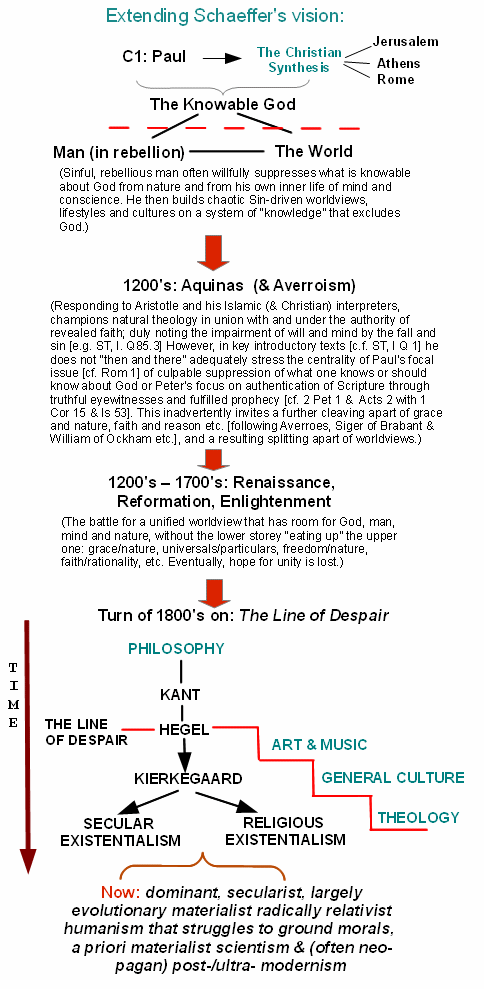
Extending (and correcting) Schaeffer’s vision of the course of western thought, worldviews and culture, C1 – 21

Schaeffer thought that once there was an upper/lower storey approach that in effect gave up on solving the problem of the one and the many, the lower storey would eat up the upper one, unity and coherence would disintegrate:

Dichotomising nature and grace leads to disjointedness in western man’s worldview

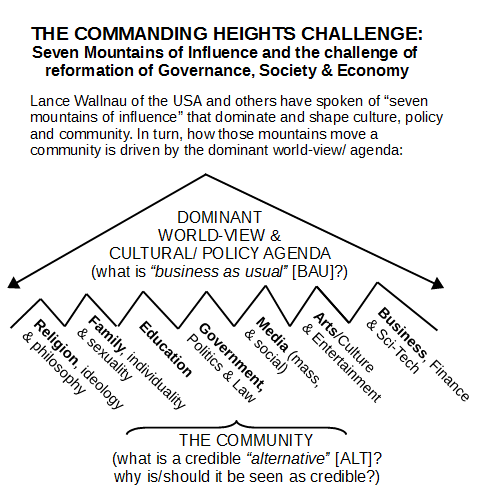
Schaeffer and others also thought in terms of the seven mountains picture of the span of culture, how the dominant view sets the agenda and how cultures therefore change. This has been championed by Wallnau and others in recent years. I adapt:
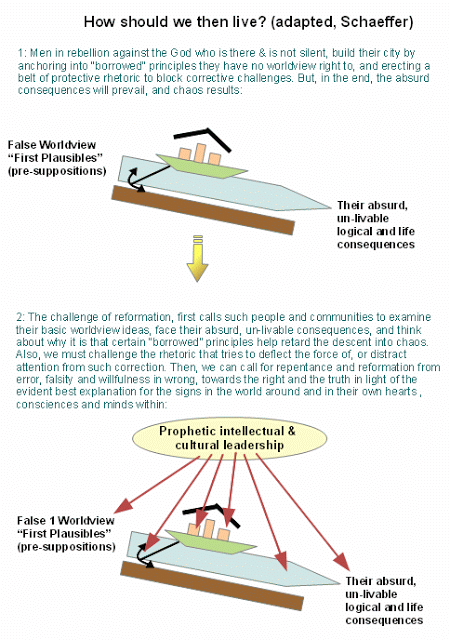
We may carry this onward to the challenge to speak into the culture prophetically, from a gospel based, worldviews informed sound perspective rooted in “The God who is there and who is not silent”:
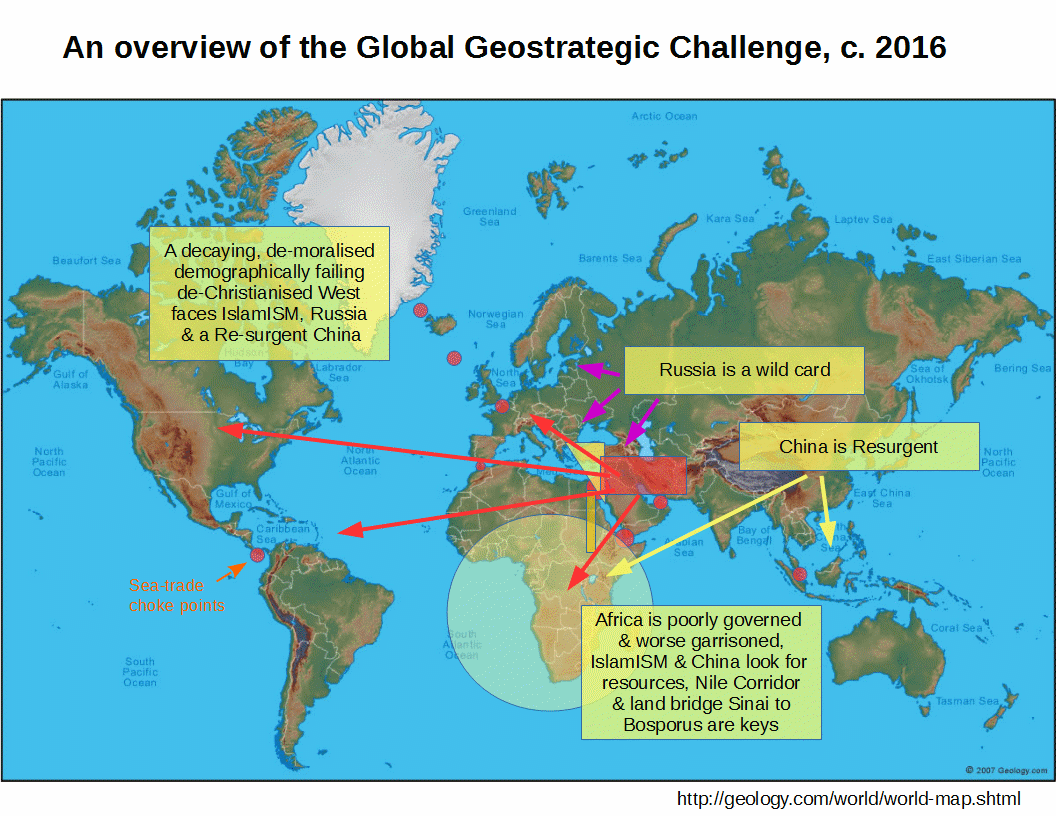
In our time, all of this is complicated by complex geostrategic issues:
Food for thought. END

F/N: Let me add, a summary from a 2014 conference on military strategy and issues, by Russian General Valery Gerasimov, who in 2014 was Army General, Chief of General Staff of the Armed Forces of the Russian Federation – First Deputy Minister of Defense of the Russian Federation.

So, this is not some nonentity speculating, this is literally the Russian analysis behind the war in Ukraine, which began in 2014 and has now surged to a much higher kinetic level:
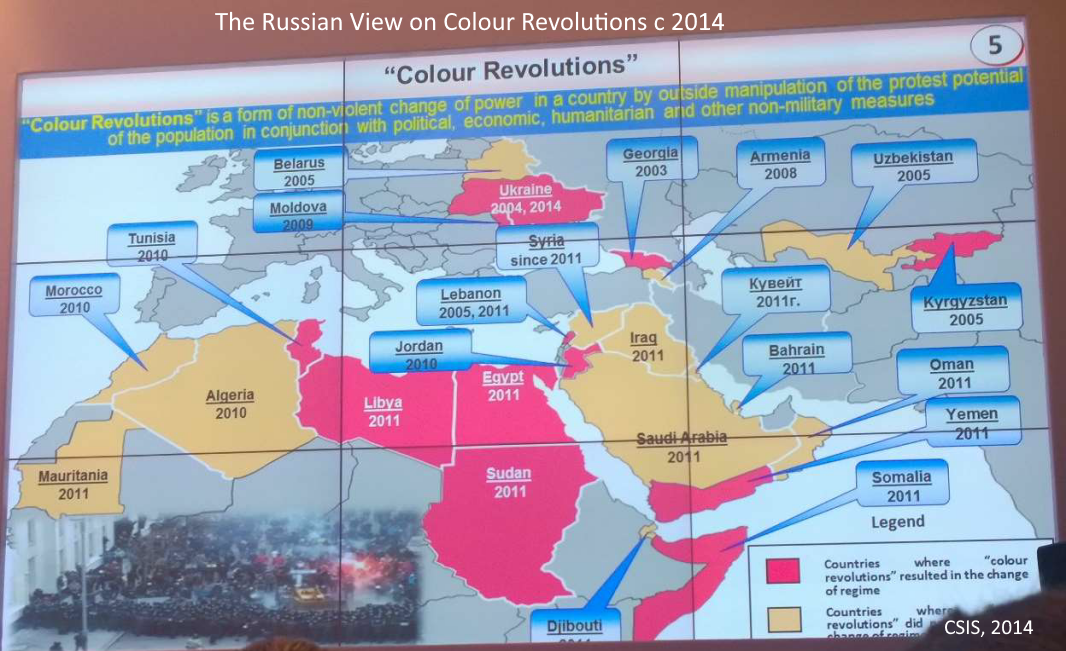
He further amplifies:

U/D April 7: As a “lowest common denominator reference,” we may note that Wikipedia has an article on Colour Revolutions, complete with a list starting with the “yellow” revolution in the Philippines in 1986 (a year which saw also the ouster of “Baby Doc” Duvalier in Haiti). I add, in the same 1986, the student “Cess” strike and protests were observed to be targetted by literal card carrying Communists to become a trigger for a Haiti style overthrow of the Seaga, parliamentary government, it failed but came to the edge of having students shot down by riot police. (I note here as an eyewitness.) We should also note that Jamaica’s low intensity, cold war involved civil war from 1976 to 1980, culminating in the “peanut or lime” [red vs green] violence tainted election in October 1980 also reflects similar characteristics. It is clear that Cuba, the USSR, the USA and UK as well as Israel were involved in Jamaica’s civil conflict, indeed, in late 1990, the USSR sent a delegation to Jamaica to publicly apologise for its part in what happened. Wikipedia’s anonymous drafters and moderators collectively summarise:

Colour revolution (sometimes coloured revolution)[1] is a term used since around 2004 by worldwide media to describe various anti-regime protest movements and accompanying (attempted or successful) changes of government that took place in post-Soviet Eurasia during the early 21st century—namely countries of the former Soviet Union, the former Yugoslavia, and People’s Republic of China.[2] The term has also been more widely applied to several other revolutions elsewhere, including in the Middle East, the Asia-Pacific region, and South America, dating from the late 1980s to the 2020s. Some observers (such as Justin Raimondo and Michael Lind) have called the events a revolutionary wave, the origins of which can be traced back to the 1986 People Power Revolution (also known as the “Yellow Revolution”) in the Philippines.

Some of these movements have had a measure of success; in the early 2000s, for example, the Federal Republic of Yugoslavia’s Bulldozer Revolution (2000), Georgia’s Rose Revolution (2003), Ukraine’s Orange Revolution (2004), and Kyrgyzstan’s Tulip Revolution (2005). In most but not all cases, massive street-protests followed disputed elections or demands for fair elections. They led to the resignation or overthrow of leaders regarded by their opponents as authoritarian.[3] Some events have been called “colour revolutions” but differ from the above cases in certain basic characteristics, including such examples as Lebanon’s Cedar Revolution (2005) and Kuwait’s Blue Revolution (2005).

Russia, China and Vietnam[4] share the view that colour revolutions are the “product of machinations by the United States and other Western powers” and pose a vital threat to their public and national security.[5]

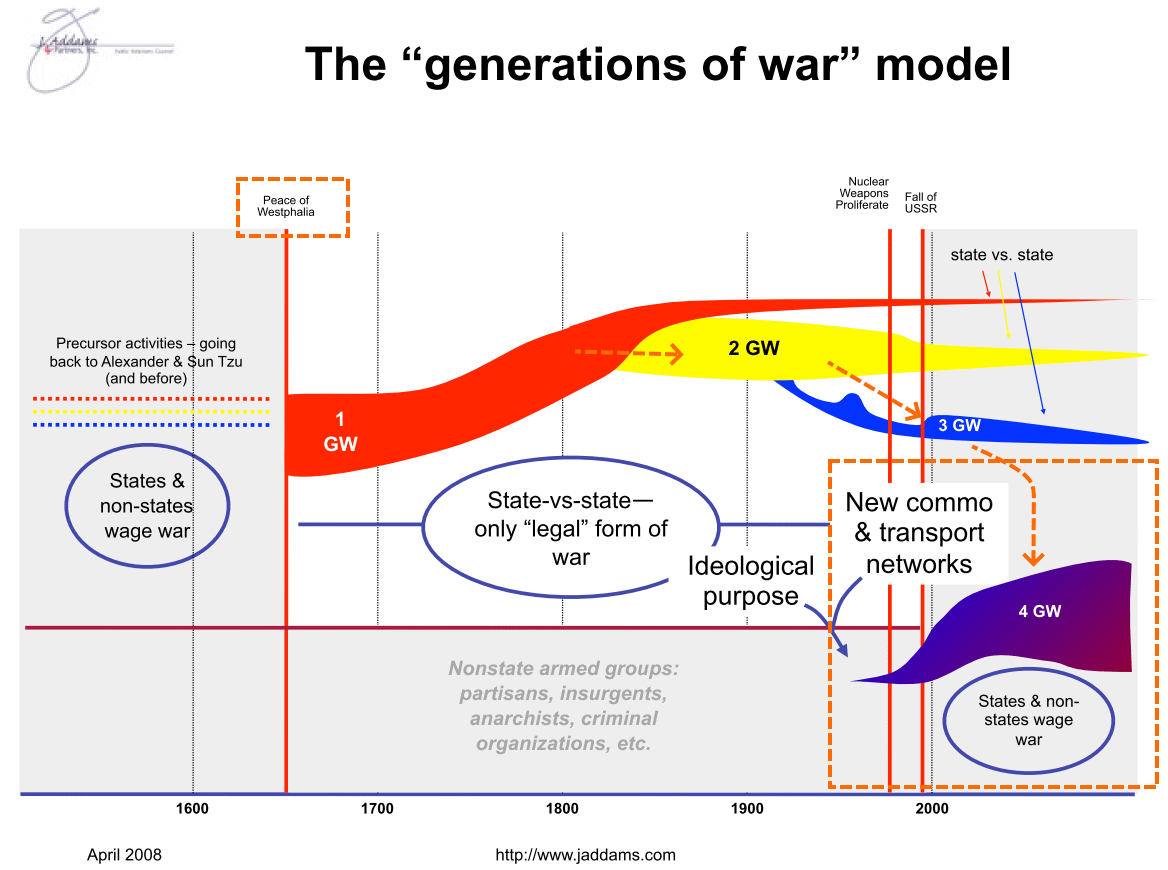
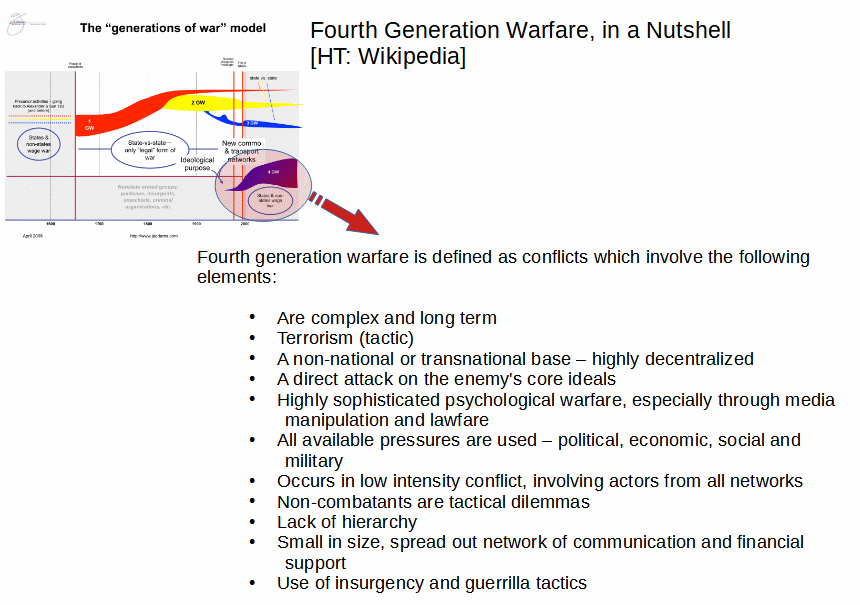
In short, colour revolutions are seen here, as a form of 4th generation war, with emphasis on subversive external intervention, but obviously the pivot is civil conflict, war in the shadows with low kinetic elements leading to or resisting subjugation. Where, as low kinetic implies, the operations of war are no longer primarily military.

Where, too, the baseline summary as to what fourth generation war is and how it emerged in mid C20 [going beyond Blitzkrieg, Deep Battle etc], can be charted:
Characteristics:
Where, the dirty form McFaul Colour revolution model can next be profitably cross connected to the SOCOM insurgency escalator framework and further tied to the 4th generation war model:
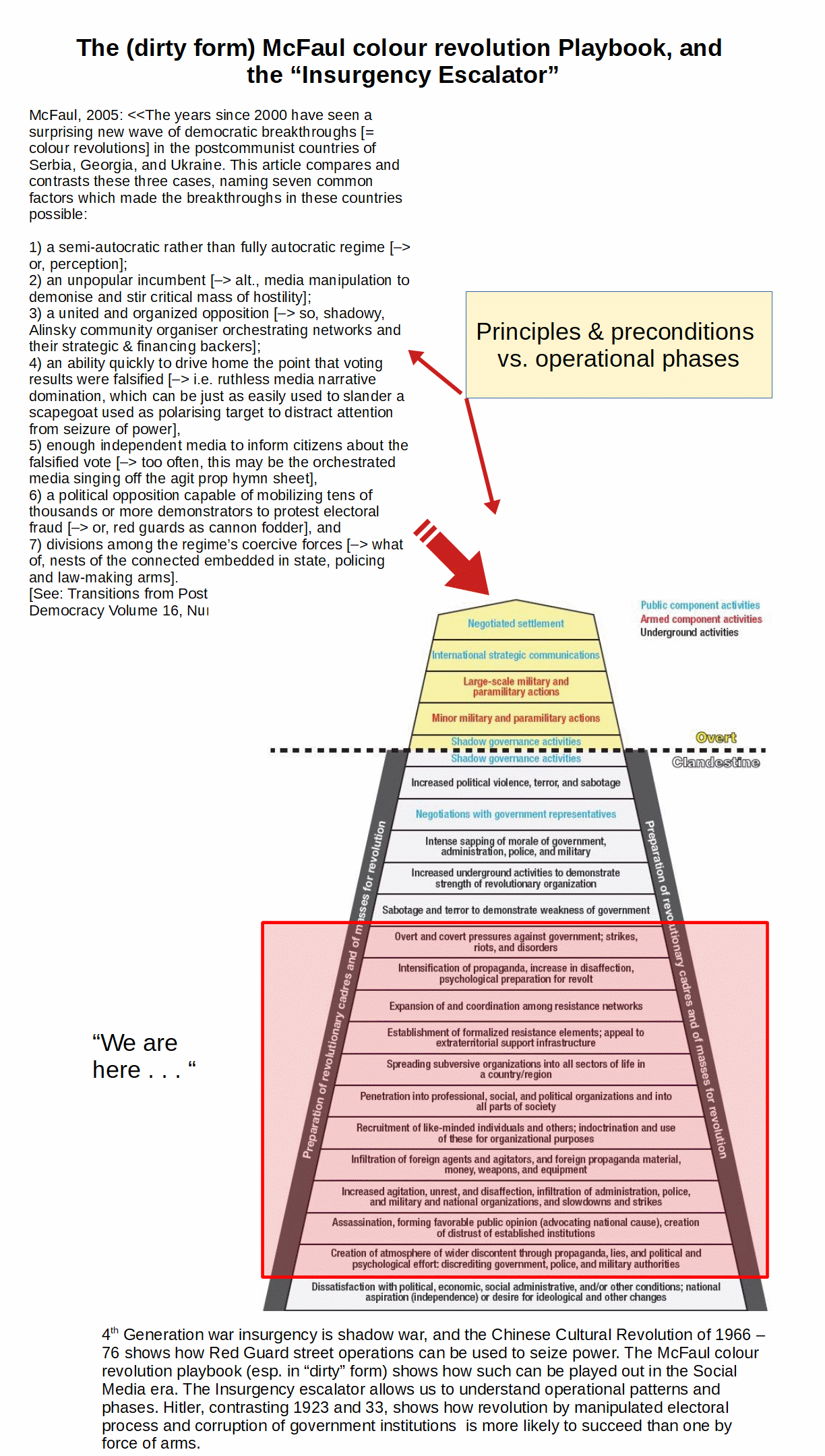
If that sounds familiar, it should. Culture War has gone geostrategic.

F/N2: How to destroy liberty.

We can use the Overton window concept to analyse how we can lose constitutional, lawful democracy with freedom and order, through cultural decline driven by ratcheting, slipperly slope lawless agendas, as summarised in the chain of expressions:

WORLDVIEW + POLICY/CULTURAL AGENDA = IDEOLOGY

IDEOLOGY + POWER/STRONG INFLUENCE = REGIME

REGIME (AKA, BALANCE OF POWER-FACTIONS) + DECISION-MAKING INFLUENCES = BUSINESS AS USUAL (BAU)

BAU + INSISTENT VOYAGE OF SINFUL FOLLY = SHIPWRECK

And yes, cultural marxism and broader “critical theory” in the line flowing from the Frankfurt School, I am looking straight at you.

We must recall, lawless oligarchy is — historically — the normal state of government and governance and it can return:
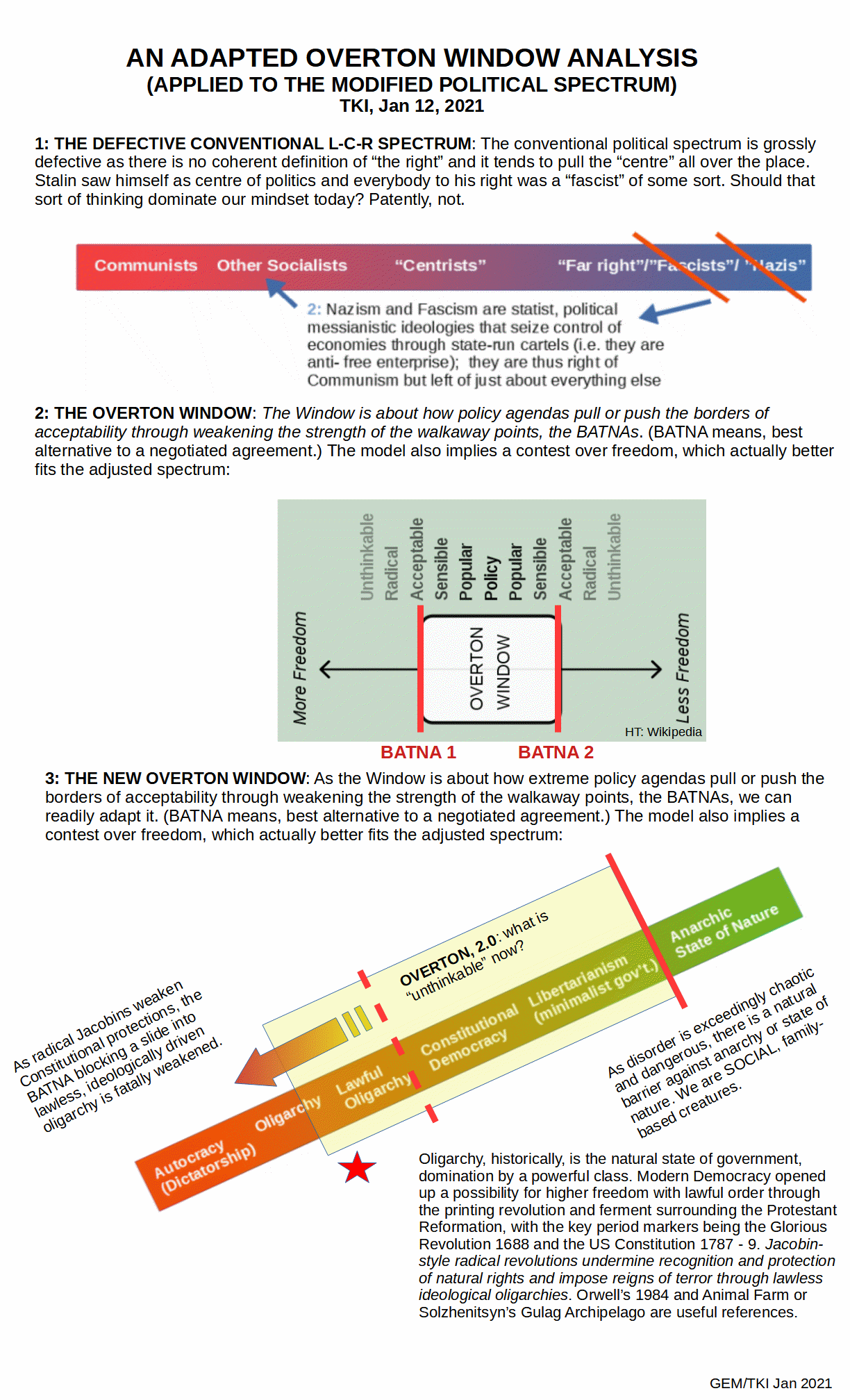
For those who want background, here is more on the Overton Window:
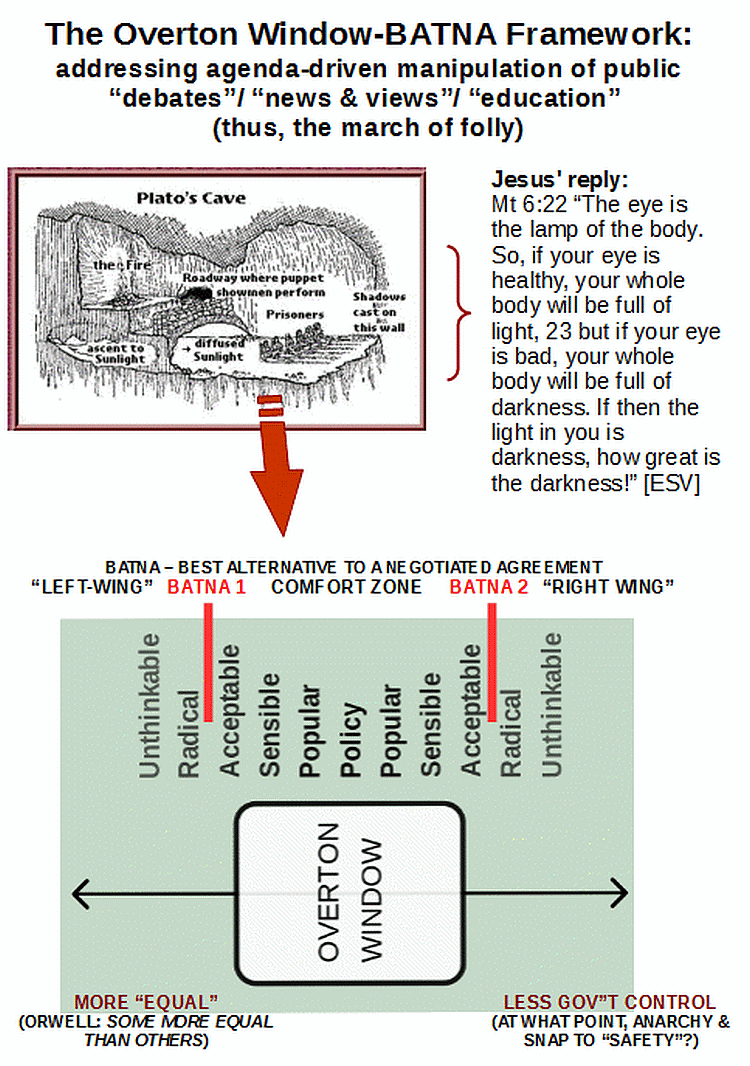
Video:

We must not overlook, the media spin and gaslight game:

More broadly, we can analyse the conventional left-centre-right political spectrum and an alternative more historically anchored political spectrum:
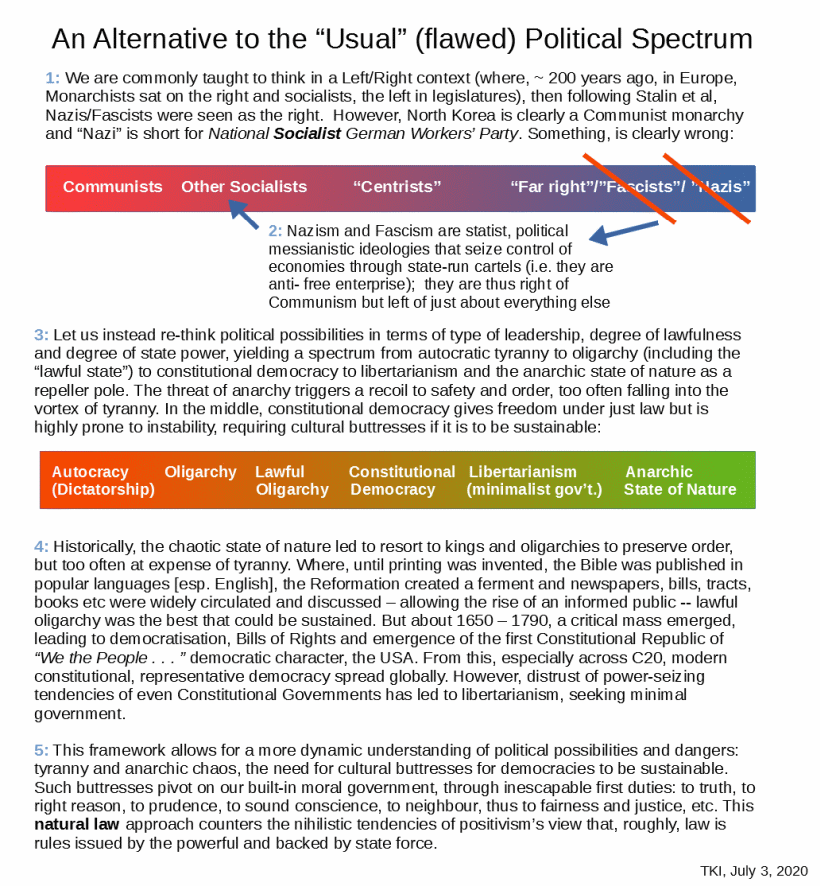
These tie back to Schaeffer’s line of despair model, which is about worldview shifts that open up new cultural, lifestyle and political possibilities as seemingly plausible, opening up the Overton Window. The power brokers and influences manipulate this, and currently the means in play go all the way to colour revolution, 4th generation war operations.

Comments
F/N: Some corrective notes on the myths about methodological and metaphysical naturalism as bulwarks of science, from a series of articles from some years ago:
Sometimes the most obvious facts are the easiest to overlook. Here is one that ought to be stunningly obvious: science as an organized, sustained enterprise arose only once in the history of Earth. Where was that? Although other civilizations have contributed technical achievements or isolated innovations, the invention of science as a cumulative, rigorous, systematic, and ongoing investigation into the laws of nature occurred only in Europe; that is, in the civilization then known as Christendom. Science arose and flourished in a civilization that, at the time, was profoundly and nearly exclusively Christian in its mental outlook. There are deep reasons for that, and they are inherent in the Judeo-Christian view of the world which, principally in its Christian manifestation, formed the European mind. As Stark observes, the Christian view depicted God as "a rational, responsive, dependable, and omnipotent being and the universe as his personal creation, thus having a rational, lawful, stable structure, awaiting human comprehension." That was not true of belief systems elsewhere. A view that the universe is uncreated, has been around forever, and is just "what happens to be" does not suggest that it has fundamental principles that are rational and discoverable. Other belief systems have considered the natural world to be an insoluble mystery, conceived of it as a realm in which multiple, arbitrary gods are at work, or thought of it in animistic terms. None of these views will, or did, give rise to a deep faith that there is a lawful order imparted by a divine creator that can and should be discovered.
[--> Clue: why do we still talk about "Laws" of nature? Doesn't such historically rooted language not suggest: a law-giver? (And indeed, that is precisely what Newton discussed at length in his General Scholium to his Mathematical Principles of Natural Philosophy.) Of course, that will not move the deeply indoctrinated and polarised, but it is a clear marker to those who are willing to think more open-mindedly.]
Recent scholarship in the history of science reveals that this commitment to rational, empirical investigation of God's creation is not simply a product of the "scientific revolution" of the 16th and 17th centuries, but has profound roots going back at least to the High Middle Ages . . . . Albertus Magnus -- prodigious scholar, naturalist, teacher of Thomas Aquinas, and member of the Dominican order -- affirmed in his De Mineralibus that the purpose of science is "not simply to accept the statements of others, that is, what is narrated by people, but to investigate the causes that are at work in nature for themselves." Another 13th-century figure, Robert Grosseteste, who was chancellor of Oxford and Bishop of Lincoln, has been identified as "the first man ever to write down a complete set of steps for performing a scientific experiment," according to Woods. WHEN THE DISCOVERIES of science exploded in number and importance in the 1500s and 1600s, the connection with Christian belief was again profound. Many of the trailblazing scientists of that period when science came into full bloom were devout Christian believers, and declared that their work was inspired by a desire to explore God's creation and discover its glories. Perhaps the greatest scientist in history, Sir Isaac Newton, was a fervent Christian who wrote over a million words on theological subjects. Other giants of science and mathematics were similarly devout: Boyle, Descartes, Kepler, Leibniz, Pascal. To avoid relying on what might be isolated examples, Stark analyzed the religious views of the 52 leading scientists from the time of Copernicus until the end of the 17th century. Using a methodology that probably downplayed religious belief, he found that 32 were "devout"; 18 were at least "conventional" in their religious belief; and only two were "skeptics." More than a quarter were themselves ecclesiastics: "priests, ministers, monks, canons, and the like." Down through the 19th century, many of the leading figures in science were thoroughgoing Christians. A partial list includes Babbage, Dalton, Faraday, Herschel, Joule, Lyell, Maxwell, Mendel, and Thompson (Lord Kelvin). A survey of the most eminent British scientists near the end of the 19th century found that nearly all were members of the established church or affiliated with some other church. In short, scientists who were committed Christians include men often considered to be fathers of the fields of astronomy, atomic theory, calculus, chemistry, computers, electricity, genetics, geology, mathematics, and physics. In the late 1990s, a survey found that about 40 percent of American scientists believe in a personal God and an afterlife -- a percentage that is basically unchanged since the early 20th century. A listing of eminent 20th-century scientists who were religious believers would be far too voluminous to include here -- so let's not bring coals to Newcastle, but simply note that the list would be large indeed, including Nobel Prize winners. Far from being inimical to science, then, the Judeo-Christian worldview is the only belief system that actually produced it. Scientists who (in Boyle's words) viewed nature as "the immutable workmanship of the omniscient Architect" were the pathfinders who originated the scientific enterprise. The assertion that intelligent design is automatically "not science" because it may support the concept of a creator is a statement of materialist philosophy, not of any intrinsic requirement of science itself. The redefinition of science in materialist terms -- never wholly successful, but probably now the predominant view -- required the confluence of several intellectual currents. The attack on religious belief in general, and Christianity in particular, has been underway for more than two centuries . . . . IT WAS THE AWE-INSPIRING SUCCESS of science itself, nurtured for centuries in a Christian belief system, that caused many to turn to it as the comprehensive source of explanation. With the mighty technology spawned by science in his hands, man could exalt himself, it seemed, and dispense with God. Although Darwin was by no means the sole cause of the apotheosis of materialist science, his theories gave it crucial support. It is perhaps not altogether a coincidence that the year 1882, in which Darwin died, found Nietzsche proclaiming that "God is dead...and we have killed him." The capture of science (in considerable measure) by materialist philosophy was aided by the hasty retreat of many theists. There are those who duck any conflict by declaring that science and religion occupy non-overlapping domains or, to use a current catchphrase, separate "magisteria." One hears this dichotomy expressed in apothegms such as, "Science asks how; religion asks why." In this view, science is the domain of hard facts and objective truth. Religion is the realm of subjective belief and faith. Science is publicly verifiable, and is the only kind of truth that can be allowed in the public square. Religion is private, unverifiable, and cannot be permitted to intrude into public affairs, including education. The two magisteria do not conflict, because they never come into contact with each other. To achieve this peace, all the theists have to do is interpret away many of the central beliefs of the Judeo-Christian tradition. This retreat makes some theists happy, because they can avoid a fight that they feel ill-equipped to win, and can retire to a cozy warren of warm, fuzzy irrelevancy. It also makes materialists happy, because the field has been ceded to them. As ID advocate Phillip Johnson remarks acerbically:
Politically astute scientific naturalists feel no hostility toward those religious leaders who implicitly accept the key naturalistic doctrine that supernatural powers do not actually affect the course of nature. In fact, many scientific leaders disapprove of aggressive atheists like Richard Dawkins, who seem to be asking for trouble by picking fights with religious people who only want to surrender with dignity.
But the ID theorists do not go gentle into that good night. That's what's different about intelligent design. ID says that the best evidence we have shows that life is the product of a real intelligent agent, actually working in space and time, and that the designer's hand can be detected, scientifically and mathematically, by what we know about the kinds of things that are produced only by intelligence. It is making scientific claims about the real world. Because it relies on objective fact and scientific reasoning, ID seeks admission to the public square. Rather than retreating to the gaseous realm of the subjective, it challenges the materialist conception of science on its own turf. It thus threatens materialism generally, with all that that entails for morality, law, culture -- and even for what it means to be human. THOSE WHO NOW OCCUPY the public square will fight to keep possession of it. The advocates of Darwinian materialism believe that they are in possession of The Truth, and are perfectly willing to invoke the power of the state to suppress competing views [--> which should be a big warning-sign that something has gone very wrong] . . . ["What's the Big Deal About Intelligent Design?" By Dan Peterson, American Spectator, Published 12/22/2005; also cf his earlier popular level summary on ID here. (HT: Wayback Machine.)]
These seem necessary at this point to correct a longstanding agit prop false and persistent accusation (not mere innocent mischaracterisation), and should be seen i/l/o the direct text we have from Newton. KFkairosfocus
April 6, 2022
April
04
Apr
6
06
2022
12:02 AM
12
12
02
AM
PDT
VL, attn Jerry, there is an openness to a fifth force, of course. KFkairosfocus
April 5, 2022
April
04
Apr
5
05
2022
10:16 PM
10
10
16
PM
PDT
VL, Newton clearly thought God did it and then proceeded to produce the greatest breakthroughs in the history of modern science and mathematics. He concluded God did it and proceeded in the same context to lay out ideas that opened up lines of exploration in physics and related disciplines for 200+ years. Indeed in that context, he further laid out the classic defining framework of science and its methods INCLUDING HOW EARLIER CONCLUSIONS ARE TO BE MODIFIED AND WHEN NOT. In short, it is clear that you have been unresponsive to demonstrated fact because of a talking point that is commonplace but inaccurate to key history with Newton as Exhibit A on why it is inaccurate. Pardon how direct you have forced me to be. KF PS, I append, for comparison:
Newton, 1718, Opticks, Query 31: >>As in Mathematicks, so in Natural Philosophy, the Investigation of difficult Things by the Method of Analysis, ought ever to precede the Method of Composition. This Analysis consists in making Experiments and Observations, and in drawing general Conclusions from them by Induction, and admitting of no Objections against the Conclusions, but such as are taken from Experiments, or other certain Truths. For [speculative] Hypotheses are not to be regarded in experimental Philosophy. And although the arguing from Experiments and Observations by Induction be no Demonstration of general Conclusions; yet it is the best way of arguing which the Nature of Things admits of, and may be looked upon as so much the stronger, by how much the Induction is more general. And if no Exception occur from Phænomena, the Conclusion may be pronounced generally. But if at any time afterwards any Exception shall occur from Experiments, it may then begin to be pronounced with such Exceptions as occur. By this way of Analysis we may proceed from Compounds to Ingredients, and from Motions to the Forces producing them; and in general, from Effects to their Causes, and from particular Causes to more general ones, till the Argument end in the most general. This is the Method of Analysis: And the Synthesis consists in assuming the Causes discover’d, and establish’d as Principles, and by them explaining the Phænomena proceeding from them, and proving the Explanations.>> 2005, historically and philosophically better founded and more substantial definition: “Science is a systematic method of continuing investigation, that uses observation, hypothesis testing, measurement, experimentation, logical argument and theory building, to lead to more adequate explanations of natural phenomena.”
Notice, how the dissenters of 2005 are also showing that open endedness is pivotal to science. The term induction, even with modern sense specified has become far too controversial to be used in a schools context. I would add that science seeks to increasingly accurately describe, explain, predict and provide tools to influence and control the materials, forces and phenomena of the natural world, but they were good enough.kairosfocus
April 5, 2022
April
04
Apr
5
05
2022
10:01 PM
10
10
01
PM
PDT
Jerry writes, "Science is limited to the four natural forces of physics. There is more than these four forces. Thus, there is truth beyond what science reveals or more importantly can reveal. Science has a limited domain and thus, by definition is limited in what it can show." I agree entirely, and that is similar to things I said in earlier posts. That is why CD's professor's statement that science is searching for physical explanations for physical phenomena (or something like that) is accurate.Viola Lee
April 5, 2022
April
04
Apr
5
05
2022
06:56 PM
6
06
56
PM
PDT
religious thinking is not a science stopper if you consider it a stimulus to explore the order that is in the world. It is a science stopper if you conclude “God did it”, and thus forestall any further investigation.
Should this be added?
Science is not a truth stopper if you consider it a stimulus to explore the order that is in the world. It is a truth stopper if you preclude “God did it”, and thus forestall any further understanding of the world.
Science is limited to the four natural forces of physics. There is more than these four forces. Thus, there is truth beyond what science reveals or more importantly can reveal. Science has a limited domain and thus, by definition is limited in what it can show. Another great resource for understanding science is Stephen Meyer’s new book, the Return of the God Hypothesis.jerry
April 5, 2022
April
04
Apr
5
05
2022
06:18 PM
6
06
18
PM
PDT
KF writes, "theistic thinking is anti science and a science stopper." As I stated above, religious thinking is not a science stopper if you consider it a stimulus to explore the order that is in the world. It is a science stopper if you conclude "God did it", and thus forestall any further investigation. Also, you quoted more of Newton. I assume you read what isaac-newton.org said about the Scholium in my post 78. Also, you write, "elites wish to exorcise even the shadow of God’s foot from the province of serious knowledge" No, there is no problem in proposing God as part of serious knowledge. The objection is to proposing God as part of serious science. Science does not encompass all of knowledge,Viola Lee
April 5, 2022
April
04
Apr
5
05
2022
05:39 PM
5
05
39
PM
PDT
VL, note how Newton closes off his remarks as just cited. Inference from nature of things to their author. KFkairosfocus
April 5, 2022
April
04
Apr
5
05
2022
05:31 PM
5
05
31
PM
PDT
F/N: Newton's General Scholium to Principia:
. . . This most beautiful system of the sun, planets, and comets, could only proceed from the counsel and dominion of an intelligent and powerful Being. And if the fixed stars are the centres of other like systems, these, being formed by the like wise counsel, must be all subject to the dominion of One; especially since the light of the fixed stars is of the same nature with the light of the sun, and from every system light passes into all the other systems: and lest the systems of the fixed stars should, by their gravity, fall on each other mutually, he hath placed those systems at immense distances one from another. This Being governs all things, not as the soul of the world, but as Lord over all [--> sets aside pantheism and panentheism]; and on account of his dominion he is wont to be called Lord God pantokrator , or Universal Ruler; for God is a relative word, and has a respect to servants; and Deity is the dominion of God not over his own body, as those imagine who fancy God to be the soul of the world, but over servants. The Supreme God is [--> definition of God and his domain:] a Being eternal, infinite, absolutely perfect; but a being, however perfect, without dominion, cannot be said to be Lord God; for we say, my God, your God, the God of Israel, the God of Gods, and Lord of Lords; but we do not say, my Eternal, your Eternal, the Eternal of Israel, the Eternal of Gods; we do not say, my Infinite, or my Perfect: these are titles which have no respect to servants. The word God usually signifies Lord; but every lord is not a God. It is the dominion of a spiritual being which constitutes a God: a true, supreme, or imaginary dominion makes a true, supreme, or imaginary God. And from his true dominion it follows that the true God is a living, intelligent, and powerful Being; and, from his other perfections, that he is supreme, or most perfect. He is eternal and infinite, omnipotent and omniscient; that is, his duration reaches from eternity to eternity; his presence from infinity to infinity; he governs all things, and knows all things that are or can be done. He is not eternity or infinity, but eternal and infinite; he is not duration or space, but he endures and is present. He endures for ever, and is every where present; and by existing always and every where, he constitutes duration and space. Since every particle of space is always, and every indivisible moment of duration is every where, certainly the Maker and Lord of all things cannot be never and no where. Every soul that has perception is, though in different times and in different organs of sense and motion, still the same indivisible person. There are given successive parts in duration, co-existent puts in space, but neither the one nor the other in the person of a man, or his thinking principle; and much less can they be found in the thinking substance of God. Every man, so far as he is a thing that has perception, is one and the same man during his whole life, in all and each of his organs of sense. [--> identity issues] God is the same God, always and every where. He is omnipresent not virtually only, but also substantially; for virtue cannot subsist without substance. In him are all things contained and moved [i.e. cites Ac 17, where Paul evidently cites Cleanthes and sets him in a Biblical, Creation context]; yet neither affects the other: God suffers nothing from the motion of bodies; bodies find no resistance from the omnipresence of God. It is allowed by all that the Supreme God exists necessarily [--> necessary being]; and by the same necessity he exists always, and every where. [i.e accepts the cosmological argument to God, also implies God is framework to the world, one doubts possible world speak would have been well studied then.] Whence also he is all similar, all eye, all ear, all brain, all arm, all power to perceive, to understand, and to act; but in a manner not at all human, in a manner not at all corporeal, in a manner utterly unknown to us. As a blind man has no idea of colours, so have we no idea of the manner by which the all-wise God perceives and understands all things. He is utterly void of all body and bodily figure [--> issues of necessary being, not made up from detachable parts], and can therefore neither be seen, nor heard, or touched; nor ought he to be worshipped under the representation of any corporeal thing. [Cites Exod 20.] We have ideas of his attributes, but what the real substance of any thing is we know not. In bodies, we see only their figures and colours, we hear only the sounds, we touch only their outward surfaces, we smell only the smells, and taste the savours; but their inward substances are not to be known either by our senses, or by any reflex act of our minds: much less, then, have we any idea of the substance of God. We know him only by his most wise and excellent contrivances of things, and final cause [i.e from his designs]: we admire him for his perfections; but we reverence and adore him on account of his dominion: for we adore him as his servants; and a god without dominion, providence, and final causes, is nothing else but Fate and Nature. Blind metaphysical necessity, which is certainly the same always and every where, could produce no variety of things. [i.e necessity does not produce contingency] All that diversity of natural things which we find suited to different times and places could arise from nothing but the ideas and will of a Being necessarily existing. [That is, implicitly rejects chance, Plato's third alternative and explicitly infers to the Designer of the Cosmos.] But, by way of allegory, God is said to see, to speak, to laugh, to love, to hate, to desire, to give, to receive, to rejoice, to be angry, to fight, to frame, to work, to build; for all our notions of God are taken from. the ways of mankind by a certain similitude, which, though not perfect, has some likeness, however. And thus much concerning God; to discourse of whom from the appearances of things, does certainly belong to Natural Philosophy. [General Scholium to Principia, paragraphs added. Notice what he thought about discourse on God and Natural Philosophy.]
kairosfocus
April 5, 2022
April
04
Apr
5
05
2022
05:29 PM
5
05
29
PM
PDT
VL, any number have said theistic thinking is anti science and a science stopper. As one clue they commonly make a contrast between natural and supernatural rather than Plato's ART-ificial from The Laws Bk X 360 BC. But if you narrow it to design thinkers or even Biblical Creationists, Newton classifies as both. We have in hand in Opticks Query 31 a direct disproof by having theistic, creationist and design thought, cheek by jowl with a classic, set the yardstick definition of science and its methods including strengths and limitations so an implied weak form sense of knowledge. He is writing in the context of leading arguably the greatest breakthrough of modern science and Mathematics [co inventor of Calculus] and manages to sketch out major lines down which Physics would go for 200+ years. Science stopper is dead. As for definitions in Kansas, Lewontin let the cat out of the bag on the subtext of "natural" in 2001 and 2007 alike, the elites wish to exorcise even the shadow of God's foot from the province of serious knowledge, by which they manifestly mean scientism, evolutionary materialistic scientism. The radical redefinitions are historically demonstrably inaccurate and as SA just hinted would lead to bowdlerising or conveniently back burner-ing or censoring Newton's main scientific works. If your definition cannot pass the Newton test it is hopeless. Fail. KFkairosfocus
April 5, 2022
April
04
Apr
5
05
2022
05:17 PM
5
05
17
PM
PDT
yo SA: That is a favorite quote, but Newton did not propose that as a scientific explanation. He proposed the laws of universal gravitation as explanations, and he famously declared that as far as science went, he did not propose a metaphysical explanation for gravity. The General Scholium was an appendix to the Principia which isaac-newton.org says "contains an excursion into natural theology and theology proper." Newton was very religious, and in fact spent the later part of his life more involved in theology, alchemy, and Bible studies than he was in physics. But the critical point he did not confuse his religious beliefs with his scientific work where he searched for explanations of physical phenomena in terms of other physical phenomena. Yes, the NSTA would say that the quote you offered was religious belief, but not science. That doesn't negate the vast amount of science that Newton did.Viola Lee
April 5, 2022
April
04
Apr
5
05
2022
05:00 PM
5
05
00
PM
PDT
The US NSTA Board says in 2007: “Science is a human activity of systematically seeking natural explanations for what we observe in the world around us” Newton:
But it is not to be conceived that mere mechanical causes could give birth to so many regular motions: since the Comets range over all parts of the heavens, in very eccentric orbits. For by that kind of motion they pass easily through the orbits of the Planets, and with great rapidity; and in their aphelions, where they move the slowest, and are detain’d the longest, they recede to the greatest distances from each other, and thence suffer the least disturbance from their mutual attractions. This most beautiful System of the Sun, Planets, and Comets, could only proceed from the counsel and dominion of an intelligent and powerful being. ... We know him only by his most wise and excellent contrivances of things, and final causes; we admire him for his perfections; but we reverence and adore him on account of his dominion. For we adore him as his servants; and a God without dominion, providence, and final causes, is nothing else but Fate and Nature. Blind metaphysical necessity, which is certainly the same always and every where, could produce no variety of things. All that diversity of natural things which we find, suited to different times and places, could arise from nothing but the ideas and will of a Being necessarily existing. The General Scholium to Isaac Newton’s Principia mathematica
Newton's work would therefore be censored by the NSTA.Silver Asiatic
April 5, 2022
April
04
Apr
5
05
2022
04:47 PM
4
04
47
PM
PDT
re 75, to KF. I don’t think anyone has said that “theistic thought is a science stopper.” Lots of theists believe that God has created the world to be orderly and for that order to be discoverable by us. That is a motivation to do science. But that is different than saying that God is part of a resulting scientific explanation. You write, “Then, I cannot but note how you have dropped your attempt to stigmatise and dismiss the dissenters of 2005 without acknowledging that they were right, the heretics turned out to be sounder than the radical ruling orthodoxy of evolutionary materialistic scientism. Duly noted.” I have no idea what you are talking about. I said I liked the 2001 definition, which is like CD’s professor's statement, and that I had problems with the 2005 definition, for various reasons, one of which, according to what I read on the internet, was written by ID supporters who thought the 2001 definition was basically atheistic, which seems quite wrong to me. I didn’t acknowledge those 2005 authors were right because I don’t think they are right, especially in the context of that particular situation.Viola Lee
April 5, 2022
April
04
Apr
5
05
2022
02:58 PM
2
02
58
PM
PDT
I never thought this was difficult. Scientific investigation is limited to things we can observe and things we can test.JHolo
April 5, 2022
April
04
Apr
5
05
2022
02:22 PM
2
02
22
PM
PDT
VL, it is part of his frame of doing science, it grounded his expectation of lawlike behaviour intelligible to us as has long since been drawn out going far beyond Newton, as a key part of the puzzle why science had its breakthrough where and when it did. Further to this, Opticks Query 31 puts paid to the notion that theistic thought is a science stopper, in fact this was a starter and a basis for laying out in outline 200+ years of onward fruitful inquiry in the hardest core of all modern sciences, the yardstick science in fact. We need history like this as a hard, factual counter weight to a lot of radical secularist myths and ideological talk points confused for truth about the actual history and nature of science. Then, I cannot but note how you have dropped your attempt to stigmatise and dismiss the dissenters of 2005 without acknowledging that they were right, the heretics turned out to be sounder than the radical ruling orthodoxy of evolutionary materialistic scientism. Duly noted. More directly, as there is ever a trend of invidious insinuations about design thinkers, the despised IDers have here demonstrated a sounder understanding of the nature and methods of science. What is more, despite agit prop and lawfare as happened in Kansas and Pennsylvania, as the UD Weak Argument Correctives point out, the design inference is an inference on tested reliable signs to their known causal process/factor, intelligently directed configuration. This is not an inference to any particular designer, and we see that natural [= blind chance and/or mechanical necessity] has a proper contrast with techne, the ART-ifice and contrivance of intelligently directed configuration. So the agit prop driven oh it's natural vs supernatural is at best an historically misinformed strawman. Plato went on record on this in The Laws Bk X, c 360 BC. KFkairosfocus
April 5, 2022
April
04
Apr
5
05
2022
02:18 PM
2
02
18
PM
PDT
And would a statement that God, in the beginning, created the atoms with the properties they have be considered a scientific explanation?
No. It's an explanation. Someone painted the Mona Lisa. If you had three people who witnessed Da Vinci paint it, then that would be an explanation. But I doubt it would be called a scientific explanation. However, once a system was intact and changes happened to it by the laws of physics, then one might want to call that a scientific explanation. The laws of physics are the basis for chemistry and chemistry is the basis for much of what happens in biology. But all explanations that science investigates may not be due to the laws of physics and a distinction should be made for these types of explanations. ID essentially says that some changes/and the causes for these change are not due to available forces of nature but are due to some other force intervening to cause a change. Some of these changes have some remarkable properties which would obviate some unknown physical force from being the cause. The likely cause is some intelligence. Are we still trying to understand what science is? If it is. I again recommend the Durston video.jerry
April 5, 2022
April
04
Apr
5
05
2022
01:55 PM
1
01
55
PM
PDT
And would a statement that God, in the beginning, created the atoms with the properties they have be considered a scientific explanation? Newton was religious, so of course he had religious thoughts about God, but in his scientific work did he ever do anything other than look for physical explanations for physical phenomena? And how would the definition you offered as wrong "censor Opticks and Principia." Could you be specific?Viola Lee
April 5, 2022
April
04
Apr
5
05
2022
01:43 PM
1
01
43
PM
PDT
VL, you may find the full Query 31 interesting reading, he actually guesses at a surprising number of onward trends in physics with a touch or two of chemistry. A convinced atomist, he remarked earlier than our excerpt that defines Science and its methods: "All these things being consider’d, it seems probable to me, that God in the Beginning form’d Matter in solid, massy, hard, impenetrable, moveable Particles, of such Sizes and Figures, and with such other Properties, and in such Proportion to Space, as most conduced to the End for which he form’d them . . ." And then there is the General Scholium to Principia. However, the focal point you have been challenging is the accuracy of the 2005 definition, and I would suggest that a definition that would censor Opticks and Principia . . . Newton's two most famous works of science, fails the historical accuracy test rather badly. KFkairosfocus
April 5, 2022
April
04
Apr
5
05
2022
01:22 PM
1
01
22
PM
PDT
Would Newton have accepted God as an explanation for some physical phenomena
He did. Which led to La Place’s famous response.
Je n'avais pas besoin de cette hypothèse-là. ("I had no need of that hypothesis.")
Napoleon told this to Lagrange who said
Ah! c'est une belle hypothèse; ça explique beaucoup de choses. ("Ah, it is a fine hypothesis; it explains many things.")
Both La Place and Lagrange were correct.jerry
April 5, 2022
April
04
Apr
5
05
2022
01:10 PM
1
01
10
PM
PDT
KF: Would Newton have accepted God as an explanation for some physical phenomena?Viola Lee
April 5, 2022
April
04
Apr
5
05
2022
11:36 AM
11
11
36
AM
PDT
SA, that result has been in the public for many years, including here at UD. Of course, it is utterly as expected. KFkairosfocus
April 5, 2022
April
04
Apr
5
05
2022
11:27 AM
11
11
27
AM
PDT
KF
For example, it produced this partial line from Henry IV, Part 2, reporting that it took “2,737,850 million billion billion billion monkey-years” to reach 24 matching characters:
People often claim that ID is not testable or non-falsifiable, but the results you posted from different tests refute that claim.Silver Asiatic
April 5, 2022
April
04
Apr
5
05
2022
10:17 AM
10
10
17
AM
PDT
SA, we know we need a necessary being root of reality to be causal source and sustainer of temporal-causal, thermodynamic [CTTh] worlds, as "years" cannot have been endlessly traversed in the past because of the infeasible supertask of traversing the implicitly or explicitly transfinite in finite stage cumulative steps. That has to do with how quantities are part of the necessary framework for any world, it is a logic of being constraint expressed through logic of structure and quantity, AKA Mathematics. So, as utter non being cannot cause anything, were there ever such a condition it would forever obtain (and circular retrocausation on cosmos level is essentially the same something from nothing), we can be certain, logically certain there was a beginning to worlds -- cosmi -- such as ours. In this world we are a new level of creature, responsibly and rationally self moved, free and morally governed. This points to a bill of requisites for the reality root, post Hume and Euthyphro; inherently good and utterly wise, as well as powerful enough to cause worlds. In that context, God is a serious candidate to be such a reality root, and so the logic of being alternatives are, actual, or else impossible of being. Actual NB's are framework for any world to exist as the numbers in N,Z,Q,R,R*,C, C* etc are for example. Objectors to the reality of God have no good reason that he is so impossible, or it would be everywhere. It is more than merely reasonable to acknowledge the reality of God and to claim to know that he is. In addition, millions know and have known him personally in life transforming power; to hold us delusional is a case where one implicitly infers that humanity is under grand delusion, which discredits ALL systems of thought and claimed reason, which is of course self referential. It is not on merits that power elites have led many to doubt, dismiss and be angry at God, but on systems of thought that will predictably fail at the bar of comparative difficulties. That is, factual adequacy, coherence and balanced explanatory power [neither ad hoc nor simplistic]. KF PS, as for reliability of signs of intelligence, we have trillions of cases on the ground and sitting in servers globally. The very comments in this thread are part of the natural experiment. As for the power of blind chance and/or mechanical necessity to create FSCO/I, let Wiki's admission against interest in the infinite monkeys theorem article speak for itself:
The infinite monkey theorem states that a monkey hitting keys at random on a typewriter keyboard for an infinite amount of time will almost surely type any given text, such as the complete works of William Shakespeare. In fact, the monkey would almost surely type every possible finite text an infinite number of times. However, the probability that monkeys filling the entire observable universe would type a single complete work, such as Shakespeare's Hamlet, is so tiny that the chance of it occurring during a period of time hundreds of thousands of orders of magnitude longer than the age of the universe is extremely low (but technically not zero) . . . . The theorem concerns a thought experiment which cannot be fully carried out in practice, since it is predicted to require prohibitive amounts of time and resources. Nonetheless, it has inspired efforts in finite random text generation. One computer program run by Dan Oliver of Scottsdale, Arizona, according to an article in The New Yorker, came up with a result on 4 August 2004: After the group had worked for 42,162,500,000 billion billion monkey-years, one of the "monkeys" typed, "VALENTINE. Cease toIdor:eFLP0FRjWK78aXzVOwm)-‘;8.t" The first 19 letters of this sequence can be found in "The Two Gentlemen of Verona". Other teams have reproduced 18 characters from "Timon of Athens", 17 from "Troilus and Cressida", and 16 from "Richard II".[27] A website entitled The Monkey Shakespeare Simulator, launched on 1 July 2003, contained a Java applet that simulated a large population of monkeys typing randomly, with the stated intention of seeing how long it takes the virtual monkeys to produce a complete Shakespearean play from beginning to end. For example, it produced this partial line from Henry IV, Part 2, reporting that it took "2,737,850 million billion billion billion monkey-years" to reach 24 matching characters: RUMOUR. Open your ears; 9r"5j5&?OWTY Z0d
That is a factor of 10^100 short of the configuration space for 500 - 1,000 bits [72 - 143 ASCII characters], the threshold we are interested in. islands odf function in large configuration spaces are a reality as for example even the diverse systems for genetics for sex determination show and the distribution of protein fold domains in AA sequence space also shows. That's before we identify that the code in the cell is linguistic and algorithmic so clearly characteristic of intelligence, right from the root of the tree of life. Besides, the fine tuning of the physics of the cosmos speaks for itself. Cosmos level design fine tuned to sustain cell based, Carbon chemistry, aqueous medium life.kairosfocus
April 5, 2022
April
04
Apr
5
05
2022
08:56 AM
8
08
56
AM
PDT
KF
Actually, Lewontin showed — yes this is a design inference on motive, means, opportunity and linked evidence
Exactly. ID says that we know with certainty what can only be produced by intelligent causes. We can observe and identify and prove some things can only be produced by intelligent design. We then see in nature things which share these exact characteristics. Therefore, the inescapable conclusion is that they also were produced by intelligent design. One kind of anti-IDist view then just denies this because they assert that "no such intelligence exists". So, like Lewontin - they shut the door on the inquiry before it can get started. Where's the direct evidence that God does not exist?Silver Asiatic
April 5, 2022
April
04
Apr
5
05
2022
07:24 AM
7
07
24
AM
PDT
Whatever begins to exist has a cause. The universe began to exist. Therefore, the universe has a cause. The universe, by definition, is all physical matter, space, time, energy. Therefore, the cause of the universe is non-physical, non-material, non-bounded by space or time. The necessary being (spaceless, timeless, unbounded), therefore, with the power to cause the origin of the universe is what we call "God". Life is irreducible to blind, material nature and can only be the product of intelligence. Proof: https://uncommondescent.com/intelligent-design/film-premieres-today-cell-membranes-as-a-challenge-in-the-origin-of-life/ The necessary being with the power, intelligence can capability to be the source, cause, origin or author of life is what we call "God".Silver Asiatic
April 5, 2022
April
04
Apr
5
05
2022
07:16 AM
7
07
16
AM
PDT
F/N: Anyone care to respond to geostrategic considerations, 4th gen post Westphalia war, Russian style views on colour revolutions, Reichstag fire type incidents, and where we may already be? KFkairosfocus
April 5, 2022
April
04
Apr
5
05
2022
03:01 AM
3
03
01
AM
PDT
F/N, Actually, Lewontin showed -- yes this is a design inference on motive, means, opportunity and linked evidence -- how a: censorship and marginalisation operations by elites dominated by a radical a priori materialist ideology b: seek to lock out evidence and inference that might point where they have no intent to allow so long as they hold decisive power. This then becomes C: capture of science and institutions, leading to the intellectual bankruptcy of locking out freedom to follow evidence in light of what it warrants, towards objective truth and knowledge. ________________________ CONCLUSION: Intellectual bankruptcy of the elites and undermining of credibility of science and of institutions across the 7 mtns [see OP] Trouble is upon us. KFkairosfocus
April 5, 2022
April
04
Apr
5
05
2022
01:40 AM
1
01
40
AM
PDT
Sev (attn VL), selective hyperskepticism and ideological imposition illustrating the precise point. Evidence is evidence and should be allowed to speak in its own voice, especially i/l/o Newton's Rules and empirically tested, reliable signs. Once designers are a possible candidate, tested, observed to be reliable signs of design must be allowed to speak. Otherwise science has become little more than an agit prop, lab coat clad front for precisely the domineering, a priori materialist, evolutionary materialistic scientism that Lewontin exposed, that we can see in the US NSTA attempt to ideologically capture science education, and which I summarised in extending Schaeffer's analysis to now, 38 years after he passed on after a long cancer fight. KF PS: Per Newton, I remind of the title of Lyell's Principles of Geology Vol 3:
PRINCIPLES OF GEOLOGY: BEING AN INQUIRY HOW FAR THE FORMER CHANGES OF THE EARTH’S SURFACE ARE REFERABLE TO CAUSES NOW IN OPERATION
Now, kindly explain to us the observed cause of meaningful alphanumeric, linguistic text beyond 500 - 1,000 bits of complexity, especially of algorithms, which are goal directed stepwise finite procedures with halting ________. More broadly, kindly explain the observed cause of trillions of occurrences of functionally specific, complex organisation and/or associated information [FSCO/I] that we have observed the actual causal process for ________ . If you can, kindly identify actually observed cases where such have come about by blind chance and/or mechanical necessity _________ . Then, explain to us why, apart from ideological imposition and selective hyperskepticism, we should rule out as unscientific [or even pseudo-scientific or anti-science etc . . . ], inference from reliable, tested observed signs to causal process involving intelligently directed configuration ____________ . Especially, given that many investigations of unquestionably scientific character routinely investigate and infer to or even embed in key metrics such as S/N power ratio, the reality of such design and inference thereto. KF PPS, Mill is simply wrong, once we recognise that design is intelligently directed configuration which often leaves strong traces of its causation by ART-ificial act rather than blind chance and/or mechanical necessity. There would be no reason why an act of said intelligent action by God, would not show traces of such intelligent action, indeed even the concept of a miracle is one where in rare cases for good reason God acts beyond the normal course of the world, showing signs that draw attention to intelligent cause by a power above powers of the natural world. At more mundane level, we routinely infer to acts of mind from FSCO/I eg text posted as comments here. Besides, on the most discussed case, the world of life based on the cell, there is no claimed design inference from FSCO/I to God as cause. From 1984 on in TMLO modern design thinkers have made that clear. If you wish to address fine tuning of the physics of the cosmos and issues of inherent finitude of the actual past, then we can, and we can infer on logic of being to a necessary being world root adequate to be source of our observed world.kairosfocus
April 5, 2022
April
04
Apr
5
05
2022
01:36 AM
1
01
36
AM
PDT
VL, kindly take due note of Newton, Opticks, Query 31. After that, much else will be clear regarding science, its methods, what is historically correct, what is justified and what has been done by radicals. KFkairosfocus
April 5, 2022
April
04
Apr
5
05
2022
01:04 AM
1
01
04
AM
PDT
"We have Mill’s argument that a being with God-like knowledge and powers would have no need to “design” anything at all." I like that line. And this:
No, Lewontin was right insofar as he was saying that science could not allow unproven theological claims to gain a foothold in the field as acceptable explanations. If you once allow that “God did it” or “It must have been God’s will” have any kind of explanatory traction then you put an end to science at that point.
Viola Lee
April 4, 2022
April
04
Apr
4
04
2022
07:59 PM
7
07
59
PM
PDT
Kairosfocus/57
In short, inference to the ART-ificial is a common part of science, based on its characteristic signs.
Except that the only artifice to which we can reliably infer is that of the only intelligent agency for which we have overwhelming evidence, ourselves. We have no idea how an alien intelligence might approach design. We have Mill's argument that a being with God-like knowledge and powers would have no need to "design" anything at all. And the "appearance of design" argument implies that a being capable of creating our Universe did so using design principles that would be recognizable to a species of intelligent ape that would not come into existence until roughly 13.8 bn years later.
To a priori exclude from the definition of science that it may when appropriate infer to intelligently directed configuration is massive question begging and twists science from pursuing empirically warranted, credibly and objectively truth (or at least best efforts so far) into a prestigious front for evolutionary materialistic scientism, an ideology.
So you resort to a conspiracy theory to explain why science does not accept your theology as a scientific theory of equivalent standing to those already well-established by decades of diligent investigation?
The end of this will be to discredit science, education, media and governments that went along with that perversion of the proper aim and values of science.
No, Lewontin was right insofar as he was saying that science could not allow unproven theological claims to gain a foothold in the field as acceptable explanations. If you once allow that "God did it" or "It must have been God's will" have any kind of explanatory traction then you put an end to science at that point. The reality is that the proper response by science to Christian claims that their theology is also a scientific explanation is to refer to the burden of proof that the faith bears when making such claims. In other words, if you say "God did it", prove it.Seversky
April 4, 2022
April
04
Apr
4
04
2022
06:48 PM
6
06
48
PM
PDT
1 2 3 4 5 6

Leave a Reply