In a recent UD thread on evidence vs selectively hyperskeptical dismissal, AS has been challenging that “religious” belief [= theism as worldview, worked into way of life] is ill founded, lacks evidence beyond testimonials, and the like. (Such is not new, already at UD I have had occasion to rebut his blanket dismissals of religious “dogma.”)
At 64, he sums up his perspective particularly succinctly:
AS, 64: I think religions have an emotional appeal that some people are more susceptible to than others. For those that succumb to that emotional need, evidence is superfluous. Those that lack that need aren’t swayed by testimony. Whether they might be impressed by evidence other than testimony is yet to be tested.
This is the old religion as a crutch fallacy.
(BTW, when I all but broke my ankle one Christmas morning as a student and had a doctor tell me I was very lucky once the X-Rays came out, I learned a lesson about crutches: when you need one, you need one real bad. Just ask the lovely and ever-cheerful Sis N, a lifelong Polio victim who walks with the aid of a pair of crutches and the most impressively muscled arms I have ever seen on a woman.)
Now, while debating theism is not the main purpose of UD, there is a matter of intellectual justice vs secularist prejudice — and even in some cases bigotry — here; the tendency to scorn theists as intellectually inferior emotional wrecks depending on unwarranted blind “faith” must be set straight.
Nor should the parting words of testimony as an eyewitness and chief spokesman of the 500+ witnesses at the core of the Christian contention, the Apostle Peter, about to be judicially murdered by Nero on a false charge of arson at Rome in AD 64, be ignored:
2 Peter 1:13 I think it right, as long as I am in this body, to stir you up by way of reminder, 14 since I know that the putting off of my body will be soon, as our Lord Jesus Christ made clear to me. 15 And I will make every effort so that after my departure you may be able at any time to recall these things.
16 For we did not follow cleverly devised myths when we made known to you the power and coming of our Lord Jesus Christ, but we were eyewitnesses of his majesty . . . .
19 And we have the prophetic word [E.g. Isa 53, c 700 BC] more fully confirmed, to which you will do well to pay attention as to a lamp shining in a dark place, until the day dawns and the morning star rises in your hearts, 20 knowing this first of all, that no prophecy of Scripture comes from someone’s own interpretation. 21 For no prophecy was ever produced by the will of man, but men spoke from God as they were carried along by the Holy Spirit. [ESV]
Where (given the Christian Faith is a primary target) I note, this is what Peter was talking about, vid:
[vimeo 17960119]
Or, as Barrister Frank Morison so aptly put the matter eighty plus years past now:
[N]ow the peculiar thing . . . is that not only did [belief in Jesus’ resurrection as in part testified to by the empty tomb] spread to every member of the Party of Jesus of whom we have any trace, but they brought it to Jerusalem and carried it with inconceivable audacity into the most keenly intellectual centre of Judaea . . . and in the face of every impediment which a brilliant and highly organised camarilla could devise. And they won. Within twenty years the claim of these Galilean peasants had disrupted the Jewish Church and impressed itself upon every town on the Eastern littoral of the Mediterranean from Caesarea to Troas. In less than fifty years it had began to threaten the peace of the Roman Empire . . . .
Why did it win? . . . .
We have to account not only for the enthusiasm of its friends, but for the paralysis of its enemies and for the ever growing stream of new converts . . . When we remember what certain highly placed personages would almost certainly have given to have strangled this movement at its birth but could not – how one desperate expedient after another was adopted to silence the apostles, until that veritable bow of Ulysses, the Great Persecution, was tried and broke in pieces in their hands [the chief persecutor became the leading C1 Missionary/Apostle!] – we begin to realise that behind all these subterfuges and makeshifts there must have been a silent, unanswerable fact. [Who Moved the Stone, (Faber, 1971; nb. orig. pub. 1930), pp. 114 – 115.]
Where also, we would do well to bear in mind the remarks of famed jurist (and former skeptic) Simon Greenleaf, in the opening chapter of his treatise on evidence (where, such of course includes eyewitness testimony and record of same):
Evidence, in legal acceptation, includes all the means by which any alleged matter of fact, the truth of which is submitted to investigation, is established or disproved . . . None but mathematical truth is susceptible of that high degree of evidence, called demonstration, which excludes all possibility of error [–> Greenleaf wrote almost 100 years before Godel], and which, therefore, may reasonably be required in support of every mathematical deduction.
Matters of fact are proved by moral evidence alone; by which is meant, not only that kind of evidence which is employed on subjects connected with moral conduct, but all the evidence which is not obtained either from intuition, or from demonstration. In the ordinary affairs of life, we do not require demonstrative evidence, because it is not consistent with the nature of the subject, and to insist upon it would be unreasonable and absurd.
The most that can be affirmed of such things, is, that there is no reasonable doubt concerning them.
The true question, therefore, in trials of fact, is not whether it is possible that the testimony may be false, but, whether there is sufficient probability of its truth; that is, whether the facts are shown by competent and satisfactory evidence. Things established by competent and satisfactory evidence are said to be proved.
By competent evidence, is meant that which the very-nature of the thing to be proved requires, as the fit and appropriate proof in the particular case, such as the production of a writing, where its contents are the subject of inquiry. By satisfactory evidence, which is sometimes called sufficient evidence, is intended that amount of proof, which ordinarily satisfies an unprejudiced mind, beyond reasonable doubt.
The circumstances which will amount to this degree of proof can never be previously defined; the only legal test of which they are susceptible, is their sufficiency to satisfy the mind and conscience of a common man; and so to convince him, that he would venture to act upon that conviction, in matters of the highest concern and importance to his own interest. [A Treatise on Evidence, Vol I, 11th edn. (Boston: Little, Brown, 1888) ch 1., sections 1 and 2. Shorter paragraphs added. (NB: Greenleaf was a founder of the modern Harvard Law School and is regarded as a founding father of the modern Anglophone school of thought on evidence, in large part on the strength of this classic work.)]
So, trying to sweep the report of millions of people whose lives have been transformed by meeting God off the table is patently ill-advised.
Now, too, I replied to AS initially at 165, pointing to the significance of worldview foundations:
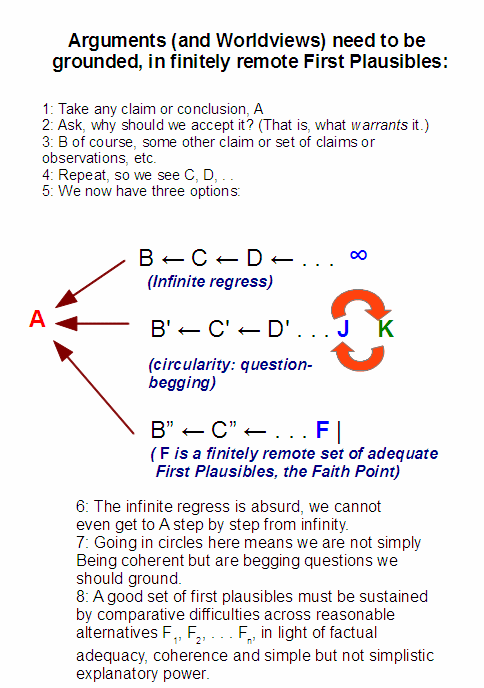
A summary of why we end up with foundations for our worldviews, whether or not we would phrase the matter that way}
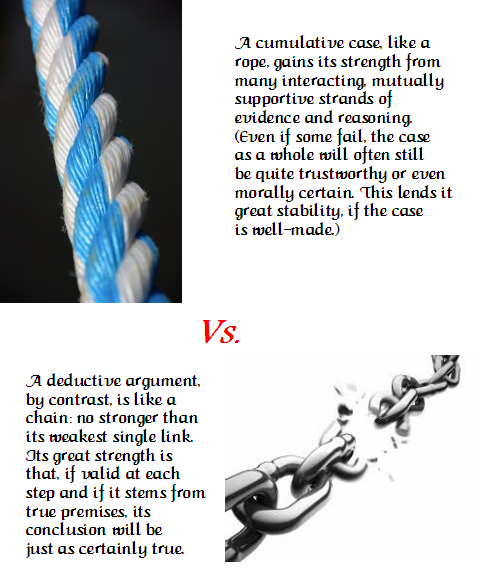
In that context, to blanket-dismiss the experience of millions across the world and across the ages of life-transforming encounter with the living God, is tantamount to implying general delusion of the human mind. This leads straight to self-referential incoherence. I suggest, you may find it relevant to contrast the chain and the rope. KF
Of chains, ropes and cumulative cases
PS: I point out that evolutionary materialism credibly does entail general delusion by way of self-referential incoherence, e.g. as the well known evolutionary theorist Haldane noted:
“It seems to me immensely unlikely that mind is a mere by-product of matter. For if my mental processes are determined wholly by the motions of atoms in my brain I have no reason to suppose that my beliefs are true. They may be sound chemically, but that does not make them sound logically. And hence I have no reason for supposing my brain to be composed of atoms. In order to escape from this necessity of sawing away the branch on which I am sitting, so to speak, I am compelled to believe that mind is not wholly conditioned by matter.” [“When I am dead,” in Possible Worlds: And Other Essays [1927], Chatto and Windus: London, 1932, reprint, p.209. [–> and in response to a silly distractor, what Haldane says here is pivotal and needs to be seriously attended to and addressed on its merits.]]
In reply to this, AS went off on a tangent as to why denominations and variants of theism exist and why their adherents quarrel or even fight. To which the basic answer is obvious, we humans are factious. Then, at 176, AS repeated his challenge and dismissal of testimony, in reply to a question on what research he has recently done on religious evidence:
AS: None, recently. Where do you suggest I start, bearing in mind that testimony isn’t going to cut it for me?
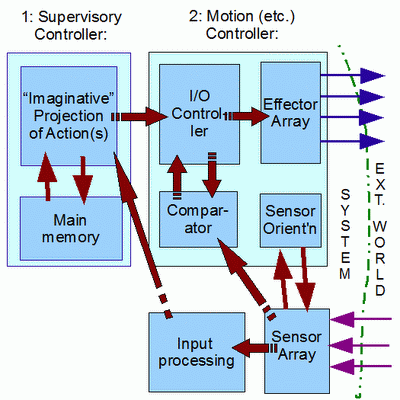
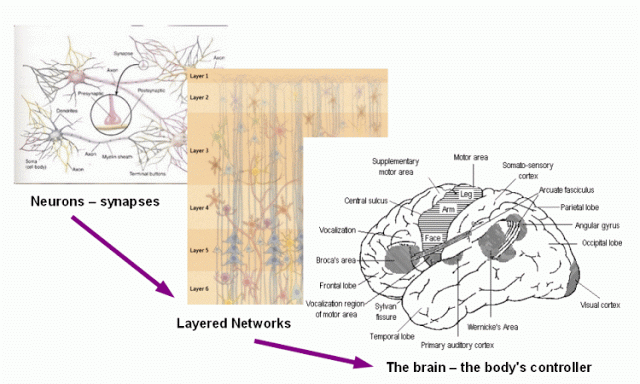
c: But human thought, clearly a phenomenon in the universe, must now fit into this [a priori evolutionary materialistic] meat-machine picture. So, we rapidly arrive at Crick’s claim in his The Astonishing Hypothesis (1994): what we subjectively experience as “thoughts,” “reasoning” and “conclusions” can only be understood materialistically as the unintended by-products of the blind natural forces which cause and control the electro-chemical events going on in neural networks in our brains that (asthe Smith Modelillustrates) serve as cybernetic controllers for our bodies.
The Derek Smith two-tier controller cybernetic model
d: These underlying driving forces are viewed as being ultimately physical, but are taken to be partly mediated through a complex pattern of genetic inheritance shaped by forces of selection [[“nature”] and psycho-social conditioning [[“nurture”], within the framework of human culture [[i.e. socio-cultural conditioning and resulting/associated relativism]. And, remember, the focal issue to such minds — notice, this is a conceptual analysis made and believed by the materialists! — is the physical causal chains in a control loop, not the internalised “mouth-noises” that may somehow sit on them and come along for the ride.
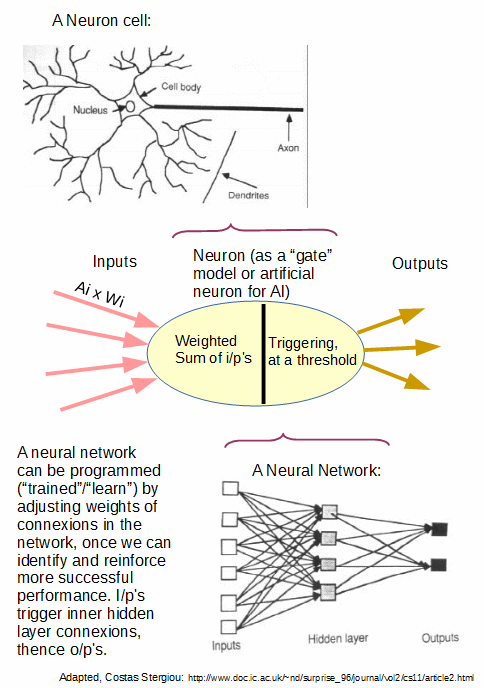
A neural network is essentially a weighted sum interconnected gate array, it is not an exception to the GIGO principle
(Save, insofar as such “mouth noises” somehow associate with or become embedded as physically instantiated signals or maybe codes in such a loop. [[How signals, languages and codes originate and function in systems in our observation of such origin — i.e by design — tends to be pushed to the back-burner and conveniently forgotten. So does the point that a signal or code takes its significance precisely from being an intelligently focused on, observed or chosen and significant alternative from a range of possibilities that then can guide decisive action.])
e: For instance, Marxists commonly derided opponents for their “bourgeois class conditioning” — but what of the effect of their own class origins? Freudians frequently dismissed qualms about their loosening of moral restraints by alluding to the impact of strict potty training on their “up-tight” critics — but doesn’t this cut both ways? Should we not ask a Behaviourist whether s/he is little more than yet another operantly conditioned rat trapped in the cosmic maze? And — as we saw above — would the writings of a Crick be any more than the firing of neurons in networks in his own brain?
f: For further instance, we may take the favourite whipping-boy of materialists: religion. Notoriously, they often hold that belief in God is not merely cognitive, conceptual error, but delusion. Borderline lunacy, in short. But, if such a patent “delusion” is so utterly widespread, even among the highly educated, then it “must” — by the principles of evolution — somehow be adaptive to survival, whether in nature or in society. And so, this would be a major illustration of the unreliability of our conceptual reasoning ability, on the assumption of evolutionary materialism.
g: Turning the materialist dismissal of theism around, evolutionary materialism itself would be in the same leaky boat. For, the sauce for the goose is notoriously just as good a sauce for the gander, too.
h: That is, on its own premises [and following Dawkins in A Devil’s Chaplain, 2004, p. 46], the cause of the belief system of evolutionary materialism, “must” also be reducible to forces of blind chance and mechanical necessity that are sufficiently adaptive to spread this “meme” in populations of jumped- up apes from the savannahs of East Africa scrambling for survival in a Malthusian world of struggle for existence. Reppert brings the underlying point sharply home, in commenting on the “internalised mouth-noise signalsriding on the physical cause-effect chain in a cybernetic loop” view:
. . . let us suppose that brain state A, which is token identical to the thought that all men are mortal, and brain state B, which is token identical to the thought that Socrates is a man, together cause the belief that Socrates is mortal. It isn’t enough for rational inference that these events be those beliefs, it is also necessary that the causal transaction be in virtue of the content of those thoughts . . . [[But] if naturalism is true, then the propositional content is irrelevant to the causal transaction that produces the conclusion, and [[so] we do not have a case of rational inference. In rational inference, as Lewis puts it, one thought causes another thought not by being, but by being seen to be, the ground for it. But causal transactions in the brain occur in virtue of the brain’s being in a particular type of state that is relevant to physical causal transactions. [[Emphases added. Also cf. Reppert’s summary of Barefoot’s argument here.]
AS comments:
AS, 189: KF writes:
…to blanket-dismiss the experience of millions across the world and across the ages of life-transforming encounter with the living God, is tantamount to implying general delusion of the human mind.
Well, “delusion” is a bit strong, but, yes, I do think people who believe that the various gods exist are mistaken. But I don’t think belief in something that is not true is per se a terrible thing. It is only when religion is used as an excuse to attack the out-group, be they infidels, women, gays and so on, that it becomes something that must be opposed.
Of course, we have just come off a century where ideologies of irreligion, atheism, materialism, scientific racism or class-ism, amorality disguising itself under the label of advancing novel rights and rescue for favoured groups [= the essence of fascism] and the like, secularism and evolutionism were used as a key part of agendas that murdered well over 100 millions, just inside states. Names such as Stalin, Pol Pot, Mao, or even Hitler (who definitively was NOT a Christian, pace too many atheistical online rants), are not to be found in the generally acknowledged lists of religious leaders. Nor is such exactly news, Plato long since warned 2350 years ago, speaking in the voice of the Athenian Stranger in The Laws bk X:
Ath. . . .[The avant garde philosophers and poets, c. 360 BC] say that fire and water, and earth and air [i.e the classical “material” elements of the cosmos], all exist by nature and chance, and none of them by art . . . [such that] all that is in the heaven, as well as animals and all plants, and all the seasons come from these elements, not by the action of mind, as they say, or of any God, or from art, but as I was saying, by nature and chance only [ –> that is, evolutionary materialism is ancient and would trace all things to blind chance and mechanical necessity] . . . . [Thus, they hold] that the principles of justice have no existence at all in nature, but that mankind are always disputing about them and altering them; and that the alterations which are made by art and by law have no basis in nature, but are of authority for the moment and at the time at which they are made.- [ –> Relativism, too, is not new; complete with its radical amorality rooted in a worldview that has no foundational IS that can ground OUGHT.] These, my friends, are the sayings of wise men, poets and prose writers, which find a way into the minds of youth. They are told by them that the highest right is might [ –> Evolutionary materialism — having no IS that can properly ground OUGHT — leads to the promotion of amorality on which the only basis for “OUGHT” is seen to be might (and manipulation: might in “spin”)], and in this way the young fall into impieties, under the idea that the Gods are not such as the law bids them imagine; and hence arise factions [ –> Evolutionary materialism-motivated amorality “naturally” leads to continual contentions and power struggles influenced by that amorality], these philosophers inviting them to lead a true life according to nature, that is, to live in real dominion over others [ –> such amoral factions, if they gain power, “naturally” tend towards ruthless abuse], and not in legal subjection to them.
But, the core issue needed some elaboration. So, at 207, I pointed to ontological and linked issues. This, I believe, should be headlined for record:
I have long since suggested that we start with the foundations of worldviews and then overnight, that we focus on a pivotal issue, root of being in a necessary being and of what character. Cf here for an outline i/l/o modes of being and ontology:
https://uncommondescent.com…..eat-being
I must assume that you have not simply ignored a linked discussion, in haste to drum out talking points in disregard of there being another side to the story.
If you all are unable to recognise this as addressing a body of evidence on the general approaches of inference to best explanation, comparative difficulties and particularly grand sense-making, in light of evidence accessible to all who would inquire, then it shows logical, epistemological and broader philosophical impoverishment.
Which, is unsurprising.
Let me do a basic outline of key points:
1: A world, patently exists.
2: Nothing, denotes just that, non-being.
3: A genuine nothing, can have no causal capacity.
4: If ever there were an utter nothing, that is exactly what would forever obtain.
5: But, per 1, we and a world exist, so there was always something.
6: This raises the issue of modes of being, first possible vs impossible.
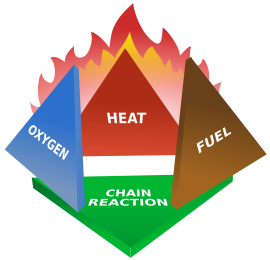
7: A possible being would exist if a relevant state of affairs were realised, e.g. heat + fuel + oxidiser + chain rxn –> fire (a causal process, showing fire to depend on external enabling factors)
8: An impossible being such as a square circle has contradictory core characteristics and cannot be in any possible world. (Worlds being patently possible as one is actual.)
9: Of possible beings, we see contingent ones, e.g. fires. This also highlights that if something begins, there are circumstances under which it may not be, and so, it is contingent and is caused as the fire illustrates.
10: Our observed cosmos had a beginning and is caused. This implies a deeper root of being, as necessarily, something always was.
11: Another possible mode of being is a necessary being. To see such, consider a candidate being that has no dependence on external, on/off enabling factors.
12: Such (if actual) has no beginning and cannot end, it is either impossible or actual and would exist in any possible world. For instance, a square circle is impossible,
One and the same object cannot be circular and square in the same sense and place at the same time
. . . but there is no possible world in which twoness does not exist.
13: To see such, begin with the set that collects nothing and proceed:
{ } –> 0
{0} –> 1
{0, 1} –> 2
Etc.
14: We thus see on analysis of being, that we have possible vs impossible and of possible beings, contingent vs necessary.
15: Also, that of serious candidate necessary beings, they will either be impossible or actual in any possible world. That’s the only way they can be, they have to be in the [world-]substructure in some way so that once a world can exist they are there necessarily.
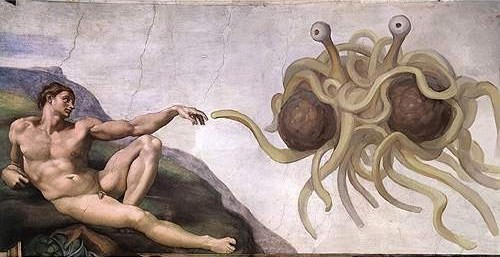
16: Something like a flying spaghetti monster or the like, is contingent [here, not least as composed of parts and materials], and is not a serious candidate. (Cf also the discussions in the linked thread for other parodies and why they fail.)
Public domainFlying Spaghetti Monster Creation of Adam
17: By contrast, God is a serious candidate necessary being, The Eternal Root of being. Where, a necessary being root of reality is the best class of candidates to always have been.
18: The choice, as discussed in the already linked, is between God as impossible or as actual. Where, there is no good reason to see God as impossible, or not a serious candidate to be a necessary being, or to be contingent, etc.
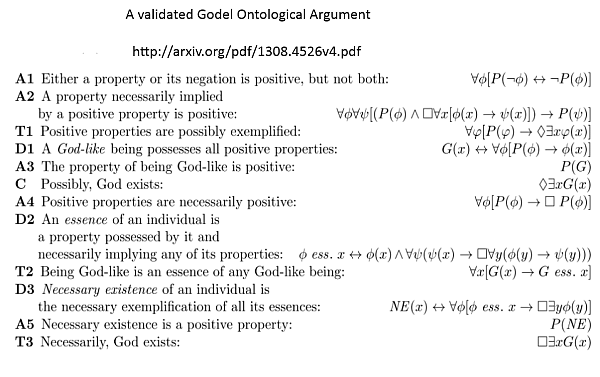
19: So, to deny God is to imply and to need to shoulder the burden of showing God impossible. [U/D April 4, 2015: We can for illustrative instance cf. a form of Godel’s argument, demonstrated to be valid:]
20: Moreover, we find ourselves under moral government, to be under OUGHT.
21: This, post the valid part of Hume’s guillotine argument (on pain of the absurdity of ultimate amorality and might/manipulation makes ‘right’) implies that there is a world foundational IS that properly bears the weight of OUGHT.
22: Across many centuries of debates, there is only one serious candidate: the inherently good, eternal creator God, a necessary and maximally great being worthy of loyalty, respect, service through doing the good and even worship.
23: Where in this course of argument, no recourse has been had to specifically religious experiences or testimony of same, or to religious traditions; we here have what has been called the God of the philosophers, with more than adequate reason to accept his reality such that it is not delusional or immature to be a theist or to adhere to ethical theism.
24: Where, ironically, we here see exposed, precisely the emotional appeal and hostility of too many who reject and dismiss the reality of God (and of our being under moral government) without adequate reason.
So, it would seem the shoe is rather on the other foot.
In the day since, there has been a tip-toe around. But, given that there has been a global challenge to the basic rationality of theists, rooted in a priori evolutionary materialist scientism, it is appropriate to headline this matter as a question on science, scientism, worldviews, cultural agendas and society. END
PS: Trollish conduct will not be tolerated. Comment at UD is a privilege on good behaviour — basic civility and what in my neck of the woods is termed broughtupcy; especially in a world where there are any number of soap boxes out there and a blog can be set up in fifteen minutes at no cost. Abuse of privilege will lead to forfeit.
PPS: It seems some notes on first rules of right reason are required:
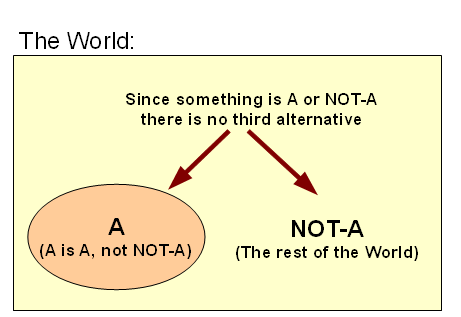
Here we see a bright red ball on a table, marking a world partition {A | NOT_A }.
From this we can generalise to see the force of first principles of right reason:
That is, the world partition pivoting on our ball or any entity having a distinct identity immediately imposes that A is A, A is not also at the same time and in the same sense NOT_A, and that anything will either be A or not A but not both or neither. This directly applies to for instance what happens when we try to communicate. As noted in comment 98 below to P:
. . . you object using a definite, structured language based on distinct sounds and using text that is based on distinct symbols. That is already pregnant with implications that decisively undermine your argument (i.e. WJM is right). Let me go to an often neglected classical source, Paul of Tarsus, speaking to requisites of articulate, intelligible language and implications thereof:
1 Cor 14:7 If even inanimate musical instruments, such as the flute or the harp, do not give distinct notes, how will anyone [listening] know or understand what is played? 8 And if the war bugle gives an uncertain (indistinct) call, who will prepare for battle?
9 Just so it is with you; if you in the [unknown] tongue speak words that are not intelligible, how will anyone understand what you are saying? For you will be talking into empty space!
10 There are, I suppose, all these many [to us unknown] tongues in the world [somewhere], and none is destitute of [its own power of] expression and meaning. 11 But if I do not know the force and significance of the speech (language), I shall seem to be a foreigner to the one who speaks [to me], and the speaker who addresses [me] will seem a foreigner to me. [AMP]
In short, the very project of communication in symbolic language or music depends on and manifests the self evident nature of distinct identity, linked contrast and associated dichotomy. A is A (let’s use the bright red ball sitting on a table case in point I have used here at UD for years . . . I will append to OP for reference) directly distinguishes itself via a dichotomising world partition:
{ A | ~ A }
As immediately present corollaries of distinct identity (LOI), we have LNC, that A AND ~A cannot hold of the same thing and sense, and also excluded middle (LEM) by virtue of partition: A X-OR ~ A.
These are first, self evident truths that we must imply or acknowledge just in order to communicate.
So, my first, foremost point, is that it is thereafter useless to seek to dismiss the reality and presence of foundational, self evident truths.
To try to protest such is to hopelessly depend on them, it is absurd. Manifestly absurd.
The case you attempt to make collapses with literally the first word of your own, in comment no 83:
{Y | ~Y} + {o | ~o} + {u | ~u}
Comments
AS
Yet where is the evidence, other than ...
Other than the evidence given already ... I think it would be good for you to investigate the evidence provided first.
Do you consider “Conversations with God” evidence of Walsch’s deity?
You've provided one of very many sources of testimonial evidence. As above, it's important to investigate the best evidence offered -- look to what theologians and what the best theistic scholars point to as testimonial evidence.
You've also wondered why there are different conceptions of God, but evidence can be interpreted differently (as scientific evidence is). But you can notice commonalities among those who assert that God exists. You'd be looking for that - evidence for a supernatural agency meeting the general definition of God. Plato and Aristotle offer evidence and support for the belief in God. The Hebrew scriptures are theological testimonial support. Hindu belief in Brahman is very similar.
So, there's a lot to investigate and it wouldn't make sense to dismiss all testimonial evidence without looking into it.
I have my own additional supports of evidence, which work for some people and not others ... but I'll mention anyway:
Some public miracles like the Tilma of Guadalupe, or the Fatima miracle of the sun are powerful, in my view. Some european scientists pointed to the Shroud of Turin as giving evidence of the supernatural.
I'm also interested in excorcism. This is sensationalized and ridiculed at times - but I think a movie like "The Exorcism of Emily Rose" is challenging. The book "The Rite" (I haven't seen the movie yet) is another good one. "An Exorcist tells his story" by Gabriel Amorth offers excellent evidence, as I see it.
I think also the life of Padre Pio of Pietrelcina offers very good testimonial (and photographic) evidence.
Anyway, there's a lot more than merely one person's claim to have conversations with God. Although, the fact that someone claims that is, in fact, evidence - however strong or weak it may be.Silver Asiatic
April 4, 2015
April
04
Apr
4
04
2015
09:25 AM
9
09
25
AM
PDT
AS
For brevity, I don’t preface all the sentences in which I express a personal view with the phrase “it is my personal view that…”. As to whether truth exists; that would depend what the word means to the person discussing it. Hence the question: “what is truth?” I happen to think there is an objective reality in which we all live but how good our perception and interpretation of that reality is is open to question.
Again, you're using a referencing a truth-value in your commentary.
"It is my personal view" - is a positive declarative statement asserting that something is true. In order to discuss anything with you, I accept that your assertion of a truth is valid. Otherwise, I'd have to question everything you say.
So, the choice is yours. Would you be willing to say:
"I can never speak the truth about anything."?
Of course, that statement is paradoxical - because it requires that the truth exists in order for you to make that positive affirmation.
You are clearly using truth values, and assuming that the truth exists. To make your arguments, you rely on truth. Even making the argument "We can't know reality", relies on the existence of a true understanding.
Skepticism about what the truth is, really doesn't work. Because in order to question something, you have to do it from some vantage point. You stand on some foundation - observe things, and then question. But if you question the foundation you're standing on, then you can't even be skeptical or raise any questions.
That's the problem with scientism. It claims science is the only means of arriving at the truth, but we couldn't make that statement on scientific terms alone.Silver Asiatic
April 4, 2015
April
04
Apr
4
04
2015
09:07 AM
9
09
07
AM
PDT
AS:
such evidence has been provided, literally a world's worth. You have spent days dancing around the fact of that evidence and its import in light of ontological and moral reflection upon it.
And, we were not born yesterday. We full well understand what things like:
AS: I think religions have an emotional appeal that some people are more susceptible to than others. For those that succumb to that emotional need, evidence is superfluous. Those that lack that need aren’t swayed by testimony. Whether they might be impressed by evidence other than testimony is yet to be tested.
. . . mean, above and beyond being merely mistaken.
You have indicted millions.
This thread is a response and an invitation to you to substantiate your assertions, loaded words and suggestions thereby.
To date you have been unable to provide a cogent response on substance.
Duly noted.
KFkairosfocus
April 4, 2015
April
04
Apr
4
04
2015
08:37 AM
8
08
37
AM
PDT
AS: This thread is about a particular assertion you have made, which attempts to dismiss millions as emotional basket cases clinging to an imaginary crutch. To date, after over a week, it is showing that you cannot back it up, other than by selectively hyperskeptical dismissiveness, drumbeat repetition, and side-tracks. Out of simple fairness, you should withdraw the statement and do some serious re-thinking. KFkairosfocus
April 4, 2015
April
04
Apr
4
04
2015
08:07 AM
8
08
07
AM
PDT
AS, kindly cf the just above, and all the way back to the OP. You may think and doubtless will announce to some mutual echo-chamber how you showed that those silly theists have no evidence apart from easily dismissed "testimonials." All that such would show is that which is sadly already evident above: you have crossed the line into speaking with disregard to truth in hopes that what you have said or suggested will be taken as true. Please, think again, on what you are doing. KFkairosfocus
April 4, 2015
April
04
Apr
4
04
2015
07:28 AM
7
07
28
AM
PDT
F/N: Does someone like Rosenberg in Ch 9 of his 2011 The Atheist's guide to Reality [sic] recognise the self-referential incoherence and self-refutation by appeal to general delusion in:
>> FOR SOLID EVOLUTIONARY REASONS, WE’VE BEEN tricked into looking at life from the inside. Without scientism, we look at life from the inside, from the first-person POV (OMG, you don’t know what a POV is?—a “point of view”). The first person is the subject, the audience, the viewer of subjective experience, the self in the mind.
Scientism shows that the first-person POV is an illusion. Even after scientism convinces us, we’ll continue to stick with the first person. But at least we’ll know that it’s another illusion of introspection and we’ll stop taking it seriously. We’ll give up all the answers to the persistent questions about free will, the self, the soul, and the meaning of life that the illusion generates.
The physical facts fix all the facts. The mind is the brain. It has to be physical and it can’t be anything else, since thinking, feeling, and perceiving are physical process—in particular, input/output processes—going on in the brain. We can be sure of a great deal about how the brain works because the physical facts fix all the facts about the brain. The fact that the mind is the brain guarantees that there is no free will. It rules out any purposes or designs organizing our actions or our lives. It excludes the very possibility of enduring persons, selves, or souls that exist after death or for that matter while we live. [W W Norton, 2011] >>
We need to understand the underlying mindset we are dealing with, and how it falls apart.
KF
PS: As long since pointed out, yes testimony is evidence and reasonably credible testimony and record (sometimes called observation) are vital to history, jurisprudence, affairs of life and even science. Going beyond, the universal pretty near experience of being morally governed is evidence, as is the existence of a flame and the conditions under which it can/cannot begin or be sustained. Likewise, the existence of things with distinct identity is evidence, as is that of a whole world in which we live as morally governed beings. Where, reasoned argument that summarises and refers to such then draws forth inferences on canons of reasoning presents the relevant facts, experiences and record as evidence relative to its reasonable import. But then, there is none so blind as he who refuses to put the eyepiece of the 'scope to his eyes. As, the above so repeatedly demonstrates.kairosfocus
April 4, 2015
April
04
Apr
4
04
2015
07:23 AM
7
07
23
AM
PDT
AS said:
There is testimony and there are assertions – but no evidence.
Testimony is evidence, by definition. There is also the scientific fine-tuning evidence, and the logical arguments which have been made, which also counts as evidence. However, this has been pointed out to you. Your "there is no evidence" denial mantra only exposes your own hyperskeptical bias against anything indicating theism.William J Murray
April 4, 2015
April
04
Apr
4
04
2015
06:53 AM
6
06
53
AM
PDT
AS:
Pardon but the infinite regress of affirmations that states of affairs obtain is showing:
For brevity, I don’t preface all the sentences in which I express a personal view with the phrase “it is my personal view that…”.
The English language is knocking on your door and trying to tell you something.
Likewise, truth:
As to whether truth exists; that would depend what the word means to the person discussing it.
Nope, you here conflate opinion with truth; fairly common in a radically relativist frame of thought. There is already a perfectly good word for what one holds or accepts as true: BELIEF.
Ah, but then people caught up in selective hyperskepticism usually target beliefs they are disinclined to accept (while exerting demands for standard of warrant that cannot be consistently applied) as being blind and without possibility of grounds to the point that they dismiss "faith" as utterly irrational or delusional. (Which of course from your fulminations above and elsewhere, is true for you).
I suggest to you that there is a perfectly simple solution: truth says of what is that it is, and of what is not that it is not. As Ari said in Metaphysics 1011b 2300+ years ago. On this, we may have opinions or beliefs with varying degrees of warrant, but on many points we may be in error, failing to attain truth. However certain truths are self evident and easily understood to be certain, e.g. that error exists.
So, we have epistemic duties of care to seek truth and warrant things we claim are true and/or are knowledge. Where, given the inherent dignity of and manifest moral duties towards other people, there is a further duty of care of fairness.
I suggest to you, that these you are failing, especially in your broad-brush dismissal of "religion."
And, in the OP and again in the discussion above, a reasonable basis -- backed up by a world of evidence -- as to why ethical theism is a reasonable worldview over and against evolutionary materialist scientism and similar forms of atheism and/or hyperskeptical agnosticism, has been presented.
For over a week, you have repeatedly ducked addressing it cogently and squarely on the merits.
That speaks volumes, not in your favour.
KFkairosfocus
April 4, 2015
April
04
Apr
4
04
2015
04:48 AM
4
04
48
AM
PDT
Aurelio Smith:
As I’ve remarked before, if you are inclined to religious ideas, you don’t need evidence. I’m happy to leave it there.
As I’ve remarked before, if you are inclined to non-religious ideas, you don’t need evidence. I’m happy to leave it there.Mung
April 3, 2015
April
04
Apr
3
03
2015
09:51 PM
9
09
51
PM
PDT
kf, it's not likely you will ever get the recognition you deserve, but keep up the good fight.
God BlessMung
April 3, 2015
April
04
Apr
3
03
2015
07:55 PM
7
07
55
PM
PDT
Popperian, again by the mere act of typing a response you affirm your dependence on the prior foundation of distinct identity. In addition, this continues as you assert X is the case, Y is not the case and so forth. You implicitly depend on what you would dismiss in order to argue. And meanwhile it has not escaped our notice that you are far out on a tangent away from the focal issue for the thread. Which is not so co-incidentally the case. The utter unresponsiveness to (a) the issue of being vs non-being, need for root being adequate to account for a world of reasoning morally governed persons, and (b) to the issue that had there ever been utter nothing such would forever obtain so there was always something, something best understood as unconditioned being, is therefore revealing. KFkairosfocus
April 3, 2015
April
04
Apr
3
03
2015
02:09 PM
2
02
09
PM
PDT
"I’m interested in what other people find convincing as explanations of why what is is, but I’m more concerned that discussion of why what is is is a free and open discussion."
So you've made strong rational objections to science texts and other materialist dogmas that begin with statements like:
"No serious scientist questions [insert materialist position here], etc"
Right? You've got as long a history of arguing with those people as you have here?
And being a fan of evidence,, you have evidence for this, right?ScuzzaMan
April 3, 2015
April
04
Apr
3
03
2015
02:07 PM
2
02
07
PM
PDT
KF: Popperian, as soon as you type a word you are basing your steps on distinct identity thus the first principles of right reason. As soon as you argue, you are appealing to logic.
And, yet, the very things you described are also compatible with a non-foundational epistemology. You might not subscribe to it, and therefore deem it absurd, but all I have to do is point out that such an epistemology exists. Epistemologies are explanations about how the world works, which are subject to criticism.
Furthermore, we have to work with words that are ultimately undefined, but that doesn't mean we can't use them to solve problems. IOW, I'm using a different approach, which is to start out with a problem to solve.
On the other hand, you're trying to define words for the sake of defining them, which doesn't actually solve problems. That's a key difference between us. In the same sense, I've adopted the law of non-contridiciton because it allows us to solve problems, not because it's some kind of foundation that I must accept uncritically.Popperian
April 3, 2015
April
04
Apr
3
03
2015
01:44 PM
1
01
44
PM
PDT
AS
What is truth?
I'll just echo KF - that's a great question to ask today on Good Friday.
How can we be certain of anything? We can observe and measure the world around us and formulate hypotheses that make predictions that we can test.
You expressed absolute certainty several times in the above words. You're building your entire worldview on the certainty that truth exists. When you ask a question, you're asserting that the truth does exist.
How can we be certain of anything? You asked that. You also provided an answer. But you asserted that the truth exists.
A. We can be certain
B. We can't be certain
C. We don't know
You chose B as the True answer. If there was no truth, then all three statements would be equal.
We pragmatists can be content and live with those tentative conclusions about how the universe and everything in it really is.
You identify yourself as a pragmatist. You are asserting, indirectly, that you're saying something True. You're expecting me to believe it is true. You then describe what pragmatists do - again, all based on the existence of Truth.
If truth did not exist - you might be a pragmatist, or you might believe in God, or you might not know what any of the words mean.
"Pragmatists are content to live with tentative conclusions" Equals "Pragmatists are not content to live with tentative conclusions" in terms of Truth value because there would be no truth.
And you idealists can carry on believing the world is as you wish it to be.
As I said, you're carrying on asserting that some things are true, perhaps because you wish the truth to exist.
You are not carrying on as if the truth does not exist.
If you did that, you'd be consistent. But you'd also be irrational and impossible to discuss anything with.
You could try to argue under the basis that "nothing is true" but then, what a theist would call "a lie" would not be any different than what a theist would call "the truth" for you.
I’m carrying on campaigning for everyone to think their own thoughts without let or hindrance, though I encourage everyone to poke, prod and test their ideas against reality.
If you assert that there is no truth, then you can't state that you are campaigning that everyone think their own thoughts -- because that statement would be meaningless.
The fact that Truth and Falsehood exist means that there are limitations on our thoughts.
If you fight against those limitations, by saying "nothing is true" -- then you can no longer have any rational thoughts. You would basically be insane and totally incoherent.Silver Asiatic
April 3, 2015
April
04
Apr
3
03
2015
11:27 AM
11
11
27
AM
PDT
WJM #128:
Thank you very much!
Therefore, if logic is not assumed to be a causally independent, authoritative arbiter of true statements, there’s no reason to apply it.
Box
April 3, 2015
April
04
Apr
3
03
2015
11:05 AM
11
11
05
AM
PDT
AS said:
Well it seems to me there are no certainties and the only way to proceed is pragmatically.
Pragmatically speaking, we all behave as if morality refers to an objective commodity anyway; we all behave and argue as if we and others have libertarian free will anyway; we all argue as if logic is an uncaused, authoritative arbiter of true statements anyway; we all behave as if truth exists and matters very much anyway.
The real question is why hold to atheism and/or agnosticism when theism is the only pragmatic explanation for such behavior.William J Murray
April 3, 2015
April
04
Apr
3
03
2015
11:00 AM
11
11
00
AM
PDT
AS said:
You use the word “evidence” as if some has been presented, or perhaps you have some that you haven’t mentioned yet. I’m not having an argument about what anyone should or shouldn’t believe. I am advocating a society where people can believe what they wish, without interference. I merely question these assertions about evidence, other than personal or reported testimony, that keep popping up. KF particularly appears to be certain about his version of God but manages at the same time to be utterly unconvincing.
This has already been addressed explicitly. In #52, I said:
The logical arguments (such as KF has presented) for god are not “testimonial” in nature, AS. The fine-tuning evidence is not “testimonial” in nature. The moral argument for god is not “testimonial” in nature. Yet you keep insisting that the only thing that has been presented is “testimonial” in nature, and that’s simply not true.
AS responded, in #62:
But an argument is not evidence of anything.
In #68, I provided two standard definitions for "evidence" which any reasonable person admits includes logical arguments:
Wikipedia says: "Evidence, broadly construed, is anything presented in support of an assertion." The Free Dictionary says: A thing or set of things helpful in forming a conclusion or judgment.
I also pointed out that the Fine-Tuning evidence is a collection of scientific facts which are employed as evidence in favor of a creator god that fine-tuned the universe for life.
AS responded:
“Fine-tuning” is an interpretation of facts we observe about the universe that is visible to us. It is an argument and not a convincing one, in my view. It suffers from the same flaw (which god?) as the Ontological argument.
I pointed out that this is what all scientific evidence is, a collection of facts interpreted in light of a theory or postulate. Facts are argued to support this theory or that theory, and are argued to support one better than another. Facts do not, and cannot, "speak for themselves"; they must be interpreted in order to become evidence, and an argument (hopefully a logical one) must be employed to explain the fit of the facts into the competing interpretive models.
However, AS keeps on reiterating his preferred meme here because he summarily(and idiosyncratically, according to definitions of "evidence") dismisses all non-testimonial argument and evidence as "non-evidence".
So, we have in this thread described scientific evidence for god; logical argument evidence for god, and testimonial evidence for a god of some sort, at least embodying certain necessary, classical-theism characteristics and the capacity to create and fine-tune our universe.William J Murray
April 3, 2015
April
04
Apr
3
03
2015
10:48 AM
10
10
48
AM
PDT
AS:
What is truth?
Today is an ironically apt day to pose this cynical question, as procurator Pilate proverbially asked it of Jesus "and stayed not for an answer."
Truth, very simply -- and following Aristotle in Metaphysics 1011b who nailed it -- is to say of what is, that it is; and, of what is not, that it is not.
As to how can we be certain of anything, this is -- given just above -- a case of your not staying for the answer.
Something like Error exists, is self evidently true and undeniably certain. As stated just up:
It would be wiser, methinks, to accept E = Error exists, i.e. the set that collects errors is necessarily non-empty. For simple instance to assert ~E means it is an error to affirm E. Thus E is undeniably, self-evidently true and instantiates truth as accurate affirmation of reality, warranted and justified credible truth accepted and believed i.e. known, to undeniable certainty.
Therefore schemes of thought, reasoning or worldviews that deny or imply denial of such, collapse.
Including, radical pragmatism.
(where of course that one certain truth is that error exists gives us a reason to be cautious and open minded regarding truth-claims. Though beyond the self-evident, many things are morally certain and no reasonable person would seriously doubt such though s/he could not demonstrate beyond dispute.)
Perhaps -- given that good testimony and adequate record can easily attain to moral certainty, you would be well advised to take a look at the vid here,
https://vimeo.com/17960119
which is particularly appropriate today.
KF
PS: Dictionary at law.com:
moral certainty
n. in a criminal trial, the reasonable belief (but falling short of absolute certainty) of the trier of the fact (jury or judge sitting without a jury) that the evidence shows the defendant is guilty. Moral certainty is another way of saying "beyond a reasonable doubt." Since there is no exact measure of certainty it is always somewhat subjective and based on "reasonable" opinions of judge and/or jury.
--> this shows how important this concept is for not only jurisprudence but many other serious decision-making and action contexts where irrational indecision or selective hyperskepticism would be ruinous.kairosfocus
April 3, 2015
April
04
Apr
3
03
2015
10:21 AM
10
10
21
AM
PDT
AS:
I simply have to highlight this one, 134:
it seems to me there are no certainties
So, are you certain that it seems to you there are no certainties, or is that just another "seeming" as you slide off in an infinite regress?
Ending, in absurdity.
It would be wiser, methinks, to accept E = Error exists, i.e. the set that collects errors is necessarily non-empty. For simple instance to assert ~E means it is an error to affirm E. Thus E is undeniably, self-evidently true and instantiates truth as accurate affirmation of reality, warranted and justified credible truth accepted and believed i.e. known, to undeniable certainty.
Therefore schemes of thought, reasoning or worldviews that deny or imply denial of such, collapse.
Including, radical pragmatism.
(where of course that one certain truth is that error exists gives us a reason to be cautious and open minded regarding truth-claims. Though beyond the self-evident, many things are morally certain and no reasonable person would seriously doubt such though s/he could not demonstrate beyond dispute.)
KFkairosfocus
April 3, 2015
April
04
Apr
3
03
2015
08:46 AM
8
08
46
AM
PDT
AS
Well it seems to me there are no certainties and the only way to proceed is pragmatically.
There are no certainties. Nothing is true.Silver Asiatic
April 3, 2015
April
04
Apr
3
03
2015
08:33 AM
8
08
33
AM
PDT
AS:
To date, regrettably, you have given no sign of being able to acknowledge well-founded correction on your mistaken concepts and views of evidence.
You have shown no reason to believe you have risen beyond snip-snipe to even actually read what you dismiss. And to date you have had no cogent response, in a context where you have made the most grave and even sneeringly dismissive assertions regarding the rationality of others; millions of others.
Sorry to have to say, but at this stage you give all the signs of a fallacy I long since highlighted in discussing selective hyperskepticism:
[FALLACY OF THE CLOSED, TYPICALLY DEEPLY INDOCTRINATED MIND:] Stubbornly irrational, question-begging resistance to correction and/or alternative views. (Cf. a typical turnabout accusation on this, here.)
This fallacy manifests itself in a habitual pattern of thought, feelings and argument that is:
(a) question-beggingly committed to and/or
(b) indoctrinated into thinking in the circle of a particular view or position and/or
(c) blindly adherent to "the consensus" or vision and school of thought or paradigm of a particular set of authorities. [NB*: This last includes today's new Magisterium: "Science."]
As a result,
(d) the victim of closed-mindedness becomes unwarrantedly (i.e. fallaciously and often abusively) resistant to new or alternative ideas, information or correction . . .
That is, it is not a matter of mere disagreement that is at stake here, but of
(e) stubborn and objectively unjustified refusal to be corrected or to entertain or fairly discuss on the merits ideas or points of view outside of a favoured circle of thought.
In extreme cases,
(f) the closed minded person who has access to power or influence may engage in the willfully deceptive (and even demonic) practice of actively suppressing the inconvenient truth that s/he knows or should know.
(By contrast, a properly educated person is open-minded but critically aware: s/he is aware of the possibility and prevalence of error, and so (i) habitually investigates and then (ii) accurately, objectively and fairly describes major alternative views, fact claims and lines of argument on a topic, (iii) comparing them on congruence to his/her real-world experience and that of others s/he knows and respects, general factual correctness, logical coherence and degree of explanatory power; thus (iv) holds a personal view that results from such a process of comparative difficulties, while (v) recognising and respecting that on major matters of debate or controversy, different people will hold different views.)
Please, think again.
KFkairosfocus
April 3, 2015
April
04
Apr
3
03
2015
08:32 AM
8
08
32
AM
PDT
WJM
Just to highlight again ...
If you do not assume the law of non-contradiction, you have nothing to argue about. If you do not assume the principles of sound reason, you have nothing to argue with. If logic is not assumed to be a causally independent, authoritative arbiter of true statements, there’s no reason to apply it. If you do not assume libertarian free will, you have no one to argue against. If you do not assume morality to be an objective commodity, you have no reason to argue in the first place. If you do not assume mind is primary, there is no “you” to make any argument at all.
Beautifully stated - and irrefutable.Silver Asiatic
April 3, 2015
April
04
Apr
3
03
2015
08:29 AM
8
08
29
AM
PDT
Andre
How can we be charitable to such idiocy?
They seem intelligent enough to understand something - but then they say things that are totally idiotic. I don't know what the answer is.Silver Asiatic
April 3, 2015
April
04
Apr
3
03
2015
08:27 AM
8
08
27
AM
PDT
WJM (Attn Box): So useful in 128 that I have updated my citation as part of the lead-in to address worldviews, here. KFkairosfocus
April 3, 2015
April
04
Apr
3
03
2015
08:18 AM
8
08
18
AM
PDT
Andre asks:
How can we be charitable to such idiocy?
To help preserve a forum with civil discourse and to encourage such behavior from others by example? Even if some appear immune to reason and evidence, and even if we make essentially the same case over and over, you never know who is watching that may be open to the evidence and logical arguments we present.
I was one of those "lurkers" when I first found this place. The arguments presented here in a reasonable and charitable manner by several tireless, dedicated individuals had a great impact on my making the transition from hardcore atheist/materialist to intellectually satisfied theist.William J Murray
April 3, 2015
April
04
Apr
3
03
2015
07:49 AM
7
07
49
AM
PDT
These are the same people using reason to deny that any reason whatsoever exists for the existence of a universe and any life in it. How can we be charitable to such idiocy?Andre
April 3, 2015
April
04
Apr
3
03
2015
07:06 AM
7
07
06
AM
PDT
WJM @ 115
Popperian and others present “arguments” that make me seriously consider that some of us truly are Darwinian biological automatons, uttering programmed responses in reaction to certain keywords and phrases, with no “ghost in the machine” capable of separately reflecting upon the meaning of the content they receive or spew.
How else to explain, under the charity of a good faith reading, the things they say?
That's a different thought - interesting. I agree that we should extend the charity of accepting a good faith reading. So, not to say they're lying.
Your proposal is interesting because it would explain why the responses are scripted ... they're programmed in by stimuli. This actually prevents real thought or engagement with the issue. It's a triggered response - mechanistic, exactly what materialism would propose.
The contradiction between materialist determinism and how rationality actually works is necessarily ignored, because the irrational response to that question is already programmed-in by materialistic scientism.
The only other view I'd offer is that there is a kind of ignorance ... sometimes when we're less charitable we call it blindness.
Ignorance is not always the fault of the person who can't see their own illogical position (they're 'invincibly ignorant'). But it's hard to be sympathetic to someone who argues that they rely on science, logic and reason as the only sure means of truth, but that there is no real logic or truth anyway.
It is impossible to be invincibly ignorant of the first precepts of the natural law: Do good and avoid evil. Do not do to others what you would not wish them to do to you. You shall not kill, you shall not steal ... At least by the order of the world, the starry sky, and the whole creation, man can easily obtain a knowledge of the probability of the existence of God, supreme Ordainer and Legislator. When he has this probability, he must seek to become more enlightened and must ask for light; otherwise he is not in genuine good faith or in absolutely involuntary and invincible ignorance. -- Garrigou-Lagrange
It seems to me that some of our opponents just shut down the 'probability' mentioned above. Not only that, when confronted with an obvious contradiction between the claim that there is no logic and their own attempt to use logic (and build a foundation on logical points), there's something more than simple ignorance at work.
That's the way I see it anyway.Silver Asiatic
April 3, 2015
April
04
Apr
3
03
2015
06:57 AM
6
06
57
AM
PDT
Seversky said:
Even if we allow that people appear to act as if morality is an objective phenomenon, that doesn’t make it so.
It adds to the case that it is so, and detracts from the case that it is essentially subjective in nature.
A lot of people act as if their personal religious or philosophical or political beliefs are objective certainties. Those of us who know they’re wrong beg to differ.
Unfortunately, Seversky, you cannot ascertain them as "wrong" in their beliefs, nor can you refer to that view as "knowledge", without necessary reference to fundamental worldview first principles unavailable to non-theistic positions. You might have a materially-caused sensation that you "know" they are "wrong", but such a sensation cannot be of any more intrinsic validity than the sensations of those you disagree with.
IOW, without theistic first principles, your assessment of them as "wrong" and your characterizing the assessment as "knowledge" is incoherent.
And a/mat or nat/mat morality is a stronger form than divine command because it is something we have actually had to work out for ourselves.
You're not making any sense. In the first place, if a/mat or nat/mat is true, it equally produced as material facts the sensations (thoughts, convictions, feeling of knowledge and truth) of both Divine Command and "working it out for ourselves" subjective morality.
In what way would the subjective form be "stronger"? Islam, which is the world's leading and most pure form of Divine Command morality, appears to me to be "stronger" in the sense that it is growing by leaps and bounds, it forces conversion or puts you to death, it produces lots and lots of offspring. The adherents are also maniacally devoted to that worldview.
How on earth can you possibly consider, in any meaningful nat/mat or a/mat perspective, subjective morality "stronger" when essentially the only thing standing between you and them is an army almost fully comprised of either Divine Command or Natural Law theists?
We didn’t just wait submissively until some alleged authority figure told us what to do.
No, under your paradigm, you developed morality as happenstance chemical interactions dictated, same as them, under a/mat premises. Now the question is: which one is superior in terms of evolution, which is the only "right" vs "wrong" that matters under a/mat?
As for subjective morality inexorably leading back to immoral principles, I need hardly point out that throughout history, certainly including accounts in the Old Testament, divine command morality has been used to justify atrocious acts that would most certainly have been judged immoral in any other circumstances.
Have I not already agreed that Divine Command morality is just as bad as subjective morality? Neither offers a sound basis for a moral system.
The utility of logic or the laws of thought or of mathematics are not in dispute, but they are tools. They can be used for any number of purposes but they are still subject to GIGO. It is quite possible to construct perfectly valid logical arguments that are complete nonsense. Just because a conclusion is valid doesn’t necessarly mean it is true.
When several lines of logic and the evidence of our own behavior requires the premise that morality refers to an objective commodity (or else morality makes no sense), accepting that morality most likely refers to an objective commodity is an entirely rational and reasonable conclusion.
You respond by saying, "Well, it still might not be true." I agree. However, neither you nor I can live as if it is not true, so what purpose does believing it is not true serve, other than making one a hypocrite and preserving one's atheism/materialism?William J Murray
April 3, 2015
April
04
Apr
3
03
2015
06:53 AM
6
06
53
AM
PDT
William J Murray @ 124
velikovskys, besides the fact that all sane people act as if morality is objective anyway (first link), and besides the fact that morality is an empty concept under atheism/materialism/naturalism (second link), there is also the logical fact that there is no logically sustainable form of subjective morality that does not inexorably lead back to self-evidently immoral principles (might makes right, because I feel like it, because I can).
Even if we allow that people appear to act as if morality is an objective phenomenon, that doesn't make it so. A lot of people act as if their personal religious or philosophical or political beliefs are objective certainties. Those of us who know they're wrong beg to differ.
And a/mat or nat/mat morality is a stronger form than divine command because it is something we have actually had to work out for ourselves. We didn't just wait submissively until some alleged authority figure told us what to do.
As for subjective morality inexorably leading back to immoral principles, I need hardly point out that throughout history, certainly including accounts in the Old Testament, divine command morality has been used to justify atrocious acts that would most certainly have been judged immoral in any other circumstances.
The utility of logic or the laws of thought or of mathematics are not in dispute, but they are tools. They can be used for any number of purposes but they are still subject to GIGO. It is quite possible to construct perfectly valid logical arguments that are complete nonsense. Just because a conclusion is valid doesn't necessarly mean it is true.Seversky
April 3, 2015
April
04
Apr
3
03
2015
05:53 AM
5
05
53
AM
PDT
Box,
If you do not assume reason is independent of material causation, then a "rational conclusion" is nothing more than a sensation produced by happenstance, interacting molecules. If that is all a reasonable conclusion is - a sensation caused by interacting molecules - then all rational conclusions are equal because they are ultimately nothing more than the sensation product of an individual's particular molecular interactions.
If we accept this, there's no reason to argue on the basis of reason/logic; it would be like arguing that other people's favorite colorshould be the same as ours because we really like our favorite color. Calling such arguments "reason" or "logical" as if they are something other than simple expressions of personal sensations/feelings would be a farce.
Which is why I made the case in the 2nd link that both truth and reason are "stolen obligations" which do not apply to the atheist/materialist position; if reason is just a happenstance, physically produced sensation, then one might as well say "because I don't wanna" as to make a rational case, because that's all a logic-based argument amounts to under their paradigm.
Therefore, if logic is not assumed to be a causally independent, authoritative arbiter of true statements, there's no reason to apply it.
And so we have:
If you do not assume the law of non-contradiction, you have nothing to argue about. If you do not assume the principles of sound reason, you have nothing to argue with. If logic is not assumed to be a causally independent, authoritative arbiter of true statements, there’s no reason to apply it. If you do not assume libertarian free will, you have no one to argue against. If you do not assume morality to be an objective commodity, you have no reason to argue in the first place. If you do not assume mind is primary, there is no “you” to make any argument at all.William J Murray

 Public domain

AS, 189: KF writes:
Well, “delusion” is a bit strong, but, yes, I do think people who believe that the various gods exist are mistaken. But I don’t think belief in something that is not true is per se a terrible thing. It is only when religion is used as an excuse to attack the out-group, be they infidels, women, gays and so on, that it becomes something that must be opposed.