Uncommon Descent Serving The Intelligent Design Community
Year

2011

Michael Behe’s Darwin’s Black Box #1 in list of 10 books that screwed up the world

Here at Listverse. Also rans include Mein Kampf (7) and the The Manifesto of the Communist Party (3) The author’s thesis is: On the list because: It fuels fundamentalist attacks on Science By arguing against aspects of Darwin’s theories, this book has given fuel to the fundamentalists who argue that a literal interpretation of the Book of Genesis is the only possible manner in which the earth was created. Despite much refutation from the Scientific community, many fundamentalists still use this as a “source” for proof that evolution is not true. The book itself was not peer reviewed as Behe claimed under oath, and the Science community has overwhelming rejected it. It should be noted that Behe himself is not Read More ›

He said it: PZM on the tolerance of evolutionary materialist atheists

Since it is liable otherwise to be lost in the flood of distractive tangential comments,  I here headline my markup of PZM’s recent remarks on Dr Jonathan Wells.

Pardon some fairly direct comments, but unless we specifically expose capital examples of what we are objecting to, the destructive misbehaviour will continue:

[“They said it: Judge Jones of Dover …” is here. – UD News]

Read More ›

Do atheists or religious people have better sex lives – or chimpanzees?

"I thought you ..."

Darrel Ray thinks that atheists have better sex lives, citing his study to prove it:

But devoutly religious people rated their sex lives far lower than atheists. They also admitted to strong feelings of guilt afterwards.

Strict religions such as Mormons ranked highest on the scale of sexual guilt. Their average score was 8.19 out of 10. They were followed closely behind by Jehovah’s Witness, Pentecostal, Seventh Day Adventist, and Baptist.

Catholics rated their levels of sexual guilt at 6.34 while Lutherans came slightly lower at 5.88 . In contrast, atheists and agnostics ranked at 4.71 and 4.81 respectively.

It’s quite true that devoutly religious people feel bad if they do something they think is bad. Some sources are more unsettled by people who aren’t like that.

Ray is best known as the discoverer of the God virus.

On the other hand, Read More ›

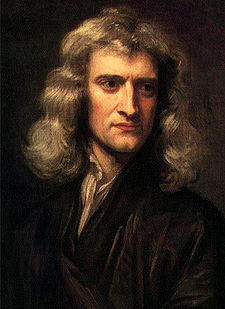
GodfreyKneller-IsaacNewton-1689
Sir Isaac Newton
Public domain

They said it: NCSE/Judge Jones of Dover and Wikipedia vs. Newton in Opticks, Query 31, on methodological naturalism and science

Public domain
Sir Isaac Newton

In further addressing the now commonly promoted idea that methodological naturalism is an innocent, “natural” part of the definition of science that properly keeps out those who wish to smuggle in “the supernatural” where it does not belong, I have had occasion to add an appendix to the recent June 17 post promoting Nancy Pearcey’s 2005 sleeper article on Christianity as a science starter, not a science stopper.

That appendix is worth a post in its own right, as — by utter contrast with Wikipedia’s enthusiastic citation of Judge Jones channelling the NCSE on how methodological naturalism has been the prevailing rule for doing science since the 1500’s & 1600’s — we can see how in his 1704  Opticks, Query 31 Newton blows apart the Wikipedian talking-point:

Read More ›

The multiverse goes mainstream …

You can tell how much the notion of the multiverse pervades popular culture when a media release for the latest woo-woo train advises, Patricia McLaine’s Cosmic Conspiracy explores the common humanity that we all share as members of the Universe or Multiverse, which intricately connects us all. It is a result of the intense emotion generated within the “Mass Mind” that psychics, “regardless of the level of awareness or education” are far more in tune with—picking up negative patterns then positive ones—in predicting future world events.When asked by journalist Hal Jacques to make world predictions for The Star in January of 1977, … Twenty-five years ago, who knew the term “multiverse” so well? File with: What the Bleep Do We Read More ›

“Gay Muslim blogger” hoax reveals current mainstream media’s fatal self-obsession

In “Why liberals fell for ‘Muslim lesbian blogger’ hoax” (OC Register, June 17, 2011), Mark Steyn tells a story that shows why current Big Media won’t likely recover from their current tailspin:

On Sunday, Amina Arraf, the young vivacious Syrian lesbian activist whose inspiring blog “A Gay Girl In Damascus” had captured hearts around the world, was revealed to be, in humdrum reality, one Tom MacMaster, a 40-year-old college student from Georgia. The following day, Paula Brooks, the lesbian activist and founder of the website LezGetReal, was revealed to be one Bill Graber, a 58-year-old construction worker from Ohio. In their capacity as leading lesbians in the Sapphic blogosphere, “Miss Brooks” and “Miss Arraf” were colleagues. “Amina” had posted at LezGetReal before starting “A Gay Girl In Damascus.” As one lesbian to another, they got along swimmingly. The Washington Post reported:”Amina often flirted with Brooks, neither of the men realizing the other was pretending to be a lesbian.”

It got so crazy that …

This problem will not get any better. There isn’t going to be a mainstream media that writes with any understanding whatever about the intelligent design controversy. The media that do that will either be new media or media emerging alive from the debacle. The only solution is, …

Read More ›

Human evolution: “Fatherhood made us human”is next up

By now, so many things made us human. Better to say we don’t know?

Here we are told about “How fatherhood made us human.”

According to Alan Boyle at MSNBC‘s Cosmic Log (06/2011/17):

Other research suggests that early humans diverged from chimps in the organization of hunter-gatherer societies. Groups of chimpanzees are generally organized along kinship lines, and there’s a high level of aggression between those kin groups. But Arizona State University anthropologist Kim Hill and his colleagues reported in the journal Science that today’s human hunter-gatherer groups are more mixed up, genetically speaking. Read More ›

Culture critic Nancy Pearcey on Christianity as science starter, not science stopper

Here: Why didn’t polytheistic religions produce modern science? The answer is that finite gods do not create the universe. Indeed, the universe creates them. They are generally said to arise out of some pre-existing, primordial “stuff.” For example, in the genealogy of the gods of Greece, the fundamental forces such as Chaos gave rise to Gaia, the great mother, who created and then mated with the heavens (Ouranos) and the sea (Pontos) to give birth to the gods. Hence, in a polytheistic worldview, the universe itself is not the creation of a rational Mind, and is therefore not thought to have a rational order. The universe has some kind of order, of course, but one that is inscrutable to the Read More ›

If peer review were a drug, would it get on the market?

Here, we’ve written a fair bit about peer review, but so have lots of sources. Here’s E. Calvin Beisner of the Cornwall Alliance (climate Armageddon skeptics),

It now arises that the failures occur not just in climate science but across the board, as the article “Classical Peer Review: An Empty Gun” (published in a peer-reviewed journal!), summarized and commented on here, reveals. Writes Richard Smith in his study of peer review published in Breast Cancer Review:… almost no scientists know anything about the evidence on peer review. It is a process that is central to science – deciding which grant proposals will be funded, which papers will be published, who will be promoted, and who will receive a Nobel prize. We might thus expect that scientists, people who are trained to believe nothing until presented with evidence, would want to know all the evidence available on this important process. Yet not only do scientists know little about the evidence on peer review but most continue to believe in peer review, thinking it essential for the progress of science. Ironically, a faith based rather than an evidence based process lies at the heart of science.

Read More ›

Agnostic sociologist on the “Darwinian wars”

Darwin's Pious Idea: Why the Ultra-Darwinists and Creationists Both Get It Wrong Steve Fuller, reviewing Conor Cunningham’s Darwin’s Pious Idea: Why the Ultra-Darwinists and Creationists Both Get It Wrong (Eerdmans, 2011) for Times Higher (24 March 2011), comments,

Let me start by conceding the central, most controversial thesis argued in this book: that neo-creationism and ultra-Darwinism are opposing offshoots of the same modernist root. Both read the Bible literally and take nature itself to possess a crackable code. Neither wishes science and theology to exist in separate spheres. To be sure, William Dembski and Richard Dawkins, say, differ radically on what should happen once the two are brought together: one infers natural theology, the other atheistic naturalism. These are the terms on which the ongoing “Darwin wars” are fought.My disagreement starts with the suggestion in the subtitle that Read More ›

Atheist philosopher Raymond Tallis trashes “Darwinitis,” strikes blow for reality of consciousness

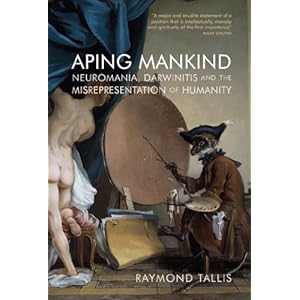
Aping Mankind: Neuromania, Darwinitis and the Misrepresentation of Humanity

In “Human consciousness is much more than mere brain activity,” Mark Vernon writes, “When we meditate or use our powers of perception, we call on more than just a brain” (The Guardian, June17, 2011):

How does the animated meat inside our heads produce the rich life of the mind? Why is it that when we reflect or meditate we have all manner of sensations and thoughts but never feel neurons firing? It’s called the “hard problem”, and it’s a problem the physician, philosopher and author Raymond Tallis believes we have lost sight of – with potentially disastrous results.Vernon, reviewing Raymond Tallis’s new book Aping Mankind: Neuromania, Darwinitis and the Misrepresentation of Humanity, offers,

What is astonishing about this rampant reductionism is that it is based on a conceptual muddle that is readily unpicked. Sure, you need a brain to be alive, but to be human is not to be a brain. Think of it this way: you need legs to walk, but you’d never say that your legs are walking.  Read More ›

Is World Magazine what Christianity Today was supposed to be?

Steno tells us that Jay Richards’ (ed) God and Evolution won World Magazine’s Book of the Year (American), as did Norman Nevin’s (ed) Should Christians Embrace Evolution (British).

Don’t miss Marvin Olasky’s thoughtful discussion of why these two books deserved to lead. First, because

Think about the three main intellectual influencers of the 20th century: Karl Marx, Sigmund Freud, and Charles Darwin. Two of the three—Freud and Marx—have lost most of their influence. The exception is Darwin. Two years ago his millions of fans celebrated the bicentennial of his birth, which was also the 150th anniversary of his famous book On the Origins of Species.He highlights the role of the Templeton Foundation in fronting Christian Darwinism, which most Christians actually do not and cannot accept.

Or, as I like to say, “Your church would make a nice little block of condos, but why are you giving it money in the mean time? Shouldn’t you be buying shares?” Read More ›