2011
Nazca boobies studied to help explain child abuse
Markus Rammerstorfer, one of our authors, writes on the significance of Junk DNA
“Most proteins that drive disease processes are actually undruggable.”
Australopithecus sediba after the hype
With headlines like “Caveman from 2m years ago may be missing link“, the world’s media made a field day of some recent work on Australopithecus sediba. For those with a memory, it has all happened previously in 2010. The announcement was made in the journal Science that the evolutionary path “From Australopithecus to Homo” had been found. Consequently, the media trumpeted the significance of the bones to their readers (see here). You had to read carefully to realize that hype and science were being confused. Move on to the present and the newly reported research: the journal Science carried three News Focus stories and five scientific papers on the fossils. This was picked up by the popular science journals (New Read More ›
Ancient burial place turns out to be lunar calendar as well
ID Foundations, 8: Switcheroo — the error of asserting without adequate observational evidence that the design of life (from OOL on) is achievable by small, chance- driven, success- reinforced increments of complexity leading to the iconic tree of life
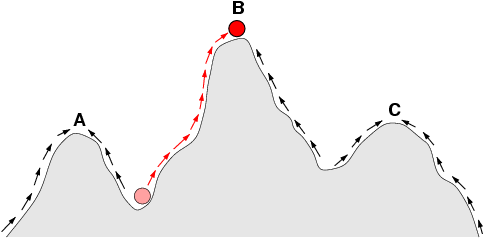
[UD ID Founds Series, cf. Bartlett on IC]
Ever since Dawkins’ Mt Improbable analogy, a common argument of design objectors has been that such complex designs as we see in life forms can “easily” be achieved incrementally, by steps within plausible reach of chance processes, that are then stamped in by success, i.e. by hill-climbing. Success, measured by reproductive advantage and what used to be called “survival of the fittest.”
[Added, Oct 15, given a distractive strawmannisation problem in the thread of discussion: NB: The wide context in view, plainly, is the Dawkins Mt Improbable type hill climbing, which is broader than but related to particular algorithms that bear that label.]
Weasel’s “cumulative selection” algorithm (c. 1986/7) was the classic — and deeply flawed, even outright misleading — illustration of Dawkinsian evolutionary hill-climbing.
To stir fresh thought and break out of the all too common stale and predictable exchanges over such algorithms, let’s put on the table a key remark by Stanley and Lehman, in promoting their particular spin on evolutionary algorithms, Novelty Search:
. . . evolutionary search is usually driven by measuring how close the current candidate solution is to the objective. [ –> Metrics include ratio, interval, ordinal and nominal scales; this being at least ordinal] That measure then determines whether the candidate is rewarded (i.e. whether it will have offspring) or discarded. [ –> i.e. if further moderate variation does not improve, you have now reached the local peak after hill-climbing . . . ] In contrast, novelty search [which they propose] never measures progress at all. Rather, it simply rewards those individuals that are different.
Instead of aiming for the objective, novelty search looks for novelty; surprisingly, sometimes not looking for the goal in this way leads to finding the goal [–> notice, an admission of goal- directedness . . . ] more quickly and consistently. While it may sound strange, in some problems ignoring the goal outperforms looking for it. The reason for this phenomenon is that sometimes the intermediate steps to the goal do not resemble the goal itself. John Stuart Mill termed this source of confusion the “like-causes-like” fallacy. In such situations, rewarding resemblance to the goal does not respect the intermediate steps that lead to the goal, often causing search to fail . . . .
Although it is effective for solving some deceptive problems, novelty search is not just another approach to solving problems. A more general inspiration for novelty search is to create a better abstraction of how natural evolution discovers complexity. An ambitious goal of such research is to find an algorithm that can create an “explosion” of interesting complexity reminiscent of that found in natural evolution.
While we often assume that complexity growth in natural evolution is mostly a consequence of selection pressure from adaptive competition (i.e. the pressure for an organism to be better than its peers), biologists have shown that sometimes selection pressure can in fact inhibit innovation in evolution. Perhaps complexity in nature is not the result of optimizing fitness, but instead a byproduct of evolution’s drive to discover novel ways of life.
While their own spin is not without its particular problems in promoting their own school of thought — there is an unquestioned matter of factness about evolution doing this that is but little warranted by actual observed empirical facts at body-plan origins level, and it is by no means a given that “evolution” will reward mere novelty — some pretty serious admissions against interest are made.
Read More ›