Uncommon Descent Serving The Intelligent Design Community

Durston and Craig on an infinite temporal past . . .

Categories
Atheism
Mathematics
rhetoric
worldview
Share
Facebook
Twitter/X
LinkedIn
Flipboard
Print
Email

In recent days, the issue of an infinite temporal past as a step by step causal succession has come up at UD. For, it seems the evolutionary materialist faces the unwelcome choice of a cosmos from a true nothing — non-being or else an actually completed infinite past succession of finite causal steps.

Durston:

>>To  avoid  the  theological  and  philosophical  implications  of  a  beginning  for the  universe,  some  naturalists  such  as  Sean  Carroll  suggest  that  all  we  need  to  do  is  build  a  successful  mathematical  model  of  the  universe  where  time  t runs  from  minus  infinity  to  positive  infinity. Although  there  is  no  problem  in  having  t run  from  minus  infinity  to  plus  infinity with  a  mathematical  model,  the real past  history  of  the  universe  cannot  be  a  completed  infinity  of  seconds  that  elapsed,  one  second  at  a  time. There  are at  least  two  problems.  First,  an  infinite  real  past  requires  a  completed  infinity, which  is  a  single  object and  does  not  describe  how  history  actually  unfolds.  Second,  it  is  impossible  to  count  down  from  negative  infinity  without  encountering the  problem  of  a  potential infinity  that  never  actually  reaches  infinity. For  the  real  world,  therefore,  there  must  be  a  first  event  that  occurred  a  finite  amount  of  time  ago  in  the  past . . . [More] >>

Craig:

>Strictly speaking, I wouldn’t say, as you put it, that a “beginningless causal chain would be (or form) an actually infinite set.” Sets, if they exist, are abstract objects and so should not be identified with the series of events in time. Using what I would regard as the useful fiction of a set, I suppose we could say that the set of past events is an infinite set if the series of past events is beginningless. But I prefer simply to say that if the temporal series of events is beginningless, then the number of past events is infinite or that there has occurred an infinite number of past events . . . .

It might be said that at least there have been past events, and so they can be numbered. But by the same token there will be future events, so why can they not be numbered? Accordingly, one might be tempted to say that in an endless future there will be an actually infinite number of events, just as in a beginningless past there have been an actually infinite number of events. But in a sense that assertion is false; for there never will be an actually infinite number of events, since it is impossible to count to infinity. The only sense in which there will be an infinite number of events is that the series of events will go toward infinity as a limit.

But that is the concept of a potential infinite, not an actual infinite. Here the objectivity of temporal becoming makes itself felt. For as a result of the arrow of time, the series of events later than any arbitrarily selected past event is properly to be regarded as potentially infinite, that is to say, finite but indefinitely increasing toward infinity as a limit. The situation, significantly, is not symmetrical: as we have seen, the series of events earlier than any arbitrarily selected future event cannot properly be regarded as potentially infinite. So when we say that the number of past events is infinite, we mean that prior to today ℵ0 events have elapsed. But when we say that the number of future events is infinite, we do not mean that ℵ0 events will elapse, for that is false. [More]>>

Food for further thought. END

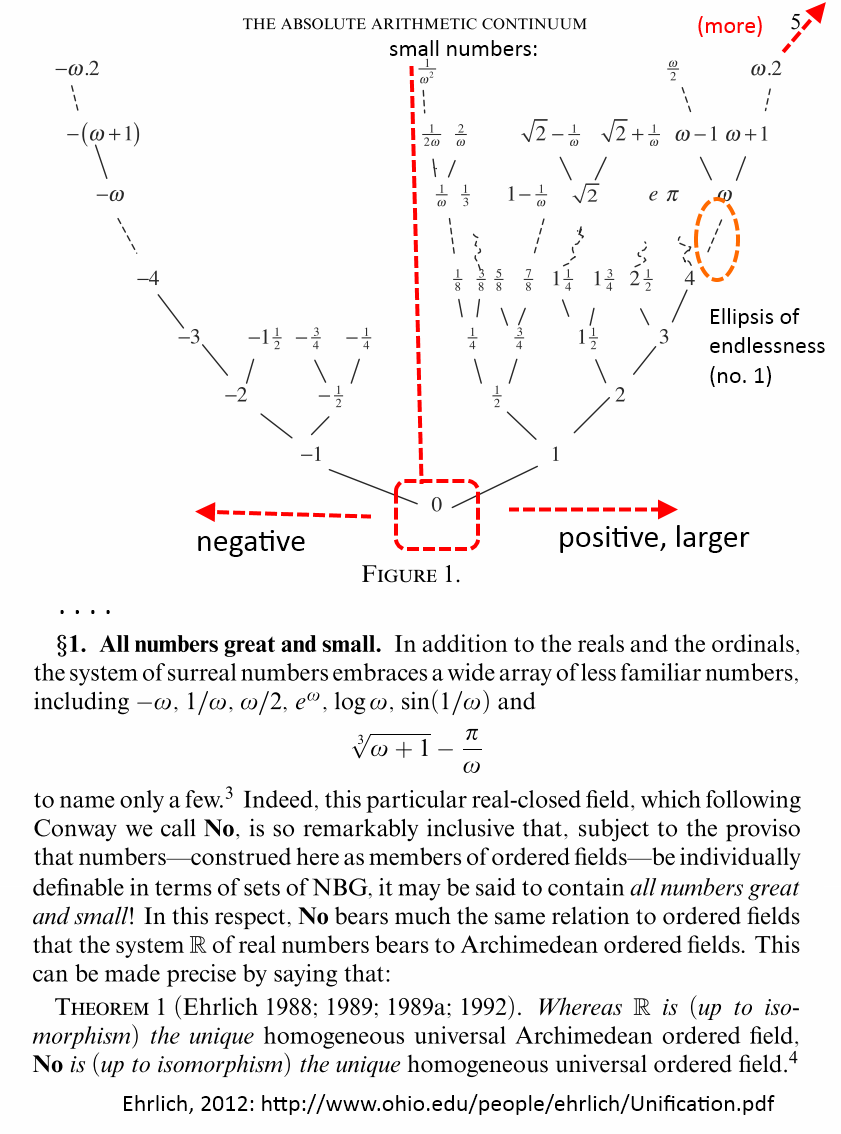
PS: As issues on numbers etc have become a major focus for discussion, HT DS here is a presentation of the overview:
unity

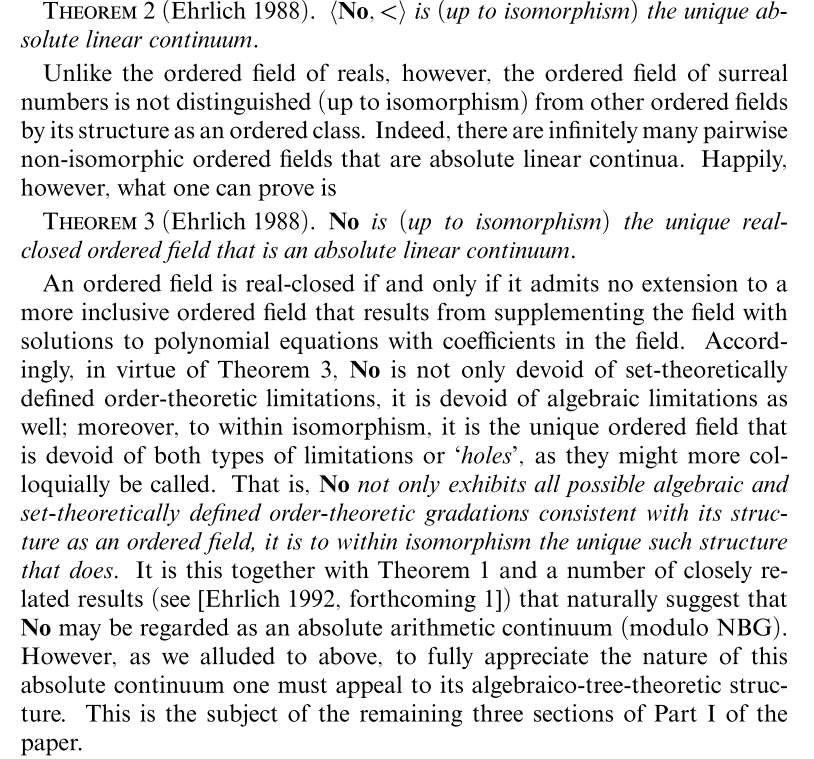
Where also, this continuum result is useful:
unified_continuum

PPS: As a blue vs pink punched paper tape example is used below, cf the real world machines
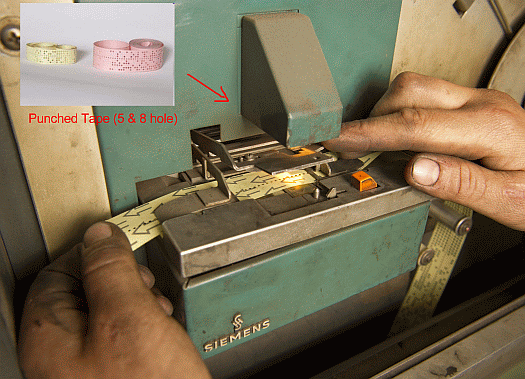
Punched paper Tape, as used in older computers and numerically controlled machine tools (Courtesy Wiki & Siemens)

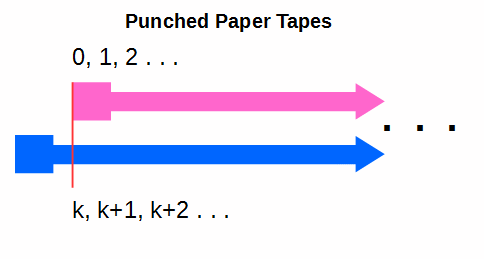
and the abstraction for mathematical operations:
punchtapes_1-1

Note as well a Turing Machine physical model:
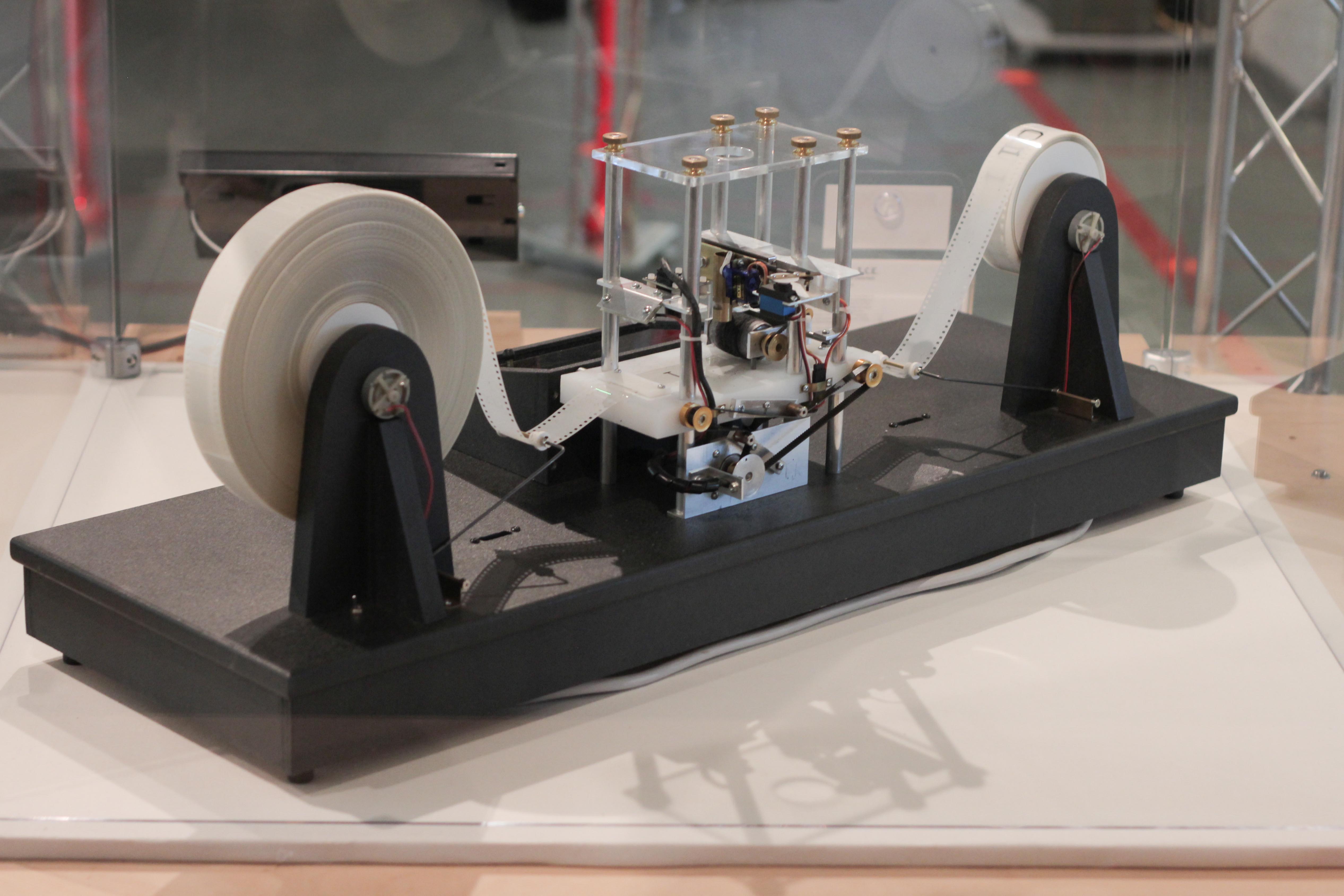
Turing_Machine_Model_Davey_2012

and its abstracted operational form for Mathematical analysis:
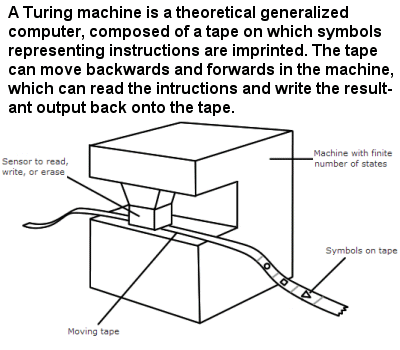
turing_machine

F/N: HT BA77, let us try to embed a video: XXXX nope, fails XXXX so instead let us instead link the vid page.

Comments
#694 KF
That is we may only specifically attain to finitely many concrete finite values such as 1987 *10^2016 etc, values that depend on stepwise and surpass-able increments of +1 from 0 or (as illustrated) on representations such as place value or sci notation that use similarly dependent components. But the endlessness goes beyond what we can reach in that way. We can establish a pattern sufficiently in steps but then we must always point to the do forever onward that goes beyond what we can attain in finite stage steps from 0. Indeed notice the just above riff on Hilbert’s Hotel to see the point about endless steps of counting onward from a further k steps on. Thus also observe use of infinitesimals in the y = 1/x function to catapult to hyper-reals in the transfinite domain, cf Ehrlang’s tree of numbers.
You really must learn to espouse mathematics in a standard form. I asked if you had any academic publications or research work which supports or elucidates your view. I read your view over and over again and I'm asking if there is anyone other than you who thinks the way you do. Could you at least give me a mathematical definition of 'endlessness'? Please?ellazimm
March 8, 2016
March
03
Mar
8
08
2016
06:09 AM
6
06
09
AM
PDT
KF,
And in the case of finitude of natural counting sets, that becomes material. For, on the copy of the set-list so far premise, actual succession to endless degree would include that some members in the far zone would have to copy in that endlessness into individual members. Which, would render such members non finite.
Let's assume than α is a nonfinite counting set as described above. Then we have a strictly increasing sequence: {}, {0}, {0, 1}, {0, 1, 2}, ... , α Now it is impossible that α is the least nonfinite counting set, because such a thing cannot exist. By definition, α = n ∪ {n} for some natural number n, which implies that n < α and that n is also infinite. However, this is at odds with the proposition that there is a least infinite ordinal ω. Are we agreed on this?daveS
March 8, 2016
March
03
Mar
8
08
2016
05:34 AM
5
05
34
AM
PDT
EZ, the phenomenon of endlessness as shown by the ellipsis of endlessness is the heart of the conception of infinity routinely appearing in mathematics {0,1,2 . . . k, k+1, . . . } . The second ellipsis is unbounded, endless, as opposed to the first, and the expression is a commonplace. It should not be a debatable point. I find it amazing that you want yet another definition after the many in this thread, just scroll up: that which goes on beyond any arbitrarily large but finite value, in a nutshell, cf the pink vs blue tape and the k, k+1 etc matched to 0,1,2 etc to to see what this means. The thought exercise is WLOG and keeps the speculations anchored to realities in the empirical world -- which is important. The relevant case in point is the ongoing set of collected successive counting sets, which goes on and on beyond any arbitrarily large k that is finite and bounded by k+1; we therefore accept that we can only point and collect the ellipsis of endlessness INSIDE the set definition, giving omega as symbol of its order type. Third, that after k finite numbers there is a k+1th only illustrates that this too is finite, as we then feed the former k+1 into the value-k register and repeat, thus we only attain to finite values in steps. That is we may only specifically attain to finitely many concrete finite values such as 1987 *10^2016 etc, values that depend on stepwise and surpass-able increments of +1 from 0 or (as illustrated) on representations such as place value or sci notation that use similarly dependent components. But the endlessness goes beyond what we can reach in that way. We can establish a pattern sufficiently in steps but then we must always point to the do forever onward that goes beyond what we can attain in finite stage steps from 0. Indeed notice the just above riff on Hilbert's Hotel to see the point about endless steps of counting onward from a further k steps on. Thus also observe use of infinitesimals in the y = 1/x function to catapult to hyper-reals in the transfinite domain, cf Ehrlang's tree of numbers. KFkairosfocus
March 8, 2016
March
03
Mar
8
08
2016
03:50 AM
3
03
50
AM
PDT
#692 KF
As a further result, it seems to me that we cannot automatically assume that per ordinary mathematical induction, properties of succession from case k to case k+1 will be unaffected by endless-NESS. The chain does show that any value we may reach is indeed going to behave in the specified way once case 0 and the chaining obtain, but such will not actually traverse the endless. And in the case of finitude of natural counting sets, that becomes material. For, on the copy of the set-list so far premise, actual succession to endless degree would include that some members in the far zone would have to copy in that endlessness into individual members. Which, would render such members non finite.
You can't be asserting that there is only a finite number of finite numbers because you can always find one more. Which means you can't point to a boundary or line which, when crossed, takes you into the infinite. Do you have any academic or research papers which explore your concept of 'endlessness' which you can link to. I'd like to see it defined and worked out rigorously.
Therefore, we need to revert to transfinite induction (and possibly recursion) for cases where the potential but not actualised transfinite is not good enough. But, as the very name implies, that goes beyond the finite.
Do you have an example of a case?ellazimm
March 8, 2016
March
03
Mar
8
08
2016
01:01 AM
1
01
01
AM
PDT
VC (Attn A, DS etc), You are bringing out some of the ways first degree so-called "countable" endlessness changes everything. Which is a strategic result. Yes in a finite pattern, {0,1,2,3, 4 . . . . k}, k LT k+1 "less" {0, 2, 4, . . . [k]} "gives" {1, 3, 5 . . . [k]} But in the endless case the standard counting sequence, the evens and the odds become simply different ways of expressing first degree endlessness, as we can transform one pattern into the next. It is the endlessness that is here shown to be a decisive component of the structured sets. It literally changes the import of everything. This then refocuses the points of concern I have discussed above, starting from the argument from the easily seen bounded-ness of 0, 1, 2 etc, the closure under succession so k which is k x (+1) from 0 is then bounded by the k+1th step, k + 1 and the extension that therefore all naturals, endlessly, are finite. Endlessness counts and generates strange results but ought not to generate contradictions, so we modify our thinking if a particular approach ends in questionable claims. This is of course a summary of another famous proof technique, proof of claim X by demonstration of contradiction in its denial ~X. We notice, from the pink vs blue endless punched tape thought exercise, that truncating at k, k+1 etc and putting in 1:1 correspondence with the undisturbed sequence preserves an endless match. That is starting the succession from any finite k, k+1 is equivalent to (strictly, isomorphic with) starting from 0,1 etc. Because of onward endlessness. And this truncation and correlation process can be repeated endless-LY via do forever looping, with the same result every time. (Hilbert's Hotel has a similar result for bringing in new guests of endless number. Move the old guests in rooms n to rooms 2n and put the new guests into 1,3,5 etc endlessly. [In closer comparison with our case, consider an endless train of buses with k new guests lined up in front of the hotel which is full as usual. The manager broadcasts, present guests in room n move to room n+k, then puts the latest busload into rooms 1 to k. This can be repeated endlessly. This of course shows that such a hotel cannot be physically built. Magic step, the new guests are actually repair people and rooms 1 to k are going under repair, bus 1 is carpenters, bus 2 electricians, etc, so now rooms 1 to k go through first repairs, with guests moved to k+1 on. Bus 2 then shifts the first lot of carpenters to rooms K +1 to 2k, and the process continues. The whole lot of actual guess are still there even as the repair people keep on coming into the rooms 1 to k and earlier repair people shift up another k rooms. At no stage is there need for actual guests to leave, no matter that the crazy hotel was full to begin with. In short these thought exercises are telling us that endlessness produces weird results.] ) As a result, we see that no finite stage, stepwise succession can traverse endlessness. Instead we use this process to set up the pattern (the potential infinite) and project a leap of endless faith, often putting it into axioms, as has been discussed above. In the case of the claim that all naturals, are finite but there are infinitely many such finite natural counting sets, I think this is a step too far. For, it can be seen that the next counting set is the list of sets so far from 0. As a result if a list of such is wholly of finite elements, the members of the list, necessarily, will be finite. At the same time, the endless list has been assigned order type the first transfinite, omega, which is not a natural. The solution, to my mind, is that the endlessness cannot be completed in successive finite stage steps and so while every specific natural we can reach by stepwise finite stage process is indeed finite, we cannot exhaust the endlessness. The ellipsis of endlessness is a major, material component of the set that collects successive counting sets. As a further result, it seems to me that we cannot automatically assume that per ordinary mathematical induction, properties of succession from case k to case k+1 will be unaffected by endless-NESS. The chain does show that any value we may reach is indeed going to behave in the specified way once case 0 and the chaining obtain, but such will not actually traverse the endless. And in the case of finitude of natural counting sets, that becomes material. For, on the copy of the set-list so far premise, actual succession to endless degree would include that some members in the far zone would have to copy in that endlessness into individual members. Which, would render such members non finite. The solution to my mind is that ordinary mathematical induction extends to the potentially infinite, not the actual completion of endlessness. So we must reckon with a fallacy of composition on taking the leap to endlessness. Therefore, we need to revert to transfinite induction (and possibly recursion) for cases where the potential but not actualised transfinite is not good enough. But, as the very name implies, that goes beyond the finite. KFkairosfocus
March 8, 2016
March
03
Mar
8
08
2016
12:21 AM
12
12
21
AM
PDT
KF @690 Very timely advice. Thank you. BTW, apparently this discussion thread remains popular: :)
Popular Posts (Last 30 Days) A world-famous chemist tells the truth: there’s no… (15,843) Durston and Craig on an infinite temporal past . . . (2,351) Homologies, differences and information jumps (2,318) Larry Moran needs to do some more reading (1,716) A Little Timeline on the Second Law Argument (1,700)
Dionisio
March 7, 2016
March
03
Mar
7
07
2016
11:58 PM
11
11
58
PM
PDT
NOTICE: There is no need for the use of questionable vocabulary (e.g. Mathematics has nothing to do with questionable sexual behaviour) and accusatory verbal grenades. Where, if people are speaking with disregard to truth that will show itself well enough. I am asking for such language to be avoided in the interests of preserving a tone that is family friendly. Comment is a privilege on good behaviour, not a right. KFkairosfocus
March 7, 2016
March
03
Mar
7
07
2016
11:29 PM
11
11
29
PM
PDT
Hi Virgil. I've been thinking about your comment about the number of elements in the even natural numbers, so I'm going to try to explain what I understand. Let N = {1,2,3,...n,...} Let E = {2,4,6,...2n,...) Also, consider the obvious mapping between the sets: 1 -> 2 2 -> 4 3 -> 6 ... n -> 2n ... Now, consider the 5th term of N, which is 5. The matching term in E is 10, but both N and E have 5 numbers at that time: N has 1,2,3,4,5 and E has 2,4,6,8,10 So at that time, for n = 5, they both have the same number of numbers. Now consider the 1 billionth term: the 1 billionth term of N is 1 billion and the 1 billionth term of E is 2 billion, but just as with 5, the number of terms in each set is the same. They both have 1 billion terms. Since the same argument can be made for any number, for any term n in N, the number of terms in N and E at that time are equal. The actual numbers are different (the number in E is twice that of the number in n), but the number of numbers in each set is the same. Since this is so for any n, how do numbers of numbers in N and E ever get to be unequal?Aleta
March 7, 2016
March
03
Mar
7
07
2016
09:01 PM
9
09
01
PM
PDT
Well, this is interesting. I just found the post in which kf gave me a warning, at 644.
I especially won’t bother with people who don’t appreciate the importance of pure mathematics, irrespective of applied utility, and I also am not fond of discussing things with people who call others [SNIP — Aleta warning. KF]
Since kf snipped what I wrote we can't see what I said, but I remember that I had quoted Virgil in 643 as calling EZ a "cowardly wanker." Those were Virgil's words, directed at EZ, not my words. However, now 643 uses the phrase "mathematical weenie", which Virgil edited after my post at 644. It is clear that Virgil edited his post, because in 649, EZ quoted Virgil's original statement:
NOTE- I am NOT asking about Cantor’s set theory but just one small part of it. That means when Jared responds with Cantor’s set theory is fundamental he proves that he is a cowardly wanker who cannot support his position.
So now I understand the situation.Aleta
March 7, 2016
March
03
Mar
7
07
2016
08:41 PM
8
08
41
PM
PDT
Virgil
But EZ is lying. You should be talking to him about that
I'm not lying. Everyone else agrees with me. You haven't yet told me what the cardinality of sets A and B (as defined above) are.
Well I showed above that simple set subtraction proves that the set of positive integers has more elements than the set of positive even integers and positive odd integers.
You were incorrect.
If there is more than one correspondence then there isn’t any one-to-one correspondence. If I can match an element in your set D to more than one element in your set C, then there isn’t a one-to-one correspondence, by definition.
That is incorrect. There can be many mappings between two sets. There can even be multiple one-to-one mappings. The key point is: IF there is even one one-to-one mapping then the sets are 'the same size'.
And if I can subtract one set from another and get a set with infinite elements then it is obvious that the three sets do not have the same number of elements.
Again, incorrect.
Again, cuz you say so isn’t an argument. That you refuse to even address what I said speaks volumes.
I have addressed your . . . proclamations. I gave you two sets, A and B defined above, which your set subtraction method doesn't work. And you haven't been able to tell me their cardinalities. Just like you've never been able to tell me the cardinality of the set of prime numbers. Your method doesn't work.
But anyway, seeing that you are a liar and I get reprimanded for calling you what you obviously are, we have nothing to discuss.
I'm not lying. You are incorrect.
He also says that an infinite set has to given all at once, which it obviously cannot be as infinity is a journey. Also mathematics isn’t a consensus and you can’t even answer a basic question.
You have been shown, many, many times, how your ideas fail. You have been given many, many references to correct information. You have been shown time and time again correctly worked out examples. You cannot find any academic support for your ideas. You have not been able to find fault with any proof of any mathematical theorem. NO ONE agrees with you. No one. Give it up.ellazimm
March 7, 2016
March
03
Mar
7
07
2016
08:03 PM
8
08
03
PM
PDT
EZ Jared:
See Virgil, even KF disagrees with you. Like we said.
He also says that an infinite set has to given all at once, which it obviously cannot be as infinity is a journey. Also mathematics isn't a consensus and you can't even answer a basic question.Virgil Cain
March 7, 2016
March
03
Mar
7
07
2016
04:51 PM
4
04
51
PM
PDT
If there is more than one correspondence then there isn’t any one-to-one correspondence. If I can match an element in your set D to more than one element in your set C, then there isn’t a one-to-one correspondence, by definition.
Clearly you are mistaken as I showed.
Except you didn't show anything. So clearly you are just a bluffing loser who cannot understand a definition. And if I can subtract one set from another and get a set with infinite elements then it is obvious that the three sets do not have the same number of elements.
Again, clearly you are mistaken.
Again, cuz you say so isn't an argument. That you refuse to even address what I said speaks volumes. But anyway, seeing that you are a liar and I get reprimanded for calling you what you obviously are, we have nothing to discuss.Virgil Cain
March 7, 2016
March
03
Mar
7
07
2016
04:49 PM
4
04
49
PM
PDT
kairosfocus:
VC (attn EZ & A), well above I showed how the set of naturals can be directly transformed into the set of evens or the set of odds.
Well I showed above that simple set subtraction proves that the set of positive integers has more elements than the set of positive even integers and positive odd integers.Virgil Cain
March 7, 2016
March
03
Mar
7
07
2016
04:44 PM
4
04
44
PM
PDT
kairosfocus:
VC, there is not any reason to toss verbal grenades such as “liar.”
But EZ is lying. You should be talking to him about thatVirgil Cain
March 7, 2016
March
03
Mar
7
07
2016
04:42 PM
4
04
42
PM
PDT
kf writes,
VC (attn EZ & A), well above I showed how the set of naturals can be directly transformed into the set of evens or the set of odds. Likewise for the set of tens or the set from k, k+1 on. That is they are all isomorphic and of the same cardinality.
Thanks, kf. That is a nice clear statement.Aleta
March 7, 2016
March
03
Mar
7
07
2016
02:25 PM
2
02
25
PM
PDT
Dionisio, re 679: I think it was fairly clear that when I wrote "to a believer, such as kf" I was referring to a believer in God. Thus when I answered your question "Aren’t you a believer, too?" in the negative, I was referring to God also. For you to now say "Oh, really? Don’t you believe anyone, anything or in anything? Absolutely not?" is not a reasonable response.Aleta
March 7, 2016
March
03
Mar
7
07
2016
01:58 PM
1
01
58
PM
PDT
kf writes, "Aleta, you are also warned on language. KF" Please let me know what post, and what language, you are objecting toAleta
March 7, 2016
March
03
Mar
7
07
2016
01:52 PM
1
01
52
PM
PDT
Aleta @631
3. WhenI wrote, “I think, to a believer such as kf, […]”, Dionisio wrote, “Aren’t you a believer, too?” No.
Oh, really? Don't you believe anyone, anything or in anything? Absolutely not? :)Dionisio
March 7, 2016
March
03
Mar
7
07
2016
01:45 PM
1
01
45
PM
PDT
Dionisio,
“mainly interested in mathematics here” Your comrade used the word ‘only’ but now you say ‘mainly’? Do you see the difference? Do you see the conflicting (inconsistent) statements?
Well, Aleta and I are not the same person. We are bound to make conflicting statements now and again.
What’s your goal in this discussion? [emphasis mine]
I don't have a "goal" per se. I, like many people, enjoy discussing things on the internet. When I read a post that interests me, or that I perhaps disagree with, I will often reply. When I read something that I believe is definitely wrong, I will offer a correction. These threads actually have been quite productive for me, as I have learned a lot and have found a number of books and articles to add to my reading list.daveS
March 7, 2016
March
03
Mar
7
07
2016
01:45 PM
1
01
45
PM
PDT
velikovskys @671
Dionisio: What’s the bottom line of this discussion thread according to KF’s OP?
If the volume of KF’s responses is an indicator, the discussion of mathematics . Why,what do you think it is?
Didn't you understand my question? [emphasis mine]Dionisio
March 7, 2016
March
03
Mar
7
07
2016
01:38 PM
1
01
38
PM
PDT
#670 KF
I showed how the set of naturals can be directly transformed into the set of evens or the set of odds.
See Virgil, even KF disagrees with you. Like we said.ellazimm
March 7, 2016
March
03
Mar
7
07
2016
01:37 PM
1
01
37
PM
PDT
#655 VC
You were supposed to be addressing the utility issue.
You always punt on that so I thought I'd just skip to the other bits.
It is contained in C and it is what the natural correspondence is
Are you sure? Look again. Read what I wrote. Please.
If there is more than one correspondence then there isn’t any one-to-one correspondence. If I can match an element in your set D to more than one element in your set C, then there isn’t a one-to-one correspondence, by definition.
Clearly you are mistaken as I showed.
And if I can subtract one set from another and get a set with infinite elements then it is obvious that the three sets do not have the same number of elements.</blockquote. Again, clearly you are mistaken.
ellazimm
March 7, 2016
March
03
Mar
7
07
2016
01:34 PM
1
01
34
PM
PDT
daveS @667
Well, like Aleta, I am mainly interested in mathematics here, but certainly I have weighed in on a few tangential subjects. The post that started this whole discussion had to do with the possibility of an actual infinite past, so naturally that rises to the surface now and again. I think it’s typical of posters here to participate in the occasional side-discussion, especially in these lengthy threads.
"mainly interested in mathematics here" Your comrade used the word 'only' but now you say 'mainly'? Do you see the difference? Do you see the conflicting (inconsistent) statements? What's your goal in this discussion? [emphasis mine]Dionisio
March 7, 2016
March
03
Mar
7
07
2016
01:32 PM
1
01
32
PM
PDT
#655 VC
Are you saying that you didn’t understand the relevance of what I posted? Figures
Not at all. I am suggesting that you are confusing a definition vs an example.
Who cares? If you did then you should be able to figure it out by yourself given everything I have told you. If you can’t figure it out then you aren’t the mathematician that you think you are.
I have an answer, I can address the question. Can you? Are the sets A and B as defined above the same size or not? I'll tell you my answer after you tell me yours.ellazimm
March 7, 2016
March
03
Mar
7
07
2016
01:26 PM
1
01
26
PM
PDT
VC, there is not any reason to toss verbal grenades such as "liar." KFkairosfocus
March 7, 2016
March
03
Mar
7
07
2016
01:24 PM
1
01
24
PM
PDT
Dionisio: What’s the bottom line of this discussion thread according to KF’s OP? If the volume of KF's responses is an indicator, the discussion of mathematics . Why,what do you think it is?velikovskys
March 7, 2016
March
03
Mar
7
07
2016
01:22 PM
1
01
22
PM
PDT
VC (attn EZ & A), well above I showed how the set of naturals can be directly transformed into the set of evens or the set of odds. Likewise for the set of tens or the set from k, k+1 on. That is they are all isomorphic and of the same cardinality DUE TO ENDLESSNESS of the first degree. Endlessness counts, it is an important component of the relevant sets. And it has consequences that have been of concern to me. I have already showed how, consistently, the relevant sets are composed on finite stage stepwise cumulative increments from 0. This gives the peculiar characteristics and it is also the context in which I stress that a crucial part of several axioms is an infinite leap of faith across the ellipsis of endlessness. I think that has implications for inductive step by step conclusions. KFkairosfocus
March 7, 2016
March
03
Mar
7
07
2016
01:21 PM
1
01
21
PM
PDT
Aleta @631
2. In response to my comment that “I once wrote the theological question, “Does God need an ellipsis”, Dionisio wrote, “Is that a scientific comment.” Of course not – it says clearly that it is a theological question.
Do you see the difference between 'comment' and 'question'? Since you claimed that you were interested solely in pure math issues when you entered this discussion thread, why did you write a non-scientific comment? If one wants to talk only about basketball, but the discussion also includes canoeing, shouldn't one move somewhere else where they only discuss basketball issues?Dionisio
March 7, 2016
March
03
Mar
7
07
2016
01:20 PM
1
01
20
PM
PDT
Aleta, you are also warned on language. KFkairosfocus
March 7, 2016
March
03
Mar
7
07
2016
01:11 PM
1
01
11
PM
PDT
Dionisio,
Well, maybe they were not ‘hidden’ but unclear. However, it seems like after some of you have answered a few questions your true motives have been clarified a bit. At least more details have come up to the surface. For example, you may look @659. :)
Well, like Aleta, I am mainly interested in mathematics here, but certainly I have weighed in on a few tangential subjects. The post that started this whole discussion had to do with the possibility of an actual infinite past, so naturally that rises to the surface now and again. I think it's typical of posters here to participate in the occasional side-discussion, especially in these lengthy threads.daveS
March 7, 2016
March
03
Mar
7
07
2016
01:09 PM
1
01
09
PM
PDT
1 23 24 25 26 27 48

Leave a Reply