Uncommon Descent Serving The Intelligent Design Community

Durston and Craig on an infinite temporal past . . .

Categories
Atheism
Mathematics
rhetoric
worldview
Share
Facebook
Twitter/X
LinkedIn
Flipboard
Print
Email

In recent days, the issue of an infinite temporal past as a step by step causal succession has come up at UD. For, it seems the evolutionary materialist faces the unwelcome choice of a cosmos from a true nothing — non-being or else an actually completed infinite past succession of finite causal steps.

Durston:

>>To  avoid  the  theological  and  philosophical  implications  of  a  beginning  for the  universe,  some  naturalists  such  as  Sean  Carroll  suggest  that  all  we  need  to  do  is  build  a  successful  mathematical  model  of  the  universe  where  time  t runs  from  minus  infinity  to  positive  infinity. Although  there  is  no  problem  in  having  t run  from  minus  infinity  to  plus  infinity with  a  mathematical  model,  the real past  history  of  the  universe  cannot  be  a  completed  infinity  of  seconds  that  elapsed,  one  second  at  a  time. There  are at  least  two  problems.  First,  an  infinite  real  past  requires  a  completed  infinity, which  is  a  single  object and  does  not  describe  how  history  actually  unfolds.  Second,  it  is  impossible  to  count  down  from  negative  infinity  without  encountering the  problem  of  a  potential infinity  that  never  actually  reaches  infinity. For  the  real  world,  therefore,  there  must  be  a  first  event  that  occurred  a  finite  amount  of  time  ago  in  the  past . . . [More] >>

Craig:

>Strictly speaking, I wouldn’t say, as you put it, that a “beginningless causal chain would be (or form) an actually infinite set.” Sets, if they exist, are abstract objects and so should not be identified with the series of events in time. Using what I would regard as the useful fiction of a set, I suppose we could say that the set of past events is an infinite set if the series of past events is beginningless. But I prefer simply to say that if the temporal series of events is beginningless, then the number of past events is infinite or that there has occurred an infinite number of past events . . . .

It might be said that at least there have been past events, and so they can be numbered. But by the same token there will be future events, so why can they not be numbered? Accordingly, one might be tempted to say that in an endless future there will be an actually infinite number of events, just as in a beginningless past there have been an actually infinite number of events. But in a sense that assertion is false; for there never will be an actually infinite number of events, since it is impossible to count to infinity. The only sense in which there will be an infinite number of events is that the series of events will go toward infinity as a limit.

But that is the concept of a potential infinite, not an actual infinite. Here the objectivity of temporal becoming makes itself felt. For as a result of the arrow of time, the series of events later than any arbitrarily selected past event is properly to be regarded as potentially infinite, that is to say, finite but indefinitely increasing toward infinity as a limit. The situation, significantly, is not symmetrical: as we have seen, the series of events earlier than any arbitrarily selected future event cannot properly be regarded as potentially infinite. So when we say that the number of past events is infinite, we mean that prior to today ℵ0 events have elapsed. But when we say that the number of future events is infinite, we do not mean that ℵ0 events will elapse, for that is false. [More]>>

Food for further thought. END

PS: As issues on numbers etc have become a major focus for discussion, HT DS here is a presentation of the overview:
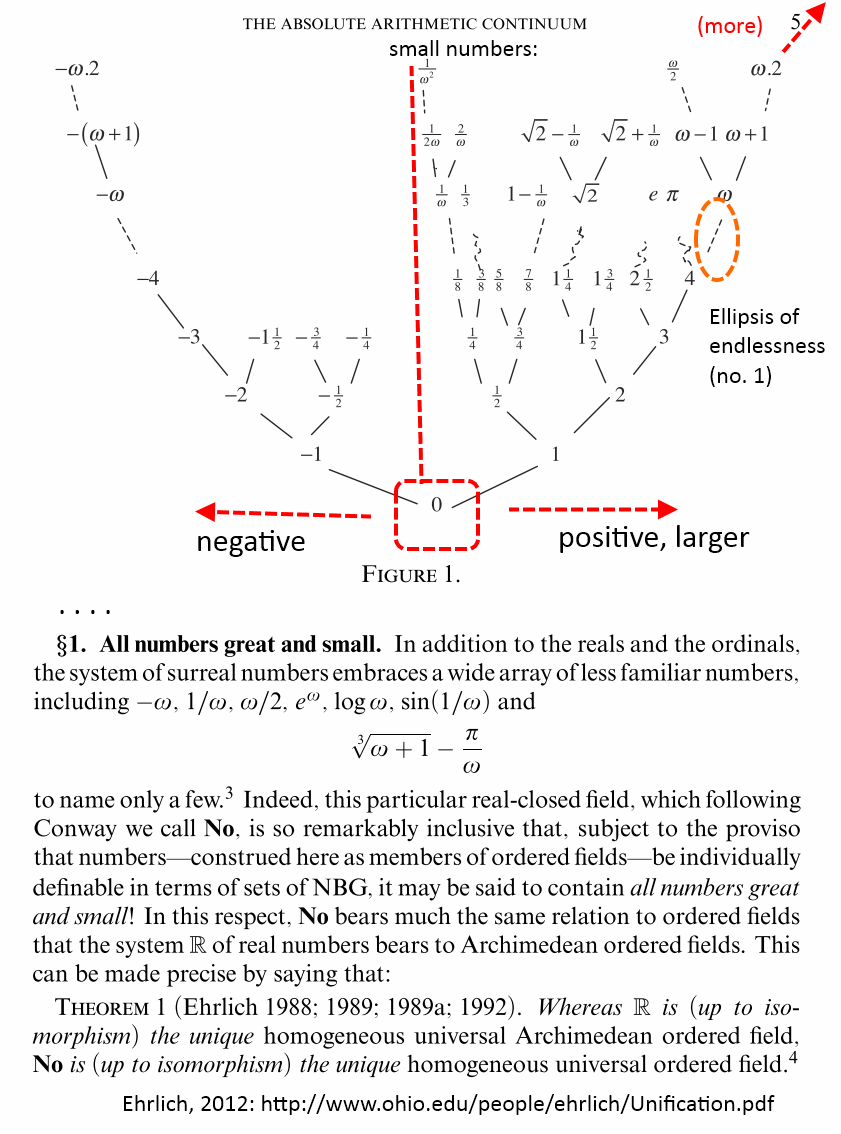
unity

Where also, this continuum result is useful:
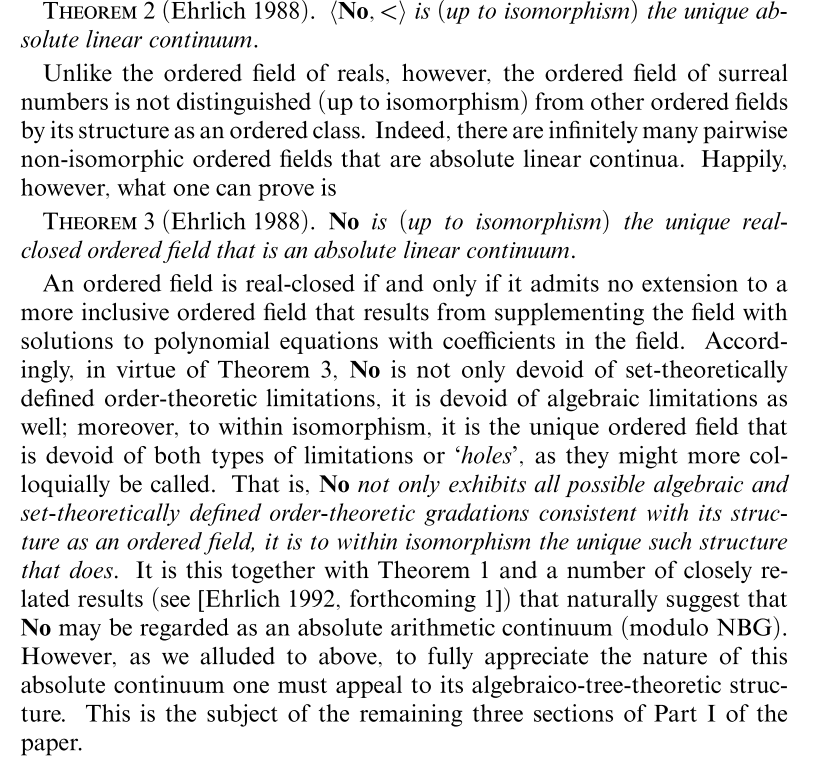
unified_continuum

PPS: As a blue vs pink punched paper tape example is used below, cf the real world machines
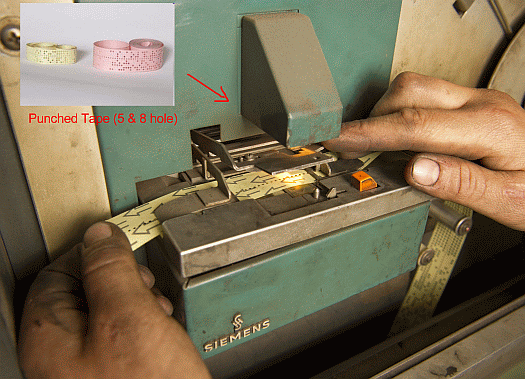
Punched paper Tape, as used in older computers and numerically controlled machine tools (Courtesy Wiki & Siemens)

and the abstraction for mathematical operations:
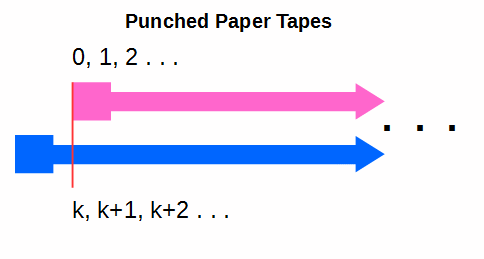
punchtapes_1-1

Note as well a Turing Machine physical model:
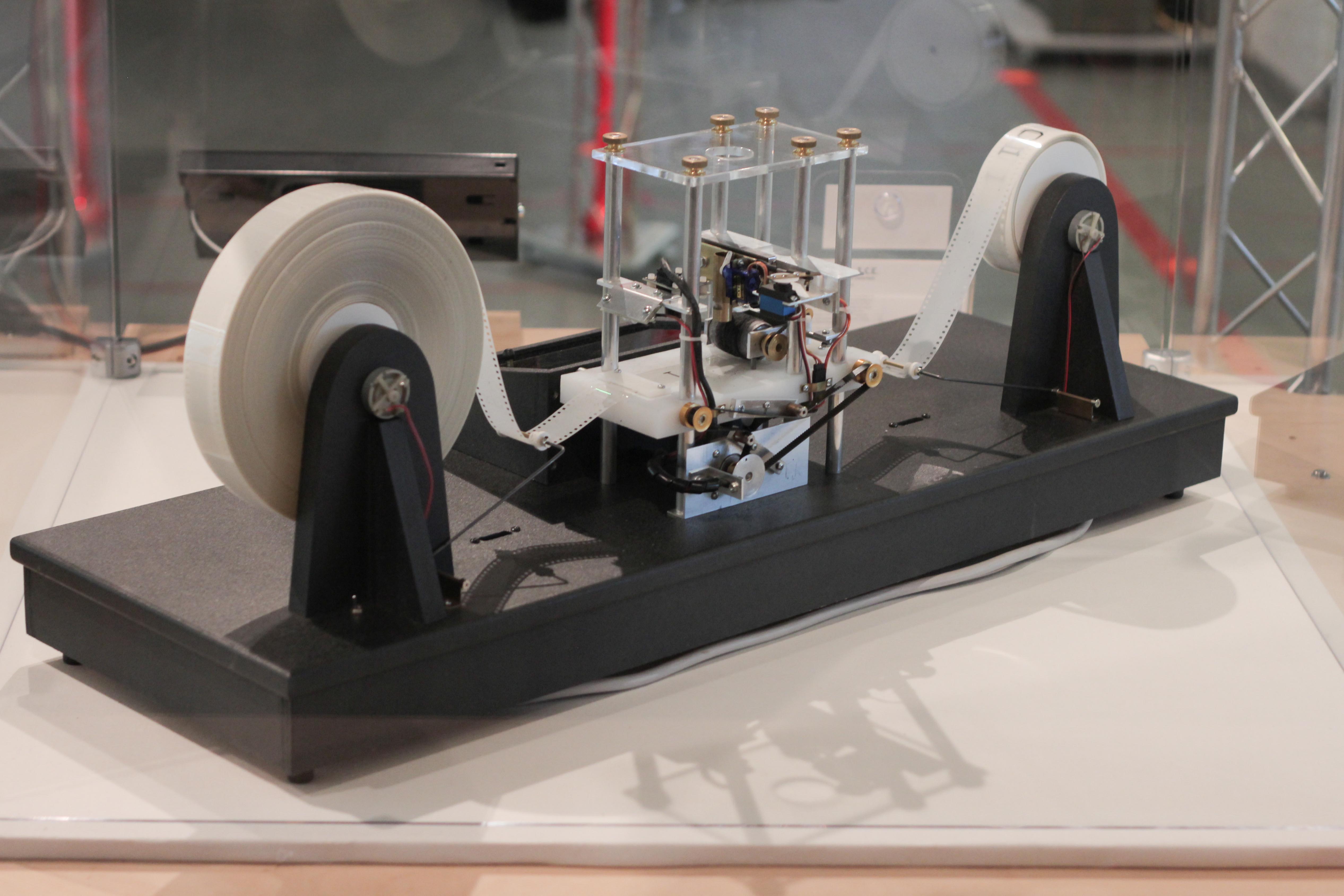
Turing_Machine_Model_Davey_2012

and its abstracted operational form for Mathematical analysis:
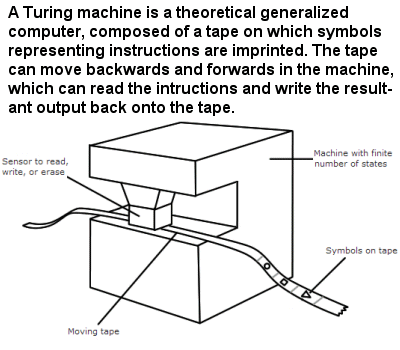
turing_machine

F/N: HT BA77, let us try to embed a video: XXXX nope, fails XXXX so instead let us instead link the vid page.

Comments
PS: For convenience Wiki on Ax inf:
In words, there is a set I (the set which is postulated to be infinite), such that the empty set is in I and such that whenever any x is a member of I, the set formed by taking the union of x with its singleton {x} is also a member of I. Such a set is sometimes called an inductive set. Interpretation and consequences This axiom is closely related to the von Neumann construction of the naturals in set theory, in which the successor of x is defined as x U {x}. If x is a set, then it follows from the other axioms of set theory that this successor is also a uniquely defined set. Successors are used to define the usual set-theoretic encoding of the natural numbers. In this encoding, zero is the empty set: 0 = {}. The number 1 is the successor of 0: 1 = 0 U {0} = {} U {0} = {0}. Likewise, 2 is the successor of 1: 2 = 1 U {1} = {0} U {1} = {0,1}, and so on. A consequence of this definition is that every natural number is equal to the set of all preceding natural numbers.
[--> the copy set to date principle highlighted in 217 above; this is where my concern that were N to be all finite values but extends endlessly, at some point it would need endless members. Of course -- like the ever receding foot of the rainbow -- that cannot be reached and so we have the ellipsis as a crucial part of N, i.e. we may only actually operationally succeed to finite values but may do so without upper limit. The endlessness of first order is then transferred to its order type w]
This construction forms the natural numbers. However, the other axioms are insufficient to prove the existence of the set of all natural numbers. Therefore its existence is taken as an axiom—the axiom of infinity. [--> forcing the result by pointing across the ellipsis of endlessness] This axiom asserts that there is a set I that contains 0 and is closed under the operation of taking the successor [--> which is endless in principle but operationally is ever limited to finite and bounded individual values]; that is, for each element of I, the successor of that element is also in I. Thus the essence of the axiom is: There is a set, I, that includes all the natural numbers. [--> which becomes endless in principle though operationally we may only succeed to finite specific values and as the pink/ blue paper tape thought exercise shows, for every k of arbitrarily large but finite scale we can truncate the tape so far and set k to correspond to 0 in the unmoved pink tape, k+1 to 1, etc and obtain an endless 1:1 match, that is endlessness is pivotal and cannot be traversed stepwise]
I have commented on points.kairosfocus
March 1, 2016
March
03
Mar
1
01
2016
06:48 AM
6
06
48
AM
PDT
F/N: Ehrlich, with emphasis: >>Among the striking s-hierarchical features of No is that much as the surreal numbers emerge from the empty set of surreal numbers by means of | a transfinite recursion that provides an unfolding of the entire spectrum of numbers great and small (modulo the aforementioned provisos), the recursive process of defining No’s arithmetic in turn provides an unfolding of the entire spectrum of ordered fields in such a way that an isomorphic copy of every such system either emerges as an initial subtree of No or is contained in a theoretically distinguished instance of such a system that does.>> Recursion and unfolding all the way up and down. Where AmHD:
re·cur·sion (r?-kûr?zh?n) n. 1. Mathematics a. A method of defining a sequence of objects, such as an expression, function, or set, where some number of initial objects are given and each successive object is defined in terms of the preceding objects. The Fibonacci sequence is defined by recursion. b. A set of objects so defined. c. A rule describing the relation between an object in a recursive sequence in terms of the preceding objects.
In short a pattern is established then it is universalised by pointing across ellipsis of endlessness. Which is also embedded in relevant axioms. KFkairosfocus
March 1, 2016
March
03
Mar
1
01
2016
06:27 AM
6
06
27
AM
PDT
KF,
PS: kth successor –> successive what . . . ?
Natural number? You can construct any finite set {0, 1, 2, ..., k} using the successor operation. To construct the set N requires the Axiom of Infinity.daveS
February 29, 2016
February
02
Feb
29
29
2016
02:38 PM
2
02
38
PM
PDT
F/N: Ehrlich, pp 7 - 8:
Among the striking s-hierarchical features of No is that much as the surreal numbers emerge from the empty set of surreal numbers by means of | a transfinite recursion that provides an unfolding of the entire spectrum of numbers great and small (modulo the aforementioned provisos), the recursive process of defining No’s arithmetic in turn provides an unfolding of the entire spectrum of ordered fields in such a way that an isomorphic copy of every such system either emerges as an initial subtree of No or is contained in a theoretically distinguished instance of such a system that does.
KF PS: kth successor --> successive what . . . ?kairosfocus
February 29, 2016
February
02
Feb
29
29
2016
02:25 PM
2
02
25
PM
PDT
KF, That's the misleading aspect of the domino model I referred to somewhere above. It implies that mathematical induction is simply the application of the law of detachment over and over, which is not the case. Without the Axiom of Induction, you would be right. But this axiom does the "heavy lifting" that you refer to, omitting the do forever loop. It in essence says you can replace these "do forever" loops with one (or just a few) steps. Edit:
the induction axiom describes an essential property of {N}, viz. that each of its members can be reached from 0 by sufficiently often adding 1 [–> do forever looping creating stepwise succession]
This simply states that any natural number is the k-th successor to 0, for some finite k. It doesn't say anything about do forever loops, and that's not how N is constructed.daveS
February 29, 2016
February
02
Feb
29
29
2016
07:40 AM
7
07
40
AM
PDT
F/N: Wiki has an interesting remark on ordinary mathematical induction:
Having proven the base case and the inductive step, then the structure of {N} is such that any value can be obtained by performing the inductive step repeatedly. It may be helpful to think of the domino effect. Consider a half line of dominoes each standing on end, and extending infinitely to the right (see picture) [--> similar to the punched tape]. Suppose that: The first domino falls right. If a (fixed but arbitrary) domino falls right, then its next neighbor also falls right. With these assumptions one can conclude (using mathematical induction) that all of the dominoes will fall right. [--> strictly, that the dominoes in sequence from the first will be subjected to a chaining process propagating stepwise from one to the next, however this then runs into endlessness of the chain as set up] If the dominoes are arranged in another way, this conclusion needn't hold (see Peano axioms#Formulation for a counter example). Similarly, the induction axiom describes an essential property of {N}, viz. that each of its members can be reached from 0 by sufficiently often adding 1 [--> do forever looping creating stepwise succession]
That is, we see the do forever iteration implicated in the process. This runs into the problem that for any k achieved in k finite steps, from k, k+1 on is just as much able to be put in 1:1 correspondence with the undisturbed set as before. This illustrates a case in point of pointing across an ellipsis of endlessness. KFkairosfocus
February 29, 2016
February
02
Feb
29
29
2016
07:32 AM
7
07
32
AM
PDT
F/N: Headlined (HT DS), the numbers sandbox is now officially open for play. KFkairosfocus
February 29, 2016
February
02
Feb
29
29
2016
12:29 AM
12
12
29
AM
PDT
PS: Footnoted to OP is a picture of Ehrlich's grand number tree. This sets a context for discussion in a unified context with room enough for pondering numbers great and small through the surreals. Not to mention rather unusual operations on surprising numbers.kairosfocus
February 28, 2016
February
02
Feb
28
28
2016
11:59 PM
11
11
59
PM
PDT
DS, That does look promising, Abstract:
Abstract. In his monograph On Numbers and Games, J. H. Conway introduced a real-closed field containing the reals and the ordinals as well as a great many less familiar numbers including [lists] to name only a few. Indeed, this particular real-closed field, which Conway calls No , is so remarkably inclusive that, subject to the proviso that numbers—construed here as members of ordered fields—be individually definable in terms of sets of NBG (von Neumann–Bernays–Godel set theory with global choice), it may be said to contain “All Numbers Great and Small.” In this respect, No bears much the same relation to ordered fields that the system R of real numbers bears to Archimedean ordered fields. In Part I of the present paper, we suggest that whereas R should merely be regarded as constituting an arithmetic continuum (modulo the Archimedean axiom), No may be regarded as a sort of absolute arithmetic continuum (modulo NBG), and in Part II we draw attention to the unifying framework No provides not only for the reals and the ordinals but also for an array of non-Archimedean ordered number systems that have arisen in connection with the theories of non-Archimedean ordered algebraic and geometric systems, the theory of the rate of growth of real functions and nonstandard analysis. In addition to its inclusive structure as an ordered field, the system No of surreal num-bers has a rich algebraico-tree-theoretic structure—a simplicity hierarchical structure—that emerges from the recursive clauses in terms of which it is defined. In the development of No outlined in the present paper, in which the surreals emerge vis-a-vis a generalization of the von Neumann ordinal construction, the simplicity hierarchical features of No are brought to the fore and play central roles in the aforementioned unification of systems of numbers great and small and in some of the more revealing characterizations of No as an absolute continuum.
KFkairosfocus
February 28, 2016
February
02
Feb
28
28
2016
11:22 PM
11
11
22
PM
PDT
KF,
But what I am really saying is, how does the jungle get set in order with a tree of unifying relationships? Particularly among the trans-finites? Surreals? Whatever?
I don't know anything about this, but last post on this page at stackexchange discusses the relationship between hyperreals and surreal numbers, with a link to this paper. Theorem 1 states:
Whereas R is (up to isomorphism) the unique homogeneous universal Archimedean ordered field, No [the surreal numbers] is (up to isomorphism) the unique homogeneous universal ordered field.
The precise definitions are given in the paper, but the key one is (paraphrased):
An ordered field A is said to be universal if every ordered field whose universe is a class of NBG can be embedded in A.
Apparently every ordered field can be embedded in the surreal numbers, so it's "large as possible" in some sense. This is based on the NBG axiom system for set theory rather than ZFC.daveS
February 28, 2016
February
02
Feb
28
28
2016
06:01 PM
6
06
01
PM
PDT
Aleta, pardon but k is transfinite, o is not. I suggest that makes a difference for looking at them. I notice as follows as a simple clip at Wolfram:
Transfinite Number One of Cantor's ordinal numbers omega, omega+1, omega+2, ..., omega+omega, omega+omega+1, ... which is "larger" than any whole number.
which is suggestive. I essay no proof-claim there, I just notice a resemblance that would "fit" with a hard infinitesimal catapulting to something in say the bolded range or one of its many onward cousins. But what I am really saying is, how does the jungle get set in order with a tree of unifying relationships? Particularly among the trans-finites? Surreals? Whatever? This being beyond main focus but relevant to the principle that knowledge claims should be unified where possible. GEMkairosfocus
February 28, 2016
February
02
Feb
28
28
2016
03:42 PM
3
03
42
PM
PDT
kf writes,
PS: k as defined looks like enclosed by two ellipses of endlessness within the transfinites, i.e. it sits far out among transfinites.
That's a strange thing to say. We could write the integers as {... -3, -2, -1, 0, 1, 2, 3, ...} 0 sits between two ellipses: Is it "far out" among the integers? Is it more or less far out than 70 billion billion billion?Aleta
February 28, 2016
February
02
Feb
28
28
2016
03:31 PM
3
03
31
PM
PDT
DS, I just noted, there are two ellipses of endlessness surrounding the transfinite k and neighbours, which looks interestingly inviting of a siting suitably remote from w among transfinites. But this is just a look not an argument. My real point is there is a jungle out there that has strange critters of unknown linkages inviting some unification. On that front try: http://shelah.logic.at/files/825.pdf on candidates to be "the" -- even that is controversial it seems -- hyper reals. KFkairosfocus
February 28, 2016
February
02
Feb
28
28
2016
03:18 PM
3
03
18
PM
PDT
Due to problems displaying Greek letters, here's a correct 528: Supporting Dave in 522: In the hyperreals
There is infinitude of infinite integers, i.e., not finite elements of PA1infinity: ... k - 2, k - 1, k, k + 1, k + 2, ..., 2 k, 3 k, ..., k² - k, ..., k² - 1, ... which shows that our choice of k was pretty much arbitrary. It's more common to use the symbol omega instead. However, there is certainly a danger of confusing it with the first infinite ordinal number. The latter is of course defined uniquely.
[Note: a Greek K shows up on the website where I have typed k, and a Greek w where I've typed omega.] http://www.cut-the-knot.org/WhatIs/Infinity/HyperrealNumbers.shtmlAleta
February 28, 2016
February
02
Feb
28
28
2016
03:14 PM
3
03
14
PM
PDT
KF,
DS, what is the least ordinal greater than any 1 +1 +1 . . . +1 where the string is not transfinitely long? KF
The least ordinal greater than any 1 + 1 + ... + 1 is ω. The least hyperinteger greater than any 1 + 1 + ... + 1? There is no such thing. See Aleta's link.daveS
February 28, 2016
February
02
Feb
28
28
2016
03:07 PM
3
03
07
PM
PDT
Aleta, point taken, but I think the same question applies as was just posed to DS. KF PS: k as defined looks like enclosed by two ellipses of endlessness within the transfinites, i.e. it sits far out among transfinites.kairosfocus
February 28, 2016
February
02
Feb
28
28
2016
03:06 PM
3
03
06
PM
PDT
DS, what is the least ordinal greater than any 1 +1 +1 . . . +1 where the string is not transfinitely long? KFkairosfocus
February 28, 2016
February
02
Feb
28
28
2016
03:02 PM
3
03
02
PM
PDT
Thanks for hunting that down, Aleta.daveS
February 28, 2016
February
02
Feb
28
28
2016
02:59 PM
2
02
59
PM
PDT
Supporting Dave in 522: In the hyperreals
There is infinitude of infinite integers, i.e., not finite elements of PA1?: ... ? - 2, ? - 1, ?, ? + 1, ? + 2, ..., 2?, 3?, ..., ?² - ?, ..., ?² - 1, ?², ... which shows that our choice of omega was pretty much arbitrary. It's more common to use the symbol omega instead. However, there is certainly a danger of confusing it with the first infinite ordinal number. The latter is of course defined uniquely.
[Note: the Greek w shows u on the website where I have typed omega.] http://www.cut-the-knot.org/WhatIs/Infinity/HyperrealNumbers.shtmlAleta
February 28, 2016
February
02
Feb
28
28
2016
02:51 PM
2
02
51
PM
PDT
Khan Academy vid https://www.khanacademy.org/math/recreational-math/vi-hart/infinity/v/kinds-of-infinity . . . a look at the jungle.kairosfocus
February 28, 2016
February
02
Feb
28
28
2016
02:43 PM
2
02
43
PM
PDT
KF,
DS, there is a first transfinite ordinal w and there are hyper integers.
Yes, but there is no first transfinite positive hyperinteger. The ω in the hyperreal wikipedia article is not a von Neumann ordinal.daveS
February 28, 2016
February
02
Feb
28
28
2016
02:37 PM
2
02
37
PM
PDT
EZ, denialism -- a term you tossed in like a live grenade -- is so loaded a term that it is beyond the pale of civil discussion. Second, I have pointed out sufficient above that shows there is a jungle out there full of strange critters. And, the concept that we can tie hyper reals etc together is demonstrably on the table. It is also quite clear to me that ordinary induction is successive and that ever so many core points embed or imply do forever loops. Notice how a definition of reals progresses on what premise just above. So we do have to look at endlessness, which is indeed doing a lot of heavy lifting. The y = 1/x catapult does seem very fruitful. KFkairosfocus
February 28, 2016
February
02
Feb
28
28
2016
02:36 PM
2
02
36
PM
PDT
DS, there is a first transfinite ordinal w and there are hyper integers. The construction pointing to w seems reasonable to me as w being first ordinal greater than any chain of +1s from 0, interpreted on the von Neumann construction. Why, then, a call for specific reference on that? KFkairosfocus
February 28, 2016
February
02
Feb
28
28
2016
02:30 PM
2
02
30
PM
PDT
#513 KF
Rhetoric about denialism — which is horrifically loaded with Holocaust denial — does not help settle the matter. Nor does the notion, we do not dispute this, it is settled so there, only the ignorant, stupid, insane and/or wicked denialists would challenge the Consensus. EZ, I am looking at you here.
You throw this into a purely academic discussion. YOU are loading the discussion. YOU are trying to make this into something else. YOU are poisoning the waters. Why, I don't know. This discussion has nothing to do with Holocaust denial. So why bring it up? Why?
And EZ, motive mongering or how I came up with the idea of pink and blue paper punch tapes is of little value. In fact, as Turing tapes of endlessness were discussed and as coloured 3+5 punched paper computer tapes exist, it seemed reasonable to look at parallel tapes running off endlessly and to ponder in ways that are anchored to an intuitive, simple entity. Thought exercises and abstracted models thereof are commonplace in several linked fields. And there is Hilbert’s hotel.
And there is Hilbert's hotel. Let me ask you this: have you had any of your work looked at by a group of reputable mathematicians? Have you submitted any of your ideas to any kind of magazine or peer-reviewed journal? Have you presented any of your ideas to a conference or gathering of bone fide mathematicians? I'm not trying to be rude I just want to know if you've HONESTLY had your contentions examined and critique by people who know the field.ellazimm
February 28, 2016
February
02
Feb
28
28
2016
02:09 PM
2
02
09
PM
PDT
KF,
1 LT omega, 1+1 LT omega, 1+1+1 LT omega, 1+1+1+1 LT omega, . . . . [–> Obviously w is the first transfinite and is recognised as being in the hyper reals *R but not the reals R]
Eh? Do you have a reference? The problem is there is no "first transfinite" in the hyperreals. Given any positive infinite hyperinteger k, there exists infinitely many other positive infinite hyperintegers less than k. That means the ω above cannot be the same as the ordinal ω we have been referring to.daveS
February 28, 2016
February
02
Feb
28
28
2016
02:06 PM
2
02
06
PM
PDT
Aleta, I have said w is not in N. What I have said is that the set we label N will have w as its order type and the ellipsis of endlessness is pivotal to its meaning. Where w does not appear out of nothing or sneak in magical properties, it is the order type resulting from endless succession that cannot be operationally completed stepwise. KF PS: Let me add, every number we can reach in N by a +1 stage sequence or extensions to that such as writing down in place value or scientific notation etc (all of which will involve series) will be finite and have another number beyond that will by iteration be finite. But due to endlessness we cannot exhaust N. Taking the +1 succession and the equivalent succession of sets, to go to actual endlessness -- infeasible -- would entail copying the set as a whole, endlessness within endlessness. But also this is the set we count by, if it has endless continuation there is an open endedness we CANNOT exhaust. That is where w steps in to point past the ellipsis.kairosfocus
February 28, 2016
February
02
Feb
28
28
2016
01:56 PM
1
01
56
PM
PDT
PS: FWIW, Wiki on hyper reals:
The system of hyperreal numbers is a way of treating infinite and infinitesimal quantities. The hyperreals, or nonstandard reals, *R, are an extension of the real numbers R that contains numbers greater than anything of the form 1 + 1 + . . . + 1. [--> so these will be transfinite], Such a number is infinite, and its reciprocal is infinitesimal. [--> hence the use of the catapult function y = 1/x to go between the neighbourhood of 0 and the relevant range] The term "hyper-real" was introduced by Edwin Hewitt in 1948.[1] . . . . The idea of the hyperreal system is to extend the real numbers R to form a system *R that includes infinitesimal and infinite numbers, but without changing any of the elementary axioms of algebra. Any statement of the form "for any number x..." that is true for the reals is also true for the hyperreals. [--> not for any x in R, x is finite] For example, the axiom that states "for any number x, x + 0 = x" still applies. The same is true for quantification over several numbers, e.g., "for any numbers x and y, xy = yx." This ability to carry over statements from the reals to the hyperreals is called the transfer principle. However, statements of the form "for any set of numbers S ..." may not carry over. [--> okay] The only properties that differ between the reals and the hyperreals are those that rely on quantification over sets, or other higher-level structures such as functions and relations, which are typically constructed out of sets. Each real set, function, and relation has its natural hyperreal extension, satisfying the same first-order properties. The kinds of logical sentences that obey this restriction on quantification are referred to as statements in first-order logic. The transfer principle, however, doesn't mean that R and *R have identical behavior. For instance, in *R there exists an element omega such that 1 LT omega, 1+1 LT omega, 1+1+1 LT omega, 1+1+1+1 LT omega, . . . . [--> Obviously w is the first transfinite and is recognised as being in the hyper reals *R but not the reals R] [--> cf below, this w may be further along than the previous, i.e. there is a construction below that has predecessors and successors with surrounding ellipses of endlessness. That invites exploration but that is not primary for this thread's purpose. Note my suggestion on mild infinitesimals above vs hard ones, on analogy of the catapulting function 1/x] but there is no such number in R. (In other words, *R is not Archimedean.) . . . . The hyperreals *R form an ordered field containing the reals R as a subfield. Unlike the reals, the hyperreals do not form a standard metric space, but by virtue of their order they carry an order topology. The use of the definite article the in the phrase the hyperreal numbers is somewhat misleading in that there is not a unique ordered field that is referred to in most treatments. However, a 2003 paper by Vladimir Kanovei and Shelah[4] shows that there is a definable, countably saturated (meaning omega-saturated, but not of course countable) elementary extension of the reals, which therefore has a good claim to the title of the hyperreal numbers. ---> in short just who are these guys is a debate but there is a suggestion as to how to unify] Furthermore, the field obtained by the ultrapower construction from the space of all real sequences, is unique up to isomorphism if one assumes the continuum hypothesis . . .
And on surreals
In mathematics, the surreal number system is an arithmetic continuum containing the real numbers as well as infinite and infinitesimal numbers, respectively larger or smaller in absolute value than any positive real number. [--> I note my remaining qualms about the closed interval [0,1] and how it must be continuous] The surreals share many properties with the reals, including a total order LTEQ and the usual arithmetic operations (addition, subtraction, multiplication, and division); as such, they form an ordered field. (Strictly speaking, the surreals are not a set, but a proper class.[1]) If formulated in Von Neumann–Bernays–Gödel set theory, the surreal numbers are the largest possible ordered field; all other ordered fields, such as the rationals, the reals, the rational functions, the Levi-Civita field, the superreal numbers, and the hyperreal numbers, can be realized as subfields of the surreals.[2] It has also been shown (in Von Neumann–Bernays–Gödel set theory) that the maximal class hyperreal field is isomorphic to the maximal class surreal field; in theories without the axiom of global choice, this need not be the case, and in such theories [--> norice, we are now in the zone of exploratory theories in Maths which work as explanatory models] it is not necessarily true that the surreals are the largest ordered field. The surreals also contain all transfinite ordinal numbers; the arithmetic on them is given by the natural operations . . . . In the first stage of construction, there are no previously existing numbers so the only representation must use the empty set: { | }. This representation, where L and R are both empty, is called 0. Subsequent stages yield forms like: { 0 | } = 1 { 1 | } = 2 { 2 | } = 3 and { | 0 } = -1 { | -1 } = -2 { | -2 } = -3 The integers are thus contained within the surreal numbers. (The above identities are definitions, in the sense that the right-hand side is a name for the left-hand side. That the names are actually appropriate will be evident when the arithmetic operations on surreal numbers are defined, as in the section below). Similarly, representations arise like: { 0 | 1 } = 1/2 { 0 | 1/2 } = 1/4 { 1/2 | 1 } = 3/4 so that the dyadic rationals (rational numbers whose denominators are powers of 2) are contained within the surreal numbers. After an infinite number of stages [--> do forever loops again with ellipses of endlessness pointed across . . . ], infinite subsets become available, so that any real number a can be represented by { La | Ra } [--> reals imply do forever loops], where La is the set of all dyadic rationals less than a and Ra is the set of all dyadic rationals greater than a (reminiscent of a Dedekind cut). Thus the real numbers are also embedded within the surreals. But there are also representations like { 0, 1, 2, 3, … | } = omega { 0 | 1, 1/2, 1/4, 1/8, … } = epsilon where omega is a transfinite number greater than all integers and epsilon is an infinitesimal greater than 0 but less than any positive real number. Moreover, the standard arithmetic operations (addition, subtraction, multiplication, and division) can be extended to these non-real numbers in a manner that turns the collection of surreal numbers into an ordered field, so that one can talk about 2*omega or omega - 1 and so forth.
Looks like its a positive jungle out there full of stranger and stranger critters.kairosfocus
February 28, 2016
February
02
Feb
28
28
2016
01:54 PM
1
01
54
PM
PDT
w is not in N. Every number in N is finite. w is not in N, so it doesn't negate the fact that all numbers within N are finite.Aleta
February 28, 2016
February
02
Feb
28
28
2016
01:26 PM
1
01
26
PM
PDT
DS, I thank you for sharing a link. However, I remain at a point where the concept of an actualised infinity of successive finite only values from 0 on in steps of +1 cannot seem reasonable. The largest finite values attained -- being successively collections of prior sets in the succession (as was noted already in discussing axiom of infinity) -- obviously would be inherently finite and will copy the sequence of counting sets so far. That was highlighted back in 217. So, it seems to me that an actualised collection of an infinite string of . . . finite value only . . . counting sets from 0 is not feasible. From what I see, the assertion that all that lurks under the ellipsis of endless continuation in {0,1, 2 . . . } will be finite will fail. How it fails is not that there are infinite attainable values, but that the transfinite zone cannot be operationally attained to. Ordinary induction chains and has the same counting embedded, as do the axioms. When we complete the domain conceptually by pointing across the ellipsis, we enfold a span that cannot be counted out. The all at once step, however, does not lead to oh all in the collection are finite. For the copy- of- the- set- so- far reason above. Instead, it seems to me that the ellipsis of endless continuation of counting sets and succession to such taken as a whole {0,1,2, . . . } lead rather to the transfinite order type w and onward as a concept, an idealisation beyond actual counting. That seems to resolve my concern, we only can operationalise finites but the succession may continue endless-LY and has order type w, cardinality aleph null. Then we may speak of the endless collection as a whole understanding we cannot operationally complete it. An endless tape, therefore obviously cannot be physically actualised no more than HH can, but the thought exercise is instructive; hence my remark that the tape records inspection reports on the HH rooms, one byte/row per room in succession. This points to the extended ordering of successive numbers from w on, beyond an impassable ellipsis of endlessness. That would be the remote far zone that could be contemplated, counting sets in succession cannot be extended operationally to a point of: "the next set k is now transfinite." But endlessness -- the key issue -- has implications that can be used in an analysis, one of which is counting onwards from k, k+1 etc will 1:1 match the original order from 0, 1 etc, i.e. the set of endless successive rows is infinite and attempting to traverse the endless in steps will be futile; it will never attain to a transfinite value. Bringing in the ellipsis, {0,1,2 . . . } --> w, we are instantly at the zone of w on, which cannot be physically realised or attained to in a do forever loop but may profitably be mathematically discussed on an all at one go basis for {0,1,2 . . . }. So an endless continuation of tapes is conceptual and one may therefore reasonably suggest the far zone is the recognised transfinite one -- in effect the tape dissolves into the extended ordered numbers. Where on this w etc would be beyond the naturals or reals. Resolving that concern-point. There is a qualitative difference thanks to the ellipsis of endlessness. The transfinite emerges from the endless-NESS of successive counting sets which can only be operationalised to finite extent. We cannot operationally complete an endless traverse of +/-1 steps. Which is the main point after all, and it is what brings a logical focus to the issue of a proposed endless causal succession as the past leading to the world of today. Such a proposed endless space-time past does not seem to be a tenable view. We cannot traverse an endless span in finite stage steps. (The issue of from k, k+1 on we can match the from 0,1 on shows how such will be frustrated. Endlessness is not realisable operationally in steps.) From that, we then may ask questions as to a unified far zone. KFkairosfocus
February 28, 2016
February
02
Feb
28
28
2016
12:59 PM
12
12
59
PM
PDT
PS to my #516: This appears to be a (relatively) accessible introduction to the hyperreals. I challenge you to read it and decide whether you are more comfortable working with the hyperreals vs. the natural and real numbers.daveS
February 28, 2016
February
02
Feb
28
28
2016
07:09 AM
7
07
09
AM
PDT
1 28 29 30 31 32 48

Leave a Reply