Uncommon Descent Serving The Intelligent Design Community

HeKS strikes gold again, or, why strong evidence of design is so often stoutly resisted or dismissed

Categories
Atheism
ID Foundations
rhetoric
specified complexity
Share
Facebook
Twitter/X
LinkedIn
Flipboard
Print
Email

New UD contributor HeKS notes:

The evidence of purposeful design [–> in the cosmos and world of life]  is overwhelming on any objective analysis, but due to Methodological Naturalism it is claimed to be merely an appearance of purposeful design, an illusion, while it is claimed that naturalistic processes are sufficient to achieve this appearance of purposeful design, though none have ever been demonstrated to be up to the task. They are claimed to be up to the task only because they are the only plausible sounding naturalistic explanations available.

He goes on to add:

The argument for ID is an abductive argument. An abductive argument basically takes the form: “We observe an effect, x is causally adequate to explain the effect and is the most common [–> let’s adjust: per a good reason, the most plausible] cause of the effect, therefore x is currently the best explanation of the effect.” This is called an inference to the best explanation.

When it comes to ID in particular, the form of the abductive argument is even stronger. It takes the form: “We observe an effect, x is uniquely causally adequate to explain the effect as, presently, no other known explanation is causally adequate to explain the effect, therefore x is currently the best explanation of the effect.”

Abductive arguments [–> and broader inductive arguments] are always held tentatively because they cannot be as certain as deductive arguments [–> rooted in known true premises and using correct deductions step by step], but they are a perfectly valid form of argumentation and their conclusions are legitimate as long as the premises remain true, because they are a statement about the current state of our knowledge and the evidence rather than deductive statements about reality.

Abductive reasoning is, in fact, the standard form of reasoning on matters of historical science, whereas inductive reasoning is used on matters in the present and future.

And, on fair and well warranted comment, design is the only actually observed and needle in haystack search-plausible cause of functionally specific complex organisation and associated information (FSCO/I) which is abundantly common in the world of life and in the physics of the cosmos. Summing up diagramatically:
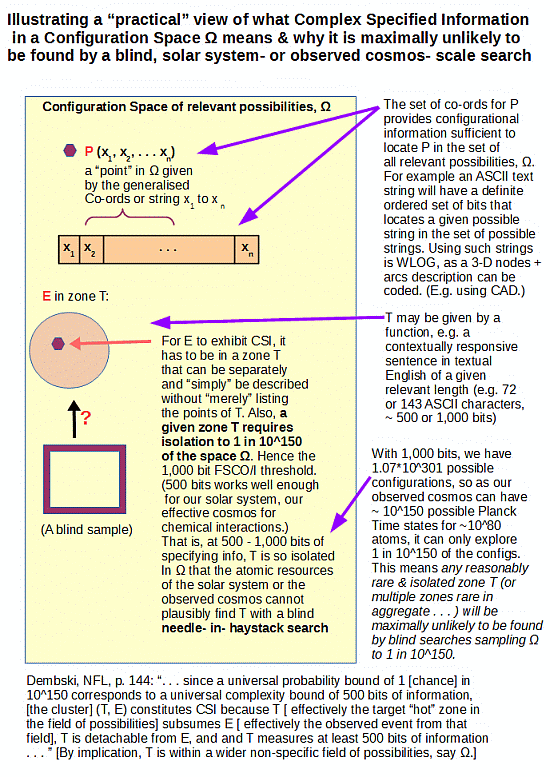
csi_defn

Similarly, we may document the inductive, inference to best current explanation logic of the design inference in a flow chart:
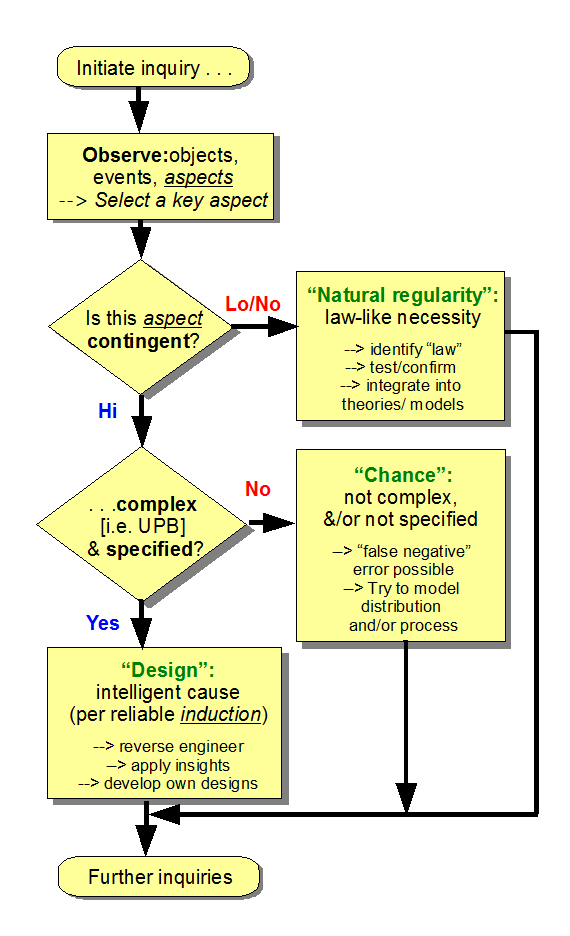
explan_filter

Also, we may give an iconic case, the protein synthesis process (noting the functional significance of proper folding),
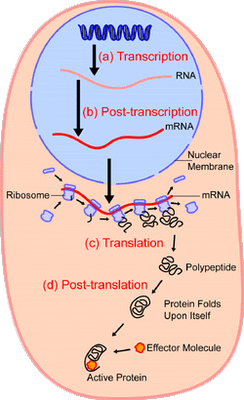
Proteinsynthesis

. . . especially the part where proteins are assembled in the ribosome based on the coded algorithmic information in the mRNA tape threaded through the Ribosome:
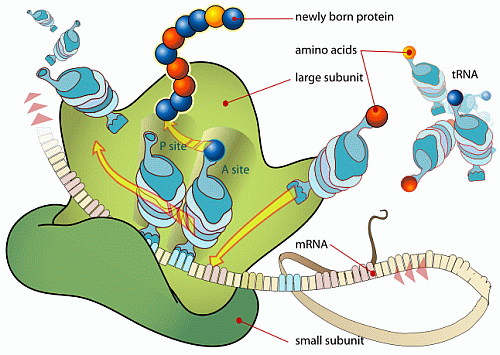
prot_transln

And, for those who need it, an animated video clip may be helpful:

So, instantly, we may ask: what is the only actually — and in fact routinely — observed causal source of codes, algorithms, and associated co-ordinated, organised execution machinery?

ANS: intelligently directed contingency, aka design, where there is no good reason to assume, imply or constrain such intelligence to humans.

Where also, FSCO/I or even the wider Complex Specified Information is not an incoherent mish-mash dreamed up by silly brainwashed or machiavellian IDiots trying to subvert science and science education by smuggling in Creationism while lurking in cheap tuxedos, but instead the key notions and the very name itself trace to events across the 1970’s and into the early 1980’s as eminent scientists tried to come to grips with the evidence of the cell and of cosmology, as was noted in reply to a comment on the UD Weak Argument Correctives:

. . . we can see across the 1970′s, how OOL researchers not connected to design theory, Orgel (1973) and Wicken (1979) spoke on the record to highlight a key feature of the organisation of cell based life:

ORGEL, 1973: . . . In brief, living organisms are distinguished by their specified complexity. Crystals are usually taken as the prototypes of simple well-specified structures, because they consist of a very large number of identical molecules packed together in a uniform way. Lumps of granite or random mixtures of polymers are examples of structures that are complex but not specified. The crystals fail to qualify as living because they lack complexity; the mixtures of polymers fail to qualify because they lack specificity. [The Origins of Life (John Wiley, 1973), p. 189.]

WICKEN, 1979: ‘Organized’ systems are to be carefully distinguished from ‘ordered’ systems. Neither kind of system is ‘random,’ but whereas ordered systems are generated according to simple algorithms [ –> i.e. “simple” force laws acting on objects starting from arbitrary and common- place initial conditions] and therefore lack complexity, organized systems must be assembled element by element according to an [ –> originally . . . ] external ‘wiring diagram’ with a high information content . . . Organization, then, is functional complexity and carries information. It is non-random by design or by selection, rather than by the a priori necessity of crystallographic ‘order.’ [“The Generation of Complexity in Evolution: A Thermodynamic and Information-Theoretical Discussion,” Journal of Theoretical Biology, 77 (April 1979): p. 353, of pp. 349-65.]

At the turn of the ’80′s Nobel-equivalent prize-holding astrophysicist and lifelong agnostic, Sir Fred Hoyle, went on astonishing record:

Once we see that life is cosmic it is sensible to suppose that intelligence is cosmic. Now problems of order, such as the sequences of amino acids in the chains which constitute the enzymes and other proteins, are precisely the problems that become easy once a directed intelligence enters the picture, as was recognised long ago by James Clerk Maxwell in his invention of what is known in physics as the Maxwell demon. The difference between an intelligent ordering, whether of words, fruit boxes, amino acids, or the Rubik cube, and merely random shufflings can be fantastically large, even as large as a number that would fill the whole volume of Shakespeare’s plays with its zeros. So if one proceeds directly and straightforwardly in this matter, without being deflected by a fear of incurring the wrath of scientific opinion, one arrives at the conclusion that biomaterials with their amazing measure or order must be the outcome of intelligent design. No other possibility I have been able to think of in pondering this issue over quite a long time seems to me to have anything like as high a possibility of being true.” [Evolution from Space (The Omni Lecture[ –> Jan 12th 1982]), Enslow Publishers, 1982, pg. 28.]

Based on things I have seen, this usage of the term Intelligent Design may in fact be the historical source of the term for the theory.

The same worthy also is on well-known record on cosmological design in light of evident fine tuning:

From 1953 onward, Willy Fowler and I have always been intrigued by the remarkable relation of the 7.65 MeV energy level in the nucleus of 12 C to the 7.12 MeV level in 16 O. If you wanted to produce carbon and oxygen in roughly equal quantities by stellar nucleosynthesis, these are the two levels you would have to fix, and your fixing would have to be just where these levels are actually found to be. Another put-up job? . . . I am inclined to think so. A common sense interpretation of the facts suggests that a super intellect has “monkeyed” with the physics as well as the chemistry and biology, and there are no blind forces worth speaking about in nature. [F. Hoyle, Annual Review of Astronomy and Astrophysics, 20 (1982): 16]

A talk given to Caltech (For which the above seems to have originally been conclusive remarks) adds:

The big problem in biology, as I see it, is to understand the origin of the information carried by the explicit structures of biomolecules. The issue isn’t so much the rather crude fact that a protein consists of a chain of amino acids linked together in a certain way, but that the explicit ordering of the amino acids endows the chain with remarkable properties, which other orderings wouldn’t give. The case of the enzymes is well known . . . If amino acids were linked at random, there would be a vast number of arrange-ments that would be useless in serving the pur-poses of a living cell. When you consider that a typical enzyme has a chain of perhaps 200 links and that there are 20 possibilities for each link,it’s easy to see that the number of useless arrangements is enormous, more than the number of atoms in all the galaxies visible in the largest telescopes. This is for one enzyme, and there are upwards of 2000 of them, mainly serving very different purposes. So how did the situation get to where we find it to be? This is, as I see it, the biological problem – the information problem . . . .

I was constantly plagued by the thought that the number of ways in which even a single enzyme could be wrongly constructed was greater than the number of all the atoms in the universe. So try as I would, I couldn’t convince myself that even the whole universe would be sufficient to find life by random processes – by what are called the blind forces of nature . . . . By far the simplest way to arrive at the correct sequences of amino acids in the enzymes would be by thought, not by random processes . . . .

Now imagine yourself as a superintellect working through possibilities in polymer chemistry. Would you not be astonished that polymers based on the carbon atom turned out in your calculations to have the remarkable properties of the enzymes and other biomolecules? Would you not be bowled over in surprise to find that a living cell was a feasible construct? Would you not say to yourself, in whatever language supercalculating intellects use: Some supercalculating intellect must have designed the properties of the carbon atom, otherwise the chance of my finding such an atom through the blind forces of nature would be utterly minuscule. Of course you would, and if you were a sensible superintellect you would conclude that the carbon atom is a fix.

These words in the same talk must have set his audience on their ears:

I do not believe that any physicist who examined the evidence could fail to draw the inference that the laws of nuclear physics have been deliberately designed with regard to the consequences they produce within stars. [“The Universe: Past and Present Reflections.” Engineering and Science, November, 1981. pp. 8–12]

So, then, why is the design inference so often so stoutly resisted?

LEWONTIN, 1997: . . . to put a correct view of the universe into people’s heads we must first get an incorrect view out . . . the problem is to get them to reject irrational and supernatural explanations of the world, the demons that exist only in their imaginations, and to accept a social and intellectual apparatus, Science, as the only begetter of truth [–> NB: this is a knowledge claim about knowledge and its possible sources, i.e. it is a claim in philosophy not science; it is thus self-refuting] . . . .

It is not that the methods and institutions of science somehow compel us to accept a material explanation of the phenomenal world, but, on the contrary, that we are forced by our a priori adherence to material causes [–> another major begging of the question . . . ] to create an apparatus of investigation and a set of concepts that produce material explanations, no matter how counter-intuitive, no matter how mystifying to the uninitiated. Moreover, that materialism is absolute [–> i.e. here we see the fallacious, indoctrinated, ideological, closed mind . . . ], for we cannot allow a Divine Foot in the door. [Billions and billions of demons, NYRB Jan 1997. If you imagine that the above has been “quote mined” kindly read the fuller extract and notes here on, noting the onward link to the original article.]

NSTA BOARD, 2000: The principal product of science is knowledge in the form of naturalistic concepts and the laws and theories related to those concepts [–> as in, Phil Johnson was dead on target in his retort to Lewontin, science is being radically re-defined on a foundation of a priori evolutionary materialism from hydrogen to humans] . . . .

Although no single universal step-by-step scientific method captures the complexity of doing science, a number of shared values and perspectives characterize a scientific approach to understanding nature. Among these are a demand for naturalistic explanations [–> the ideological loading now exerts censorship on science] supported by empirical evidence [–> but the evidence is never allowed to speak outside a materialistic circle so the questions are begged at the outset] that are, at least in principle, testable against the natural world [–> but the competition is only allowed to be among contestants passed by the Materialist Guardian Council] . . . .

Science, by definition, is limited to naturalistic methods and explanations and, as such, is precluded from using supernatural elements [–> in fact this imposes a strawman caricature of the alternative to a priori materialism, as was documented since Plato in The Laws, Bk X, namely natural vs artificial causal factors, that may in principle be analysed on empirical characteristics that may be observed. Once one already labels “supernatural” and implies “irrational,” huge questions are a priori begged and prejudices amounting to bigotry are excited to impose censorship which here is being insitutionalised in science education by the national science teachers association board of the USA.] in the production of scientific knowledge. [[NSTA, Board of Directors, July 2000. Emphases added.]

MAHNER, 2011: This paper defends the view that metaphysical naturalism is a constitutive ontological principle of science in that the general empirical methods of science, such as observation, measurement and experiment, and thus the very production of empirical evidence, presuppose a no-supernature principle . . . .

Metaphysical or ontological naturalism (henceforth: ON) [“roughly” and “simply”] is the view that all that exists is our lawful spatiotemporal world. Its negation is of course supernaturalism: the view that our lawful spatiotemporal world is not all that exists because there is another non-spatiotemporal world transcending the natural one, whose inhabitants—usually considered to be intentional beings—are not subject to natural laws . . . .

ON is not part of a deductive argument in the sense that if we collected all the statements or theories of science and used them as premises, then ON would logically follow. After all, scientific theories do not explicitly talk about anything metaphysical such as the presence or absence of supernatural entities: they simply refer to natural entities and processes only. Therefore, ON rather is a tacit metaphysical supposition of science, an ontological postulate. It is part of a metascientific framework or, if preferred, of the metaparadigm of science that guides the construction and evaluation of theories, and that helps to explain why science works and succeeds in studying and explaining the world. Now this can be interpreted in a weak and a strong sense. In the weak sense, ON is only part of the metaphysical background assumptions of contemporary science as a result of historical contingency; so much so that we could replace ON by its antithesis any time, and science would still work fine. This is the view of the creationists, and, curiously, even of some philosophers of science (e.g., Monton 2009). In the strong sense, ON is essential to science; that is, if it were removed from the metaphysics of science, what we would get would no longer be a science. Conversely, inasmuch as early science accepted supernatural entities as explainers, it was not proper science yet. It is of course this strong sense that I have in mind when I say that science presupposes ON. [In, his recent Science and Education article, “The role of Metaphysical Naturalism in Science” (2011) ]

In short, there is strong evidence of ideological bias and censorship in contemporary science and science education on especially matters of origins, reflecting the dominance of a priori evolutionary materialism.

To all such, Philip Johnson’s reply to Lewontin of November 1997 is a classic:

For scientific materialists the materialism comes first; the science comes thereafter. [Emphasis original.] We might more accurately term them “materialists employing science.” And if materialism is true, then some materialistic theory of evolution has to be true simply as a matter of logical deduction, regardless of the evidence. That theory will necessarily be at least roughly like neo-Darwinism, in that it will have to involve some combination of random changes and law-like processes capable of producing complicated organisms that (in Dawkins’ words) “give the appearance of having been designed for a purpose.”

. . . . The debate about creation and evolution is not deadlocked . . . Biblical literalism is not the issue. The issue is whether materialism and rationality are the same thing. Darwinism is based on an a priori commitment to materialism, not on a philosophically neutral assessment of the evidence. Separate the philosophy from the science, and the proud tower collapses. [Emphasis added.] [The Unraveling of Scientific Materialism, First Things, 77 (Nov. 1997), pp. 22 – 25.]

Please, bear such in mind when you continue to observe the debate exchanges here at UD and beyond. END

Comments
R0bb- The only evidence that we have says that CSI only comes from intelligent agencies. No one has ever observed nature, operating freely, produce anything close to CSI.Joe
October 8, 2014
October
10
Oct
8
08
2014
03:36 AM
3
03
36
AM
PDT
nightlight- the problem is there isn't any evidence for unguided processes producing CSI. Unguided processes break and deform- that is it.Joe
October 8, 2014
October
10
Oct
8
08
2014
03:31 AM
3
03
31
AM
PDT
F/N: From the conclusion, OP: >> . . . there is strong evidence of ideological bias and censorship in contemporary science and science education on especially matters of origins, reflecting the dominance of a priori evolutionary materialism. To all such, Philip Johnson’s reply to Lewontin of November 1997 is a classic:
For scientific materialists the materialism comes first; the science comes thereafter. [Emphasis original.] We might more accurately term them “materialists employing science.” And if materialism is true, then some materialistic theory of evolution has to be true simply as a matter of logical deduction, regardless of the evidence. That theory will necessarily be at least roughly like neo-Darwinism, in that it will have to involve some combination of random changes and law-like processes capable of producing complicated organisms that (in Dawkins’ words) “give the appearance of having been designed for a purpose.” . . . . The debate about creation and evolution is not deadlocked . . . Biblical literalism is not the issue. The issue is whether materialism and rationality are the same thing. Darwinism is based on an a priori commitment to materialism, not on a philosophically neutral assessment of the evidence. Separate the philosophy from the science, and the proud tower collapses. [Emphasis added.] [The Unraveling of Scientific Materialism, First Things, 77 (Nov. 1997), pp. 22 – 25.]
Please, bear such in mind when you continue to observe the debate exchanges here at UD and beyond. >> The above has abundantly underscored this. Let the onlooker of contemporary origins science and the student under contemporary science education beware. KFkairosfocus
October 8, 2014
October
10
Oct
8
08
2014
01:27 AM
1
01
27
AM
PDT
@R0bb #65
Regardless, you can look at any example of CSI-based design detection that you like, whether it be Hamlet or coins or DNA or ballot headers. In no case does an IDist base the calculation on the correct hypothesis of design, and in no case does the IDist say “This would have N bits of CSI if my chance hypothesis were the correct one.”
I don't claim to be an expert on the issue of CSI and Dembski's methods of calculation, and this largely because, as I've said, math is not my forte. In fact, for whatever areas I have in which I excel, my lack of ability to deal with remotely complex math will certainly serve to keep me humble (until I get a chance to learn it and take over the world ... muahahahah). That said, in the matter of what would be required to meet Barry's challenge, the answer has been absolutely clear to me from square one. In fact, even a very basic understanding of how CSI is used within the Design Inference to eliminate chance hypotheses, combined with very basic logic, makes the answer clear. Now, you cited Ewert's article to say that Barry's challenge has already been met, because there was a chance hypothesis addressed by Ewert that did not produce the pattern in Liddle's image but which resulted in a high CSI calculation. In turn, I explained that this obviously does not answer Barry's challenge, because in order to show that a chance process can produce 500 bits of CSI, you would need to show that the natural pattern claimed to have 500 bits of CSI had that amount of CSI when the calculation was based on the natural process known to have actually produced it. If the calculation of CSI attributed to a pattern changes and is dependent upon the chance hypothesis used to explain it, then it is obvious that a natural process that has produced some pattern can only be said to have produced 500 bits of CSI if the CSI calculation that results in a value of 500 bits is one that is based on that process known to have produced the pattern. If the CSI value is contingent on the chance hypothesis in question, you can't simply port over the CSI value from a calculation contingent on a different chance hypothesis that didn't produce the pattern. You seemed to think that this was nonsense and that I was misunderstanding how this is supposed to work, and evidently that I was misunderstanding Ewert. In light of this, I contacted Ewert. We've been having an interesting exchange that is still ongoing as I try to get a better handle on some of the logic of various aspects of CSI and the Design Inference. However, on the point of dispute between you and I, specifically over what would be required to meet Barry's challenge and demonstrate that a natural process had produced something like 500 bits of CSI, the discussion was very brief. I reproduce it here:
HeKS: So, for the purposes of Barry's challenge asking id opponents to give an example of natural processes actually producing 500 or more bits of CSI, it seems to me that the only way one could meet this challenge is to point to some object that was actually produced by natural processes where that object demonstrates 500 or more bits of CSI in a calculation that is made on the basis of that particular natural process that actually produced it. Isn't this correct? Do you get what I'm saying?
Ewert: Yes.? ?You're exactly right.
Dare I hope that you will now agree that I was accurately representing Ewert and the way that the calculation of CSI relates to Barry's challenge?HeKS
October 8, 2014
October
10
Oct
8
08
2014
12:06 AM
12
12
06
AM
PDT
My real point is that the none of the CSI ID arguments prove that the observed phenomena of life and its evolution are not even in principle computable (e.g. by some underlying computational process) i.e. they cannot be a manifestation of some purely lawful underlying processes.
The translation of information requires a local independence from physical determinism. It accomplishes this by preserving the necessary discontinuity between the arrangement of the medium and its post-translation effect. It's a coherent system, made coherent by this independence. It could not function without it. To say that it's all a result of underlying law is an assertion without evidence. It flies in the face of evidence. Additionally, the representations within genetic encoding are dimensional in nature, which means they exist independent of the minimum total potential energy principle (which otherwise applies to all physical objects). This separates the individual representations from the thermodynamic properties of the medium, which in turn enables effective long-term memory (i.e. it limits the set of objects required to encode memory, and moreover, the primacy of the pattern makes the representation transferable among mediums). Consequently, this also means that the system requires an entirely separate set of additional protocols to establish the dimensional operation of the system itself. None of this is locally derivable from the material that makes up the system. Which is to say that you'll need a whole set of interdependent causes at work in your mysterious unknown laws. On the other hand, we can posit that the most likely cause of all this is the same as it is in the only other example of such a system found in the cosmos. That would be in the altogether common use of recorded language and mathematics. - - - - - - - - - - (...which by the way, provides incontrovertible physical evidence that the material conditions required for recorded language and mathematics existed at the origin of the very first living cell on earth).Upright BiPed
October 7, 2014
October
10
Oct
7
07
2014
11:26 PM
11
11
26
PM
PDT
#73 Eric Anderson "Is your point really just that, yes, design is required, but that a smaller amount of original design is required than some people think? If that is the real point you are making, then fine." My real point is that the none of the CSI ID arguments prove that the observed phenomena of life and its evolution are not even in principle computable (e.g. by some underlying computational process) i.e. they cannot be a manifestation of some purely lawful underlying processes. The CSI arguments prove nothing of the sort. They carry no more weight or significance than someone looking at endless sequence of digits of number Pi and proving that these digits cannot be obtained as decimal digits from division A/B of two integers A and B. The Discovery Institute's ID then leaps from such non-controversial and correct result to "conclusion" that no arithmetic algorithm of any kind can produce that sequence of digits, hence they must be coming from 'conscious intelligent agency' that is beyond arithmetic algorithms (i.e. that no lawful process can exist that could generate life and its evolution, hence life must be result of action by a 'conscious intelligent agency'). How much computational front loading (hardware + software i.e. rules of the automata + initial configuration) is needed to produce phenomena of physical laws, fine tuning, life and its evolution, is another matter. I happen to believe (along with some number of others working on pregeometry models) that relatively simple front loading of the right kind of computational building blocks would suffice. But whatever the answer eventually turns out to be (simple or complex front loading), no one has proven that no amount of such computational (or lawful process based) front loading is sufficient as claimed in Discovery Institute's ID mythology.nightlight
October 7, 2014
October
10
Oct
7
07
2014
07:43 PM
7
07
43
PM
PDT
#72 Silver Asiatic "Also, as I mentioned, the presence of functional CSI (information that does something or communicates some meaning or shows a purpose) is another means of saying "higher CSI". There is no coherent universal definition of "functional" (CSI) -- anything does something, changes something, downstream, via interactions. When is that "something" deserving of label "functional" effect? If it makes you (S.A.) money, or keeps you (S.A) alive, you (S.A.) may call it "S.A.-functional" since it does something S.A. happens to care about. But if a rock breaks off and leaves its imprint in the mud, that is not "S.A.-functional" since it does nothing S.A. cares about. In short "functional" is an arbitrary label without intrinsic or universal meaning or definition. One can attach it or not attach it to any effects of any interactions as one wishes. The upshot is, such semantic games are not going to prove God or convince anyone to teach any such word play at schools as natural science.nightlight
October 7, 2014
October
10
Oct
7
07
2014
06:59 PM
6
06
59
PM
PDT
nighlight: Ignoring your religious aspersions as irrelevant, we note that your hypothesis that "the amount of CSI needed for life or proteins or fine tuning by a computing process underlying universe and its laws may be relatively trivial . . . " is largely unsupported by anything other than your assertion. Nevertheless, even at that you still aren't answering the question of where those "few lines of code" came from. Is your point really just that, yes, design is required, but that a smaller amount of original design is required than some people think? If that is the real point you are making, then fine. We note the lack of empirical support, but, sure, probably less design is required than some people think.
Therefore declaring some figure say of 500 bits as the CSI of some protein, and asking how it got to have all these 500 bits of ‘complex specified information’, is as “profound” as declaring that some object has x coordinate of 500 yards and asking how it got to have all these 500 yards of x coordinate. It has got x=500 yards because you chose x=0 to be 500 yards away from it, that’s how. The same goes for the 500 bits of CSI — a sequence has got 500 bits of CSI because you assumed kind of computer and algorithm which needs 500 bits of program to generate that string.
This raises a couple of interesting issues. First, your primary point (some simpler algorithm might have generated the 500 bits) is, again, little more than an assertion and is based on, we might be forgiven for pointing out, the mere possibility that there might exist some algorithm of fewer bits that could produce the protein that might someday be discovered. So you are essentially asking us to rely on a non-existent, unproven, unknowable, as-yet-undiscovered algorithm that could generate a protein, and not just any protein, but essentially all proteins, and protein complexes, and molecular machines, and cells, and tissues, and organs and organisms. All from a simple "few lines of code." This is an argument built firmly on a lack of evidence. Second, and somewhat more interesting is the question of whether some number of bits, say 500, has any inherent meaning. No it really doesn't, at least not in terms of function or information of specification. I'm in the middle of a post on that very issue, which hopefully will get posted in the next couple of days, but suffice it to say that the question of "bits" in a string is really only relevant for ruling out determinism and identifying a threshold of complexity. It does not help us identify specification. (This is precisely the point I have been making on the other thread, "KF Cuts to the Chase (Again)."Eric Anderson
October 7, 2014
October
10
Oct
7
07
2014
06:11 PM
6
06
11
PM
PDT
The ‘specification’ pattern can be anything. It is the correlation with a second pattern that makes the second pattern have ‘specified information’. I can’t find “echoing” exception (or its definition) in any CSI definition.
An echoed pattern is not the original generation of information. Gene duplication is not considered the creation of new CSI.
Namely, how do you know that biological CSI isn’t also “echoing” merely with a longer chain of interactions than rock and mud.
We don't know, but we don't observe any echo. How do we know that biological CSI isn't a replication of something the intelligent designer created? Again, we know what we observe - and if we observe Hamlet's soliloquy reflected off the surface of water, we don't consider the water to be the generator of CSI.
But there is nothing in the CSI definitions that sets some threshold on the length of chain of interactions below which it is called “echoing” and above which it becomes CSI phenomenon.
We're looking for the original source of the CSI. It's a question of origins. When you press the wet ink of a printed page on a flat surface, the surface shows that CSI -- but it's not the origin of it. The wet paint of an illustration can press against a surface and leave a print -- but the surface is not the origin of the CSI in the illustration.
Would that be long enough chain of interaction to get us beyond the “echoing” threshold you just made up above?
Again, it's a question of the original generation of CSI and not copies of the same.
What about a robot or a sculptor watching the rock and shaping the mud (or amber) into the same 3-D imprint? Is there CSI in either of these imprints?
Interesting question and I would say "no". There are some gray areas in discerning CSI. For example, there are Jackson Pollack styled paintings which are "designed" but use a randomizing technique making them virtually indistinguishable from non-designed splotches. Is there CSI in the designed version and not in the random? In the same way, we could be receiving high-CSI content radio signals every day from space but we can't match them to specified patterns at present so we can't recognize the CSI in them. Sure, a sculptor could carve a rock to make it look like a piece of rock that broke off another. Or the sculptor deliberatly break the rock. But a rock doesn't provide much by way of a recognizable pattern. Also, I think it's problems like this, that you raise -- which moved the discussion to functional CSI (FCSI) which is a later development from Dr. Dembski's work.
Of course, instead of rock, it could have been human face that struck the mud, which then turned into amber sculpture, which gets us closer to the favorite Mount Rushmore example of CSI.
Or a fossil, of course. But again, it's a search for origins.
Specifically, which kinds of interaction chains between CSI rich object features and its specification are allowed and which disallowed (give precise characterization of interactions so a robot can measure and deduce which is which), for declaring that something demonstrates presence of high CSI?
I think it's dependent on the quantity of CSI in the matched pattern, for one thing. Also, as I mentioned, the presence of functional CSI (information that does something or communicates some meaning or shows a purpose) is another means of saying "higher CSI".Silver Asiatic
October 7, 2014
October
10
Oct
7
07
2014
05:58 PM
5
05
58
PM
PDT
#68 Nightlight – Thanks for the response. In reply: first, Barry hasn't changed the goalposts. My query was not necessarily consistent with Barry's point, if I understood it correctly (which is by no means certain): I am not persuaded that bare low-probability CSI is sufficient to justify a design hypothesis (which is what, on the face of it, Barry's case seemed to possibly imply), and I was in part therefore questioning that; however, I note that the explanatory filter in the original post does include other considerations (necessity and chance), so Barry's CSI might just be shorthand for the whole package (in which case I'm not sure what Barry is in particular driving at). Following the way the discussion was going I was questioning whether these other components were being overlooked. Secondly, I do not need to prove that there was no law-like (or chance) process which produced intelligent designer organisms: I observe that the appearance of design can result from necessity, chance or intentional conscious mindful design, or a combination of these. ID, as I understand it, provides an unequivocal law-like method of identifying the certain tell-tale signs of intentional conscious mindful design within a certain range of defined conditions; on the basis of those signs an intelligent design hypothesis is formulated which can then be subject to further enquiry and test. I simply observe that personal design exists and consider that ID, as a scientific methodology formulated along the above lines, is a reliable way to detect it (within its defined range of limitations). If you propose that the intelligent designer is in fact ultimately the product of exclusively chance and necessity (and so intelligent design is reducible to chance and necessity) then it is up to you to prove it: "he who asserts must prove". Again, I am not at all convinced that natural (non-conscious/non-mindful) agents cannot produce CSI: however, the production of CSI is characteristic of minds at work, and what ID does (in my view) is separate the ultimately conscious/intentional/mindful sources of CSI production from the ultimately non-conscious/non-intentional/non-mindful sources of CSI. The majority of the rest of your post seems to be an appeal to our ignorance to justify a conclusion of non-intentional design (or to justify a conclusion that intentional design cannot be reliably hypothesised); but we cannot rely upon “what ifs” to get along: ID as formulated above claims reliability in identifying intentional design: it provides positive justification for formulating design hypotheses. In each hypothesised case it is up to us to then examine it and test it. There may be other (even better) explanations/descriptions, but it is up to their advocates to justify and test them, not merely raise them as speculative objections or assertions (which is what many 'big name' critics of ID do). Science is grounded in observation, description, analysis, hypothesis and test – not mere speculation beyond those observations, descriptions and analyses. Finally, in rough terms, tractable and conditional independence looks at proximity and remoteness of potential causal linkages: in short, relevance (at least, that's how I perceive it—which, again, might be a mis-perception on my part). Yes, in some way everything is conditionally dependent on something else before or contemporary with it to a degree, but this point on your part really seems to be a case of obfuscation; the point is that the specification should not directly and necessarily trigger or physically cause the thing specified. In the case of your stone, the antitype or impression (with its CSI) was directly caused by the specification - the contours or type - of the stone: it wasn't remotely independent. Anyway, thanks for giving me food for thought.Thomas2
October 7, 2014
October
10
Oct
7
07
2014
05:45 PM
5
05
45
PM
PDT
#69 Eric Anderson Assuming for a moment that much of nature can be understood as the result of computational processes, the question is: Where did those computational processes come from? Any deductive system DS1 needs some starting premises (postulates) that are taken for granted within that system DS1. Of course, there could be some other deductive system DS2 in which some of the premises from DS2 are deduced, but still only from the premises of DS2. Deductive system DS0 with no premises is empty system -- it says nothing since nothing follows from it. The ontological counterpart of the 'starting premises' of DS (which is epistemological category) is 'front loading' of the physical system PS being described by the deductive system DS. Hence, the natural science at any stage of its development always takes for granted existence of (front loaded) physical system PS (universe) satisfying the postulates (starting premises) of that science. How did the PS come to have particular starting properties is not something that given DS can answer. Only some new DS2 can explain the starting premises of some other DS1. The interesting question is how much front loading does one need and how complicated does it have to be to explain the known phenomena in the universe (including fine tuning & life). Religious dogmas commonly declare that only an action of all-knowing and all-powerful being is the minimum requirement on the front loading needed to explain the known facts about universe. Curiously, though, the priesthoods making and peddling such proclamations, always somehow happen to have a secret, invisible channel with that being through which the instruction allegedly came down that you, as a mere mortal, owe them obedience plus 10% or some such of all the fruits of your labors, or the being will get angry at you and bad things will happen. Well, how convenient. As explained over previous posts in this thread (e.g. here), what research of computational processes has shown is that far simpler front loading (than actions of omniscient and omnipotent being) suffices. Namely, networks consisting of simple finite state automata connected via adaptable links work as distributed self-programming universal computers i.e. they can compute anything that is conceivably computable (including anything we presently compute with our computing technology). Their intelligence is additive i.e. it grows as more of the same kinds of simple nodes & links are added to the network. Hence the minimum front loading needed to explain universe is far less powerful and wise than the omnipotent and omniscient being of conventional religions or theism/deism. The 'chief programmer of the universe' i.e. the 'front loader', need not have any more clue as to what such system of networked automata will eventually come up with, than a human programmer who wrote a simple few line program to compute million digits of Pi would have about the digits that will turn up. Chess programmers are quite familiar with this phenomenon (of child exceeding their parent)-- their own chess programs are as a rule much stronger chess players than themselves. nightlight completely misses the question at hand, and thus stumbles over himself to provide a red herring non-answer to something other than the real question at issue. Just because you didn't get it, doesn't make it "red herring." I am still awaiting a coherent answer to CSI questions I asked and why the counter-examples provided don't work. All I got back instead so far are ad hominem or non sequitur responses. My basic issue with CSI is that most people here apparently don't understand that "information" (including CSI) are relative quantities like velocity or coordinates x,y,z. The coordinate x of some object is always meant as distance from some point arbitrarily defined as point with x=0. Similarly, amount of "information" S(A) in some sequence of symbols A is always meant as the minimum length (in bits) of program P on some computer C that can generate sequence A. For example, if someone gave you 1 million bits of Pi, and you have no idea about what number Pi is, much less how to compute it, you would declare that the sequence has million bits of information. Yet the program that produced it on regular PC may have been only 500 bits long. Therefore declaring some figure say of 500 bits as the CSI of some protein, and asking how it got to have all these 500 bits of 'complex specified information', is as "profound" as declaring that some object has x coordinate of 500 yards and asking how it got to have all these 500 yards of x coordinate. It has got x=500 yards because you chose x=0 to be 500 yards away from it, that's how. The same goes for the 500 bits of CSI -- a sequence has got 500 bits of CSI because you assumed kind of computer and algorithm which needs 500 bits of program to generate that string. As suggested above, the research of computational processes which might explain our physical laws (including space-time) suggests that far less and far simpler front loading is needed than usually proclaimed by theologians and religions. Hence, the amount of CSI needed for life or proteins or fine tuning by a computing process underlying universe and its laws may be relatively trivial (like few lines of code for the automata rules, as Wolfram believes), just like front loading needed to compute billions of digits of Pi, or of square root of 2,... on conventional computer is a few line program.nightlight
October 7, 2014
October
10
Oct
7
07
2014
05:28 PM
5
05
28
PM
PDT
nightlight @6 claims that nature can be completely understood in terms of computational processes. Assuming for a moment that much of nature can be understood as the result of computational processes, the question is: Where did those computational processes come from? The certainly didn't come from law-like necessity. That is anathema to computational processes. So we're left with blind dumb luck as the answer. And so the question remains: are functional computational processes more likely the result of blind dumb luck or the result of intelligent purpose and planning. It isn't even a close call. The "creator" of the materialist creation myth is a lame, pathetic, incompetent bunch of particles bumping into each other -- something that has never been shown to produce anything even close to the kinds of computational processes nightlight refers to. No-one in the ID camp is arguing that processes in living organisms do not follow rules of chemistry and physics. The question is: Where did the computational process that mediates the inexorable effect of chemistry and physics come from? nightlight completely misses the question at hand, and thus stumbles over himself to provide a red herring non-answer to something other than the real question at issue.Eric Anderson
October 7, 2014
October
10
Oct
7
07
2014
03:51 PM
3
03
51
PM
PDT
#66 Thomas2 "If that is a fair summary, then the stone impression may indeed exhibit significant CSI, but that would not be sufficient to draw a design inference because the stone impression will have been the result of law-like (deterministic) cause" Well, first Barry asks for some example of CSI that is produced by a law-like process. I provide example, but now the goalpost has moved and any law-like process/cause is apparently excluded by definition (whose definition?). But let's say, hust for the fun I go along and approve the amendment of no law-like process/cause for any CSI. But then, how do you prove that there was no law-like process behind transformations of matter-energy that started with non-live matter-energy and transformed it into live matter-energy (cells and other organisms). Namely, if there is a law-like process/cause that can produce such transformation (from non-live matter-energy to live), then there is no CSI in the live organisms by the above amended CSI exclusion rule, hence there is nothing to debate as to who created the CSI of the live organisms that is not there. In fact, that level of transformation of matter-energy from non-live into live by law-like processes isn't all that far fetched -- it happens all the time. For example, we know that law-like processes of metabolism, reproduction and ontogenesis can transform energy, food and water into cells and live organisms such as new humans that didn't exist before and which are built of previously non-live matter (atoms of food & water making up their cells). Hence law-like processes that can achieve that degree of transformation are not in principle impossible, they exist and we know them. In other words, there exist the initial conditions for some chunk of matter-energy (= the state of 'parent' organisms and their food & energy) which yield that kind of law-like transformation of surrounding matter-energy within a short time relative to age of universe. Once you know that at least one set of initial conditions can produce transformation of matter-energy from non-live to live via lawful processes, the question is how do you know that there are no other initial conditions that can do the same? Note for those unfamiliar with term "initial conditions" -- the natural laws by themselves don't determine what some system will do. E.g. while a ball does obey Newton laws of motion and gravity, these laws don't tell you how the ball will move or where and when it will land. To deduce what ball will do, you need also to input into the "physics algorithm" (equations) the "initial conditions" of the ball, such as its starting position and velocity. Only the combination of these two sets of data, the 'natural laws' + 'initial conditions', yields definite behavior of the ball. With that explanation, the previous example of transformation of matter energy from non-live to live via lawful or law-like processes is saying that the 'initial conditions' of matter energy which are known to yield such transformation are the physical state of 'parent' organisms plus state of their food & energy used in the transformation into new organisms. There was never any evidence found of anything violating natural laws within such processes of transforming non-live matter-energy to live organism. Hence, having never observed non-lawlike interventions in the above known examples of such transformation processes, we can conclude that some future more advanced technology will be able to have a computerized process that performs the entire transformation of non-live to live matter-energy, while operating under explicitly known law-like processes, in every detail and step by step. But then, as explained in earlier posts in this thread, if some computing processes like that future technology can produce such transformation, some other computing processes (such as networks of simple cellular automata) underlying the operation of universe and its physical laws can also produce the existent life without human programmers or technology involved. "and even more because it is not at all conditionally independent of the specification." Nothing is "conditionally independent" from anything that has the common backwards light cone i.e. everything on Earth is in principle dependent (via physical interactions) on anything else in the universe within a sphere of 14+ billion light years around Earth.nightlight
October 7, 2014
October
10
Oct
7
07
2014
03:33 PM
3
03
33
PM
PDT
Barry:
There is no need to form any hypothesis whatsoever to meet the challenge.
Since Dembski defines CSI in terms of a hypothesis, you must be using some other definition of CSI which you haven't shared with us. That makes for a pretty safe challenge.R0bb
October 7, 2014
October
10
Oct
7
07
2014
12:32 PM
12
12
32
PM
PDT
Nightlight - I seem to have missed something: in a nutshell (as I understand it), ID as a would-be scientific theory states that where in nature an entity exhibits non-deterministic, appropriately statistically significant, tractable and conditionally independent specified complexity then an unequivocal design inference/hypothesis can be made; and that CSI is a particular way of defining and quantifying specified complexity. If that is a fair summary, then the stone impression may indeed exhibit significant CSI, but that would not be sufficient to draw a design inference because the stone impression will have been the result of law-like (deterministic) cause and even more because it is not at all conditionally independent of the specification.Thomas2
October 7, 2014
October
10
Oct
7
07
2014
12:32 PM
12
12
32
PM
PDT
HeKS:
I don’t have that book by Dembski
You can see the passage here.
Dembski is here providing the calculation of the mere complexity of the sequence, not its specified complexity or degree of specification.
In Dembski's old way of measuring CSI, specificity was binary, and if an event was specified, then its amount of CSI was simply its amount of complexity. His current definition folds the degree of specificity into the CSI measure, along with probabilistic resources. (And he shifts the "design threshold" accordingly -- it's now zero bits rather than 500 bits.) Also, note that in the passage above, he's doing the calculation in order to demonstrate "CSI holism". Regardless, you can look at any example of CSI-based design detection that you like, whether it be Hamlet or coins or DNA or ballot headers. In no case does an IDist base the calculation on the correct hypothesis of design, and in no case does the IDist say "This would have N bits of CSI if my chance hypothesis were the correct one."R0bb
October 7, 2014
October
10
Oct
7
07
2014
12:15 PM
12
12
15
PM
PDT
#62 Silver Asiatic "The rock itself is not specified information since its shape is formed randomly." The 'specification' pattern can be anything. It is the correlation with a second pattern that makes the second pattern have 'specified information'. I can't find "echoing" exception (or its definition) in any CSI definition. "The image of the rock in the mud also does not create new CSI — it merely echoes whatever information is in the rock." Just labeling it "echoing" doesn't distinguish it from usual examples of CSI. Namely, how do you know that biological CSI isn't also "echoing" merely with a longer chain of interactions than rock and mud. But there is nothing in the CSI definitions that sets some threshold on the length of chain of interactions below which it is called "echoing" and above which it becomes CSI phenomenon. All that CSI asks for are the two correlated sequences (e.g. values of some physical variables), one which is called 'specification' for the other. Imagine for example that the rock landed on a log in a river after bouncing from a mud where it left its 3-D image. Then the rock on this log got carried by the river and ocean currents far away, say to another continent. At the same time, a tree resin dripped into and filled the mud imprint, hardened over time into a big chunk of amber. Now someone finds this chunk of amber say in Africa, then travels to America and finds there a rock that closely matches (in millions of bits of CSI) the amber block. Would that be long enough chain of interaction to get us beyond the "echoing" threshold you just made up above? What about a robot or a sculptor watching the rock and shaping the mud (or amber) into the same 3-D imprint? Is there CSI in either of these imprints? Interactions between rock and a hole were different in three cases, but there is nothing in CSI "theory" that distinguishes one from the other. Of course, instead of rock, it could have been human face that struck the mud, which then turned into amber sculpture, which gets us closer to the favorite Mount Rushmore example of CSI. What precisely are the semantic lines of CSI rich phenomena? Specifically, which kinds of interaction chains between CSI rich object features and its specification are allowed and which disallowed (give precise characterization of interactions so a robot can measure and deduce which is which), for declaring that something demonstrates presence of high CSI?nightlight
October 6, 2014
October
10
Oct
6
06
2014
08:12 PM
8
08
12
PM
PDT
Worth repeating, as this objection to her (mis-)characterization of the argument for ID came up repeatedly here at UD:
Liddle’s primary objection is that we cannot calculate the P(T|H), that is, the “Probability that we would observe the Target (i.e. a member of the specified subset of patterns) given the null Hypothesis.” However, there is no single null hypothesis. There is a collection of chance hypotheses. Liddle appears to believe that the design inference requires the calculation of a single null hypothesis somehow combining all possible chance hypotheses into one master hypothesis. She objects that Dembski has never provided a discussion of how to calculate this hypothesis. But that is because Dembski’s method does not require it. Therefore, her objection is simply irrelevant.
Mung
October 6, 2014
October
10
Oct
6
06
2014
07:15 PM
7
07
15
PM
PDT
Interesting example, but it doesn't quite work. The rock itself is not specified information since its shape is formed randomly. The image of the rock in the mud also does not create new CSI -- it merely echoes whatever information is in the rock. It would be like the image of something reflected in smooth water. The water isn't creating new CSI. Or the echo of musical notes in a canyon - the canyon is not creating new CSI.Silver Asiatic
October 6, 2014
October
10
Oct
6
06
2014
06:06 PM
6
06
06
PM
PDT
#59 My challenge will be met when someone shows a single example of chance/law forces having been actually observed creating 500 bits of CSI. Say a chunk of a rock on some slope breaks off and falls down on a muddy bank, then bounces off nearby. At this point you have a highly detailed and accurate 3-D mud imprint of the face of the rock, with megabits worth of information (e.g. if you tried to scan, digitize and compress it), plus you also have its 'specification' nearby, the rock which matches this 3-D mud image. So, a pure lawful behavior yielded millions of bits of CSI in front of your eyes. Of course, a robot could have created similar 3-D imprint of a rock, too. Or human sculptor. In all 3 cases it is interaction between a rock and mud through whatever chain of intermediary objects and interactions (e.g. photons bouncing on rock's face if robot or human were viewing the rock to create its imprint in the mud, plus any tools they used to shape the mud) that produced the CSI. With CSI examples in the live organisms, we don't know the chain of interactions that produced it as we do for the above mud imprint in the rock, but there is no scientific law or principle or a mathematical theorem that precludes existence of such chain of interactions, Dembski's no free lunch reasoning notwithstanding. Namely, Dembski's 'no free lunch' argument translated into the above rock & its mud imprint example, amounts to restricting the possible interaction chains by wishfully adding arbitrary assumptions about the 'allowed interaction chains', then showing that within his 'allowed set of interaction chains' there is none that could have yielded the imprint with that amount of CSI.nightlight
October 6, 2014
October
10
Oct
6
06
2014
05:00 PM
5
05
00
PM
PDT
@R0bb #57
Consider, for example, page 174 of Dembski’s book Intelligent Design: The Bridge Between Science and Theology, where he is explaining “CSI holism” and using “METHINKS IT IS LIKE A WEASEL” as an example. He says, “Moreover, because the sentence is a sequence of 28 letters and spaces, its complexity comes to -log2(1/27^8) = 133 bits of information.” This is based on a chance hypothesis of uniform randomness, even though the correct hypothesis is that the phrase was designed. Why do you not consider this confused and nonsensical, as you do when we’re talking about natural processes rather than design?
I don't have that book by Dembski so I can't check that reference or speak particularly intelligently about the larger context of what he's saying. However, I do notice this: "Moreover, because the sentence is a sequence of 28 letters and spaces, its complexity comes to -log2(1/27^8) = 133 bits of information" Unless he says something in the larger context to contradict the normal distinctions in terminology that is typically used on this matter (and which Ewert uses in his articles), Dembski is here providing the calculation of the mere complexity of the sequence, not its specified complexity or degree of specification. Consider what Ewert says in one of the relevant articles:
Under Dembski's definition, an event is complex if it is improbable, and specified if it matches an independent pattern. Events that have both properties are said to exhibit CSI. We may infer that an event that exhibits CSI under all possible chance hypotheses is a product of design.
And...
If a given object is highly improbable under a giving hypothesis, i.e. it is unlikely to occur, we say that the object is complicated. If the object fits an independent pattern, we say that it is specified. When the object exhibits both of these properties we say that it is an example of specified complexity. If an object exhibits specified complexity under a given hypothesis, we can reject that hypothesis as a possible explanation.
And...
At a couple of points, Liddle seems to misunderstand the design inference. As I mentioned, two criteria are necessary to reject a chance hypothesis: specification and complexity. However, in Liddle's account there are actually three. Her additional requirement is that the object be "One of a very large number of patterns that could be made from the same elements (Shannon Complexity)." This appears to be a confused rendition of the complexity requirement. "Shannon Complexity" usually refers to the Shannon Entropy, which is not used in the design inference. Instead, complexity is measured as the negative logarithm of probability, known as the Shannon Self-Information. But this description of Shannon Complexity would only be accurate under a chance hypotheses where all rearrangement of parts are equally likely. A common misconception of the design inference is that it always calculates probability according to that hypothesis. Liddle seems to be plagued by a vestigial remnant of that understanding.
In any case, I've reached out to Ewert to offer some clarification on this issue. We'll see if he responds. In the meantime, I need to get some actual work done :)HeKS
October 6, 2014
October
10
Oct
6
06
2014
04:28 PM
4
04
28
PM
PDT
RObb and HeKS Here is my challenge from above:
Show me one example – just one; that’s all I need – of chance/law forces creating 500 bits of complex specified information. [Question begging not allowed.] If you do, I will delete all of the pro-ID posts on this website and turn it into a forum for the promotion of materialism. [I won’t be holding my breath.] I understand your faith requires you to taunt us like this; yours is a demanding religion after all; but until you can do that, your taunts seem premature at best and just plain stupid at worst.
I thought my challenge was plain enough, but I will clarify for RObb. There is no need to form any hypothesis whatsoever to meet the challenge. The provenance of the example of CSI that will meet the challenge will be ACTUALLY KNOWN. That is why I put the part about question begging in there. It is easy for a materialist to say “the DNA code easily has more than 500 bits of CSI and we know that it came about by chance/law forces.” Of course we know no such thing. Materialists infer it from the evidence, but that is not the only possible explanation. Let me give you an example. If you watch me put 500 coins on a table and I turn all of them “heads” up, you will know that the provenance of the pattern is “intelligent design.” You do not have to form a chance hypothesis and see if it is rejected. You sat there and watched me. There is no doubt that the pattern resulted from intelligent agency. My challenge will be met when someone shows a single example of chance/law forces having been actually observed creating 500 bits of CSI.Barry Arrington
October 6, 2014
October
10
Oct
6
06
2014
02:56 PM
2
02
56
PM
PDT
P.S. Sorry for the blockquote mess-up in the last part. The sentence "No, because what we’re talking about is the second step in the Design Inference" is HeKS's.R0bb
October 6, 2014
October
10
Oct
6
06
2014
01:43 PM
1
01
43
PM
PDT
HeKS, I don't have much time, so it's good that we're getting to the heart of our disagreement:
In any given case, ‘natural processes’ can only be said to have produced the amount of CSI that is calculated on the basis of the specific natural process that actually produced the effect in question.
On what do you base this claim? In everything that has been written about CSI, can you show me anything to support this? When Dembski and other ID proponents say that intelligent designers create CSI, are they talking about CSI calculated on the basis of the hypothesis of design? Of course not. They're talking about CSI calculated on the basis of some chance hypothesis H, even though H didn't actually produce the effect. Consider, for example, page 174 of Dembski's book Intelligent Design: The Bridge Between Science and Theology, where he is explaining "CSI holism" and using "METHINKS IT IS LIKE A WEASEL" as an example. He says, "Moreover, because the sentence is a sequence of 28 letters and spaces, its complexity comes to -log2(1/27^8) = 133 bits of information." This is based on a chance hypothesis of uniform randomness, even though the correct hypothesis is that the phrase was designed. Why do you not consider this confused and nonsensical, as you do when we're talking about natural processes rather than design?
R0bb, that is EXACTLY what Barry’s challenge was asking for. That just IS Barry’s challenge in different words. Any other challenge would be ludicrous, since it is ridiculously easy to generate high CSI values when using the WRONG chance hypothesis, as Ewert’s article amply demonstrates.
Barry's challenge is an "other challenge", since he never says that the calculation must be based on the correct hypothesis, and there is nothing in the ID literature that says or implies anything about basing CSI calculations on the correct hypothesis, nor are there any examples of Dembski or anyone else doing this. I honestly have no idea where you got the idea from. And I agree that the challenge is ludicrous.
Ewert is accurately representing Dembski’s work, which involves identifying ALL relevant chance hypotheses that might explain some object, pattern, event, etc. See Ewert’s third article on this subject, where he addresses this misconception you seem to have about calculating CSI with respect to only one chance hypothesis.
What misconception? I said that "when IDists calculate CSI in practice, it is almost always with respect to only one chance hypothesis, that of white noise." Are you saying that this isn't true?
- You’ve made some remarks regarding the design inference. But Barry’s challenge and my response to it have nothing to with the design inference. Do you agree?
No, because what we’re talking about is the second step in the Design Inference. Here is Barry's challenge: "Show me one example – just one; that’s all I need – of chance/law forces creating 500 bits of complex specified information. [Question begging not allowed.]" Note: 1) The challenge refers only to CSI, not to the design inference. 2) Dembski's definition of CSI makes no reference to the design inference. 3) Therefore, we don't need to refer to the design inference in order to understand Barry's challenge, and, in the interest of managing the scope of our discussion, I propose we leave it out. If you think that Barry meant something more than what he actually said, then we should bring Barry into the discussion. (I wish he'd join it anyway.)R0bb
October 6, 2014
October
10
Oct
6
06
2014
01:36 PM
1
01
36
PM
PDT
@R0bb #54 We seem to actually agree on a lot of points this time so I'm going to give this another try...
Ewert did not give a calculation of CSI inherent in the image itself,
Again, you’re talking as if there is such thing as “CSI inherent in the image itself”, as distinct from “CSI in the image with respect to chance hypothesis H”. Can you tell me how to calculate the CSI inherent in a thing itself?
No, I'm saying exactly that there is NOT such a thing as "CSI inherent in the image itself" because the CSI can only be calculated with reference to the backdrop of a particular proposed naturalistic hypothesis. I was saying that Ewert did not give such a calculation of the CSI inherent in the image itself because it seemed to me, based on the way you were talking, that you thought he somehow had. At least that was one of only two ways I thought you could be interpreting him that made your claim seem coherent to me.
The only high-CSI values Ewert offered for the image were based on two natural mechanisms that did not produce the pattern and you agree that these processes did not produce any high-CSI pattern.
I’ll say it again: The question of which process actually produced the pattern is completely irrelevant to CSI calculations. If you disagree with this, then please say so explicitly. If you agree with it, then why do you keep bringing up the fact that the processes described by the chance hypotheses didn’t actually produce the pattern?
This is where I start to feel like I'm entering the Twilight Zone. Look again at Barry's challenge:
Show me one example … of chance/law forces creating 500 bits of complex specified information.
Let me add a word to this which does not change but merely draws out the obvious meaning of what Barry said:
Show me one example … of chance/law forces [ACTUALLY] creating 500 bits of complex specified information.
In order for this challenge to be met we would need a naturalistic process, called X, to produce some object / pattern / event that had 500 or more bits of CSI when the calculation was made with respect to process X! I don't know how I can be any more clear. You cannot meet the challenge by saying, for example: 1) Process X produced a pattern that, when calculated with respect to Process X, is found to have 2 bits of CSI 2) When a CSI calculation is performed on the pattern produced by Process X under the hypothesis that it was produced by Process Y, the pattern is found to have 3,000 bits of CSI 3) Therefore, a natural process has produced over 500 (i.e. 3,000) bits of CSI This just doesn't make any sense. It is completely confused. The way that the above example is properly interpreted is that, in this example, a natural process produced 2 bits of CSI. NOT 3,000 bits of CSI! The value produced by a CSI calculation tells us how much CSI the object or pattern would be found to have IF it was produced by the naturalistic hypothesis upon which the calculation was based. You cannot take a value for the amount of CSI a pattern WOULD have IF it was produced by a process that DIDN'T produce it and then say that some natural process produced that amount of CSI. Again, that is completely confused. If the naturalistic hypothesis that was used to calculate the high CSI value for a pattern is not the hypothesis that was actually responsible for producing the pattern then that hypothesized process did not produce that high amount of CSI. So, coming back to your comment, you said:
The question of which process actually produced the pattern is completely irrelevant to CSI calculations. If you disagree with this, then please say so explicitly.
Whether this is true or false depends on how you mean it. It is obviously true that CSI calculations can be performed with respect to naturalistic hypotheses that did not create the object, pattern, etc. under consideration, since the whole point of the CSI calculation is to determine if the hypothesis can be eliminated from consideration as being the correct one. So being the correct hypothesis is not a precondition for simply performing a calculation to find out how much CSI a pattern WOULD have IF it was produced by that hypothesis. HOWEVER, whether a particular naturalistic hypothesis is the correct one is ABSOLUTELY, UTTERLY, COMPLETELY relevant and central to the question of how much CSI a natural process has ACTUALLY produced in any given case. In any given case, 'natural processes' can only be said to have produced the amount of CSI that is calculated on the basis of the specific natural process that actually produced the effect in question.
1) When compared to some natural processes that did not produce the pattern, the pattern is calculated to have high CSI. 2) When compared to some other natural processes that did not produce the pattern, the pattern is calculated to have low CSI. 3a) Therefore, the pattern itself has high CSI. OR 3b) Therefore, when compared to the natural process that actually produced the pattern, the pattern has high CSI. 3a is a complete non-sequitur.
Actually, 3a follows from 1. From 2, it follows that the pattern has low CSI. It has multiple values of CSI, one value for each chance hypothesis.
No, 3a does not follow from 1. 3a is equivalent to saying "Therefore, the pattern inherently has high CSI." And just to avoid confusion, I think it's too muddy to say that the pattern "has multiple values of CSI, one value for each chance hypothesis." Rather, it would be more accurate to simply say that each chance hypothesis leads to a different CSI calculation for the pattern, but the pattern itself does not have any of these CSI values (unless, of course, the CSI value is calculated on the basis of the correct hypothesis).
But Ewert did not say that the pattern had a high CSI value when calculated on the hypothesis that it was produced by volcanic eruptions. Nor did he say the pattern had a high CSI value when calculated on a single hypothesis called “by nature”. If he had said that then you would have a point, but he didn’t.
Barry’s challenge said nothing about “a high CSI value when calculated on the chance hypothesis that is, in fact, the correct hypothesis”
R0bb, that is EXACTLY what Barry's challenge was asking for. That just IS Barry's challenge in different words. Any other challenge would be ludicrous, since it is ridiculously easy to generate high CSI values when using the WRONG chance hypothesis, as Ewert's article amply demonstrates. I mean, for goodness sake, the entire design inference relies on first finding high CSI values for all relevant chance hypotheses in order to identify those hypotheses as incorrect! Finding high CSI values on WRONG hypotheses is exactly what is expected under Dembski's method. Barry would have to be completely insane to challenge someone to find an instance where the comparison of a pattern to a WRONG hypothesis resulted in a CSI calculation over 500 bits. You fall over those every which way you turn, which is kinda the whole point.
But I get your drift. For objects that aren’t designed, one of the chance hypotheses may in fact be the correct hypothesis. But as I said, when IDists calculate CSI in practice, it is almost always with respect to only one chance hypothesis, that of white noise. Ewert’s article is almost the sole exception.
Ewert is accurately representing Dembski's work, which involves identifying ALL relevant chance hypotheses that might explain some object, pattern, event, etc. See Ewert's third article on this subject, where he addresses this misconception you seem to have about calculating CSI with respect to only one chance hypothesis. Wrapping this up...
From my perspective, here is what you’ve done: - You’ve pointed out repeatedly that none of the chance hypotheses chosen by Ewert actually produced the pattern in question. But this fact is irrelevant to the validity of his CSI calculations, or any CSI calculations. Do you agree?
No. See my explanation above. It is absolutely relevant to determining how much CSI any natural process has actually produced and is the only thing relevant to Barry's challenge. In light of the way that CSI calculations are used in the second step of the design inference, anything else would be obviously and utterly ridiculous.
- You’ve said that “Ewert did not give a calculation of CSI inherent in the image itself”. But from your summary above, it seems that you understand that there is no such thing as CSI that inheres in the image alone. Every CSI calculation is with respect to a chance hypothesis. Ewert gave us four such calculations. There is no such thing as a CSI calculation that is unlike Ewert’s calculations in that it inheres “in the image itself”. Do you agree?
Yes.
- You’ve made some remarks regarding the design inference. But Barry’s challenge and my response to it have nothing to with the design inference. Do you agree?
No, because what we're talking about is the second step in the Design Inference. Actually making a design inference is the third step, which comes after all relevant chance hypotheses identified in the first step have been found to result in high CSI values at the second step. Do you get it now? Please tell me you get it. If not then we may need to get someone else to jump in here and pick up the ball because I don't think there's much point in me spending several more hours writing out the same thing in different words.HeKS
October 6, 2014
October
10
Oct
6
06
2014
01:53 AM
1
01
53
AM
PDT
R0bb: You have been looking at file size of an image, and that such is FSCO/I is unquestionable. You seem to be going back to the old debate on whether a raw event per se is information, or is potentially informational. Even if so, we are not dealing with empirically shown, functionally specific organisation and or associated information. To see that, is the ash-and-snow pattern constrained to be close to what it is or some function will fail? If so, exactly what function is so sensitive to configuration? Then, you can ask whether describing that config sufficiently to specify the relevant config requires a chain of at least 500 - 1,000+ yes/no questions, which of course is expressible in a suitably coded string. (This is essentially the question answered by an AutoCAD DWG file.) By contrast, if the image is to faithfully reflect reality as projected to a 2-d surface, it is functionally constrained. And I am sure you know that accounting for the eye per blind chance and mechanical necessity through chance variation and incremental culling on differential reproductive success or the like, with adequate empirical observations and no a priori Lewontinian materialist impositions or just so stories dressed up in lab coats is a major un-answered challenge to Darwinists and fellow travellers. KF PS: You have long since known of reasonable metric models for FSCO/I using complexity thresholds as above and using observed functional specificity as a control dummy variable on cunting info, e.g. Chi_500 = Ip*s - 500, bits beyond the solar system thresholdkairosfocus
October 6, 2014
October
10
Oct
6
06
2014
12:44 AM
12
12
44
AM
PDT
Ewert did not give a calculation of CSI inherent in the image itself,
Again, you're talking as if there is such thing as "CSI inherent in the image itself", as distinct from "CSI in the image with respect to chance hypothesis H". Can you tell me how to calculate the CSI inherent in a thing itself?
nor did he give a calculation of the CSI on the assumption that the pattern was produced by the successive eruptions of a volcano
If you mean that he never used the volcanic process as a chance hypothesis, then of course he didn't. I never said that he did.
The only high-CSI values Ewert offered for the image were based on two natural mechanisms that did not produce the pattern and you agree that these processes did not produce any high-CSI pattern.
I'll say it again: The question of which process actually produced the pattern is completely irrelevant to CSI calculations. If you disagree with this, then please say so explicitly. If you agree with it, then why do you keep bringing up the fact that the processes described by the chance hypotheses didn't actually produce the pattern?
He also offered very low-CSI values for the image based on different natural processes. Why are you not adopting these as the CSI value for the image?
I've never rejected those values -- they're just as valid as the high values. As I said before, for a given semiotic agent, the image has multiple values of CSI, one for each chance hypothesis considered.
The simple fact of the matter is that none of these CSI values are inherent in the pattern itself.
Again, can you tell me how to calculate the CSI inherent in the pattern itself?
1) When compared to some natural processes that did not produce the pattern, the pattern is calculated to have high CSI. 2) When compared to some other natural processes that did not produce the pattern, the pattern is calculated to have low CSI. 3a) Therefore, the pattern itself has high CSI. OR 3b) Therefore, when compared to the natural process that actually produced the pattern, the pattern has high CSI. 3a is a complete non-sequitur.
Actually, 3a follows from 1. From 2, it follows that the pattern has low CSI. It has multiple values of CSI, one value for each chance hypothesis. When we talk as if CSI inheres in the pattern (which, as I said, is understandable since even Dembski does it), we're stuck with the fact that the CSI for a given pattern is multivalent. Dembski himself says so, as I pointed out already. If we want univalent CSI, we have to talk about "the CSI in pattern T with respect to chance hypothesis H and semiotic agent S". And we can talk about a different value: "CSI in the pattern T with respect to chance hypothesis J and semiotic agent S", and yet another value of "CSI in the pattern T with respect to hypothesis H and semiotic agent W". But if you think that "the CSI in pattern T" has a single value, then again, please tell me how to calculate it.
But Ewert did not say that the pattern had a high CSI value when calculated on the hypothesis that it was produced by volcanic eruptions. Nor did he say the pattern had a high CSI value when calculated on a single hypothesis called “by nature”. If he had said that then you would have a point, but he didn’t.
Barry's challenge said nothing about "a high CSI value when calculated on the chance hypothesis that is, in fact, the correct hypothesis" or "a high CSI value when calculated on a single hypothesis called 'by nature'". Once again, the validity of a CSI calculation doesn't depend on choosing a chance hypothesis that turns out to be the correct hypothesis, nor on choosing a chance hypothesis called "by nature".
You keep pointing out that the chance hypothesis employed to calculate the CSI of the pattern is not the actual process that produced the pattern. But that is how CSI is always calculated. It’s calculated with a null hypothesis, not the actual process that produced the pattern.
That is just not correct. A CSI value is calculated for each naturalistic hypothesis that is proposed to have produced the object or event in question, not on the basis of a single specific null hypothesis.
Each naturalistic hypothesis that is proposed to have produced the object or event in question is a single specific null hypothesis. Each CSI calculation is based on single null hypothesis, but there are multiple null hypotheses for a given object or event. It seems that we agree on this, which is encouraging.
In fact, after writing that last sentence I just went and looked up Ewert’s other articles on this subject and here’s what he says about this very issue:
Ewert: ... However, there is no single null hypothesis. ... the design inference requires that we calculate probabilities, not a probability. Each chance hypothesis will have it own probability, and will be rejected if that probability is too low.
Again, we agree that there is no single null hypothesis, which is great. And again, Barry's challenge and my response to it have nothing to do with the design inference.
But CSI is not defined in terms of the process that actually produced the result. If you think that it is, then why do IDists always calculate the CSI in designed artifacts with respect to a non-design hypothesis (almost always white noise, as I said in #41)?
The CSI value is determined/calculated in terms of each of the naturalistic (i.e. non-teleological) hypotheses proposed to explain some object or event, one of which might actually be the process that produced the object or event.
Thank you for answering. By definition, a naturalistic process cannot produce a designed artifact. (I realize that "designed artifact" is redundant, but I wanted to emphasize that I'm talking about cases in which the object is in fact designed.) But I get your drift. For objects that aren't designed, one of the chance hypotheses may in fact be the correct hypothesis. But as I said, when IDists calculate CSI in practice, it is almost always with respect to only one chance hypothesis, that of white noise. Ewert's article is almost the sole exception.
The concept of CSI is used exclusively to rule out the naturalistic hypotheses proposed to explain some object or event. Each of the proposed naturalistic hypotheses offer a backdrop, baseline or context against which the object or event might be compared and found to either have a high or low degree of CSI relative to that backdrop. If any proposed naturalistic hypothesis leads to a very low calculation of CSI for the object/event, then a design inference is not made. A design inference is only made when all proposed naturalistic hypotheses lead to a calculation of high CSI. And even then the design inference is held tentatively, allowing the possibility that some naturalistic hypothesis might be proposed in the future that leads to a low CSI calculation.
That's an excellent summary of Dembski's work on CSI -- I mean that sincerely. But again, Barry's challenge and my response to it have nothing to do with the design inference.
I’ve done just about all I can to help you understand that it was mistaken. If you want to go on insisting that it wasn’t mistaken, then I don’t think there’s anything else I can do for you.
From my perspective, here is what you've done: - You've pointed out repeatedly that none of the chance hypotheses chosen by Ewert actually produced the pattern in question. But this fact is irrelevant to the validity of his CSI calculations, or any CSI calculations. Do you agree? - You've said that "Ewert did not give a calculation of CSI inherent in the image itself". But from your summary above, it seems that you understand that there is no such thing as CSI that inheres in the image alone. Every CSI calculation is with respect to a chance hypothesis. Ewert gave us four such calculations. There is no such thing as a CSI calculation that is unlike Ewert's calculations in that it inheres "in the image itself". Do you agree? - You've made some remarks regarding the design inference. But Barry's challenge and my response to it have nothing to with the design inference. Do you agree? I've probably missed something, and I hope you'll tell me what it is.R0bb
October 5, 2014
October
10
Oct
5
05
2014
11:32 PM
11
11
32
PM
PDT
@R0bb #48
They were two chance hypotheses that actually had nothing to do with the generation of the image content, so to say that they created high levels of CSI in the image, thereby answering Barry’s challenge, is literally nonsensical.
I agree completely. That’s why I never said that those two hypotheses created high levels of CSI. As I said in #27, it was a volcano that created the high-CSI pattern.
But R0bb, you've been arguing that, according to Ewert, the pattern given by Liddle has sufficient CSI to answer Barry's challenge. This is not what Ewert said and nothing that Ewert said supports this claim. Ewert did not give a calculation of CSI inherent in the image itself, nor did he give a calculation of the CSI on the assumption that the pattern was produced by the successive eruptions of a volcano, since he was not supposed to know where the pattern came from. To say "it was a volcano that created the high-CSI pattern" is to say something that Ewert did not say at all. The only high-CSI values Ewert offered for the image were based on two natural mechanisms that did not produce the pattern and you agree that these processes did not produce any high-CSI pattern. Yet you use these values (values which are only valid under the specific chance hypotheses to which they were attributed) to claim that natural processes produced a high-CSI pattern. This simply doesn't make any sense. He also offered very low-CSI values for the image based on different natural processes. Why are you not adopting these as the CSI value for the image? The simple fact of the matter is that none of these CSI values are inherent in the pattern itself. The claim you are making is a non-sequitur. You are basically arguing like this: 1) When compared to some natural processes that did not produce the pattern, the pattern is calculated to have high CSI. 2) When compared to some other natural processes that did not produce the pattern, the pattern is calculated to have low CSI. 3a) Therefore, the pattern itself has high CSI. OR 3b) Therefore, when compared to the natural process that actually produced the pattern, the pattern has high CSI. 3a is a complete non-sequitur. 3b is not in evidence, since no CSI calculation has been provided for the pattern when compared to the actual natural process of successive volcanic eruptions.
Again, I agree completely. Barry’s challenge is obviously not met by the Mona Lisa, because the Mona Lisa was not produced by nature. But the ash bands that Ewert analyzed were produced by nature.
But Ewert did not say that the pattern had a high CSI value when calculated on the hypothesis that it was produced by volcanic eruptions. Nor did he say the pattern had a high CSI value when calculated on a single hypothesis called "by nature". If he had said that then you would have a point, but he didn't.
You keep pointing out that the chance hypothesis employed to calculate the CSI of the pattern is not the actual process that produced the pattern. But that is how CSI is always calculated. It’s calculated with a null hypothesis, not the actual process that produced the pattern.
That is just not correct. A CSI value is calculated for each naturalistic hypothesis that is proposed to have produced the object or event in question, not on the basis of a single specific null hypothesis. In fact, after writing that last sentence I just went and looked up Ewert's other articles on this subject and here's what he says about this very issue:
Ewert: As I emphasized earlier, the design inference depends on the serial rejection of all relevant chance hypotheses. Liddle has missed that point. I wrote about multiple chance hypotheses but Liddle talks about a single null hypothesis. She quotes the phrase "relevant [null] chance hypothesis"; however, I consistently wrote "relevant chance hypotheses." Liddle's primary objection is that we cannot calculate the P(T|H), that is, the "Probability that we would observe the Target (i.e. a member of the specified subset of patterns) given the null Hypothesis." However, there is no single null hypothesis. There is a collection of chance hypotheses. Liddle appears to believe that the design inference requires the calculation of a single null hypothesis somehow combining all possible chance hypotheses into one master hypothesis. She objects that Dembski has never provided a discussion of how to calculate this hypothesis. But that is because Dembski's method does not require it. Therefore, her objection is simply irrelevant. .... Liddle objects that we cannot calculate the probability necessary to make a design inference. However, she is mistaken because the design inference requires that we calculate probabilities, not a probability. Each chance hypothesis will have it own probability, and will be rejected if that probability is too low. - Pink EleP(T|H)ants on Parade: Understanding, and Misunderstanding, the Design Inference
Also, in pointing out that 'the chance hypothesis employed to calculate the CSI of the pattern is not the actual process that produced the pattern', I was not saying that as a matter of general truth. I was making a specific statement about the case under consideration. Generally speaking, it could obviously very well be the case that one of the natural hypotheses proposed to explain some event or object was the one that actually produced it, but when this is the case, the calculated CSI value invariably turns out to be very low.
But CSI is not defined in terms of the process that actually produced the result. If you think that it is, then why do IDists always calculate the CSI in designed artifacts with respect to a non-design hypothesis (almost always white noise, as I said in #41)?
The CSI value is determined/calculated in terms of each of the naturalistic (i.e. non-teleological) hypotheses proposed to explain some object or event, one of which might actually be the process that produced the object or event. The concept of CSI is used exclusively to rule out the naturalistic hypotheses proposed to explain some object or event. Each of the proposed naturalistic hypotheses offer a backdrop, baseline or context against which the object or event might be compared and found to either have a high or low degree of CSI relative to that backdrop. If any proposed naturalistic hypothesis leads to a very low calculation of CSI for the object/event, then a design inference is not made. A design inference is only made when all proposed naturalistic hypotheses lead to a calculation of high CSI. And even then the design inference is held tentatively, allowing the possibility that some naturalistic hypothesis might be proposed in the future that leads to a low CSI calculation. I don't want to be rude here or anything, but I really don't know what else I can say. Your original claim that Ewert's article showed Barry's challenge had been met was simply mistaken. I've done just about all I can to help you understand that it was mistaken. If you want to go on insisting that it wasn't mistaken, then I don't think there's anything else I can do for you.HeKS
October 5, 2014
October
10
Oct
5
05
2014
08:16 PM
8
08
16
PM
PDT
Sorry, option 1 above is poorly worded. Substitute: 1) Even if the data was never store as an image, it was still collected by some kind of optical sensor, and optical sensors are man-made!R0bb
October 5, 2014
October
10
Oct
5
05
2014
05:54 PM
5
05
54
PM
PDT
KF and UB, Here are the data points that Ewert analyzed. Please show me how his calculations would have been different if those data points had been taken from the glacier itself rather than from an image of the glacier. For your convenience, you can respond by referring to one of the following by number: 1) But it was a camera that collected that data from the glacier, and cameras are man-made! 2) But that's a computer file that you linked to, and computers are man-made! 3) But those data points are Hindu-Arabic numbers, and the Hindu-Arabic numeral system is man-made! 4) Other: _____________________________________________________R0bb
October 5, 2014
October
10
Oct
5
05
2014
05:37 PM
5
05
37
PM
PDT
1 2 3 4 5