Uncommon Descent Serving The Intelligent Design Community
Author

niwrad

A third way between evolution and design?

Some, who are aware of the absurdity of Darwinian macroevolution but, in the same time, dislike intelligent design (ID), believe that a third way is possible between the two, a third way able to explain the origin of living beings. Their position can be expressed in many manners, e.g.: (1) “natural substances have built-in capabilities to produce complexity” or “an intrinsic teleology is built into the universe”; (2) “cells have an internal intelligence, sort of natural internal engineering. […] Evolution by natural genetic engineering has the capacity to generate complex novelties.” (James A. Shapiro, “A Third Way”); (3)”self-assembly to produce complexes which have capabilities far beyond component pieces seems built into creation at multiple levels”. (Loren Haarsma, “Models of evolving Read More ›
How do you derive moral principles from theism?

Usually this is not a topic I deal with, but an UD commenter gently asked such interesting question in another thread. Theism states a transcendent Principle, which is One and Infinite. This Unity is the First cause of the universal existence, of all beings and all things (for this reason He is also the Great Designer of the universe). This Supreme Principle is the Self “who stays within the heart of any being; who is the principle, the mean and the end of all beings”. Besides, this Self is also absolute Truth and supreme Knowledge. Given this fundamental Unity, this Center, where “all beings are fused but not confused” – as M. Eckart said -, it is straightforward to derive Read More ›

The Chernobyl of evolution

Darwin said that evolution needs huge amount of time, and this is the reason why his evolution couldn’t be seen by us. Differently from Darwin, modern evolutionary scientists have much more technical resources at their disposal. By means of these advanced tools they eventually could give us experimental evidence of evolution in the lab. With the modern technologies, they could even compress millions of years of evolution into a few years of lab work. Since evolution depends on reproduction time, they can grow populations of organisms that have fast reproduction time, e.g. bacteria, fruit flies (Drosophila melanogaster), etc.. Evolution is based on random genetic mutations, then they can use chemical and physical means that increase the frequency of mutations. One Read More ›

evo

The hole of the SLoT

Definition of the 2nd law of thermodynamics (SLoT). This law (in its statistical mechanics sense) states that an isolated system goes towards its more probable states (those more numerous). Since the disordered states are countless, while the ordered/organized ones are few, a closed system spontaneously goes towards disorder/disorganization (related to entropy). Difference between order and organization. Increase of order implies decrease of entropy. Examples of order in nature are crystals; soap bubbles and raindrops are examples of naturally ordered quasi-spheres. Examples of order in human artefacts are the pattern of wood in a fence and the configuration of seats in a cinema. Organization also implies persistent decrease of entropy, but is far more and far higher than order. Organization is Read More ›

Die to evolve

Matt Ridley, author of the book “Genome: the Autobiography of a Species in 23 Chapters” (2006 Harper Perennial) is known to be a brilliant propagandist of Darwin. Perhaps also for this reason the Wall Street Journal gives him the opportunity to periodically write articles on this topic. In one of these, Ridley candidly writes: “Biological evolution, too, is anti-fragile. The death of unfit individuals is what causes a species to adapt and improve. Some could wrongly interpret here the “improvement” in a minor, reductive sense. In truth, Ridley, like all evolutionists, when speaks of “improvement” of species dreams its major all-comprehensive sense, nothing less than biological macroevolution of all species starting from the “primordial soup”, in other words, the “molecules-to-man” Read More ›

Artificial Intelligence or intelligent artifices?

The so called “strong Artificial Intelligence” (AI) has some relations with evolutionism because both imply a “more” coming from a “less” and both are products of a materialist reductionist worldview. In evolutionism they believe that life arises from non life, and, similarly, in AI they believe that the intelligent comes from the non intelligent, that “machines can think”. To try to experimentally prove this last claim it was even developed a test, called “Turing test”. “The Turing test [TT] is a test of a machine’s ability to exhibit intelligent behavior equivalent to, or indistinguishable from, that of an actual human. In the original illustrative example, a human judge engages in a natural language conversation with a human and a machine Read More ›

Quality, Quantity and Intelligent Design

In all things there are two different kinds of characteristics: quality and quantity. While quantity is relatively easy to define, quality is difficult to define or specify. Consider an apple. It is easy to grasp what is the difference between one apple, two apples, three apples… only an integer number changes, representing the amount of apples. Differently, it becomes hard to define in detail what an apple is, what are its essential properties and its intrinsic attributes, ─ in a single word ─ what is its quality, which distinguishes it from anything else. This is more true more the thing investigated is complex and rich of information and organization. Often a quality of a thing is related to its shape. Read More ›

Mount Rushmore and the alien

Sorry if I return on a topic several times treated here. Imagine an extraterrestrial spaceship landing exactly before Mount Rushmore. An alien gets off the spaceship and sees the faces of the four US Presidents carved on the rock. The ET has of course a knowledge of the natural forces and the physical laws at least deep as humans (otherwise he couldn’t have designed his spaceship). While to recognize the patterns is easy for us because we see human faces everywhere, how can the alien infer design if he never saw a human being? In the following I will explain why, in my opinion, the ET concludes that the figuration he sees on the mountain cannot be due to long-term Read More ›

Comprehensibility of the world

Albert Einstein, who was struck by the astonishing organization of the cosmos, said: “The most incomprehensible thing about the universe is that it is comprehensible” and asked “How can it be that mathematics, being after all a product of human thought which is independent of experience, is so admirably appropriate to the objects of reality?” I have to deduce that Einstein hadn’t an understanding of traditional metaphysics. Otherwise he would neither have spoken about the comprehensibility of the universe as “the most incomprehensible thing” or a “miracle”, nor he would have been surprised that math is so “appropriate to the objects of reality”. In fact metaphysics postulates “universal intelligibility” (nothing is unknowable in principle). The comprehensibility of the world is Read More ›

Joe scores

In a previous post of mine Joe replied to a comment of an evolutionist: Evolutionist: “Reproductive success is usually what is meant by fitness. As the biomass of living bacteria currently far exceeds that of all other organisms on Earth, perhaps they should be considered the pinnacle of fitness.” Joe: “Kind of makes you wonder why eukaryotes even got started. And it seems to go against natural selection. The less fit appear to be doing very, very well.” Bravo Joe. If bacteria are the “pinnacle of fitness” you ask “why eukaryotes even got started”? In prokaryotes natural selection worked to increase fitness. In eukaryotes natural selection worked to decrease fitness. Evolution does X and NOT X in the same time. Read More ›

The equations of evolution

For the Darwinists “evolution” by natural selection is what created all the species. Since they are used to say that evolution is well scientifically established as gravity, and given that Newton’s mechanics and Einstein’s relativity theory, which deal with gravitation, are plenty of mathematical equations whose calculations pretty well match with the data, one could wonder how many equations there are in evolutionary theory, and how well they compute the biological data related to the Darwinian creation.   As known, Darwin introduced no math whatsoever in his theory of origin of species. Darwin hated math (not by chance). Therefore one had to wait for few XX century mathematicians before seeing some math in evolutionary theory. It is specifically in population Read More ›

LPA

Life Project Architecture

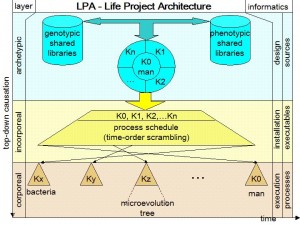
A point that Darwinists make is that anti-Darwinists have not developed any theory for the origins of species, and think that is a weakness. But for an IDer/creationist is not so difficult to have ideas about solutions of the problem of origins. I for one developed a proposal for a theory, and I will illustrate it here. I called it “LPA” (Life Project Architecture). See below its simple schema, where the x-axis is time and the y-axis the top-down intelligent causation: LPA model for origins is cent percent design based. The role of natural selection, about the creation of biological information and complexity, is null. To grasp LPA one must entirely invert the reasoning of evolutionism. This means in the Read More ›

When does the Programmer install the software?

A thing that evolutionists wrongly consider a serious problem for the creation/ID worldview is the “multiple acts of creation” or – in ID terms – “multiple insertions of information” in time. Here I will argue to show that this is a false problem, or – better said – is a problem that in no way can undermine the creation/ID explanation. This issue is also related to the question when in the cosmos the information is injected by its Designer: is it fully frontloaded from the beginning or is fractionated in time? My assumption is however that we take for granted that the Designer of the universe is God. I dealt with this issue here. Moreover I consider sound the so-called Read More ›

Logical inconsistency of Darwinism

I already wrote about some internal contradictions of evolutionism here here here here and here. Today I deal with another logical inconsistency of Darwinism that is directly related to its foundations. Darwinian evolution, which is supposed to have created purposelessly all the biological complexity on Earth, would work according to genetic variations and natural selection. Organisms with traits that give them a reproductive advantage over their competitors pass these advantageous traits on, while traits that do not confer an advantage are not passed on to the next generation. Natural selection is the process in populations by which advantageous traits that enhance reproduction are selected for and are passed on to the next generation. These traits would arise because of many Read More ›

A “cost” is a “goal”

In the phys.org news “Researchers solve biological mystery and boost artificial intelligence” is cited a research about “The Evolutionary Origins of Modularity” (in Proceedings of the Royal Society B, Jan. 30, 2013). The researchers have simulated “25,000 generations of evolution within computers” and believe to have discovered why biological systems show modularity. They say: “Researchers have discovered why biological networks tend to be organized as modules – a finding that will lead to a deeper understanding of the evolution of complexity. […] As it turned out, it was enough to include a “cost of wiring” to make evolution favor modular architectures. […] Once you add a cost for network connections, modules immediately appear. Without a cost, modules never form.” What Read More ›