Uncommon Descent Serving The Intelligent Design Community
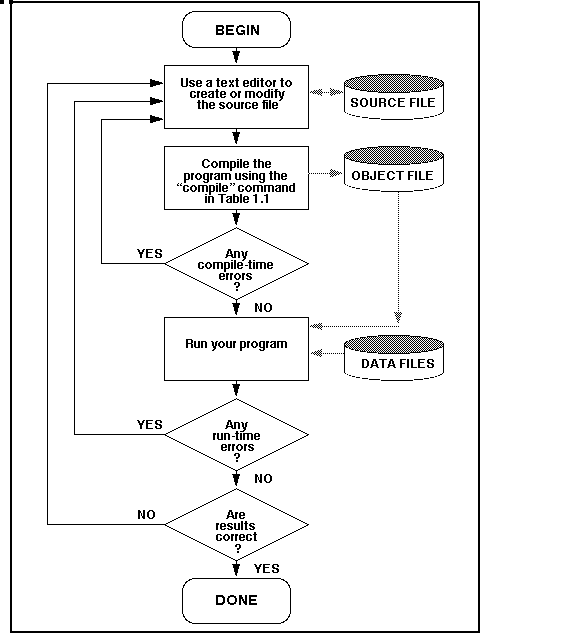
progflow

Darwinism from an informatics point of view

Categories
Biology
Darwinism
Informatics
Intelligent Design
Share
Facebook
Twitter/X
LinkedIn
Flipboard
Print
Email

progflowAs everyone knows, life in all its countless instances (organisms) involves internal instructions, as well as processors that run them. Without these instructions, no organism would be able to originate in the first place, let alone develop or survive. The discovery of these instructions – contained in DNA/RNA macromolecules and the molecular machinery that reads and writes them in biological cells – has been hailed as one of the greatest theoretical and experimental breakthroughs of the 20th century. The ID movement claims that these scientific findings have only served to highlight the weaknesses and inconsistencies of the neo-Darwinian theory of macro-evolution, according to which all species have evolved from a common ancestor, as a result of random mutation and natural selection.

The discovery of complex information processing in biology invites the question of whether there are any significant similarities between bio-informatics and the artificial informatics of computers, i.e. so-called computer science. Given that in both fields information has to be managed and processed, some similarities must of course exist. In this post, I will attempt to outline some conclusions on this topic, which lead us inexorably to the conclusion that Darwinian theory is incapable in principle of explaining the mystery of the origin of life and of species, as it claims to do.

When we consider the development of organisms and their complex internal organs and biological systems, we can easily see that these developmental sequences – and here I am talking about both ontogenetic and phylogenetic sequences – must involve complex programs, which embody decision logic about what has to be assembled, and also when and where it should be assembled. In other words, the right things need to be put in the right place at the right time, according to a precise schedule which is in some respects even more rigorous than schedules used in human engineering. For example, the development of an embryo is a process whose countless steps need to be choreographed in their most minute details by a program that is oriented towards the final result. Any error in the execution of this program may have severely deleterious consequences. The same thing can be said regarding the alleged macroevolution of new kinds of organs or even new body plans.

Given that biology and informatics both make use of programs, it will be necessary for me to say a few things about computer programming, in order to explain as clearly as possible exactly what a program is. I know that a lot of UD readers are software developers, so the points I will be making below will be very obvious to them. However, I’ll have to ask them to bear with me, as some of our readers are laypeople in these fields.

In order to process information – i.e. create software – it is necessary to create data and programs. Data is passive information: it cannot change or decide anything by itself. For example, let’s say I have a string variable (called $a) and I set it to contain the value “something” – or maybe I have a numeric variable $b which I set to contain the value 3.14. In these cases, I am neither specifying what should be done with the set values, nor when it should be done. Hence if I were to confine my work as a programmer to simply declaring the values of passive data, I would never be able to actively run a program or control any of its processes. Putting it another way: a program, in its simplest concept, is a blueprint specifying the reiteration of basic decision structures, about what to do and when to do it. A program must specify conditions and actions forming a control structure:

conditions (when to do it)
{

actions (what to do)

}

In other words, a program is active information. Since it determines conditions and actions, it has to be able to decide and organize things, and it also has to be able to create and change data. A program implies a decision hierarchy – in a word, a “logic”. It states what to do, when certain particular conditions arise. Once a program is designed, its execution by a processor can be used to control data and processes of any kind.

The simple structure described above can be repeated many times and can also be nested to create very complex structures with multiple nesting layers, such as the following example, with three nesting levels (the indentations and carriage returns have been inserted to help the reader understand the program flow, but are irrelevant per se at the level of machine code):

conditions
{

actions
conditions;
{

actions;
conditions;
{

actions;
conditions;
{

actions;

}

}

}

}

Another important concept of programming is that of the sub-function or sub-routine:

function
{

}

The main program can reference and run a sub-function as follows:

conditions
{

actions
&function

}

where “&” is the symbol for referencing.

A sub-routine is a sub-program (or “child” program) of the parent program (usually called “main”) that invokes it, which can be referenced (i.e. used indirectly, thanks to a pointer that points to it). Two important things to note about sub-functions are that they work only if they exist somewhere within the software (a very obvious point) and that they are “called” by the main program. In other words, even if we have entire libraries of sub-functions, they will be useless if they are never called: they will be “dormant software”. Thus in a sense, dormant sub-functions constitute passive information. They are passive because they still require a caller that can run them. A sub-function which is never called does absolutely nothing.

From another point of view, programming can be defined as whatever implements control of a process. Since – as Michel Behe says – the fundamental problem of biochemistry and molecular biology (and, in the final analysis, of systems biology) is the problem of control, it follows that programming is indispensable in biology, where countless complex and concurrent processes are involved. Because multiple processes are running at the same time in biological systems – a property that scientists refer to as concurrency – there must be some higher level of direction that governs them all.

It should be noted that the conclusions obtained above hold quite independently of whether an organism’s biological instructions are completely contained within its genome, or only partially. There are many (and I would count myself among them) who suspect that the genome, by itself, does not contain enough information to account for the overall biological complexity of an organism. However one thing is certain: the assembly instructions of living beings must exist somewhere, and the science of generating instructions (computer science) can help us understand their organization and fabrication.

Modern evolutionary theory proposes several unguided mechanisms in order to explain the alleged global macroevolution of species from a single common ancestor: random genetic mutations, sexual genetic recombination, horizontal gene transfer, gene duplication, genetic drift, and so on. According to evolutionary theory, the output of all of these blind processes is subsequently processed (or filtered) by natural selection, which allows only the fittest to survive and reproduce. However, as we will see below, not one of these processes is capable of generating programs. Hence they are also incapable of creating new organs, new body plans, or even new species.

The concept of the gene is fundamental to evolutionary theory in particular, and to genetics and biology in general. Despite its importance, we are still a long way from a clear definition of what a gene is. From the old definition of “recipe for a protein” to the new definition of “functional unit of the genome,” the concept of gene has evolved to the point where some researchers now openly declare that “a gene is a unit of both structure and function, whose exact meaning and boundaries are defined by the scientist in relation to the experiment he or she is doing.” In practice, this means that a gene is whatever a particular scientist has in mind when he/she is doing a particular experiment.

The argument which I am putting forward here cuts through these definitional controversies, because from my informatics-based perspective there are really only two possibilities, which can be summarized as follows: either (a) genes are data (which corresponds to the above old definition of a gene); or (b) genes are functions (which corresponds to the new definition). The key point to understand here is that the development of new organs or body-plans (macroevolution) necessarily involves new decision logic, i.e. new hierarchies of nested control structures. Specifically, the architectural complexity (at the system level) of new organs or body-plans and their embryogenesis involves assembly instructions which require advanced-level control, and hence advanced programming.

Let’s suppose that the first option is correct, and that genes are data. In this case, it can easily be demonstrated that point random mutations, sexual recombination, horizontal gene transfer and data duplication are all incapable of creating the hierarchical decision logic of the main program. In fact, data is what the main program elaborates. Data is passive, while the program is active. What is passive cannot create what is active. This is just as true for intelligently designed data as it is for the data upon which the random operations of Darwinian evolution are applied.

We can illustrate this point from another perspective, by using the analogy of the bricks in a building. If genes are data containing only “recipes for proteins,” and proteins are the “bricks” of the organism “building,” then it is obvious that genes/bricks (and the random Darwinian operations performed upon them) cannot account for the construction and assembly of the organism/building – that is, the set of rules and instructions specifying the way in which the various bricks have to assemble together, in order to yield the unity of a complete system. The building construction metaphor also helps us understand why different organisms can have almost the same genetic patrimony. Just as the same bricks can be used to construct entirely different buildings, the same genes can be used to develop entirely different organisms. In other words, in both biology and architecture, what matters are not the basic building blocks, but rather the higher-level instructions which operate upon them.

Now let’s consider the second alternative, which is that genes are equivalent to software sub-functions. This is quite a generous assumption for evolutionists to make, because it implies that genes possess their own internal decision logic, without explaining how they acquired it. In reality, the so-called “regulatory regions” of genes probably don’t warrant being described as true algorithms. But even if genes were the equivalent of software functions, then once again, random mutations, sexual recombination, horizontal gene transfer and duplication of functions would still be incapable of creating hierarchical decision logic. Why not? Because the decision logic contained in the main program is what invokes the functions (by referencing them). Just as a hammer or a drill cannot create a carpenter, the above operations on functions are incapable of creating their user.

Let us note in passing that the classic evolutionist objection that a mutation involving only a few bits (or even a single bit) is capable of triggering major changes (evolutionists typically cite homeobox genes that control some configurations of the body plan, etc.) contains another misunderstanding. For the active information for these changes still has to exist somewhere, and it must be as large as the changes require it to be. It is true that a programmer can write a very short “wrapper program” to trigger large changes, but that doesn’t mean that the changes themselves require only a little information to specify. For example, I can write a short piece of code which I choose to run on my computer – say, a word processor or a chess program. This code is a few bits long, but the word processor and the chess program are really large programs. All the function does is point to or reference them. However, the function doesn’t create the active information contained in the word processor or chess program software; rather, it simply switches control between the two. Hence there is no free-lunch creation of information whatsoever here.

Leaving aside the problems associated with defining what a gene is, it can still be shown that the random processes which evolutionary theory claims are capable of generating biological complexity, simply don’t work. They don’t work because they are, by their very nature, incapable of generating the top-down functional hierarchy of nested decision structures that is responsible for making the whole system. Since this objection to the adequacy of random processes is an in-principle objection, it is useless for evolutionists to attempt to counter it by resorting to vast amounts of time or huge probabilistic resources. The fundamental problem of Darwinism is that the greater cannot come from the less.

To sum up: Darwinism, from an informatics point of view, has absolutely zero credibility. This explains, among other things, why so many computer programmers who are interested in the ID/evolution debate are on the ID side. In their own job they have never seen a single bit of software arise gratis. Rather they have to create, bit by bit, the active information of the software applications they develop. These people are justifiably perplexed when they encounter the evolutionist claim that God did not have to write a single line of code, because biological complexity (which is far greater than any computer software) arose naturalistically. “Why no work for Him and so much work for me?” they may ask. In this post, I hope I have helped explain that God, also in this case, expects far less from us than what He Himself did and does.

Comments
StephenB @ 142,
You avoid my questions like the plague.
Any questions that concern the character or describe the designer in any way, like the following,
Let’s expore that. Does your “nature” have an intellect and a will? Does your “nature” have the capacity to decide whether to create or not create? Is your nature omnipotentent and omniscient? Is your nature an eternal, unchanging, non-material pure spirit? Does your nature integrate into one person the qualities of truth, life, goodness, beauty, and love ? Does your nature have the capacity to love its creatures? Can your “nature” take the form of a human and become a sacrificial lamb?
will be avoided like the plague. This is in keeping with the spirit of ID as being a scientific endeavour and not one of theology.Toronto
May 30, 2010
May
05
May
30
30
2010
08:10 PM
8
08
10
PM
PST
StephenB @ 142,
Yes, we are talking about the power to create. So, why are you talking about religion? I didn’t introduce the subject. You are chasing your own tail.
Here you are @ 128 introducing religion,
Can your “nature” take the form of a human and become a sacrificial lamb?
unless I am mistaken and this is not a reference to Jesus.Toronto
May 30, 2010
May
05
May
30
30
2010
07:58 PM
7
07
58
PM
PST
StephenB @ 144, Here's what I said @ comment 136,
—”With your definition of cause, a straw could not break a camel’s back since it does not have the required mass.”
which made you reply with this,
So you think that all effects are the result of a singular cause do you? [..snip]
which I don't think is valid in light of my very next sentence @ comment 136 which said,
However, if it happens to be the last straw, it would be the cause.
clearly indicating that all effects are not the result of a single cause.Toronto
May 30, 2010
May
05
May
30
30
2010
07:49 PM
7
07
49
PM
PST
---"With your definition of cause, a straw could not break a camel’s back since it does not have the required mass." So you think that all effects are the result of a singular cause do you? By the way, what do you understand my definition of a cause to be?StephenB
May 30, 2010
May
05
May
30
30
2010
07:07 PM
7
07
07
PM
PST
--Toronto: "You again demonstrate an inability to stay within the level of abstraction our debate is in at any given time." I think it is clear who is confused and who is not. Anyone who understands his own abstractions can answer any relevant question that an inquirer will ask. I have no problem with your questions and have answered all of them. You avoid my questions like the plague. By the way, you are very wise to do so because your ideas could not survive even one round of scrutiny.StephenB
May 30, 2010
May
05
May
30
30
2010
06:50 PM
6
06
50
PM
PST
---Toronto: “:A “peer” to X is something that operates at the same “level” as X not because it appears to be identical to X in operation.” Try to sell yourself on your own idea. You claim that nature can “operate on the same level” as the first cause, but you obviously do not think so when I challenge the point. ---“You can’t say that communication protocol stacks don’t have peer relationships simply because one is implemented over a serial port and the other over Ethernet” Irrelevant. ---“What you have done is to suggest that because I don’t believe the designer exhibits the human-like qualities in your list, then my designer is not a peer of your designer.” The qualities I listed are necessary qualities for a “first cause,” not human qualities. This dialogue is very humorous indeed. Among other things, I explain why a first cause must be immaterial. You say your “nature” can be a first cause, insist that it is a peer of my first cause, and yet you refuse to answer when I ask you if it your “first cause” is immaterial, which is just one of the many attributes needed. What does that say about your intellectual honesty? ---“If a Muslim doesn’t answer all the questions in your list the way you believe, does that mean that Islam is not to be considered a peer of Christianity? ---“We are talking about the power to create life, not issues of worship.” Yes, we are talking about the power to create. So, why are you talking about religion? I didn’t introduce the subject. You are chasing your own tail. ---“My designer is a peer of yours and is under no obligation to tell either of us why he created life if he was actually even conscious in the same way we are.” You keep making that claim, but when I call you on it and ask you about your designer’s attributes, you refuse to answer. [According to the principle of causality, a cause cannot give what it does not have to give.] ---“Your list is simply a set of human-like attributes you have mapped onto your designer.” What does my list have to do with the legitimacy of the principle? Do you realize how irrelevant your comments are becoming? No, I am sure that you do not. ---“You couldn’t claim that Ford is not a peer of Chevrolet simply because the Ford owner won’t answer yes to your question, “But can your car take you to your daughter’s first soccer game?” If, as a Chevrolet owner, I told the Ford owner that my automobile had four wheels, a crankshaft, and an engine, and if he refused to tell me on request if his automobile had those same qualities, I would not accept his assessment that his car could transport anyone. Further, I would know that his refusal to answer was an indication that he was hiding something for the purpose of avoiding debate, just as I know that your refusal to answer constitutes the same thing.StephenB
May 30, 2010
May
05
May
30
30
2010
06:40 PM
6
06
40
PM
PST
Toronto #138 The discussion with my friend Nak wasn’t about the fitness of the informatics-biology analogy. The proof is the very fact that Nak followed me in this analogy by offering an example of genetic program generated by evolution. Our discussion was: a) I denied evolution can create programs. b) Nak replied that evolution can. However to avoid a boring ping-pong of accusations between us, I offer you sort of armistice until Nak is back. Ok?niwrad
May 30, 2010
May
05
May
30
30
2010
02:03 PM
2
02
03
PM
PST
Clive Hayden @ 139,
I think you might be so abstract that no one can follow you.
At times I do exactly that. When it comes to clarity, I guess I'm a work in progress. I'll try to take a little more time before I hit "Submit Comment".Toronto
May 30, 2010
May
05
May
30
30
2010
12:43 PM
12
12
43
PM
PST
Toronto,
You again demonstrate an inability to stay within the level of abstraction our debate is in at any given time.
I think you might be so abstract that no one can follow you. I don't think it's StephenB's problem of abstraction, I think you might have too much of it, and not enough grounding.Clive Hayden
May 30, 2010
May
05
May
30
30
2010
11:12 AM
11
11
12
AM
PST
niwrad @ 136, 1) You are the one that is affirming computer systems are like biological processes. 2) You provided a certain level of detail as proof. 3) Nakashima replied at the same level of detail that you set. 4) Why should he provide a higher level of detail than you when you are the one with the burden of proof, since it was your affirmation in the first place?Toronto
May 30, 2010
May
05
May
30
30
2010
08:51 AM
8
08
51
AM
PST
Toronto #129
...you should provide that relevant extra detail first.
No. "Affirmanti incumbit probatio". The burden of proof is on the shoulders of who affirms. I deny that unguided evolution can create software systems. You affirm it can. You should provide the proof, in concepts and details, of your affirmation.niwrad
May 30, 2010
May
05
May
30
30
2010
08:32 AM
8
08
32
AM
PST
StephenB @ 132,
According to the principle of causality, a cause cannot give what it does not have to give.
With your definition of cause, a straw could not break a camel's back since it does not have the required mass. However, if it happens to be the last straw, it would be the cause. I think a better definition of a cause would be; "A cause triggers a state transition in a system". This would be more useful to engineers, computer programmers, mathematicians, etc.Toronto
May 30, 2010
May
05
May
30
30
2010
08:08 AM
8
08
08
AM
PST
Mr Niwrad, As I said in my first comment on this thread, you write as if the field of genetic programming did not exist. The issues you raise have been raised by others and dealt with before. Genetic programming could not exist if they had not been dealt with. But it does exist, and hands out cash awards every year for programs that have evolved competencies, not just greater than the programmer, but greater than any human being. I would like to continue this discussion, but I am getting married on Friday, so I no longer have much free time. Sorry, and best wishes.Nakashima
May 30, 2010
May
05
May
30
30
2010
03:08 AM
3
03
08
AM
PST
StephenB @ 132,
According to the principle of causality, a cause cannot give what it does not have to give.
Your list is simply a set of human-like attributes you have mapped onto your designer. You couldn't claim that Ford is not a peer of Chevrolet simply because the Ford owner won't answer yes to your question, "But can your car take you to your daughter's first soccer game?" You again demonstrate an inability to stay within the level of abstraction our debate is in at any given time.Toronto
May 29, 2010
May
05
May
29
29
2010
08:35 PM
8
08
35
PM
PST
StephenB @ 131, A "peer" to X is something that operates at the same "level" as X not because it appears to be identical to X in operation. You can't say that communication protocol stacks don't have peer relationships simply because one is implemented over a serial port and the other over Ethernet. Any two Congressman are peers despite the fact that they vote in opposition to each other since one is a Democrat and the other a Republican. What you have done is to suggest that because I don't believe the designer exhibits the human-like qualities in your list, then my designer is not a peer of your designer. Islam is a peer of Christianity as they are both fairly modern religions. If a Muslim doesn't answer all the questions in your list the way you believe, does that mean that Islam is not to be considered a peer of Christianity? We are talking about the power to create life, not issues of worship. My designer is a peer of yours and is under no obligation to tell either of us why he created life if he was actually even conscious in the same way we are.Toronto
May 29, 2010
May
05
May
29
29
2010
08:22 PM
8
08
22
PM
PST
---Toronto: ..."why would it be “necessary” for that entity to display the attributes you listed, in order to possess the capabilities required to create life?” According to the principle of causality, a cause cannot give what it does not have to give.StephenB
May 29, 2010
May
05
May
29
29
2010
08:00 PM
8
08
00
PM
PST
---Toronto: "If my intelligent designer “is” your intelligent designer, why would it be “necessary” for that entity to display the attributes you listed, in order to possess the capabilities required to create life?" You are evading my questions again as I knew you would. You said that your nature is a "peer" to my designer. I explained to you more than once that such a condition is not possible because the idea of nature as first cause violates the law of causality and I also explained why. Yet you continue to claim otherwise. I am, therefore, asking you to back up your claim and acknowledge that your "nature" [your "peer to my God," as you put it], really is a peer--that it contains the same specific qualities and attributes of God that I listed. Of course, you will not do that because you do not mean what you say, that is, you already know that nature cannot possess all those qualities in spite of your claims to the contrary. These discussions always end the same way. I explain that Darwinists deny causality, a Darwinist takes exception, I prove the point, the Darwinist begins to get it and promptly resorts to misdirection, refusing to answer all relevant questions--even those that can be answered with a yes or no.StephenB
May 29, 2010
May
05
May
29
29
2010
07:37 PM
7
07
37
PM
PST
StephenB @ 128, You are presenting to me an identity and a list of qualities for your intelligent designer and I appreciate that openness. If my intelligent designer "is" your intelligent designer, why would it be "necessary" for that entity to display the attributes you listed, in order to possess the capabilities required to create life?Toronto
May 29, 2010
May
05
May
29
29
2010
03:24 PM
3
03
24
PM
PST
niwrad @ 127, Nakashima should not have to provide a higher level of detail than you did in your initial example in the OP. If more detail is required for a discussion at the level you selected, then you should provide that relevant extra detail first.Toronto
May 29, 2010
May
05
May
29
29
2010
02:54 PM
2
02
54
PM
PST
---Toronto: "I have pointed out to you in a way that leaves no wiggle room, that my Nature is a peer of your God meaning there is nothing your God can do that my Nature can’t." Let's expore that. Does your "nature" have an intellect and a will? Does your "nature" have the capacity to decide whether to create or not create? Is your nature omnipotentent and omniscient? Is your nature an eternal, unchanging, non-material pure spirit? Does your nature integrate into one person the qualities of truth, life, goodness, beauty, and love ? Does your nature have the capacity to love its creatures? Can your "nature" take the form of a human and become a sacrificial lamb?StephenB
May 28, 2010
May
05
May
28
28
2010
05:28 PM
5
05
28
PM
PST
Nakashima #125 Your cut&paste example is the iteration and nesting of a void skeleton (or generic template). It doesn’t work for at least three reasons. (1) The structure and nesting is random because generated by unguided processes. (2) Does who grant that the structure is syntactically correct? (3) It lacks the specificity (or specification) about all conditions and actions. This specification constitutes in ID terms one of the necessary components of the system’s CSI. The perfect match of #1,2,3 is what makes the structure work. This reasoning holds for computer programming and biological information processing. To provide an analogy, it would be as you offer a skeleton of the chapters and paragraphs structure of a book with a random plot and without words. Unfortunately a book with random plot and without words (or with random words) has no value or meaning. Analogously a random program template as yours, without conditions and actions (or with dummy conditions and actions not tuned to obtain the desired functionality), cannot work. Besides, your solution is based on the gratuitous assumption that genes contain decisions and are program modules syntactically nestable in hierarchical structures. As I said in my post, this is a concession very generous to Darwinism.niwrad
May 28, 2010
May
05
May
28
28
2010
01:26 PM
1
01
26
PM
PST
StephenB, I have never changed my definition of nature. I have pointed out to you in a way that leaves no wiggle room, that my Nature is a peer of your God meaning there is nothing your God can do that my Nature can't. I have tried to be as scientific as possible, that our two terms are at a peer level. Every time I told you that my definition makes nature a peer with God, you would come back with a comment that effectively said, "but nature is not a peer of God". So I've given you my definition more than once, and you claim now that I've changed it.Toronto
May 28, 2010
May
05
May
28
28
2010
08:49 AM
8
08
49
AM
PST
Mr Niwrad, To create functioning hierarchical decision logic is a “vertical” job that only intelligence can do. It is a nice assertion, but you haven't said anything to back it up, either in the opening post or since then. Looking at your very conventional programming examples, if( condition ){ action } taking this as a gene, duplicate it if( condition ){ action } if( condition ){ action } and transpose it if( condition ){if( condition ){ action } action } Voila, hierarchy! We didn't even do any mutation yet. Boy, this is easy. Are you going to argue that this is somehow harder in biology than in programming?Nakashima
May 28, 2010
May
05
May
28
28
2010
06:46 AM
6
06
46
AM
PST
Clive @120: Thanks for the tip and the link. That was fun.StephenB
May 27, 2010
May
05
May
27
27
2010
10:10 PM
10
10
10
PM
PST
---Toronto: "No, between the two of us it means what I told you it means." You have not defined nature. ---"You many times have asked for a clear definition when debating a point." Yes, that's true. --"I’ve given you mine, but instead of accepting it, you replace it with your definition." No, you have not defined nature. So I can hardly replace something that wasn't defined with another definition. --"Since I’ve said that my first cause, we’ll call it “Nature”, is a peer of your first cause “God”, you must use it as I’ve defined it in order to contest any point I make." First you say that I replaced your definition of nature. Now you are telling me that you appropriated my definition of God as first cause and called it nature. Please decide which is the case. What is a peer of God? Is that your definition of nature? Are you now saying that "nature" is the first cause of the physical universe in the same way that God is said to be the cause of the physical universe? Are you saying that nature is an immaterial, unchanging, eternal reality as is God. Or, are you saying that is nature synonymous with the physical universe, which is material, changing, and begain in time? Please make a decision on your definition of nature since it is getting quite late in this discussion.StephenB
May 27, 2010
May
05
May
27
27
2010
09:38 PM
9
09
38
PM
PST
What the...He just read the comment... Is he trying to get UD publicity?Phaedros
May 27, 2010
May
05
May
27
27
2010
08:20 PM
8
08
20
PM
PST
Clive, Re: 120 Careful now, you might be the next to be lampooned on YouTube. :) Do you think he is 'Silly Silly' of Amazon fame? He tends to do the same thing in his 'reviews' of ID books.CannuckianYankee
May 27, 2010
May
05
May
27
27
2010
08:15 PM
8
08
15
PM
PST
StephenB, You have a big fan! 8) http://www.youtube.com/watch?v=Doqv-5KSBEE Notice he doesn't provide an actual argument, he just laughs like anyone else who has nothing at all to say. Silly, silly young man. Clive Hayden
May 27, 2010
May
05
May
27
27
2010
08:04 PM
8
08
04
PM
PST
StephenB @ 118,
you use the imprecise term, “nature,” which can mean almost anything.
No, between the two of us it means what I told you it means. You many times have asked for a clear definition when debating a point. I've given you mine, but instead of accepting it, you replace it with your definition. Since I've said that my first cause, we'll call it "Nature", is a peer of your first cause "God", you must use it as I've defined it in order to contest any point I make. If you change that definition, you are no longer having a debate with me as much as winning a debate with yourself.Toronto
May 27, 2010
May
05
May
27
27
2010
05:25 PM
5
05
25
PM
PST
...Toronto: "we are not discussing the cause of nature, we are discussing the cause of life." We are discussing both. The two points are inextricably tied together. To say that nature caused life is to say that nature contains the life principle within it, which is to elevate it to first cause status. In order to avoid the clumsy claim that the physical universe is synonymous with the life principle and the laws which govern it, you use the imprecise term, "nature," which can mean almost anything. Thus you seek to avoiding the precise term, "physical universe," which would help clarify the futility of your argument. --"If you want me to prove the cause of nature instead, you have to prove the cause of God." If God had a cause, God wouldn't be God. If the first cause had a cause, it would not be a causeless cause. That point is well worth absorbing.StephenB
May 27, 2010
May
05
May
27
27
2010
04:29 PM
4
04
29
PM
PST
1 2 3 4 6

Leave a Reply