Uncommon Descent Serving The Intelligent Design Community

How do we move civilisation (and especially science, tech and math) forward?

Categories
Academic Freedom
Control vs Anarchy
Defending our Civilization
Education
rhetoric
Share
Facebook
Twitter/X
LinkedIn
Flipboard
Print
Email

We are clearly in an age of reversion to oligarchic domination and lockout of dissent, so the issue is that of formation of a counter-culture, starting with the life of the mind.

H’mm, as a preliminary, let us look briefly at a refresher on a more useful ideological/political spectrum than the usual LEFT/RIGHT (which has no coherent definition of centre and right, where also Nazism/Fascism is actually of the left . . . contrary to popular notions):
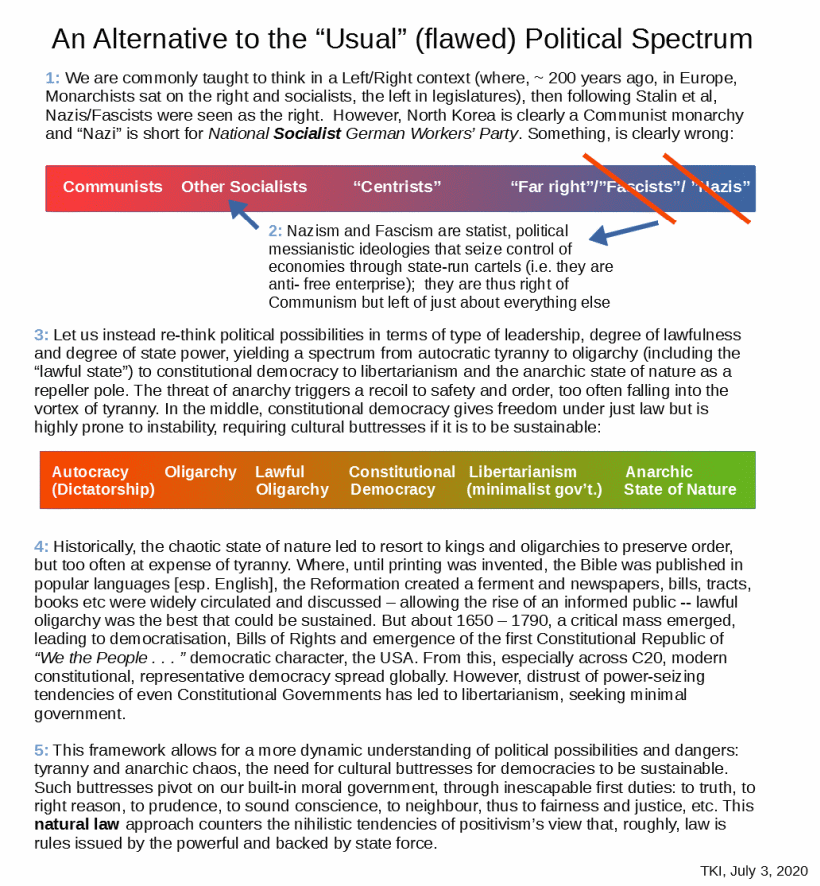
This is necessary because, regrettably, power dominates over essentially anything, especially in a time of deep polarisation. We can map that through the seven mountains/pillars of influence model:
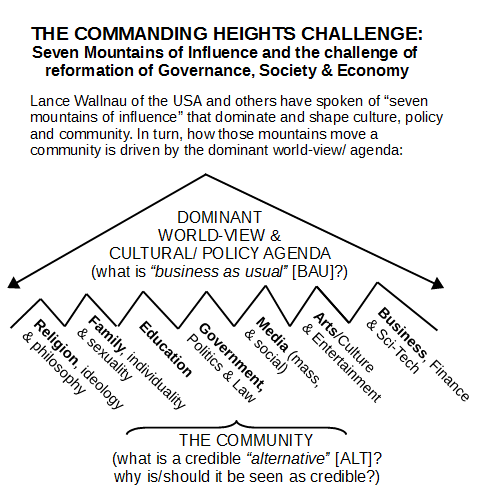
This naturally points to the cliff metaphor and warning:
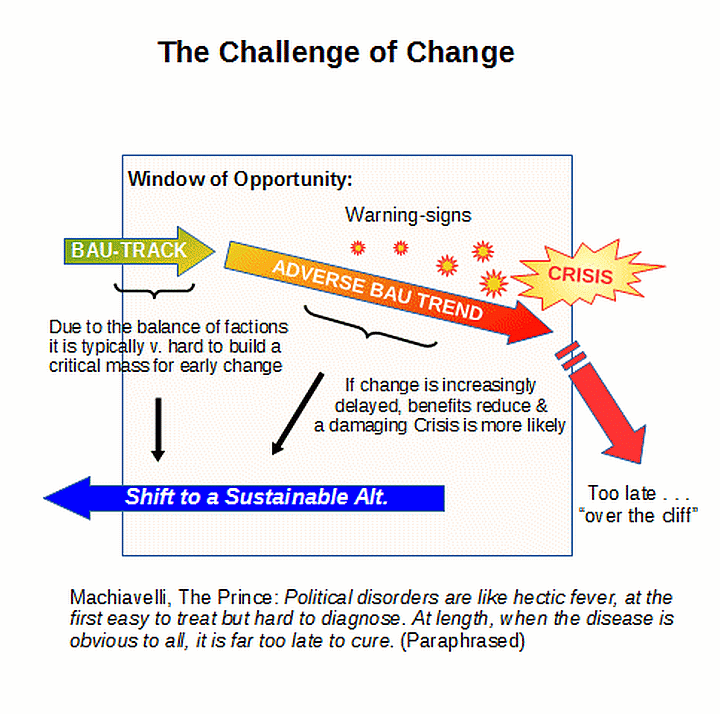
Let me add, that with our bounded rationality, we need to ponder the limitations on how we think:
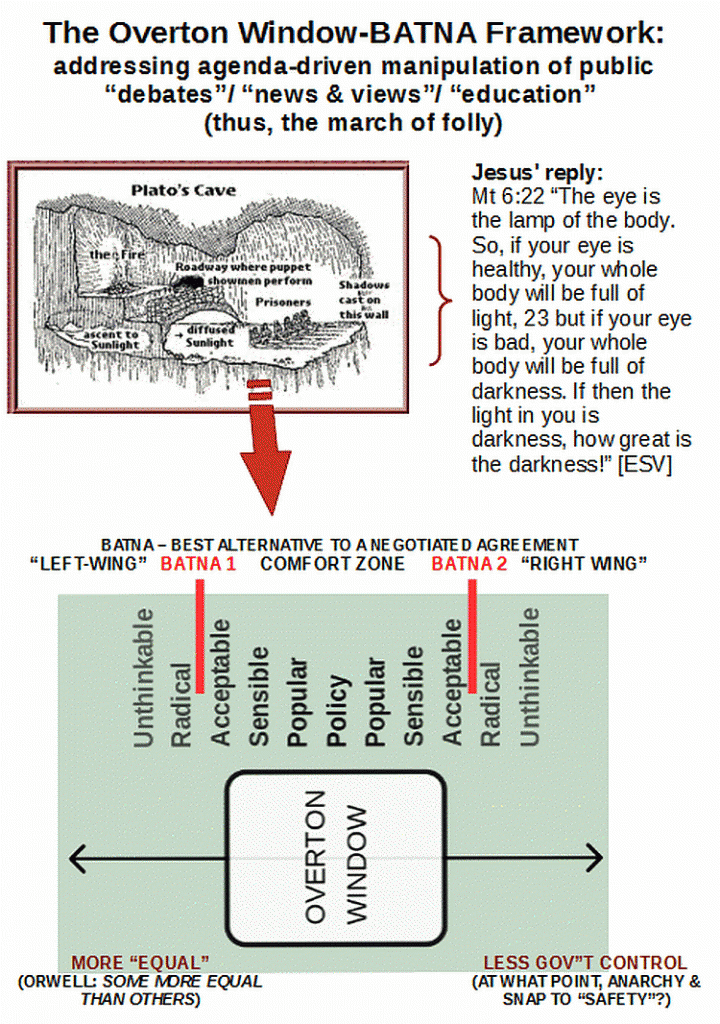
For there to be a choice, there has to be sober-minded thinking through of issues in fora that are not unduly censored, by people who rise above small-p party-spiritedness. Or else we turn Mencken’s cynicism into prophecy:
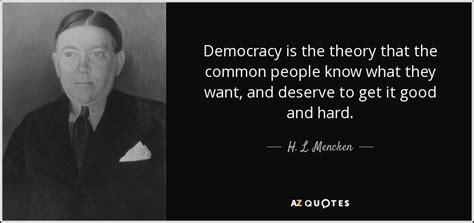
Accordingly, the first substantial issue is inescapable first duties of reason; which also happen to be pivotal to sound framing of law and government as well as opening the door to understanding roots of reality in a world with significantly free, rational, responsible, morally governed creatures — arguably, including us:

FIRST DUTIES OF RESPONSIBLE REASON

We can readily identify at least seven inescapable first duties of reason. “Inescapable,” as they are so antecedent to reasoning that even the objector implicitly appeals to them; i.e. they are self-evident. Namely, duties,

1 – to truth, 

2 – to right reason, 

3 – to prudence, 

4 – to sound conscience, 

5 – to neighbour; so also, 

6 – to fairness and

 7 – justice 

x – etc.

Such built-in . . . thus, universal . . . law is not invented by parliaments, kings or courts, nor can these principles and duties be abolished by such; they are recognised, often implicitly as an indelible part of our evident nature. Hence, “natural law,” coeval with our humanity, famously phrased in terms of “self-evident . . . rights . . . endowed by our Creator” in the US Declaration of Independence, 1776. (Cf. Cicero in De Legibus, c. 50 BC.) Indeed, it is on this framework that we can set out to soundly understand and duly balance rights, freedoms and duties; which is justice, the pivot of law.

The legitimate main task of government, then, is to uphold and defend the civil peace of justice through sound community order reflecting the built in, intelligible law of our nature. Where, as my right implies your duty a true right is a binding moral claim to be respected in life, liberty, honestly acquired property, innocent reputation etc. To so justly claim a right, one must therefore demonstrably be in the right.

Likewise, Aristotle long since anticipated Pilate’s cynical “what is truth?”: truth says of what is, that it is; and of what is not, that it is not. [Metaphysics, 1011b, C4 BC.] Simple in concept, but hard to establish on the ground; hence — in key part — the duties to right reason, prudence, fairness etc. Where, prudence can also be seen via Aristotle’s summary:  “. . . [who aptly] defined prudence as recta ratio agibilium, ‘right reason applied to practice.’ The emphasis on ‘right’ is important . . .  Prudence requires us to distinguish between what is right and what is wrong . . . If we mistake the evil for the good, we are not exercising prudence—in fact, we are showing our lack of it.”  [NB: This implies that through sound reason and balanced, insightful judgement applied to the material evidence, factors, claims and circumstances in a situation (which may often be clouded, contentious and confusing or even willfully distorted by deceivers),  we soundly discern and warrant truth and risks or uncertainties . . . yes, we need to ponder and warrant degrees of risk and uncertainty . . . so we can confidently, soberly act as we are rightly guided. This requires that we act through trained, experienced wisdom that delights in “solid food” which is “for the mature, for those who have their powers of discernment trained by constant practice to distinguish good from evil.” [Heb 5:14.]

And yes, we find here no comfort for those inclined to remain over-long at the milk stage: “everyone who lives on milk is unskilled in the word of righteousness, since he is a child” [v. 13]. Indeed, in the Proverbs, the simple youth are counselled to study the proverbs, precisely “to give prudence to the simple” [Prov 1:4.]  

There is no wrong in being young, simple and naive, but this is a mark of baby-hood,  and a healthy child grows beyond that stage in good time. Long delay in immaturity and in struggling to learn and master the simple is not a good sign: “though by this time you ought to be teachers, you need someone to teach you again the basic principles of the oracles of God. You need milk, not solid food.” [Heb 5:12. It is of course just after this that the author points to the famous six foundational, ABC principles in 6:1 – 2, repentance, faith, baptisms, laying on of hands, resurrection of the dead, eternal judgement. This is what the “milk” is. Note, it is led by meta + noia, a profound change in attitude, thought patterns and inclination of life leading to a right-about turn from the wrong, false and foolish to the ways of truth and right in love to God and man.]

This, too, is how prudence becomes “auriga virtutum — the charioteer of the virtues” (as Aquinas put it); the skilled steersman who guides and controls the chariot. Or even, the ship of state (what is implicitly in view in the Proverbs: “[t]he proverbs of Solomon, son of David, king of Israel”, Prov 1:1).

From this, we may also see how the first duties naturally fall into a logical chain in light of the key factors, loving God who is Truth Himself, and loving Neighbour made in God’s image just as we are; with sound conscience as pivot:

[i] truth –> right reason –> prudence, so sound conscience clears for action. Then, through the voice of sound conscience,
[ii] love for neighbour who is as we are requires fairness and justice etc.]

Thus, too, we may compose sound civil law informed by that built-in law of our responsibly, rationally free morally governed nature; from such, we may identify what is unsound or false thus to be reformed or replaced even though enacted under the colour and solemn ceremonies of law.

The first duties, also, are a framework for understanding and articulating the corpus of built-in law of our morally governed nature, antecedent to civil laws and manifest our roots in the Supreme Law-giver, the inherently good, utterly wise and just creator-God, the necessary (so, eternal), maximally great being at the root of reality.

This is where we must begin. Without this, there is no basis for that comity required to have sound academic disciplines, much less general public policy or even current events discussion. The ever-eager Red Guard censors are at our heels.

The case of Mathematics is central.

Mathematics, being best understood as [The study of] the logic of structure and quantity, where certain core intelligible mathematical facts are framework to any possible world (= a sufficiently complete chain of propositions describing a possible state of affairs), and lead to a programme of analysis and elaboration of logic-model worlds that may then apply to relevant situations of interest. For example, per von Neumann:

{} –> 0
{0} –> 1
{0,1} –> 2
. . . .
{0,1,2 . . .) –> w, omega

From reflecting on the principle of distinct identity, we see that for a world W to be distinct from some arbitrarily close neighbour W’, we have some A in W that is not in W’, so

W = {A|~A} and also W = {A|W’}, thence,

we see the partition | is empty, manifesting nullity.

A is a simple and ~A = W’ is a complex, unity.

With distinct unities, we find duality, and already we see that von Neumann’s framework applies to any distinct world.

It is truly universal, i.e. we find the natural counting numbers, N as an abstract structure necessarily present in and framework to any possible world.

From N, we can define additive inverses so for n in N, -n is such that n + (-n) = 0, i.e. we have that vector set where elements have both size and direction in an abstract space, the integers Z. Taking ratios, we have the rationals, Q. Reals bring in transfinite converging sums of rationals without repeating cycles when displayed in place value form, R. From that we go in a second orthogonal spatial direction, to C, using the j* rotating operator: j*x for all x in R defines the imaginary axis by anticlockwise rotation through one right angle and j*j* x is – x so we see j is sqrt – 1.

Beyond we define the hyperreals R* on the reals R being mileposted by N. H = 1/h, where h is smaller than 1/n for any finite n in N, where for any k in N the von Neumann succession continues k+1, k+2 etc, i.e. we cannot exhaust N stepwise. From this h is an infinitesimal hyperreal near 0; H is a transfinite integer hyperreal and we see a connected domain from zero and N,Z,Q,R to the hyper-domain R* such that any r in R may be surrounded by an infinitesimally altered cloud of form r + h, *r*, in effect vector shifting and adding the cloud *0* to r. (This allows us to use Robinson’s tamed infinitesimals and Model Theory etc to view Calculus as an extension of algebra.)

Notice, we have nowhere specified a particular individual world, this holds for any distinct world, for all possible worlds. It is reality-universal and possibility-universal. That is, a core domain of numbers, associated relationships and operations is a body of abstracta framework for any possible world, physical or imaginary. Hence, immediately, some of the universal power of both mathematics and logic. Hence too, we can recognise a category of beings, necessary, world framework entities; abstracta that constrain what is possible, by laying out constraints on possible being.

We can pause to summarise key first principles of right reason:
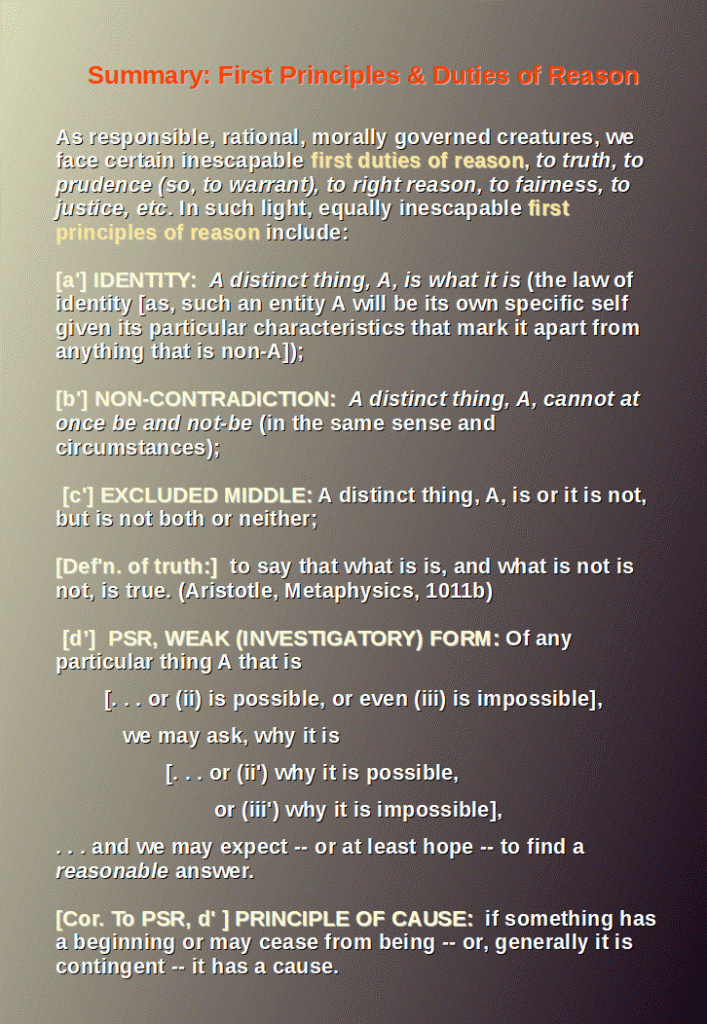
If we want a bit more on the first triad:
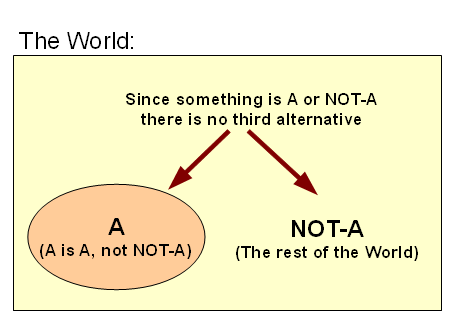
Laws of logic in action as glorified common-sense first principles of right reason

Where, we may ponder Science and linked technology (Computing being in key part a technology of Mathematics, which obviously is not an empirical science but a logic-constrained and guided field of study), as a domain of inductive reason pivoting on inference to best current — hopefully progressive — explanation:
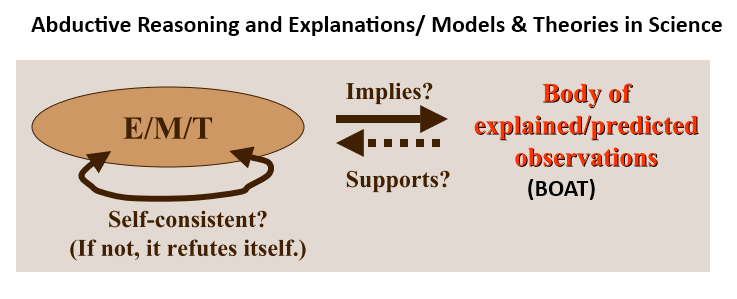
Abductive, inductive reasoning and the inherent provisionality of scientific theorising

These, we must not lose sight of, or all will be lost.

Going forward, that we are morally governed creatures has profound worldview import. For, at least one possible world, which is actualised, has in it such creatures. The root of all reality must be such that such a world is adequately accounted for.

That opens the door to serious consideration of ethical theism, which posits that the explanation for such a world is the inherently good, utterly wise creator God, a necessary [worlds-framework and so too eternal] and maximally great being.

These, we must not lose sight of. END

PS: Eugenics Congress:

Logo, 2nd Int’l Congress, Eugenics Movement, 1921 [HT: Wiki]

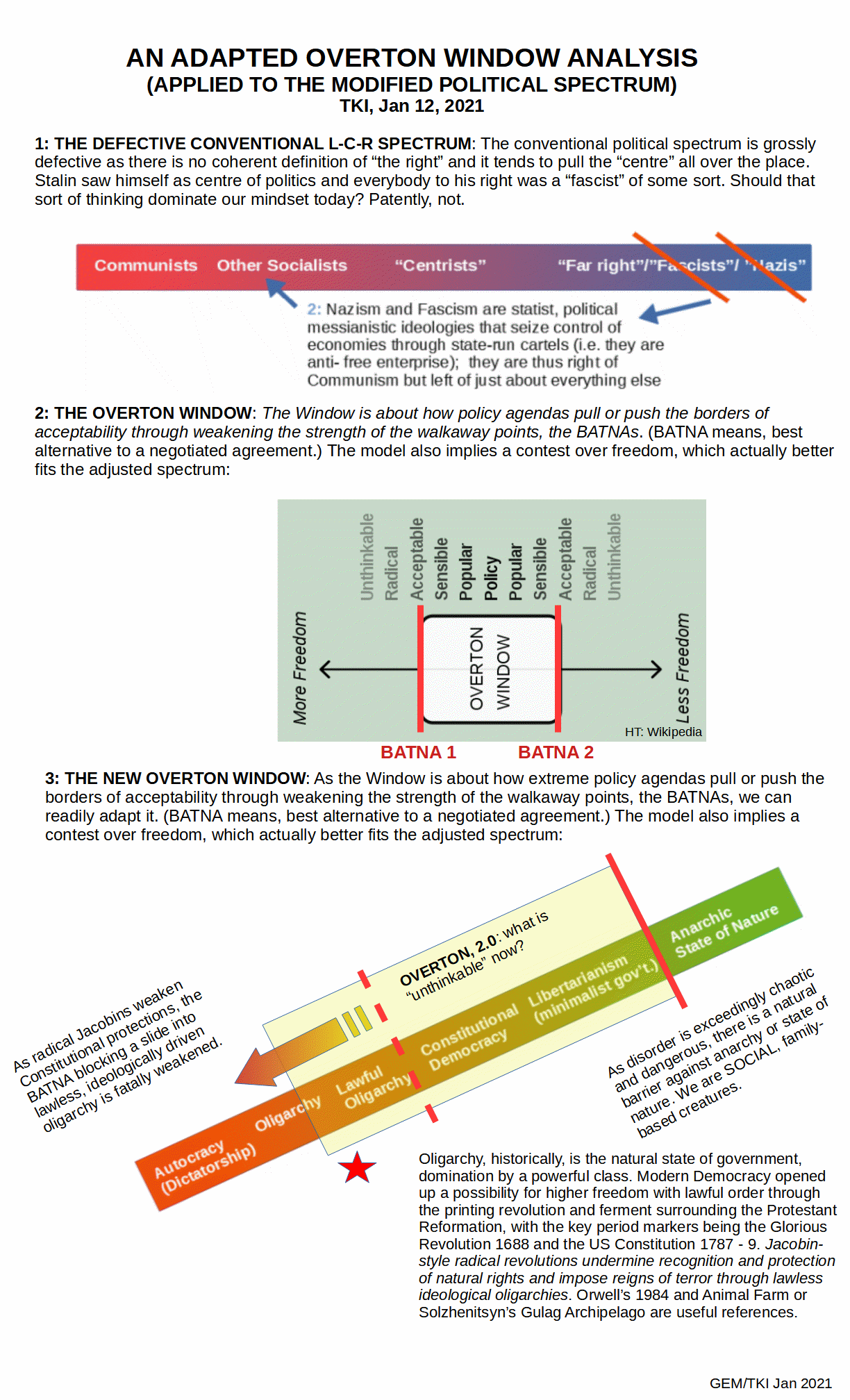
U/D1 Jan 12: An adapted Overton Window analysis, applied to the peril of the new Jacobins:
U/D2, Jan 13, the issue of the crooked yardstick:

In that light, consider Plato’s parable of the cave:

Not, as a fallacious cosmology but as a study on how a manipulated public reacts to truth. Ask yourselves, who is running the puppet shadow-show confused for reality and who is running the prison that locks up denizens from discovering the truth for themselves. (Then, ponder the course of current events.)

U/D3, Jan 18: Impact of cumulative evidence, as a part of first principles of reason in an inductive context:
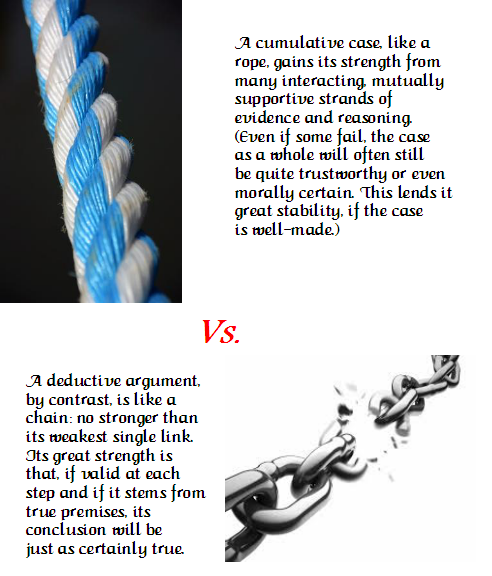
Of chains, ropes and cumulative cases

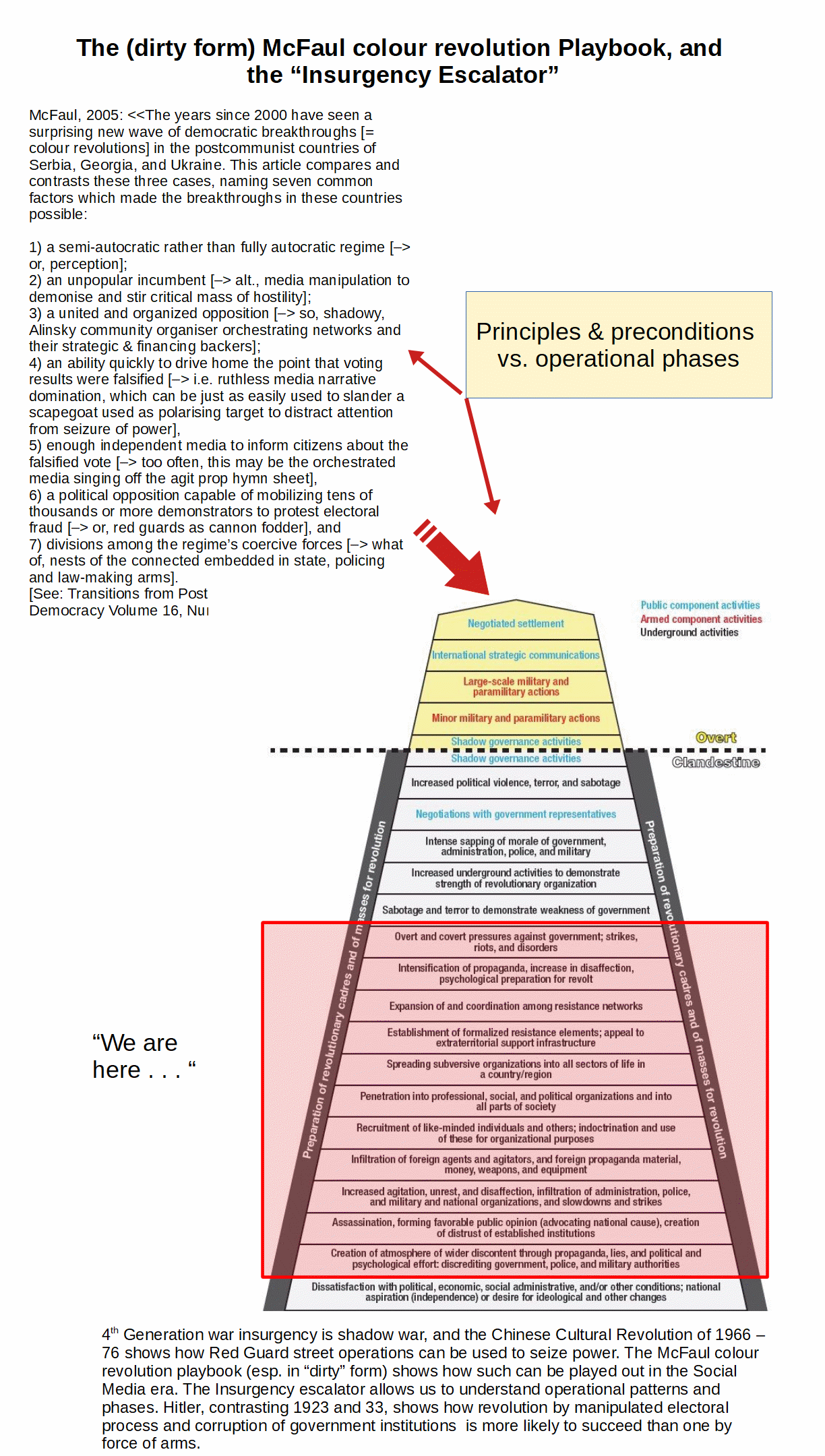
U/D4 Jan 18, to point to the documentation of the McFaul Colour Revolution programme and the SOCOM Insurgency Escalator:
Where, note from the earlier U-Haul a Riot thread on red guard street theatre operations tied to radical Jacobin networks . . . there is much more behind that:
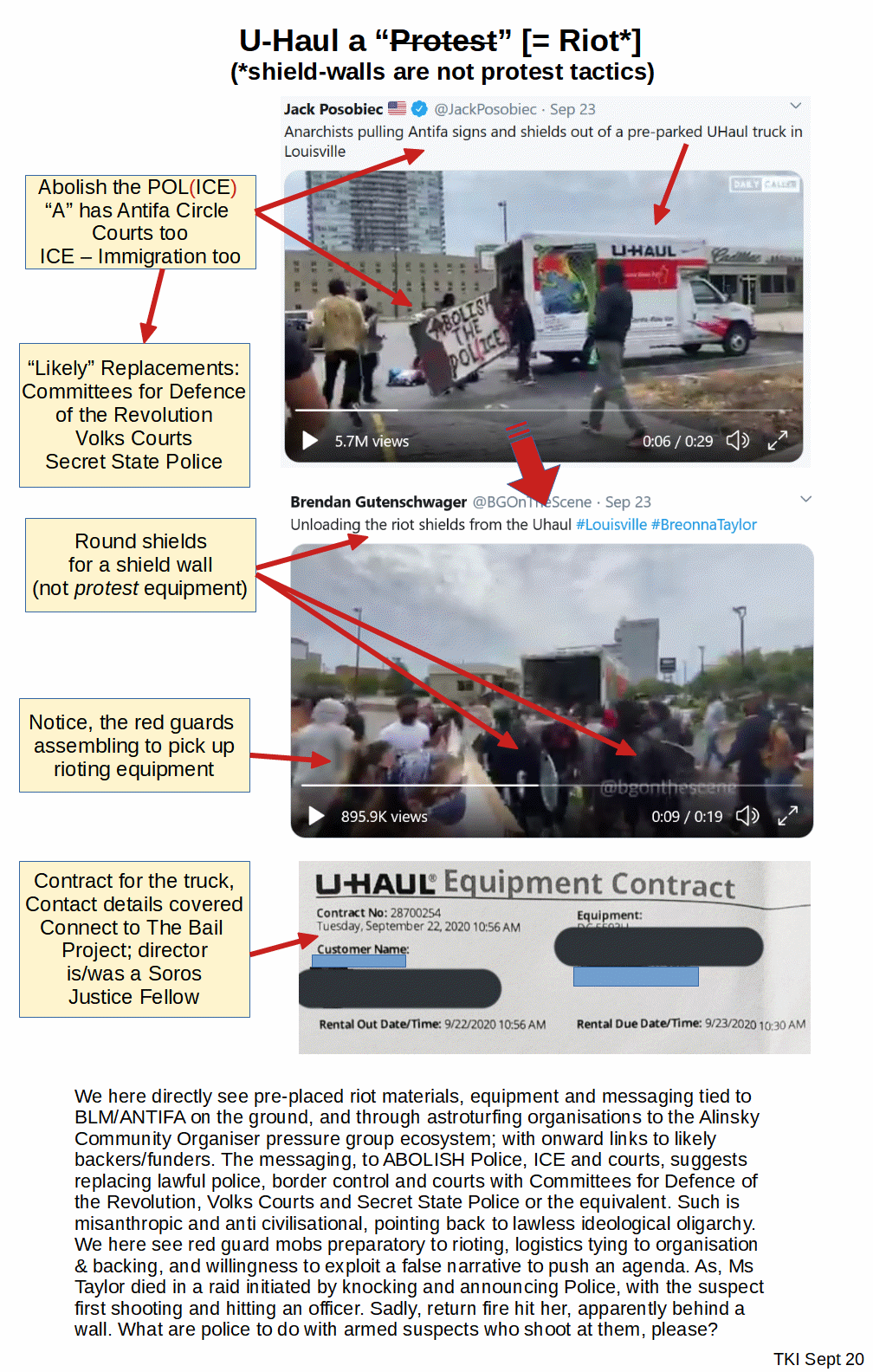
That is, it seems there is little matter of who is rioting to be addressed.

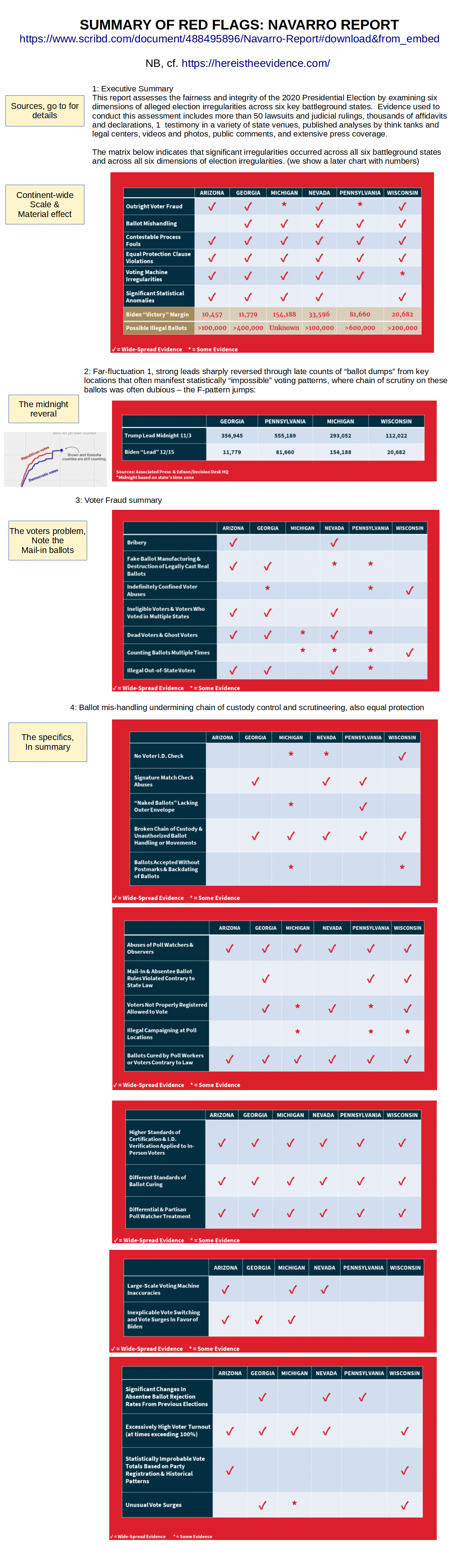
Where, this summary of points of concern by Navarro is a good place to begin pondering the “baseless” talking point that was used below to personally attack me as poster of the OP and host of the live event tracking threads:
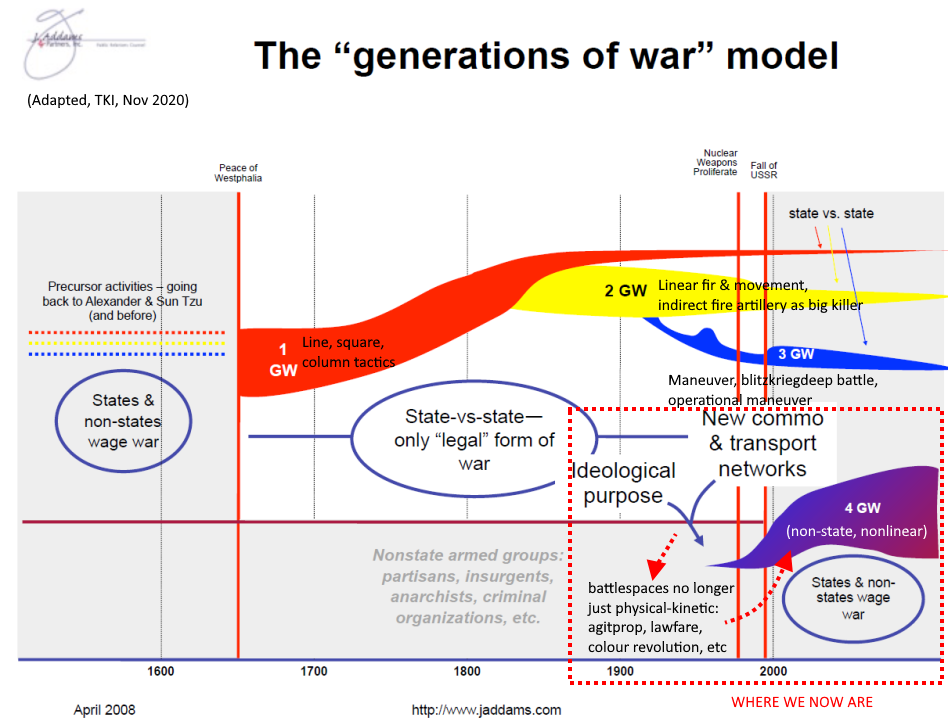
U/D5, Jan 19: It is becoming apparent that as part of reforming thinking we need to re-orient our understanding of war, strategy and associated operations in light of the unlimited scope, full spectrum of force options, social- space- is- the- battlespace evolution of warfare under 4th generation war principles. First, while we may not be interested in war — in a world of ruthless geostrategic operators who lack power to simply steamroller those blocking imposition of their will — the vultures not the eagles — war may well be interested in us.

So, if near-perpetual war is in every sphere and across the spectrum of force options (most often non kinetic) we need to map the social space, so let me repeat the seven mountains/pillars of influence model:

Where, we can map the evolution of war:
In that context, let us note on Unrestricted Warfare, using a summary of the 1999 work by PLA Air Force Colonels Qiao Liang and Wang Xiangsui:

In 1999, two Chinese colonels wrote a book called Unrestricted Warfare, about warfare in the age of globalization. Their main argument: Warfare in the modern world will no longer be primarily a struggle defined by military means — or even involve the military at all.

They were about a decade and a half before their time.

Colonels Qiao Liang and Wang Xiangsui argued that war was no longer about “using armed forces to compel the enemy to submit to one’s will” in the classic Clausewitzian sense. Rather, they asserted that war had evolved to “using all means, including armed force or non-armed force, military and non-military, and lethal and non-lethal means to compel the enemy to accept one’s interests.” The barrier between soldiers and civilians would fundamentally be erased, because the battle would be everywhere. The number of new battlefields would be “virtually infinite,” and could include environmental warfare, financial warfare, trade warfare, cultural warfare, and legal warfare, to name just a few. They wrote of assassinating financial speculators to safeguard a nation’s financial security, setting up slush funds to influence opponents’ legislatures and governments, and buying controlling shares of stocks to convert an adversary’s major television and newspapers outlets into tools of media warfare. According to the editor’s note, Qiao argued in a subsequent interview that “the first rule of unrestricted warfare is that there are no rules, with nothing forbidden.” That vision clearly transcends any traditional notions of war.

Unrestricted Warfare was an explicit response to the reigning Western military orthodoxy of the time. The preface is dated January 17, 1999, which the authors note was the eighth anniversary of the outbreak of the 1991 Gulf War. In many ways, their argument refuted many of the Western lessons drawn from that conflict: that wars could be short, sharp, and dominated by high-technology weaponry used with stunning precision to shatter an enemy’s armed forces in hours or days. By 1999, U.S. military thinking was dominated by the revolution in military affairs and network centric-warfare, which relied on advanced technologies to give the United States total battlefield dominance.

But Qiao and Wang argued that the battlefield had fundamentally changed. It was no longer a place where militaries met and fought; instead, society itself was now the battlefield. Future wars would inevitably encompass attacks on all elements of society without limits. Military battles resembling those of 1991 might become secondary elements of conflict — if they even occurred at all.

In short, war that by and large does not SEEM to be war due to lack of naked high kinetic weaponry in action. War that is only visible as war once one recognises the involvement of ruthless domination and subjugation by use of force and deception. Force, that is often masked as legitimate actions (often, by turnabout projections of blame . . . maskirovka); force calibrated to seem legitimate to the superficial onlooker.

Force, that needs not involve state actors or states. Which, gives it its 4th generational character.

War waged by vultures in the shadows, not just obvious ones in the sky.

War, that is only over, when the vultures themselves are checkmated and irrecoverably defeated. With history signposted so they cannot regroup to rebrand and come again, as obviously has happened with Marxism’s shiny new brand, critical theories.

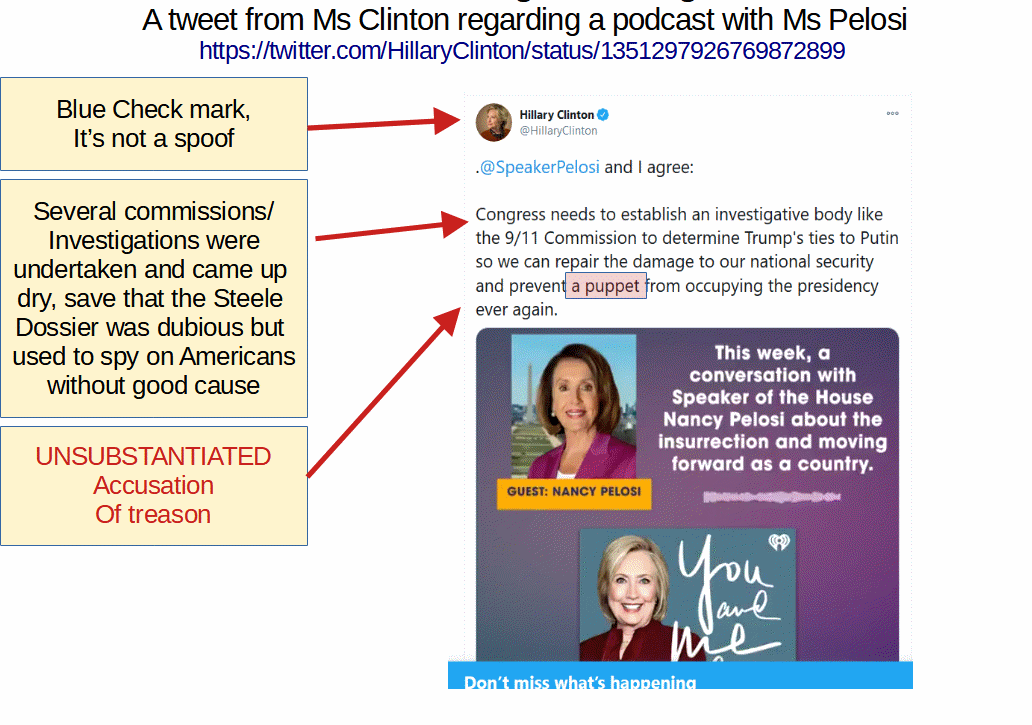
U/D6, Jan 19: Ms Clinton and Ms Pelosi, unsubstantiated accusation of treason, screenshot:
Comments
[SNIP -- irrelevant and distractive; the threads for such ran for two months and nearly five thousand comments, yielding a clear -- and damning -- verdict. This is about restoration of sound civilisation from ground up, as a direct consequence.]Steve Alten2
January 9, 2021
January
01
Jan
9
09
2021
08:50 PM
8
08
50
PM
PDT
JVL, it's not a who; that's the point. That's why it is so crucial to understand inescapable, self evident first duties that frame how responsible freedom is morally governed. It goes as far as governing how we go about math, much less opening a way to restore law to soundness, thus government. That is why we need to return to understanding that we are free, responsible, thus morally governed, coeval with our humanity. That way we are not locked up to manipulated mobs or self-seeking power elites hell-bent on marches of folly. If we fail here, our civilisation reverts to lawless oligarchy. I need not say more than that Plato warned that in a day of a march of folly on the ship of state, soundness would be marginalised as the mutineers set out on looting the stores. KFkairosfocus
January 9, 2021
January
01
Jan
9
09
2021
04:15 PM
4
04
15
PM
PDT
Kairosfocus: eugenics is a capital example of why social consensus or consensus of elites is not a sound guide to justice. That, BTW, was debated in Plato’s dialogues, long since. But who gets to decide then? If you don't have a consensus of the many then it will always be some kind of 'elite' or 'chosen' group that gets to decide. The whole process has to be accessible by everyone with a wide variety of input otherwise there will be a lot of dissension and objection.JVL
January 9, 2021
January
01
Jan
9
09
2021
02:16 PM
2
02
16
PM
PDT
JVL, eugenics is a capital example of why social consensus or consensus of elites is not a sound guide to justice. That, BTW, was debated in Plato's dialogues, long since. KFkairosfocus
January 9, 2021
January
01
Jan
9
09
2021
12:42 PM
12
12
42
PM
PDT
SA2, first, no-one is talking of blocking scientific research, absent serious moral or legal issues, or because of economic constraints/priorities. The supercollider for TX was refused, the follow on to Mars never got going in the 70's, embryonic stem cells have serious issues and pluripotent cells have done fairly well. Mengele and co were war criminals; the Tuskegee case was dubious even criminal. But, science does not equal civilisation, it is civilisation that is on the table and things that are far prior to the sciences are at stake. KFkairosfocus
January 9, 2021
January
01
Jan
9
09
2021
11:37 AM
11
11
37
AM
PDT
Kairosfocus “ This means that every product of reason, including Science, is morally governed.” I don’t think there is any argument here. But everyone, including scientists, have different views on what is morally acceptable. That is why funding for science is generally handled through committees that weigh many factors including government restrictions. It is far from perfect but it does minimize the number and risk of “rogue” scientists. “Science is a part of reason and it can and should be towards the good;” I agree but very few scientific discoveries are purely for the good or for the bad. For example nuclear physics have resulted in the generation of power and the development of nuclear medicine, both beneficial to humans, but it has also resulted in nuclear waste and nuclear bombs, both detrimental to humans. In addition, many advances in science have been the result of accidents (serendipity). That is why funding “pure” science is important. “but it can be horrifically abused, eugenics being a key example. ” Eugenics was simply the application of selective breeding to humans. It should also be noted that selective breeding has been used for animals, plants and humans long before Darwin proposed his theory. Yes, scientific discoveries can be abused. But that is no reason to prevent the research. If we took that attitude we would have banned research in physics and chemistry. What we need is oversight of how the science and its discoveries are applied. And this can, in some circumstances, mean the temporary halt of further research until the potential consequences can be assessed.Steve Alten2
January 9, 2021
January
01
Jan
9
09
2021
10:57 AM
10
10
57
AM
PDT
IMO, the main problem with moving civilization "forward" from here is the fact that the fundamental premise of what life and existence is, is entirely wrong. You cannot move "forward" beginning with entirely erroneous premises and expect to build anything other than a weak, poorly-founded structure doomed to eventual collapse.William J Murray
January 9, 2021
January
01
Jan
9
09
2021
10:03 AM
10
10
03
AM
PDT
AS2, part of the point of the OP is that, inescapably, we are under first duties of reason; indeed your own comment pivots on such. This means that every product of reason, including Science, is morally governed. Science is a part of reason and it can and should be towards the good; but it can be horrifically abused, eugenics being a key example. Such is part of why it is so important to get back to first duties. KFkairosfocus
January 9, 2021
January
01
Jan
9
09
2021
09:22 AM
9
09
22
AM
PDT
Kairosfocus: eugenics is a major lesson on how science went astray, losing sight of moral government. BTW so extreme was the domination that in the hey-day there were like two significant public intellectual voices challenging it, G K Chesterton being one. A lesson. And btw it keeps on creeping back in. Like I said: it's up to society as a whole to determine what applications of science are implemented and supported. Society failed during the eugenics period. The state should not have allowed it to happen. Sadly, enough people thought it was a good idea so it happened. The science is the same as any selective breeding programme. And we still do that with animals and plants all the time. You don't get poodles and collies and cauliflower without using selective breeding. But doing that will people is a violation of their lawful rights. It's wrong, morally and legally.JVL
January 9, 2021
January
01
Jan
9
09
2021
09:21 AM
9
09
21
AM
PDT
SNIP - irrelevantSteve Alten2
January 9, 2021
January
01
Jan
9
09
2021
09:21 AM
9
09
21
AM
PDT
JVL, eugenics is a major lesson on how science went astray, losing sight of moral government. BTW so extreme was the domination that in the hey-day there were like two significant public intellectual voices challenging it, G K Chesterton being one. A lesson. And btw it keeps on creeping back in. KFkairosfocus
January 9, 2021
January
01
Jan
9
09
2021
09:16 AM
9
09
16
AM
PDT
Science is neither moral nor immoral. For example, science postulates that we can direct human evolution through selective breeding as we have done with animals for centuries. And there is no reason to believe that this is not possible. However, deciding whether something should be done with this knowledge is a societal decision, not a science one. Governments and society have a responsibility to make decisions on the direction of scientific research, and after discoveries are made they are responsible for deciding how or if to apply the new knowledge. This is always a balancing act. If our policy makers are too risk-averse, we will miss out on discoveries and their applications that could greatly benefit individuals as well as the country. Conversely, if they are too risk-tolerant, we can end up with things like eugenics and thalidomide. In spite of the numerous mistakes we have made over the last century or so, I think that the benefits we have obtained as the result of science greatly outweigh the negatives.Steve Alten2
January 9, 2021
January
01
Jan
9
09
2021
09:12 AM
9
09
12
AM
PDT
Kairosfocus: JVL, maybe you don’t realise it but eugenics was the overwhelming, enthusiastic consensus of the educated classes including the establishment and the second generation of the Darwin family. It was still a horrible and misguided application of science; I don't care who was in favour of it. And society as a whole could have stomped on that application but they didn't. Almost no scientist in the world has such great power, the application of their work depends on the consent of the populace as a whole. Too bad such much of society agreed with the eugenics programmes. Indeed, the 2nd congress on it defined eugenics as self-direction of human evolution. It was the shock of the exposed holocaust that broke momentum. Start there. It was horrible. But it's not happening now and we still hold unguided evolution to be true. You don't have to jettison the science when all that's called for is the ceasing of certain 'applications' which are abhorrent. You should never put your faith in one person or one strict interpretation. That almost always fails. yes, specifically a medical doctor, so bound under ethical oath. Which, he treacherously betrayed. Which no one would dispute. So why make it sound like it's a point of contention? Almost all scientific discoveries and ideas can be used to help the human race or hinder it, even destroy it. It's up to us, the public as a whole, to oversee what applications are supported. We are not obligated to implement every new idea that comes along. I am surprised when ID proponents who feel they have to fight for their ideas to be given time and consideration suggest suppressing and sensoring areas of science. I would think that would be their last argument since they feel they suffer under that same burden.JVL
January 9, 2021
January
01
Jan
9
09
2021
08:28 AM
8
08
28
AM
PDT
JVL, maybe you don't realise it but eugenics was the overwhelming, enthusiastic consensus of the educated classes including the establishment and the second generation of the Darwin family. Indeed, the 2nd congress on it defined eugenics as self-direction of human evolution. It was the shock of the exposed holocaust that broke momentum. Start there and work your way back to the focal issue of inescapable first duties of reason and moral government of rationality. KF PS: Since it is needed, I add as a PS to OP, a key focal image for that congress.kairosfocus
January 9, 2021
January
01
Jan
9
09
2021
08:22 AM
8
08
22
AM
PDT
Barry Arrington: Yes, the scientists were doing pretty well when they were employing their eugenics programs to slaughter people in the cause of purifying “human stock” (a phrase they used a lot). A hideous and mistaken application of some scientific theories by politicians and power mongers. And probably a few scientists who let their personal morals dictate their behaviour. And they were doing pretty well when they decided the best way to deal with some people is drive big nails up into their brains through their eye sockets. Not sure what this refers to. But, again, science is impartial, science applications can be extremely moral or immoral. That's down to the individuals involved not the science. And they were doing pretty well when they developed poison gases to slaughter by the tens of thousands. And they were doing pretty well . . . When they developed nuclear weapons. And high powered rifles. And machine guns. But they also put men on the moon, developed vaccines, radios, semi-conductors, CAT machines, antibiotics, contact lenses, etc, etc, etc. It's easy to make a list of good and bad things developed by human beings. It's up to us as groups to sanction how those discoveries are applied and used. Science is a tool. Scientists are people who use that tool. It is stupid to suggest we should blindly trust scientists and just let them do their jobs. Josef Mengele was a scientist. Letting them discover things is one thing, blindly giving them the money and power to apply them as they see fit is something else completely different. I am not conflating those two things as you seem to be implying. Very few people do that. So why create that straw man?JVL
January 9, 2021
January
01
Jan
9
09
2021
08:13 AM
8
08
13
AM
PDT
BA, yes, specifically a medical doctor, so bound under ethical oath. Which, he treacherously betrayed. KFkairosfocus
January 9, 2021
January
01
Jan
9
09
2021
08:13 AM
8
08
13
AM
PDT
Jerry, I am speaking in the first instance to a going concern world. Energy beyond muscle, wind and flowing water is the currency of physical work, from steam engines to cell phone networks. Work, physically, being forced ordered motion. Economically, work is such motion dedicated to the goods and services that produce value. Where, regrettably, there is always going to be waste, pointing to the need for sound, restrained policy. Not least, energy policy. On freedom, note what I commented: >>freedom is a pivot of credible creation of knowledge by warrant>> This speaks to several levels. First, to be rational, we must have significant morally governed freedom as part of our nature; where to provide warrant for knowledge claims, we must be rational. Note, discussion in the OP. But, that is potential, without respect for and recognition of freedom in society, creativity including of knowledge, is hampered. Hence, my note on the opening up of political space in the OP, tracing to impacts of the printing revolution. Observe the alternative political spectrum and its context. Freedom, social sense, is not a given, historically the natural state of society is lawless oligarchy, and such is not easily overthrown once it has control. The breakthrough to the degree of social freedom we take for granted and apparently cannot perceive as fragile, did not just happen, poof. We need to go back to core principles to understand it. Hence the focus above. Freedom is an aspect of justice, due balance of rights, freedoms, responsibilities. Thus, we see law and government and begin to realise that law is not merely what whoever controls legal presses publishes . . . in effect, so called legal positivism. Without primacy of justice rooted in our morally governed nature, law becomes an excuse for domineering and government is brigandage or warlordism writ large. KFkairosfocus
January 9, 2021
January
01
Jan
9
09
2021
08:03 AM
8
08
03
AM
PDT
JVL "Let the scientists, engineers and mathematicians do their jobs. They’ve been advancing things pretty well in since the industrial revolution." Yes, the scientists were doing pretty well when they were employing their eugenics programs to slaughter people in the cause of purifying "human stock" (a phrase they used a lot). And they were doing pretty well when they decided the best way to deal with some people is drive big nails up into their brains through their eye sockets. And they were doing pretty well when they developed poison gases to slaughter by the tens of thousands. And they were doing pretty well . . . A gun is a tool. Gunsmiths are people who use that tool. No one would say that we should blindly trust gunsmiths and allow them to shoot anyone they want. Science is a tool. Scientists are people who use that tool. It is stupid to suggest we should blindly trust scientists and just let them do their jobs. Josef Mengele was a scientist.Barry Arrington
January 9, 2021
January
01
Jan
9
09
2021
07:52 AM
7
07
52
AM
PDT
Seversky, who controls the "let-ery"? That is, who are the WE. I remind you of Mr Lewontin's let-the-cat-out-of-the-bag moment:
. . . to put a correct [--> Just who here presume to cornering the market on truth and so demand authority to impose?] view of the universe into people's heads
[==> as in, "we" the radically secularist elites have cornered the market on truth, warrant and knowledge, making "our" "consensus" the yardstick of truth . . . where of course "view" is patently short for WORLDVIEW . . . and linked cultural agenda . . . ]
we must first get an incorrect view out [--> as in, if you disagree with "us" of the secularist elite you are wrong, irrational and so dangerous you must be stopped, even at the price of manipulative indoctrination of hoi polloi] . . . the problem is to get them [= hoi polloi] to reject irrational and supernatural explanations of the world [--> "explanations of the world" is yet another synonym for WORLDVIEWS; the despised "demon[ic]" "supernatural" being of course an index of animus towards ethical theism and particularly the Judaeo-Christian faith tradition], the demons that exist only in their imaginations,
[ --> as in, to think in terms of ethical theism is to be delusional, justifying "our" elitist and establishment-controlling interventions of power to "fix" the widespread mental disease]
and to accept a social and intellectual apparatus, Science, as the only begetter of truth
[--> NB: this is a knowledge claim about knowledge and its possible sources, i.e. it is a claim in philosophy not science; it is thus self-refuting]
. . . . To Sagan, as to all but a few other scientists [--> "we" are the dominant elites], it is self-evident
[--> actually, science and its knowledge claims are plainly not immediately and necessarily true on pain of absurdity, to one who understands them; this is another logical error, begging the question , confused for real self-evidence; whereby a claim shows itself not just true but true on pain of patent absurdity if one tries to deny it . . . and in fact it is evolutionary materialism that is readily shown to be self-refuting]
that the practices of science provide the surest method of putting us in contact with physical reality [--> = all of reality to the evolutionary materialist], and that, in contrast, the demon-haunted world rests on a set of beliefs and behaviors that fail every reasonable test [--> i.e. an assertion that tellingly reveals a hostile mindset, not a warranted claim] . . . . It is not that the methods and institutions of science somehow compel us [= the evo-mat establishment] to accept a material explanation of the phenomenal world, but, on the contrary, that we are forced by our a priori adherence to material causes [--> another major begging of the question . . . ] to create an apparatus of investigation and a set of concepts that produce material explanations, no matter how counter-intuitive, no matter how mystifying to the uninitiated. Moreover, that materialism is absolute [--> i.e. here we see the fallacious, indoctrinated, ideological, closed mind . . . ], for we cannot allow a Divine Foot in the door . . . [--> irreconcilable hostility to ethical theism, already caricatured as believing delusionally in imaginary demons]. [Lewontin, Billions and billions of Demons, NYRB Jan 1997,cf. here. And, if you imagine this is "quote-mined" I invite you to read the fuller annotated citation here.]
In short, Big-S Science can all too easily become a totalitarian ideology. The issue is to go back to first principles and duties, which allow us to think straight in a day when that seems to be at severe discount; ironically, especially among those who consider themselves to be the intellectual betters. KFkairosfocus
January 9, 2021
January
01
Jan
9
09
2021
07:39 AM
7
07
39
AM
PDT
Seversky, FYI, for seven years, I have noted here at UD and elsewhere that a mapping of society's key institutions as a range of mountains or pillars in a temple -- notice, this is not a simplistic copy of what Mr Wallnau used -- is a useful map of how societies work. There is a dominant worldview and linked cultural agenda, tied to forms of the Overton window too [I guess I had better add . . . ], which work with key institutions and power centres to shape the business as usual agenda of a community. That has precisely nothing to do with your attempted smear with "theocracy." It has a lot more to do with seeking a simplification of talking on stratagems and factions among decision making classes and issues of sustainability across biophysical, sociocultural and economic-policy domains. There is an issue of credible alternative and counter-culture in the context of a civilisation going amiss, as is patent, but then that has more to do with a modified version of Gro Harlem Bruntland on sustainability, with admixtures from Kant's Categorical Imperative than anything else; where I have repeatedly credited the Bariloche foundation of Argentina, from the days in which I helped write a primer on sustainability for SIDS. Unfortunately, your ideology and its projections to the despised other are warping your ability to see straight. KFkairosfocus
January 9, 2021
January
01
Jan
9
09
2021
07:26 AM
7
07
26
AM
PDT
energy is a pivot of economies and that freedom is a pivot of credible creation of knowledge
No. Freedom is the driver of everything. Why did the modern world start is a small place? What changed to let this happen? The answer is freedom. The ingenuity and energy were always there but they were not allowed to manifest itself till the religious wars in England led to freedom for the average person and not just the nobility. This is what drove the modern world first in England and a little bit in Holland but then mainly in the British colonies and then the United States. The exemplar was Pennsylvania which was called the poor man's country and allowed hundreds of thousand of immigrants to settle and Philadelphia became the most vibrant city in the Western Hemisphere. Penn invited about 100.000 poor German farmers to his colony and they prospered. It was freedom Aside: it was not just Protestant vs Catholic. In England the religious wars were between different versions of Protestantism. Protestant countries in Europe that were mainly one religion like the Catholic ones remained sluggish till they saw what was happening in England. It was a monarchy that kept countries backwards but in England the king lost power to parliament and eventually to the common person. In the British colonies the common person was king.jerry
January 9, 2021
January
01
Jan
9
09
2021
06:59 AM
6
06
59
AM
PDT
Kairosfocus: JVL, that depends on so much else that it is incredible. Start with, that energy is a pivot of economies and that freedom is a pivot of credible creation of knowledge by warrant. In my experience, most academics are pretty free in choosing what particular topic or subtopic they wish to research, as long as it's a) somewhat in their field and b) gets funded. Obviously, the funding can be a big area of disagreement. But generally the system works. Dr Behe manages to find a balance between his 'accepted', funded research and his 'questionable' work on ID without having lost his tenure so it's clearly possible for academics, even those on the fringes, to have a decent, tenured position and still pursue something less accepted. I add, ponder the implications of “Let . . .” as in who controls the “let-ery,” on what principles or want thereof? You phrase things strangely but I'm guessing you're referring to the part of who gets to decide what's accepted and what isn't. I think my example of Dr Behe is important; he's found a good, tenure-safe, middle ground. Funding choices are always made by committees; that's the nature of the beast. And, as it stands right now in virtually all academic funding environments, most of the topics you might feel are ostracised do not have anything close to sufficient support to fund via the normal means. Of course that doesn't mean researchers interested in things like ID are completely bereft. The Discovery Institute has its own research organisation. The Biologic Institute? I think that's right. With Dr Douglas Axe and Dr Anne Gauger. And there's the Templeton Prize which kind of straddles the gap between theology and materialistic science. A bit anyway. There is no reason that there cannot be an independently funded ID research institute. I would recommend that Dr Meyer, et al ask for research funding instead of publishing more books. The revenue generated by the books could be spent on labs and facilities!JVL
January 9, 2021
January
01
Jan
9
09
2021
06:19 AM
6
06
19
AM
PDT
How Do We Move Civilisation (And Especially Science, Tech And Math) Forward?
I have to admit I hadn't thought of you as a progressivist until now. Although citing Lance Wallnau and the Seven Mountains theory sounds like you see progress as movement towards Christian theocracy. That aside, are you suggesting that scientific progress can be directed by following the most promising lines of research? But wasn't one of the points of Carl Sagan's little parable of the "Westminster Project" that it's very difficult to cherry-pick which are the most promising lines of research because we have no way of knowing in advance which they are? Isn't the best approach to give science its head, within the obvious limits of available resources, and see where it takes us?Seversky
January 9, 2021
January
01
Jan
9
09
2021
05:44 AM
5
05
44
AM
PDT
JVL, that depends on so much else that it is incredible. Start with, that energy is a pivot of economies and that freedom is a pivot of credible creation of knowledge by warrant. I add, ponder the implications of "Let . . ." as in who controls the "let-ery," on what principles or want thereof? KFkairosfocus
January 9, 2021
January
01
Jan
9
09
2021
04:28 AM
4
04
28
AM
PDT
Kairosfocus: How do we move civilisation (and especially science, tech and math) forward? Let the scientists, engineers and mathematicians do their jobs. They've been advancing things pretty well in since the industrial revolution.JVL
January 9, 2021
January
01
Jan
9
09
2021
04:19 AM
4
04
19
AM
PDT
How do we move civilisation (and especially science, tech and math) forward?kairosfocus
January 9, 2021
January
01
Jan
9
09
2021
03:48 AM
3
03
48
AM
PDT
1 … 14 15 16