Uncommon Descent Serving The Intelligent Design Community

How do we move civilisation (and especially science, tech and math) forward?

Categories
Academic Freedom
Control vs Anarchy
Defending our Civilization
Education
rhetoric
Share
Facebook
Twitter/X
LinkedIn
Flipboard
Print
Email

We are clearly in an age of reversion to oligarchic domination and lockout of dissent, so the issue is that of formation of a counter-culture, starting with the life of the mind.

H’mm, as a preliminary, let us look briefly at a refresher on a more useful ideological/political spectrum than the usual LEFT/RIGHT (which has no coherent definition of centre and right, where also Nazism/Fascism is actually of the left . . . contrary to popular notions):
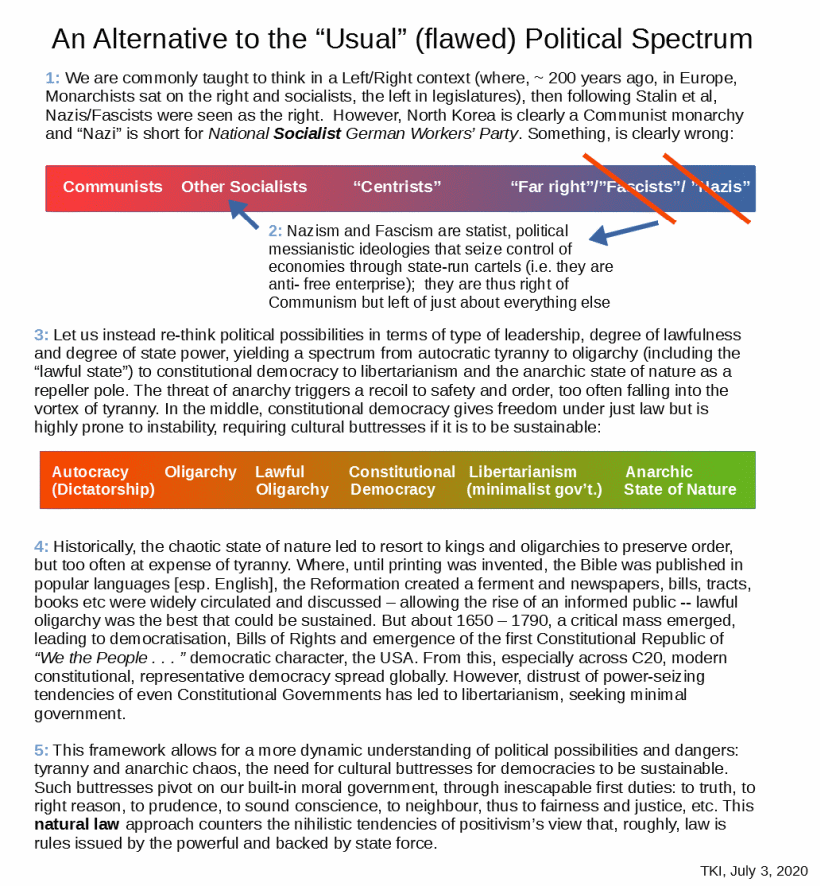
This is necessary because, regrettably, power dominates over essentially anything, especially in a time of deep polarisation. We can map that through the seven mountains/pillars of influence model:
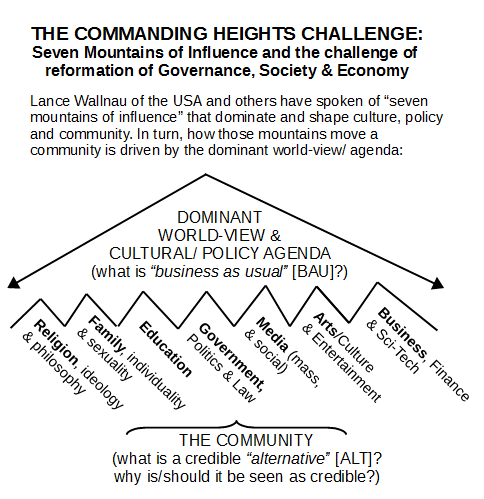
This naturally points to the cliff metaphor and warning:
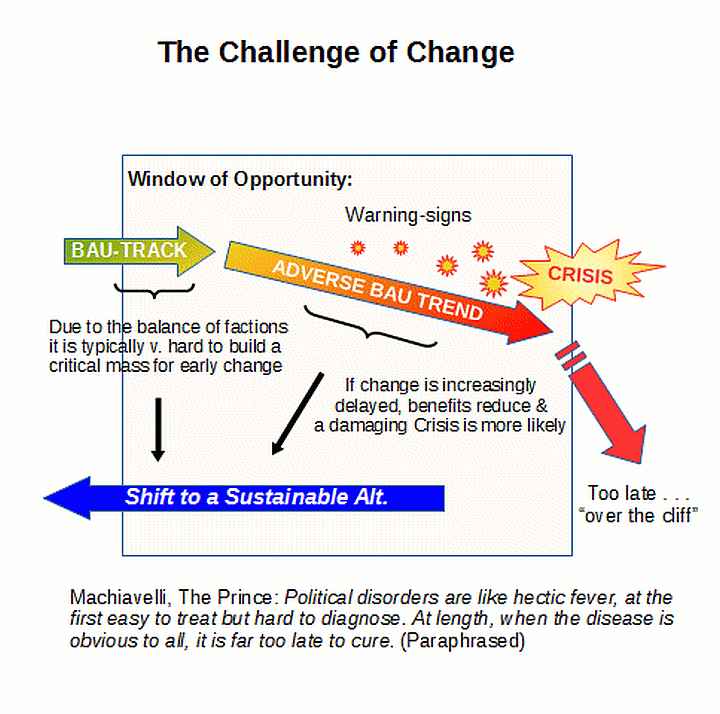
Let me add, that with our bounded rationality, we need to ponder the limitations on how we think:
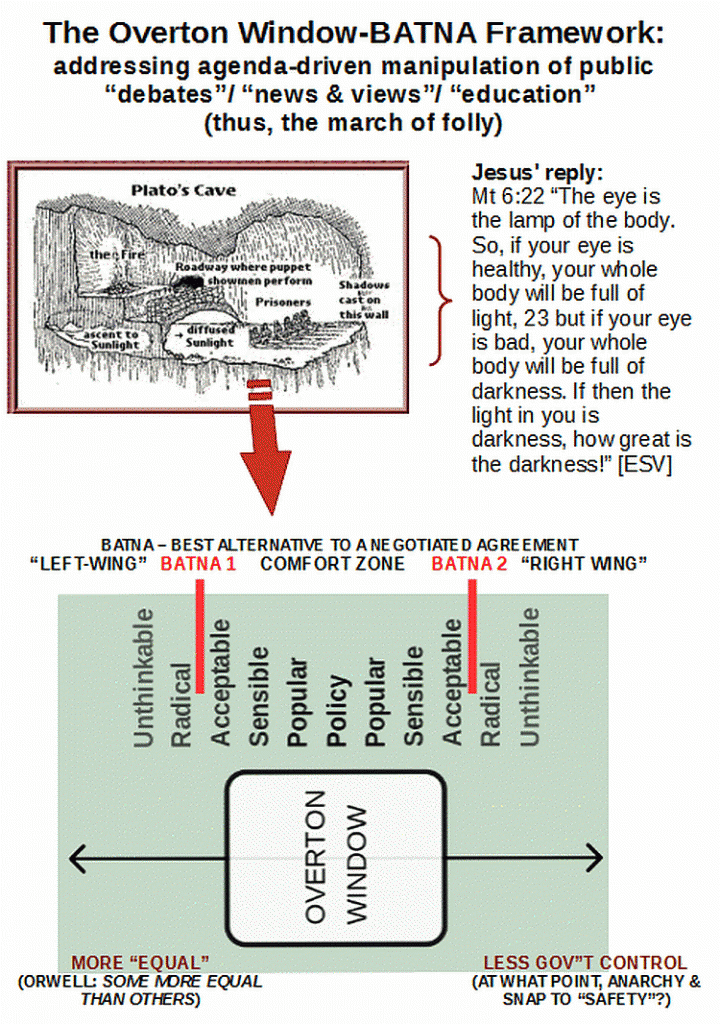
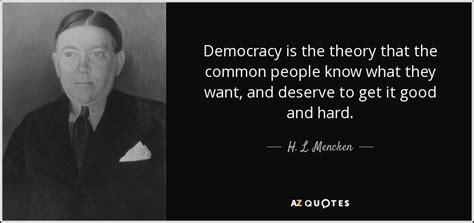
For there to be a choice, there has to be sober-minded thinking through of issues in fora that are not unduly censored, by people who rise above small-p party-spiritedness. Or else we turn Mencken’s cynicism into prophecy:
Accordingly, the first substantial issue is inescapable first duties of reason; which also happen to be pivotal to sound framing of law and government as well as opening the door to understanding roots of reality in a world with significantly free, rational, responsible, morally governed creatures — arguably, including us:

FIRST DUTIES OF RESPONSIBLE REASON

We can readily identify at least seven inescapable first duties of reason. “Inescapable,” as they are so antecedent to reasoning that even the objector implicitly appeals to them; i.e. they are self-evident. Namely, duties,

1 – to truth, 

2 – to right reason, 

3 – to prudence, 

4 – to sound conscience, 

5 – to neighbour; so also, 

6 – to fairness and

 7 – justice 

x – etc.

Such built-in . . . thus, universal . . . law is not invented by parliaments, kings or courts, nor can these principles and duties be abolished by such; they are recognised, often implicitly as an indelible part of our evident nature. Hence, “natural law,” coeval with our humanity, famously phrased in terms of “self-evident . . . rights . . . endowed by our Creator” in the US Declaration of Independence, 1776. (Cf. Cicero in De Legibus, c. 50 BC.) Indeed, it is on this framework that we can set out to soundly understand and duly balance rights, freedoms and duties; which is justice, the pivot of law.

The legitimate main task of government, then, is to uphold and defend the civil peace of justice through sound community order reflecting the built in, intelligible law of our nature. Where, as my right implies your duty a true right is a binding moral claim to be respected in life, liberty, honestly acquired property, innocent reputation etc. To so justly claim a right, one must therefore demonstrably be in the right.

Likewise, Aristotle long since anticipated Pilate’s cynical “what is truth?”: truth says of what is, that it is; and of what is not, that it is not. [Metaphysics, 1011b, C4 BC.] Simple in concept, but hard to establish on the ground; hence — in key part — the duties to right reason, prudence, fairness etc. Where, prudence can also be seen via Aristotle’s summary:  “. . . [who aptly] defined prudence as recta ratio agibilium, ‘right reason applied to practice.’ The emphasis on ‘right’ is important . . .  Prudence requires us to distinguish between what is right and what is wrong . . . If we mistake the evil for the good, we are not exercising prudence—in fact, we are showing our lack of it.”  [NB: This implies that through sound reason and balanced, insightful judgement applied to the material evidence, factors, claims and circumstances in a situation (which may often be clouded, contentious and confusing or even willfully distorted by deceivers),  we soundly discern and warrant truth and risks or uncertainties . . . yes, we need to ponder and warrant degrees of risk and uncertainty . . . so we can confidently, soberly act as we are rightly guided. This requires that we act through trained, experienced wisdom that delights in “solid food” which is “for the mature, for those who have their powers of discernment trained by constant practice to distinguish good from evil.” [Heb 5:14.]

And yes, we find here no comfort for those inclined to remain over-long at the milk stage: “everyone who lives on milk is unskilled in the word of righteousness, since he is a child” [v. 13]. Indeed, in the Proverbs, the simple youth are counselled to study the proverbs, precisely “to give prudence to the simple” [Prov 1:4.]  

There is no wrong in being young, simple and naive, but this is a mark of baby-hood,  and a healthy child grows beyond that stage in good time. Long delay in immaturity and in struggling to learn and master the simple is not a good sign: “though by this time you ought to be teachers, you need someone to teach you again the basic principles of the oracles of God. You need milk, not solid food.” [Heb 5:12. It is of course just after this that the author points to the famous six foundational, ABC principles in 6:1 – 2, repentance, faith, baptisms, laying on of hands, resurrection of the dead, eternal judgement. This is what the “milk” is. Note, it is led by meta + noia, a profound change in attitude, thought patterns and inclination of life leading to a right-about turn from the wrong, false and foolish to the ways of truth and right in love to God and man.]

This, too, is how prudence becomes “auriga virtutum — the charioteer of the virtues” (as Aquinas put it); the skilled steersman who guides and controls the chariot. Or even, the ship of state (what is implicitly in view in the Proverbs: “[t]he proverbs of Solomon, son of David, king of Israel”, Prov 1:1).

From this, we may also see how the first duties naturally fall into a logical chain in light of the key factors, loving God who is Truth Himself, and loving Neighbour made in God’s image just as we are; with sound conscience as pivot:

[i] truth –> right reason –> prudence, so sound conscience clears for action. Then, through the voice of sound conscience,
[ii] love for neighbour who is as we are requires fairness and justice etc.]

Thus, too, we may compose sound civil law informed by that built-in law of our responsibly, rationally free morally governed nature; from such, we may identify what is unsound or false thus to be reformed or replaced even though enacted under the colour and solemn ceremonies of law.

The first duties, also, are a framework for understanding and articulating the corpus of built-in law of our morally governed nature, antecedent to civil laws and manifest our roots in the Supreme Law-giver, the inherently good, utterly wise and just creator-God, the necessary (so, eternal), maximally great being at the root of reality.

This is where we must begin. Without this, there is no basis for that comity required to have sound academic disciplines, much less general public policy or even current events discussion. The ever-eager Red Guard censors are at our heels.

The case of Mathematics is central.

Mathematics, being best understood as [The study of] the logic of structure and quantity, where certain core intelligible mathematical facts are framework to any possible world (= a sufficiently complete chain of propositions describing a possible state of affairs), and lead to a programme of analysis and elaboration of logic-model worlds that may then apply to relevant situations of interest. For example, per von Neumann:

{} –> 0
{0} –> 1
{0,1} –> 2
. . . .
{0,1,2 . . .) –> w, omega

From reflecting on the principle of distinct identity, we see that for a world W to be distinct from some arbitrarily close neighbour W’, we have some A in W that is not in W’, so

W = {A|~A} and also W = {A|W’}, thence,

we see the partition | is empty, manifesting nullity.

A is a simple and ~A = W’ is a complex, unity.

With distinct unities, we find duality, and already we see that von Neumann’s framework applies to any distinct world.

It is truly universal, i.e. we find the natural counting numbers, N as an abstract structure necessarily present in and framework to any possible world.

From N, we can define additive inverses so for n in N, -n is such that n + (-n) = 0, i.e. we have that vector set where elements have both size and direction in an abstract space, the integers Z. Taking ratios, we have the rationals, Q. Reals bring in transfinite converging sums of rationals without repeating cycles when displayed in place value form, R. From that we go in a second orthogonal spatial direction, to C, using the j* rotating operator: j*x for all x in R defines the imaginary axis by anticlockwise rotation through one right angle and j*j* x is – x so we see j is sqrt – 1.

Beyond we define the hyperreals R* on the reals R being mileposted by N. H = 1/h, where h is smaller than 1/n for any finite n in N, where for any k in N the von Neumann succession continues k+1, k+2 etc, i.e. we cannot exhaust N stepwise. From this h is an infinitesimal hyperreal near 0; H is a transfinite integer hyperreal and we see a connected domain from zero and N,Z,Q,R to the hyper-domain R* such that any r in R may be surrounded by an infinitesimally altered cloud of form r + h, *r*, in effect vector shifting and adding the cloud *0* to r. (This allows us to use Robinson’s tamed infinitesimals and Model Theory etc to view Calculus as an extension of algebra.)

Notice, we have nowhere specified a particular individual world, this holds for any distinct world, for all possible worlds. It is reality-universal and possibility-universal. That is, a core domain of numbers, associated relationships and operations is a body of abstracta framework for any possible world, physical or imaginary. Hence, immediately, some of the universal power of both mathematics and logic. Hence too, we can recognise a category of beings, necessary, world framework entities; abstracta that constrain what is possible, by laying out constraints on possible being.

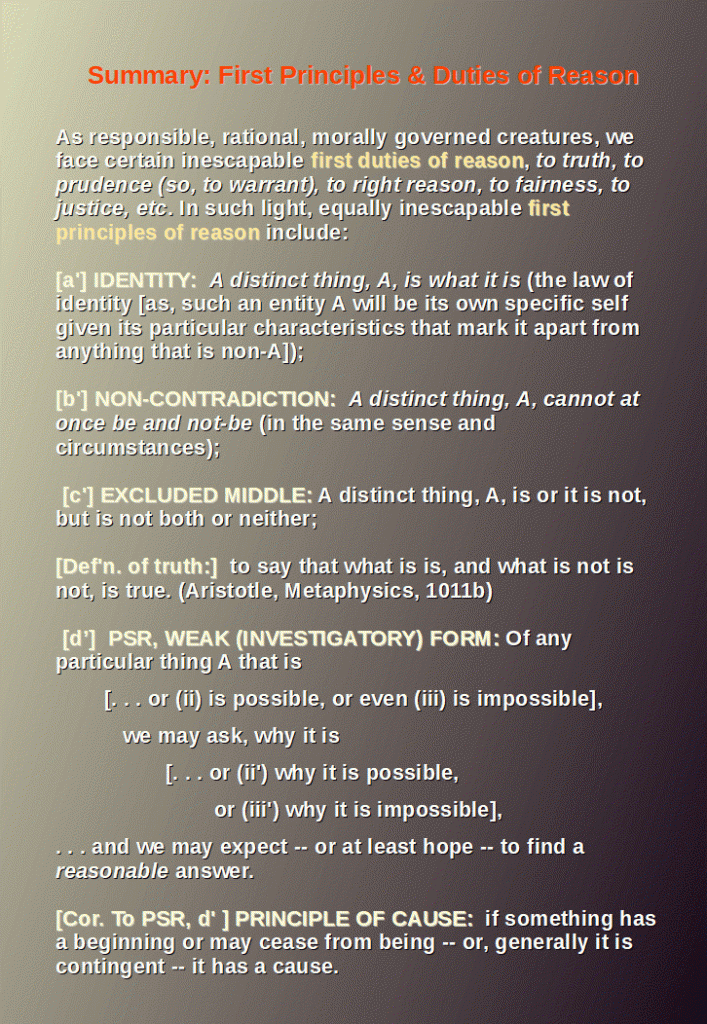
We can pause to summarise key first principles of right reason:
If we want a bit more on the first triad:
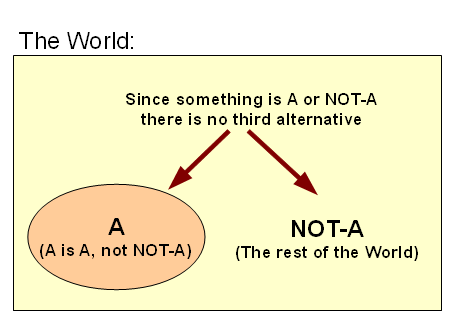
Laws of logic in action as glorified common-sense first principles of right reason

Where, we may ponder Science and linked technology (Computing being in key part a technology of Mathematics, which obviously is not an empirical science but a logic-constrained and guided field of study), as a domain of inductive reason pivoting on inference to best current — hopefully progressive — explanation:
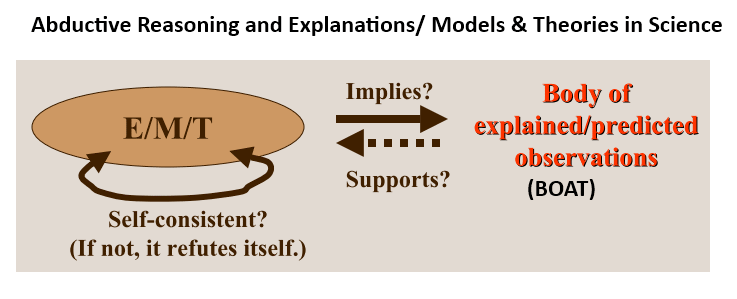
Abductive, inductive reasoning and the inherent provisionality of scientific theorising

These, we must not lose sight of, or all will be lost.

Going forward, that we are morally governed creatures has profound worldview import. For, at least one possible world, which is actualised, has in it such creatures. The root of all reality must be such that such a world is adequately accounted for.

That opens the door to serious consideration of ethical theism, which posits that the explanation for such a world is the inherently good, utterly wise creator God, a necessary [worlds-framework and so too eternal] and maximally great being.

These, we must not lose sight of. END

PS: Eugenics Congress:

Logo, 2nd Int’l Congress, Eugenics Movement, 1921 [HT: Wiki]

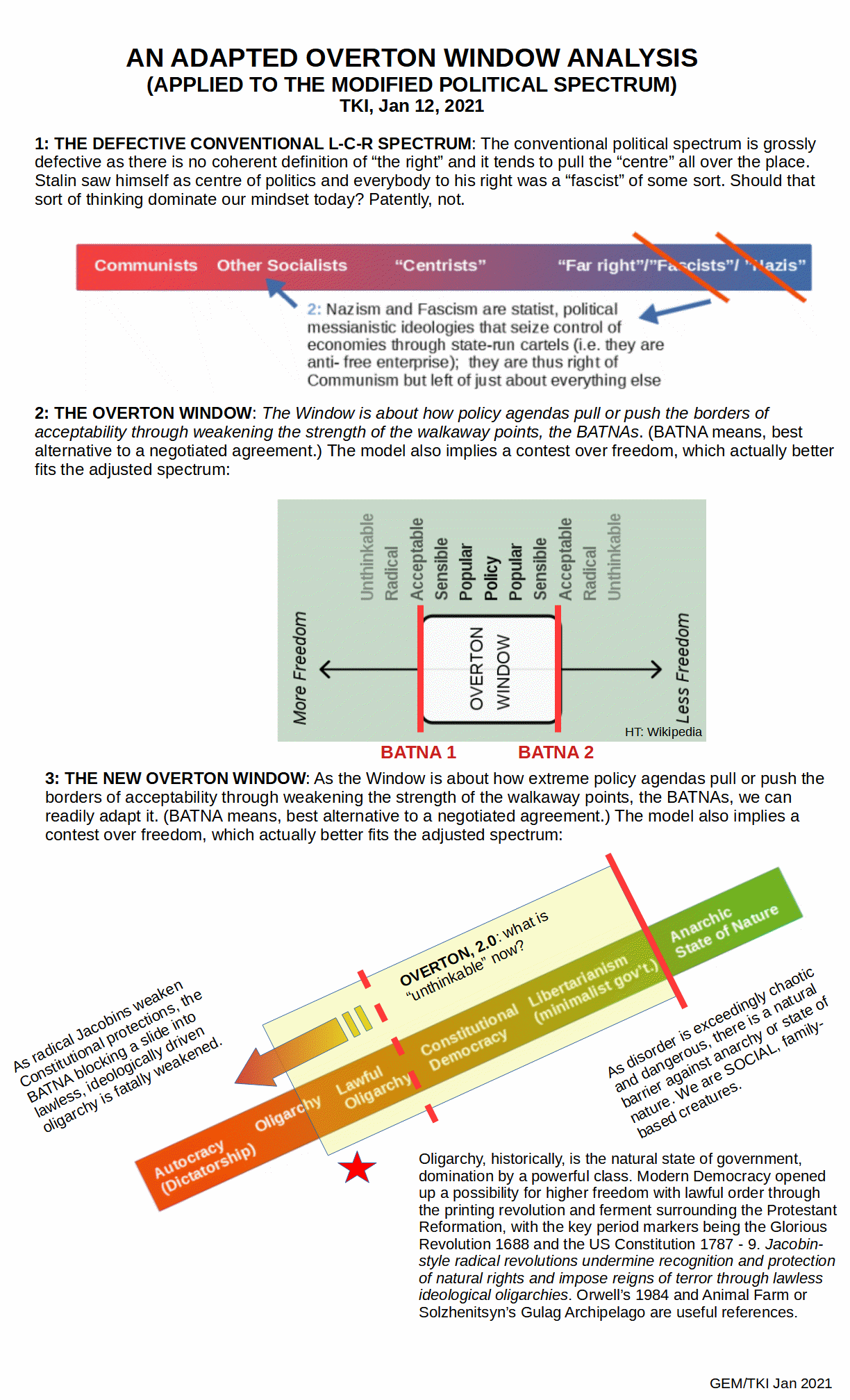
U/D1 Jan 12: An adapted Overton Window analysis, applied to the peril of the new Jacobins:
U/D2, Jan 13, the issue of the crooked yardstick:

In that light, consider Plato’s parable of the cave:

Not, as a fallacious cosmology but as a study on how a manipulated public reacts to truth. Ask yourselves, who is running the puppet shadow-show confused for reality and who is running the prison that locks up denizens from discovering the truth for themselves. (Then, ponder the course of current events.)

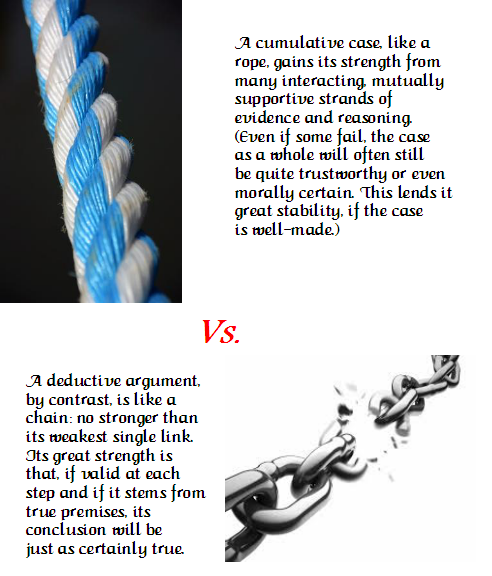
U/D3, Jan 18: Impact of cumulative evidence, as a part of first principles of reason in an inductive context:
Of chains, ropes and cumulative cases

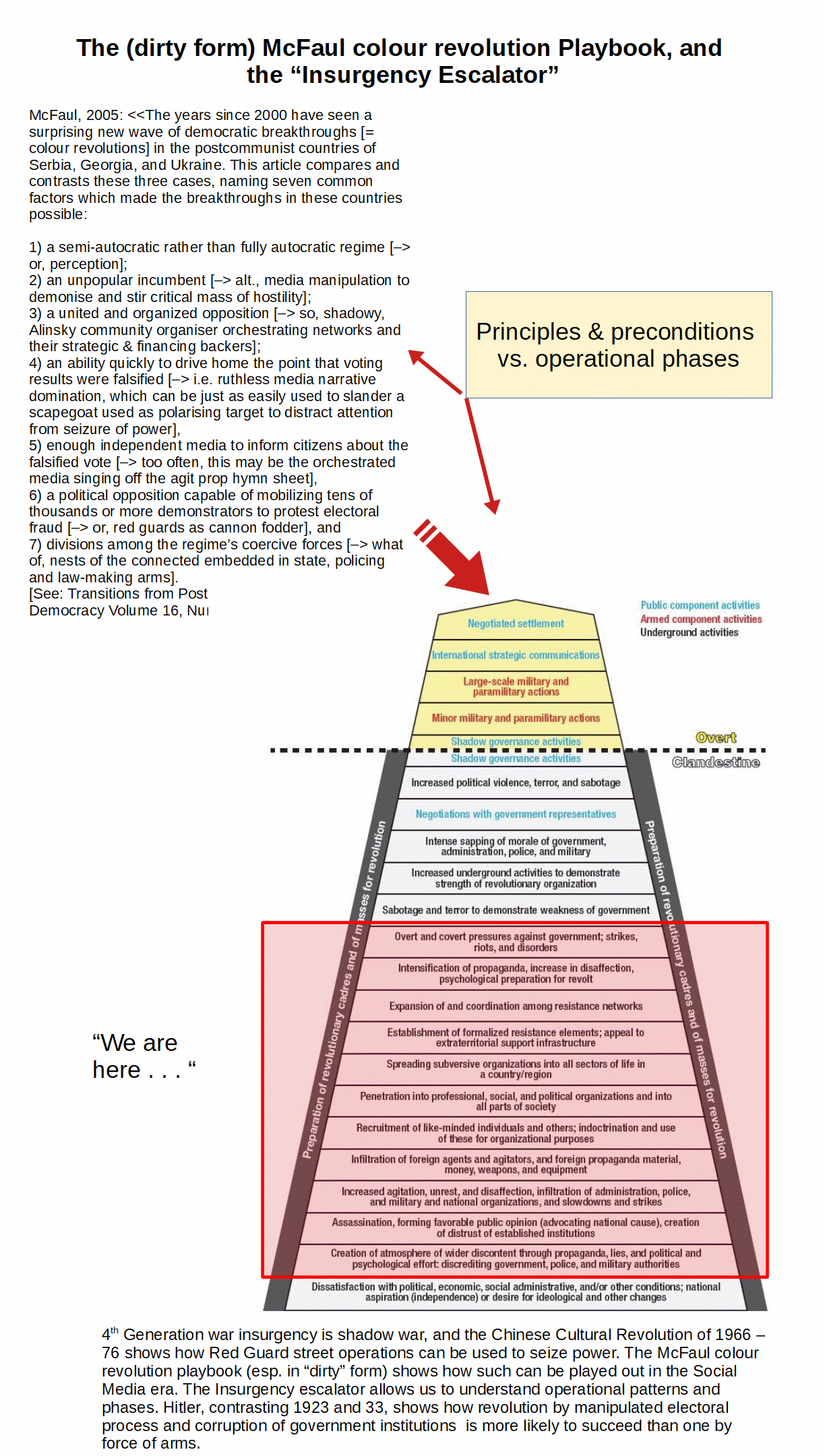
U/D4 Jan 18, to point to the documentation of the McFaul Colour Revolution programme and the SOCOM Insurgency Escalator:
Where, note from the earlier U-Haul a Riot thread on red guard street theatre operations tied to radical Jacobin networks . . . there is much more behind that:
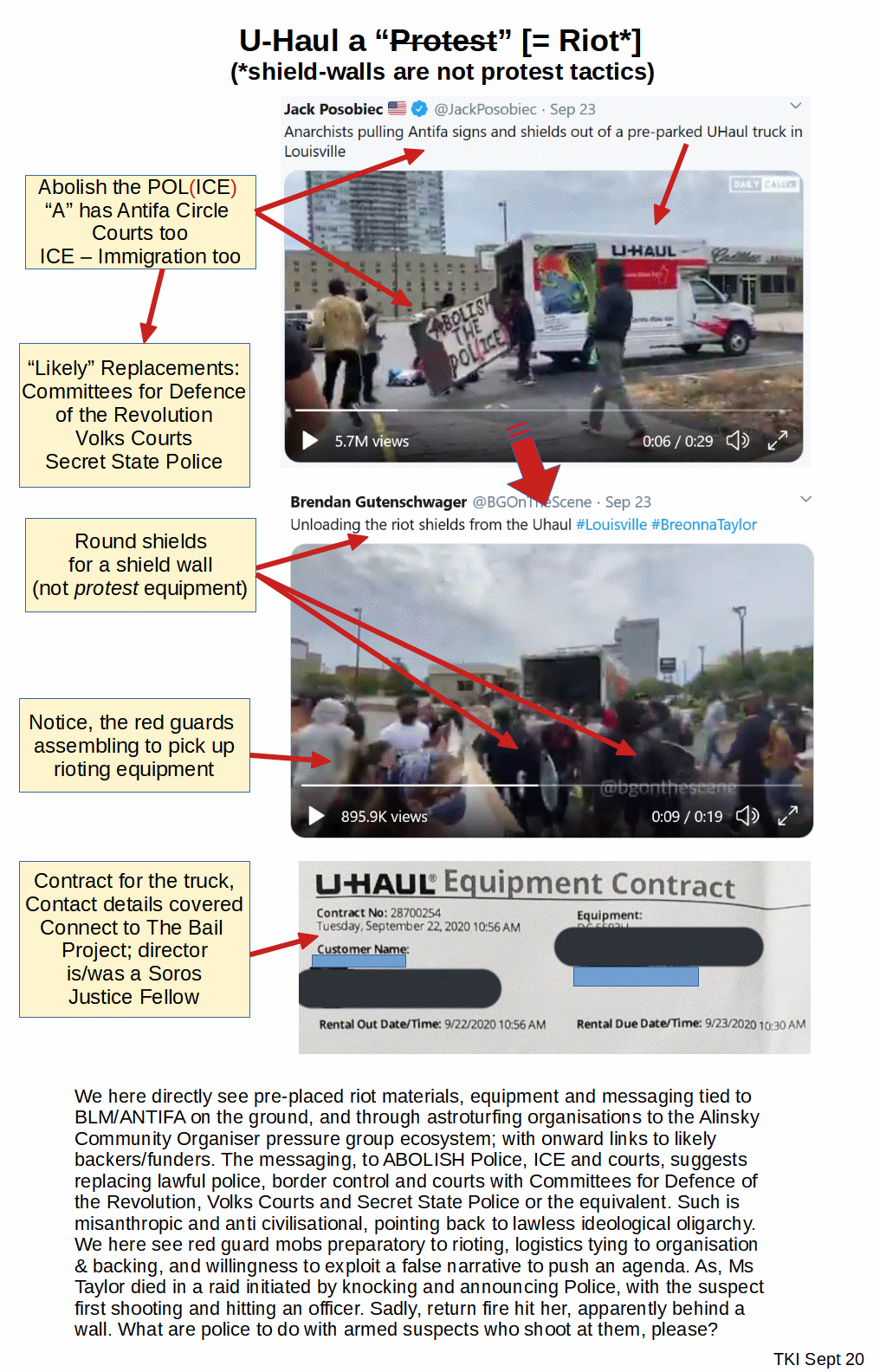
That is, it seems there is little matter of who is rioting to be addressed.

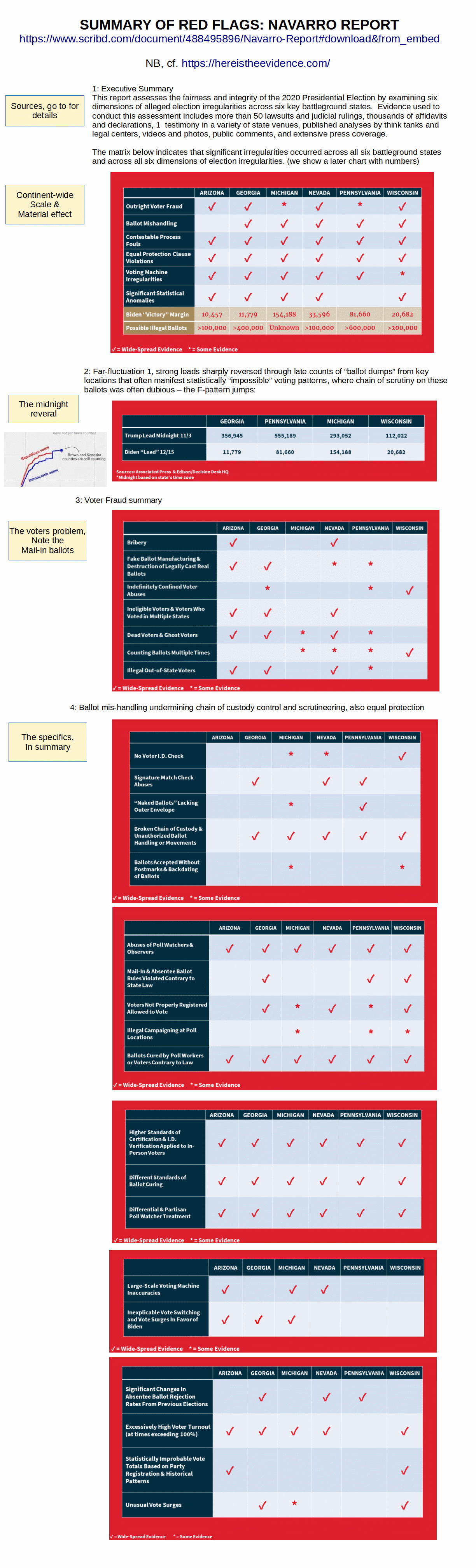
Where, this summary of points of concern by Navarro is a good place to begin pondering the “baseless” talking point that was used below to personally attack me as poster of the OP and host of the live event tracking threads:
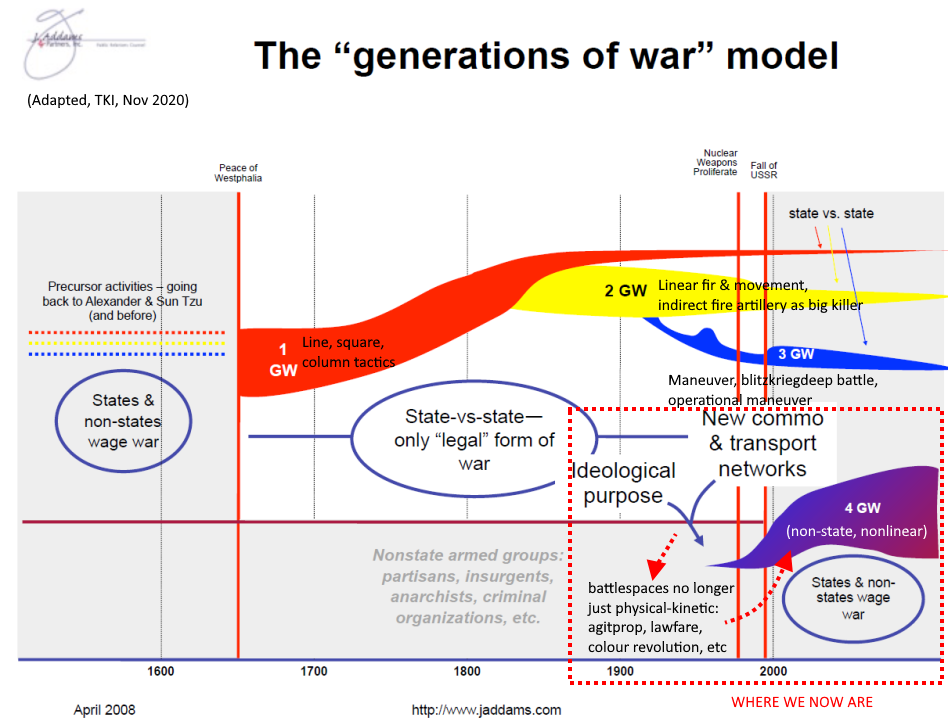
U/D5, Jan 19: It is becoming apparent that as part of reforming thinking we need to re-orient our understanding of war, strategy and associated operations in light of the unlimited scope, full spectrum of force options, social- space- is- the- battlespace evolution of warfare under 4th generation war principles. First, while we may not be interested in war — in a world of ruthless geostrategic operators who lack power to simply steamroller those blocking imposition of their will — the vultures not the eagles — war may well be interested in us.

So, if near-perpetual war is in every sphere and across the spectrum of force options (most often non kinetic) we need to map the social space, so let me repeat the seven mountains/pillars of influence model:

Where, we can map the evolution of war:
In that context, let us note on Unrestricted Warfare, using a summary of the 1999 work by PLA Air Force Colonels Qiao Liang and Wang Xiangsui:

In 1999, two Chinese colonels wrote a book called Unrestricted Warfare, about warfare in the age of globalization. Their main argument: Warfare in the modern world will no longer be primarily a struggle defined by military means — or even involve the military at all.

They were about a decade and a half before their time.

Colonels Qiao Liang and Wang Xiangsui argued that war was no longer about “using armed forces to compel the enemy to submit to one’s will” in the classic Clausewitzian sense. Rather, they asserted that war had evolved to “using all means, including armed force or non-armed force, military and non-military, and lethal and non-lethal means to compel the enemy to accept one’s interests.” The barrier between soldiers and civilians would fundamentally be erased, because the battle would be everywhere. The number of new battlefields would be “virtually infinite,” and could include environmental warfare, financial warfare, trade warfare, cultural warfare, and legal warfare, to name just a few. They wrote of assassinating financial speculators to safeguard a nation’s financial security, setting up slush funds to influence opponents’ legislatures and governments, and buying controlling shares of stocks to convert an adversary’s major television and newspapers outlets into tools of media warfare. According to the editor’s note, Qiao argued in a subsequent interview that “the first rule of unrestricted warfare is that there are no rules, with nothing forbidden.” That vision clearly transcends any traditional notions of war.

Unrestricted Warfare was an explicit response to the reigning Western military orthodoxy of the time. The preface is dated January 17, 1999, which the authors note was the eighth anniversary of the outbreak of the 1991 Gulf War. In many ways, their argument refuted many of the Western lessons drawn from that conflict: that wars could be short, sharp, and dominated by high-technology weaponry used with stunning precision to shatter an enemy’s armed forces in hours or days. By 1999, U.S. military thinking was dominated by the revolution in military affairs and network centric-warfare, which relied on advanced technologies to give the United States total battlefield dominance.

But Qiao and Wang argued that the battlefield had fundamentally changed. It was no longer a place where militaries met and fought; instead, society itself was now the battlefield. Future wars would inevitably encompass attacks on all elements of society without limits. Military battles resembling those of 1991 might become secondary elements of conflict — if they even occurred at all.

In short, war that by and large does not SEEM to be war due to lack of naked high kinetic weaponry in action. War that is only visible as war once one recognises the involvement of ruthless domination and subjugation by use of force and deception. Force, that is often masked as legitimate actions (often, by turnabout projections of blame . . . maskirovka); force calibrated to seem legitimate to the superficial onlooker.

Force, that needs not involve state actors or states. Which, gives it its 4th generational character.

War waged by vultures in the shadows, not just obvious ones in the sky.

War, that is only over, when the vultures themselves are checkmated and irrecoverably defeated. With history signposted so they cannot regroup to rebrand and come again, as obviously has happened with Marxism’s shiny new brand, critical theories.

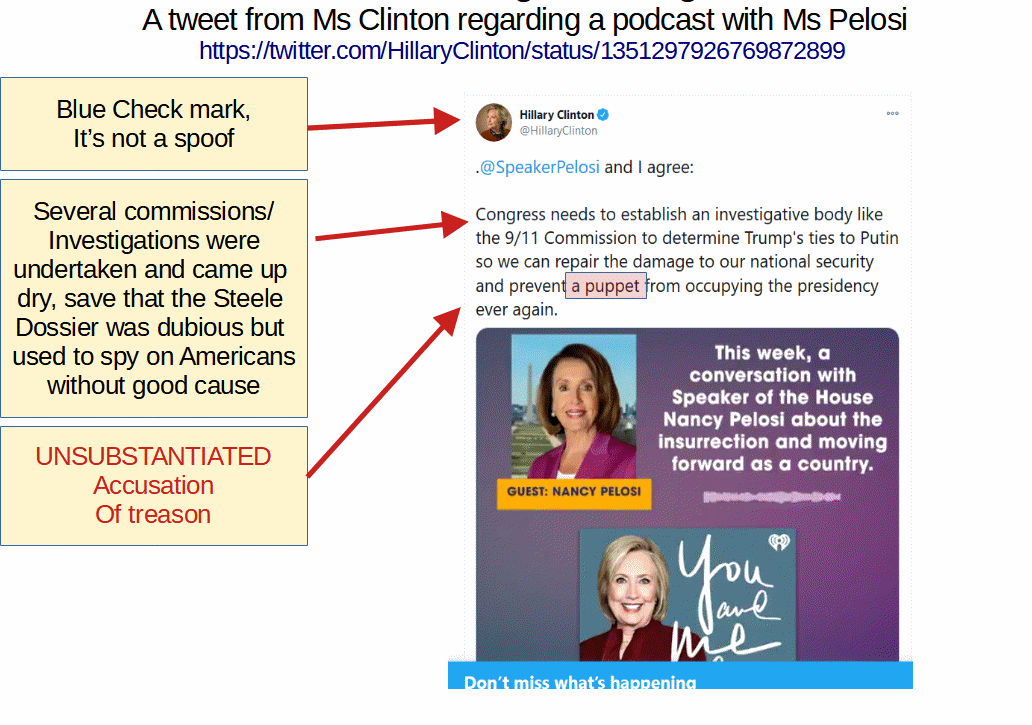
U/D6, Jan 19: Ms Clinton and Ms Pelosi, unsubstantiated accusation of treason, screenshot:
Comments
Viola Lee: For instance, the “basic fact” that we “come in two compatible, complementary, genetically stamped sexes” is, first, subject to exceptions, and second doesn’t necessarily lead to conclusions about same-sex relationships in the same way that a conclusion in math does. Especially if we are granted free will. What's the point of being able to do what we please if we are going to be punished for stepping across some line which no one can actually justify? That's one of the points, can you justify your moral, reasoning, first principle lines? How? But first, lets see how you apply your first principles to a particular example. It should be dead easy.JVL
January 10, 2021
January
01
Jan
10
10
2021
07:53 AM
7
07
53
AM
PDT
William J Murray: “Torturing children for one’s own pleasure is immoral.” Not the question on the table. Try again. AND, answering that question does not get us to the point we're raising which is: how do you make a societal decision when there are major ideological differences between groups of people? Perhaps you'd like to actually try and contribute to that question instead of falling back on some old trope about how 'materialists' don't have an objective basis for morality.JVL
January 10, 2021
January
01
Jan
10
10
2021
07:47 AM
7
07
47
AM
PDT
Yes, I appeal to fairness and justice. However, those are abstract principles with no obvious route to what is exactly fair and just in any particular situation. That is how morals are different then math. For instance, the "basic fact" that we "come in two compatible, complementary, genetically stamped sexes" is, first, subject to exceptions, and second doesn't necessarily lead to conclusions about same-sex relationships in the same way that a conclusion in math does. And then KF, you write,
The point is, it is the very hesitation and projection that such straightforward duties are strange, cloudy and unclear that tells us something has gone wrong.
My "hesitancy" about such "straightforward" duties is because you are in fact "cloudy and unclear": you aren't able to bring your rhetoric down to specifics when asked. You say, "Sure there are details to be elaborated and cases to be drawn out but that does not cast these into doubt as inescapable." If so, show us the details and the elaboration so that a conclusion is "inescapable." This can be done in math. I don't think it can be done in morals. So rather than abstract claims, show us an example.Viola Lee
January 10, 2021
January
01
Jan
10
10
2021
07:21 AM
7
07
21
AM
PDT
JVL & VL: I think what you're looking for is a moral statement (or equation) that is self-evidently, universally, objectively and certainly true as "1+1=2." Try this one on for size: "Torturing children for one's own pleasure is immoral."William J Murray
January 10, 2021
January
01
Jan
10
10
2021
07:16 AM
7
07
16
AM
PDT
Kairosfocus: As we are prone to error, we justify on chains of logic, pivoting on prudence. In trying to suggest that objecting to or questioning various fashionable assertions under colour of law is unfair or bigoted, you appeal to duty to conscience and to neighbour, thus fairness and justice. Yup, more or less. We agree. Not so obvious is the implication of justice as due balance of rights, freedoms and duties such that to claim a right or freedom one must first show oneself in the right and in claiming such, compatible with the freedoms and sound conscience of others. Hang on. I think people should have rights without having to 'show oneself in the right'. For example, there is no just power to compel me or another to lie or enable a lie under colour of law about basic facts such as that we come in two compatible, complementary, genetically stamped sexes. That's not really the point is it though. The question is: are you loving and forgiving and accepting enough to allow same-sex couples the right to marry? Remember too that there are many intra-sex individuals who do not easy fall into a binary category. And, much more. The point is, it is the very hesitation and projection that such straightforward duties are strange, cloudy and unclear that tells us something has gone wrong. Sure there are details to be elaborated and cases to be drawn out but that does not cast these into doubt as inescapable. Party we just want you to spell out what you are saying and thinking. Then we can discuss the issue of things being 'first principles'. Male and Female are just biological classifications. You are aware, I would think, that some animals change sex during their lives? And it gets even messier than that. I personally cannot see the connection between biology and first principles or morals. Can you explain that? Are we a slave to our biology? What if the biology is much weirder than you think? And what does any of this have to do with same-sex couplings? If we have free will then we can transcend our biology surely?JVL
January 10, 2021
January
01
Jan
10
10
2021
07:07 AM
7
07
07
AM
PDT
Viola Lee: I think KF has often explained his thoughts on math. I want to see how he extends that to morals. Fair enough!! I think he wants to extend morals back to pure logic therefore mathematics and then, somehow, divinity. That's the part I'd like to hear about.JVL
January 10, 2021
January
01
Jan
10
10
2021
07:01 AM
7
07
01
AM
PDT
VL, JVL, your "clear example" hinges on these antecedents. Besides, there is precisely such right there in the OP, the core of Mathematics itself. What I notice is that your own arguments (insofar as they make appeals) also pivot implicitly on said duties. Mathematics seeks truth through logic tied to quantity and structure, as just one case. Truth, accurately describing reality. As we are prone to error, we justify on chains of logic, pivoting on prudence. In trying to suggest that objecting to or questioning various fashionable assertions under colour of law is unfair or bigoted, you appeal to duty to conscience and to neighbour, thus fairness and justice. Not so obvious is the implication of justice as due balance of rights, freedoms and duties such that to claim a right or freedom one must first show oneself in the right and in claiming such, compatible with the freedoms and sound conscience of others. For example, there is no just power to compel me or another to lie or enable a lie under colour of law about basic facts such as that we come in two compatible, complementary, genetically stamped sexes. And, much more. The point is, it is the very hesitation and projection that such straightforward duties are strange, cloudy and unclear that tells us something has gone wrong. Sure there are details to be elaborated and cases to be drawn out but that does not cast these into doubt as inescapable. KFkairosfocus
January 10, 2021
January
01
Jan
10
10
2021
06:59 AM
6
06
59
AM
PDT
I accept that our rational minds can apprehend the fundamentals of math: the fact that individual units exist separate from other units is the foundation of the number system and all else that follows, and that the fundamentals of logic are part of our rationality. I think KF has often explained his thoughts on math. I want to see how he extends that to morals.Viola Lee
January 10, 2021
January
01
Jan
10
10
2021
06:55 AM
6
06
55
AM
PDT
Kairosfocus: How do you know that mathematics is certain, or that deductions obtain? Do you not see that I am speaking to what things like Mathematics come from? Things that we cannot escape appealing to implicitly or explicitly and which are therefore at least as certain as what we hinge on them? Why don't you spell it out more clearly. Where do you think mathematics comes from? I think mathematics is invariant, always true everywhere. I don't think that tells us anything about where it comes from though.JVL
January 10, 2021
January
01
Jan
10
10
2021
06:38 AM
6
06
38
AM
PDT
Can you give a clear example, KF. Pick an example of a moral issue and show what principles lead to a logically certain position about that issue. That is what we do in math, and you claim "moral government" has the same properties. I accept that in part human beings are rational, moral, free, and responsible creatures. (I certainly believe I am.) Now what? By what steps do we now reach necessary moral conclusions?Viola Lee
January 10, 2021
January
01
Jan
10
10
2021
06:26 AM
6
06
26
AM
PDT
Kairosfocus: kindly observe that even in evasions and attempted dismissals objectors are forced to pivot on appeals to duty to truth, to right reason, to prudence, to sound conscience, to neighbour; so too to fairness and justice etc. Fine, we're just asking you to spell those things out for a particular example. It should be easy. These are inescapable, are antecedent to demonstrative deductive or inductive arguments, are thus inescapably true and are self-evidently true. The demonstrations or inductions you point to hinge on these. Then, too, they are the pivot of that law which is coeval with our humanity and which therefore frames any discussion on government, policy, law, and the like. We are at the very beginning. Yes, but we'd like you to be very clear and spell things out for a particular example. These principles and duties are foundational to civilisation. Can you explain how these apply to a particular situation? Sigh. Can you PLEASE just pick an example and show how your first principles and duties and reasoning is brought to bear on the issue? Why is this so hard? Why are you so determined to avoid doing it? Are you afraid? The question of 'how will you know if I impose on you' is a good one. But I cannot believe that most people would not have an answer for that, unlike in the text you quoted. Why don't you answer that question: how would YOU know when you were imposed on?JVL
January 10, 2021
January
01
Jan
10
10
2021
06:22 AM
6
06
22
AM
PDT
VL, kindly observe that even in evasions and attempted dismissals objectors are forced to pivot on appeals to duty to truth, to right reason, to prudence, to sound conscience, to neighbour; so too to fairness and justice etc. These are inescapable, are antecedent to demonstrative deductive or inductive arguments, are thus inescapably true and are self-evidently true. The demonstrations or inductions you point to hinge on these. Then, too, they are the pivot of that law which is coeval with our humanity and which therefore frames any discussion on government, policy, law, and the like. We are at the very beginning. These principles and duties are foundational to civilisation. That there is not a straightforward and ready general acknowledgement of something so patent as this is diagnostic of what has gone wrong with our civilisation. We need to ask, why are we so hesitant at the outset, the pivot of all else. Is it, that the direct import is that we are accountable before a built in law coeval with our nature, that then points onward to how we could have such a nature? Could it be that we are seeing the reflection of cognitive dissonance about that accountability and the issue it raises, bridging is and ought? For, post Hume, we know that that can only be done in the root of reality. Until this issue of priors of responsible rational freedom is faced, there is literally no context for reasonably, responsibly addressing any further questions. We are then reduced to the nihilism of might and/or manipulation make "truth"/ "right"/ "warrant"/ "logic"/ "rights"/ "duties"/ "freedoms"/ "justice" etc, an outright absurdity that undermines rationality. And no, for cause I will never yield to, appease, compromise with or submit to such folly. I will, however, elaborate on one of the seven by citing Epictetus, on logic,
DISCOURSES CHAPTER XXV How is logic necessary? When someone in [Epictetus'] audience said, Convince me that logic is necessary, he answered: Do you wish me to demonstrate this to you?—Yes.—Well, then, must I use a demonstrative argument?—And when the questioner had agreed to that, Epictetus asked him. How, then, will you know if I impose upon you?—As the man had no answer to give, Epictetus said: Do you see how you yourself admit that all this instruction is necessary, if, without it, you cannot so much as know whether it is necessary or not? [Notice, inescapable, thus self evidently true and antecedent to the inferential reasoning that provides deductive proofs and frameworks, including axiomatic systems and propositional calculus etc. Cf J. C. Wright]
See the force of the point? That which is first must be freely acknowledged as first, or civilisation of reasonable, responsible people is finished. That is why I start there. KF PS: How do you know that mathematics is certain, or that deductions obtain? Do you not see that I am speaking to what things like Mathematics come from? Things that we cannot escape appealing to implicitly or explicitly and which are therefore at least as certain as what we hinge on them?kairosfocus
January 10, 2021
January
01
Jan
10
10
2021
06:17 AM
6
06
17
AM
PDT
AndyClue/40
How about, as an exercise, YOU lay out which first principles apply to same-sex marriage and see where it gets you.
How about if it harms no one else then what right do we have to interfere with it?
The object of this Essay is to assert one very simple principle, as entitled to govern absolutely the dealings of society with the individual in the way of compulsion and control, whether the means used be physical force in the form of legal penalties, or the moral coercion of public opinion. That principle is, that the sole end for which mankind are warranted, individually or collectively in interfering with the liberty of action of any of their number, is self-protection. That the only purpose for which power can be rightfully exercised over any member of a civilized community, against his will, is to prevent harm to others. His own good, either physical or moral, is not a sufficient warrant. He cannot rightfully be compelled to do or forbear because it will be better for him to do so, because it will make him happier, because, in the opinions of others, to do so would be wise, or even right. These are good reasons for remonstrating with him, or reasoning with him, or persuading him, or entreating him, but not for compelling him, or visiting him with any evil, in case he do otherwise. To justify that, the conduct from which it is desired to deter him must be calculated to produce evil to someone else. The only part of the conduct of any one, for which he is amenable to society, is that which concerns others. In the part which merely concerns himself, his independence is, of right, absolute. Over himself, over his own body and mind, the individual is sovereign
- John Stuart Mill, On LibertySeversky
January 10, 2021
January
01
Jan
10
10
2021
05:46 AM
5
05
46
AM
PDT
KF writes, "The issue is then what is intelligible about reality, thus about moral government coeval with our humanity, the law of our morally governed nature." I don't see how you jump from math, which is logically certain, to "moral government". JVL is right: examples would be useful. I can show you clearly why e^(i*pi) = -1 is true, and show clearly the axioms, definitions, and logical steps to establish that. I don't see a similar framework for moral government issues.Viola Lee
January 10, 2021
January
01
Jan
10
10
2021
05:35 AM
5
05
35
AM
PDT
AndyClue: How about, as an exercise, YOU lay out which first principles apply to same-sex marriage and see where it gets you. One of my basic principles is that, unless they give good cause to do otherwise, all consenting adults should be treated equally under the law. I can think of no legal reason why same-sex couples should not be allowed to marry according to the laws of their country. If Kairosfocus has different first principles which lead him to a different conclusion then I'd appreciate if he elucidated them so that I can discuss our differences more better.JVL
January 10, 2021
January
01
Jan
10
10
2021
05:31 AM
5
05
31
AM
PDT
Kairosfocus: the issue is the roots of civilisation. Thus, the first principles and duties of responsible reason. This is also why I led with core mathematics as here we see a product of pure abstract reason that is reality- and possibility-universal as world-framework truth that constrains logic of being. Truth beyond opinions, debates and rhetorical gambits. Therefore, we can and do know pivotal truths to certainty, here not only of this world but any possible world. Further to such, in so reasoning we find ourselves inescapably resting on and appealing to first principles and duties of reason, which are therefore inescapably and self-evidently true. The issue is then what is intelligible about reality, thus about moral government coeval with our humanity, the law of our morally governed nature. Then, are we willing to acknowledge and start our thinking from such? If not, why not. This is literally civilisation-foundational, that is why I start here. Fine, if you could spell out those principles and the reasoning for a particular issue then maybe we can find where we disagree. no, I will not allow or follow a toxic, distractive diversion. There is a focal issue, literally at the level of first principles and duties. That is what must come first. How is it toxic to ask for an example of how your reasoning and first principles are applied? If you don't like my example then why don't you pick another. Why is the question of same-sex marriage toxic? It's an issue that is frequently discussed and dealt with these days. The point is that it would be much easier for me and others to understand what you are standing on if you show how it works with a particular example. Any good mathematics teacher knows it helps to work out a few examples. How about divorce? What do your first principles and your reasoning say about that?JVL
January 10, 2021
January
01
Jan
10
10
2021
05:30 AM
5
05
30
AM
PDT
@JVL:
Let’s talk about same-sex marriage. You lay out the first principles you think apply and we can talk.
How about, as an exercise, YOU lay out which first principles apply to same-sex marriage and see where it gets you.AndyClue
January 10, 2021
January
01
Jan
10
10
2021
05:12 AM
5
05
12
AM
PDT
JVL, no, I will not allow or follow a toxic, distractive diversion. There is a focal issue, literally at the level of first principles and duties. That is what must come first. KFkairosfocus
January 10, 2021
January
01
Jan
10
10
2021
04:37 AM
4
04
37
AM
PDT
JVL, the issue is the roots of civilisation. Thus, the first principles and duties of responsible reason. This is also why I led with core mathematics as here we see a product of pure abstract reason that is reality- and possibility-universal as world-framework truth that constrains logic of being. Truth beyond opinions, debates and rhetorical gambits. Therefore, we can and do know pivotal truths to certainty, here not only of this world but any possible world. Further to such, in so reasoning we find ourselves inescapably resting on and appealing to first principles and duties of reason, which are therefore inescapably and self-evidently true. The issue is then what is intelligible about reality, thus about moral government coeval with our humanity, the law of our morally governed nature. Then, are we willing to acknowledge and start our thinking from such? If not, why not. This is literally civilisation-foundational, that is why I start here. KFkairosfocus
January 10, 2021
January
01
Jan
10
10
2021
04:35 AM
4
04
35
AM
PDT
Kairosfocus: the issue is not opinion or power but warrant, warrant on merits of fact, logic and start-points of reasoning. So, how do you deal with disagreements? Just insist they are not using good logic or considering the facts? No compromise? the point is, reasonableness, to acknowledge that reason has core, governing duties that are inescapable, inescapably true, self-evident. Not by my say-so but by the evidence we can discuss objectively. Great, let's do so on the issue of same-sex marriage. first, I have not argued such, I have pointed to objective first principles that you are here forced to appeal to even as you try to blunt their force But the upshot is that, say with same-sex marriage, you will not condone that happening. You would deny same-sex couples that legal right. That noted, I point out again, that laying on the table first duties, with a discussion as to why they are inescapable and so inescapably true and self-evident is not, cannot be censorship, suppression or marginalisation. Instead, it is a pointing out of pivotal first principles that lead us to sound discernment and prudence on often needlessly contentious matters. And what if someone disagrees with you about those first principles? Let's talk about same-sex marriage. Underneath, the pattern of invidious associations and false projections is duly noted. And by being noted it is exposed as an ad hominem fallacy. You set up and knocked over a strawman rather than dealing with the substantial issue. Because I might disagree with you about first principles that's false projection? next, compromise is an issue of negotiated settlement, which raises the matter of balances of power and accommodation of the evil with whatever amelioration is possible because there are not favourable circumstances for reformation. Does that sound familiar? Let's talk about same-sex marriage, then we can address a particular topic. Next, what was the compromise regarding slavery in the American Founding, again? What was the compromise on settlement again? Why did it break down? Why do so many today now take it as a basis for painting the founders, framers and their work as evil oppression to be disqualified and repudiated? It broke down because, slowly, a majority of US citizens came to believe that slavery was wrong. And when they had the political power they got it removed. The issue of revisionist history is a different topic, one I am willing to discuss if you wish. what about those who across the 1930’s sought to compromise with Hitler? To appease him? To find him a man they could do business with? The example of Neville Chamberlain is a sad example, which we should learn from, of who NOT to compromise with. It only took a short while to realise that was a bad move. And the compromises were shown to be wrong. A lot of people in Europe remembered the First World War which devastated whole countries and destroyed many families. Their first reaction was to try and avoid another such conflict. And, please note, the US tried to stay out of it and did so until blatantly attacked. Some people in the US did want to support the allies before December 7th, 1941 but the consensus was to stay out of it. In fact, trading with Germany went on for some time. in short, there is no disagreement in principle on need to compromise in an imperfect world where balances of power and BAU are often tainted. Nor, the need to see the various sides of an argument. So, kindly set aside the strawmen. Look, you know a lot of people disagree with you on certain issues. Aside from just saying they are wrong, are not using good reason based on first principles (a non-compromising approach) how do you propose to resolves such conflicts? Like same-sex marriage? what is on the table and needs to be addressed is self-evident first principles on duties of reason. If you disagree with such then — without appealing to them — provide refutation: _______ I predict, hard to do. Let's talk about same-sex marriage. You lay out the first principles you think apply and we can talk.JVL
January 10, 2021
January
01
Jan
10
10
2021
03:30 AM
3
03
30
AM
PDT
JVL, further fallacies: >>Setting aside relativism means a particular point of view wins.>> - the issue is not opinion or power but warrant, warrant on merits of fact, logic and start-points of reasoning. - it is manifest that I have put on the table some first principles which are inescapable . . . even this objection on your part is an appeal to fairness and duty to neighbour. - the point is, reasonableness, to acknowledge that reason has core, governing duties that are inescapable, inescapably true, self-evident. Not by my say-so but by the evidence we can discuss objectively. >> If you consistently tell some members of your society that they are limited in their participation in legal matters >> - first, I have not argued such, I have pointed to objective first principles that you are here forced to appeal to even as you try to blunt their force - and of course, this happens to be a week in which a corrupt state acting with oligopolistic media interests is rushing to censor, lock out, slander and even prosecute those who do not toe Big Brother's partyline. The irony should be manifest. >>they are going to get angry and say something. >> - and so . . . we csee the telling inconsistencies and double standards. - That noted, I point out again, that laying on the table first duties, with a discussion as to why they are inescapable and so inescapably true and self-evident is not, cannot be censorship, suppression or marginalisation. Instead, it is a pointing out of pivotal first principles that lead us to sound discernment and prudence on often needlessly contentious matters. - Underneath, the pattern of invidious associations and false projections is duly noted. And by being noted it is exposed as an ad hominem fallacy. You set up and knocked over a strawman rather than dealing with the substantial issue. >>You have to learn to listen and compromise. It’s the only way forward.>> - first, strawman projections again. - next, compromise is an issue of negotiated settlement, which raises the matter of balances of power and accommodation of the evil with whatever amelioration is possible because there are not favourable circumstances for reformation. Does that sound familiar? - Next, what was the compromise regarding slavery in the American Founding, again? What was the compromise on settlement again? Why did it break down? Why do so many today now take it as a basis for painting the founders, framers and their work as evil oppression to be disqualified and repudiated? - what about those who across the 1930's sought to compromise with Hitler? To appease him? To find him a man they could do business with? Even, as eugenics was imposed and genocide by holocaust was brewing. - in short, there is no disagreement in principle on need to compromise in an imperfect world where balances of power and BAU are often tainted. Nor, the need to see the various sides of an argument. So, kindly set aside the strawmen. - what is on the table and needs to be addressed is self-evident first principles on duties of reason. If you disagree with such then -- without appealing to them -- provide refutation: _______ I predict, hard to do. KFkairosfocus
January 10, 2021
January
01
Jan
10
10
2021
03:18 AM
3
03
18
AM
PDT
Kairosfocus: Next, given the pattern of cultural relativism you have shown above and elsewhere, that society and its overlords may rule one way or another is irrelevant. For, that does not actually make eugenics right or wrong. That lies in the underlying facts, principles, axioms and argument. That is why it is important to draw out how an overwhelming consensus was created and imposed under colours of science, progress, law and more. A consensus that, had it been properly analysed, would have failed at outset but that is the point the analysis was marginalised and an elite gained oligarchic power over others, whose voices were marginalised and dismissed. I have agreed that society failed on that point. A lot of people didn't step up and state the obvious which was it was wrong. They let others make the decision for them. You just keep saying the same thing over and over and over again when we basically agree that something hideous went wrong. An elite can only gain power if the majority of people don't want to get involved. And they didn't. It may have even been the case that a lot of people tacitly agreed with eugenics. Thank goodness that is not the case anymore. And that is true because, eventually, those opposed made their case more loudly and they got things changed. If there was an elite they lost that case.JVL
January 10, 2021
January
01
Jan
10
10
2021
03:02 AM
3
03
02
AM
PDT
Why don't we narrow the discussion down to a particular topic . . . how about same-sex marriage. Why don't you lay out your arguments as to why allowing same-sex marriage violates your first principles of reasoning and then we can discuss it.JVL
January 10, 2021
January
01
Jan
10
10
2021
02:57 AM
2
02
57
AM
PDT
JVL, I note from you above:
[JVL, 18:] it’s up to society as a whole to determine what applications of science are implemented and supported. Society failed during the eugenics period. The state should not have allowed it to happen. Sadly, enough people thought it was a good idea so it happened. The science is the same as any selective breeding programme. And we still do that with animals and plants all the time. You don’t get poodles and collies and cauliflower without using selective breeding. But doing that will people is a violation of their lawful rights. It’s wrong, morally and legally.
Similarly, SA2, 21:
Eugenics was simply the application of selective breeding to humans. It should also be noted that selective breeding has been used for animals, plants and humans long before Darwin proposed his theory.
Notice, you both failed to bring out the point I emphasised in 27:
eugenics is not merely selective breeding of people; by and large, we select our spouses fairly carefully. Eugenics as policy is about IMPOSED limitations on breeding contrary to or subverting the choices of alleged inferior varieties relative to some claimed standard of superiority; or it is about manipulation to the same end. That is, it is about oligarchic domination — fundamentally, lawless oligarchic domination, a misanthropic and anti civilisational stance, but disguised as a scientific breakthrough and imposed under colour of law.
This issue of oligarchic imposition is pivotal. Next, given the pattern of cultural relativism you have shown above and elsewhere, that society and its overlords may rule one way or another is irrelevant. For, that does not actually make eugenics right or wrong. That lies in the underlying facts, principles, axioms and argument. That is why it is important to draw out how an overwhelming consensus was created and imposed under colours of science, progress, law and more. A consensus that, had it been properly analysed, would have failed at outset but that is the point the analysis was marginalised and an elite gained oligarchic power over others, whose voices were marginalised and dismissed. Notice, in the heyday, Chesterton was a lone voice, contra mundum, likely dismissed. And yet, he was manifestly right. Fundamentally, we are not dogs to be bred into retrievers, nor cabbages. To make a comparison to selective breeding hides an enormous and destructive premise: imposition of power by dominant, oligarchic elites suppressing rights. An all too familiar pattern in history. Which is why this case is highly relevant. KFkairosfocus
January 10, 2021
January
01
Jan
10
10
2021
02:51 AM
2
02
51
AM
PDT
Kairosfocus: Don’t you see the gap in your reasoning i/l/o the issue of reasoning on intelligible first principles, which you keep skipping over? What I see, perhaps, is you and I disagreeing over first principles. Look, it's a complicated world now; there are lots of different faiths and ethics and beliefs. You don't agree with them all, I don't agree with them all. But if we are to avoid a societal meltdown (hints of which happened on January 6th in Washington) then we're going to have to talk to each other, consider each others' points of view, and compromise. disagreement/”consensus” — or for that matter, opinion — is immaterial, the issue is duties of reason and sound reasoning pivoting on first principles and well founded facts, e.g. the case of Eugenics that I intend to draw out further in coming days I agreed that Eugenics was wrong, clearly wrong. Why do you keep bringing it up? strawman. Gross misrepresentation in the teeth of abundant evidence otherwise. Nowhere have I ever argued that my view, per my view, must prevail. I am under the impression that you are not willing to consider any compromise which allows some abortions or same-sex marriage. Is that correct? I have consistently argued that emotions by themselves carry no probative force, though the underlying judgements may rest on accurate observation/perception and reasonable inference. As for credibility of claimed authorities, presenters or witnesses etc, they are no better than underlying facts and logic. That is why I have always pointed to the balance on the merits of fact and logic. That's fine, but we still disagree on particular points. We're both reasonable people, we both want peace and justice and such. So how do we find a middle ground? Are you willing to find a middle ground? indeed, further to this, such is why I have emphasised going to first principles, self-evident truths and first duties, precisely as this is how objective, sound bodies of knowledge can be built up. But your self-evident truths are not universally agreed on. So, again, unless you insist on your point of view prevailing, how do you propose we find acceptable middle ground? if you disagree with the first duties, kindly justify your claim without using them: ______ Predictably, you cannot. If agreeing with you first duties means disallowing same-sex marriage then I do disagree. And I say allowing same-sex marriage is not a harbinger of the end of civilisation. Your slippery slope argument is fallacious. I live in a country where homosexuality is now considered very normal. You and lots of others disagree. The fact is that the UK is NOT teetering on the brink of disaster and you have no facts or data to say it is. It's relatively peaceful, prosperous and dealing with its internal disagreements as well as any nation. Brexit and COVID-19 are much more critical crises than letting two consenting adults get married. Let us set aside the fallacies of relativism and reducing issues of moral government, justice, law and policy to implicitly amoral, subtly nihilistic imposition of power games. Where, eugenics is an excellent case in point. Setting aside relativism means a particular point of view wins. If you consistently tell some members of your society that they are limited in their participation in legal matters they are going to get angry and say something. You have to learn to listen and compromise. It's the only way forward.JVL
January 10, 2021
January
01
Jan
10
10
2021
02:50 AM
2
02
50
AM
PDT
JVL: I will clip:
Kairosfocus: it’s not a who; that’s the point. That’s why it is so crucial to understand inescapable, self evident first duties that frame how responsible freedom is morally governed. [JVL:] Yes, you’ve been saying that for a long time. But, when it comes to disagreements about certain ethical decisions you and I frequently disagree and that’s when you insist your view must take precedence. Which means it’s all coming down to a particular view winning the day.
Don't you see the gap in your reasoning i/l/o the issue of reasoning on intelligible first principles, which you keep skipping over? >>when it comes to disagreements about certain ethical decisions you and I frequently disagree>> - people have sharply disagreed on policy, economics, science, mathematics, philosophy. - disagreement/"consensus" -- or for that matter, opinion -- is immaterial, the issue is duties of reason and sound reasoning pivoting on first principles and well founded facts, e.g. the case of Eugenics that I intend to draw out further in coming days. - lessons of sound history are also pivotal. - underlying is the unstated premise of relativism, to which I respond with the following instructive clip:
Excerpted chapter summary, on Subjectivism, Relativism, and Emotivism, in Doing Ethics 3rd Edn, by Lewis Vaughn, W W Norton, 2012. [Also see here and here.] Clipping: . . . Subjective relativism is the view that an action is morally right if one approves of it. A person’s approval makes the action right. This doctrine (as well as cultural relativism) is in stark contrast to moral objectivism, the view that some moral principles are valid for everyone.. Subjective relativism, though, has some troubling implications. It implies that each person is morally infallible and that individuals can never have a genuine moral disagreement Cultural relativism is the view that an action is morally right if one’s culture approves of it. The argument for this doctrine is based on the diversity of moral judgments among cultures: because people’s judgments about right and wrong differ from culture to culture, right and wrong must be relative to culture, and there are no objective moral principles. This argument is defective, however, because the diversity of moral views does not imply that morality is relative to cultures. In addition, the alleged diversity of basic moral standards among cultures may be only apparent, not real. Societies whose moral judgments conflict may be differing not over moral principles but over nonmoral facts. Some think that tolerance is entailed by cultural relativism. But there is no necessary connection between tolerance and the doctrine. Indeed, the cultural relativist cannot consistently advocate tolerance while maintaining his relativist standpoint. To advocate tolerance is to advocate an objective moral value. But if tolerance is an objective moral value, then cultural relativism must be false, because it says that there are no objective moral values. Like subjective relativism, cultural relativism has some disturbing consequences. It implies that cultures are morally infallible, that social reformers can never be morally right, that moral disagreements between individuals in the same culture amount to arguments over whether they disagree with their culture, that other cultures cannot be legitimately criticized, and that moral progress is impossible. Emotivism is the view that moral utterances are neither true nor false but are expressions of emotions or attitudes. It leads to the conclusion that people can disagree only in attitude, not in beliefs. People cannot disagree over the moral facts, because there are no moral facts. Emotivism also implies that presenting reasons in support of a moral utterance is a matter of offering nonmoral facts that can influence someone’s attitude. It seems that any nonmoral facts will do, as long as they affect attitudes. Perhaps the most far-reaching implication of emotivism is that nothing is actually good or bad. There simply are no properties of goodness and badness. There is only the expression of favorable or unfavorable emotions or attitudes toward something.
- in short, there is ground clearing work, framing and sound foundation laying to be done as a first vital step to reformation. >> and that’s when you insist your view must take precedence.>> - strawman. Gross misrepresentation in the teeth of abundant evidence otherwise. Nowhere have I ever argued that my view, per my view, must prevail. - I have always . . . ever since recognising it for myself nigh on 40 years ago and having a professor point me to Aristotle on the point . . . argued that arguments have three levers of persuasion. Pathos, ethos, logos. - I have consistently argued that emotions by themselves carry no probative force, though the underlying judgements may rest on accurate observation/perception and reasonable inference. As for credibility of claimed authorities, presenters or witnesses etc, they are no better than underlying facts and logic. That is why I have always pointed to the balance on the merits of fact and logic. - indeed, further to this, such is why I have emphasised going to first principles, self-evident truths and first duties, precisely as this is how objective, sound bodies of knowledge can be built up. - the issue is not who, but what. That you keep trying to get back to the Arthur Leff, sez who fallacy indicates that you do not have the better case on relevant facts and logic. Hence, dismissive appeal to relativistic disagreement. Fallacy, kindly stop. - when it comes to first duties of reason, it is also obvious that your own arguments implicitly appeal to same. No wonder, they are inescapable. So, true and self-evident. >> Which means it’s all coming down to a particular view winning the day. >> - error carried forward - if you disagree with the first duties, kindly justify your claim without using them: ______ Predictably, you cannot. - Let us set aside the fallacies of relativism and reducing issues of moral government, justice, law and policy to implicitly amoral, subtly nihilistic imposition of power games. Where, eugenics is an excellent case in point. KFkairosfocus
January 10, 2021
January
01
Jan
10
10
2021
02:30 AM
2
02
30
AM
PDT
Kairosfocus: Eugenics as policy is about IMPOSED limitations on breeding contrary to or subverting the choices of alleged inferior varieties relative to some claimed standard of superiority; or it is about manipulation to the same end. That is, it is about oligarchic domination — fundamentally, lawless oligarchic domination, a misanthropic and anti civilisational stance, but disguised as a scientific breakthrough and imposed under colour of law. I have already stated that I thought imposed human breeding programs are wrong so you don't need to go on and on and on about it. I have already said that society needs to take the blame for allowing such an abomination to take place. People, especially large groups of people, sometimes make mistakes. And, as I've already said, the science of unguided evolution has not been jettisoned but eugenics has. Societies can learn and move on. It doesn't mean there is rot deep down. It means people were afraid or stupid and made the wrong call. We know better now.JVL
January 10, 2021
January
01
Jan
10
10
2021
01:37 AM
1
01
37
AM
PDT
Kairosfocus: it’s not a who; that’s the point. That’s why it is so crucial to understand inescapable, self evident first duties that frame how responsible freedom is morally governed. Yes, you've been saying that for a long time. But, when it comes to disagreements about certain ethical decisions you and I frequently disagree and that's when you insist your view must take precedence. Which means it's all coming down to a particular view winning the day. It goes as far as governing how we go about math, much less opening a way to restore law to soundness, thus government. That is why we need to return to understanding that we are free, responsible, thus morally governed, coeval with our humanity. That way we are not locked up to manipulated mobs or self-seeking power elites hell-bent on marches of folly. If we fail here, our civilisation reverts to lawless oligarchy. I need not say more than that Plato warned that in a day of a march of folly on the ship of state, soundness would be marginalised as the mutineers set out on looting the stores. Again, who makes the call when reasonable, intelligent, empathetic and concerned people disagree? You are dead set against abortion and letting same sex couples marry. Many, many people disagree with you. I suspect, in fact, that a majority of people disagree with you. If you just insist your view trumps all others then how are you not an elite imposing your views on others? It is a fact that many, many countries that allow some abortions and same-sex marriages have not devolved into lawless anarchy. You think they will but there is no evidence of that. Europe is doing quite well; it's stable, the various economies are doing pretty well, there are no major wars between sovereign governments, there's little rioting or desires to overthrow the status quo. Why should your moral view take precedence based on how things are and are working for a large number of people on the planet?JVL
January 10, 2021
January
01
Jan
10
10
2021
01:33 AM
1
01
33
AM
PDT
SA2, 21:
Kairosfocus “ This means that every product of reason, including Science, is morally governed.” [SA2:] I don’t think there is any argument here. But everyone, including scientists, have different views on what is morally acceptable. That is why funding for science is generally handled through committees that weigh many factors including government restrictions. It is far from perfect but it does minimize the number and risk of “rogue” scientists.
On the contrary, the idea that morality is a mere matter of perceptions and values, which vary across the population uncontrollably is a reflection of a major modern malaise of thought and disagreement on the subject of moral truths. Where, as Government is inherently about coercive force, the issue of sound and general, valid principles of justice is crucial. The pickpocket, the serial rapist, the killer for hire [sometimes with a law enforcement badge] has a differing opinion, but the question is, how do we distinguish the sound from the unsound. To which, the OP answers by identifying pivotal and inescapable first duties of reason which then are self-evident moral truths. Here is the key core point -- a point that is manifestly central if sound civilisation is to be restored:
We can readily identify at least seven inescapable first duties of reason. “Inescapable,” as they are so antecedent to reasoning that even the objector implicitly appeals to them; i.e. they are self-evident. Namely, duties, 1 – to truth, 2 – to right reason, 3 – to prudence, 4 – to sound conscience, 5 – to neighbour; so also, 6 – to fairness and 7 – justice x – etc. Such built-in . . . thus, universal . . . law is not invented by parliaments, kings or courts, nor can these principles and duties be abolished by such; they are recognised, often implicitly as an indelible part of our evident nature. Hence, “natural law,” coeval with our humanity, famously phrased in terms of “self-evident . . . rights . . . endowed by our Creator” in the US Declaration of Independence, 1776. (Cf. Cicero in De Legibus, c. 50 BC.) Indeed, it is on this framework that we can set out to soundly understand and duly balance rights, freedoms and duties; which is justice, the pivot of law. The legitimate main task of government, then, is to uphold and defend the civil peace of justice through sound community order reflecting the built in, intelligible law of our nature. Where, as my right implies your duty a true right is a binding moral claim to be respected in life, liberty, honestly acquired property, innocent reputation etc. To so justly claim a right, one must therefore demonstrably be in the right. Likewise, Aristotle long since anticipated Pilate’s cynical “what is truth?”: truth says of what is, that it is; and of what is not, that it is not. [Metaphysics, 1011b, C4 BC.] Simple in concept, but hard to establish on the ground; hence — in key part — the duties to right reason, prudence, fairness etc. Where, prudence can also be seen via Aristotle’s summary: “. . . [who aptly] defined prudence as recta ratio agibilium, ‘right reason applied to practice.’ The emphasis on ‘right’ is important . . . Prudence requires us to distinguish between what is right and what is wrong . . . If we mistake the evil for the good, we are not exercising prudence—in fact, we are showing our lack of it.”
Such built-in law of our nature, coeval with our humanity, is universal and cannot be abolished. As it governs our rationality, it governs, too, the rationality of science, engineering, education, media, mathematics [especially in that notorious application to state-purposes, statistics]. Accordingly, we have a basis of truthful principles of duty that can be used to work out on a responsible, objective basis, what is morally sound, just and prudent in particular circumstances including those of sci-tech. Where, again:
prudence can also be seen via Aristotle’s summary: “. . . [who aptly] defined prudence as recta ratio agibilium, ‘right reason applied to practice.’ The emphasis on ‘right’ is important . . . Prudence requires us to distinguish between what is right and what is wrong . . . If we mistake the evil for the good, we are not exercising prudence—in fact, we are showing our lack of it.”
It is the breakdown of prudence (and of incorporated sound discernment) that has been at the pivot of the breakdown of civilisation that is now in all too manifest progress. Accordingly, if we are to return to safe ground, we must set this right. KFkairosfocus
January 10, 2021
January
01
Jan
10
10
2021
12:23 AM
12
12
23
AM
PDT
JVL and SA2, BTW, eugenics is not merely selective breeding of people; by and large, we select our spouses fairly carefully. Eugenics as policy is about IMPOSED limitations on breeding contrary to or subverting the choices of alleged inferior varieties relative to some claimed standard of superiority; or it is about manipulation to the same end. That is, it is about oligarchic domination -- fundamentally, lawless oligarchic domination, a misanthropic and anti civilisational stance, but disguised as a scientific breakthrough and imposed under colour of law. KF PS: First, an introduction on the point:
Lecture 36: Eugenics and Other Evils by Dale Ahlquist The Case Against a Scientifically-Designed Society Eugenics is a nice-sounding word, combining as it does the Greek words for “good” and “birth.” And Francis Galton, who made up the word and the idea, proposed Eugenics “for the betterment of mankind.” But that’s as far as the nice-sounding stuff goes. The actual definition is rather horrible: the controlled and selective breeding of the human race. Galton based his ideas on the theories of his cousin: Charles Darwin. By the beginning of the 20th century, when Darwin’s theory was safely embraced by the scientific establishment, Eugenics was getting good press. The New York Times gave it constant and positive coverage. Luther Burbank and other scientists promoted Eugenics. George Bernard Shaw said that nothing but a Eugenic religion could save civilization. Only one writer wrote a book against Eugenics. G.K. Chesterton. Eugenics and Other Evils may be his most prophetic book.
One of very few intellectual objectors, G K Chesterton, on the subject when it was live and exceedingly popular, enforced by consensus of the powerful in the name of science. Remember, this is a lone voice speaking contra mundum, and being right when it counted:
I publish these essays at the present time for a particular reason connected with the present situation; a reason which I should like briefly to emphasise and make clear. Though most of the conclusions, especially towards the end, are conceived with reference to recent events, the actual bulk of preliminary notes about the science of Eugenics were written before the [First World] war. It was a time when this theme was the topic of the hour; when eugenic babies (not visibly very distinguishable from other babies) sprawled all over the illustrated papers; when the evolutionary fancy of Nietzsche was the new cry among the intellectuals; and when Mr. Bernard Shaw and others were considering the idea that to breed a man like a cart-horse was the true way to attain that higher civilisation, of intellectual magnanimity and sympathetic insight, which may be found in cart-horses. It may therefore appear that I took the opinion too controversially, and it seems to me that I sometimes took it too seriously. But the criticism of Eugenics soon expanded of itself into a more general criticism of a modern craze for scientific officialism and strict social organisation . . . . The wisest thing in the world is to cry out before you are hurt. It is no good to cry out after you are hurt; especially after you are mortally hurt. People talk about the impatience of the populace; but sound historians know that most tyrannies have been possible because men moved too late. It is often essential to resist a tyranny before it exists. It is no answer to say, with a distant optimism, that the scheme is only in the air. A blow from a hatchet can only be parried while it is in the air. There exists to-day a scheme of action, a school of thought, as collective and unmistakable as any of those by whose grouping alone we can make any outline of history . . . It is called for convenience "Eugenics"; and that it ought to be destroyed I propose to prove in [4]the pages that follow. I know that it means very different things to different people; but that is only because evil always takes advantage of ambiguity. I know it is praised with high professions of idealism and benevolence; with silver-tongued rhetoric about purer motherhood and a happier posterity. But that is only because evil is always flattered, as the Furies were called "The Gracious Ones." I know that it numbers many disciples whose intentions are entirely innocent and humane; and who would be sincerely astonished at my describing it as I do. But that is only because evil always wins through the strength of its splendid dupes; and there has in all ages been a disastrous alliance between abnormal innocence and abnormal sin. Of these who are deceived I shall speak of course as we all do of such instruments; judging them by the good they think they are doing, and not by the evil which they really do. But Eugenics itself does exist for those who have sense enough to see that ideas exist; and Eugenics itself, in large quantities or small, coming quickly or coming slowly, urged from good motives or bad, applied to a thousand people or applied to three, Eugenics itself is a thing no more to be bargained about than poisoning. It is not really difficult to sum up the essence of Eugenics: though some of the Eugenists seem to be rather vague about it. The movement consists of two parts: a moral basis, which is common to all, and a scheme of social application which varies a good [5]deal. For the moral basis, it is obvious that man's ethical responsibility varies with his knowledge of consequences . . . Now the Eugenic moral basis is this; that the baby for whom we are primarily and directly responsible is the babe unborn. That is, that we know (or may come to know) enough of certain inevitable tendencies in biology to consider the fruit of some contemplated union in that direct and clear light of conscience which we can now only fix on the other partner in that union . . . . Far into the unfathomable past of our race we find [10]the assumption that the founding of a family is the personal adventure of a free man. Before slavery sank slowly out of sight under the new climate of Christianity, it may or may not be true that slaves were in some sense bred like cattle, valued as a promising stock for labour. [--> Barbuda, two islands over, was a slave breeding plantation, and today, we can still see characteristics in our population] If it was so it was so in a much looser and vaguer sense than the breeding of the Eugenists; and such modern philosophers read into the old paganism a fantastic pride and cruelty which are wholly modern. It may be, however, that pagan slaves had some shadow of the blessings of the Eugenist's care. It is quite certain that the pagan freemen would have killed the first man that suggested it . . . The shortest general definition of Eugenics on its practical side is that it does, in a more or less degree, propose to control some families at least as if they were families of pagan slaves. I [11]shall discuss later the question of the people to whom this pressure may be applied; and the much more puzzling question of what people will apply it. But it is to be applied at the very least by somebody to somebody, and that on certain calculations about breeding which are affirmed to be demonstrable . . .
He of course continues at book length, but this should be enough for a first stimulus for reflection. For, it turns out that eugenics is a telling case study on attempted imposition of oligarchic domination, under colours of science, science-guided policy, media manipulation and equally false colour of law. Underneath, lies the subtext of contempt for perceived inferiors and threats to the interests of the power classes making the imposition for the alleged common good on a claim to scientific knowledge. That's someone walking over your grave that you feel.kairosfocus
January 9, 2021
January
01
Jan
9
09
2021
11:26 PM
11
11
26
PM
PDT
1 … 13 14 15 16