Uncommon Descent Serving The Intelligent Design Community

UD PRO-DARWINISM ESSAY CHALLENGE

Categories
Darwinism
Design inference
Education
Evolution
ID Foundations
Intelligent Design
Origin Of Life
Science
science education
specified complexity
worldview
Share
Facebook
Twitter/X
LinkedIn
Flipboard
Print
Email

On Sept 23rd, I put up an essay challenge as captioned, primarily to objecting commenter Jerad.

As at October 2nd, he has definitively said: no.

Joe informs us that Zachriel has tried to brush it aside:

Try Darwin’s Origin of Species (1859). It’s a bit dated and longer than 6,000 words, (the 6th edition is 190,000 words), but Darwin considered it just a long abstract, and it still makes for a powerful argument.

This is, frankly, a “don’t bother me” brush-off; telling in itself, as a definitive, successful answer would have momentous impact on this blog.

Zachriel’s response reminds me, all too strikingly, of the cogency of  what Philip Johnson had to say in reply to Lewontin’s claims in his NYRB article in January 1997:

For scientific materialists the materialism comes first; the science comes thereafter. [[Emphasis original]We might more accurately term them “materialists employing science.” And if materialism is true, then some materialistic theory of evolution has to be true simply as a matter of logical deduction, regardless of the evidence. That theory will necessarily be at least roughly like neo-Darwinism, in that it will have to involve some combination of random changes and law-like processes capable of producing complicated organisms that (in Dawkins’ words) “give the appearance of having been designed for a purpose.”
 
. . . .   The debate about creation and evolution is not deadlocked . . . Biblical literalism is not the issue. The issue is whether materialism and rationality are the same thing. Darwinism is based on an a priori commitment to materialism, not on a philosophically neutral assessment of the evidence. Separate the philosophy from the science, and the proud tower collapses. [[Emphasis added.] [[The Unraveling of Scientific Materialism, First Things, 77 (Nov. 1997), pp. 22 – 25.]

There is a serious matter on the table, to be addressed in the context that there is now a significant empirically grounded challenge to the claim that blind chance forces and mechanical necessity can account for the world of life. And, that reminds us to mention that the co-founder of the theory of evolution from 1869 on argued for intelligent evolution, specifically publishing his views at length in The World of Life. Which, is still a powerful argument that that world is “a manifestation of Creative Power, Directive Mind and Ultimate Purpose.”

Hey, let’s add a vid:

For instance, here — with simplified paragraphing — is a comment in Wallace’s preface:

. . . the most prominent feature of my book is that I enter into a popular yet critical examination of those underlying fundamental problems which Darwin purposely excluded from his works as being beyond the scope of his enquiry.

Such are, the nature and causes of Life itself ; and more especially of its most fundamental and mysterious powers growth and reproduction. I first endeavour to show (in Chapter XIV.) by a care-ful consideration of the structure of the bird’s feather; of the marvellous transformations of the higher insects ; and, more especially of the highly elaborated wing-scales of the Lepidoptera (as easily accessible examples of what is going on in every part of the structure of every living thing), the absolute necessity for an organising and directive Life-Principle in order to account for the very possibility of these complex outgrowths.

I argue, that they necessarily imply first, a Creative Power, which so constituted matter as to render these marvels possible ; next, a directive Mind which is demanded at every step of what we term growth, and often look upon as so simple and natural a process as to require no explanation ; and, lastly, an ultimate Purpose, in the very existence of the whole vast life-world in all its long course of evolution throughout the eons of geological time.

This Purpose, which alone throws light on many of the mysteries of its mode of evolution, I hold to be the development of Man, the one crowning product of the whole cosmic process of  life-development ; the only being which can to some extent comprehend nature; which can perceive and trace out her modes of action ; which can appreciate the hidden forces and motions everywhere at work, and can deduce from them a supreme and over-ruling Mind as their necessary cause.

For those who accept some such view as I have indicated, I show (in Chapters XV. and XVI.) how strongly it is sup-ported and enforced by a long series of facts and co-relations which we can hardly look upon as all purely accidental coincidences. Such are the infinitely varied products of living things which serve man’s purposes and man’s alone not only by supplying his material wants, and by gratifying his higher tastes and emotions, but as rendering possible many of those advances in the arts and in science which we claim to be the highest proofs of his superiority to the brutes, as well as of his advancing civilisation.

From a consideration of these better-known facts I proceed (in Chapter XVII.) to an exposition of the mystery of cell-growth ; to a consideration of the elements in their special relation to the earth itself and to the life-world ; while in the last chapter I endeavour to show the purpose of that law of diversity which seems to pervade the whole material Universe.

In short, Darwin’s co-founder — and a man who was at least as learned on the substantial evidence as Darwin was — plainly argued at book length with copious evidence, that the evidence on the ground strongly points to design and purpose even within an evolutionary frame. Brushing the challenge off off by pointing to Darwin’s book, fails the giggle test.

So, here is the challenge, placed before the Darwinist (and similar), Blind Watchmaker Thesis objectors to design theory; especially those at TSZ:
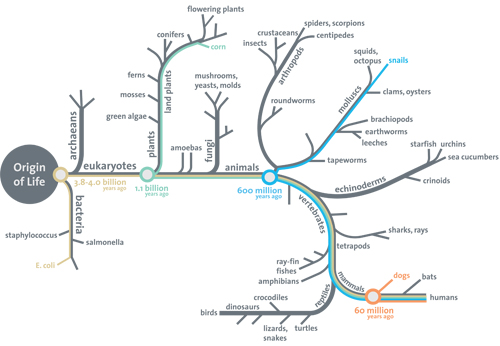
The Smithsonian’s tree of life model, note the root in OOL

UD PRO-DARWINISM ESSAY CHALLENGE: Compose your summary case for darwinism (or any preferred variant that has at least some significant support in the professional literature, such as punctuated equlibria etc) in a fashion that is accessible to the non-technical reader — based on empirical evidence that warrants the inference to body plan level macroevolution — in up to say 6,000 words [a chapter in a serious paper is often about that long]. Outgoing links are welcome so long as they do not become the main point. That is, there must be a coherent essay, with

(i)an intro,
(ii) a thesis,
(iii) a structure of exposition,
(iv) presentation of empirical warrant that meets the inference to best current empirically grounded explanation [–> IBCE] test for scientific reconstructions of the remote past,
(v) a discussion and from that
(vi) a warranted conclusion.

Your primary objective should be to show in this way, per IBCE, why there is no need to infer to design from the root of the Darwinian tree of life — cf. Smithsonian discussion here —  on up (BTW, it will help to find a way to resolve the various divergent trees), on grounds that the Darwinist explanation, as extended to include OOL, is adequate to explain origin and diversification of the tree of life. A second objective of like level is to show how your thesis is further supported by such evidence as suffices to warrant the onward claim that is is credibly the true or approximately true explanation of origin and body-plan level diversification of life; on blind watchmaker style chance variation plus differential reproductive success, starting with some plausible pre-life circumstance.

It would be helpful if in that essay you would outline why alternatives such as design, are inferior on the evidence we face. [As an initial spark for thinking, contrast my own survey of origins science here on (note the onward resources page), the definition of design theory in the UD resources tab top of this and every UD page, the Weak Argument Correctives in the same tab, the general resources that pop up on clicking the tab itself, and the discussion of design theory in the NWE article here. You may also want to refer to the site of the IDEA Center, and the Discovery Institute CSC site as well as Mike Gene’s Telic Thoughts. Notice IDEA’s essay on the case for design here.] . . . .

I would put this up as an original post, with preliminary contextual remarks and an invitation to respond in the comments section.

I will not submit the post with a rebutting markup or make an immediate rebuttal. In fact, let me make the offer to hold off my own comments for at least five initial comments. I will give you two full days of comments before I post any full post level response; though others at UD will be free to respond in their own right.

And BTW, I am making this offer without consulting with the blog owner or others, I am sure they would welcome a serious response . . .  [NB: I have given how to contact me in the original Sept 23 post, I will not repeat that in a headlined original post.]

That challenge is on the table. In truth, it has always been implicitly on the table. For, as I went on to note on Sept 23:

Now, at any time, in essentially any thread at UD any serious and civil design theory objector could have submitted such an essay, breaking it up into a multi part comment if desired . . .

And, it is quite clear that if there were a cogent, empirically well-grounded blind watchmaker thesis account of the origins of the world of life, there would be no design theory movement in biology.

(There would still be a serious design argument in cosmology, but that is a different matter. That does, however, show that strictly speaking design theory has no need to make its case in the world of life; it is because of the blatant weight of the evidence that there is a design movement on phenomena in the world of life.)

So, there you have it, there is a challenge officially on the table.

Let us see if any of the many objectors to design theory at TSZ or elsewhere — I would even accept a parallel post and discussion here and at TSZ (though, no, I will not be commenting there if that is done) — will be willing to step up to the plate. END

Comments
I've read that section, and also some of Timaeus. The argument in Laws struck me as frustrating. It seemed to be something like this: (1) moving things are either self-moving or other-moved; (2) organisms are self-moving movers; (3) but they are not originally self-moving movers (because each organism comes from some other organism); (4) self-moving movers require an originally self-moving mover; (5) mind is an originally self-moving mover; (6) so mind is the cause of organisms. (1), (2), and (3) look fine to me. I'm not entirely sure about (4), and the way the argument moves from (4) to (5) to (6) worries me. I can't shake the feeling that something's gone wrong here. And it just seems odd to me to think that the rise of Democritean atomism was somehow responsible for Alcidiabes' moral corruption, but I don't know. Thucydides portrays Alcibiades as vain, intelligent, and narcissistic, which would be enough as it is without attributing his corruption to Democritus' aprioristic anti-creationism. A few years ago I read Creationism and Its Critics in Antiquity, and I use Sedley's narrative as part of the structure of the ancient philosophy course I sometimes offer. (The other part of the structure traces the narrative from the Sophists through Thucydides' History to Plato's Republic.)Kantian Naturalist
October 9, 2012
October
10
Oct
9
09
2012
04:24 PM
4
04
24
PM
PDT
So I took this home DNA test that's been advertised on this site, and I flunked. Do you think it's me, or the test?Mung
October 9, 2012
October
10
Oct
9
09
2012
04:18 PM
4
04
18
PM
PDT
KN:
So far as I can see, one part of the solution will require rethinking what we take “non-teleological processes” to be.
As for me, I think "non-teleological process" is an oxymoron.Mung
October 9, 2012
October
10
Oct
9
09
2012
04:16 PM
4
04
16
PM
PDT
KN: At last, someone who is serious:
So far as I can see, one part of the [OOL] solution will require rethinking what we take “non-teleological processes” to be. It seems to me that the most promising naturalistic solution will involve thinking of matter as itself essentially ‘proto-teleological’, which is why I’m strongly sympathetic to self-organization theory.
This of course would point straight to cosmological design, especially in the context of the already known. KFkairosfocus
October 9, 2012
October
10
Oct
9
09
2012
04:14 PM
4
04
14
PM
PDT
KN, I suggest a look at Plato in The Laws Bk X. There is also a reason why when I taught intro to phil, I began from Plato's parable of the cave. Since I am not exactly a movie fan, it was a student who pointed to The Matrix. KFkairosfocus
October 9, 2012
October
10
Oct
9
09
2012
04:03 PM
4
04
03
PM
PDT
In re: 176, I suppose that would depend on whether one held that view on a priori grounds -- because it seems to be the most reasonable or least improbable view -- or if one held that view on empirical grounds. Personally, though I accept teleological realism, I take that to mean that organisms purposively direct their own behavior. Whether that extends to their evolution is a difficult question. I suppose I think it does not, because I think of evolution as a consequence of their behavior but not itself a part of it. I take very seriously the problem of abiogenesis, because if one is a naturalist (as I am), the problem is one of figuring out how non-teleological processes (what is described by the laws of physics and chemistry) gave rise to teleological processes (what is described by biology). So far as I can see, one part of the solution will require rethinking what we take "non-teleological processes" to be. It seems to me that the most promising naturalistic solution will involve thinking of matter as itself essentially 'proto-teleological', which is why I'm strongly sympathetic to self-organization theory. That said, I'm the last person to insist that we actually have in our possession a naturalistic theory of abiogenesis. It remains a real problem. If I had the mind for organic chemistry and biochemistry, I'd be working on it myself. (Unfortunately, I don't have the mind for it, as my college transcript clearly indicates.)Kantian Naturalist
October 9, 2012
October
10
Oct
9
09
2012
04:00 PM
4
04
00
PM
PDT
KN, Say organisms guided their own evolution. Where would that fall in your list? cheersMung
October 9, 2012
October
10
Oct
9
09
2012
03:39 PM
3
03
39
PM
PDT
Hi Eric,
Look, I understand the idea of a receiver being involved in communication of information and that the information can have the semantic effect of conveying previously-unknown material (which is really what your authors are trying to highlight, as opposed to a string of nonsensical Shannon-only “information”).
I don't believe in nonsensical Shannon-only information either. Nonsensical information is an oxymoron. Even Shannon information is information about something. And is there any question that it involves the exact same concepts, though in terms of reduction in uncertainty? As ID'ists we should not fall prey to misapplication of information theory. How much "Shannon information" is contained in the following: 00101Mung
October 9, 2012
October
10
Oct
9
09
2012
03:37 PM
3
03
37
PM
PDT
The disambiguation of "information" comes from viewing it in terms of its material existence alone.
Information is the form of a thing instantiated in the arrangement of a material medium.
Information requires a material medium? check Information is about something? check. Information is separate from the thing it’s about? check. Information requires a protocol in order to achieve an effect? check From this, a coherent, unambiguous view of information can be formally understood, and that understanding can be tested over and over again in real-world situations. Information can be transcribed (copied) by law-based (rate-dependent) processes (such as vision, auditory, and tactile input) or it can be conveyed through rate-independent structures (such as language, gestures, codes, and nucleic sequences). In all of these cases, information will be materially arbitrary to its resulting effect, because it is not a concrete thing being transferred; it is only an abstracted (and incomplete) form of that thing, resulting in an specified effect.Upright BiPed
October 9, 2012
October
10
Oct
9
09
2012
03:34 PM
3
03
34
PM
PDT
In re: 166 -- yes, mine as well. I was just surprised, that's all. Not that this is relevant, but it might interest some folks here to know that I presented the material as follows. First, I distinguished between (1) empirical science: Darwinism or intelligent design?, and (2) metaphysics: naturalism or theism? So that yields four options: (1) naturalistic evolution (i.e. "random"="unguided"); (2) theistic evolution (i.e. "random"="caused by God through means that are undetectable to human beings); (3) naturalistic design (i.e. the designers might be aliens); (4) theistic design (i.e. the designer is the God of the philosophers, if not also that of the Bible). Interestingly enough, none of my students expressed any strong feelings one way or the other on the empirical question, though some of them had strong feelings one way or the other on the metaphysical side of things. _____ Design can also be embedded in the cosmological order. KFKantian Naturalist
October 9, 2012
October
10
Oct
9
09
2012
03:13 PM
3
03
13
PM
PDT
Mung @168: Yes, another example of someone using the word information in the colloquial sense of "it's news to me." So let's see. I pick up a book I haven't yet read. It has lots of information contained in it. Then I read it. All the information vanishes and the book now contains no information (pity the poor guy who picks the book up next -- there is no information in it any more). Then a year later I forget half of what I read, and, remarkably, that portion of the information reappears in the book. But only until someone reads it . . . Pretty funny stuff! Look, I understand the idea of a receiver being involved in communication of information and that the information can have the semantic effect of conveying previously-unknown material (which is really what your authors are trying to highlight, as opposed to a string of nonsensical Shannon-only "information"). But we have to do a lot better job of parsing the nuances than just saying that information doesn't exist if I already know it or that it doesn't exist if I don't understand the language involved. Furthermore, there is lots of information that is operational in nature (rather than communicative, like the book example). Right now in my computer as I type this there is a ton of information being retrieved, acted upon, processed, and stored. And it is all happening -- objectively so -- regardless of whether I, the user, have the faintest idea what is going on or whether I fully understand every operation down to the last bit. Yes, the communication of particular information can have different effects on me, depending on what I already know. But the information is objectively there. Whether I fully know the information already or whether I can never hope to access the information (for example, if it is in a language I don't understand) has a great bearing on what it means to me and the impact of the communication of that information to me, but it has no bearing on whether the information is there.Eric Anderson
October 9, 2012
October
10
Oct
9
09
2012
02:56 PM
2
02
56
PM
PDT
Joe Felsenstein:
Another issue that we can dispose of quickly is the issue of common design, which was mentioned in the post by keiths. Common design does explain all the data.
Well keiths, good luck now attempting to press your argument that ID is not compatible with the evidence for common descent. Until you rebut JF's claim, I'm just going to quote him.Mung
October 9, 2012
October
10
Oct
9
09
2012
02:41 PM
2
02
41
PM
PDT
Eric (139) . . . I think. There's so many posts off topic .. . Okay. I'm trying hard to understand. Can we talk about a particular situation. Did the dinosaurs go into a distinct period of decline about 66 million years ago? Is the answer to that information? Is what happened then information? Where did that information come from? Did that information exist before human beings were able to understand it? Is it possible for non-directed processes to created information? Why haven't Mung and KF and others addressed these points? ______ Jerad, I am processing the impact of a national tragedy, where one of the best teachers in my son's school was killed (as well as two others, incl the pilot) in a plane crash Sunday afternoon, on her 29th birthday. A really lovely young miss. They had to shut down the school y/day morning -- crying from the principal on down; and this evening is the second candlelight vigil. As for info, the D/RNA in the heart of the living cell is coded and algorithmic info, causally prior to living cells that make proteins based on DNA. The decline of dinosaurs, whenever it happened is an EVENT, as opposed to semantic info describing it. The rocks with dino bones don't have DVDs in them that play the diaries of Dr Dino Historian. A model has been made in recent years that purports to report this as almost unquestionable fact. That is way too strong of a claim for the strict degree of evidence we have. What is fact is that these animals lived and have gone extinct, leaving traces. One thing I will note is that I get just a tad dubious about claims of soft tissues and cells in bones surviving in the sort of condition recently reported for 70 mn years (without needing to commit myself to anyone's timeline claims); I don't think the last conclusive word has been spoken on these animals yet. More broadly, I think too much of what is presented as Science Sez on the remote past of earth needs to be tempered by a dose of recognising that we did not actually observe the past and our reconstructions have limitations. KFJerad
October 9, 2012
October
10
Oct
9
09
2012
02:34 PM
2
02
34
PM
PDT
KF, My guess is that to do so he would need to actually learn some of what this "evidence" is, figure out how to present it, and then see it subjected to critique. He doesn't really know what he thinks he knows. What he thinks he knows doesn't actually demonstrate what he thinks it does. He doesn't want to find out that he's wrong. Better to not go there.Mung
October 9, 2012
October
10
Oct
9
09
2012
01:26 PM
1
01
26
PM
PDT
Hi Eric, Well, I'm not alone:
...let us consider the following situation. We have a book in Japanese and want to ask what information it contains. For a person who does not know Japanese, it contains no information. Another situation is also possible. Let us consider a textbook, for example, in mathematics. ...If we show this book to a professional mathematician, she or he might say, "Oh, I know everything in this book, so it contains no information for me." - Mark Burgin, Theory of Information
Mung
October 9, 2012
October
10
Oct
9
09
2012
01:21 PM
1
01
21
PM
PDT
Mung: Why doesn't KS simply produce a 6,000 word essay on the empirical warrant that grounds accepting molecules to man, blind watchmaker evolution as credibly scientific knowledge, instead of playing at the you ID'ers are too dumb to understand game? KFkairosfocus
October 9, 2012
October
10
Oct
9
09
2012
01:20 PM
1
01
20
PM
PDT
KN: My (sobering) experience is that on any reasonably technical subject, you will find that most HS students have but the vaguest recall once the exam is safely in the past. I would suggest that Darwinian naturalism is presented as the standard view in ever so many formal and informal contexts that it is inconceivable that students will have not had any exposure to it. This is not the 1920's. As to objective morality, that is a case of even more deeply set saturation coverage, and presented in the guise of "values clarification" and derivatives since those days, it will fix the notion that morality is relative. The students have been raised in a relativist cave and will struggle to recognise the apparatus of the shadow show, much less to go up the ascent to the outer world that it will take considerable time to see differently. When belief and value systems have been deeply indoctrinated, they will only break through major crisis. So, that resistance you report is not unexpected. Plato would have smiled. KFkairosfocus
October 9, 2012
October
10
Oct
9
09
2012
01:13 PM
1
01
13
PM
PDT
keiths:
The entire OP was an explanation of why unguided evolution is literally trillions of times better than ID at explaining the evidence. Did you somehow miss that?
A trillion times huh? How did you measure that?
The entire OP was an explanation of why unguided evolution is literally trillions of times better than ID at explaining the evidence. Did you somehow miss that?
What evidence?
The entire OP was an explanation of why unguided evolution is literally trillions of times better than ID at explaining the evidence. Did you somehow miss that?
Let me explain what I did not miss. I did not miss the shift from an assertion that ID was incompatible with the evidence for universal common ancestry to one in which you argue instead that unguided evolution is just a better explanation. A "trillion times" better.
Can you identify any fatal flaws in my argument, or do you concede that it is correct?
What argument?
Unguided evolution is literally trillions of times better at explaining the data, regardless.
What data?
Likewise, scientists reject ID not because it is logically impossible, but rather because the theory of unguided evolution is more elegant, requires fewer assumptions, and is better — trillions of times better — at explaining the evidence.
Ah. Parsimony. What about maximum likelihood?
Likewise, scientists reject ID not because it is logically impossible, but rather because the theory of unguided evolution is more elegant, requires fewer assumptions, and is better — trillions of times better — at explaining the evidence.
So. Evolution is unguided. That's 1 assumption. Evolution is guided. That's one assumption. Looks to me like the score is tied and we'll need to appeal to something else to establish which assumption is the most parsimonious. Look keiths, let's simplify. Assume I am an ID'er who does not reject common ancestry. Choose simply one evidence for common ancestry, and present an argument for why it is incompatible with ID. That's what your OP claims you're going to do. I just haven't seen it yet. "Intelligent Design is not compatible with the evidence for common descent." That's your thesis. That's the argument you need to make. Arguing about which theory better explains the evidence doesn't advance that claim. When I say, what evidence, what argument, what data. That's what I mean to point out.Mung
October 9, 2012
October
10
Oct
9
09
2012
12:36 PM
12
12
36
PM
PDT
C'mon Mung (@160). You're smarter than that. And I know you're smarter than that. And you know I know you're smarter than that. :) I'm familiar with the idea MacKay is conveying. But what you wrote in your comment is still information, nonetheless. :) MacKay is distinguishing between the statistical Shannon level of information (that a lot of folks get hung up on) and the semantic level of information and pointing out, quite rightly, that information in the sense we are interested in has an important semantic component; a simple statistical Shannon-type description is inadequate. He then gives an example of how to recognize this semantic aspect of information when we interact with it. I agree with his point and example. Yet the fact that information has been once communicated doesn't mean it ceases to be information. Again, once I read a book, does it cease to contain information? Of course not. Let's not confuse the inherent information with the "that was news to me" kind of colloquial idea.Eric Anderson
October 9, 2012
October
10
Oct
9
09
2012
11:56 AM
11
11
56
AM
PDT
CR, Can a thing that does not exist cause something to happen? Its a simple question. Answer it.Upright BiPed
October 9, 2012
October
10
Oct
9
09
2012
11:54 AM
11
11
54
AM
PDT
And in perfect form, CR relentlessly dodges the question yet again:
Yet, I’ve made it clear that my program is *not* based on justificationism. Apparently, UB cannot even conceive of operating in this sense, despite my having corrected him repeatedly. Again, this is precisely my point. The underlying explanation of Darwinism is apparently unconceivable to UB. As such, it comes as no surprise that he rejects it.
The operation of the Darwinian mechanism in inheretance and evolution is something I neither find inconceivable, nor do I reject it. Where do you go with your deflective ad homs now?
Note that UB has still not clarified whether “I could be wrong about anything” includes his conception of human knowledge.
I cleared that up long ago. I could be wrong about anything. So could you. Fantastic insight, eh?
“Can a thing that does not exist cause something to happen?”
This denies the existence of high-level explanatory theories in science. It’s denies that we can and have made progress, despite the fact that much at the atomic level is simply intractable.
Utter double-speak [snip] You refuse to integrate material evidence and rational observation because it inteferes in your justification in the Darwinian mechanism. You cannot even so much as address it. _______ UB, please watch tone and language. Also, don't feed da troll. KFUpright BiPed
October 9, 2012
October
10
Oct
9
09
2012
11:50 AM
11
11
50
AM
PDT
CR now wishes to pretend again that the issue of the "Creationism in a cheap tuxedo and theocratic anti-science tyranny" slander has not been adequately pointed out, explained and discussed, or that he is now now involved as a trollish enabler in a further, "this is UD playing at censorship" smear. Removed for cause of insistent uncivil conduct. KFcritical rationalist
October 9, 2012
October
10
Oct
9
09
2012
11:48 AM
11
11
48
AM
PDT
Eric: "No, it doesn’t make any difference whether I already know the information." Ah, memories: https://uncommondescent.com/intelligent-design/since-you-asked/
Shannon’s analysis of the ‘amount of information’ in a signal, which disclaimed explicitly any concern with its meaning, was widely misinterpreted to imply that the engineers had defined a concept of information per se that was totally divorced from that of meaning. We shall find it profitable to ask: ‘To what does information make a difference? What are its effects?’ This will lead us to an ‘operational’ definition covering all senses of the term, which we can then examine in detail for measurable properties. In everyday language we say we have received information, when we know something now that we did not know before. If we are exceptionally honest, or a philosopher, we assert only that we now believe something to be the case which we did not previously believe to be the case. Information makes a difference to what we believe to be the case. It is always information about something. It’s effect is to change, in one way or another, the total of ‘all that is the case’ for us. This rather obvious statement is the key to the definition of information. – Donald M. MacKay, Information, Mechanism and Meaning
Mung
October 9, 2012
October
10
Oct
9
09
2012
11:40 AM
11
11
40
AM
PDT
Onlookers, observe the pattern of attempted turnabout of the burden of proof. Notice, every attempt is made to get us to forget that there is a challenge to produce a 6,000 word positive evidence essay. Meanwhile there is now a debate over the shapes of fitness landscapes. Try some occasional sand banks emerging from a sea, with hiilocks that move around but in a limited time zone will be more or less fixed. Then address the issue of finding these zones by blind random walks of atom configs, in a warm little pond or whatever. Then, factor in the scope of genomes starting at 100 - 1,000 k bits credibly, and the scope of config spaces for such. 100 k bits has 9.99 * 10^30,102 possibilities. If you want to speak of narrow sampling frames, then start with selecting blindly from the power set of the first tier space. Then translate this into the genome info stored as an effective string. (If you want to look at the functional organisation that too can be converted into a suitably structured nodes and arcs description and coded in a string, so this is WLOG.) In short the config space I have in mind is reducible to the lattice for a string data structure of sufficient size and we can profitably talk in terms of Hamming distances and zones where we have specific complex function and much larger zones of non-function. Obviously we are here in hyperspaces well beyond our ability to draw. Then, think in terms of the challenge of search via blind chance and necessity, on the gamut of the solar system or the observable cosmos, given the set of possible configs of strings of that sort of length. That is just for OOL. Go on up to strings on the order of billions of bits to capture the world of life. Then ask yourself, where is the empirical warrant for incremental origin of major body plans, starting with the Cambrian. KFkairosfocus
October 9, 2012
October
10
Oct
9
09
2012
11:37 AM
11
11
37
AM
PDT
In re: 127: glad we agree! In re: 128: I'm not quite sure if the suggestion being made here is that students are being successfully indoctrinate with anti-teleology. I'm presently teaching an introduction to philosophy (big state school in the South), and when we did a week-long unit on Darwinism vs. I.D., I found that many of my students didn't know anything about Darwinian evolution. It wasn't taught in their high schools. Yet they are perfectly happy with moral relativism, and bristled at my suggestion (increasingly insistent as the semester passes) that there are objective moral truths.Kantian Naturalist
October 9, 2012
October
10
Oct
9
09
2012
11:35 AM
11
11
35
AM
PDT
Removed for cause, as long since noted on. Until CR resolves a fairly serious matter of bigotry and incivility, he will not be welcome in threads I host. He knows this but seems to be playing a game of feeding a further slanderous talking point that insisting on resolving matters of civility that have been raised by CR's wrongful conduct is a condition of participation in discussion; this is not censorship as he know, it is insistence that a serious problem be resolved before a discussion can continue on reasonable terms. . CR needs to observe that other critics continue to comment and discuss without problems, this is because they have not stepped out of the pale of civil discussion. CR should draw a lesson therefrom if he wishes to be a part of threads I host, noting in particular that he cannot relabel slanderous conduct as "criticism" and induce me to go along with such behaviour. KFcritical rationalist
October 9, 2012
October
10
Oct
9
09
2012
11:35 AM
11
11
35
AM
PDT
Joe Felsenstein:
Mung’s fitness landscape question was simply OT
Just call me prescient:
1. Neither KF nor any other ID proponent has mapped out the actual biological fitness landscapes. He simply doesn’t know that there are “islands of function”. That’s why he’s careful to say only that “we have reason to expect” islands of function.
http://theskepticalzone.com/wp/?p=1331&cpage=1#comment-16439 Maybe when KF talks about "islands of function" he's not using the same metaphor. Design DON’Ts– The Landscape Island I was able to find this article: PROBING THE ADAPTIVE LANDSCAPE USING EXPERIMENTAL ISLANDS What would an island on a biological fitness landscape represent?Mung
October 9, 2012
October
10
Oct
9
09
2012
11:23 AM
11
11
23
AM
PDT
Fuzzy overlap/shading/ gradient fill pattern rather than Venn diags that CAN be expressed in a hierarchy?kairosfocus
October 9, 2012
October
10
Oct
9
09
2012
11:22 AM
11
11
22
AM
PDT
1. Neither KF nor any other ID proponent has mapped out the actual biological fitness landscapes.
Umm biological fitness refers to reproductive success and whatever survives to reproduce, survives to reproduce. How do we "map" that, exactly?Joe
October 9, 2012
October
10
Oct
9
09
2012
11:18 AM
11
11
18
AM
PDT
Oh goody, keiths has responded: Just about anything can be placed in a nested hierarchy. Meaning nested hierarchies are not anything special. It just all depends on the criteria.
Anything can be placed into a subjective nested hierarchy, but life forms an objective nested hierarchy.
BWAAAAAAAAHAAAAAAAAHAAAAA 1- Prokaryotes do not form a nested hierarchy based on traits 2- Plants do not form a nested hierarchy based on traits 3- Those are life forms that refute what you just said 4- Evolutionism does not expect descent with modification to construct a nested hierarchy based on traits. This is so for at least two reasons- 1- in order to have des w/ mod produce a nested hierarchy based on traits, traits have to be immutable and additive. 2- with gradual evolution we would expect a smooth blending of traits, which would produce a Venn diagram, not a nested hierarchy. 5- Linneaus formed the nested hierarchy based on a common design. Evos stole his idea and just replaced the archetype with common ancestor and sed "see we got a nested hierarchy too" 6- Cladistics is based on traits with ancestry ASSUMED. And again it all requires traits to be additive and immutable- all descendents have to have all of the defining traits as the alleged parent population. Yet evoluttion is not like that. Does Theobald really think that evolution predicts defining traits to be immutable and additive?Joe
October 9, 2012
October
10
Oct
9
09
2012
11:16 AM
11
11
16
AM
PDT
1 12 13 14 15 16 20

Leave a Reply