Uncommon Descent Serving The Intelligent Design Community

UD PRO-DARWINISM ESSAY CHALLENGE

Categories
Darwinism
Design inference
Education
Evolution
ID Foundations
Intelligent Design
Origin Of Life
Science
science education
specified complexity
worldview
Share
Facebook
Twitter/X
LinkedIn
Flipboard
Print
Email

On Sept 23rd, I put up an essay challenge as captioned, primarily to objecting commenter Jerad.

As at October 2nd, he has definitively said: no.

Joe informs us that Zachriel has tried to brush it aside:

Try Darwin’s Origin of Species (1859). It’s a bit dated and longer than 6,000 words, (the 6th edition is 190,000 words), but Darwin considered it just a long abstract, and it still makes for a powerful argument.

This is, frankly, a “don’t bother me” brush-off; telling in itself, as a definitive, successful answer would have momentous impact on this blog.

Zachriel’s response reminds me, all too strikingly, of the cogency of  what Philip Johnson had to say in reply to Lewontin’s claims in his NYRB article in January 1997:

For scientific materialists the materialism comes first; the science comes thereafter. [[Emphasis original]We might more accurately term them “materialists employing science.” And if materialism is true, then some materialistic theory of evolution has to be true simply as a matter of logical deduction, regardless of the evidence. That theory will necessarily be at least roughly like neo-Darwinism, in that it will have to involve some combination of random changes and law-like processes capable of producing complicated organisms that (in Dawkins’ words) “give the appearance of having been designed for a purpose.”
 
. . . .   The debate about creation and evolution is not deadlocked . . . Biblical literalism is not the issue. The issue is whether materialism and rationality are the same thing. Darwinism is based on an a priori commitment to materialism, not on a philosophically neutral assessment of the evidence. Separate the philosophy from the science, and the proud tower collapses. [[Emphasis added.] [[The Unraveling of Scientific Materialism, First Things, 77 (Nov. 1997), pp. 22 – 25.]

There is a serious matter on the table, to be addressed in the context that there is now a significant empirically grounded challenge to the claim that blind chance forces and mechanical necessity can account for the world of life. And, that reminds us to mention that the co-founder of the theory of evolution from 1869 on argued for intelligent evolution, specifically publishing his views at length in The World of Life. Which, is still a powerful argument that that world is “a manifestation of Creative Power, Directive Mind and Ultimate Purpose.”

Hey, let’s add a vid:

For instance, here — with simplified paragraphing — is a comment in Wallace’s preface:

. . . the most prominent feature of my book is that I enter into a popular yet critical examination of those underlying fundamental problems which Darwin purposely excluded from his works as being beyond the scope of his enquiry.

Such are, the nature and causes of Life itself ; and more especially of its most fundamental and mysterious powers growth and reproduction. I first endeavour to show (in Chapter XIV.) by a care-ful consideration of the structure of the bird’s feather; of the marvellous transformations of the higher insects ; and, more especially of the highly elaborated wing-scales of the Lepidoptera (as easily accessible examples of what is going on in every part of the structure of every living thing), the absolute necessity for an organising and directive Life-Principle in order to account for the very possibility of these complex outgrowths.

I argue, that they necessarily imply first, a Creative Power, which so constituted matter as to render these marvels possible ; next, a directive Mind which is demanded at every step of what we term growth, and often look upon as so simple and natural a process as to require no explanation ; and, lastly, an ultimate Purpose, in the very existence of the whole vast life-world in all its long course of evolution throughout the eons of geological time.

This Purpose, which alone throws light on many of the mysteries of its mode of evolution, I hold to be the development of Man, the one crowning product of the whole cosmic process of  life-development ; the only being which can to some extent comprehend nature; which can perceive and trace out her modes of action ; which can appreciate the hidden forces and motions everywhere at work, and can deduce from them a supreme and over-ruling Mind as their necessary cause.

For those who accept some such view as I have indicated, I show (in Chapters XV. and XVI.) how strongly it is sup-ported and enforced by a long series of facts and co-relations which we can hardly look upon as all purely accidental coincidences. Such are the infinitely varied products of living things which serve man’s purposes and man’s alone not only by supplying his material wants, and by gratifying his higher tastes and emotions, but as rendering possible many of those advances in the arts and in science which we claim to be the highest proofs of his superiority to the brutes, as well as of his advancing civilisation.

From a consideration of these better-known facts I proceed (in Chapter XVII.) to an exposition of the mystery of cell-growth ; to a consideration of the elements in their special relation to the earth itself and to the life-world ; while in the last chapter I endeavour to show the purpose of that law of diversity which seems to pervade the whole material Universe.

In short, Darwin’s co-founder — and a man who was at least as learned on the substantial evidence as Darwin was — plainly argued at book length with copious evidence, that the evidence on the ground strongly points to design and purpose even within an evolutionary frame. Brushing the challenge off off by pointing to Darwin’s book, fails the giggle test.

So, here is the challenge, placed before the Darwinist (and similar), Blind Watchmaker Thesis objectors to design theory; especially those at TSZ:
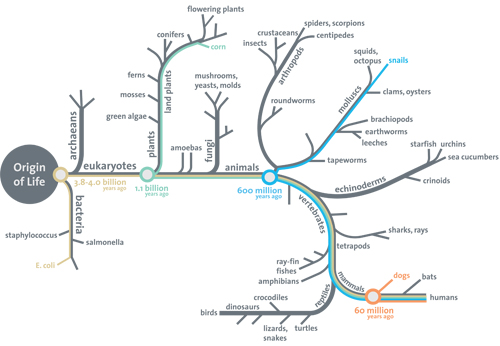
The Smithsonian’s tree of life model, note the root in OOL

UD PRO-DARWINISM ESSAY CHALLENGE: Compose your summary case for darwinism (or any preferred variant that has at least some significant support in the professional literature, such as punctuated equlibria etc) in a fashion that is accessible to the non-technical reader — based on empirical evidence that warrants the inference to body plan level macroevolution — in up to say 6,000 words [a chapter in a serious paper is often about that long]. Outgoing links are welcome so long as they do not become the main point. That is, there must be a coherent essay, with

(i)an intro,
(ii) a thesis,
(iii) a structure of exposition,
(iv) presentation of empirical warrant that meets the inference to best current empirically grounded explanation [–> IBCE] test for scientific reconstructions of the remote past,
(v) a discussion and from that
(vi) a warranted conclusion.

Your primary objective should be to show in this way, per IBCE, why there is no need to infer to design from the root of the Darwinian tree of life — cf. Smithsonian discussion here —  on up (BTW, it will help to find a way to resolve the various divergent trees), on grounds that the Darwinist explanation, as extended to include OOL, is adequate to explain origin and diversification of the tree of life. A second objective of like level is to show how your thesis is further supported by such evidence as suffices to warrant the onward claim that is is credibly the true or approximately true explanation of origin and body-plan level diversification of life; on blind watchmaker style chance variation plus differential reproductive success, starting with some plausible pre-life circumstance.

It would be helpful if in that essay you would outline why alternatives such as design, are inferior on the evidence we face. [As an initial spark for thinking, contrast my own survey of origins science here on (note the onward resources page), the definition of design theory in the UD resources tab top of this and every UD page, the Weak Argument Correctives in the same tab, the general resources that pop up on clicking the tab itself, and the discussion of design theory in the NWE article here. You may also want to refer to the site of the IDEA Center, and the Discovery Institute CSC site as well as Mike Gene’s Telic Thoughts. Notice IDEA’s essay on the case for design here.] . . . .

I would put this up as an original post, with preliminary contextual remarks and an invitation to respond in the comments section.

I will not submit the post with a rebutting markup or make an immediate rebuttal. In fact, let me make the offer to hold off my own comments for at least five initial comments. I will give you two full days of comments before I post any full post level response; though others at UD will be free to respond in their own right.

And BTW, I am making this offer without consulting with the blog owner or others, I am sure they would welcome a serious response . . .  [NB: I have given how to contact me in the original Sept 23 post, I will not repeat that in a headlined original post.]

That challenge is on the table. In truth, it has always been implicitly on the table. For, as I went on to note on Sept 23:

Now, at any time, in essentially any thread at UD any serious and civil design theory objector could have submitted such an essay, breaking it up into a multi part comment if desired . . .

And, it is quite clear that if there were a cogent, empirically well-grounded blind watchmaker thesis account of the origins of the world of life, there would be no design theory movement in biology.

(There would still be a serious design argument in cosmology, but that is a different matter. That does, however, show that strictly speaking design theory has no need to make its case in the world of life; it is because of the blatant weight of the evidence that there is a design movement on phenomena in the world of life.)

So, there you have it, there is a challenge officially on the table.

Let us see if any of the many objectors to design theory at TSZ or elsewhere — I would even accept a parallel post and discussion here and at TSZ (though, no, I will not be commenting there if that is done) — will be willing to step up to the plate. END

Comments
Joe: You are correct in all essential points. However, note that a branching tree evolutionary pattern can be made for the automobile which would have a timelined pattern in a nested hierarchy with cross links as new features propagate in a burst -- as in horizontal info transfer. There was also a very famous blunder by Berra on the ancestral pattern of the Corvette. This could be extended to show ancestral patterns complete with extinctions. Indeed a trip I made to Cuba took me in a timewarp to the vehicles of my early childhood [complete with Hillman Hunters and the like, '57 Fords, 47 ford station wagons etc], i.e. we even have a case of a land that time forgot, save for a few innovations! The only fly in the ointment, this was all by known design. Hence, the blunder. KFkairosfocus
October 9, 2012
October
10
Oct
9
09
2012
11:14 AM
11
11
14
AM
PDT
Onlookers: Do you observe how the challenge to actually put up a positive, empirically grounded case for blind watchmaker molecules to man evo, is being repeatedly diverted from? What does this tell you, given that a solid case for such would have devastating impact on this blog and far beyond it? KFkairosfocus
October 9, 2012
October
10
Oct
9
09
2012
11:08 AM
11
11
08
AM
PDT
olegt sez:
Hey, KF, draw us a nested hierarchy for the Prius.
What does that mean- as in a nested hierarchy of a Prius and all of its parts? Or a nested hierarchy of transportation that includes the Prius? Man I wish thse people would learn how to propely ask a question. Iin the second scenario well the first thing we do is get rid of the names we have given them and focus on the traits- the names mean nothing, only the traits matter. So we would have the nested hierarchy called "Transportation". The next level would be the categories "land"- "water"- "air". Then you just keep filling in the levels and sets depending on the criteria used. Denton went over this in "Evolution: A Theory in Crisis"
Which car was its daddy?
1- Ancestor-descendent relationships do not form a nested hierarchy 2- Nested hierarchies do not require "daddies"Joe
October 9, 2012
October
10
Oct
9
09
2012
11:08 AM
11
11
08
AM
PDT
Jerad @139: Of course there are physical realities (past, present, and future). And they can be described using information.
I’m not sure this information way of looking at things is very helpful.
It is critical. Particularly because some people have a hard time distinguishing between the information contained in DNA and the so-called "information" contained in a pile of rubble (or the rings of Saturn). We have to make the distinction. Otherwise, we end up with the absurd and nonsensical position that everything everywhere is information, and we deceive ourselves into thinking that what is contained in DNA or in a language isn't special but is just more information like everything else. Again, my DNA example is important. Now, I am not a big stickler for semantic labels, so I am perfectly happy for purposes of discussion to let someone call the physical existence of something "information," as long as they understand very clearly that it is vastly different from the information contained in a code/language. If someone wants to call the information contained in DNA "Information Type 1" and the information that describes the physical reality of DNA "Information Type 2," then fine. That is a strange and questionable approach from the standpoint of information theory or what is typically understood from the term, but fine. We could still have a meaningful discussion as long as we carefully deliniate the difference between actual information/code type information and the physical reality of objects. The first is interesting; it is unusual; it comes (at least in our experience) only from mental activity and requires coding conventions; it is (amazingly) found not only in our books, DVD's, and newspapers, but in our very cells. The second is uninteresting; it is ubiquitous and everywhere; it comes from everything; it is about as useful as noting that "stuff exists."Eric Anderson
October 9, 2012
October
10
Oct
9
09
2012
11:04 AM
11
11
04
AM
PDT
CR, Yet your entire program of justification in Darwinism is failed by the avoidance of a simple question. "Can a thing that does not exist cause something to happen?"Upright BiPed
October 9, 2012
October
10
Oct
9
09
2012
10:46 AM
10
10
46
AM
PDT
Mung @140: No, it doesn't make any difference whether I already know the information. After I read a book does it cease to contain information because I already read it? Does the DVD cease to contain information after I watch the movie. Of course not. You're using "information" like "news," as in: "That's news to me." Obviously that is incorrect. If you were being sarcastic, I apologize for restating the obvious.Eric Anderson
October 9, 2012
October
10
Oct
9
09
2012
10:42 AM
10
10
42
AM
PDT
keiths:
...the discovery of an objective nested hierarchy implies common descent, but the converse is not true; common descent does not imply that we will be able to discover an objective nested hierarchy.
...replication of the genetic material, a process that is intrinsically error prone, is both the condition and the direct cause of evolution. A critical point for defining the status of trees in biology is that replication and the evolution that necessarily follows are inherently tree-like processes (Koonin and Wolf, 2009a). Indeed, a replicating molecule, gives rise to two copies...or multiple copies...with errors, resulting in a tree-like process of divergence. ...a tree is a necessary formal consequence of the descent history of replicating nucleic acids and the ensuing evolution. - Eugene V. Koonin, The Logic of Chance
keiths also seems to think that "the Designer" should have created living systems with none of the characteristics of living systems in order to avoid the appearance of descent with modification, and that because "the Designer" didn't do that, this is a massive problem for ID.Mung
October 9, 2012
October
10
Oct
9
09
2012
10:29 AM
10
10
29
AM
PDT
F/N: Does KS understand that e.g. paper clips -- a classic classroom study -- come in nested hierarchies, so also do automobiles by a given manufacturer at a given time and across time, and that this is consistent with design and with the fact that there is no empirically warranted incremental blind functional- all- the- way incremental random walk based path from any one config to any other? Does he understand that multi-part tightly coupled components to achieve function normally and naturally leads to islands of function whereby minor change within an island will be possible but significant change beyond that boundary destroys function before a new one could emerge with a new configuration? Does he understand that the real challenge on the table is to provide an adequately empirically warranted blind watchmaker account of OOL from a reasonable pre-life condition, and then a similarly empirically warranted one for the branching tree of life pattern advanced for 150 years, with adequate empirical warrant, including say accounting for the top-down Cambrian life architectures, and that this is now going a-begging for sixteen plus days total?kairosfocus
October 9, 2012
October
10
Oct
9
09
2012
10:27 AM
10
10
27
AM
PDT
I had hoped that CR understood the issue of abusive behaviour he was presenting; his behaviour now constitutes insistent thread vandalism on top of the slanders and bigotry he has been advancing. I ask him to cease and desist, if he is unwilling to accept that he has passed slanderous remarks and has conducted himself in an unseemly fashion and needs to make amends therefor. KFcritical rationalist
October 9, 2012
October
10
Oct
9
09
2012
10:25 AM
10
10
25
AM
PDT
removed for cause, as already documented. KFcritical rationalist
October 9, 2012
October
10
Oct
9
09
2012
10:23 AM
10
10
23
AM
PDT
keiths, clueless to the end:
3. The pattern we see in nature — the objective nested hierarchy — is exactly what we would expect if there were no “islands of function” problem.
1- Just about anything can be placed in a nested hierarchy. Meaning nested hierarchies are not anything special. It just all depends on the criteria. 2- Evolutionism does not expect descent with modification to construct a nested hierarchy based on traits. This is so for at least two reasons- 1- in order to hace des w/ mod produce a nested hierarchy based on traits, traist have to be immutable and additive. 2- with gradual evolution we would expect a smooth blending of traits, which would produce a Venn diagram, not a nested hierarchy. An no keiths, we do not assume there are islands of function that unguided evolution cannot reach. That is what all the EVIDENCE says. So don't cry just because you are unable to support the claims of your position and stop blaming us for your failure.Joe
October 9, 2012
October
10
Oct
9
09
2012
09:32 AM
9
09
32
AM
PDT
and more substance-free trope from dr boo-who- No, it was more of an uneducated rant. Theobald’s “evidences” do NOT support unguided evolution. And unguided evolution can’t even construct new protein machinery that require more than two new protein-to-protein binding sites. Heck, keiths, you can’t even provide a testable hypothesis pertaining to unguided evolution. dr boo who:
Dear Joe, if you think there are no testable hypotheses pertaining to to unguided evolution, what are you doing in the I.D. movement?
Well obvioulsy ID is the only rational and reasonable choice seeing unguided is out.
And why don’t you write to people like Michael Behe and give them your opinion that they are wasting their time in trying to falsify the general hypothesis that non-intelligently guided evolution is responsible for the diversity of life that we see around us, as that hypothesis is, in your opinion, untestable?
Umm they say they have already refuted it. IOW you have no idea what you are saying. But nice of you to prove my point- that you have nothing. ________ Joe, kindly adjust your tone. I notice that once the int3ensity of terms you use ratchets up, you slip off the wagon. You do not need to be more than substantive to make some very good points. Let those who choose to be abusive be that, not you. (And BTW, you used a suspicious term that I do not understand about fingers; I suggest you back away from questionable terms. KINDLY, TURN DOWN THE VOLTAGE NOW. kfJoe
October 9, 2012
October
10
Oct
9
09
2012
09:19 AM
9
09
19
AM
PDT
...then that description would be information.
IF: that description was something we did not already know.Mung
October 9, 2012
October
10
Oct
9
09
2012
08:52 AM
8
08
52
AM
PDT
Eric, I hear what you're saying but . . . We know that the earth's magnetic core has reversed many times in the past. That's information. Where did it come from? I'm not just describing the varying polarities of magnetic rock deposits. We know the dinosaurs died out about 66 million years ago. Where did that information come from? Did we create that information? Did it not exist before us modern humans made it up? Does that mean it wasn't true before that? We know lots of stuff about occurrences in the past that we haven't observed and we have no written records. Where does all the information come from? I'm not sure this information way of looking at things is very helpful. Why don't we just focus on the stuff we can deduce from the evidence?Jerad
October 9, 2012
October
10
Oct
9
09
2012
08:37 AM
8
08
37
AM
PDT
Jerad @135:
An insect preserved in amber contains information aside from it’s DNA. You can date it, find out what it ate (if you’re lucky), maybe even figure out what time of the year it was born. From the state.
Apologies for jumping in with a drive-by comment, and I'll let you two continue your conversation, but I wanted to make one quick observation. Jerad, one of the aspects I struggled with for a while was this very issue you are pointing out, namely some physical object "containing" information. For example, do the rings of Saturn contain information? Well, certainly a detailed description of all the rock and ice parts would be very complex and specific, so we might be tempted to think that the rings of Saturn "contain" information even though there is no code or language involved. I had an epiphany of sorts when reading Werner Gitt's In the Beginning Was Information (despite the books other failings, he pieces together a pretty good primer on information). It is this: Information about something is never the thing itself. Stated another way, the existence of something is not information in an of itself. Understanding this principle makes things much clearer in terms of what we mean by information. Do the rings of Saturn contain information? No. Now if someone were to describe for us the rings of Saturn in detail, then that description would be information. However, that description is not (indeed cannot be) the rings themselves, but is a mental construct created to describe an existing reality. And a code is always used. No exceptions. Same goes for your ant in the amber. Is it true that there are facts about the ant and the amber? Sure, there are historical realities. But where is that information? It is non-existent until someone (an intelligent agent) looks at reality and creates a mental construct, using a code and a language, to describe the reality. Then that information exists. In the kind of situation you are thinking of, it would be helpful to think not in terms of information being contained in the rings of Saturn or an ant in amber, but the fact that there are certain physical realities that can be ascertained and then described using information. It is critical to grasp this nuance to understand what we are talking about when we talk about information. Now we could have an argument about the definition of the word "information" and angels on the head of a pin, but regardless of the exact deliniation of the definition anyone wants to put on the word or the different types of information that may exist, the fact remains that the kind of information we are interested in (and the kind of information contained in DNA) is always code/language based, and is always separate from the thing described. Think of it this way: (i) DNA contains information (genetic code, instructions for building proteins, etc.); (ii) there are also certain realities about DNA that could be discovered and described using information (how many nucleotides, the double helix structure, the size, type of molecules used, and on and on). We must not confuse the latter with the former. There is a very important distiction.Eric Anderson
October 9, 2012
October
10
Oct
9
09
2012
08:26 AM
8
08
26
AM
PDT
KF (136):
I understand, just lost an edit on a Word doc and had to recreate. Somehow forgot to save on the paragraph.
Ouch! We all know how to prevent that but we all get bit sometimes.
Universal but guided common descent has always been held by a distinguished minority, starting with the co founder of evolutionary theory. The question is blind watchmaker molecules to man evo vs everything else. The design issue does not pivot on common descent vs not.
No, it doesn't. Like I said, I was merely wanting to clear up one small bit of vocabulary. And, as I admitted, I was side-stepping the 'functional' part of functional complex specified information.
As for the blind chance and necessity driven origin of mind, that runs into self referential incoherence.
I find it quite reassuring actually. Not because I can abrogate responsibility for my actions or treat other people poorly which I try hard NOT to do. I just find that general viewpoint explains a lot about why us humans are so bad at statistical thinking on the fly, recording accurate memories of situations we observed and really, really awful at seeing the world from anything other than our own selfish point of view. I struggle everyday trying not to be such a dopey human being.
Gotta go.
Do what you gotta do. Lots of things are more important than this blog. Lots.Jerad
October 9, 2012
October
10
Oct
9
09
2012
08:00 AM
8
08
00
AM
PDT
Jerad as I head out the door: I understand, just lost an edit on a Word doc and had to recreate. Somehow forgot to save on the paragraph. Universal but guided common descent has always been held by a distinguished minority, starting with the co founder of evolutionary theory. The question is blind watchmaker molecules to man evo vs everything else. The design issue does not pivot on common descent vs not. Instead it pivots on the empirically grounded root of FSCO/I. Similarly, nowhere at no time, it can be confidently shown, has it been empirically warranted that blind chance and mechanical necessity without guidance or influence of intelligence, has been shown to be the likely source of cell based life. The OOl challenge the root of the tree of life model, is missing. And there is no possibility of differential reproductive success to appeal to to resolve the matter as this is the root of reproductive capacity. Next, similarly, there is no good empirical warrant for the blind watchmaker thesis on OO body plans. As for the blind chance and necessity driven origin of mind, that runs into self referential incoherence. See summaries above in responses to Wiki clips and onward stuff elsewhere. Gotta go. KFkairosfocus
October 9, 2012
October
10
Oct
9
09
2012
07:24 AM
7
07
24
AM
PDT
KF: Lost an earlier reply, my internet connection is being wonky. Oh well, will try and recreate: I was trying to come up with a way to refer to unguided vs guided/assisted/tweaked common descent. I guess we could use common descent and universal common descent but I find that confusing since most biologists use common descent to mean unguided common descent. I think I shall use undirected common descent to imply what most biologists mean and directed common descent to mean what I think Dr Behe means, i.e. a designer intervened at certain stages. That seems unambiguous to me. I hope that doesn't misrepresent anyone's point of view. I am sorry for the plane tragedy. I hope that's being handled with grace and compassion. It's hard to say without being able to see all the posts but I gather you are annoyed with being grouped with Creationists. While I would avoid such labelling I suppose the idea that a designer intervened in some way and their design(s) were implemented implies that lots of little creation events had to happen. Please don't censor this post, I'm just discussing the issue. I am also trying to figure out what Mung means by information. He(?) seems to think that written text has no information until it is interpreted. And that material deposits, like fossils layers and bands of alternating polarity alongside the mid-Atlantic rift contain data and not information. But I'm not really clear. In my mind, if DNA contains complex and specified information then so does text, read or not. (I am avoiding the functional aspect for the moment, I admit.) As does any pattern, by your standard, which exhibits more than 500-bits of complex, specified information.
First, do you understand that ancient scripts were recognised as coded symbolic representations of messages expressed as structured sets of glyphs long before they were deciphered?
Of course they were, otherwise no one would have tried to decipher them. So they conveyed or contained information.
Second, do you know that so soon as DNA was discovered as a double helix, the same symbolic representation under a protocol, a convention, was recognised to be taking place? (Think here of Crick’s March 19, 1953 letter to his son Michael, years before the actual code table was worked out. In the letter, Crick spoke of a direct parallel between the sequence of bases and the letters of a textual message.]
Yup, we disagree on whether or not that could have arisen via undirected processes or not though. But obviously, it's a code!!
Do you see the equivocation between that which has effect because of meaning as interpreted and expressed, and that which has effect because of mechanical necessity in light of initial circumstances and the mere presence of the forces and materials of nature in the situation?
Uh . . . I don't think so. A string of bits that can be read and interpreted as the first sentence of this post has complex and specified information. Even if it's not read? Yes? A protein coding sequence of DNA bases contains complex and specified information whether it's transcribed or not. Yes?
You are equivocating the STATE of an object with its being informational. the STATE of the bubble of air in an ice field is just that, a state. The shape of a snowflake is just that. These are contingent and can be shaped by chance and necessity, or by choice.
I agree there's a difference between a code and an object. And that the code exists abstractly in some sense. But the state of an object tells your something about it's history and what forces put it in that state! Albeit without a code. An insect preserved in amber contains information aside from it's DNA. You can date it, find out what it ate (if you're lucky), maybe even figure out what time of the year it was born. From the state. You can figure out when the magnetic poles of the earth reversed based on the polarity of datable metallic deposits. That is information about the past history of the earth surely. The forensics around a dead body have to do with the state and situation in which it was found. And that information can lead you to determine if murder was committed and maybe even give you some clues to who the killer is. That's information contained purely in the state of the body and the state of the surroundings. Joe's favourite example, Stonehenge clearly didn't just happen via natural processes. The state of the objects in question, the stones, tell you this structure was deigned and built by intelligent designers. No text, no code, just the state. Unless I'm really misunderstanding you I don't see that you can't have complex and specified information created by non-directed processes and/or recorded in the state of objects. Not the same as a code, clearly. If your argument is that it's impossible for non-directed processes to come up with a code . . . I'd have to think about that. But can undirected processes create stores of complex specified information by putting things in certain states or configurations? I think so.Jerad
October 9, 2012
October
10
Oct
9
09
2012
06:21 AM
6
06
21
AM
PDT
F/N: It may be helpful to use the informational definition of entropy, to help see the relevant distinction. The Gibbs entropy metric indicates the average missing info on the specific micro state of an entity, given its macro state. That is, the system plainly has a more or less specific actual state [up to relevant quantum uncertainties], of the position, momentum and energy of constituent particles, but that specific state is not specifically described by giving the macro-observable thermodynamic state variables, hence the metric gives an index of number of degrees of freedom consistent with the macrostate. In short, actual condition, observability of that and record of it, are not to be equated. So much so, that we can define a physically meaningful and important metric of missing info.kairosfocus
October 9, 2012
October
10
Oct
9
09
2012
04:49 AM
4
04
49
AM
PDT
Jerad: First, do you understand that ancient scripts were recognised as coded symbolic representations of messages expressed as structured sets of glyphs long before they were deciphered? Second, do you know that so soon as DNA was discovered as a double helix, the same symbolic representation under a protocol, a convention, was recognised to be taking place? (Think here of Crick's March 19, 1953 letter to his son Michael, years before the actual code table was worked out. In the letter, Crick spoke of a direct parallel between the sequence of bases and the letters of a textual message.] Do you see the equivocation between that which has effect because of meaning as interpreted and expressed, and that which has effect because of mechanical necessity in light of initial circumstances and the mere presence of the forces and materials of nature in the situation? You seem to be conflating apples and oranges, because your evident underlying materialism tends to suppress the difference. Specifically, such materialism leads you to reduce mind to matter and does not see the implied self referential incoherence. For just one instance, in the protein assembly process, the bases in the mRNA in the Ribosome, couple to tRNA anticodons, and thus the chaining chemistry of AA's is used. So far all is mechanism, though functionally specific in organisation and highly complex at many levels. Now, understand the next point: the tRNA's are loaded at a universal coupler the CCA end, that couples to the same side of the AA, regardless of its identity. That is, which AA couples to which tRNA is not Chemically determined. Instead, there are what I descriptively call loading enzymes, that couple to the tRNA's based on their coded shape -- like a Yale Lock's prongs -- and then the right AA is added based on the information stored in the tRNA. That is why tRNA's have recently been artificially reprogrammed to load novel AA's, extending the range of AA's used in assembly. You are equivocating the STATE of an object with its being informational. the STATE of the bubble of air in an ice field is just that, a state. The shape of a snowflake is just that. These are contingent and can be shaped by chance and necessity, or by choice. Remember, the Shannon info metric is a measure of info carrying capacity; not of the sort of functional coded info that is being discussed at UD and elsewhere. The process of growth of a tree, is driven by internal programs and algorithms from cells to systems, and responds to a cluster of environmental effects. Because it is contingent, it can be used to store info, and we can come along and deduce per inference to best explanation a model of the past on the state of the rings we observe. But the state of the rings as such in the state of nature, is not a part of a source-encoder/modulator, transmitter/ storage, detector, demod/decode, sink system. It is just an effect and a state of nature working freely that we can come along, measure and record. Then, we interpret based on models of cause and effect to suggest a past timeline. By sharpest contrast, the DNA, RNA, enzymes, Ribosome protein synthesis process uses just such a comms system, and a digital code to effect an automatic assembly process. I am sure however, that a priori commitment to materialism will tend to suppress or cloud the distinction. Do you genuinely see no difference between the text of this post, or the Rosetta stone or the Behistun rock etc, and the pattern of concentration of gases in an air bubble in an ice core? What do you think it is that such is clearly telling us, looking on; never mind how it may well seem so convincingly to say to card-carrying members of your apparent party? KFkairosfocus
October 9, 2012
October
10
Oct
9
09
2012
03:59 AM
3
03
59
AM
PDT
F/N: Six days and counting for the offer as given in the headlined post above, sixteen days if we remember the in-thread offer; note as well the absence of a cogent response in light of the clips and comments from Wiki as stand-in for the empty chair. Advocates and enthusiasts of Darwin need to understand the first rule of holes: if you need to get out, stop digging in deeper.kairosfocus
October 9, 2012
October
10
Oct
9
09
2012
03:12 AM
3
03
12
AM
PDT
Jerad: Do you understand that there is a sharp and material difference between imposing a priori evolutionary materialism -- read all five illustrative cases in point, please -- and accepting common descent [with some degree or another of modification and diversification], including universal common descent? (Behe for instance is perhaps the no 2 current scientific advocate of design theory in the world of life, and he holds to universal common descent. Similarly, the co-founder of evolutionary theory, Wallace, held to a view that has been called intelligent evolution, as can be seen in his The World of Life. [It is telling that this book has been recently re-issued by the publisher, Forgotten Books. Cf. the original post for links and do watch the vid.) Similarly, despite many bland assurances from the evo mat establishment that there is simply a matter of cumulative effect between micro- and macro- evolutionary change, the fact of multi-part complexity dependent on tight integration of the components, and correct organisation to achieve function, shows that in the world of life we have reason to expect to see islands of function. This is evident, first, from the fact of thousands of protein fold domains that simply do not fit a branching tree pattern and are isolated to something like 1 in 10^60 or 70 in AA config space. Similarly, we observe that small mutations often derange function and many can easily be lethal (hence our fear bordering on panic over radioactivity). Next, the actual fossil record, as opposed to the branching tree diagram often imposed on it, shows a pattern of top-down diversification [from the Cambrian fossils on], multiplied by appearance, stasis, disappearance of forms at all sorts of levels as a dominant pattern. So, we have excellent grounds to see that islands of function are just as much of a challenge in the biological world as in any other domain where we see FSCO/I. And, it remains the case that the only widely observed, empirically reliable source of FSCO/I is design. Likewise, the term "Evolution" is notoriously slippery and prone to the rhetoric of equivocation. But, given the reason to see the islands of function effect as a serious challenge, adaptation to niches within a body plan is one thing; molecules in a pond to Mozart is quite another. And, given the evidence just summarised, that is not just a matter of question-begging, there is a case to be answered to in the face of abundant empirical evidence. What is being objected to is not common descent and evolution in the micro sense [accepted by even today's young earth creationists and seen as a designed mechanism of adaptation, cf the way the immune system responds to infections as a model] or even universal common descent, but he a priori imposition of evolutionary materialism that definitely begs big questions and warps the way observationally grounded inductive empirical reasoning works in science. And since someone out there -- utterly astonishingly -- is trying to pretend in the name of Popper that induction is a dubious intellectual exercise and does not extend to inference to best current empirically grounded explanation, let me underscore from the Internet Encyclopedia of Philosophy on Deduction and Induction:
A deductive argument is an argument in which it is thought that the premises provide a guarantee of the truth of the conclusion. In a deductive argument, the premises are intended to provide support for the conclusion that is so strong that, if the premises are true, it would be impossible for the conclusion to be false. An inductive argument is an argument in which it is thought that the premises provide reasons supporting the probable truth of the conclusion. In an inductive argument, the premises are intended only to be so strong that, if they are true, then it is unlikely that the conclusion is false. The difference between the two comes from the sort of relation the author or expositor of the argument takes there to be between the premises and the conclusion. If the author of the argument believes that the truth of the premises definitely establishes the truth of the conclusion due to definition, logical entailment or mathematical necessity, then the argument is deductive. If the author of the argument does not think that the truth of the premises definitely establishes the truth of the conclusion, but nonetheless believes that their truth provides good reason to believe the conclusion true, then the argument is inductive . . . . Because deductive arguments are those in which the truth of the conclusion is thought to be completely guaranteed and not just made probable by the truth of the premises, if the argument is a sound one, the truth of the conclusion is “contained within” the truth of the premises; i.e., the conclusion does not go beyond what the truth of the premises implicitly requires. For this reason, deductive arguments are usually limited to inferences that follow from definitions, mathematics and rules of formal logic . . . . Inductive arguments, on the other hand, can appeal to any consideration that might be thought relevant to the probability of the truth of the conclusion. Inductive arguments, therefore, can take very wide ranging forms, including arguments dealing with statistical data, generalizations from past experience, appeals to signs, evidence or authority, and causal relationships. Some dictionaries define “deduction” as reasoning from the general to specific and “induction” as reasoning from the specific to the general. While this usage is still sometimes found even in philosophical and mathematical contexts, for the most part, it is outdated . . . . Because the difference between inductive and deductive arguments involves the strength of evidence which the author believes the premises to provide for the conclusion, inductive and deductive arguments differ with regard to the standards of evaluation that are applicable to them. The difference does not have to do with the content or subject matter of the argument. Indeed, the same utterance may be used to present either a deductive or an inductive argument, depending on the intentions of the person advancing it.
In short, in inductive reasoning [the major part of reasoning, let us not forget, and those who object will invariably be found bringing back inductive reasoning in under another name by the back door, e.g. when we see the concept of corroboration in Popper, it is a case of unacknowledged and probably unrecognised inference to best explanation across competing options . . . ], we seek to provide good and reasonable, responsible grounds of warrant for a conclusion in light of relevant facts etc. So, where the evidence and reasoning adduced give good grounds to SUPPORT the credibility of the claim that a conclusion is plausibly or probably true, then this is a cogent inductive argument. Inference to best current explanation fits under this. Degree of warrant varies with the case and a reasonable man will assess that degree of warrant for itself and in light of comparable cases. For quite painful current instance, observe how I have tracked the emerging story of the Fly Montserrat crash on takeoff from V C Bird Antigua Sunday afternoon that has Montserrat in a state of shock. Note:
(i) The core matter of a crash on takeoff has been from the first grounded to moral certainty on credible and convergent testimonies (ii) The identity of the venue and photos of the plane are similarly morally certain factual reports. That the front about 1/3 of the plane was crumpled in, is mute testimony to the force of the impact and why the pilot did not survive. The precise reason for the crash is not certain and is subject to an investigation that will reconstruct the course of events on observation and inference to best explanation. This, with the aim of preventing future tragedies. (Notice the implication for how much we routinely trust IBCE in life and death situations.) (iii) Starting with the time of the incident, specific details have been harder to clarify and firm up, once we move beyond the agreement that the pilot was one of the fatalities -- a sign that the accident was a fatal one -- which was reported as soon as such details were released. (iv) Number, identity and details on the other victims, fatalities and survivors were much less firm, but all too soon, between crowd and official sources, corroborated by the failure of a popular young Jamaican teacher to show up for work at MSS yesterday, and staff and student body reduced to tears from the Principal down, we realised that a specific teacher at the high school was one of the losses. She taught my son Integrated Science. [They had to release the school early, and send counsellors ranging from ministers of religion to ministers of Government, think of a teacher driving to school, barely being able to park his car then collapsing in tears over the steering wheel in shocked grief. A candle light vigil was held yesterday evening, and a more formal one will follow this evening.) (v) Similarly, the mother of a now utterly distraught young woman in the hospital with a problem pregnancy, who was trying to fly in from Guyana was the other passenger fatality. (vi) The survivor turns out to be a volunteer on an ecological project from the UK, and again the circle closes to a personal contact with family and friends.
In short, inductive reasoning is credible, is widely and reliably used in important situations with life and death on the line, and it counts. (And, on a personal note, try to understand having to deal with the sort of abusive behaviour that was so evident yesterday, while having to face this community tragedy and other difficult challenges at the same time. The uncivil advocates and enthusiasts of Darwin need to begin to understand some of the ways in which their irresponsible behaviour is needlessly harmful.) As to the invidious association game where "Creationist" is used as a term of abuse and projection of bogeyman fears,t hen is used as a tar baby to try to associate design theory with a series of perceived threats to science and society, based on what are demonstrably slanders, that has been more than adequately shown above. Similarly, the key and material divergences between the pattern of Creationist thought and that of design thought, has already been outlined here and is plain enough from many other accessible sources. The rhetorical tactic of guilt by invidious association with the creationist bogeyman, is a slander. And, a slander used to substitute for a patent absence of cogent response on what is an open invitation to provide positive warrant. Remember, my offer has been that I will personally host here the 6,000 word essay. In reply to that slander, I have seen all sorts of poisonous distractions, including what looks like the tactic of being disruptive in a thread to attract disciplinary action in defence of civility, that is then twisted into a compounding Big Lie false accusation of censorship. Remember, such stunts are in response to an offer to host a 6,000 word essay laying out the positive case for blind watchmaker thesis molecules to man evolution. That speaks loudest volumes on the want of sound warrant for the case, and it frankly goes to character. Let me cite the 2350 year old warning from Plato in his The Laws, Bk X, on the amorality and dangerous behaviour of nihilistic factions premised on evolutionary materialism, to underscore the point:
Ath. . . . [[The avant garde philosophers and poets, c. 360 BC] say that . . . the whole heaven has been created, and all that is in the heaven, as well as animals and all plants, and all the seasons come from these elements, not by the action of mind, as they say, or of any God, or from art, but as I was saying, by nature and chance only. [[In short, evolutionary materialism premised on chance plus necessity acting without intelligent guidance on primordial matter is hardly a new or a primarily "scientific" view! Notice also, the trichotomy of causal factors: (a) chance/accident, (b) mechanical necessity of nature, (c) art or intelligent design and direction.] . . . . [[Thus, they hold that t]he Gods exist not by nature, but by art, and by the laws of states, which are different in different places, according to the agreement of those who make them; and that the honourable is one thing by nature and another thing by law, and that the principles of justice have no existence at all in nature, but that mankind are always disputing about them and altering them; and that the alterations which are made by art and by law have no basis in nature, but are of authority for the moment and at the time at which they are made.- [[Relativism, too, is not new; complete with its radical amorality rooted in a worldview that has no foundational IS that can ground OUGHT. (Cf. here for Locke's views and sources on a very different base for grounding liberty as opposed to license and resulting anarchistic "every man does what is right in his own eyes" chaos leading to tyranny. )] These, my friends, are the sayings of wise men, poets and prose writers, which find a way into the minds of youth. They are told by them that the highest right is might [[ Evolutionary materialism leads to the promotion of amorality], and in this way the young fall into impieties, under the idea that the Gods are not such as the law bids them imagine; and hence arise factions [[Evolutionary materialism-motivated amorality "naturally" leads to continual contentions and power struggles; cf. dramatisation here], these philosophers inviting them to lead a true life according to nature, that is, to live in real dominion over others [[such amoral factions, if they gain power, "naturally" tend towards ruthless tyranny], and not in legal subjection to them.
We can hardly say we have not been warned in good time. It is time to think again, and it is high time for the enthusiasts and advocates of Darwin to do a lot better than this. KFkairosfocus
October 9, 2012
October
10
Oct
9
09
2012
03:09 AM
3
03
09
AM
PDT
Mung (124):
So you agree there’s a distinction between data and information?
I know what you're saying: the bits or the numbers therein are the data but they don't mean anything without interpretation. Like saying that the average daily temperature of the world is just data, interpreting it as indicative of climate change is imposing or gleaning information from the data. But I don't think the separation is normally that great. If Voyager 1 is sending back temperature data and that's what the scientists want to see then that's information. You can/could say that the actual 0s and 1s, the bits, sent are data and not information but they're just a translation of the temperature which was measured before it was translated into bits and then is reread as temperature when the signal reaches earth. If there is a locked way of translating from 'information' to bits then I don't see the distinction as being important.
But an alien culture might not know how to ‘read’ the signal. Does that change the information?
It doesn’t change the data. Since that data is not informative, it follows that it’s not information. Information informs.
Really? So when we couldn't read Linear B there was no information there but when we learned how then there was information? Information comes and goes depending on who's looking at the transmission medium/data? So if there's never anyone to interpret it the information is lost? It was there when someone wrote the text but it goes away 'til someone reads it?
I think air bubbles trapped in ice layers contain information, no evolution required there. I think sedimentary layers of rock contain information regarding their ‘journey’ no evolution required. I think the bands of magnetic polarity on either side of the mid-Atlantic rift contain information about tectonics, no evolution required.
What do they contain information about? Why do you think these things “contain” information rather than merely serving as a source of data?
Are you saying seeing the bands of reversed polarity in magnetic rocks on either side of the mid-Atlantic trench contain no information unless there is someone to interpret it? Before humans learned to send down probes and 'read' those bands there was no information there but after we did there was? That the information just, all of a sudden, came into existence? Who created it then? What intelligent agent created the information in tree rings or when an insect is trapped in amber or when air bubbles are trapped in ice layers or when fossils are formed and then 'interpreted' later. Who created the information? The person who 'reads' it?
Make it possible for humans, you mean? In the absence of interpreters of these phenomena, in what sense do they contain information?
Again, are you saying the interpreters are then creating the information? If yes then how? If not then where is the information coming from?Jerad
October 8, 2012
October
10
Oct
8
08
2012
11:46 PM
11
11
46
PM
PDT
Mung (123):
I bet not many of us here here expect to change your mind, but that has not prevented us from presenting our best case(s). Who knows, by presenting your best case and seeing it critiqued you may actually come to see some merits to the criticisms.
Do you really think so? After comments like these (just from this thread after your post):
A third grader can come up with a better explanation for not having his homework finished on time than unguided evolution has for the diversity of life
And now you are very proud of yourself because it is a lot of work erecting and destroying so many strawmen at one time. You may have broken a record- heh, you surely are a broken record, skipping, repeating and just noisy.
Yet we repeatedly have to deal with the argument as if it’s a scientifically settles issue. Jerad himself has recently asserted that random indicates unguided while at the same time rejecting the idea that if it’s non-random it is therefore guided.
When Darwinists write the textbooks that influence young skulls full of mush, they make it clear that evolutionary “science” is all about unguided evolution and the creative power of ontological chance (Evolution IS purposeless and definitely doesn’t know where it is going). When they speak about it in public, however, they fight amongst themselves about whether to be honest about it or to pretend that they allow for epistemological chance (Evolution SEEMS purposeless but we can’t be sure). Some analysts, such as Jay Richards and Stephen Meyer understand the deception. Others, such as Alvin Plantinga and William Lane Craig have been taken in. What matters, though, is what the Darwinists tell the children, and what they tell the children in the name of science is this: “Evolution is a purposeless, mindless process that did not have man in mind.”
If I went through some other recent threads I could find much more disparaging comments about evolutionary theory. I did give an explanation of how I see the evidence earlier in this thread (comment 86) and no one commented on it. And so it goes . . .Jerad
October 8, 2012
October
10
Oct
8
08
2012
11:23 PM
11
11
23
PM
PDT
Kantian Naturalist
That is to say: modern evolutionary theory says only that mutations are random, in the precise sense provided by Sober. Whether those random mutations are also unguided is a metaphysical question. So we can distinguish between what’s empirically knowable (whether mutations are random) and what’s a matter of metaphysical speculation (whether mutations are unguided).
When Darwinists write the textbooks that influence young skulls full of mush, they make it clear that evolutionary "science" is all about unguided evolution and the creative power of ontological chance (Evolution IS purposeless and definitely doesn't know where it is going). When they speak about it in public, however, they fight amongst themselves about whether to be honest about it or to pretend that they allow for epistemological chance (Evolution SEEMS purposeless but we can't be sure). Some analysts, such as Jay Richards and Stephen Meyer understand the deception. Others, such as Alvin Plantinga and William Lane Craig have been taken in. What matters, though, is what the Darwinists tell the children, and what they tell the children in the name of science is this: "Evolution is a purposeless, mindless process that did not have man in mind."StephenB
October 8, 2012
October
10
Oct
8
08
2012
11:11 PM
11
11
11
PM
PDT
KN, That is correct. There is no scientific methodology which can measure the extent to which some process is guided or not guided. Yet we repeatedly have to deal with the argument as if it's a scientifically settles issue. Jerad himself has recently asserted that random indicates unguided while at the same time rejecting the idea that if it's non-random it is therefore guided.Mung
October 8, 2012
October
10
Oct
8
08
2012
08:28 PM
8
08
28
PM
PDT
I've started reading Plantinga's Where the Conflict Really Lies, and he makes a nice point on the distinction between "random" and "unguided." Planting quotes Sober as saying, "There is no physical mechanism (either inside organisms or outside of them) that detects which mutations would be beneficial and causes those mutations to occur", to which Plantinga adds, "But their being random in that sense is clearly compatible with their being caused by God." By contrast, by unguided Plantinga understands the claim that "no personal agent, not even God, has guided, directed, orchestrated, or shaped it [the process of evolution." That is to say: modern evolutionary theory says only that mutations are random, in the precise sense provided by Sober. Whether those random mutations are also unguided is a metaphysical question. So we can distinguish between what's empirically knowable (whether mutations are random) and what's a matter of metaphysical speculation (whether mutations are unguided). Now, Plantinga then goes on to chastise scientists and philosophers who conflate these issues, and take evolutionary theory as basically giving us empirical confirmation of unguidedness. At first blush, it seems to me that Plantinga is correct to do so. I say that because even though I am a naturalist, as Plantinga is not, I share with Plantinga the idea that there's some distinction to be drawn between science and metaphysics, whether that metaphysics is naturalistic or theological.Kantian Naturalist
October 8, 2012
October
10
Oct
8
08
2012
07:51 PM
7
07
51
PM
PDT
The entire OP was an explanation of why unguided evolution is literally trillions of times better than ID at explaining the evidence.
No, it was more of an uneducated rant. Theobald's "evidences" do NOT support unguided evolution. And unguided evolution can't even construct new protein machinery that require more than two new protein-to-protein binding sites. Heck, keiths, you can't even provide a testable hypothesis pertaining to unguided evolution. A third grader can come up with a better explanation for not having his homework finished on time than unguided evolution has for the diversity of life.
As the OP explains, the evidence is a problem for ID whether or not you accept common descent.
No, you just declare it and erect strawman after strawman to support your bald declaration. And now you are very proud of yourself because it is a lot of work erecting and destroying so many strawmen at one time. You may have broken a record- heh, you surely are a broken record, skipping, repeating and just noisy.Joe
October 8, 2012
October
10
Oct
8
08
2012
05:30 PM
5
05
30
PM
PDT
Jerad:
I don’t think you’ve addressed my statements in post 95 trying to answer a question you posed to me. Does that mean you’re tired of the topic, busy or that my answer is not worth responding to?
You answered my question. You don't think the existence of recorded information requires evolution. As for your questions, let's go back to your previous scenario involving Voyager 1:
Voyager 1 is transmitting millions of bits of data every day. It’s an amazing feat of engineering if nothing else. We on earth know the format the data is being couched in so it’s easy for us to interpret the signal. Read the information.
So you agree there's a distinction between data and information?
But an alien culture might not know how to ‘read’ the signal. Does that change the information?
It doesn't change the data. Since that data is not informative, it follows that it's not information. Information informs.
I think air bubbles trapped in ice layers contain information, no evolution required there. I think sedimentary layers of rock contain information regarding their ‘journey’ no evolution required. I think the bands of magnetic polarity on either side of the mid-Atlantic rift contain information about tectonics, no evolution required.
What do they contain information about? Why do you think these things "contain" information rather than merely serving as a source of data?
I think the moon contains information in it’s geology and make up and crater patterns that make it possible to hypothesise about how and when it was created, no evolution required. I think radioactive dating tells us about the age of non-living deposits.
Make it possible for humans, you mean? In the absence of interpreters of these phenomena, in what sense do they contain information?Mung
October 8, 2012
October
10
Oct
8
08
2012
05:04 PM
5
05
04
PM
PDT
Jerad:
But there’s not much point in me trying to present my best case is there? I’m not going to change anyone’s mind so . . .
I bet not many of us here here expect to change your mind, but that has not prevented us from presenting our best case(s). Who knows, by presenting your best case and seeing it critiqued you may actually come to see some merits to the criticisms.Mung
October 8, 2012
October
10
Oct
8
08
2012
03:46 PM
3
03
46
PM
PDT
1 13 14 15 16 17 20

Leave a Reply