Seminal Christian thinker, Francis Schaeffer, often said that “ideas have consequences.” The issue of course, is that good/bad ideas have similarly good/bad consequences. So, we face a familiar dilemma, especially when a culture or community or civilisation is on a dangerous path:
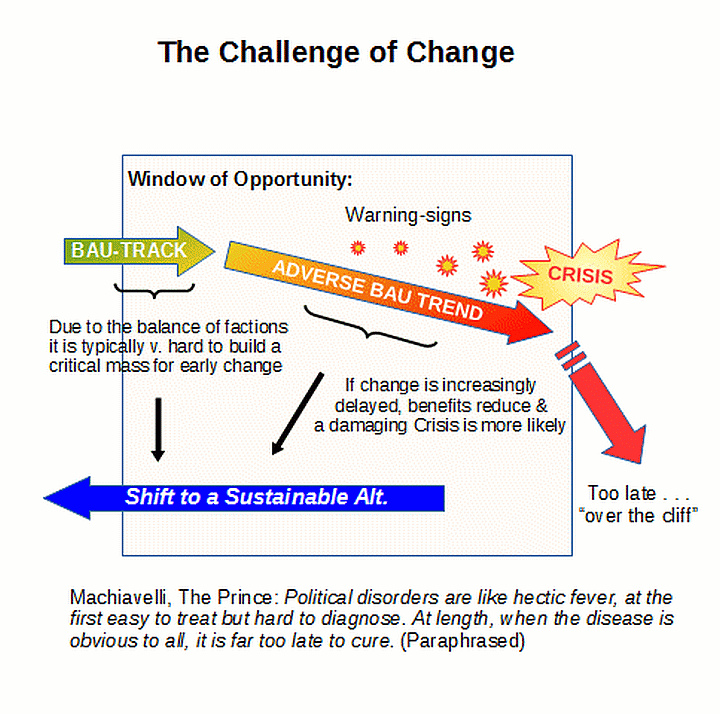
This helps us to focus the issue: we are looking at alternatives in a community where balances of power tend to lock in business as usual and tend to marginalise alternatives. So, we will have to look at power structures, polarisation and prudence in decision-making at policy level. Which, as a fairly simple framework, raises the concept of seven “commanding heights” mountains/pillars of influence that uphold and in turn are protected by a dominant worldview and cultural agenda:
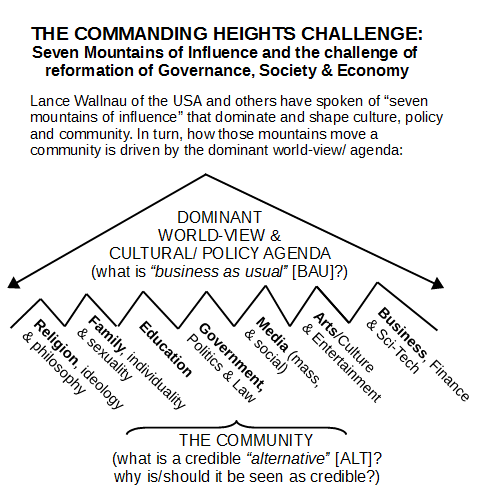
At once, it is obvious that an entrenched policy and its associated dominant worldview will be very hard to change. That’s why it was said of new paradigms in science, that they progress one funeral at a time.
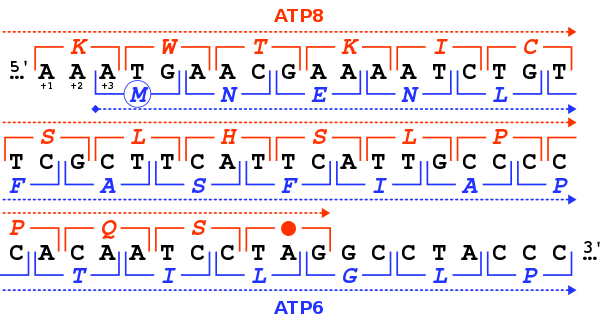
(All of this will be very familiar to design thinkers, who have experienced what cultural lockout and creation of a scientific counter-culture under siege looks like. Even, when it is blatant that we live in a cosmos with physics fine tuned in ways that set the stage for C-chemistry, aqueous medium, cell based life. Even, when it has been further obvious since 1953 that in the heart of such life we find alphanumeric, coded, complex algorithmic information in string data structures, working with molecular nanotech to build the workhorse molecules of life. Even, when we go on to discover inter-woven, overlapping code; a known high point of design. Even, when it is utterly implausible that such codes and associated execution machinery could come about by blind chance and/or mechanical necessity. Even, when — thanks to Venter et al — we know that nanotech design is feasible and we know the routine source of coded, complex algorithmic information and execution machinery.)
Here is an example of such overlapping code:
A first answer lies in the concepts, the Overton window and the BATNA negotiation power balance challenge:
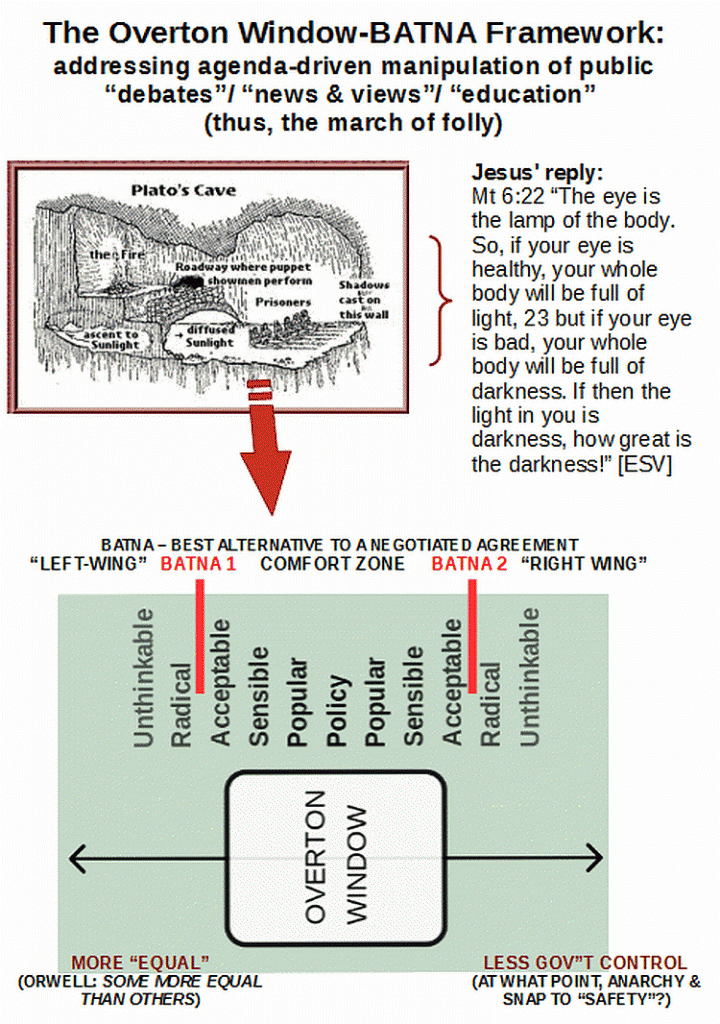
A further key clue is to understand how Frankfurt School Culture-form Marxist thought — through so-called Critical Theory Studies — has come to dominate large swathes of the Academy. This has led to Gramsci’s “long march through the institutions” . . . as we mapped above, and thus also a strong pulling of the Overton window to the “Left.”
Wikipedia, inadvertently testifying against known ideological interest, helps us understand Critical Theory and its roots:
In sociology and political philosophy, the term Critical Theory describes the Western-Marxist philosophy of the Frankfurt School, which was developed in Germany in the 1930s and draws on the ideas of Karl Marx and Sigmund Freud. Though a “critical theory” or a “critical social theory” may have similar elements of thought, the capitalization of Critical Theory as if it were a proper noun particularly stresses the intellectual lineage specific to the Frankfurt School.[citation needed]
Modern critical theory has additionally been influenced by György Lukács and Antonio Gramsci, as well as second-generation Frankfurt School scholars, notably Jürgen Habermas. In Habermas’ work, critical theory transcended its theoretical roots in German idealism and progressed closer to American pragmatism. Concern for social “base and superstructure” is one of the remaining Marxist philosophical concepts in much of contemporary critical theory.[3]:5-8
Postmodern critical theory analyzes the fragmentation of cultural identities in order to challenge modernist-era constructs such as metanarratives, rationality, and universal truths, while politicizing social problems “by situating them in historical and cultural contexts, to implicate themselves in the process of collecting and analyzing data, and to relativize their findings.”[4]
Notice, the post-/ultra- modern radical relativism, undermining of truth, intent of subversion and delegitimisation of what they differ with (shifting the Overton Window through “mainstreaming), thus reducing policy and issues to nihilistic power struggles to be decided — ironically — by their metanarrative:
Postmodern critical theory analyzes the fragmentation of cultural identities in order to challenge modernist-era constructs such as metanarratives, rationality, and universal truths, while politicizing social problems “by situating them in historical and cultural contexts, to implicate themselves in the process of collecting and analyzing data, and to relativize their findings.”
If there are no truths, simpliciter, then, on what foundations can such a radically relativist analysis rest? If there is no self-evident framework of rationality, then why should we trust such an alleged analysis? If all is relativised, does not that include such “critical theories” and their claimed power to liberate? Speaking of, is it really sound to seek to liberate from truth, logic, established and even self evident first principles? Similarly, what happens when the agenda wraps itself up in a Scientific or medical lab coat?
Does that then make sudden, shocking sense of the tendency to accuse of a war against science and its alleged consensus? Especially, as we have seen as the current pandemic has unfolded? In particular, in reaction to the evidence that Hydroxychloroquine-based cocktails, if administered early enough, can be an effective treatment? Does that not uncomfortably echo the Climate Change debates and those over the design inference?
That leads the linked question of Left/Right politics in general.
To which, it is clear that the more or less socialist left has become a pole of politics ever since the French Revolution and anything that does not fit in with the current partyline or agenda items is deemed “right.” Since the rise of Nazism, there has been a tendency to smear the “right” as crypto-nazi or crypto-fascist. Including, perhaps especially, “Fundamentalist” Christians. In fact, however, Nazism and fascism were ideologies of the left (just, they were right of Stalin): National Socialist German Workers’ Party . . . what “Nazi” abbreviates . . . gives a clue or two.
Similarly, in the days of his Red Guards mob led coup and linked devastating Cultural Revolution of 1966 – 76, Mao viewed his fellow communists who were less radical than he as “rightists.”
We need to move away from the increasingly irrelevant and simplistic Left/Right models, where the left is the polar “centre” and whatever does not fit is marginalised and stigmatised as “the [crypto-Nazi] right.” I have suggested:
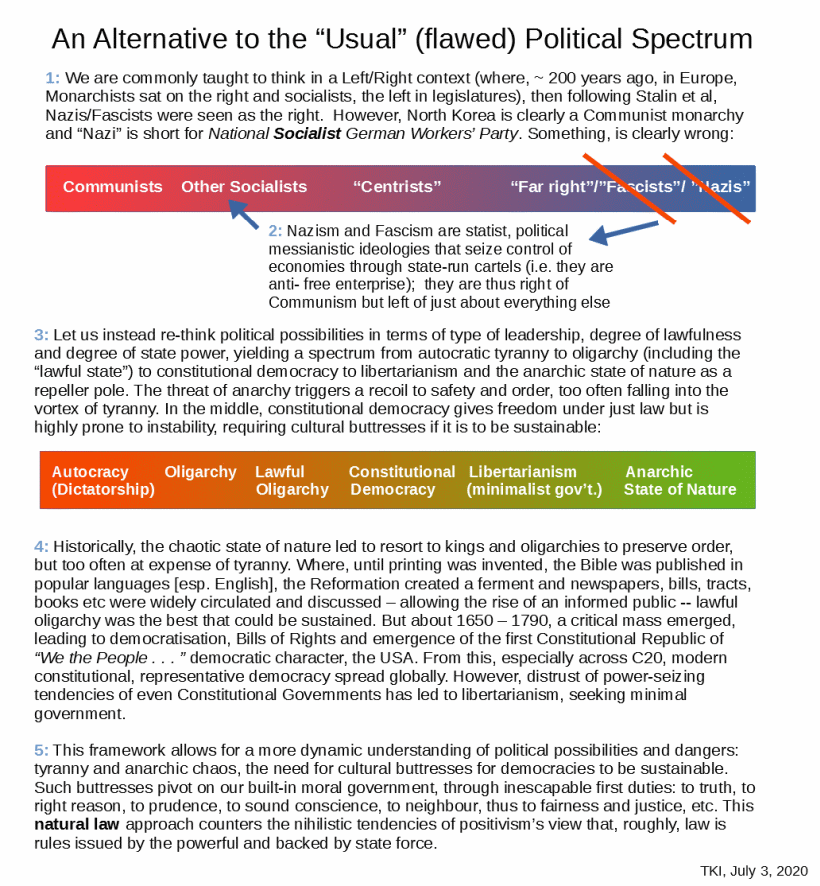
Let me add some background to the alternative:

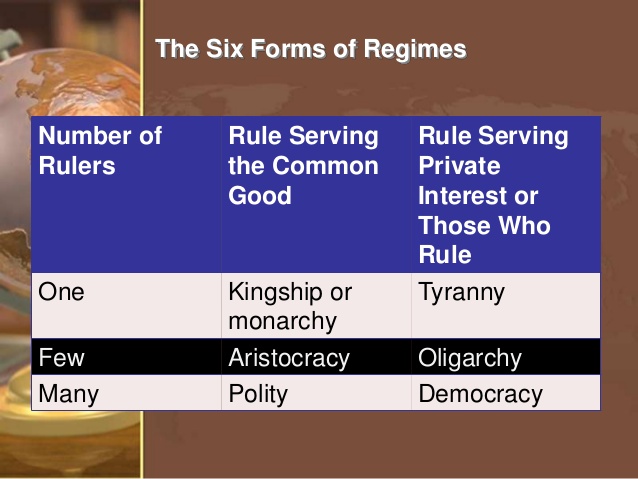
Note, too, a classical tabulation on forms of regimes, IIRC, tracing to Aristotle:
David Horowitz has suggested an analysis of American politics that is worth pondering as 4th Generation Civil War begins to engulf the USA, with obvious Red Guards — and their shadowy backers — rampaging through the culture, almost at will:
In contrast to Europe, where conflicts pitted socialists against conservatives and often erupted in revolution and civil war, American politics [in the aftermath of the Civil War and Reconstruction] involved little or no social upheaval. Whatever divided Americans was not fundamental; elections were about nuts-and-bolts issues, not about the foundations of the republic itself.
Critics complained that the two parties were no more different than Tweedledum and Tweedledee and offered voters “an echo, not a choice.” But there was also a bright side to this political convergence: it reflected the common values and shared understandings of the American social contract. Elections may have lacked ideological drama, but the payoff was political stability and the sense of a common national purpose, which seemed well worth the price.
All this changed in the 1960s with the emergence of an ideological left in the heart of America’s political culture. This countercultural movement was socialist in content and radical in its approach. Its leaders styled themselves revolutionaries, turned their backs on democratic elections, and took their causes “to the streets.” They rejected the political parties, calling them pawns of a “corporate ruling class.”
Democracy, they groused, was a “sham.” But the revolutionary idea proved elusive in democratic America, and in 1972 the radicals of the 1960s abandoned the battle of the streets to join the presidential campaign of antiwar candidate George McGovern. In the aftermath of Watergate and the Nixon impeachment, they assumed a new role as the activist core of the Democratic Party.
As a result of these developments, today the Democratic Party draws its strength fr om the ideological left, a constituency composed of government unions, whose agenda is the expansion of govern-mental power, and organizations that grew out of the crusades of the 1960s and are driven by racial grievances, environmental radicalism, and campaigns for reproductive and welfare rights.Philosophically, the Democratic Party is now almost indistinguishable from the traditional left- wing parties of Europe that make up the “Second Socialist International.” [From, The Art of Political War, 2000.]
This picture, whatever its flaws in detail (and without endorsing Mr Horowitz across the board), seems a fair enough, rough summary of the roots and substance of the polarisation that is now spiralling down ever deeper into 4th Generation Civil War, complete with Red Guards. It came from the left, especially the Culture-form Marxist Left, with linked Po-mo influences. Similarly, given the dominance of US media and other cultural influences, this pattern is spreading globally. The radicals know that, that’s why the US is their chosen Archimedean point.
That is context, how can we respond to restore reason, prudence and soundness?
At this point, by counter-culture strategy that consciously takes a pivotal decision to put the first duties of reason — recognised as core, built-in law of our morally governed nature — to the centre of our thinking. Specifically:
We can readily identify at least seven inescapable first duties of reason. Inescapable, as they are so antecedent to reasoning that even the objector implicitly appeals to them; i.e. they are self-evident. Duties, to truth, to right reason, to prudence, to sound conscience, to neighbour, so also to fairness and justice etc. Such built in law is not invented by parliaments or courts, nor can these principles and duties be abolished by such. (Cf. Cicero in De Legibus, c. 50 BC.) Indeed, it is on this framework that we can set out to soundly understand and duly balance rights, freedoms and duties; which is justice. The legitimate main task of government, then, is to uphold and defend the civil peace of justice through sound community order reflecting the built in, intelligible law of our nature. Where, as my right implies your duty a true right is a binding moral claim to be respected in life, liberty, honestly aquired property, innocent reputation etc. To so justly claim a right, one must therefore demonstrably be in the right. Thus, too, we may compose sound civil law informed by that built-in law of our responsibly, rationally free morally governed nature; from such, we may identify what is unsound or false thus to be reformed or replaced even though enacted under the colour and solemn ceremonies of law.
Of course, such self-evidence by way of inescapability echoed in the promptings of sound conscience does not directly tell us where such come from, only that they are so established and central that they govern our whole rationality. Yes, reasoning itself is pervasively morally governed. Governed, by intelligible law, law that is built-in and attested by sound conscience.
That tellingly echoes a familiar source that is of course a major target for marginalisation. Such, by way of trying to taint and discredit the principal author, Jefferson (and thus to suppress Blackstone, Locke, Rutherford, the Dutch Declarants of 1581 and Duplessis-Mornay behind him without ever having actually addressed the substantial case). Yes, the US Declaration of Independence, 1776:
When . . . it becomes necessary for one people . . . to assume among the powers of the earth, the separate and equal station to which the Laws of Nature and of Nature’s God entitle them, a decent respect to the opinions of mankind requires that they should declare the causes which impel them to the separation.
We hold these truths to be self-evident, [cf Rom 1:18 – 21, 2:14 – 15], that all men are created equal, that they are endowed by their Creator with certain unalienable Rights, that among these are Life, Liberty and the pursuit of Happiness. –That to secure these rights, Governments are instituted among Men, deriving their just powers from the consent of the governed, –That whenever any Form of Government becomes destructive of these ends, it is the Right of the People to alter or to abolish it, and to institute new Government, laying its foundation on such principles and organizing its powers in such form, as to them shall seem most likely to effect their Safety and Happiness. Prudence, indeed, will dictate that Governments long established should not be changed for light and transient causes; and accordingly all experience hath shewn, that mankind are more disposed to suffer, while evils are sufferable, than to right themselves by abolishing the forms to which they are accustomed. But when a long train of abuses and usurpations, pursuing invariably the same Object evinces a design to reduce them under absolute Despotism, it is their right, it is their duty, to throw off such Government, and to provide new Guards for their future security . . .
We find ourselves bound by built-in law, the law of our responsibly, rationally free, morally governed nature. Such law, credibly, traces to our source. Where, obviously — as non-being can have no causal powers — were there ever utter nothingness such would forever obtain. Likewise, circular retro causality where a not yet future reaches back to cause its own origin is just as absurd. Also, to traverse an infinite succession of finite stages [“years” for convenience] to reach here is an infeasible supertask, so an infinite causal-temporal past is also implausible.
So, we freely conclude, if a world now is, something always was, something capable of causing a world with responsible, rational, free (so, morally governed) creatures such as we are.
After centuries of debates on roots of moral government, we have just one serious candidate: the inherently good and utterly wise creator God, a necessary and maximally great being. One, worthy of our loyalty and of the reasonable, responsible service of doing the good that accords with our evident nature.
That is the true root issue: ever so many today are committed to rejecting such a creator God that they will cling to the most patent of absurdities. This is a big problem.
We need to champion reason, soundness and prudence, recognising that we must stand and take blows and defeats now, if we are to be the good people in the storm if and when things go over the cliff. A grim task, but a necessary one.
Where, we must not shun to point out the absurdity of our civilisation’s current path. Even in the teeth of Red Guards and their mobbing tactics backed by nihilistic power brokers.
In my estimation, the next six to eighteen months will be crucial for our civilisation, if it is to avert needless catastrophe that will likely drastically curtail liberty under just law and government with the informed consent of the governed. Fourth Generation Warfare is often so subtle that it does not seem to be what it is, war. END