Uncommon Descent Serving The Intelligent Design Community

Be Afraid

Categories
Intelligent Design
Share
Facebook
Twitter/X
LinkedIn
Flipboard
Print
Email

For nearly 75 years the Holocaust has been used as an example of evil so clear as to be beyond reasonable dispute.  It was useful as a counter to arguments for moral nihilism such as we get on these pages so often, because very few people were willing to stand up and say, “I personally don’t agree with Holocausts, but of course that’s just my opinion; I can’t say a contrary opinion is necessarily wrong.”

That is not the case anymore as the following exchange between me and Bob O’H demonstrates:

Bob O’H: But doesn’t [Becky’s Lesson] actually support the materialists’ assertion? The story shows a situation where an act that the reader regards as grossly immoral is shown as being morally acceptable in another society.


Barry:  Your second sentence is almost right. It should read:  The story shows a situation where an act that the reader regards as KNOWS FOR AN ABSOLUTE CERTAIN FACT IS grossly immoral is shown as being morally acceptable in another society.

Thus, if “morality comes from society” is true, it can lead to a situation in which known immoral acts are moral. The materialist is then on the horns of a dilemma. He must admit that under certain circumstances the Holocaust would be good (note, “good,” not merely “regarded as good”) if everyone in the society believes that to be the case. Or he can admit that since that is patently absurd, the premise “morality comes from society” is false.


Bob:  Well, no. If I’m a moral subjectivist and I’m being precise, I can say that I regard certain acts are good, and I can say that societies (or other groups) regard these acts as good, but I don’t have any external objective standard by which to say that they actually are good.

Given the choice between (1) embracing the patently absurd proposition that under any conceivable circumstances the Holocaust could be morally good; and (2) rejecting the moral subjectivism his materialism demands, Bob casually clings to his materialism and embraces the absurdity.

Bob is a teacher.  God help his students.  God help the rest of us as well, because Bob speaks for many, and that should make you very afraid.

Critical Rationalist is even scarier.  At least Bob tries to ground his view that the Holocaust was evil in something, even if that something (subjective preference) in practice turns out to be nothing.  CR insists there is absolutely no justification for the proposition “the Holocaust was evil.”

Nietzsche speaks of such:

What were we doing when we unchained this earth from its sun? Whither is it moving now? Whither are we moving? Away from all suns? Are we not plunging continually? Backward, sideward, forward, in all directions? Is there still any up or down? Are we not straying, as through an infinite nothing?

“Are we not straying, as through an infinite nothing?”  Yes, says CR.

If CR is right, then Camus’ observation that the only interesting question is whether to kill yourself in the face of the patent absurdity of life without meaning has real force.

UPDATE:

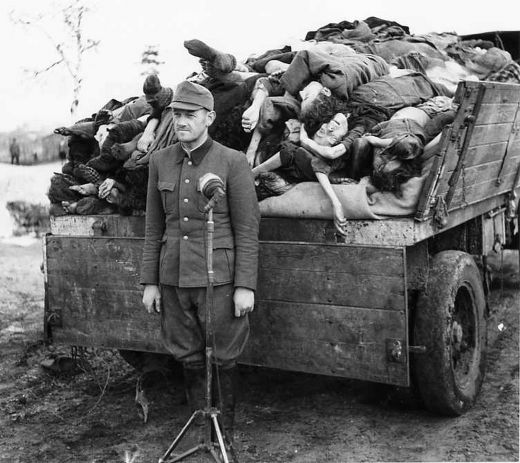
Bob O’H doubles down.  In comment 1 in the combox, he says it would be “arrogant” for him to say no one could ever see any circumstances under which they would consider this to be good:


Comments
Bob,
I don’t think you’re getting it
No, I get it. You made the unqualified statement in ALL CAP shouting letters "YES, I AM ABSOLUTELY CERTAIN THAT HIMMLER WAS WRONG THAT THE HOLOCAUST WAS GOOD." When you made that statement you were lying. Now you are saying that you are not, in fact, absolutely certain. You now allow for Himmler having a different standard than yours. Despite what you said earlier, you say you can't be absolutely sure Himmler was wrong, because you "don’t have any external objective standard by which to say" Himmler's standard is necessarily inferior to yours. Bob, I truly do get it, and I am not surprised. When someone is soft on whether the Holocaust was evil, flip flopping and lying are certainly no big reach.Barry Arrington
March 10, 2018
March
03
Mar
10
10
2018
11:55 AM
11
11
55
AM
PDT
CR: ... no position can be positively justified ...
Good grief CR, when will you understand that your pseudo-philosophy is self-defeating? Read slowly with comprehension: It cannot be positively justified that "no position can be positively justified."Origenes
March 10, 2018
March
03
Mar
10
10
2018
11:06 AM
11
11
06
AM
PDT
Barry - I don't think you're getting it. I'm sure that (by may standards) Himmler was wrong. But I acknowledge that my standards are not objective, and allow for other people having different standards. That is how I can be sure that Himmler was wrong, but he was (presumably) equally sure that he was right. We both started with different standards. On the arrogance, my point was not that I think it arrogant to believe something very strongly, it's that I think it's arrogant to say what other people may think.Bob O'H
March 10, 2018
March
03
Mar
10
10
2018
11:01 AM
11
11
01
AM
PDT
Bob Himmler was wrong . . . Morality isn’t just about personal preference – it’s something that is determined by society. That's serious irony.tribune7
March 10, 2018
March
03
Mar
10
10
2018
10:32 AM
10
10
32
AM
PDT
Bob @ 34
Why is is arrogant to have a strong opinion?
I dunno Bob. You are the one who wrote your comment at 1, not I.
I think Himmler was wrong, but that’s based on the morals instilled into me by my family and surrounding society. Just because I believe something very strongly doesn’t make it a fact or objective.
I knew Bob would waffle when he realized the implications of what he said. At 26 he was absolutely certain. It was pointed out to him that absolute certainty implies objective morals. Now he only "thinks" Himmler was wrong. He "believes very strongly." Apparently, he is no longer "absolutely certain." Now we are right back to Comment 1 Bob, who is open to the possibility that Himmler might have been right. We are back to the Bob I described in the OP:
Given the choice between (1) embracing the patently absurd proposition that under any conceivable circumstances the Holocaust could be morally good; and (2) rejecting the moral subjectivism his materialism demands, Bob casually clings to his materialism and embraces the absurdity.
Barry Arrington
March 10, 2018
March
03
Mar
10
10
2018
10:12 AM
10
10
12
AM
PDT
Barry @ 31 - Why is is arrogant to have a strong opinion? I'm not insisting that others should hold the same opinion (although I obviously hope they would). Also, my moral opinions aren't objective - I think Himmler was wrong, but that's based on the morals instilled into me by my family and surrounding society. Just because I believe something very strongly doesn't make it a fact or objective.Bob O'H
March 10, 2018
March
03
Mar
10
10
2018
10:05 AM
10
10
05
AM
PDT
CR says the proposition "the Holocaust was evil" can in fact be justified in this sense:
although it is possible to justify a preference for a particular position in the light of evidence and arguments produced to date, on the understanding that the preference can change in the light of new evidence and arguments.
Translation: CR tentatively holds to the notion that the Holocaust was evil, but he is open to being persuaded he is wrong. Horrifying. God help us. CR rails against "dogmatists." I assume he means people like me who are not open to being persuaded the Holocaust was a good thing. I will ask the readers to judge. As between CR, who is open to be persuaded the Holocaust was good, and Barry, who is not, who is more likely to be persuaded the Holocaust was a good thing? Yes, my mind is closed on the issue. And it is horrifying to me that CR's is not.Barry Arrington
March 10, 2018
March
03
Mar
10
10
2018
09:49 AM
9
09
49
AM
PDT
Barry: CR insists there is absolutely no justification for the proposition “the Holocaust was evil.”
CR: you keep misrepresenting me
So you agree the proposition “the Holocaust was evil” is positively justified? Good to know. Thanks for clearing that up.
CR: no position can be positively justified
Oh. Nevermind. Barry Arrington
March 10, 2018
March
03
Mar
10
10
2018
09:38 AM
9
09
38
AM
PDT
Bob,
Bob at comment 26: YES, I AM ABSOLUTELY CERTAIN THAT HIMMLER WAS WRONG THAT THE HOLOCAUST WAS GOOD.
Bob at comment 1: I wouldn’t want to be arrogant enough to say whether anyone else could see any circumstances under which they would consider genocide to be good.
Wow, Bob. Isn't your comment at 26 an arrogant thing to say? Just kidding. Since you are now absolutely certain Himmler was wrong, welcome to moral objectivism. Good for you.Barry Arrington
March 10, 2018
March
03
Mar
10
10
2018
09:35 AM
9
09
35
AM
PDT
EricMH @ 20 - I can be certain Himmler was wrong because they were wrong by my moral standards, and the standards of the society around me. Morality isn't just about personal preference - it's something that is determined by society. If morality is objective, then how come there is so much disagreement about it? How come slavery was morally OK for so long, for example?Bob O'H
March 10, 2018
March
03
Mar
10
10
2018
09:11 AM
9
09
11
AM
PDT
harry @20 -- excellent, thank you very much.ayearningforpublius
March 10, 2018
March
03
Mar
10
10
2018
08:44 AM
8
08
44
AM
PDT
@Bob O'H, how can you be certain Himmler is wrong yet say there is no objective right or wrong? Saying there is no objective morality means you cannot be right or wrong when you make a moral claim. It's like me saying you are wrong when you say "I like chocolate ice cream." Morality is not a preference, it is an objective judgement about the state of the world. It is like saying "1+1=3" is wrong. If someone likes killing Jews he is a messed up person, and that's an objective fact.EricMH
March 10, 2018
March
03
Mar
10
10
2018
08:32 AM
8
08
32
AM
PDT
Critical Rationalist is even scarier. At least Bob tries to ground his view that the Holocaust was evil in something, even if that something (subjective preference) in practice turns out to be nothing. CR insists there is absolutely no justification for the proposition “the Holocaust was evil.”
And for all your talk of morality, you keep misrepresenting me, despite making numerous clarifications. Apparently, you subscribe to the old strategy of presenting a false version of an idea you find objectionable, then pointing out how it is false. To again further clarify, from this essay.....
“The traditional systems of epistemology may be said to result from yes-answers or no-answers to questions about the sources of our knowledge. They never challenge these questions, or dispute their legitimacy; the questions are taken as perfectly natural, and nobody seems to see any harm in them. This is quite interesting, for these questions are clearly authoritarian in spirit. They can be compared with that traditional question of political theory, 'Who should rule?', which begs for an authoritarian answer such as 'the best', or 'the wisest', or 'the people' or 'the majority'. (It suggests, incidentally, such silly alternatives as 'Who should be our rulers: the capitalists or the workers?', analogous to 'What is the ultimate source of knowledge: the intellect or the senses?') This political question is wrongly put and the answers which it elicits are paradoxical (as I have tried to show in chapter 7 of my Open Society). It should be replaced by a completely different question such as 'How can we organize our political institutions so that bad or incompetent rulers (whom we should try not to get, but whom we so easily might get all the same) cannot do too much damage?' I believe that only by changing our question in this way can we hope to proceed towards a reasonable theory of political institutions.” (Popper, 1963, 25)
The key point in the passage is “these questions are clearly authoritarian in spirit”. Popper and Bartley used the term “justificationism” to describe the philosophical quest for “justified true beliefs”, based on the appropriate authority. They argued that this quest is misplaced because foundationalist justification cannot be achieved, although it is possible to justify a preference for a particular position in the light of evidence and arguments produced to date, on the understanding that the preference can change in the light of new evidence and arguments. The first section of this paper notes the damaging effect of moral relativism and the subversion of traditional values by the constructivist rationalists who Hayek subjected to protracted criticism. His “abuse of reason” project is a part of the defence of classical liberalism, specifically a defence of the little recognized but all-important moral framework. The second section examines the failure in the market of ideas which creates problems for classical liberalism, sketches the core problem of rationality, the dilemma of the infinite regress versus dogmatism, and introduces Bartley’s proposal for a solution. The third section sketches the various responses to the dilemma and the way that classical liberalism has suffered from the “justified belief” framework. It notes that academic philosophy and the ‘true belief” religions tend to propagate the framework of justificationism and the “true belief” mindset. The fourth section shows how the non-justificationist approach resolves some tensions in the treatment of rationality and criticism in the work of Popper and Hayek. The final sections briefly describe Jan Lester’s application of Bartley’s ideas in political economy and a rejoinder to the deconstructionists in literary theory.
IOW, you're committing the fallacy of equivocation in respect to justificationism, which specifically refers to sources of knowledge. Furthermore, it addresses events like the holocaust in context already presented.
3. Responses to the dilemma of the infinite regress versus dogmatism In the light of the dilemma of the infinite regress versus dogmatism, we can discern three attitudes towards positions: relativism, “true belief” and critical rationalism [Note 3] Relativists tend to be disappointed justificationists who realise that positive justification cannot be achieved. From this premise they proceed to the conclusion that all positions are pretty much the same and none can really claim to be better than any other. There is no such thing as the truth, no way to get nearer to the truth and there is no such thing as a rational position. True believers embrace justificationism. They insist that some positions are better than others though they accept that there is no logical way to establish a positive justification for an belief. They accept that we make our choice regardless of reason: "Here I stand!". Most forms of rationalism up to date have, at rock bottom, shared this attitude with the irrationalists and other dogmatists because they share the theory of justificationism. According to the critical rationalists, the exponents of critical preference, no position can be positively justified but it is quite likely that one (or more) will turn out to be better than others in the light of critical discussion and tests. This type of rationality holds all its positions and propositions open to criticism and a standard objection to this stance is that it is empty; just holding our positions open to criticism provides no guidance as to what position we should adopt in any particular situation. This criticism misses its mark for two reasons. First, critical rationalism is not a position. It is not directed at solving the kind of problems that are solved by fixing on a position. It is concerned with the way that such positions are adopted, criticised, defended and relinquished. Second, Bartley did provide guidance on adopting positions; we may adopt the position that to this moment has stood up to criticism most effectively. Of course this is no help for people who seek stronger reasons for belief, but that is a problem for them, and it does not undermine the logic of critical preference. Liberalism has been forced to constantly work against the grain of the received opinions, locked in place by the justificationist or true belief mindset so the gains of one generation have often been lost to the forces of irrationalism and authoritarianism in the next. But the really penetrating insight provided by Bartley’s work is that traditional theories of rationality (based on the assumption of justificationism) perpetuate the justificationist tradition/framework/mindset and hence the dilemma of the infinite regress versus dogmatism. Hence it seems that rationalists of the justificationist variety, like Bertrand Russell (who was described as a “passionate skeptic”, unwittingly nurture the framework that creates so many problems for rationalists. This helps to explain why the survival of liberalism is precarious, why it needs auxiliaries to support its causes and why civilisation lapses into occasional bouts of irrationalism. Episodes such as the Nazi holocaust and the wilder excesses of the generation of '68 are generally regarded as strange aberrations in the normally rational Western tradition, perhaps calling for psychological analysis of the individuals involved, for studies of 'the authoritarian personality' or ruminations on the 'contradictions of developed capitalism' or the decline of religious faith. But seen from the perspective of Bartley's work such failures of reason are only to be expected in the justificationist framework, which sponsors dogmatism and fanaticism. And as long as that framework remains dominant our traditions of rationality, tolerance and freedom will remain fragile and liable to collapse at any time of social or political crisis (as in Greece, circa 2012). One of the thought-provoking results of his analysis is to identify academic philosophy and the “true belief” religions as major vehicles which perpetuate the justificationist framework.
critical rationalist
March 10, 2018
March
03
Mar
10
10
2018
08:21 AM
8
08
21
AM
PDT
Barry @ 25 - Huh? What? I just said that I thought Himmler was wrong. What's embarrassing about that? But just to make it clear: YES, I AM ABSOLUTELY CERTAIN THAT HIMMLER WAS WRONG THAT THE HOLOCAUST WAS GOOD. Happy now?Bob O'H
March 10, 2018
March
03
Mar
10
10
2018
07:42 AM
7
07
42
AM
PDT
Bob @ 23. Just stop it. It's embarrassing. Yes, Himmler believed the Holocaust was good. I am absolutely certain he was wrong. Until you can say the same thing, my point stands.Barry Arrington
March 10, 2018
March
03
Mar
10
10
2018
07:32 AM
7
07
32
AM
PDT
Seversky @ 19;
The same is true of the atrocities recounted approvingly in the Old Testament. We are told – by the victors – that all these peoples who were unfortunate enough to get tis the way of the Israelites and their God were horrible people who did horrible things and deserved all they got. Maybe they were, but there’s no evidence provided and we never get to hear their side of the story at all.
If I read it so skeptically, I must attribute any morality I derive to my skeptical viewpoint. Blaming the Bible for ill-conceived morality and cynical opportunism that contradicts Its message is like blaming a physics text for the bad rationales that contribute to the pile of "over unity" generator schemes.
But the says of unchallengeable edicts being handed down on tablets of stone are past.
According to the Bible, they have yet to even start. Humanity has always challenged, and failed, God's Law and Word. The Israelites were worshiping an animal statue when those tablets were delivered. Prophets questioned and even pleaded against God's edicts; often enough, successfully. Israel failed to completely drive the Canaanites from their lands, and adopted the evil ways of the remnant. YHWH is constantly allowing and adjusting for human failure and rebellion. Yeshua's primary mission was to justify and establish an escape clause for the lot of us. God's case is history itself. His judgement is being withheld for a time; to let those who may yet still sort themselves out, sort. There will be no disputing the final verdict of They whose Word precedes gravity.LocalMinimum
March 10, 2018
March
03
Mar
10
10
2018
07:19 AM
7
07
19
AM
PDT
Barry @ 2 - He gets called on his monstrous nihilistic Holocaust-enabling moral views, and he pretends his views were twisted. Yes, that it utterly twisting my views. Yes, the holocaust was evil. I have no problems saying that. How is that Holocaust enabling?
Prediction, Bob will say that IN HIS VIEW, at all times, in all places, and under all circumstances the Holocaust would be evil, but it would be arrogant to say Himmler was necessarily wrong if he thought it was good.
I would say that Himmler was wrong, but that is of course based on my own moral views. Himmler, presumably, thought that he was doing a good thing, and although I would utterly reject his conclusion, I would acknowledge that he had come to that conclusion.Bob O'H
March 10, 2018
March
03
Mar
10
10
2018
07:18 AM
7
07
18
AM
PDT
@Seversky, sounds like some objective morality supporting your position. You are saying it's objectively wrong to have a tyrannical system, therefore it is better to have a democracy. An interesting question is whether the tyrannical regimes of today tend to be atheistic or theistic? A similar question, do democratic regimes have their roots in theism or atheism? What would you say?EricMH
March 10, 2018
March
03
Mar
10
10
2018
05:51 AM
5
05
51
AM
PDT
Something that gets lost in the translation of all this is the fact that we are all sinners and in need of redemption. Many people of the atheistic persuasion may deny the reality of objective morality, and hold that all morality is subjective, but I hold that the primary reason they are doing this is so that they may be free to do those things which they feel God is preventing them from doing. As Aldous Huxley honestly confessed:
“I had motives for not wanting the world to have a meaning; and consequently assumed that it had none, and was able without any difficulty to find satisfying reasons for this assumption. The philosopher who finds no meaning in the world is not concerned exclusively with a problem in pure metaphysics. He is also concerned to prove that there is no valid reason why he personally should not do as he wants to do. For myself, as no doubt for most of my friends, the philosophy of meaninglessness was essentially an instrument of liberation from a certain system of morality. We objected to the morality because it interfered with our sexual freedom. The supporters of this system claimed that it embodied the meaning - the Christian meaning, they insisted - of the world. There was one admirably simple method of confuting these people and justifying ourselves in our erotic revolt: we would deny that the world had any meaning whatever.” ? Aldous Huxley, Ends and Means
And although atheists may feel God is preventing them from being free to 'sin', the fact of the matter is that sin takes your freedom away and makes you a slave to it. As Jesus said,,
John 8:34 Jesus answered them, “Truly, truly, I say to you, everyone who practices sin is a slave to sin.
Thus despite what atheists may want to believe, it is not that God is preventing us from being free to sin, it is that God is preventing us from becoming slaves to sin. For over a decade, my own life had been destroyed by my own personal sin. I was a homeless drunk and drug addict for many years. Some of the things I did and went through during that time still haunt me to this day. I knew all too well that sin was very real and that I was very much a slave to it. What the sinner who is acutely aware of his sin readily understands, but the sinner, who does not think he is really a sinner (if he even admits that there is such a thing as sin), but who is under the delusion that he is controlling his sin, does not readily understand, is that Jesus Christ had the full power and authority of heaven to relieve Himself of the horrid torment of the cross but instead chose, because of His great love for us, to endure it, in its entirety, willingly, so that he might completely overcome sin, hell and death, and all their horrors, on our behalf, (since we were and are incapable), so that we may be set free from our sin and reunited with him. Love is the only proper response on our part.
Luke 7 Then he turned toward the woman and said to Simon, “Do you see this woman? I came into your house. You did not give me any water for my feet, but she wet my feet with her tears and wiped them with her hair. 45 You did not give me a kiss, but this woman, from the time I entered, has not stopped kissing my feet. 46 You did not put oil on my head, but she has poured perfume on my feet. 47 Therefore, I tell you, her many sins have been forgiven—as her great love has shown. But whoever has been forgiven little loves little.” 48 Then Jesus said to her, “Your sins are forgiven.” 49 The other guests began to say among themselves, “Who is this who even forgives sins?” 50 Jesus said to the woman, “Your faith has saved you; go in peace.”
bornagain77
March 10, 2018
March
03
Mar
10
10
2018
05:02 AM
5
05
02
AM
PDT
The state claiming for itself the authority to “legalize” the murder of innocent humanity is a rejection of civilization itself and a return to savagery. One need not be a fervent Christian or even a serious theist to understand why this is so: • Humanity precedes the state and brings it into existence. • Therefore the state exists for humanity, not humanity for the state. • Therefore it is humanity that bestows and withdraws the state's right to exist, not the state that bestows and withdraws humanity's right to exist. • Therefore the state simply has no authority whatsoever to “legalize” the murder of innocent humanity. Aristotle declared in his Politics that “The state comes into existence that Man may live.” The very purpose of the state is to facilitate the flourishing of human life, not its destruction. This is also true of the medical profession. The ancient physicians' oath of Hippocrates explicitly prohibited abortion; it required that physicians do no harm to any human being regardless of their status in society or lack thereof. Before this the sick had to wonder if the doctor was there to heal them or to harm them. Hippocrates turned witch doctors into physicians. Under savagery the powerful kill the less powerful and/or take their possessions simply because doing so serves their purposes at the moment. Ideally, at some point the response of humanity to this is the formation of a state that is more powerful than the most powerful individuals; the state is to protect the lives, liberty and property of everyone. The experience of humanity though, is that there is usually some segment of humanity that, due to bigotry – the curse of civilized humanity – just “doesn't count.” This is what allows states only pretending to be civilized to “legalize” things like the murder, enslavement or the brutal oppression of some segment of humanity, even though it is just such things that the state is formed to prevent. The common sense morality at the heart of civilized society itself is immeasurably reinforced and extended to include all humanity, creating a civilization where everybody “counts,” by the belief in a benevolent Creator of humanity, One Who requires mankind to live according to an objective, common sense morality understandable by any rational mind, a morality that prohibits things like murder and theft, and in essence demands that we do not do to others what we wouldn't want others to do to us. In a society where ethics have been enhanced in this way, if in one's opinion the life of another human being is worthless and just doesn't matter, one must still acknowledge that the God Who created such a human being had His own reasons for doing so, and expects the human rights of such a “worthless” human being to be respected like any other. As for Western civilization, the roots of its societal ethic placing great emphasis on the intrinsic worth and equal value of every human life regardless of its stage or condition are ancient, even if they were often betrayed. The common sense morality of Aristotle and Hippocrates was reinforced by the Christianization of the West. The most enlightened aspects of the ancient pre-Christian morality were blessed and enhanced by the Judeo-Christian ethic. This formed what became the traditional Western ethic, one that acknowledged the inestimable value of any and every human being, and has been the basis for most of our laws and much of our social policy. If the state, or “Caesar” if you will, is just a mere mortal like the rest of us, he too, must acknowledge the authority of the benevolent Creator. Christianity made possible the very notion that even Caesar – no, Caesar in particular – had an obligation to protect human rights, the God-given, inalienable rights of humanity, and had no authority to do otherwise. God was God, Caesar was not a god. This fundamental paradigm shift was a spectacular achievement purchased for humanity with the blood of many Christian martyrs. This foundation stone of the traditional Western ethic has been steadily eroded though, beginning with the rise of the militant atheism born of the so-called Enlightenment. This is because atheism provides no intellectual basis for not doing unto others what we wouldn't want done to us. To understand this we must ask again fundamental questions. Why would any human being deserve human rights or anything else for that matter? What exactly is wrong with the powerful serving their own interests at the expense of the less powerful simply because they are able to do so? Are the less powerful, simply because of their humanity, owed something? Is merely being human enough to merit any and every human being rights that must be respected by those more powerful? Militant atheism, on the one hand, believes that ultimately humanity is nothing more than some stuff that was quite accidentally vomited forth by mindless, purposeless natural processes. If that is the case then there is really nothing wrong with the powerful serving their own interests at the expense of others. It's all about the survival of the fittest. Nobody owes anybody anything. A human being is just another collection of atoms, albeit a rather peculiar one in that it possesses consciousness and suffers from the delusion that it has a free will, with no more intrinsic rights than a rock -- maybe less, since at least the collection of atoms of which a rock is comprised isn't delusional. On the other hand militant atheism, after having destroyed the intellectual foundation for any notion of human rights, claims to be the champion of human rights, and insists that theism, which provides the required edifice upon which any intellectually satisfying explanation of intrinsic human rights must be built, is the enemy of humanity. This is exactly why, in the last 100 years (Lenin's Bolsheviks seized control of Russia in 1917), godless regimes hostile to theism have murdered well over a hundred million people. And why wouldn't they murder everyone who resisted their agenda? In doing so they are only cleaning up some vomit, destroying some inconvenient collections of atoms with no more intrinsic rights than rocks, that have become an obstacle in their path to power and dominance. Such militant atheism sees itself, of course, as the superior “fittest” doing what the fittest must do. And it is obvious why these self-appointed elites must claim that theism is the enemy of humanity: because theism and its insistence on the inalienable rights of all humanity is their mortal enemy, not the enemy of the human race as they claim. Theism is in truth humanity's chief advocate. The murderous, militant atheists of the last century were fully aware of this, but they are liars and murderers whose first victim was their own consciences.harry
March 10, 2018
March
03
Mar
10
10
2018
03:12 AM
3
03
12
AM
PDT
Actually, the really frightening thing is that not only did the hardcore Nazis who carried out the Holocaust think it was a Good Thing, there are today extreme alt-right types, neo-Nazis, Nazi sympathizers whatever you want to call them who still think it was a Good Thing. And you will find them all over the place, the US, UK, France, Italy, many of the East European countries. They may be small in number but they are a reminder that what happened in Nazi Germany could happen elsewhere if things were to go bad. What happened in Nazi Germany, as well as Soviet Russia, Mao's China or Pol Pot's Cambodia was that relatively small but well-armed and well-disciplined groups were able to seize control of a state and, once in power, crushed opposition ruthlessly and violently. They were not interested in the opinions or will of the majority in the slightest. They are object lessons in what happens when a consensus is not sought. The same is true of the atrocities recounted approvingly in the Old Testament. We are told - by the victors - that all these peoples who were unfortunate enough to get tis the way of the Israelites and their God were horrible people who did horrible things and deserved all they got. Maybe they were, but there's no evidence provided and we never get to hear their side of the story at all. The only thing that stands between us and subjection to some extremist group is a moral code and set of rights to which all can and do assent and for which any attempt at violation or suppression will be resisted by whatever means necessary. Just as, in a democracy, a government derives its authority and legitimacy by being the expressed will of the people so does a moral code stand on the assent of those subject to it. If God or any other being wants to contribute to the debate about morality with suggestions and the reasoning behind them then they should be heard. But the says of unchallengeable edicts being handed down on tablets of stone are past.Seversky
March 9, 2018
March
03
Mar
9
09
2018
09:10 PM
9
09
10
PM
PDT
The a/mat's prove objective morality with their counter example. If the god of the Bible commands morally reprehensible things, that proves objective morality is true. Otherwise, the commands would not be morally reprehensible.EricMH
March 9, 2018
March
03
Mar
9
09
2018
07:21 PM
7
07
21
PM
PDT
rvb8, I suspect very few of the SS guards were ordinary shop owners or the like. The SS recruited from the scum of the land: petty criminals, societal outcasts and the like. Furthermore, they culled their own ranks such that if a guard showed any sympathy with the prisoners, or was unable to be sufficiently brutal, he would be stripped of his rank and uniform, and thrown in _with_ the prisoners. In this manner, the guards were filtered until only the most brutal were left running the show. Thus, they had no morality to speak of. >When Christ comes again... I do not anticipate being asked to kill anybody now, or at that time.EDTA
March 9, 2018
March
03
Mar
9
09
2018
06:56 PM
6
06
56
PM
PDT
Steve H @ 7: 1 Timothy 2:3-4:
This is good and pleasing in the sight of God our Savior, who desires all men to be saved and to come to the knowledge of the truth.
Ezekiel 18:22-23
All his transgressions which he has committed will not be remembered against him; because of his righteousness which he has practiced, he will live. "Do I have any pleasure in the death of the wicked," declares the Lord GOD, "rather than that he should turn from his ways and live?
Ezekiel 18:31-32
"Cast away from you all your transgressions which you have committed and make yourselves a new heart and a new spirit! For why will you die, O house of Israel? "For I have no pleasure in the death of anyone who dies," declares the Lord GOD. "Therefore, repent and live."
John 3:17
For God did not send His Son into the world to condemn the world, but to save the world through Him.
Romans 3:9-10
What then? are we better than they? No, in no wise: for we have before proved both Jews and Gentiles, that they are all under sin; As it is written, There is none righteous, no, not one:
Note also Romans chapter 11. Clearly any Christian who doesn't count the murdered Jews as a loss needs to spend some time with the Manual.LocalMinimum
March 9, 2018
March
03
Mar
9
09
2018
06:06 PM
6
06
06
PM
PDT
So we keep gravitating to the equivocation of utterly destroying cities to drive a thoroughly diseased, child murdering society out of a specific land; to chasing millions of innocent people across an entire continent to murder them purely on the basis of their genetic heritage; because the claim to objective materialistic morality is vacuous (as pointed out by the story) and thus of no interest or use in discussion even to materialists? It seems all we have left on the table is Christian morality and a natural morality which cannot be accounted for on a materialistic basis when applied beyond the survival of one's own genome; but is well accounted for by Christianity at every level.LocalMinimum
March 9, 2018
March
03
Mar
9
09
2018
04:58 PM
4
04
58
PM
PDT
Bob O'H, you're awfully quite. We are waiting for you to elucidate on your position that it is arrogant to say no one could see any circumstances under which that truckload of corpses would be good.Barry Arrington
March 9, 2018
March
03
Mar
9
09
2018
04:37 PM
4
04
37
PM
PDT
steve-h is another gutless A-Mat who wants to have it both ways. Steve at 7. I have no problem saying that the Holocaust would be evil at all times, places etc. Steve at 10. It’s not an objective moral truth. Uh, Steve, what you said in 7 is the very essence of objective moral truth.Barry Arrington
March 9, 2018
March
03
Mar
9
09
2018
04:33 PM
4
04
33
PM
PDT
steve-h
It’s not an objective moral truth – it’s pretty much a tautology.
You don't know what the word "tautology" means. You should look big words up before you use them. Here, I will help you with that. A tautology is the saying of the same thing twice in different words. "The Holocaust was evil" is not a tautology because "Holocaust" and "evil" don't mean the same thing.Barry Arrington
March 9, 2018
March
03
Mar
9
09
2018
04:26 PM
4
04
26
PM
PDT
Agreed mike1962. What do you make of Bob O'H? Do you think he is a sociopath when he says he wouldn’t want to be arrogant enough to say whether Himmler could see any circumstances under which he would consider genocide to be good? Is he an idiot? I'm fairly sure that if push came to shove he could bring himself to condemn Himmler's views on The Final Solution. So why in the world does he spout such shite?Barry Arrington
March 9, 2018
March
03
Mar
9
09
2018
04:12 PM
4
04
12
PM
PDT
Then you believe in at least one objective transcendent moral truth. Tell me steve, where did that objective moral truth come from?
It's not an objective moral truth - it's pretty much a tautology. I use "Evil" to denote acts which are harmful and without mitigating circumstances. It's difficult to think of clearer examples of the concept than the Holocaust or say murdering or torturing a child for pleasure. As definitions go it's far from perfect, but it's no worse than "evil: something which is on God's and Barry's lists of things which are objectively evil (which just happen to be the same)". If evil things are evil for all times and places, why are you so keen to sweep Canaan 3000 years ago under the carpet?steve_h
March 9, 2018
March
03
Mar
9
09
2018
04:10 PM
4
04
10
PM
PDT
1 2 3