Uncommon Descent Serving The Intelligent Design Community

ID Breakthrough — Syn61 marks a live case of intelligent design of a life form

Categories
Cell biology
Design inference
General interest
Genomics
ID Foundations
Intelligent Design
Origin Of Life
speciation
specified complexity
The Design of Life
Share
Facebook
Twitter/X
LinkedIn
Flipboard
Print
Email

Let’s read the Nature abstract:


Nature (2019) Article | Published: 15 May 2019

Total synthesis of Escherichia coli with a recoded genome
Julius Fredens, Kaihang Wang, Daniel de la Torre, Louise F. H. Funke, Wesley E. Robertson, Yonka Christova, Tiongsun Chia, Wolfgang H. Schmied, Daniel L. Dunkelmann, Václav Beránek, Chayasith Uttamapinant, Andres Gonzalez Llamazares, Thomas S. Elliott & Jason W. Chin
Abstract
Nature uses 64 codons to encode the synthesis of proteins from the genome, and chooses 1 sense codon—out of up to 6 synonyms—to encode each amino acid. Synonymous codon choice has diverse and important roles, and many synonymous substitutions are detrimental. Here we demonstrate that the number of codons used to encode the canonical amino acids can be reduced, through the genome-wide substitution of target codons by defined synonyms. We create a variant of Escherichia coli with a four-megabase synthetic genome through a high-fidelity convergent total synthesis. Our synthetic genome implements a defined recoding and refactoring scheme—with simple corrections at just seven positions—to replace every known occurrence of two sense codons and a stop codon in the genome. Thus, we recode 18,214 codons to create an organism with a 61-codon genome; this organism uses 59 codons to encode the 20 amino acids, and enables the deletion of a previously essential transfer RNA. [Cited, per fair use doctrine for academic, non commercial purposes.]

Let us refresh memory on the genetic code:
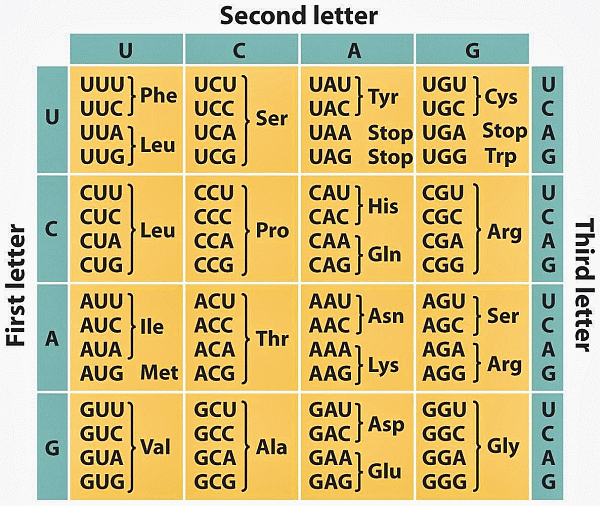
The Genetic code uses three-letter codons to specify the sequence of AA’s in proteins and specifying start/stop, and using six bits per AA

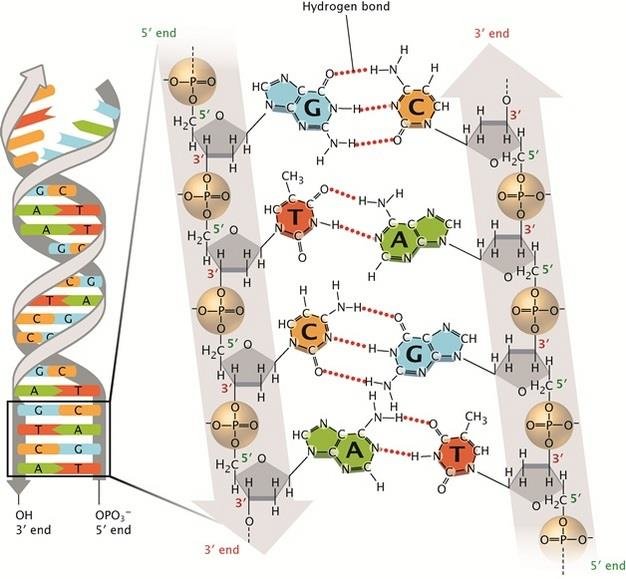
And on the DNA:

The DNA Helix with GCAT (HT: Research Gate, fair use)

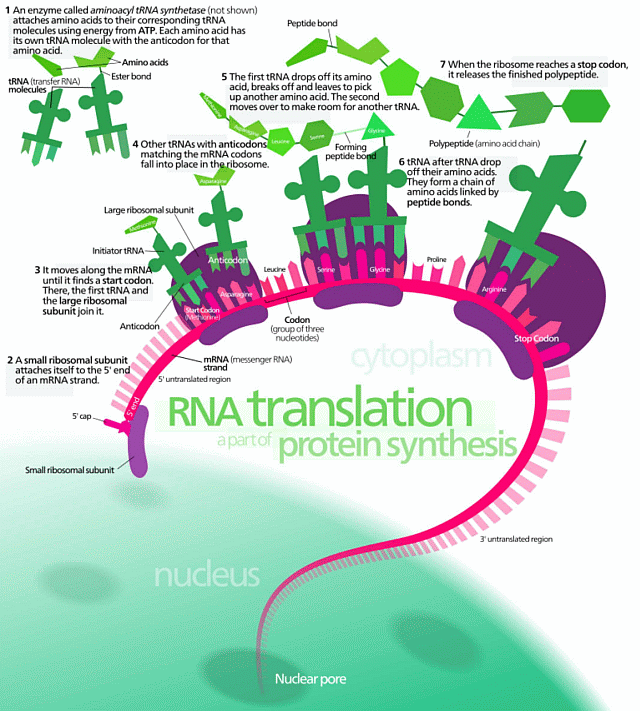
Then also, protein synthesis:

Protein Synthesis (HT: Wiki Media)

Phys dot org gives some context:

A team of researchers at Cambridge University has replaced the genes of E. coli bacteria with genomes they synthesized in the lab. In their paper published in the journal Nature, the group describes replacing the genome and removing redundant genetic codes [–> three letter 4-state elements have 64 possibilities but only 20 are needed for typical protein AA’s, AUG codes for an AA and serves as START, there are three STOP codons] . . . . In this new effort, the researchers had two goals: The first was to synthesize the genome of an E. coli bacterium in their lab—all four million letters of it. The second was to find out what would happen to such a specimen if some of its DNA redundancies were removed . . . .

The researchers report that it took longer for the special bacterial specimen to grow, but other than that, it behaved just like unedited specimens. They suggest that in future efforts, it might be possible to replace the redundancies they removed with other sequences to create bacteria with special abilities, such as making new types of biopolymers not found in nature.

In short, they confirmed that the choice of “synonym” has a regulatory effect.

Where are we today, then?

First, we have definitive demonstration of the intelligent design of a genome. Yes, they obviously have not created a de novo cell body (a much more difficult task), but we see that intelligent design of life here definitively passes the Newton test of observed actual cause. Further, we see that DNA functions as an information system in the cell, supporting the significance of this conceptual representation, based on Yockey’s work:
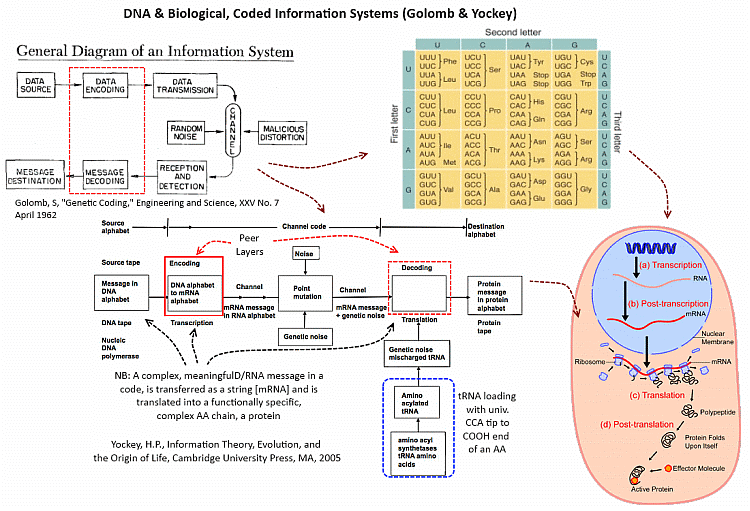
I add: Let’s zoom in on Yockey’s contribution, on the code-communication system as applied to protein synthesis, which underscores the linguistic nature of what is involved:
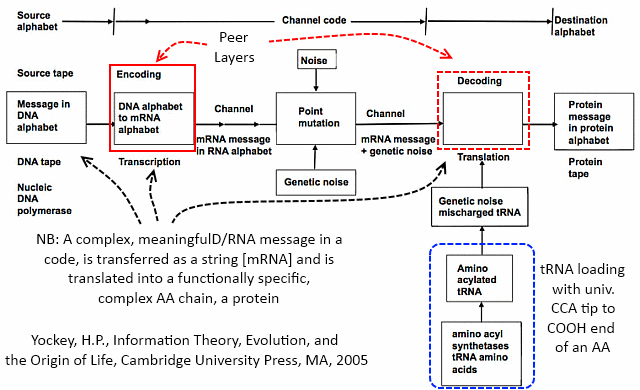
Yockey’s analysis of protein synthesis as a code-based communication process

Where, Crick understood this from the beginning in 1953, witness p. 5 of his letter to his son Michael, March 19, 1953:
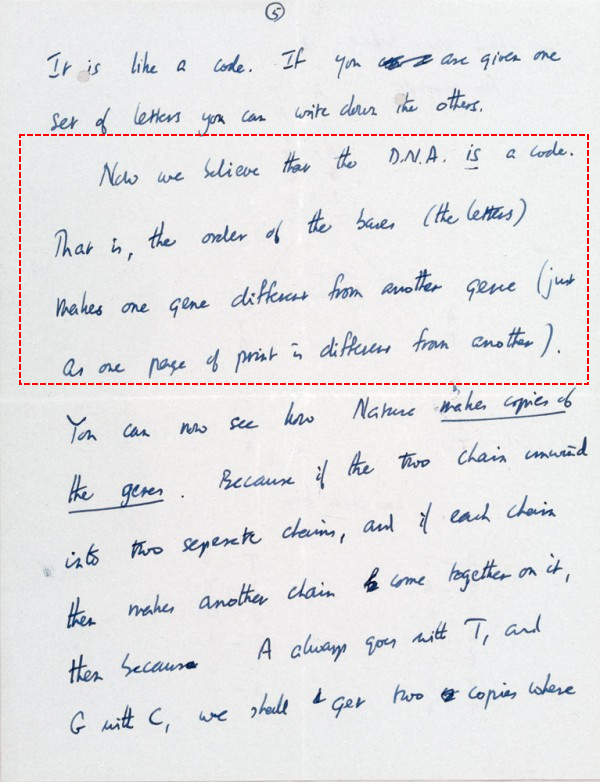
Crick’s letter

At this stage, we definitively know that using nanotech molecular biology and linked computational techniques it is feasible to construct a genome based on intelligently directed configuration. AKA, design.

Therefore, intelligent design, as of right not sufferance, sits at the table for study on origin of life and of body plans.

Where, we separately know on configuration space search challenge, that it is maximally implausible to construct in excess of 500 – 1,000 bits of functionally specific complex organisation and/or associated information. As a reminder:
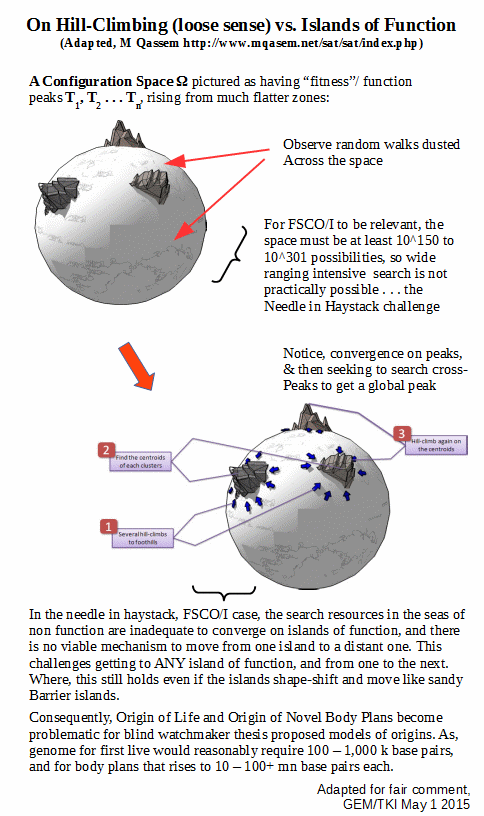
We are now in a different ball game completely: Intelligent Design of life is demonstrated to be feasible and actual in the here and now, as of this investigation. Therefore, as of right, it is a serious candidate to explain what we see in the world of life; especially as regards origin of cell based life and origin of main body plans.

Going forward, we are now a full-fledged independent school of thought. END

PS: James Tour on the Mystery of Life’s Origin, challenging the usual OoL claims, focus from c. 8:30 on:

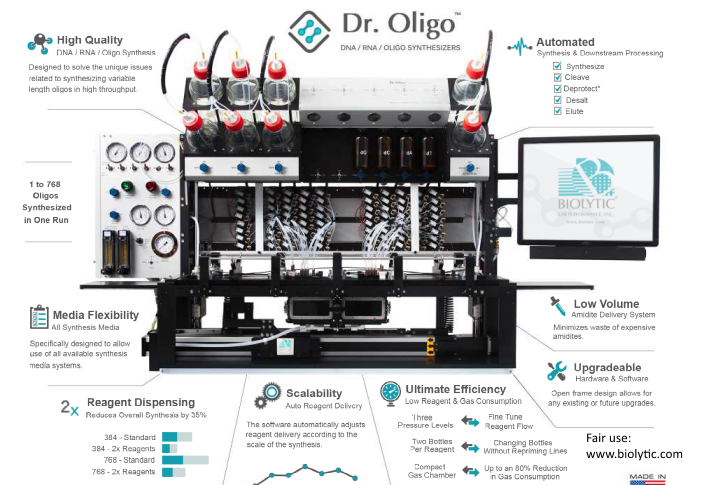
PPS: It seems we need to understand that there are such things as DNA Synthesisers. Here, is a sample, the “Dr Oligo”:
Biocyclopedia lays out the architecture:
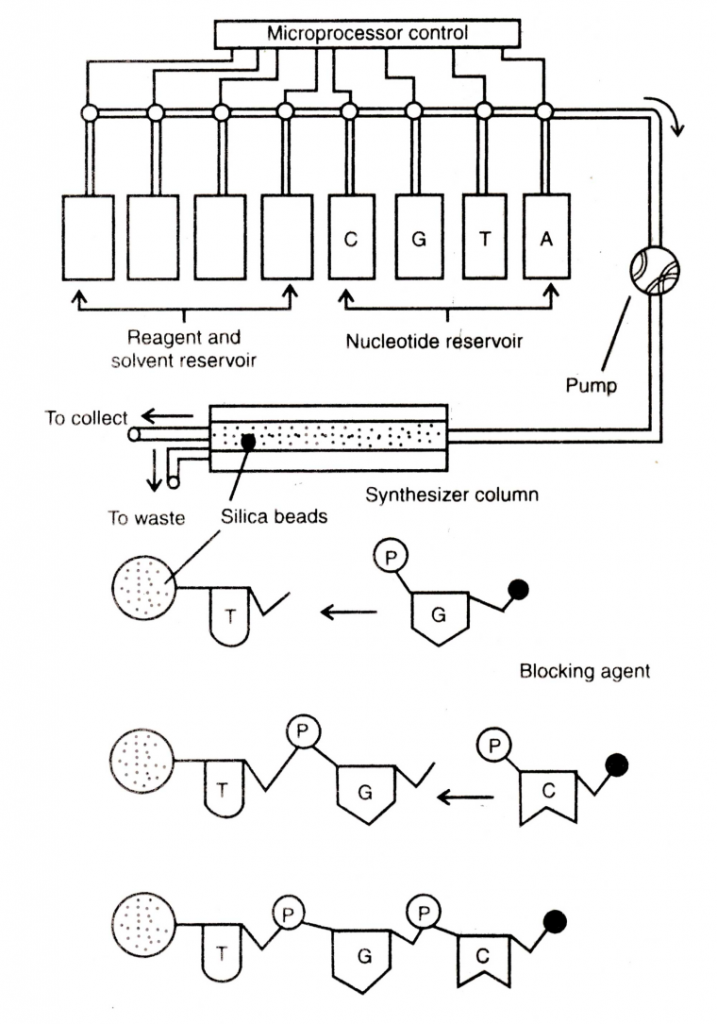
Clipping the explanation:

Recently, fully automated commercial instrument called automated polynucleotide synthesizer or gene machine is available in market which synthesizes predetermined polynucleotide sequence. Therefore, the genes can be synthesized rapidly and in high amount. For example, a gene for tRNA can be synthesized within a few days through gene machine. It automatically synthesizes the short segments of single stranded DNA under the control of microprocessor. The working principle of a gene machine includes (i) development of insoluble silica based support in the form of beads which provides support for solid phase synthesis of DNA chain, and (ii) development of stable deoxyribonucleoside phosphoramidites as synthons which are stable to oxidation and hydrolysis, and ideal for DNA synthesis.

The mechanism of a gene machine is shown in Fig. 2.14 [–> above]. Four separate reservoirs containing nucleotides (A,T,C and G) are connected with a tube to a cylinder (synthesizer column) packed with small silica beads. These beads provide support for assembly of DNA molecules. Reservoirs for reagent and solvent are also attached. The whole procedure of adding or removing the chemicals from the reagent reservoir in time is controlled by microcomputer control system i.e. microprocessor . . . .

The desired sequence is entered on a key board and the microprocessor automatically opens the valve of nucleotide reservoir, and chemical and solvent reservoir. In the gene machine the nucleotides are added into a polynucleotide chain at the rate of two nucleotides per hour. By feeding the instructions of human insulin gene in gene machine, human insulin has been synthesized.

As in, molecular nanotech lab in action.

PPPS: As objectors have raised the claimed logical, inductive inference that designing intelligences are embodied (which we can safely hold, implicitly “lives” in the context of the presumed, evolutionary materialistic account of origins — of cosmos, matter, life, body plans, man, brains and minds), I first link a discussion of how this undermines rationality, by Craig:

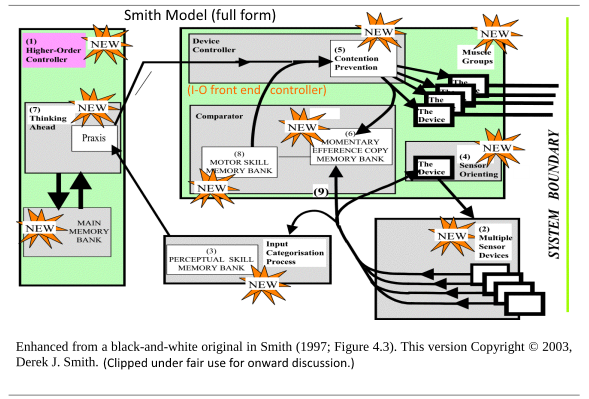
I also put on the table the Smith, two-tier supervisory controller bio-cybernetic model, as a context to discuss embodiment, intelligence and computational substrates, first in simplified form:
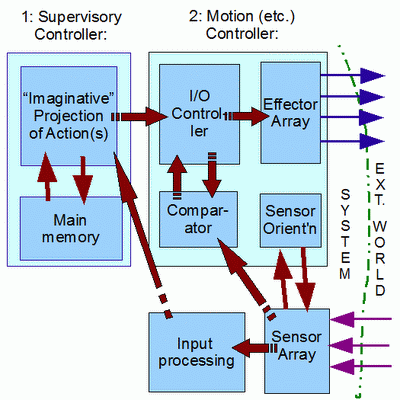
The Derek Smith two-tier controller cybernetic model

Then, in more full detail:

This then leads to the gap between computation on a substrate and rational contemplation. That is, Reppert’s point holds:

. . . let us suppose that brain state A [–> notice, state of a wetware, electrochemically operated computational substrate], which is token identical to the thought that all men are mortal, and brain state B, which is token identical to the thought that Socrates is a man, together cause the belief [–> concious, perceptual state or disposition] that Socrates is mortal. It isn’t enough for rational inference that these events be those beliefs, it is also necessary that the causal transaction be in virtue of the content of those thoughts . . . [But] if naturalism is true, then the propositional content is irrelevant to the causal transaction that produces the conclusion, and [so] we do not have a case of rational inference. In rational inference, as Lewis puts it, one thought causes another thought not by being, but by being seen to be, the ground for it. But causal transactions in the brain occur in virtue of the brain’s being in a particular type of state that is relevant to physical causal transactions.

Comments
PA, the molecular nanotech contribution to the next generation of economic growth? (FYI, Tour lists a cluster of emerging applications of molecular nanotech, including those relevant to life extension, breaking cancer, overcoming handicaps etc; potentially transforming demographics and productive lifespan. On AI, I note it is being used to try to tame the unruly plasma in the Tokamak fusion reactor, which if successful makes water the most important energy source in the world, one capable of taming deserts, providing H as energy carrier and of supporting sol system colonisation over the next couple of centuries.) KFkairosfocus
May 21, 2019
May
05
May
21
21
2019
03:59 AM
3
03
59
AM
PDT
What are you smoking? Changing a bunch of "tag"s to "taa" proves the genetic code is "language"?Mimus
May 21, 2019
May
05
May
21
21
2019
03:51 AM
3
03
51
AM
PDT
Ever-watching (but silent) Invisible Remnant, see why I took time months ago to show that objections start with basic fact and logic, including necessary first principles and self-evident facts? When we move on to empirical observation and exercises, the pattern of hyperskepticism will continue. KFkairosfocus
May 21, 2019
May
05
May
21
21
2019
03:49 AM
3
03
49
AM
PDT
KF @6: Spot on ThanksPeterA
May 21, 2019
May
05
May
21
21
2019
03:46 AM
3
03
46
AM
PDT
Turell, I should note, that DNA is part of the molecular complement of the living cell. We know that relevantly complex molecules can be synthesised chemically, and in the case of chromosomes, some of the biggest. We have focussed on this cell but the implications are much broader. What first needs to be empirically established (given a raft of objections and ideological lockouts) is that design is feasible and actual. Then, it cannot be properly excluded. Further to this, from Tour and general considerations on configuration spaces and implications of n bits implying 2^n possibilities, multiplied by 10^17 s or so and fast rxn rates being about 10^12 - 10^15/s, with 10^57 atoms in sol system and 10^80 in the observed cosmos, then blind needle in haystack search is not plausible as possible search scope is negligible relative to scale of config space. Where if one proposes a golden search, searches are samples so subsets, i.e. the space of possible searches for a space of 2^n possibilities is the power set, of space 2^[2^n], exponentially harder yet. When the requisite of correct, matched, clumped, properly arranged and coupled parts is added, we then see that config-based function comes naturally as deeply isolated islands in those large config spaces so hill climbing algorithms are defeated by the challenge to get to a shoreline of function (then to transition to the next island, cf OP illustration). Protein-relevant fold domains in AA sequence space is a clear molecular case in point. Design is demonstrated to be possible and it is a legitimate candidate cause. It is the strong horse causal explanation to beat. KFkairosfocus
May 21, 2019
May
05
May
21
21
2019
03:41 AM
3
03
41
AM
PDT
Sev, citing Mill (& attn, H):
It is not too much to say that every indication of Design in the Kosmos is so much evidence against the Omnipotence of the Designer. For what is meant by Design? Contrivance: the adaptation of means to an end. But the necessity for contrivance—the need of employing means—is a consequence of the limitation of power. Who would have recourse to means if to attain his end his mere word was sufficient?
Such a clip is inherently tangential, but a reasonable short response that addresses the underlying error by Mill may help us understand the rationality involved in design. First, Mill's bare assertions are little more than sour grapes rhetoric, turning on a gross strawman caricature of the theistic concepts of omnipotence and omniscience. A caricature comparable to imagining one has discredited the concept by asking whether God can build a square circle or make a rock so heavy and large it cannot be moved. These are pseudotasks, showing that words can frame things that are incoherent or impossible of being. Where, Mill seems to have overlooked the import of the Greek he learned from his father at ever so young an age: logos, the key theological and general term translated as Word (and which is explicitly set in the context of creation of "anything that was made") implies communicative reason. Reason, which patently implies coherent adaptation of means to an end, here, an intelligibly ordered cosmos rather than a disjoint, incoherent, arbitrary, jumbled chaos. So, "contrivance" (an obvious allusion to Paley et al) is not arbitrary tinkering or incoherent arbitrariness, but intelligent, rational configuration to effectively attain an end, a purposed goal. On the first, kindly note a classic summary in the Catholic Encyclopedia:
Omnipotence is the power of God to effect whatever is not intrinsically impossible. These last words of the definition do not imply any imperfection, since a power that extends to every possibility must be perfect. The universality of the object of the Divine power is not merely relative but absolute, so that the true nature of omnipotence is not clearly expressed by saying that God can do all things that are possible to Him; it requires the further statement that all things are possible to God. The intrinsically impossible is the self-contradictory, and its mutually exclusive elements could result only in nothingness. "Hence," says Thomas (Summa I, Q. xxv, a. 3), "it is more exact to say that the intrinsically impossible is incapable of production, than to say that God cannot produce it." To include the contradictory within the range of omnipotence, as does the Calvinist Vorstius, is to acknowledge the absurd as an object of the Divine intellect, and nothingness as an object of the Divine will and power. "God can do all things the accomplishment of which is a manifestation of power," says Hugh of St. Victor, "and He is almighty because He cannot be powerless" (De sacram., I, ii, 22). As intrinsically impossible must be classed: Any action on the part of God which would be out of harmony with His [--> inherently good] nature and attributes; Any action that would simultaneously connote mutually repellent elements, e.g. a square circle [--> impossible of being], an infinite creature [--> such as the rock above], etc.
A further point:
The very idea of means implies that the means have an efficacy which the direct action of the being who employs them has not . . . if the employment of contrivance is in itself a sign of limited power, how much more so is the careful and skilful choice of contrivances?
In this case, the omnipotent creator Mill targets, would be the creator of the cosmos, its laws and contents, so the means in question are his means, not entities he found lying around and managed to figure out how to turn to his goals. So, the mere LOGOS devises the means by calling them into existence, then working with them. Mill of course was 100+ years too early to know about fine tuning evidence. Going further, pure logic of being imposes all sorts of inherent limits on any possible distinct world, i.e. inherently. That is, arbitrariness is locked out. By this, I speak of what follows on some distinct possible world W as distinguished from a near neighbour W' by some particular attribute A is on the table: W = {A|~A}. thus immediately, distinction, two-ness, simple unity, complex unity in the ~A, nullity in the partition, numbers following as {} --> 0, {0} --> 1, {0,1} --> 2 etc, with integers, rationals, reals, transfinites and complex numbers in train with innumerable constraints and relationships as well as possibilities, starting with, necessarily 2 + 3 = 5 etc. The rationality of being inherently entails highly specific properties, so the existence of constraints in a world is no proper objection to a being of the sort envisioned by theists. Accordingly, evidence of rational ordering of contingent aspects of the world should not be held as a counter argument in the way Mills tries. Coming back to main focus, this points to how intelligible rational ordering, specific functional organisation beyond a threshold of complexity that could plausibly be achieved by blind chance and/or mechanical necessity, codes, algorithms, language etc are signs of design. Designers configure means (material and conceptual) to ends. Indications of purpose, of knowledge, of skill, of creativity etc all point to not only the result design, but the credible source, a relevantly capable designer. Of course, this bare result does not necessarily specify any particular candidate. KFkairosfocus
May 21, 2019
May
05
May
21
21
2019
03:05 AM
3
03
05
AM
PDT
BB & Mimus:
BB: But what was the original source of the information-rich configuration? It certainly wasn’t human. This human directed configuration didn’t provide any new information. M: Lol. I have seen some weird claims on this site, but this might be the winner. When has the possibility that biomolecules could be intelligently tinkered with ever been questioned?
As a start, the issue is not (at this stage) any great originality in design -- that will come (for good and ill . . . e.g. nextgen bioweapons) -- but the simple fact that may be hard to focus: the actual, bare fact of demonstrated technical feasibility and actuality of genome scale . . . here, 18,000 genes worth . . . intelligently directed configuration of life forms as opposed to the much smaller scale changes we have seen for some years in genetic modification. Genome scale design is demonstrably feasible. We can also see a secondary demonstration: that as has been suggested for some time, synonyms affect rates of expression etc, thus have regulatory effect. Thirdly, as "recoding" strongly indicates, we are definitively dealing with a code, thus a language based information system, one that by its nature is antecedent to cell based life. That effectively sweeps off the table many objections over the years here at UD and elsewhere that no, the term code in genetic code is only a dismissible analogy. We are demonstrably dealing with codes that can be recoded, albeit with some effects that may be sub-optimal due to regulatory, likely context-sensitive effects of synonyms. This speaks to the known pattern of variants on a protein in similar life forms.. Fourth, the codes are in the direct context of algorithms, there is framing of stored coded information, then AUG acts as START -- add Met, there is elongation using the ribosome as assembly site, codon by codon in succession (that's where substitutions occurred), there are finitely many steps leading to a STOP codon (three synonyms), then the AA chain is usually assisted in folding and we attain a clear goal, creation of a new protein molecule. Algorithms, using codes are strong indicators of intelligence, abstract thinking capability, purpose, a relevant knowledge base that allows programming how to move from a start point in steps to a desired goal, and linked machine technologies to achieve the practical implementation. Where in this case we are dealing with the difficult to work with molecular nanotech that Tour discusses in the video in the OP. Yes, strong evidence of language and technology using design antecedent not only to human designers (we are here riding piggyback on somebody else's work) but to cell based life on earth. Of course, by itself, design of cell based life on earth does not demand more than a sufficiently sophisticated molecular nanotech lab. That's a point ID thinkers have observed since the mid 1980's, a point that keeps on being buried under by the flood of objecting rhetoric. (I will add, that when the evidence of design of C-chem, aqueous medium, code using cell based life is set in the context of a cosmos evidently fine tuned in ways that facilitate such, we get a very interesting broader picture. For example, the physics of our cosmos sets up as four most abundant elements: H, He, C, O; with N close enough. That's stars, gateway to the periodic table, organic chem, water, amino acids. Add in a few others such as Si, Fe etc, and that's terrestrial planets.) That cluster of findings is legitimately a breakthrough result, never mind predictable attempts by objectors to minimise its force. Of these, oh we all know that tinkering is possible and attempted lost in the dismissive laugh are clear fails. 24 hours later, the point in the OP stands: this is a breakthrough that though inadvertent, definitively shows that genome scope design of life forms is a technically feasible proposition. Multiply that by codes being recoded (so, language) and by algorithms that were being modified (so, goal-directed action) and we find signatures of the known source of sophisticated design: language-using, purposive, knowledgeable, skillful intelligence. Thus we see code, language, algorithms, goals in action, here backed by demonstrated feasibility of relevant technologies. Design is therefore a serious candidate explanation for origin of cell based life and of major body plans. Ideologically driven exclusion following the materialistic a priori commitments Lewontin exposed long since, cannot be defended. KFkairosfocus
May 21, 2019
May
05
May
21
21
2019
02:24 AM
2
02
24
AM
PDT
Very interesting quote, Sev.hazel
May 20, 2019
May
05
May
20
20
2019
07:16 PM
7
07
16
PM
PDT
I never read anything from John Stuart Mill. I always expected something smart from a person with a triple name but that maybe too much expectationEugen
May 20, 2019
May
05
May
20
20
2019
07:06 PM
7
07
06
PM
PDT
It is not too much to say that every indication of Design in the Kosmos is so much evidence against the Omnipotence of the Designer. For what is meant by Design? Contrivance: the adaptation of means to an end. But the necessity for contrivance—the need of employing means—is a consequence of the limitation of power. Who would have recourse to means if to attain his end his mere word was sufficient? The very idea of means implies that the means have an efficacy which the direct action of the being who employs them has not. Otherwise they are not means, but an incumbrance. A man does not use machinery to move his arms. If he did, it could only be when paralysis had deprived him of the power of moving them by volition. But if the employment of contrivance is in itself a sign of limited power, how much more so is the careful and skilful choice of contrivances? Can any wisdom be shown in the selection of means, when the means have no efficacy but what is given them by the will of him who employs them, and when his will could have bestowed the same efficacy on any other means? Wisdom and contrivance are shown in overcoming difficulties, and there is no room for them in a Being for whom no difficulties exist. The evidences, therefore, of Natural Theology distinctly imply that the author of the Kosmos worked under limitations; that he was obliged to adapt himself to conditions independent of his will, and to attain his ends by such arrangements as those conditions admitted of.
-- John Stuart Mill, Three Essays on ReligionSeversky
May 20, 2019
May
05
May
20
20
2019
06:47 PM
6
06
47
PM
PDT
KF
Turell, modification of the genome is important in itself as a scientific advance. The technologies allow us to tailor organisms to do things we need.
But this isn’t exactly news. We have been using recombinant DNA and bacteria to produce insulin since the early 80s. But, again, we didn’t design insulin, we just used genetic engineering to get E. coli to produce it.Brother Brian
May 20, 2019
May
05
May
20
20
2019
06:28 PM
6
06
28
PM
PDT
BB, Technologies like this are not yet able to make megabase molecules from scratch, so not only was the oraganism but entirety de novo (we are a long way from that!), Even the genome is a patchwork. Typically, you can swap out ~hundred kilobase regions of the target genome. So you start with the synthetic genome spread out across a bunch of bacteria, each with ~95% native DNA. You then use the cells own tricks to duplicate and recombine the pieces until you have a cell with only the synthetic genome.Mimus
May 20, 2019
May
05
May
20
20
2019
06:17 PM
6
06
17
PM
PDT
Lol. I have seen some weird claims on this site, but this might be the winner. When has the possibility that biomolecules could be intelligently tinkered with ever been questioned? The difference between this study and rational protein design or GM or CRISPR is only in the scale of the changes and the cool techniques used. I really can't see how this realates to ID at allMimus
May 20, 2019
May
05
May
20
20
2019
06:03 PM
6
06
03
PM
PDT
ET, welcome back. I think :)Brother Brian
May 20, 2019
May
05
May
20
20
2019
05:34 PM
5
05
34
PM
PDT
KF
BB, the synthesis of a genome involving synonyms is itself a significant case of information-rich, intelligently directed configuration.
But what was the original source of the information-rich configuration? It certainly wasn’t human. This human directed configuration didn’t provide any new information. It utilized existing information and substituted some synonyms. A not insignificant feat to be sure, but not exactly the ID breakthrough you claim it to be. But I am curious, were they able to use this new genome to create an organism from scratch, or did they utilize an existing cell and insert their replicated (with modification) genome?Brother Brian
May 20, 2019
May
05
May
20
20
2019
05:30 PM
5
05
30
PM
PDT
DS, in short the cluster of technologies points to huge possible economic implications of generational character. KFkairosfocus
May 20, 2019
May
05
May
20
20
2019
02:11 PM
2
02
11
PM
PDT
It would be interesting to put this modified E-coli into a normal batch to see how it competes, and whether there is horizontal gene transfer, and if so, how that affects the offspring. Would the new strain compete well or die out? Or would the new genes diffuse into the future mixed population? They mention that it took longer to grow. Why was that I wonder? Also, after N life cycles, would any of the missing 3 codons come back via random mutation? Lots of cool experiments they could do with this new batch...Fasteddious
May 20, 2019
May
05
May
20
20
2019
02:03 PM
2
02
03
PM
PDT
That's TWO cases of an intelligent agency producing a genome from scratch. And still ZERO for nature doing so. And until we learn how to program a living organism we won't be able to synthesize a living organism.ET
May 20, 2019
May
05
May
20
20
2019
12:49 PM
12
12
49
PM
PDT
hazel, Heh. :) I posted the same thing earlier and deleted it because I thought it too speculative, until I saw:
I daresay, this is also a sign of one dimension of the coming Kondratiev long wave, along with AI and new energy technologies.
daveS
May 20, 2019
May
05
May
20
20
2019
12:14 PM
12
12
14
PM
PDT
Don't go off on tangents, Dave! :-)hazel
May 20, 2019
May
05
May
20
20
2019
11:28 AM
11
11
28
AM
PDT
MW, the breakthrough, first, is in the demonstrated technology to synthesise a genome under control of programmed instructions. The synthesis is itself a huge achievement, as Tour implies. (Have you watched his vid? This is a world class expert speaking.) Again, all that was needed for ID purposes was demonstration of intelligent design of life beyond 500 - 1,000 bits. This has been achieved with a whole genome with 18,000 genes. KFkairosfocus
May 20, 2019
May
05
May
20
20
2019
11:05 AM
11
11
05
AM
PDT
DS, the focal issue is, design of cell based life is demonstrated. That is a milestone. Its significance needs to be duly noted. Speculation on hoped for AI developments is tangential. KFkairosfocus
May 20, 2019
May
05
May
20
20
2019
11:00 AM
11
11
00
AM
PDT
BB, the synthesis of a genome involving synonyms is itself a significant case of information-rich, intelligently directed configuration. The technological and knowledge base to achieve such already marks a major achievement, and demonstrates feasibility of intelligent design of life forms. We already have a significant case of design of a life form in hand. That has significant logical and epistemological import that fully justifies the headlined breakthrough. KFkairosfocus
May 20, 2019
May
05
May
20
20
2019
10:57 AM
10
10
57
AM
PDT
Actually, now I think this recoding is more like starting with a book written in English, and recoding each "qu" with "kw", and each "c" with "s" or "k", thereby eliminating the need for the "q" and "c" keys on the keyboard. While this recoding might require some intelligence, I wouldn't call it a "breakthrough", and it says nothing about the intelligence required to write the original book.MikeW
May 20, 2019
May
05
May
20
20
2019
10:56 AM
10
10
56
AM
PDT
Turell, modification of the genome is important in itself as a scientific advance. The technologies allow us to tailor organisms to do things we need. Along the way, they managed to demonstrate the feasibility of intelligent design. Of course, as Tour discusses, creating a whole cell is a further very serious undertaking; but what was already done is a remarkable and significant achievement. KFkairosfocus
May 20, 2019
May
05
May
20
20
2019
10:52 AM
10
10
52
AM
PDT
KF,
A milestone on a yet far longer journey to synthesise a full cell from scratch. But, sufficient to demonstrate the feasibility as a lab matter of design of cell based life forms.
I'll repost something I deleted earlier. It certainly will be interesting if scientists are eventually able to create designed organisms from scratch. But what if they end up creating a new conscious, intelligent lifeform?daveS
May 20, 2019
May
05
May
20
20
2019
10:06 AM
10
10
06
AM
PDT
Consider, if raw E. coli DNA, without the living cell body, is modified what is the result? We have modified raw DNA, but no living E. coli. So what is the point? Unless living organism are used, nothing is accomplished. Only existing life makes life. The citation of Tour is right on point. Proves nothing about the design of the origin of life.turell
May 20, 2019
May
05
May
20
20
2019
09:34 AM
9
09
34
AM
PDT
KF
BB, I think you do not understand the molecular biology, chemical synthesis, computation etc involved in this.
I understand it better than most, but definitely not at the level of the authors of the paper. We have had the technology to string together DNA in any arrangement we would like. It is, after all, just chemical reactions. What they did was to replicate an E. coli genome, gene by gene, identical to wild E. coli, with the exception that they replaced some “natural” codons with known synonyms for those amino acids. As far as I know (I only have access to the abstract) they did not create any new functionality. The analogy to replacing car parts is appropriate. If you want to use genetic engineering as “a breakthrough for ID”, I would recommend the numerous examples of introducing new functionality to plants that they didn’t previously have.Brother Brian
May 20, 2019
May
05
May
20
20
2019
09:27 AM
9
09
27
AM
PDT
DS, yes, it was years and decades in the building. A milestone on a yet far longer journey to synthesise a full cell from scratch. But, sufficient to demonstrate the feasibility as a lab matter of design of cell based life forms. KFkairosfocus
May 20, 2019
May
05
May
20
20
2019
09:03 AM
9
09
03
AM
PDT
BB, I think you do not understand the molecular biology, chemical synthesis, computation etc involved in this. This is not changing a car tyre. I suggest you listen to the man who has done the chemistry, Tour. KFkairosfocus
May 20, 2019
May
05
May
20
20
2019
09:01 AM
9
09
01
AM
PDT
1 9 10 11 12

Leave a Reply